Every excipient supplier tracks global market size. Few track which drugs they are actually inside. That gap between macro estimates and drug-level reality is where competitive position is won or lost — and it is widening as patent cliffs, generic entry timelines, and formulation patent strategies reshape the landscape faster than traditional market reports can capture.
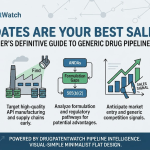
This guide covers the full intelligence stack: how to build a drug-by-drug market share model from public FDA data, how to benchmark competitor penetration across therapeutic areas, how formulation patents signal future excipient demand, how patent cliff dynamics create volume surges for specific ingredient categories, and what all of this means for commercial strategy, R&D investment, and supply chain planning.
Why Excipient Suppliers Can’t Afford to Think in Market Percentages Anymore
The Revenue at Risk When Your Drug Loses Market Share
An excipient supplier’s revenue is a derivative of the finished drug market. If a drug loses exclusivity and faces 12 generic entrants, the volume opportunity for the excipient in that formulation multiplies — but only for suppliers positioned as qualified, validated sources. If the innovator’s formulation used Ingredient A, and most generic developers replicate that formulation, Ingredient A’s supplier captures the wave. If they don’t know that specific drug is approaching loss of exclusivity, they miss the window to qualify, build inventory, and contact the generic manufacturers filing ANDAs.
Across the small-molecule patent cliff expected between 2025 and 2029, drugs generating over $63 billion in annual sales face generic entry. Each of those drugs contains an average of 8 to 15 excipients. For each excipient category represented, there is a supplier either positioned to capture the generics volume surge or not. This is not an abstract market opportunity — it is a product-by-product, manufacturer-by-manufacturer execution problem.
How the ‘Inactive Ingredient’ Label Distorts Supplier Strategy
The regulatory label ‘inactive ingredient’ has nothing to do with commercial inactivity. It means the ingredient is not the primary therapeutic agent. Microcrystalline cellulose is ‘inactive’ by this definition, but its flow properties determine whether a tablet press runs at 98% efficiency or shuts down for recalibration. Hypromellose is ‘inactive,’ but its viscosity grade controls whether a modified-release formulation hits the target dissolution profile. Polysorbate 80 is ‘inactive,’ but without it, many injectable biologics would aggregate and become non-viable within hours of manufacture.
The commercial consequence of this labeling artifact is that excipient suppliers have historically been treated as commodity vendors rather than formulation partners — which means their intelligence programs have also been treated as commodity-level work. That treatment has real costs: missed opportunities at generic launch, no advance positioning with ANDA filers, late entry into biosimilar development programs, and inability to forecast demand spikes tied to specific drug events.
What Drug-Level Intelligence Changes for Commercial Teams
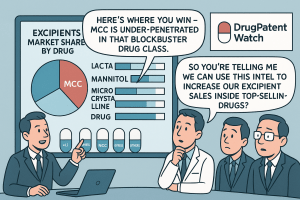
The shift from ‘we have X% of the global microcrystalline cellulose market’ to ‘our MCC is used in 24% of all oral solid NDCs currently approved, with 40% penetration among the top 10 generic manufacturers and 18% in drugs approved in the last 36 months’ is not a data exercise. It is a strategic reorientation. It tells the commercial team which accounts to prioritize, tells R&D where the product portfolio is aging relative to modern formulation trends, and tells supply chain which products to watch on the FDA’s Orange Book for upcoming loss of exclusivity events.
The Patent Cliff and Excipient Demand Cycles: What the Numbers Actually Mean
Which Drug Categories Are Generating the Largest Volume Surges for Excipient Suppliers
Patent expiry timelines do not affect all excipient categories equally. The type of drug — oral solid, injectable biologic, topical, modified-release — determines which excipients are at play. As the 2025-2029 small-molecule cliff plays out, the volume surge concentrates in oral solid dosage form excipients: fillers, binders, disintegrants, lubricants, and film-coating polymers. That is where the ANDA pipeline is densest.
Beyond 2028, the biologics patent cliff begins in earnest. Humira (adalimumab) exclusivity loss in the U.S. opened the first major wave, with biosimilar approvals from AbbVie’s competitors including Amgen (Amjevita), Samsung Bioepis (Hadlima), Sandoz (Hyrimoz), Organon (Hadlima), Pfizer (Abrilada), Fresenius Kabi (Idacio), and others. The formulation requirements for subcutaneous adalimumab biosimilars — citrate vs. citrate-free buffering systems, polysorbate 80 concentration, mannitol and sodium chloride levels — have become a clinical differentiator, not just a manufacturing detail. The biosimilar that avoids injection site pain through a citrate-free formulation has a commercial positioning advantage, and the excipient supplier providing the specific grade of polysorbate 80 or the buffer system used in that differentiated formulation is embedded in a value argument, not just a price argument.
Keytruda Patent Expiry: What It Means for High-Value Injectable Excipient Suppliers
Pembrolizumab (Keytruda, Merck) generated approximately $25 billion in 2023 revenue, making it the world’s top-selling drug. Its primary U.S. composition-of-matter patents are expected to face challenges beginning in the late 2020s, though Merck has filed secondary patents on formulation, manufacturing process, and dosing regimens that could extend protection into the early 2030s. The biosimilar development pipeline for pembrolizumab already includes programs from Samsung Bioepis, Celltrion, and Alvotech, among others.
The formulation of pembrolizumab — an IV concentrate for infusion — uses L-histidine, L-histidine hydrochloride monohydrate, sucrose, and polysorbate 80. For injectable excipient suppliers serving biosimilar developers, the window to qualify USP-grade histidine buffer systems and high-purity polysorbate 80 grades opens well before the first BPCIA patent dance exchange. Suppliers who track the biosimilar pipeline through platforms like DrugPatentWatch can identify which companies are in Phase I manufacturing development and initiate vendor qualification conversations 18 to 24 months before commercial launch.
Opdivo, Eliquis, and the IP Structures That Determine When Generics Enter
Bristol Myers Squibb has defended nivolumab (Opdivo) through an Orange Book patent portfolio and the BPCIA litigation framework. Apixaban (Eliquis, BMS/Pfizer) faces a more complex patent situation: the primary composition-of-matter patent (US 6,967,208) expired in 2022, but a dosing regimen patent (US 9,326,945) became the center of Paragraph IV litigation with generic filers including Mylan, Sigmapharm, and others. BMS and Pfizer settled with most challengers, granting authorized generic entry in 2026 and full market entry in 2028 for the majority of filers.
For excipient suppliers, the settlement terms are as commercially relevant as the patent expiry dates. An authorized generic entering in 2026 at volume represents a near-term demand event. Full generic competition in 2028 represents a larger, multi-manufacturer surge. Each ANDA filer must qualify excipient suppliers independently. A supplier who has mapped the apixaban ANDA landscape — which manufacturers have filed, which are likely to use the reference formulation’s excipients (lactose monohydrate, microcrystalline cellulose, croscarmellose sodium, magnesium stearate, hydroxypropyl cellulose) — can build targeted outreach 18 months before launch.
How to Build a Drug-by-Drug Excipient Market Intelligence Database
Why the FDA’s Inactive Ingredient Database (IID) Is Only Half the Answer
The IID, published at fda.gov and updated quarterly, lists every excipient that has received FDA precedent for use in a specific route of administration and dosage form. It includes the UNII code, CAS number, route, dosage form, and maximum approved potency for each entry. It does not tell you which drugs contain each excipient. It establishes the regulatory safety envelope, not the commercial footprint.
The maximum potency entries in the IID carry their own strategic value, though. An excipient supplier developing a novel multifunctional ingredient can scan the IID to confirm whether any previous approval provides regulatory precedent that would simplify the GRAS or inactive ingredient review process for a new drug application. If the IID shows prior use at 15 mg/tablet for a specific route, and a customer’s new formulation requires 12 mg/tablet, the regulatory argument for the supplier’s ingredient is significantly de-risked. This is not a technical footnote — it is a commercial argument that shortens the customer’s development timeline and makes the supplier’s ingredient the path-of-least-resistance choice.
How DailyMed SPL Data Unlocks Drug-Level Formulation Intelligence
DailyMed, maintained by the National Library of Medicine, provides Structured Product Labeling (SPL) data for the majority of FDA-approved drugs. Each SPL file contains the complete label, including the full inactive ingredient list with UNII codes. The complete SPL dataset is available for bulk download and is updated daily.
Parsing SPL files at scale requires processing thousands of XML documents, extracting the inactive ingredient list from each, and loading the output into a relational database indexed by UNII. Once built, the database answers the core commercial question: for any excipient, how many NDCs contain it, and which ones? The query is a three-field join: DailyMed ingredient UNII matches IID UNII, linked to the NDC record that includes product name, manufacturer/labeler, and dosage form.
The UNII code is the universal linker in this architecture. It is assigned based on molecular structure and is consistent across FDA databases, pharmacopeial monographs, and EMA documentation. A single UNII identifies a single substance regardless of trade name, grade designation, or supplier. This means data from the IID and DailyMed can be joined without ambiguity, and the resulting database provides a complete map of which excipients appear in which approved drug products.
The Orange Book Integration Layer: Connecting Formulations to Patent Events
Once the formulation database is built, the Orange Book download adds the IP dimension. The Orange Book links each NDC or NDA number to the patent numbers covering that product, their expiry dates, and the current exclusivity status. Joining this to the formulation database allows a supplier to ask: among all NDCs containing my excipient, which ones have Orange Book patents expiring in the next 36 months? Which have already lost exclusivity and have five or more ANDA approvals? Which have active Paragraph IV litigation that could accelerate generic entry?
This query structure converts static market share data into a dynamic commercial pipeline. The output is a list of specific drugs, their formulation ingredients, their patent event timeline, and the likely ANDA filers who will need to source those ingredients. It is, in effect, a lead generation engine built from public regulatory data.
Key Data Sources for Excipient Intelligence: A Reference Table
Data Source
Key Fields
Primary Use
Update Frequency
FDA Inactive Ingredient Database (IID)
Excipient name, UNII, CAS, route, dosage form, max potency
Loss of exclusivity timing; generic entry forecasting
Monthly
USPTO Patent Database
Patent full text, claims, assignment history
Formulation patent analysis; competitor IP strategy
Continuous
DrugPatentWatch
Aggregated patent, litigation, ANDA, and biosimilar pipeline data
Paragraph IV tracking; Hatch-Waxman litigation monitoring; LOE forecasting
Continuous
ClinicalTrials.gov
Trial phase, drug class, formulation type, sponsor
Pipeline demand forecasting; early identification of novel formulation needs
Continuous
How to Calculate Your True Excipient Market Share by Drug
Why Share of NDCs Is a More Useful Metric Than Share of Revenue
Revenue-based market share in excipients is difficult to calculate accurately because pricing data is not public and varies substantially by contract, grade, and customer tier. Share of NDCs — the percentage of all approved drug products in a defined market that contain a specific excipient — is calculable from public data and is directly actionable. It tells a commercial team exactly where the product is and is not present in the market.
The calculation requires three numbers: the total NDC count in the defined universe (e.g., all approved oral solid dosage form products), the count of those NDCs containing the excipient in question (identified by UNII), and the count containing each key competitor excipient (identified by their UNIIs). Market penetration is the ratio of the first two. Competitive gap is the difference between your penetration and a competitor’s.
A more commercially useful version of this metric weights each NDC by annual prescription volume or sales revenue, sourced from commercial data providers like IQVIA. A drug generating $1.2 billion in annual sales should count for more in a market share calculation than one with $4 million in annual sales. The commercial-weighted penetration rate gives a truer picture of where an excipient supplier’s product is earning meaningful revenue versus where it appears in low-volume formulations.
Segmented Market Share: Breaking Down Penetration by Therapeutic Area and Manufacturer
An overall penetration rate across all oral solid NDCs is a starting point. The strategic intelligence is in the segmentation. The same 24% overall penetration can mask very different competitive positions: 40% in cardiovascular, 11% in oncology, 30% in central nervous system drugs. Each of those segments has different customer sets, different formulation complexity requirements, and different patent event profiles.
By manufacturer, the segmentation reveals account-level vulnerability. If a supplier has 70% penetration among the top 10 innovator companies but only 15% among the top 10 generic manufacturers, that is a specific sales problem with a specific target list. The generic manufacturer penetration gap is particularly consequential given that ANDA volume typically represents the largest and most predictable demand cycles in oral solid excipients.
By drug approval date, the segmentation reveals portfolio aging. If penetration is 30% in drugs approved before 2015 but only 14% in drugs approved since 2020, that is a leading indicator that newer formulation trends — co-processed excipients, direct compression grades, functional coatings — are not well represented in the product portfolio. The commercial consequence will not show up in current revenue figures. It will show up in five years, when the 2020-2025 cohort of approvals represents a larger fraction of prescription volume.
White Space Analysis: Finding the Drugs That Don’t Use Your Excipient Yet
An exclusion query against the formulation database finds every drug product in a defined market segment that uses neither your excipient nor any of your primary competitors’ excipients — meaning these products currently rely on a different approach or an older ingredient category. Each entry in the output is a qualified commercial opportunity: a specific drug, at a specific manufacturer, where a reformulation conversation or a new ANDA development program could incorporate your ingredient.
For a supplier of a functional excipient designed to address BCS Class II solubility problems, the relevant query would target all oral solid NDCs in therapeutic areas known for poorly soluble APIs — oncology, CNS, antifungals — that contain none of the standard solubilizing agents in the IID. The result is a list of drugs likely formulated with older solubilization approaches that could benefit from a more modern functional excipient, along with the manufacturers responsible for those formulations.
How Formulation Patents Signal Future Excipient Demand
Reading a Formulation Patent the Way a Commercial Strategist Would
A pharmaceutical formulation patent is simultaneously a legal document, a technical disclosure, and a competitive signal. The Background section names the problem — poor solubility, instability at physiological pH, unacceptable bitterness — and that problem statement is a market signal for excipient suppliers who can solve it. The Detailed Description specifies the preferred excipient concentrations, the manufacturing process, and the technical rationale for each ingredient choice. The Examples section contains the actual prototype formulations with exact weight percentages and dissolution or stability data.
When an innovator company files a formulation patent on a drug generating $3 billion in annual revenue, that patent is a detailed map of the formulation challenges that every future generic developer will face. It is also a specification document for the excipients they are likely to need. A supplier who identifies that formulation patent early, recognizes that their ingredient appears in the preferred embodiments, and begins qualifying with generic manufacturers two years before loss of exclusivity has a structural advantage that a supplier who learns about the opportunity at an industry conference does not.
Patent Thickets in Formulation: How Innovators Use Secondary Patents to Extend Excipient Relationships
The patent thicket strategy — filing multiple overlapping secondary patents covering formulation, dosage regimen, manufacturing process, and patient population to extend commercial exclusivity beyond composition-of-matter expiry — has a direct excipient dimension. When a company like AbbVie files formulation patents on adalimumab covering specific polysorbate 80 concentrations, citrate-free buffer compositions, and high-concentration subcutaneous delivery, those patents are simultaneously IP barriers to biosimilar entry and specifications for the excipients embedded in the preferred formulation.
If biosimilar developers decide to design around the citrate-free formulation patents by using a different buffer system, they create demand for alternative excipients. If they choose to challenge the formulation patents in BPCIA litigation and ultimately license the original formulation approach, they create demand for the same excipients. Either outcome is commercially useful for a supplier who has mapped the relevant formulation patent families and can engage the biosimilar developers in technical discussions about both pathways.
DrugPatentWatch and similar platforms aggregate patent family data, Orange Book listings, BPCIA patent dance filings, and litigation dockets. For an excipient supplier, the value is not in monitoring their own IP but in monitoring their customers’ and potential customers’ IP to predict formulation decisions and procurement needs.
GLP-1 Formulation Complexity and What It Means for Excipient Suppliers
Semaglutide (Ozempic, Wegovy, Rybelsus, Novo Nordisk) and tirzepatide (Mounjaro, Zepbound, Eli Lilly) have created the fastest-growing new drug market in recent pharmaceutical history, and their formulation profiles reflect that complexity. Injectable semaglutide formulations use phosphate buffer, propylene glycol, and phenol as preservative. Oral semaglutide (Rybelsus) uses Emisphere’s Eligen SNAC technology — sodium N-(8-[2-hydroxybenzoyl]amino)caprylate — as a permeation enhancer, a functional excipient with significant IP protection that enabled the first commercially successful oral GLP-1 formulation.
The SNAC excipient situation illustrates why formulation patent intelligence has direct revenue implications for suppliers. Novo Nordisk licensed the SNAC technology from Emisphere (subsequently acquired by Hamni Pharmaceuticals). Any generic developer who wants to file an ANDA for oral semaglutide referencing the Rybelsus NDA will need access to SNAC or develop a bioequivalent formulation approach. That creates either a licensing negotiation for SNAC or a demand signal for alternative permeation enhancers that can achieve comparable results. Suppliers of competing permeation enhancement technologies have a commercial window that is directly tied to the patent expiry and litigation timeline for SNAC.
Tirzepatide’s injectable formulation is similarly complex. As Eli Lilly builds a patent estate around both the peptide and the formulation, biosimilar developers will spend the next decade navigating that IP — and evaluating excipient suppliers along the way.
Competitor Benchmarking in Excipients: How to Read Your Real Position
The Mirror Analysis: Running Competitor UNIIs Against Your Customer Base
The same database query that calculates your excipient’s market penetration can be run for any competitor ingredient identified by UNII. For crospovidone (superdisintegrant) suppliers, the relevant comparison is against croscarmellose sodium and sodium starch glycolate. For microcrystalline cellulose suppliers, the relevant comparison is against other cellulose derivatives, calcium carbonate, and co-processed diluent systems. Each competitor ingredient has one or more UNII codes in the IID, which can be used to query penetration across the same NDC universe.
The result of running all three queries against the oral solid tablet universe is a competitive position map that shows penetration by ingredient category. Running that same analysis segmented by manufacturer reveals which generic companies have a strong preference for each competitor’s ingredient — and those preferences are the targets for technical selling. A generic manufacturer with 80% of their oral solid portfolio using Competitor A’s binder has probably made that choice for reasons that include supplier qualification history, technical support quality, and pricing. Understanding that history is the starting point for displacing a competitor.
How Dow, BASF, JRS Pharma, and Roquette Compete in Core Excipient Categories
The major suppliers in cellulose-based excipients — Dow (now part of the International Flavors and Fragrances portfolio through the Nutrition & Biosciences acquisition), JRS Pharma, Mingtai Chemical — compete on grade breadth, technical support, and supply chain reliability more than price alone. BASF dominates several categories in polymeric excipients (Kollidon, Soluplus, Kollicoat) through formulation science leadership and deep embedding in extended-release and solubilization applications. Roquette is the dominant supplier of co-processed excipients and specialty starches.
For a supplier trying to identify where its NDC footprint is strong versus where a competitor has structural advantages, the UNII-based analysis reveals the product-level reality. If BASF’s Soluplus (polyvinyl caprolactam-polyvinyl acetate-polyethylene glycol graft copolymer, UNII: 65DKB1P8OR) appears in 40% of newly approved amorphous solid dispersion formulations and your comparable product appears in 8%, that gap is a product capability signal, not just a sales execution problem.
What Generic Manufacturer Pipeline Activity Tells Excipient Suppliers About Demand Timing
ANDA filings are public. The FDA publishes paragraph IV certification notifications in the Federal Register, and third-party platforms aggregate ANDA approval data. For an excipient supplier, monitoring the ANDA pipeline for specific reference drugs that use their ingredients provides a 24-to-36-month demand forecast. When six ANDA filers have received tentative approval for a drug that contains your binder system, and the primary patent expires in 18 months, that is a quantifiable volume event.
The mapping task is: identify the reference listed drug’s formulation (via DailyMed), confirm which excipients it contains and their UNII codes, identify the ANDA filers via FDA’s Paragraph IV database, and contact those manufacturers about excipient supplier qualification. This process is executable with public data. It does not require purchasing a $150,000 market research report.
Regulatory Pathways That Affect Excipient Market Access
How the FDA’s IID Precedent System Creates Moats for Established Suppliers
Once an excipient has been used in an approved drug product for a specific route and dosage form, it carries regulatory precedent in the IID. Drug developers filing new NDAs or ANDAs who use that excipient within the established route, dosage form, and maximum potency parameters face a materially lower regulatory review burden than developers using an excipient without IID precedent. This precedent system creates a structural advantage for established suppliers whose ingredients appear across hundreds of approved products.
For a supplier launching a novel multifunctional excipient, the path to IID entry requires either inclusion in a new drug application (where the ingredient is reviewed as part of that NDA) or participation in the FDA’s Pilot Program for Excipient Review and Evaluation, announced in 2022. The pilot program allows excipient manufacturers to submit data packages for FDA review independently of a specific drug application — a significant change that could accelerate novel excipient adoption by reducing the regulatory risk premium drug developers assign to unestablished ingredients.
USP-NF Monograph Status: Why It Matters for Supplier Market Access
The United States Pharmacopeia-National Formulary (USP-NF) and the European Pharmacopoeia (Ph. Eur.) set quality standards through monographs that specify identity tests, purity requirements, and other characterization criteria for excipients. An excipient with an official monograph can be described on a drug label using the compendial name, which simplifies supplier qualification and regulatory review. An excipient without a monograph requires additional characterization documentation in each drug application where it is used, increasing development friction.
Suppliers developing novel excipients or new grades of established excipients should treat monograph submission to USP as a commercial activity, not an administrative one. A new USP monograph for a novel co-processed excipient opens the ingredient to every drug developer who wants to avoid custom characterization work, and it signals the FDA’s familiarity with the ingredient’s quality profile. For competitive positioning, tracking proposed USP monograph revisions — which are published for public comment — can provide advance notice of quality standard changes that may create compliance costs for competitors using slightly different specifications.
EMA Excipient Policy Divergences and Their Commercial Implications
The EMA’s approach to novel excipients in the EU diverges from the FDA’s IID framework. The EMA does not maintain an equivalent published database of approved excipients with precedent-based safety classification. Instead, the acceptability of an excipient in the EU is established through the drug application process, with specific guidance on when excipient safety data packages must be submitted. For global excipient suppliers, this means EU market access requires parallel regulatory strategies that cannot simply be extrapolated from FDA IID precedent.
The ICH Q4B guidelines on regulatory acceptance of pharmacopeial interchangeability between major markets (FDA, EMA, PMDA in Japan) partially address this by establishing mutual recognition for certain compendial standards, but gaps remain for novel excipients and complex co-processed ingredients. Suppliers building global market positions need dedicated EU regulatory intelligence functions that track EMA guideline updates, reflection papers on excipient safety, and market authorization decisions that create new precedent in EU drug applications.
Patent Intelligence in Excipients: Where Formulation IP Creates Supply Opportunities
How Novo Nordisk’s Emisphere SNAC Acquisition Changed the Oral Peptide Market
When Novo Nordisk gained full control of the SNAC excipient technology through its acquisition of Emisphere Technologies (completed via a transaction with Hamni Pharmaceuticals), it did not simply acquire a patent — it acquired a formulation moat. SNAC (sodium N-(8-[2-hydroxybenzoyl]amino)caprylate) is the permeation enhancer that made oral semaglutide bioavailable at therapeutically meaningful levels, solving a problem that had defeated multiple prior oral peptide development programs.
From an excipient supply chain perspective, SNAC is now a proprietary ingredient controlled by the drug manufacturer, not an independently marketed excipient. This is an important market structure observation: as pharmaceutical companies acquire formulation technology companies, they sometimes vertically integrate excipient supply in ways that close off independent supplier access for that specific ingredient in that specific application. Understanding which functional excipients are proprietary versus independently commercially available is essential for correctly mapping the addressable market.
For generic developers targeting oral semaglutide, the SNAC patent situation is part of the IP landscape that shapes their formulation options. If the SNAC patents hold through their expected expiry timelines, generic developers may need to develop alternative permeation enhancement approaches — creating demand for competing technologies. If licensing arrangements become available, they create demand for SNAC manufacture. Both scenarios have different excipient supply implications, and both are predictable from monitoring the patent and licensing activity around the Rybelsus IP estate.
Co-Processed Excipients: IP Positions in the Multifunctional Ingredient Market
Co-processed excipients — physical mixtures of two or more excipients manufactured together to create synergistic functional properties that neither ingredient achieves alone — represent one of the higher-IP-density segments of the excipient market. JRS Pharma’s PROSOLV SMCC (microcrystalline cellulose and colloidal silicon dioxide) and PROSOLV EASYtab (MCC, silicon dioxide, and croscarmellose sodium), Roquette’s PEARLITOL Flash (mannitol and starch), and BASF’s Ludipress (lactose, povidone, and crospovidone) each carry patent protection on the co-processing method and the resulting functional properties.
The commercial advantage of a successfully IP-protected co-processed excipient extends beyond the ingredient itself: drug formulators who rely on these multifunctional systems build formulations that are difficult to replicate exactly using single-source alternatives. When a drug is formulated with a patented co-processed excipient, generic developers face a choice between licensing that excipient or developing an alternative formulation approach that achieves bioequivalence without the specific ingredient. Either path creates business development conversations with the co-processed excipient supplier.
Supply Chain Risk in Excipients: What Patent Cliffs and API Concentration Mean for Ingredient Sourcing
Why Concentration of API Supply in India and China Creates Excipient Demand Volatility
The geographic concentration of API manufacturing in India and China — which collectively supply the majority of APIs for generic drugs sold in the U.S. and EU — has a downstream effect on excipient demand patterns. When regulatory actions by the FDA or EMA result in import alerts on specific API manufacturing facilities, the approved ANDA products that use those APIs may face supply interruptions. Reformulation or manufacturing site transfers sometimes require excipient re-qualification, which can either disrupt existing supplier relationships or create new ones.
For excipient suppliers, monitoring FDA warning letters, import alerts, and 483 observations at major generic pharmaceutical manufacturers provides early notice of situations where a customer may need to accelerate excipient supplier qualification to ensure supply continuity. This is a form of account retention intelligence rather than growth intelligence — but in an industry where customer switching costs are high due to regulatory validation requirements, early engagement in a customer’s supply disruption scenario is a relationship-building opportunity.
How Single-Source Excipients Create Revenue Concentration Risk for Drug Manufacturers
A pharmaceutical manufacturer that relies on a single qualified supplier for a critical excipient with no available compendial alternative faces supply chain concentration risk. For complex functional excipients — specific viscosity grades of hypromellose for controlled-release matrices, specific particle size distributions of MCC for direct compression, pharmaceutical-grade polysorbate 80 for injectable biologics — the qualification barrier to adding a second source is significant. It typically requires a comparative testing program, potentially a bioequivalence study if the excipient change is material to drug release, and regulatory notification or approval depending on the jurisdiction and the extent of the change.
This qualification burden works in favor of entrenched excipient suppliers and against new entrants. It also creates a strategic opportunity for suppliers who can position themselves as the second-source qualification partner for critical excipients. A drug manufacturer whose primary MCC supplier faces a quality event has immediate need for a qualified backup — and the supplier who has already initiated partial qualification with that manufacturer, even without capturing initial volume, is in the strongest position to capture emergency business and ultimately displace the primary supplier.
Commercial Strategy for Excipient Suppliers: How Intelligence Translates to Revenue
What the ANDA Pipeline Tells a Sales Team About the Next 36 Months
The FDA publishes tentative ANDA approvals, which represent drugs that have met all scientific and regulatory requirements but cannot launch due to outstanding patent or exclusivity barriers. A tentative approval is a confirmed future generic entrant. For excipient suppliers, mapping the tentative ANDA pipeline against the reference listed drug formulations reveals which drugs will enter generic competition and what ingredients their formulations contain.
Matching the tentative ANDA list to the DailyMed formulation database produces a prospect list: drug manufacturers holding tentative approvals for drugs that contain a specific excipient, who will need to source that excipient commercially at scale when their product launches. The lead time between tentative approval and anticipated launch date is the sales cycle window. A supplier who initiates vendor qualification discussions when a tentative approval is granted has a structural advantage over one who responds to a request for proposal that goes out six months before launch.
How R&D Investment Should Follow Formulation Trend Data
The patent analysis framework — reading Background sections in formulation patents for problem statements, reading preferred embodiments for excipient specifications — provides an aggregate signal about where the industry’s formulation challenges are concentrated. If analysis of formulation patents filed for BCS Class II drugs over the past five years shows that approximately 65% of the preferred embodiments use amorphous solid dispersion technology and 30% rely on lipid-based drug delivery systems, that is a data-driven argument for R&D investment in polymers that stabilize amorphous dispersions and lipid excipient grades suitable for self-emulsifying drug delivery systems.
Without this formulation intelligence, R&D investment decisions in excipient companies often follow either convention (‘we’ve always made MCC, let’s make a new grade of MCC’) or trade show anecdotes (‘a formulator mentioned they needed better solubilization’). The formulation patent database converts those scattered inputs into a quantified demand signal, sorted by drug class, API property challenge type, and patent filing frequency.
Investment Strategy: What the Excipient Patent Cliff Opportunity Means for Sector Positioning
For institutional investors assessing excipient sector companies, the drug-by-drug intelligence framework described here provides a more rigorous basis for evaluating market position than top-down market share estimates. A company that can demonstrate 30% penetration in NDCs representing the top-50 revenue drugs approaching loss of exclusivity in the next five years has a more defensible growth thesis than one that claims a percentage of a $10 billion global market.
Key metrics for investor diligence in excipient companies include: share of new drug approvals in the trailing 24 months (a leading indicator of portfolio relevance), penetration rate among the top 20 ANDA filers by approval volume (a proxy for generic market positioning), and the number of specialty functional excipients with USP monograph status or FDA IID precedent at commercially relevant concentrations (a proxy for regulatory moat depth). These metrics are calculable from public data and are more predictive of durable revenue growth than aggregate market share figures.
Most Important Ongoing Developments to Watch
FDA Excipient Pilot Program: What It Could Change for Novel Ingredient Suppliers
The FDA’s 2022 Pilot Program for Excipient Review and Evaluation, introduced through the Innovation and Modernization of Excipients initiative, allows excipient manufacturers to submit a data package for FDA review outside of a specific drug application. Prior to this program, novel excipients could only gain FDA precedent by being included in an approved NDA, meaning the excipient supplier was entirely dependent on a pharmaceutical company taking the risk of including an unestablished ingredient in a drug application.
If the pilot program evolves into a formal stand-alone review pathway, it would fundamentally change the competitive dynamics for novel excipient introduction. Established suppliers with resources to compile comprehensive safety data packages would be able to build IID precedent ahead of drug formulation demand, creating regulatory advantages that smaller or newer entrants could not replicate without significant investment. The commercial implication for novel excipient suppliers is a potential first-mover advantage in IID registration that parallels the market exclusivity benefits that pharmaceutical companies derive from new drug exclusivity periods.
Biosimilar Interchangeability Designations and Their Effect on Formulation Switching
The FDA’s biosimilar interchangeability designation — which allows a pharmacist to substitute an interchangeable biosimilar for the reference biologic without a specific prescription — requires a higher demonstration of similarity than standard biosimilar approval. Achieving interchangeability typically requires a switching study. For excipient suppliers, the interchangeability pathway creates a formulation discipline: biosimilar developers pursuing interchangeability have strong incentives to match the reference product’s formulation as closely as possible, because formulation differences can introduce variation that complicates the switching study design.
This formulation conservatism among interchangeability-seeking biosimilar developers concentrates demand on the same excipient types and grades used in the originator formulation. It is the opposite of the design-around incentive created by formulation patent challenges. For excipient suppliers, mapping the reference formulations of biologics that have interchangeable biosimilar approvals — adalimumab, insulin glargine, filgrastim — and ensuring those specific grades and specifications are available and readily qualifiable is a direct commercial priority.
Common Investor Questions
How large is the addressable market for excipient intelligence tools?
The addressable market is any company whose revenues depend on excipient placement in approved drug products: excipient manufacturers, CDMOs with formulation service capabilities, generic manufacturers making sourcing decisions, and specialty chemical companies entering pharmaceutical ingredient markets. That population numbers in the hundreds globally, with the top 50 excipient suppliers collectively accounting for the majority of market revenue. The market for the intelligence itself — platforms, databases, analytical services — is a small fraction of the physical excipient market but growing as the patent cliff makes formulation intelligence more commercially valuable.
How does the patent cliff affect excipient supplier revenue stability?
The patent cliff is structurally positive for high-volume oral solid excipient suppliers because generic entry multiplies the number of manufacturers sourcing a given excipient per drug. A drug with one innovator manufacturer becomes a drug with 8 to 12 generic manufacturers, each requiring independent supplier qualification. The risk is that generic competition also drives down ingredient cost expectations. Suppliers who differentiate on technical service, supply reliability, and regulatory documentation quality rather than price alone are better positioned to maintain margin in generic market segments.
What is the commercial value of a USP monograph for a novel excipient?
A new USP monograph reduces the characterization burden for drug developers using the excipient, lowers their perceived regulatory risk, and signals quality standardization that makes the excipient easier to include in NDAs and ANDAs across multiple manufacturers. The indirect commercial benefit is expanded adoption; the direct commercial benefit is reduced sales cycle length due to lower customer risk perception. Quantifying this precisely requires comparing adoption rates of comparable novel excipients with and without monograph status, which is achievable with the DailyMed NDC penetration methodology.
How does API supply chain disruption create excipient demand volatility?
API supply disruptions from a single country or facility concentration event typically affect excipient demand in two ways: short-term, as production slowdowns reduce excipient consumption for the affected products; medium-term, as manufacturers execute supply diversification programs that may involve new manufacturing site approvals and excipient re-qualification at those sites. Excipient suppliers should track FDA 483 observations and import alerts at their top-20 customers’ API suppliers as a leading indicator of both demand risk and qualification opportunity.
Key Takeaways
The macro excipient market size, currently estimated at $9.5 to $10.7 billion with 4% to 6% projected CAGR, does not tell a supplier anything actionable. The number of NDCs containing their specific ingredient in each therapeutic area, segmented by manufacturer, approval vintage, and Orange Book exclusivity status, is the metric that drives commercial decisions.
The IID and DailyMed, both free public databases, contain the raw data to build a complete drug-level formulation map. The UNII code is the joining key. The Orange Book connects that formulation map to patent expiry timelines and generic entry forecasts. The result is a commercial intelligence engine that costs engineering time, not licensing fees, and produces lead lists, demand forecasts, and competitive positioning data more specific than any market report.
Formulation patents filed by innovator companies are a five-to-seven-year early warning system for excipient demand. Reading Background sections for problem statements and preferred embodiments for ingredient specifications converts patent monitoring into a product development and business development planning tool.
The 2025-2029 small-molecule patent cliff, the expanding biosimilar pipeline for biologics like pembrolizumab and semaglutide, and the increasing formulation complexity of BCS Class II and Class III APIs are all demand-positive for excipient suppliers positioned in functional categories: solubilizers, permeation enhancers, amorphous dispersion polymers, modified-release matrices, and biologic stabilizers. Suppliers in undifferentiated commodity categories face volume growth but margin compression. The data infrastructure described here is what separates the suppliers who identify that mix early from those who discover it in quarterly revenue results.
Data referenced in this analysis draws on public FDA databases including the Inactive Ingredient Database, DailyMed SPL, the Orange Book, and the FDA NDC Directory, supplemented by DrugPatentWatch commercial intelligence data. Patent family and litigation references reflect publicly available USPTO and PACER filings.