1. The Shattered Consensus: A New Era of Pharmaceutical Risk
For nearly four decades, the pharmaceutical industry operated under a relatively stable, albeit contentious, truce established by the Drug Price Competition and Patent Term Restoration Act of 1984, universally known as the Hatch-Waxman Act. This “grand bargain” was designed to balance two competing societal imperatives: the need to incentivize the high-risk, capital-intensive innovation of new medicines, and the equally pressing need to ensure those medicines eventually become affordable commodities. The architecture of this compromise was built on specific statutory mechanisms—patent term extensions for innovators, and the Abbreviated New Drug Application (ANDA) pathway for generic competitors.
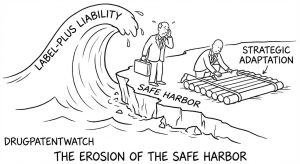
Central to this architecture was the concept of the “Section viii” carve-out, or the “skinny label.” This mechanism allowed a generic manufacturer to seek approval for a drug by certifying that it would not seek to market the drug for indications still protected by patents. It was a statutory safety valve, a safe harbor that allowed the generic to navigate the “patent thicket” by essentially threading the needle—marketing the drug for unpatented uses while leaving the patented uses exclusively to the brand. For years, the legal consensus was clear: if the generic label was “skinny,” and the generic manufacturer did not explicitly instruct physicians to use the drug for the carved-out indication, they were generally shielded from liability for induced infringement. The label was the law.
That consensus is now effectively dead.
We have entered a period of profound structural destabilization in pharmaceutical intellectual property (IP) law. The safe harbor has been eroded by a series of seismic judicial decisions that have shifted the inquiry from the text of the label to the “totality of the circumstances” surrounding the commercial reality of the drug’s use. Simultaneously, the regulatory environment has turned hostile. The Federal Trade Commission (FTC), abandoning decades of deference to the Food and Drug Administration’s (FDA) ministerial role in patent listings, has launched an aggressive campaign to purge the “Orange Book” of device and REMS (Risk Evaluation and Mitigation Strategies) patents.
This report serves as a strategic manual for navigating this new, high-risk landscape. It is written for the patent prosecutor who must draft claims that can withstand the “intertwined” scrutiny of the courts; for the regulatory affairs director who must navigate a weaponized Orange Book; and for the business executive who must make “at-risk” launch decisions in a world where the 30-month stay is no longer guaranteed. The era of relying on statutory text alone is over; survival now requires a synthesized mastery of legal doctrine, regulatory foresight, and forensic commercial intelligence.
2. The Collapse of the Section viii Defense: GSK v. Teva and the “Intertwined” Doctrine
2.1 The Historical Assumptions of Induced Infringement
To understand the magnitude of the current shift, one must appreciate the baseline from which we have deviated. Under 35 U.S.C. § 271(b), “whoever actively induces infringement of a patent shall be liable as an infringer.” Historically, proving inducement required a high evidentiary bar. The patentee had to prove that the alleged inducer not only knew of the patent but also possessed the specific intent to encourage another’s infringement. In the context of generic drugs, courts typically looked to the proposed labeling. If the generic manufacturer utilized the Section viii pathway to “carve out” the patented indication, and the label did not instruct the patented use, courts were reluctant to find inducement, even if they knew that pharmacists and doctors would inevitably substitute the generic for the patented use under state substitution laws.
This deference to the “skinny label” recognized the commercial reality that generic companies have little control over prescribing habits once their product enters the supply chain. It was a legal fiction, perhaps, but a necessary one to ensure the viability of the generic industry.
2.2 The GSK v. Teva Earthquake
The Federal Circuit’s decision in GlaxoSmithKline LLC v. Teva Pharmaceuticals USA, Inc. fundamentally altered this landscape. The case centered on Coreg (carvedilol), a beta-blocker originally approved for hypertension, and later for congestive heart failure (CHF) and left ventricular dysfunction following a myocardial infarction (post-MI LVD). By the time Teva launched its generic, the patent for hypertension had expired, but the method-of-use patent for CHF remained in force. Teva, following the standard playbook, carved out the CHF indication from its label, marketing the drug only for hypertension and post-MI LVD.
Under the old rules, Teva’s launch should have been safe. The label did not mention CHF. However, GSK sued for induced infringement, and a jury awarded $235 million in damages. After the district court overturned the verdict as a matter of law, the Federal Circuit reinstated it in a split decision that sent shockwaves through the industry.
2.2.1 The “Intertwined” Analysis
The court’s reasoning dismantled the mechanical reliance on the label. GSK successfully argued that the “unpatented” indication (post-MI LVD) was clinically “intertwined” with the “patented” indication (CHF). GSK’s experts testified that post-MI LVD is, in essence, a precursor to or a subset of heart failure. Therefore, by instructing physicians to treat post-MI LVD, Teva was implicitly instructing them to treat the underlying physiology of heart failure, thereby inducing infringement of the CHF patent.
This “intertwined” doctrine suggests that if the biology of a disease makes it difficult to distinguish between the patented and unpatented conditions, a carve-out may be legally impossible. It forces generic companies to grapple with the underlying mechanism of action of the drug, not just the regulatory definitions of the indications. If treating Condition A inevitably treats Condition B, and Condition B is patented, the generic cannot safely market for Condition A.1
2.2.2 The “Label-Plus” Evidence
Even more damaging for the generic defense was the court’s reliance on evidence outside the label—what has come to be known as “label-plus” evidence. The court found that Teva’s marketing materials contributed to the inducement finding. Specifically:
Press Releases: Teva issued press releases describing its product as an “AB-rated generic equivalent” of Coreg. The court found that touting “equivalence” without a forceful disclaimer regarding the carved-out indication could be interpreted by a jury as an instruction to substitute the generic for all uses.
Marketing Materials: Teva’s catalogs listed the generic alongside the brand without distinguishing the indications.
Sales Force Conduct: The absence of an active campaign to discourage off-label use was weighed against them.
This holding effectively imposes an affirmative duty on generic manufacturers to police the marketplace. It suggests that merely stripping the label is insufficient if the company continues to profit from the market’s perception of fungibility. The “AB rating”—the gold standard of generic substitutability—has now become a potential liability hook.
2.3 Amarin v. Hikma: The Expansion of the “Implied Instruction”
If GSK created a crack in the dam, Amarin Pharma, Inc. v. Hikma Pharmaceuticals USA Inc. burst it open. The case involved Vascepa (icosapent ethyl), a fish oil derivative. Amarin held patents for a method of reducing cardiovascular risk (the CV indication), while the original indication for severe hypertriglyceridemia (the SH indication) was unpatented. Hikma launched with a skinny label for the SH indication only.
The district court dismissed Amarin’s inducement claim, citing the skinny label. But the Federal Circuit reversed, finding that Amarin had plausibly pleaded inducement based largely on Hikma’s public statements. The “smoking gun”? Hikma’s press releases cited global sales figures for Vascepa. Since the vast majority of Vascepa’s sales were for the patented CV indication, the court inferred that by citing these “total sales” figures, Hikma was signaling its intent to capture the revenue from the patented use.
Table 1: The Evolution of Inducement Liability Standards
Feature
Traditional “Skinny Label” Era
The “Label-Plus” Era (Post-GSK & Amarin)
Primary Evidence
The FDA-approved label text.
The “totality of the circumstances,” including press releases, investor decks, and website metadata.
“Equivalence” Claims
Standard industry practice; proof of AB rating.
Potential evidence of intent to induce if not accompanied by explicit disclaimers.
Clinical Overlap
Irrelevant if indications are distinct in the Orange Book.
“Intertwined” Doctrine: If treating Condition A treats Condition B, the carve-out fails.
Sales Data
Standard financial reporting.
Citing “total brand sales” can be proof of intent to capture patented market share.
Burden of Policing
Minimal; reliance on pharmacy substitution laws.
Affirmative duty to avoid “encouraging” substitution for carved-out uses.
Analysis of Amarin: The implication here is profound. It suggests that the economic reality of a launch can override the regulatory reality. If a generic launches into a market where 80% of prescriptions are for a patented use, courts are increasingly willing to infer that the generic must intend to induce that infringement, otherwise their business model would make no sense. This “intent-by-economics” theory places generics in a precarious position for any blockbuster drug where the new, patented indication has cannibalized the old, unpatented one.3
2.4 Litigation Beyond the Generic: The Payer Liability Frontier
Perhaps the most aggressive expansion of inducement theory appeared in Amarin v. Health Net. Amarin sued not just the generic manufacturer, but the health insurer itself. The theory was novel but logically consistent with the “label-plus” expansion: by placing the skinny-label generic on a preferred formulary tier with a lower copay for all prescriptions, regardless of indication, the insurer was “inducing” infringement.
The district court refused to dismiss the case, signaling that this theory was at least legally plausible. Although the case eventually settled, the precedent stands as a warning shot to the entire Payer/PBM (Pharmacy Benefit Manager) complex. If insurers can be held liable for treble damages for “inducing” the use of a generic for a patented indication, they may become much more hesitant to force automatic substitution. For brand companies, this offers a potent new lever: threatening PBMs with inducement litigation to maintain preferred formulary status for the brand, even after generic entry.5
3. The Regulatory Pincer: The FTC and the Weaponization of the Orange Book
While the courts have been dismantling the safe harbor from the liability side, the regulatory agencies have launched a coordinated assault on the procedural mechanisms brand companies use to delay generic entry. The target is the “Orange Book,” and specifically, the listing of device and platform patents.
3.1 The “Junk Listing” Crackdown
For decades, the FDA maintained that its role in listing patents in the Orange Book was purely ministerial. If a New Drug Application (NDA) holder submitted a patent on Form 3542, the FDA listed it. Brand companies capitalized on this by listing patents that were only tangentially related to the drug—such as patents covering the dose counter of an inhaler, the firing mechanism of an auto-injector, or the packaging distribution system.
Listing these patents was strategic. Under the Hatch-Waxman Act, listing a patent allows the brand to sue a generic challenger and trigger an automatic 30-month stay of FDA approval. This stay is effectively a preliminary injunction without the need to prove irreparable harm. It buys the brand nearly three years of monopoly revenue, regardless of the strength of the patent.
In late 2023, the FTC decided this practice was anticompetitive.
The Campaign: The FTC issued multiple waves of warning letters (November 2023, April 2024, May 2025) to major pharmaceutical companies, including Teva, GSK, AstraZeneca, and Boehringer Ingelheim, challenging over 300 patents listed in the Orange Book.
The Argument: The FTC argued that the statute only permits the listing of patents that claim the “drug” or a “method of using the drug.” Patents that claim only the device (e.g., the inhaler hardware) do not meet this statutory criteria and are therefore “improper” listings that illegally delay competition.7
3.2 Teva v. Amneal: The “Active Ingredient” Nexus
The industry initially resisted, arguing that for drug-device combination products (like asthma inhalers), the “drug product” includes the device. This resistance collapsed in December 2024 with the Federal Circuit’s decision in Teva Branded Pharmaceutical Products R&D, Inc. v. Amneal Pharmaceuticals of New York, LLC.
The case involved Teva’s ProAir HFA, a blockbuster albuterol inhaler. Teva had listed patents covering the inhaler’s dose counter and canister mechanism. Amneal, seeking to launch a generic, argued these patents were improperly listed. The Federal Circuit agreed, establishing a strict new standard for listability:
“To be listable in the Orange Book, a patent must claim the ‘drug’ for which the application was submitted, and the ‘drug’ is defined by its active ingredient.”
The court explicitly rejected Teva’s argument that the “drug product” included the device components for listing purposes. If the patent claims did not explicitly recite the active ingredient (albuterol sulfate), they were not listable. The court ordered Teva to delist the patents.10
3.3 The Economic Consequences of Delisting
The removal of these patents from the Orange Book does not invalidate them; Teva can still sue Amneal for infringement. However, the procedural consequence is catastrophic for the brand:
Loss of the 30-Month Stay: Without an Orange Book listing, suing the generic does not trigger the automatic stay. The FDA can approve the generic immediately upon technical readiness.
The “At-Risk” Dynamic: The generic can launch “at risk” (before the patent litigation concludes). To stop them, the brand must seek a preliminary injunction (PI).
Higher Legal Bar: Obtaining a PI requires proving a “likelihood of success on the merits” and “irreparable harm.” This is a far higher burden than the automatic stay.
Financial Impact: For a product like ProAir, which generates hundreds of millions in revenue, the loss of the 30-month stay accelerates generic entry by years. The difference in revenue between a 2025 launch and a 2028 launch is measured in billions of dollars. This ruling effectively transfers that value from the brand shareholder to the healthcare system and the generic manufacturer.10
4. Strategic Patent Prosecution: Designing the Uncarveable Portfolio
In this hostile environment, the burden shifts upstream to the patent prosecutor. The goal is no longer just to get a patent issued; it is to draft a patent that is immune to Section viii carve-outs (by being “intertwined”) and resistant to FTC delisting (by creating a “nexus” to the active ingredient).
4.1 Drafting Against Section viii: The “Intertwined” Strategy
Biotech prosecutors must proactively draft method-of-treatment claims that fuse the unpatented condition with the patented invention. The objective is to make it impossible for a generic to label for the unpatented use without infringing the new patent.
Technique A: The Patient Sub-Population Claim
Do not just claim “A method of treating Condition Y.” Instead, define the patient population by the overlap.
Vulnerable Claim: “A method of treating heart failure comprising administering Drug X.” (Generic carves this out).
Robust Claim: “A method of treating hypertension in a patient suffering from post-MI LVD, comprising administering Drug X.”
Strategic Rationale: If the generic labels for hypertension (unpatented), they inevitably capture this claim because the patient population (hypertension + post-MI LVD) is clinically distinct. The generic cannot “warn” against using the drug in this sub-population without contradicting the safety profile. The label itself becomes evidence of infringement.
Technique B: The Titration Nexus
Link the dosing regimen to the unpatented indication in a way that creates a patented method essential for safety.
Example: “A method of treating [Unpatented Condition] comprising initiating treatment at 5mg and titrating to 20mg over 2 weeks to minimize.”
Strategic Rationale: The generic must include the titration instructions to ensure the drug is safe and effective (as required by the FDA). If those specific instructions are patented, the carve-out is blocked. The “method of administration” becomes the choke point.14
4.2 Drafting Against Teva v. Amneal: The “Nexus” Claim
To ensure device or platform technology patents remain listable in the Orange Book, claims must now explicitly recite the active ingredient. Pure device claims are commercially inferior for Orange Book purposes because they trigger no stay.
Restructuring Device Claims
Old (Delisted) Style: “A dose counter comprising a gear mechanism configured to…”
New (Listable) Style: “A pharmaceutical product comprising: (a) a canister containing albuterol sulfate; and (b) a dose counter coupled to said canister, wherein the dose counter comprises…”
This “nexus” drafting style satisfies the Federal Circuit’s requirement that the patent “claim the drug” (active ingredient). While this narrows the scope of the patent (it technically only covers the device with that specific drug), it preserves the all-important 30-month stay.
Prosecution Trap: Be wary of subject matter eligibility (Section 101) issues. Drafting claims that mix “method of use” with “device apparatus” can sometimes invite indefiniteness or mixed-statutory-class rejections. The claim must be unitary.16
When drafting fails to prevent a carve-out, the battle moves to commercial litigation. The “label-plus” era provides brands with new offensive tools, while demanding extreme hygiene from generics.
5.1 The Brand Offensive: Weaponizing Metadata
Brand companies are investing in forensic monitoring of generic commercial behavior. The goal is to find the “Plus” factor that converts a skinny label into an infringing act.
Digital Surveillance: Brands track generic website metadata, “alt-text” on images, and cached versions of press releases for any mention of the carved-out indication. Even a stray meta-tag referencing “heart failure” on a hypertension-labeled generic page can be evidence of inducement.
The “Notice Letter” Strategy: Upon generic launch, brand counsel should send immediate letters to the generic manufacturer, PBMs, and major hospital networks. These letters explicitly detail the patented uses and warn that any promotion of “full equivalence” or “AB rating” without specific disclaimers will be treated as willful inducement. This puts the generic on notice, potentially triggering treble damages if they proceed.19
5.2 The Generic Defense: The “Clean Launch”
For generics, the path to market requires a “Clean Launch” protocol that goes far beyond the label.
The “Silent” Strategy: Generics should rely entirely on state automatic substitution laws rather than active promotion. If the generic sales force never speaks to a doctor, proving “active inducement” is significantly harder.
Explicit Disclaimers: Marketing materials should arguably state: “Indicated ONLY for [X]. Not indicated for.” This affirmative disclaimer was cited by the dissenting judges in GSK as a potential shield, though the majority found it insufficient in that specific fact pattern.
Payer Education: Generics must educate payers privately (to avoid public inducement claims) about the legality of the carve-out, ensuring that formulary placement doesn’t accidentally trigger a Health Net-style lawsuit.
5.3 Turning Data into Advantage: The Role of DrugPatentWatch
In this high-stakes environment, data is the primary weapon. Tools like DrugPatentWatch have moved from research utilities to essential strategic infrastructure.
Predicting “At-Risk” Launches: With the 30-month stay eroding for device patents, brands use DrugPatentWatch to monitor “Paragraph IV” certifications globally. They track which generic firms have a history of aggressive at-risk launches (e.g., Teva, Apotex) versus those that settle.
Identifying Weak Listings: Generics use the platform to identify patents that are vulnerable to the new Teva v. Amneal standard. If DrugPatentWatch shows a patent is listed but claims only a device, that is a prime target for a Paragraph IV challenge that might not trigger a stay, allowing for an accelerated launch.20
6. The Legislative Horizon: The “Skinny Labels, Big Savings Act”
The destabilization of the Section viii pathway has prompted a legislative response. In early 2025, Senators Hickenlooper and Collins introduced the Skinny Labels, Big Savings Act (S. 43). This bipartisan bill aims to essentially legislatively overrule GSK v. Teva and codify the old safe harbor rules.
6.1 Analysis of S. 43
The bill is aggressive in its protection of generics. Its key provisions include:
Statutory Safe Harbor: It explicitly amends 35 U.S.C. § 271 to state that submitting a Section viii statement is not an act of infringement, direct or induced.
Marketing Shield: It declares that truthfully describing a generic as “therapeutically equivalent” or “AB-rated” to the reference drug cannot be used as evidence of intent to induce infringement, provided the label itself is properly carved out. This directly targets the “label-plus” evidence used in GSK and Amarin.
Retroactivity: The bill applies to ongoing litigation, which would immediately imperil pending inducement suits.23
Industry Outlook: The Association for Accessible Medicines (AAM) has made passing this bill a top priority, arguing that without it, the skinny label pathway is commercially dead. PhRMA opposes it vehemently, arguing it legalizes the theft of patented innovation. While the bill has momentum, its passage is not guaranteed. Until it becomes law, the GSK precedent remains the controlling risk factor.
7. Key Takeaways
The Safe Harbor is a Mirage: A “skinny label” is no longer a shield. Under GSK and Amarin, a generic’s press releases, website metadata, and even its “AB rating” claims can create liability for induced infringement (“Label-Plus” theory).
The Orange Book is Weaponized: The FTC and the Federal Circuit (Teva v. Amneal) have successfully purged pure device patents from the Orange Book. To trigger the 30-month stay, a patent must explicitly “claim the drug” (active ingredient).
Drafting is Destiny: Successful prosecution now requires “intertwining” method claims (making carve-outs clinically impossible by linking indications) and “nexus” device claims (linking hardware to the active molecule to ensure listability).
Commercial Surveillance: Brands must treat generic marketing metadata as forensic evidence; Generics must enforce strict “clean launch” protocols to avoid implying off-label uses.
Intelligence is Critical: In a market moving this fast, platforms like DrugPatentWatch are indispensable for predicting the collapse of patent thickets, timing “at-risk” launches, and monitoring global litigation trends.
8. Frequently Asked Questions (FAQ)
Q1: Can a generic manufacturer still use a Section viii carve-out to avoid patent litigation?
A: Yes, the statutory pathway remains, but the commercial risk has skyrocketed. While a generic can file a Section viii statement, the GSK and Amarin decisions mean that if the unpatented use is “intertwined” with the patented use, or if the generic’s marketing implies full equivalence, they face a high risk of inducement liability. It is no longer a low-risk administrative process; it is a high-stakes litigation gamble.
Q2: What was the specific trigger for the FTC’s recent warning letters regarding Orange Book listings?
A: The FTC targeted what it termed “junk” listings—specifically patents that claimed devices (like inhaler dose counters) or distribution systems (REMS) but did not explicitly claim the active ingredient. The Federal Circuit’s Teva v. Amneal decision validated this approach, confirming that such patents do not meet the statutory requirement to “claim the drug,” thereby empowering the FTC to demand their delisting.
Q3: How does the “Label-Plus” theory change generic marketing strategies?
A: “Label-Plus” imposes a gag order on “equivalence.” Generics can no longer simply tout their “AB rating” in press releases or investor decks without qualification. They must scrub all public-facing materials of any reference that could be construed as encouraging the carved-out use. Some experts suggest generics should avoid active marketing entirely and rely solely on passive pharmacy substitution to minimize inducement risk.
Q4: Why is the Amarin v. Health Net case significant even though it settled?
A: It established the plausibility of “payer inducement.” By refusing to dismiss the claim, the court signaled that health insurers can be liable for inducement if they structure their formularies to encourage the use of a skinny-label generic for a patented indication (e.g., by giving it a lower copay for all uses). This creates a new pressure point for brands to use against PBMs.
Q5: What is the “Day 1 Imperative” in the context of generic entry?
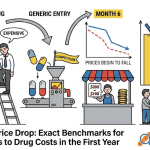
A: The “Day 1 Imperative” refers to the overwhelming economic advantage of being the first generic to market. Data shows that the first entrant captures the vast majority of profits before price erosion sets in. With the 30-month stay eroding for device patents, the ability to predict the exact “at-risk” launch window using tools like DrugPatentWatch has become the single most critical factor in maximizing generic ROI.
Sharpening a biotech patent through methods claims under the litigation strategy of induced infringement: A message from the US Federal Circuit full court decision – NIH, accessed December 11, 2025, https://pmc.ncbi.nlm.nih.gov/articles/PMC4130279/