Bristol Myers Squibb (BMS) reported $14.4 billion in Eliquis sales and $10.0 billion in Opdivo sales for 2025. [1] Both products have a 2028 date for US generic or biosimilar competition. [2][3] Together they equal 50.8% of the company’s $48.2 billion in 2025 revenue. [1] That ratio is our calculation from the reported figures.
This ratio shows the patent cliff in one line. This guide explains how loss of exclusivity (LOE) works. It shows how fast sales fall after LOE, how concentrated exposure is at BMS and Merck through 2028, and which lifecycle tactics have evidence behind them. Every figure comes from a company filing, a regulator, a statute or a named news report. We label each calculation as analysis.
The Short Answer: What Drug Patent Expiration Means in 2026
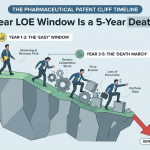
Drug patent expiration does not end a brand’s revenue on one date. A patent term, FDA exclusivities, a settlement date and a court ruling each set a separate clock. The date that governs a launch is the date that a court or a settlement confirms. It is not always the date printed on the patent.
What Is Loss of Exclusivity (LOE)?
Loss of exclusivity is the point at which a brand drug faces lawful competition from a generic or biosimilar copy. It can follow patent expiration, the end of an FDA exclusivity, a court decision or a licensed entry date in a settlement. FDA states that a US patent term is 20 years from the filing date, subject to other factors that change the duration. [4]
How Big Is the $400 Billion Patent Cliff?
Three published estimates give three sizes. Evaluate says that over $300 billion of prescription drug revenue will lose exclusivity from 2025 to 2030. [5] PitchBook estimates that about $180 billion of pharmaceutical revenue is at risk by 2030. [6] STAT estimates $400 billion in lost revenue by 2033. [6]
The periods differ. Evaluate counts 2025 to 2030, which is six calendar years. The figure averages $50 billion per year over that period. That average is our calculation. The STAT figure runs three years longer than the PitchBook figure. The pages we reviewed do not state each firm’s method, so we do not claim that the numbers are comparable. Read each number as an estimate with its own scope.
“Over $300bn in prescription drug revenues will lose exclusivity” between 2025 and 2030. (Evaluate, October 2025) [5]
The Six Findings That Matter
Eliquis and Opdivo produced $24.5 billion of BMS revenue in 2025. That is 50.8% of the company total. Both have 2028 entry markers. (Analysis of [1].)
Keytruda and Keytruda Qlex produced $8.37 billion of Merck’s $16.61 billion in sales in the second quarter of 2026. That is 50.4% (analysis of [7]).
Humira’s US sales fell 34.7% in 2023, the year US biosimilars launched. [8]
Johnson & Johnson (J&J) reported that Stelara sales fell 55.7% in the second quarter of 2026. [9]
Eliquis sales grew 57.5% between 2020 and 2025 while a court-confirmed patent shield stayed in place (analysis of [10] and [1]).
The Medicare-negotiated Eliquis price took effect on January 1, 2026. Generic entry is set for April 1, 2028. The gap is 27 months (analysis of [11] and [2]).
Methodology: What We Analyzed and How
Data Sources and Period
We used company filings, earnings releases, FDA documents, US statutes and named news reports. The period runs from the Humira settlement in September 2017 to October 13, 2026. We included a drug only when a source confirms an LOE event or a scheduled entry date. We counted each drug once.
DrugPatentWatch is a database of drug patents, litigation records and estimated generic entry dates. We name it for context. A reader can use it as a starting point to compare a listed patent date with a settlement date. We did not use it as the source for any figure in this article. The cited primary document governs each date.
Calculation Rules and Limits
Share of revenue equals product revenue divided by company revenue for the same period, as reported.
Erosion rates are the percentage changes that each source reports. The windows differ. Humira and Revlimid use a full year. Stelara and Entresto use one quarter.
Scenario tables apply observed rates to reported 2025 sales. They are not forecasts.
The Keytruda sources give a year (2028) and not an exact patent expiration date. We do not invent one.
Definitions: Terms Used in This Guide
Term
Meaning in this guide
Reference
ANDA
The abbreviated new drug application that a generic company files with FDA
Our three exit shapes (Table 3). They are an original classification
Analysis
How Drug Patent Expiration Works: The Legal Clock
How Long Does a Drug Patent Last?
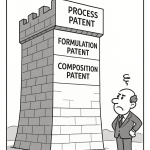
A US patent lasts 20 years from its filing date, subject to other factors that change the duration. [4] A company files the patent before FDA approves the drug. This is why the time left after approval is shorter than 20 years.
How Patent Term Extension Works Under 35 U.S.C. 156
Section 156 restores part of the time lost to FDA review. The extension equals the approval phase plus one-half of the remaining testing phase. [13] The extension may not exceed five years. [13] The total patent term after approval may not exceed 14 years. [13]
These periods run beside the patent term. FDA states that the 3-year exclusivity runs “irrespective of, but concurrent with, any applicable patent term.” [12] Pediatric exclusivity adds six months to existing patents and exclusivities. FDA says it “does not stand alone.” [4]
When Does Paragraph IV ANDA Litigation Start?
A generic company can file an abbreviated new drug application (ANDA) with a Paragraph IV certification at the “NCE-1” date. That date is year four after NDA approval. [12] The certification challenges a listed patent. The brand company then decides whether to sue.
What Is the 30-Month Stay?
A brand company that sues in the one-year window after year four can delay FDA approval of the ANDA. FDA states that the stay extends so that 7.5 years pass from the NDA approval date. [12] An NCE holder can therefore keep a generic off the market for up to 7.5 years from approval while the suit runs.
What the 180-Day Exclusivity Blocks
The first applicant to file a substantially complete ANDA with a Paragraph IV challenge earns 180-day exclusivity. FDA states that this exclusivity “will block approval of all non-First Applicants both prior to approval and after approval of the First Applicant(s).” [12]
How Long Do Biologics Keep Exclusivity Under the BPCIA?
A biosimilar application cannot be submitted until four years after first licensure of the reference product. FDA cannot make the approval effective until 12 years after first licensure. [14] A completed pediatric study request adds six months to each period. [14] The statute also gives the first interchangeable biosimilar its own exclusivity window. [14]
Analysis: a biologic reference product keeps 12 years of exclusivity. A new chemical entity keeps five. The longer biologic period is one reason Keytruda and Opdivo have later entry markers than many small-molecule peers.
Three Exit Shapes: A Classification of Loss of Exclusivity
We sort the exits in our data into three shapes. This is an original framework. It is not an industry standard.
Shape
Definition
Example in this article
Dated cliff
A court ruling or settlement fixes one entry date for all challengers
A settlement licenses capped generic volumes first and unlimited volumes later
Revlimid (capped entry from 2022; unlimited from January 31, 2026)
Hill by design
The brand moves demand to a new form before the date arrives
Keytruda Qlex; Opdivo Qvantig
The Dated Cliff: Humira and Eliquis
Humira: A Date Set in 2017 and Reached in 2023
Amgen and AbbVie settled on September 28, 2017. Amgen agreed to wait until January 31, 2023 to launch its Humira biosimilar in the US. [16] That is 5.3 years of advance notice (our calculation). Humira US sales were about $10.4 billion in 2016. [16]
Global Humira sales reached $21.2 billion in 2022, up 2.6%. [17] In 2023 they were $14.404 billion, down 32.2%. [8] The drop equals $6.8 billion (our calculation).
Eliquis: A Date Confirmed in 2021
On September 3, 2021, the Federal Circuit affirmed a 2020 district court ruling that two Eliquis patents are valid and infringed. The patents are US 6,967,208 (composition of matter) and US 9,326,945 (formulation). [2] Pfizer and BMS said the earliest generic launch is April 1, 2028, “subject to additional appeals and challenges.” [2]
Before the ruling, analysts expected entry between 2026 and 2031. [10] The challengers in that appeal were Sigmapharm, Sunshine Lake Pharma, Hec Pharm and Unichem. Other generic companies had settled. [10]
Eliquis sales were $9.17 billion in 2020. [10] They reached $14.443 billion in 2025. [1] That is growth of 57.5% inside the shield (our calculation). BMS guides Eliquis to grow 10% to 15% worldwide in 2026. [1]
The Staircase: Revlimid Generic Entry Timeline
Celgene, now part of BMS, settled with Dr. Reddy’s on September 17, 2020. The settlement gave Dr. Reddy’s capped quantities from an undisclosed date after March 2022. Unlimited sales could start no earlier than January 31, 2026. [18]
BMS reported Revlimid revenue of $2.951 billion in 2025, down 49% from $5.773 billion. [1] That is $2.8 billion of lost sales (our calculation). The decline came in the last year before unlimited entry under the Dr. Reddy’s license.
The Hill by Design: Keytruda and the Subcutaneous Bet
Merck CEO Rob Davis said on July 29, 2025 that he sees the Keytruda patent expiration “as more of a hill than a cliff.” [19] Keytruda sales were $25 billion in 2023 and $29.5 billion in 2024. [20] BioSpace reports that key patent protections expire in 2028. [20]
FDA approved Keytruda Qlex, a subcutaneous form, in September 2025. It treats most solid tumor indications of the IV version. A lung cancer study showed a 45% overall response rate for Qlex and 42% for IV Keytruda. [20] A Merck spokesperson said the price is at parity with IV Keytruda. [20]
Qlex sales were $463 million in the second quarter of 2026. Keytruda and Qlex together were $8.366 billion. [7] Qlex is therefore 5.5% of the franchise (our calculation).
In February 2023, AbbVie vice chairman Rob Michael said, “we anticipate that sales erosion will be more heavily weighted towards the second half of 2023.” [17] AbbVie expected 2023 Humira sales of $13.7 billion and US erosion of 37%. [17] It reported $14.404 billion globally and a US decline of 34.7%. [8]
Reported global sales ran $0.7 billion, or 5.1%, above the guidance (our calculation). Michael also said AbbVie expected up to 10 biosimilars in the market for the full year. [17]
Stelara Biosimilar Launch: A 55.7% Decline in One Quarter
Stelara sales peaked at $10.9 billion in 2023. [21] They fell 40% in the first nine months of 2025. [21] In the second quarter of 2026 J&J reported a 55.7% decline. J&J tied it to biosimilar competition, adoption of newer treatment classes and unfavorable patient mix. [9]
Ryan Kurz, J&J’s vice president of investor relations, said Stelara was a headwind of about 760 basis points to Innovative Medicine growth. [9] J&J still raised its 2026 sales growth outlook to 6.5% to 7.1%. [9]
Entresto Generic Entry: A 45% Quarterly Drop
Novartis states that it lost market exclusivity for Entresto in the US in July 2025. [22] It also states that regulatory data protection in Europe expires in November 2026. It expects revenue to decline substantially after that date. [22] Entresto sales were $1.2 billion in the fourth quarter of 2025, down 45% in constant currency. [23]
Pricing Pressure: Why Do Generics Erode Sales So Fast?
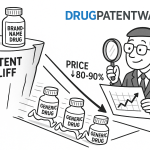
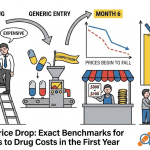
FDA analyzed 181 products with initial generic entry from 2015 to 2017. It compared generic prices with the average brand price in the three months before entry. [24] The price decline grows with each added competitor.
The analysis covers retail pharmacy sales only and excludes PBM rebates. [24] It covers generics and not biosimilars. FDA concludes that “Greater competition among generic drug makers is associated with lower generic drug prices.” [24]
Who Is Exposed Through 2028?
Product
Company
Latest reported revenue
Entry marker
Reference
Eliquis
BMS and Pfizer
$14,443 million worldwide; $10,239 million US (FY2025)
April 1, 2028 earliest generic launch (court-confirmed)
Bristol Myers Squibb: Two Products Equal Half of Revenue
Eliquis and Opdivo sales total $24.492 billion. BMS total revenue was $48.194 billion. [1] The share is 50.8% (our calculation). US sales of the two products total $16.143 billion. That is 48.5% of US revenue of $33.279 billion and 33.5% of global revenue (our calculation from [1]).
BMS guides its Legacy Portfolio, which includes Revlimid and Pomalyst, to fall 12% to 16% in 2026. [1] Eliquis is part of an alliance with Pfizer. [2]
Merck: Keytruda Is Half of Quarterly Sales
Merck reported sales of $16.607 billion in the second quarter of 2026. Keytruda and Qlex together were $8.366 billion. [7] The share is 50.4% (our calculation). IV Keytruda alone fell 1% to $7.904 billion. [7]
In July 2025 Merck announced $3 billion of cost cuts by the end of 2027. It expects about $1.7 billion in annual savings from its restructuring program and recorded a $649 million charge in the second quarter of 2025. [19]
Time to LOE: How Many Months Remain?
We counted the days from October 13, 2026 to each entry marker. Eliquis has a single date, so its count is exact. Opdivo and Keytruda have only a year, so we show the range from January 1 to December 31, 2028.
Product
Entry marker
Days remaining
Months remaining
Eliquis
April 1, 2028
536
17.6
Opdivo (estimated minimum biosimilar entry)
2028 (date not given)
445 to 810
14.6 to 26.6
Keytruda (key protections expire)
2028 (date not given)
445 to 810
14.6 to 26.6
Sources for the markers: [2], [3] and [20]. The range is wide because the sources give a year and not a date. A reader who needs a date should check the patent records and the court dockets directly.
Scenario Analysis: How Much US Revenue Could Eliquis and Opdivo Lose in Year One?
This scenario applies three observed first-year decline rates to 2025 US sales. The rates are Humira’s 2023 US decline (34.7%), Revlimid’s 2025 US decline (49%) and Stelara’s second-quarter 2026 decline (55.7%). The assumptions are a constant 2025 sales base, entry on schedule and no price changes before entry. The scenario is not a forecast.
Decline rate applied
Eliquis loss
Opdivo loss
Combined loss
Combined, as share of 2025 BMS revenue
34.7% (Humira US, 2023)
$3.55 billion
$2.05 billion
$5.60 billion
11.6%
49% (Revlimid US, 2025)
$5.02 billion
$2.89 billion
$7.91 billion
16.4%
55.7% (Stelara, Q2 2026)
$5.70 billion
$3.29 billion
$8.99 billion
18.7%
Limits: the Humira rate covers a full year. The Stelara rate covers one quarter. The Eliquis and Opdivo entry dates also differ. Opdivo is a biologic with a biosimilar pathway and Eliquis is a small molecule. FDA price data suggest that a small-molecule drug with many generic entrants can fall further than a biologic (see Table 5). [24]
Keytruda Qlex vs. Halozyme: Litigation Breakdown
A subcutaneous form can extend a franchise only if the new product is free of third-party patents. Halozyme Therapeutics asserts patents on modified hyaluronidase enzymes (MDASE patents) against Keytruda Qlex. Merck, through its subsidiary MSD, disputes them.
Timeline of the Halozyme and Merck Dispute
Date
Event
Reference
November 2024 to November 2025
MSD files post-grant review (PGR) petitions against 15 Halozyme patents
The Patent Trial and Appeal Board (PTAB) found claims 1 to 4 and 8 to 21 of US 11,952,600 invalid. It cited lack of enablement and failure to meet the written description requirement. Halozyme disclaimed claims 5 to 7. [15]
The decision covers one of 18 challenged patents (our count from the petitions listed in [15]). Thirteen of the other 14 PGR petitions were instituted. The three IPR petitions had not been instituted at the time of the report. [15]
What Merck Says
An MSD spokesperson has said that the enzyme in Keytruda Qlex was “developed independently” from Halozyme. MSD also says that it “strongly believes” the Halozyme patents on the enzyme variant are invalid. [15]
What Halozyme Says
After the Dutch ruling, Halozyme said that the injunction “does not affect intravenous Keytruda.” It also said that its MDASE enforcement does not affect partners that use its ENHANZE technology. [25]
What This Means for Brand Manufacturers
Analysis: a route-of-administration switch moves part of the LOE risk from the original patents to new third-party patents. Merck holds a US approval and sold $463 million of Qlex in one quarter. [7] It also faces a preliminary injunction in Germany and a Dutch order that covers eight European markets. [15][25] The US outcome is open in the sources we reviewed.
Opdivo vs. Amgen’s ABP 206: A Biosimilar Patent Fight
What BMS and Ono Allege in the Delaware Suit
BMS and Ono sued Amgen in Delaware over seven Opdivo patents: the ‘449, ‘320, ‘082, ‘154, ‘107, ‘153 and ‘917 patents. [3] They allege that Amgen plans to launch before key US patents on the active ingredient and the method of treatment expire. [3]
They also allege that Amgen shared incomplete information on its manufacturing process. [3] Amgen says it “remains confident that ABP 206 will be in the first wave of Opdivo biosimilars.” It expects an FDA decision by the end of 2026. [3]
Opdivo Qvantig as a Lifecycle Hedge
FDA cleared Opdivo Qvantig, a subcutaneous form of nivolumab with hyaluronidase, in December 2024. It covers almost all Opdivo indications. [26] Opdivo sales were $10.049 billion in 2025, up 8%. [1] The sources we reviewed do not give Qvantig sales, so we do not estimate its share.
Does Medicare Price Negotiation Change the Patent Cliff?
Yes. The Inflation Reduction Act (IRA) adds a price clock that runs beside the patent clock. A single-source small-molecule drug becomes eligible for selection at least 7 years after FDA approval. A biologic becomes eligible at least 11 years after licensure. [11]
Which Drugs Did CMS Select for Price Negotiation?
Price year
Drugs
Reference
2026
Ten Part D drugs: Farxiga, Fiasp/NovoLog, Januvia, Jardiance, Eliquis, Xarelto, Entresto, Stelara, Enbrel and Imbruvica
CMS estimated that Medicare would have saved $6 billion in 2023 on the first ten drugs. That is a net saving of 22%. [11] For the 2028 list, the 15 drugs account for about $27 billion in Medicare Part B and Part D spending. CMS estimated savings of about $8.5 billion if the prices had applied in 2024. [27] The implied saving is 31% (our calculation from [27]). It is not an official discount rate.
Eliquis Price Negotiation: The Price Cut Arrives 27 Months Before Entry
Eliquis is on the 2026 list, so its negotiated price took effect on January 1, 2026. [11] The earliest generic launch is April 1, 2028. [2] The gap is 27 months (our calculation).
Analysis: for Eliquis, the policy clock runs ahead of the patent clock. A forecast that models only patent dates misses a price reset. Stelara and Entresto are on the same 2026 list, and both already face copies. [11][22] BMS issued its 2026 Eliquis growth guidance of 10% to 15% in its fourth-quarter 2025 results. [1]
Biosimilar Launch Rules: What Changed in 2025
FDA’s October 2025 Draft Guidance on Comparative Efficacy Studies
FDA issued draft guidance on October 29, 2025. It proposes that manufacturers often can skip a comparative efficacy study and rely on comparative analytical assessments. [28] A study may not be needed when three conditions apply. The products must come from clonal cell lines and be well characterized. The link between quality attributes and efficacy must be understood. A human pharmacokinetic similarity study must be feasible and relevant. [28]
FDA also plans final guidance that would remove switching studies for interchangeability. FDA Commissioner Marty Makary said, “Today, the FDA is also announcing its plans to issue final guidance on interchangeability.” He expected the biosimilar guidance to be final in three to six months. [28] We did not confirm whether FDA finalized it by October 13, 2026.
What This Means for Biosimilars
Analysis: fewer clinical requirements can shorten development time. That lets more developers aim at a given LOE date. AbbVie expected up to 10 biosimilars for Humira in 2023. [17] Opdivo already has one filed application from Amgen. [3] FDA price data show that each added competitor deepens the decline. [24]
Lifecycle Management Strategy: What Brand Manufacturers Can Buy
Tactic
What it does
Evidence
Limit
New route of administration
Moves demand to a new form before LOE
Qlex is 5.5% of the Keytruda franchise in Q2 2026 [7]
The Keytruda hill depends on how much demand moves to Qlex before 2028. We model three conversion levels. The base is Q2 2026 franchise sales of $8.366 billion, annualized to $33.5 billion. [7] Annualizing is a simple multiplication by four.
Share of franchise on Qlex at LOE
Annualized revenue on Qlex
Annualized revenue left on IV
25%
$8.4 billion
$25.1 billion
50%
$16.7 billion
$16.7 billion
75%
$25.1 billion
$8.4 billion
The assumptions are constant sales, price parity and no change in total demand. [20] The table does not state that Qlex revenue is safe from biosimilar competition. That depends on the Halozyme outcome and on which patents protect the subcutaneous form. We do not assume either.
Exclusivity Stacking: Pediatric, Clinical and Orphan Periods
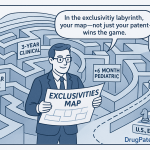
Brands can add time through FDA exclusivities. New clinical investigations earn 3 years. Orphan designations earn 7 years. Pediatric work adds 6 months. [4] These periods run beside patents and can add protection when a patent is weak or has expired. [12]
Portfolio Replacement and Cost Resets
J&J: Growth Without Stelara
CEO Joaquin Duato said that J&J grew double digits in the second quarter of 2026 when Stelara is excluded. Darzalex grew 17.6% to over $4 billion. Tremfya grew 71% and reached its first $2 billion quarter. [9] In July 2025, J&J set a goal of $50 billion in oncology revenue by 2030. [21]
Merck: A Cost Program Before the Date
Merck announced its cost program in July 2025, before the 2028 Keytruda protections expire. [19] The company also launched Qlex. [20] Analysis: the two moves address different parts of the problem. One cuts spending. The other protects revenue.
BMS: Guided Decline and Guided Growth
BMS guides the Legacy Portfolio down 12% to 16% in 2026 and Eliquis up 10% to 15%. [1] Analysis: that split matches the two clocks. Revlimid and Pomalyst face copies now. Eliquis faces them in 2028.
Five Forecasting Errors That the Data Exposes
The documented cases in this guide point to five errors that appear in LOE forecasts. This list is our analysis. Each item rests on a cited fact.
Using the patent expiration date as the entry date. Analysts expected Eliquis generic entry between 2026 and 2031 before the 2021 ruling. The ruling and settlements fixed April 1, 2028. [10][2]
Ignoring the policy clock. Eliquis took a negotiated Medicare price on January 1, 2026, 27 months before the entry date. [11][2]
Assuming no erosion before the date. Revlimid revenue fell 49% in 2025, in the last year before unlimited entry under the Dr. Reddy’s license. [1][18]
Assuming a new form is free of new patents. Qlex faces suits and an injunction over the enzyme that makes the subcutaneous form possible. [15][25]
Comparing erosion rates across different windows. Humira’s 34.7% covers a year, and Stelara’s 55.7% covers one quarter. [8][9]
What This Means for Generic and Biosimilar Developers
A court-confirmed or settlement-fixed date is the launch date to plan around. Eliquis shows that the date can move from an expected 2026 to 2031 range to a single date. [10]
Biologic patent suits can involve many patents. BMS and Ono assert seven against Amgen. [3]
Price falls with each added competitor. In FDA’s data, a market with six or more generic competitors shows prices more than 95% below the pre-entry brand price. [24]
Reformulated brands carry their own patent disputes. Halozyme and Merck show that the new form can be the contested asset. [15]
Teams that track these dates need patent, litigation and exclusivity records in one place. DrugPatentWatch is one database that collects those records. The cited court and agency documents remain the authority for any date.
What This Means for Investors, Analysts and Payers
Investors and Analysts
Read the product line and the company total together. At BMS the two products with 2028 entry markers equal 50.8% of revenue. At Merck one franchise equals 50.4% of quarterly sales. [1][7] Concentration of this size means that one court ruling or one settlement can move the company outlook.
Check how a company guides. BMS guides the Legacy Portfolio down 12% to 16% and Eliquis up 10% to 15%. [1] That guidance shows the company treats the two groups on different clocks. J&J raised its 2026 growth outlook while Stelara fell 55.7%. [9]
Payers and Health Systems
Payers see price relief from two sources. CMS estimated net savings of 22% on the first ten negotiated drugs. [11] FDA data show generic price declines that deepen with each added competitor. [24] The timing differs. The negotiated price arrives on a fixed January date. Generic price relief arrives after a launch date that a court or a settlement sets.
What Happens Next: Dates to Watch
Date
Event
Status
Reference
By end of 2026
FDA decision on Amgen’s ABP 206 (Opdivo biosimilar)
Published estimates of revenue exposed to patent expiration range from about $180 billion to $400 billion, depending on the period and the source. [5][6]
Eliquis and Opdivo equal 50.8% of BMS 2025 revenue and both have 2028 entry markers. [1][2][3]
Keytruda and Qlex equal 50.4% of Merck’s second-quarter 2026 sales. [7]
Reported first-year declines in this data set range from 34.7% (Humira US) to 55.7% (Stelara, one quarter). [8][9]
FDA data show generic prices more than 95% below brand prices with six or more competitors. [24]
The Medicare price clock runs ahead of the patent clock for Eliquis by 27 months. [11][2]
Qlex is 5.5% of the Keytruda franchise, and the Halozyme litigation is unresolved in the US. [7][15]
FAQ
Does a generic company have to wait for the patent to expire?
No. A generic company can file a Paragraph IV challenge at year four after NDA approval for an NCE. [12] A settlement can also license entry on a set date. Dr. Reddy’s received capped Revlimid volumes before the unlimited date of January 31, 2026. [18]
What is the difference between patent expiration and loss of exclusivity?
Patent expiration is the end of a patent term. Loss of exclusivity is the point of lawful competition. FDA exclusivities run beside the patent and can end later. [4] A settlement can set a different date from both.
How much can patent term extension add?
Up to five years. The total term after approval cannot exceed 14 years. [13]
How long do biologics keep exclusivity?
Twelve years from first licensure of the reference product. A biosimilar application cannot be filed until year four. [14]
Which blockbuster drugs have 2028 entry markers?
Eliquis has an earliest generic launch of April 1, 2028. [2] BMS estimates a minimum US Opdivo biosimilar entry in 2028. [3] BioSpace reports that key Keytruda protections expire in 2028. [20]
How fast do sales fall after generic entry?
Humira US sales fell 34.7% in 2023. [8] Stelara sales fell 55.7% in the second quarter of 2026. [9] The windows differ, so treat these as ranges and not as a rule.
Does Medicare price negotiation depend on patent expiry?
Not directly. Eligibility depends on time since approval: 7 years for small molecules and 11 years for biologics. [11] A drug can face a negotiated price while its patents remain in force. Eliquis is an example. [11][2]
What is the 180-day exclusivity?
It is a reward for the first applicant that files a substantially complete ANDA with a Paragraph IV challenge. It blocks approval of other applicants during that period. [12]
Can a subcutaneous version protect a franchise after patent expiry?
Possibly. The evidence is early. Qlex is 5.5% of Keytruda sales and faces patent claims from Halozyme in several jurisdictions. [7][15][25] Opdivo Qvantig has no sales figure in our sources. [26]
Do more generic competitors lower prices more?
Yes. FDA found price declines of 39% with one competitor and more than 95% with six or more. [24] The analysis covers generics at retail pharmacies and not biosimilars.
Conrad, R., & Lutter, R. (2019, December). Generic competition and drug prices: New evidence linking greater generic competition and lower generic drug prices. U.S. Food and Drug Administration. https://fda.gov/media/133509/download