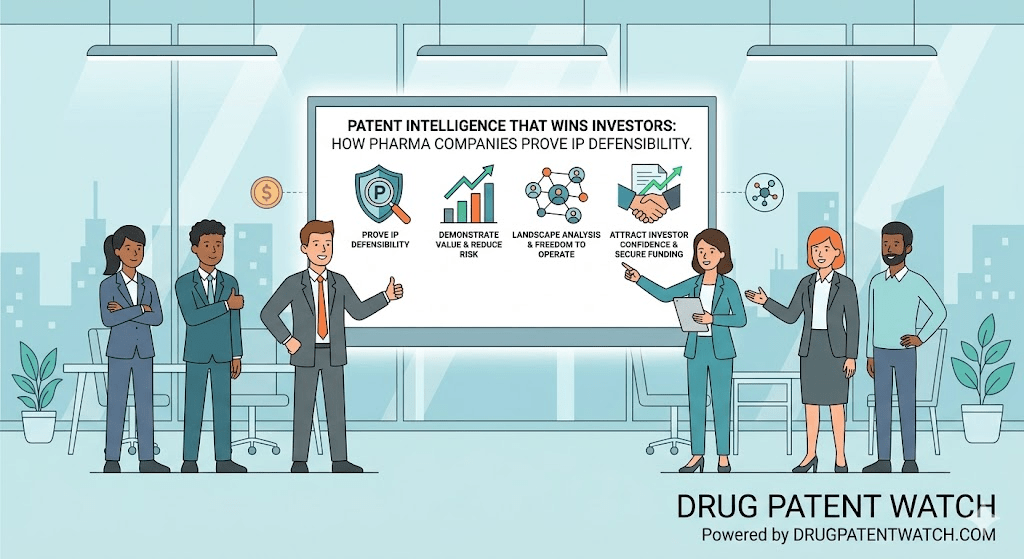
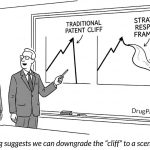
Most pharmaceutical companies treat patent disclosures as a legal obligation. The better ones treat them as a revenue forecast. The best ones use them as a competitive weapon in investor conversations.
There is a gap between what a company’s IP team knows about its own patent position and what gets communicated to the institutional investors, buy-side analysts, and venture capital allocators who price that position into a stock or a valuation cap table. That gap costs real money. A drug with eight years of defensible exclusivity that reads like a two-year cliff on a quick Orange Book screen will trade at a discount it does not deserve. A drug whose secondary patent thicket looks impenetrable to management but is riddled with Paragraph IV targets will attract a premium it cannot sustain.
This guide is for the people who sit at that gap: business development leads, investor relations executives, CFOs, IP counsel who brief boards, and founders of clinical-stage companies preparing for Series B or pre-IPO rounds. It explains how patent intelligence works, what data sources power it, how investors actually use it, and how to structure IP defensibility arguments that hold up to scrutiny from a sophisticated analyst who has DrugPatentWatch open in one tab and your 10-K in the other.
The analysis covers small molecules and biologics, generic and biosimilar entry dynamics, Orange Book mechanics, inter partes review (IPR) risk, the loss of exclusivity (LOE) modeling framework, and the specific disclosures that distinguish companies that understand their own IP position from those that merely list it.
Why Investors Price Patent Risk Differently Than Management Does
Management teams tend to think about patents in terms of their strongest claim: the composition-of-matter patent, the core ‘123 patent, the one that covers the molecule itself. Investors, particularly those who have been burned by a Paragraph IV filing that landed six weeks after a long position was established, think about the weakest link.
That difference in perspective is not irrational on either side. Management lives with the patent portfolio daily. They know which claims are bulletproof and which are hedged. Investors work from public disclosures, Orange Book listings, FDA ANDA dockets, and whatever third-party patent intelligence services they subscribe to. They are doing probabilistic analysis from a position of information asymmetry, and they price that asymmetry as risk.
The practical implication is that a company confident in its IP position needs to close that information gap actively. Passive disclosure is not sufficient. A paragraph in the 10-K that says ‘our key patents expire between 2031 and 2035’ tells an analyst almost nothing about actual exclusivity duration, litigation exposure, or the depth of secondary protection. A structured patent intelligence briefing, backed by Orange Book citation counts, IPR petition history, and litigation outcome data, tells them everything they need to build a credible model.
How Buy-Side Analysts Actually Use Patent Data in Pharmaceutical Valuations
The buy-side workflow for a pharma company under coverage typically starts with the Orange Book. An analyst pulls the patent listings for a product, notes the expiration dates, cross-references any Paragraph IV certifications on the FDA’s ANDA database, checks PACER for active litigation, and builds a probability-weighted LOE scenario into the DCF model. The whole process takes about 45 minutes with the right tools, and it produces a number that becomes the single most important variable in the model for any product inside its commercial window.
Where this process breaks down is in the interpretation of secondary patents. A formulation patent with a 2034 expiration looks valuable until you understand that generic manufacturers can sometimes design around it or challenge it as obvious in light of the prior art. A method-of-use patent covering a new indication looks like durable protection until you realize it only covers 18% of prescriptions. The raw patent data does not tell you which claims are commercially meaningful and which are defensive filings that will not actually delay generic entry.
Companies that communicate the difference explicitly, in investor presentations, earnings call Q&A, and analytical briefings, get rewarded with a more accurate valuation. Those that leave the interpretation to the analyst get whatever probability discount the analyst applies, which defaults to conservative.
What ‘Defensibility’ Actually Means to a Pharmaceutical Investor
Defensibility is not the same as patent coverage. A drug can have 40 Orange Book-listed patents and still face credible generic entry in three years if those patents are all method-of-use claims on secondary indications that can be carved out of the label. Defensibility means the specific legal and regulatory barriers that a potential generic or biosimilar entrant must overcome before it can reach commercial launch at scale.
Those barriers break into four categories. First, composition-of-matter protection, which covers the active pharmaceutical ingredient (API) itself and is the hardest to design around. Second, formulation protection, which covers the specific physical and chemical architecture of the dosage form. Third, method-of-use protection, which covers the clinical indication and can be partially circumvented through carve-out labeling. Fourth, regulatory exclusivity, which includes Hatch-Waxman five-year NCE exclusivity, three-year new clinical investigation exclusivity, pediatric exclusivity extensions, and orphan drug exclusivity, none of which require a patent.
A credible defensibility argument addresses all four layers, quantifies when each expires, and explains what a generic entrant would need to do to commercially launch before those expirations. That argument, built from patent intelligence and regulatory data, is the asset that separates a well-prepared investor conversation from a generic investor relations answer.
‘Between 2025 and 2030, the global pharmaceutical industry faces a Loss of Exclusivity wave that puts an estimated $200 billion to $400 billion in branded drug revenue at direct risk. That range reflects genuine uncertainty about litigation outcomes, biosimilar entry timelines, and IRA price negotiation schedules.’ — DrugPatentWatch, Drug Patent Expiration Strategic Guide (2025)
The Information Asymmetry Problem: What Companies Know vs. What Investors Can See
Patent prosecution strategy is largely invisible to outside observers. Management knows which claims they argued hardest, which prior art was overcome during examination, which continuation applications are pending, and where the prosecution history creates estoppel risks. None of that is in public disclosures. The public record shows granted claims, Orange Book listings, and litigation filings, but not the strategic intent behind the portfolio construction or the internal assessment of claim strength.
This asymmetry works in both directions. A company that has built a genuinely strong thicket around a key franchise can use that knowledge to support a valuation premium, if it communicates it clearly. A company whose portfolio looks strong on the surface but has internal weaknesses it has not fully disclosed faces a different problem: the market will eventually price in those weaknesses when they surface in litigation, and the repricing tends to be abrupt.
The cleanest way to manage this is through structured transparency. Not full disclosure of prosecution strategy, which would be competitively counterproductive, but a clear, layered explanation of why the key exclusivity claims are defensible, what the realistic timeline for generic entry is under different litigation scenarios, and what the financial model looks like in each scenario.
The Patent Intelligence Stack: Data Sources That Power Defensibility Analysis
Patent intelligence for pharmaceutical companies draws from a relatively small number of authoritative data sources. Understanding which sources carry weight with sophisticated investors helps IR teams and IP counsel structure their communications around the same data their audience is already using.
The FDA Orange Book: What It Tells You and What It Hides
The Orange Book (officially titled ‘Approved Drug Products with Therapeutic Equivalence Evaluations’) is the primary public record of patent protection for FDA-approved small-molecule drugs. When a drug company lists a patent in the Orange Book, it is asserting that the patent claims the approved drug product or an approved method of using the drug. A generic manufacturer filing an ANDA must certify its position on each listed patent, and a Paragraph IV certification, which asserts that the listed patent is invalid, unenforceable, or will not be infringed, triggers the Hatch-Waxman litigation mechanism.
What the Orange Book tells you: which patents a company has chosen to assert as relevant to a particular product, when those patents expire, and whether any ANDA applicants have filed Paragraph IV certifications. What it hides: the quality of those patent claims, the prosecution history risk, the likelihood that any given claim would survive validity challenge, and whether secondary patents would actually delay commercially meaningful generic entry.
The Orange Book listing count is often used as a proxy for IP strength in casual analysis, but it is a poor proxy. A drug with 20 Orange Book listings may have 18 method-of-use patents on indications that represent 5% of prescriptions and two formulation patents that a competent generic chemistry team can design around. A drug with three Orange Book listings may have a composition-of-matter patent with 2035 expiry that is backed by airtight prosecution history. Listing count is the beginning of analysis, not the conclusion.
The FTC’s 2023-2025 campaign against allegedly improper Orange Book listings added another layer of complexity. The agency disputed more than 500 patent listings held by major companies including Teva, GSK, and Boehringer Ingelheim. The core argument was that patents on drug-device combination components, inhaler caps, dose counters, and similar mechanical components, do not claim the ‘drug product’ as defined by statute and cannot legitimately trigger the 30-month stay. In December 2024, the Federal Circuit affirmed a lower court decision ordering Teva to delist five Orange Book patents, and Teva subsequently agreed to remove more than 200 patent listings along with a $35 million settlement.
For investors analyzing the Orange Book, the post-2024 environment means that a company’s listing count may overstate effective exclusivity if any of those listings involve device components rather than the drug product itself. This is a specific red flag that analytical briefings should address directly.
How DrugPatentWatch Translates Raw Patent Data Into Commercial Intelligence
DrugPatentWatch is the dominant third-party platform for pharmaceutical patent intelligence, and it is used by IP counsel, investor relations teams, institutional investors, and generic manufacturers. Understanding what the platform surfaces helps a company anticipate what analysts are finding during their diligence.
The platform aggregates Orange Book data, ANDA filing records, Paragraph IV certification histories, litigation outcomes, patent family trees, and regulatory exclusivity timelines into a searchable database. A user can look up any branded drug and immediately see: which patents are listed, when they expire, how many ANDA applications have been filed, which applicants have filed Paragraph IV certifications, and the current litigation status of each challenge.
For an investor doing diligence on a pharmaceutical company, a DrugPatentWatch search is typically the first stop after the Orange Book and before PACER. The platform’s LOE date estimates incorporate both patent and regulatory exclusivity, and its patent family analysis can reveal related applications that are not yet listed in the Orange Book but may create future protection or future challenges.
Companies preparing investor materials should run their own products through DrugPatentWatch and understand exactly what a diligence-focused analyst will see. If the platform’s LOE estimate is different from what management expects, that discrepancy needs to be explained in investor materials. If there are pending continuation applications that will extend coverage but do not yet appear in the commercial intelligence databases, that pipeline should be disclosed and explained.
PTAB IPR Petition History as a Patent Quality Signal
The Patent Trial and Appeal Board (PTAB) inter partes review process has become a primary mechanism for challenging pharmaceutical patent validity outside district court litigation. Since IPR petitions are publicly filed and PTAB decisions are published, the IPR history of a patent family is a direct signal of patent quality that sophisticated investors can and do read.
A patent that has been subjected to IPR petitions and survived them is demonstrably stronger than one that has not been tested. An institution decision denying review on all grounds, followed by a final written decision finding all challenged claims patentable, is the closest thing to third-party validation of patent strength available in the public record. A patent that was cancelled or had claims amended in IPR is demonstrably weaker, even if the amended claims remain in force.
For investor communications, a company whose key patents have survived IPR challenges should say so explicitly and explain what that survival means for the defensibility timeline. Most investor presentations omit this information entirely, defaulting to expiration dates without any discussion of whether those expiration dates have been tested by sophisticated adversaries.
The PTAB landscape shifted again in 2025. Under the PREVAIL Act framework discussions, potential changes to IPR standing requirements and discretionary denial standards have created uncertainty about whether the board will remain as accessible a venue for generic manufacturers as it has been since the America Invents Act took effect in 2012. Portfolio managers tracking generic pharma assets should monitor PREVAIL Act legislative progress, as its passage would meaningfully increase the cost and risk of patent challenges at PTAB, extending effective exclusivity for brand assets.
The FDA ANDA Database and Paragraph IV Certification Tracking
When a generic manufacturer files a Paragraph IV certification, that filing appears in the FDA’s ANDA database and in the Federal Register. The certification identifies which patent is being challenged and on what grounds, typically invalidity, unenforceability, or non-infringement. The brand company then has 45 days to file a patent infringement lawsuit in district court; if it does, the ANDA’s approval is automatically stayed for 30 months, giving the brand company time to litigate.
For investors, a Paragraph IV certification against a key product is the most significant public signal of generic entry risk. Each certification represents a specific threat, backed by a generic manufacturer who has spent significant resources on the analysis and believes it has a viable path to launch. The mere filing does not mean the challenge will succeed, but it does mean the challenge has been analyzed by a capable adversary and found worthwhile to pursue.
The number of Paragraph IV certifications a product has received, and the outcome of any resulting litigation, is public information. A product that has received ten Paragraph IV challenges and successfully defended against all of them has a different risk profile than a product that has received none. The absence of Paragraph IV challenges can signal either strong patents or a product too small to attract generic interest; the investor communication task is to clarify which one applies.
Building the Patent Thicket Argument: What Makes a Portfolio Defensible
The term ‘patent thicket’ typically appears in policy discussions as a criticism of pharmaceutical lifecycle management strategy. For investor communications purposes, it is a feature, not a bug. A well-constructed patent thicket means that a generic manufacturer must design around or challenge multiple independent patents, each with its own expiration date and litigation risk, before it can commercially launch. That complexity is real protection, and it should be communicated as such.
Composition-of-Matter vs. Formulation vs. Method-of-Use: Which Claims Actually Defend Revenue
Not all patent claims defend revenue equally. The hierarchy matters enormously for defensibility analysis, and the order of commercial significance runs precisely in the order of how difficult the claims are to obtain.
Composition-of-matter claims cover the API itself, typically the specific chemical structure, salt form, or polymorph that constitutes the drug. These are the most valuable claims in a pharmaceutical patent portfolio because a generic manufacturer cannot market the same API without infringing them, regardless of how the dosage form is constructed. A composition-of-matter patent with a 2032 expiration typically means no generic entry before 2032 unless the patent is invalidated. Pfizer’s atorvastatin composition patent, which protected Lipitor until November 2011, generated peak annual sales of $12.9 billion and represents the paradigmatic case of what a single composition-of-matter patent is worth.
Formulation patents cover the specific physical and chemical architecture of the dosage form: the excipient system, the coating technology, the delivery mechanism, the salt form combination, the specific particle size distribution. These are valuable but more circumventable. A competent generic chemistry team can often develop a bioequivalent formulation that does not use the same excipient system, potentially designing around formulation patents while delivering the same API. The key question for any formulation patent is whether there is a technically feasible non-infringing alternative that achieves bioequivalence; if there is not, the formulation patent provides near-composition-of-matter protection.
Method-of-use patents cover the clinical indication: ‘a method of treating [disease] comprising administering [compound] to a patient in need thereof.’ These are the weakest class for revenue defense because they can be partially circumvented through carve-out labeling. Under the ‘skinny label’ doctrine, a generic manufacturer can seek approval for only the indications not covered by method-of-use patents, carving those indications out of its label. The generic then legally markets the drug for the unpatented indications, knowing physicians may prescribe it off-label for the patented indication.
The skinny label doctrine has sharp edges, however. The 2024 decision in Amarin Pharma v. Hikma illustrates the limits: even with a carved-out label, Hikma’s pre-launch marketing materials, which described its product as a ‘generic Vascepa,’ created inducement liability. The court found it plausible that Hikma’s statements encouraged prescriptions for the patented cardiovascular risk reduction indication. That case is a useful counterargument to the assumption that method-of-use patents provide zero revenue defense.
Patent Layering Strategy: The AbbVie Humira Model and What It Teaches About Thicket Construction
AbbVie’s Humira patent portfolio is the most analyzed example of pharmaceutical patent thicket construction in modern IP history. Between 2013 and 2016, AbbVie filed 85 patents covering Humira, the vast majority protecting secondary innovations: new formulations, treatment methods, and manufacturing processes. Nearly 90% of Humira’s patents were filed after FDA approval of the original drug. The result was a portfolio of more than 130 granted patents that required biosimilar developers to design around or challenge a substantial number of independent claims before commercial launch in the United States.
AbbVie ultimately extracted commitments from biosimilar manufacturers to delay U.S. market entry until January 2023, a five-year delay relative to European entry, in the world’s most lucrative pharmaceutical market. The company used that window to execute a revenue transition that reduced Humira revenue dependence from 39% of total revenue in 2022 to an expected 9% in 2025, while Skyrizi and Rinvoq rose from 14% to 43% of combined revenues.
The strategic lesson is not that AbbVie’s approach was simply about filing more patents. It was about filing patents that were difficult to circumvent simultaneously. Each layer of the thicket addressed a different technical pathway to biosimilar entry: citrate-free formulation patents addressed the most obvious formulation improvement, high-concentration subcutaneous delivery patents covered the preferred delivery route, and manufacturing process patents created additional uncertainty for any entrant considering process optimization. A biosimilar developer had to solve all of those problems, not just one.
For investor communications, this layering story is how you explain why a drug with multiple patent families has more defensibility than the longest-dated single patent expiration would suggest. Each additional layer is a separate barrier to entry, and the probability of successfully commercializing a generic or biosimilar is the product of successfully overcoming all layers, not just the first.
How Patent Family Depth Signals IP Sophistication to Institutional Investors
Institutional investors who cover pharmaceutical companies closely have developed a pattern-matching instinct for IP sophistication. The signals they look for are not always obvious from the outside, but they correlate reliably with companies that have invested seriously in building defensible exclusivity rather than relying on a single foundational patent.
Patent family depth, the number of related applications in a family including continuation applications, divisional applications, continuation-in-part applications, and international filings, is one signal. A drug with a single patent and no related applications is protected only by that patent’s granted claims. A drug with a family of 15 related applications, including pending continuations that may issue with narrower claims covering specific polymorphs, specific formulation elements, or specific patient populations, has layered protection that extends beyond what the granted claims alone cover.
Consistency of Orange Book listing practices is another signal. Companies that list patents in the Orange Book promptly as they issue, maintain accurate expiration dates, and systematically list new patents covering lifecycle management innovations demonstrate operational IP discipline. Companies with inconsistent listings, missed deadlines, or patents that were removed after FTC challenge demonstrate the opposite.
Track record in Hatch-Waxman litigation is the most direct signal. A company that has successfully defended six of its last seven Paragraph IV challenges, with the seventh resolving via authorized generic settlement, has demonstrated its litigation team’s competence and the quality of its patent claims. That track record belongs in investor communications, not buried in litigation disclosures.
LOE Modeling for Investor Presentations: How to Frame the Patent Cliff Without Losing Credibility
Loss of exclusivity modeling is where patent intelligence becomes a financial argument. The question every investor is trying to answer is: when does generic or biosimilar competition arrive, at what scale, and what does it do to revenue? Companies that provide a rigorous, data-backed answer to that question in investor materials are valued differently than those that provide a range of expiration dates and leave the rest to the model.
Building a Probability-Weighted LOE Timeline: The Analytical Framework
A credible LOE model for a pharmaceutical asset has four components. The first is the base-case exclusivity date: the latest expiration date among patents whose claims cover the commercially relevant product without feasible design-around. For a composition-of-matter patent with no design-around path, that is just the expiration date. For a portfolio with mixed claim types, it is the earliest date at which a design-around route opens combined with the probability that a generic manufacturer will pursue it.
The second component is litigation probability: the likelihood that any specific patent in the portfolio will be challenged via Paragraph IV or IPR, and the historical success rate for that type of claim in similar litigation. Composition-of-matter patents with clean prosecution histories and no close prior art have won roughly 55-60% of contested Hatch-Waxman trials historically. Method-of-use patents have a lower success rate, particularly those that face obviousness challenges. Formulation patents fall in between. These are rough priors; actual claim-specific analysis will modify them substantially.
The third component is regulatory exclusivity. NCE exclusivity runs five years from approval. Three-year exclusivity applies when a new clinical investigation was conducted for a new indication, formulation, or dosage form. Pediatric exclusivity adds six months to any existing patent or regulatory exclusivity. Orphan drug exclusivity runs seven years from approval for rare disease designations. These run independently of patents and can provide protection even after the patent portfolio has been challenged or invalidated.
The fourth component is competitive context: how many ANDA applicants have filed, which generic manufacturers have the technical capability to develop a commercial-scale product quickly, and what the realistic launch timeline is from ANDA filing to commercial launch given FDA review queues and any pending litigation stays.
A model incorporating all four components produces a probability distribution over LOE dates, not a single point estimate. Presenting that distribution to investors, with the assumptions underlying each scenario made explicit, is more credible than presenting a single ‘our patents expire in 2034’ statement.
Eliquis LOE Scenario Analysis: How Investors Are Modeling the 2026 Risk
Eliquis (apixaban), the leading oral anticoagulant jointly owned by Bristol Myers Squibb and Pfizer, had combined revenues exceeding $13 billion in 2024. The drug’s key patents expire in 2026, but BMS and Pfizer have mounted an aggressive litigation campaign against generic challengers, with multiple Paragraph IV ANDAs filed and 30-month stays triggered. BMS has reported over $13 billion in 2024 Eliquis revenue, making it one of the most scrutinized LOE events in the current pharmaceutical cycle.
The investor modeling challenge for Eliquis illustrates exactly why patent intelligence matters. The raw patent expiration data suggests a 2026 LOE. But the litigation posture, the number of challengers, the specific claims at issue, and the progress of the 30-month stays all affect whether generic entry actually occurs in 2026 or is delayed to 2027 or 2028. An investor relying only on the expiration date has a meaningfully different model than one who has tracked the litigation through PACER and understands the current status of each active case.
For BMS and Pfizer, the investor communication task is to explain specifically which claims are being litigated, what the company’s litigation position is, and what the revenue impact would be under each scenario. Neither company has done this with exceptional granularity in public disclosures, which means the analyst community is filling in the gap with its own models, generating a wider range of estimates than the underlying facts warrant.
Keytruda 2028 LOE: Merck’s Communication Strategy as a Case Study in Defensibility Framing
Merck’s Keytruda (pembrolizumab) generated more than $29 billion in global sales in 2024, making it the world’s highest-grossing drug. Core patent expiry arrives in 2028, creating what analysts have described as the largest single revenue erosion event in pharmaceutical history. Merck is simultaneously the most exposed major pharma company to a patent cliff and, arguably, the most transparent about its strategy for managing it.
Merck CEO Rob Davis has been explicit with investors about the company’s multi-pronged Keytruda defense. First, the company is developing and commercializing a subcutaneous formulation of pembrolizumab, targeting approval and launch by the end of 2025, years ahead of the IV formulation’s 2028 LOE. The subcutaneous version carries its own patent protection extending beyond 2028, and if the market transitions to the subcutaneous delivery route before biosimilar manufacturers can scale an IV biosimilar, a portion of the commercial franchise may be insulated. Second, Davis has indicated Merck will price the subcutaneous version to drive adoption by considering where biosimilar pricing for the IV formulation will eventually land, a forward-looking pricing strategy designed to make the transition economically compelling before generic alternatives arrive.
This level of strategic specificity in investor communications is unusual for a LOE event still three years out. It is also a direct model for how pharmaceutical companies should communicate defensibility: not just ‘our patents are strong’ but ‘here is specifically what we are doing with our IP portfolio to manage the transition, here is the technical feasibility basis for that strategy, and here is the revenue model under each scenario.’
How to Present a Patent Cliff to Investors Without Triggering a Sell Rating
The investor relations challenge with a known LOE event is that transparency about risk and credibility about mitigation pull in opposite directions. Too much focus on the risk validates investor concern. Too much focus on mitigation sounds like minimization. The correct calibration is: full acknowledgment of the quantified risk, paired with a specific, evidence-backed account of the steps taken to manage it.
Specific means specific. ‘We have a robust pipeline’ is not a defensibility argument. ‘We have three compounds in Phase 2 with expected LOE overlap coverage of approximately $2.1 billion in revenue by 2028, supported by the following patent filings’ is a defensibility argument. The second version requires the same data that management already has; it just requires organizing and disclosing it in the format that investor analysis needs.
The William Blair research cited by DrugPatentWatch estimated that from 2023 through 2025, nearly 50 products would lose patent protection, eroding aggregate sales from $162.8 billion to $67 billion by 2029, with disproportionate impact on Bristol Myers Squibb, Pfizer, AstraZeneca, Novartis, and Regeneron, where assets accounting for more than 30% of their collective 2024 revenues are at risk. When an investor knows that macro context, they bring a prior assumption that your LOE disclosures are incomplete until demonstrated otherwise. The communication task is to demonstrate otherwise, specifically.
Biosimilar Entry Risk and How to Quantify It for Investors
Biologics face a different competitive dynamics model than small molecules. Generic entry for small molecules is binary: either a generic enters with a bioequivalent product or it does not. Biosimilar entry for biologics is probabilistic along multiple dimensions: approval pathway timing, interchangeability designation status, PBM formulary negotiations, physician prescribing inertia, and the specific technical complexity of the reference biologic.
Biosimilar vs. Generic Entry: Why Revenue Erosion Timelines Differ
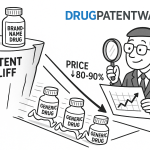
When a small-molecule blockbuster loses its primary composition-of-matter patent and generic manufacturers have filed ANDAs in advance, the initial year of multi-source generic competition typically produces an 80-90% price and volume decline. The market dynamic is close to commodity substitution: pharmacies substitute automatically, payers mandate generics, and branded revenue collapses unless an authorized generic or other defensive strategy is in place.
Biosimilar entry produces a different erosion curve. For biologics, where the interchangeability barrier and PBM rebate dynamics slow substitution, market-share loss in the first year after biosimilar entry ranges from 30% to 70%, with the lower end reflecting products where the originator maintains aggressive rebate contracting and physician habit is strong. Humira illustrates the range: after its first biosimilar competitor launched in January 2023, U.S. sales fell from a peak of $21.2 billion in 2022 to $14.04 billion in 2023 and $8.99 billion in 2024, representing roughly 58% erosion over two years, consistent with the middle of the historical biosimilar range.
For investor communications, the distinction matters because it affects the revenue model differently. A biologic with a 2028 LOE and a credible interchangeability defense should have a shallower erosion curve than a small molecule facing the same LOE date. That difference can represent billions of dollars in NPV at a standard discount rate, and it needs to be modeled and communicated explicitly rather than left to the analyst’s default assumption.
Interchangeability Designation: What It Means for Biosimilar Revenue Defense
FDA interchangeability designation allows a pharmacist to substitute a biosimilar for the reference biologic without physician intervention, exactly as a generic can be substituted for a small molecule. Not all biosimilars receive interchangeability designation; demonstrating interchangeability requires additional clinical data showing that switching between the originator and the biosimilar produces no greater risk than continued use of the originator.
For the reference biologic manufacturer, the absence of interchangeable biosimilars is meaningful revenue protection. A biosimilar that requires physician action for substitution faces a much higher barrier to formulary-level uptake than one that pharmacies can substitute automatically. Companies that have structured their biosimilar defense around the interchangeability barrier, through clinical evidence that their own product is uniquely consistent in ways that would complicate the switching demonstration, have a legitimate investor argument about the pace of revenue erosion.
This argument requires supporting data: how many of the approved biosimilars have interchangeability status, what percentage of prescriptions flow through pharmacy channels where automatic substitution would apply if interchangeability were granted, and what the historical erosion pattern has been for biologics with and without interchangeable biosimilar competition. None of that analysis appears in standard investor presentations, but all of it is directly relevant to revenue modeling.
Stelara LOE and the J&J Playbook: What a 42% Revenue Drop Looks Like in Practice
Johnson & Johnson’s Stelara (ustekinumab), with more than $10 billion in annual sales, faced biosimilar competition beginning in 2024 in Europe and 2025 in the U.S. The immediate financial impact was severe: Q2 2025 Stelara sales dropped by 42.7% year-over-year. J&J’s overall top-line revenue still grew by 5.8% in the same period, illustrating the critical distinction between a company that has managed its LOE transition and one that has not.
The J&J result is a teaching case for investor communications. The company had prepared for this outcome by growing its non-Stelara immunology portfolio, maintaining a diverse therapeutic mix, and communicating the transition strategy with enough lead time that analysts could build the erosion into their models. When the 42.7% quarterly decline materialized, it was expected, and the stock response was muted relative to what a surprise of that magnitude would have produced. Expectation management is itself a form of defensibility in the investor conversation.
Orange Book Strategy and What It Signals to Investors
The Orange Book listing decision is not purely a legal one. It is also a strategic communication. The patents a company chooses to list, and the timing of those listings, tell an informed analyst something about the company’s confidence in its own claims and its intent with respect to any generic challengers.
Why Orange Book Listing Count Alone Is a Misleading Metric
The raw listing count tells you how many patents a company has chosen to assert as relevant to a product. It does not tell you whether those patents would withstand a validity challenge, whether they cover commercially meaningful aspects of the product, or whether the listing strategy is designed to extend exclusivity through litigation procedure rather than genuine patent merit.
The FTC’s 2023-2025 delisting campaign targeted listings that the agency characterized as covering device components rather than the drug itself. Teva’s agreement to remove more than 200 listings and pay a $35 million settlement illustrates the downside risk of over-listing: a large number of Orange Book patents that cannot withstand regulatory challenge is a liability, not an asset. When investors see a company with 40 Orange Book patents for a single product, the sophisticated response is to ask how many of those listings would survive FTC scrutiny, not to interpret the count as a strength signal.
Companies should address this directly in investor materials by distinguishing between the listings that cover the core drug product, which are the ones that generate real 30-month stay protection when challenged, and any supplemental listings that cover peripheral elements. Presenting the core count with an explanation of what each patent covers is more credible than presenting the total count without context.
What the 30-Month Stay Mechanism Is Worth: Quantifying Its Value in LOE Models
The 30-month stay is one of the most financially valuable features of the Hatch-Waxman system. When a brand company files a patent infringement lawsuit within 45 days of receiving a Paragraph IV notice letter, the ANDA’s approval is automatically stayed for 30 months or until the court issues a final judgment, whichever comes first. For a $5 billion-per-year drug, 30 months of additional exclusivity is worth approximately $12.5 billion in prevented revenue erosion, discounted for probability.
The strategic implication is that listing any defensible patent in the Orange Book, even one the company expects to lose in litigation, may be commercially rational if the 30-month stay value exceeds the litigation cost. Critics including the FTC have characterized certain listing strategies as ‘pay-to-delay by litigation,’ using the stay mechanism to extract exclusivity through procedural delay rather than patent merit. That critique is legally and commercially accurate in some cases. For investor communications, the relevant question is whether the company’s Orange Book strategy is supported by patents whose claims are defensible on the merits or primarily by the procedural value of the stay.
Authorized Generic Strategy and What It Means for Post-LOE Revenue Floors
An authorized generic (AG) is a version of the branded product that the innovator licenses to a generic manufacturer, or markets itself, at generic price points. Because the AG is the same product as the branded version rather than a new ANDA filer, it does not require a Paragraph IV certification or new FDA approval. The innovator can launch an AG on the same day as the first generic entrant.
Pfizer’s Lipitor defense is the textbook AG deployment. When Ranbaxy launched its atorvastatin generic on November 30, 2011, Pfizer launched an AG through Watson Pharmaceuticals simultaneously. The AG split the 180-day first-filer exclusivity period, reducing Ranbaxy’s market share and Pfizer’s total revenue erosion relative to a scenario without the AG. Lipitor had generated peak annual sales of $12.9 billion; the AG strategy helped manage the transition.
For investor communications, an AG strategy is a concrete post-LOE revenue floor that can be modeled. A company with an AG program in place for its next LOE event has a more defensible revenue story than one that does not, because the AG captures revenue that would otherwise go entirely to third-party generic manufacturers. That difference should appear explicitly in LOE scenario modeling.
Hatch-Waxman Litigation Outcomes: What the Data Says About Defending Pharma Patents
Paragraph IV litigation has a predictable statistical profile that informed investors use to calibrate LOE scenario probabilities. Understanding the base rates helps companies frame their specific litigation positions in a context that supports rather than undermines the valuation argument.
Paragraph IV Win Rates by Patent Type: What History Shows
The litigation outcome data for Hatch-Waxman cases is publicly available through PACER and has been analyzed extensively by academic researchers and commercial intelligence services. The general pattern: brand companies win contested Paragraph IV cases at roughly the same rate as defendants win commercial patent litigation overall, somewhere between 50-60% of cases that proceed to judgment. But the breakdown by patent type is where the data becomes strategically useful.
Composition-of-matter patents, covering novel APIs with clean prosecution histories and substantial technical distance from prior art, have the highest success rate. Method-of-use patents, particularly those covering indications that were described in prior art or obvious in light of the known pharmacology, have the lowest. Formulation patents occupy the middle range, with outcomes heavily dependent on the specific technical context and the skill of the generic development team.
The settlement rate is the other critical data point. The majority of Paragraph IV cases settle before trial, typically with the generic manufacturer receiving an authorized entry date that splits the difference between the expiration date and the generic’s preferred immediate launch date. For investors, settlements are not binary outcomes; they represent negotiated LOE dates that often lie somewhere between the patent expiration and the generic’s claimed date. Modeling the settlement probability and the likely settlement entry date is part of a complete LOE analysis.
IPR Success Rate Against Pharmaceutical Patents: PTAB as a Generic Manufacturer’s Tool
The IPR process at PTAB has historically been favorable to petitioners in pharmaceutical cases, with institution rates higher than the broader patent landscape and cancellation rates that have concerned innovator companies. The lower burden of proof at PTAB, preponderance of the evidence versus clear and convincing evidence in district court, and the broader prior art discovery available through the IPR process made it an attractive venue for generic manufacturers with strong anticipation or obviousness arguments.
The 2025 PTAB landscape shows a modestly more discretionary board under the impact of Apple v. Fintiv and related serial petitioner concerns. Discretionary denial rates for pharmaceutical IPR petitions increased through 2024, particularly for petitions filed after parallel district court litigation had been pending for more than six months. For brand companies with active Hatch-Waxman litigation, an IPR petition filed by the same generic respondent may face discretionary denial precisely because the district court proceeding provides an adequate alternative forum.
For investor communications, a company whose key patents have survived IPR institution denials, meaning PTAB found insufficient reason to even institute review, has a stronger defensibility argument than its litigation win rate alone would suggest. Highlighting those outcomes specifically, with the claim scope that PTAB declined to challenge, is a legitimate and informative disclosure.
The Federal Circuit’s Recent Patent-Eligibility and Obviousness Decisions: What They Mean for LOE Timelines
Federal Circuit decisions on pharmaceutical patent law move LOE timelines across the entire industry, not just for the specific parties in the case. The 2024 en banc Federal Circuit rehearing in Allergan USA v. MSN Pharmaceuticals addressed the obviousness-type double patenting doctrine as applied to continuation applications, a doctrine with direct implications for pharmaceutical patent lifecycle management. The outcome of that case affects whether continuation applications in a family can be challenged as obvious variants of their parent patents, a question that touches on the prosecution strategy for virtually every major brand pharmaceutical company.
The 2024 Teva v. Federal Circuit delisting ruling, discussed above, changed the risk calculus for Orange Book listing strategies across the industry. Companies now face a credible FTC enforcement mechanism against device-component listings that they previously listed without challenge. That change is effectively a reduction in the average effective patent thicket depth for brand companies with drug-device combination products.
Monitoring Federal Circuit trends, and understanding which of those trends are moving toward stronger or weaker patent protection, is part of the analytical context for any LOE timeline. Companies briefing investors on their IP defensibility should acknowledge this legal context and explain why their specific patent claims are or are not exposed to the doctrinal shifts currently moving through the circuit.
Regulatory Exclusivity: The Non-Patent Barrier That Investors Often Miss
Patent protection and regulatory exclusivity are separate legal mechanisms, and they run on separate clocks. A drug can lose its composition-of-matter patent to an IPR challenge and still have three years of regulatory exclusivity left, during which time the FDA cannot approve an ANDA for the same drug. Understanding the regulatory exclusivity framework, and ensuring that investors model it correctly, is part of complete defensibility communication.
NCE Exclusivity, Three-Year Exclusivity, and Pediatric Extensions: The Regulatory Shield
Five-year new chemical entity (NCE) exclusivity is granted to all drugs containing an active moiety never previously approved by the FDA. During the NCE period, the FDA will not accept any ANDA applications for the same drug product, regardless of patent status. This means that even a drug with no Orange Book patents has at least five years of generic-free market time from initial approval.
Three-year exclusivity applies when a company submits a new application or supplemental application for a change that required conducting a new clinical investigation, covering new indications, new formulations, new dosage forms, or new patient populations. This three-year period applies to the specific change studied, not the entire product; a generic can still market the original indication once the original exclusivity expires.
Pediatric exclusivity adds six months to any existing patent or exclusivity period for drugs that have completed FDA-requested pediatric studies. The six-month extension applies to all Orange Book-listed patents and all existing regulatory exclusivities. For a blockbuster drug with a portfolio of patents expiring between 2030 and 2034, pediatric exclusivity on the last-expiring patent pushes the effective exclusivity floor to mid-2034. That six months can represent substantial revenue for a high-volume product.
Orphan drug exclusivity grants seven years of market protection for drugs approved for rare diseases affecting fewer than 200,000 people in the United States. The seven years run from approval and are independent of patent status, meaning a drug that has been patent-challenged still has orphan exclusivity intact. For rare disease companies, this is often the primary defensibility argument, and it should be the centerpiece of investor communications on IP protection.
IRA Price Negotiation and Its Interaction With Patent Exclusivity
The Inflation Reduction Act’s Medicare drug price negotiation provisions, which began applying to small molecules in 2026 for drugs with at least seven years of market exclusivity and biologics with at least eleven years, created a new variable in pharmaceutical LOE modeling. A drug subject to IRA price negotiation will have its Medicare price set by negotiation rather than market dynamics, potentially reducing revenue before the patent technically expires.
For investor communications, the IRA interaction with patent exclusivity means that the commercial value of the last few years of patent protection, the years during which the drug is subject to negotiation but before generic entry, is substantially reduced relative to pre-IRA assumptions. Companies with drugs entering the IRA negotiation pipeline need to model and disclose this impact explicitly, and investors modeling the net present value of remaining exclusivity need to adjust their discount rates accordingly.
What Sophisticated Investors Actually Ask in Pharma IP Diligence
Knowing the questions that sophisticated investors ask in IP diligence briefings helps companies prepare communications that address them directly rather than reactively. The question list has evolved as the investor community has developed more patent-literate analytical teams and better data tools.
The 12 Patent Intelligence Questions Every Pharma IR Team Should Be Ready to Answer
First: What is the composition-of-matter expiration date for the API, and has that patent been the subject of any Paragraph IV certification, IPR petition, or district court challenge? Second: How many ANDA applications have been filed for the product, and what is the current status of any associated 30-month stays? Third: What is the pediatric exclusivity status, and what is the final date on which the FDA can accept an ANDA? Fourth: What secondary patents are listed in the Orange Book, what do they specifically cover, and why would a generic manufacturer not be able to design around them? Fifth: Have any Orange Book listings been challenged by the FTC, and is the company confident that all current listings are defensible under the 2024 delisting standard?
Sixth: What is the IPR petition history for the key portfolio patents, and how did those proceedings resolve? Seventh: What revenue percentage comes from the primary indication covered by composition-of-matter protection versus secondary indications potentially accessible through carve-out labeling? Eighth: For biologic products, how many biosimilar applications are pending, and what is the interchangeability status of any approved biosimilars? Ninth: What does the post-LOE revenue model look like under a three-scenario analysis: settled entry at the patent expiration date, settled entry 18 months prior, and litigation loss with immediate entry? Tenth: Does the company have an authorized generic program ready to deploy, and what is the estimated AG market-share capture rate?
Eleventh: What lifecycle management investments are currently in development, and what new patents or regulatory exclusivities would they generate? Twelfth: What is the Federal Circuit’s current doctrinal trend on the most legally vulnerable claims in the portfolio, and how does that trend affect the company’s litigation position?
Companies that have prepared answers to all twelve questions, backed by specific data, are positioned to have productive investor conversations. Those that cannot answer questions four through seven will face a valuation discount that reflects the analyst’s uncertainty rather than the actual risk.
How Venture Investors and Private Equity Evaluate IP in Early-Stage Pharmaceutical Companies
Early-stage pharmaceutical companies face a different investor communication challenge than publicly traded companies. A clinical-stage biotech raising a Series B does not have an Orange Book listing, an ANDA history, or a litigated patent portfolio. The defensibility argument must be made prospectively, based on the strength of the patent applications filed and pending, the freedom-to-operate analysis relative to known prior art, and the structural durability of the proposed exclusivity strategy.
Venture investors evaluating pharmaceutical IP focus on composition-of-matter coverage for the lead compound, the distance of the claims from known prior art, the prosecution strategy for maintaining broad claim scope while distinguishing cited references, and the international filing strategy for key commercial markets. A company with issued claims in the U.S., EU, Japan, and China covering the core composition is in a different position than one with only a U.S. application pending and no international prosecution strategy.
Private equity investors in later-stage or commercial-stage pharmaceutical assets apply much of the same framework as institutional public market investors, but with greater attention to EBITDA waterfall modeling under different LOE scenarios. The key metric for PE in a leveraged pharma acquisition is the debt service coverage ratio under the downside LOE scenario. A company that can document its IP position rigorously enough to support a specific downside LOE date, rather than a range, allows the PE investor to model the acquisition with confidence rather than building in a conservative buffer that reduces the maximum offer price.
How to Structure an IP Defensibility Presentation for an Investor Meeting
The structure of an IP defensibility presentation matters as much as its content. Investors who receive a 40-slide deck dense with patent numbers and prosecution history will not absorb the argument; they need a structured narrative that moves from the most commercially important claim to the most precise scenario analysis.
The Five-Slide IP Defensibility Structure for Pharmaceutical Investor Presentations
A focused IP defensibility section of an investor presentation can be organized in five slides. The first slide presents the exclusivity timeline: a visual representation of each patent and regulatory exclusivity running in parallel against a commercial revenue projection, with the primary IP layer clearly distinguished from secondary layers. The goal is to show the total barrier to entry visually, not just the expiration dates.
The second slide addresses the challenge history: a clear statement of how many Paragraph IV certifications have been filed, the outcome or current status of each, and the key legal arguments that support the company’s position in any active litigation. This is where IPR outcomes, favorable Markman rulings, and prior litigation wins belong. It turns the legal history from a risk disclosure into a strength demonstration.
The third slide covers the secondary patent portfolio: a brief description of the formulation, method-of-use, and manufacturing process patents, with an explicit explanation of why each one independently creates a barrier to generic entry rather than merely being a listed patent. The FTC delisting context should be acknowledged and addressed: a statement that all current Orange Book listings were reviewed against the post-2024 standards and found appropriate is a credibility signal.
The fourth slide presents the three-scenario LOE model: base case at the current latest expiration date, litigation risk case with an 18-month acceleration, and settlement case with a negotiated entry date. Revenue projections under each scenario, with the authorized generic capture rate modeled, give investors everything they need to build their own models. Providing the analytical framework for three scenarios is more credible than advocating for a single point estimate.
The fifth slide covers the lifecycle management pipeline: new formulations, new indications, combination products, or next-generation assets in development that will generate new patent coverage and overlap with the primary product’s LOE window. The key metric here is the estimated revenue protected by each lifecycle management initiative, not just the pipeline stage.
Using DrugPatentWatch Data in Investor Materials: What to Cite and How
Companies preparing investor materials can use DrugPatentWatch as a credibility anchor for patent data that might otherwise appear self-serving. When a company cites the number of ANDA filings and their current status, attributing the data to DrugPatentWatch or the FDA ANDA database gives the disclosure third-party authority. Investors who cross-check the citation in their own subscription will confirm the data, and the confirmation builds trust rather than skepticism.
The specific data from DrugPatentWatch that belongs in investor materials includes: the number of ANDA applicants and their filing dates, which shows the timeline of competitive interest in the product; the patent expiration dates as listed in the Orange Book, which provides a reference point for the exclusivity timeline; the litigation status of any Paragraph IV challenges, which is more current than what appears in SEC filings; and the patent family depth for key assets, which supports the thicket depth argument.
What should not be cited directly from DrugPatentWatch is the platform’s LOE date estimate without explanation. DrugPatentWatch generates LOE estimates based on its data model, and those estimates may differ from management’s internal assessment based on information not reflected in public databases. If the platform’s LOE estimate is earlier than what management believes, investor materials should explain the discrepancy specifically rather than leaving it unaddressed.
Earnings Call Q&A: Handling Patent Risk Questions Without Undermining the Investment Thesis
Earnings calls are where patent risk questions arrive without preparation time. The analyst who follows Paragraph IV cases closely and notices a new ANDA filing the week before the call will ask about it directly. The CFO who does not know the answer, or who deflects with ‘we believe our IP position is strong,’ has communicated uncertainty to every listener.
The preparation for earnings call patent questions is exactly the same as the preparation for investor day IP presentations. If the team can answer the 12 diligence questions listed above, they can answer any earnings call question. The difference is that earnings call answers need to be accurate, current, and consistent with prior disclosures. A company that said on the prior call that no Paragraph IV certifications had been filed and now needs to disclose one has a credibility management problem that goes beyond the patent risk itself.
The recommended approach is to establish a standing process for reviewing FDA ANDA docket updates in the 30 days before each earnings call, briefing investor relations and the CFO on any new developments, and preparing specific Q&A responses for any new filings or litigation developments. That process, run consistently, eliminates the surprise answer problem and allows the company to be proactive about disclosures rather than reactive.
IP Defensibility in M&A: Patent Intelligence as a Valuation Tool in Pharmaceutical Transactions
Pharmaceutical M&A involves the most intensive patent diligence process in any industry. An acquirer paying $15 billion for a commercial-stage biologic is paying for the exclusivity period as much as the product itself, and every year of effective exclusivity that is removed by a successful patent challenge reduces that valuation by hundreds of millions to billions of dollars.
How Acquirers Use Patent Intelligence to Discount Pharmaceutical Acquisition Prices
Pharmaceutical acquirers build LOE models as a core component of their transaction valuation. The model typically runs three scenarios: a base case using the management-provided exclusivity timeline, a downside case assuming a specific Paragraph IV challenge succeeds or an IPR petition cancels key claims, and an upside case in which ongoing lifecycle management patents extend exclusivity. The purchase price is typically anchored to a probability-weighted average of the three scenarios, with the weighting calibrated to the specific litigation and patent history of the asset.
Target companies that have invested in building a transparent patent record, documented IPR survivals, maintained clean Orange Book listings, and can answer the 12 diligence questions listed above command materially higher acquisition prices than those that require the acquirer to do all of the work. The diligence premium is real: an asset that saves an M&A team three months of patent analysis and reduces the uncertainty range in the LOE model will price higher because the acquirer faces less execution risk in the integration.
Patent Cliff Risk in Pharma Portfolio Company Valuations: What PE and VC Firms Look For
As noted by DrugPatentWatch in its pharmaceutical patent filing strategies guide, companies with robust IP analytics capabilities that generate early warning of competitive threats, guide R&D toward defensible innovation, and actively manage prosecution to maximize exclusivity periods demonstrate operational IP sophistication that is a positive differentiator in portfolio company evaluation. That sophistication is not easily measured from public disclosures, but it can be assessed through the depth of patent family construction, the consistency of Orange Book listing practices, and the track record of Hatch-Waxman litigation outcomes against generic challengers.
For venture-backed companies, the IP diligence process at Series B and later rounds increasingly includes an independent patent counsel opinion on the composition-of-matter claims and their vulnerability to IPR challenge. Companies that have commissioned these opinions proactively, rather than waiting for investor-initiated diligence, can provide the reports as part of their data room and reduce the time and cost of the investment process. Investors interpret a proactive opinion as a signal of management’s confidence in the claims; the absence of an opinion when one would be warranted is interpreted as avoidance.
What Happens to Pharmaceutical Valuations When a Paragraph IV Is Filed: The Immediate Market Impact
When a Paragraph IV certification is filed against a major pharmaceutical product, the public disclosure typically triggers a rapid repricing of the brand company’s equity. The magnitude of the repricing depends on how expected the filing was, how much of the company’s value is tied to the challenged product, and how strong the market believes the company’s litigation position is. A Paragraph IV against a product representing 60% of a mid-cap company’s revenue, from a credible generic filer with a history of successful challenges, can move a stock 10-20% on the day of disclosure.
The speed of repricing argues for getting ahead of the disclosure. Companies that have communicated their litigation posture proactively, established credibility on the strength of their patent claims, and given investors the analytical framework for evaluating a challenge will see smaller repricing events than those that have been silent on their IP position. The investor who has a fully modeled three-scenario LOE analysis, built from the company’s own disclosures, is not surprised by a Paragraph IV filing; it activates one of the scenarios they had already modeled.
The Evergreening Debate: How to Communicate Lifecycle Management Without Triggering Regulatory or Investor Scrutiny
Lifecycle management is a standard and commercially rational component of pharmaceutical IP strategy. The term ‘evergreening’ is used by critics to describe the same practices when they conclude that the secondary patents obtained do not reflect genuine innovation and are designed primarily to extend exclusivity beyond what the original innovation warrants.
Legitimate Lifecycle Management vs. Evergreening: Where the Line Is for Investors
The distinction between legitimate lifecycle management and evergreening is genuinely difficult to draw and is contested in both legal and policy literature. From an investor communications perspective, the relevant question is not whether the strategy will survive policy criticism but whether the specific patents obtained will survive Paragraph IV challenge and whether the courts and PTAB have historically upheld the type of claims at issue.
A formulation patent that covers a measurable patient benefit, improved bioavailability, reduced side effects, less frequent dosing, is commercially meaningful and clinically defensible. A formulation patent that covers a minor manufacturing convenience with no patient benefit and no commercial differentiation will face more aggressive Paragraph IV challenge and is less likely to prevail in litigation. The investor argument should be built around the former: specific, documented patient benefits that are reflected in the claim language and supported by the clinical data.
The AbbVie Humira portfolio included patents that covered the clinically meaningful improvement of citrate-free subcutaneous formulation, which significantly reduced injection site pain. That patent was commercially valuable because it covered an improvement patients and physicians actually preferred. Other patents in the Humira portfolio covered permutations that did not reflect the actual commercial product. For investor communications, AbbVie’s argument was correctly built around the clinically meaningful claims rather than the total listing count.
Reformulation Strategy as IP Defensibility: The Merck Keytruda Subcutaneous Case
The Merck subcutaneous Keytruda strategy, described above, is the current industry model for reformulation as an IP defense. The IV-to-subcutaneous transition accomplishes three things simultaneously: it provides a genuine clinical benefit to patients who prefer subcutaneous injection to intravenous infusion, it generates a new patent estate covering the specific subcutaneous formulation and delivery technology, and it creates a commercial platform that biosimilar manufacturers must match rather than simply copying the existing IV formulation.
The investor argument for a reformulation strategy is strongest when all three elements are present. A reformulation that provides clinical benefit will attract prescriber adoption. A reformulation that generates robust new patent coverage will have legal defensibility. A reformulation that creates a technically distinct commercial product will require biosimilar manufacturers to develop and test their own subcutaneous version rather than relying on an IV biosimilar interchangeability pathway.
Companies with reformulation programs in development should be communicating the patent strategy for the new formulation, not just the clinical development program. The clinical program tells investors about approval probability; the patent strategy tells them about the commercial life of the reformulated product after approval.
Common IP Communication Failures and How to Fix Them
Most pharmaceutical companies make the same set of IP communication errors in investor materials. Identifying them is straightforward; fixing them requires coordination between IP counsel, investor relations, and the financial modeling team.
Why ‘Our Patents Expire Between 2030 and 2034’ Is an Investor Relations Failure
A range of expiration dates without a product-by-product breakdown, without identification of which patents cover which products, and without scenario analysis for litigation outcomes is the minimum acceptable disclosure under SEC rules but far below what a sophisticated investor needs to model the company. It is also below what a diligent analyst can construct in 45 minutes from public databases. Providing less than what an analyst can find independently signals either that management does not have the analysis or does not want to share it; neither is a positive signal.
The fix requires organizing the patent portfolio by product, presenting the primary IP layer separately from the secondary layer, acknowledging the known challenge history, and providing scenario modeling that shows management has thought through the LOE risk. That analysis is typically already prepared internally for board presentations and management decision-making. Making it available to investors in a structured format is an organizational decision, not an analytical challenge.
Disclosure Consistency Between 10-K, Investor Day Materials, and Earnings Call Language
Inconsistent IP disclosures across different investor-facing documents create confusion at best and securities law exposure at worst. A 10-K that identifies a patent expiring in 2033 for a specific product, an investor day deck that shows the same product with a 2031 LOE date in its revenue model, and an earnings call answer that references ‘strong patent protection into the 2030s’ without specifying which patents creates three different models in the analyst community, all derived from the same company.
The discipline required is to maintain a master IP timeline that is updated whenever a new patent is issued, a new challenge is filed, a litigation outcome is received, or a regulatory exclusivity milestone is passed. All investor communications should be checked against that master timeline before release. The investor relations team should own the document; IP counsel should update it; the CFO’s office should verify consistency before any public disclosure.
The Patent Number Trap: When Too Much Specificity Hurts More Than It Helps
Some investor presentations list patent numbers, individual patent expiration dates, and prosecution history details that most institutional investors have neither the time nor the expertise to evaluate. Listing 15 patent numbers in a slide does not communicate strength; it communicates either a lack of editorial judgment about what matters or an attempt to obscure the core defensibility argument in technical detail.
The correct level of specificity is by patent layer, not by individual patent number. ‘Our composition-of-matter coverage on the API runs to 2032, supported by claims that have survived two IPR petitions and one district court challenge on obviousness grounds’ is specific and meaningful. A table of 15 patent numbers with 15 expiration dates requires the investor to do analytical work that should have been done for them in the presentation.
What Strong IP Defensibility Communication Does for Pharmaceutical Valuations
The financial impact of strong IP defensibility communication is measurable across the pharmaceutical company lifecycle. At IPO, companies with clear IP narratives and documented exclusivity arguments access a broader institutional investor base and achieve higher first-day valuation than those with vague disclosures. In secondary offerings, IP clarity reduces the discount that underwriters apply to offer price relative to current trading. In M&A, it reduces acquirer diligence time and increases purchase price multiples.
The Valuation Premium for Documented IP Sophistication: What Investor Data Shows
The correlation between IP communication quality and valuation multiple is difficult to isolate empirically because multiple factors determine pharmaceutical stock performance. But the directional relationship is robust in both analyst and investor interviews. Analysts consistently report that companies that proactively address their IP position in detail receive fewer discount adjustments in their models relative to peers with equivalent products but weaker communications.
The intuition behind this result is straightforward. An analyst modeling a drug with a well-documented, litigation-tested patent portfolio and clear scenario analysis from management faces less uncertainty in the model. Less uncertainty means a lower discount rate, which directly increases NPV. A drug with equivalent commercial prospects but an opaque IP position trades at a higher uncertainty discount. That discount persists until one of two things happens: the IP position is either clarified by a litigation outcome or explained in enough detail that the uncertainty resolves.
How the 2025-2030 Patent Cliff Changes the Standard for IP Communication
The 2025-2030 pharmaceutical patent cliff, which puts an estimated $200 billion to $400 billion in branded drug revenue at direct risk, has sharpened investor attention to IP defensibility across the entire sector. Every major pharmaceutical company is now in some stage of explaining its LOE exposure and its mitigation strategy. The companies that do this most rigorously will distinguish themselves from those that provide minimum disclosure.
The specific drugs facing the largest LOE events, Keytruda at approximately $29.5 billion in 2028 revenue with patent expiry arriving that year, Eliquis at over $13 billion with key patents expiring in 2026, Opdivo at approximately $9 billion, and Entresto whose LOE began in mid-2025, represent the concentrated risk that is driving the current investor focus on pharmaceutical IP defensibility. For companies without those specific exposures, the peer group context means investors are calibrating their IP communication standards against what the best-managed LOE disclosures look like. The standard has risen.
Building an Internal Patent Intelligence Capability That Supports Investor Relations
The companies that communicate IP defensibility most effectively have built internal patent intelligence capabilities that serve both the IP prosecution function and the investor relations function. They are not preparing IP briefings for investors as a separate exercise; they are adapting the same analytical output that drives internal prosecution strategy into investor-facing format.
The Patent Intelligence Function: Where It Sits and What It Produces
In the most analytically sophisticated pharmaceutical companies, patent intelligence is a dedicated function within or adjacent to the IP department, staffed by professionals who combine patent law expertise with competitive intelligence methodology. The function monitors competitor patent filings, ANDA dockets, PTAB proceedings, and Federal Circuit opinions on an ongoing basis and produces periodic briefings that inform both prosecution strategy and business development decisions.
The outputs of a patent intelligence function that serve investor relations most directly are: the LOE modeling update, which incorporates new litigation developments and prosecuted continuation applications into the exclusivity timeline on a quarterly basis; the Paragraph IV monitor, which tracks new ANDA filings and litigation status in real time; and the competitive landscape assessment, which analyzes how competitor patent strategies affect the addressable market for the company’s products post-LOE.
Companies that have this function operating in a disciplined way can provide investor materials that are current, specific, and analytically grounded. Those that rely on legal counsel to compile patent information on an ad hoc basis for investor inquiries will produce materials that reflect the episodic nature of that compilation: accurate in aggregate but missing the current detail that informed investors are looking for.
Integrating Patent Intelligence Into the Quarterly Investor Relations Calendar
The most effective patent intelligence to investor relations pipeline operates on the same quarterly rhythm as earnings reporting. Before each earnings call, the patent intelligence team produces a one-page summary of: new ANDA filings received in the quarter, litigation developments in active Paragraph IV cases, any PTAB filings or outcomes affecting portfolio patents, new patent issuances that extend or modify the exclusivity timeline, and any FTC or FDA actions affecting Orange Book listings.
That summary goes to investor relations and the CFO’s office in advance of the earnings call preparation cycle. It becomes the basis for the IP section of the earnings script, the Q&A preparation document, and any investor conference presentations in the following quarter. By institutionalizing this cadence, the company ensures that its public disclosures reflect current information rather than quarterly disclosure of developments that occurred two months earlier.
Key Takeaways
Patent intelligence and investor communications are the same discipline with different audiences. The data that IP teams use to manage prosecution strategy, monitor generic threats, and defend litigation is the same data investors use to model LOE timelines and apply discount rates. Bridging that gap directly increases valuation.
The Orange Book is a starting point, not a conclusion. Listing count, expiration dates, and Paragraph IV history are the inputs to a defensibility analysis, not the analysis itself. The quality of claims, the litigation history, and the regulatory exclusivity framework determine actual defensibility.
Composition-of-matter, formulation, method-of-use, and regulatory exclusivity are four separate barriers to generic or biosimilar entry, and each needs to be addressed independently in investor communications. Collapsing them into a single expiration range obscures commercially important distinctions.
IPR survival history is underused as a patent quality signal in investor materials. A patent that has withstood IPR challenge has been tested by a sophisticated adversary under a favorable standard of review. That outcome belongs in investor presentations.
The biosimilar erosion curve differs materially from the small-molecule generic erosion curve. Revenue model assumptions that treat biologics the same as small molecules will systematically misestimate post-LOE revenue.
The 30-month stay has quantifiable financial value. Companies with active Hatch-Waxman litigation should be calculating and disclosing that value, not just describing it as a legal mechanism.
Reformulation and indication expansion are legitimate revenue defense strategies whose value depends on the strength of the new patent coverage generated. The clinical case and the IP case for lifecycle management investments are inseparable in investor analysis.
DrugPatentWatch is the primary third-party patent intelligence tool for pharmaceutical investors. Companies should know what the platform shows for their products and address any discrepancies with management’s own timeline directly in investor materials.
Scenario analysis with three LOE timelines, base case, litigation risk, and settlement case, is more credible than a single point estimate and gives investors the analytical framework they need without requiring them to fill in assumptions that the company itself should be supplying.
The $200-400 billion in at-risk branded pharmaceutical revenue between 2025 and 2030 has raised the investor standard for IP communication. Companies with clear, specific, data-backed defensibility narratives will be valued differently than those relying on minimum disclosure.
Frequently Asked Questions
What is pharmaceutical patent defensibility, and why do investors care about it?
Patent defensibility is the set of legal and regulatory barriers that prevent generic or biosimilar manufacturers from entering a drug market before the innovator company is ready for that competition. Investors care about it because the commercial value of a pharmaceutical asset is almost entirely a function of how long it can generate exclusivity-protected revenue before price erosion begins. A drug with ten years of defensible exclusivity is worth far more than one with two years, and the difference directly determines how a sophisticated investor prices the company’s stock or a private asset’s valuation.
How many Orange Book patents does a drug need to be considered well-protected?
The number of Orange Book patents is less important than the type and quality of claims they contain. A single composition-of-matter patent with clean prosecution history and a 2033 expiration can provide more effective protection than 25 method-of-use patents covering minor indications. After the 2024 Teva delisting ruling, the FDA also expects that all listed patents legitimately claim the drug product as defined by statute. Quality and commercial relevance of claims, not count, is the correct metric.
What does a Paragraph IV certification mean for an investor?
A Paragraph IV certification means a generic manufacturer has filed an ANDA asserting that the brand’s listed patent is invalid, unenforceable, or will not be infringed by the generic product. It is the opening of Hatch-Waxman litigation and a direct signal that a sophisticated adversary has analyzed the patent and found a viable challenge path. If the brand company files suit within 45 days, the ANDA is stayed for up to 30 months. For investors, a Paragraph IV filing represents a probability-weighted LOE acceleration event whose magnitude depends on the credibility of the specific legal argument being made.
How should a pharmaceutical company model LOE timelines for investor presentations?
LOE timelines in investor materials should include at least three scenarios: a base case reflecting the current patent and regulatory exclusivity timeline, a litigation risk case assuming a specific Paragraph IV challenge succeeds and moves the LOE date earlier by 18-24 months, and a settlement case reflecting a negotiated entry date. Revenue projections for each scenario, including authorized generic program capture rates, give investors the full analytical picture. A single point estimate without scenario context is not a complete disclosure.
What is the difference between patent expiration and loss of exclusivity?
Patent expiration is the date on which a specific patent term ends. Loss of exclusivity (LOE) is the date on which the FDA can approve generic competition. These dates are not the same. LOE is controlled by whichever is later: the last expiring Orange Book patent, the end of regulatory exclusivity (NCE, three-year, pediatric, or orphan), or the resolution of any pending Hatch-Waxman litigation. A drug can have its last patent expire in 2030 but face LOE in 2031 due to a pediatric exclusivity extension. Investor materials that use only patent expiration dates without incorporating regulatory exclusivity will understate the effective protection period.
How does IPR petition history affect a pharmaceutical patent’s value?
A patent that has survived inter partes review, either through a denied institution petition or a favorable final written decision, has been tested by an adversary using a lower burden of proof than district court litigation. That testing has value. Investors and analysts familiar with PTAB proceedings understand that a denied IPR petition on strong composition-of-matter claims is a positive data point, not just a legal outcome. Companies should highlight survived IPR challenges in patent quality discussions, including the specific grounds that PTAB declined to institute.
What does biosimilar interchangeability mean for a biologic’s revenue model after LOE?
Interchangeability designation from the FDA allows a pharmacist to substitute an approved biosimilar for the reference biologic automatically, without requiring physician authorization, just as pharmacies substitute generic drugs for branded small molecules. A biosimilar without interchangeability designation requires physician action for substitution, which slows the rate of market share transfer. Biologics whose biosimilar competition lacks interchangeability status will have a shallower revenue erosion curve post-LOE than those with interchangeable biosimilar entrants. The specific interchangeability status of any approved biosimilars for a biologic product is a key variable in post-LOE revenue modeling.
How does regulatory exclusivity interact with Orange Book patent protection?
Regulatory exclusivities run independently of patent protection and can provide protection even after patents have expired or been invalidated. Five-year NCE exclusivity runs from FDA approval regardless of patent status. Three-year new clinical investigation exclusivity applies to supplemental approvals for new indications or formulations. Six-month pediatric exclusivity extends any existing patent or regulatory exclusivity. Orphan drug exclusivity runs seven years from approval for rare disease indications. A complete defensibility analysis must incorporate both the patent timeline and the regulatory exclusivity timeline; exclusive reliance on either one will misstate the effective protection period.
What is an authorized generic strategy, and how does it affect post-LOE revenue?
An authorized generic is a version of the branded product that the innovator company markets itself or licenses to a third-party distributor at generic price points, launched simultaneously with the first generic entrant. Because the AG uses the same formulation and manufacturing process as the brand, it does not require separate ANDA approval. The AG competes with the first generic filer for the 180-day exclusivity period, reducing the first filer’s market share and generating revenue for the innovator that would otherwise go entirely to third-party generic manufacturers. For investors, a confirmed AG program is a quantifiable post-LOE revenue floor.
How should companies address the IRA price negotiation impact on their exclusivity value?
The Inflation Reduction Act’s Medicare drug price negotiation provisions apply to small-molecule drugs with at least seven years of market exclusivity and biologics with at least eleven years. A drug subject to IRA negotiation will have its Medicare reimbursement price set by government negotiation before the patent technically expires. Companies should incorporate IRA negotiation impact into their LOE scenario models as a de facto revenue reduction beginning at the negotiation trigger date, even though the patent protection technically remains intact. Investor materials that present patent exclusivity extending to 2034 without noting that the drug will be under IRA-negotiated pricing from 2031 present an incomplete revenue picture.
Citations
DrugPatentWatch. (2025). Uncovering the success patterns in modern Paragraph IV litigation. https://www.drugpatentwatch.com/blog/uncovering-the-success-patterns-in-modern-paragraph-iv-litigation/
DrugPatentWatch. (2025). Drug patent strategy: The definitive guide for pharmaceutical IP teams, R&D leads, and institutional investors. https://www.drugpatentwatch.com/blog/optimizing-your-drug-patent-strategy-a-comprehensive-guide-for-pharmaceutical-companies/
DrugPatentWatch. (2025). The patent cliff playbook: Pharmaceutical IP valuation, generic entry timing, and biosimilar strategy. https://www.drugpatentwatch.com/blog/patent-expirations-seizing-opportunities-in-the-generic-drug-market/
DrugPatentWatch. (2026). Pharma patent filing strategies that maximize exclusivity: The complete IP playbook. https://www.drugpatentwatch.com/blog/filing-strategies-for-maximizing-pharma-patents/
DrugPatentWatch. (2025). ANDA litigation: The complete playbook for pharmaceutical patent litigators, IP teams, and institutional investors. https://www.drugpatentwatch.com/blog/anda-litigation-strategies-and-tactics-for-pharmaceutical-patent-litigators/
DrugPatentWatch. (2026). Drug patent challenges: The complete strategic playbook for IP teams and portfolio managers. https://www.drugpatentwatch.com/blog/when-science-meets-law-the-art-and-strategy-of-challenging-drug-patents/
Helland, E., & Seabury, S. (2022). Settlements in Paragraph IV patent litigation. Therapeutic Innovation and Regulatory Science. https://www.sciencedirect.com/science/article/abs/pii/S0144818823000479
DrugPatentWatch. (2026). The patent cliff panic: A pain point every pharma investor faces. https://www.drugpatentwatch.com/blog/the-patent-cliff-panic-a-pain-point-every-pharma-investor-faces/
CrispIdea. (2025). Patent cliff 2025: Impact on pharma investors. https://www.crispidea.com/pharma-investing-patent-cliff-2025/
DrugPatentWatch. (2026). Pharma profitability after drug patents expire: The complete strategy guide. https://www.drugpatentwatch.com/blog/top-strategies-for-pharma-profitability-after-drug-patents-expire/
DrugPatentWatch. (2025). A strategic investor’s guide to pharmaceutical patent expiration. https://www.drugpatentwatch.com/blog/a-strategic-investors-guide-to-pharmaceutical-patent-expiration/
DeepCeutix. (2026). $300 billion in pharma revenue loses patent protection by 2030. https://deepceutix.com/insights/patent-cliff-reformulation
DrugPatentWatch. (2025). Drug patent expiration: The complete strategic guide to loss of exclusivity, lifecycle management, and the $400 billion cliff. https://www.drugpatentwatch.com/blog/the-impact-of-drug-patent-expiration-financial-implications-lifecycle-strategies-and-market-transformations/
Global Pricing Innovations. (2025). Patent cliff in pharma: Disruption and opportunity. https://globalpricing.com/patent-cliff-in-pharma-navigating-disruption-and-creating-opportunity/
LegalAdvantage. (2026). Patent cliffs 2025-2030: The $300 billion reckoning. https://legaladvantage.net/2026/05/patent-cliffs-2025-2030-the-300-billion-reckoning/
DrugPatentWatch. (2026). The drug patent cliff portfolio: A strategic guide to identifying and investing in companies facing major expiries. https://www.drugpatentwatch.com/blog/the-drug-patent-cliff-portfolio-a-strategic-guide-to-identifying-and-investing-in-companies-facing-major-expiries/
DrugPatentWatch. (2025). ANDA litigation strategies: An expert defense guide. https://www.drugpatentwatch.com/blog/anda-litigation-strategies-an-expert-defense-guide/