How to use price erosion curves, Paragraph IV filings, Orange Book patent analysis, and biosimilar IP valuation to build a defensible generic portfolio with real return on development spend.
Generic Market Mechanics: What the Revenue Numbers Actually Mean
Market SizingPrice DynamicsHatch-Waxman
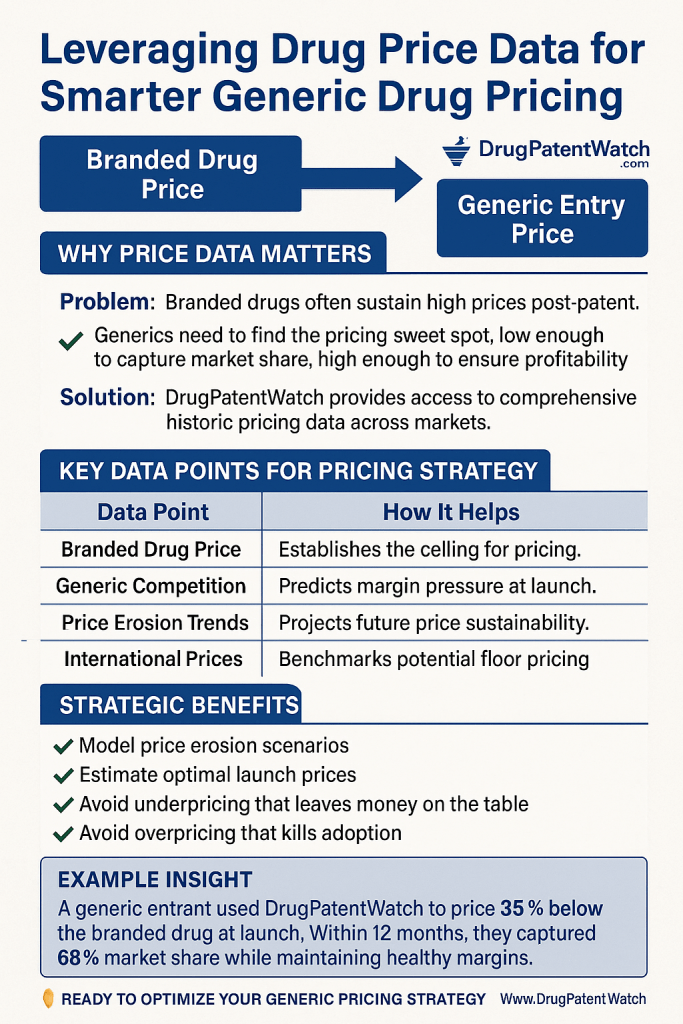
The global generic drug market reached approximately $412 billion in 2022 and is forecast to exceed $600 billion by 2030. Those headline numbers obscure what actually matters to a portfolio manager: the distribution of value across competitor cohorts is radically unequal. The first generic entrant, particularly one holding 180-day exclusivity, can capture 30-50% of the brand’s pre-entry revenue during its exclusivity window. The fifth or sixth entrant into the same market often operates near or below viable margin thresholds. Portfolio strategy, at its core, is about ensuring you are positioned in the first cohort, not the fifth.
In the United States, generic prescriptions account for roughly 91% of all dispensed prescriptions, yet generics represent only about 18-20% of total drug spend. That gap is the entire business model: enormous volume, compressed price per unit, with value concentrated at entry rather than through tenure. The companies that consistently monetize this model treat generic portfolio management as an intelligence operation, not a manufacturing exercise.
Global Generic Market (2022)
$412B
Forecast $600B+ by 2030
US Rx Dispensed Generic
~91%
Share of prescriptions, not spend
Price Erosion at 10+ Competitors
70-80%
vs. pre-generic brand price, 3 yrs post-entry
Price Erosion at ~3 Competitors
~20%
HHS Medicare data, 2007-2022
The Competitor-Count-to-Price Relationship Is Empirically Stable
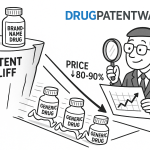
The HHS analysis of Medicare Part D and Part B claims data spanning 2007-2022 establishes a remarkably consistent relationship between competitor count and price levels. In markets with approximately three generic labelers, prices decline roughly 20% below the pre-generic brand price. Markets with ten or more labelers, measured three years after first generic entry, settle at a price ratio close to 0.30, meaning prices have fallen roughly 70% from the brand baseline. The erosion is non-linear: the steepest drop occurs when competitors two through four enter, and the curve flattens materially after six or seven competitors establish positions.
‘In markets with 10 or more labelers, the expected price ratio is close to 30%, implying a 70% decline in prices relative to the pre-generic entry price.’HHS Drug Competition Series: Effect of Market Entry on Generic Drug Prices, Medicare Data 2007-2022
This pattern is consistent across time periods in the dataset, though market size modifies the speed of erosion rather than the ultimate endpoint. Larger revenue opportunities attract competitors faster, meaning the 70-80% price floor is reached sooner in a $2 billion market than in a $200 million one. Portfolio models that apply identical erosion curves regardless of market size systematically overestimate revenue in large markets and underestimate durability in niche ones.
Why ‘Market Size’ Is a Lagging Indicator
Most generic portfolio teams size opportunities against current brand revenue. This is a useful but insufficient input. The relevant figure is the total addressable market at the projected entry date, discounted by expected volume losses from therapeutic class competition, label expansions by the brand, authorized generic agreements, and payer-driven access restrictions. A drug generating $1.5 billion annually today may face a structurally different market in 36 months if a new mechanism-of-action competitor achieves formulary parity. Forward-looking portfolio models must incorporate these demand-side variables, not just the supply-side patent cliff.
Key Takeaways: Section 01
Price erosion follows a non-linear curve tied to competitor count, not time alone. Model the competitor trajectory, not just the patent expiry date.
First-cohort entry in a large market is worth disproportionately more than late entry in any market. Portfolio value is heavily front-loaded.
Market sizing must account for demand-side dynamics at projected entry, not current brand revenue.
The 70-80% price floor at 10+ competitors is empirically stable across the 2007-2022 Medicare dataset but is reached faster in larger markets.
02
The Hatch-Waxman Framework: Regulatory Architecture as a Competitive Weapon
ANDA PathwayExclusivitiesIP Strategy
The Drug Price Competition and Patent Term Restoration Act of 1984, universally called Hatch-Waxman, created two parallel mechanisms that remain the structural foundation of generic market entry four decades later. On one side, the Abbreviated New Drug Application (ANDA) pathway eliminates the need for repeat clinical safety and efficacy trials by substituting bioequivalence data, reducing time-to-market by years and development costs by an order of magnitude relative to a 505(b)(1) NDA. On the other side, patent term restoration allows originators to recover, in theory up to five years of patent life lost to the regulatory review process, with a hard ceiling of 14 years of remaining exclusivity post-approval.
The strategic tension embedded in Hatch-Waxman is deliberate. The same statute that enables rapid generic approval also creates layered IP protections, from Orange Book-listed compound patents to use patents to NCE exclusivity, that sophisticated originators exploit to delay entry well beyond a molecule’s base patent expiration. Understanding how each protection layer interacts is the foundational competency for any generic IP team.
The ANDA Bioequivalence Standard: What ‘AB-Rated’ Actually Requires
An ANDA approval rests on demonstrating bioequivalence to the Reference Listed Drug (RLD), typically defined as the absence of a statistically significant difference in rate and extent of absorption (Cmax and AUC) when administered at the same molar dose under similar conditions. FDA’s regulatory standard requires that the 90% confidence interval for the geometric mean ratio of the generic to the reference fall within 80-125% for both Cmax and AUC parameters. Products meeting this standard receive an ‘AB’ therapeutic equivalence rating in the Orange Book, which signals substitutability to pharmacists and payers.
The practical importance of the AB rating extends beyond formulary access. Most state automatic substitution laws and PBM substitution programs operate on the AB equivalence code. A product without it may be technically approved but commercially limited, unable to capture the automatic substitution volume that drives generic economics. For complex products, particularly extended-release formulations, modified-release systems, and non-oral delivery forms, achieving AB rating may require additional in vitro dissolution testing or even in vivo pharmacokinetic studies beyond standard two-period crossover bioequivalence studies. These requirements should be identified and quantified at the go/no-go stage, not during development.
Exclusivity Layers: A Hierarchy Portfolio Teams Must Map
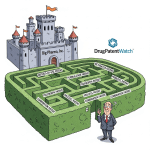
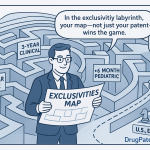
Hatch-Waxman and subsequent legislation created overlapping exclusivity provisions that can, when stacked, extend market exclusivity for years beyond a compound’s base patent. The exclusivity types that most commonly appear in Orange Book analysis include five-year New Chemical Entity (NCE) exclusivity, which blocks ANDA submission entirely for new molecular entities; three-year new clinical investigation exclusivity, which protects new formulations, new indications, or new combinations supported by new clinical studies; seven-year orphan drug exclusivity; six-month pediatric exclusivity, which functions as an add-on to whatever underlying exclusivity or patent protection exists; and the 30-month stay triggered by Paragraph IV litigation. Portfolio teams must map all active exclusivities for each target molecule, as FDA will not approve an ANDA while statutory exclusivity is in force regardless of patent status.
NCE exclusivity on a new molecular entity creates a hard statutory bar on ANDA submission for five years post-approval. However, a Paragraph IV ANDA may be submitted after four years if the challenge is to validity or non-infringement rather than to a formulation patent. This four-year submission window is a critical planning parameter for early movers targeting recently approved NCEs.
Pediatric exclusivity, granted under BPCA when sponsors conduct FDA-requested pediatric studies, attaches six additional months to all underlying patents and exclusivities, not just those protecting the studied formulation. A brand that successfully obtains pediatric exclusivity on a top-selling drug can delay all generic entry, even for already-challenged Paragraph IV applications, by six months.
Technology Roadmap: The ANDA Development Lifecycle
Stage 1 / Months 0-6
Feasibility & IP Assessment
Orange Book mapping, patent validity analysis, API sourcing assessment, initial bioequivalence strategy
Pilot/pivotal bioequivalence studies, ANDA assembly, site readiness, API DMF cross-reference
Stage 4 / Post-Submission
Review, Litigation & Launch
FDA review cycle (typically 10-12 months for para IV), 30-month stay management, at-risk launch assessment
Standard ANDA development timelines run 30-48 months from initiation to approval for straightforward oral solid dose products with unchallenged patents. Complex products, including modified-release formulations, non-oral routes, or drug-device combinations, regularly require 48-72 months. Paragraph IV litigation extends effective timelines by the duration of the 30-month stay, often the binding constraint on launch timing for high-value targets. These are not estimates; they are planning parameters that directly determine discounted cash flow projections and the NPV of any individual development decision.
Key Takeaways: Section 02
Map all Orange Book exclusivities for each target molecule before committing development resources. NCE, pediatric, and orphan exclusivities can create hard statutory bars that patents alone do not explain.
AB-rated equivalence is a commercial prerequisite, not just a regulatory checkbox. Products without it face automatic substitution barriers that cripple generic economics.
The four-year ANDA submission window for NCE-protected drugs is an underutilized entry point for early movers with strong patent challenge strategies.
ANDA development timelines must be modeled product-by-product, not from industry averages. Oral solid dose and complex injectables face structurally different clock speeds.
03
Paragraph IV Strategy and the IP Valuation of 180-Day Exclusivity
The Paragraph IV certification is the most consequential decision in generic portfolio management. By certifying that a listed Orange Book patent is invalid, unenforceable, or will not be infringed by the generic product, the first applicant to file earns a 180-day exclusivity period that no subsequent ANDA filer can displace, with narrow exceptions. During those six months, the first filer operates as the only generic manufacturer in a two-player market alongside the brand. In large therapeutic categories, this duopoly pricing environment can generate revenue equivalent to several times the total development and litigation cost of the program.
Quantifying the Economic Value of First-to-File Status
The simplest approximation of 180-day exclusivity value starts with the brand’s annualized net revenue, applies a generic price discount of 10-20% relative to brand (typical during the duopoly period), estimates a generic market share capture of 40-60%, and multiplies by the 0.5-year exclusivity window. For a brand generating $1 billion annually, this produces a rough gross revenue estimate of $200-300 million over the exclusivity period, before cost of goods, distribution, and royalties. Litigation costs for Paragraph IV cases typically run $5-20 million per case through trial, depending on complexity and duration, making the risk-adjusted return highly attractive for the right targets.
# Simplified 180-Day Exclusivity Value Model Brand Annual Revenue (Net) = $1,000M Generic Entry Price (% of Brand) = 80% [duopoly pricing, ~20% discount] Generic Market Share (excl. period) = 50% Exclusivity Duration = 0.5 years Gross Revenue Estimate = $1,000M × 80% × 50% × 0.5 = $200M Less: Development Cost = ($25M) Less: Litigation (para IV, est.) = ($12M) Pre-Tax Operating Contribution = ~$163M # Adjust for patent challenge probability (30-60% win rate historically) Risk-Adjusted Value @ 45% Win Rate = ~$73M
This simplified model understates value in two systematic ways. First, it does not capture the market positioning benefit: first-to-market generics establish formulary presence, pharmacy inventory positions, and contract relationships that persist well beyond the exclusivity period, generating above-average market share for years afterward. Second, it ignores the potential for shared exclusivity forfeiture by subsequent filers, which can convert a duopoly into an oligopoly if the first filer fails to trigger its exclusivity within prescribed timeframes.
IP Valuation of the Exclusivity Asset
From an IP asset valuation perspective, 180-day exclusivity functions as a time-limited statutory monopoly that, unlike a patent, cannot be licensed, sold as a standalone asset, or transferred independently of the ANDA application. Its valuation for balance sheet or M&A purposes follows an income approach: the present value of the incremental cash flow generated during the exclusivity period versus what the product would earn as a non-exclusive generic. This valuation input is material in ANDA portfolio acquisitions and in-licensing transactions, where buyers often pay significant premiums over manufacturing cost basis precisely because they are acquiring this exclusivity position.
In M&A transactions involving ANDA portfolios, Paragraph IV applications with valid first-to-file status are typically valued at 3-6x the valuation assigned to later-wave ANDAs for the same molecule, reflecting the exclusivity premium. Due diligence must confirm: (1) the specific patent(s) challenged, (2) the filing date relative to other known applicants, (3) whether forfeiture events have occurred or are pending, and (4) the current litigation posture. A first-to-file ANDA in active litigation with a 60% patent invalidation probability carries materially different value than one where a preliminary injunction has been denied.
Forfeiture provisions under the Medicare Modernization Act mean that exclusivity not triggered within 75 days of a final court decision or FDA approval triggers forfeiture to the next qualifying applicant. This forfeiture risk must be modeled explicitly in any ANDA portfolio valuation.
Paragraph IV Litigation Dynamics: Win Rates and Portfolio Strategy
Historical data on Paragraph IV litigation outcomes shows that generic challengers prevail in approximately 45-55% of contested cases, with significant variation by patent type. Method-of-use patents covering approved indications show higher invalidation rates than compound patents, where novelty challenges are harder to sustain. Formulation patents occupy the middle ground: they are often vulnerable on enablement or obviousness grounds when the formulation advance is incremental, but they require dedicated expert testimony and litigation investment that compounds total program cost.
Portfolio teams should categorize Paragraph IV opportunities by the type of patent being challenged. A first-to-file certification against a single composition-of-matter patent that expires in 18 months carries very different risk than a certification against a cluster of five patents covering compound, method of manufacture, method of use, and patient selection. The latter requires invalidating all relevant patents to avoid an injunction, raising litigation cost and duration. Multi-patent challenges should incorporate case-by-case probability weighting, not a blended industry average win rate.
Patent Type
Est. Generic Win Rate
Avg Litigation Duration
Strategic Consideration
Composition of Matter
35-45%
3-5 yrs
Hardest to invalidate; narrow claim scope is primary vulnerability
Formulation / Dosage Form
45-55%
2-4 yrs
Obviousness most common attack vector; prior art search critical
Method of Use (approved indication)
55-65%
2-3 yrs
Skinny labeling carve-out can bypass; induced infringement risk remains
Polymorph / Salt Form
50-60%
2-4 yrs
Anticipation and lack of unexpected properties are primary arguments
Process / Manufacturing
60-70%
2-3 yrs
Non-infringement often easier than invalidity; process design-around feasible
Investment Strategy: Paragraph IV Portfolio
Target products where the primary Orange Book patent is a method-of-use or process patent, not a composition-of-matter claim. Win rates are materially higher and design-around pathways may reduce litigation exposure.
Evaluate whether skinny labeling under 21 U.S.C. 505(j)(2)(A)(viii) can carve out patented indications, bypassing method-of-use patents entirely while still accessing major prescribing populations. GlaxoSmithKline v. Teva remains the controlling risk in this strategy.
Discount all Paragraph IV valuations by at least the base litigation cost ($8-15M) as a certain outlay before probability-weighting. Companies that ignore litigation cost in base-case models systematically overstate program economics.
In markets where three or more Paragraph IV filers have already secured first-to-file status (shared exclusivity), the duopoly economics no longer apply. Assess true net value after adjusting for an oligopoly pricing environment from day one of generic launch.
04
Price Erosion Modeling: Building Accurate Revenue Curves
rNPVErosion CurvesCompetitor Modeling
Price erosion modeling is where generic portfolio analysis generates or destroys the most value. Companies that use a single industry-average erosion curve across all products routinely misvalue their portfolios by 25-40%, sometimes in both directions simultaneously: overvaluing large-market entries where competitive intensity accelerates erosion, while undervaluing niche products where technical barriers sustain pricing well above the commodity floor.
The Four Erosion Determinants That Override Market Size
Market size drives the number of competitors who attempt entry but does not determine how quickly any individual product’s price erodes. Four product-level factors have greater predictive power: API complexity and sourcing concentration, dosage form manufacturing difficulty, distribution channel specialization, and therapeutic category prescribing dynamics. A drug dispensed primarily through specialty pharmacy in a restricted distribution program may sustain pricing at 40-50% of brand even with six competitors, because the access infrastructure creates barriers that raw competitor count does not capture. By contrast, a commodity oral solid dose product in retail pharmacy may see 70% erosion within the first 18 months if API supply is broadly available and entry barriers are minimal.
Segmented Erosion Curve Construction
Market Segment
Erosion at 3 Competitors
Erosion at 6 Competitors
Erosion at 10+ Competitors
Typical Time to 10+ Comps
Retail Oral Solid Dose, >$500M brand
~25%
~55%
~75-80%
12-24 months
Retail OSD, $100-500M brand
~20%
~45%
~70-75%
24-48 months
Modified-Release / Complex OSD
~15%
~35%
~60-65%
36-60 months
Injectable / Parenteral (hospital)
~10-15%
~30%
~55-65%
36-72 months
Specialty / Restricted Distribution
~10%
~20-30%
~40-55%
48-84 months
Biologics / Biosimilars
~15-25%
~25-40%
~40-60%
60-120 months
These ranges are approximations drawn from published HHS data and commercial channel analyses. Each product requires its own calibration. The operative question when building a forecast is not ‘what does the market typically do?’ but ‘how many competitors can realistically enter this specific product given API availability, manufacturing requirements, and economics, and on what timeline?’ That question requires intelligence gathering, not statistical averaging.
The rNPV Calculation: What to Include and What Gets Left Out
Risk-adjusted net present value (rNPV) is the correct valuation metric for generic development programs because it accounts for the probability of technical failure, regulatory rejection, patent litigation loss, and competitive preemption, each of which can terminate a program before it generates any return. A simplified rNPV model multiplies each period’s projected free cash flow by the cumulative probability of reaching that period, discounts at an appropriate WACC (typically 8-12% for generic programs), and sums across the projected commercial life.
# rNPV Framework for Generic Program rNPV = Σ [ (FCFt × Pt) / (1 + r)^t ] Where: FCFt = Free Cash Flow in period t Pt = Cumulative probability of reaching period t (P_technical × P_regulatory × P_litigation × P_commercial) r = Risk-adjusted discount rate (WACC, typically 8-12%) t = Period (years from today) # Typical probability assumptions for Paragraph IV ANDA P_technical (formulation success) = 0.80 P_regulatory (ANDA approval) = 0.85 P_litigation (para IV, mixed patent type) = 0.48 P_commercial (launch & market access) = 0.90 P_cumulative = 0.80 × 0.85 × 0.48 × 0.90 = 0.29 # Only 29% of para IV programs reach their full commercial projection
The compounded probability figure is sobering. A program with a 29% cumulative success probability needs a gross revenue potential sufficiently large to justify development investment in expected value terms. At $30 million total program cost and a 15% pre-tax margin target, the required gross revenue of the program in a success scenario exceeds $700 million. This calculation immediately filters out most sub-$100 million generic opportunities from Paragraph IV consideration, unless the program can be developed at below-average cost through platform formulation technologies or shared API development with companion products.
Key Takeaways: Section 04
Apply product-specific erosion curves, not industry averages. Complex dosage forms and restricted-distribution products sustain pricing significantly above commodity oral solid dose benchmarks.
Build competitor count trajectory models, not just endpoint assumptions. The speed of erosion is as important as the ultimate price floor for IRR calculations.
rNPV, not NPV, is the correct decision metric for programs with regulatory, technical, and litigation uncertainty. Cumulative probability of program success is typically 25-40% for contested Paragraph IV opportunities.
Authorized generic agreements by brand companies can effectively convert a 180-day exclusivity window into a three-player market from day one, materially eroding first-filer economics. Check brand authorized generic history before committing to Para IV programs.
05
Orange Book Intelligence: Reading Patent Estates as IP Assets
Orange BookPatent Term ExtensionPTAB
The FDA Orange Book, formally ‘Approved Drug Products with Therapeutic Equivalence Evaluations,’ is the primary public instrument for mapping the patent and exclusivity landscape of branded drugs. For every approved NDA, the Orange Book lists submitted patents by type (drug substance, drug product, method of use) along with their expiry dates and the applicable exclusivity end dates. Portfolio teams that rely solely on Orange Book data for patent expiry planning are making a systematic error: the Orange Book reflects what the brand submitted, not the full scope of intellectual property that might be asserted in litigation.
What the Orange Book Does Not Show
Several categories of patents routinely appear in Paragraph IV litigation but are not Orange Book-listed. Patents covering manufacturing processes, intermediates, metabolites, prodrugs, and drug-device combination components are not required to be listed. Brand companies may also hold patents on active metabolites, enantiomers, or salts that create design-around complexity for formulation-identical generics. A complete patent estate analysis requires searching the USPTO database, reviewing the brand’s continuation application history, monitoring divisional filings that frequently issue near patent expiry on the base compound, and tracking inter partes review (IPR) proceedings at the Patent Trial and Appeal Board (PTAB) that may have already invalidated or amended relevant claims.
Patent Term Extension and Restoration Mechanics
Under 35 U.S.C. 156, patent holders can apply for patent term extension (PTE) to recover time lost during the regulatory review process. The maximum recoverable extension is five years, subject to a ceiling of 14 years of remaining patent life after NDA approval. FDA and the USPTO jointly administer PTE, with FDA calculating the eligible term and the USPTO issuing the extension. Only one patent per approved product may receive a PTE, and only claims covering the approved active ingredient or an approved method of using it are extended. Portfolio teams must independently calculate the maximum allowable PTE for each targeted product rather than relying solely on Orange Book expiry dates, which may not reflect final USPTO determinations or litigation-driven adjustments.
The interaction between PTE, pediatric exclusivity, and NCE exclusivity creates layered protection scenarios that can push effective entry dates years beyond the base patent expiry. For example, a compound patent with a five-year PTE, followed by a six-month pediatric exclusivity add-on, can extend market protection to 5.5 years beyond what the base patent expiry suggests. Modeling only the patent expiry date in these scenarios produces optimistic entry projections that overstate program value.
PTAB Inter Partes Review as a Pre-Litigation Tool
IPR petitions at the PTAB provide an administrative mechanism to challenge patent validity on prior art grounds before or during ANDA-related district court litigation. Petitions must be filed within one year of service of an infringement complaint, and institution rates for pharma patents have historically run 60-70% of petitions filed. When instituted, PTAB proceedings typically conclude within 12-18 months, potentially invalidating claims faster than district court timelines. The strategic value of a coordinated PTAB-plus-district court defense is significant: winning an IPR on a claim subset forces claim narrowing that may resolve the infringement question, or produces cancellations that eliminate stay-triggering patents entirely, accelerating FDA’s ability to approve the ANDA.
Investment Strategy: Orange Book & IP Analysis
Commission a full freedom-to-operate analysis before ANDA submission that goes beyond Orange Book listings to include non-listed process and intermediate patents. The cost of this analysis is small relative to the cost of a surprise injunction at launch.
Monitor continuation application filing activity for target brands. New patents issuing from continuations near a product’s patent cliff are a known evergreening tactic and create pre-launch litigation risk that standard Orange Book watch programs miss.
Evaluate PTAB IPR as a strategic accelerant on high-value targets where Orange Book-listed formulation patents are the primary bar. A successful IPR can eliminate the 30-month stay trigger entirely if the challenged claims are cancelled before the ANDA is approved.
06
Evergreening Tactics Decoded: The Brand Playbook and How to Counter It
Evergreening is the systematic extension of market exclusivity beyond a compound’s base patent life through sequential intellectual property filings and regulatory strategy. It is not a single tactic but a portfolio of techniques that, when executed in combination, can delay meaningful generic competition for five to ten years past the original compound patent expiry. Generic portfolio teams need a taxonomy of these tactics to anticipate delays and price their programs accordingly.
Formulation Patents
New patents on extended-release systems, drug-polymer matrices, or novel excipient combinations. Filed to cover improvements that may or may not offer clinical benefit over existing formulations.
Polymorph Patents
Patents on specific crystalline or amorphous forms of the active ingredient. Routinely challenged for lack of unexpected properties relative to the base compound, but force generics to use different manufacturing processes.
Product Hopping
Reformulation of a drug (e.g., IR to XR) followed by promotional conversion of the patient base before generic entry on the original formulation. Abbott’s Depakote ER switch is the canonical example.
Method-of-Use Patents
Patents on specific dosing regimens, patient populations, or treatment sequences. Protected indications can be labeled around via ‘skinny labeling,’ though induced infringement risk under Teva v. GSK persists.
Pediatric Exclusivity Farming
Conducting FDA-requested pediatric studies to obtain the six-month BPCA exclusivity add-on. Adds six months to all underlying patents and exclusivities across the entire drug, not just the studied indication.
Authorized Generic Agreements
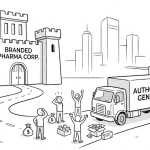
Brand launches its own authorized generic (AG) simultaneously with the first filer, converting 180-day duopoly economics into three-player competition. Raises antitrust questions when structured as reverse payment settlements.
Pay-for-Delay (Reverse Payment)
Settlements where the brand compensates the Paragraph IV filer to delay launch. FTC v. Actavis (2013) requires rule-of-reason antitrust analysis; large unexplained payments above avoided litigation cost create liability exposure for both parties.
REMS Abuse
Leveraging Risk Evaluation and Mitigation Strategy programs to deny generic manufacturers access to drug samples needed for bioequivalence testing. FDA Reauthorization Act of 2017 added REMS-sharing provisions to limit this tactic.
The most durable evergreening strategies combine multiple tactics across a single product. AbbVie’s patent estate strategy around Humira (adalimumab) became a benchmark for aggressive IP lifecycle management, eventually assembling over 130 U.S. patents through a combination of formulation, method-of-use, manufacturing process, and device patents. The result was a 20-year delay in biosimilar market entry in the United States beyond the original compound’s protection, despite biosimilars launching in Europe in 2018. Quantifying the cost of this delay: independent analyses estimated that U.S. biosimilar entry would have saved the healthcare system $5-10 billion annually had the 2018 European entry timeline applied domestically.
The most durable evergreening is invisible to a standard Orange Book watch: continuation patents filed on manufacturing improvements, device components, and patient monitoring systems, none of which require Orange Book listing.
Counter-Evergreening Strategy for Generic Teams
The most effective response to a deep patent estate is a phased entry plan that addresses the brand’s market transition, not just its patent calendar. When a brand is actively converting its prescribing base from the original formulation to a reformulated product protected by newer patents, a generic of the original formulation captures a shrinking market. Portfolio teams should model reformulation risk explicitly: if the brand has filed NDA supplements for a new formulation and is running detailing campaigns to convert prescribers, the relevant market for the ANDA target may be 40-60% smaller by the anticipated launch date than current IMS/IQVIA data suggests.
On the intellectual property side, a coordinated IPR strategy targeting the formulation and polymorph patents in the brand’s estate, filed concurrent with or shortly after ANDA submission, can collapse the effective exclusivity timeline by eliminating patents before they trigger a 30-month stay or post-launch injunction. This requires upfront investment in prior art searching and claim mapping, but the cost is trivial relative to the commercial impact of eliminating a two to three year litigation delay on a high-value generic program.
Key Takeaways: Section 06
Evaluate product hopping risk for every target. If the brand has filed NDA supplements for a new formulation, model the fraction of prescriptions migrating to the protected reformulation before your projected ANDA launch.
Authorized generic launch by the brand at day one of generic market entry converts 180-day duopoly economics into three-player competition. Check brand AG history and contractual AG commitments in settlement agreements before committing to Para IV programs.
Reverse payment settlements are subject to FTC antitrust scrutiny under the rule of reason. Unexplained value transfers above saved litigation costs create regulatory risk that must be considered when evaluating settlement offers from brand companies.
Coordinated IPR-plus-ANDA strategies on formulation and polymorph patents are underutilized by mid-size generic companies. The PTAB institution rate for pharma patents remains 60-70%, and successful IPRs can collapse effective exclusivity timelines by years.
07
Biosimilar Entry: Separate Rules, Higher Stakes, Different IP Architecture
Biosimilar entry operates under a completely separate statutory and regulatory framework from ANDA-based small molecule generics. The Biologics Price Competition and Innovation Act (BPCIA), enacted as part of the Affordable Care Act in 2010, created the 351(k) biosimilar pathway and introduced a set of IP dispute resolution procedures, informally called ‘the patent dance,’ that have no analog in the ANDA process. Portfolio teams treating biosimilars as large-molecule equivalents of small molecule generics will consistently misvalue these programs and misallocate development resources.
Reference Product Exclusivity: The 12-Year Bar
BPCIA grants reference product sponsors (the originator biologic manufacturer) a 12-year period of reference product exclusivity (RPE) during which FDA cannot approve a 351(k) biosimilar application. Biosimilar applications may be submitted four years after reference product licensure, but approval cannot occur before the 12-year exclusivity period expires. This 12-year window is the single most consequential structural difference between small molecule generics and biosimilars from a portfolio timing perspective. A biologic approved in 2015 cannot face an approved biosimilar competitor before 2027 regardless of patent status, and patent litigation timelines routinely extend the effective entry date beyond the RPE endpoint.
Biosimilar Interchangeability Designation: IP Value and Prescribing Impact
A biosimilar approved as ‘interchangeable’ under BPCIA meets a higher evidentiary standard than standard biosimilar approval, requiring demonstration that the product can be expected to produce the same clinical result in any given patient and that the risk of alternating between the reference product and the biosimilar is not greater than the risk of using the reference product alone. The commercial significance of biosimilar interchangeability designation is substantial in the U.S. market: interchangeable biosimilars are eligible for automatic pharmacy-level substitution under state substitution laws, analogous to the AB rating for small molecule generics.
The first biosimilar to receive interchangeability designation for a given reference product holds an exclusivity period of one year, or until a second biosimilar achieves interchangeability designation for the same reference product, whichever comes first. This first-interchangeable exclusivity is a meaningful IP asset in high-volume subcutaneous biologics administered in retail pharmacy or specialty pharmacy settings, where automatic substitution drives significant volume without prescriber engagement. For biologics administered in hospital or outpatient infusion settings, the interchangeability designation has less commercial impact because substitution decisions are made by institutional pharmacy and therapeutics committees rather than at the dispensing counter.
The Patent Dance: A Technology Roadmap for BPCIA IP Disputes
Step 1 / Filing
351(k) Application Submitted
Biosimilar applicant notifies reference product sponsor within 20 days of FDA acceptance
Step 2 / 60 Days
Information Exchange
Applicant provides application and manufacturing information; sponsor provides patent list (List A)
Step 3 / 60 Days
Applicant’s Statement
Applicant provides detailed statement of non-infringement or invalidity for each List A patent
Step 4 / 60 Days
Negotiation & Litigation List
Parties negotiate which patents to litigate in first wave; sponsor may add List B patents
The patent dance is optional for biosimilar applicants under the Supreme Court’s Sandoz v. Amgen (2017) ruling, which held that applicants may elect to skip the exchange process and instead provide the reference product sponsor with a 180-day pre-commercial marketing notice. Opting out of the patent dance forfeits the applicant’s right to obtain a declaratory judgment on non-listed patents, but it simplifies the litigation posture and avoids early disclosure of manufacturing information that the sponsor could use to prepare a more comprehensive infringement case. Whether to engage or opt out of the patent dance is a case-specific IP strategy decision that should be made with patent counsel well before 351(k) application submission.
IP Valuation of Biosimilar Development Programs
Biosimilar development costs run $100-250 million per program, roughly 10-20 times the cost of a complex small molecule ANDA. The higher cost reflects cell line development and optimization, upstream and downstream bioprocessing development, extensive analytical characterization to demonstrate structural and functional similarity, and large-scale comparative clinical immunogenicity studies. The higher cost basis requires correspondingly higher revenue potential to produce acceptable rNPV, which is why commercially viable biosimilar programs concentrate on high-revenue reference biologics, typically products generating $1 billion or more annually in the U.S. market.
The IP asset value of an approved biosimilar derives from three sources: the regulatory data package itself (which cannot be disclosed to or relied upon by subsequent applicants without consent), any manufacturing process patents held by the biosimilar developer, and any interchangeability designation. In M&A contexts, biosimilar programs in late-stage development are valued primarily on their probability-weighted commercial launch projections and on the regulatory package’s defensibility against subsequent entrants. Unlike ANDA programs, where the underlying molecular entity is identical to the reference product, biosimilar commercial value is partly a function of the specific manufacturing platform and the analytical data demonstrating similarity, which are proprietary.
Key Takeaways: Section 07
Model the 12-year reference product exclusivity as a hard planning constraint. Biosimilar programs targeting biologics approved after 2018 face RPE expiry dates that push earliest possible approval past 2030.
Biosimilar interchangeability designation carries IP-like commercial value in retail and specialty pharmacy settings. First-interchangeable status generates automatic substitution volume that standard biosimilar approval does not.
The patent dance opt-out decision under Sandoz v. Amgen involves real trade-offs: faster litigation posture and less early disclosure vs. loss of declaratory judgment rights on non-listed patents. Do not default to either strategy without case-specific analysis.
Biosimilar programs require rNPV thresholds at least 10-15x higher than complex small molecule ANDAs to justify development costs. Program selection filters should reflect this cost differential explicitly.
08
Portfolio Construction: Scoring, Weighting, and Strategic Balance
Portfolio DesignDiversificationRisk Balancing
A generic portfolio is not a collection of individual product decisions. It is a capital allocation system with interdependencies across development resources, manufacturing capacity, regulatory bandwidth, and commercial infrastructure. Treating each program in isolation produces a portfolio that is systematically overweighted in technically similar products (because those are the easiest to evaluate by the teams doing the analysis), underweighted in specialty formats (because they require non-standard evaluation skills), and exposed to correlated risks that only become visible at the portfolio level.
The Four-Segment Portfolio Model
A workable strategic segmentation for generic portfolio construction uses four categories that differ in risk profile, capital requirement, and expected return. Paragraph IV first-filer programs are high-risk, high-return bets that function as the portfolio’s value drivers: they consume disproportionate IP and legal resources, generate outsized returns if successful, and should be limited to the number of programs the company can genuinely execute at high quality. Early-wave programs, meaning standard ANDA filings targeting products with patent expiry within two to four years, are the portfolio’s workhorses: moderate investment, predictable competitive dynamics, and returns proportional to entry timing relative to the competitive wave. Niche and complex product programs target markets with higher technical barriers, fewer competitors, and more durable pricing; they require specialized formulation or manufacturing capabilities but generate better margin sustainability than commodity generics. Biosimilar programs, where the company has the relevant bioprocessing capability, represent the strategic frontier: long development lead times, high capital intensity, but access to reference products whose revenues dwarf the typical small molecule generic target.
Weighted Scoring Methodology
Consistent portfolio scoring across these four segments requires a weighted multi-criteria framework that avoids the recency bias and champion-driven overvaluation that plague informal prioritization processes. A well-constructed scoring model weights rNPV as the primary financial metric (typically 35-40% of total score), applies competitive position assessment including first-filer probability and expected competitor count (20-25%), evaluates manufacturing and technical feasibility against the company’s existing platform (15-20%), incorporates IP and regulatory risk (15%), and adjusts for strategic fit with therapeutic focus, commercial capabilities, and existing customer relationships (10-15%). The specific weights should reflect the company’s strategic situation: a generic manufacturer with a strong injectables platform should weight manufacturing fit more heavily, because the platform capability creates a competitive advantage that a commodity oral solid dose operation does not possess.
Portfolio-Level Risk Monitoring
Beyond individual program scoring, portfolio managers need visibility into risk concentrations at the aggregate level. Common risk concentrations in generic portfolios include API supply dependency (multiple products sourcing from a single Indian or Chinese supplier), therapeutic category clustering (over-representation in, for example, CNS or cardiovascular with exposure to formulary restructuring by major PBMs), and litigation timeline correlation (multiple Paragraph IV programs against the same originator brand company, creating bundled risk of coordinated litigation strategy). Regular portfolio-level risk review, conducted at minimum annually and ideally at each stage-gate decision, should flag these concentrations and prompt explicit discussion of mitigation strategies.
Investment Strategy: Portfolio Construction
Limit Paragraph IV programs to those where the company can deploy best-in-class IP counsel and formulation expertise. A weak Para IV execution is worse than no Para IV program: it consumes resources, potentially loses shared exclusivity to stronger filers, and generates litigation adverse outcomes that damage future programs in the same portfolio.
Size the niche and complex product segment of the portfolio to provide earnings stability against the lumpiness of Para IV outcomes. A portfolio entirely composed of high-risk first-filer programs produces volatile quarterly performance that is difficult to manage operationally and unacceptable to institutional investors.
Evaluate API supply diversification as a portfolio-level risk KPI, not a product-level one. A company that has 40% of its pipeline dependent on a single API supplier in Hyderabad faces a systemic supply risk that individual program assessments will not capture.
09
Advanced Analytics and Machine Learning for Price Forecasting
ML ForecastingMonte CarloScenario Planning
The core limitation of traditional price erosion models is that they extrapolate historical patterns onto future markets without accounting for structural changes in competitive dynamics, payer behavior, or supply chain economics. Machine learning approaches address this limitation by identifying non-linear interactions between variables that linear regression models miss, and by updating predictions as new market data is incorporated. For generic portfolio management, the most valuable ML applications cluster around three use cases: competitor entry timing prediction, price floor estimation by product type and market structure, and anomaly detection for early warning of supply-driven pricing deviations.
Gradient Boosting Models for Competitive Entry Prediction
Gradient boosting ensemble methods (XGBoost, LightGBM) have shown the strongest predictive performance in published pharmaceutical market entry modeling tasks because they handle categorical features effectively (therapeutic class, dosage form, brand company) and are robust to incomplete feature sets, which are common in pharmaceutical datasets where some market characteristics are partially observable. A well-trained gradient boosting model for competitor entry timing incorporates features including brand revenue at patent expiry, API supplier count in public Drug Master File (DMF) data, number of pending ANDAs for the molecule (available from FDA’s ANDA queue data), historical entry counts for structurally similar products, and market concentration indices for the relevant therapeutic category. Trained on five to eight years of historical launch data, these models can predict the 12-month probability of a 10+ competitor market environment with substantially higher accuracy than the historical averages typically used in spreadsheet-based portfolio models.
Monte Carlo Simulation for Revenue Distribution Analysis
A single-point NPV estimate for a generic program is an artifact, not a forecast. The actual revenue outcome for any program follows a distribution that reflects uncertainty in launch timing, competitor entry counts, price erosion speed, market share capture, and payer access dynamics. Monte Carlo simulation replaces point estimates with probability distributions for each key input and runs thousands of iterations to produce a revenue distribution showing the range of outcomes and their relative likelihoods. The output, a probability distribution rather than a single number, is far more useful for resource allocation: it shows the probability of achieving the minimum acceptable return, the probability of recouping development cost, and the tail risk of a severely adverse outcome (e.g., a brand successfully obtaining a preliminary injunction or a second filer triggering shared exclusivity).
Practical implementation requires disciplined distribution assignment. Launch timing uncertainty typically follows a log-normal distribution centered on the median regulatory review plus litigation timeline with variance reflecting historical dispersion for comparable programs. Competitor count uncertainty at a specified time post-launch is best modeled from observed historical distributions for comparable molecule types and market sizes. Price at each competitor count is best taken from the empirically stable HHS erosion data with variance applied based on product-specific factors. Building these distributions requires historical data discipline that many generic companies have not invested in, but the competitive advantage of accurate range forecasting over point estimation is substantial.
Key Takeaways: Section 09
Single-point NPV estimates are artifacts. Monte Carlo simulation on key input variables produces revenue distributions that are far more useful for capital allocation decisions, particularly for Para IV programs where outcome variance is high.
ANDA queue data from FDA is a publicly available leading indicator of competitive entry. Products with five or more pending ANDAs in the queue at patent expiry will reach the 10+ competitor price floor faster than generic model assumptions typically reflect.
Machine learning price models trained on historical market data outperform linear regression on non-linear competitive dynamics, but require disciplined feature engineering. A model trained on commodity oral solid dose data will not generalize to specialty injectables without retraining on category-specific data.
10
Cross-Functional Integration: Where Portfolio Strategy Dies in Execution
The gap between portfolio strategy and commercial outcome in generic pharmaceutical companies is almost always an execution problem, not an analysis problem. Formulation teams evaluate products through the lens of technical feasibility; commercial teams through revenue potential; regulatory affairs through submission timelines and risk; manufacturing through capacity and process fit. Without a governance structure that forces these perspectives into a single scoring framework at defined decision points, high-value programs get killed by local resource constraints and low-value programs persist because they are technically easy. The most common failure mode is the ‘orphan project’: a program that passes technical review but has never had a rigorous commercial analysis, or one that has a compelling commercial case but whose manufacturing requirements have not been assessed against actual plant capacity.
Stage-Gate Architecture for Generic Programs
A four-gate development model provides the decision structure most generic companies need. Gate 1, at program initiation, requires a minimum commercial threshold (typically positive rNPV above a defined hurdle with a stated set of competitive assumptions), a preliminary IP clearance opinion, and a manufacturing feasibility assessment. Programs that cannot clear all three criteria at Gate 1 should not receive formulation development resources. Gate 2, at the pre-bioequivalence development milestone, requires an updated commercial model reflecting current competitive intelligence, a completed prior art search and infringement analysis for non-Orange Book patents, and a confirmed API source with DMF status. Gate 3, at ANDA submission, requires an approved litigation strategy for any Paragraph IV certification and a commercial launch readiness plan including distribution agreements and pricing strategy. Gate 4, post-approval, governs at-risk launch decisions for programs still in active litigation, requiring formal legal and commercial authorization at the senior leadership level.
‘With a more comprehensive view of a pharmaceutical portfolio, stakeholders across R&D can gain a broader perspective of the pipeline, identifying areas that may not align with strategy.’Pharmaceutical Portfolio Management: A Complete Primer
The at-risk launch decision at Gate 4 is the most consequential and least formally governed decision in most generic companies. Launching a product while Paragraph IV litigation is still active exposes the company to a permanent injunction and, potentially, disgorgement of profits if the court finds in the brand’s favor. The potential rewards, particularly for first-to-file exclusivity programs, are enormous: capturing market position before the litigation concludes. But the analysis must include a genuine assessment of preliminary injunction probability, which depends on the likelihood of success on the merits and the irreparable harm standard, not simply enthusiasm about the commercial opportunity. Companies that have lost at-risk launch bets have faced profit disgorgement awards that wiped out multiple years of earnings from the program.
11
Risk Quantification: Supply Chain, Regulatory, and Litigation
API SourcingLitigation RiskComplete Response Letters
API Sourcing Concentration Risk
The U.S. generic drug market’s structural dependence on API production concentrated in India and China creates correlated supply risk that individual program assessments routinely underestimate. FDA warning letters to API manufacturers in these geographies, which have historically run 60-80 per year for Indian facilities alone, can disrupt supply chains with no pre-launch warning. Programs where the only viable API source is a single supplier operating under a pending FDA Form 483 observation carry a supply disruption probability that should be explicitly modeled in the program’s risk-adjusted timeline, not treated as a zero-probability event. Drug shortages in the U.S. market follow API supply disruptions with a lag of 6-18 months, and the programs most vulnerable are those with a single qualified API supplier and a high drug-to-excipient ratio that makes reformulation with an alternative API impractical.
Complete Response Letters and Approval Cycle Delays
FDA’s Complete Response Letter (CRL) rate for ANDAs is lower than for NDAs, but CRLs on first-cycle ANDA review remain a material timeline risk, particularly for products requiring complex dissolution testing, products referencing older RLDs with limited publicly available characterization data, and applications from facilities that received observations during the review cycle. A first-cycle CRL adds 12-18 months to the approval timeline in most cases, shifting competitive position from potential first-wave to second-wave entry and correspondingly reducing program rNPV. ANDA programs with first-cycle CRL probability above 20% (estimated based on the formulation type, facility history, and reference product characteristics) should carry an explicit timeline buffer and a contingency rNPV reflecting the second-wave pricing environment.
Quantifying Litigation Cost as a Portfolio Budget Item
Generic companies with active Paragraph IV litigation portfolios routinely have 15-30 open patent cases at any given time. Total annual litigation spend for a mid-size generic company with an active Para IV program commonly runs $40-80 million. This spend is a de facto R&D budget item that must be planned against available resources: committing to an additional Paragraph IV filing requires budgeting $8-20 million in litigation reserve, not just formulation development costs. Companies that do not treat litigation cost as a portfolio-level budget item end up with more cases open than they can staff adequately, leading to adverse outcomes on otherwise strong programs.
Key Takeaways: Section 11
Model API supply concentration as a portfolio-level risk, not a product-level one. More than 40% pipeline dependence on a single geography or supplier creates systemic exposure that individual program rNPV calculations do not surface.
CRL probability should be estimated by formulation type and facility history at the ANDA submission gate, with an explicit timeline buffer for programs above a 20% first-cycle CRL probability threshold.
Paragraph IV litigation spend must be budgeted as a portfolio-level item. The number of simultaneously active litigation cases a company can execute at adequate quality is a real capacity constraint that limits how many Para IV programs the portfolio should carry.
12
Global Market Expansion: Regulatory Arbitrage and Reference Pricing Complexity
EMA / EUInternational Reference PricingEmerging Markets
Multi-market generic portfolio strategy introduces a layer of regulatory and pricing complexity that single-market analysis cannot anticipate. The European Medicines Agency’s decentralized and mutual recognition procedures for generic approval differ structurally from ANDA pathways in submission requirements, data protection periods, and bioequivalence acceptance criteria. EU data protection provides 10 years of market exclusivity for reference products (the ‘8+2+1’ system: eight years of data exclusivity, two years of market protection during which the generic can receive approval but cannot launch, and one additional year if the originator gains approval for a new indication during the data exclusivity period). This protection is entirely separate from patent rights and must be mapped independently for EU market entry planning.
International Reference Pricing and Cross-Border Price Spillover
Approximately 25 countries use some form of international reference pricing (IRP), meaning they set or benchmark domestic drug prices against prices in a basket of reference countries. The practical consequence for generic portfolio strategy is that pricing decisions in one market can automatically affect the reimbursable price in others. A generic launch in Germany at a deeply discounted price may anchor the reference price calculation for Austria, Belgium, Greece, and several non-EU markets that use German prices as a reference. Companies with multi-market portfolios must model these IRP cascades before setting entry prices in any reference country, because the cross-border price impact may cost more in aggregate market value than the incremental volume gained from aggressive pricing in the initial launch market.
This dynamic is particularly acute for biosimilars, where European markets have longer biosimilar experience than the United States, biosimilar penetration rates are higher, and tender-based procurement in hospital settings drives price to levels that, if used as IRP anchors, would make U.S. commercial economics unviable. A European biosimilar launch strategy must explicitly account for IRP feedback into other markets and, where necessary, accept volume limitations in European tenders to protect the pricing architecture in larger revenue markets.
Investment Strategy: Global Portfolio Expansion
Sequence global launches to protect the highest-value market’s pricing architecture. Launch in high-price markets before IRP reference countries to establish the price anchor rather than being anchored by it.
Evaluate EU data protection periods independently of patent mapping for European market entry. The ‘8+2+1’ system may block market launch even when all relevant patents have expired or been successfully challenged.
In emerging markets, prioritize products where WHO prequalification or EMA Article 58 status provides a credentialing shortcut around full domestic registration dossiers. These regulatory pathways dramatically reduce the cost and timeline of multi-market registration programs.
13
Frequently Asked Questions
Q How many generic competitors typically enter after patent expiration, and how fast does the market reach commodity pricing?
Competitor entry velocity depends primarily on market revenue and product complexity. For oral solid dose products with brand revenues above $500 million, five to eight ANDA applications are typically pending in FDA’s queue at the patent expiry date, and the market reaches a 10+ competitor environment within 12-24 months of first generic entry. Products with brand revenues below $100 million or with significant formulation complexity may see two to four competitors enter over 36-60 months and never reach the 70-80% price erosion threshold, settling instead at 40-55% erosion with sustained margin. Portfolio managers should pull the current FDA ANDA queue count for any target molecule as a real-time leading indicator, since this data is publicly available and updates faster than any commercial data service.
Q What is the standard price erosion pattern once generics enter the market?
Price erosion follows a non-linear, competitor-count-driven pattern. At approximately three generic labelers, prices average roughly 20% below pre-generic brand price. At six competitors, prices fall to approximately 40-55% of brand price. At 10 or more competitors measured three years after first entry, prices settle around 20-30% of the original brand price, implying 70-80% erosion. The steepest decline occurs when competitors two through four enter; the erosion rate flattens significantly after six or seven labelers establish market positions. This pattern is consistent across the 2007-2022 Medicare data analyzed by HHS, though it compresses in timeline for larger markets and extends in markets with API supply constraints or manufacturing complexity.
Q How should a company evaluate whether to file a Paragraph IV certification?
The evaluation requires four parallel analyses before a decision is made. First, patent strength assessment: a detailed claim mapping and prior art search to estimate the probability that the challenged patent is invalid or non-infringed, by patent type. Second, market value under exclusivity: a model of expected revenue during the 180-day window accounting for brand authorized generic risk, projected market share, and realistic duopoly pricing. Third, litigation cost and timeline: a budget reserve for the expected litigation cost through district court and potentially appellate review, and a timeline model for the 30-month stay and its impact on the program’s IRR. Fourth, first-filer status confirmation: verification that no earlier ANDA with a Paragraph IV certification was submitted, including a review of any public court dockets or FDA Orange Book-listed patent challenge history. Programs that produce positive risk-adjusted NPV after explicitly incorporating these four inputs are Para IV candidates; programs that require optimistic assumptions on more than one input to reach positive rNPV are not.
Q What data sources should a portfolio manager prioritize for competitive intelligence?
The highest-signal public data sources, in approximate priority order: FDA’s ANDA queue data (pending applications by molecule, updated weekly, publicly available), the Orange Book (patent and exclusivity listings, updated monthly), PTAB ESTT (IPR petition and institution data, updated continuously), federal court PACER dockets (active Para IV litigation filings), and the FDA Drug Shortages database (early warning of supply disruption in existing competitor products). Commercial sources add pricing transaction data, market share, and IMS/IQVIA volume trends that are not available from public sources. For biosimilars, the FDA’s Biosimilar Product Development Meeting database and the Purple Book are the equivalents of the Orange Book and ANDA queue. Building an intelligence workflow that systematically monitors these sources at defined frequencies, rather than conducting ad hoc searches at decision points, produces a sustained competitive advantage over teams that rely on periodic commercial reports alone.
Q What organizational structure is most effective for generic portfolio governance?
Effective portfolio governance requires a cross-functional portfolio management committee with defined decision rights, not a single-function owner. The committee should have mandatory representation from R&D, regulatory affairs, IP and legal, manufacturing, supply chain, and commercial finance. Decision authority should be tiered by program investment size: programs below a defined development cost threshold can be approved at the committee level; programs above it require C-suite sign-off. Stage-gate criteria must be specific and pre-defined, not qualitative. A program that clears Gate 1 with a positive rNPV calculated under stated competitive assumptions should face a formal re-evaluation if any of those assumptions change materially before Gate 2. Companies that run portfolio governance as a bureaucratic process rather than a genuine capital allocation discipline will find that their stage-gate approvals are disconnected from actual strategic priorities, and that programs persist past their economic viability because nobody has the authority or the incentive to kill them.
Sources and Data References
HHS Drug Competition Series: Effect of Market Entry on Generic Drug Prices, Medicare Data 2007-2022. U.S. Department of Health and Human Services, Office of the Assistant Secretary for Planning and Evaluation.
Portfolio Management for Generics: 40 Years of Evolution and Rising Complexity. IQVIA Institute for Human Data Science, 2022.
Estimating the Effect of Entry on Generic Drug Prices Using Hatch-Waxman. Journal of Health Economics, 2020.
How to Conduct Effective Generic Drug Market Analysis. DrugPatentWatch, 2024.
Pharmaceutical Portfolio Management: A Complete Primer. Industry working group publication, 2023.
Sandoz Inc. v. Amgen Inc., 582 U.S. 1 (2017). Supreme Court of the United States.
FTC v. Actavis, Inc., 570 U.S. 136 (2013). Supreme Court of the United States.
FDA Orange Book: Approved Drug Products with Therapeutic Equivalence Evaluations, 44th Edition. U.S. Food and Drug Administration.
FDA Biosimilar Product Development Meeting Public Database. U.S. Food and Drug Administration, 2024.