A Strategic Guide for Pharmaceutical IP Professionals, Formulation Scientists, and Generic Drug Developers
Introduction: Why Patent Claims Decide Who Wins the Drug Market
The difference between a generic drug that reaches pharmacy shelves in 2026 and one stuck in litigation until 2034 often comes down to a single paragraph in a patent claim. Not the molecule, not the clinical trial data, not the manufacturing capacity. A claim. Specifically, the words chosen by a patent attorney in a filing room years before the product launched.
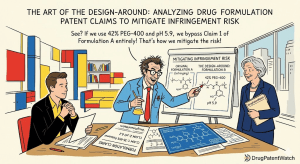
Design-around strategies are how generic manufacturers, follow-on brand developers, and specialty pharma companies turn that reality into competitive advantage. A design-around is a deliberate reformulation or process modification that produces a drug product achieving the same therapeutic goal as a patented product while remaining outside the legal scope of the patent claims. It is not infringement. It is engineering.
The pharmaceutical industry offers particularly fertile ground for design-around work because formulation patents operate differently from composition-of-matter (small molecule) patents. A composition patent claims the active molecule itself and is, practically speaking, impenetrable until it expires. A formulation patent claims a specific way of making or delivering that molecule. Those claims carry gaps, limitations, and prosecution history that skilled analysts can exploit.
This article walks through the full anatomy of drug formulation patent claims, the legal framework governing their scope, the specific formulation categories most vulnerable to design-arounds, and a step-by-step process for executing one without creating new infringement exposure. Where instructive, real drug products illustrate each concept.
Patent intelligence platforms like DrugPatentWatch have become indispensable at the front end of this process. They aggregate Orange Book listings, patent term extensions, regulatory exclusivities, and litigation histories in a single searchable interface, saving analysts weeks of manual research that previously required combing through FDA databases, USPTO records, and court filings separately.
The commercial stakes justify the investment in rigorous design-around analysis. The global generic pharmaceuticals market reached approximately $490 billion in 2022 and is projected to exceed $700 billion by 2028 (Grand View Research, 2023) [1]. Each patent successfully designed around represents a direct path into that market without the litigation cost, settlement risk, or delay associated with a patent challenge.
Section 1: Patent Claim Anatomy – The Foundation of Every Design-Around
Independent vs. Dependent Claims
Every patent contains at least one independent claim and typically a set of dependent claims. An independent claim stands on its own and defines the broadest scope of protection. A dependent claim incorporates all the limitations of the independent claim it references and adds at least one more. That structure matters enormously for design-around strategy.
When analyzing a formulation patent, start with the independent claims. If your proposed product falls outside all of their limitations, you have no infringement regardless of what the dependent claims say. Dependent claims only add restrictions; they never expand the scope beyond the independent claim they depend from. A product that does not infringe Claim 1 cannot infringe Claim 3 if Claim 3 depends from Claim 1.
The practical workflow: map your proposed formulation against each independent claim. For each limitation in each claim, determine whether your formulation reads on that limitation, either literally or under the doctrine of equivalents (addressed in depth in Section 3). Only after concluding that a product reads on an independent claim does it make sense to analyze dependent claims.
Claim Language and Functional vs. Structural Limitations
Formulation patent claims use two broad types of limitations: structural and functional. A structural limitation describes a specific physical or chemical property. Examples include: “a hydroxypropyl methylcellulose matrix having a viscosity grade of K4M,” “a polymer coating comprising ethyl cellulose in an amount of 10% to 30% by weight,” or “spray-dried solid dispersion comprising a drug-polymer ratio of 1:2.” These are measurable, concrete, and relatively easy to design around because substituting a different material or different proportion takes the product outside the claim.
A functional limitation describes what something does rather than what it is. Examples include: “a release rate controlling polymer,” “a solubilizing agent sufficient to achieve at least 80% dissolution in 45 minutes,” or “an absorption enhancer.” Functional limitations are far more dangerous for design-around purposes because they can capture multiple different materials performing the same function. If a claim recites “a polymer capable of sustained release over 12 hours” and your formulation uses a different polymer that also achieves sustained release over 12 hours, you may still infringe.
The strategic response to functional claims is either to find a formulation that does not perform that function (difficult if the function is clinically required) or to identify prosecution history that limited the claim’s scope to specific materials. In many patents, what begins as a broad functional claim gets narrowed during prosecution when the examiner challenges its scope.
Markush Groups and Numerical Ranges
How Markush Groups Create Vulnerability
A Markush group is a list of alternatives within a patent claim, typically formatted as “selected from the group consisting of A, B, and C.” This structure appears constantly in formulation patents when the inventor wants to claim multiple polymer types, multiple salts, multiple excipient classes, or multiple active pharmaceutical ingredient (API) forms simultaneously.
Markush groups create two distinct design-around opportunities. First, the group is typically closed: “consisting of” language means that alternatives not listed in the group fall outside the claim. If a claim recites “a release-controlling polymer selected from the group consisting of hydroxypropyl methylcellulose, polyvinyl alcohol, and polyethylene oxide,” then a formulation using a different polymer, say ethyl cellulose, falls outside the claim regardless of how similar its release-controlling properties might be.
Second, Markush groups create prosecution history vulnerability. When a patent examiner cites prior art on certain members of the group during examination, the applicant often cancels those members to secure allowance. The canceled members, and any equivalents of them, become disclaimed subject matter through prosecution history estoppel. This creates additional space outside the claim that a design-around formulation can occupy.
Range Claims and the Doctrine of Equivalents
Numerical range claims are among the most common claim elements in formulation patents. “From about 5% to about 25% by weight of a hydrophilic polymer” is a typical example. These claims look precise but contain analytical complexity.
Literal infringement of a range claim requires the accused product to fall within the claimed range. A formulation using 28% of the polymer falls outside the claim literally. But the doctrine of equivalents can potentially capture values just outside the claimed range if the patentee argues the difference is insubstantial.
Two factors limit the doctrine of equivalents for range claims. First, prosecution history estoppel often applies. If the applicant argued during prosecution that the range was critical, or if the range was added to overcome prior art, then the patentee cannot recapture values outside the range through the doctrine of equivalents. Second, courts have been reluctant to apply the doctrine of equivalents when doing so would vitiate a claim limitation entirely; using 40% of a polymer when the claim specifies 5% to 25% is unlikely to be treated as equivalent.
A safe design-around practice for range claims is to work near but deliberately outside the range, document the technical rationale for the out-of-range value (bioequivalence data, stability data, or manufacturing considerations), and confirm that prosecution history does not specifically disclaim the outside-range value.
Section 2: The Legal Framework – Infringement Analysis from the Ground Up
Literal Infringement vs. Doctrine of Equivalents
Patent infringement in the United States requires a two-step analysis. Courts first construe the claims, determining what each limitation means. Then they compare the construed claims against the accused product or process. If every element of the claim is present in the accused product, whether literally or equivalently, infringement exists (Warner-Jenkinson Co. v. Hilton Davis Chemical Co., 1997) [2].
Literal infringement is straightforward: the accused product must contain every limitation of the claim, exactly as written. A sustained-release formulation patent claiming “a matrix comprising 15% to 40% by weight of HPMC K100M” is not literally infringed by a formulation using HPMC K15M, a different viscosity grade, even if the release profiles look similar.
The doctrine of equivalents is the danger zone for design-around analysis. It allows a patentee to capture accused products that, while not literally within a claim, perform substantially the same function in substantially the same way to achieve substantially the same result. This is the function-way-result test from Graver Tank & Manufacturing Co. v. Linde Air Products Co. (1950) [3].
A robust design-around is one that does not infringe literally and presents strong arguments against infringement under the doctrine of equivalents. The latter usually requires showing that the formulation element differs in function, way, or result from what the claim specifies, or that prosecution history estoppel bars application of the doctrine.
Prosecution History Estoppel
Prosecution history estoppel is the most powerful tool a design-around analyst has. It prevents a patentee from using the doctrine of equivalents to recapture subject matter they surrendered during prosecution to obtain the patent.
Estoppel arises in two ways. Amendment-based estoppel occurs when the applicant narrowed a claim by amendment in response to a rejection. If an applicant originally claimed “a polymer” and amended to “hydroxypropyl methylcellulose” after the examiner cited prior art on the generic class, then estoppel bars claiming that any polymer other than HPMC is equivalent to HPMC. Argument-based estoppel occurs when the applicant made arguments about claim scope during prosecution without formally amending the claim. Courts hold applicants to statements made in the record to distinguish prior art.
The Supreme Court’s ruling in Festo Corp. v. Shoketsu Kinzoku Kogyo Kabushiki Co. (2002) [4] established that narrowing amendments create a presumption of complete surrender of the territory between the original claim scope and the amended claim scope. The patentee can rebut this presumption only by demonstrating that the equivalent was unforeseeable, that the rationale for the amendment was tangential to the equivalent, or some other reason for the surrender.
In practice, this means that a thorough freedom-to-operate analysis for a design-around must include a complete prosecution history review. The file wrapper for a formulation patent often contains examiner rejections, applicant responses, interview summaries, and continuation filings that together define the actual enforceable scope of the claims far more precisely than the claims themselves.
Claim Construction – The Pivotal Step
Phillips v. AWH and Intrinsic Evidence
Claim construction is the legal process of determining the meaning of disputed claim terms. It is performed by a court as a matter of law, but every skilled analyst must engage in preliminary claim construction before reaching conclusions about infringement.
The governing standard comes from Phillips v. AWH Corp. (Fed. Cir. 2005) [5], which established that courts should read claim terms in the context of the entire patent, giving primacy to the patent’s intrinsic record: the claim language itself, the specification, and the prosecution history. The specification is particularly important because it can reveal how the inventor used a term differently from its ordinary meaning, or can confirm that a term has its ordinary technical meaning.
For formulation patents, specification analysis often reveals limiting examples or preferred embodiments that courts sometimes (controversially) read as limiting the claims. More reliably, the specification reveals the problem the invention was designed to solve. Pharmaceutical formulation patents frequently recite a specific technical problem, such as food effect variability, premature release in the stomach, or poor bioavailability in fed versus fasted states. This stated purpose can be used in claim construction arguments to narrow the scope of functional limitations.
Extrinsic Evidence and Expert Testimony
Extrinsic evidence, including expert testimony, technical dictionaries, and scientific publications, can supplement intrinsic evidence when claim terms are genuinely ambiguous. In formulation patent litigation, expert witnesses play a major role. A polymer scientist’s testimony about whether ethyl cellulose and polyvinyl acetate are understood in the art as interchangeable release-controlling polymers can be decisive on the doctrine of equivalents issue.
For design-around strategy, this means that identifying technical literature distinguishing your proposed formulation element from the claimed element is as important as the legal analysis. A published study showing that the two polymers produce statistically different release profiles, or have fundamentally different mechanisms of controlled release, provides both a technical and a legal argument against equivalence.
Section 3: Formulation Patent Typology – Know What You Are Dealing With
Drug formulation patents do not form a monolithic category. They divide into distinct technical families, each with characteristic claim structures, vulnerability points, and design-around strategies. A skilled analyst treats each family differently.
Controlled Release Systems
Controlled release formulation patents are arguably the most heavily litigated and most frequently designed around category in pharmaceutical IP. Their commercial significance is enormous: a controlled release system can extend a product’s market exclusivity by years, as the original composition-of-matter patent expires but the formulation patent protects the brand product’s delivery characteristics.
Matrix Systems
A matrix system incorporates the drug into a polymer matrix that controls release as the matrix erodes or hydrates. Claims in matrix patents typically specify: the identity or class of the rate-controlling polymer; the viscosity grade or molecular weight range of the polymer; the weight percentage range of the polymer in the formulation; and the resulting release rate profile as a dissolution specification.
Design-around opportunities in matrix patents arise from polymer substitution, viscosity grade substitution, and ratio modification. If the patent claims HPMC at a specific viscosity grade (e.g., K4M, K15M, or K100M), switching to a different viscosity grade or to a different polymer class (e.g., polyvinyl alcohol, carbomer, or sodium carboxymethylcellulose) may take the formulation outside the claim, provided the substitution can be accomplished while maintaining bioequivalence. The bioequivalence requirement is the tension: the design-around must achieve the same pharmacokinetic profile while using different excipients.
The matrix systems of several top-selling drugs have been subjects of successful design-arounds. Abbott Laboratories’ once-daily nifedipine product (Procardia XL) used an osmotic pump system protected by ALZA patents. Generic developers designed around those patents by developing hydrophilic matrix systems using HPMC that achieved bioequivalent release without using the osmotic technology. Courts ultimately agreed the matrix systems fell outside the osmotic pump patent claims (Biovail Corp. v. Andrx Pharmaceuticals, 2001) [6].
Reservoir/Membrane Systems
A reservoir system encapsulates the drug core within a rate-controlling membrane. The drug diffuses through the membrane at a rate determined by the membrane’s composition, thickness, and permeability. Patents on reservoir systems typically claim the membrane composition (often ethyl cellulose with plasticizers), the drug-to-membrane ratio, the permeability characteristics, and the manufacturing process parameters.
Design-arounds for reservoir patents often focus on the plasticizer system. Many reservoir patents specify dibutyl sebacate, triethyl citrate, or polyethylene glycol as plasticizers. A formulation using an unpatented plasticizer or a different concentration of the same plasticizer can fall outside literal claim scope, provided the drug release characteristics remain bioequivalent. The functional claim risk is real here: “a plasticizer sufficient to provide membrane flexibility” captures many candidates. The design-around succeeds by showing the substitute plasticizer operates by a different mechanism or produces quantitatively different membrane properties.
Solubilization and Bioavailability Patents
Solid Dispersions and Amorphous Forms
A solid dispersion molecularly disperses a poorly water-soluble drug within a polymer matrix, increasing apparent solubility and bioavailability. This technology has become essential for BCS Class II and IV compounds, which include many modern small molecules. The AstraZeneca proton pump inhibitor formulations, the Abbott HIV drugs, and numerous oncology compounds rely on solid dispersion technology.
Solid dispersion patents claim the specific polymer system used, the drug-polymer ratio, the manufacturing process (most commonly hot melt extrusion or spray drying), and the physical state of the drug in the dispersion (amorphous, crystalline, or a specific polymorph). Design-arounds focus on several axes. Polymer substitution is feasible if the claim specifies a particular polymer like PVPVA (polyvinylpyrrolidone vinyl acetate) and an unpatented polymer like HPMC-AS (hydroxypropyl methylcellulose acetate succinate) can maintain amorphous stability and bioequivalence. Process substitution attacks manufacturing process claims: if a patent claims spray drying, hot melt extrusion may fall outside the claim, and vice versa.
The amorphous state claim is the trickiest element to design around because the amorphous form of the drug is often what provides the bioavailability advantage, and it may itself be separately patented. Analysts must distinguish the solid dispersion process patent from any polymorph patent on the amorphous form, then assess the freedom-to-operate posture for both.
Nanoparticle Patents
Nanoparticulate drug formulations, typically defined as particles below 1,000 nanometers in diameter, improve dissolution rate by increasing surface area. ELan Drug Technologies (now part of Alkermes) built a significant patent portfolio around nanoparticle technology commercialized as NanoCrystal, protecting drugs including Rapamune (sirolimus), Tricor (fenofibrate), and Emend (aprepitant).
Nanoparticle patents claim particle size ranges, surface stabilizer identities and concentrations, and milling or homogenization processes. The design-around history here is instructive. Tricor (Abbott/Fournier) was reformulated from a micronized tablet to a nanoparticulate formulation, and generic developers faced a layered patent estate. Some designed around the NanoCrystal patents by using wet milling with different surface stabilizers, others developed amorphous solid dispersions that achieved the same bioavailability enhancement through a different mechanism. Andrx (now part of Allergan) succeeded with a co-micronized approach not covered by the nanoparticle claims (In re Fenofibrate Patent Litigation, 2011) [7].
Salt and Polymorph Patents
A single active molecule can exist in multiple physical forms: free acid or free base, various salt forms, and multiple crystalline polymorphs or an amorphous form. Each of these can, in principle, be separately patented. This creates what practitioners call polymorph patent thickets: a web of patents protecting different physical forms of the same drug, each with different expiration dates.
Polymorph patents claim a specific crystalline form characterized by X-ray powder diffraction (XRPD) peak positions, differential scanning calorimetry (DSC) endotherms, infrared or Raman spectroscopy signatures, and physical properties like melting point. The critical design-around question for polymorph patents is whether an alternative polymorph, the amorphous form, or a different salt form is available, bioequivalent, and outside the claim scope.
The escitalopram litigation provides a defining case study, discussed in depth in Section 5. Briefly, Lundbeck held a compound patent on escitalopram and a separate polymorph patent. Generic developers successfully argued that the polymorph patent was either anticipated by prior art or that their manufacturing processes produced a different, unpatented polymorph. The lesson: polymorph patents require rigorous solid-state characterization both to establish a design-around and to demonstrate that your manufacturing process reliably produces the unpatented form.
Combination Product Patents
A combination product patent claims a formulation containing two or more active ingredients, or an active ingredient combined with a specific excipient that plays a functional therapeutic role. Examples include fixed-dose combination HIV regimens, long-acting injectable antipsychotics with specific formulation systems, and dual-release capsules combining immediate-release and extended-release beads.
Design-around work on combination patents requires analyzing both the combination claim and any individual component patents. A combination claim like “a pharmaceutical composition comprising [Drug A] and [Drug B] in a weight ratio of 1:2 to 1:4” can be designed around by using a different ratio, but only if no other patent claims the specific ratio your formulation uses and if bioequivalence to the reference listed drug can still be demonstrated. The ratio change may require a new clinical pharmacology study or a Type C meeting with FDA to confirm the regulatory pathway.
Device-Drug Combination Patents
Autoinjectors, prefilled syringes, inhaler systems, and implantable devices combined with a specific drug formulation sit at the intersection of pharmaceutical formulation IP and medical device IP. Designing around device-drug patents requires simultaneous analysis of both patent categories and typically involves two separate IP and regulatory teams working in parallel.
The design-around for device-drug combinations usually targets the device components, since the drug formulation itself may be separately protected by composition or formulation patents. Changing the drug delivery device while keeping the same formulation may resolve device patent exposure while a separate analysis addresses formulation patent risk. This layered approach characterized the development of biosimilar injection devices competing with the Humira (adalimumab) autoinjector platform.
Section 4: The Design-Around Process – Step by Step
Step 1: Comprehensive Patent Landscape Analysis
No design-around project starts with formulation work. It starts with intelligence gathering. The goal is to identify every issued and pending patent that could apply to the drug product you intend to develop, then understand each patent’s expiration date, claim scope, and litigation history.
The Orange Book (FDA’s Approved Drug Products with Therapeutic Equivalence Evaluations) lists patents that the brand manufacturer has certified cover the reference listed drug (RLD). These are the patents that trigger the 30-month stay of ANDA approval when a Paragraph IV certification is filed. But Orange Book listings represent a floor, not a ceiling. A complete patent landscape includes non-Orange-Book patents on excipients, processes, and packaging that the brand holder has not listed but could still assert in litigation.
Using DrugPatentWatch for Orange Book Intelligence
DrugPatentWatch aggregates Orange Book data, patent expiration information, Paragraph IV certification histories, and litigation records for virtually every FDA-approved drug product. For a design-around project, the platform provides a starting point that would otherwise require parallel searches across FDA’s Orange Book, the USPTO patent database, and PACER court records.
A typical DrugPatentWatch search on a reference listed drug returns the full list of Orange Book-listed patents, their expiration dates inclusive of any patent term extensions or adjustments, any 180-day generic exclusivity periods, non-patent exclusivities like NCE or ODE status, and a history of Paragraph IV certifications filed by previous generic applicants. That certification history is particularly useful: it reveals which patents prior ANDA filers considered worth challenging and which they certified non-infringement on without challenge, implying a successful design-around was already in place.
Beyond the Orange Book, DrugPatentWatch tracks patent litigation histories. When a brand holder has sued an ANDA applicant, the litigation record shows which specific patent claims were asserted, which were found invalid, and which resulted in consent judgments. This intelligence substantially shortcuts the claim analysis process: if a court has already construed Claim 1 of the formulation patent at issue, your analysis does not need to start from scratch on claim construction.
Step 2: Claim Mapping
Claim mapping is the systematic comparison of your proposed formulation against each limitation of each independent claim in each relevant patent. The output is a claim chart: a table with each claim limitation in one column and your formulation’s corresponding element (or absence of that element) in the adjacent column.
Rigorous claim mapping requires three inputs. First, a complete understanding of your proposed formulation: the identity of every excipient, its concentration range, its physical form, the manufacturing process parameters, and the resulting product characteristics including release rate, particle size, polymorphic form, and dissolution profile. Second, the full text of each relevant patent’s independent claims with accurate construed meanings. Third, the prosecution history of each patent to identify any limitations on claim scope created by estoppel.
The claim chart is the document most critical to both legal analysis and regulatory planning. It identifies which elements of your formulation require further study, which claim limitations require expert testimony to construe, and which patents can be dismissed as clearly non-infringed without additional analysis.
Step 3: Freedom-to-Operate Analysis
A freedom-to-operate (FTO) analysis builds on the claim mapping to reach a legal conclusion about infringement risk. It is a formal legal opinion, typically prepared by patent counsel, that identifies each potentially infringed patent, assesses the likelihood of infringement, evaluates invalidity arguments for each patent, and quantifies the overall risk profile.
An FTO analysis rates each relevant patent on two dimensions: infringement risk (low, medium, or high) and validity strength (strong, moderate, or weak). The product of these assessments guides the design-around decision. A patent with high infringement risk but weak validity may be addressed by an IPR (inter partes review) petition rather than a formulation change. A patent with moderate infringement risk and strong validity is the prime target for design-around work.
One aspect of FTO analysis that generic applicants sometimes underweight is the assessment of continuation applications. A patent family typically includes one or more continuation or divisional applications that claim priority to the original filing but have different claims. A formulation designed around the original patent may still infringe a continuation’s claims if the continuation contains broader or differently worded limitations. Tracking continuation applications through the USPTO’s patent family database, or through platforms like Derwent Innovation or PatSnap, is a non-negotiable step in thorough FTO work.
Step 4: Identifying Design-Around Candidates
Once the FTO analysis identifies the specific patent claims posing infringement risk, the formulation science team can develop design-around candidates. Each candidate targets one or more infringement risks by modifying the formulation element that reads on the problematic claim limitation.
Candidates arise from four general strategies. Substitution replaces a claimed element with an unclaimed alternative that performs comparably (a different polymer, a different salt form, a different manufacturing process). Elimination removes an element from the formulation entirely and demonstrates the product still meets regulatory specifications without it. Range adjustment modifies a quantity to fall outside the claimed range while maintaining bioequivalence. Process modification changes the manufacturing process to one outside the scope of any process claims.
Each candidate must be evaluated not only for patent clearance but for regulatory viability. A formulation modification that moves outside a patent claim may also move outside the demonstrated bioequivalence window, requiring additional clinical pharmacology studies and increasing the cost and timeline of the design-around project. The formulation scientist, the IP attorney, and the regulatory affairs professional must work together from this stage forward.
Step 5: Formulation Development and Testing
Design-around formulation development is not materially different from conventional formulation development, except that it operates within defined constraints imposed by the patent analysis. The development team works with a clear specification of which excipients and parameters are off-limits, which ranges are permissible, and which physical characteristics the final product must not exhibit.
Solid-state characterization deserves particular emphasis in design-around development. For polymorph patents, the manufacturing process must be validated to produce the intended, non-infringing polymorphic form consistently. XRPD, DSC, and solid-state NMR studies at multiple stages of development and stability testing confirm the physical form. This documentation becomes part of the ANDA submission and the litigation defense record.
Analytical characterization of release mechanisms also matters. For controlled release design-arounds, demonstrating that the release mechanism is different from the patented mechanism, not just that the release profile is similar, provides evidence against functional equivalence. If the patented system releases drug by matrix erosion and your design-around releases by diffusion through a reservoir membrane, this mechanistic difference is a strong argument against infringement under the doctrine of equivalents.
Step 6: Regulatory Pathway Alignment
The design-around formulation must satisfy FDA’s requirements for the chosen regulatory pathway. For generic drugs, that means demonstrating bioequivalence to the reference listed drug under FDA’s guidance for the specific dosage form. For 505(b)(2) applications or new drug applications, the formulation change may require additional clinical studies.
A design-around that achieves patent clearance but requires a clinical bioequivalence study adds 6 to 18 months to the development timeline and $1 million to $5 million in costs, depending on the pharmacokinetic complexity of the study. This cost-benefit calculation is central to the business case for the design-around. Comparing the cost of formulation development plus any required clinical studies against the cost and timeline of patent litigation, and against the revenue opportunity from early market entry, determines whether the design-around makes economic sense.
Section 5: Case Study Deep Dives
OxyContin Abuse-Deterrent Reformulation – A Design-Around That Backfired
Purdue Pharma’s reformulation of OxyContin from its original formulation to the abuse-deterrent polyethylene oxide (PEO) matrix tablet in 2010 is one of the most strategically complex formulation patent maneuvers in pharmaceutical history. Purdue filed new formulation patents on the PEO matrix, then sought to have the original OxyContin formulation discontinued, which FDA granted, citing abuse concerns.
From a design-around perspective, the case illustrates what happens when the brand manufacturer uses reformulation offensively. Generics had developed Paragraph IV filings on the original OxyContin formulation. When the reference listed drug changed to the reformulated product, generic developers faced a choice: develop a bioequivalent to the new abuse-deterrent formulation (requiring design-around work on the new PEO matrix patents) or seek approval for the old formulation as an AB-rated equivalent to a discontinued product.
Several generic manufacturers pursued the abuse-deterrent bioequivalent route. The patents on the PEO matrix claimed specific molecular weight ranges for the PEO, specific tablet compression parameters, and specific abuse deterrence test results. Generics worked to demonstrate their formulations used different PEO specifications or different manufacturing processes. Courts found some generic formulations infringing and others non-infringing, with the specific claim language on PEO molecular weight range and compression force proving decisive in several cases (Purdue Pharma L.P. v. Amneal Pharmaceuticals, 2019) [8].
The lessons for design-around practitioners: first, formulation patents on abuse-deterrent systems often combine multiple types of claims (matrix composition, physical properties, and functional abuse-deterrence tests), requiring a design-around that addresses all of them simultaneously. Second, when FDA has effectively made the original formulation unavailable as a reference standard, the design-around must target a more complex, recently patented product, which typically has a denser patent estate.
Nexium – The Evergreening Playbook and the Design-Arounds It Spawned
AstraZeneca’s transition from omeprazole (Prilosec) to esomeprazole (Nexium) is the textbook evergreening case study. The composition-of-matter patent on omeprazole expired in 2001. AstraZeneca filed patents on the individual enantiomer, esomeprazole, and launched Nexium in 2001, extending its proton pump inhibitor market position by a decade.
Generic manufacturers faced a layered patent estate on esomeprazole that included the enantiomer composition patent, formulation patents on the magnesium salt form, delayed-release pellet formulation patents specifying particular coating systems and dissolution specifications, and polymorph patents on specific crystalline forms of esomeprazole magnesium.
Successful design-arounds to this portfolio operated on multiple fronts. For the delayed-release pellet formulation, generics developed coating systems using different polymers and different coating ratios than those specified in the AstraZeneca formulation patents. The key AstraZeneca patent claimed pellets with a specific HPMC-based subcoating beneath an enteric coating of a cellulose acetate phthalate system at specific weight gain percentages. Generics used Eudragit L100-55 (methacrylic acid copolymer) enteric coatings with different coating levels, demonstrating that the release mechanism, while functionally equivalent in achieving enteric protection, used a chemically distinct system not within the literal scope of the claims.
The Nexium case also illustrates the importance of regulatory exclusivity as distinct from patent protection. AstraZeneca had five-year new chemical entity (NCE) exclusivity on esomeprazole, which expired before the formulation patents. Generic applicants filed ANDAs after NCE exclusivity expired, targeting the formulation patents with both Paragraph IV certifications and design-around formulations. The resulting litigation produced a series of claim construction orders that, once public, informed the broader generic industry’s approach to the remaining claims.
Lipitor and Extended-Release Atorvastatin
Pfizer’s atorvastatin (Lipitor) lost composition-of-matter patent protection in November 2011. The drug’s market had been entirely in immediate-release form. Following generic entry, several companies developed extended-release (ER) atorvastatin formulations, reasoning that an ER version could be positioned as an improvement and protected by new formulation patents.
The ER atorvastatin case illustrates a less common design-around scenario: designing around not a competitor’s patent but a potential patent landscape that does not yet fully exist. Companies developing ER atorvastatin needed to design formulations that would be both effective and capable of being protected by their own patents, while assessing whether any pending applications from other parties might cover the formulation space they intended to occupy.
The challenge with atorvastatin ER was the drug’s instability in alkaline conditions. The immediate-release formulation used a calcium salt form. Extended-release formulations required excipient systems that maintained drug stability over longer gastric transit times. Several developers filed patents on specific polymer matrix systems using alkalinizing excipients to protect the drug during extended release. These patents claimed particular buffering agents, specific pH ranges within the tablet matrix, and drug-excipient stability profiles. Subsequent entrants had to design around these first-filed ER atorvastatin formulation patents, creating a secondary wave of design-around work within the generic ER segment.
Suboxone Film vs. Tablet – A Strategic Reformulation
Reckitt Benckiser’s transition of buprenorphine/naloxone from a sublingual tablet (Suboxone tablet) to a sublingual film (Suboxone film) in 2010 is another strategic reformulation with significant design-around implications. Reckitt filed formulation patents on the film product, which used a polyethylene oxide and polyethylene glycol film matrix with specific permeation-enhancing excipients and a specific mucoadhesive property profile.
The film formulation patents claimed the combination of a water-soluble polymer film matrix with a specific flux enhancer, dissolution profile requirements specifying that at least 50% of each active released within 15 minutes, and a pH modification system for buprenorphine solubilization. Generic developers pursuing film versions had to design around these claims by either using different film-forming polymers (hydroxypropyl cellulose, pullulan, or other non-PEO/PEG systems), different permeation enhancers, or demonstrating that the dissolution specification limitation was functional rather than structural and was not met literally by their films.
Interestingly, several generic developers chose to develop equivalent film products by claiming their formulations fell outside the literal scope of all the film patents while still meeting FDA’s bioequivalence requirements. The FTC investigated the settlement between Reckitt and generic manufacturers regarding the sublingual film, ultimately challenging reverse payment settlements in the product as potentially anticompetitive (FTC v. Actavis, Inc., 2013) [9]. The legal complexity of that litigation ultimately delayed generic film entry by years.
Humira Biosimilar Patent Thickets and Formulation Workarounds
AbbVie’s adalimumab (Humira) patent estate is the most aggressively constructed pharmaceutical patent thicket in history. By 2022, AbbVie had amassed more than 200 patents related to Humira, covering the antibody sequence, manufacturing processes, formulation concentrations, autoinjector devices, dosing regimens, and clinical methods. The formulation patent component alone covered the citrate-free formulation at 100 mg/mL concentration that AbbVie introduced in 2018.
The citrate-free formulation patents claimed specific excipient combinations (mannitol, polysorbate 80, and acetic acid as a pH modifier) at specific concentration ranges, the absence of citrate (which had been associated with injection site pain), and a 100 mg/mL concentration that allowed single-injection dosing compared to the original 40 mg/0.8 mL formulation.
Biosimilar developers faced a choice: design around the citrate-free formulation patents or wait for them to expire. Several developers, including Samsung Bioepis and Sandoz, pursued formulations using different stabilizer systems or different concentration presentations. Others developed citrate-containing formulations, demonstrating that injection site pain data did not require the citrate-free formulation to demonstrate biosimilarity for FDA purposes. The FDA approval of multiple Humira biosimilars beginning in January 2023 represented the resolution of both the formulation patent design-around work and the broader patent settlement landscape.
The Humira case demonstrates that formulation design-arounds for biologics function differently from small molecule design-arounds. For biologics, the active substance is a large molecule with significant structural and functional complexity. Excipient and formulation changes that might produce a straightforward generic bioequivalence showing for a small molecule instead require extensive comparability studies, stability analyses, and in some cases additional clinical pharmacology data to satisfy FDA’s biosimilarity standard.
Section 6: Controlled-Release Formulation Design-Arounds in Depth
“More than 60% of drug patent litigation involving ANDA filers between 2010 and 2020 centered on formulation and method-of-use patents rather than composition-of-matter patents, reflecting the shift in brand manufacturers’ IP strategy toward life-cycle management.” — Hatch-Waxman Litigation Trends Report, IQVIA, 2021 [10]
HPMC Grade Substitution
Hydroxypropyl methylcellulose (HPMC or hypromellose) is the most commonly used polymer in oral controlled release formulations. Its viscosity grades, designated by USP viscosity values (e.g., K4M, K15M, K100M), determine the rate at which water penetrates the matrix and drugs diffuse out. Patents that specify a particular HPMC viscosity grade are relatively easy to design around through grade substitution, provided the substitution can maintain bioequivalence.
The HPMC grade substitution design-around requires careful characterization work. Different viscosity grades of HPMC produce different hydration and erosion rates, different drug diffusion coefficients, and different sensitivity to pH changes along the GI tract. A formulation switching from K15M to K4M (lower viscosity, faster hydration) must compensate by adjusting the polymer concentration, the tablet geometry, or both. Alternatively, switching to a higher viscosity grade like K100M reduces hydration rate but may require a higher polymer percentage to maintain matrix integrity.
From a patent claim standpoint, the substitution is clean when the original patent specifies a single viscosity grade by name or USP designation. It becomes more complex when the patent claims “a hydroxypropyl methylcellulose having a viscosity of 1,000 to 100,000 mPa.s in 2% aqueous solution,” which covers multiple grades. In that case, the design-around must move to a different polymer class entirely.
Osmotic Systems (OROS) – Patents and Circumvention
ALZA Corporation, later acquired by Johnson & Johnson, developed the OROS (Osmotic Release Oral System) technology and built a substantial patent portfolio around it. The OROS system uses osmotic pressure to drive drug solution or suspension out of a tablet through a laser-drilled orifice at a constant, zero-order rate independent of GI conditions. Drugs delivered via OROS include nifedipine (Procardia XL), methylphenidate (Concerta), and oxybutynin (Ditropan XL).
The OROS patents claimed the osmotic core composition (the drug compartment and the osmotic agent layer in a bilayer configuration), the semipermeable membrane composition (cellulose acetate with specific pore formers), and the laser orifice delivery aperture. These claims were specific enough that most generic designs required either a non-osmotic alternative delivery mechanism or a fundamentally different osmotic system architecture.
OROS design-arounds took two paths. The first used HPMC matrix technology, accepting that the release profile would not be perfectly zero-order but demonstrating FDA-defined bioequivalence to the OROS reference product. For nifedipine, the pH-independent solubility and the relatively forgiving pharmacodynamic relationship allowed hydrophilic matrix products to achieve bioequivalence despite rate-of-release differences. The second path developed modified osmotic systems using different semipermeable membrane compositions or single-compartment push-pull designs not covered by the ALZA claims. Both approaches succeeded commercially, and the OROS patent estate has now largely expired, opening the market to straightforward generic development.
Mucoadhesive Systems
Mucoadhesive formulations use polymers that adhere to mucosal surfaces, extending the residence time of a drug at the absorption site. This technology appears in buccal tablets, sublingual films, nasal gels, and ophthalmic formulations. Patents on mucoadhesive systems typically claim the identity and concentration of the mucoadhesive polymer (carbomer, chitosan, sodium carboxymethylcellulose, or polyacrylic acid derivatives), the in vitro mucoadhesion test results (typically reported as detachment force or work of adhesion), and the residence time profile.
Design-arounds for mucoadhesive patents focus on the mucoadhesive polymer substitution and the in vitro test specification. The in vitro test limitation is particularly interesting because mucoadhesion testing methods are not standardized, and different test apparatus designs produce different absolute values. A patent specifying a minimum detachment force of 200 mN measured by one test method may not cover a formulation with 350 mN detachment force measured by a different validated method, particularly if the prosecution history shows the applicant argued for the specific test method during examination.
Multi-Particulate Systems
Multi-particulate formulations consist of multiple small drug-containing units (beads, pellets, minitablets, or granules) typically presented in a capsule or compressible tablet. The advantage over single-unit systems is reduced intra- and inter-patient variability in release and more predictable GI transit.
Multi-particulate patent claims specify the bead manufacturing method (extrusion-spheronization, coating of starter seeds, or spray congealing), the functional coat composition and weight gain, the particle size range of the beads, and the dissolution specification. For design-arounds, the coating composition and manufacturing process parameters offer the most flexibility. A patent claiming extrusion-spheronized beads with a specific microcrystalline cellulose-to-drug ratio can be avoided by using solution-layered beads on sugar spheres, which uses a fundamentally different manufacturing process and a different matrix composition.
The multi-particulate design-around is particularly common for proton pump inhibitors. Omeprazole, esomeprazole, lansoprazole, and pantoprazole all use enteric-coated multi-particulate systems because the free base API is acid-labile. Patent claims on these systems specify precise coating polymer choices, coating levels, subcoating requirements, and dissolution specifications in different pH media. The diversity of enteric coating polymer systems available (Eudragit variants, cellulose acetate phthalate, HPMCP, and shellac-based systems) gives formulation developers multiple independent paths to acid-resistant multi-particulate products, each potentially outside the literal scope of existing patent claims.
Section 7: Solubility Enhancement Design-Arounds
Hot Melt Extrusion vs. Spray Drying
Hot melt extrusion (HME) and spray drying (SD) are the two dominant processes for producing amorphous solid dispersions of poorly soluble drugs. Both produce an amorphous drug-polymer system, but they differ substantially in process parameters, polymer requirements, thermal history, and the resulting product’s physical and chemical attributes.
This process difference creates a natural design-around dynamic. A patent claiming an amorphous solid dispersion produced by hot melt extrusion with specific screw speed, barrel temperature, and torque parameters does not literally cover a spray-dried product made by dissolving the drug and polymer in an organic solvent and spray drying the solution to atomize and evaporate the solvent. The manufacturing process is completely different, the equipment is different, and the product may have different physical characteristics (particle morphology, residual solvent levels, and thermal history effects on molecular mobility) even if both products contain the drug in an amorphous state dispersed in the same polymer matrix.
The analysis becomes more complex when the patent claims both process and product. A claim to “an amorphous solid dispersion comprising Drug X and PVPVA in a 1:1 ratio, produced by hot melt extrusion” combines a product claim with a process limitation. Under U.S. patent law, a product-by-process claim is infringed only if the product itself, regardless of how it is made, infringes; the process limitation does not provide a legal escape if the product is identical. This interpretation (Atlantic Thermoplastics Co. v. Faytex Corp., 1992) [11] means that designing around the process limitation alone is insufficient when the claim is properly construed as a product-by-process claim covering the product regardless of how made.
The safe design-around for product-by-process claims in solid dispersion patents is to develop a formulation with a different drug-polymer ratio or a different polymer, such that the product itself is materially different from the claimed product, not just manufactured differently.
Cyclodextrin Patents and Alternatives
Cyclodextrins are cyclic oligosaccharides that form inclusion complexes with hydrophobic drug molecules, dramatically increasing their aqueous solubility. Several commercially important drug products use cyclodextrin complexation, including itraconazole oral solution (Sporanox) using hydroxypropyl-beta-cyclodextrin (HPbCD) and sulfobutylether-beta-cyclodextrin (SBEbCD) used in multiple injectable formulations.
Cyclodextrin patents typically claim the specific cyclodextrin type (alpha, beta, or gamma, and their hydroxypropyl or sulfobutylether derivatives), the drug-to-cyclodextrin molar ratio, the complexation method, and the resulting solubility enhancement factor or dissolution profile. CyDex (later acquired by Ligand Pharmaceuticals) built a significant patent estate around SBEbCD under the trade name Captisol, which was used in numerous NDA and IND filings.
Design-arounds for cyclodextrin patents follow several routes. Using a different cyclodextrin type (e.g., gamma-CD versus HPbCD) or a different derivative may produce equivalent solubility enhancement outside the literal claim scope. Alternatively, entirely different solubilization technologies avoid the cyclodextrin claims entirely: co-solvent systems, micellar solubilization using polysorbate 80 or poloxamers, or solid dispersion approaches may achieve equivalent bioavailability without any cyclodextrin.
The bioequivalence risk for cyclodextrin design-arounds is moderate. Cyclodextrin inclusion complexes often modify not only the drug’s dissolution rate but also its permeability and absorption characteristics. A co-solvent formulation achieving the same Cmax and AUC may have a different Tmax or a different food effect profile, requiring careful clinical pharmacology study design to demonstrate bioequivalence under FDA’s requirements.
Co-Crystal Strategies
Co-crystals are crystalline materials in which the drug molecule and a co-former molecule (such as an organic acid or base) coexist within the same crystal lattice through non-covalent interactions, without forming a salt. Co-crystals of poorly soluble drugs often show markedly improved dissolution rates and physical stability compared to the free form, without the formal ion pairing that defines a pharmaceutical salt.
Co-crystal patents occupy a distinctive position in formulation IP because they sit between polymorph patents (claiming a specific solid form of the drug itself) and formulation patents (claiming a drug combined with excipients). They typically claim the specific co-former identity, the crystal structure characterized by XRPD pattern and unit cell parameters, the drug-to-co-former molar ratio, and dissolution or solubility enhancement characteristics.
The design-around landscape for co-crystal patents is relatively open because the field is young and the number of approved drug products using co-crystal technology is still limited. Co-crystal patents on one co-former do not typically cover co-crystals of the same drug with a different co-former, and they do not cover amorphous solid dispersions, salt forms, or conventional crystal forms of the same drug. For a generic developer, this means that a reference listed drug based on a co-crystal formulation can often be addressed through a conventional solid dispersion or salt form approach, provided those alternative forms can achieve the required bioequivalence profile.
Section 8: Polymorph and Salt Patents – A Minefield
The Escitalopram Lessons
H. Lundbeck’s escitalopram (Lexapro) situation produced some of the most instructive case law on polymorph patents. Lundbeck held the composition-of-matter patent on escitalopram (the S-enantiomer of citalopram) and separate patents on specific crystalline forms, including the oxalate salt and specific hydrate and solvate polymorphs.
When the composition-of-matter patent approached expiration, Lundbeck sought to extend exclusivity through the polymorph patents. Generic developers challenged the polymorph patents on multiple grounds. Teva Pharmaceuticals argued that the polymorph patents were anticipated by prior art because escitalopram oxalate, when crystallized under standard conditions, necessarily produced the patented polymorph; it was not a novel discovery. Other generic developers argued their manufacturing processes produced a different polymorph entirely, and they supported this with XRPD and DSC data.
The court proceedings in the Lexapro cases established several important principles. First, a polymorph patent is only valid if the claimed form was not inherently produced by prior art processes for making the compound. Second, a generic manufacturer claiming a different polymorphic form than the one patented bears the burden of showing that their manufacturing process reliably produces the non-infringing form and that they can control the process to avoid inadvertently producing the patented form. Third, interconversion between polymorphs during processing or storage is a real risk that must be addressed through stability studies and process analytical technology (PAT) controls.
When Polymorphic Forms Claim Everything
The most aggressive polymorph patent strategy involves patenting all known polymorphs of a drug, in anticipation that any future crystallization will produce one of them. This approach has been challenged as patent misuse or as an anticompetitive exploitation of the patent system, but courts have generally upheld polymorph patents that were validly novel and non-obvious at the time of filing.
When a patent estate covers multiple polymorphs of the same compound, the design-around options narrow substantially. The remaining routes are: the amorphous form (which may itself be separately patented), co-crystal forms (discussed in Section 7), novel solvate forms not explicitly covered by existing claims, or salt form changes if the patent covers only one salt form. For some drugs, the chemical properties constrain the available options further: a drug that only forms stable amorphous solid dispersions may not have accessible crystalline alternatives outside the patent claims.
In these situations, the FTO analysis must be brutally honest about the limits of the design-around approach. If every feasible solid form of the drug falls within some patent claim, the realistic strategic options are invalidity challenge via IPR or inter partes reexamination, licensing negotiation, or waiting for the patents to expire. The design-around is not always available, and pretending otherwise wastes development resources.
Navigating Polymorphic Patent Thickets
A systematic approach to polymorph patent thickets involves four parallel workstreams. The first is a complete form screening study that identifies every accessible crystalline polymorph, solvate, hydrate, and amorphous form of the drug. This study, typically conducted by a solid-state chemistry CRO, produces the universe of possible forms from which a design-around might be constructed.
The second workstream maps each identified form against the existing patent claims. Forms not covered by existing claims are candidates for the design-around formulation. The third workstream assesses the pharmaceutical viability of each candidate form, including solubility, physical stability, hygroscopicity, and compatibility with standard excipients. The fourth workstream files the design-around formulation’s own polymorph or form patent if the candidate form is genuinely novel and non-obvious. This last step is often overlooked but provides a critical defensive position.
Databases like Reaxys, SciFinder, and Cambridge Structural Database (CSD) are indispensable for the form screening and patent mapping workstreams. The CSD contains crystal structure data for hundreds of pharmaceutical compounds and their polymorphs, providing structural information that complements XRPD pattern matching.
Section 9: Prosecution History Estoppel as a Design-Around Tool
Mining the File Wrapper
The prosecution history, also called the file wrapper or file history, is the complete record of communications between the patent applicant and the USPTO during the examination of the application. For a formulation patent, this record typically spans several years and multiple rounds of office actions and responses. Reading it systematically is one of the highest-return activities in design-around analysis.
A file wrapper for a controlled release formulation patent might contain: an initial office action rejecting the claims as obvious over a prior art formulation using similar polymers; the applicant’s response arguing that the prior art did not teach the specific polymer viscosity grade or concentration range claimed; a second office action; an after-final amendment narrowing the polymer concentration range to overcome the rejection; a notice of allowance; and the examiner’s statement of reasons for allowance. Each of these documents contains information about the patent’s actual scope.
For the design-around analyst, the most valuable documents in the file wrapper are the prior art rejections and the applicant’s responses to them. When the examiner rejected a claim as obvious over a prior art formulation, and the applicant amended the claim to add a limitation distinguishing that prior art, the amendment defines a boundary that the applicant cannot recapture through the doctrine of equivalents. The design-around formulation can safely occupy the territory of the prior art that prompted the rejection.
File wrappers are available through the USPTO’s Patent Center (formerly PAIR) and through commercial databases. For international patent families, prosecution histories from the European Patent Office (EPO) are available through EPO’s Online Register. Key patent analysis platforms like PatBase and Orbit aggregate prosecution histories across multiple jurisdictions, which matters because the claim scope obtained in European prosecution can differ significantly from U.S. prosecution even for the same technology.
Argument-Based Estoppel
Argument-based estoppel arises when a patent applicant makes representations about claim scope during prosecution without formally amending the claim. This form of estoppel is governed by the doctrine of prosecution disclaimer and requires that the applicant made a clear and unmistakable surrender of subject matter.
Argument-based estoppel is frequently overlooked in design-around analysis because it does not result in a formally amended claim. The claim language looks broad, but the arguments made during prosecution effectively narrow it. A classic example: a formulation patent claims “a polymer matrix.” The examiner cites a prior art reference using a cellulosic polymer matrix. The applicant argues: “The claimed polymer matrix is a polymethacrylate system, which the examiner’s reference does not teach or suggest.” This argument, though made without formally limiting the claim to polymethacrylate, may constitute prosecution disclaimer that prevents the patentee from claiming cellulosic polymer matrices are equivalent to polymethacrylate matrices under the doctrine of equivalents.
The legal standard for prosecution disclaimer requires that the disclaimer be clear and unmistakable; ambiguous statements do not create estoppel. The Federal Circuit has repeatedly cautioned against finding disclaimer based on isolated statements read out of context. The design-around analyst must read the full exchange, not just an isolated response paragraph, before concluding that argument-based estoppel limits the claim scope.
Amendment-Based Estoppel
Amendment-based estoppel is the more commonly invoked form and the more legally reliable design-around tool. When an applicant amends a claim in response to a rejection under 35 U.S.C. 102 (anticipation) or 103 (obviousness), the amendment presumptively surrenders everything between the original claim scope and the amended claim scope.
For formulation patents, the most common amendments narrow numerical ranges. An original claim to “from 5% to 50% by weight of a hydrophilic polymer” might be amended to “from 10% to 30% by weight of a hydrophilic polymer” after the examiner cites a prior art formulation with 8% polymer. The amendment surrenders both the 5% to 10% range and the 30% to 50% range. A design-around formulation using 35% of the polymer is not only outside the literal claim but is also not capturable by the doctrine of equivalents because it falls within the surrendered territory.
The practical value of amendment-based estoppel for design-around work is immense. In many cases, the claim as filed was broader than the claim as allowed, and the narrowing amendments create design-around space that does not exist on the face of the issued patent. This is why reading only the issued patent and not the prosecution history systematically underestimates design-around opportunities.
Section 10: The Doctrine of Equivalents – Calculating the Risk
The Function-Way-Result Test
The function-way-result (FWR) test for the doctrine of equivalents asks whether the accused element performs substantially the same function, in substantially the same way, to achieve substantially the same result as the claimed element. All three prongs must be satisfied for infringement under the doctrine. A design-around that differs in any one of the three prongs is not equivalent.
For formulation design-arounds, the “way” prong is the most useful to exploit. If the claimed polymer controls drug release through matrix hydration and erosion, and the design-around polymer controls release through membrane diffusion (a reservoir mechanism), the two operate in different ways even if the function (controlling release) and the result (a specific release profile) are similar. Mechanistic characterization studies demonstrating the different release mechanism provide the factual basis for the non-equivalence argument.
The result prong offers design-around opportunities when the release profiles are quantitatively different even if both achieve controlled release. If the claimed product achieves 25% drug released at 2 hours, 50% at 6 hours, and 85% at 12 hours, and the design-around achieves 35% at 2 hours, 60% at 6 hours, and 90% at 12 hours, the results are different enough that the strict FWR test may not be met, particularly when combined with mechanistic differences in the way prong.
Insubstantial Differences
An alternative formulation of the doctrine of equivalents asks whether the differences between the claimed element and the accused element are insubstantial. Courts apply this test alongside or instead of the FWR test in various circumstances.
The insubstantial differences inquiry looks at the knowledge and understanding of a person of ordinary skill in the art (POSITA) at the time of the alleged infringement. If a POSITA would regard the substitution as a trivial variation that is well within their ordinary skill to make, the differences may be insubstantial. If the substitution required genuine inventive effort, is not taught by any reference, or produces unexpected results, the differences are likely substantial enough to defeat the doctrine of equivalents.
For design-around practitioners, this standard cuts both ways. On one hand, it means that if your design-around substitution is something every formulation scientist knows to try, it might be considered an insubstantial difference. On the other hand, if you can demonstrate that the substitution required real scientific investigation, produced unexpected performance differences, or required solving a non-trivial formulation problem (such as excipient incompatibility or stability challenges), then the insubstantial differences test works in your favor.
Documenting the design-around development process is therefore both a scientific record and a litigation defense asset. Lab notebooks, formulation screening reports, stability study reports, and internal scientific communications showing the challenges encountered and solved during development build the factual foundation for the argument that the substitution was not insubstantial.
The All-Elements Rule
The all-elements rule (also called the all-limitations rule) requires that the doctrine of equivalents be applied on an element-by-element basis rather than to the claim as a whole. A claim that has 6 limitations cannot be infringed under the doctrine of equivalents by a product that lacks three of those limitations, even if the product as a whole achieves a result similar to the claim.
For design-around work, the all-elements rule provides a structural safeguard: a design-around that genuinely lacks one complete claim element, rather than merely substituting an allegedly equivalent element, is on much firmer ground than one that substitutes for each element. A formulation that uses no controlled release polymer of any kind, instead relying on a prodrug or API particle size engineering for modified release, avoids the entire release-controlling polymer element of a matrix patent claim. That kind of structural omission is much harder for a patentee to overcome than a polymer substitution that might be argued as insubstantially different.
Section 11: Common Mistakes in Design-Around Strategies
Ignoring Continuation Applications
The most common and costly mistake in design-around analysis is limiting the patent review to issued patents without systematically searching for pending continuation applications from the same patent family. A brand manufacturer that anticipates generic entry routinely files continuation applications with claims specifically drafted to cover known or anticipated generic formulation approaches.
These continuation applications may not publish until 18 months after filing, and they may not issue until years later. A design-around formulation that is safely outside all issued patents in 2024 can face a newly issued continuation patent in 2026 with claims drafted to cover the generic formulation precisely. This practice, sometimes called “claim dragging,” is legal and common. The Hatch-Waxman Act’s patent listing requirements partially address it by requiring brand manufacturers to list formulation patents in the Orange Book within 30 days of issuance, but this protection only applies after the patent issues.
The mitigation strategy for this risk involves monitoring relevant patent families continuously throughout the design-around development and ANDA review period. Patent alert services and the USPTO’s public PAIR system allow tracking of pending applications within a family. When a continuation application publishes, its pending claims can be analyzed before issuance, giving the generic developer time to adjust the formulation if necessary.
A design-around that achieves patent clearance but cannot demonstrate bioequivalence to the reference listed drug has achieved nothing commercially. The regulatory and patent analyses must proceed in parallel, not sequentially.
Several formulation changes that appear straightforward from a patent perspective create genuine bioequivalence challenges. Changing the release rate profile even slightly can affect both Cmax and AUC in ways that fall outside FDA’s standard 80% to 125% bioequivalence window. Modified release products are particularly sensitive because small differences in polymer type or concentration can shift the release kinetics enough to change the systemic pharmacokinetic profile. A generic product must demonstrate bioequivalence not just to the standard statistical criteria but, for modified release drugs, often in both fed and fasted conditions and sometimes in multiple dose steady-state studies.
Involving regulatory affairs professionals in the design-around team from the beginning ensures that proposed formulation modifications are screened for bioequivalence risk before development resources are committed. When a modification is deemed likely to affect bioequivalence, the business case analysis must incorporate the cost and timeline of the clinical PK study required to demonstrate bioequivalence, not just the formulation development cost.
The Design-Around That Creates a New Infringement
A design-around developed to avoid Patent A can inadvertently infringe Patent B, particularly when the design-around uses a less common excipient or process that happens to be specifically claimed in a separate patent from a different holder. This risk is highest when the design-around involves novel or recently developed excipients or technologies with their own patent estates.
Cyclodextrin technology is a clear example: designing around a simple solution formulation patent by using a hydroxypropyl-beta-cyclodextrin complexation approach brings a company directly into CyDex’s Captisol patent estate. Hot melt extrusion equipment and process patents, held by various pharmaceutical equipment manufacturers and technology companies, represent another risk area. A design-around moving to HME from spray drying should include an FTO analysis on the HME process itself, not just the resulting product.
The mitigation is systematic: when the design-around candidate involves a technology shift (new excipient, new process platform, or new delivery system), trigger a secondary FTO analysis specifically on that technology before committing to it as the design-around path.
Section 12: Building a Defensible IP Position After the Design-Around
Documenting the Design-Around Process
The design-around process, from initial patent analysis through formulation development and testing, should be documented in a contemporaneous, organized record. This documentation serves multiple purposes. It demonstrates the genuineness of the design-around effort, which can matter in inequitable conduct arguments and willful infringement defenses. It preserves the factual basis for non-infringement arguments, including the technical rationale for each formulation choice. It provides the record needed to rebut doctrine of equivalents arguments by showing that the differences between the claimed and developed formulations were known, deliberate, and technically meaningful.
Lab notebooks should record not only the formulations made and the analytical results obtained but also the decision rationale: why a particular polymer was chosen over alternatives, what the target release profile was and why, and how each formulation modification related to the patent analysis. Electronic lab notebook systems with audit trails are preferable to paper notebooks for maintaining the integrity of the contemporaneous record.
Filing Your Own Formulation Patents
A successful design-around generates patentable subject matter in its own right. If the design-around formulation achieves a technical result (improved stability, reduced food effect, better patient compliance) that is novel and non-obvious compared to the prior art, it can and should be protected by the generic developer’s own formulation patent.
This strategy serves two purposes. It creates a competitive moat around the design-around formulation, preventing other generic developers from immediately copying it. It also establishes a prior art date for the formulation approach, which can be asserted against later continuation applications from the brand manufacturer that attempt to claim the design-around formulation.
Companies that consistently file formulation patents on their generic products build a defensive patent estate that provides leverage in patent litigation and licensing discussions. The cost of filing and prosecuting a formulation patent, typically $20,000 to $50,000 for a U.S. application through issuance, is modest relative to the commercial value of a defensible generic drug product.
Trade Secret Considerations
Not every valuable aspect of a design-around formulation should be patented. Process parameters, manufacturing controls, and formulation optimization details that are not disclosed in the ANDA and are not independently derivable from the patent claims may qualify for trade secret protection. Trade secrets provide indefinite protection, unlike patents, which expire.
The tension between patent protection (which requires public disclosure) and trade secret protection (which requires secrecy) is particularly acute for manufacturing processes. A novel granulation method or spray-drying parameter set that produces the design-around’s unique performance characteristics may be better protected as a trade secret if the method cannot be reverse-engineered from the final product and if maintaining secrecy is operationally feasible. These decisions require coordinated advice from both IP counsel and manufacturing operations leadership.
Section 13: The Business Case for Design-Around Investment
ROI Analysis
The return on investment for a successful design-around project is calculated against two counterfactuals: launching without analysis (risking injunction and treble damages for willful infringement) and patent challenge through Paragraph IV litigation (risking loss of the 180-day first-filer exclusivity period).
A branded drug generating $2 billion in annual U.S. sales at 90% gross margin produces approximately $1.8 billion in annual gross profit. A generic entering the market first, capturing a 10% market share at 30% gross margin on the generic price, generates approximately $180 million in annual gross profit in the first year of generic exclusivity. A 180-day first-filer exclusivity period protects this share from competition by other generic entrants.
The design-around investment, including patent analysis, formulation development, analytical characterization, and any required clinical studies, typically ranges from $2 million to $15 million depending on the complexity of the formulation and the number of patents to address. Against the potential first-year generic profit of $180 million on a major drug, this investment produces a return multiple of 12x to 90x in the first year alone.
The cost of getting it wrong is substantially higher. An injunction granted in a Hatch-Waxman patent case prevents FDA from approving the ANDA for the 30-month period or the duration of the trial, whichever is shorter. If the generic developer is found to have willfully infringed a valid patent, damages can be enhanced up to three times actual damages under 35 U.S.C. 284. For a drug with $2 billion annual sales, even a 6-month delay in market entry costs the generic developer hundreds of millions of dollars in lost profits.
Timeline Considerations
Design-around projects add time to the ANDA development timeline, but they often reduce the total time to market compared to the alternative of filing a Paragraph IV challenge and litigating through trial. A Hatch-Waxman patent trial takes, on average, 3 to 4 years from the filing of the complaint to trial. If the generic developer loses, the litigation adds 3 to 4 years of delay and $10 million to $30 million in legal fees. If the generic wins, it gets to market when it would have anyway, having spent the legal fees.
A design-around that requires only formulation development work (no clinical studies) can be completed in 12 to 24 months. One that requires bioequivalence studies adds 6 to 18 months. Even the 36-month total timeline for a complex design-around with clinical studies is comparable to the Hatch-Waxman litigation timeline, without the risk of a loss that delays market entry entirely.
The timeline calculation also benefits from the patent landscape intelligence gathered at the outset. Platforms like DrugPatentWatch allow an ANDA team to quickly identify which patents are at highest risk of assertion, which have strong invalidity arguments, and which were successfully designed around by previous ANDA filers. This intelligence reduces the time spent analyzing patents that pose little real risk and focuses resources on the genuinely problematic claims.
Cost Comparison vs. Licensing
When a design-around is not feasible (all accessible formulations fall within patent claims) or not cost-effective (the required clinical studies cost more than the value of early entry), licensing is the remaining option. Licensing costs for pharmaceutical formulation patents typically range from a low royalty rate of 1% to 3% of net sales for non-exclusive licenses on mature technology to higher rates of 5% to 15% for patented technologies with limited alternatives.
The design-around analysis directly informs the licensing negotiation, even when a license is ultimately chosen. A thorough FTO analysis that identifies strong invalidity arguments or design-around options gives the licensee bargaining leverage. If the patentee knows that the would-be licensee has a viable design-around option, the licensing terms will be more favorable than if the patentee believes it has monopoly leverage. Companies that do the design-around analysis regardless of whether they ultimately use the design-around are better negotiators.
Section 14: Tools and Intelligence Platforms
DrugPatentWatch
DrugPatentWatch is the most widely used patent intelligence platform specifically built for the pharmaceutical industry. Its core value for design-around projects is the integration of FDA approval data (including Orange Book listings, ANDAs, and exclusivity periods) with USPTO patent data, patent term extension information, and litigation history. This integration allows an analyst to move from “I want to develop a generic version of Drug X” to a comprehensive understanding of the patent landscape, the patent litigation history, and the existing ANDA filings within hours rather than days.
For design-around analysis specifically, DrugPatentWatch’s value lies in the Paragraph IV certification history it tracks. When previous ANDA filers certified non-infringement (rather than invalidity) on specific Orange Book patents, it implies they believed a design-around was feasible. When they certified invalidity only, it suggests the formulation space is tightly constrained and the patent may need to be challenged rather than designed around. This certification pattern analysis, readily available through DrugPatentWatch, guides the strategic prioritization of design-around effort.
The platform also tracks litigation outcomes at a patent-specific level. When a court has ruled on specific claims of a formulation patent, whether finding infringement, non-infringement, validity, or invalidity, DrugPatentWatch makes that information searchable and linkable to the affected ANDA filings. This allows analysts to assess the current strength of each listed patent before committing to either a design-around or a litigation strategy.
Patent Databases and Analysis Tools
USPTO’s Patent Center provides free access to prosecution histories, patent family trees, and continuations, but it requires active monitoring and manual tracking. Commercial platforms including Derwent Innovation, PatSnap, Orbit Intelligence, and Clarivate Analytics offer automated patent family tracking, alert systems for new continuation filings, machine learning-based claim analysis tools, and citation analysis. For a generic developer working on multiple design-around projects simultaneously, the cost of a commercial patent analytics platform is trivially small compared to the value of the intelligence it provides.
Cambridge Structural Database remains essential for solid-state chemistry analysis. For polymorph and co-crystal design-arounds, CSD searches for known crystal forms of a drug provide both prior art and formulation candidate information in a single query. The CSD now contains over 1 million crystal structures and is searchable by compound, crystal system, space group, and unit cell parameters.
Regulatory Intelligence Tools
Design-around analysis does not end with the patent assessment. Regulatory databases must be searched in parallel to understand the bioequivalence guidance, product-specific guidance, and any citizen petitions that might affect the design-around formulation’s approval pathway. FDA’s Drugs@FDA database, the Dockets Management System for citizen petitions, and ANDA approval letters (which sometimes describe the bioequivalence methodology used) all inform the regulatory risk assessment for a proposed design-around formulation.
The combination of DrugPatentWatch for patent and litigation intelligence, a commercial patent analytics platform for continuation monitoring and claim analysis, and FDA’s regulatory databases for bioequivalence guidance creates a comprehensive intelligence infrastructure for design-around projects. The total cost of these tools for a mid-sized generic company is typically $200,000 to $500,000 per year, representing well under 1% of the revenue opportunity from a single successful major generic launch.
Key Takeaways
Formulation patents are more vulnerable to design-arounds than composition-of-matter patents because they claim specific physical and chemical implementations rather than the active molecule itself.
Prosecution history analysis is the highest-return activity in design-around work. Amendment-based and argument-based estoppel frequently create design-around space that the issued claim text alone does not reveal.
The doctrine of equivalents is the primary infringement risk for design-around formulations. Designs that differ in function, mechanism, or quantitative result from the claimed element are substantially protected from equivalents liability.
Different formulation patent types require different design-around strategies: polymer substitution for matrix patents, process platform changes for solid dispersion patents, solid-state form selection for polymorph patents, and excipient system redesign for controlled release membrane patents.
Continuation application monitoring is non-negotiable. A design-around that is clear of all issued patents can be captured by a pending continuation with newly drafted claims. Continuous monitoring throughout the ANDA development period is required.
Regulatory bioequivalence requirements constrain the design-around space. A formulation change that achieves patent clearance but produces a non-bioequivalent product has no commercial value. The IP and regulatory analyses must proceed in parallel.
Document everything. The design-around development record is simultaneously a scientific archive and a litigation defense asset. Contemporaneous documentation of formulation decisions and their rationale provides the factual basis for non-infringement arguments under the doctrine of equivalents.
Platforms like DrugPatentWatch reduce the time and cost of initial patent landscape analysis by integrating Orange Book data, patent information, Paragraph IV certification history, and litigation records in a single searchable interface.
A successful design-around typically generates patentable subject matter. Filing formulation patents on the design-around product protects the generic developer’s competitive position and creates prior art against future brand continuation applications.
When a design-around is not feasible, the analysis still informs licensing negotiations. A thorough FTO identifying design-around options and invalidity arguments gives the licensee leverage to negotiate lower royalties.
Frequently Asked Questions
1. What is the difference between a Paragraph IV certification and a design-around in an ANDA filing?
A Paragraph IV certification is a legal declaration filed with FDA asserting that a listed patent is invalid, unenforceable, or will not be infringed by the ANDA product. It invites litigation from the brand patentee, which triggers a 30-month stay of ANDA approval. A design-around, by contrast, is a formulation modification that takes the ANDA product outside the scope of the patent’s claims, allowing a Paragraph III (non-infringement based on expiration) or a “section viii” carve-out certification without risking litigation. In practice, many ANDAs use both strategies on the same drug: Paragraph IV challenges on weaker patents and design-arounds for formulation patents that appear robust. The choice between strategies depends on the patent’s validity strength, the claim scope’s breadth, and the feasibility of achieving bioequivalence with a modified formulation.
2. How does the concept of “inherent anticipation” affect polymorph patent design-arounds?
Inherent anticipation is a patent invalidity doctrine holding that a claim is anticipated even by prior art that does not explicitly disclose the claimed element, if that element necessarily results from practicing the prior art. For polymorph patents, this doctrine is critically important. If the patented polymorph is inevitably produced whenever a person synthesizes the drug compound according to the prior art process, then the polymorph patent is inherently anticipated and therefore invalid. Generic developers successfully used this argument against several polymorph patents, including in the escitalopram litigation. The practical implication for design-around analysis is that inherent anticipation arguments are most powerful when the patented polymorph is the thermodynamically stable form that crystallizes preferentially under standard conditions. If the prior art routinely produced the patented form, the patent is likely invalid, and a validity challenge may be more efficient than a design-around.
3. Can a generic manufacturer file its own formulation patents while pursuing an ANDA for the same drug?
Yes, and this practice is both legal and strategically valuable. An ANDA does not prevent the filer from patenting its own formulation, provided the ANDA formulation genuinely differs from the brand’s patented formulation (as it must to support the non-infringement position) and from any prior art. The generic developer’s own patent on its design-around formulation can provide two protections: it creates a period of exclusivity against other generic manufacturers that might copy the design-around approach, and it establishes prior art that can be used defensively against brand continuation applications claiming the design-around formulation. This strategy is common among larger generic companies that have built substantial formulation IP portfolios alongside their generic product lines. It does require that the ANDA formulation genuinely contribute something novel; a formulation patent application on a standard pharmaceutical formulation will be rejected for obviousness.
4. How do courts determine whether a formulation patent claim using a Markush group covers products using alternatives not listed in the group?
Under settled U.S. patent law, Markush groups using “consisting of” language are closed: a product using a material not explicitly listed in the group does not literally infringe. Courts have confirmed this in multiple pharmaceutical patent cases, including those involving polymer and excipient Markush groups. The question becomes whether the doctrine of equivalents can capture the unlisted alternative. Courts apply the function-way-result test on an element-by-element basis, and prosecution history estoppel often applies when the Markush group was narrowed during prosecution. If an applicant originally claimed a broader group and deleted certain members to overcome a prior art rejection, those deleted members and their equivalents are estopped from recapture. For design-around purposes, alternatives outside the Markush group that were not the subject of prosecution disclaimers and that differ in function, mechanism, or result from the listed members are the safest candidates.
5. What is the role of a citizen petition in protecting a brand drug from generic competition, and how does it affect design-around timelines?
A citizen petition to FDA, filed by the brand manufacturer, can request that FDA impose additional requirements on ANDA applicants, such as requiring additional clinical studies, specific bioequivalence test parameters, or risk evaluation and mitigation strategies (REMS). While FDA is required to respond to citizen petitions before approving ANDAs that raise the petition’s concerns, the agency routinely rejects petitions filed solely to delay generic entry (pursuant to the FDA Amendments Act of 2007’s prohibition on delay-only petitions). The practical effect of a citizen petition on a design-around timeline depends on whether the petition raises legitimate scientific or regulatory issues about the generic’s bioequivalence methodology. A petition challenging the in vitro dissolution specifications for a modified release design-around formulation may result in FDA requesting additional in vivo bioequivalence data, adding 12 to 18 months to the development timeline. Patent attorneys and regulatory scientists working on design-around projects should monitor citizen petition filings through FDA’s docket system beginning as soon as an ANDA program is initiated, since petitions filed shortly before projected ANDA approval can cause delays even when ultimately denied.
References
[1] Grand View Research. (2023). Generic pharmaceuticals market size, share & trends analysis report, 2023-2028. Grand View Research, Inc.
[2] Warner-Jenkinson Co. v. Hilton Davis Chemical Co., 520 U.S. 17 (1997).
[3] Graver Tank & Manufacturing Co. v. Linde Air Products Co., 339 U.S. 605 (1950).
[4] Festo Corp. v. Shoketsu Kinzoku Kogyo Kabushiki Co., 535 U.S. 722 (2002).
[5] Phillips v. AWH Corp., 415 F.3d 1303 (Fed. Cir. 2005) (en banc).
[10] IQVIA Institute for Human Data Science. (2021). Hatch-Waxman at 35: Trends, challenges and innovations in generic drug approvals. IQVIA Holdings Inc.