On November 30, 2011, Ranbaxy Laboratories was supposed to be the only company selling a generic version of Lipitor. It had won 180 days of first-filer exclusivity under the Hatch-Waxman Act, the legal reward for being the first to challenge Pfizer’s atorvastatin patents. It never got to use that exclusivity alone. Hours before the FDA cleared Ranbaxy’s product late that night, Watson Pharmaceuticals had already begun shipping an “authorized generic” version of Lipitor made by Pfizer itself.[1][2] The branded manufacturer beat the first-to-file generic challenger to its own patent cliff, on the same day the patent expired.
That is not an isolated trick. A brand company’s own generic, sold without the brand name, now launches on a scale most pharma teams underestimate: 854 authorized generic products entered the U.S. market between 2010 and 2019 alone, according to the most detailed peer-reviewed accounting available.[3] Teams that build loss-of-exclusivity models around the first-filer’s 180-day clock are modeling half the picture.
The Short Answer
An authorized generic (AG) is the brand-name drug itself, sold without the brand name, under the original New Drug Application rather than a separate Abbreviated New Drug Application (ANDA).[4] Because it is not an ANDA product, an AG does not trigger or violate a first-filer’s 180-day exclusivity — a brand can launch one on day one of generic competition, before it, or use the promise not to launch one as a bargaining chip in litigation settlements. Federal Trade Commission (FTC) data show AGs cut first-filer generic revenue by 47% to 51% during the exclusivity window,[5] which is precisely why so much strategy gets built around them — and why so many generic-challenger business cases quietly assume they won’t show up.
The Five Findings That Matter
854 authorized generic products launched in the U.S. between 2010 and 2019, an average of roughly 85 a year, peaking in 2014.[3]
About 70% of authorized generics eligible for the 180-day exclusivity period launched before or during that window — not after it.[3]
Authorized generic competition lowers retail prices by 4.2% and wholesale prices by 6.5%, on average, relative to the pre-generic brand price, during the 180-day exclusivity period.[5]
Between FY2004 and FY2010, roughly 25% of patent settlements with first-filing generics included an explicit brand promise not to launch an AG — deals covering drugs worth more than $23 billion in combined sales, which delayed competition by an average of 37.9 months past the settlement date.[6] By FY2012, that share had risen to 47.5% (19 of 40 settlements).[7]
In the entacapone (Comtan) market, the brand manufacturer licensed four separate companies to sell authorized generics before any independent generic could enter — a sequencing peer-reviewed researchers estimate cost Medicare $137 million to $449 million in excess spending between 2011 and 2020.[8]
What Is an Authorized Generic, and Why Does It Beat First-Filers to Market?
An authorized generic is chemically, physically, and legally the same product as the brand-name drug. The only thing that changes is the label. It can be sold by the brand company directly, through a subsidiary, or through a third-party distributor under a licensing deal — Pfizer’s arrangement with Watson for Lipitor and GSK’s arrangement with Prasco Laboratories for Flovent are both examples of the licensed-distributor model.[2][9] Patient demand for the option predates most of the litigation: a 2005 Roper Public Affairs & Media poll found 87% of Americans wanted authorized generics available as a choice, with 48% agreeing strongly.[30]
AG vs. ANDA Generic: The Legal Difference That Matters
A traditional generic drug maker files an Abbreviated New Drug Application, proves bioequivalence to the brand, and gets its own approval. An authorized generic skips that process entirely because it rides on the brand’s own New Drug Application (NDA).[4] It is not listed in the FDA’s Orange Book as a separate generic entry the way an ANDA product is — it is simply a second labeling and marketing channel for a product the FDA already approved.
Why the Hatch-Waxman 180-Day Exclusivity Doesn’t Block an AG
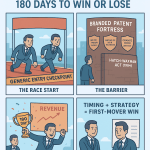
The Hatch-Waxman Act gives the first company to successfully challenge a patent with a Paragraph IV certification 180 days during which the FDA cannot approve any other ANDA for that drug. Courts have consistently read that provision narrowly: it restrains the FDA’s approval authority over ANDAs, not a brand’s ability to market its own product under its own NDA.[6] That reading is why the exclusivity period has never functioned as true generic-market exclusivity — a first-filer’s 180 days is really 180 days of exclusivity from other ANDA generics, shared from day one with whatever authorized generic the brand chooses to release.
How Common Is This? What 854 Authorized-Generic Launches Reveal
A 2023 Health Affairs study by Fowler, Jacobo-Rubio, and Xu linked FDA and IQVIA sales data to track every newly launched authorized generic product from 2010 through 2019.[3] The study counted 854 launches over the decade, with activity peaking in 2014, and it found two timing patterns that most brand-side patent-cliff planning fails to account for.
Timing Pattern One: Brands Wait for Generic Competition, Then Join It
In markets where independent generics eventually entered but there was no 180-day exclusivity to race against, roughly three-fourths of authorized generics launched only after the first independent generic was already on shelves.[3] The brand is not trying to beat anyone to market here — it is joining a generic price war it can no longer prevent, on its own terms, at a moment of its choosing.
Timing Pattern Two: Brands Race the Exclusivity Clock
The picture flips entirely wherever a 180-day exclusivity period is in play. About 70% of authorized generics eligible for that exclusivity launched before or during the window — meaning the brand deliberately entered the generic market at the exact moment its own first-filer competitor did, or earlier.[3] That is the Lipitor pattern, and the data show it is the norm in exclusivity markets, not the exception.
Original Analysis: A Four-Type Taxonomy of Authorized-Generic Strategy
Based on the case law, FTC enforcement history, and market data reviewed for this article, authorized-generic deployment falls into four distinct strategic types. This classification is original to this analysis; it is not an established FDA or FTC category, though it draws directly on their published findings.
Type 1 — Day-One Blunting AG
The brand launches its own AG at the same moment the first independent generic enters, specifically to blunt the first-filer’s 180-day exclusivity. Lipitor is the clearest documented example: Watson’s authorized generic began shipping on the day the compound patent expired, alongside — and briefly ahead of — Ranbaxy’s first-filer product.[1][2]
Type 2 — No-AG as Reverse-Payment Currency
Instead of launching an AG, the brand promises in a patent-litigation settlement not to launch one during the first-filer’s exclusivity period. That promise has real cash value to the generic company, because AG competition cuts first-filer revenue by close to half.[5] Provigil, Effexor XR, and Lamictal are the three most litigated examples, discussed below.
Type 3 — Brand-Replacement / Perpetual AG
The brand discontinues the branded product entirely and replaces it with an authorized generic years before any independent generic exists — effectively using the AG label change, not patent expiration, as the transition event. Flovent is the documented example.
Type 4 — Multi-Licensee Cascade AG
The brand licenses AG rights to more than one company in sequence, each one entering the generic market before independent generic competition can. Entacapone (Comtan) is the documented example, with four separate authorized generics licensed before any independent generic reached the market.[8]
Type
Drug
Brand Company
Mechanism
Documented Outcome
Day-One Blunting
Lipitor (atorvastatin)
Pfizer / Watson
AG launched same day as patent expiration
AG began shipping before first-filer Ranbaxy’s product[1][2]
No-AG Reverse Payment
Provigil (modafinil)
Cephalon
Brand promised no AG in exchange for delayed generic entry
Brand promised no AG in exchange for delayed entry
3rd Circuit: no-AG promise can be an actionable payment[12]
Brand-Replacement
Flovent HFA (fluticasone)
GSK / Prasco
Brand discontinued; AG launched years before any true generic
True generic did not arrive until March 2026, four years later[13]
Multi-Licensee Cascade
Comtan (entacapone)
Orion / Novartis
Four sequential AG licensees ahead of independent generics
Est. $137M–$449M excess Medicare spending, 2011–2020[8]
Case Study: Lipitor — The AG That Beat the First-Filer by Hours
Pfizer and Ranbaxy settled their worldwide Lipitor patent litigation in June 2008, three years before the compound and enantiomer patents were due to expire. The settlement fixed the U.S. generic entry date at November 30, 2011, and gave Ranbaxy 180 days of first-filer exclusivity from that date.[14] It also left Pfizer free to do exactly what it had planned all along.
Timeline: November 30, 2011
Pfizer signed an exclusive supply and distribution agreement with Watson Pharmaceuticals under which Pfizer would manufacture atorvastatin and Watson would market and distribute it as an authorized generic, with Pfizer retaining an estimated 70% of net sales.[15][2] Watson confirmed it began shipping that authorized generic on November 30, 2011 — the same day Lipitor’s patent protection ended.[2] Ranbaxy’s own generic, by contrast, was not cleared to ship until the FDA granted final approval late that evening, after a last-minute review of manufacturing-quality issues at Ranbaxy’s plants.[1][16] For the first hours of the generic atorvastatin market, Pfizer’s own authorized generic was the only generic version of Lipitor for sale.
What This Means for Brand Manufacturers Modeling Their Own Cliff
Pfizer’s Lipitor sales fell 42% year-over-year in the first quarter after generic entry, alongside a 19% earnings decline and 7% revenue decline company-wide.[17] Those numbers happened despite — not instead of — the AG strategy. The lesson for portfolio teams is not that an AG prevents the cliff; it is that an AG changes who captures the first six months of post-cliff revenue, and the data above show that in 70% of exclusivity-eligible markets, brands now plan for exactly that fight.[3]
Case Study: When “No AG” Becomes the Payment
The Lipitor pattern is a brand competing with the first-filer. A separate and more legally fraught pattern is a brand agreeing not to compete at all — trading a no-AG promise for a delayed generic launch date. Three cases define the law here.
FTC v. Cephalon: The $1.2 Billion Consequence
Cephalon settled patent litigation over its narcolepsy drug Provigil (modafinil) with four generic challengers — Teva, Barr, Mylan, and Ranbaxy — between late 2005 and early 2006, paying them roughly $300 million combined in cash, licensing fees, and supply arrangements in exchange for agreeing to stay off the market until April 2012, about six years earlier than the patent’s expiration but roughly six years later than the generics could otherwise have launched.[18][19] The FTC sued in 2008, arguing the settlements were an illegal pay-for-delay scheme. In 2015, Cephalon and its parent Teva agreed to disgorge $1.2 billion — the largest equitable monetary relief in FTC history at the time — and a parallel private class action separately settled for $512 million.[20][21]
In re Effexor XR: The Fight Over Non-Cash Payments
Wyeth settled its Effexor XR (venlafaxine) patent litigation with Teva in 2005, allowing Teva to launch a generic in July 2010 — roughly two years after the compound patent expired in June 2008 — while Wyeth agreed not to market its own authorized generic during Teva’s exclusivity window.[22][23] Direct purchasers sued, arguing the no-AG commitment functioned as the “payment” the Supreme Court had flagged as antitrust-relevant in FTC v. Actavis. The FTC filed an amicus brief in the case arguing that non-cash consideration, including a no-AG promise, deserves the same scrutiny as a cash reverse payment.[11]
King Drug Co. v. SmithKline Beecham: The Third Circuit Settles the Question
GlaxoSmithKline settled its Lamictal (lamotrigine) litigation with Teva in 2005: Teva would drop its patent challenge in exchange for early entry into the roughly $50-million chewable-tablet market, plus GSK’s promise not to launch an authorized generic of the roughly $2-billion tablet market during Teva’s 180-day exclusivity.[24] Direct purchasers sued, and the case became the first appellate test of whether a non-cash “no-AG” commitment can trigger the same antitrust scrutiny as a cash reverse payment under FTC v. Actavis.
What the Court Actually Held
In June 2015, the Third Circuit vacated the district court’s dismissal and held that a settlement need not involve a cash transfer to be actionable — an agreement not to compete with an authorized generic can itself be the “reverse payment” the Supreme Court warned about in Actavis, because it lets the generic firm capture revenue it would otherwise have shared with the brand’s own AG.[25][12]
Why the Supreme Court’s Denial of Cert Matters
GSK and Teva petitioned the Supreme Court to review the ruling, and the Court declined to hear the case in November 2016.[26] That left the Third Circuit’s holding as controlling law: in that circuit, and persuasively cited elsewhere, a no-AG commitment is legally sufficient to support antitrust exposure on the same footing as a cash reverse payment.[27]
Between FY2004 and FY2010, roughly one in four patent settlements with first-filing generic challengers included a brand’s explicit promise not to launch an authorized generic — deals covering drugs worth more than $23 billion in combined sales, delaying generic competition by an average of 37.9 months past the settlement date. By FY2012, nearly one in two pay-for-delay settlements included that same promise. — Federal Trade Commission, Bureau of Competition[6][7]
It Rarely Stops at One Settlement
The FTC’s FY2012 review also found that no-AG settlements tend to cluster around the same branded product. Seven branded products had more than one settlement involving compensation and entry restrictions in FY2012 alone, and since the agency began collecting data in 2004, 26 branded products have had multiple generic challengers paid to delay entry — 14 of those products saw three or more generics paid, with as many as 10 separate generic companies compensated in connection with a single branded drug.[7] A no-AG promise negotiated with one challenger rarely exists in isolation from the brand’s broader settlement strategy against every other filer behind it.
Case Study: Entacapone — When Every Independent Challenger Converts to an AG
Flovent shows an AG standing in for a brand that no longer exists. Entacapone, marketed as Comtan by Orion (and later Novartis), shows a different failure mode: independent generic challengers that filed to compete were converted into authorized-generic licensees instead, one after another, before a single true independent generic ever launched.[8]
Timeline: Three Challengers, Four Authorized Generics, Zero Independent Generics
Wockhardt filed the first ANDA for entacapone in 2007 and was granted first-to-file status; Sun Pharma followed in 2008 and Mylan in 2010, each certifying that the compound patent — set to expire October 19, 2013 — was invalid or not infringed.[8] Orion sued each of the three for infringement and settled with all of them rather than litigating to judgment. Instead of clearing the way for independent generics, the settlements converted each challenger into an authorized-generic licensee: Wockhardt launched the first AG version of entacapone in October 2012, a year ahead of patent expiration; Sun’s AG followed exactly 180 days later; and Mylan’s AG launched roughly three months after that.[8] A fourth AG was later added. No independent, ANDA-branded generic entered the market during this entire sequence.
What This Means for Generic-Entry Cost Estimates
Researchers using Medicare Part D data compared actual spending on entacapone against a counterfactual in which independent generic competition began after the October 2013 patent expiration and prices fell to levels typical of other genericized drugs. The gap — attributable to AGs standing in for the independent competition that never arrived — came to an estimated $137 million to $449 million in excess Medicare spending between 2011 and 2020.[8] Averaged across that nine-year window, the midpoint of that range works out to roughly $33 million a year in spending that a fully independent generic market would not have produced — a calculation applied to the study’s reported range, not a figure the study itself reports as an annual average.
Case Study: Flovent — The Authorized Generic That Arrived Before the Cliff Existed
Every case above involves an AG racing, or trading places with, a first-filer generic challenger. Flovent shows a fourth possibility: an AG that substitutes for the brand entirely, years before any independent generic exists at all.
Timeline: May 2022 to March 2026
GSK launched an authorized generic of Flovent HFA (fluticasone propionate), manufactured by GSK and distributed by Prasco Laboratories, in May 2022.[9] It followed with an authorized generic of Flovent Diskus in October 2023. Effective January 1, 2024, GSK discontinued the branded product entirely in the U.S., leaving the authorized generic as the only GSK-supplied version of the drug on the market.[9][28] No independent, ANDA-approved generic of Flovent HFA existed at that point — the FDA did not approve the first true generic, made by Glenmark, until March 2026, nearly four years after GSK’s authorized generic first launched.[13]
What Happened to Patients and Payers in Between
Because the authorized generic was not subject to the same rebate and discount agreements GSK had negotiated for branded Flovent, a Senate Finance Subcommittee on Health Care minority-staff investigation found the AG was, in practice, more expensive for many payers than the discontinued brand had been.[29] The same report cited a study finding a 17.5% increase in asthma-related hospitalizations in the three months immediately after Flovent’s discontinuation, and a 24.1% increase in the following three months, compared with the same quarters a year earlier — alongside a finding that only about half of privately insured patients could access the authorized generic without prior authorization, versus roughly three-quarters who had unrestricted access to the branded product.[29] GSK has said the discontinuation and AG launch were a business decision intended to preserve affordable access to the medication.[28]
What This Means for Generic Entry
Because an authorized generic is not listed in the Orange Book as a separate generic product, its presence does not obligate the FDA to treat the market as already generic, and it does not, by itself, accelerate independent ANDA review. The Flovent gap illustrates the limit case of the Type 3 pattern in the taxonomy above: an AG can occupy the “generic” position in a therapeutic market for years without a single independent competitor ever filing a successful Paragraph IV challenge.
What the Data Shows: Price and Revenue Effects of AG Competition
The FTC’s 2011 report is still the most rigorous accounting of what an authorized generic actually does to a market during the 180-day exclusivity window, built from compulsory-process accounting data covering more than 100 brand and generic manufacturers.[6] Two findings anchor most of the legal and commercial reasoning that followed it.
Retail prices during the 180-day exclusivity period average 4.2% lower, and wholesale prices average 6.5% lower, relative to the pre-generic brand price, when an authorized generic is competing against the first-filer than when it is not.[6]
The first-filer generic’s own revenue during that same period drops by 47% to 51% when an authorized generic is present, compared with a scenario with no AG competition.[5]
Those two numbers are why the no-AG promise has cash value in a settlement negotiation in the first place: it is the difference between a generic company keeping roughly half its exclusivity-period revenue and losing it to a competitor with no development costs and full access to the brand’s own supply chain.
Original Analysis: Estimating the Scale of a No-AG Promise
Using the FTC’s own reported range, a first-filer generic capturing $200 million in revenue during a 180-day exclusivity window would be expected to see that figure fall to roughly $98 million to $106 million if an authorized generic enters — a swing of roughly $94 million to $102 million attributable to the AG’s presence. That is not a reported statistic; it is a calculation applied to the FTC’s published 47%–51% revenue-decline range, offered here to illustrate why brand companies can credibly offer “we won’t launch an AG” as compensation worth tens or hundreds of millions of dollars in a patent settlement, without a single dollar changing hands directly.
How to Spot a Brand Preparing to Launch Its Own Authorized Generic
Because an AG launch is not an ANDA event, it does not appear on the FDA’s generic-approval calendar the way an independent challenger’s product does. Signals tend to show up elsewhere first: a brand quietly registering a private-label NDC under its existing NDA number; a settlement agreement filed with the FTC under the Medicare Modernization Act that is silent on AG rights (which, under current case law, keeps the option open); or a distribution agreement with a known AG specialist, such as Prasco or Greenstone, appearing in an SEC filing months ahead of a patent’s expiration. Teams tracking Orange Book listings, exclusivity codes, and settlement-filing patterns through a service such as DrugPatentWatch can flag a pending AG threat well before the launch date, because the manufacturing and distribution agreements that make an AG possible are typically negotiated a year or more in advance of the cliff itself.
What Happens If You Don’t Model the AG? A Scenario Comparison
Consider two otherwise identical first-filer generic launches, each targeting $200 million in exclusivity-period revenue, built on the FTC’s published price and revenue figures.[5][6] In the first scenario, no authorized generic appears: the first-filer captures close to its full projected $200 million, and the brand’s post-cliff retail price sits at its normal, non-AG-competed level. In the second scenario, the brand launches an authorized generic on day one, consistent with the pattern documented in 70% of exclusivity-eligible markets:[3] the first-filer’s realized revenue falls into the FTC’s documented $98 million–$106 million range, and consumers see the additional 4.2%–6.5% price reduction that comes only with AG competition.[6] A business case built on the first scenario, without at least flagging the second as a live possibility, is modeling the exception rather than the norm.
Methodology
The findings above draw on FTC’s 2009 interim and 2011 final reports on authorized generics, built from compulsory-process accounting and sales data from more than 100 brand and generic manufacturers;[6] the FTC’s annual Medicare Modernization Act settlement reports for FY2004–FY2010 and FY2012;[6][7] the 2023 Health Affairs study linking FDA and IQVIA National Sales Perspectives data to track 854 authorized generic product launches between 2010 and 2019;[3] the peer-reviewed entacapone case study using Medicare Part D claims data;[8] primary litigation records and appellate opinions in FTC v. Cephalon, In re Effexor XR Antitrust Litigation, and King Drug Co. of Florence v. SmithKline Beecham; and company press releases, SEC filings, and a March 2026 congressional staff investigation for the Flovent case study. The four-type strategic taxonomy is original analysis for this article, built by categorizing the documented case studies and FTC enforcement patterns above by launch timing and legal mechanism; it is not an FDA or FTC classification. The illustrative revenue-transfer calculation applies the FTC’s published 47%–51% revenue-decline range to a hypothetical $200 million exclusivity-period baseline and is clearly a calculation, not a reported figure.
FAQ
What is an authorized generic, in plain terms?
It is the brand-name drug, sold without the brand name, made or licensed by the brand company itself under its original FDA approval rather than a separate generic application.[4]
Is an authorized generic the same drug as the brand?
Yes. It uses the same formulation, the same manufacturing process in most cases, and is approved under the same New Drug Application — only the labeling changes.[4]
Does an authorized generic count against a first-filer’s 180-day exclusivity?
No. The 180-day exclusivity only restrains FDA approval of other ANDA generics; because an AG is marketed under the brand’s own NDA, it can enter on day one of the exclusivity period without violating it.[6]
Why would a brand company sell its own generic?
To capture generic-market revenue it would otherwise lose entirely to an independent challenger. Health Affairs data show brands do this in roughly 70% of markets where a 180-day exclusivity period is at stake.[3]
What is a “no-AG” agreement and why is it controversial?
It is a brand’s promise, made as part of a patent settlement, not to launch an authorized generic during a challenger’s exclusivity period. Because AG competition cuts a first-filer’s revenue by close to half, that promise has significant cash value, which is why the FTC treats it as a potential form of pay-for-delay compensation.[5][6]
Can a court treat a no-AG promise as an illegal payment?
In the Third Circuit, yes. King Drug Co. of Florence v. SmithKline Beecham held in 2015 that a no-AG commitment can constitute a reverse payment subject to antitrust scrutiny under FTC v. Actavis, and the Supreme Court declined to review that ruling in 2016.[12][26]
How much do authorized generics lower prices during exclusivity?
The FTC found retail prices average 4.2% lower and wholesale prices average 6.5% lower during the 180-day exclusivity period when an authorized generic is competing, relative to the pre-generic brand price.[6]
How often do brands actually launch an authorized generic?
At least 854 times between 2010 and 2019 in the U.S. alone, an average of roughly 85 product launches a year, according to the most comprehensive peer-reviewed count available.[3]
What happened with Flovent, and why does it matter?
GSK launched an authorized generic of Flovent HFA in May 2022, then discontinued the branded product in January 2024 — nearly four years before the first independent generic reached the market in March 2026. In the interim, a congressional staff investigation linked the transition to reduced insurance coverage and an increase in asthma-related hospitalizations.[9][13][29]
How can a generic-challenger company protect itself against an AG?
There is no legal mechanism to block a brand from launching an authorized generic. The realistic options are commercial: negotiating AG rights or a no-AG commitment directly into a settlement, pricing exclusivity-period revenue projections against the FTC’s documented 47%–51% revenue-decline range rather than assuming no AG competition, and monitoring brand-side distribution and licensing filings well ahead of the patent-expiration date.[5][6]
Key Takeaways
854 authorized generic products launched in the U.S. between 2010 and 2019, and about 70% of those eligible for 180-day exclusivity launched before or during that window, not after it.[3]
An authorized generic does not need to wait for a first-filer’s exclusivity to expire, because it is marketed under the brand’s own NDA rather than a separate ANDA — a legal distinction courts have consistently upheld.[6]
Watson’s authorized generic of Lipitor began shipping before Ranbaxy’s first-filer product received final FDA clearance on the same day, November 30, 2011.[1][2]
A brand’s promise not to launch an AG has documented cash value in patent settlements — the FTC found such promises in roughly 25% of first-filer settlements between FY2004 and FY2010, rising to 47.5% by FY2012, and the Third Circuit has held that promise can be treated as an antitrust-actionable reverse payment.[6][7][12]
An authorized generic can also substitute for a discontinued brand for years before any independent generic exists, as documented in the Flovent case, where the gap ran from May 2022 to March 2026.[9][13]
References
Johnson, L. A. (2011, December 1). Indian drugmaker OK’d to launch generic Lipitor. NBC News/Associated Press. https://www.nbcnews.com/health/health-news/indian-drugmaker-okd-launch-generic-lipitor-flna1c9452691
Watson Pharmaceuticals, Inc. (2011, November 30). Watson Launches Generic LIPITOR® [Press release]. PR Newswire. https://www.prnewswire.com/news-releases/watson-launches-generic-lipitor-134737648.html
Fowler, A. C., Jacobo-Rubio, R., & Xu, J. (2023). Authorized generics in the US: Prevalence, characteristics, and timing, 2010–19. Health Affairs, 42(8), 1071–1080. https://www.healthaffairs.org/doi/10.1377/hlthaff.2022.01677
U.S. Food and Drug Administration. (n.d.). FDA List of Authorized Generic Drugs. https://www.fda.gov/drugs/abbreviated-new-drug-application-anda/fda-list-authorized-generic-drugs
Federal Trade Commission. (2009). Authorized Generics: An Interim Report. https://www.ftc.gov/reports/authorized-generics-interim-report-federal-trade-commission
Federal Trade Commission. (2011). Authorized Generic Drugs: Short-Term Effects and Long-Term Impact. https://www.ftc.gov/reports/authorized-generic-drugs-short-term-effects-long-term-impact-report-federal-trade-commission
Federal Trade Commission. (2013, January 17). FTC study: In FY 2012, branded drug firms significantly increased the use of potential pay-for-delay settlements to keep generic competitors off the market [Press release]. https://ftc.gov/news-events/press-releases/2013/01/ftc-study-fy-2012-branded-drug-firms-significantly-increased
Rome, B. N., Egilman, A. C., Patel, N. G., & Kesselheim, A. S. (2022). Using multiple authorized generics to maintain high prices: The example of entacapone. Value in Health. https://www.valueinhealthjournal.com/article/S1098-3015(22)02181-7/fulltext
Asthma and Allergy Foundation of America. (2023, September). Flovent HFA and Flovent Diskus asthma medicines being discontinued. https://community.aafa.org/blog/flovent-hfa-and-flovent-diskus-asthma-medicines-being-discontinued
Federal Trade Commission. (2015, May 28). Statement of the Federal Trade Commission, FTC v. Cephalon, Inc. https://www.ftc.gov/system/files/documents/public_statements/645491/150528cephalonstatement.pdf
Federal Trade Commission. (2013, August). FTC submits proposed amicus brief concerning “no-authorized-generic” commitments in drug companies’ patent settlements [Press release]. https://www.ftc.gov/news-events/news/press-releases/2013/08/ftc-submits-proposed-amicus-brief-concerning-no-authorized-generic-commitments-drug-companies-patent
King Drug Co. of Florence, Inc. v. SmithKline Beecham Corp., 791 F.3d 388 (3d Cir. 2015). https://law.justia.com/cases/federal/appellate-courts/ca3/14-1243/14-1243-2015-06-26.html
Dunleavy, K. (2026, March 17). FDA gives Glenmark thumbs-up for first ‘true’ generic version of GSK’s asthma inhaler Flovent. Fierce Pharma. https://www.fiercepharma.com/pharma/fda-gives-glenmark-thumbs-first-true-generic-version-gsks-flovent
Pfizer Inc. (2008, June 18). Pfizer and Ranbaxy settle Lipitor patent litigation worldwide [Press release]. https://www.pfizer.com/news/press-release/press-release-detail/pfizer_and_ranbaxy_settle_lipitor_patent_litigation_worldwide
PM360. Pfizer’s 180-Day War for Lipitor. https://pm360online.com/pfizers-180-day-war-for-lipitor/
Drug Store News. (2011). Ranbaxy generic Lipitor launch delayed as Watson launches authorized generic. https://drugstorenews.com/pharmacy/ranbaxy-generic-lipitor-launch-delayed-watson-launches-authorized-generic
PM360. Pfizer’s 180-Day War for Lipitor [Q1 2012 financial impact]. https://pm360online.com/pfizers-180-day-war-for-lipitor/
Lexology. (2015, January 30). In re Modafinil litigation finds no “threshold burden” in reverse payment suit. https://www.lexology.com/library/detail.aspx?g=09855434-f1ba-460b-8b40-8e9d31272088
Berger Montague. (n.d.). King Drug Co. of Florence Inc. v. Cephalon Inc. — Modafinil antitrust settlement. https://bergermontague.com/cases/provigil-direct-purchaser-antitrust-lawsuit/
Federal Trade Commission. (2015, May 28). Statement of the Federal Trade Commission, FTC v. Cephalon, Inc. https://www.ftc.gov/system/files/documents/public_statements/645491/150528cephalonstatement.pdf
TopClassActions. Cephalon settles FTC’s Provigil pay-for-delay lawsuit for $1.2B. https://topclassactions.com/lawsuit-settlements/lawsuit-news/cephalon-settles-ftcs-provigil-pay-delay-lawsuit-1-2b/
Faruqi & Faruqi, LLP. (n.d.). In re Effexor XR Antitrust Litigation, No. 11-cv-5479 (D.N.J.). https://faruqilaw.com/case/in-re-effexor-xr-antitrust-litigation-no-11-cv-5479-dnj/
Drug Store News. Six retailers charge Wyeth, Teva with unlawfully delaying generic Effexor XR. https://drugstorenews.com/pharmacy/six-retailers-charge-wyeth-teva-unlawfully-delaying-generic-effexor-xr
Justia. King Drug Co. of Florence v. SmithKline Beecham Corp., No. 14-1243 (3d Cir. 2015). https://law.justia.com/cases/federal/appellate-courts/ca3/14-1243/14-1243-2015-06-26.html
Patent Docs. (2015, June 30). King Drug Co. of Florence, Inc. v. SmithKline Beecham Corp. (3rd Cir. 2015). https://www.patentdocs.org/2015/07/king-drug-co-of-florence-inc-v-smithkline-beecham-corp-3rd-cir-2015.html
Knobbe Martens. (2016). Supreme Court will not review pay-for-delay case over GSK’s Lamictal. https://www.knobbe.com/blog/supreme-court-will-not-review-pay-delay-case-over-gsks-lamictal/
Federal Trade Commission. (2025, January). Reverse payments: From cash to quantity restrictions and other possibilities. https://www.ftc.gov/enforcement/competition-matters/2025/01/reverse-payments-cash-quantity-restrictions-other-possibilities
GSK. (n.d.). GSK’s position on Flovent. https://www.gsk.com/en-gb/media/media-statements/gsks-position-on-flovent/
U.S. Senate Finance Subcommittee on Health Care, Minority Staff. (2026, March). Manufactured Crisis: By Discontinuing Asthma Inhaler, GSK Profited While Children Suffered. https://www.hassan.senate.gov/imo/media/doc/flovent_investigation_report.pdf
U.S. Pharmacist. (2011, June). Authorized Generic Drugs [citing Roper Public Affairs & Media, June 2005 opinion poll]. https://www.uspharmacist.com/article/authorized-generic-drugs