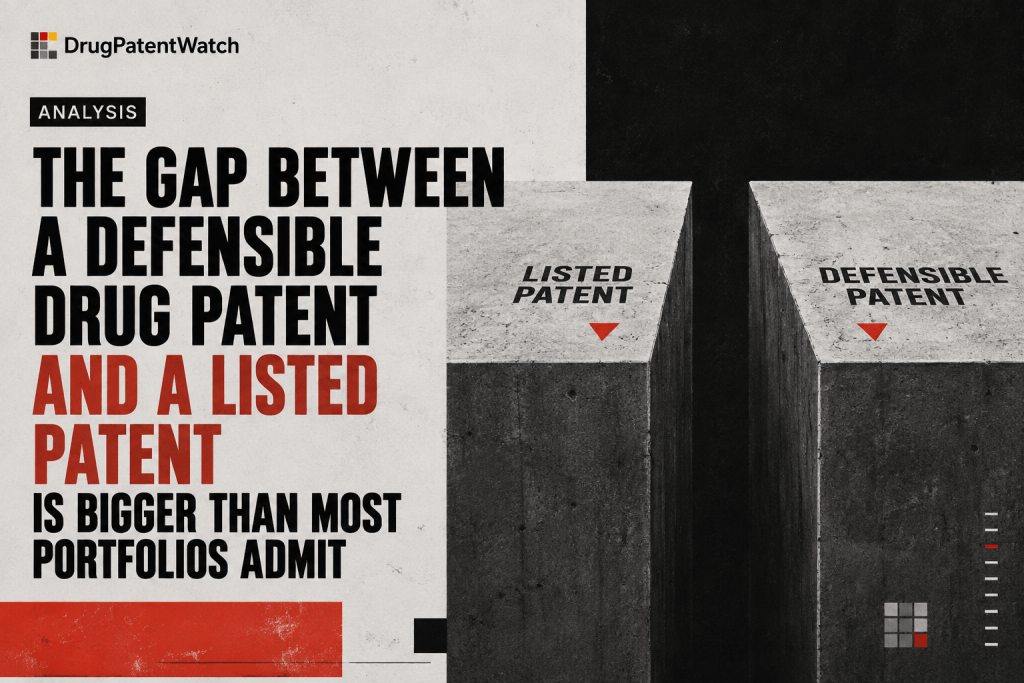
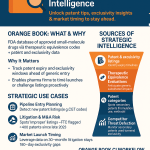
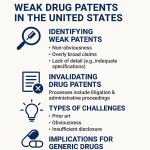
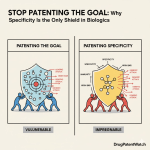
A patent’s presence in the FDA Orange Book proves it was submitted and accepted for listing. It does not prove the patent claims what the brand needed it to claim, and it does not prove the patent would survive a validity challenge. Between 2020 and 2025, federal appeals courts delisted or forced the removal of Orange Book patents covering a diabetes drug, a narcolepsy drug, and an asthma inhaler, in each case because the patent did not meet the statutory listing requirement under 21 U.S.C. § 355(b)(1), regardless of whether the underlying invention was sound. [1] In the same window, a heart-failure drug’s own listed patent went to a full validity trial, was found invalid at the district court, and was reversed and upheld on appeal. [2] Listability and defensibility are two different tests, decided by two different bodies of law, and a portfolio built to pass only the first one is exposed in ways that do not show up until a generic files a Paragraph IV certification.
What the Data Shows: Five Findings That Matter
Only three categories of patent qualify for Orange Book listing under 21 CFR 314.53: drug substance patents, drug product (formulation and composition) patents, and method-of-use patents tied to an approved indication. Process, packaging, metabolite, and intermediate-compound patents are excluded by regulation. [3]
On November 7, 2023, the FTC disputed more than 100 Orange Book patent listings covering 62 unique patents across roughly 18 approved products, sent to 10 brand manufacturers including AbbVie, AstraZeneca, Boehringer Ingelheim, GSK, Kaleo, Impax, Mylan Specialty, and Teva Branded Pharmaceuticals. [4]
In the four precedential appellate rulings decided between 2020 and 2024 that tested Orange Book listability on the merits, the patent holder lost every time: Sanofi (Lantus), Takeda (Actos), Jazz Pharmaceuticals (Xyrem), and Teva (ProAir HFA) were each ordered to delist. [5]
A patent can pass the FTC’s improper-listing theory and still be a strong patent, and a patent can be properly listed and still lose on validity. Novartis’s Entresto patent (the ‘659 patent) was properly listed as a drug-product patent, went through a three-day bench trial, was found invalid at the district court, and was reversed and upheld by the Federal Circuit in a precedential 2025 opinion. [2]
Three of the 28 claims in Jazz Pharmaceuticals’ REMS patent for Xyrem had already been found unpatentable in a 2017 inter partes review before the same patent was later ordered delisted on unrelated grounds, showing that listability and validity failures can hit the same patent independently. [6]
What “Listed” Actually Means Under the Statute
The Orange Book listing requirement comes from 21 U.S.C. § 355(b)(1) and § 355(c)(2), implemented through 21 CFR 314.53. An NDA holder must submit patent information to FDA within 30 days of NDA approval, or within 30 days of a later patent’s issuance, for any patent that claims the drug substance, the drug product, or an approved method of using the drug. [3] FDA’s own instructions on Form FDA 3542 repeat this three-part boundary: submit a patent only if it claims a drug substance, a drug product, or a method of using the approved drug product. [7]
FDA does not substantively review these submissions. The 2020 Federal Register history and subsequent case law both describe the process as an honor system: the agency publishes what the NDA holder certifies, without independently checking whether the patent actually claims the approved drug. [8] That gap between what the statute allows and what FDA polices is the reason listability disputes end up in federal court rather than at the agency.
A 2003 Federal Register notice, still cited by courts and law firms today, clarified that device-related patents can be listable only when the patent claims the finished dosage form itself, such as a metered aerosol, capsule, metered spray, gel, or pre-filled drug delivery system. Patents on bottles, containers, and other packaging are explicitly excluded because packaging is not a dosage form. [9] That distinction, drawn more than two decades before the current FTC campaign, turned out to be the exact fault line the courts later used to order delisting of device-component patents.
What Is Excluded From Listing
Manufacturing process patents, packaging patents, and patents claiming metabolites or intermediates are excluded from Orange Book listing by regulation. [3] A patent that only claims a device component, without reciting the active ingredient or an approved use of it, falls into this excluded category even if that component is essential to how the drug is delivered, as the Federal Circuit confirmed in 2024. [10]
What “Defensible” Actually Means
Defensibility is a separate legal question, decided under Title 35 of the U.S. Code and tested in infringement litigation, inter partes review at the Patent Trial and Appeal Board, or both. A patent is defensible if it survives challenges to novelty, obviousness, written description, enablement, and indefiniteness, and if its claims actually cover the accused product. None of that inquiry asks whether the patent was correctly listed in the Orange Book. A patent can be a textbook example of listable subject matter, such as a drug-product formulation patent, and still be obvious over the prior art. A patent can also be scientifically sound and commercially important, such as a REMS distribution-control patent, and still be unlistable because Congress limited the listing statute to drug substance, drug product, and method-of-use claims. [11]
DrugPatentWatch’s Orange Book and litigation datasets separate these two questions in practice: a listing record shows what a company submitted and when, while patent status, IPR outcomes, and district court validity rulings show whether that patent actually held up. Portfolio teams that only track the listing side of that data are tracking paperwork, not protection.
Case Study: In re Lantus, the Patent That Was Never About the Drug
Sanofi’s Lantus (insulin glargine) generated more than $7 billion in annual U.S. sales by 2014. [12] Sanofi listed the original drug-substance patent covering insulin glargine at approval in 2000. In 2007, Sanofi won approval for Lantus SoloSTAR, a disposable injector pen version of the same drug, and later listed U.S. Patent No. 8,556,864, which claimed the drive mechanism inside the pen. [13]
The ‘864 patent’s ten claims describe the mechanical components that push medication out of the pen’s cartridge. None of the claims mention insulin glargine or Lantus by name. [14] Direct purchasers sued Sanofi under Section 2 of the Sherman Act, arguing the listing was used to trigger an automatic 30-month stay against a competing pen. A magistrate judge initially dismissed the case, finding Sanofi’s listing decision reasonable given ambiguity in FDA guidance. [15] The First Circuit reversed in February 2020, holding that a patent must claim the drug itself, not merely a component that happens to deliver it. The court rejected Sanofi’s argument by analogy: a patent claiming a car’s transmission is not, by extension, a patent claiming the car. [16]
The case did not end the listability question outright. The First Circuit also held that a good-faith, reasonable listing decision could still be a defense to antitrust liability, sending the case back for a fact-intensive inquiry into Sanofi’s state of mind. [17] Three years later, FTC Chair Lina Khan cited Lantus by name as the legal foundation for the agency’s broader 2023 Orange Book enforcement campaign. [18]
Case Study: Takeda’s Actos, When a Combination Patent Outlives Its Ingredient
Takeda’s diabetes drug Actos (pioglitazone) is a useful case because the flaw was not a device claim, it was timing. Takeda’s original pioglitazone drug-substance patent expired January 17, 2011. [19] Takeda also held two later patents, the ‘584 and ‘404 patents, covering pioglitazone in combination with other diabetes medications, and told FDA these combination patents claimed Actos itself in addition to methods of using it. FDA’s own Orange Book listing, however, recorded the ‘584 and ‘404 patents only as method-of-use patents, not drug-substance or drug-product patents. [20]
Purchasers alleged Takeda’s patent descriptions were incorrect and had the effect of extending exclusivity over plain pioglitazone past the 2011 expiration of the original compound patent. On interlocutory appeal in 2021, the Second Circuit agreed with the framework, holding that under the Listing Requirement of 21 U.S.C. § 355(b)(1), a combination patent does not claim any of its component drug substances past that component’s own individual patent expiration date. [21] The court also held that plaintiffs did not need to prove Takeda’s listing interpretation was unreasonable to plead a monopolization claim, a lower bar than the good-faith inquiry that helped Sanofi in Lantus. [22]
Of the ten generic applicants that eventually sought to enter the Actos market, nine routed around the disputed patents using the standard certification process; the Second Circuit’s later 2017 ruling in the related In re Actos End-Payor litigation found that only Teva’s market entry was plausibly delayed by the allegedly false patent descriptions, because Teva was the one applicant whose approval pathway did not depend on knowledge of those descriptions. [23]
Case Study: Jazz v. Avadel, a System Claim Is Not a Method Claim
Xyrem, Jazz Pharmaceuticals’ narcolepsy drug, is built on sodium oxybate, a compound with no remaining substance patent because of its decades-long history of medical use and its parallel history of abuse as a so-called date-rape drug. [24] Because of that abuse risk, FDA conditioned Xyrem’s approval on a Risk Evaluation and Mitigation Strategy, and Jazz built its patent estate around Xyrem’s formulation, distribution, and use rather than the molecule itself. In 2014, Jazz listed U.S. Patent No. 8,731,963, describing it as a method-of-use patent tied to Xyrem’s single-pharmacy REMS distribution model. [25]
When Avadel sought approval for Lumryz, a once-nightly oxybate competitor with its own, more lenient REMS, it had to certify against the ‘963 patent. Avadel counterclaimed for delisting, arguing the patent’s claims described a computer-implemented distribution system, not a method of treating a patient. The district court agreed on claim construction grounds, and the Federal Circuit affirmed in February 2023: the ‘963 patent’s independent claims recited an assemblage of components defining a system, not steps for using a drug, so the patent did not meet the statute’s narrower category of listable method-of-use patents. [26]
The listability failure was not the only weakness in the ‘963 patent’s history. In a 2017 inter partes review brought by Amneal, the PTAB had already found three of the patent’s 28 claims unpatentable. [6] The delisting order six years later rested on an entirely separate legal theory, claim scope under the listing statute, illustrating that a single patent can be vulnerable on validity and listability at once, through completely independent legal tracks. Notably, delisting did not immediately open the Xyrem market: Jazz’s exclusivity continued past the ‘963 patent’s December 2022 claim expiration because of a separate pediatric exclusivity grant running through June 2023, a reminder that regulatory exclusivity and patent listing are also two different protections. [27]
Case Study: Teva v. Amneal, the Active-Ingredient Test
Teva’s ProAir HFA inhaler, approved under NDA No. 021457 in October 2004, delivers albuterol sulfate through a metered-dose device. [28] Teva listed nine unexpired patents against the product in the Orange Book. Amneal filed an ANDA for a generic version and, after Teva sued for infringement, counterclaimed that five of those nine patents, covering the inhaler’s dose counter and canister, should be delisted because none of their claims mentioned albuterol sulfate at all. [29]
In June 2024, the District of New Jersey agreed and ordered delisting. Teva argued on appeal that a patent should count as claiming the drug if the approved product simply reads on the patent’s claims, meaning the dose counter and canister patents were listable because ProAir HFA happens to contain a dose counter and canister. The Federal Circuit rejected that reading in a precedential opinion issued December 20, 2024, holding that to be listed, a patent must, at minimum, claim the active ingredient that made the product approvable as a drug in the first place. [10] The FTC filed an amicus brief supporting Amneal’s position, and the court declined to reach a broader argument about whether the patents also failed to qualify as drug-substance or drug-product patents under language Congress added to the statute in 2021. [30] Teva’s petition for rehearing en banc was denied. [31]
Case Study: Entresto, a Listed Patent That Actually Held
Novartis’s heart-failure drug Entresto (sacubitril/valsartan) is the counterexample. Its lead patent, the ‘659 patent, claims a pharmaceutical composition of the two active ingredients “administered in combination,” with a priority date of January 17, 2002, and an expiration date of January 15, 2025 after patent term extension. [32] Generic manufacturer MSN stipulated to infringement once the district court construed “in combination” broadly enough to cover both a physical mixture and Entresto’s actual form, a non-covalently bonded complex of the two drugs discovered only in 2006, four years after the patent’s original filing. [33]
After a three-day bench trial, the district court found the ‘659 patent enabled and not obvious, but invalid for lack of written description, reasoning that Novartis could not have described a complex form its own scientists had not yet discovered when the patent was filed. Novartis appealed, and on January 10, 2025, the Federal Circuit reversed the written-description finding in a precedential opinion, holding that the district court had improperly evaluated the description against its own claim construction rather than against what the patent actually claimed; the court affirmed that the claims were not proven obvious or non-enabled. [2] Entresto’s global sales reached $7.822 billion in 2024, making it Novartis’s top-selling product that year. [34]
The ‘659 patent’s survival did not make Novartis’s portfolio invincible. A separate, later-filed patent covering Entresto’s amorphous solid form, the ‘918 patent, was found not infringed by MSN after a December 2024 trial, and a temporary injunction Novartis had obtained on that patent was lifted by the Federal Circuit on July 22, 2025. Once that injunction fell and the ‘659 patent’s pediatric exclusivity expired on July 16, 2025, multiple generic manufacturers launched at the end of July 2025. [35] A defensible patent bought Novartis nearly the full length of the ‘659 patent’s term; it did not, on its own, block every generic indefinitely once the rest of the portfolio and the exclusivity clock ran out.
Comparing the Outcomes
Case
Drug
Patent Type Asserted
Court / Date
Outcome
In re Lantus
Lantus SoloSTAR (insulin glargine)
Device drive-mechanism patent (‘864)
1st Cir., Feb. 2020
Improperly listed; case remanded on antitrust liability
UFCW Local 1776 v. Takeda
Actos (pioglitazone)
Combination / method-of-use patents (‘584, ‘404)
2d Cir., Aug. 2021
Combination patent does not claim ingredient past its own expiration
Jazz v. Avadel
Xyrem (sodium oxybate)
REMS system patent (‘963)
Fed. Cir., Feb. 2023
System claims are not listable method-of-use claims; ordered delisted
Teva v. Amneal
ProAir HFA (albuterol sulfate)
Inhaler device patents (5 of 9 listed)
Fed. Cir., Dec. 2024
Must claim active ingredient; ordered delisted; en banc denied
An Original Taxonomy: Four Types of Orange Book Patent Risk
The case law above sorts into four recurring failure and success patterns. This is an original classification built from the outcomes above, not an FDA or USPTO category, and it is offered as a way to sort a portfolio rather than as an established legal term of art.
Type I: Non-Qualifying Subject Matter
The patent claims something the statute never authorized for listing in the first place, such as a device component, a distribution system, packaging, or a manufacturing process. Lantus, Jazz v. Avadel, and Teva v. Amneal all fall here. [16] [26] [10] These patents can be commercially real and even valid, but they were never eligible for the Orange Book’s 30-month-stay mechanism, and courts have been consistent about removing them once challenged.
Type II: Combination Overreach
The patent is a legitimate method-of-use or drug-product patent, but it is used to extend effective protection over a component ingredient after that ingredient’s own patent has expired. Takeda’s Actos combination patents are the clearest example. [21] This category is subtler than Type I because the patent is not obviously wrong on its face; it becomes a problem only when read against the expiration date of a separate, earlier patent.
Type III: Substantively Vulnerable
The patent is properly listable, drug substance, drug product, or method of use, but fails on classic validity grounds once tested: obviousness, lack of written description, lack of enablement, or anticipation. The ‘659 Entresto patent nearly fell into this category at the district court level before the Federal Circuit reversed. [2] Patents that survive an IPR institution decision but lose at trial, or vice versa, also belong here.
Type IV: Defensible
The patent is properly listable and has actually been tested against a validity or infringement challenge and held. The Entresto ‘659 patent, after the January 2025 Federal Circuit reversal, is the example in this dataset. [2] This is the only category where “listed” and “defensible” fully overlap, and it is worth noting how rare a full merits win is in the sample above: of the five precedential rulings reviewed here, only one resulted in the brand’s asserted claims being upheld against a validity challenge on the merits.
The FTC’s Listing Crackdown: What Changed and What Didn’t
The FTC’s September 14, 2023 policy statement announced that improperly listing patents in the Orange Book could itself be an unfair method of competition under Section 5 of the FTC Act, separate from any antitrust monopolization theory. [11] Less than two months later, the agency used the FDA’s own 314.53(f) patent-listing dispute process, rather than filing a lawsuit, to challenge more than 100 listings covering 62 unique patents across roughly 18 products, mostly asthma inhalers, epinephrine autoinjectors, and cyclosporine eye-drop dispensers. [4] Under that process, once the FTC disputes a listing, FDA forwards the dispute to the NDA holder, who has 30 days to withdraw the patent, amend it, or certify its accuracy under penalty of perjury. [36]
The FTC’s dispute letters relied heavily on the 2020 Lantus precedent, arguing that dose-counter and inhaler patents that never mention any drug in their claims were improperly listed under the same logic the First Circuit had already applied to Sanofi’s pen mechanism. [37] The regulatory dispute process itself does not remove a patent; it only forces a certification or a withdrawal. The FTC’s dispute letters, by themselves, had what one 2024 legal analysis characterized as minimal effect on manufacturers’ actual listing decisions. [38] The mechanism that produced real removals was litigation: it took Amneal’s delisting counterclaim and a Federal Circuit opinion, not an FTC letter, to force Teva’s ProAir patents out of the Orange Book. [10]
What This Means for Generic Entry and ANDA Strategy
The direct answer to “how do I challenge a listed patent I think doesn’t belong there” runs through the delisting counterclaim Congress added in the Medicare Modernization Act, codified at 21 U.S.C. § 355(j)(5)(C)(ii)(I), which lets an ANDA filer sued for infringement counterclaim that a listed patent does not claim the approved drug or an approved method of use. [39] Every case above except the FTC’s own dispute letters proceeded through this route or an equivalent Sherman Act claim, not through a citizen petition or an FDA administrative reversal. A generic team evaluating whether to file Paragraph IV should treat every listed patent that does not recite the active ingredient by name as a candidate for a delisting counterclaim, independent of whether the patent would also be vulnerable to an obviousness or written-description challenge.
What This Means for Brand Portfolio Strategy
Listing a device, distribution-system, or combination patent can still generate a real 30-month stay and real litigation leverage in the short term, since FDA does not screen listings before publication. [8] But every precedential ruling reviewed here shows that leverage is temporary once a well-resourced generic challenger counterclaims. A portfolio strategy that treats Orange Book listing as the finish line, rather than the starting gate for a defensibility fight, is pricing in protection that courts have been unwilling to honor since at least 2020. The more durable comparison is Entresto: Novartis’s protection held not because the ‘659 patent was listed, but because it survived a bench trial on obviousness, enablement, and written description, and was upheld on appeal against a genuinely contested validity argument. [2]
Methodology
This analysis draws on five precedential U.S. Court of Appeals decisions issued between February 2020 and January 2025 that directly ruled on Orange Book patent listability or the validity of a listed patent following a full trial: In re Lantus Direct Purchaser Antitrust Litigation (1st Cir. 2020), United Food & Commercial Workers Local 1776 v. Takeda Pharmaceutical Co. (2d Cir. 2021), Jazz Pharmaceuticals, Inc. v. Avadel CNS Pharmaceuticals, LLC (Fed. Cir. 2023), Teva Branded Pharmaceutical Products R&D, Inc. v. Amneal Pharmaceuticals of New York, LLC (Fed. Cir. 2024), and Novartis Pharmaceuticals Corp. v. Torrent Pharma Inc., also captioned In re Entresto (Fed. Cir. 2025). Cases were included only where a federal appellate court issued a precedential or otherwise citable merits ruling directly addressing listability under 21 U.S.C. § 355(b)(1) or a full validity trial of a listed patent. Regulatory and enforcement context was drawn from FDA regulations (21 CFR 314.53), FDA Form 3542 instructions, and the FTC’s September 2023 policy statement and November 2023 dispute letters. Patent numbers, dates, and procedural history were verified against the court opinions themselves or SEC filings where available. The classification of case outcomes into four risk types is original analysis, not a court-recognized taxonomy, and is intended as a portfolio-review framework rather than a legal conclusion about any specific untested patent.
Limitations: this review covers precedential federal appellate rulings and does not attempt to catalog every district court delisting order or every FTC dispute-letter outcome, many of which remain unresolved, settled confidentially, or under appeal as of this writing. It also does not cover biologics patents under the BPCIA’s separate patent dance framework, which uses different listing and disclosure mechanics than small-molecule Orange Book listing.
Of the four precedential appellate rulings between 2020 and 2024 that tested Orange Book listability on the merits, brand patent holders lost all four times; the fifth ruling in this set, on a properly listed drug-product patent taken to a full validity trial, went the other way. [1] [2]
Key Takeaways
Only drug substance, drug product, and method-of-use patents qualify for Orange Book listing; device, process, packaging, and system patents do not, regardless of how integral they are to the approved product. [3]
FDA does not substantively review listings before publication, which is why every listability dispute reviewed here was resolved in court, not by the agency. [8]
Federal appellate courts ordered delisting in every precedential listability case decided between 2020 and 2024: Lantus, Actos, Xyrem, and ProAir HFA. [5]
A single patent can fail on listability and validity through entirely separate legal tracks, as shown by the ‘963 Xyrem patent’s 2017 partial IPR loss and its unrelated 2023 delisting. [6]
Being properly listed does not guarantee validity: Entresto’s ‘659 patent had to win a bench trial and a Federal Circuit appeal to remain enforceable through its full term. [2]
Defensibility and regulatory exclusivity are also separate: Jazz kept Xyrem’s market position past its delisted patent’s expiration only because of a separate pediatric exclusivity grant. [27]
FAQ
What makes a patent “listable” in the FDA Orange Book?
A patent qualifies for listing only if it claims the drug substance (active ingredient), the drug product (formulation or composition), or an approved method of using the drug, under 21 U.S.C. § 355(b)(1) and 21 CFR 314.53. [3] Nothing else qualifies, regardless of how important that other patent is to the approved product.
Can a device patent ever be listed in the Orange Book?
Only if the patent claims the finished dosage form itself, such as a pre-filled drug delivery system, and still recites the active ingredient. A patent that claims only a device component, like a dose counter, canister, or drive mechanism, without reciting the drug, is not listable, as the Federal Circuit confirmed in Teva v. Amneal. [10]
What is a delisting counterclaim under Hatch-Waxman?
It is a statutory counterclaim, codified at 21 U.S.C. § 355(j)(5)(C)(ii)(I), that lets a generic applicant sued for patent infringement ask the court to order the brand to delist a patent that does not meet the listing requirements. [39] Avadel and Amneal both used this mechanism successfully.
Does the FDA verify whether a listed patent actually qualifies?
No. FDA publishes what the NDA holder certifies without independently reviewing whether the patent claims the approved drug, which is why listability disputes are resolved in federal court rather than by the agency itself. [8]
What happened to the FTC’s 2023 Orange Book patent challenges?
The FTC disputed more than 100 listings covering 62 unique patents through the FDA’s 314.53(f) process in November 2023, but that regulatory dispute mechanism only forces a company to certify, amend, or withdraw a listing; it does not remove a patent on its own. [4] The actual removals in this record, such as Teva’s ProAir patents, came from litigation rather than from the FTC’s dispute letters directly. [38]
Can a REMS patent be listed in the Orange Book?
Not if it claims a computerized distribution or risk-management system rather than a method of treating a patient. The Federal Circuit held in Jazz v. Avadel that Xyrem’s REMS patent claimed a system, not a method of use, and ordered it delisted. [26]
What is the difference between an improperly listed patent and an invalid patent?
An improperly listed patent may be entirely valid; it simply does not claim subject matter the Orange Book statute allows to be listed, such as a device component. An invalid patent fails a substantive test like obviousness or written description, regardless of what it claims. A patent can fail either test independently, as Xyrem’s ‘963 patent did on both, at different times, for different reasons. [6] [26]
Can a combination patent block generic entry after its own ingredient patent expires?
Not indefinitely. The Second Circuit held in the Takeda Actos case that a combination patent does not claim a component drug substance past that component’s own individual patent expiration date, limiting how far combination claims can extend protection over an off-patent ingredient. [21]
Does delisting a patent end brand exclusivity for a drug?
Not necessarily. Jazz Pharmaceuticals lost its ‘963 patent to delisting in 2023, but the drug’s market protection continued past that patent’s own December 2022 claim expiration because of a separate pediatric exclusivity period running through June 2023. Patent listing and regulatory exclusivity are independent protections that happen to be tracked in the same publication. [27]
What should generic and brand teams check before relying on an Orange Book listing?
Generic teams should check whether a listed patent actually recites the active ingredient or a specific approved method of use, since patents that do not are candidates for a delisting counterclaim regardless of their underlying validity. Brand teams should independently stress-test every listed patent against obviousness, written description, and enablement standards, since Entresto shows that even a drug-product composition patent needs to survive a full validity trial to hold. [2] [10]
References
Cooley LLP. (2025, January 2). Teva v. Amneal ruling interprets Orange Book listing statute, affirms delisting of device patents. https://www.cooley.com/news/insight/2025/2025-01-02-teva-v-amneal-ruling-interprets-orange-book-listing-statute-affirms-delisting-of-device-patents
McDermott Will & Emery. (2025, January). Novartis Pharmaceuticals Corp. v. Torrent Pharma Inc. [Case summary of In re Entresto, No. 23-2218 (Fed. Cir. Jan. 10, 2025)]. National Law Review. https://natlawreview.com/article/federal-circuit-highlights-importance-separating-claim-construction-and
Federal Trade Commission. (2023, September 14). Statement concerning brand drug manufacturers’ improper listing of patents in the FDA’s Orange Book. https://www.ftc.gov/system/files/ftc_gov/pdf/p239900orangebookpolicystatement092023.pdf
Wilson Sonsini Goodrich & Rosati. (2023, November 15). FTC disputes patent listings of 10 brand drug makers as improperly listed in FDA’s Orange Book. https://www.wsgr.com/en/insights/ftc-disputes-patent-listings-of-10-brand-drug-makers-as-improperly-listed-in-fdas-orange-book.html
Congressional Research Service. (2026, January 21). Patent listing in FDA’s Orange Book (IF12644). https://www.congress.gov/crs_external_products/IF/PDF/IF12644/IF12644.4.pdf
United States Court of Appeals for the Federal Circuit. (2023, February 24). Jazz Pharmaceuticals, Inc. v. Avadel CNS Pharmaceuticals, LLC, 60 F.4th 1373. https://litigationtracker.law.georgetown.edu/wp-content/uploads/2025/01/Ja_2023.02.24_JUDGMENT-AND-OPINION.pdf
U.S. Food and Drug Administration. Instructions for filling out Form FDA 3542a, patent information submitted with the filing of an NDA, amendment, or supplement. https://www.fda.gov/media/133714/download
DrugPatentWatch. (2026, February 27). Own the market: How brand companies strategically list patents in the FDA Orange Book. https://www.drugpatentwatch.com/blog/own-the-market-how-brand-companies-strategically-list-patents-in-the-fda-orange-book/
Foley & Lardner LLP. (2023, November 17). Revisiting FDA’s original guidance on Orange Book listability in light of heightened FTC scrutiny. https://www.foley.com/insights/publications/2023/11/fda-guidance-orange-book-listability-ftc/
United States Court of Appeals for the Federal Circuit. (2024, December 20). Teva Branded Pharmaceutical Products R&D, Inc. v. Amneal Pharmaceuticals of New York, LLC, No. 24-1936. https://www.cafc.uscourts.gov/opinions-orders/24-1936.OPINION.12-20-2024_2439730.pdf
Crowell & Moring LLP. (2024, April 29). Red alert on the Orange Book: The FTC continues to crack down on improperly listed drug patents. https://www.crowell.com/en/insights/client-alerts/red-alert-on-the-orange-book-the-ftc-continues-to-crack-down-on-improperly-listed-drug-patents
Cozen O’Connor. (2020, March 5). First Circuit permits antitrust claims for improperly listing a device patent on the FDA’s Orange Book to move forward. https://www.cozen.com/news-resources/publications/2020/first-circuit-permits-antitrust-claims-for-improperly-listing-a-device-patent-on-the-fda-s-orange-book-to-move-forward
Fish & Richardson. (2020, June 26). Device patent improperly listed in the Orange Book. https://www.fr.com/insights/thought-leadership/blogs/first-circuit-device-patent-improperly-listed-orange-book/
United States Court of Appeals for the First Circuit. (2020, February 13). In re Lantus Direct Purchaser Antitrust Litigation, 950 F.3d 1. https://media.ca1.uscourts.gov/pdf.opinions/18-2086P-01A.pdf
FindLaw. (2020). In re: Lantus Direct Purchaser Antitrust Litigation [case summary]. https://caselaw.findlaw.com/court/us-1st-circuit/2047703.html
The FDA Law Blog (Hyman, Phelps & McNamara). (2020, March 16). If FDA won’t regulate, maybe the courts will: First Circuit opines on listing device patents in the Orange Book. https://www.thefdalawblog.com/2020/03/if-fda-wont-regulate-maybe-the-courts-will-first-circuit-opines-on-listing-device-patents-in-the-orange-book/
Lexology (McDermott Will & Emery). (2020, March 5). Antitrust liability risk when listing patents in Orange Book. https://www.lexology.com/library/detail.aspx?g=1ad20a9e-f7d5-4f44-9f32-b328d29deb67
The Capitol Forum. (2023, November 16). Taking a closer look at Lantus, the case behind the FTC’s crackdown on improper Orange Book listings. https://thecapitolforum.com/taking-a-closer-look-at-lantus-the-case-behind-the-ftcs-crackdown-on-improper-orange-book-listings/
United Food & Commercial Workers Local 1776 & Participating Employers Health & Welfare Fund v. Takeda America Holdings, Inc. (In re Actos End-Payor Antitrust Litigation), Docket No. 15-3364, 2d Cir. https://cases.justia.com/federal/appellate-courts/ca2/15-3364/215277550/0.pdf
FindLaw. (2021). United Food and Commercial Workers Local 1776 … v. Takeda Pharmaceutical Company Limited [case summary]. https://caselaw.findlaw.com/court/us-2nd-circuit/2142419.html
Justia. (2021, August 25). United Food & Commercial Workers Local 1776 v. Takeda Pharmaceutical Co., No. 20-1994 (2d Cir. 2021). https://law.justia.com/cases/federal/appellate-courts/ca2/20-1994/20-1994-2021-08-25.html
New York Law Journal. United Food and Commercial Workers Local 1776 v. Takeda Pharm. Co. Ltd. https://www.law.com/newyorklawjournal/almID/1630333960NY201994cv/
VLEX (2d Cir. 2017). In re Actos End-Payor Antitrust Litigation, Docket No. 15-3364. https://case-law.vlex.com/vid/893843616
Robins Kaplan LLP. (2023, April 25). Jazz Pharms., Inc. v. Avadel CNS Pharms. https://www.robinskaplan.com/resources/legal-updates/generically-speaking-hatch-waxman-bulletin/2023/generically-speaking-q1/jazz-pharms-v-avadel-cns-pharms
National Law Review (IP Update, McDermott Will & Emery). (2023, March 9). Federal Circuit: Patent law principles apply to claim scope: Orange Book delisting and listing and regulations. https://www.ipupdate.com/2023/03/patent-law-principles-apply-to-claim-scope-orange-book-delisting-and-listing-and-regulations/
Wilson Sonsini Goodrich & Rosati. (2023, April). Federal Circuit affirms Jazz Pharmaceutical’s Risk Evaluation and Mitigation Strategy patent is not listable in Orange Book. https://www.wsgr.com/en/insights/federal-circuit-affirms-jazz-pharmaceuticals-risk-evaluation-and-mitigation-strategy-patent-is-not-listable-in-orange-book.html
National Law Review (Mintz). (2023, March 6). Federal Circuit affirms delisting of REMS system patent from FDA Orange Book. https://www.natlawreview.com/article/federal-circuit-affirms-delisting-rems-system-patent-fda-orange-book
Robins Kaplan LLP. (2024, December 20). Teva Branded Pharm. Products R&D, Inc. v. Amneal Pharms. of NY, LLC. https://www.robinskaplan.com/newsroom/insights/generically-speaking-hatch-waxman-bulletin-2024-q4-Teva-Branded-Pharm-v-Amneal
DLA Piper. (2024, October 17). Teva ordered to delist inhaler patents from FDA Orange Book. https://www.dlapiper.com/en/insights/publications/synthesis/2024/teva-ordered-to-delist-inhaler-patents-from-fda-orange-book
Knobbe Martens. (2024, November 25). Teva v. Amneal oral arguments and claim construction order. https://www.knobbe.com/blog/teva-v-amneal-oral-arguments-and-claim-construction-order-recent-developments-in-the-ongoing-debate-over-the-orange-book-listing-of-device-patents/
JD Supra (Duane Morris LLP author feed). Federal Circuit denies Teva’s request for en banc rehearing in Orange Book patent dispute. https://www.jdsupra.com/authors/sheena-wang/orange-book
United States Court of Appeals for the Federal Circuit. (2025, January 10). Novartis Pharmaceuticals Corp. v. Torrent Pharma Inc., No. 23-2218. https://www.cafc.uscourts.gov/opinions-orders/23-2218.OPINION.1-10-2025_2448627.pdf
Akin Gump Strauss Hauer & Feld LLP. (2025, February 12). Federal Circuit: Written description and enablement depend on what a patent “claims,” not what the claims cover. https://www.akingump.com/en/insights/blogs/ip-newsflash/federal-circuit-written-description-and-enablement-depend-on-what-a-patent-claims-not-what-the-claims-cover
Fordham Intellectual Property, Media & Entertainment Law Journal. (2025, April 28). Patent protection for future embodiments: Key lessons from the Federal Circuit’s Entresto ruling. http://www.fordhamiplj.org/2025/04/26/patent-protection-for-future-embodiments-key-lessons-from-the-federal-circuits-entresto-ruling/
Fish & Richardson. (2025, October 27). Lessons for biopharma from the battle of Entresto. https://www.fr.com/insights/thought-leadership/blogs/lessons-for-biopharma-from-the-battle-of-entresto/
Crowell & Moring LLP. (2023, November 16). Throwing the (Orange) Book at pharmaceutical manufacturers: FTC challenges over 100 drug product patents listed in FDA publication. https://www.crowell.com/en/insights/client-alerts/throwing-the-orange-book-at-pharmaceutical-manufacturers-ftc-challenges-over-100-drug-product-patents-listed-in-fda-publication
Morrison Foerster LLP. (2023, November 13). FTC alleges improper Orange Book listing of drug delivery device patents. https://www.mofo.com/resources/insights/231113-ftc-alleges-improper-orange-book-listing
Fenwick & West LLP. FTC employs new tactic in effort against drug makers alleged to have improperly listed patents in the FDA’s Orange Book. https://www.fenwick.com/insights/publications/ftc-employs-new-tactic-in-effort-against-drug-makers-alleged-to-have-improperly-listed-patents-in-the-fdas-orange-book
Assyro AI. (2026, March 16). FDA Orange Book: Search patents and TE codes. https://www.assyro.com/blog/fda-orange-book-guide