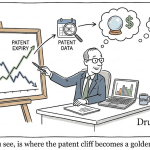
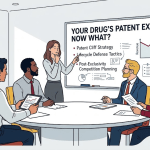
In the fourteen months after Bristol Myers Squibb agreed to pay up to $14.4 billion for Karuna Therapeutics, its lead asset became Cobenfy, the first new mechanism-of-action antipsychotic approved by the FDA in decades.[1] In the same window, AbbVie’s $8.7 billion bet on Cerevel Therapeutics produced the opposite outcome: its lead schizophrenia candidate, emraclidine, failed both Phase 2 trials on the same day, erasing roughly $40 billion of AbbVie’s market capitalization before lunch.[2] Both companies were buying the same modality — a muscarinic receptor drug for schizophrenia — to solve the same problem, on nearly the same acquisition calendar, in service of the same patent cliff. One diligence process produced a marketed drug. The other produced a $3.5 billion impairment charge.[3]
That is the real subject of this piece. Every “patent cliff” article tells the story from one side: how much revenue is at risk, and which drugs are exposed. This one is built the other way — as a mirrored framework covering the two decisions that actually happen inside a deal: what a cliff-exposed buyer screens for, and what a clinical-stage seller does to get chosen. The evidence is drawn from primary sources: SEC filings, company press releases, and trade coverage of the specific 2023-2026 deals that big pharma itself has described, in writing, as patent-cliff responses.
The Short Answer
Pharma buyers facing a patent cliff screen acquisition and licensing targets on six variables: how closely the target’s development stage matches the buyer’s own cliff timeline, whether the modality diversifies an existing portfolio, whether the clinical data beats standard of care rather than merely matching it, whether the IP estate is clean enough to close quickly, whether manufacturing can scale without a multi-year build-out, and whether the seller will accept a deal structure — upfront cash versus milestones and contingent value rights — that fits the buyer’s balance sheet. Sellers that engineer their company toward those same six variables consistently command premium valuations; those that don’t get passed over even with real science, or get bought cheap. Verified 2023-2024 deals from AbbVie, Bristol Myers Squibb, Merck, Pfizer, Novartis and Roche total more than $117 billion in disclosed upfront-equivalent value, and two of the largest — AbbVie’s Cerevel deal and Novartis’s MorphoSys deal — illustrate that passing every buy-side screen still does not guarantee the acquired asset survives its next clinical readout.
The Deal Wave Is the Evidence: How Big Is the 2025-2026 Cliff-Driven M&A Cycle
Global biopharma M&A totaled $228.4 billion in announced deal value in 2025, up 73% from 2024, with 17 or more individual transactions exceeding $1 billion.[4] That momentum carried into 2026: J.P. Morgan’s Q1 2026 deal report counted $15.6 billion across 19 transactions in the first quarter alone, and separate first-half tracking put total 2026 biotech M&A on pace for its best year since before the pandemic, with average deal size climbing to $527.3 million from $365 million in 2025.[5][6] IQVIA frames the driver plainly: blockbuster brands including Keytruda, Gardasil, Eliquis, Jardiance, Opdivo, Darzalex and Cosentyx lose exclusivity by the end of the decade, with a further $200-250 billion of industry revenue exposed to loss-of-exclusivity events in the early 2030s on top of that.[7] On the supply side of the deal market, emerging biopharma companies now account for roughly 70% of all clinical-stage assets in the industry pipeline — the majority unpartnered — which is why licensing and acquisition, not internal R&D, has become the primary mechanism for refilling a pipeline fast enough to matter.[7]
“A major patent cliff, with more than 200 drugs losing exclusivity, is driving pharmaceutical firms to acquire late-stage or market-ready assets to maintain revenue growth.”[8]
Part One: The Buy-Side Framework — What a Cliff-Exposed Buyer Actually Screens For
Reading the acquisition rationale that buyers themselves disclosed in SEC filings and press releases across 2023-2024 surfaces the same six variables again and again, independent of company or therapeutic area.
Variable 1: Stage Fit to the Buyer’s Own Cliff Calendar
A buyer with three years until its cliff cannot absorb a preclinical asset; a buyer with eight years of runway does not need to overpay for something already on the market. BMS’s Karuna acquisition closed in March 2024 with KarXT already under FDA review and a PDUFA date of September 26, 2024 — a nine-month gap between close and potential launch.[9] Pfizer’s Seagen deal, by contrast, bought four already-approved ADCs (Padcev, Tukysa, Adcetris, Tivdak) generating revenue on day one, directly against a 2026-2028 cliff on Eliquis, Ibrance, Xtandi and Prevnar that Pfizer itself sized at $15-18 billion in lost annual revenue.[10][11]
Variable 2: Modality Diversification, Not Duplication
Buyers consistently bought a different drug class than the one facing expiration. AbbVie’s Humira and Skyrizi/Rinvoq franchise is small-molecule and monoclonal-antibody immunology; its two late-2023 acquisitions added an antibody-drug conjugate platform (ImmunoGen) and a CNS small-molecule/receptor-modulator pipeline (Cerevel) — neither overlapping with immunology.[12] BMS bought three different modalities in one quarter: a KRAS inhibitor (Mirati’s Krazati), a muscarinic receptor agonist (Karuna’s KarXT), and an alpha-emitting radiopharmaceutical platform (RayzeBio), explicitly to diversify beyond the immuno-oncology base of Opdivo and Yervoy that was underperforming.[13][14]
Variable 3: Clinical Differentiation Against Standard of Care, Not Parity With It
“Me-too” assets are treated as non-starters in the current cycle; the single largest driver of acquisition premium is data that beats, not matches, existing standard of care.[15][16] Analysts flagged this explicitly in the Cerevel deal: emraclidine’s appeal was a differentiated mechanism (an M4-selective positive allosteric modulator) that promised efficacy without the metabolic side effects of older antipsychotics — a genuine SoC-beating proposition on paper, which is precisely why its Phase 2 failure was received as a surprise rather than a discount being priced in.[17]
Variable 4: A Clean IP Estate and Fast Freedom-to-Operate Diligence
2026 dealmaking guidance is explicit that IP diligence has become forensic: “ensure IP estates are pristine and CMC foundations are compliant before engaging.”[15] A target with pending interferences, unresolved inventorship disputes, or a thin patent family around its lead asset adds months to closing — time a cliff-exposed buyer often does not have.
Variable 5: Manufacturing and CMC Readiness
BMS’s RayzeBio deal is the clearest example of manufacturing capability itself functioning as a valuation driver rather than a mere operational detail. RayzeBio’s Indianapolis facility, on track for GMP radiopharmaceutical production in the first half of 2024, was cited by William Blair analysts as a specific factor in BMS’s willingness to pay a price more than double RayzeBio’s IPO valuation just three months after that IPO.[18][19]
Variable 6: Deal Structure That Matches the Buyer’s Balance Sheet
Upfront cash as a share of total announced licensing deal value fell to just 6% in J.P. Morgan’s Q1 2026 tracking — buyers are systematically shifting risk onto milestones and contingent value rights rather than paying it all at signing.[5] Merck’s Daiichi Sankyo alliance illustrates the mechanics at scale: $4.0 billion upfront against a headline value of up to $22 billion, with Merck responsible for 75% of the first $2 billion of R&D cost and the rest tied to development, regulatory and sales milestones stretched toward the mid-2030s.[20][21]
Five Buy-Side Case Studies, Five Different Cliffs
AbbVie: Two Deals in Six Days, One Humira-Sized Hole
AbbVie announced the $10.1 billion ImmunoGen acquisition on November 30, 2023, and the $8.7 billion Cerevel acquisition six days later, on December 6, 2023 — $18.8 billion in combined disclosed value inside a single week.[22][23] Both were explicit responses to Humira’s biosimilar erosion, which had cut U.S. sales by a third, to $11.1 billion, in the first nine months of 2023 alone.[24] ImmunoGen brought an already-approved ovarian cancer ADC, Elahere, plus a follow-on ADC pipeline; Cerevel brought a seven-candidate neuroscience pipeline across schizophrenia, Parkinson’s disease and mood disorders.[25][26]
Bristol Myers Squibb: Three Deals in One Quarter, Three Different Modalities
BMS announced the Mirati Therapeutics acquisition (up to $5.8 billion) on October 8, 2023, then the Karuna Therapeutics acquisition ($14.0 billion) on December 22, and the RayzeBio acquisition ($4.1 billion) just five days later, on December 27.[13][27][28] All three deals were tied by BMS’s own executives to the coming loss of patent protection on Opdivo, Yervoy and Eliquis, and to Revlimid’s already-underway generic erosion, which had forced BMS to cut its full-year 2023 sales guidance from growth to a decline.[13] Combined disclosed value across the three: up to $23.9 billion.
Merck: Licensing at Scale Instead of Owning Outright
Merck took a different structural path. It acquired Prometheus Biosciences outright for $10.8 billion in June 2023 for an immunology asset now known as tulisokibart, then chose a co-development and co-commercialization alliance — not an acquisition — for three Daiichi Sankyo ADCs in October 2023, worth up to $22 billion against $4 billion upfront.[20][29] CEO Rob Davis was explicit about why: Merck’s preferred deal size tops out around $15 billion for outright acquisitions, which the ADC portfolio’s full risk-adjusted value exceeded, making a shared-cost alliance the more capital-efficient way to hedge Keytruda’s 2028 U.S. patent expiration.[30]
Pfizer: One Very Large Swing
Rather than a series of mid-size deals, Pfizer concentrated its cliff response into a single $43.4 billion acquisition of Seagen, closed in December 2023, betting the entire response to a 2026-2028 cliff on Eliquis, Ibrance, Xtandi and Prevnar on one platform: antibody-drug conjugates.[10][31] Eliquis and Ibrance alone represented 20% of Pfizer’s total 2023 revenue.[10]
Novartis and Roche: The Mid-Size, Multi-Deal Playbook
Novartis spent $3.5 billion on Chinook Therapeutics (June 2023, kidney disease) and $2.9 billion on MorphoSys (February 2024, oncology) — $6.4 billion combined across two mid-size deals rather than one large one.[32][33] Roche followed the same pattern: $7.1 billion for Telavant’s inflammatory bowel disease asset (October 2023) and $2.7-3.1 billion for Carmot Therapeutics’ obesity and diabetes portfolio (December 2023), $9.8-10.2 billion combined.[34][35]
Buyer
Target
Disclosed value
Modality acquired
Cliff addressed
AbbVie
ImmunoGen
$10.1B
ADC, approved + pipeline
Humira erosion
AbbVie
Cerevel Therapeutics
$8.7B
CNS small molecule
Humira erosion
BMS
Mirati Therapeutics
Up to $5.8B
KRAS inhibitor, approved
Opdivo/Revlimid/Eliquis
BMS
Karuna Therapeutics
$14.0B
Muscarinic receptor agonist
Opdivo/Revlimid/Eliquis
BMS
RayzeBio
$4.1B
Radiopharmaceutical (Ac-225)
Opdivo/Revlimid/Eliquis
Merck
Prometheus Biosciences
$10.8B
Anti-TL1A antibody
Keytruda 2028 LOE
Merck
Daiichi Sankyo (alliance)
$4.0B upfront / up to $22B
3 ADCs
Keytruda 2028 LOE
Pfizer
Seagen
$43.4B
ADC platform, 4 approved
Eliquis/Ibrance/Xtandi/Prevnar
Novartis
Chinook Therapeutics
Up to $3.5B
Kidney disease, Ph3
Portfolio diversification
Novartis
MorphoSys
$2.9B
BET inhibitor, Ph3
Oncology pipeline
Roche
Telavant
$7.1B initial
Anti-TL1A antibody
IBD pipeline gap
Roche
Carmot Therapeutics
$2.7-3.1B
GLP-1/incretin, clinical
Obesity/diabetes entry
Sources: SEC 10-K/10-Q/8-K filings and company press releases cited throughout this section.[9][13][20][22][23][27][28][32][33][34][35] Disclosed upfront-equivalent total across all twelve deals: approximately $117.1 billion, a figure calculated for this article by summing closed or upfront-plus-guaranteed values rather than maximum contingent totals.
What “De-Risked” Doesn’t Mean: Two Buy-Side Case Studies That Went Wrong
Every acquisition rationale above describes a target that looked de-risked at signing: late-stage data, a named indication, a defensible mechanism. Two of the deals in Table 1 show what happens when the underlying clinical risk resolves the wrong way after the deal closes — a distinction that matters because it is invisible in any revenue-at-risk table and only shows up after the transaction is done.
AbbVie/Cerevel: A Phase 2 Failure Erased $40 Billion in a Morning
On November 11, 2024 — fourteen months after the Cerevel deal was announced and three months after it closed — AbbVie disclosed that both Phase 2 EMPOWER trials of emraclidine missed their primary endpoint against placebo.[36] AbbVie’s shares fell more than 12%, a roughly $40 billion single-morning loss in market capitalization.[2][37] AbbVie’s own 10-K quantifies the accounting consequence: the drug’s carrying value was written down from $6.9 billion to a fair value of $2.4 billion at that trigger event, followed by a further $3.5 billion impairment charge disclosed in a January 2025 SEC filing.[3][36] Guggenheim Securities had projected emraclidine sales reaching $1.5 billion by 2033 before the failure; that revenue line was removed from AbbVie’s model entirely.[38] Analysts at BMO Capital Markets called the result “a flat out” failure and noted it handed a clear competitive advantage to Bristol Myers Squibb’s newly approved Cobenfy.[39][40]
Novartis/MorphoSys: A Mixed Endpoint, Then a Safety Signal
Novartis’s $2.9 billion MorphoSys acquisition shows a subtler version of the same risk. At signing in February 2024, pelabresib had already hit its primary spleen-volume-reduction endpoint in the Phase 3 MANIFEST-2 trial in combination with Incyte’s Jakafi — but had missed the secondary symptom-improvement endpoint, a fact Leerink Partners analyst Andrew Berens flagged at the time as making the deal’s timing a “potential risk.”[41][42] Eight months after the deal closed, Novartis disclosed a safety signal: a higher rate of malignant transformation to acute myeloid leukemia among pelabresib recipients, pushing the planned U.S. regulatory filing back by what CEO Vas Narasimhan described as potentially “a couple of years.”[43]
The Comparison Neither Company Planned: Cobenfy vs. Emraclidine
BMS and AbbVie were, in effect, running a natural experiment neither company designed. Both bought a muscarinic-pathway antipsychotic in the same acquisition wave, against the same competitive backdrop, evaluated by the same investment banks in the same weeks. KarXT/Cobenfy had already cleared three medium-to-large trials before FDA approval in September 2024; emraclidine had one small earlier trial showing a positive signal before its two pivotal Phase 2 studies failed outright.[40][44] The lesson for the buy-side framework in Part One is not that BMS’s diligence was better in some abstract sense — both deals passed every screening variable listed above at signing. It is that stage fit, modality diversification, and differentiated mechanism are necessary conditions for a good acquisition, not sufficient ones. Clinical risk on an unapproved asset does not go to zero because the acquirer has a $14 billion or $8.7 billion checkbook.
Part Two: The Sell-Side Framework — What Makes a Biotech a Premium-Priced Target
The buy-side variables above have a mirror image on the sell side. Companies that engineer toward these five levers consistently price better, whether the outcome is a full acquisition or a licensing alliance.
Lever 1: Differentiated Data Beats “Me-Too,” Every Time
2026 dealmaking guidance states this as a filter, not a preference: “‘Me-too’ drugs are non-starters. Data must show a clear advantage over the Standard of Care.”[15] Head-to-head trial wins against an approved comparator consistently command the highest premiums observed in 2025 deal data.[16]
Lever 2: A Clean, Diligence-Ready Data Room Is a Pricing Lever, Not Just a Closing Requirement
“Clean data rooms, organized regulatory dossiers, compliant manufacturing processes, and clear IP positions reduce diligence friction and accelerate deal timelines” — and speed itself has value to a buyer racing a cliff calendar.[16] This is the sell-side mirror of buy-side Variable 4: an unresolved IP dispute costs the seller as much in negotiating leverage as it costs the buyer in closing time.
Lever 3: Manufacturing Capacity Can Be the Deal-Maker, Not an Afterthought
RayzeBio is the clearest evidence: a company three months removed from its IPO, still pre-revenue, commanded a price more than double its IPO valuation substantially because it already had a GMP radiopharmaceutical facility nearing production readiness in Indianapolis.[18][19] For a seller in a manufacturing-intensive modality — radioligands, cell therapy, ADCs — owning even partial commercial-scale capacity ahead of a sale process is a direct, quantifiable premium driver, not a cost center to minimize before diligence.
Lever 4: Willingness to Accept Milestone-Heavy Structure Widens the Buyer Pool
With upfront cash falling to roughly 6% of total announced licensing value in early 2026, sellers unwilling to accept CVRs or heavy milestone weighting are self-selecting out of a large share of available buyers.[5] Chinook Therapeutics took this structure directly: $3.2 billion upfront cash plus a CVR of up to $4 per share (up to roughly $300-400 million more) tied to a single regulatory milestone for its lead asset, atrasentan — a structure that still delivered an 83% premium to Chinook’s 60-day volume-weighted average price.[45][46] Accepting contingent structure did not cost Chinook shareholders the premium; it appears to have been part of what made the deal financeable for Novartis at that valuation.
Lever 5: The Dual-Track IPO Threat Is a Real Negotiating Lever, Not a Bluff
Current dealmaking guidance recommends sellers keep “a ‘dual-track’ process in mind. The credible threat of an IPO can be a powerful negotiating tool to drive the acquisition price.”[15] This only works, notably, if the other four levers are already in place: an IPO threat from a company with unclean IP or a “me-too” asset is not credible and buyers price it accordingly.
Matching Target Stage to the Buyer’s Cliff Window
Combining the buy-side and sell-side evidence above produces a practical timing rule: the gap between a buyer’s cliff year and the present determines what stage of asset that buyer can rationally absorb.
Years to buyer’s cliff
Rational target stage
Deal type
Verified example
0-2 years (imminent)
Approved or PDUFA-imminent
Outright acquisition
BMS/Karuna (PDUFA 9 months post-signing)[9]
2-4 years (near-term)
Late Phase 3 / just-approved
Outright acquisition
Novartis/MorphoSys (Ph3 readout at signing)[41]
4-6 years (medium-term)
Phase 2/3, differentiated mechanism
Acquisition or alliance
AbbVie/Cerevel (Ph2 at signing)[23]
4-6 years, high-cost modality
Phase 1-3 platform, shared R&D risk
Co-development alliance
Merck/Daiichi Sankyo ADCs[20]
6+ years (long-term)
Early clinical or preclinical platform
Minority investment or option
Not represented among the 2023-2024 deals above; consistent with the broader 2025-2026 shift toward smaller, earlier bolt-ons noted in current deal tracking[47]
How Deal Structure Allocates the Cliff Risk Between Buyer and Seller
The AbbVie/Cerevel and Novartis/MorphoSys outcomes above raise an obvious question: why don’t buyers structure every cliff-driven deal to hedge exactly this risk? Increasingly, they do. The industry-wide shift to roughly 6% upfront cash in licensing deals is a direct response to exactly the failure pattern both case studies illustrate — it moves the cost of a Phase 2 or Phase 3 miss from the buyer’s balance sheet onto the deal’s contingent-payment schedule.[5] But the two acquisitions examined here were structured as all-cash-upfront deals: AbbVie paid $8.7 billion in cash for Cerevel with no clinical-outcome-linked CVR on emraclidine, and Novartis paid $2.9 billion upfront for MorphoSys with the pelabresib risk fully absorbed at close.[9][32] Chinook Therapeutics, by contrast, is the one case in Table 1 that used exactly this hedge — a CVR tied to a regulatory milestone — and it is not coincidental that Chinook’s asset, atrasentan, was also the most clinically advanced of the group at signing.[45] The practical rule this suggests: the earlier the clinical stage of the target’s lead asset, the more a buyer should be structuring around contingent payments rather than upfront cash, and the more a seller with real differentiation should expect that structure rather than treat it as a discount.
Where the Inflation Reduction Act Reshapes the Math for Both Sides
One variable neither the AbbVie nor the Novartis deal rationale mentioned explicitly, but which now sits inside every serious 2025-2026 acquisition model, is the IRA’s Medicare drug price negotiation timeline: small-molecule drugs become eligible for negotiation nine years after FDA approval, versus thirteen years for biologics, and drugs selected face price cuts in the range of 25-60%.[48] That asymmetry means a buyer evaluating two otherwise-identical assets — one small molecule, one biologic — should rationally value the biologic’s later years of exclusivity more highly, and current BD guidance now instructs teams to model IRA impact on every deal likely to generate $1 billion or more in Medicare Part B/D revenue.[48] This is a second, quieter reason (alongside modality diversification) that several of the deals in Table 1 — RayzeBio’s radiopharmaceutical platform, the ADC assets across AbbVie, Pfizer and Merck — skew toward biologics and complex modalities rather than small molecules.
Methodology
This piece draws its case studies from SEC filings (10-K, 10-Q, 8-K), company press releases, and trade press coverage explicitly describing each transaction as a response to a named patent-cliff exposure, limited to deals valued at $1 billion or more announced or closed between June 2023 and February 2024, plus the two post-close outcome events (AbbVie/Cerevel, Novartis/MorphoSys) that followed through January 2025. Deal values in Table 1 use disclosed upfront-plus-guaranteed figures where a deal separates guaranteed from maximum-contingent value (e.g., Merck/Daiichi Sankyo’s $4.0 billion upfront against a $22 billion maximum); the calculated $117.1 billion aggregate sums these guaranteed figures, not maximum contingent totals, and is labeled throughout as a DrugPatentWatch calculation rather than an independently reported industry statistic. Day-count gaps between same-buyer announcements (AbbVie’s six days, BMS’s five days) were calculated directly from each deal’s disclosed announcement date.
Key Takeaways
Seven buyers committed roughly $117.1 billion in disclosed upfront-equivalent value across twelve patent-cliff-driven deals between June 2023 and February 2024.
Buy-side screening consistently runs on six variables: stage fit to the buyer’s own cliff calendar, modality diversification, clinical differentiation against standard of care, IP cleanliness, manufacturing readiness, and deal-structure fit.
Passing every buy-side screen at signing does not eliminate clinical risk: AbbVie’s Cerevel deal lost its lead asset to a Phase 2 failure that erased roughly $40 billion in market value in a single morning, and Novartis’s MorphoSys deal hit both a missed secondary endpoint and a later safety signal.
Sell-side levers mirror the buy-side screen almost exactly, with one addition: willingness to accept milestone-heavy or CVR-based structure, now roughly 94% of announced licensing deal value, materially widens a seller’s buyer pool without necessarily costing the acquisition premium.
The IRA’s nine-year small-molecule versus thirteen-year biologic negotiation timeline is now modeled into deal price and helps explain the current tilt toward biologics and complex modalities like ADCs and radiopharmaceuticals in cliff-driven deals.
FAQ
What is a patent-cliff-driven acquisition?
It is an M&A or licensing deal a pharmaceutical company enters primarily to replace revenue it expects to lose when a top-selling drug loses patent exclusivity, as distinct from a deal made for pure scientific diversification or geographic expansion. Companies including AbbVie, BMS, Merck and Pfizer have all described specific 2023-2024 deals in these terms in SEC filings and public statements.[13][20][24]
How do pharma buyers pick which biotech to acquire ahead of a patent cliff?
They screen on how closely a target’s development stage matches the buyer’s own cliff timeline, whether the modality diversifies the existing portfolio, whether clinical data beats standard of care, and whether the IP estate and manufacturing process are clean enough to close quickly and confidently.
What makes a biotech an attractive acquisition target right now?
Differentiated late-stage clinical data against standard of care, a diligence-ready IP and regulatory data room, scalable manufacturing, and a willingness to accept milestone-heavy or CVR-based deal structure rather than insisting on all-cash upfront.[15][16]
Why do some patent-cliff acquisitions fail after they close?
Because the acquisition price is set on a risk-adjusted probability of clinical and regulatory success that is never 100%, even for a differentiated, late-stage mechanism. AbbVie’s $8.7 billion Cerevel deal lost its lead asset to a Phase 2 failure fourteen months after the deal was announced.[3][36]
What is a contingent value right (CVR) and why does it matter in these deals?
A CVR is a promise to pay target shareholders additional consideration — often a specified amount per share — if a defined future event occurs, typically a regulatory approval or sales milestone. It lets a buyer pay less cash upfront while shifting part of the clinical or regulatory risk onto the seller’s former shareholders, as in Novartis’s Chinook Therapeutics deal.[45]
Does a biotech’s development stage determine whether it gets acquired outright or just licensed?
Largely, yes. Buyers facing a near-term cliff tend to acquire companies with approved or late Phase 3 assets outright, as BMS did with Karuna and Mirati. Buyers with more runway before their own cliff, or facing very high per-asset development cost, more often choose co-development alliances that share cost and risk, as Merck did with Daiichi Sankyo’s ADC portfolio rather than acquiring Daiichi Sankyo outright.[20][30]
Why did BMS and AbbVie both acquire muscarinic-receptor schizophrenia drugs in the same window, with opposite outcomes?
Both companies were responding to the same clinical opportunity — a differentiated non-dopaminergic mechanism for schizophrenia — on the same acquisition calendar. KarXT/Cobenfy had cleared three medium-to-large trials before approval; emraclidine had one small earlier positive trial before its two pivotal Phase 2 studies failed. Passing the same buy-side screening variables at signing did not guarantee the same clinical outcome.[40][44]
How does the Inflation Reduction Act affect patent-cliff deal valuations?
Small-molecule drugs become eligible for Medicare price negotiation nine years after FDA approval, versus thirteen years for biologics, and negotiated drugs face price cuts of roughly 25-60%. That timeline gap is now modeled directly into acquisition price and helps explain the current tilt toward biologics and complex modalities in cliff-driven M&A.[48]
Is licensing or full acquisition the better response to a patent cliff?
Neither is uniformly better; each allocates cost and risk differently. Licensing, as in Merck’s Daiichi Sankyo alliance, spreads R&D cost and lets the originator retain some upside and geographic rights. Full acquisition gives the buyer complete control and all future upside, but concentrates the risk of a single trial failure entirely on the buyer’s own balance sheet, as AbbVie’s Cerevel outcome shows.
Which company is best positioned heading into the 2026-2030 patent cliff?
No single deal guarantees a winning position; the evidence in this article shows that even well-screened, well-structured acquisitions carry real post-close clinical risk. Tracking each company’s specific Orange Book, exclusivity, and pipeline-replacement timeline in parallel — rather than relying on deal announcements alone — is the kind of ongoing monitoring that structured patent and exclusivity data from a source like DrugPatentWatch is built to support, particularly for teams that need to track a buyer’s remaining cliff exposure alongside its acquired pipeline’s own patent runway.
References
Bristol Myers Squibb. (2024, March 18). Bristol Myers Squibb Completes Acquisition of Karuna Therapeutics, Strengthening Neuroscience Portfolio. https://news.bms.com/news/details/2024/Bristol-Myers-Squibb-Completes-Acquisition-of-Karuna-Therapeutics-Strengthening-Neuroscience-Portfolio/default.aspx
BioPharma Dive. (2024, November 11). AbbVie’s $9B bet collapses as closely watched schizophrenia drug fails studies. https://www.biopharmadive.com/news/abbvie-emraclidine-failure-schizophrenia-bristol-myers-cobenfy/732534/
FierceBiotech. (2025, January 10). AbbVie takes $3.5B hit after emraclidine’s phase 2 flop in schizophrenia. https://www.fiercebiotech.com/biotech/abbvie-takes-35b-hit-after-emraclidines-phase-2-flop-schizophrenia
Vision Life Sciences. (2026, February 16). Pharma M&A Tracker 2026: Every Major Acquisition Decoded. https://visionlifesciences.com/insights/pharma-ma-tracker-2026
Data Room. (2026, May 21). Biotech M&A in 2026: Trends, Deals, and Buyer Signals. https://data-room.ca/biotech-mergers-and-acquisitions-trends-2026/
CNBC. (2026, June 4). Biotech M&A hits $106 billion, on track for best year since pre-Covid. https://www.cnbc.com/2026/06/04/biotech-ma-dealmaking-pharma-106-billion.html
IQVIA. (2026, January 19). Biopharma M&A: Outlook for 2026. https://www.iqvia.com/locations/emea/blogs/2026/01/biopharma-m-and-a-outlook-for-2026
Ideals VDR. (2026, June 16). Biotech M&A Outlook 2025-2026: Trends and Market Drivers. https://www.idealsvdr.com/blog/ma/biotech-ma/
Karuna Therapeutics. (2024). Form 8-K. U.S. Securities and Exchange Commission. https://www.sec.gov/Archives/edgar/data/1771917/000095017024018393/krtx-ex99_1.htm
BioSpace. (2024, July 26). How Pfizer, Bristol Myers Squibb and Johnson & Johnson Are Confronting Patent Cliffs. https://www.biospace.com/how-pfizer-bristol-myers-squibb-and-johnson-and-johnson-are-confronting-patent-cliffs
Parola Analytics. (2026, January 20). Pfizer’s impending patent cliff. https://parolaanalytics.com/parolanews/pfizer-patent-cliff/
Labiotech. (2026, April 27). The AbbVie pipeline strategy, a company at an inflection point. https://www.labiotech.eu/in-depth/abbvie-pipeline-strategy/
Fierce Pharma. (2024, February 10). Bristol Myers CEO outlines transition strategy featuring 11 key brands, more dealmaking. https://www.fiercepharma.com/pharma/bristol-myers-ceo-outlines-transition-strategy-featuring-11-key-brands-continued-dealmaking
Fierce Pharma. (2023, October 9). BMS buys Mirati for up to $5.8B as I-O giant branches out. https://www.fiercepharma.com/pharma/bristol-myers-buys-mirati-58b-i-o-giant-branches-out-targeted-therapy-cancer
Synerg Biopharma. (2026, March 31). Biopharma M&A in 2026: Key Trends, Deal Drivers, and Strategic Outlook. https://synergbiopharma.com/blog/biopharma-ma-trends/
Vision Life Sciences. (2026, February 16). Pharma M&A Tracker 2026 [premium-valuation factors]. https://visionlifesciences.com/insights/pharma-ma-tracker-2026
Pharmaphorum. (2023, December 7). AbbVie swoops on Pfizer spin-out Cerevel with $8.7bn offer. https://pharmaphorum.com/news/abbvie-swoops-pfizer-spin-out-cerevel-87bn-offer
FierceBiotech. (2024, January 2). BMS enters radiopharma race with $4.1B acquisition of RayzeBio just 3 months after biotech went public. https://www.fiercebiotech.com/biotech/bms-enters-radiopharma-race-41b-acquisition-rayzebio-just-3-months-after-biotechs-ipo
C&EN. (2024, January 2). Bristol Myers Squibb snaps up RayzeBio. https://cen.acs.org/business/mergers-&-acquisitions/Bristol-Myers-Squibb-snap-Karuna/101/web/2023/12
Merck & Co. (2023). Form 10-Q. U.S. Securities and Exchange Commission. https://www.sec.gov/Archives/edgar/data/310158/000162828023036717/mrk-20230930.htm
BioPharma Dive. (2023, October 20). Merck allies with Daiichi Sankyo in major bet on antibody cancer drugs. https://www.biopharmadive.com/news/merck-daiichi-sankyo-adc-antibody-cancer-drug/697260/
AbbVie Inc. (2023). Form 10-K. U.S. Securities and Exchange Commission. https://www.sec.gov/Archives/edgar/data/1551152/000155115224000011/Financial_Report.xlsx
AbbVie. (2023, December 6). AbbVie to Acquire Cerevel Therapeutics in Transformative Transaction to Strengthen Neuroscience Pipeline. https://investors.abbvie.com/news-releases/news-release-details/abbvie-acquire-cerevel-therapeutics-transformative-transaction
Pharmaphorum. (2023, December 7). AbbVie swoops on Pfizer spin-out Cerevel with $8.7bn offer [Humira erosion figures]. https://pharmaphorum.com/news/abbvie-swoops-pfizer-spin-out-cerevel-87bn-offer
GEN. (2024, February 20). AbbVie to Acquire Cerevel for $8.7B, Growing Neuro Drug Pipeline. https://www.genengnews.com/topics/drug-discovery/abbvie-to-acquire-cerevel-for-8-7b-growing-neuro-drug-pipeline/
BioPharm International. (2024, August). AbbVie Completes $8.7 Billion Acquisition of Cerevel Therapeutics to Boost Neurological Pipeline. https://www.biopharminternational.com/view/abbvie-completes-8-7-billion-acquisition-of-cerevel-therapeutics-to-boost-neurological-pipeline
Bocconi Students M&A Circle. (2025, June 4). Bristol Myers Squibb has acquired Karuna in a $14.0 billion cash deal. https://bsmac.org/2024/06/14/bristol-myers-squibb-has-acquired-karuna-in-a-14-0-billion-cash-deal/
Pharmaphorum. (2023, December 28). BMS strikes again, with $4.1bn RayzeBio takeover bid. https://pharmaphorum.com/news/bms-strikes-again-41bn-rayzebio-takeover-bid
MedCity News. (2023, October 20). Merck Missed on Seagen, But Comes Back With Potential $22B Daiichi ADC Deal. https://medcitynews.com/2023/10/merck-missed-on-seagen-but-comes-back-with-potential-22b-daiichi-adc-deal/
Yahoo Finance / BioPharma Dive. (2024, February 1). Merck keeps deal focus with Keytruda patent cliff on horizon. https://finance.yahoo.com/news/merck-keeps-deal-focus-keytruda-115500135.html
PharmExec. (2026, July 22). Pfizer at a Crossroads: Leadership, Strategy, and the Risk of a Narrative Cliff. https://www.pharmexec.com/view/pfizer-leadership-strategy-narrative-cliff
Chinook Therapeutics. (2023). Form 8-K, Exhibit 99.1. U.S. Securities and Exchange Commission. https://www.sec.gov/Archives/edgar/data/1435049/000119312523164891/d511815dex991.htm
Novartis. (2024, February 5). Novartis to strengthen oncology pipeline with agreement to acquire MorphoSys AG. https://www.novartis.com/news/media-releases/novartis-strengthen-oncology-pipeline-agreement-acquire-morphosys-ag-eur-68-share-or-aggregate-eur-27bn-cash
BioPharma Dive. (2023, October 23). Roche to gain gut disease drug in $7.1B deal for Roivant subsidiary. https://www.biopharmadive.com/news/roivant-roche-pfizer-tl1a-telavant-acquire-ibd-drug/687882/
DCAT Value Chain Insights. (2024, August 2). Roche Completes $2.7-Bn Acquisition of Carmot Therapeutics. https://www.dcatvci.org/top-industry-news/roche-completes-2-7-bn-acquisition-of-carmot-therapeutics/
AbbVie Inc. (2024). Form 10-K. U.S. Securities and Exchange Commission. https://www.sec.gov/Archives/edgar/data/1551152/000155115225000020/abbv-20241231.htm
Clinical Trials Arena. (2024, November 12). AbbVie’s stock plummets over 12% after schizophrenia drug flops in Phase II trials. https://www.clinicaltrialsarena.com/news/abbvie-stock-plummets-over-12-after-schizophrenia-drug-flops-in-phase-ii-trials/
BioSpace. (2024, November 14). AbbVie Shares Plummet 12% as Cerevel Schizophrenia Asset Fails Phase II Trials. https://www.biospace.com/drug-development/abbvie-shares-plummet-12-as-cerevel-schizophrenia-asset-fails-phase-ii-trials
BioPharma Dive. (2024, November 11). On Wall Street, ‘flat out’ failure of AbbVie schizophrenia drug leaves analysts stunned. https://www.biopharmadive.com/news/abbvie-wall-street-cerevel-emraclidine-schizophrenia-neurocrine-neumora/732557/
BioPharma Dive. (2024, February 6). MorphoSys to sell to Novartis for $2.9B, offload cancer drug to Incyte. https://www.biopharmadive.com/news/morphosys-novartis-incyte-acquire-myelofibrosis-pelabresib/706648/
Pharmaceutical Technology. (2025, December 17). Novartis to Acquire MorphoSys for Roughly $2.9 Billion. https://www.pharmtech.com/view/novartis-to-acquire-morphosys-for-roughly-2-9-billion
FierceBiotech. (2024, October 29). Novartis’ $2.9B MorphoSys bet stumbles as safety signal delays filing by years. https://www.fiercebiotech.com/biotech/novartis-29b-morphosys-bet-stumbles-safety-signal-delays-filing-years
Wikipedia. Emraclidine [clinical trial and approval-comparison timeline]. https://en.wikipedia.org/wiki/Emraclidine
BioSpace. (2024, July 17). 10 Multibillion-Dollar M&As That Closed Since July 2023. https://www.biospace.com/top-10-m-and-as-since-july-2023
Chinook Therapeutics. (2023). Form DFAN14A. U.S. Securities and Exchange Commission. https://www.sec.gov/Archives/edgar/data/1435049/000119312523070189/tm2318441d1_dfan14a.htm
Ideals VDR. (2026, June 16). Biotech M&A Outlook 2025-2026 [2026 shift toward smaller, earlier bolt-ons]. https://www.idealsvdr.com/blog/ma/biotech-ma/
Vision Life Sciences. (2026, February 16). Pharma M&A Tracker 2026 [IRA modeling guidance]. https://visionlifesciences.com/insights/pharma-ma-tracker-2026