In November 2014, the FDA changed two letters next to a drug’s name in a government database, and a $1.23 billion acquisition collapsed as a result.
The drug was methylphenidate hydrochloride extended-release, the generic form of Johnson & Johnson’s ADHD medication Concerta. Mallinckrodt and Kremers Urban Pharmaceuticals had been selling FDA-approved, AB-rated versions since 2012 and 2013. Then post-marketing reports and a reanalysis of release-rate data convinced the FDA that both products might deliver less drug late in the dosing day than Concerta itself.[1] The agency downgraded both from AB to BX, meaning “data are insufficient to determine therapeutic equivalence.” A pending sale of Kremers Urban to a private equity buyer fell apart within weeks.[2] Two years later, the FDA proposed withdrawing both ANDAs outright.[3]
That two-letter code, not patent law, not trademark law, is the real machinery behind the U.S. version of the branded generic. Most industry coverage of branded generics treats the term as a single global phenomenon, driven by trust premiums in India or out-of-pocket psychology in Brazil. That framing is accurate for those markets. It is close to useless for understanding why a handful of off-patent drugs behave like brands inside the United States, where automatic pharmacy substitution is the default and unbranded generics are supposed to dominate. In the U.S., branded-generic durability is a regulatory and legal artifact: a therapeutic equivalence code, a state substitution statute, or a 505(b)(2) reformulation that resets the clock. This piece maps that machinery using FDA actions, state law text, and SEC filings, not survey data on patient sentiment.
1. Two Different Products Share One Name
“Branded generic” describes two structurally different things depending on which market is being discussed, and conflating them produces bad forecasts.
1.1 The Emerging-Market Branded Generic: A Trust Signal
In India, Brazil, and much of Southeast Asia, a branded generic is an off-patent molecule sold under a proprietary name to a physician who prescribes it by brand, to a patient paying out of pocket who has no insurer forcing substitution to the cheapest option. The brand functions as a stand-in for regulatory assurance in markets where enforcement capacity is viewed as inconsistent. This is the version most existing branded-generic commentary, including earlier analysis on this same subject, describes in depth.
1.2 The U.S. Branded Generic: A Legal Carve-Out
In the United States, automatic generic substitution at the pharmacy counter is the statutory default in nearly every state once a product is AB-rated. A U.S. branded generic therefore is not competing against substitution through better marketing alone; it is typically living inside one of a small number of carve-outs where the law does not force substitution, or where a bioequivalence question is genuinely open. Those carve-outs are the subject of this piece.
1.2.1 Why This Distinction Changes Commercial Strategy
A company evaluating whether to protect a U.S. off-patent asset with “branding” is asking a fundamentally different question than one protecting an Indian asset with branding. The Indian question is about physician relationships and out-of-pocket psychology. The U.S. question is about whether the product sits in a legally defensible category: NTI status, a 505(b)(2) label distinct from the reference product, or a bioequivalence profile that has not yet been successfully replicated by an ANDA filer.
2. The Orange Book Code That Decides Everything
The FDA’s Approved Drug Products with Therapeutic Equivalence Evaluations, universally called the Orange Book, assigns every approved generic a two-letter therapeutic equivalence code. This code, not the ANDA approval itself, is what triggers automatic substitution.
2.1 What the Codes Mean
Codes beginning with A (AA, AB, AB1 through AB6, AN, AO, AP, AT) indicate the FDA has found no known or expected bioequivalence problems and considers the product interchangeable with its reference listed drug. Codes beginning with B (BC, BD, BE, BN, BP, BR, BS, BT, BX) indicate either an identified bioequivalence problem or insufficient data to resolve one; B-coded products are not recommended for automatic substitution.[4]
2.2 The Code Can Change After Approval
The Orange Book is a living document, republished monthly, and a code assigned at approval is not permanent. Two documented cases show the code moving from A to B years after launch, each time following an FDA reassessment triggered by adverse-event reports rather than a new sponsor filing.
2.2.1 Why a Post-Approval Downgrade Is Different From a Recall
A downgrade to a B-series code does not necessarily remove a product from the market. Both Mallinckrodt’s and Kremers Urban’s methylphenidate ER products remained commercially available and legally prescribable for roughly two years after their BX downgrade in November 2014; what changed immediately was pharmacist-level substitution authority, not shelf presence.[5]
2.3 Case Study: Budeprion XL 300 mg
Impax Laboratories’ bupropion hydrochloride extended-release 300 mg tablet, marketed by Teva as Budeprion XL 300, was approved in December 2006 as an AB-rated generic of GlaxoSmithKline’s Wellbutrin XL 300 mg.[6] The approval rested on a bioequivalence study conducted at the 150 mg strength and extrapolated to the 300 mg strength, a methodology the FDA’s guidance permitted at the time, chosen partly because testing the higher dose directly in healthy volunteers raised seizure-risk concerns.[7]
Between January and June 2007, the FDA received 85 reports of adverse events or loss of efficacy from patients who had switched from Wellbutrin XL to Budeprion XL.[8] A 2007 FDA review nonetheless reaffirmed bioequivalence. It took an FDA-sponsored clinical study, begun in 2010 and completed in August 2012, testing 24 healthy volunteers directly at the 300 mg strength, to establish that Budeprion XL 300 failed to demonstrate therapeutic equivalence.[9] Teva agreed to stop distribution in September 2012. The FDA formally withdrew the ANDA (number 77-415) in a March 15, 2013 Federal Register notice.[10] The 150 mg version, tested directly rather than by extrapolation, was not affected. The FDA subsequently required the drug’s four other generic manufacturers, Anchen, Actavis, Watson, and Mylan, to submit their own 300 mg-specific bioequivalence data by March 2013 and reissued formal bioequivalence recommendations at the 100, 150, 200, 300, and 450 mg strengths.[11]
2.4 Case Study: Generic Concerta’s AB-to-BX Downgrade
Mallinckrodt’s methylphenidate ER ANDA was approved in December 2012; Kremers Urban Pharmaceuticals’ (then doing business as Kudco) was approved in July 2013, both as AB-rated substitutes for Concerta.[12] In November 2014, the FDA disclosed concerns, based on adverse-event reports of insufficient late-day effect and a reanalysis of release-rate data, that both products might deliver methylphenidate more slowly than Concerta between roughly 7 and 12 hours post-dose.[13] The agency changed both codes from AB to BX and asked each company to either run new bioequivalence studies under revised guidance or voluntarily withdraw within six months. Neither did. Mallinckrodt sued the FDA over the determination; a federal judge in Maryland dismissed the suit in August 2015.[14] In October 2016 the FDA proposed formally withdrawing both ANDAs, offering each company a hearing.[15] A third manufacturer, Actavis, whose product used an identical formulation licensed from Concerta’s own manufacturer, kept its AB rating throughout and became, for a period, the only AB-rated generic Concerta on the market.[16]
The commercial fallout preceded the formal withdrawal proposal by nearly two years. UCB had been negotiating to sell Kremers Urban to a private equity buyer; that deal collapsed in December 2014, within a month of the BX downgrade. UCB instead sold Kremers Urban to Lannett Company in 2015 for $1.23 billion upfront plus contingent payments tied to whether the FDA ever restored the drug’s equivalence rating, a deal structure that priced the AB-to-BX downgrade directly into the purchase agreement.[17]
Event
Date
Product
Mechanism
Source
ANDA approved, AB-rated
Dec. 2006
Budeprion XL 300 (Impax/Teva)
150 mg BE study extrapolated to 300 mg
RAPS[6]
85 adverse-event/efficacy-loss reports
Jan.–June 2007
Budeprion XL 300
FAERS post-marketing signal
Gabionline[8]
FDA reaffirms bioequivalence
2007
Budeprion XL 300
Agency review of existing data
RAPS[6]
FDA-sponsored direct 300 mg study completed
Aug. 2012
Budeprion XL 300
24-subject clinical BE study
Gabionline[8]
Teva agrees to stop distribution
Sept./Oct. 2012
Budeprion XL 300
Non-equivalence confirmed
RAPS[9]
ANDA formally withdrawn
Mar. 15, 2013
Budeprion XL 300
Federal Register notice
RAPS[10]
Mallinckrodt/Kremers ANDAs approved AB
Dec. 2012 / July 2013
Methylphenidate ER (generic Concerta)
Initial BE data accepted
SEC filing[12]
AB downgraded to BX
Nov. 13, 2014
Methylphenidate ER (Mallinckrodt, Kremers)
Reanalysis of release-rate data
FDA[13]
Kremers Urban sale to PE buyer collapses
Dec. 2014
Kremers Urban
BX rating disclosed to buyer
Outsourcing-Pharma[17]
Mallinckrodt v. FDA dismissed
Aug. 2015
Methylphenidate ER (Mallinckrodt)
Federal court, District of Maryland
RAPS[14]
Kremers Urban sold to Lannett
2015–16
Kremers Urban
$1.23B upfront + BX-contingent payments
Outsourcing-Pharma[17]
FDA proposes ANDA withdrawal
Oct. 2016
Methylphenidate ER (Mallinckrodt, Kremers/Lannett)
Formal withdrawal proceeding
RAPS[15]
3. The Narrow Therapeutic Index Carve-Out
Setting aside disputed bioequivalence, U.S. law provides one durable, statutory reason a pharmacist cannot automatically substitute a generic for a prescribed brand or branded generic: narrow therapeutic index status.
3.1 Definition
A narrow therapeutic index (NTI), sometimes called narrow therapeutic ratio, drug is one for which the difference between an effective dose and a toxic dose is small, conventionally described as less than a twofold difference between the median effective and median lethal or toxic concentrations.[18] Warfarin, digoxin, levothyroxine, phenytoin, lithium, carbamazepine, cyclosporine, theophylline, and tacrolimus recur across nearly every state and clinical list of NTI drugs, though the exact rosters differ.[19,20]
3.2 State Law, Not Federal Law, Controls Substitution
Generic substitution authority is delegated to the states. Pennsylvania’s Generic Substitution Law states plainly that an NTI drug is not substitutable “regardless of bioequivalency rating in the Federal Orange Book or safety/efficacy data,” meaning an AB rating does not override the state carve-out.[21] North Carolina’s 1997 statute names warfarin, lithium, phenytoin, carbamazepine, digoxin, theophylline, and levothyroxine specifically as drugs requiring physician and patient approval before substitution.[22] Texas and Virginia passed comparable mandatory-notification laws in the same period, while Alabama, Indiana, Nebraska, New Jersey, New York, and Missouri introduced similar bills.[22] The FDA itself has repeatedly, and unsuccessfully, lobbied state pharmacy boards against these laws, writing to the National Association of Boards of Pharmacy in the late 1990s that it had found “no documented examples of a generic product manufactured to meet its approved specifications that could not be used interchangeably with the corresponding brand-name drug.”[23] The state laws survived that lobbying and remain in force.
3.2.1 Why This Matters More Than the Federal AB Rating for Some Products
For a warfarin or levothyroxine product, NTI status functions as a second, independent lock on substitution that exists regardless of what the Orange Book says. A branded product in one of these categories can retain prescriber loyalty and pharmacy-level protection from automatic swap-out in an NTI-restrictive state even after every patent and exclusivity period on the molecule has expired, so long as prescribers keep writing for it by brand and the state law keeps requiring their sign-off to switch.
3.2.2 The Geographic Inconsistency Problem
Because NTI lists and substitution rules are set state by state, a national branded-generic strategy built on NTI status in one jurisdiction does not transfer cleanly to another. A drug protected from automatic substitution in Pennsylvania or North Carolina may face ordinary AB-rated substitution in a state that has not enacted an equivalent carve-out, meaning national market share for an NTI-branded product is a patchwork of state-by-state substitution friction rather than a single national moat.
3.3 The Synthroid Example
Levothyroxine is the most litigated real-world example of NTI substitution risk. A widely cited medical-education case describes a patient stabilized on Synthroid whose prescription was filled with a generic levothyroxine without physician notification, followed a year later by new-onset atrial fibrillation and a suppressed TSH level with no interim monitoring, illustrating exactly the clinical scenario NTI substitution statutes are designed to prevent.[24]
4. Where 505(b)(2) Creates a New Branded Product From an Old Molecule
4.1 The Pathway
A 505(b)(2) New Drug Application allows a sponsor to rely in part on the FDA’s existing finding of safety and effectiveness for a previously approved drug, combined with new supporting data the sponsor generates, rather than either running a full independent clinical program or filing a true ANDA copy.[25] This pathway is the standard route for extended-release conversions of an immediate-release molecule, new fixed-dose combinations, new dosage forms, and new routes of administration.
4.2 Why This Produces a Durable Branded Product, Not a Generic
A 505(b)(2) product receives its own NDA number, its own Orange Book listing, and is eligible for its own patent listings and regulatory exclusivity (commonly three years of new clinical investigation exclusivity where the sponsor generated new clinical data supporting the change), independent of whatever happened to the original reference molecule’s patent life. A generic competitor must file its own ANDA against this new NDA specifically; it cannot simply substitute against the original immediate-release molecule’s generic.
4.2.1 Formulation Change as a Substitution Firewall
Because the reformulated product carries its own therapeutic equivalence evaluation, an ANDA filer copying the reformulated branded product must independently demonstrate bioequivalence to that specific formulation, not to the original off-patent molecule. This is precisely the mechanism that produced both documented AB-rating failures above: Concerta’s original extended-release, two-layer bead technology proved difficult for two of three ANDA filers to replicate at the required release-rate profile, even though methylphenidate itself had been off-patent and genericized for decades in its immediate-release form.[16]
5. The Adjacent, Frequently Confused Category: Authorized Generics
An authorized generic is not a branded generic in the sense used throughout this piece, and the distinction is worth stating precisely because the two categories are commonly merged in casual industry usage.
5.1 Structural Difference
An authorized generic is the innovator’s own approved drug, manufactured on the innovator’s own production line under the innovator’s own NDA, repackaged and sold, often through a subsidiary, without the original brand name.[26] It shares the brand’s identical formulation and NDA lineage. A branded generic, as this piece uses the term, is a separate company’s product, approved under its own ANDA or 505(b)(2) NDA, marketed under a name that company chose.
5.2 What the FTC’s Data Actually Shows
The FTC’s 2011 final report on authorized generics, following a 2009 interim report, found that when an authorized generic competes against a first-filer generic during the 180-day exclusivity period, retail prices run roughly 4 to 8 percent lower and wholesale prices roughly 7 to 14 percent lower than in periods without an authorized generic present.[27] The same report found first-filer generic firm revenue drops 40 to 52 percent during the exclusivity period itself and 53 to 62 percent during the 30 months following, when an authorized generic is present, because the authorized generic is a closer substitute that captures volume rather than simply forcing a price war.[27] A more recent Health Affairs study of 146 oral-solid drugs experiencing first generic entry from 2016 to 2023 found on-invoice prices paid by pharmacies were 13 to 18 percent lower when an authorized generic was present, evidence the price effect has, if anything, strengthened since the FTC’s original data.[28]
“Authorized generic entry during this time also substantially reduces the revenues of a first-filer generic firm, with declines ranging from 47 to 51 percent,” the FTC’s interim report on authorized generic drugs found.[29]
6. Financial Mechanics: The U.S. Niche Compared With the Emerging-Market Model
6.1 Different Cost Structures, Different Moats
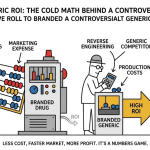
The emerging-market branded generic monetizes a marketing-and-distribution cost structure: field-force promotion, retailer margin schemes, and brand trust built over years of repeat purchase. The U.S. branded generic monetizes a regulatory and legal cost structure instead: the cost of running (or defending against) a bioequivalence study, the cost of litigating an NTI substitution question, or the cost of a 505(b)(2) clinical program that produces a new, separately patentable formulation. These are not interchangeable playbooks, and a company that assumes India-style brand marketing spend will protect a U.S. off-patent asset from AB-rated substitution is solving the wrong problem.
6.2 What a Rating Downgrade Costs a Manufacturer
The Kremers Urban transaction is a rare instance where the market priced a bioequivalence rating change directly into a deal: a pending sale collapsed within weeks of the BX downgrade, and the eventual buyer restructured the purchase price to include contingent payments tied to whether the FDA later restored the AB rating.[17] That structure is itself evidence of how differently sophisticated buyers treat rating risk compared with ordinary patent-cliff risk, which is priced through conventional discounted cash flow methods; rating risk is priced as a binary, event-driven contingency because it can eliminate substitutability, and therefore genericness, overnight.
7. Methodology
This analysis draws on FDA drug safety communications and Federal Register notices for the Budeprion XL and generic Concerta timelines, an SEC exhibit filing for deal-structure detail on the Kremers Urban transaction, the FTC’s 2009 interim and 2011 final reports on authorized generics for pricing and revenue data, a 2024 Health Affairs peer-reviewed study for more recent authorized-generic pricing evidence, and state-published generic substitution law text (Pennsylvania Department of Health) and contemporaneous trade-press coverage (Relias Media) for narrow therapeutic index substitution rules. Only two documented, FDA-confirmed post-approval therapeutic equivalence rating changes were located for this analysis (Budeprion XL 300 mg and generic Concerta); no claim is made that these are the only two such events in FDA history, only that they are the two most thoroughly documented in public FDA and trade-press records at time of writing. Figures describing FTC price and revenue effects are direct citations to the cited FTC reports and are not independently recalculated here.
8. Definitions
Bioequivalence (BE): A statistical finding that the rate and extent of absorption of a test drug, measured by area under the curve and maximum concentration, falls within a 90 percent confidence interval of 80 to 125 percent relative to the reference drug.
Therapeutic equivalence code: A two-letter (or two-letter-plus-number) rating assigned in the Orange Book indicating whether the FDA considers a generic product automatically substitutable (A-series) or not (B-series).
Narrow therapeutic index (NTI): A classification for drugs with a small margin between effective and toxic doses, subject to state-specific substitution restrictions independent of federal Orange Book ratings.
505(b)(2) application: An NDA pathway relying partly on the FDA’s existing finding of safety and effectiveness for a previously approved drug, combined with new sponsor-generated data, commonly used for reformulations and new dosage forms.
Authorized generic (AG): The innovator’s own approved drug, sold without the brand name, typically through a subsidiary, sharing the original NDA rather than a separate ANDA.
Key Takeaways
In the U.S., a durable branded generic is almost always sitting inside a legal carve-out from automatic substitution, not simply winning on marketing spend.
The FDA can and has downgraded a therapeutic equivalence rating years after approval, based on post-marketing signals rather than a new filing; this happened to Budeprion XL 300 mg in 2012 and to two generic Concerta manufacturers in 2014.
A rating downgrade does not remove a product from the market immediately, but it ends automatic pharmacy substitution and can be followed, years later, by formal ANDA withdrawal proceedings.
Narrow therapeutic index status, set state by state rather than federally, is a second, independent substitution lock that can outlast every patent and exclusivity period on a molecule.
A 505(b)(2) reformulation creates a new NDA, a new Orange Book listing, and a new bioequivalence bar that ANDA filers must clear against the reformulation specifically, not the original molecule.
Authorized generics are a structurally distinct category from branded generics; FTC and Health Affairs data show they compress first-filer generic revenue by 40 to 62 percent even while reducing retail prices by single digits.
Sophisticated buyers price rating risk as an event-driven contingency, as seen in the Kremers Urban acquisition structure, rather than through ordinary patent-cliff discounted cash flow modeling.
FAQ
What is the difference between a branded generic and an authorized generic in the U.S.?
A branded generic is a separate company’s off-patent product sold under its own proprietary name and its own ANDA or 505(b)(2) NDA. An authorized generic is the innovator’s own approved drug, made on the innovator’s line under the innovator’s original NDA, repackaged without the brand name.
What does an AB rating in the Orange Book actually mean?
It means the FDA considers the product interchangeable with its reference listed drug at the pharmacy counter, in states permitting automatic substitution, based on accepted bioequivalence data.
Can the FDA revoke an AB rating after approval?
Yes, as it did with generic Concerta in November 2014, downgrading two manufacturers from AB to BX based on post-marketing and reanalyzed release-rate data.
Why was Budeprion XL 300 mg withdrawn in 2012 after being approved in 2006?
Its original approval extrapolated bioequivalence from a 150 mg study; a direct 2012 FDA-sponsored study at the 300 mg strength found it was not therapeutically equivalent to Wellbutrin XL 300 mg.
What is a narrow therapeutic index drug?
A drug, such as warfarin, digoxin, or levothyroxine, with a small margin between an effective and a toxic dose, subject to state-level substitution restrictions.
Do all states treat NTI drugs the same way?
No. Pennsylvania bars substitution of NTI drugs regardless of federal rating; North Carolina requires physician and patient approval for a named list of NTI drugs; other states vary further.
What is a 505(b)(2) application?
An NDA pathway relying partly on the FDA’s existing finding for a previously approved drug plus new data, commonly used for reformulations that create a new, separately protected branded product.
Where do branded generics actually survive in the U.S.?
In NTI-restricted categories, in complex extended-release or device-combination products where bioequivalence has proven difficult, and in 505(b)(2) reformulations with their own Orange Book listing.
Does an authorized generic lower prices the same way an independent generic does?
Only partially. FTC data shows single-digit retail and wholesale price reductions from authorized generic competition, alongside a 40 to 62 percent revenue hit to first-filer generic firms.
Is an off-patent brand-name drug the same as a branded generic?
No. An off-patent brand-name drug is the original product under its original NDA. A branded generic is a different company’s product under a different application and a different proprietary name.
Works Cited
FDA. (2014). Methylphenidate Hydrochloride Extended Release Tablets (generic Concerta) made by Mallinckrodt and Kudco. U.S. Food and Drug Administration. https://www.fda.gov/drugs/drug-safety-and-availability/methylphenidate-hydrochloride-extended-release-tablets-generic-concerta-made-mallinckrodt-and-kudco
Outsourcing-Pharma. (2016, October 24). Lannett compiling evidence to block FDA efforts to pull generic Concerta ANDA. https://outsourcing-pharma.com/Article/2016/10/24/Lannett-compiling-evidence-to-block-FDA-efforts-to-pull-generic-Concerta-ANDA
Brennan, Z. (2016, October 18). FDA Proposes to Withdraw Two Generic Versions of ADHD Drug Concerta. RAPS. https://www.raps.org/resource/fda-proposes-to-withdraw-two-generic-versions-of-a.html
U.S. Pharmacist. Optimizing Generic Medication Use. https://uspharmacist.com/article/optimizing-generic-medication-use
North Carolina Association of Psychiatry. (2014, December 1). Attention Medical Providers – Important Information Regarding Generic Formulations of Concerta. https://www.ncpsychiatry.org/assets/docs/DHHS/generic%20concerta%20letter%2012-1-14.pdf
Gaffney, A. (2012, October 4). Teva Withdraws Antidepressant After Bioequivalence Concerns Validated by FDA. RAPS. https://www.raps.org/resource/teva-withdraws-antidepressant-after-bioequivalence.html
RAPS. (2013, April 1). In Response to Bioequivalence Concerns, FDA Reissues Standards for Popular Antidepressant. https://www.raps.org/resource/in-response-to-bioequivalence-concerns-fda-reissu.html
GaBI Online. Teva withdraws generic antidepressant from US. https://gabionline.net/generics/news/Teva-withdraws-generic-antidepressant-from-US
Gaffney, A. (2013, April 15). Now-Withdrawn Antidepressant’s Bioequivalency Problems Raises Unanswered Issues, FDA Says. RAPS. https://www.raps.org/resource/now-withdrawn-antidepressant-s-bioequivalency-prob.html
RAPS. (2013, March 15). FDA Withdraws Approval for Impax’s Budeprion after Bioequivalence Concerns Raised. https://www.raps.org/resource/fda-withdraws-approval-for-impax-s-budeprion-after.html
RAPS. (2013, March 15). FDA Formally Withdraws Approval for Second Generic. https://www.raps.org/resource/fda-formally-withdraws-approval-for-second-generic.html
SEC EDGAR. (2015). Exhibit 99.1, Lannett Company Form 8-K. https://www.sec.gov/Archives/edgar/data/57725/000110465915070270/a15-21025_1ex99d1.htm
FDA. (2014, November 13). FDA Drug Safety Communication re: methylphenidate ER. (See citation 1.)
RAPS. (2016, October 18). FDA Proposes to Withdraw Two Generic Versions of ADHD Drug Concerta. (See citation 3.)
RAPS. (2016, October 18). (See citation 3.)
GoodRx. Certain Generics Are No Longer Equivalent to Brand Name Concerta. https://www.goodrx.com/blog/certain-generics-are-no-longer-equivalent-to-brand-name-concerta/
Outsourcing-Pharma. (2016, October 24). (See citation 2.)
New Jersey Legislature, Assembly Health Committee. A2500/S1 Statement. https://www.njleg.state.nj.us/9697/Bills/A2500/2926_S1.htm
Achievable. (See citation 18.)
Pennsylvania Department of Health. Pennsylvania Generic Substitution Law and Narrow Therapeutic Index (NTI) Drugs. https://www.health.pa.gov/topics/Documents/Laws%20and%20Regulations/Narrow.pdf
Relias Media. (1998, May 1). FDA backs NTIs, again. https://reliasmedia.com/articles/34241-fda-backs-ntis-again
Relias Media. (1998). (See citation 22.)
The Hospitalist. Medicolegal aspects of generic drugs. https://community.the-hospitalist.org/index.php/content/medicolegal-aspects-generic-drugs
U.S. Pharmacist. (See citation 4.)
Pharmacy Times. The FDA, Generics and Differentiating Authorized from Branded Types.
Federal Trade Commission. (2011). Authorized Generic Drugs: Short-Term Effects and Long-Term Impact. https://www.ftc.gov/node/43732
Health Affairs. (2024). Trends In Authorized Generic Drug Launches And Their Effects On Competition In Oral-Solid Drug Markets In The US, 2016–23. https://www.healthaffairs.org/doi/10.1377/hlthaff.2024.01058
Federal Trade Commission. (2009). FTC Issues Interim Report on “Authorized Generic” Drugs. https://www.ftc.gov/news-events/news/press-releases/2009/06/ftc-issues-interim-report-authorized-generic-drugs