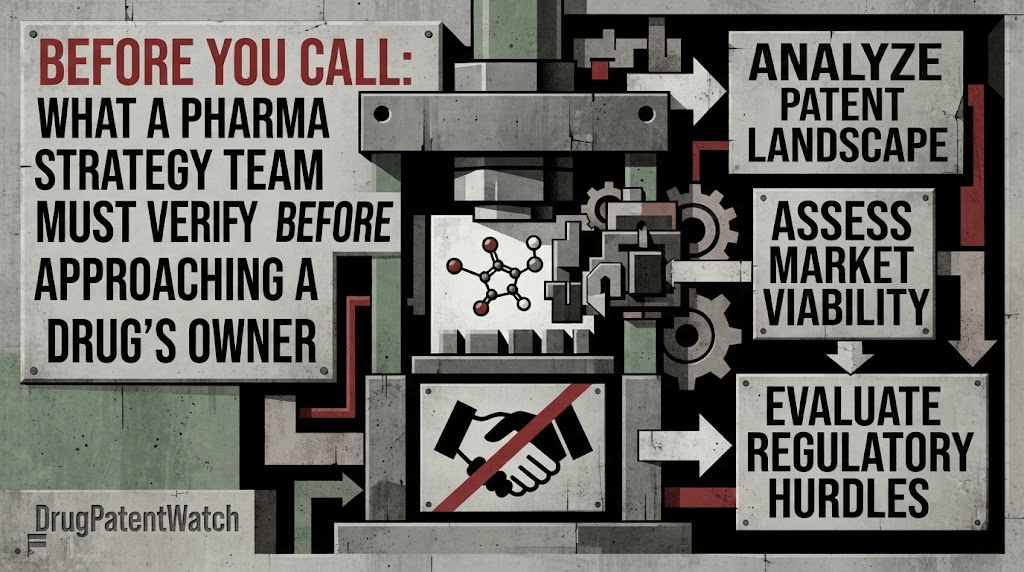
A strategy team that wants to license, co-promote, or acquire a drug asset needs to answer four questions before the first outreach email goes out, not after a term sheet is signed. Who actually holds the rights the team wants, and does that party hold all of them. What existing agreements, royalty sales, or funding obligations sit on top of the asset and survive a change of control. What the patent estate and regulatory exclusivity actually cover, versus what a database summary implies they cover. And what litigation, arbitration, or forfeiture risk is already running on the clock. Skipping any one of these does not kill a deal outright. It just means the team finds out about the fourth layer of ownership, or the royalty repurchase clause, during confirmatory diligence, after the target has priced the asset assuming the buyer already knew.
Up to 200 drugs are expected to lose patent exclusivity by 2030, including 69 blockbusters such as Ibrance, Trulicity, and Keytruda, and only 28 percent of FDA approvals between 2015 and 2021 came from in-house development at major pharma and biopharma companies, with the other 72 percent sourced externally through M&A and licensing. [1]
Why This Question Matters More Than It Did Five Years Ago
The math above is the reason business development has become a standing function rather than an occasional project. A pipeline built mostly on in-licensed and acquired assets means a strategy team spends more time evaluating other companies’ drugs than its own. That changes what due diligence means. It stops being a step that happens after a target is chosen and becomes the process that decides which targets are worth approaching at all.
Pre-Approach Diligence Is a Different Exercise Than Confirmatory Diligence
Confirmatory diligence happens inside a data room, under a signed confidentiality agreement, with the seller’s cooperation. Pre-approach diligence happens with none of that. It draws on public filings, the Orange Book and Purple Book, PACER dockets, USPTO assignment records, SEC filings from every company that has ever touched the asset, and press releases going back to the original license. The goal is not to find everything. It is to find enough to walk into the first conversation already knowing what the seller controls, what it does not, and where the value is likely to be contested.
Why “The Owner” Is Rarely One Company
A drug’s commercial rights are almost never held by a single entity for its entire life. An academic institution or small biotech originates the molecule. A larger company in-licenses development and commercialization rights, sometimes for one region and sometimes worldwide. A royalty financier buys a slice of future sales to fund the launch. A co-commercialization partner picks up rights outside the original licensee’s territory. Each of these transactions layers a new set of obligations, consent rights, and change-of-control triggers onto the same molecule. A strategy team that identifies only the company whose name is on the FDA label has found the operator, not necessarily the owner, and definitely not the full list of parties whose consent or cooperation the deal will eventually require.
Case Study One: The Four-Layer Rights Stack Behind a Single FDA-Approved Drug
Niktimvo (axatilimab-csfr) is a useful illustration precisely because nothing about its history is unusual. The FDA approved it on August 14, 2024, for chronic graft-versus-host disease after failure of at least two prior lines of systemic therapy, under a Biologics License Application that had received both Orphan Drug Designation and Priority Review. [2] Behind that single approval sit four separate parties with four separate, overlapping economic interests.
Layer One: UCB, the Originating Licensor
Syndax Pharmaceuticals develops and holds the U.S. marketing authorization for axatilimab, but the underlying antibody was licensed from UCB Biopharma. Under that license, Syndax owes UCB up to $119.5 million in development and regulatory milestone payments, double-digit royalties on sales, and up to an additional $250 million in one-time sales-based milestones once certain annual thresholds are hit. [3] Either party can terminate the agreement for uncured material breach or insolvency, and UCB can terminate outright if Syndax challenges the validity of a UCB-licensed patent. [3] None of that appears in a simple ownership lookup that stops at the NDA holder of record.
Layer Two: Syndax, the Regulatory Sponsor
Syndax is the party whose name sits on the FDA approval and who negotiates every downstream agreement, but its rights are themselves conditioned on staying current with UCB.
Layer Three: Incyte, the Commercial Partner
In a 2021 collaboration agreement, Incyte took exclusive commercialization rights to axatilimab outside the United States and agreed to split U.S. commercialization profits and losses equally with Syndax. Incyte books all global revenue and leads commercial strategy, while the two companies split development costs 55 percent to Incyte and 45 percent to Syndax. Incyte owes Syndax up to $220 million in further development and regulatory milestones, up to $230 million in sales milestones, and tiered royalties in the mid-teens on European and Japanese sales and low double digits on sales in the rest of the world outside the U.S. [4] A strategy team approaching “the owner” of ex-U.S. rights is approaching Incyte, not Syndax, and a strategy team approaching for U.S. rights alone still needs Incyte’s consent, because the two companies co-own the U.S. economics.
Layer Four: Royalty Pharma, the Revenue Participation Right Holder
On November 4, 2024, less than three months after FDA approval, Syndax sold Royalty Pharma a synthetic royalty, structured as a Revenue Participation Right, on U.S. net sales of Niktimvo, in exchange for $350 million in committed funding split across Niktimvo and Syndax’s other approved product, Revuforj. [5] The purchase agreement gives Syndax the right, but not the obligation, to repurchase the Revenue Participation Right on a change of control, and separately gives Royalty Pharma the right to force a repurchase, at a price equal to the Royalty Cap, if certain default events occur, including a termination event under Syndax’s UCB license agreement. [6]
What the Cross-Default Provision Actually Does
That last clause is the one a pre-approach diligence process is built to catch. It means a dispute that begins at the top of the stack, between Syndax and UCB, can trigger a forced repurchase obligation to a party three layers removed, Royalty Pharma, that never touches the underlying patent or the FDA approval at all. An acquirer evaluating Niktimvo has to model not just the patent estate and the Incyte profit share, but the health of a license agreement it may never see the full text of before signing a confidentiality agreement.
What a Change of Control Triggers Here
Because Syndax holds the repurchase option rather than Royalty Pharma, a change of control does not automatically unwind the royalty. It gives the surviving entity a choice: keep paying Royalty Pharma its percentage of U.S. net sales indefinitely, or buy the right back at a price fixed by the original agreement. Either way, the number belongs in the acquirer’s valuation model before the first call, not after.
Layer
Party
Nature of Interest
What It Controls or Conditions
1
UCB Biopharma
Originating licensor
Underlying antibody patents; milestone and royalty stream; can terminate on unresolved breach or patent challenge [3]
2
Syndax Pharmaceuticals
Regulatory sponsor / U.S. licensee
FDA approval and NDA holder of record; U.S. commercialization, shared with Incyte [3][4]
3
Incyte
Commercial partner
Exclusive rights outside the U.S.; 50/50 U.S. profit and loss share; 55/45 development cost split [4]
4
Royalty Pharma
Revenue Participation Right holder
Synthetic royalty on U.S. net sales; change-of-control repurchase option; cross-default tied to the UCB agreement [5][6]
Case Study Two: When a Territorial Sublicense Turns Into an Unwind
Fragmentation is not only a risk in high-value synthetic royalty structures. It shows up just as often in ordinary regional sublicensing, and it can turn into litigation risk that lasts years before the rights become available again.
The Original 2018 China Sublicense
Puma Biotechnology licensed NERLYNX (neratinib) for breast cancer through Pierre Fabre in most of the world, and separately granted CANbridge Biomed an exclusive sublicense to develop and commercialize NERLYNX across Greater China.
The 2020 Arbitration
On July 28, 2020, Puma filed a request for arbitration against CANbridge before the ICC International Court of Arbitration, alleging that CANbridge had breached or was in anticipatory breach of the sublicense, had failed to use commercially reasonable efforts to commercialize NERLYNX, and could not transfer the agreement to a third party without Puma’s consent. [7] For roughly two years, the China rights to a commercially approved, FDA-cleared oncology drug sat inside an active arbitration, unavailable to any third party that might have wanted to license or acquire them regardless of what the underlying patent estate looked like.
The 2021 Termination and Reassignment
Puma and CANbridge mutually terminated the sublicense on February 24, 2021. Puma paid CANbridge a one-time $20.0 million termination fee to recover the Greater China rights and immediately reassigned them, on the same day, to Pierre Fabre through a second amendment that paid Puma a $50.0 million upfront fee plus up to $240.0 million in additional regulatory and sales-based milestones, along with double-digit tiered royalties on Greater China sales. [8]
What a $20 Million Unwind Signals to a Would-Be Licensor
The arbitration and termination together ran close to three years, calculated from the original 2018 sublicense grant referenced in Puma’s SEC filings to the February 2021 termination. A strategy team scouting NERLYNX for a China opportunity in 2019 or 2020 would have found an apparently valid, exclusive sublicense on paper and no way to know, without checking Puma’s quarterly filings, that the counterparty was already in arbitration over a commercially reasonable efforts covenant, a term that shows up in nearly every out-license agreement and rarely gets checked until it is breached.
What a Patent Count Does Not Tell You
Once a team has established who actually controls the rights it wants, the second question is what those rights are worth to hold. A patent estate’s headline number, the count of Orange Book or Purple Book listings, is the least informative figure in the whole diligence package.
Composition, Formulation, and Method-of-Use Are Not Interchangeable
A composition-of-matter patent blocks any generic or biosimilar version of the molecule itself, regardless of indication. A formulation patent blocks only a specific dosage form and can often be designed around. A method-of-use patent blocks a specific labeled indication and can be avoided entirely by a generic that carves the protected indication out of its own label, a practice sometimes called skinny labeling. A strategy team pricing a deal around a fifteen-patent Orange Book listing without separating these categories is pricing around a number that overstates the drug’s real exclusivity runway.
Patent Count Is Not the Same as Litigated Strength
A large patent family signals investment in prosecution, not necessarily enforceability. The only reliable test of a patent’s strength is whether it has survived a validity challenge, in district court, at the Patent Trial and Appeal Board, or both. A hundred-patent portfolio that has never been tested against an inter partes review petition carries more uncertainty than a five-patent portfolio that has already beaten one.
The Thicket-Density Trap
Dense patent portfolios can create a false sense of security for a would-be licensee and a genuine negotiating asset for the seller, but the two effects point in opposite directions for a buyer’s diligence process. A thick portfolio raises the cost of a generic or biosimilar challenge, which supports a higher purchase price. It does not raise the probability that any individual patent in the thicket would survive a challenge on its own, which is the number that actually determines how long the exclusivity runway really is.
Regulatory Exclusivity: The Clock That Runs Independently of the Patents
Patents are granted by the USPTO on the basis of novelty and nonobviousness. Exclusivity is granted by the FDA on the basis of the type of approval, and it runs on its own calendar regardless of what happens to the patent estate. A strategy team needs both timelines, not just one.
New Chemical Entity Exclusivity
A drug containing an active moiety never before approved by the FDA in any other application receives five years of exclusivity, during which the FDA cannot accept an ANDA or a 505(b)(2) application referencing that moiety, with a narrow exception for a Paragraph IV challenge filed after four years. [9]
Orphan Drug Exclusivity
A drug approved for a rare disease or condition, affecting 200,000 or fewer people in the United States, receives seven years of exclusivity specific to that approved use. [9] Axatilimab’s Orphan Drug Designation for chronic graft-versus-host disease means Niktimvo’s orphan exclusivity, calculated from its August 2024 approval, runs to roughly August 2031, a full year beyond where a simple five-year NCE calculation would place it, a distinction that only matters to a buyer who checks which exclusivity type actually attached.
Pediatric Exclusivity as a Multiplier, Not a Standalone Grant
Pediatric exclusivity never stands alone. It adds six months to whatever exclusivity or patent term is already in place at the time it is granted, and it attaches to every approved use of that active moiety, not just the pediatric indication that triggered it. [9] A six-month pediatric extension layered onto a patent expiring at the end of a fiscal quarter can push a generic-entry date into the following year, which matters far more to a licensing valuation than the six months suggests on its own.
Exclusivity Type
Duration
What It Blocks
New Chemical Entity (NCE)
5 years
ANDA and 505(b)(2) filings referencing the same active moiety [9]
Orphan Drug (ODE)
7 years
Approval of the same drug for the same rare disease or condition [9]
New Clinical Investigation
3 years
Approval of a change supported by new clinical data, for that change only
Pediatric (PED)
+6 months
Added to whatever exclusivity or patent term is in place when granted; attaches to all approved uses of the active moiety [9]
180-Day Generic Exclusivity
180 days
Competing ANDAs, awarded to the first generic filer under specific forfeiture-sensitive conditions
Litigation Status: The Variable a Static Database Cannot Capture
An Orange Book listing shows a patent’s nominal expiration date. It says nothing about whether that patent is currently being challenged, has already lost a challenge on appeal, or is the subject of a settlement that delays generic entry to a date earlier or later than the listed expiration. A strategy team pricing a deal off the listed date alone is pricing off a number the docket may have already overridden.
Three States a Patent Can Be In When a Team Approaches
Active and Unchallenged
The listed date is the best available estimate, but it has not been tested against a validity or infringement challenge of any kind.
Under Active Challenge
Whether a district court Paragraph IV suit, an inter partes review at the PTAB, or both are pending, the real exclusivity date is a range rather than a fixed point until the case resolves.
Settled
A specific negotiated entry date has already replaced the patent’s nominal expiration, sometimes earlier and sometimes later than what the Orange Book shows.
Why Settlement Terms Matter More Than the Patent Date
A settled ANDA case typically fixes a generic-entry date by contract, independent of the patent’s real strength. A buyer who prices a deal off the underlying patent’s nominal expiration, without checking whether a settlement has already moved that date, is pricing off a number the parties themselves agreed to stop relying on.
Synthetic Royalties: The Encumbrance the Orange Book Was Never Built to Show
The Niktimvo case study above shows what a synthetic royalty looks like once it is layered onto an approved, commercial-stage drug. The instrument shows up earlier than that in a growing number of cases, attached to assets that have not yet reached the market at all.
How a Synthetic Royalty Differs From a Traditional Royalty Sale
A traditional royalty monetization involves the sale of a royalty stream a company already receives from a licensee. A synthetic royalty is newly created: the developer itself agrees to pay a percentage of its own top-line sales to the financier, in exchange for upfront and milestone-based funding, without giving up operational control of the asset. [10]
Case in Point: A Royalty Sold Before Approval
On June 24, 2025, Royalty Pharma agreed to provide Revolution Medicines up to $2 billion in funding, structured as up to $1.25 billion in synthetic royalty and up to $750 million in secured debt, tied to daraxonrasib, a RAS(ON) inhibitor that was still in Phase 3 development for pancreatic and non-small cell lung cancer at the time of signing. [11] The royalty runs for 15 years on worldwide net sales, tiered and decreasing as sales rise, falling to zero above $8 billion in annual sales, and is structured in five $250 million tranches tied to specific milestones. [11] Calculated from the 2025 signing date, a 15-year royalty term extends to roughly 2040, a horizon that a strategy team evaluating this asset for partnership or acquisition in, say, 2027 or 2028 would need to model regardless of how the underlying patent estate or clinical program develops between now and then.
Reading the Repurchase and Default Language Before the First Call
The two mechanisms that matter most in any synthetic royalty agreement are the change-of-control provision, which determines whether an acquirer inherits the royalty automatically or gets an option to buy it back, and the cross-default provision, which determines whether trouble in an unrelated agreement, as with the UCB license behind Niktimvo, can force a repurchase regardless of how the acquired drug itself is performing. Both are negotiated privately and rarely summarized in a press release. A strategy team that identifies the existence of a synthetic royalty deal from a company’s SEC filings still needs the underlying purchase agreement, usually filed as an exhibit to a Form 8-K, to see the actual trigger language.
Government-Funded IP: A Narrow but Real Category of Exposure
A smaller but recurring category of pre-approach risk involves inventions that trace back to federally funded research. The Bayh-Dole Act of 1980 lets universities, nonprofits, and small businesses retain title to inventions made with federal funding, in exchange for specific obligations: timely disclosure to the funding agency, an election-of-title window, a patent-filing deadline, and a requirement to give the government a nonexclusive, royalty-free license to practice the invention. [12]
What March-In Rights Actually Cover
Section 203 gives a federal agency the authority to require the titleholder to license a “responsible applicant” if the titleholder has not taken effective steps toward practical application, if action is needed to meet health or safety needs the titleholder is not reasonably satisfying, if action is needed to meet public-use requirements set by regulation, or if the titleholder has not met the domestic manufacturing requirement tied to an exclusive license. [12] No federal agency has ever completed a march-in action; the National Institutes of Health alone has received and denied six petitions over the life of the statute. [12]
Why This Belongs on a Pre-Approach Checklist Anyway
A near-zero historical exercise rate is not the same as zero relevance. The obligation that actually bites more often is not march-in itself but the disclosure and title-election requirements underneath it: an invention that traces to federal funding and was never properly disclosed or title-elected can, under Federal Circuit precedent, result in the government taking title outright, which is a far more immediate risk to a deal’s underlying ownership than the remote possibility of a march-in order. [12] The fix is simple and belongs in the earliest stage of diligence: check whether the patent family cites federal funding in its specification, and if it does, confirm the disclosure and election history before assuming the seller’s chain of title is clean.
An Original Taxonomy: Four Types of Pre-Approach Risk
The case studies above sort into four distinct categories. Treating them as one undifferentiated bucket labeled diligence is how a strategy team ends up checking for the wrong thing at the wrong stage.
Type One: Fragmented Legal Ownership
Rights split by territory, indication, or function across more than one entity, as with Incyte’s ex-U.S. rights to Niktimvo or CANbridge’s sublicense to NERLYNX in Greater China. The fix is a chain-of-title search across every SEC filing, license amendment, and USPTO assignment record touching the asset, not just the current NDA holder.
Type Two: Layered Economic Encumbrance
Obligations that do not touch legal title at all but reduce the economics an acquirer actually receives, as with Royalty Pharma’s Revenue Participation Right on Niktimvo or its synthetic royalty on daraxonrasib. The fix is a review of every 8-K, 10-K, and 10-Q the seller has filed referencing royalty, milestone, or revenue-sharing agreements.
Type Three: Contested or Unresolved Legal Status
Active litigation, arbitration, or forfeiture proceedings that make a right unavailable or uncertain regardless of what the underlying patent or exclusivity timeline shows, as with the CANbridge arbitration over NERLYNX. The fix is a docket search covering not just Paragraph IV patent litigation but contract and arbitration proceedings involving the seller and any sublicensee.
Type Four: Conditional or Government-Derived Title
Rights that depend on continued compliance with a funding, disclosure, or manufacturing obligation, as with Bayh-Dole-derived university patents. The fix is a specification review for federal funding acknowledgments, followed by a disclosure and title-election history check where one is found.
Building the Pre-Approach Checklist
The four risk types above translate into a concrete document and question list a strategy team can work through before drafting an outreach email.
Document Requests That Do Not Require an NDA
Every SEC filing from the current rights holder and every prior rights holder in the chain, searched for the asset by name. Orange Book or Purple Book listings, separated by patent type. PACER and PTAB dockets for any litigation or post-grant proceeding touching the patent family. USPTO assignment records confirming the current recorded owner of each patent, which can lag the economic reality by months. Press releases and 8-K exhibits describing any royalty, co-commercialization, or sublicense agreement.
Questions That Belong in the First Conversation
Whether the counterparty’s rights are subject to any third-party consent right on assignment or change of control. Whether any royalty or revenue-participation agreement exists on the asset, and whether it includes a cross-default tied to a separate license. Whether any patent in the core estate has been challenged, and the outcome if the challenge has resolved. Whether any portion of the underlying IP traces to federally funded research.
What DrugPatentWatch Diligence Data Adds to This Process
Assembling the picture above by hand, one SEC filing and one docket search at a time, is the actual bottleneck in most pre-approach processes, not the absence of any single data point. DrugPatentWatch consolidates Orange Book and Purple Book listings, Paragraph IV certifications, PTAB proceedings, and patent assignment history into a single trackable timeline for a given drug, which turns a multi-day manual search into a starting reference point a team can move from directly into the questions above, rather than a substitute for reading the underlying license and purchase agreements themselves.
What Happens After the Approach
Pre-approach diligence does not replace confirmatory diligence. It changes what confirmatory diligence is for.
Confirmatory Diligence Becomes Verification, Not Discovery
A team that has already mapped the rights stack, the exclusivity timeline, and the litigation status walks into the data room checking specific numbers against specific documents. A team that has not done that work is using the data room to build its first picture of the asset from scratch, on the seller’s schedule, with the seller controlling which documents get uploaded first.
Where the Term Sheet Should Reflect the Findings
Every Type One through Type Four risk identified before the approach should show up somewhere in the term sheet: a representation and warranty on chain of title and absence of undisclosed encumbrances, a condition precedent tied to third-party consents, an indemnity scoped to the specific litigation already identified, and, where a synthetic royalty or Bayh-Dole obligation exists, an explicit allocation of who bears the cost of a triggered repurchase or a disclosed march-in exposure.
Methodology
The case studies in this piece are drawn from primary sources: SEC filings (Forms 10-K, 10-Q, and 8-K) from Syndax Pharmaceuticals, Incyte, Puma Biotechnology, and Royalty Pharma; FDA approval and exclusivity guidance documents; and company press releases announcing the underlying transactions. Dollar figures, dates, and contractual mechanics are taken directly from these filings rather than from secondary summaries. Where a figure is calculated rather than directly reported, such as the orphan exclusivity expiration estimate for Niktimvo or the elapsed time in the NERLYNX China dispute, it is labeled as a calculation in the surrounding text rather than presented as an independently reported figure. The two case studies were selected because both involve fully documented, publicly traceable rights structures rather than private information, and because both illustrate a distinct risk type from the original taxonomy above rather than repeating the same failure mode.
The Findings That Matter
Niktimvo’s U.S. and ex-U.S. commercial rights sit across four separate parties, UCB, Syndax, Incyte, and Royalty Pharma, each with distinct consent and termination rights, fewer than three months after FDA approval. [3][4][5][6]
The Revenue Participation Right Syndax sold to Royalty Pharma on November 4, 2024 includes a cross-default provision tied to Syndax’s separate UCB license agreement, meaning a dispute at the top of the rights stack can force a repurchase obligation at the bottom of it. [6]
The 2018 CANbridge sublicense of NERLYNX in Greater China spent roughly two years in ICC arbitration before terminating on February 24, 2021 for a $20.0 million fee, after which the rights were reassigned the same day to Pierre Fabre for $50.0 million upfront plus up to $240.0 million in milestones. [7][8]
Royalty Pharma’s synthetic royalty on daraxonrasib, signed June 24, 2025, attached to a drug that was still in Phase 3 development, runs for 15 years, and decreases to a zero royalty rate above $8 billion in annual sales. [11]
Pediatric exclusivity adds six months to whatever protection is already in place at the time it is granted and attaches to every approved use of the active moiety, not just the indication that triggered the pediatric study. [9]
No federal agency has ever completed a Bayh-Dole march-in action; the National Institutes of Health has received and denied six petitions, making the disclosure and title-election requirements underneath march-in the more immediate diligence concern. [12]
Only 28 percent of FDA approvals between 2015 and 2021 came from in-house pharma development, with 72 percent sourced externally, which is the structural reason pre-approach diligence has become a recurring function rather than a one-time deal step. [1]
Key Takeaways
The party whose name appears on the FDA label is the regulatory sponsor, not necessarily the full owner of the economic and legal rights a deal requires.
Synthetic royalties and Revenue Participation Rights are economic encumbrances that do not appear in the Orange Book or Purple Book and require a direct review of SEC filings and purchase agreement exhibits to find.
Change-of-control and cross-default provisions inside royalty and license agreements determine whether an acquirer inherits an obligation automatically or gets a repurchase option, and the difference belongs in the valuation model before the approach.
A patent count is not a measure of enforceable exclusivity; composition, formulation, and method-of-use patents block different things, and only a litigated or post-grant-tested patent has a confirmed strength.
Regulatory exclusivity runs on a separate calendar from patent expiration, and orphan and pediatric exclusivity in particular can move the real generic-entry date well past what a simple NCE calculation would suggest.
Litigation and arbitration status, not just the listed patent date, determines whether a right is actually available to transact on at the time of approach.
Federally funded inventions carry a narrow but real diligence obligation, concentrated in disclosure and title-election compliance rather than in march-in risk itself.
FAQ
What is the single most commonly missed item in pre-approach pharma diligence?
Economic encumbrances that do not touch legal title, most often synthetic royalty or Revenue Participation Right agreements, are the most commonly missed category because they do not appear in the Orange Book, the Purple Book, or a standard patent search. They surface only in SEC filings and the underlying purchase agreement exhibits, as with the Revenue Participation Right Syndax sold to Royalty Pharma on Niktimvo. [5][6]
How is a synthetic royalty different from a traditional third-party royalty?
A traditional royalty involves the sale of a stream a company already collects from a licensee. A synthetic royalty is newly created by the developer itself, which agrees to pay a percentage of its own top-line sales in exchange for upfront and milestone funding, while keeping operational control of the asset. [10]
Does a change of control automatically cancel a synthetic royalty agreement?
Not automatically. In the Niktimvo agreement, a change of control gives Syndax the right, but not the obligation, to repurchase the Revenue Participation Right; absent that repurchase, the royalty continues under the acquiring entity. [6] The specific mechanic varies by agreement and has to be read in the underlying purchase agreement rather than assumed.
What does a cross-default provision in a royalty agreement actually mean for a buyer?
It means a default or termination event in a separate, unrelated license agreement, such as the UCB license underlying Niktimvo, can force a repurchase obligation on the royalty agreement even though the royalty holder has no direct relationship with that separate license. [6] A buyer needs visibility into the health of every material license in the stack, not just the one directly being acquired.
Is a large number of Orange Book-listed patents a reliable signal of exclusivity strength?
No. Patent count reflects prosecution investment, not litigated strength, and mixes composition, formulation, and method-of-use patents that block different things. A smaller portfolio that has already survived a validity challenge can represent a stronger exclusivity position than a larger, untested one.
How long does orphan drug exclusivity last compared to standard new chemical entity exclusivity?
Orphan drug exclusivity runs seven years from approval for the specific rare disease indication, compared to five years for standard new chemical entity exclusivity, and the two protect different scopes: orphan exclusivity is indication-specific, while NCE exclusivity blocks any use of the same active moiety. [9]
Does pediatric exclusivity apply only to the pediatric indication that triggered the study?
No. Pediatric exclusivity attaches to every approved use of the active moiety once granted, adding six months to whatever patent or exclusivity protection is in place at that time, not just to the specific pediatric indication or formulation studied. [9]
Has the U.S. government ever exercised Bayh-Dole march-in rights against a pharmaceutical patent?
No federal agency has ever completed a march-in action under the Bayh-Dole Act. The National Institutes of Health has received and denied six march-in petitions over the life of the statute, though the disclosure and title-election requirements underneath march-in remain a more practically relevant diligence item. [12]
What is the practical difference between pre-approach diligence and confirmatory diligence?
Pre-approach diligence relies entirely on public sources, SEC filings, court dockets, and regulatory databases, and happens before any confidentiality agreement is signed. Confirmatory diligence happens inside a data room with the seller’s cooperation and should function as verification of what pre-approach diligence already found, not as the first attempt to build a picture of the asset.
Why has external sourcing of drug assets become more central to pharma strategy in recent years?
Between 2015 and 2021, only 28 percent of FDA-approved drugs from major pharma and biopharma companies were developed in-house, with the remaining 72 percent sourced through M&A and licensing, a shift driven in part by a patent cliff expected to affect up to 200 drugs, including 69 blockbusters, by 2030. [1] That dependence on external sourcing is the structural reason pre-approach diligence now functions as a standing capability rather than a deal-specific exercise.
References
Simon-Kucher & Partners. (2024). Precision in pharma: The critical role of due diligence for industry success. Retrieved from https://www.simon-kucher.com/index%2Ephp/ja/node/6818
U.S. Food and Drug Administration. (2024, August 14). FDA approves axatilimab-csfr for chronic graft-versus-host disease. Retrieved from https://www.fda.gov/drugs/resources-information-approved-drugs/fda-approves-axatilimab-csfr-chronic-graft-versus-host-disease
Syndax Pharmaceuticals, Inc. (2024). Form 10-K for the fiscal year ended December 31, 2023. U.S. Securities and Exchange Commission. Retrieved from https://www.sec.gov/Archives/edgar/data/1395937/000095017024021253/sndx-20231231.htm
Incyte Corporation. (2025). Form 10-K for the fiscal year ended December 31, 2024. U.S. Securities and Exchange Commission. Retrieved from https://www.sec.gov/Archives/edgar/data/879169/000162828025004633/incy-20241231.htm
Syndax Pharmaceuticals, Inc. and Royalty Pharma plc. (2024, November 4). Syndax Pharmaceuticals and Royalty Pharma enter into $350 million royalty funding agreement for Niktimvo. Retrieved from https://syndaxpharmaceuticalsinc.gcs-web.com/node/5816?page=1
Syndax Pharmaceuticals, Inc. (2024). Form 8-K: Revenue Participation Right Purchase and Sale Agreement disclosure. Retrieved from https://syndaxpharmaceuticalsinc.gcs-web.com/static-files/dda9d70a-225b-415b-8521-de08f1a3482f
Puma Biotechnology, Inc. (2020). Form 10-Q for the quarterly period ended June 30, 2020. U.S. Securities and Exchange Commission. Retrieved from https://www.sec.gov/Archives/edgar/data/1401667/000156459020037821/pbyi-10q_20200630.htm
Puma Biotechnology, Inc. (2021). Form 10-K for the fiscal year ended December 31, 2020. U.S. Securities and Exchange Commission. Retrieved from https://www.sec.gov/Archives/edgar/data/1401667/000156459021009840/pbyi-10k_20201231.htm
U.S. Food and Drug Administration. (n.d.). Patents and exclusivity: Pediatric exclusivity and Orange Book exclusivity codes [Presentation slides]. Retrieved from https://www.fda.gov/media/92548/download and https://www.fda.gov/media/135234/download
Royalty Pharma plc. (2023). Form DEF 14A. U.S. Securities and Exchange Commission. Retrieved from https://www.sec.gov/Archives/edgar/data/1802768/000114036123020909/ny20006708x1_def14a.htm
Royalty Pharma plc and Revolution Medicines, Inc. (2025, June 24). Royalty Pharma and Revolution Medicines enter into funding agreements for up to $2 billion. Retrieved from https://www.royaltypharma.com/wp-content/uploads/2025/06/RPRX-RevMed-Press-Release.pdf
Congressional Research Service. (2016, September 23). March-in rights under the Bayh-Dole Act (Report No. R44640). Retrieved from https://www.everycrsreport.com/files/20160923_R44640_8ed7bcdc2091d75b23d9579d0a794eb633b5ddc0.html