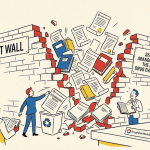
In 2023, Mylan filed an inter partes review against Novo Nordisk’s U.S. Patent No. 8,536,122, the compound patent covering semaglutide, the active ingredient in Ozempic and Wegovy. The IPR failed. That single loss preserved Novo Nordisk’s exclusivity on the ‘343 patent family into 2031, rather than letting generic competition start in 2026, and left the company with the negotiating leverage to set its own settlement terms with the other generic makers waiting in line [1]. Mylan did not lack for lawyers. It lacked the prior art reference that would have made the case.
Nine time zones away, a different set of challengers won the fight Mylan lost. Between October 2024 and May 2025, the European Patent Office’s Boards of Appeal revoked three separate Novo Nordisk patents tied to semaglutide’s use in obesity and its long-acting GLP-1 mechanism, after opponents including Teva, Generics UK, and Galenicum Health showed the board that the closest prior art already established semaglutide’s suitability for treating obesity [2][4]. Same molecule. Same underlying science. Opposite outcomes, months apart, because the two proceedings ran on different prior art records.
That gap is the subject of this article. Drug patent litigation is usually described as a contest of legal skill: who has the sharper cross-examination, the more persuasive claim construction brief, the better-credentialed expert. The case record says otherwise. Across the four disputes examined here, the deciding factor was not advocacy. It was whether the challenger’s search team found the one document, filed years earlier and often outside the pharmaceutical literature entirely, that the original patent examiner never saw.
The Short Answer: What Actually Decides These Cases
Under 35 U.S.C. § 103, a patent claim is invalid if it would have been obvious to a person of ordinary skill in the art in view of the prior art. That is a factual question, not a rhetorical one. A brief cannot manufacture a missing teaching, and no amount of courtroom skill turns a weak prior art record into a strong one. The Federal Circuit’s own guidance after KSR International Co. v. Teleflex Inc., 550 U.S. 398 (2007), reinforced this: the Supreme Court told examiners and courts to apply a flexible, common-sense obviousness inquiry rather than demand an explicit textual link between references [16]. That change raised, not lowered, the premium on finding references that actually combine to teach the claimed invention, because “common sense” arguments still have to be built on real documents. Patent litigators have understood the implication for close to two decades: an invalidity case built on prior art the original examiner never considered is far easier to win than one built on art the examiner already rejected as insufficient [17].
Why “The Best Lawyers” Is the Wrong Predictor
What a firm’s track record doesn’t measure
Law firm league tables rank patent litigators by trial wins, verdict size, and client rosters. None of those metrics capture whether the invalidity team assembled the right prior art before the petition or complaint was ever filed. A firm can run a flawless trial and still lose because its search turned up the same references the examiner already weighed and rejected. A relatively obscure firm can win decisively because its technical searchers found a 2005 clinical trial protocol nobody else looked for.
The recycled-reference problem
The Patent Trial and Appeal Board has started treating recycled prior art as a reason to deny review outright, independent of how the petition is argued. In Sandoz Inc. v. Acerta Pharma B.V., IPR2023-00478, the Board denied institution because the prior art Sandoz asserted was cumulative of what the examiner had already considered during prosecution [15]. The petition’s legal arguments were not the problem. The underlying evidence was.
Case One: A Failed Search Cost Generic Semaglutide Roughly Five Years
What Mylan’s 2023 IPR needed to prove
Semaglutide’s two core compound patents, U.S. 8,129,343 and U.S. 8,536,122, were filed as an international application on March 20, 2006. Patent term adjustment and patent term extension pushed the ‘122 patent’s expiration to March 20, 2026, and the ‘343 patent’s expiration to December 5, 2031 [20]. Mylan’s 2023 IPR targeted the ‘343 patent. To win, Mylan’s search needed to surface a reference, or combination of references, published before the 2006 priority date that rendered the specific claimed compound and its GLP-1 agonist activity obvious. It did not find one that persuaded the Board. The IPR failed, and with it went the near-term possibility of a 2026 U.S. generic launch for the compound itself [1].
The same drug, a different result, in Europe
The European opposition proceedings did not target the same compound patent family; they attacked later-filed, narrower patents covering semaglutide’s obesity indication, its long-acting GLP-1 peptide claims, and its formulation. But the contrast in outcomes is instructive. In T 1701/22, the EPO Boards of Appeal revoked EP 2 866 825, covering the use of long-acting GLP-1 peptides, after the panel found that the closest prior art had already established semaglutide’s suitability for treating obesity, which meant the claimed inventive step was not there to defend [2][4]. That decision followed the October 2024 revocation of EP 2 827 845 and EP 2 827 885, both directed to oral semaglutide administration [2]. Not every challenge succeeded: in a separate 2025 decision, the EPO upheld Novo Nordisk’s EP 3 746 111, covering the tablet formulation that improves bioavailability, after concluding the opponents’ inventive-step attack did not hold up against that particular claim set [3]. The pattern across five rulings in eighteen months is not “generic challengers always win” or “brand patents always survive.” It is that outcome tracked the specific prior art available against each specific patent, family by family, claim by claim.
What this means for generic entry timing
Wegovy carries eighteen listed patents and has already drawn twenty-five separate patent litigation cases [5].
That volume of listed patents and litigation is itself a data point about search difficulty. A generic or biosimilar applicant does not get to invalidate one patent and walk through the door; every distinct patent family, with its own priority date and its own art, has to be cleared separately. DrugPatentWatch’s tracking projects the earliest U.S. generic entry date for Wegovy at March 2029 even accounting for pending challenges, a number that will move only if a challenger’s search turns up better art than Mylan found on the ‘343 patent [5]. The commercial stakes are not abstract: one health-policy advocacy group’s analysis estimated that the roughly five extra years of U.S. exclusivity added to the semaglutide compound patents through patent term adjustment and extension are worth an estimated $166 billion in additional revenue across Ozempic, Rybelsus, and Wegovy, a projection that should be read as advocacy-driven analysis rather than a company-confirmed figure [21].
Case Two: Two Overlooked Documents Beat a 29-Patent Portfolio
Three patent families, three different fates
Salix Pharmaceuticals sued Norwich Pharmaceuticals over its proposed generic rifaximin, the active ingredient in Xifaxan, asserting a portfolio built around three separate patent groups: patents covering the treatment of hepatic encephalopathy (HE), patents covering a specific 1,650 mg/day dosing regimen for irritable bowel syndrome with diarrhea (IBS-D), and patents covering rifaximin’s crystalline polymorph form β [6][7]. This was not a thin portfolio case; Salix’s litigation involved a rifaximin patent estate built up around synthesis, polymorphic forms, formulations, and disease-specific methods of treatment across roughly two dozen patents in total [10]. After a bench trial, the district court found all three patent families infringed but reached three different validity conclusions: the HE patents survived, Norwich did not even appeal that finding, but the IBS-D and polymorph patents were both held invalid as obvious [6]. The Federal Circuit affirmed all three outcomes in a precedential April 2024 decision [8].
How a 2005 clinical trial protocol and a 2006 journal article beat the IBS-D patents
The IBS-D patents claimed a specific regimen: 550 mg of rifaximin, three times daily, for fourteen days. Norwich’s invalidity case rested on two references that had nothing dramatic about them. The first was a Phase II clinical trial protocol, published on ClinicalTrials.gov in 2005, describing twice-daily doses of 550 mg and 1,100 mg for fourteen and twenty-eight days [9]. The second was a 2006 peer-reviewed journal article, referred to in the litigation as “Pimentel,” which taught a lower thrice-daily dose for IBS but explicitly noted that the optimal rifaximin dose “may, in fact, be higher” than what the study had tested [9]. Neither reference disclosed the exact claimed regimen. The district court found, and the Federal Circuit affirmed, that the combination of the two was enough: a skilled person reading both documents together would have understood that the next logical dose step above 400 mg thrice daily was 550 mg thrice daily, the exact regimen in Salix’s patent [9]. A registered clinical trial protocol and a single journal article, both publicly available for roughly two decades before the case was filed, did more to invalidate Salix’s IBS-D claims than any argument made at trial.
The Cannata reference and the polymorph patents
The polymorph patents claimed rifaximin in its crystalline “form β.” Norwich’s search located a reference called “Cannata,” which disclosed that crystalline rifaximin had antibacterial properties and described preparation protocols and solvent systems for producing crystalline rifaximin, without ever identifying that the resulting crystal was specifically form β [11]. The district court found, based on expert testimony, that a skilled chemist following Cannata’s own protocols would have obtained form β and could have confirmed it through routine characterization testable “in one day” [11]. Salix argued on appeal that this reasoning improperly used hindsight, effectively working backward from the claimed compound to find that the prior art must have produced it. A dissenting judge on the three-judge panel agreed with Salix on this point, flagging that the majority’s use of “background knowledge” references not considered by the district court risked exactly the kind of ex post facto reconstruction that obviousness doctrine is supposed to guard against [11]. The majority affirmed anyway, and the split itself illustrates how close prior-art-driven obviousness calls can be even at the appellate level.
What survived and why it survived
The HE patents survived because Norwich’s prior art search, whatever it found for the other two patent families, did not turn up a comparable reference or combination for the HE indication and dosing claims. Norwich did not appeal the HE finding, which means the strongest patents in Salix’s twenty-nine-patent estate are the ones still standing between Norwich and a full generic launch: the district court’s injunction blocks FDA approval of Norwich’s ANDA until the last HE method patent expires in October 2029 [6][7].
Routine characterization would have revealed form β
Case Three: Fifteen Generic Companies, Seventeen References, Zero That Worked
The scale of the failed challenge
If sheer legal resources determined outcomes, this case should have gone the other way. Millennium Pharmaceuticals’ patent on Velcade, the multiple myeloma and mantle cell lymphoma treatment built around a mannitol ester of bortezomib, was challenged in ANDA litigation by a coalition of generic manufacturers that eventually included Sandoz, Accord Healthcare, Actavis, Mylan, Agila Specialties, Dr. Reddy’s, Sun Pharma, Apotex, Teva, Glenmark, Hospira, and Wockhardt, spanning eight consolidated Federal Circuit appeals [14]. The district court initially sided with the challengers, finding the asserted claims obvious as the “inherent result” of a known process: freeze-drying (lyophilizing) bortezomib in the presence of mannitol, a well-known bulking agent [11][12].
Seventeen references, none that taught the missing step
The Federal Circuit reversed in a precedential 2017 decision, and the reasoning turned entirely on what the prior art did and did not disclose. Bortezomib itself was known, described in an earlier Millennium patent, and its use of mannitol as one of ten possible alcohols for ester formation was disclosed in that same earlier patent [14]. But nothing in that reference, or in any of the other prior art the generic companies located, taught that lyophilizing bortezomib specifically with mannitol would form a new chemical compound, let alone one that solved bortezomib’s long-standing stability and solubility problems [12][14]. The opinion notes that Sandoz’s own testifying expert, tasked with building the strongest available obviousness case, cited seventeen separate references, and the court found that none of them taught or suggested the claimed compound or proposed lyophilizing bortezomib in the presence of mannitol [14]. Millennium’s formulation scientists had tried roughly twenty different liquid formulations and failed before stumbling onto the freeze-dried mannitol ester by accident; the years of well-documented failure by skilled formulators became, on appeal, evidence that the solution was not obvious to begin with [14].
The lead compound doctrine and the cost of hindsight
The Federal Circuit’s opinion is explicit that the district court’s error was methodological: it treated the process (lyophilization with a bulking agent) as the relevant question, when it should have treated the specific new chemical compound as the relevant question, and then asked whether the prior art taught or suggested making that particular compound [13]. That distinction sounds technical, but it is the entire ballgame. A search that stops at “lyophilization was well known” and “mannitol was a well-known bulking agent” will always look like it supports obviousness. A search rigorous enough to ask “does any reference disclose or suggest this specific ester forming under these conditions” will come back empty, because none did.
What this means for petition quality over petitioner headcount
Fifteen generic manufacturers, many represented by large, well-resourced patent litigation teams, collectively failed to find prior art that taught the invention, because the underlying discovery, an accidental compound formed during a known process, genuinely was not disclosed anywhere in the public record before Millennium found it. More lawyers and more defendants did not create prior art that did not exist. This is the clearest illustration in the four cases here of a fact pattern working directly against a numerically dominant legal coalition.
The PTAB’s Growing Intolerance for Recycled Prior Art
Sandoz v. Acerta Pharma and the “cumulative” denial
The Millennium case shows what happens when a search comes up empty at trial. The Board’s 2023 decision in Sandoz Inc. v. Acerta Pharma B.V., IPR2023-00478, shows what happens when a petitioner does not even get past the courthouse door for the same underlying reason. The Board denied institution because the prior art Sandoz asserted was cumulative of art the examiner had already considered during the original prosecution of the challenged patent [15]. The Board’s message was direct: re-citing, or lightly repackaging, the same references an examiner already weighed and found insufficient is not a new invalidity case. It is the same case the examiner already rejected, filed again.
Why re-treading old ground fails even with strong advocacy
This matters because IPR petitions are drafted by some of the most sophisticated patent litigation teams in the country, and institution denial for cumulative art is not a drafting failure, it is a search failure. The petition can frame known references in a new legal theory, but the Board is evaluating whether the evidentiary record is genuinely different from what the examiner already saw, not whether the brief is well written.
An Original Taxonomy: Four Ways Pharmaceutical Prior Art Searches Fail
Drawing on the pattern across these cases and the structure of professional prior art search practice, four recurring failure modes explain most weak invalidity positions in pharmaceutical patent disputes. This taxonomy is original to this article and is offered as a practical framework, not an established industry classification.
Type 1: The database-bound search
A search confined to patent databases will never find a document like Salix’s 2005 ClinicalTrials.gov protocol or the 2006 journal article that decided the IBS-D claims, because neither was a patent [9]. Non-patent literature, clinical trial registries, conference abstracts, and product inserts routinely predate the equivalent patent filings and are searched far less rigorously than issued patents and applications.
Type 2: The English-language-only search
Pharmaceutical prior art frequently originates outside the United States, in foreign patent filings, foreign regulatory submissions, and non-English scientific literature. The European opposition proceedings against Novo Nordisk’s secondary semaglutide patents relied on evidence and arguments never raised, or raised differently, in the corresponding U.S. IPR against the compound patent [1][2]. A search that stops at U.S. and English-language sources will systematically miss prior art that a European or Asian filing already made public.
Type 3: The keyword-bound search
A search built entirely around keywords tied to the challenged invention will miss analogous art from adjacent fields. The Millennium case turned on whether any reference taught combining bortezomib specifically with mannitol during lyophilization; a search focused narrowly on bortezomib literature, rather than on lyophilization and ester-formation chemistry more broadly, would have missed the same gap the generic companies’ combined search effort ultimately missed anyway [14].
Type 4: The cumulative, re-tread search
As the PTAB’s decision in Sandoz v. Acerta demonstrates, resubmitting references the examiner already considered, even under new legal framing, produces a weaker invalidity position than finding genuinely new art, and can result in a petition never being instituted at all [15].
Where the Strongest Pharmaceutical Prior Art Actually Hides
Clinical trial registries and protocols
ClinicalTrials.gov protocols are published, dated, and often precede the corresponding patent filing by years, as in the Salix case, yet they are not indexed the way patent literature is and require a targeted, deliberate search strategy rather than a general keyword sweep [9].
Foreign oppositions and parallel patent families
The EPO’s opposition system, unlike U.S. IPR, allows any third party, not just a party facing potential infringement liability, to challenge a patent, which means European oppositions against a drug’s international patent family sometimes generate prior art analysis and findings months or years before an equivalent U.S. challenge is filed [2][3][4]. A U.S.-focused search that ignores the corresponding European prosecution and opposition history is ignoring a body of highly relevant, already-litigated art.
The innovator’s own prior disclosures
Some of the most damaging prior art against a drug patent comes from the patent owner’s own earlier publications, investigator conference presentations, or, as Salix’s litigation illustrates, the company’s own earlier-filed patents disclosing broader classes of compounds that later, narrower patents attempt to carve out as novel [14].
Non-patent scientific literature
Peer-reviewed journal articles, like the 2006 “Pimentel” paper in the Salix case, are searched less exhaustively than patent databases by many prosecution-side search vendors, even though they carry equal weight as prior art under Section 102 and 103 [9].
Inside the Professional Prior Art Search Industry
Who actually does this work
A distinct professional services industry exists specifically to conduct prior art searches for litigation, separate from the law firms that argue the cases. These firms typically staff searches with former USPTO examiners, patent agents, and technical specialists holding advanced degrees in the relevant scientific field, and market their work specifically on the premise that a dedicated, full-time searcher will find references that a litigation associate working the search as one task among many will not [18][19]. Their offerings commonly include worldwide non-patent literature searching and foreign-language search capability, precisely the categories of art that fall into the Type 1 and Type 2 failure modes above [18][19].
Search intensity tiers
Several search vendors explicitly offer tiered search intensity, ranging from a standard “diligent” search to a more exhaustive, resource-intensive search sometimes marketed under a name like “scorched earth,” reflecting an industry understanding that search thoroughness is a dial that can be turned up or down depending on the stakes of the underlying case [19]. For a patent covering a blockbuster drug generating billions in annual revenue, the cost difference between a standard and an exhaustive search is immaterial against the commercial stakes; for a smaller-revenue product, it may not be.
Original Analysis: Comparing the Four Cases
The following table consolidates the four disputes examined in this article. It is original analysis prepared for this article, not a reproduction of any single source, and the “search depth signal” column is this article’s own qualitative assessment based on the facts of each case as reported in the cited decisions and legal commentary.
Drug / Patent
Case
Prior art that decided it
Outcome
Search depth signal
Semaglutide (Ozempic/Wegovy), U.S. ‘343 compound patent
Mylan IPR, 2023
None sufficient found
IPR failed; exclusivity to 2031
Search fell short of the compound’s core claims
Semaglutide, EPO secondary patents
Teva/Generics UK/Galenicum oppositions, 2024-2025
Closest prior art on obesity indication
Three patents revoked; one upheld
Mixed: strong on indication claims, weak on formulation claims
Non-patent literature search succeeded where it mattered
Rifaximin, HE patents
Salix v. Norwich, 2024
None sufficient found
Valid, infringed, injunction to 2029
Search gap left the strongest claims standing
Bortezomib (Velcade), ester compound patent
Millennium v. Sandoz, 2017
17 references cited, none on point
Reversed to valid on appeal
Combined 15-defendant search still came up short
Timing Makes the Search Harder: The One-Shot Structure of IPR
The one-year filing bar and estoppel
Inter partes review carries a one-year bar from service of an infringement complaint and, once instituted, exposes the petitioner to estoppel on any ground it “raised or reasonably could have raised” in that proceeding. That structure means a petitioner effectively gets one real opportunity to put its best prior art forward against a given patent; a search that misses the strongest reference the first time cannot easily be supplemented in a second attempt against the same claims. The Mylan-versus-Novo Nordisk outcome on the ‘343 patent illustrates the cost of that structure: a single failed IPR closed off, for practical purposes, the fastest path to challenging that compound patent in the United States [1].
Why this raises the value of pre-filing search investment
Because the shot is effectively singular, the search that precedes the petition matters more than the search that precedes ordinary district court litigation, where discovery and expert reports can surface additional art as the case develops. An IPR petitioner is, in practice, locked into whatever its search team found before filing.
What This Means for Generic and Biosimilar Manufacturers
The pattern across these four cases points to a specific resource allocation question for any company evaluating a Paragraph IV challenge or IPR petition against a branded drug’s patent estate: whether the budget for the invalidity case is weighted toward search or toward advocacy. Millennium v. Sandoz shows that fifteen companies pooling legal resources could not substitute for a search that actually located the missing reference. The Novo Nordisk semaglutide split shows that the same underlying molecule can produce opposite outcomes across jurisdictions when the prior art record differs, which argues for treating foreign opposition and litigation records as a resource, not a separate silo, when building a U.S. case.
What This Means for Brand Manufacturers Defending a Portfolio
The Salix outcome is the most instructive case for a brand-side portfolio strategy: a twenty-nine-patent estate did not fail as a whole, it failed patent family by patent family, and the families that survived were the ones for which no challenger’s search located comparable prior art [6][10]. That argues for brand manufacturers running their own adversarial prior art searches against each patent family before litigation, essentially stress-testing the portfolio the way a well-resourced generic challenger would, rather than assuming portfolio size alone provides protection. Patent intelligence platforms such as DrugPatentWatch track exactly this kind of family-by-family litigation history and patent challenge status across a branded drug’s full portfolio, which is the starting data set for that kind of internal stress test, though it is not a substitute for an actual technical prior art search [5][20].
Methodology
This article analyzes four pharmaceutical patent disputes selected because each turned substantially on the content of the prior art record rather than on procedural or claim-construction issues alone: the 2023 Mylan IPR against Novo Nordisk’s semaglutide ‘343 patent, the 2024-2025 EPO opposition proceedings against related Novo Nordisk semaglutide patents, the 2024 Federal Circuit decision in Salix Pharmaceuticals v. Norwich Pharmaceuticals, and the 2017 Federal Circuit decision in Millennium Pharmaceuticals v. Sandoz. Cases were drawn from Federal Circuit opinions, EPO Boards of Appeal decisions, contemporaneous legal commentary from law firm publications, and drug patent tracking data. The comparison table in the “Original Analysis” section reflects this article’s own qualitative synthesis of search depth signals across the four disputes and is clearly labeled as original analysis rather than an independently reported metric. Figures describing patent counts and litigation counts for Wegovy are drawn directly from DrugPatentWatch’s tracking data as of the sources cited. This article does not include IPR institution-rate or invalidation-rate statistics as an independent analytical claim, since those industry-wide figures were not the subject of new analysis here; readers interested in aggregate PTAB statistics should consult USPTO Patent Trial and Appeal Board reporting directly.
Key Takeaways
Mylan’s 2023 IPR against Novo Nordisk’s semaglutide ‘343 patent failed to find prior art sufficient to invalidate the claims, preserving U.S. exclusivity into 2031 [1].
Between October 2024 and May 2025, the EPO revoked three separate Novo Nordisk semaglutide-related patents for lack of inventive step over the closest prior art, while upholding a fourth covering the tablet formulation [2][3][4].
In Salix v. Norwich, a 2005 ClinicalTrials.gov protocol and a 2006 journal article invalidated Salix’s IBS-D dosing patents, while Salix’s HE patents survived because no comparable prior art was found against them [6][9].
In Millennium v. Sandoz, fifteen generic manufacturers and seventeen cited prior art references failed to invalidate Millennium’s Velcade compound patent, because none of the references taught the specific claimed compound [14].
The PTAB denied institution in Sandoz v. Acerta Pharma specifically because the asserted prior art was cumulative of art the examiner already considered, independent of the petition’s legal arguments [15].
Wegovy currently carries eighteen listed patents and has drawn twenty-five separate patent litigation cases, illustrating the scale of the search problem facing any single challenger [5].
FAQ
Does a stronger legal team increase the odds of winning a pharmaceutical patent invalidity case? A strong legal team can present a prior art case effectively, but it cannot substitute for prior art that does not exist. In Millennium v. Sandoz, fifteen generic manufacturers with substantial combined legal resources lost because none of the seventeen references their search located taught the claimed invention [14].
Why did Mylan’s IPR against Novo Nordisk’s semaglutide patent fail? Public reporting on the case does not attribute the failure to a specific missing reference, but the outcome preserved Novo Nordisk’s ‘343 patent exclusivity into 2031 and is widely described as a significant setback for near-term generic semaglutide entry in the United States [1].
Can the same drug patent survive in one country and fail in another? Yes. Novo Nordisk’s semaglutide patents illustrate this directly: a U.S. IPR against the compound patent failed in 2023, while separate EPO opposition proceedings against related European patents succeeded in revoking three patents between 2024 and 2025, based on different prior art records developed by different opponents [1][2][4].
What is “cumulative” prior art, and why does the PTAB reject it? Cumulative prior art is evidence that substantially overlaps with references the original patent examiner already considered and found insufficient to block the patent. In Sandoz v. Acerta Pharma, the PTAB denied institution of an IPR specifically because the petitioner’s asserted art was cumulative of what the examiner had already weighed [15].
Where does the strongest pharmaceutical prior art typically come from? Based on the cases examined here, it frequently comes from sources outside traditional patent databases: clinical trial registries such as ClinicalTrials.gov, peer-reviewed journal articles, and foreign patent prosecution or opposition records, categories that a narrow, patent-only, English-language search can miss entirely [2][9].
How many patents typically protect a single blockbuster drug? It varies widely by drug and lifecycle management strategy. Wegovy currently carries eighteen listed patents, and Salix’s Xifaxan litigation involved roughly twenty-nine asserted patents across three distinct claim families [5][10].
Does invalidating one patent in a drug’s portfolio clear the way for generic entry? Not necessarily. In Salix v. Norwich, Norwich successfully invalidated the IBS-D and polymorph patent families but was still blocked from FDA approval because Salix’s HE treatment patents survived and remain in force until October 2029 [6][7].
What is the difference between an IPR and a district court invalidity defense? An IPR is a proceeding before the USPTO’s Patent Trial and Appeal Board, subject to a one-year filing bar from service of an infringement complaint and estoppel provisions that limit a petitioner’s ability to raise the same grounds again. A district court invalidity defense is litigated as part of an infringement case and is not subject to the same one-year bar.
Why did the Federal Circuit reverse the district court’s obviousness finding in Millennium v. Sandoz? The Federal Circuit found the district court had asked the wrong question, focusing on whether the general lyophilization process was obvious rather than whether the prior art taught or suggested the specific new chemical compound that resulted, and further found the district court had improperly discounted evidence of the compound’s unexpected stability and solubility results [13][14].
Is a larger patent search always better? Not automatically. The relevant variable across these cases is not search volume but search breadth across categories, patent literature, non-patent literature, foreign filings, and whether the art located is genuinely new rather than cumulative of what the examiner already reviewed. The Sandoz v. Acerta Pharma denial shows that a large volume of recycled prior art can fail even to secure institution [15].
References
Markman Advisors. (2025, February 7). What is the patent landscape for Novo Nordisk’s semaglutide products, Ozempic, Wegovy and Rybelsus? https://www.markmanadvisors.com/blog/2025/2/7/what-is-the-patent-landscape-for-novo-nordisks-semaglutide-products-ozempic-wegovy-and-rybelsus
JUVE Patent. (2025, May 20). EPO revokes another Novo Nordisk patent behind Ozempic and Wegovy drugs. https://www.juve-patent.com/cases/epo-revokes-another-novo-nordisk-patent-behind-ozempic-and-wegovy-drugs/
JUVE Patent. (2025, December 17). Novo Nordisk and D Young defend crucial patent for tablet form of semaglutide. https://www.juve-patent.com/cases/epo-upholds-novo-nordisk-semaglutide-patent-ozempic-wegovy/
IPKat. (2025, May 8). Commercial success is a nothing-burger for the EPO in Wegovy patent inventive step analysis (T 1701/22, Obesity treatment with semaglutide). https://ipkitten.blogspot.com/2025/05/commercial-success-is-nothing-burger.html
DrugPatentWatch. Wegovy Drug Patent Profile. https://www.drugpatentwatch.com/p/alphasignals/tradename/WEGOVY
Robins Kaplan LLP. Salix Pharms., Ltd. v. Norwich Pharms. Inc. https://www.robinskaplan.com/newsroom/insights/resources-legal-updates-generically-speaking-hatch-waxman-bulletin-2024-generically-speaking-q2-salix-pharms-v-norwich-pharms2
Sheppard Mullin. (2024, June 6). Federal Circuit Upholds Rifaximin Patent Rulings, Affirms ANDA Approval Restrictions. https://www.sheppard.com/insights/blogs/federal-circuit-upholds-rifaximin-patent-rulings-affirms-anda-approval-restrictions
Mintz. (2024, April 25). Federal Circuit Affirms Obviousness of Rifaximin Polymorph Patents and Denial of Motion to Modify Judgment After Post-Trial Patented Indication Carve Out. https://www.mintz.com/insights-center/viewpoints/2231/2024-04-25-federal-circuit-affirms-obviousness-rifaximin-polymorph
IPWatchdog. (2024, April 11). CAFC Panel Splits on Reasonable Expectation of Success Analysis. https://ipwatchdog.com/2024/04/11/cafc-panel-splits-reasonable-expectation-success-analysis/
PatSnap Eureka. (2026, May 21). Federal Circuit Affirms Rifaximin Patent Victory for Salix Pharmaceuticals. https://www.patsnap.com/resources/blog/litigation/federal-circuit-affirms-rifaximin-patent-victory-for-salix-pharmaceuticals-patsnap-eureka/
National Law Review. (2017, July 26). Federal Circuit Thoroughly Reverses District Court Findings of Velcade® Patent Obviousness. https://natlawreview.com/article/federal-circuit-thoroughly-reverses-district-court-findings-velcade-patent
Lexology / Knobbe Martens. (2017, August 4). Federal Circuit upholds Millennium’s Patent on Velcade®. https://www.lexology.com/library/detail.aspx?g=10a1a74e-cc72-402f-800f-7a58faed154f
Wiley. Federal Circuit Patent Bulletin: Millennium Pharm., Inc. v. Sandoz Inc. https://www.wiley.law/alert-Federal_Circuit_Patent_Bulletin_Millennium_Pharm_Inc_v_Sandoz_Inc
United States Court of Appeals for the Federal Circuit. (2017, July 17). Millennium Pharmaceuticals, Inc. v. Sandoz Inc., No. 2015-2066. https://www.govinfo.gov/content/pkg/USCOURTS-ca13-16-01010/pdf/USCOURTS-ca13-16-01010-0.pdf
JD Supra / Jones Day. PTAB Rejects Double-Dose of Prior Art (Sandoz Inc. v. Acerta Pharma B.V., IPR2023-00478). https://www.jdsupra.com/topics/prior-art/sandoz/
Federal Register. (2007, October 10). Examination Guidelines for Determining Obviousness Under 35 U.S.C. 103 in View of the Supreme Court Decision in KSR International Co. v. Teleflex Inc. https://www.federalregister.gov/documents/2007/10/10/E7-19973/examination-guidelines-for-determining-obviousness-under-35-usc-103-in-view-of-the-supreme-court
Oliff PLC. Supreme Court Holds in KSR Case That Expansive and Flexible Approach Governs Obviousness. https://www.oliff.com/wp-content/uploads/2020/11/Supreme-Court-Holds-in-KSR.pdf
TPR International. Patent Litigation Prior Art Search. https://www.tprinternational.com/patent-litigation-prior-art-search/
DrugPatentWatch. How to bypass the GLP-1 patent lock. https://www.drugpatentwatch.com/blog/how-to-bypass-the-glp-1-patent-lock/
I-MAK. The Heavy Price of GLP-1 Drugs: How Financialization Drives Pharmaceutical Patent Abuse and Health Inequities for GLP-1 Therapies. https://www.i-mak.org/glp-1/