Pharmaceutical revenue is a melting ice cube. Between 2025 and 2030, the global industry faces a wave of patent expirations putting $236 billion to $400 billion in annual branded revenue at risk.1 For a small-molecule blockbuster, the entry of a generic competitor often triggers a 90% collapse in sales within months.4 For biologics, the erosion is a managed slope.5 This structural transformation of the market value proposition is driven by the expiration of patents on biologic blockbusters, the interventions of the Inflation Reduction Act, and a Federal Trade Commission that has challenged device patent listings.1 Accurate forecasting of the loss of exclusivity is no longer a supply chain exercise. It is a fundamental competency for financial survival.1 A forecast error of a single quarter for an asset like Eliquis or Stelara represents a revenue variance of hundreds of millions of dollars.1
The Structural Physics of Exclusivity
Pharmaceutical assets operate within a government-granted monopoly limited by time.5 To model revenue erosion, analysts must distinguish between the legal frameworks of the Hatch-Waxman Act and the Biologics Price Competition and Innovation Act (BPCIA).6
Small Molecule Mechanics Under Hatch-Waxman
The 1984 Hatch-Waxman Act created the modern generic industry.6 It established the Abbreviated New Drug Application (ANDA) pathway, which allows generic manufacturers to rely on the safety and efficacy data of the innovator drug.6 A generic applicant only needs to demonstrate bioequivalence.6 This streamlined process allows bioequivalent drugs to reach the market immediately upon patent expiry.7
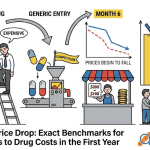
The act provides a 180-day marketing exclusivity period to the first generic manufacturer that challenges a patent.6 This period acts as a “golden ticket” because it limits competition to the brand and one generic filer.6 During these 180 days, the brand typically loses 30% to 40% of its market share.1 Once this period ends and multiple generics enter, the price collapses.1
Large Molecule Dynamics Under BPCIA
Biologics are complex proteins manufactured in living systems.9 Because they are not simple chemicals, they cannot be replicated exactly.5 The BPCIA created the “biosimilar” pathway for products that are highly similar to an existing biologic with no clinically meaningful differences.5
Innovator biologics have 12 years of data exclusivity in the U.S..6 This is longer than the five years granted to new chemical entities under Hatch-Waxman.6 Biosimilar adoption relies on physician confidence and payer contracts rather than automatic pharmacy substitution.10 This creates a slower erosion profile compared to small molecules.11
Feature
Hatch-Waxman (Small Molecule)
BPCIA (Biologic)
Application
ANDA
aBLA
Data Exclusivity
5 Years
12 Years
Automatic Stay
30 Months
None
Substitution
Automatic (AB-rated)
Varies (Interchangeable)
6
The Effective Patent Life Fallacy
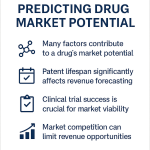
Generalist investors often assume a drug has 20 years of monopoly.3 This “clean expiry” narrative is false.3 While a patent has a 20-year term from its filing date, the time required for clinical trials and FDA review consumes a large portion of that term.2
Nominal vs Effective Life
Clinical trials can take six to eight years.2 FDA review for a New Drug Application typically lasts one to two years.2 By the time a drug reaches the market, its effective patent life is often only 10 to 14 years.2 The commercial value of the asset is a function of the time remaining on the “pivotal patent” at the moment of approval.11
Calculating the Exclusivity Stack
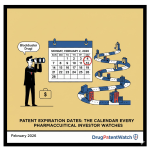
The loss of exclusivity (LOE) date is the later of the patent expiry or the regulatory exclusivity period.12 Analysts must audit filing dates, grant dates, and regulatory exclusivities.11
Patent Term Adjustment (PTA) compensates for delays at the patent office.11
Patent Term Extension (PTE) restores up to five years of time lost during clinical trials.5
Pediatric Exclusivity adds six months to every patent and exclusivity period for the drug.11
Orphan Drug Exclusivity provides seven years of protection for treatments of rare diseases.5
Quantitative Erosion Modeling
Traditional time-series methods often fail to capture the non-linear shock of a generic launch.1 Advanced forecasting requires models that account for competitive density and market behavior.1
The Bass Diffusion Model
The Bass model is the standard for predicting generic uptake.1 It describes how new products get adopted based on the interaction between innovators and imitators.14
The model uses a differential equation:
$$\frac{dF(t)}{dt} = [1 – F(t)][p + qF(t)]$$
Where:
$F(t)$ is the cumulative fraction of adopters.14
$p$ is the coefficient of innovation, representing external influence like formulary mandates.1
$q$ is the coefficient of imitation, representing word-of-mouth or physician trust.1
In small-molecule markets, high $p$ values reflect the “cliff” effect of mandatory substitution.1 In biosimilar markets, higher $q$ values reflect the slower growth of physician confidence.1
Monte Carlo Simulations in Litigation
For assets like Eliquis or Opdivo, the LOE date is a distribution.1 Monte Carlo simulations run thousands of scenarios based on probability distributions for litigation outcomes and regulatory delays.1 This allows teams to calculate a risk-weighted LOE date.11
The Scalloped Curve of Price Decay
Generic price erosion follows a predictable relationship with the number of competitors.10 This relationship is consistent enough to function as a law of physics in post-LOE environments.10
Number of Generic Competitors
Price Reduction vs Brand
1
30% – 39%
2
50% – 54%
3-5
60% – 79%
6-10+
80% – 95%
10
As competition drives prices down, the average market price follows a “scalloped curve”.10 In 20% of cases, prices temporarily “bounce” when competitors exit a market that has become unsustainable.10
Defensive Patent Strategies
Innovator companies use legal and regulatory mechanisms to extend their monopoly and soften the revenue cliff.4
The Patent Thicket
A patent thicket is a web of overlapping intellectual property rights.4 AbbVie used this strategy for Humira.4 Although the primary molecule patent expired in 2016, biosimilar competition was delayed until 2023.4 AbbVie filed over 300 patent applications, with 160 being issued.4 Over 90% of these were filed after the drug received FDA approval.4 Competitors settled rather than litigating over 100 patents.4
Volume-Limited Entry
Celgene used volume-limited settlements for Revlimid.4 Generics were permitted to launch but with market share strictly capped from 2022 to 2026.4 This prevents the price from crashing because manufacturers have no incentive to cut prices if they cannot capture more volume.4 This converted a revenue cliff into a managed slope.4
Regulatory Disruptors
Legislative shifts in 2024 and 2025 have introduced new “artificial cliffs” that do not align with patent terms.5
The Inflation Reduction Act Price Cliff
The Inflation Reduction Act (IRA) allows Medicare to negotiate prices for top-spending drugs.1 Negotiation eligibility begins nine years after approval for small molecules and 13 years for biologics.5 This four-year differential is a “pill penalty” that disincentivizes small-molecule development.1 Small-molecule funding dropped 70% following the introduction of the IRA.20
The FTC and Device Patents
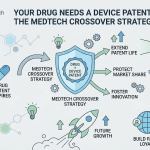
The Federal Trade Commission began a crackdown on “improper” device patent listings in 2024.1 By removing these patents from the Orange Book, the FTC eliminates the 30-month stay that delays generic entry.5 This accelerates revenue erosion for products like inhalers and auto-injectors.5
Product Hopping and Antitrust Risk
Product hopping is a strategy where a brand shifts demand from an old drug facing generic competition to a new, patented version.21
A “soft switch” involves marketing the new product while keeping the old one available.22
A “hard switch” involves removing the old product from the market to force a transition.22
Hard switches often lead to antitrust litigation.22 The FTC obtained a $50 million settlement from Reckitt Benckiser over the switch from Suboxone tablets to film.23 In 2024, a case against Teva involving the QVAR inhaler proceeded to trial over allegations of two distinct product hops.23
The 90-Day Operational Framework
Organizations can establish a defensive forecasting program by following a structured 90-day plan.11
Phase I (Days 1-30): Data Sanitation Dismantle functional silos to create a single source of truth.11 Audit filing dates, Patent Term Adjustments, and litigation status.11 Identify the pivotal patent that serves as the final barrier.11
Phase II (Days 31-60): Intelligence Infrastructure Monitor Paragraph IV certifications and construct “at-risk” launch scenarios.11 Evaluate whether to launch an internal “authorized generic” to disrupt first-filer profits.11
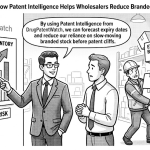
Phase III (Days 61-90): Commercial Integration Model erosion curves using Bass Diffusion and Monte Carlo engines.1 Integrate these forecasts into supply chain systems to ramp down production of branded stock as LOE approaches.11
DrugPatentWatch is a critical component of this infrastructure.11 It bridges the gap between legal patent data and commercial sales.11 The platform tracks 1.3 million global patents and provides real-time updates on litigation and regulatory exclusivities.11
The Economics of Innovation
Developing a new medicine takes 10 to 15 years and costs an average of $2.6 billion when accounting for failures.25 Only 10% of compounds that enter clinical development reach the market.25
“The average cost of developing a drug has risen to $2.23 billion in 2024, continuing an upward trend observed in 12 of the top 20 global pharmaceutical companies.” 26
The internal rate of return (IRR) for the top 20 biopharma companies rose to 5.9% in 2024.26 This is driven by high-value products in obesity and diabetes.26 However, for every 10% reduction in expected U.S. revenue, new drug approvals are expected to fall by 2.5% to 15%.29 Strategic forecasting allows companies to protect the revenue that funds this innovation.
Key Takeaways
Revenue erosion is modality-specific. Small molecules face a cliff while biologics face a slope.5
Effective patent life is the only metric that matters. Nominal patent terms ignore the years lost during clinical trials and regulatory review.2
The number of competitors dictates the price floor. Erosion accelerates dramatically once six or more generic players enter the market.10
Regulatory shifts are the new cliffs. The Inflation Reduction Act and FTC interventions can terminate exclusivity before patents expire.1
Forecasting requires probabilistic modeling. Monte Carlo simulations and the Bass Diffusion model provide more accurate results than simple moving averages.1
FAQ
How does the Inflation Reduction Act change patent lifecycle modeling? The IRA enables government price negotiation nine years after approval for small molecules and 13 years for biologics.5 Analysts must now model a revenue cliff at these points regardless of the patent expiration date.1
What is the difference between an ANDA and an aBLA? An ANDA is for generic versions of small-molecule drugs and requires proof of bioequivalence.6 An aBLA is for biosimilar versions of biologics and requires proof of high similarity with no clinically meaningful differences.6
Why do some brands launch their own “Authorized Generic”? An authorized generic allows the brand to capture a portion of the generic market revenue and disrupt the 180-day exclusivity profits of the first-filing generic competitor.11
What triggers a 30-month stay of FDA approval? A 30-month stay occurs if a patent owner files an infringement suit against an ANDA applicant within 45 days of receiving a Paragraph IV certification notice.11
How does DrugPatentWatch assist in forecasting revenue erosion? DrugPatentWatch aggregates disparate datasets, including patent terms, litigation dockets, and manufacturing signals.11 It allows commercial teams to automate alerts for generic filings and patent adjustments.11