A technical reference for pharma IP counsel, portfolio managers, R&D strategy leads, business development teams, and institutional investors with exposure to AI-driven drug discovery companies.
Part 1: The Ownership Problem in Numbers — Why This Question Costs Real Money
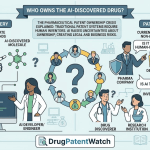
The question of who owns a drug designed by a generative AI model is not abstract. It determines the duration and defensibility of market exclusivity for assets that, in some cases, represent the entire enterprise value of publicly traded companies. Get the answer wrong — or fail to document it properly — and you have an unpatentable drug, an unenforceable patent, or a validity challenge that wipes out a franchise.
The financial stakes are concrete. The average capitalized cost of bringing a new drug to market runs approximately $2.6 billion when accounting for the full cost of failures across a development portfolio. A 20-year composition-of-matter patent, if it covers a drug that achieves blockbuster status, can protect $50 billion or more in cumulative net revenue over its lifetime. The difference between a patent that holds and one that falls on an inventorship challenge is not a legal fee line item; it is the difference between a functioning business model and a generic cliff arriving five to ten years ahead of schedule.
AI drug discovery is no longer a future scenario. As of 2025, more than 150 AI-designed or AI-assisted drug candidates are in clinical development globally, according to estimates from Citeline and other pipeline tracking services. The combined pipeline value of companies with AI-first discovery platforms — Insilico Medicine, Recursion Pharmaceuticals, Relay Therapeutics, Exscientia (now acquired by Sanofi), Schrodinger, and a dozen others — runs into the hundreds of billions of dollars at various probability-adjusted stages. Every one of those valuations depends on a chain of patent validity assumptions that the current legal framework has not fully resolved.
Patent offices in the United States, Europe, the United Kingdom, China, and Japan have all taken positions on AI inventorship. None of those positions has been tested in litigation involving a commercially significant drug that reached the market primarily through AI-led discovery. That test is coming. The first blockbuster drug that a generic manufacturer can credibly challenge on inventorship grounds — arguing that the named human inventors did not actually conceive the claimed invention because the AI did — will be the case that finally forces the law to catch up with the technology.
This guide walks through every dimension of that problem: the technical reality of how these systems work, the case law that currently governs them, the prosecution and drafting strategies that manage the risk, the valuation discounts that analysts should apply, and the investment signals embedded in how AI drug companies disclose their IP position.
Part 2: How Generative AI Actually Designs Drugs — The Technical Stack Behind the Headlines
The term ‘generative AI’ covers a range of architectures with meaningfully different implications for the inventorship analysis. Conflating them produces bad legal strategy. A company using AI to screen a library of existing compounds faces a different inventorship question than one using a diffusion model to generate novel molecular structures with no human-specified scaffold.
Molecular Generation Architectures and Their Legal Footprint
The most widely deployed generative architectures in drug discovery include variational autoencoders (VAEs), generative adversarial networks (GANs), diffusion models, and transformer-based sequence models. Each encodes a different relationship between human input and machine output.
A VAE learns a compressed latent representation of known drug-like molecules and can generate new structures by sampling from that latent space. The human researcher defines the target, the property constraints, and the training data. The VAE generates candidates within those constraints. The legal question is whether specifying the constraints constitutes ‘significant contribution to conception’ under the USPTO’s 2024 guidance. The answer is not settled, but the better argument is that specifying the therapeutic objective and the physicochemical constraint profile is analogous to defining the problem in a way that prior case law has treated as inventive.
A diffusion model generates molecular structures by learning to reverse a noise process applied to training data. The outputs can be genuinely novel scaffolds with no direct structural antecedent in the training set. When the model produces a compound with an unexpected binding profile at a target of interest, the human’s role in that conception shrinks further. The researcher may have defined the target and the evaluation criteria, but the structural idea came from the model. This is the configuration most vulnerable to an inventorship challenge.
Transformer-based sequence models, adapted from large language model architectures, treat molecular structures as sequences (SMILES strings or amino acid sequences for biologics) and generate new sequences with desired properties. Isomorphic Labs (a DeepMind subsidiary) and Insilico Medicine both use transformer-derived architectures. These models can suggest synthesis routes, predict ADMET properties, and optimize lead compounds — tasks that previously required substantial human medicinal chemistry expertise.
The legal significance: the more autonomous the generative step, the thinner the human ‘significant contribution’ argument becomes, and the more dependent patent validity is on what the human researcher did after receiving the AI’s output.
The De Novo Design Workflow and Its Documentation Implications
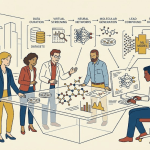
A typical AI-first drug discovery workflow runs through five stages: target identification and validation, hit generation, lead optimization, ADMET prediction, and candidate selection. The AI’s role varies by stage, but in the most capable current platforms, it is central to hit generation and lead optimization — the stages where patent law places the inventive act.
Target identification — determining which protein or pathway to drug — often involves human scientific judgment informed by genomics, proteomics, and disease biology literature. This stage generally produces strong human contribution evidence. Hit generation — finding or creating molecules that bind to the target — is where generative models dominate. Lead optimization — modifying the hit to improve potency, selectivity, and druglikeness — can be almost entirely automated in advanced platforms.
The documentation protocol an IP team builds around this workflow directly determines how defensible the patents are. Every stage where a human scientist makes a non-trivial decision — selecting a generation objective, rejecting a compound class on mechanistic grounds, modifying an AI-suggested structure based on synthetic accessibility reasoning — should be contemporaneously recorded in electronic lab notebooks with timestamps, version-controlled model configurations, and explicit capture of the scientific rationale.
This documentation is not optional. In any future inventorship challenge, a generic defendant will issue discovery requests targeting exactly these records. A company that relied on AI logs without systematic human decision capture has a discovery problem that no retrospective account can cure.
Key Takeaways: Technical Architecture and Legal Exposure
The degree of AI autonomy in the generative step maps directly onto inventorship vulnerability. Pharma IP teams should characterize every AI discovery platform their organization uses according to where human decision-making is essential versus where the model operates autonomously. That characterization is the starting point for claim drafting strategy, prosecution documentation, and the inventorship risk discount applied in IP valuation.
Part 3: Case Study — Insilico Medicine, ISM001-055, and the IP Valuation of an AI-First Pipeline
Insilico Medicine provides the most studied real-world data point on AI drug discovery IP strategy. Its lead candidate, ISM001-055 (now designated INS018-055), targets TRAF2- and NCK-interacting kinase (TNIK) for the treatment of idiopathic pulmonary fibrosis (IPF). The compound moved from AI-generated design to Phase 2 clinical trials in under 30 months, a timeline that is roughly one-third of the conventional industry average for the same development arc.
The Discovery Architecture
Insilico used its proprietary PandaOmics platform for target identification and its Chemistry42 generative chemistry platform for molecular design. Chemistry42 is a generative model that draws on reinforcement learning, generative adversarial networks, and transformer-based molecular generation. The human scientific team defined IPF as the therapeutic area, identified TNIK as a compelling target based on multi-omics analysis from PandaOmics, and set the optimization objectives for Chemistry42. The platform generated candidate structures; the team selected ISM001-055 based on predicted potency, selectivity, and synthetic accessibility.
The Inventorship Question at Insilico
Under the USPTO’s 2024 ‘significant contribution’ standard, Insilico’s scientists have a defensible inventorship claim. They selected the target, defined the optimization objectives, chose the candidate from among multiple AI-generated options using scientific judgment, and designed the initial pharmacological experiments that validated the compound’s activity. That sequence of decisions is more than operating or owning an AI tool. It more closely resembles the type of contribution that courts have treated as inventive even when the researcher did not devise the specific molecular structure.
The vulnerability is in the claim language. If Insilico’s patents claim the specific chemical structure of ISM001-055 with narrow claim scope, a challenger will argue that the structure was generated by Chemistry42, not conceived by the named inventors. If the patents claim a broader genus of TNIK inhibitors with shared structural features, the human-led target selection and genus-definition exercise provides stronger inventorship grounds, but the claims face obviousness challenges if the AI-generated genus is expansive. Insilico has filed multiple patent applications covering ISM001-055 and its structural analogs. The prosecution history of those applications will be central to any future Paragraph IV challenge.
IP Valuation Implications
IPF carries an estimated patient population of approximately 100,000 in the United States. Existing approved therapies — pirfenidone (Esbriet, Roche) and nintedanib (Ofev, Boehringer Ingelheim) — generate combined annual U.S. revenues in the range of $1.5 billion. A novel mechanistic agent with a differentiated safety profile could capture a meaningful share of that market and premium pricing. Pipeline analysts have modeled peak annual U.S. sales for a successful TNIK inhibitor in the $500 million to $1.2 billion range, depending on efficacy outcomes and pricing dynamics.
The composition-of-matter patent for ISM001-055, if it survives both validity and the clinical development process, would protect that revenue stream through the mid-2040s, including patent term extension. The inventorship uncertainty introduces a validity discount that should be applied to any IP valuation model. Using a probability-weighted approach, if the inventorship risk raises the probability of a successful Paragraph IV challenge on validity grounds by 15 percentage points relative to a comparable human-discovered compound, the expected value of the patent-protected revenue stream declines by a proportionate amount. For a drug with $800 million in peak annual sales and a protected exclusivity period of eight years, a 15-percentage-point validity risk reduction translates to approximately $960 million in probability-adjusted revenue at stake.
Institutional investors in Insilico or in companies with structurally similar AI discovery platforms should apply this inventorship risk premium explicitly in DCF models, rather than treating AI-discovery as a pipeline acceleration story without acknowledging the corresponding IP risk.
Part 4: Case Study — Halicin, Abaucin, and the Inventorship Gap in Academic AI Discovery
The antibiotic discovery work from James Collins’ laboratory at MIT provides a different and important case study: AI-led discovery in an academic context where commercialization IP strategy was secondary to the scientific objective, and where the inventorship documentation challenge is now fully visible.
The Halicin Discovery
A 2020 study published in Cell detailed how a deep learning model trained on molecular structure-activity relationships identified halicin (SU-3327, a c-Jun N-terminal kinase inhibitor previously explored for diabetes) as a potent broad-spectrum antibiotic, including activity against Mycobacterium tuberculosis and carbapenem-resistant Acinetobacter baumannii. The model screened approximately 107 million compounds from the ZINC15 chemical database in a matter of days. The researchers did not design halicin; they trained a model to predict antibiotic activity and then screened virtual libraries using that model. Halicin existed in ZINC15 as a known compound; the discovery was the prediction of its antibiotic activity.
The inventorship question here is instructive. The researchers conceived the experimental approach, curated the training data, trained the model, and then selected halicin from the model’s output based on predicted activity and structural dissimilarity from existing antibiotics. The compound itself was not novel; its antibiotic application was. Method-of-use patent claims covering the use of halicin as an antibiotic are more defensible on human inventorship grounds than a composition-of-matter claim would have been, because the human researchers did conceive the inventive use even though the model identified the candidate.
A follow-on study published in Nature Chemical Biology in 2023 used a structurally deeper neural network to identify abaucin, a compound with selective activity against Acinetobacter baumannii. The research team included the AI-generated candidate selection within a larger experimental validation workflow that required substantial human scientific judgment. The method-of-use framing for abaucin — treating A. baumannii infections with a compound identified through a specified computational method — strengthens the human contribution argument because the inventors can credibly claim to have conceived the therapeutic use, the selection methodology, and the experimental validation approach.
The Academic-to-Commercial IP Transfer Problem
Neither halicin nor abaucin has, as of mid-2025, reached clinical development with clear commercial sponsorship. The academic publication of these discoveries before patent filing, or contemporaneous with provisional filing, creates prior art problems for any subsequent patent application on the compounds’ antibiotic uses. Publication in Cell or Nature Chemical Biology constitutes prior art under 35 U.S.C. § 102, with a one-year grace period in the United States but no grace period in most foreign jurisdictions under first-to-file systems.
Companies licensing academic AI drug discoveries face a specific due diligence challenge: assessing whether the provisional patent applications were filed before or after the key publications, whether foreign patent rights have been preserved, and whether the laboratory notebooks and model training records support the inventorship narrative under the USPTO’s 2024 standard. These are the questions a business development team must resolve before pricing a license or an acquisition of rights to an academic AI discovery.
Part 5: The Global Inventorship Map — DABUS, Thaler v. Vidal, and What Every Jurisdiction Has Actually Decided
The DABUS litigation is the most comprehensive test of AI inventorship doctrine conducted to date. Its outcomes across jurisdictions reveal not a single answer but a map of legal risk that should inform where pharma companies file patent applications for AI-assisted inventions and how they structure their inventorship declarations.
United States: Human Inventors Required, AI Tools Permitted
The Federal Circuit’s decision in Thaler v. Vidal (43 F.4th 1207, Fed. Cir. 2022) held that the Patent Act’s references to ‘individuals’ require that an inventor be a natural person. The court grounded its reasoning in the statutory text: 35 U.S.C. § 100(f) defines ‘inventor’ as ‘the individual, or if a joint invention, the individuals collectively who invented or discovered the subject matter of the invention.’ The use of ‘individual’ and related terms throughout the Patent Act, the court held, refers to natural persons under the Dictionary Act’s default definitions. The Supreme Court declined certiorari, leaving the Federal Circuit’s holding in place.
The USPTO’s February 2024 guidance elaborated on what this means in practice. AI cannot be named as an inventor. A human who uses AI as a tool can be named as an inventor if, and only if, that human ‘significantly contributed’ to the conception of the claimed invention. The guidance explicitly stated that prompting an AI to generate a design, and then receiving that design, is not sufficient if the human played no further inventive role. The human contribution must go to the conception of the specific claimed invention, not merely to the framing of a research problem that an AI then solved.
European Patent Office: Legal Capacity Required
The EPO rejected DABUS-related applications on the ground that Article 81 and Rule 19(1) of the European Patent Convention require an inventor designation that names a natural person. The EPO’s position is that an inventor must have legal capacity — the ability to hold rights and obligations under law — which AI systems lack. The EPO has also issued guidance indicating that AI-assisted inventions remain patentable as long as a human inventor is named, applying a standard broadly analogous to the USPTO’s significant contribution approach.
United Kingdom: The Comptroller’s Position Upheld
The UK Supreme Court upheld the Comptroller-General of Patents’ rejection of Thaler’s DABUS applications in Thaler v. Comptroller-General of Patents, Designs and Trade Marks [2023] UKSC 49. The court held that the Patents Act 1977 requires an inventor to be a person, and that Thaler, as owner of DABUS, could not derive title to the patent from DABUS because an AI cannot hold property rights in its inventions. The court explicitly declined to address whether DABUS had in fact generated the relevant inventions, treating that as irrelevant to the statutory question.
China: Human Contribution Standard, Administrative Practice Still Developing
China’s National Intellectual Property Administration (CNIPA) has taken the position that only natural persons can be listed as inventors. CNIPA guidance issued in 2023 requires disclosure of AI tool usage in applications where AI played a substantial role in generation of the inventive concept, with human inventors required to attest to their specific contributions. Chinese pharmaceutical companies with AI discovery programs — including XtalPi, BioMap, and Insilico Medicine’s China operations — are navigating this disclosure requirement under a regime where enforcement practice is still developing.
South Africa: The Non-Examining Exception
South Africa was the first jurisdiction to grant a patent listing DABUS as inventor, in July 2021. The grant reflects South Africa’s non-examining patent system, in which the patent office does not conduct substantive examination of applications before grant. The South African patent grants by acceptance of the filing, with validity tested post-grant. The DABUS grant is not precedent in any adjudicative sense; it is an administrative output of a system that did not examine the inventorship question. Its value as a data point on AI inventorship law is minimal.
Australia: Reversed on Appeal
The Federal Court of Australia initially held in Thaler v. Commissioner of Patents [2021] FCA 879 that AI could be an inventor. The Full Federal Court reversed in Commissioner of Patents v. Thaler [2022] FCAFC 62, holding that the Patents Act 1990 requires an inventor to be a natural person. The High Court of Australia denied special leave to appeal.
Table 1: AI Inventorship Status by Jurisdiction (as of Q2 2025)
Jurisdiction
AI as Named Inventor
Standard for Human Inventors Using AI
Key Authority
United States
Not permitted
‘Significant contribution’ to conception of claimed invention
Thaler v. Vidal (Fed. Cir. 2022); USPTO Feb. 2024 Guidance
European Union / EPO
Not permitted
Natural person with legal capacity must be named; AI use as tool permitted
EPO DABUS decisions; EPO AI Guidance 2023
United Kingdom
Not permitted
Natural person required; AI tool use not disqualifying
Thaler v. Comptroller [2023] UKSC 49
China
Not permitted
Human inventor required; AI usage disclosure required in application
CNIPA 2023 Guidance
Japan
Not permitted
Human inventor required; JPO AI and IP Study Group guidance
JPO 2023 AI Guidance
South Africa
Technically granted (DABUS)
Non-examining system; no substantive validity
CIPRO 2021 (no legal precedent value)
Key Takeaways: Jurisdiction Strategy
Every major pharmaceutical patent jurisdiction requires a human inventor. The operative legal question in all of them is whether the specific human contribution clears a threshold — variously described as ‘significant,’ ‘inventive,’ or ‘substantial’ — above mere tool operation. Filing strategy for AI-assisted pharmaceutical inventions should account for the fact that priority must be established in at least one examining jurisdiction before any publication. Filing provisionals in the United States before publication, then entering the PCT phase for international coverage, remains the standard approach. The inventorship declaration in the U.S. nonprovisional and in each national phase entry should be accompanied by a supporting memo describing the specific human contributions at each stage of the discovery workflow.
Part 6: The USPTO’s 2024 ‘Significant Contribution’ Standard — What It Requires and Where It Breaks Down
The USPTO’s February 2024 guidance, titled ‘Inventorship Guidance for AI-Assisted Inventions,’ is the operative U.S. standard until Congress amends the Patent Act or the Federal Circuit revisits the question. The guidance does not require that AI be excluded from the discovery process; it requires that at least one named human inventor made a significant contribution to the conception of each claimed invention.
What ‘Conception’ Means in AI-Assisted Discovery
Patent law defines conception as the formation in the mind of the inventor of a definite and permanent idea of the complete and operative invention. The Burroughs Wellcome Co. v. Barr Laboratories case (Fed. Cir. 1994) established a standard for conception that has become central to the AI inventorship debate: conception is complete only when the inventor has a definite and permanent idea of the complete operative invention, including every limitation of every claim.
Applied to generative AI drug discovery, this standard creates a specific problem. If an AI platform generates a molecular structure with no human-specified scaffold, and the human researchers test it and find it active, have they conceived the invention? The human contribution was in target selection, evaluation criteria, and experimental validation — not in the structural idea. Whether that contribution satisfies the ‘conception of the claimed compound’ test depends on how the claims are drafted.
If the claims cover the specific compound structure, the invention’s conception is the identification of that structure, and the human’s contribution is thin. If the claims cover a method of treating a disease using a compound generated by a specified AI-assisted process, the human’s conception of the method — including the process design — is more clearly present. If the claims cover a class of compounds defined by shared binding mode, pharmacophore features, or functional properties that the human researchers identified and characterized, the human contribution to defining that class can constitute conception of the genus even if the AI generated the specific examples within it.
The Four Categories of Human Contribution the USPTO Recognizes
The 2024 guidance identifies four categories of activity that may constitute significant contribution: constructing the prompt or query that causes the AI to generate the inventive output, identifying the problem to be solved in a way that shapes the inventive solution, selecting from the AI’s outputs using independent inventive judgment, and making an inventive modification to the AI’s output based on domain expertise. Each of these requires more than passive receipt of the AI’s work product.
The guidance is explicit that the following activities do not constitute significant contribution on their own: owning or licensing the AI system, setting general research goals without specifying inventive constraints, and supervising the AI’s operation at a high level of abstraction. A Chief Scientific Officer who approved the research program but did not engage with the specific discovery process cannot be named as an inventor on the resulting patent.
Where the Standard Breaks Down: Fully Autonomous Discovery
The significant contribution standard assumes a human-in-the-loop who makes at least one inventive decision that drives the final design. Fully autonomous AI discovery pipelines — where the system selects targets, generates candidates, predicts properties, and ranks compounds according to pre-set criteria without human intervention at any stage — do not fit this framework. As these systems become more capable and more widely deployed, the inventorship gap will widen.
The practical consequence is not that fully autonomous AI inventions are unpatentable in theory. It is that they are unpatentable under current U.S. law, and that companies deploying these systems must either structure the discovery process to preserve human inventive decisions at key stages or accept that the output cannot be patented as of right. The strategic alternative — protecting the output as a trade secret while using the patent to cover the method of discovery rather than the compound itself — is discussed in Part 9.
Part 7: Patent Strategy for AI-Assisted Inventions — Claim Drafting, Prosecution Tactics, and the Enablement Trap
Given the inventorship constraints, claim drafting strategy for AI-assisted pharmaceutical inventions requires more deliberate architecture than for conventional medicinal chemistry programs. The goals are to capture meaningful claim scope, establish defensible inventorship, and avoid the enablement and written description pitfalls that arise when AI generates compounds faster than the human team can characterize them.
Claim Architecture for AI-Discovered Small Molecules
The strongest patent position for an AI-discovered small molecule covers multiple claim types in a coordinated structure: a genus claim defined by structural or functional features that the human team identified and validated, specific compound claims for the lead and key analogs, method-of-treatment claims covering the therapeutic indication, and process claims covering the AI-assisted discovery method itself.
The genus claim is the most strategically valuable and the most legally precarious. A genus defined by common structural elements — for example, a substituted heteroaromatic core with specified substituent patterns at defined positions — requires that the specification provide adequate written description support for the full scope of the genus. When a generative AI produces a lead compound, it typically produces dozens or hundreds of analogs in the same generation run. If the patent applicant uses those analogs to define the genus without testing them, the genus may be vulnerable to a written description challenge: the applicant has claimed a class of compounds without demonstrating possession of the full class.
The Federal Circuit’s 2021 decision in Juno Therapeutics v. Kite Pharma tightened the written description standard for biologic patent claims in ways that directly apply to AI-generated molecular classes. An applicant cannot describe a vast functional class and claim possession of the full class based on a handful of examples. For AI-discovered small molecules, this means that the scope of the genus claim must track the scope of the experimental validation data. AI can generate 500 analogs, but patent coverage is defensible only for the subset that has been characterized with sufficient specificity to establish possession.
Method-of-Discovery Claims: Protecting the AI Platform Itself
A method claim covering the AI-assisted discovery process — ‘a method of identifying a TNIK inhibitor comprising generating candidate molecular structures using a generative adversarial network trained on [specified dataset], selecting candidates with predicted binding affinity above [threshold], and confirming activity in [specified assay]’ — covers the platform rather than the product. These claims are harder for a generic manufacturer to design around because the claimed method is the discovery process, not the resulting compound. A generic that independently synthesizes the same compound without using the claimed method does not infringe.
Method-of-discovery claims have limited commercial value compared to composition-of-matter claims because they do not block a competitor who arrives at the same compound by a different route. But they protect the AI discovery platform as a commercial asset and can be licensed to partners who want access to the platform’s capabilities. For companies like Recursion, Exscientia, and Schrödinger that operate partially as platform businesses in addition to drug developers, method-of-discovery patents are a core IP asset category.
The Enablement Trap in AI-Generated Chemistry
Section 112 of the Patent Act requires that the specification enable a person skilled in the art to make and use the claimed invention without undue experimentation. The Supreme Court’s 2023 decision in Amgen v. Sanofi (598 U.S. 594) applied an expansive enablement standard to broad functional antibody claims, holding that Amgen had not enabled the full scope of its claimed genus of antibodies that bind a specific PCSK9 epitope and block its receptor binding. The court found that claiming a class of antibodies defined by function required enabling the full class, not just providing examples.
Amgen v. Sanofi applies directly to AI-generated molecular portfolios. An AI platform that generates ten thousand PCSK9 antibody variants cannot be used to claim a genus defined by function if the specification only characterizes a few dozen of them experimentally. The patent owner has claimed an outcome — all antibodies that achieve the functional result — without providing the experimental roadmap to reach the full outcome. Post-Amgen, claim scope must be calibrated to experimental coverage, and AI’s capacity to generate candidates far exceeds the team’s capacity to characterize them at the pace the generation runs.
Prosecution Documentation Protocol
Every AI-assisted patent application should be accompanied by a prosecution documentation file, maintained separately from the patent prosecution record, that captures: the AI platform version and configuration used at the time of the discovery, the human decision points recorded with timestamps and scientific rationale, the model outputs that were generated but not selected and the reasons for their rejection, and the experimental validation data showing which human-designed experiments confirmed the AI-generated predictions. This file is both legal protection for the inventorship declaration and the foundation of the laboratory notebook record that will be demanded in discovery during any future Paragraph IV challenge.
Part 8: IP Valuation of AI-Discovered Drug Portfolios — Applying the Inventorship Risk Discount
Standard pharmaceutical IP valuation applies a probability of technical success (PTS) and a probability of regulatory success (PRS) to the projected revenue of each pipeline asset, discounted back to present value at a risk-adjusted discount rate. AI-discovered drugs require an additional factor: probability of patent survival (PPS), the likelihood that the composition-of-matter patent covering the drug survives an inventorship-based validity challenge in Paragraph IV litigation or inter partes review.
Constructing the Inventorship Risk Premium
The inventorship risk premium is not a fixed number. It varies based on the degree of AI autonomy in the discovery workflow, the quality of the human contribution documentation, the claim architecture of the relevant patents, and the litigation environment for similar challenges in the relevant jurisdiction.
A rough calibration framework uses four risk tiers. Tier 1 covers AI-assisted programs where the human team’s inventive contribution is unambiguous — the AI provided computational support for a decision that the human scientists would have been capable of making without it, comparable to using molecular modeling software or high-throughput screening. These programs carry minimal inventorship risk premium, perhaps 3 to 5 percentage points of additional validity discount on top of the baseline for the compound class.
Tier 2 covers programs where AI-generated lead identification was central to the discovery but the human team made subsequent inventive modifications to the AI-suggested structure based on documented medicinal chemistry reasoning. These programs carry a moderate inventorship risk premium, 8 to 15 percentage points, depending on documentation quality.
Tier 3 covers programs where the AI generated the lead structure with minimal human input beyond target specification and evaluation criteria, and the human team’s contribution was primarily experimental validation. These programs carry a material inventorship risk premium, 15 to 25 percentage points, reflecting the significant probability that a generic manufacturer could challenge inventorship successfully on discovery.
Tier 4 covers programs from fully autonomous discovery platforms with no meaningful human contribution to the structural concept. These programs carry the maximum inventorship risk discount; any DCF model for such an asset should reflect the distinct possibility that the composition-of-matter patent cannot be enforced against a generic entrant who can document the AI’s autonomous role.
Application to Specific Platform Companies
Recursion Pharmaceuticals uses AI-driven phenotypic screening and drug repositioning, identifying biological effects of known and novel compounds in cellular imaging datasets. The human scientists define the cellular assay, select the disease model, and interpret the imaging data that flags active compounds. This workflow preserves more human inventive contribution than pure generative molecular design and sits in Tier 2. Recursion’s partnership with Roche and Genentech, announced in 2023 for up to $12 billion in milestones, implicitly priced Recursion’s pipeline with assumptions about patent defensibility that should include this moderate inventorship risk factor.
Exscientia, acquired by Sanofi in 2024, used AI to design small molecules through an automated design-make-test-analyze cycle with human review at key decision points. Its lead oncology candidates were designed using AI-assisted optimization with documented human input at target selection and candidate selection stages. The Sanofi acquisition at approximately $1.2 billion (net of cash adjustments) implied a valuation of the AI drug design platform and early pipeline assets. Sanofi’s IP diligence on Exscientia’s prosecution files and documentation practices was reportedly extensive, reflecting the materiality of the inventorship question in the deal economics.
Investment Strategy Note: The IP Disclosure Audit
Institutional investors in AI drug discovery companies should conduct an IP disclosure audit when assessing position sizing. The audit covers four questions: Does the company’s 10-K or 20-F disclose the AI inventorship risk as a material uncertainty? Do the patent prosecution files show contemporaneous documentation of human inventive contributions, or are they substantively identical to filings for conventionally discovered compounds? Has the company received any USPTO rejections or requests for supplemental evidence on inventorship in any prosecution file? Has any third party filed an inter partes review petition against the company’s lead program patents?
A company whose filings do not acknowledge inventorship uncertainty as a material IP risk is either operating with inadequate legal counsel or deliberately downplaying a risk that should affect valuation. Either interpretation is a due diligence flag.
Part 9: Trade Secrets vs. Patents — The Strategic Calculus for AI Drug Discovery Platforms
The decision to patent an AI-generated drug discovery output versus protecting it as a trade secret is not a binary choice between full disclosure and full secrecy. It is a portfolio allocation decision that depends on the commercial life cycle of the asset, the competitive landscape, and the degree of inventorship certainty the company can establish.
What a Trade Secret Can and Cannot Protect
A trade secret is any information that derives independent economic value from not being generally known or readily ascertainable by others who could obtain economic value from its use, and that is the subject of reasonable measures to maintain its secrecy. Under the Defend Trade Secrets Act (DTSA), this protection is available for pharmaceutical formulas, processes, methods, and compilations of information, including curated chemical and biological datasets.
For AI drug discovery companies, trade secret protection is available for the trained model weights and architecture, the curated training datasets, the computational pipeline configurations, and the specific compound candidates before publication or clinical disclosure. Trade secret protection is not available for any compound that has been publicly disclosed — through patent publication, clinical trial registration, regulatory filings, or scientific publication — because public disclosure destroys the secrecy that is the basis for the protection.
Trade secret protection has one categorical advantage over patents: it can last indefinitely, constrained only by the company’s ability to maintain secrecy. The Coca-Cola formula is the canonical example, but pharmaceutical process secrets with longer practical lives than the equivalent 20-year patent term are well documented. The trade-off is that trade secret protection does not block independent discovery. A competitor who develops the same AI platform and generates the same compound candidates has no obligation to cease their program, regardless of whether the first company has trade secret rights.
The Hybrid Strategy: Platform as Trade Secret, Product as Patent
The most commercially rational approach for most AI drug discovery companies is a hybrid: patent the specific drug candidates that advance to clinical development, while protecting the AI platform itself — the model architecture, training data, and computational workflow — as a trade secret. This captures patent exclusivity for the product while preserving the competitive advantage of the platform against competitors who might otherwise license or independently replicate the generative capability.
The critical risk in this hybrid strategy is the enablement requirement. A patent application must enable a person skilled in the art to make and use the claimed invention. If the invention is an AI-discovered compound and the AI platform used to discover it is a trade secret, the patent applicant must enable the compound’s manufacture and use without relying on the trade secret. For small molecules, this is generally feasible: the compound structure and synthesis route can be disclosed in the specification without disclosing the AI platform that generated the lead. For AI-discovered biologics with novel sequence features that required proprietary model architecture to generate, the enablement line is harder to draw.
Key Takeaways: Trade Secret Decisions Must Be Made Before the First Publication
Trade secret rights are lost the moment information becomes publicly available, with no grace period and no recovery. The decision to treat a compound as a trade secret versus a patent candidate must be made before any publication, clinical trial registration, conference presentation, or regulatory filing that would constitute public disclosure. Companies that are accustomed to the academic practice of publishing novel compound discoveries in peer-reviewed journals before filing patent applications are not operating in a compatible framework for trade secret protection.
Part 10: The Disclosure Dilemma — When Trade Secret Protection and Patent Enablement Collide
The tension between patent enablement and trade secret protection creates a structural dilemma that is particularly acute for AI drug discovery companies. Call it the disclosure dilemma: the more transparent a company is about its AI platform’s role in generating a drug candidate, the stronger its enablement defense becomes and the weaker its trade secret protection is. The more opaque it is about the platform, the stronger its trade secret position but the more vulnerable the patent is to an enablement or inventorship challenge.
The Enablement Dimension
Post-Amgen, broad functional claims require enabling the full scope of the functional class. For AI-generated molecular classes, this means the specification must teach how to generate and characterize the full genus, not just exemplify it with the AI’s top candidates. If the AI platform is a trade secret, and the platform is the means by which the genus is generated, the specification cannot reference the platform as the enablement pathway without destroying the trade secret.
The solution is to enable the genus through conventional chemistry teachings — structural relationships, synthesis methodology, SAR guidance — that do not require disclosure of the AI platform itself. This is feasible when the AI-generated candidates cluster around a chemically coherent scaffold that can be defined and enabled through conventional medicinal chemistry disclosure. It is less feasible when the AI generates structurally diverse candidates that span multiple chemical series, because enabling that structural diversity without the platform requires a multi-year experimental characterization that no company can complete before filing.
Discovery Demand Exposure
In Paragraph IV ANDA litigation, the generic defendant will issue discovery requests targeting the full scope of AI involvement in the drug’s discovery. These requests will ask for model training datasets, architecture specifications, generation run logs, candidate ranking criteria, and all communications between the scientific team and the AI system. The company will claim trade secret protection over these materials and seek a protective order.
The tension arises when the same materials that establish trade secret protection — detailed records of the AI’s generative role — also support the generic’s inventorship challenge. If the discovery record shows that the AI autonomously generated the lead structure and the human team’s role was validation rather than conception, the protective order protects the platform but the inventorship argument fails. Companies should anticipate this dynamic in litigation preparation and structure their discovery response strategy before the lawsuit arrives.
Part 11: Copyright, Data Ownership, and the IP of Training Datasets
The AI model’s output is only as valuable as the data it was trained on. In pharmaceutical AI, training data typically includes millions of molecular structures with associated biological activity data from public databases like ChEMBL, ZINC15, and BindingDB, combined with proprietary experimental data generated in-house or licensed from partners. The IP status of these datasets is an independent legal question from the inventorship of the model’s outputs.
Copyright in Compiled Pharmaceutical Datasets
Factual data is not copyrightable. Individual molecular structures, their SMILES strings, and their measured biological activities are facts that belong to no one. The Supreme Court established in Feist Publications v. Rural Telephone Service (1991) that compilations of facts are copyrightable only to the extent that they reflect original selection, coordination, or arrangement. A database of 100 million molecules drawn from public sources using automated curation scripts likely does not clear Feist’s originality threshold.
A curated dataset incorporating proprietary experimental data generated through original experimental designs, with selection criteria developed by domain experts and annotation methods developed in-house, has a stronger copyright claim for the original curation and annotation layer, though not for the underlying factual data. The copyright in the curation layer protects against wholesale copying of the database structure and selection methodology, not against using individual data points for model training.
Contractual Data IP: The License Layer Under Every AI Model
Most pharmaceutical AI models are trained on a combination of publicly available data and data licensed from third parties — CROs, academic collaborators, and commercial bioactivity database providers. The terms of those licenses determine whether the AI model trained on the data can be used commercially, whether the outputs can be patented, and whether the trained model itself can be licensed or transferred.
Several academic institutions and database providers have begun incorporating explicit AI training restrictions into their data licenses, prohibiting the use of licensed data to train commercial AI models without additional licensing arrangements. Companies that trained their AI platforms before these restrictions were introduced, or whose licenses pre-date these provisions, may have an ambiguous contractual position on whether their model’s current use is within scope.
In drug discovery M&A, data license audits have become a standard component of IP diligence. An acquiring company that inherits an AI drug discovery platform without reviewing the data licenses underlying the trained models may be operating a model whose training data use is unlicensed, exposing the acquirer to contractual claims that could extend to the drug candidates generated by the model.
Part 12: The Obviousness Elevation Problem — How AI Is Raising the Patentability Bar for Everyone
Generative AI’s impact on pharmaceutical patent law extends beyond the companies using it. By expanding what is computationally achievable in drug design, AI is changing the baseline capability attributed to the hypothetical person having ordinary skill in the art (PHOSITA) — the legal standard against which obviousness is assessed. This affects the patentability of conventionally discovered drugs as much as AI-discovered ones.
The KSR Doctrine in an AI-Augmented World
KSR International Co. v. Teleflex Inc. (2007) established that if a combination of known elements produces only predictable results, the combination is likely obvious even without an explicit prior art suggestion to combine. The KSR court relied on the concept of a PHOSITA with ‘ordinary creativity’ who would use common sense to combine references. In 2007, the ordinary skilled medicinal chemist had access to computational docking tools, pharmacophore modeling, and molecular dynamics simulations, but not to generative AI that could propose novel scaffolds de novo.
By 2025, generative AI tools are accessible to any medicinal chemist with a computational chemistry background. AlphaFold2 (DeepMind) and its successors have made protein structure prediction a commodity. RoseTTAFold, ESMFold, and similar models have done the same for sequence-to-structure prediction of novel proteins. Molecular generation platforms including RDKit-based tools, REINVENT from AstraZeneca, and commercial APIs from Schrödinger and OpenEye are standard computational chemistry infrastructure. If the PHOSITA in 2025 has access to these tools, the argument that a specific structural modification to a known pharmacophore is non-obvious becomes harder to sustain.
The Obviousness Elevation Mechanism
The elevation mechanism works through the PHOSITA’s expanded knowledge base. Suppose a patent covers a compound with a specific heterocyclic substituent at a defined position of a kinase inhibitor scaffold. A prior art reference discloses the unsubstituted parent compound. A human chemist in 2007 would have needed to reason from structure-activity relationship data and analog literature to predict whether the substituent would improve potency. That reasoning, while possible, was not automatic and could support a non-obviousness argument.
The same PHOSITA in 2025, using a generative AI tool, could input the parent compound and generate hundreds of substituted analogs, with predicted binding affinities ranked by the model. If the claimed compound appears in or near the top of the model’s ranking, a challenger can argue that the modification was not only predictable but computationally suggested by tools available to the skilled artisan. The non-obviousness argument that once depended on the difficulty of the human reasoning step is now weakened because the AI collapses the difficulty.
No Federal Circuit decision has yet explicitly held that AI-generated prior art suggestions render a claim obvious, but the factual predicate for that argument is already in place in cases where a challenger can show that a standard AI tool would have proposed the claimed modification. Patent prosecutors should anticipate this evolution and draft claims with non-obviousness arguments that acknowledge the AI-augmented PHOSITA, rather than relying on reasoning frameworks developed for a pre-AI skilled artisan.
Part 13: Regulatory Convergence — FDA AI Guidance, CMC Implications, and the IND-to-NDA Documentation Trail
The FDA’s engagement with AI in drug development has proceeded on two tracks: AI in clinical trial design and evidence generation (where substantial guidance exists), and AI in drug discovery and manufacturing (where guidance is more nascent). Both tracks have direct implications for how AI-discovered drugs are documented from IND filing through NDA.
FDA’s Current AI/ML Framework for Drug Development
The FDA’s October 2023 discussion paper on ‘Artificial Intelligence in Drug Discovery and Development’ outlined the agency’s initial thinking on AI’s role across the drug development process. The paper identified three specific areas of regulatory focus: AI-generated drug candidates and the data required to support their IND filing, AI in manufacturing process development and the implications for Chemistry, Manufacturing, and Controls (CMC) submissions, and AI-assisted trial design and adaptive protocols.
For AI-generated drug candidates, the FDA’s current position requires the same preclinical safety and efficacy package as for conventionally discovered compounds. The agency has not established a reduced preclinical burden for AI-predicted safety profiles, despite arguments from some industry groups that AI toxicity predictions could substitute for some animal studies. An IND for an AI-discovered compound must include the same pharmacokinetic, pharmacodynamic, and toxicological data required for any small molecule or biologic candidate.
CMC Implications for AI-Optimized Manufacturing Processes
AI is increasingly used in process chemistry to optimize synthesis routes, identify scalable reaction conditions, and predict impurity profiles. When an AI-optimized synthesis route is used to manufacture a drug substance for clinical trials, the CMC section of the IND must describe the synthesis route in sufficient detail to establish control over the process and the resulting impurity profile. The description must enable an FDA reviewer to evaluate whether the process produces a drug substance of defined identity, strength, quality, and purity.
If the AI-generated synthesis route relies on novel conditions or reagent combinations that were not previously characterized in the literature, the CMC section must include the experimental validation data demonstrating process control. The FDA cannot evaluate a synthesis described primarily by reference to the AI model’s output parameters without the underlying experimental characterization. CMC reviewers are not equipped to validate AI-generated process predictions in lieu of experimental data, and the agency has not indicated any inclination to modify this standard.
The IND-to-NDA Documentation Trail and Inventorship Records
The INDand NDA documentation trail created during development becomes relevant to patent prosecution and litigation in ways that are not always anticipated by the development team. Clinical investigators’ communications, DMC meeting minutes, and internal scientific reports created during clinical development may contain statements about the AI’s role in the drug’s discovery that are inconsistent with the inventorship narrative in the prosecution file. This inconsistency is discoverable in Paragraph IV litigation.
IP teams should review the full IND-to-NDA documentation trail for statements about AI involvement before the first patent application is filed, and should establish a protocol for internal scientific communications that accurately reflects the human contribution to the discovery without creating statements that could undermine the inventorship declaration.
Part 14: Investment Strategy — Reading AI Drug Company IP Disclosures as Financial Signals
The AI Drug Discovery Premium and Its Patent Dependency
AI drug discovery companies trade at pipeline development cost multiples that reflect two assumptions: that their AI platforms can generate clinical candidates faster and more cheaply than conventional medicinal chemistry, and that the resulting candidates will be patentable with the same exclusivity durability as conventionally discovered drugs. The first assumption is increasingly well-supported by empirical data. The second is the source of unpriced risk in many current valuations.
A company claiming a ten-fold reduction in discovery timelines relative to conventional R&D while maintaining the same patent exclusivity assumptions is implicitly claiming that AI acceleration does not alter the patent durability of the output. That claim is only valid if the company has solved the inventorship documentation problem, drafted its claims in ways that are resilient to the AI-augmented PHOSITA obviousness challenge, and built enablement support that survives post-Amgen scrutiny. These are legal and prosecutorial questions, not scientific ones.
Five Disclosure Signals That Matter in AI Drug Company Filings
The following signals, all drawn from publicly available disclosures, differentiate companies that are managing AI IP risk systematically from those that are not.
The first signal is the risk factor language in the annual report. A company that identifies AI inventorship uncertainty, the DABUS precedent, and the significant contribution standard as specific IP risk factors has counsel that understands the exposure. A company whose patent risk disclosure is generic boilerplate about patent validity has not specifically addressed the issue.
The second signal is the prosecution history of the lead program patents, accessible through the USPTO’s Patent Center. Prosecution files for AI-discovered compounds should show examiner inquiries about the nature and scope of the human contribution, responses from counsel that specifically address the significant contribution standard with factual support, and claim amendments that reflect deliberate choices about scope versus inventorship defensibility.
The third signal is the reference to AI tool use in the patent specifications themselves. Some companies explicitly describe the AI platform and its role in the specification; others describe the discovery as though it were conducted by conventional methods. The latter approach may create an enablement problem if the actual discovery process cannot be reproduced without the AI platform.
The fourth signal is the data license disclosure. Companies that disclose specific licensing arrangements for their training datasets — identifying the source, the scope of the license, and any restrictions on commercial AI training use — have conducted the diligence necessary to know that their models’ training data is properly licensed. Companies that describe their training data only in general terms have either not done this diligence or are not disclosing what they found.
The fifth signal is the CMC detail in regulatory filings for clinical-stage programs. An IND that describes the synthesis route for an AI-generated compound in sufficient detail to demonstrate independent experimental characterization provides indirect evidence that the human team engaged with the compound’s chemistry at a level consistent with inventive contribution. An IND that relies substantially on computational predictions without robust experimental validation raises both regulatory and inventorship questions simultaneously.
Portfolio Positioning Around AI Drug IP Uncertainty
From a portfolio construction standpoint, AI drug discovery creates both upside and risk that conventional pharma analysis does not capture. The upside is genuine: faster discovery timelines reduce the time-value cost of early development, broader exploration of chemical space may yield compounds with better efficacy or differentiation than conventional programs, and AI optimization can improve ADMET profiles in ways that reduce late-stage attrition.
The risk is equally genuine: higher inventorship uncertainty, higher obviousness exposure due to the AI-augmented PHOSITA standard, and higher enablement risk from AI-generated compound classes that exceed the experimental characterization scope. Investors who can assess the quality of a company’s IP prosecution documentation — a capability that requires legal and scientific expertise that most buy-side teams do not maintain in-house — can price these risks more accurately than the market currently does, generating alpha from an information asymmetry that is directly addressable through the public record.
Part 15: Key Takeaways by Audience
For Pharma IP Counsel
The USPTO’s 2024 significant contribution standard requires contemporaneous documentation of human inventive decisions at every stage of AI-assisted discovery. Build the documentation protocol before the first generation run, not after the compound reaches clinical development. Claim architecture must balance scope against inventorship defensibility and enablement scope, and that balance shifts depending on whether the claims cover a specific compound, a genus, a method of treatment, or a method of discovery. Every AI-assisted prosecution file should carry a supporting memo that connects the named inventors’ specific decisions to the claimed invention’s conception. This memo will not appear in the prosecution file but will be essential in any deposition about inventorship.
For Portfolio Managers
Apply an explicit inventorship risk discount to every AI-discovered drug asset in your valuation model. The discount magnitude depends on the degree of AI autonomy in the discovery workflow, the quality of the company’s documentation practices, and the claim architecture of the relevant patents. Companies that do not disclose AI inventorship uncertainty as a material IP risk in their public filings either have not identified the risk or are downplaying it; both interpretations should affect confidence in the company’s IP management quality. The Sanofi/Exscientia and Roche/Recursion deals demonstrate that major pharmaceutical acquirers treat AI IP diligence as material; public market investors should apply the same standard.
For R&D Strategy Leads
The boundary between tool use and autonomous AI invention is not defined by how sophisticated the AI system is. It is defined by where in the discovery workflow a human scientist makes a non-trivial scientific decision that shaped the inventive output. Design the discovery workflow to preserve those decision points, document them in real time, and build the chain of human inventive contribution from target selection through candidate selection into the lab notebook record. The scientific team should understand that their contemporaneous records are the IP team’s primary evidence in any future patent challenge.
For Business Development and M&A Teams
AI drug discovery diligence requires a specific protocol beyond conventional patent due diligence. The protocol must cover the inventorship documentation behind every material patent in the target’s portfolio, the data license status of the training datasets underlying the AI platform, the prosecution history of lead program patents for examiner challenges to inventorship, and the CMC documentation trail for IND-stage programs. Acquirers of AI drug discovery companies who skip this protocol inherit inventorship risk that cannot be retroactively cured and that can materialize as a Paragraph IV challenge after the deal closes.
Part 16: Frequently Asked Questions
Can a pharmaceutical company patent a drug if AI generated the lead compound structure?
Yes, under current U.S. law, as long as at least one human inventor made a significant contribution to the conception of the claimed invention. The human contribution must go to the specific inventive concept, not just to operating the AI system. In practice, this means the named inventors should be the scientists who defined the optimization objectives, selected from among the AI’s outputs using independent scientific judgment, made inventive modifications to the AI-suggested structure, or validated unexpected properties that informed the claim scope. The critical requirement is contemporaneous documentation of those contributions.
What is the biggest single IP risk for a company with an AI-first drug discovery platform?
Inventorship vulnerability in the composition-of-matter patent covering the lead drug candidate. If a generic manufacturer can demonstrate in Paragraph IV litigation that the named human inventors did not conceive the structural idea of the claimed compound — because the AI generated it autonomously and the human role was validation — the patent is invalid for improper inventorship. This is the scenario that makes AI inventorship a material financial risk, not just a legal technicality.
How should analysts value the IP of a company like Recursion or Insilico relative to a conventional pharma company?
Apply a probability of patent survival (PPS) factor in addition to standard probability of technical and regulatory success factors. Calibrate the PPS based on the degree of AI autonomy in the discovery workflow, the quality of the inventorship documentation disclosed in the company’s regulatory filings and prosecution records, and the claim architecture of the lead program patents. A company with Tier 1 AI assistance (AI as tool, human as inventor) carries minimal PPS discount. A company with Tier 3 or Tier 4 AI autonomy (AI as primary generator, human as validator) carries a material PPS discount that reduces the expected value of the patent-protected revenue stream.
Does the Amgen v. Sanofi decision affect AI-generated antibody or biologic patents differently than small molecule patents?
Yes. Post-Amgen, functional genus claims covering antibodies defined by what they do rather than what they are require enabling the full scope of the functional genus. AI-generated antibody portfolios — whether from generative language models for protein sequences or from diffusion models for structure-based antibody design — can produce hundreds of candidates across structurally diverse sequence spaces. Claiming them as a functional class requires experimental characterization across the full structural diversity the claim encompasses. AI’s ability to generate diversity faster than the team can characterize it creates a persistent enablement gap that does not exist to the same degree for small molecules, where structural diversity is more tractable to enable through SAR guidance and analog synthesis.
Is it worth filing patents in South Africa for AI-discovered drugs on the theory that DABUS was granted there?
No. South Africa’s DABUS grant has no precedential or commercial value. South Africa’s non-examining patent system grants patents by acceptance without substantive examination. The grant can be challenged post-issue and does not represent a legal finding that AI inventorship is valid under South African law. South African patents for pharmaceutical compounds also face the country’s specific compulsory licensing and pharmaceutical patent reform landscape, which limits their commercial utility independent of the AI inventorship question.
This guide is for informational purposes for pharmaceutical IP professionals and investors. It does not constitute legal advice. For patent prosecution, inventorship determinations, or litigation strategy, consult qualified patent counsel with pharmaceutical and biotechnology expertise.