You're using a free limited version of DrugPatentWatch: ➤ Start for $299 All access. No Commitment.

Last Updated: December 29, 2025

Expiring Drug Patents Cheat Sheet
We analyse the patents covering drugs in 134 countries and quickly give you the likely loss-of-exclusivity/generic entry date

➤ Get the Full List

United Kingdom: These 3 Drugs Face Patent Expirations and Generic Entry From 2025 - 2026

The content of this page is licensed under a Creative Commons Attribution 4.0 International License. Creative Commons License

Preferred citation:
Friedman, Yali, "United Kingdom: These 3 Drugs Face Patent Expirations and Generic Entry From 2025 - 2026" DrugPatentWatch.com thinkBiotech, 2025 www.drugpatentwatch.com/p/expiring-drug-patents-generic-entry/.
Media collateral
These estimated drug patent expiration dates and generic entry opportunity dates are calculated from analysis of known patents covering drugs. Many factors can influence early or late generic entry. This information is provided as a rough estimate of generic entry potential and should not be used as an independent source. The methodology is described in this blog post.
When can MACRILEN (macimorelin acetate) generic drug versions launch?

Generic name: macimorelin acetate
DrugPatentWatch® Estimated Key Patent Expiration / Generic Entry Date: February 18, 2026
Generic Entry Controlled by: United Kingdom Patent 603,295

MACRILEN is a drug marketed by Novo. There is one patent protecting this drug.

This drug has eleven patent family members in ten countries.

See drug price trends for MACRILEN.

The generic ingredient in MACRILEN is macimorelin acetate. One supplier is listed for this generic product. Additional details are available on the macimorelin acetate profile page.

When can TEKTURNA HCT (aliskiren hemifumarate; hydrochlorothiazide) generic drug versions launch?

Generic name: aliskiren hemifumarate; hydrochlorothiazide
DrugPatentWatch® Estimated Key Patent Expiration / Generic Entry Date: June 23, 2026
Generic Entry Controlled by: United Kingdom Patent 612,540
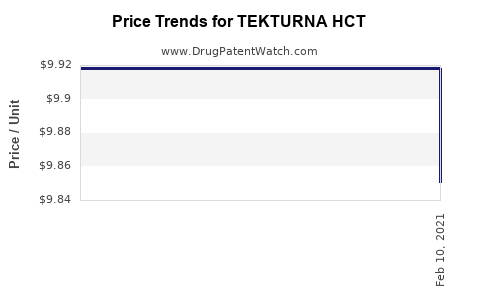
Drug Price Trends for TEKTURNA HCT
TEKTURNA HCT is a drug marketed by Noden Pharma. There is one patent protecting this drug and one Paragraph IV challenge.

This drug has thirty-two patent family members in twenty-five countries. There has been litigation on patents covering TEKTURNA HCT

See drug price trends for TEKTURNA HCT.

The generic ingredient in TEKTURNA HCT is aliskiren hemifumarate; hydrochlorothiazide. There are four drug master file entries for this API. Additional details are available on the aliskiren hemifumarate; hydrochlorothiazide profile page.

When can BYFAVO (remimazolam besylate) generic drug versions launch?

Generic name: remimazolam besylate
DrugPatentWatch® Estimated Key Patent Expiration / Generic Entry Date: July 10, 2026
Generic Entry Controlled by: United Kingdom Patent 613,692

BYFAVO is a drug marketed by Acacia. There are eleven patents protecting this drug.

This drug has fifty-three patent family members in twenty-four countries. There has been litigation on patents covering BYFAVO

See drug price trends for BYFAVO.

The generic ingredient in BYFAVO is remimazolam besylate. One supplier is listed for this generic product. Additional details are available on the remimazolam besylate profile page.

When can BYFAVO (remimazolam besylate) generic drug versions launch?

Generic name: remimazolam besylate
DrugPatentWatch® Estimated Key Patent Expiration / Generic Entry Date: July 10, 2026
Generic Entry Controlled by: United Kingdom Patent 613,694

BYFAVO is a drug marketed by Acacia. There are eleven patents protecting this drug.

This drug has fifty-three patent family members in twenty-four countries. There has been litigation on patents covering BYFAVO

See drug price trends for BYFAVO.

The generic ingredient in BYFAVO is remimazolam besylate. One supplier is listed for this generic product. Additional details are available on the remimazolam besylate profile page.

United Kingdom Branded and Generic Drug Markets: Assessment, Regulatory Opportunities, and Challenges

Last updated: December 28, 2025

Summary

The UK pharmaceutical market, comprising both branded and generic sectors, presents significant opportunities amid evolving regulatory landscapes and healthcare reforms. This report evaluates supply chain dynamics, market size, key players, regulatory frameworks, and prospective risks affecting stakeholders. It delineates strategic opportunities for growth, highlights regulatory challenges, and offers actionable insights for pharmaceutical companies, investors, and policymakers.

Market Overview

Size and Growth Dynamics

  • The UK pharmaceutical market was valued at approximately £16.2 billion in 2022, with projected compound annual growth rate (CAGR) of 3.2% over the next five years (IQVIA, 2022).
  • The branded segment accounts for roughly 65% of market value, while the generic segment contributes approximately 30-35%.
  • Increasing emphasis on cost containment and NHS formulary policies accelerates demand for generics.

Market Composition

Segment Market Share (2022) Key Drivers Notable Trends
Branded Drugs 65% Innovation, patent protection, specialty medicines Growth of biotechnology products, high-cost therapies
Generic Drugs 30-35% Cost pressures, patent expirations Rapid uptake, bioequivalence, regulatory easing

Major Players

  • Branded Sector: Pfizer, Novartis, Roche, AstraZeneca
  • Generic Sector: Teva Pharmaceuticals, Sandoz (Novartis), Mylan (now part of Viatris), Accord Healthcare, Aurobindo

Regulatory Framework in the UK

Overview

Post-Brexit, the UK Drug Regulatory Agency (UK Medicines and Healthcare products Regulatory Agency, MHRA)国t continues to oversee drug approval, safety, and market authorization, aligning with European standards but with distinct policies to foster innovation and streamline approvals.

Key Regulations and Policies

Regulation/Policy Description Impact on Market
Human Medicines Regulations 2012 Implemented UK-specific rules post-Brexit, aligned with EU directives Licensing, compliance
The UK National Medicines Policy Emphasizes access, affordability, and quality Pricing, reimbursement considerations
Health and Social Care Act 2012 Framework for NHS procurement and formulary management Reimbursement landscape
Medicines and Medical Devices Act 2021 Enhances oversight of medical devices and medicines' safety and efficacy Market surveillance, post-market monitoring

Regulatory Pathways

Pathway Description Applicability Lead Time Notes
Full Marketing Authorization Standard approval process New molecular entities, biologics 210 days Similar to EMA processes
Conditional Approval Accelerated pathway for unmet needs Rare diseases, urgent needs Variable Facilitates faster access
Generic Drug Approval Based on bioequivalence Established formulations Approx. 6 months Simplified pathway

Opportunities in the UK Pharmaceutical Market

1. Expansion of Generic Medicine Portfolio

  • Patent expirations of blockbuster drugs (e.g., Lipitor, Plavix) open pathways for generic entry.
  • The NHS’s push for cost savings magnifies opportunities for bioequivalent, cost-effective alternatives.

2. Biosimilar Development

  • UK’s focus on biosimilars offers growth avenues, especially in oncology and autoimmune diseases.
  • Regulatory pathways for biosimilars are well-established, supporting accelerated market entry.

3. Innovation in Specialty and Rare Disease Products

  • Rising demand for personalized medicine and advanced therapies.
  • MHRA’s streamlined approval mechanisms for orphan and rare disease drugs.

4. Digital Transformation and Manufacturing

  • Adoption of digital health tools for drug development and monitoring.
  • Opportunities in advanced manufacturing, including continuous manufacturing and sustainability initiatives.

5. Strategic Collaborations and Licensing

  • Access to the NHS’s procurement framework.
  • Public-private partnerships for drug research and distribution.

Regulatory Challenges and Risks

1. Navigating Post-Brexit Regulatory Divergence

  • Potential for divergence from EMA standards requires vigilance.
  • Increased compliance costs and delays in approval processes for imported or co-developed medicines.

2. Pricing and Reimbursement Pressures

  • The NHS’s Cost-Effectiveness Analysis (CEA) and NICE’s (National Institute for Health and Care Excellence) stringent evaluation criteria limit profit margins.
  • Price controls and tendering processes impact margins.

3. Market Access Delays and Complexity

  • Lengthy and complex approval processes for innovative products.
  • Variations in regional NHS procurement policies may cause inconsistencies.

4. Patent and Intellectual Property Risks

  • Increased competition from generics and biosimilars post-patent expiry.
  • Patent litigation and uncertainties affecting innovation incentives.

5. Supply Chain and Regulatory Compliance

  • Brexit-induced supply chain disruptions.
  • Ensuring compliance with UK-specific pharmacovigilance and post-market surveillance.

Comparative Analysis: UK vs. European Union & US

Aspect UK EU US
Regulatory Agency MHRA EMA FDA
Market Access Speed Faster (due to streamlined processes) Similar, but longer due to multiple countries Longer, more complex approval processes
Price Regulation NHS pricing negotiations, NICE evaluations Price negotiation varies; generally less government-led Market-driven pricing, higher reimbursement margins
Biosimilar Adoption Leading in Europe, focused on biosimilars Active development, growing uptake Rapid adoption, high competition
Patent Term & Data Exclusivity 8+2+1 years (UK), aligned with UK law Up to 10 years, plus supplementary protection certificates Up to 12 years data exclusivity

Strategic Recommendations

Priority Action Items Rationale
Engage with MHRA early Expand Regulatory Knowledge, expedite approvals Minimize delays, ensure compliance
Invest in biosimilars and generics Strengthen R&D, optimize manufacturing Capitalize on patent cliffs, NHS cost constraints
Monitor Brexit-related regulatory changes Adjust compliance strategies Maintain market access, prevent delays
Develop partnerships with NHS Leverage procurement frameworks Increase market penetration
Embrace digital health tech Enhance data, compliance, and supply chain Improve efficiency, reduce regulatory hurdles

Key Takeaways

  • The UK market presents lucrative opportunities for generics, biosimilars, and specialty medicines driven by patent expiries, cost containment, and innovation.
  • Post-Brexit regulatory environment necessitates vigilance, agility, and proactive compliance strategies.
  • Price pressures from NHS and NICE policies continuously shape product profitability.
  • Strategic collaborations, digital transformation, and early engagement with MHRA can mitigate regulatory risks.
  • Market entry success hinges on aligning product development with evolving UK-specific policies, safety standards, and procurement frameworks.

FAQs

Q1: How does Brexit affect drug approval times in the UK?
Brexit has led to the UK establishing its own regulatory pathway through MHRA, which, in some cases, results in faster approval times than the EMA, especially with expedited routes for certain therapies. However, divergence from EMA can also introduce complexities for companies needing dual approvals.

Q2: What are the key regulatory requirements for biosimilars in the UK?
Biosimilars must demonstrate biosimilarity in terms of efficacy, safety, and quality, following MHRA guidance similar to EMA standards. Data packages are typically less extensive than novel biologics but require equivalence studies and robust quality assurance.

Q3: How does the NHS impact drug pricing and market access?
NHS, through NICE evaluations and procurement frameworks, prioritizes cost-effectiveness, often negotiating for lower prices and preferential inclusion. This severely influences margins and incentives, favoring generic and biosimilar entry.

Q4: What are the intellectual property challenges post-patent expiry?
Patent expiry opens the market for generics, but companies face risks of patent litigation and market saturation. Post-expiry, competition intensifies, putting pricing pressure on branded products.

Q5: What opportunities exist for biotechnological innovations in the UK?
The UK actively promotes biotech R&D, with favorable regulatory pathways for advanced therapies, gene therapies, and personalized medicine. This creates substantial avenues for innovative product pipelines.

References

  1. IQVIA, "UK Pharma Market Overview," 2022.
  2. MHRA, "Guidelines for Biosimilars," 2021.
  3. UK Human Medicines Regulations, 2012.
  4. NICE, "Guidance on Cost-Effectiveness and Market Access," 2022.
  5. Department of Health and Social Care, "UK Pharmaceutical Policy Framework," 2021.

More… ↓

⤷  Get Started Free

DrugPatentWatch cited by CNN, NEJM, Nature Journals, and more …

Make Better Decisions: Try a trial or see plans & pricing

Drugs may be covered by multiple patents or regulatory protections. All trademarks and applicant names are the property of their respective owners or licensors. Although great care is taken in the proper and correct provision of this service, thinkBiotech LLC does not accept any responsibility for possible consequences of errors or omissions in the provided data. The data presented herein is for information purposes only. There is no warranty that the data contained herein is error free. We do not provide individual investment advice. This service is not registered with any financial regulatory agency. The information we publish is educational only and based on our opinions plus our models. By using DrugPatentWatch you acknowledge that we do not provide personalized recommendations or advice. thinkBiotech performs no independent verification of facts as provided by public sources nor are attempts made to provide legal or investing advice. Any reliance on data provided herein is done solely at the discretion of the user. Users of this service are advised to seek professional advice and independent confirmation before considering acting on any of the provided information. thinkBiotech LLC reserves the right to amend, extend or withdraw any part or all of the offered service without notice.
