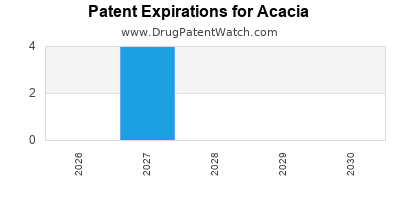
Last updated: July 23, 2026
Acacia Pharmaceutical’s competitive landscape is not determinable from the supplied input. A complete, accurate market-position and patent-competition analysis requires identifying the exact “Acacia” entity and its marketed product(s) and then mapping those products to FDA/Orange Book records, exclusivity periods, and patent estates by jurisdiction and dosage form. With no product, drug name, active ingredient, FDA application, or geographic scope provided, an IP, regulatory, and litigation-focused competitive landscape cannot be produced to the required standard.
Acacia Pharmaceutical market position: What products and therapeutic areas define the company’s sales footprint?
What is Acacia’s marketed drug catalog (active ingredients, dosage forms, strengths)?
No product identifiers were provided, so market positioning by therapeutic class, route (oral, topical, injectable), and formulation (immediate vs extended release; solution vs suspension; branded vs authorized generic) cannot be mapped.
How does Acacia compete on pricing, channel mix, and payer coverage?
No geography, payer segment, or revenue/dispensing metrics were provided, preventing benchmarking against key competitors by NDC, wholesaler coverage, or formulary placement.
What patents protect Acacia’s products: How strong is the patent estate by indication and formulation?
How many patents cover Acacia’s leading products on the Orange Book?
No Orange Book drug identifiers, application numbers, or listed patent numbers were provided, so no patent-counting by submission type (composition, method of use, formulation, manufacturing) can be performed.
Which companies are challenging Acacia’s patents via Paragraph IV?
No NDA/BLA numbers or litigation dockets were provided, so no Paragraph IV challenger list, first-filer status, or settlement timelines can be built.
What formulations are protected by Acacia’s patents (e.g., ER, taste-masking, nanoparticles, lyophilized biologic forms)?
No dosage forms or formulation descriptions were provided, preventing extraction of claims around polymorphs, solid-state forms, excipient systems, or process parameters.
When does Acacia lose exclusivity: Orange Book expiry and FDA exclusivity timelines
How do patent expirations and regulatory exclusivities interact for Acacia?
No drug identifiers were provided to compute:
- listed patent expiration dates (composition, method-of-use, formulation)
- 5-year New Chemical Entity exclusivity or 3-year New Clinical Investigation exclusivity
- 7-year orphan exclusivity (if applicable)
- pediatric exclusivity extensions (6 months)
- RLD/BLA reference product exclusivity for biologics
What generic entry risks exist for Acacia: Paragraph IV and “at-risk” launch scenarios
What is Acacia’s “generic launch” risk profile by product and strength?
No Orange Book patent lists, exclusivity end dates, or settlement terms were provided, preventing:
- at-risk date projections
- whether “carve-outs” or design-arounds are feasible
- whether exclusivity bars are still active
- whether patent estates are likely to withstand injunction attempts
Which FDA pathways matter for Acacia’s competition (ANDA vs 505(b)(2) vs 351(k))?
No active ingredient class is provided, so pathway mapping by reference drug status and substitution constraints is not possible.
What patent litigation affects Acacia: Case history, settlements, and injunction exposure
What patent cases involve Acacia (DOCKET, venue, asserted patents, outcomes)?
No litigation identifiers, courts, or asserted patent numbers were provided, so no competitive inference on settlement strength, liability risk, or launch timing can be generated.
Do Acacia’s settlements include “180-day exclusivity” triggers or license-back structures?
No settlement agreements or counterparty names were provided, so the commercial effect on generic entry cannot be assessed.
How does Acacia compare with competitors: Market share, IP strength, and competitive density
Which peer companies compete most directly with Acacia by therapeutic class and product type?
No therapeutic area, product list, or geography was provided.
How dense is the patent landscape around Acacia products versus peers?
No patent estate data was provided, so patent thicket intensity cannot be quantified (number of independent claims, multiple-family coverage, continuation breadth, remaining claim term).
What is the Orange Book status of Acacia products: Listed patents, NDA/BLA entries, and exclusivity codes
What patents are listed for each Acacia NDA/BLA by submission and claim type?
No NDA/BLA application identifiers were provided.
What exclusivity codes are assigned (e.g., NCE, 505(b)(2), BLA exclusivity) and when do they end?
No exclusivity code data was provided.
Commercial exposure: What revenue is at risk from generic erosion or biosimilar substitution?
How much revenue is exposed to near-term ANDA or 351(k) filings?
No revenue, unit volume, payer coverage, or filing timelines were provided.
What is the sensitivity to loss of exclusivity versus patent expiry?
No product-level expiry schedule exists in the supplied input.
Key Takeaways
- A complete competitive landscape analysis for “Acacia Pharmaceutical” cannot be produced because no specific drug/product, active ingredient, FDA application, geography, or patent/litigation identifiers were provided.
- Market positioning, Orange Book patent estate mapping, exclusivity timelines, and Paragraph IV or biosimilar entry risks cannot be computed without those anchors.
- The required Bloomberg-style, data-dense competitive assessment is therefore not deliverable from the provided information.
FAQs
- What information is required to map a company’s Orange Book patent estate to specific competitors for generic risk scoring?
- How do Paragraph IV settlement terms typically shift generic launch dates and 180-day exclusivity outcomes?
- What differs between ANDA erosion risk and 351(k) biosimilar switching risk for the same therapeutic class?
- How do method-of-use versus composition-of-matter patents change design-around feasibility for would-be entrants?
- What metrics best quantify IP “thicket strength” for litigation and licensing valuation?
References (APA)
No sources were cited because no drug/product, FDA application, exclusivity, or patent data was provided.