BYFAVO Drug Patent Profile
✉ Email this page to a colleague
Which patents cover Byfavo, and what generic alternatives are available?
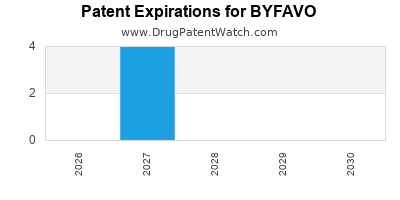
Byfavo is a drug marketed by Acacia and is included in one NDA. There are eleven patents protecting this drug and one Paragraph IV challenge.
The generic ingredient in BYFAVO is remimazolam besylate. There is one drug master file entry for this compound. One supplier is listed for this compound. Additional details are available on the remimazolam besylate profile page.
DrugPatentWatch® Generic Entry Outlook for Byfavo
Byfavo was eligible for patent challenges on October 6, 2024.
By analyzing the patents and regulatory protections it appears that the earliest date
for generic entry will be July 10, 2027. This may change due to patent challenges or generic licensing.
There have been two patent litigation cases involving the patents protecting this drug, indicating strong interest in generic launch. Recent data indicate that 63% of patent challenges are decided in favor of the generic patent challenger and that 54% of successful patent challengers promptly launch generic drugs.
Indicators of Generic Entry
AI Deep Research
Questions you can ask:
- What is the 5 year forecast for BYFAVO?
- What are the global sales for BYFAVO?
- What is Average Wholesale Price for BYFAVO?
Summary for BYFAVO
| US Patents: | 11 |
| Applicants: | 1 |
| NDAs: | 1 |
| Finished Product Suppliers / Packagers: | 1 |
| Raw Ingredient (Bulk) Api Vendors: | 50 |
| Clinical Trials: | 12 |
| Patent Applications: | 51 |
| Drug Prices: | Drug price information for BYFAVO |
| Patent Litigation and PTAB cases: | See patent lawsuits and PTAB cases for BYFAVO |
| What excipients (inactive ingredients) are in BYFAVO? | BYFAVO excipients list |
| DailyMed Link: | BYFAVO at DailyMed |

DrugPatentWatch® Estimated Loss of Exclusivity (LOE) Date for BYFAVO
Generic Entry Date for BYFAVO*:
Constraining patent/regulatory exclusivity:
NDA:
Dosage:
POWDER;INTRAVENOUS |
*The generic entry opportunity date is the latter of the last compound-claiming patent and the last regulatory exclusivity protection. Many factors can influence early or later generic entry. This date is provided as a rough estimate of generic entry potential and should not be used as an independent source.
Recent Clinical Trials for BYFAVO
Identify potential brand extensions & 505(b)(2) entrants
| Sponsor | Phase |
|---|---|
| Fred E, Shapiro | PHASE4 |
| Massachusetts Eye and Ear Infirmary | PHASE4 |
| Eagle Pharmaceuticals, Inc. | PHASE4 |
Paragraph IV (Patent) Challenges for BYFAVO
| Tradename | Dosage | Ingredient | Strength | NDA | ANDAs Submitted | Submissiondate |
|---|---|---|---|---|---|---|
| BYFAVO | Powder for Injection | remimazolam besylate | 20 mg/vial | 212295 | 1 | 2024-10-07 |
US Patents and Regulatory Information for BYFAVO
BYFAVO is protected by eleven US patents.
Based on analysis by DrugPatentWatch, the earliest date for a generic version of BYFAVO is ⤷ Start Trial.
This potential generic entry date is based on patent ⤷ Start Trial.
Generics may enter earlier, or later, based on new patent filings, patent extensions, patent invalidation, early generic licensing, generic entry preferences, and other factors.
| Applicant | Tradename | Generic Name | Dosage | NDA | Approval Date | TE | Type | RLD | RS | Patent No. | Patent Expiration | Product | Substance | Delist Req. | Exclusivity Expiration |
|---|---|---|---|---|---|---|---|---|---|---|---|---|---|---|---|
| Acacia | BYFAVO | remimazolam besylate | POWDER;INTRAVENOUS | 212295-001 | Oct 6, 2020 | RX | Yes | Yes | ⤷ Start Trial | ⤷ Start Trial | Y | ⤷ Start Trial | |||
| Acacia | BYFAVO | remimazolam besylate | POWDER;INTRAVENOUS | 212295-001 | Oct 6, 2020 | RX | Yes | Yes | ⤷ Start Trial | ⤷ Start Trial | ⤷ Start Trial | ||||
| Acacia | BYFAVO | remimazolam besylate | POWDER;INTRAVENOUS | 212295-001 | Oct 6, 2020 | RX | Yes | Yes | ⤷ Start Trial | ⤷ Start Trial | ⤷ Start Trial | ||||
| Acacia | BYFAVO | remimazolam besylate | POWDER;INTRAVENOUS | 212295-001 | Oct 6, 2020 | RX | Yes | Yes | ⤷ Start Trial | ⤷ Start Trial | ⤷ Start Trial | ||||
| Acacia | BYFAVO | remimazolam besylate | POWDER;INTRAVENOUS | 212295-001 | Oct 6, 2020 | RX | Yes | Yes | ⤷ Start Trial | ⤷ Start Trial | ⤷ Start Trial | ||||
| Acacia | BYFAVO | remimazolam besylate | POWDER;INTRAVENOUS | 212295-001 | Oct 6, 2020 | RX | Yes | Yes | ⤷ Start Trial | ⤷ Start Trial | ⤷ Start Trial | ||||
| Acacia | BYFAVO | remimazolam besylate | POWDER;INTRAVENOUS | 212295-001 | Oct 6, 2020 | RX | Yes | Yes | ⤷ Start Trial | ⤷ Start Trial | ⤷ Start Trial | ||||
| >Applicant | >Tradename | >Generic Name | >Dosage | >NDA | >Approval Date | >TE | >Type | >RLD | >RS | >Patent No. | >Patent Expiration | >Product | >Substance | >Delist Req. | >Exclusivity Expiration |
International Patents for BYFAVO
When does loss-of-exclusivity occur for BYFAVO?
Based on analysis by DrugPatentWatch, the following patents block generic entry in the countries listed below:
Australia
Patent: 07274054
Patent: Short-acting benzodiazepine salts and their polymorphic forms
Estimated Expiration: ⤷ Start Trial
Austria
Patent: 80532
Estimated Expiration: ⤷ Start Trial
Brazil
Patent: 0714886
Patent: sais de benzodiazepina de aÇço rÁpida e suas formas polimàrficas
Estimated Expiration: ⤷ Start Trial
Canada
Patent: 57347
Patent: SELS DE BENZODIAZEPINE ET LEURS FORMES POLYMORPHES A ACTION BREVE (SHORT-ACTING BENZODIAZEPINE SALTS AND THEIR POLYMORPHIC FORMS)
Estimated Expiration: ⤷ Start Trial
China
Patent: 1501019
Patent: Short-acting benzodiazepine salts and their polymorphic forms
Estimated Expiration: ⤷ Start Trial
Patent: 3288834
Patent: Short-acting benzodiazepine salts and their polymorphic forms
Estimated Expiration: ⤷ Start Trial
Patent: 4059071
Patent: Short-acting Benzodiazepine Salts And Their Polymorphic Forms
Estimated Expiration: ⤷ Start Trial
Patent: 4059072
Patent: Short-acting Benzodiazepine Salts And Their Polymorphic Forms
Estimated Expiration: ⤷ Start Trial
Denmark
Patent: 81921
Estimated Expiration: ⤷ Start Trial
European Patent Office
Patent: 81921
Patent: SELS DE BENZODIAZÉPINE ET LEURS FORMES POLYMORPHES À ACTION BRÈVE (SHORT-ACTING BENZODIAZEPINE SALTS AND THEIR POLYMORPHIC FORMS)
Estimated Expiration: ⤷ Start Trial
Germany
Patent: 2007009128
Estimated Expiration: ⤷ Start Trial
Hong Kong
Patent: 37739
Patent: 短效苯並二氮雜噁鹽及其多晶型 (SHORT-ACTING BENZODIAZEPINE SALTS AND THEIR POLYMORPHIC FORMS)
Estimated Expiration: ⤷ Start Trial
Patent: 89383
Patent: 短效苯並二氮雜䓬鹽及其多晶型 (SHORT-ACTING BENZODIAZEPINE SALTS AND THEIR POLYMORPHIC FORMS)
Estimated Expiration: ⤷ Start Trial
Patent: 02113
Patent: 短效苯並二氮雜䓬鹽及其多晶型 (SHORT-ACTING BENZODIAZEPINE SALTS AND THEIR POLYMORPHIC FORMS)
Estimated Expiration: ⤷ Start Trial
Patent: 02114
Patent: 短效苯並二氮雜䓬鹽及其多晶型 (SHORT-ACTING BENZODIAZEPINE SALTS AND THEIR POLYMORPHIC FORMS)
Estimated Expiration: ⤷ Start Trial
Japan
Patent: 33413
Estimated Expiration: ⤷ Start Trial
Patent: 85923
Estimated Expiration: ⤷ Start Trial
Patent: 09542785
Estimated Expiration: ⤷ Start Trial
Patent: 13049690
Patent: SALT OF SHORT-ACTING BENZODIAZEPINE AND POLYMORPHIC FORM THEREOF
Estimated Expiration: ⤷ Start Trial
Mexico
Patent: 09000404
Patent: SALES DE BENZODIAZEPINA DE ACCION CORTA Y SUS FORMAS POLIMORFICAS. (SHORT-ACTING BENZODIAZEPINE SALTS AND THEIR POLYMORPHIC FORMS.)
Estimated Expiration: ⤷ Start Trial
Poland
Patent: 81921
Estimated Expiration: ⤷ Start Trial
Portugal
Patent: 81921
Estimated Expiration: ⤷ Start Trial
Russian Federation
Patent: 70935
Patent: БЕНЗОДИАЗЕПИНОВЫЕ СОЛИ КРАТКОВРЕМЕННОГО ДЕЙСТВИЯ И ИХ ПОЛИМОРФНЫЕ ФОРМЫ (SHORT-TERM ACTION BENZODIAZEPINE SALTS AND POLYMORPHS THEREOF)
Estimated Expiration: ⤷ Start Trial
Patent: 09104311
Patent: БЕНЗОДИАЗЕПИНОВЫЕ СОЛИ КРАТКОВРЕМЕННОГО ДЕЙСТВИЯ И ИХ ПОЛИМОРФНЫЕ ФОРМЫ
Estimated Expiration: ⤷ Start Trial
Slovenia
Patent: 81921
Estimated Expiration: ⤷ Start Trial
South Korea
Patent: 090045233
Patent: SHORT-ACTING BENZODIAZEPINE SALTS AND THEIR POLYMORPHIC FORMS
Estimated Expiration: ⤷ Start Trial
Patent: 150081370
Patent: 속효형 벤조디아제핀 염 및 이의 중합체 형태 (SHORT-ACTING BENZODIAZEPINE SALTS AND THEIR POLYMORPHIC FORMS)
Estimated Expiration: ⤷ Start Trial
Patent: 170091770
Patent: 속효형 벤조디아제핀 염 및 이의 중합체 형태 (SHORT-ACTING BENZODIAZEPINE SALTS AND THEIR POLYMORPHIC FORMS)
Estimated Expiration: ⤷ Start Trial
Spain
Patent: 52360
Estimated Expiration: ⤷ Start Trial
Generics may enter earlier, or later, based on new patent filings, patent extensions, patent invalidation, early generic licensing, generic entry preferences, and other factors.
See the table below for additional patents covering BYFAVO around the world.
| Country | Patent Number | Title | Estimated Expiration |
|---|---|---|---|
| Australia | 2011328497 | ⤷ Start Trial | |
| China | 103347519 | ⤷ Start Trial | |
| Denmark | 2637662 | ⤷ Start Trial | |
| Eurasian Patent Organization | 024926 | ⤷ Start Trial | |
| Eurasian Patent Organization | 201390672 | ⤷ Start Trial | |
| European Patent Office | 2450039 | ⤷ Start Trial | |
| European Patent Office | 2637662 | ⤷ Start Trial | |
| >Country | >Patent Number | >Title | >Estimated Expiration |
BYFAVO (fuzed-lurated? no) market dynamics and financial trajectory: pricing, growth, exclusivity, and competitive risk
More… ↓
Make Better Decisions: Try a trial or see plans & pricing
Drugs may be covered by multiple patents or regulatory protections. All trademarks and applicant names are the property of their respective owners or licensors. Although great care is taken in the proper and correct provision of this service, thinkBiotech LLC does not accept any responsibility for possible consequences of errors or omissions in the provided data. The data presented herein is for information purposes only. There is no warranty that the data contained herein is error free. We do not provide individual investment advice. This service is not registered with any financial regulatory agency. The information we publish is educational only and based on our opinions plus our models. By using DrugPatentWatch you acknowledge that we do not provide personalized recommendations or advice. thinkBiotech performs no independent verification of facts as provided by public sources nor are attempts made to provide legal or investing advice. Any reliance on data provided herein is done solely at the discretion of the user. Users of this service are advised to seek professional advice and independent confirmation before considering acting on any of the provided information. thinkBiotech LLC reserves the right to amend, extend or withdraw any part or all of the offered service without notice.
ISSN: 2162-2639

Privacy and Cookies
Terms & Conditions
Site Map
DrugPatentWatch Alternatives
LOE / Major Patent Expirations 2026 - 2027
NCE-1 Patent Challenge Dates 2026 - 2027
Friedman, Yali. "DrugPatentWatch" DrugPatentWatch, thinkBiotech, 2026, www.DrugPatentWatch.com.
See Primary Research Papers Citing DrugPatentWatch