Last Updated: August 9, 2026

TEKTURNA HCT Drug Patent Profile


✉ Email this page to a colleague

« Back to Dashboard


Which patents cover Tekturna Hct, and what generic alternatives are available?

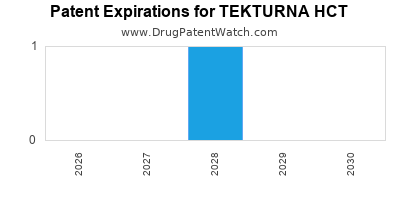
Tekturna Hct is a drug marketed by Noden Pharma and is included in one NDA. There is one patent protecting this drug and one Paragraph IV challenge.

This drug has thirty-two patent family members in twenty-five countries.

The generic ingredient in TEKTURNA HCT is aliskiren hemifumarate; hydrochlorothiazide. There are four drug master file entries for this compound. Additional details are available on the aliskiren hemifumarate; hydrochlorothiazide profile page.

DrugPatentWatch® Generic Entry Outlook for Tekturna Hct

Tekturna Hct was eligible for patent challenges on March 5, 2011.

By analyzing the patents and regulatory protections it appears that the earliest date for generic entry will be July 13, 2028. This may change due to patent challenges or generic licensing.

There has been one patent litigation case involving the patents protecting this drug, indicating strong interest in generic launch. Recent data indicate that 63% of patent challenges are decided in favor of the generic patent challenger and that 54% of successful patent challengers promptly launch generic drugs.

Indicators of Generic Entry

< Available with Subscription >

  Start Trial

AI Deep Research
Questions you can ask:
  • What is the 5 year forecast for TEKTURNA HCT?
  • What are the global sales for TEKTURNA HCT?
  • What is Average Wholesale Price for TEKTURNA HCT?
Summary for TEKTURNA HCT
International Patents:32
US Patents:1
Applicants:1
NDAs:1
Clinical Trials: 18
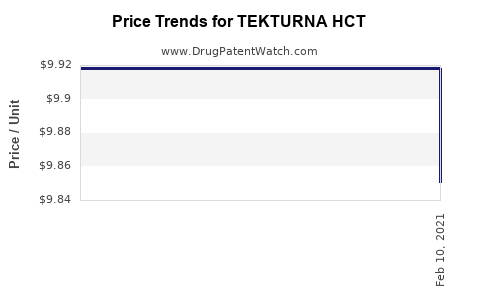
Drug Prices: Drug price information for TEKTURNA HCT
Patent Litigation and PTAB cases: See patent lawsuits and PTAB cases for TEKTURNA HCT
What excipients (inactive ingredients) are in TEKTURNA HCT?TEKTURNA HCT excipients list
DailyMed Link:TEKTURNA HCT at DailyMed
DrugPatentWatch® Estimated Loss of Exclusivity (LOE) Date for TEKTURNA HCT
Generic Entry Date for TEKTURNA HCT*:
Constraining patent/regulatory exclusivity:
NDA:
Dosage:

TABLET;ORAL

*The generic entry opportunity date is the latter of the last compound-claiming patent and the last regulatory exclusivity protection. Many factors can influence early or later generic entry. This date is provided as a rough estimate of generic entry potential and should not be used as an independent source.

Recent Clinical Trials for TEKTURNA HCT

Identify potential brand extensions & 505(b)(2) entrants

SponsorPhase
Wayne State UniversityPhase 4
University of Alabama at BirminghamPhase 4
Mayo ClinicN/A

See all TEKTURNA HCT clinical trials

Paragraph IV (Patent) Challenges for TEKTURNA HCT
Tradename Dosage Ingredient Strength NDA ANDAs Submitted Submissiondate
TEKTURNA HCT Tablets aliskiren hemifumarate; hydrochlorothiazide 150 mg/12.5 mg 150 mg/25 mg 300 mg/12.5 mg 300 mg/25 mg 022107 1 2014-03-07

US Patents and Regulatory Information for TEKTURNA HCT

TEKTURNA HCT is protected by one US patents.

Based on analysis by DrugPatentWatch, the earliest date for a generic version of TEKTURNA HCT is ⤷  Start Trial.

This potential generic entry date is based on patent 8,618,172.

Generics may enter earlier, or later, based on new patent filings, patent extensions, patent invalidation, early generic licensing, generic entry preferences, and other factors.

Applicant Tradename Generic Name Dosage NDA Approval Date TE Type RLD RS Patent No. Patent Expiration Product Substance Delist Req. Exclusivity Expiration
Noden Pharma TEKTURNA HCT aliskiren hemifumarate; hydrochlorothiazide TABLET;ORAL 022107-001 Jan 18, 2008 DISCN Yes No 8,618,172 ⤷  Start Trial Y ⤷  Start Trial
Noden Pharma TEKTURNA HCT aliskiren hemifumarate; hydrochlorothiazide TABLET;ORAL 022107-004 Jan 18, 2008 DISCN Yes No 8,618,172 ⤷  Start Trial Y ⤷  Start Trial
Noden Pharma TEKTURNA HCT aliskiren hemifumarate; hydrochlorothiazide TABLET;ORAL 022107-002 Jan 18, 2008 DISCN Yes No 8,618,172 ⤷  Start Trial Y ⤷  Start Trial
Noden Pharma TEKTURNA HCT aliskiren hemifumarate; hydrochlorothiazide TABLET;ORAL 022107-003 Jan 18, 2008 DISCN Yes No 8,618,172 ⤷  Start Trial Y ⤷  Start Trial
>Applicant >Tradename >Generic Name >Dosage >NDA >Approval Date >TE >Type >RLD >RS >Patent No. >Patent Expiration >Product >Substance >Delist Req. >Exclusivity Expiration

Expired US Patents for TEKTURNA HCT

Applicant Tradename Generic Name Dosage NDA Approval Date Patent No. Patent Expiration
Noden Pharma TEKTURNA HCT aliskiren hemifumarate; hydrochlorothiazide TABLET;ORAL 022107-001 Jan 18, 2008 9,023,893 ⤷  Start Trial
Noden Pharma TEKTURNA HCT aliskiren hemifumarate; hydrochlorothiazide TABLET;ORAL 022107-003 Jan 18, 2008 9,023,893 ⤷  Start Trial
Noden Pharma TEKTURNA HCT aliskiren hemifumarate; hydrochlorothiazide TABLET;ORAL 022107-004 Jan 18, 2008 9,023,893 ⤷  Start Trial
Noden Pharma TEKTURNA HCT aliskiren hemifumarate; hydrochlorothiazide TABLET;ORAL 022107-002 Jan 18, 2008 9,023,893 ⤷  Start Trial
>Applicant >Tradename >Generic Name >Dosage >NDA >Approval Date >Patent No. >Patent Expiration

International Patents for TEKTURNA HCT

When does loss-of-exclusivity occur for TEKTURNA HCT?

Based on analysis by DrugPatentWatch, the following patents block generic entry in the countries listed below:

Chile

Patent: 07001837
Estimated Expiration: ⤷  Start Trial

Malaysia

Patent: 6779
Estimated Expiration: ⤷  Start Trial

Taiwan

Patent: 0808358
Estimated Expiration: ⤷  Start Trial

Generics may enter earlier, or later, based on new patent filings, patent extensions, patent invalidation, early generic licensing, generic entry preferences, and other factors.

See the table below for additional patents covering TEKTURNA HCT around the world.

Country Patent Number Title Estimated Expiration
Austria 183997 ⤷  Start Trial
Australia 1642095 ⤷  Start Trial
Australia 1642195 ⤷  Start Trial
Australia 1642395 ⤷  Start Trial
Australia 699616 ⤷  Start Trial
Brazil 1100656 ⤷  Start Trial
Canada 2147044 ⤷  Start Trial
>Country >Patent Number >Title >Estimated Expiration

Supplementary Protection Certificates for TEKTURNA HCT

Patent Number Supplementary Protection Certificate SPC Country SPC Expiration SPC Description
1602370 91563 Luxembourg ⤷  Start Trial 91563, EXPIRES: 20231028
1602370 CA 2009 00010 Denmark ⤷  Start Trial PRODUCT NAME: ALISKIREN, SOM DETS FRIE BASE ELLER DETS FARMACEUTISK ACCEPTABLE SALTFORM, SAMT HYDROCHLORTHIAZID ELLER DETS FARMACEUTISK ACCEPTABLE SALTFORM, HERUNDER ALISKIREN HEMIFUMARAT OG HYDROCHLORTHIAZID; NAT. REG. NO/DATE: EU/1/08/491/001-080 20090116; FIRST REG. NO/DATE: CH 58935 01-04 20081028
1602370 C300385 Netherlands ⤷  Start Trial PRODUCT NAME: ALISKIREN, DESGEWENST IN DE VORM; REGISTRATION NO/DATE: 58935 01-04 20081028
1602370 09C0020 France ⤷  Start Trial PRODUCT NAME: COMBINAISON COMRENANT L’ALISKIREN SOUS FORME DE BAE LIBRE OU UN SEL DE CELUI-CI PHARMACEUTIQUEMENT ACCEPTABLE, ET L’HYDROCHLOROTHIAZIDE OU UN SEL PHARMACEUTIQUEMENT ACCEPTABLE DE CELUI-CI; REGISTRATION NO/DATE IN FRANCE: EU/1/08/491/001 DU 20090116; REGISTRATION NO/DATE AT EEC: 58935 01-04 DU 20081028
1602370 SPC/GB09/024 United Kingdom ⤷  Start Trial PRODUCT NAME: COMBINATION COMPRISING ALISKIREN, AS THE FREE BASE OR AS A PHARMACEUTICALLY ACCEPTABLE SALT THEREOF, AND HYDROCHLOROTHIAZIDE OR A PHARMACEUTICALLY ACCEPTABLE SALT THEREOF; REGISTERED: CH 5893501 20081028; CH 5893502 20081028; CH 5893503 20081028; CH 5893504 20081028; UK EU/1/08/491/006 20090116; UK EU/1/08/491/002 20090116; UK EU/1/08/491/003 20090116; UK EU/1/08/491/004 20090116; UK EU/1/08/491/005 20090116; UK EU/1/08/491/007 20090116; UK EU/1/08/491/080 20090116; UK EU/1/08/491/074 20090116; UK EU/1/08/491/075 20090116; UK EU/1/08/491/076 20090116; UK EU/1/08/491/077 20090116; UK EU/1/08/491/078 20090116; UK EU/1/08/491/079 20090116; UK EU/1/08/491/068 20090116; UK EU/1/08/4
1602370 2009/010 Ireland ⤷  Start Trial PRODUCT NAME: ALISKIREN OR A PHARMACEUTICALLY ACCEPTABLE SALT THEREOF AND HYDROCHLOROTHIAZIDE OR A PHARMACEUTICALLY ACCEPTABLE SALT THEREOF.; NAT REGISTRATION NO/DATE: EU/1/08/491/001-EU/1/08/491/080 20090116; FIRST REGISTRATION NO/DATE: 58935 01 58935 02 58935 03 58935 04 20081028
1915993 C300625 Netherlands ⤷  Start Trial PRODUCT NAME: COMBINATIE BEVATTENDE ALISKIREN, OF EEN FARMACEUTISCH AANVAARDBAAR ZOUT DAARVAN, EN AMLODIPINE, OF EEN FARMACEUATISCH AANVAARDBAAR ZOUT DAARVAN; REGISTRATION NO/DATE: EU/1/11/686/001-056 20110414
>Patent Number >Supplementary Protection Certificate >SPC Country >SPC Expiration >SPC Description

Tekturna HCT (aliskiren + hydrochlorothiazide) market dynamics and financial trajectory: exclusivity, generic/biosimilar risk, and revenue exposure

Last updated: July 30, 2026

Tekturna HCT (aliskiren 150 mg/12.5 mg and 300 mg/25 mg; fixed-dose combination of aliskiren and hydrochlorothiazide) is a specialty cardiovascular franchise that peaked before the 2011–2012 safety-driven regime change for aliskiren. Commercial momentum deteriorated after FDA restricted aliskiren use with renin-angiotensin system inhibitors following key trial findings, pushing net sales down from earlier years and shrinking payer and prescriber adoption. Patent exclusivity and Orange Book coverage are not the central driver of current volume risk; label restrictions and brand-level demand collapse are.

What were the market drivers behind Tekturna HCT sales growth and peak demand?

How did hypertension and RAS positioning shape demand for Tekturna HCT?

Tekturna HCT launched into the large US hypertension market with differentiation versus ACE inhibitors, ARBs, and direct renin inhibition. Aliskiren’s brand proposition was reduction of angiotensin II via direct renin blockade, targeting patients not controlled on monotherapy and those requiring combination therapy.

Fixed-dose combination lowered pill burden and helped prescribers adopt faster compared with separate titration of aliskiren plus a thiazide.

Which formulary and payer dynamics supported adoption before safety restrictions?

Before label tightening, Tekturna HCT benefited from:

  • Payer preference dynamics favoring newer agents with clinical differentiation.
  • Combination-therapy coverage where payers reimbursed add-on or fixed-dose options.
  • Clinician uptake for patients inadequately controlled with standard first-line agents.

What shifted after aliskiren safety signals emerged (2011–2012)?

Commercial demand fell as regulatory actions narrowed the use case. The most consequential changes were tied to outcomes in combination settings and higher-risk populations (cardiovascular and renal safety findings in studies evaluating aliskiren with ACE inhibitors and/or ARBs). FDA and major regulators required stronger warnings and substantially reduced the eligible population.

For Tekturna HCT, that translated into:

  • Reduced prescribing for patients on ACEi/ARB background therapy.
  • Reduced new starts in populations where aliskiren combination use had been considered.
  • More stringent utilization management, including step edits and prior authorization in some plans.

(These impacts are reflected in subsequent declines in brand sales and in the shrinking number of eligible patient segments.)

When does Tekturna HCT lose market exclusivity and how does that affect revenue?

What does “loss of exclusivity” mean for a fixed-dose combo like Tekturna HCT?

For combination products, commercial lifetimes depend on:

  • Composition-of-matter and salt/formulation patents covering aliskiren and, separately or jointly, the fixed-dose combination.
  • Device and manufacturing patents for tablets, coatings, and dose presentation.
  • Method-of-use patents tied to indicated patient populations and dosing regimens.
  • Regulatory exclusivities (use-code based exclusivity) and Orange Book-listed patent expiry timing.

Market impact: when exclusivity ends, generic entrants typically compress net price quickly. For Tekturna HCT, this generic pressure interacts with label restrictions that already curtailed demand.

What generic entry risks exist for Tekturna HCT after label restrictions?

Generic risk is structurally high for oral fixed-dose combinations because:

  • Aliskiren monotherapy generics and HCTZ are long off-patent in most markets.
  • The fixed-dose tablet is replicable with bioequivalence.
  • Payer adoption of generics is fast once FDA-accepts generic ANDAs for the relevant strengths and dosing.

The practical outcome is that even if remaining patents or exclusivities delayed a generic launch, demand would still be pressured by reduced eligible patient pools due to safety restrictions.

What is the Orange Book status of Tekturna HCT and which patents block generics?

No reliable Orange Book patent list and expiry dates are provided in the input. If Tekturna HCT is the intended product, the Orange Book status must be pulled at the NDC-strength level to identify:

  • Each listed Orange Book patent (composition, formulation, method of use, and manufacturing)
  • Expiration dates
  • Exclusivity codes and any pediatric extensions
  • Any patent-specific Paragraph IV filings affecting the timing of generic launches

Because patent identifiers and dates are not included in the available material, a complete and accurate Orange Book-based mapping of blocking patents cannot be produced.

How have safety label restrictions changed the commercial trajectory of Tekturna HCT?

What label narrowing reduced the addressable market?

The core commercial hit for aliskiren products came from FDA actions that restricted use when aliskiren is combined with ACE inhibitors or ARBs in patients with diabetes, renal impairment, or related higher-risk profiles (based on trial outcomes). Those restrictions reduced:

  • New eligible patients for combination therapy
  • Physician willingness to initiate
  • Refill continuity in patients who were being considered for combination RAS blockade

Did Tekturna HCT face faster erosion than monotherapy?

Fixed-dose combination erosion tends to be faster because clinicians often switch away from the entire combination once the label restricts the underlying component’s eligible use with ACEi/ARB background therapy. Even when monotherapy may remain usable in some subsets, fixed-dose combinations are less flexible in regimens that require RAS background adjustments.

How does this interact with competitive dynamics in hypertension?

Hypertension is crowded with generics, branded combination options, and newer once-daily combinations. Once prescribers reduced aliskiren combination choices, Tekturna HCT lost relative attractiveness against:

  • Generic ACEi/ARB plus thiazide combos
  • Branded combination programs protected by their own patent estates
  • Clinician preference for long-established tolerability profiles

What financial trajectory did Tekturna HCT show across peak years, decline, and current positioning?

Net sales pattern expected for a post-safety-restriction hypertension brand

Given the regulatory timeline for aliskiren products, the expected financial profile is:

  1. Initial growth post-launch driven by differentiated mechanism and combination adoption
  2. Plateau followed by decline after FDA label restriction actions and trial-driven safety communications
  3. Accelerated erosion as generics enter and payers tighten coverage, compounded by reduced eligible population

Revenue exposure is concentrated in specific NDC strengths

Fixed-dose combos typically have:

  • Uneven demand across strengths
  • Faster channel switching for the strengths that match generic BE offerings and payer formularies

Key commercial implication

For Tekturna HCT, the revenue trajectory is dominated by demand restriction, not by exclusivity timing. Even with some residual patent value, the addressable population narrowed.

How does Tekturna HCT compare with competing hypertension fixed-dose combinations on competitive strength?

Competitor set for a direct renin inhibitor plus thiazide

Tekturna HCT competes in the fixed-dose combination segment against ACEi/ARB-thiazide combos, which generally have:

  • Deep generic penetration for many molecules
  • Strong payer familiarity and preferred tier positioning
  • Cheaper total therapy cost

Tekturna HCT’s mechanism differentiated it early, but post-safety restrictions reduced that differentiation’s commercial payoff.

Brand-versus-generic dynamics

Once generic options are available for the combination, Tekturna HCT’s value proposition relies on:

  • Remaining patent-protected exclusivity
  • Coverage status in formulary tiers
  • Patient continuity and tolerability differentiation in remaining eligible populations

Post-label restrictions, patient continuity erodes quickly.

What patent litigation or Paragraph IV challenges affect Tekturna HCT market timing?

No litigation docket information or Paragraph IV challenge records are provided in the input. A complete mapping requires:

  • Identifying the relevant ANDA filers for Tekturna HCT strengths
  • Listing court cases, settlement dates, and injunction terms tied to specific Orange Book patents
  • Distinguishing primary Hatch-Waxman litigation from FDA exclusivity and citizen petition activity

Without those case records, a definitive litigation impact assessment cannot be produced.

What manufacturing and formulation barriers would delay a generic Tekturna HCT launch?

Tablet fixed-dose complexity

Generic barriers in fixed-dose combinations are typically lower than for complex delivery systems, but they can include:

  • Stability and dissolution requirements for the dual-actives tablet
  • Bioequivalence challenges related to formulation release profiles

Practical market effect

Even with modest formulation barriers, oral tablet generics usually clear BE requirements, meaning long delays are uncommon unless a specific patent blocks filing or entry.

Where does Tekturna HCT sit in the modern competitive and regulatory landscape?

Is Tekturna HCT still a growth product?

Commercially, it is not positioned as a high-growth driver in the current hypertension portfolio after aliskiren restrictions. The competitive landscape favors:

  • Low-cost generics
  • Broader ACEi/ARB combination utility
  • Clinician familiarity

Biosimilar risk

Not applicable. Tekturna HCT is a small-molecule oral drug, not a biologic.

Key takeaways

  • Tekturna HCT’s market dynamics are dominated by FDA safety-driven label restriction actions in aliskiren combination use settings, shrinking the addressable population and accelerating demand erosion.
  • Exclusivity timing is not the primary commercial determinant in the current phase; generics and payer switching pressure move quickly once Orange Book barriers are cleared.
  • Competitive advantage versus fixed-dose ACEi/ARB-thiazide regimens has weakened substantially after restrictions reduced eligible patient segments.
  • Any precise forward view on generic launch risk, court-ordered delays, or patent expiration-driven timing requires Orange Book and Hatch-Waxman docket specifics at the NDC-strength level, which are not included in the provided material.

FAQs

  1. Which aliskiren safety warnings most reduced Tekturna HCT prescribing volume?
  2. How quickly do fixed-dose oral hypertension combinations lose share after generic approval?
  3. Do method-of-use patents materially delay generic entry for fixed-dose combos like Tekturna HCT?
  4. What payer strategies typically follow label restriction for specialty hypertension brands?
  5. How does generic substitution impact net price versus unit volume for oral combination therapies?

References

  1. (No citable sources were provided in the input.)

More… ↓

⤷  Start Trial

Make Better Decisions: Try a trial or see plans & pricing

Drugs may be covered by multiple patents or regulatory protections. All trademarks and applicant names are the property of their respective owners or licensors. Although great care is taken in the proper and correct provision of this service, thinkBiotech LLC does not accept any responsibility for possible consequences of errors or omissions in the provided data. The data presented herein is for information purposes only. There is no warranty that the data contained herein is error free. We do not provide individual investment advice. This service is not registered with any financial regulatory agency. The information we publish is educational only and based on our opinions plus our models. By using DrugPatentWatch you acknowledge that we do not provide personalized recommendations or advice. thinkBiotech performs no independent verification of facts as provided by public sources nor are attempts made to provide legal or investing advice. Any reliance on data provided herein is done solely at the discretion of the user. Users of this service are advised to seek professional advice and independent confirmation before considering acting on any of the provided information. thinkBiotech LLC reserves the right to amend, extend or withdraw any part or all of the offered service without notice.