Last updated: September 24, 2026
JUBLIA, the branded efinaconazole 10% topical solution for toenail onychomycosis, remains a material Bausch Health dermatology product but has moved past its peak commercial period. U.S. sales have declined from the product’s launch-era performance as prescription growth slowed, payer pressure increased, and generic efinaconazole risk approached. Its commercial value depends on physician familiarity, low systemic exposure, and the difficulty of replacing a convenient brush-applied treatment with an equivalent topical product.
What is JUBLIA and how does it work?
JUBLIA contains efinaconazole, a triazole antifungal administered as a 10% topical solution. The product is applied once daily to affected toenails and surrounding skin for 48 weeks. The FDA approved JUBLIA in June 2014 for topical treatment of toenail onychomycosis caused by Trichophyton rubrum and Trichophyton mentagrophytes.[1]
JUBLIA uses a low-surface-tension vehicle intended to improve penetration through the nail plate. Unlike oral terbinafine, it does not require routine systemic liver monitoring and has limited systemic exposure. Its main clinical limitation is treatment duration and moderate complete-cure performance, which makes patient adherence important.
Key product characteristics
| Attribute |
JUBLIA |
| Active ingredient |
Efinaconazole |
| Strength |
10% topical solution |
| Dosage form |
Nail solution with integrated applicator |
| Administration |
Once daily |
| Treatment duration |
48 weeks |
| Primary indication |
Toenail onychomycosis |
| FDA approval |
June 6, 2014 |
| U.S. commercial rights |
Bausch Health |
| Original developer |
Kaken Pharmaceutical |
| Therapeutic category |
Topical antifungal |
How has JUBLIA revenue changed over time?
JUBLIA’s revenue trajectory is consistent with a mature branded prescription product: rapid post-launch adoption, a period of high commercial contribution, followed by erosion from lower new-patient volume and reimbursement constraints.
Bausch Health has reported declining JUBLIA sales in its branded prescription portfolio. Public company disclosures and investor materials indicate that annual JUBLIA revenue reached the high hundreds of millions of dollars at its peak and subsequently fell into the low-to-mid hundreds of millions.
| Period |
Commercial position |
Revenue direction |
| 2014-2016 |
U.S. launch and formulary expansion |
Rapid growth |
| 2017-2019 |
Peak brand penetration |
High, but increasingly mature |
| 2020-2021 |
Pandemic-related prescription disruption |
Decline |
| 2022-2023 |
Mature brand with generic pressure building |
Continued decline |
| 2024 onward |
Exclusivity and access risk |
Likely further erosion |
The central economic issue is that JUBLIA requires a long treatment course while producing a relatively slow visible response. That combination can increase abandonment and reduce refill persistence. The product also competes with low-cost oral terbinafine, ciclopirox, amorolfine outside the United States, and over-the-counter or nonprescription alternatives.
What drives JUBLIA’s revenue?
JUBLIA revenue depends on:
- New prescriptions from dermatologists, podiatrists, and primary-care physicians.
- Insurance coverage and prior-authorization requirements.
- Manufacturer copay support.
- Patient persistence through the 48-week course.
- The price gap versus generic oral terbinafine and older topical products.
- The timing and scope of generic efinaconazole launches.
- Bausch’s ability to preserve pharmacy access and physician awareness.
The brand has an advantage in topical prescribing because it is easy to apply and avoids the systemic safety concerns associated with oral antifungals. That advantage is weakened by JUBLIA’s higher cost and lower convenience relative to a short oral regimen.
When does JUBLIA lose exclusivity?
JUBLIA lost new chemical entity exclusivity in June 2019, five years after FDA approval. The end of NCE exclusivity allowed ANDA applicants to pursue approval, subject to any remaining listed patents and regulatory requirements.
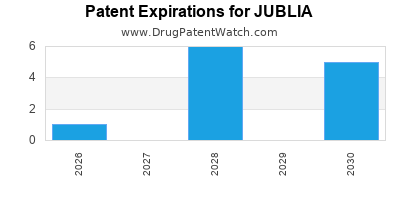
Patent protection is more important than regulatory exclusivity for JUBLIA’s generic-entry timing. The principal U.S. patent estate covers efinaconazole topical formulations and aspects of treatment for nail fungal infections. Core protection has been associated with patent terms extending into the late 2020s, while later-issued formulation or use patents may create additional Orange Book barriers.
The practical loss-of-exclusivity date is therefore not the date of FDA approval plus five years. It depends on:
- The earliest non-infringing generic approval pathway.
- Orange Book-listed patent expiration dates.
- Paragraph IV certifications.
- Patent litigation outcomes.
- Any 30-month FDA stay triggered by litigation.
- Whether a generic applicant launches at risk before final judgment.
What patents protect JUBLIA?
JUBLIA’s patent protection has generally centered on three claim categories:
| Patent category |
Commercial purpose |
Generic impact |
| Efinaconazole composition claims |
Protect the active ingredient or formulation |
Core protection |
| Topical vehicle and penetration claims |
Protect the low-surface-tension delivery system |
May delay or complicate formulation substitution |
| Method-of-use claims |
Protect treatment of toenail onychomycosis |
Can support litigation against labeled ANDA use |
The strongest commercial patents are those that claim the approved formulation or a formulation necessary for equivalent nail penetration. Narrow method-of-use claims can be easier for generic companies to design around, particularly when a generic applicant uses a Section viii statement or carves out a patented indication from its labeling.
Current patent status should be assessed against the FDA Orange Book and the relevant patent litigation docket because listing status, pediatric extensions, terminal disclaimers, and patent-term adjustments can change the effective barrier date.[2]
What is the Orange Book status of JUBLIA?
JUBLIA is an FDA-approved prescription drug listed in the Orange Book as a topical efinaconazole product. The Orange Book is the operative source for determining which patents Bausch identifies as covering the approved drug and which patents an ANDA applicant must address.[2]
An Orange Book listing does not guarantee that a patent will survive litigation. It creates a regulatory and litigation mechanism. An ANDA applicant must generally file a Paragraph IV certification against a listed patent that it believes is invalid, unenforceable, or not infringed, unless it waits for patent expiration or uses another legally available certification pathway.
The commercial relevance of the Orange Book estate is highest where listed patents cover the exact vehicle, concentration, applicator, or use instructions in the reference labeling. A generic that can obtain approval through a label carve-out or a non-infringing formulation may reduce the blocking effect of method-of-use patents.
Which companies are challenging JUBLIA?
Generic-drug companies have had a commercial incentive to challenge JUBLIA because:
- Efinaconazole is a known active ingredient.
- The product has a relatively simple topical dosage form.
- JUBLIA established a reimbursed market.
- The product’s high branded price creates room for generic substitution.
- Manufacturing does not require the complex facilities associated with biologics or sterile injectables.
The likely challenger universe includes companies with topical dermatology capabilities, including Taro Pharmaceuticals, Lupin, Perrigo, Padagis, Teva, and other ANDA manufacturers. The identity of an active challenger depends on FDA application disclosures and federal patent litigation records.
A Paragraph IV filing would normally trigger patent litigation by the NDA holder within 45 days if the holder seeks the statutory 30-month stay. The resulting dispute would focus on claim construction, formulation equivalence, obviousness, enablement, and whether the ANDA product infringes listed patents.
What patent litigation affects JUBLIA?
JUBLIA litigation risk is concentrated in the District of Delaware and other federal courts handling ANDA disputes. The typical defendants are generic manufacturers that submit an ANDA for efinaconazole topical solution 10%.
The key litigation questions are:
- Whether the claimed topical formulation was obvious over earlier antifungal solutions.
- Whether the patent claims adequately describe the nail-penetrating vehicle.
- Whether the generic formulation falls within the asserted composition claims.
- Whether treatment claims are infringed when the generic label contains the same use instructions.
- Whether any asserted patent is improperly listed or unenforceable.
A settlement can delay generic entry but usually does not eliminate it. Common settlement structures include an agreed entry date before patent expiration, a license for one or more manufacturers, or restrictions on the generic’s label and distribution channel. Publicly available settlement terms are not always complete, and confidential commercial provisions can affect the competitive outcome.
What generic entry risks exist for JUBLIA?
JUBLIA faces three principal generic-entry scenarios.
Scenario 1: Delayed entry after patent expiry
Under this outcome, Bausch retains branded revenue through the late 2020s, followed by rapid prescription and price erosion after the first generic launches. Topical products often experience slower substitution than oral tablets, but pharmacy benefit managers can accelerate conversion when multiple suppliers enter.
Scenario 2: Authorized or settlement-based entry
Bausch could permit a generic or authorized generic to enter before the final patent expiry date. This would preserve some value from the product while reducing the risk of a court-imposed loss of exclusivity. The tradeoff is earlier price erosion and lower net sales.
Scenario 3: At-risk launch
A generic company could launch after prevailing in litigation or before final resolution. An at-risk launch would expose the manufacturer to damages if the patent holder later prevails. For Bausch, this scenario could cause a rapid decline in prescriptions and force an emergency pricing response.
The first-generic impact would probably be more severe than the initial decline caused by competing branded products. Pharmacy substitution and payer formulary changes can shift volume quickly once an AB-rated generic is available.
How strong is the JUBLIA patent estate?
JUBLIA has a moderate patent estate rather than a biologic-style exclusivity position.
Strengths
- The approved product uses a defined formulation and application system.
- Nail penetration and vehicle characteristics can create formulation-specific claims.
- The product generated substantial commercial value, making litigation economically rational.
- The topical route can support patent claims beyond the active ingredient itself.
Weaknesses
- Efinaconazole is a small molecule with a known chemical structure.
- The product is not technically complex compared with an inhaled biologic or sterile injectable.
- Generic manufacturers can pursue formulation design-around strategies.
- Method-of-use claims may be narrowed through label carve-outs.
- NCE exclusivity has already expired.
The estate is strongest against an ANDA that closely copies the reference formulation and labeling. It is weaker if a challenger develops a materially different vehicle that achieves comparable delivery without falling within the asserted claims.
How does JUBLIA compare with competing onychomycosis drugs?
| Product |
Active ingredient |
Route |
Commercial advantage |
Main weakness |
| JUBLIA |
Efinaconazole |
Topical |
Established brand, once-daily use, no systemic monitoring |
High cost and 48-week treatment |
| Lamisil |
Terbinafine |
Oral |
Shorter treatment and strong efficacy |
Systemic exposure and drug-interaction concerns |
| Kerydin |
Tavaborole |
Topical |
Once-daily topical treatment |
Lower commercial scale and prolonged therapy |
| Penlac |
Ciclopirox |
Topical |
Low-cost generic availability |
Lower convenience and application burden |
| OTC antifungals |
Various |
Topical |
Low price and easy access |
Limited evidence for toenail disease |
JUBLIA’s strongest competitive position is among patients who are poor candidates for oral terbinafine or who prefer a topical option. Its weakest position is among cost-sensitive patients and those likely to abandon a long treatment course.
What is JUBLIA’s FDA regulatory status?
JUBLIA is FDA-approved as a prescription topical solution for toenail onychomycosis. It is not a biologic, does not require a biosimilar pathway, and is not subject to the interchangeability framework used for biologic products.
Future regulatory activity is more likely to involve:
- ANDA approvals for efinaconazole topical solution.
- Labeling revisions.
- Manufacturing-site changes.
- Postmarketing safety updates.
- Potential supplemental claims, if Bausch seeks additional uses.
Biosimilar risk is not relevant to JUBLIA. The competitive threat is conventional generic substitution through the ANDA pathway.
What licensing deals support JUBLIA?
Kaken Pharmaceutical developed efinaconazole and commercialized the product in Japan under the brand name Jublia. Valeant Pharmaceuticals, later Bausch Health, obtained commercialization rights for the United States and other markets through agreements with Kaken. The structure gave Bausch access to a differentiated topical antifungal without originating the active ingredient.
The licensing arrangement affects value allocation. Bausch bears U.S. commercialization, sales, and market-access costs, while Kaken retains economic participation under the applicable regional agreements. The precise royalty and milestone terms are not generally disclosed in the companies’ public financial statements.
What is the revenue exposure for Bausch Health?
JUBLIA is no longer a company-defining asset for Bausch Health, but it remains economically relevant to the branded prescription portfolio. The product contributes recurring cash flow with relatively low manufacturing complexity and established physician demand.
Revenue exposure is constrained by:
- Declining brand prescriptions.
- Generic and therapeutic substitution.
- Payer pressure.
- Patient abandonment.
- Long treatment duration.
- Limited opportunity for substantial label expansion.
The product’s value is higher before broad generic availability than after the first two or three generic suppliers enter. Once several manufacturers compete, net prices generally fall faster than prescription volume because payers use the product as a formulary discount lever.
What generic launch scenario is most likely?
The most likely commercial sequence is a controlled transition rather than an immediate collapse:
- One or more ANDA applicants challenge the remaining patent estate.
- Bausch files patent litigation and seeks a 30-month stay where available.
- A court decision, settlement, or patent expiry establishes the first launch date.
- One generic enters with limited initial competition.
- Additional suppliers launch after regulatory and manufacturing clearance.
- Net sales decline sharply as pharmacy benefit managers prefer lower-cost alternatives.
JUBLIA may retain a branded niche after generic entry because some physicians and patients value product familiarity, applicator design, and established clinical data. That residual demand would not protect historical pricing.
Key Takeaways
- JUBLIA is efinaconazole 10% topical solution, approved by the FDA in 2014 for toenail onychomycosis.
- Its five-year NCE exclusivity ended in June 2019.
- The product is in the mature phase of its lifecycle, with revenue below its peak.
- The key IP barriers are formulation, vehicle, delivery, and method-of-use patents.
- Generic entry risk is materially higher than biosimilar risk because JUBLIA is a conventional small-molecule topical product.
- Bausch’s commercial exposure is meaningful but declining.
- The first AB-rated generic could produce rapid net-price erosion, particularly if several manufacturers enter close together.
- JUBLIA’s strongest residual defenses are physician familiarity, topical tolerability, and the difficulty of reproducing nail penetration.
- Its principal weaknesses are high cost, long treatment duration, and availability of cheaper oral and topical alternatives.
FAQs About JUBLIA Patent and Market Risk
Is JUBLIA still protected by patents?
JUBLIA’s core regulatory exclusivity has expired, but listed patents covering formulation, delivery, and use may continue to affect generic approval and launch timing.
Is efinaconazole available as a generic?
Generic availability depends on FDA approval, Orange Book patent status, and any litigation or settlement restricting launch. The active ingredient itself is no longer protected by NCE exclusivity.
Will JUBLIA lose all revenue after generic launch?
No. Branded prescriptions can continue after generic entry, but net pricing and market share typically decline as payers promote lower-cost alternatives.
Is JUBLIA interchangeable with oral terbinafine?
No. JUBLIA and oral terbinafine use different routes, treatment durations, safety profiles, and clinical positioning. A pharmacist cannot generally substitute one for the other as an automatically interchangeable product.
Does JUBLIA have biosimilar competition?
No. JUBLIA is a small-molecule topical drug, not a biologic. Its competitive pathway is generic substitution through the ANDA process.
References
- U.S. Food and Drug Administration. (2014). JUBLIA (efinaconazole) topical solution, 10%: Prescribing information.
- U.S. Food and Drug Administration. (2024). Approved drug products with therapeutic equivalence evaluations: Orange Book.
- Bausch Health Companies Inc. (2023). Annual report on Form 10-K for the fiscal year ended December 31, 2023.
- Kaken Pharmaceutical Co., Ltd. (2023). Annual securities report and corporate disclosures.
- U.S. Food and Drug Administration. (2019). New chemical entity exclusivity and regulatory exclusivity provisions under the Federal Food, Drug, and Cosmetic Act.