Generic drugs account for 90% of U.S. prescriptions yet only 17.5% of total drug spending. That math is possible because of hospital formularies. The formulary is where the economics of generic competition get decided — not the pharmacy counter, not the prescriber’s pad, not the ANDA filing. The hospital’s Pharmacy & Therapeutics (P&T) Committee picks winners and losers before a patient ever sees the drug.
Yet most generic manufacturers still approach formulary access the same way they approached it in 2005: show up with a lower price and a bioequivalence study. That playbook fails with increasing frequency as hospital systems consolidate, P&T committees mature their evaluation criteria, and supply chain risk becomes a first-order purchasing variable. In 2022 alone, generics saved the U.S. healthcare system $408 billion. The manufacturers who captured the largest share of that volume did so not by undercutting rivals on acquisition cost, but by building a case that the P&T committee couldn’t argue with — clinically, economically, and operationally.
This guide covers the complete formulary access picture: formulary structure, P&T committee anatomy, the three-pillar submission framework, the AMCP Dossier in detail, Pre-Approval Information Exchange (PIE), Group Purchasing Organization (GPO) dynamics, PBM shadow effects, patent intelligence strategy, and post-acceptance adoption. Every section targets a distinct decision-making concern. Read it as a playbook for the entire commercial launch cycle.
Why Hospital Formulary Structure Determines Your Generic’s Commercial Ceiling
The type of formulary a target institution runs is the first variable a commercial team needs to nail down. It dictates the P&T committee’s priorities, the competitive configuration, and which value levers have any real pull. There are four primary models in active use across U.S. hospital systems, each with a different cost-control mechanism and a different winning strategy for generic entrants.
Open Formularies: High Access, Low Advantage
An open formulary covers nearly all available drug products with minimal restriction. Physicians prescribe freely, non-formulary agents are rarely blocked outright, and the system exercises almost no pressure to steer toward cost-effective options. For the hospital, that means the highest per-patient drug spend. For the generic manufacturer, it means easy entry and irrelevant preferred status — because there is no preferred status.
Market share in an open formulary is won through physician relationships, detailing, and brand recognition, the same tools branded companies have always used. A generic competing on clinical interchangeability and acquisition cost has no structural advantage here. Volume depends almost entirely on prescriber habit and the inertia of whatever the medical staff is already comfortable prescribing.
The practical implication: open formulary institutions should not anchor a hospital access strategy. They can be part of a broad distribution plan, but they rarely justify the resource investment of a full formulary submission.
Closed Formularies: The Zero-Sum Game Every Generic Wants to Win
Closed formularies are the most restrictive model. Non-formulary drugs are not reimbursed without a physician-documented medical necessity exception, and the P&T committee awards contracts — often sole-source — to one or two products within each therapeutic class. A closed formulary hospital might have only a single approved ACE inhibitor, one generic cephalosporin for IV use, or one preferred PPI. Everything else goes through a prior authorization pathway that is administratively burdensome enough to deter most prescribers.
The competitive math here is brutal. Winning the contract means capturing near-total institutional volume for the contract period. Losing means near-zero sales regardless of clinical merit. A generic that wins sole-source status in a major closed-formulary health system — an Ascension, a CommonSpirit, a Sutter — is effectively guaranteed significant, predictable revenue for the contract term.
Winning requires the lowest defensible net price paired with a supply reliability guarantee that the P&T committee’s pharmacy director can take to leadership as risk mitigation. The Budget Impact Analysis (BIA) matters here not as a tie-breaker but as the primary financial justification for a sole-source decision.
Tiered Formularies: Where Most Generic Competition Actually Happens
Tiered formularies are the dominant model across U.S. integrated delivery networks. They categorize drugs into tiers — typically three to five — with patient cost-sharing increasing at each level. The mechanism is straightforward: lower-tier drugs cost patients less out of pocket, which steers utilization toward whatever the P&T committee has decided is the most cost-effective option.
For generics, Tier 1 is the objective. Tier 1 placement in a major tiered formulary is effectively a volume guarantee. The financial incentive built into the tiered structure does much of the promotional work automatically. A patient who pays $5 for a Tier 1 generic versus $45 for a Tier 3 brand will, in the vast majority of cases, fill the generic.
The competitive battle in tiered formularies is not just generic vs. brand. It is generic vs. generic vs. therapeutically-similar branded agents that may have rebate arrangements with the P&T committee. A generic pipelined into Tier 2 because a competitor agreed to a deeper discount or offered a more credible supply guarantee is commercially damaged in that institution.
Value-Based Formularies: Pharmacoeconomics as a Market Access Lever
Value-based formularies assess products primarily through cost-effectiveness analysis rather than upfront acquisition cost. Drugs that reduce hospitalizations, improve medication adherence, or cut downstream utilization of expensive interventions can earn lower-tier placement even at higher acquisition prices. The model is operationally complex and still relatively uncommon, but its adoption is accelerating among integrated delivery networks that have the data infrastructure to support total-cost-of-care modeling.
For generic manufacturers, value-based formularies present a specific opportunity that most overlook. If a generic’s formulation characteristics demonstrably improve adherence over the brand — through a simpler dosing schedule, better tolerability profile, or improved packaging that reduces administration errors — a pharmacoeconomic model showing downstream cost savings can justify Tier 1 placement. This requires investment in outcomes data, but it creates a type of moat that pure price competition cannot replicate.
Pharmacoeconomic model showing adherence or cost offsets
Anatomy of the P&T Committee: Who Has Veto Power and What They Care About
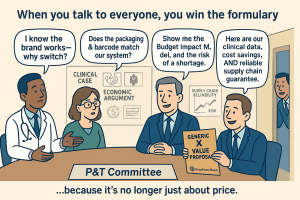
The Pharmacy & Therapeutics Committee is the organizational link between the pharmacy department and the medical staff. It is, by design, a coalition — not a single decision-maker. Every member carries a different professional mandate and a different definition of value. A formulary submission that speaks persuasively to one member while ignoring another is structurally weak.
Who Sits on the P&T Committee and Why Each Vote Matters
Core P&T membership typically includes actively practicing physicians from primary care and multiple specialties, clinical pharmacists with expertise in drug information, and senior nursing representatives. Most modern committees also include hospital administrators with pharmacy budget authority, health economics and outcomes research (HEOR) specialists, and quality assurance leadership. Teaching hospitals frequently add research-oriented clinicians or ethicists. Some health systems have formalized patient representation on the committee.
The multidisciplinary composition is the committee’s analytical strength. An infectious disease physician flags antimicrobial stewardship concerns. The chief nursing officer focuses on medication administration workflow and bedside safety. The pharmacy director is thinking about procurement complexity, shortage risk, and automated dispensing cabinet compatibility. The administrator is watching the net drug spend per adjusted patient day and the quarterly pharmacy budget variance.
These are not complementary concerns that converge naturally on the same answer. They are distinct, and sometimes competing, professional priorities. A generic that the pharmacy director loves for its supply reliability might face resistance from the ID specialist who has seen the brand perform in resistant-pathogen cases. A product the administrator wants for its cost profile might worry nursing because of labeling that looks identical to a look-alike drug already on the floor.
The implication for submission strategy: a single monolithic dossier is not sufficient. The submission framework must be modular. Each stakeholder needs a section of the argument built specifically around their decision criteria — the physician gets the bioequivalence and clinical literature summary, the pharmacist gets the supply chain and packaging data, the administrator gets the BIA.
P&T Committee Meeting Cadence and Formulary Review Timelines
Most P&T committees meet quarterly. New drug applications are typically reviewed at the meeting following submission, assuming the dossier is complete. Incomplete submissions get deferred. Deferred submissions in a competitive generic launch window can mean months of lost volume while a competitor’s product earns preferred placement.
The practical implication: submit a complete, AMCP-compliant dossier on the first attempt. A returned dossier is a tactical loss. Pre-submission outreach to the formulary pharmacist — not to lobby, but to confirm format requirements and submission deadlines — can prevent a costly quarter of exclusion.
The Utilization Management Tools P&T Committees Deploy
Beyond simple formulary inclusion, P&T committees design and enforce the policies that govern how drugs get used. Three mechanisms have the most direct commercial impact on generic penetration:
Prior authorization requires prescribers to obtain pre-approval before dispensing. P&T committees use this for high-cost or high-risk agents. Generics can benefit from prior authorization structures that gate access to a branded competitor, effectively steering new prescriptions toward the preferred generic.
Step therapy mandates that a first-line agent — almost always the generic — be tried before a more expensive alternative receives approval. A generic that achieves first-line status in a step therapy protocol captures initiation volume automatically, without ongoing prescriber persuasion.
Quantity limits restrict dispensing amounts. For generics, quantity limit structures affect waste and procurement planning but rarely represent a market access barrier.
Understanding which utilization management tools a target institution already has in place — and whether a generic can be positioned as the step-one agent in a therapy class — is a material competitive variable that most commercial teams underanalyze.
Why P&T Committees Make Decisions That Defy the Data
The P&T committee process is designed to be evidence-based. It rarely is purely that. An Institute for Safe Medication Practices (ISMP) survey identified four pervasive myths that surface in formulary deliberations and demonstrably shift outcomes. For a generic manufacturer, these are not curiosities — they are the real competitive dynamics in the room.
The Specialist Deference Problem and How to Work Around It
In the ISMP survey, 74% of respondents reported sub-specialist arguments that a generalist committee lacked authority to evaluate their therapeutic area. This deference pattern, when it operates without check, produces formulary decisions based on the clinical preference of one sub-specialty rather than the integrated evaluation the committee was designed to provide. The pattern is particularly acute for oncology, cardiology, and neurology drugs where specialist opinion carries significant institutional weight.
For a generic manufacturer, the strategic response is not to challenge specialist authority. It is to enlist it. An endocrinologist who accepts that the generic levothyroxine has demonstrated bioequivalence and supports its adoption becomes a far more powerful advocate in the committee room than any sales or medical affairs representative can be from outside it. Medical affairs teams that identify and cultivate committee-influencing KOLs in each specialty relevant to their product portfolio gain durable access advantages that pure detailing cannot replicate.
Causal Empiricism: When Anecdotal Experience Beats Clinical Trials
Seventy-five percent of ISMP survey respondents encountered physicians arguing for formulary inclusion based on favorable personal clinical experience. In 70% of those cases, the anecdotal appeal influenced the final decision. The patient who did well on the brand for five years sits in the physician’s memory. The large-scale randomized trial showing generic equivalence is abstract data.
The error in most manufacturer responses is to counter anecdote with more data. That framing positions the manufacturer against the physician’s professional identity. The better approach: validate the anecdote, then use it as a bridge. The physician’s positive outcomes with the brand confirm the molecule’s efficacy. The bioequivalence data shows that those same outcomes are reproducible with the generic across all patients in the institution. The manufacturer isn’t contradicting the physician’s experience — it’s extending it to every patient on the floor.
Popularity as Proxy for Clinical Superiority
Seventy-two percent of ISMP survey respondents encountered arguments that a drug should be on the formulary simply because other hospitals are using it or because patients are requesting it. This reasoning conflates market penetration with clinical merit. It is particularly dangerous in the generic context because brand-name drugs have had years of marketing investment behind their market position. Their formulary share at peer institutions often reflects the success of that marketing, not therapeutic superiority.
The counter-argument for a generic is not difficult to make, but it has to be made explicitly. Clinical and formulary positioning must be grounded in comparative efficacy data and total cost-of-care evidence, not benchmarking against what competitor health systems are doing. P&T committees that accept “Hospital X is using it” as clinical evidence need to be redirected toward the evaluation criteria they were constituted to apply.
Formulary Restriction as an Infringement on Clinical Freedom
The perception that a formulary interferes with physician autonomy surfaces in virtually every restrictive formulary discussion. It is not a factual argument — a well-run formulary provides clinical guidance developed by the physician’s own peers — but it is a culturally powerful one in a profession that defines itself partly through clinical independence.
Generic manufacturers that frame their product’s formulary adoption as expanding, rather than constraining, physician options are better positioned than those who ignore this dynamic. The argument: adopting the generic as the preferred first-line agent within this therapeutic class does not remove physician choice. It ensures that the default choice is the highest-value option. For the rare patient who genuinely needs the brand, a medical necessity exception remains available.
The Clinical Case: What ‘Bioequivalence’ Actually Means for a P&T Committee
The FDA’s standard for generic approval via Abbreviated New Drug Application (ANDA) is specific. The generic must match the brand in dosage form, strength, route of administration, quality, and performance characteristics. Manufacturing facilities must meet the same Current Good Manufacturing Practices (cGMP) standards as the innovator.
The 80-125% Bioequivalence Range: What It Does and Doesn’t Mean
The bioequivalence standard requires that the 90% confidence interval for the ratio of the generic’s key pharmacokinetic parameters — area under the curve (AUC) and maximum concentration (Cmax) — to the brand’s parameters falls within 80% to 125%. This range is consistently misunderstood by P&T committee members and often deliberately misrepresented by brand manufacturers trying to protect market share.
The 80-125% boundary is not a statement about the allowable variation in potency. It is a statistical criterion for establishing a very high degree of similarity. Analyses of FDA bioequivalence study data show that the actual average measured difference in absorption between generic and brand-name drugs is approximately 3.5% — comparable to batch-to-batch variation in the brand itself. A generic that meets the bioequivalence standard is therapeutically equivalent by FDA definition, which means it can be expected to produce the same clinical effect under the conditions specified in its labeling.
The generic manufacturer’s formulary submission must explain this distinction explicitly. P&T committee members who believe the 80-125% range means a generic could be 25% less potent will oppose adoption based on a misreading of the standard. That misreading has to be corrected with data and context before it derails the clinical discussion.
Why Excipient Profiles Are a Clinical Argument, Not a Footnote
The active pharmaceutical ingredient (API) in a generic must be identical to the brand. The excipients — binders, fillers, disintegrants, coatings, dyes — can differ. FDA requires these to be proven safe and inert with respect to drug function, but they can cause tolerability differences in sensitive patient populations. Patients with documented dye allergies, for example, may react to a generic that uses a colorant the brand does not.
A best-practice formulary submission does not mention excipients in passing. It provides a complete excipient list with safety profiles and cross-references to other widely prescribed FDA-approved drugs that use the same inactive ingredients. This pre-empts a category of clinical objection that surfaces regularly and can delay or derail adoption.
Narrow Therapeutic Index Drugs: Why the Generic Strategy Changes Completely
For narrow therapeutic index (NTI) drugs — antiepileptics like phenytoin and carbamazepine, anticoagulants like warfarin, thyroid medications like levothyroxine — the standard bioequivalence framework is insufficient protection against clinical concern, and in some cases, insufficient protection against actual clinical harm. Studies have documented increased seizure frequency following switches from branded antiepileptics to generics, with healthcare costs for the switched patients rising despite lower drug acquisition costs because of emergency department visits and hospitalizations required to restabilize seizure control.
The strategic response for NTI generics is not a standard substitution argument. The appropriate market position is new-patient initiation: the generic becomes the preferred, cost-effective choice for patients beginning therapy for the first time, while stable patients on the brand remain on the brand unless the physician initiates a medically supervised switch. This position respects clinical risk, demonstrates institutional responsibility, and still captures meaningful volume from every new prescription written.
P&T committees that see a manufacturer voluntarily acknowledging the limits of broad-population substitution for NTI drugs respond to that nuance with credibility rather than suspicion.
Real-World Evidence in Generic Formulary Submissions: When It Changes the Argument
If a generic has been commercially available in other markets — European Union, Canada, Australia — post-marketing surveillance data and observational studies constitute real-world evidence (RWE) that transforms the clinical argument. The shift is meaningful: from “our drug is theoretically equivalent” to “our drug has performed equivalently across thousands of actual patients in real healthcare settings.” RWE for a generic in a hospital formulary submission is not required by the AMCP Format, but it is a differentiator that few competitors provide and that clinical pharmacists on P&T committees find compelling.
The Budget Impact Analysis: How to Quantify the Economics P&T Committees Actually Care About
The Budget Impact Analysis (BIA) is the financial core of a generic formulary submission. It is not a cost-effectiveness analysis and should not be presented as one. Its function is narrowly financial: to estimate the net budget impact of adding the generic to the formulary over a defined time horizon. The BIA answers the hospital administrator’s question — what does this decision do to our pharmacy budget over the next three years — with a transparent, defensible, customizable model.
Why Cost-Minimization Analysis Is the Right Pharmacoeconomic Framework for Generics
Pharmacoeconomics offers several analytical frameworks: cost-effectiveness analysis (CEA), cost-utility analysis (CUA), cost-benefit analysis (CBA), and cost-minimization analysis (CMA). For a generic drug that has established therapeutic equivalence, CMA is the appropriate and most defensible framework. The logic is direct: when two interventions produce equivalent clinical outcomes, the decision reduces to a cost comparison. The lower-cost option is preferred.
The clinical case from Pillar 1 is the prerequisite for the CMA framing. If bioequivalence is accepted by the P&T committee, the entire economic discussion becomes a cost comparison, and the generic wins that comparison by definition. This is why the clinical case must be airtight before the economic argument is presented. Any residual clinical uncertainty about equivalence reopens the door to a cost-effectiveness framework where the brand can argue for premium pricing on the basis of outcome superiority.
Building a Hospital-Specific BIA That Goes Beyond Acquisition Cost
ISPOR guidelines for BIA construction require a clear model structure, a defined patient population estimate, a time horizon (typically one to five years, matching the hospital’s budget cycle), a treatment mix projection showing expected market share shift from brand to generic, and transparent cost inputs for all relevant comparators.
A basic BIA for a generic is simple: it multiplies the per-unit price differential by the projected volume shift and delivers a savings estimate. That calculation satisfies the minimum requirement. It does not win a competitive formulary review against a competitor who has invested in a more sophisticated model.
A sophisticated BIA builds in downstream cost offsets that affect the hospital’s total drug budget beyond acquisition cost. Specific modules worth including:
Nursing labor savings: If the brand requires complex reconstitution and the generic comes in a ready-to-administer formulation, the time per administration is reduced. At median hospital nursing wages, that time savings across an annualized patient population produces a calculable dollar figure. Presented in the BIA as a cost offset, it reframes the total value of the switch.
Laboratory monitoring reduction: Some drugs require therapeutic drug monitoring or regular laboratory checks. If the brand requires more frequent monitoring than the generic, or if monitoring protocols differ between formulations, the difference in lab costs over the time horizon is a real budget line item.
Waste reduction: Multi-dose vials generate waste when a full vial is opened but the total dose required is less than the vial’s contents. Unit-dose packaging eliminates this. Waste rate multiplied by drug cost per discarded unit, annualized across the patient population, becomes a legitimate and often substantial cost offset.
Shortage management costs: Drug shortages generate labor costs — pharmacist time spent sourcing alternatives, physician time spent managing therapeutic substitutions, administrative time spent documenting the shortage response. If the generic manufacturer can demonstrate a lower shortage risk than the brand or competing generics (see Supply Chain section), the avoided shortage management cost belongs in the BIA.
The model itself should be provided in an unlocked, interactive format — a spreadsheet with clearly labeled inputs that the hospital’s own pharmacy analyst can populate with institution-specific data. AMCP Format guidelines require this. Compliance signals professionalism; non-compliance signals that the manufacturer has something to hide in the assumptions.
Revenue at Risk: How P&T Committees Calculate the Cost of Getting This Decision Wrong
Hospital administrators evaluate formulary decisions against a revenue-at-risk framework. If they select a generic that proves unreliable and goes on shortage, the costs include emergency procurement of a higher-priced alternative, physician notification time, potential adverse patient outcomes, and the administrative burden of shortage management. If they select a generic that triggers patient non-adherence due to appearance changes without adequate patient education, they face readmission risk and the associated financial penalties under value-based purchasing contracts.
The manufacturer that presents a BIA alongside a risk-mitigation analysis — supply chain reliability data, patient communication support materials, and a clear shortage communication protocol — is addressing both sides of the administrator’s calculation. The administrator is not just asking “how much do we save?” They are asking “what is the probability we regret this decision, and what does that regret cost us?”
How Supply Chain Reliability Became the Most Valuable Generic Differentiator
Drug shortages are not random events in an otherwise stable supply chain. They are the predictable output of a specific market incentive structure: decades of relentless price compression that has driven manufacturers to strip quality management investment to preserve margin, concentrate API sourcing in single geographies (predominantly China and India), and eliminate the redundant manufacturing capacity that functions as buffer stock against disruption.
The Financial Scale of Hospital Drug Shortage Costs
One national survey estimated that drug shortages increase pharmaceutical acquisition costs in U.S. hospitals by more than $99 million annually. That figure excludes the labor costs of shortage management, which are often larger. A pharmacist spending four hours a day identifying alternative agents, notifying prescribers, updating order sets, and documenting shortage responses is not managing medication therapy. The shortage management labor burden falls disproportionately on clinical pharmacists whose time has high opportunity cost in a setting where pharmacist-managed therapy is associated with measurable improvements in patient outcomes.
The root cause identified by the Duke-Margolis Institute for Health Policy is low quality management maturity at the manufacturing facility level. The FDA’s drug shortage database consistently shows that the leading precipitating factor in critical shortages is a manufacturing quality event: contamination, failed batch testing, facility shutdown following inspection findings. The market has historically rewarded the lowest price, which created a disincentive to invest in the quality management infrastructure that prevents these events.
What ‘Supply Chain Reliability’ Means as a Purchasable Value
A generic manufacturer that invests in supply reliability is selling certainty, not just a drug. The components of a supply reliability value proposition that P&T committees find credible:
Dual-sourced API: Active pharmaceutical ingredients sourced from two geographically distinct suppliers — one Chinese, one Indian, or one from each of two different regulatory jurisdictions — reduces the single-point-of-failure risk that underlies most sterile injectable shortages. This is not a standard industry practice for low-margin generics. Documenting it signals deliberate quality management investment.
Safety stock levels: A manufacturer that maintains 90 or 120 days of finished goods inventory, compared to the 30-day industry norm, has built a buffer against manufacturing disruption. That buffer, quantified and disclosed contractually, is a risk mitigation tool for the hospital.
FDA inspection track record: The number of FDA Warning Letters, Form 483 observations, and consent decrees a manufacturer has accumulated at each relevant facility is public record. A generic manufacturer with a clean inspection history at every production site is demonstrably lower risk than a competitor with a recent 483 observation on sterility assurance. This data should be assembled, contextualized, and proactively included in the formulary submission.
Shortage notification protocol: A contractual commitment to notify hospital customers no less than 60 days before any anticipated supply constraint, with a defined escalation process, converts an uncertain risk into a manageable one. Hospital pharmacy directors can plan around a known constraint. An unexpected shortage at zero notice produces chaos.
API Geographic Concentration Risk: A Category-Level Commercial Threat
The generic drug supply chain’s dependence on API manufacturing in China and India creates a systemic concentration risk that hospital formulary decisions increasingly reflect. When the FDA identified contamination issues with valsartan API from Zhejiang Huahai Pharmaceutical in 2018, the recall cascaded across dozens of finished-dose manufacturers globally. When the COVID-19 pandemic disrupted Indian API production in 2020, the shortage effects were felt across categories including azithromycin, hydroxychloroquine, and multiple antibiotics critical to hospital formularies.
A generic manufacturer with API sourcing from compliant facilities in Europe, North America, or multiple Asian jurisdictions — and that can document this in an auditable supply chain map — has a differentiated risk profile that institutional pharmacy directors can act on. This is increasingly true as hospital systems develop formal supply chain risk assessment criteria under pressure from group purchasing organization (GPO) quality programs and FDA’s drug shortage prevention initiatives.
How the AMCP Dossier Works as a Strategic Narrative Tool, Not Just a Compliance Document
The AMCP Format for Formulary Submissions is the universal structure U.S. manufacturers use to present evidence to P&T committees. Compliance with the format is baseline. Most generic manufacturers meet it. The ones who win formulary placements treat the AMCP Format as a narrative architecture, not a checklist.
Deconstructing the AMCP Format for Generic Drug Applications
The format contains six main sections: Executive Summary, Product and Disease Information, Clinical Evidence, Economic Value and Modeling, Additional Supporting Evidence, and Appendices. Each maps to a different P&T committee priority, and each requires a distinct framing strategy for a generic product.
The Executive Summary is the single most important section. It is typically the only part of the dossier that every committee member reads in full. It must open with a clear, unambiguous statement of therapeutic equivalence and ANDA approval, move immediately to a quantified top-line budget impact (e.g., “projected annual savings of $2.1M for a 500-bed facility at 80% generic penetration”), and close with the two or three most distinctive operational advantages. No more. The executive summary is not where nuance lives. It is where the argument is won or deferred to the next committee cycle.
The Clinical Evidence section must present the bioequivalence data comparatively — brand’s pivotal trial results alongside the generic’s bioequivalence study findings — and proactively address excipients, NTI considerations where relevant, and any available real-world evidence. The framing should position the generic as the confirmed therapeutic equivalent of a molecule with an established, positive clinical record. The committee should finish the clinical section with no residual doubt about interchangeability and no unanswered questions that could become objections in deliberation.
The Economic Value and Modeling Report is the BIA. It must be a CMA framework with a customizable, unlocked spreadsheet model and clearly labeled, sourced assumptions. Any downstream cost offset modules should be presented separately with supporting methodology.
The Additional Supporting Evidence section is where operational differentiation gets documented: supply chain reliability data, facility inspection records, packaging and labeling safety features, and any value-added services the manufacturer offers.
Generic-Specific AMCP Dossier: A Tactical Checklist
AMCP Section
Minimum Requirement
Competitive Best Practice
1.0 Executive Summary
Summarize clinical and economic value
Lead with therapeutic equivalence statement. Top-line BIA savings. Two to three operational differentiators. Maximum 1 page
2.0 Product & Disease Info
Describe the product and clinical context
Frame generic as cost-effective continuation of brand’s established standard of care. Reinforce molecule’s clinical record
3.0 Clinical Evidence
Summarize bioequivalence studies
Side-by-side comparison with brand’s pivotal trials. Full excipient profile with safety cross-references. All available RWE. NTI risk stratification where applicable
Full supply chain reliability package: API sourcing map, facility inspection record, safety stock policy, shortage notification protocol. Packaging and labeling safety data
6.0 Appendices
Study reprints, product labeling
Supply commitment letter with SLA terms. Certificate of analysis from recent production batch. Stability data for formulary conditions
Pre-Approval Information Exchange (PIE): How to Shape the Formulary Before the ANDA Clears
Pre-Approval Information Exchange allows manufacturers to share clinical and economic data with payers and formulary decision-makers before FDA approval. For generic manufacturers timing a launch against a patent expiry cliff, PIE is a mechanism to compress the post-approval formulary review timeline and pre-empt the brand’s lifecycle management response.
How PIE Accelerates Post-Launch Formulary Adoption
A 2022 survey of healthcare decision-makers found that PIE access shortened formulary review timelines for nearly half of respondents. The data types P&T committees find most valuable in PIE submissions are anticipated pricing and place-in-therapy positioning — exactly the information a generic manufacturer can provide in advance. A hospital formulary committee that has received a PIE dossier with a preliminary BIA can begin budget planning, staff education planning, and supply contract drafting before the generic’s approval date. The day the ANDA clears, the formulary decision is weeks from completion rather than months.
Using PIE to Counter Brand Lifecycle Management Strategies
The brand manufacturer facing a patent expiry cliff is not passive. Common lifecycle management tactics include authorized generic launches that flood the channel and suppress the independent generic’s margin, formulation switches that move prescribers to a new extended-release or combination product that carries its own patent protection, patient assistance programs designed to retain brand-loyal patients through transition, and FUD campaigns (fear, uncertainty, doubt) targeting P&T committees on bioequivalence and safety.
PIE gives the generic manufacturer a timeline advantage. Months before the loss of exclusivity date, a PIE dossier delivered to target hospital systems can anchor expectations. The message: the brand’s primary patent expires on this date. We have an ANDA in review. We anticipate a Day 1 launch. Here is our preliminary BIA showing what the savings look like for your institution. Here is our supply chain documentation. Here is why the brand’s new extended-release formulation, priced at a premium, does not represent a meaningful clinical improvement over the proven immediate-release molecule we are replacing.
That last point is commercially critical. Brand manufacturers executing a product-hop strategy will often accompany the new formulation with minimal incremental clinical data and a messaging strategy emphasizing newness. A generic manufacturer that has briefed the P&T committee’s pharmacoeconomics team through PIE on the clinical evidence (or lack thereof) for the new formulation is positioned to undercut that strategy before it gains traction.
Compliant PIE requires a documented process under FDA’s 2023 guidance on pre-approval communication with payers. Platforms like FormularyDecisions provide compliant delivery infrastructure. Medical affairs teams that have not built a PIE capability for patent-expiry-adjacent launches are ceding a material market access advantage to competitors who have.
Patent Intelligence as a Commercial Planning Tool: Moving Beyond the Basic Expiry Date
A drug’s loss of exclusivity date is not a single number. It is the output of an analysis across a patent family that may include composition of matter patents, formulation patents, method-of-use patents, pediatric use patents, and the separate layer of regulatory exclusivities: five-year new chemical entity exclusivity, three-year new clinical investigation exclusivity, pediatric exclusivity extensions, and orphan drug exclusivity where applicable. The ANDA filer that treats the first patent expiry as the launch date without mapping the full IP estate is taking on unquantified legal and commercial risk.
How Patent Thickets Delay Generic Entry and Inflate Brand Revenue
A patent thicket is a collection of overlapping patents that the brand manufacturer maintains around a single drug franchise, each extending exclusivity by months or years past the primary composition of matter patent. AbbVie’s strategy with adalimumab (Humira) is the most analyzed example: by the time the core biologics patent expired, AbbVie had built a portfolio of more than 130 patents covering delivery devices, formulations, dosing regimens, and manufacturing processes. The result was a U.S. loss of exclusivity that lagged Europe by years, allowing Humira to remain the single largest drug revenue source in pharmaceutical history long past its primary exclusivity window.
Small-molecule generics face less complex thickets than biologics, but the strategic principle applies. A P&T committee that has been briefed on the patent thicket structure around a target drug is better equipped to understand why a generic is not yet available and what the expected launch timeline is. That briefing is also an opportunity for the generic manufacturer to position itself as the analytical partner that explains the IP landscape — which builds credibility and trust before the commercial conversation begins.
What Paragraph IV Litigation Means for Hospital Formulary Planning
When a generic manufacturer files an ANDA and certifies that a relevant patent is either invalid or will not be infringed by the generic (a Paragraph IV certification), the brand manufacturer typically responds with litigation within the 45-day window, triggering an automatic 30-month stay on ANDA approval. This means that even after the FDA would otherwise be ready to approve the ANDA, the generic cannot launch until the litigation is resolved or the 30 months expire.
For hospital formulary planners, Paragraph IV litigation is a material timeline variable. A P&T committee considering how to budget for generic entry into a therapy class needs to know whether the anticipated generic is still in the 30-month stay period or has cleared litigation. Patent intelligence platforms like DrugPatentWatch track Paragraph IV filings, litigation status, court rulings, and settlement terms in real time, allowing commercial teams to provide P&T committees with accurate launch timing estimates rather than guesses.
180-day exclusivity adds another planning variable. The first ANDA filer to successfully defend a Paragraph IV certification earns 180 days of market exclusivity before additional ANDAs can receive final approval. During that window, the first filer operates in a duopoly with the brand — margins are higher, volume is lower than the fully commoditized market. Hospital formulary decisions made during the 180-day exclusivity period may look different from decisions made after full generic competition enters, and hospital pharmacy directors managing budget cycles across fiscal years need to understand this pricing trajectory.
How Evergreening Works in Small Molecules and What It Means for Generic Launch Timelines
Evergreening is the practice of obtaining additional patents on incremental modifications to a drug — a new polymorph, a new salt form, a new dosing formulation, a new indication — to extend the effective commercial life of a pharmaceutical product past the primary patent expiry. The FDA’s Orange Book lists these patents alongside the composition of matter patent, and each requires a Paragraph IV certification if the ANDA filer believes the generic will not infringe.
The commercial implication: evergreening shifts the loss of exclusivity date the brand cares about (the date the brand’s revenue protection actually ends) from the primary patent expiry to the last patent in the thicket that a court finds valid and infringed. A generic manufacturer that files against only the primary patent and ignores subsequent formulation patents may win the primary litigation only to face an injunction based on a secondary patent the brand has maintained.
Patent mapping against the full Orange Book listing — including formulation, method-of-use, and device patents — is the baseline diligence requirement before any ANDA filing decision is made. That mapping also informs the formulary submission strategy: understanding which patents the brand is likely to assert, and which are most vulnerable to invalidity or non-infringement arguments, determines both the litigation timeline and the probability of a settlement with a specific launch date.
GPO Dynamics: When the Volume Channel Creates as Much Risk as It Captures
An estimated 98% of U.S. hospitals belong to at least one Group Purchasing Organization. The three dominant GPOs — Vizient, Premier, and HealthTrust — collectively cover the majority of U.S. hospital purchasing volume for pharmaceuticals. For a generic manufacturer, a GPO contract is a volume amplifier. It can also be a margin destroyer and a supply chain destabilizer.
How GPO Administrative Fees Create Misaligned Incentives
GPOs derive the majority of their operating revenue from administrative fees paid by manufacturers — typically calculated as a percentage of the sales volume the GPO’s contract generates. This creates a structural incentive for GPOs to favor manufacturers with higher sales volumes and, in some product categories, to prefer contracts that generate higher administrative fees over those that generate the lowest possible acquisition cost for member hospitals.
The fee structure is protected by a federal anti-kickback statute safe harbor, but it has drawn sustained scrutiny from the FTC and Congressional investigators who note that it can disadvantage smaller manufacturers, reduce competition, and contribute to market concentration in generic categories where two or three large manufacturers dominate GPO contracts.
For a generic manufacturer, the GPO administrative fee structure means that winning a GPO contract is not purely a clinical and economic argument. Relationship depth with the GPO’s sourcing and contracting team, the manufacturer’s overall GPO revenue track record, and the institutional history between the company and the GPO’s administration matter. These factors are rarely disclosed publicly, but they are part of the competitive context.
The Case for Direct Hospital Contracting: When to Bypass the GPO
For generic drugs in categories with chronic shortage histories — sterile injectables, oncology supportive care agents, certain antibiotics — the GPO contract may be the wrong primary distribution strategy. The GPO’s sole-source contracting practices and loyalty rebate structures have historically contributed to shortage risk in exactly these categories by concentrating volume in one or two manufacturers and driving prices below the level at which additional manufacturers can profitably enter the market.
A generic manufacturer with a documented supply reliability advantage can make a credible direct hospital contracting argument in these categories. The value proposition: the GPO contract may offer a lower nominal acquisition cost, but it does not include a supply guarantee. Our direct contract includes a service-level agreement with financial penalties for supply failures, a shortage notification protocol, and demonstrated manufacturing redundancy. For a drug on the FDA shortage database more than three times in the past decade, the true cost of the GPO option — including shortage management, emergency procurement, and clinical disruption — exceeds our contract price.
This argument requires quantification. The BIA for a direct-contract pitch needs a shortage impact module that estimates the institutional cost of the shortage events the drug has historically experienced, using the target hospital’s patient volumes and pharmacy labor rates. That quantification converts the supply reliability argument from a qualitative claim to a financial comparison the administrator can act on.
Bundled Contracting and Its Effects on Generic Formulary Access
GPOs frequently offer bundled contracts that provide hospitals with volume rebates in exchange for purchasing a defined share of their needs across a product portfolio from a single manufacturer or GPO-contracted supplier group. Bundling can effectively exclude a generic manufacturer with a single product or a narrow portfolio from competing in a category, even if its product is clinically equivalent and competitively priced, because the hospital’s rebate structure penalizes it for splitting the bundle.
Understanding whether a target institution has active bundle commitments relevant to the manufacturer’s therapeutic category is critical pre-engagement diligence. If bundle lock-in is present, the formulary submission strategy must account for it: either by demonstrating savings large enough to absorb the lost rebate, or by engaging at the P&T committee level with a clinical differentiation argument strong enough to justify an exception.
How Outpatient PBM Formulary Coverage Creates Inpatient Formulary Value
Pharmacy Benefit Managers manage drug coverage for commercially insured and Medicare Part D patients in the outpatient setting. The three largest — CVS Caremark, Express Scripts (now Evernorth), and OptumRx — cover the majority of commercially insured and Part D lives. Their formulary decisions on a generic’s tier placement have no direct authority over hospital inpatient formularies, but they create an indirect commercial pressure that hospital P&T committees feel through a mechanism called the continuity of care problem.
The Continuity of Care Problem and How Generics Can Solve It
A patient stabilized on a drug during a hospital stay needs a seamless transition to the same drug upon discharge. When the outpatient plan covers a different agent — typically because the inpatient formulary and the patient’s commercial plan formulary are not aligned — the discharge pharmacist must either identify a covered alternative or appeal to the plan for a formulary exception. This friction is a measurable contributor to medication non-adherence post-discharge and a documented risk factor for preventable hospital readmissions.
Hospital systems operating under value-based purchasing contracts with CMS pay a financial penalty for preventable readmissions. Any formulary decision that increases readmission risk is, from the hospital administrator’s perspective, a bad financial decision regardless of its drug acquisition cost profile.
A generic with broad Tier 1 coverage across the major national PBMs has a concrete, quantifiable formulary value for the hospital that extends beyond its inpatient acquisition cost. The message to the P&T committee: this generic is already the preferred agent for 70-80% of your commercially insured patients. Using it inpatient aligns your formulary with what your patients will be able to access when they leave. That alignment reduces discharge complexity, cuts prior authorization calls from your pharmacists, and lowers your medication-related readmission exposure. The drug’s inpatient cost advantage and its outpatient coverage profile together create a continuity-of-care value that no competitor in this class can currently match.
This framing is only possible if the manufacturer has actually secured preferred PBM placement before making the hospital access argument. That sequencing — managed care first, hospital second — is not how many generic commercial teams operate, but it is the sequencing that creates the most powerful hospital-level value proposition.
Post-Acceptance Adoption: How Formulary Listings Become Market Leadership
A formulary listing is a necessary condition for commercial success. It is not sufficient. A generic listed as Tier 1 preferred that captures only 40% of the therapeutic category’s volume because prescribers continue defaulting to the brand is worth a fraction of its potential. Adoption requires a deliberate, targeted, stakeholder-specific communication plan that begins the day the formulary decision is made.
Physician Communication: What Works and What Feels Like a Lecture
Physicians respond to clinical equivalence data presented by peers, not by manufacturer representatives. Medical affairs colleagues — PharmDs, MDs with relevant clinical training — are more credible in this channel than sales. The message must be brief, clinically grounded, and explicitly confirmatory rather than corrective. The physician who has used the brand for years has not been wrong. The generic delivers the same clinical result through the same mechanism at a lower cost. The prescribing habit can continue, just with a different NDC number on the order.
For electronic health record environments, the highest-impact intervention is an order set or clinical decision support tool that defaults to the generic on first entry. Physicians working in an EHR environment where the generic appears as the default option for a therapeutic class will, in the vast majority of cases, use the default. Changing that default to the generic — a change the P&T committee authorizes and the pharmacy informatics team implements — is often more effective at driving adoption than any amount of prescriber-directed communication.
Pharmacist and Nursing Transition Support
The physical transition from brand to generic creates operational burden for pharmacy and nursing that, if not managed proactively, generates complaints that can reopen formulary discussions. NDC number changes affect automated dispensing cabinet programming. Physical appearance changes require medication reconciliation updates and patient identification protocols. Packaging differences affect storage and handling procedures.
A manufacturer that provides in-service training materials, visual NDC conversion guides, and automated dispensing cabinet integration support is removing friction from the transition. This is not extraordinary customer service — it is basic commercial execution. But most generic manufacturers do not do it, which means those that do stand out.
Patient-facing education is the most consistently underinvested element of generic adoption programs. The nocebo effect — a patient’s negative expectation about a new medication causing perceived adverse effects or reduced efficacy — is a documented phenomenon in generic substitution. It is most acute when patients are not informed about the change before it happens. A one-sentence explanation from the discharging pharmacist (“Your medication looks different because a different company makes it, but it is the same medicine”) measurably reduces nocebo-driven non-adherence. Providing hospitals with patient education leaflets in multiple languages, pre-formatted for the institution’s patient education systems, is a practical support tool with real adherence impact.
How a Single Academic Medical Center Can Shift Community Generic Utilization
A study of Gifu Municipal Hospital in Japan documented a quantifiable halo effect from institutional generic adoption. Following the hospital’s formulary initiative, the generic dispensing rate at surrounding community pharmacies for that hospital’s discharged patients rose by 9.4 percentage points. Drug spending dedicated to generics at those pharmacies increased by 10.6 percentage points in the same period.
The implication for U.S. market access strategy: a formulary win at a major teaching hospital or academic medical center does not contain its commercial impact within that institution’s walls. Physicians who train at academic medical centers carry prescribing habits into community practice. Patients who first encounter a generic in an academic hospital setting arrive at their community pharmacy already familiar with it and more likely to accept continued use. Allocating disproportionate market access resources toward academic medical centers and large integrated delivery networks is justified not only by the direct volume but by the ripple effect on the regional prescribing and patient behavior that follows.
The VA System vs. Medicare Part D: What Formulary Design Does to Generic Penetration
The performance gap between the VA’s closed national formulary and Medicare Part D’s decentralized tiered system illustrates how directly formulary structure drives generic utilization, independent of clinical merit or price.
The VA system runs a centralized national formulary that aggressively promotes generics through therapeutic interchange and closed-system contracting. Medicare Part D operates through private plans, each with its own formulary, where brand manufacturer rebates can create incentives for tier placement that sometimes favor brands over clinically equivalent generics.
One study of diabetic patients found that use of brand-name drugs for which identical generics were available was substantially higher in Medicare Part D than in the VA system. The estimated annual savings from aligning Medicare Part D prescribing to VA patterns in diabetes alone exceeded $1.4 billion. Another analysis estimated that applying therapeutic interchange across eight medication classes to the full U.S. market could reduce pharmaceutical spending by more than $20 billion annually.
For a generic manufacturer’s commercial strategy, this comparison carries a specific implication: the system you are targeting determines the strategy you need. A VA contract win requires meeting sole-source pricing standards and demonstrating alignment with the VA’s national therapeutic interchange program. A Medicare Part D win requires working through PBM rebate negotiations and tier placement decisions that may have no direct connection to the clinical or economic arguments a P&T committee would evaluate. These are different sales processes, different economic models, and different relationship maps. Conflating them produces a strategy that is mediocre at both.
What Investors Are Watching in Generic Hospital Market Access
For equity analysts and portfolio managers covering generic pharmaceutical companies, hospital formulary dynamics are a leading indicator of revenue trajectory that is often underappreciated at the industry level and almost entirely ignored in consumer-facing pharmaceutical coverage. Several specific variables carry material valuation implications.
GPO Contract Status as a Revenue Predictor
A generic drug that has secured a GPO contract with Vizient, Premier, or HealthTrust has effectively pre-sold a predictable volume block. GPO contract announcements, or their absence at expected intervals, provide an earlier market access signal than prescription data, which lags the formulary decision by weeks. Investors who track GPO contract announcements alongside IQVIA prescription data can sometimes identify inflection points in generic volume before they appear in quarterly revenue.
Supply Chain Investment as a Quality Premium
Generic companies that publicly disclose dual-sourced API arrangements, maintain excess finished goods inventory, or have demonstrably better FDA inspection records than sector peers are pricing in a supply reliability premium that shows up in win rates on closed-formulary contracts and direct hospital agreements. This premium is not captured in standard valuation models that focus on ANDA count and launch timing. It represents a structural competitive advantage in the hospital channel that sustains margin above commoditized generic market levels.
Loss of Exclusivity Timing and the BIA Revenue Model
For innovator companies, the loss of exclusivity (LOE) date on a major drug is a revenue cliff event. The hospital formulary response to that cliff — how quickly a generic achieves Tier 1 or sole-source status at major hospital systems — determines the rate of brand revenue erosion. Hospital formulary decisions typically precede retail pharmacy generic penetration in therapeutic categories with high inpatient utilization. Investor models that use retail prescription data to forecast LOE revenue impact in hospital-heavy therapeutic categories will systematically underestimate the speed of brand erosion.
Key Takeaways
The hospital formulary is not a purchasing decision. It is a clinical governance, financial planning, and risk management decision made by a multidisciplinary committee with competing professional priorities. Generic manufacturers that approach it as a pricing negotiation will win some contracts and lose most of the value they could capture.
The clinical case must eliminate every residual source of therapeutic doubt. Bioequivalence data presented in context — with actual average measured differences, not just the statistical boundary range — removes the most common clinical objection before it surfaces. Excipient profiles, NTI risk stratification, and available real-world evidence complete the picture. A committee that finishes the clinical section with no open questions will not manufacture them in deliberation.
The economic argument must go beyond acquisition cost to total institutional cost. The BIA that quantifies nursing labor savings, lab monitoring differentials, waste reduction, and shortage management cost avoidance is a materially different document from the one that calculates acquisition cost times projected volume. It speaks to every financial decision-maker on the committee.
Supply chain reliability has become a primary purchasing variable, not a secondary one. In categories with documented shortage histories, a manufacturer that cannot demonstrate quality management investment, API sourcing redundancy, and a meaningful safety stock commitment is competing on price against a risk the hospital cannot quantify. That is a losing position even at the lowest acquisition cost.
Patent intelligence determines launch timing accuracy. PIE determines market access speed. AMCP Format compliance determines whether the formulary pharmacist even puts the submission on the committee agenda. These are not soft strategic considerations. They are the operational variables that determine whether a technically excellent generic drug achieves its commercial potential.
Common Investor Questions
How quickly do hospital formularies typically shift after a generic launches?
Closed-formulary systems move fastest — often within one to two P&T committee cycles (three to six months) after the ANDA clears, particularly if the manufacturer engaged through PIE. Tiered formularies at large integrated delivery networks typically complete a formulary addition review within one quarter of receiving a complete AMCP dossier. Open formularies show no structural adoption pressure and may take 12 to 18 months to reach meaningful generic penetration through prescriber behavior change alone.
What is the realistic margin differential between a GPO contract win and a direct hospital contract?
GPO contract pricing in commoditized generic categories can drive net prices to levels that leave 20-30% gross margin or less. Direct hospital contracts for supply-critical drugs — particularly sterile injectables in shortage-prone categories — can sustain 40-60% gross margins because the value proposition includes supply certainty, not just drug cost. The margin differential is significant enough that a commercial strategy weighted toward direct contracting in shortage-prone categories can produce substantially better financial outcomes than maximizing GPO contract volume.
How does Paragraph IV litigation status affect formulary planning at major health systems?
Health systems with sophisticated pharmacy contracting teams track Paragraph IV litigation through public court filings and patent intelligence platforms. A 30-month litigation stay means the generic is at least 30 months from launch at earliest. A settlement with a negotiated launch date gives the hospital a specific planning horizon. Health systems that receive PIE dossiers with litigation status disclosures can begin budget modeling for the generic’s arrival. Those that are not proactively briefed must rely on industry publications or public filings, which are less timely and less contextualized.
Does 180-day generic exclusivity change the hospital formulary economics?
During the 180-day exclusivity window, the first filer operates in a two-player market — brand plus one generic. Pricing in this window is typically 10-20% below the brand’s list price rather than the 70-80% discount that emerges in full generic competition. Hospital formulary committees that are sophisticated about generic launch dynamics will often defer a permanent formulary preference decision until the 180-day period ends and full generic competition arrives. Manufacturers with 180-day exclusivity need to use that window to build supply relationships and demonstrate reliability, not just to price aggressively.
What revenue cliff risk should innovator company investors model for hospital-heavy therapeutic categories?
Hospital formulary decisions in categories with significant inpatient volume can precede retail pharmacy generic penetration by 90 to 180 days, particularly when the generic manufacturer has executed a PIE strategy that pre-positioned the P&T committee. Innovator revenue models that use retail prescription lag as a proxy for hospital-channel erosion will overestimate brand revenue durability following loss of exclusivity. The steepness of the post-LOE revenue cliff is most reliably estimated by modeling hospital formulary adoption speed separately from retail, using historical P&T committee cycle data for comparable therapeutic categories.