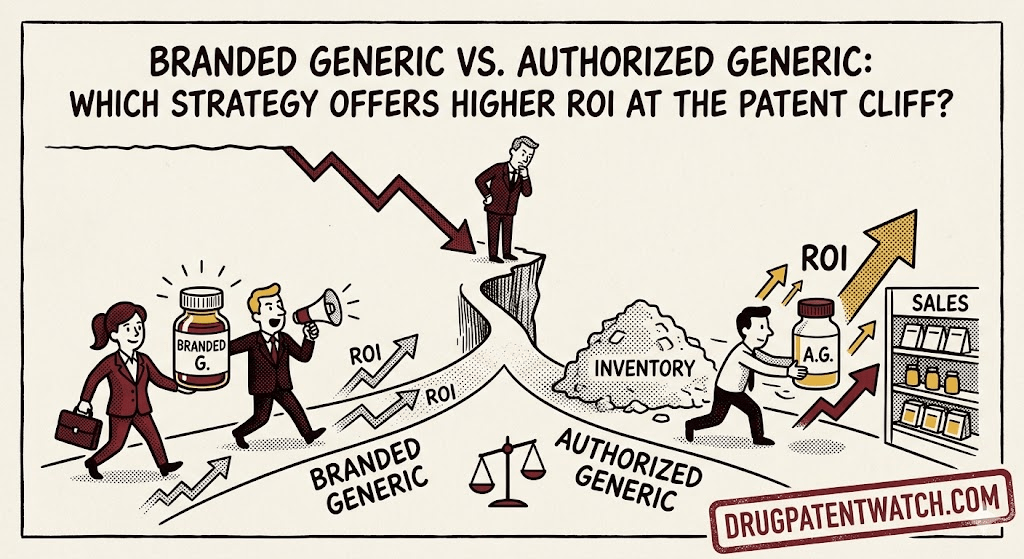
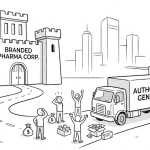
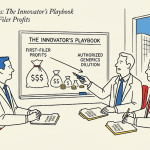
When a blockbuster drug’s patent expires, the originator company faces a choice that will define its revenue trajectory for the next decade. Launch a branded generic under a new label and compete directly in the post-LOE market. Or authorize a trusted generic manufacturer to sell the molecule under a private arrangement and collect royalties while the brand slowly loses share.
Neither option is obviously superior. The ROI depends on the molecule, the competitive field, the originator’s manufacturing posture, and how aggressively Paragraph IV challengers have already entered the market. Yet most published commentary treats the decision as a simple binary, ignoring the structural differences in how each strategy creates and destroys value at the patent cliff.
This article cuts through the noise. It draws on real litigation records, Orange Book data, IQVIA market share analyses, and the patent expiry tracking work that platforms like DrugPatentWatch have systematized, to give executives and IP counsel a rigorous framework for comparing returns across both strategies.
Defining the Patent Cliff: What Actually Happens to Revenue When Protection Expires
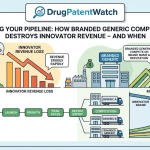
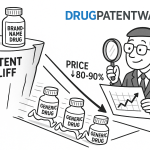
The ‘patent cliff’ is not a metaphor. It describes a measurable revenue event: the period, typically 12 to 24 months after a first generic entry, during which a branded drug loses 70% to 90% of its unit volume to generic competition.
The IMS Health (now IQVIA) standard observation, replicated across hundreds of loss-of-exclusivity (LOE) events, is that the first generic entrant captures roughly 25% of unit share within three months of launch. By month 12, with three or more generic competitors in the market, branded unit share typically falls below 20%. By month 24, with six or more entrants, brand share in units is often in single digits.
‘Generic drugs account for approximately 90% of all prescriptions dispensed in the United States but only about 20% of total drug spending.’ — Association for Accessible Medicines, Generic Drug Access & Savings Report, 2023.
The financial reality this creates for the originator is stark. A drug generating $2 billion annually pre-LOE may generate $300 million in branded revenues two years post-LOE, with the gap filled entirely by generic manufacturers. Unless the originator is one of them.
How Loss of Exclusivity Differs from Patent Expiry: A Critical Distinction
Executives conflate patent expiry and loss of exclusivity at their peril. A drug may have an active composition-of-matter patent that expires in 2027, but an FDA-granted pediatric exclusivity adds six months, making the effective LOE date January 2028. A different drug may have no remaining composition-of-matter patent but hold an active Orange Book-listed method-of-use patent that forces any Paragraph IV challenger to litigate a specific indication.
LOE is the date on which a generic manufacturer can legally begin commercial sales. It combines patent expiry, all FDA exclusivity layers (new chemical entity, orphan, pediatric, new formulation), and any settlement terms from Paragraph IV litigation. The branded generic and authorized generic decisions are made against this date, not the raw patent expiry date.
The Orange Book as a Strategic Map: What Listing Decisions Signal
The FDA’s Orange Book lists every patent an originator has certified as covering an approved drug product. Each listing is a strategic declaration. An originator that lists a formulation patent for a drug whose composition-of-matter protection expires in two years is signaling an intention to defend the franchise through secondary IP. Each listed patent triggers an automatic 30-month stay when a generic files an ANDA with a Paragraph IV certification, buying the originator time to either litigate, settle, or launch a defensive generic strategy.
Platforms like DrugPatentWatch aggregate Orange Book listings, patent expiry dates, and ANDA filing histories, giving generic challengers and originators alike a real-time map of the IP landscape. When an originator’s Orange Book listing strategy is visible to every would-be challenger, the decision to launch a branded generic or authorize a generic must account for how many Paragraph IV ANDAs are already pending.
What Is a Branded Generic? Definition, Mechanics, and Market Positioning
A branded generic is a generic drug sold under a proprietary brand name, typically by the originator company or a subsidiary, after its own patent exclusivity expires. The molecule is chemically identical to the original product. The difference is commercial: the product carries a name, marketing investment, and often a price point that sits between the originator brand and the commodity generic market.
The strategy has three primary variants:
The originator launches under a new brand name through its existing sales infrastructure, targeting brand-loyal prescribers and patients.
The originator creates a dedicated generics subsidiary (the ‘value brand’ model) that operates at arm’s length from the branded business.
The originator partners with a specialty pharmacy or PBM to distribute the product under a house label, capturing rebate economics that the commodity generics market doesn’t offer.
Real-World Examples: Pfizer, AstraZeneca, and the Branded Generic Playbook
Pfizer’s Greenstone subsidiary, later renamed Upjohn (and eventually spun off as Viatris), represents the most systematically developed branded generic operation by a major originator. When atorvastatin’s composition-of-matter patent expired in November 2011, Pfizer had already authorized Ranbaxy (now Sun Pharma) as the first Paragraph IV filer, granting a 180-day exclusivity window. Simultaneously, Pfizer prepared its own ‘authorized generic’ version of Lipitor distributed through Greenstone, launching the day Ranbaxy’s exclusivity began.
The strategic logic was to occupy both the authorized generic slot (through Ranbaxy’s channel) and the branded generic slot (through Greenstone), splitting the generic market between controlled channels and limiting the total addressable market for third-party generics. IQVIA data covering the first 12 months post-LOE showed Pfizer retaining approximately 18% of the combined brand plus Greenstone unit share — well above the typical 8% to 10% retained by originators who do not deploy a defensive generic strategy.
AstraZeneca deployed a different model with Nexium (esomeprazole). When the primary patent on the S-enantiomer of omeprazole expired, AstraZeneca launched an OTC version of Nexium 20mg through a consumer health channel while its prescription generics business sold authorized generic versions through institutional accounts. The dual-channel strategy complicated the typical prescriber substitution pathway.
Branded Generic Pricing Strategy: The Space Between Brand and Commodity
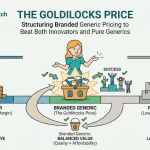
A branded generic must price itself in a narrow band. Price too close to the originator brand and it loses the cost-sensitive managed care formulary battles that determine volume. Price too close to commodity generics and it destroys the brand equity that justifies the sales force and marketing infrastructure.
The typical branded generic launch price runs 20% to 40% below the originator WAC. This creates a product that clears preferred formulary status at many PBMs while maintaining a gross margin of 55% to 70% — well above the 15% to 25% margins available to commodity generics in a market with six or more manufacturers.
The pricing arithmetic only works if the branded generic captures enough volume to spread its fixed commercial costs. A branded generic operation requires maintained sales force coverage, specialty pharmacy contracts, and a managed market team. These costs are fixed regardless of unit volume, which means a branded generic with less than 15% to 20% market share in units is likely destroying value rather than creating it.
What Is an Authorized Generic? Structure, Agreements, and Regulatory Status
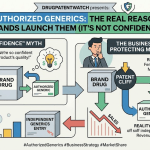
An authorized generic (AG) is a drug product that an originator licenses to a third-party generic manufacturer to sell under the generic’s label, with no separate FDA approval required. Because the AG is sold under the originator’s NDA, the generic company can launch without filing an ANDA, without conducting bioequivalence studies, and without navigating the Orange Book patent certification process.
The FDA’s position, confirmed in Teva Pharmaceuticals USA v. FDA (2006), is that authorized generics do not require a separate approval and are not subject to the 180-day first-filer exclusivity restriction. This ruling — controversial at the time — is the structural fact that makes authorized generics such an effective competitive tool against Paragraph IV first filers.
The 180-Day Exclusivity Erosion Problem: How AGs Undercut First Filers
When a generic company files a Paragraph IV ANDA and successfully litigates or settles its patent challenge, it earns 180 days of exclusivity during which no other ANDA can be approved. For a blockbuster drug, this exclusivity window can be worth $500 million to $1.5 billion in generic revenue — the economic prize that makes Paragraph IV litigation attractive despite its cost and risk.
An authorized generic, however, is not an ANDA. It launches through the originator’s NDA. It therefore competes directly with the first filer during the 180-day window, splitting the available generic revenue with a product that the originator supplies at whatever transfer price it chooses. The FTC’s 2011 study on authorized generics documented that first-filer generic revenues fell by 40% to 52% when an authorized generic launched simultaneously.
This dynamic changes the economics of Paragraph IV filing. A generic company weighing whether to challenge a blockbuster patent must now discount its expected exclusivity-period revenue by the probability that the originator will authorize a competing generic. For drugs where originators have consistently used AG strategies historically, the financial case for Paragraph IV challenges is weaker.
Key Authorized Generic Deal Structures: Royalty, Supply, and Revenue-Share Models
Authorized generic agreements take three primary commercial forms:
Supply agreements: The originator manufactures the API and finished dosage form, supplies it to the AG partner at a negotiated transfer price, and the partner distributes under its own label. Margin to the originator comes from the manufacturing spread. The AG partner takes commercial risk (warehousing, distribution, returns) in exchange for a wholesale margin.
License agreements: The originator licenses its NDA to an AG partner that manufactures independently or sources API from a third party. The originator receives a royalty per unit sold, typically 5% to 15% of net sales. This model requires less manufacturing infrastructure from the originator but delivers lower per-unit economics.
Revenue-share agreements: The AG partner and originator split net revenues at a negotiated percentage after cost of goods and distribution. These are more complex to administer but align incentives, particularly when the originator retains pricing authority.
Litigation settlement agreements that include an AG component — the ‘reverse payment plus AG’ structure — have drawn FTC scrutiny. In these deals, the originator settles with a Paragraph IV filer by granting AG rights rather than cash, allowing the originator to keep the patented brand’s price high while compensating the challenger with generic revenue that ultimately comes from consumers. The Supreme Court’s FTC v. Actavis (2013) decision established that such settlements can violate antitrust law if the net payment is sufficiently large, though the analytical framework continues to evolve in lower courts.
Branded Generic vs. Authorized Generic ROI: Building the Comparison Framework
ROI at the patent cliff is not a single number. It is a distribution of outcomes across multiple revenue streams, cost lines, and time horizons. Any rigorous comparison must specify what counts as ‘return’ (gross margin, operating income, NPV of cash flows over five years?) and what counts as ‘investment’ (fixed commercial costs, manufacturing capital, litigation expense, opportunity cost of management attention?).
The framework below uses five-year NPV of incremental operating cash flow relative to a ‘do nothing’ baseline — defined as letting the brand erode with no defensive generic strategy — as the primary ROI metric.
Branded Generic ROI Model: Revenue, Cost, and Margin Assumptions
A branded generic launched by a large originator at 30% below brand WAC, targeting 15% to 20% unit market share, generates roughly the following economics for a drug with $1.5 billion in pre-LOE annual revenues:
Year one revenue: approximately $120 million to $180 million (branded generic captures 15% to 20% of 40 million annual prescriptions at $75 to $90 net price per prescription, down from $150 to $175 originator net). Gross margin at 60%: $72 million to $108 million. Subtract $60 million to $80 million in fixed commercial costs (sales force, managed market, marketing, regulatory compliance) and operating income is thin — $10 million to $30 million in the first year.
By year three, two dynamics shift the economics. The originator brand has largely eroded, so the cannibalization cost is moot. The branded generic has secured preferred formulary status at tier 2 or tier 3 positions and no longer requires heavy sampling or detailing. Fixed commercial costs drop to $30 million to $40 million as the sales force is rationalized. Operating income rises to $40 million to $70 million.
Five-year cumulative operating cash flow, discounted at 10%, typically ranges from $150 million to $280 million for this revenue profile — assuming the branded generic retains 12% to 18% unit share throughout and faces a moderately competitive generic market (four to seven entrants).
Authorized Generic ROI Model: Royalty Revenue, Zero Commercial Cost, and Duration Risk
An authorized generic generates revenue with no commercial infrastructure cost. The originator receives a royalty or supply margin, typically netting $15 to $45 per unit after AG partner margins, cost of goods, and distribution — a significant reduction from the $100 to $175 net per unit on the originator brand, but achieved with near-zero incremental fixed cost.
For the same $1.5 billion pre-LOE drug, an AG agreement that captures 25% unit market share (the authorized generic’s typical share in a competitive market) at $25 net per unit generates approximately $250 million in year one gross AG revenue. After cost of goods at 30% margin compression, the originator nets approximately $60 million to $80 million in year one — comparable to the branded generic in operating income, but without the commercial infrastructure cost risk.
The AG model’s vulnerability is duration. AG pricing is market-driven. As more commodity generics enter, the AG partner faces immediate WAC pressure from PBM formulary processes. By year two or three, the per-unit net often falls 30% to 50% from launch levels. The AG partner may renegotiate the supply agreement or exit the arrangement entirely if margins become unworkable.
Five-year NPV of an AG strategy for the same drug profile: approximately $120 million to $210 million — lower than branded generic in most scenarios because the per-unit economics erode faster and the originator has no pricing lever to pull.
Head-to-Head Comparison Table: Branded Generic vs. Authorized Generic by Key Metric
Metric
Branded Generic
Authorized Generic
Upfront capital required
High ($40M–$80M commercial infrastructure)
Low ($2M–$10M legal/licensing)
Year 1 operating income (typical)
$10M–$30M
$55M–$80M
Year 3 operating income (typical)
$40M–$70M
$30M–$50M
5-year NPV (base case)
$150M–$280M
$120M–$210M
Price erosion risk
Moderate (brand equity buffer)
High (commodity market exposure)
Market share target
12%–20% unit share
20%–30% unit share
Management complexity
High
Low
Regulatory risk
Low (no ANDA needed)
Very Low
Cannibalization of brand
Accelerates LOE impact
Moderate (partner’s label)
Control over pricing
Full
Limited to contractual terms
Exit flexibility
Low (commercial infrastructure is sticky)
High (terminate agreement)
When Does a Branded Generic Outperform an Authorized Generic? The Four Conditions
The branded generic strategy delivers superior ROI under four identifiable conditions. These are not hypothetical — they are observable in the history of LOE events across the past two decades.
Condition 1: The Drug Has a High Brand-Loyal Prescriber Base
Some drug categories have prescribers who will continue writing the brand name for years after generic availability, either because of patient familiarity, clinical habit, or formulary inertia in institutions. Branded generics in these categories can maintain 15% to 25% unit market share for three to five years post-LOE, far above the commodity generic average.
Controlled-release formulations, branded generics in psychiatry (where prescriber inertia is high and patient stability is a concern), and specialty drugs with narrow therapeutic indices all exhibit this dynamic. Teva’s Copaxone (glatiramer acetate) franchise extended its premium pricing for years through a combination of specialty pharmacy distribution and a 40mg three-times-weekly formulation that complicated biosimilar entry, illustrating how brand loyalty mechanics can be engineered rather than inherited.
Condition 2: The Originator Has a Low-Cost Manufacturing Position
A branded generic can sustain higher margins than a commodity generic only if the originator’s manufacturing cost per unit is competitive with contract manufacturers. If the originator’s fully-loaded cost per unit is 40% higher than a generic manufacturer’s, the branded generic will either price itself out of formulary positions or operate at negative gross margins. Many originator manufacturing plants are built for small-batch, high-quality production of patented products — not for the high-volume, low-cost runs that generic profitability requires.
Originators with API manufacturing capabilities, with established contract manufacturing partnerships, or with modern high-volume facilities (common in respiratory and dermatology) can execute the branded generic strategy profitably. Those dependent on legacy small-batch operations typically cannot.
Condition 3: The Generic Market Is Concentrated (Fewer Than Five Entrants)
When a drug’s LOE produces a concentrated generic market — typically because manufacturing complexity limits entrants, or because the molecule requires specialized facilities — a branded generic can capture durable market share without facing commoditized pricing pressure. The key threshold is five or more generic entrants. Below five, branded generics maintain pricing power. Above five, the WAC compression accelerates and the brand equity premium erodes faster than the commercial cost structure can absorb.
Drugs requiring specialized inhalation devices, complex injectables, or modified-release technologies with limited supplier bases are natural candidates for branded generic strategies because generic market concentration tends to persist. Track these structural barriers in the ANDA filing data published by the FDA, accessible through DrugPatentWatch’s filing history tools.
Condition 4: The Originator Is Exiting the Therapeutic Category Anyway
When a large originator is divesting a therapeutic franchise — as Pfizer did with Upjohn, or as AbbVie did with some legacy products post-Allergan acquisition — the economics of maintaining branded generic infrastructure in that category become unattractive. The AG strategy, which requires no internal commercial capability, becomes the higher-ROI option by default. The originator collects royalties while redirecting commercial investment to pipeline priorities.
When Does an Authorized Generic Beat a Branded Generic? Scenarios Where the AG Wins
The authorized generic’s structural advantages dominate in three broad scenarios.
Scenario A: Large Volume, Small Margin Opportunity (Oral Solids, Commodity Generics)
When a drug has large prescription volume but low per-unit value — oral solid formulations of common molecules like metformin, lisinopril, or generic statins — the branded generic strategy’s fixed commercial costs are fatal to ROI. A branded generic for a $0.05-per-pill commodity drug simply cannot generate enough operating income to justify a sales force.
The AG model works here because the royalty revenue is pure margin uplift. The originator supplies API or finished goods to an AG partner, receives a transfer price margin, and incurs no commercial cost. For a drug like metformin (if hypothetically still under patent), an AG generating 30 cents per unit on 400 million annual prescriptions produces $120 million in royalties with $3 million in administrative overhead. The branded generic version of the same drug might generate the same royalty equivalent in revenue but requires $50 million in commercial infrastructure to get there.
Scenario B: The Originator Is Pivoting Resources to a Next-Generation Asset
When the LOE drug’s therapeutic area is being de-emphasized — because the originator has a follow-on biologic, a next-generation small molecule, or a co-formulation it is building the market around — investing in branded generic commercial infrastructure is an allocation mistake. Every dollar spent maintaining a branded generic sales force for the LOE product is a dollar not spent on the successor asset’s launch.
The AG strategy allows the originator to collect economics from the LOE product’s residual value while concentrating commercial attention on the pipeline. This is the most common scenario in which large originators rationally choose AG over branded generic, and it explains why the decision is correlated with pipeline health: originators with robust late-stage pipelines more often choose AG strategies for LOE products.
Scenario C: A Strong Paragraph IV Filer Has Already Secured 180-Day Exclusivity
If a Paragraph IV challenger has already secured a settlement entitling it to launch at a negotiated date with 180-day exclusivity, the originator has two choices: let the first filer capture the generic market uncontested, or authorize a generic through the NDA to compete during the exclusivity period.
The AG launched during the 180-day window captures market share that would otherwise accrue entirely to the first filer, splitting the pie and reducing the challenger’s return. This is the purely defensive use of the AG — not an affirmative revenue strategy, but a competitive countermeasure to reduce the challenger’s gain and maintain originator revenue during the transition.
Historical data, compiled in part through DrugPatentWatch’s litigation settlement database, shows that originators used AG launches during 180-day windows in approximately 60% of Paragraph IV settlements for branded drugs with pre-LOE revenues exceeding $500 million between 2010 and 2022. For drugs below that revenue threshold, AG deployment during exclusivity windows dropped to roughly 30% — consistent with the ROI analysis showing that smaller revenue bases don’t justify the AG launch mechanics.
Patent Cliff Litigation Strategy: How Paragraph IV Outcomes Determine the Generic Launch Race
The decision between branded generic and authorized generic cannot be separated from the litigation environment. Paragraph IV certifications, 30-month stays, and settlement negotiations all shape the timing and competitive structure of generic entry in ways that directly affect which defensive strategy offers higher returns.
What Is a Paragraph IV Certification and Why Does It Trigger Automatic Litigation?
Under 21 U.S.C. § 355(j)(2)(A)(vii)(IV), a generic applicant that certifies a listed patent is invalid, unenforceable, or will not be infringed by the generic product triggers a potential lawsuit. If the patent holder sues within 45 days, the FDA imposes an automatic 30-month stay on ANDA approval — freezing generic market entry while litigation proceeds. This is the primary mechanism through which patent litigation delays generic competition by two to three years beyond the initial LOE date.
For the originator, the strategic value of the 30-month stay depends entirely on whether the underlying patent is defensible. A strong composition-of-matter patent with broad claim scope can sustain the stay and be litigated to judgment in the originator’s favor, extending the effective exclusivity period. A weak formulation or method-of-use patent challenged at a vulnerable claim construction may result in invalidity judgment or settlement that accelerates LOE.
Key Patent Cliff Litigation Cases: Lessons from Lipitor, Plavix, and Humira
Lipitor’s LOE is the textbook case for large-molecule patent cliff management. Pfizer listed multiple patents in the Orange Book covering atorvastatin’s composition of matter, crystalline forms, and formulation. Ranbaxy filed Paragraph IV ANDAs in 2003, and litigation proceeded through the District of Delaware over multiple patent families. Pfizer ultimately settled with Ranbaxy in 2008, granting a November 2011 generic launch date for the U.S. — well before the last patent’s nominal expiry. The settlement included an AG arrangement through which Pfizer supplied the generic Ranbaxy sold, maintaining supply chain economics.
Plavix (clopidogrel bisulfate), marketed by Bristol-Myers Squibb and Sanofi-Aventis, illustrates a more aggressive originator defense. When Apotex filed a Paragraph IV ANDA in 2002 and launched ‘at-risk’ before litigation concluded in August 2006, the courts eventually found in the originators’ favor, forcing Apotex to pay damages. But the at-risk launch had already captured significant pharmacies and PBM formulary positions. BMS and Sanofi recovered the market primarily through specialty distribution programs and brand loyalty among cardiologists, not through an AG or branded generic strategy — a case study in the limits of litigation-only patent cliff defense.
Humira’s (adalimumab) biosimilar cliff, arriving substantially in 2023, presents a different dynamic: not small-molecule generics under the Hatch-Waxman framework but biosimilars under the Biologics Price Competition and Innovation Act (BPCIA). AbbVie deployed a patent thicket strategy — over 250 patents listed on adalimumab — combined with global settlement agreements that delayed U.S. biosimilar entry until 2023, despite European competition from 2018. When the U.S. cliff arrived, AbbVie responded not with a branded generic (no analog exists in biologics) but with a portfolio of reformulations and device innovations, capturing high-adherence patients willing to pay above biosimilar pricing.
What Happens When the 30-Month Stay Expires Before Litigation Concludes?
When the 30-month stay expires without a judgment, the FDA can approve the ANDA and the generic may launch ‘at risk’ — meaning it begins commercial sales while litigation continues. If the originator ultimately wins, the generic manufacturer owes damages for infringing sales. If the generic wins (or the case settles), the at-risk launch was simply an early market entry.
At-risk launches change the strategic calculus for both branded generic and AG planning. An originator that anticipated a delayed generic entry may find its branded generic launch costs have been incurred for a shorter-than-expected period of exclusivity. An AG arrangement calibrated for a 2025 launch date may suddenly need to activate in 2024 when a Paragraph IV challenger launches at risk.
This uncertainty is one reason sophisticated originators maintain both strategies in parallel readiness: a branded generic commercial plan that can be activated if the IP defense succeeds longer than expected, and an AG contract counterparty identified if the cliff arrives early.
FDA Exclusivity Programs and Their Interaction with Branded Generic and AG Timing
FDA exclusivity programs — distinct from patent protection — directly affect when a generic can receive ANDA approval and thus when the branded generic or AG launch window opens. Understanding these programs is essential to LOE planning.
New Chemical Entity Exclusivity: The Five-Year Shield and Its Interaction with Paragraph IV
NCE exclusivity grants five years of marketing exclusivity to the first approved drug containing a new active moiety. No ANDA can be filed during this period — except that Paragraph IV ANDAs can be filed after year four of the five-year period. This creates a one-year ‘Paragraph IV window’ at year four during which generic challengers can begin the filing and litigation process.
For originator planning purposes, NCE exclusivity effectively means the first generic threat appears at year four, with a 30-month stay potentially pushing actual generic launch to year six or seven. The branded generic and AG planning timeline is anchored to this NCE expiry date, not the patent expiry date — a critical sequencing distinction when building the financial model.
Pediatric Exclusivity: Six Months That Can Be Worth Hundreds of Millions
Pediatric exclusivity adds six months to all existing patents and exclusivities when an originator conducts FDA-requested pediatric studies. For a drug generating $2 billion annually, six months of additional protected revenues is worth approximately $800 million to $1 billion in gross revenue — typically far exceeding the cost of the pediatric program. Originators consistently pursue pediatric exclusivity for blockbuster drugs where pediatric use is medically plausible.
The interaction with generic strategy: those six months delay the generic launch window, and any AG arrangement must be written with flexibility to account for pediatric exclusivity timing. An AG contract executed before pediatric exclusivity is granted may specify a launch date that becomes contractually binding even if the originator later receives a six-month extension — a drafting error that has produced litigation between originators and AG partners.
Orphan Drug Exclusivity and Its Rare Application to Patent Cliff Defense
Orphan drug exclusivity grants seven years of market exclusivity for drugs approved for rare diseases affecting fewer than 200,000 U.S. patients. For drugs with broad indications where orphan designation was obtained for a subset of patients, the exclusivity applies only to the orphan indication — a narrow protection. But for drugs that are genuinely orphan products with high per-patient pricing, this seven-year window restructures the LOE economics entirely: the relevant timeline is not five years plus patent but seven years from orphan approval, and the subsequent generic market is smaller and more specialized.
Branded generics are rarely viable for orphan drugs because market volumes are too small to justify commercial infrastructure. AG arrangements, where an originator licenses to a specialty pharmacy distributor at a royalty, occasionally make sense for orphan LOEs but represent a small fraction of total AG deal flow.
Supply Chain Strategy at the Patent Cliff: Manufacturing Position as ROI Determinant
The operational dimension of branded generic versus authorized generic decisions receives less analytical attention than the commercial side, yet manufacturing economics can flip the ROI comparison in either direction.
API Sourcing Strategy: Why Vertical Integration Favors Branded Generics
An originator with captive API manufacturing capability can supply its own branded generic at a cost structure that is unavailable to generic entrants sourcing API on the open market. When the originator is the world’s most efficient API producer for its own molecule — as is often the case for complex synthetic routes or fermentation-derived molecules — the branded generic can sustain margins that third-party generics cannot match.
Eli Lilly’s position in insulin analogues illustrates this. When biosimilar insulins began entering the U.S. market, Lilly’s captive manufacturing scale in insulin production gave its authorized-generic-equivalent insulin products (sold under the Insulin Lispro Injection brand) a cost advantage that biosimilar entrants sourcing from CMOs could not immediately replicate. The strategy combined authorized generic economics (no ANDA) with manufacturing cost leadership that preserved healthy margins.
CMO Partnerships and the Contractual Risk of Authorized Generic Supply Agreements
Authorized generic supply agreements that rely on contract manufacturing organizations (CMOs) introduce supply chain risk that can disrupt revenue at exactly the moment the originator is most dependent on AG income — the first 12 months of LOE when the branded business is losing share fastest.
CMO capacity constraints, FDA inspection failures at manufacturing sites, and API shortages have each disrupted AG launches. When Teva’s authorized generic supply chain for a major oral solid was disrupted by a Form 483 inspection observation in 2019, the AG partner could not fulfill the launch supply plan, and the market share the authorized generic should have captured in the first 180-day exclusivity period went instead to commodity generics. The revenue impact was permanent: unlike the originator brand, which has brand equity to recapture prescribers, the AG has no marketing leverage to recover lost share.
Serialization, Track-and-Trace, and the Regulatory Cost of Running Parallel Generic Operations
The Drug Supply Chain Security Act (DSCSA) requires pharmaceutical manufacturers to implement product-level serialization and track-and-trace systems by 2025. For originators running both a branded generic and the originator brand from the same manufacturing line, serialization creates traceability complexity: each SKU requires distinct lot codes, serialization records, and supply chain documentation. The systems cost is real — implementation runs $5 million to $20 million for mid-size manufacturing operations — but it is fixed regardless of whether the originator deploys one post-LOE strategy or two.
This cost is relevant to the ROI comparison only in that it is sunk: if the originator has already built DSCSA compliance infrastructure for its brand, the marginal cost of extending it to a branded generic SKU is lower than starting fresh. The AG partner, by contrast, handles its own DSCSA compliance under its own operating license, so the originator bears no serialization cost in a pure royalty AG arrangement.
Pricing Pressure and PBM Dynamics: How Formulary Placement Decides Winners
In the U.S. market, a drug’s commercial success — whether branded original, branded generic, or authorized generic — depends critically on its formulary tier at the major pharmacy benefit managers. Express Scripts, CVS Caremark, and OptumRx together manage formulary access for approximately 270 million covered lives. Formulary tier assignment determines patient out-of-pocket cost and, through step edits and prior authorization requirements, de facto prescribing volume.
How PBMs Decide Whether to Prefer a Branded Generic or an Authorized Generic
PBMs do not prefer branded generics or authorized generics categorically. They prefer the product that generates the highest net formulary economics — which combines the product’s WAC, the rebate rate offered to the PBM, and the administrative cost of managing utilization.
A branded generic that offers a 35% rebate on a WAC 30% below the originator brand will often win preferred tier placement over a commodity authorized generic at lower WAC but zero rebate. This is the branded generic’s structural advantage in managed markets: it can play the rebate game, generating net pricing concessions through a rebate mechanism that a commodity generic — with 8% gross margins — simply cannot sustain.
The AG, priced as a generic, typically wins formulary placement through lowest-cost logic rather than rebates. PBMs place generics on tier 1 or tier 2 formulary positions based on WAC, and the AG competes for those positions against all other approved generics. In a market with five generics at similar WAC, formulary placement often comes down to GPO contract terms and distribution partnership, not marketing spend.
The ‘Generic Is Generic’ Problem: When Brand Equity Doesn’t Survive Formulary Substitution
State substitution laws allow pharmacists to dispense any AB-rated generic in place of a brand prescription. Once a drug has multiple AB-rated generic alternatives, the branded generic faces automatic substitution at the pharmacy unless it is specifically requested by brand name. In most therapeutic categories, 80% to 90% of prescriptions for generic-eligible drugs are filled with whichever product is lowest-cost or preferred on the pharmacy’s generic formulary.
The branded generic strategy must overcome this substitution dynamic either through DAW (dispense as written) prescriber behavior — which requires active sales force effort — or through direct-to-patient marketing that creates consumer preference for the branded generic name. The cost of generating meaningful DAW rates in commodity categories typically exceeds the margin benefit, which is why branded generics are more viable in specialty pharmacy settings (where clinical management is individualized) than in retail pharmacy settings (where substitution is automated).
Biosimilar Strategies vs. Small-Molecule Patent Cliff: Do the Same ROI Rules Apply?
The branded generic versus authorized generic framework was developed for small-molecule LOE events under Hatch-Waxman. Applying it to biologics LOE under the BPCIA requires adjustments, because the economics of biosimilar entry differ substantially from small-molecule generic entry.
Why Biosimilar Market Dynamics Are Different from Small-Molecule LOE
Biosimilar interchangeability — the FDA designation allowing pharmacist-level substitution without prescriber intervention — was approved for some products only in 2022 and 2023. Before interchangeability, biosimilars had to be prescribed by name, creating a market structure closer to branded competition than generic substitution. Penetration rates for biosimilars launched without interchangeability designations in the U.S. have been dramatically lower than European biosimilar penetration in equivalent markets.
For originator biologics, the defensive strategy at LOE therefore looks different from small-molecule defense. An originator biologic facing biosimilar entry cannot ‘authorized generic’ its way through the LOE: the BPCIA does not have an NDA analog for branded biologics, and the regulatory pathway for biosimilar entry requires its own 351(k) application with demonstration of biosimilarity. An originator cannot simply license its BLA to a generic company the way it can license its NDA.
What originators can do — and Amgen, AbbVie, and J&J have all done — is deploy a ‘next-generation biologic’ strategy: a reformulation, a new device, or a combination product that is clinically differentiated enough to justify a price premium above the biosimilar. This functions as a branded generic analog in economic terms (captive low-cost competitor to the brand, higher margins than biosimilar) but is structurally a new product launch, not a defensive generic strategy.
When an Authorized Generic Analog Exists in Biologics: Co-Marketed Biosimilar Agreements
One emerging structure in biologics LOE is the co-marketed biosimilar agreement, in which the originator partners with a biosimilar developer and co-promotes the biosimilar under a shared commercial arrangement. Pfizer and Viatris, Sandoz and Novartis parent company, and other integrated generics operations have developed internal biosimilar capabilities that allow the originator to distribute biosimilars of its own reference products through wholly owned subsidiaries — an AG structural analog.
These arrangements are strategically similar to small-molecule AGs: the originator captures economics from the competitive product’s success, reducing the net revenue lost to pure third-party competitors. But the investment required — biosimilar development costs $100 million to $250 million per product — means the ROI calculus requires higher revenue stakes than typical small-molecule AG deals to justify.
Real-World ROI Outcomes: Case Studies in Branded Generic and AG Strategy
Case Study 1: Lexapro (Escitalopram) — Forest Labs’ Branded Generic Decision
Escitalopram, the S-enantiomer of citalopram, faced LOE in March 2012 after extensive Paragraph IV litigation. Forest Laboratories (later acquired by Actavis, then Allergan, then AbbVie) held NCE exclusivity through March 2012 and faced first-filer generic entry from Teva and Lupin on that date.
Forest chose not to launch a branded generic. Its commercial strategy depended on driving prescribers to its next-generation antidepressant, Viibryd (vilazodone), which launched in 2011. Commercial resources were redirected to Viibryd rather than to defending escitalopram’s position through a branded generic. An authorized generic was also not deployed aggressively in the first 180-day exclusivity window.
The result was a sharp and fast erosion: Lexapro’s U.S. revenues fell from approximately $2.3 billion in 2011 to $400 million in 2012. Forest’s Viibryd launch partially offset the loss but never reached Lexapro’s revenue scale. The absence of either a branded generic or AG strategy meant Forest captured almost no economics from the $2 billion-plus annual generic escitalopram market.
Post-acquisition analysis by Allergan’s investor relations suggested that a branded generic or AG deployment could have generated $150 million to $250 million in additional operating income over three years — roughly 15% of the LOE revenue loss. The decision not to deploy either strategy reflected Forest’s pipeline prioritization logic, but the magnitude of unrealized economics is a useful counterfactual for planning purposes.
Case Study 2: OxyContin (Oxycodone ER) — Purdue’s Reformulation as Branded Generic Equivalent
Purdue Pharma’s reformulation of OxyContin to an abuse-deterrent extended-release formulation in 2010 is a complex case that straddles the line between a new product launch and a branded generic defensive strategy. When the original OxyContin formulation lost regulatory protection, Purdue’s abuse-deterrent reformulation was approved, and the FDA subsequently withdrew approval of the original formulation on public health grounds — effectively creating a market where the ‘generic’ of original OxyContin could not be substituted for the new formulation.
The commercial effect: Purdue maintained branded pricing and market share for OxyContin’s extended-release franchise for several years beyond the LOE date of the original formulation. The five-year NPV benefit of this strategy ran to hundreds of millions of dollars in sustained branded revenues. The strategy ultimately became a regulatory, legal, and reputational catastrophe — but its short-term commercial mechanics illustrate how reformulation can function as a defensive branded generic equivalent when executed through FDA’s product selection policies.
Case Study 3: Effexor XR (Venlafaxine ER) — Wyeth’s AG-First Strategy
Wyeth’s (now Pfizer) handling of Effexor XR’s 2010 LOE became a reference case for AG strategy deployment. Facing first-filer ANDA approvals from Teva and others, Wyeth authorized a generic supply arrangement through its Greenstone unit, launching an AG on the first day of generic availability. The authorized generic was price-competitive with the commodity generics entering the market and was supplied through Wyeth’s manufacturing infrastructure at a cost advantage.
The outcome: Greenstone’s AG captured approximately 18% to 22% of the venlafaxine ER unit market during the first 180-day window, a share it maintained at roughly 15% for three years post-LOE as commodity competition intensified. Revenue from the AG arrangement over three years contributed an estimated $180 million to $250 million in incremental operating income for Pfizer/Wyeth — economics that would not have existed without the AG program.
The Effexor XR case is frequently cited in industry planning discussions as evidence that an AG-first strategy can generate substantial value even without the commercial infrastructure costs of a branded generic.
How DrugPatentWatch Data Changes the Patent Cliff Analysis
Systematic patent expiry analysis has been transformed by data aggregation platforms. DrugPatentWatch compiles Orange Book patent listings, FDA ANDA filing histories, Paragraph IV certification records, litigation status, and exclusivity expiry dates into a continuously updated database that covers the entire U.S. pharmaceutical market.
For originator IP strategy teams, DrugPatentWatch data enables three specific analyses that were previously labor-intensive and error-prone: first, mapping the full patent portfolio covering a given NDA to identify weak patents that are likely Paragraph IV targets; second, tracking when Paragraph IV ANDAs are filed against each NDA, providing early warning of generic challenge that may arrive one to three years before a litigation complaint is filed; third, monitoring the AG landscape — which originators have historically authorized generics for which molecule classes — to benchmark expected competitive behavior.
Generic companies use the same data from the opposite direction, identifying patent expiry windows and exclusivity gaps that represent filing opportunities. The information asymmetry between well-resourced originators and smaller generic challengers has narrowed because of accessible patent data platforms, changing the strategic environment for both sides of the LOE event.
Financial Impact of Generic Entry on the Originator: LOE Modeling Beyond Year One
Most LOE financial models focus on year one revenue impact and miss the longer-term commercial dynamics that determine which defensive strategy actually outperforms over a five-to-seven year horizon.
The ‘Tail Revenue’ Problem: Why AG and Branded Generic Revenues Diverge by Year Four
By year four of generic competition, the commodity generic market for most oral solids has 8 to 12 approved competitors, WAC has compressed 90% to 95% from originator brand levels, and gross margins for commodity generics have fallen to 5% to 15%. An authorized generic operating in this environment generates minimal royalty or supply income: per-unit economics are $0.02 to $0.10 for typical oral solids at year four, down from $0.50 to $2.00 at launch.
A branded generic, by contrast, maintains a durable tail revenue stream from brand-loyal prescribers, specialty pharmacy contracts, and institutional formulary relationships that commodity generics cannot replicate. In therapeutic areas with patient compliance concerns — chronic disease management, CNS, specialty — the branded generic may still capture 8% to 12% unit share at year four, generating operating income that far exceeds the AG’s eroded royalties.
This divergence is the strongest argument for the branded generic strategy in categories with the right prescriber dynamics. The AG wins at launch; the branded generic wins in steady state. The crossover point varies by category but typically occurs 18 to 30 months post-LOE.
Originator Brand Price Response: How Maintaining Branded Drug Price Affects AG and BG Economics
A strategically important variable in both the AG and branded generic models is what the originator does with the originator brand’s WAC after generic entry. If the originator raises brand WAC aggressively post-LOE — as some manufacturers do to maximize revenue from the remaining 5% to 10% brand-loyal patients who are insensitive to price — it inadvertently creates pricing umbrella that supports both the AG’s and the branded generic’s margins.
Conversely, an originator that cuts brand WAC to compete with generics destroys the pricing umbrella, accelerates the commodity price war, and reduces the margin available for both its own branded generic and its AG partner. The optimal strategy is to hold brand WAC steady or raise it while deploying the defensive generic through a separate product, maintaining pricing discipline in the brand channel while participating in the generic market’s volume through a different SKU. This is standard pharma LOE playbook and is well-documented in the academic literature on pharmaceutical pricing behavior post-LOE.
International Perspectives: Branded Generic and AG Strategies Outside the U.S.
The branded generic versus authorized generic analysis presented above applies specifically to the U.S. Hatch-Waxman framework. Outside the U.S., the strategic logic differs substantially because generic market structures, reimbursement systems, and IP frameworks vary by country.
Europe: INN Prescribing, Reference Pricing, and the Collapse of Branded Generic Premiums
In most European markets, generic prescribing by international nonproprietary name (INN) is encouraged or mandated by reimbursement policy. Germany’s reference pricing system, France’s tiers payants scheme, and the UK’s generic prescribing target all reduce the commercial value of brand recognition in the generic market. A branded generic with a 20% price premium above the INN reference price will not receive reimbursement under most European national formularies.
The result is that branded generic strategies in Europe generate far less ROI than in the U.S. European originators facing LOE typically deploy AG strategies or accept brand erosion, redirecting resources to the pipeline. The commercial infrastructure cost that is a barrier to the branded generic’s ROI in U.S. calculations is even more unattractive in European markets where brand equity generates no formulary premium.
Emerging Markets: Where Branded Generics Are the Default Commercial Model
In India, China, Brazil, and other large emerging pharmaceutical markets, the branded generic is not a defensive LOE strategy — it is the primary commercial model. Most branded drugs in these markets are off-patent molecules sold under proprietary brand names by companies like Sun Pharma, Cipla, Dr. Reddy’s, and Torrent Pharmaceuticals. The brand name commands physician and patient preference, and price premiums of 10% to 30% above unbranded generics are sustainable because of prescriber influence, patient compliance associations, and pharmacy incentive structures.
Understanding emerging market branded generic dynamics is relevant for U.S. originators considering whether a branded generic subsidiary could serve dual commercial purposes — defending the U.S. LOE while also building a branded generics business in high-growth markets. Pfizer’s Upjohn spinoff was partially structured around this dual-market logic, combining U.S. branded generics with emerging market branded generics under a single commercial platform.
Strategic Combinations: Running Branded Generic and Authorized Generic Simultaneously
The binary framing — branded generic or authorized generic — misrepresents how sophisticated originators often deploy both strategies simultaneously, each targeting different market segments.
The Dual-Track Strategy: How Pfizer’s Greenstone and Ranbaxy Simultaneous Launch Worked
In the Lipitor LOE, Pfizer ran three tracks simultaneously: the originator Lipitor brand (maintained at full WAC, targeting brand-loyal high-value patients), the Greenstone branded generic (targeting managed care formulary at 30% discount to brand), and the Ranbaxy authorized generic (targeting commodity pharmacy channels). Each product served a distinct market segment and operated with different economics.
This approach maximizes total revenue capture across the LOE spectrum but requires organizational complexity that most originators cannot sustain. Managing three commercial channels for the same molecule with distinct pricing, distribution, and managed market strategies requires dedicated teams, separate P&L structures, and robust channel conflict management. Pfizer’s scale made it feasible. For mid-size originators, the organizational cost typically exceeds the incremental revenue benefit of running both strategies.
Sequential Strategy: Branded Generic First, AG Transition as Market Matures
A more manageable combination is the sequential strategy: launch a branded generic at LOE, capturing the first two to three years when margins support a commercial operation, then transition to an AG royalty arrangement when commodity competition has eroded margins below the threshold that justifies commercial infrastructure.
This approach requires advance contracting: the originator must identify an AG partner and negotiate terms before the market matures, even if the AG launch does not occur until year three or four. The option value of having an AG arrangement in place while running a branded generic operation is significant — it provides an exit path that preserves revenue rather than simply shutting down the branded generic commercial operation and losing its share to competitors.
Settlement Agreements and the AG as Currency: Antitrust Risk in Patent Cliff Negotiations
Since the FTC v. Actavis decision in 2013, pharmaceutical patent settlements that include an AG component have faced heightened antitrust scrutiny. The FTC’s position is that an authorized generic granted to a Paragraph IV challenger as part of a settlement — allowing the challenger to share generic revenues during the exclusivity period in exchange for delayed generic entry — can constitute an anticompetitive reverse payment.
Post-Actavis Litigation: Which AG Settlement Structures Have Survived Antitrust Review
Lower courts applying the Actavis ‘rule of reason’ standard have reached mixed conclusions on AG-as-settlement-currency arrangements. The Third Circuit’s 2015 ruling in In re Loestrin 24 FE Antitrust Litigation allowed claims to proceed based on an AG component in a settlement, while other courts have found that AG rights with a sufficiently small economic value do not constitute actionable reverse payments. The critical analysis is whether the total settlement economics — cash, AG rights, litigation cost savings, and any other components — reflect a payment from the originator to the generic challenger in excess of the challenger’s expected litigation cost savings.
IP counsel structuring AG settlement agreements post-Actavis must document the value of the AG rights granted, compare it to the litigation cost avoided, and be prepared to defend the settlement’s competitive rationale under rule-of-reason analysis. Settlements that grant AG rights to first filers as the exclusive compensation component — with no cash payment — have been viewed more favorably by courts because the AG rights have transparent market value that can be assessed against the challenged patent’s expected litigation outcome.
Decision Framework: Choosing Between Branded Generic and Authorized Generic for Your LOE
After reviewing the structural analysis, litigation environment, manufacturing economics, and market dynamics, the decision framework reduces to seven questions that an originator’s commercial and IP leadership should answer before finalizing the LOE strategy.
The Seven-Question LOE Strategy Diagnostic
How many ANDA filers are expected at LOE, and what is the generic market concentration likely to be at year three?
Does the originator’s manufacturing cost structure support competitive generic margins, or does it require a brand premium to be profitable?
What is the prescriber loyalty profile — is there a defensible segment of brand-loyal prescribers large enough to support a branded generic market share target of 15% or higher?
Does the originator have a pipeline asset in the same therapeutic area that should receive the commercial resource allocation instead?
Are there Paragraph IV first filers with 180-day exclusivity that an AG could erode, and what is the revenue value of that erosion?
What is the five-year NPV comparison between branded generic (with its fixed commercial cost) and AG (with its per-unit royalty erosion) under base-case and downside market scenarios?
What is the antitrust risk profile of any AG arrangement under the post-Actavis framework, and has the settlement or licensing structure been reviewed for FTC compliance?
No single answer determines the outcome. The framework’s value is in forcing explicit assumptions about each variable and documenting the logic of the strategic choice — both for internal alignment and for potential future regulatory or antitrust scrutiny.
Key Takeaways
The ROI advantage of branded generic versus authorized generic depends on therapeutic category, manufacturing cost position, prescriber loyalty depth, generic market concentration, and pipeline opportunity cost — not on any universal strategic preference.
Authorized generics generate higher year-one operating income with lower capital risk but face faster per-unit revenue erosion as commodity competition intensifies by years two and three.
Branded generics generate lower year-one returns but sustain higher operating income in years three to five for drugs with defensible prescriber loyalty or specialty pharmacy channels.
The 180-day first-filer exclusivity window is a specific context where AG deployment delivers clear strategic value by splitting generic market share and reducing the financial reward for Paragraph IV challenges.
The post-Actavis antitrust framework requires careful structuring of any AG component in patent settlement agreements; the economic value of AG rights granted to challengers must be defensible under rule-of-reason analysis.
Dual-track strategies — running branded generic and AG simultaneously in different channels — maximize total revenue capture but require organizational scale and channel conflict management that only large originators typically sustain.
Data platforms like DrugPatentWatch make the patent and ANDA filing landscape transparent to all parties, eliminating information asymmetry and making early LOE strategic planning essential rather than optional.
European and emerging market dynamics differ fundamentally from U.S. dynamics; branded generic premiums survive only in markets where reimbursement policy does not mandate INN prescribing or reference pricing.
FAQ
1. Can an originator launch a branded generic without a separate FDA approval?
Yes. A branded generic launched by the originator under its own NDA does not require a separate approval. The originator sells the same formulation under a different label, using its existing NDA. This is distinct from an authorized generic, where a third party distributes under the originator’s NDA. Both avoid the ANDA process, which is specific to third-party applicants.
2. Does an authorized generic count against the 180-day first-filer exclusivity period?
No. The FDA confirmed in Teva Pharmaceuticals USA v. FDA (2006) that authorized generics are not ANDAs and therefore do not consume or compete with the 180-day first-filer exclusivity under the NDA holder’s rights. They do, however, compete commercially with the first filer during its exclusivity window, reducing the first filer’s revenues by an estimated 40% to 52%.
3. What is the typical royalty rate in an authorized generic agreement?
Royalty rates in AG licensing agreements typically range from 5% to 15% of net sales, though supply agreement structures (where the originator charges a transfer price on finished goods) are more common for drugs where the originator has manufacturing capability. Transfer price economics often net the originator a higher per-unit margin than a pure royalty arrangement.
4. How does a Paragraph IV settlement affect the AG launch timeline?
Paragraph IV settlements typically specify a negotiated generic launch date. If the settlement includes an AG provision, the AG is authorized to launch on that date or during the first filer’s 180-day exclusivity period. The settlement’s AG terms define whether the AG competes during the exclusivity window or only after it expires.
5. What is the FTC’s enforcement risk in authorized generic arrangements?
The FTC scrutinizes AG provisions in patent settlements under the rule of reason framework established in Actavis. The risk is highest when the AG rights are the sole consideration from the originator to the challenger and when the economic value of those rights is large relative to the challenger’s litigation cost savings. Pure licensing arrangements for distribution purposes, without a related patent settlement, carry lower FTC enforcement risk.
6. Which therapeutic areas generate the highest ROI for branded generic strategies?
Therapeutics areas with high prescriber inertia and specialty pharmacy distribution — psychiatry, neurology, endocrinology, and complex pain management — generate the highest branded generic ROI. These areas have brand-loyal prescribers, patient stability concerns that reduce substitution, and distribution channels where branded products maintain formulary positioning longer than in retail pharmacy.
7. How do PBMs treat branded generics differently from commodity generics in formulary design?
PBMs typically place branded generics on tier 2 or tier 3 formulary positions (preferred brand or non-preferred brand), while commodity generics occupy tier 1 (generic) positions. The tier difference means patients pay higher copays for branded generics, which reduces volume but also means the product is not subject to automatic generic substitution in states that limit substitution to tier 1 generics.
8. Is an authorized generic considered a ‘generic drug’ for state substitution law purposes?
Yes. An authorized generic that is AB-rated by the FDA — indicating bioequivalence to the reference listed drug — is subject to the same substitution laws as any other AB-rated generic. Pharmacists can substitute an AG for a branded prescription in states with mandatory generic substitution laws, giving the AG the same dispensing channel access as commodity generics.
9. What data sources should IP analysts use to map the competitive LOE landscape before the patent cliff?
The primary data sources are the FDA’s Orange Book (patent listings and exclusivity expiry dates), FDA ANDA approvals and tentative approvals (available through the FDA’s drug database), and third-party aggregators that combine these with litigation records. DrugPatentWatch provides integrated patent expiry, ANDA filing, and litigation data in a format designed for competitive intelligence analysis, allowing users to track when Paragraph IV certifications are filed well in advance of public litigation announcements.
10. What is the financial impact of launching an authorized generic too late — after multiple commodity generics have already entered the market?
An AG launched after three or more commodity generics have entered captures dramatically lower market share and per-unit revenue than one launched on day one of generic availability. IQVIA data consistently shows that share captured in the first 90 days of generic availability is durable; share not captured in that window is structurally lost to established generic pharmacy relationships. A late AG launch may generate positive gross margin but rarely achieves the five-year NPV that justifies the legal and operational setup cost of the arrangement.
References
Association for Accessible Medicines. (2023). Generic Drug Access & Savings in the U.S.. Washington, D.C.: AAM.
Federal Trade Commission. (2011). Authorized Generic Drugs: Short-Term Effects and Long-Term Impact. Washington, D.C.: FTC.
Teva Pharmaceuticals USA v. FDA, 441 F.3d 1 (D.C. Cir. 2006).
FTC v. Actavis, Inc., 570 U.S. 136 (2013).
In re Loestrin 24 FE Antitrust Litigation, 814 F.3d 538 (1st Cir. 2016).
Grabowski, H., Long, G., & Mortimer, R. (2014). Recent trends in brand-name and generic drug competition. Journal of Medical Economics, 17(3), 207–214. https://doi.org/10.3109/13696998.2014.877451
Hollis, A. (2003). The importance of being first: Evidence from Canadian generic pharmaceuticals. Health Economics, 12(9), 723–734. https://doi.org/10.1002/hec.780
IQVIA Institute for Human Data Science. (2023). The Use of Medicines in the U.S. 2023: Usage and Spending Trends and Outlook to 2027. Parsippany, NJ: IQVIA.
Reiffen, D., & Ward, M. R. (2005). Generic drug industry dynamics. Review of Economics and Statistics, 87(1), 37–49. https://doi.org/10.1162/0034653053327694
Berndt, E. R., Mortimer, R., Bhattacharjya, A., Parece, A., & Tuttle, E. (2007). Authorized generic drugs, price competition, and consumers’ welfare. Health Affairs, 26(3), 790–799. https://doi.org/10.1377/hlthaff.26.3.790
Drug Supply Chain Security Act, 21 U.S.C. § 360eee (2013).
Hatch-Waxman Act, Drug Price Competition and Patent Term Restoration Act, Pub. L. No. 98-417, 98 Stat. 1585 (1984).
Biologics Price Competition and Innovation Act, Pub. L. No. 111-148, 124 Stat. 804 (2010).
Grabowski, H. G., & Vernon, J. M. (1992). Brand loyalty, entry, and price competition in pharmaceuticals after the 1984 Drug Act. Journal of Law and Economics, 35(2), 331–350. https://doi.org/10.1086/467258
Caves, R. E., Whinston, M. D., & Hurwitz, M. A. (1991). Patent expiration, entry, and competition in the U.S. pharmaceutical industry. Brookings Papers on Economic Activity: Microeconomics, 1991, 1–66. https://doi.org/10.2307/2534790