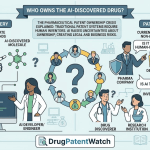
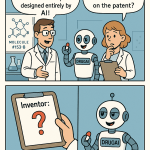
US Patent 11,530,197 B2 covers the compound that became rentosertib, the TNIK inhibitor that Insilico Medicine says is the first drug whose target and structure were both found by generative AI. Compound 112 in the patent’s claims is INS018_055, the molecule now in Phase III trials for idiopathic pulmonary fibrosis.[7] The patent names four inventors: Aleksandrs Zavoronkovs, Aleksandr Aliper, Vladimir Aladinskiy, and Andrey Kukharenko.[7] It does not name PandaOmics, the AI engine that flagged TNIK as a fibrosis target, or Chemistry42, the generative-chemistry platform that produced the molecule’s structure.[6][9] Those two systems did the work the company’s own marketing credits them with. Neither appears on the inventor line.
That is not an oversight. It is the only outcome current patent law allows anywhere in the world. This piece walks through why, using the actual court rulings, the actual USPTO guidance documents, and the actual patents filed by the two companies furthest along in AI-driven drug discovery.
The Short Answer
A human owns the inventorship line on an AI-discovered drug patent because every jurisdiction that has ruled on the question — the United States, the United Kingdom, Australia, the European Patent Office, Germany, and New Zealand — has held that an “inventor” must be a natural person.[1][3][4][14] The controlling US case is Thaler v. Vidal, decided by the Federal Circuit on August 5, 2022, which held that the Patent Act’s use of “individual” in 35 U.S.C. § 100(f) means a human being.[1] The question that remains open — and the one the USPTO has now tried to answer twice in two years — is not whether an AI can be an inventor, but which human, out of everyone who touched an AI-assisted drug program, gets to be.
What “AI-Discovered” Actually Means for a Patent Application
The Legal Test: 35 U.S.C. § 100(f) and “The Individual”
The Patent Act defines an inventor as “the individual or, if a joint invention, the individuals collectively who invented or discovered the subject matter of the invention.”[8] The statute never defines “individual.” In Thaler v. Vidal, the Federal Circuit filled that gap by importing the Supreme Court’s reasoning in Mohamad v. Palestinian Authority (2012), which held that “individual” as a noun ordinarily refers to a human being, and by citing its own 2013 precedent in University of Utah v. Max-Planck-Gesellschaft, which had already held that inventors must be natural persons and cannot be corporations or sovereigns.[10] A machine, however autonomous, is neither.
Conception, Not Computation, Is the Inventive Act
US patent law has always located the inventive act at conception — the formation, in a definite and permanent mind, of a complete idea for how to reduce something to practice — not at the labor of building or testing it. That is why a lab technician who runs the assay a chemist designed is not a co-inventor, and it is also why an AI system that runs a screening algorithm a scientist configured is not one either. The doctrine predates generative AI by decades; AI-assisted drug discovery is simply the fact pattern that has forced regulators to say the quiet part out loud.
Thaler v. Vidal: The Case That Closed the Door in the US
DABUS, the Machine That Started the Litigation
In July 2019, computer scientist Stephen Thaler filed two US patent applications naming an AI system, DABUS (Device for the Autonomous Bootstrapping of Unified Sentience), as the sole inventor of a food container and a flashing light beacon.[2] Thaler, who built and owns DABUS, executed the required inventor’s oath on the machine’s behalf and separately filed a document assigning himself DABUS’s rights as inventor.[2] The USPTO rejected both applications for lacking a valid inventor, and the US District Court for the Eastern District of Virginia granted summary judgment to the agency.[5]
The Federal Circuit’s Ruling
On appeal, the Federal Circuit affirmed unanimously (Moore, Taranto, Stark) on August 5, 2022.[1] The panel rejected Thaler’s argument that the Patent Act’s use of “whoever” elsewhere in the statute — a term that reaches corporations for infringement purposes — should extend “individual” to machines, calling the policy argument speculative and unsupported by the statutory text.[5] The Supreme Court denied certiorari on April 24, 2023, leaving the Federal Circuit’s ruling as controlling law.[5]
The Rest of the World Reached the Same Conclusion, By Different Roads
United Kingdom: A Unanimous Supreme Court
The UK Supreme Court handed down Thaler v Comptroller-General of Patents, Designs and Trade Marks on December 20, 2023, with Lord Kitchin writing for a unanimous panel that also included Lord Hodge, Lord Hamblen, Lord Leggatt, and Lord Richards.[52][57] The court held that sections 7 and 13 of the Patents Act 1977 require an inventor to be a natural person, and went further than the US courts by also rejecting Thaler’s fallback argument: that even if DABUS couldn’t be the named inventor, Thaler’s ownership of the machine entitled him to apply for and obtain the resulting patents.[49][50] The court reasoned that if there is no valid inventor, no property right in the invention ever comes into existence — so there is nothing for Thaler to have inherited from DABUS in the first place.[50] The Chartered Institute of Patent Attorneys intervened in support of Thaler’s appeal and lost.[57]
Australia’s Reversal
Australia is the one jurisdiction where a court briefly ruled the other way. In Thaler v Commissioner of Patents [2021] FCA 879, a single judge of the Federal Court held that “inventor” could include “a person or thing that invents,” reasoning that excluding AI-generated inventions from patentability would undercut the statute’s stated purpose of promoting innovation.[58][63] IP Australia appealed, and on April 13, 2022, an expanded five-judge bench of the Full Federal Court unanimously overturned that decision in Commissioner of Patents v Thaler [2022] FCAFC 62, holding that entitlement to a patent has its origin in human endeavor and that DABUS could not be named inventor under the existing regulations.[58][63] The High Court of Australia refused special leave to appeal on November 11, 2022, closing the case.[60][61] Notably, the Full Court did not simply dismiss the question — its judgment closed by urging the Australian legislature to address AI inventorship “with some urgency,” a signal that the policy question remains open even where the litigation has ended.[63]
The European Patent Office, Germany, and New Zealand
The EPO’s Legal Board of Appeal upheld the refusal of Thaler’s two European applications, holding that the European Patent Convention requires the inventor to be a natural person and that an AI machine cannot assign patent rights to an applicant.[60] New Zealand’s Intellectual Property Office reached the same result on January 31, 2022, finding that DABUS could not be “an actual devisor of the invention” under a statute that, like the others, contemplates a natural person.[62] Germany’s Federal Patent Court took a narrower middle path in its “Food Container” decision (11 W (pat) 5/21), a wrinkle that later USPTO commentary cites as evidence that even sympathetic courts have stopped short of naming a machine as inventor outright.[9][10]
The One Outlier: South Africa
South Africa’s Companies and Intellectual Property Commission granted a patent in July 2021 listing DABUS as inventor. Patent lawyers who tracked the DABUS litigation have been consistent in flagging why this is not the precedent it looks like: South Africa’s patent office does not conduct substantive examination of incoming applications, so the DABUS grant reflects a formalities-only administrative approval rather than a considered legal ruling on whether a machine can invent.[10] Every jurisdiction that has substantively examined the question — the US, UK, Australia, EPO, and New Zealand — has ruled against Thaler.[51]
Jurisdiction
Forum
Outcome for DABUS
Substantive Examination?
United States
Federal Circuit, Thaler v. Vidal (2022)
Rejected — inventor must be an “individual”
Yes
United Kingdom
Supreme Court, Thaler v Comptroller-General (2023)
Rejected — inventor must be a natural person
Yes
Australia
Full Federal Court, Commissioner of Patents v Thaler (2022)
Rejected on appeal (reversed a favorable trial ruling)
Yes
European Patent Office
Legal Board of Appeal
Rejected — EPC requires a natural person
Yes
New Zealand
IPONZ
Rejected — no “actual devisor”
Yes
South Africa
CIPC
Granted (formalities only)
No
The USPTO Has Now Written Two Different Rulebooks in Twenty Months
February 2024: Borrowing the Pannu Factors
Once Thaler v. Vidal settled that a machine cannot be an inventor, the USPTO faced a narrower and far more common question: when a human uses an AI tool to help create an invention, what does that human need to have contributed to qualify as the inventor? On February 13, 2024, under then-Director Kathi Vidal, the agency published its first answer.[11] The 2024 Guidance borrowed the three-part Pannu test — from Pannu v. Iolab Corp., 155 F.3d 1344 (Fed. Cir. 1998), a case about determining joint inventorship among multiple humans — and applied it to the human-AI relationship.[12][15] Under Pannu, a person qualifies as an inventor only if they (1) contributed in some significant manner to conception or reduction to practice, (2) made a contribution that is not insignificant in quality when measured against the full invention, and (3) did more than simply explain well-known concepts or the current state of the art to whoever actually invented it.[12][16] The 2024 Guidance held that this test applies claim-by-claim: a natural person must have significantly contributed to every individual claim in an AI-assisted patent application, not just to the invention as a general concept.[12]
Why the Framework Kept Breaking on Drug-Discovery Fact Patterns
Pannu was built to compare the relative contributions of two or more humans who all understood what they were doing and why. Applying it to a human-AI pair is a different problem: an AI drug-discovery platform doesn’t “understand” a contribution in any sense the case law anticipated, and a scientist who configures a generative-chemistry model, reviews its output, and selects a lead compound for synthesis doesn’t map cleanly onto any of the three Pannu prongs. Commentary published after the 2024 Guidance describes the fit as “ill-fitting” for exactly this reason — Pannu presumes a comparison between two inventive minds, and an AI system isn’t one.[11]
November 2025: The USPTO Starts Over
On November 26, 2025, the USPTO rescinded the 2024 Guidance in its entirety and replaced it with a shorter, differently structured framework.[17][19] The Revised Inventorship Guidance for AI-Assisted Inventions discards Pannu analysis for the single-inventor-plus-AI-tool scenario altogether. Instead, it treats AI systems — generative, analytical, or otherwise — as tools functionally equivalent to laboratory equipment, software, or a research database: things that can assist an invention without ever being capable of conceiving one.[17][20] Traditional, fact-intensive conception doctrine now applies uniformly, with no AI-specific carve-out. Pannu survives only for its original purpose: comparing the contributions of multiple human co-inventors, whether or not any of them used AI along the way.[11][20] A May 2026 analysis in the Journal of Intellectual Property Law & Practice frames the shift as a deliberate pro-innovation recalibration intended to reduce friction for AI-driven fields including drug discovery, on the theory that a simpler, tool-based framework is easier for examiners and applicants to apply consistently than a modified joint-inventorship test.[18]
Feb. 2024 Guidance
Nov. 2025 Guidance
Governing framework
Pannu factors applied to human-AI relationship
Traditional conception doctrine; no AI-specific test
AI’s legal status
Potential contributor requiring a “significant contribution” comparison
Tool, equivalent to lab equipment or software
Claim-by-claim analysis
Required — a human must contribute significantly to each claim
Not separately specified; conception doctrine applies as usual
When Pannu still applies
To the human’s contribution relative to the AI’s output
Only among multiple human co-inventors
Worked examples included
Two (transaxle, therapeutic compound)
None
According to the World Intellectual Property Organization’s 2026 Patent Trends Update in GenAI, patent families in the “molecules, genes, and proteins” data mode — the category that most directly captures AI-driven drug discovery and protein design — numbered 523 in 2023, fell to 397 in 2024, and recovered to 766 in 2025.[13]
That recovery is a calculated year-over-year swing of roughly 93% between 2024 and 2025, and a net increase of about 46% across the full three-year window — a pattern that suggests the category is smaller and more volatile than headline GenAI patenting figures, not that AI-driven drug discovery patenting is shrinking. Both figures are derived from WIPO’s published family counts and are not independently reported statistics.
Case Study One: Insilico Medicine’s Rentosertib, and the Patent That Never Mentions PandaOmics
An Eighteen-Month, AI-Prioritized Target
Insilico’s PandaOmics platform proposed TNIK (Traf2- and Nck-interacting kinase) as a novel antifibrotic target in 2019.[34] The company’s Chemistry42 generative-chemistry platform then designed and optimized a selective TNIK inhibitor, a process the company says took under 18 months from target identification to preclinical candidate nomination in February 2021, with fewer than 80 molecules synthesized and tested along the way.[34] The resulting molecule, INS018_055, entered Phase I trials, then a Phase IIa trial (GENESIS-IPF, NCT05938920) whose results — the first published clinical proof-of-concept for a drug whose target and structure were both AI-generated — appeared in Nature Medicine on June 3, 2025.[22][29] The compound received the official nonproprietary name rentosertib from the US Adopted Names Council in early 2026, and Phase III (CTR20262475, NCT07687459) began in mid-2026.[21][25]
Chemistry42 Generates the Molecule; Four Named Humans Own the Patent
US Patent 11,530,197 B2, titled “Analogs for the Treatment of Disease,” was filed February 23, 2022, claims priority to a February 24, 2021 application, and granted December 20, 2022, with an adjusted expiration date of March 6, 2042.[7] It is assigned to InSilico Medicine IP Limited and InSilico Medicine Hong Kong Limited.[7] Patent analyst Rose Hughes’s review of the filing for the IP blog IPKat identified Compound 112, claimed in claim 5, as the molecule corresponding to INS018_055, based on its reported human liver microsome stability and TNIK-inhibition data matching the values disclosed in Insilico’s own Nature Biotechnology paper.[30][37] The four named inventors — Zavoronkovs, Aliper, Aladinskiy, and Kukharenko — are also co-authors on that 2024 Nature Biotechnology paper alongside more than twenty other scientists, none of whom appear on the patent.[35][37]
Where the Patent and the Paper Diverge
The Nature Biotechnology paper walks through the AI discovery pipeline in detail: how PandaOmics scored and ranked TNIK against competing fibrosis targets, and how Chemistry42 generated and iterated candidate structures.[34][37] The patent itself does not describe how the claimed compounds were originally identified — it presents the synthesis routes, structural formulas, and biological assay data needed to satisfy the enablement requirement, without narrating the discovery process behind them.[37] That gap is legally unremarkable: US patent law asks whether a person skilled in the art could practice the claimed invention from the specification, not how the applicant happened to arrive at it. A composition-of-matter patent has never been required to explain its own discovery story, AI-assisted or not.[37]
Why That Gap Is a Deliberate Choice, Not an Oversight
Hughes’s analysis frames the disclosure gap as a live strategic tension rather than an accident. Describing the AI-driven discovery process inside a patent specification could strengthen the application in jurisdictions — Europe among them — where the inventive story carries more weight in a validity challenge, potentially supporting broader claims.[37] But disclosing that same process risks revealing infringement of other companies’ AI-platform patents, and raises exactly the inventorship-scrutiny question this piece is about: the more detail a company puts on record about which system generated which output, the more exposed its human-only inventor list becomes to a future challenge.[37] Insilico’s choice — publish the AI story in a journal, keep the patent silent on it — reflects one answer to that trade-off. Traditional pharmaceutical companies developing AI-assisted candidates in-house are likely to make the same choice for the same reason, even without Insilico’s public profile as an AI-first drug discovery company.[37]
Case Study Two: Exscientia’s DSP-1181 and the “Centaur Chemist” Problem
Three Hundred Fifty Compounds, Twelve Months, One Candidate
DSP-1181, a serotonin 5-HT1A receptor agonist developed with Sumitomo Dainippon Pharma for obsessive-compulsive disorder, entered Phase I trials in Japan in January 2020 — the industry’s first announced case of an AI-designed small molecule reaching human trials.[42][45] The companies say Exscientia’s Centaur Chemist platform, paired with Sumitomo’s monoamine-GPCR expertise, compressed the exploratory research phase to under 12 months against a typical average of 4.5 years, and reached a clinical candidate after synthesizing roughly 350 compounds rather than the approximately 2,500 a conventional program might screen.[80] That 350-versus-2,500 comparison is Exscientia and Sumitomo’s own reported figure, not an independently audited count, but it is the number both companies have used consistently in public statements since 2020.[75][80]
US10800755: Three Claimed Molecules
A structural analysis published by CAS, the scientific-information division of the American Chemical Society, found that only three molecules are specifically claimed in US Patent 10,800,755, one of two granted patents covering the DSP-1181 chemical family, corresponding to Examples 1, 8, and 11 in the specification.[40] CAS’s analysis also found that all three claimed molecules share a structural shape with haloperidol, a first-generation antipsychotic the FDA approved in 1967 — a finding CAS used to question how structurally novel the “AI-designed” label really implies, independent of the inventorship question.[40] The patent’s specification discloses 38 exemplified molecules with bioactivity data, which CAS calculates represents about 11% of the roughly 350 compounds Exscientia and Sumitomo say the AI-assisted program synthesized and tested.[40] As with Insilico’s TNIK patent, the compound-of-matter claims stand on synthesis routes and biological data; nothing in the public reporting on this filing suggests Centaur Chemist itself is listed anywhere on the inventor line.
An Original Taxonomy: Four Levels of AI Involvement and Where Inventorship Risk Concentrates
Not every AI touchpoint in a drug program carries the same inventorship exposure. Based on the conception doctrine both the 2024 and 2025 USPTO guidances share as their foundation, AI contributions to a drug program can be sorted into four levels of increasing legal exposure for whoever signs the inventor declaration.
Level 1 — Literature and Data Triage
AI used to search, rank, or summarize existing literature, patents, or assay data — the equivalent of a faster PubMed search. This is the least legally novel category: courts have never treated a literature search tool as a candidate for inventorship, AI-powered or not.
Level 2 — Target Prioritization
Platforms like PandaOmics that rank disease targets against omics data and propose a novel target, as it did with TNIK.[34] Target selection can be part of conception, but identifying a target is several steps removed from conceiving a specific claimed compound — the gap that let Insilico’s patent claims stand on synthesis and assay data without needing to describe PandaOmics at all.
Level 3 — Generative Structure Design
Platforms like Chemistry42 or Centaur Chemist that generate and optimize specific candidate structures against a chosen target. This is the level at which the inventorship question gets hardest, because the AI’s output is the literal molecule the patent claims — which is exactly why the humans who configure, constrain, review, and select from that output need a documented, substantive role to satisfy conception doctrine.
Fully automated cycles where an AI system proposes a structure, an automated lab synthesizes and tests it, and the results feed back into the next AI-generated proposal with minimal human review at each cycle. No drug approved or in late-stage trials today runs this way end to end — both Insilico and Exscientia describe human chemists reviewing and selecting compounds at each stage — but it is the scenario the USPTO’s tool-based framework will eventually have to be tested against, since it is the case with the thinnest documented human conception.
What the November 2025 Guidance Changes for Pharma IP Strategy
Documentation Still Wins Inventorship Fights
Whether an examiner or a court applies the discarded 2024 Pannu-based test or the current tool-based framework, the underlying evidentiary problem for an AI-heavy drug program is identical: someone has to be able to describe, with particularity, what a specific human contributed to conceiving a specific claimed compound. A resource platform like DrugPatentWatch, which tracks patent filings and their named inventors of record across the industry, is one place that inventorship pattern becomes visible at scale — it is possible to see, filing after filing, that the AI platform name appears in the press release and the human names appear on the patent, exactly as with Insilico’s TNIK filing. That pattern is not going to change under either version of the USPTO’s guidance, because both versions agree on the one point that actually decides these cases: only a natural person can conceive an invention.
Correcting Inventorship After the Fact
US patent law already has a mechanism for fixing inventorship errors discovered after filing or even after grant: 35 U.S.C. § 256 allows a patent to be corrected to add or remove an inventor without invalidating it, provided the error was made without deceptive intent. That mechanism matters more, not less, in an AI-assisted drug program, because the people who actually reviewed and selected a generative platform’s output are not always the same people who show up on an initial inventor declaration drafted before all the downstream chemistry and biology work is finished. A company that documents contemporaneously — who configured the model, who reviewed which outputs, who selected which compound for synthesis and why — has a corrigible record if the initial inventor list turns out to be wrong. A company that only reconstructs that story after a challenge is filed does not.
Frequently Asked Questions
Can an AI system be listed as an inventor on a US patent?
No. The Federal Circuit held in Thaler v. Vidal (2022) that the Patent Act’s definition of “inventor” requires a natural person, and the Supreme Court declined to review that ruling in 2023, leaving it as controlling law.[1][5]
What exactly did Thaler v. Vidal decide?
That an AI system, DABUS, could not be named as the sole inventor on two patent applications because the term “individual” in 35 U.S.C. § 100(f) means a human being, following the Supreme Court’s reasoning in Mohamad v. Palestinian Authority and the Federal Circuit’s own prior ruling in University of Utah v. Max-Planck-Gesellschaft.[1][10]
Did any country rule the opposite way?
Only briefly, and only at trial level. A single Australian Federal Court judge ruled in Thaler’s favor in 2021, but a five-judge Full Federal Court unanimously reversed that decision in 2022, and Australia’s High Court refused to hear a further appeal.[58][63] South Africa’s patent office granted a DABUS patent, but that office does not substantively examine applications, so the grant reflects a formalities check rather than a legal ruling on AI inventorship.[10]
Does the USPTO’s November 2025 guidance let AI be named as an inventor?
No. It reaffirms that only natural persons can be inventors and treats AI systems as tools, comparable to laboratory equipment or software, rather than potential contributors to inventorship analysis.[17][20]
Who is named on Insilico Medicine’s patent covering rentosertib?
US Patent 11,530,197 B2 names four inventors: Aleksandrs Zavoronkovs, Aleksandr Aliper, Vladimir Aladinskiy, and Andrey Kukharenko. It does not name PandaOmics or Chemistry42, the AI platforms Insilico credits with identifying the drug’s target and generating its structure.[7][34]
Does a drug patent have to disclose that AI was used to discover the compound?
No. US enablement doctrine asks whether a skilled person could practice the claimed invention from the specification, not how the applicant arrived at it. Insilico’s TNIK patent does not describe its AI discovery pipeline even though the company’s own Nature Biotechnology paper does, in detail.[34][37]
What are the Pannu factors, and do they still apply to AI-assisted inventions?
The Pannu factors are a three-part joint-inventorship test from Pannu v. Iolab Corp. (Fed. Cir. 1998). The USPTO’s February 2024 guidance applied them to the human-AI relationship; its November 2025 guidance rescinded that approach and now applies Pannu only when comparing multiple human co-inventors, never a human against an AI tool.[12][17]
Can a company fix its inventor list if it later turns out to be wrong?
Yes, in most cases. 35 U.S.C. § 256 allows correction of inventorship on an issued patent without invalidating it, as long as any error occurred without deceptive intent — which is why contemporaneous documentation of who reviewed and selected an AI platform’s output matters even after a patent has already been filed.
Is DSP-1181’s patent family evidence that AI designs are structurally novel?
Not according to CAS’s structural analysis, which found that the three molecules specifically claimed in US10800755 share a shape with haloperidol, a 1967-approved antipsychotic — a finding used to question how much AI-assisted design changes the structural novelty of the resulting compound, separate from the inventorship question.[40]
What should a pharma company running an AI-assisted discovery program do differently?
Document, as the work happens, which specific human reviewed and selected each AI-generated output and why — not just that a platform generated candidates. Under either the 2024 or the 2025 USPTO framework, that record is what supports the inventor declaration; the AI platform’s name has never been able to appear on it, and nothing on the horizon suggests that changes.
Key Takeaways
Every jurisdiction that has substantively examined the question — the US, UK, Australia, the EPO, and New Zealand — has ruled that an AI system cannot be a patent inventor; South Africa’s contrary grant reflects a non-substantive filing system, not a legal ruling.[1][51][60][62][63]
Thaler v. Vidal (Fed. Cir. 2022) is the controlling US precedent, and the Supreme Court declined to revisit it in 2023.[1][5]
The USPTO rescinded its February 2024 Pannu-based inventorship guidance in November 2025 and replaced it with a framework that treats AI purely as a tool, applying traditional conception doctrine without an AI-specific test.[17][19][20]
US Patent 11,530,197 B2, covering the compound behind rentosertib, names four human inventors and does not name Insilico’s PandaOmics or Chemistry42 AI platforms, despite both being credited publicly with the drug’s discovery.[7][34]
Composition-of-matter patents are not required to disclose the AI discovery process behind a claimed compound, even when the same company discloses that process in a peer-reviewed paper.[37]
WIPO’s GenAI patent-family data for molecules, genes, and proteins shows a non-linear pattern — 523 families in 2023, 397 in 2024, 766 in 2025 — a roughly 93% year-over-year increase from 2024 to 2025 and a 46% net increase across the full period, both figures calculated from WIPO’s published counts.[13]
References
Thaler v. Vidal, 43 F.4th 1207 (Fed. Cir. 2022).
Akin. (2022, August 11). Federal Circuit Confirms “Inventor” Must Be Human, Not AI. https://www.akingump.com/en/insights/alerts/federal-circuit-confirms-inventor-must-be-human-not-ai
Thaler v Comptroller-General of Patents, Designs and Trade Marks [2023] UKSC 49.
Commissioner of Patents v Thaler [2022] FCAFC 62.
CASRAI. Can AI Be a Patent Inventor? Thaler v. Vidal. https://casrai.org/guides/ai-patent-inventor-thaler-v-vidal-uspto-guidance
IPKat (Hughes, R.). (2025, February 4). Insilico Medicine: Lessons in IP strategy from a front-runner in AI-drug discovery. https://ipkitten.blogspot.com/2025/02/insilico-medicine-lessons-in-ip.html
US Patent No. 11,530,197 B2. Analogs for the Treatment of Disease. InSilico Medicine IP Limited. https://patents.google.com/patent/US11530197B2/en
ArentFox Schiff. Federal Circuit Holds That AI Cannot Be an “Inventor” Under the Patent Act. https://www.afslaw.com/perspectives/ai-law-blog/federal-circuit-holds-ai-cannot-be-inventor-under-the-patent-act-only
Holland & Knight. (2022, October 4). Revisiting AI Inventorship in Thaler v. Vidal. https://www.hklaw.com/en/insights/publications/2022/10/revisiting-ai-inteventorship-in-thaler-v-vidal
Holland & Knight. (2026, February 3). The Human Element: USPTO Clarifies Inventorship for AI-Assisted Inventions. https://www.hklaw.com/en/insights/publications/2026/02/the-human-element-uspto-clarifies-inventorship
Foley & Lardner. Takeaways From USPTO’s AI-Assisted Invention Guidance. https://www.foley.com/insights/publications/2024/03/takeaways-uspto-ai-assisted-invention-guidance/
National Law Review. Global AI Patent Surge: Trends, Dominance, and Strategy [citing WIPO Patent Trends Update in GenAI, 2026]. https://natlawreview.com/article/global-ai-patent-surge-trends-dominance-and-strategy
Holland & Knight. (2026, March). The Final Word? Supreme Court Refuses to Hear Case on AI Authorship and Inventorship. https://www.hklaw.com/en/insights/publications/2026/03/the-final-word-supreme-court-refuses-to-hear-case-on-ai-authorship
IPWatchdog. USPTO Issues New AI Inventorship Guidance, Snubs Vidal’s Approach. https://ipwatchdog.com/2025/11/26/uspto-issues-new-ai-inventorship-guidance-snubs-vidals-approach/
Sullivan & Cromwell. USPTO Guidance on Inventorship for AI-Assisted Inventions. https://www.sullcrom.com/SullivanCromwell/_Assets/PDFs/Memos/USPTO-Guidance-Inventorship-AI-Assisted-Inventions.pdf
Morgan Lewis. (2025, December 3). USPTO Issues Revised Inventorship Guidance for AI-Assisted Inventions. https://www.morganlewis.com/pubs/2025/12/uspto-issues-revised-inventorship-guidance-for-ai-assisted-inventions
Aboy, M., & Liddell, K. (2026). Revised USPTO guidance on inventorship for AI-assisted inventions: a pro-innovation pivot away from Pannu factors. Journal of Intellectual Property Law & Practice, 21(5), 272–275. https://doi.org/10.1093/jiplp/jpag021
Federal Register. (2025, November 28). Revised Inventorship Guidance for AI-Assisted Inventions. https://www.federalregister.gov/documents/2025/11/28/2025-21457/revised-inventorship-guidance-for-ai-assisted-inventions
Baker Botts. USPTO Publishes New Inventorship Guidance for “AI-Assisted Inventions.” https://ourtake.bakerbotts.com/post/102lw66/uspto-publishes-new-inventorship-guidance-for-ai-assisted-inventions
Insilico Medicine. Insilico Initiates Phase III Clinical Trial for Rentosertib. https://insilico.com/news/xmjsn4l091-insilico-initiates-phase-iii-clinical-tr
Ren, F., Aliper, A., Chen, J., et al. (2024). A small-molecule TNIK inhibitor targets fibrosis in preclinical and clinical models. Nature Biotechnology. https://doi.org/10.1038/s41587-024-02143-0
Nature Medicine. (2025, June 3). A generative AI-discovered TNIK inhibitor for idiopathic pulmonary fibrosis: a randomized phase 2a trial. https://www.nature.com/articles/s41591-025-03743-2
Qiming Venture Partners. Insilico Medicine’s Study Published in Nature Biotechnology. https://www.qimingvc.com/en/news/insilico-medicines-study-published-nature-biotechnology-first-novel-tnik-inhibitors-fibrotic
Drug Target Review. First AI-designed drug, Rentosertib, officially named by USAN. https://www.drugtargetreview.com/first-ai-designed-drug-rentosertib-officially-named-by-usan/647365.article
CAS. AI drug discovery: assessing the first AI-designed drug candidates for humans. https://www.cas.org/resources/cas-insights/ai-drug-discovery-assessing-the-first-ai-designed-drug-candidates-to-go-into-human-clinical-trials
Healthcare IT News. Sumitomo Dainippon Pharma and Exscientia achieve breakthrough in AI drug discovery. https://www.healthcareitnews.com/news/asia/sumitomo-dainippon-pharma-and-exscientia-achieve-breakthrough-ai-drug-discovery
C&EN (ACS). Sumitomo Dainippon puts drug developed with artificial intelligence in the clinic. https://cen.acs.org/pharmaceuticals/drug-development/Sumitomo-Dainippon-puts-drug-developed/98/i6
White & Case. UK Supreme Court Rules Against AI Inventorship of Patents. https://www.whitecase.com/insight-our-thinking/uk-supreme-court-rules-against-ai-inventorship-patents
DLA Piper. UK Supreme Court confirms inventor must be a real person. https://www.dlapiper.com/en/insights/publications/2023/12/uk-supreme-court-confirms-inventor-must-be-a-real-person
Kluwer Patent Blog. The End of the Road for DABUS and Dr Thaler at the UK Supreme Court. https://legalblogs.wolterskluwer.com/patent-blog/the-end-of-the-road-for-dabus-and-dr-thaler-at-the-uk-supreme-court/
National Law Review. Australia Reverses Stance on Patents for AI-Generated Inventions. https://natlawreview.com/article/australia-re-aligned-major-jurisdictions-ai-based-inventorship
IPWatchdog. DABUS Sent Back to Drawing Board Following Reversal of Inventorship Decision by Australia Court. https://ipwatchdog.com/2022/04/17/dabus-sent-back-drawing-board-following-reversal-inventorship-decision-australia-court/
JUVE Patent. EPO decision another setback in Dabus quest for inventorship. https://www.juve-patent.com/cases/epo-decision-another-setback-in-dabus-quest-for-inventorship/