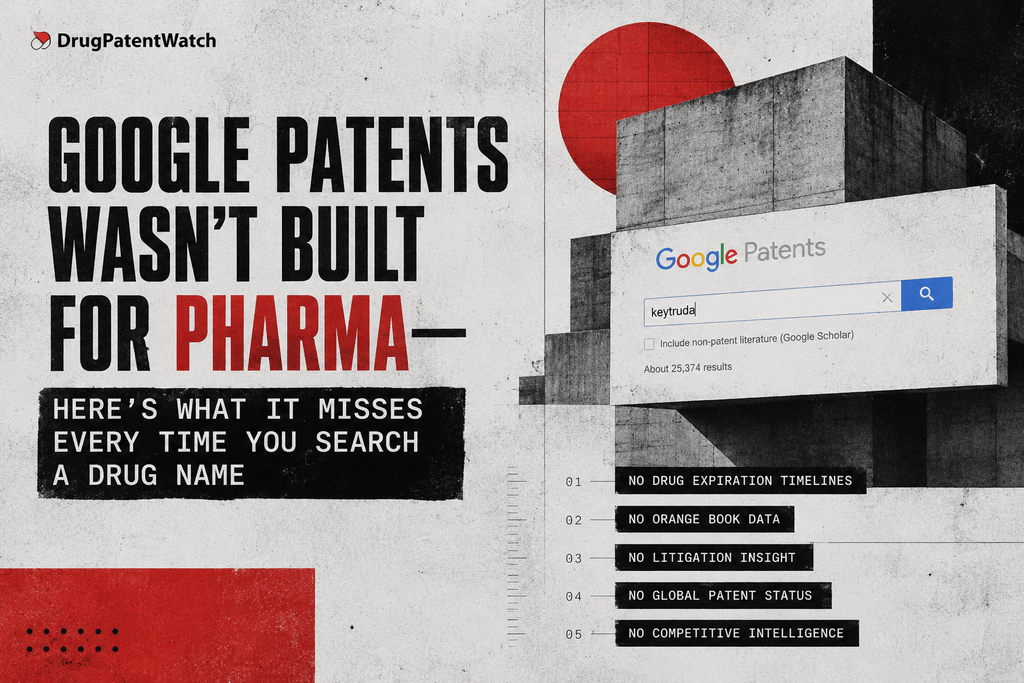
Google Patents is a free document index built for general-purpose prior art search. It has no connection to the FDA Orange Book, no structured link between a patent number and an approved drug product, no Hatch-Waxman litigation clock, and no Markush structure search. When you type a drug’s brand name, generic name, or code name into the search box, you get a list of documents ranked by keyword relevance — not the set of patents that actually protect that drug, not their FDA-adjusted expiration dates, and not their litigation status under the Paragraph IV framework that governs when a generic or biosimilar can launch. Two real examples make the gap concrete: Eliquis’s core composition patent picked up more than four and a half years of life through two separate regulatory extensions that don’t originate in the patent document itself, and Humira’s 132 granted U.S. patents span so many unrelated priority chains that no single “patent family” view on Google Patents will ever return them as one set.
What Google Patents Actually Is (and Isn’t)
A Free Index, Not a Regulatory Database
Google Patents launched in December 2006, built on the same infrastructure Google used for Google Books. Full European Patent Office coverage and a “Prior Art Finder” tool arrived in 2012; the World Intellectual Property Organization, Germany’s DPMA, Canada’s CIPO, and China’s CNIPA were added in 2013. Global litigation indicators — links out to third-party case data — were not added until 2018.[2] Today the tool indexes more than 120 million patent publications from over 100 patent offices, though full-text search only works reliably for documents originating from roughly 20 to 22 of those offices; the rest is metadata, abstracts, or machine-translated text.[1]
What “120 Million Patent Publications” Actually Covers
Google’s own coverage page is explicit that the company cannot guarantee complete coverage of any patent office, and it invites users to file feedback when documents are missing.[1] Non-English documents are machine-translated into English so they remain searchable by keyword, which is useful for a first pass but not for reading claim scope, where a single word — “comprising” versus “consisting of” — changes what the claim legally covers.
How Legal Status and Litigation Data Get Onto the Page
Every Google Patents record carries a “Legal status” module. The interface itself states, on essentially every patent page, that this status is an assumption rather than a legal conclusion, and that Google has performed no legal analysis and makes no representation about its accuracy.[4] Litigation flags that appear on some records — a line noting a case was filed in a specific district court — come from two licensed third-party feeds, Unified Patents Litigation Data and the Darts-ip global litigation dataset, integrated starting in 2018.[2][3] Those feeds are useful signals. They were not built to track the specific procedural machinery of Hatch-Waxman litigation.
The Seven Things That Break When You Search a Drug Name
1. No Link to the FDA-Approved Product
A patent number is not the same thing as a drug’s regulatory status. The FDA’s Orange Book — formally “Approved Drug Products with Therapeutic Equivalence Evaluations” — exists specifically to connect the two. Under 21 CFR 314.53, an NDA holder must submit every patent that claims the drug substance, the drug product, or an approved method of use, within 30 days of approval or patent issuance; manufacturing process patents are excluded by regulation.[5][6] Google Patents has no equivalent concept. It cannot tell you which of a company’s hundreds of pharmaceutical patents are actually Orange Book-listed against a specific NDA, and it has no field for a patent’s use code or its associated exclusivity code — both of which the Orange Book tracks explicitly.[6]
What the Orange Book Tracks That Google Patents Doesn’t
A single Orange Book listing carries the application number, proprietary name, applicant, dosage form, route of administration, strength, therapeutic equivalence code, patent number, patent expiration date, use code, exclusivity code, and exclusivity expiration date, all tied to one approved product.[8] None of those fields exist on a Google Patents record. The FDA’s role in populating them is also worth noting: the agency does not evaluate whether a listed patent is valid or even correctly listed. Listing is self-reported by the NDA holder and treated by FDA as ministerial.[7]
2. “Legal Status” Is Not Litigation Status
Because the Unified Patents and Darts-ip feeds are general-purpose litigation datasets, not pharma-specific ones, a Google Patents record can show a litigation flag without indicating whether that case was an ANDA Paragraph IV suit, an Inter Partes Review, a biosimilar BPCIA dispute, or ordinary commercial infringement litigation unrelated to generic entry.[3]
What the Darts-ip/Unified Patents Feed Actually Covers
The feed can show that a case was filed and in which court. It does not show the Hatch-Waxman-specific facts that determine generic-entry timing: whether a 45-day paragraph IV notice triggered the automatic 30-month FDA stay, which applicant holds 180-day first-filer exclusivity, or whether the parties reached a settlement with an agreed entry date. Both Eliquis and Humira, covered below, show why that distinction matters in dollar terms.
3. A Patent “Family” Isn’t the Same as a Drug’s Patent Estate
Google Patents displays a “family” of related documents for any patent you open. That family is built from shared priority claims — the technical definition used across the patent information industry.[10]
Simple Family vs. Extended Family vs. Drug Estate
The European Patent Office distinguishes a “simple family,” where every member shares exactly the same priority document or combination of priorities, from an “INPADOC” or extended family, where members need only share a priority indirectly through a chain of documents.[10] Neither concept maps onto what a pharma analyst actually needs: the full set of patents protecting one approved drug product. A drug’s patent estate typically spans several unrelated priority chains — a compound patent filed at discovery, a salt or polymorph patent filed years later, a formulation patent from a separate research program, a delivery-device patent, and one or more method-of-use patents tied to later-approved indications. None of those share a priority document with the others, so no single “family” tab on Google Patents will ever return them together.
4. Expiration Dates Rarely Show the Full Regulatory Picture
A US utility patent’s base term is 20 years from its earliest effective filing date. Google Patents shows an “Adjusted expiration” for US patents that accounts for Patent Term Adjustment (PTA) under 35 U.S.C. §154(b), which compensates for USPTO examination delay. What that adjustment does not automatically capture, in the way a pharma-specific database does, is Patent Term Extension (PTE) under 35 U.S.C. §156 — a separate mechanism tied to FDA regulatory review time, capped at five years, and granted only for one patent per approved product — or the additional six-month pediatric exclusivity extension the FDA grants for completed pediatric studies.[8]
How Eliquis’s Composition Patent Picked Up Five Extra Years
Apixaban’s composition-of-matter patent, US 6,967,208, was filed September 17, 2002. A 20-year base term put its original expiration at September 17, 2022. A PTE grant extended the patent by just over four years, to November 21, 2026; pediatric exclusivity then added six more months, pushing the effective date to May 21, 2027.[13][14] A separate formulation patent, US 9,326,945, expires February 24, 2031 on its base term, extended to August 24, 2031 with pediatric exclusivity.[13][14] None of that chain is visible from a base-term calculation, and litigation settlement terms add a third layer entirely outside the patent documents: under agreements between Bristol-Myers Squibb, Pfizer, and generic filers, most generic manufacturers are permitted to launch April 1, 2028 — three years and four months before the formulation patent’s final expiration — while filers who did not settle remain bound to the 2031 date.[14] As of Bristol-Myers Squibb’s most recent quarterly SEC filing, the company and Pfizer had filed a new infringement suit in November 2025 against an applicant seeking to market apixaban in the US, and the underlying composition patents and related supplementary protection certificates expire in the EU in November 2026 — confirming the fight is still active on multiple fronts as of this writing.[15]
5. Markush Claims Are Functionally Invisible
Named for a 1924 patent application by Eugene Markush, a Markush claim describes a genus of chemical compounds sharing a core scaffold with variable substituent groups (commonly written as R1, R2, and so on), rather than a single molecule.[11] A single Markush claim in a pharmaceutical patent can cover a functionally unlimited number of specific compounds — the TAK-831 patent claim is a documented real-world example of a core structure with two R-group positions generating a combinatorial space too large to enumerate individually.[12] Determining whether a specific compound falls inside that claim requires computational substructure search against the Markush definition. Google Patents offers keyword and citation search, not chemical substructure search, so a compound can sit squarely inside a competitor’s Markush claim and never surface as a hit.
6. Coverage Thins Out in the Markets Generics Actually Come From
Google’s own documentation limits full-text indexing to roughly 20 to 22 patent offices out of the 100-plus it lists.[1] India, a primary source of generic and API manufacturing, and China, an increasingly active filer of pharmaceutical patents, are not among the offices with the most reliable full-text coverage, and non-English filings from those and other jurisdictions rely on machine translation rather than professional legal translation.[1]
7. Drug Name Synonyms Can Make a Keyword Search Miss the Patent Entirely
Pharmaceutical patents are rarely filed under the brand name a search would naturally use. Apixaban’s own patent family illustrates the pattern: the compound was referred to internally as BMS-562247-01 before Eliquis existed as a marketed name, and later-filed patents reference it by chemical name — “1-(4-methoxyphenyl)-7-oxo-6-[4-(2-oxopiperidin-1-yl)phenyl]-4,5-dihydropyrazolo[5,4-c]pyridine-3-carboxamide” — rather than “apixaban” or “Eliquis” in the claims themselves. A keyword search on the brand name alone, without also searching the INN, the development code, and the chemical name, will systematically undercount the relevant patent set.
A 2024 JAMA Internal Medicine analysis of the 10 top-selling US prescription drugs in 2021 found that patent-thicket density peaked 13 years after FDA approval, at which point the drugs were protected by a median of 42 active patents (interquartile range 18–83) — 66% of them filed after the drug was already on the market.[18]
Case Study: What “Apixaban” Returns on Google Patents vs. What It Should
Search “apixaban” on Google Patents and the results page returns dozens to hundreds of documents by keyword relevance: the original composition patent, formulation patents from Bristol-Myers Squibb and Pfizer, and a long tail of process and polymorph patents filed by generic manufacturers themselves as they design around the originator’s claims. What that results page cannot organize for you is the two-tier legal reality that actually controls generic entry. Thirteen distinct applicants held approved ANDAs for apixaban as of a June 2026 Orange Book snapshot, and their permitted launch dates split into two groups: a settled cohort cleared to enter April 1, 2028, and litigated holdouts bound to the formulation patent’s final August 24, 2031 expiration.[14] That split is a function of confidential settlement agreements and court dockets, not of anything encoded in the patent documents Google Patents indexes. A search that stops at “when does the patent expire” will misprice the actual generic-entry date by more than three years in either direction depending on which cohort a given filer belongs to.
Case Study: Humira and the 247-Patent Estate No Single Search Surfaces
AbbVie filed approximately 247 US patent applications covering Humira (adalimumab) and was granted 132 of them, according to research by the nonprofit Initiative for Medicines, Access & Knowledge (I-MAK); 89% of those applications were filed after the drug’s original 2002 FDA approval.[16] Independent legal scholarship citing the same I-MAK dataset places the estate’s final expiration as late as 2037.[17] Those 132 granted patents are not one Google Patents “family” — they represent dozens of separately filed priority chains covering the adalimumab molecule itself, its manufacturing processes, its 50 mg/mL and 100 mg/mL formulations, its delivery devices, and its later-approved indications. A researcher who opens Humira’s original composition patent on Google Patents and clicks through to its family tab will see a small cluster of directly related filings — not the 132-patent estate that actually governed when biosimilars could enter. That estate is precisely why, even though the core composition patent expired in 2016, the first US biosimilar did not launch commercially until January 2023: every biosimilar developer negotiated a settlement rather than litigate the full thicket patent by patent.[16][17]
What Google Patents Is Actually Good For
None of this makes Google Patents useless. Its Cooperative Patent Classification tagging lets a researcher browse pharmaceutical formulation art by subject matter rather than by guessing keywords, which is a genuine advantage over pure text search for early-stage novelty checks. Its integration of Google Scholar and Google Books content brings non-patent literature into the same search interface, closing a real gap that patent-only databases leave open. And it is free, fast, and requires no training to produce a usable first-pass reading list. The failure mode is not that Google Patents is a bad product for what it was built to do. It is that “what it was built to do” — general document search — is a different job than pharmaceutical patent intelligence, and the interface gives no warning about where that gap sits.
Used together, these tools cover more ground than any one of them alone: Google Patents and USPTO Patent Public Search are strong for finding and reading the underlying documents; the Orange Book and Purple Book are the authoritative source for what is actually listed against an approved product; and a specialized pharma IP platform is built to connect the two and layer litigation and exclusivity data on top. DrugPatentWatch is one such platform, built specifically to map that patent-to-product connection — but the FDA’s own Orange Book and Purple Book remain the primary regulatory source of record, and no downstream analysis should substitute for checking them directly.
Methodology
This article draws on four categories of evidence: Google’s own documentation of Google Patents’ coverage and disclaimers, examined directly on live patent record pages; FDA and USPTO primary sources describing the Orange Book, Patent Public Search, and the statutory listing framework under 21 CFR 314.53; a peer-reviewed patent-thicket study (Horrow et al., JAMA Internal Medicine, 2024) and nonprofit patent-count research (I-MAK) for the Humira and industry-wide statistics; and primary transactional and litigation records — an SEC quarterly filing and third-party analyses citing FDA Orange Book snapshots — for the Eliquis case study. All patent numbers, dates, and figures cited are drawn from these sources as of August 2026; patent litigation and settlement terms can change, and readers evaluating a specific drug should confirm current status directly against the FDA Orange Book, the USPTO’s Patent Term Extension records, and current litigation dockets rather than relying on any single secondary source, including this one.
What This Means for FTO, Licensing, and Litigation Prep
For freedom-to-operate work, a Google Patents search that returns a clean result set provides no assurance against Markush infringement risk, since the tool cannot run a substructure search against a competitor’s genus claim. For generic-entry timing, a Google Patents expiration date should be treated as a floor, not an answer — the real date depends on whether a PTE was granted, whether pediatric exclusivity was added, and whether a settlement agreement moved the date earlier or later than the patent term itself. For portfolio and licensing due diligence, “family size” on Google Patents systematically understates a drug’s true patent estate, because compound, formulation, device, and method-of-use patents rarely share priority documents. In every one of these cases, the correction is the same: treat Google Patents as a starting point for locating documents, and treat the FDA Orange Book, litigation dockets, and a purpose-built pharma patent database as the tools that answer the actual business question.
Key Takeaways
Google Patents indexes more than 120 million patent publications from over 100 offices, but reliable full-text search covers roughly 20–22 of those offices, and the platform’s own interface states that legal status and expiration data are assumptions, not legal conclusions.[1][4]
The FDA Orange Book is the only database that links a patent to an approved drug product, complete with use codes and exclusivity codes; Google Patents has no equivalent linkage.[5][6][8]
Litigation flags on Google Patents come from the Unified Patents and Darts-ip datasets, added in 2018, and do not track Hatch-Waxman-specific mechanics such as the 45-day notice period or the 30-month FDA stay.[2][3]
Eliquis’s composition patent moved from a 2022 base expiration to a 2027 effective date through a Patent Term Extension plus pediatric exclusivity — two regulatory layers outside the patent document — while a separate settlement lets most generic filers launch in 2028, years before the litigated cohort’s 2031 date.[13][14][15]
AbbVie was granted 132 of roughly 247 US patent applications filed on Humira, 89% of them after FDA approval; those patents span dozens of unrelated priority chains that no Google Patents “family” view returns as one set.[16][17]
A 2024 JAMA Internal Medicine study of the 10 top-selling US drugs found patent-thicket density peaking at a median of 42 active patents 13 years after approval, two-thirds of them filed post-approval.[18]
FAQ
Does Google Patents show FDA Orange Book data? No. Google Patents has no field for Orange Book use codes, exclusivity codes, or application numbers. The Orange Book must be searched separately at the FDA’s own database.[5]
Can I trust the expiration date Google Patents shows for a drug patent? Treat it as a starting estimate. Google Patents’ “Adjusted expiration” reflects USPTO Patent Term Adjustment for examination delay, but a drug patent’s true effective date can also depend on a separately granted Patent Term Extension under 35 U.S.C. §156 and pediatric exclusivity, neither of which is guaranteed to be reflected automatically, as the Eliquis case shows.[8][13][14]
Why doesn’t searching a brand name on Google Patents return all the relevant patents? Pharmaceutical patents are typically filed under an internal development code or a chemical name, not the eventual brand name, so a brand-name-only keyword search will miss patents that never mention that name in their text.
What is a Markush claim, and why does it matter for patent search? A Markush claim describes a genus of chemical compounds sharing a core scaffold with variable substituent positions, first used in a 1924 patent application by Eugene Markush.[11] A single such claim can cover a combinatorially large set of compounds, and determining whether a specific molecule falls inside it requires chemical substructure search — a capability Google Patents does not offer.
Does Google Patents show pharmaceutical litigation? It shows litigation indicators sourced from the Unified Patents and Darts-ip datasets, added to the platform in 2018.[2][3] These flag that a case exists and where it was filed, but they are not built to track ANDA-specific Hatch-Waxman procedure, including the 30-month FDA stay or first-filer exclusivity status.
Is Google Patents’ family view the same as “all the patents protecting this drug”? No. Google Patents families are built from shared patent priority documents. A drug’s actual patent estate typically includes compound, salt, formulation, device, and method-of-use patents filed at different times with different priority chains, so they rarely appear in the same family view.[10]
What’s the difference between the USPTO’s Patent Public Search and Google Patents? Patent Public Search, which replaced the USPTO’s legacy PatFT, AppFT, PubEAST, and PubWEST tools in September 2022, is built on the same search infrastructure USPTO examiners use and covers US patents and applications with examiner-grade Boolean search.[9] It has broader and more precise US search functionality than Google Patents but, like Google Patents, has no FDA regulatory or Orange Book linkage.
How many patents typically protect a top-selling drug? A 2024 JAMA Internal Medicine study of the 10 top-selling US prescription drugs of 2021 found a combined 1,429 patents and pending applications, of which 742 (52%) had issued, 218 (15%) were pending, and 469 (33%) had been abandoned; 72% of the total were filed after FDA approval.[18][19]
Why did Humira biosimilars take until 2023 to launch when the core patent expired in 2016? AbbVie’s estate of 132 granted US patents around Humira — spanning formulation, manufacturing, and device claims filed largely after the drug’s 2002 approval — made a patent-by-patent litigation strategy commercially unattractive for biosimilar developers, who instead negotiated settlements setting a shared 2023 entry date.[16][17]
What should replace a Google Patents search for serious pharmaceutical IP work? No single tool replaces it. The Orange Book and Purple Book remain the authoritative source for what is actually listed against an approved drug; the USPTO’s Patent Public Search and Patent Term Extension records provide examiner-grade document search and regulatory extension data; and specialized pharma IP platforms, including DrugPatentWatch, are built to connect patents to approved products and layer exclusivity and litigation data on top of that connection.
I-MAK. “Overpatented, Overpriced 2025: A Data Brief on Medicare-Negotiated Drugs: Eliquis, Ozempic, Rybelsus and Wegovy.” https://www.i-mak.org/overpatented/
Knox, Ryan and Curfman, Gregory. “The Humira Patent Thicket, the Noerr-Pennington Doctrine, and Antitrust’s Patent Problem.” (September 11, 2022). SSRN. https://ssrn.com/abstract=4215822