A comprehensive freedom-to-operate analysis for a pharmaceutical asset takes four to twelve weeks and costs $50,000 to $200,000 in legal fees, according to DrugPatentWatch’s own guidance for pharma executives. [1] A standard external FTO search from a specialist IP search firm runs three to four weeks. [2] A systematic literature review — the closest medical-affairs equivalent to a definitive analyst report — takes a mean of 67.3 weeks from protocol registration to publication, based on a peer-reviewed analysis of 195 reviews registered in the PROSPERO database. [3] None of these numbers describes a system that is short on expertise. They describe a system that is long on waiting.
The gap between those timelines and what the underlying research actually requires has become one of the more measurable inefficiencies in pharmaceutical business intelligence. This article works through the published data on where analyst-report time goes, what has been documented to compress it, and — just as importantly — what does not compress no matter how good the tooling gets.
The Short Answer
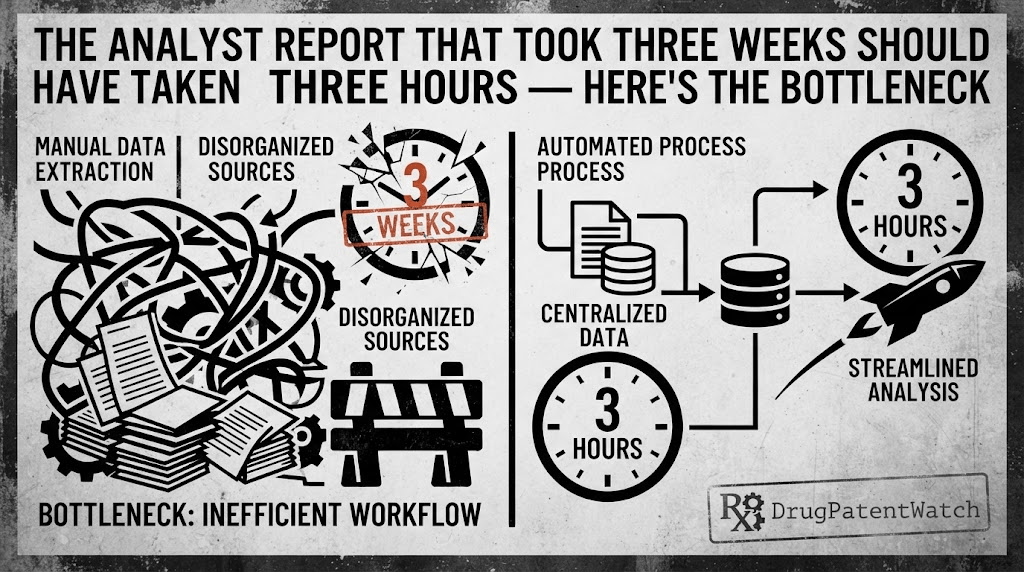
The bottleneck in most pharma analyst reports is not thinking time. Pharmaceutical competitive intelligence professionals report spending roughly 70% of their working time on collecting, monitoring, and synthesizing publicly available information, not on the interpretation that report is nominally for. [4] Documented compression, where it has occurred, has happened almost entirely on the collection side: a McKinsey internal case study reports first-draft scoping and research materials cut from days to hours, [5] a 2023 systematic-review methodology extension completed reviews in a median of 17 calendar days against a published baseline of roughly 41 weeks, [6] and pharma-specific vendors report post-congress intelligence synthesis compressed from a multi-week cycle to within four hours of session close. [7] What has not compressed — and, on current evidence, will not — is the legal and clinical sign-off that gives a freedom-to-operate opinion, a systematic review, or a due-diligence memo its evidentiary weight in the first place.
The Five Findings That Matter
4 to 12 weeks is the documented range for a comprehensive pharmaceutical FTO analysis suitable for a licensing, investment, or launch decision. [1]
67.3 weeks is the mean time from protocol registration to publication for a systematic review, across 195 PROSPERO-registered reviews analyzed in a 2017 BMJ Open study. [3]
~70% of a pharmaceutical competitive intelligence professional’s time goes to collecting, monitoring, and synthesizing public information rather than to analysis, per the TGaS Competitive Intelligence Landscape Survey (October 2025). [4]
Roughly two-thirds of pharma CI leaders expect their budgets and headcount to stay flat even as the industry’s drug-development pipeline has more than doubled over five years — meaning any capacity gain has to come from process, not headcount. [4]
17 calendar days is the median completion time reported for the “2weekSR” rapid systematic-review methodology, applied to reviews of comparable size and complexity to the PROSPERO average, without dropping PRISMA-equivalent screening or appraisal steps. [6]
What Three Weeks Actually Buys You Inside a Pharma Analyst Report
“Three weeks” is not a rhetorical number in pharmaceutical IP and competitive work. It is close to the median reported turnaround for two of the field’s most common deliverables.
Freedom-to-Operate Analysis: The Four-to-Twelve-Week Baseline
A freedom-to-operate opinion determines whether a company can manufacture, use, or sell a specific product without infringing a third party’s enforceable patent claims — a distinct question from whether the product itself is patentable. [8] DrugPatentWatch’s own guidance for pharma executives puts a comprehensive FTO analysis, of the kind that supports a licensing transaction, a Phase 3 initiation, or a commercial launch decision, at four to twelve weeks and $50,000 to $200,000 in legal fees, depending on the density of the patent landscape. [1] SciTech Patent Art, an independent IP search firm, reports a narrower band for a standard FTO study: three to four weeks, shifting with the number of jurisdictions and technology areas covered. [2] LeanLaw’s guidance for IP law firms puts the cost range at $10,000 to $50,000 for a defined-scope opinion, rising past $50,000 for comprehensive multi-jurisdiction analysis — the client-facing mirror of the same weeks-long process. [9]
Patent Landscape Reports: Where the Weeks Go
DeepIP, an AI-assisted patent-analysis vendor, describes the traditional workflow directly: dense patent landscapes generate large early result sets, relevance decisions get made late after most of the screening effort is already spent, and invalidity analysis is treated as a downstream exercise rather than an early signal — a combination the company says explains why FTO analysis “often stretches into weeks.” [10] Tradespace, an IP-operations platform aimed at growth-stage teams, makes the same point from the buyer’s side: traditional FTO analysis relied on manual patent-database searches that took days to weeks per product, and the growth-stage teams that have moved off hourly outside counsel report the alternative running hours to days rather than weeks — faster, but not instantaneous, and still gated by review. [11]
The Systematic Literature Review Comparison: 67.3 Weeks as the Outer Bound
Medical affairs and pharmacovigilance teams run a structurally similar process on the clinical-literature side. Borah, Brown, Capers, and Kaiser analyzed all 195 systematic reviews registered in the PROSPERO international registry with an associated publication as of July 2014, drawing solely from registry entries and the published articles themselves. [3] The mean time from registration to publication was 67.3 weeks, with an interquartile range of 42 weeks — meaning even the tighter half of the distribution spans most of a year — and a mean of five authors per review. [3] The number of citations screened per review ranged from 27 to more than 92,000, with a mean yield rate into the final review of just 2.94%. [3]
Systematic reviews of medical interventions take a mean of 67.3 weeks from PROSPERO registration to publication, drawn from an analysis of all 195 registered reviews with an associated publication as of mid-2014 — a dataset in which the number of studies initially screened ranged from 27 to more than 92,000 per review. (Borah et al., 2017, BMJ Open) [3]
Why the Distribution Is So Wide
Cochrane’s own guidance describes literature searches alone taking three to eight months, [12] and multiple academic library guides converge on a 6-to-18-month range for full completion, driven by team size, the number of databases searched, and how much of the process — protocol registration, dual-reviewer screening, risk-of-bias assessment, data extraction, and write-up — runs sequentially rather than in parallel. [13]
Where the Three Weeks Actually Goes: A Time-and-Motion Breakdown
Data Collection vs. Analysis: The 70/30 Problem
Trinity Life Sciences, drawing on the TGaS Competitive Intelligence Landscape Survey from October 2025, reports that pharma CI professionals have historically spent about 70% of their time collecting, monitoring, and synthesizing publicly available information — before any of the strategic interpretation that a CI report is ostensibly commissioned to deliver even begins. [4] The same survey found the drug-development pipeline has more than doubled over five years while roughly two-thirds of CI leaders expect their budgets and headcount to hold flat, which means the 70% figure is not a static inefficiency — it is a ratio under mounting pressure. [4] Ferma, a pharma-focused CI automation vendor, describes the mechanics behind that number in blunter terms: pulling trial data from one database, cross-referencing conference readouts from a second vendor, reconciling pipeline movements from a third source, and building the resulting landscape in a slide deck from a blank page — all before the “competitive framing, the strategic implication, the stakeholder narrative” that the function was actually hired to produce. [7]
The McKinsey Global Institute’s One-Day-a-Week Estimate
The pattern is not specific to pharma. McKinsey Global Institute’s 2012 estimate, still cited in the firm’s later generative-AI research, put the figure for knowledge workers generally at about a fifth of their time — one day out of every five-day work week — spent searching for and gathering information rather than acting on it. [14] That estimate predates generative AI by a decade; it describes a baseline condition of knowledge work, not a pharma-specific pathology, which is one reason the 70% figure reported for pharma CI specifically is worth taking seriously rather than dismissing as an industry outlier.
What Counts as “Searching and Gathering” in a Pharma Context
In practice this covers pulling Orange Book listings, cross-referencing ANDA filing dates, checking PACER or a docket-alert service for new Paragraph IV litigation, searching PubMed and ClinicalTrials.gov for competitor trial updates, and reconciling all of it into a single internal format — work that is necessary, largely mechanical, and only rarely the part of the job an analyst was hired for their judgment to perform.
Illustrative calculation (not an independently reported figure): if a competitive intelligence analyst’s fully loaded cost is a round, hypothetical $150,000 per year, then a 70% collection-time share implies roughly $105,000 of that cost is spent annually on collection, reconciliation, and formatting rather than on the interpretive work the role exists to perform. Scaled across a five-person CI function under the same assumption, that is roughly $525,000 per year of loaded cost directed at tasks that do not require the analyst’s judgment. This is a derived illustration built on a stated hypothetical salary figure and the reported 70% ratio — it is not a benchmark, and actual figures will vary by organization, seniority mix, and geography.
The Bottleneck, Named: Four Places Analyst Time Actually Disappears
The vendor and survey literature converges on a consistent shape even when it doesn’t use identical language. Reorganizing it produces four recurring failure modes:
1. Fragmented-Source Reconciliation
No single database covers everything an FTO or CI deliverable needs. DrugPatentWatch’s own FTO guidance makes this explicit: no single patent database covers the global patent landscape comprehensively, and effective FTO searching requires multiple databases with complementary coverage. [15] Ferma describes the same problem on the CI side — trial data from one vendor, conference data from a second, pipeline data from a third. [7]
2. Format Translation
Raw database exports do not arrive as a finished deliverable. Someone still has to move structured data into the PowerPoint or Word document a stakeholder will actually read — described in the CI literature as “building the landscape in PowerPoint from a blank slide.” [7]
3. Redundant Re-Verification
Because sources disagree or go stale, analysts re-check facts that were already checked earlier in the same project, and often re-check them again for the next quarter’s update — a cost that recurs with every reporting cycle rather than being paid once.
4. Sequential, Not Parallel, Research Steps
Systematic-review methodology makes this failure mode the most visible: protocol registration, search-strategy development, screening, risk-of-bias assessment, data extraction, and write-up are conventionally run one after another, each waiting on the completion of the last, which is a structural reason the Arizona library guide’s own stage-by-stage timeline sums to 62–67 weeks even though no individual stage looks unreasonable in isolation. [16]
What Happens When the Loop Closes in Hours Instead of Weeks
Documented compression exists, but it is concentrated in specific, mostly non-adversarial, non-regulatory tasks. Three examples illustrate both the pattern and its limits.
McKinsey’s Lilli: Two Days of Scoping Work in Under Three Hours
McKinsey’s internal generative AI platform, Lilli, launched firm-wide in 2023 and now used by more than 75% of the firm’s roughly 43,000 employees, is reported by McKinsey to save users approximately 30% of the time they would otherwise spend gathering and synthesizing information, across more than half a million monthly prompts. [17] A separate account of the platform’s internal use reports that scoping decks which once took two days of junior-analyst effort now emerge in under three hours. [18] That specific two-day-to-three-hour figure comes from a secondary account of McKinsey’s internal usage rather than from a McKinsey-published case study directly, and should be read as a reported claim rather than an independently audited benchmark. [18]
The Credit-Memo Case Study: A Non-Pharma Proof of Concept
McKinsey’s own August 2024 published account of “real results from gen AI in services” describes a North American bank where relationship managers spent one to three days gathering data from a dozen or more sources, analyzing interdependencies, and writing a 20-page memo to support a single lending decision. [19] The bank replaced that process with a multiagent system that automatically identifies the correct data sources, ingests current data, integrates qualitative and quantitative inputs against current business rules, and cites the data source behind each assumption — collapsing a multi-day sequential process into a same-session one. [19] The structural similarity to a pharma competitive-intelligence or FTO memo — multiple data sources, a written narrative with cited assumptions, a decision riding on the output — is close enough that the case study functions as a useful, if non-pharma, proof of concept for where this kind of compression is and is not achievable.
Ferma’s Congress-Coverage Workflow: Four Hours vs. Weeks of Post-Congress Synthesis
On the pharma-specific side, Ferma reports that its agentic congress-coverage workflow delivers AI-generated summaries within four hours of a conference session’s close, covering every oral presentation, poster, and satellite symposium at a medical congress — a task the company frames as one that CI teams have historically rebuilt from scratch, by hand, at every major congress. [7] As a vendor claim about the vendor’s own product, this figure sits closer to marketing material than to independently audited data, and should be weighted accordingly against the peer-reviewed comparisons elsewhere in this article.
Why “Hours” Still Requires a Human Editor
In every documented case above, the compressed output is explicitly a first draft or a synthesis layer, not a final, sign-off-ready deliverable. McKinsey’s own account of Lilli describes consultants clicking through to sources, fixing nuance errors on individual slides, and tagging outputs for the next team — editorial work layered on top of, not replaced by, the faster first draft. [20]
Freedom to Operate, Reconsidered: From Weeks to Days, Not Weeks to Hours
What the Vendor Literature Documents About Compressed FTO Timelines
Tradespace’s practitioner framing is representative of where the FTO-specific evidence currently sits: “AI-assisted patent search tools now compress the initial search phase to hours,” while the disciplined operating model the company recommends still runs FTO analysis continuously rather than as a single compressed event, and full first-pass analysis is described as achievable in days, not hours. [11] DeepIP frames the ceiling similarly — its stated goal is running FTO and invalidity analysis “in days rather than weeks,” not in hours. [10] The gap between “search phase in hours” and “opinion in days” is the gap between machine-assisted retrieval and the claim-by-claim comparison, risk categorization, and attorney sign-off that make an FTO opinion usable in litigation or diligence.
What Doesn’t Compress: Legal Sign-Off and Liability
An FTO opinion’s value is inseparable from the fact that a named attorney stands behind it — it functions, among other things, as a defense against a later claim of willful infringement. [8] No amount of faster retrieval changes the time a qualified reviewer needs to compare a product’s actual features against the literal claim language of every patent the search surfaces, jurisdiction by jurisdiction, given that patent rights are strictly territorial and a clearance obtained in one country provides no protection in another. [21]
Illustrative calculation (derived from the cited ranges, not independently reported): using DrugPatentWatch’s own $50,000–$200,000 cost range against its own 4–12 week timeline for a comprehensive FTO analysis, the implied cost per week runs from roughly $12,500 per week at the low end ($50,000 ÷ 4 weeks) to roughly $16,700 per week at the high end ($200,000 ÷ 12 weeks). [1] That is not a per-week fee schedule any firm publishes — it is simply the arithmetic those two published figures imply, and it is offered only to make the scale of a multi-week delay concrete against a pipeline decision with its own carrying cost.
The Pharma Competitive Intelligence Squeeze: Flat Headcount, Doubling Pipeline
The TGaS 2025 Landscape Survey Numbers
Three figures from the TGaS Competitive Intelligence Landscape Survey, as reported by Trinity Life Sciences, define the structural pressure CI functions are working under as of late 2025: the drug-development pipeline has more than doubled in five years; roughly two-thirds of CI leaders expect budgets and headcount to remain flat regardless; and the historical baseline for analyst time allocation sits at approximately 70% collection versus 30% everything else. [4] Trinity’s framing is direct about the implication — that the current CI operating model cannot absorb this level of complexity growth without either a change in tooling or a measurable decline in what the function can cover. [4]
What This Means for How CI Functions Are Evaluated
The practical consequence, per the same analysis, is a shift in what CI teams are expected to spend their time on — away from producing decks and toward interpretation, prediction, and measurable influence on enterprise decisions — which only becomes achievable at scale if the 70% collection share comes down. [4] That reframes “faster reports” from a productivity nicety into the precondition for the function doing the job it was actually created to do.
A Taxonomy of Analyst-Report Bottlenecks
Pulling the evidence above together, pharma analyst-report delay separates into four categories, distinguished by how much of the delay is genuinely reducible with better tooling versus structurally necessary.
Bottleneck type
Example
Reducible with tooling?
Source basis
Fragmented-source reconciliation
Combining Orange Book, ANDA, litigation, and PubMed data into one view
Largely yes
DrugPatentWatch FTO guidance [15]; Ferma [7]
Format translation
Turning a database export into a slide deck or memo
Largely yes
Ferma [7]; McKinsey Lilli account [17][20]
Redundant re-verification
Re-checking facts across successive reporting cycles
Partially
Inferred from recurring-report literature; TGaS survey pattern [4]
Sequential rigor steps
Protocol, screening, appraisal, extraction, write-up run one after another
Partially, without cutting rigor
Borah et al. 2017 [3]; Arizona SR timeline [16]; 2weekSR method [6]
What This Means for Medical Affairs and Literature Surveillance
The 67.3-Week Baseline vs. a Documented Faster Method
The most rigorous evidence of genuine, rigor-preserving compression in this entire body of research comes not from a pharma vendor but from the systematic-review methodology literature itself. A 2023 case series extending the “2weekSR” method to larger and more complex reviews reports a median completion time of 11 workdays and 17 calendar days across a set of reviews comparable in scale — screening more than 1,200 titles and abstracts, more than 60 full texts, and including roughly 15 studies — to the PROSPERO-average review Borah and colleagues described. [6] The same paper notes that this compares with a median time from protocol registration to journal submission of 41 weeks, or 287 days, for the broader PROSPERO population, a figure obtained via personal communication with one of the 2017 study’s original authors rather than published in the 2017 paper itself. [6] Critically, the 2weekSR teams reported comparable team sizes — a median of six, versus a mean of five in the Borah dataset — and did not report dropping dual-reviewer screening, risk-of-bias assessment, or other PRISMA-aligned steps to hit the faster timeline. [6]
Where AI Literature Tools Fit Without Replacing PRISMA Rigor
The 2weekSR result is a methodology and team-structuring change, not primarily a software one, which is a useful corrective to the assumption that every multi-week research bottleneck is solved by better AI retrieval. It suggests that concentrated, full-time, well-organized teams running the existing PRISMA process in parallel rather than in sequence can independently produce most of the same compression that AI-assisted retrieval promises — and that the two approaches are complementary rather than substitutes for each other.
What This Means for Competitive Intelligence and Business Development
For CI and BD functions specifically, the TGaS and Ferma data points together suggest the highest-value near-term target is not the analytical judgment step at all — it is the roughly 70% of time currently spent on collection, reconciliation, and formatting. [4][7] Compressing that share, even partially, is what converts a flat-headcount CI function into one that can plausibly keep pace with a drug-development pipeline that has more than doubled in five years, without requiring the budget growth that most CI leaders don’t expect to get. [4]
What This Means for Patent and IP Teams
For IP teams, the FTO evidence points to a narrower, more specific opportunity than “instant clearance”: compressing the search and first-pass triage phase from weeks toward days, while leaving the claim-by-claim comparison and attorney sign-off — the parts of the process that actually carry legal weight — running on roughly their current timeline. [10][11] Multi-jurisdiction complexity compounds this; a product cleared in the United States carries no protection in Europe or Asia, so any given FTO project may need the same triage-then-review cycle repeated per jurisdiction rather than compressed once. [21]
The Limits of Compression: What Three Hours Cannot Replace
Verification, Attribution, and the Liability Gap
Every documented instance of successful compression in this article retains a human verification step — McKinsey’s consultants clicking through Lilli’s sources and correcting nuance errors before a deck goes to a client is the clearest example. [20] That step does not disappear as retrieval gets faster; if anything, it becomes the rate-limiting one once collection stops being the bottleneck.
Why FTO Legal Opinions Still Take Weeks
An FTO opinion’s evidentiary function — providing a documented, reasoned basis for a commercial decision and a defense against a later willfulness claim — depends on a named professional’s judgment being applied to the search results, not merely on the results being available quickly. [8] That is a structural, not a technological, constraint, and it is the reason every vendor cited in this article frames its own achievable compression as “weeks to days” for FTO specifically, rather than the “weeks to hours” achieved in the non-adversarial cases above. [10][11]
Methodology
The time-to-completion figures in this article were drawn from a mix of primary and secondary sources gathered in August 2026: a peer-reviewed 2017 BMJ Open meta-analysis of the PROSPERO systematic-review registry (195 reviews); a 2023 peer-reviewed case-series extension of that same research lineage (the 2weekSR method); McKinsey & Company’s own published account of a bank credit-memo generative AI deployment (August 2024); independent IP-search-firm and IP-operations-platform publications describing FTO timelines (SciTech Patent Art, Tradespace, DeepIP, LeanLaw); a named industry survey (the TGaS Competitive Intelligence Landscape Survey, October 2025) as reported by Trinity Life Sciences; a pharma CI automation vendor’s own published claims about its product (Ferma); and DrugPatentWatch’s own published FTO guidance and homepage positioning. Two calculations in this article — the collection-time cost illustration and the FTO cost-per-week figure — are original, clearly labeled derivations built on the cited published ranges and, in one case, a stated hypothetical assumption; neither is presented as an independently reported statistic. Limitations: several of the pharma-specific “hours” figures (Ferma’s four-hour congress turnaround; the McKinsey Lilli “under three hours” scoping-deck figure) come from vendor blog posts or a secondary account of internal usage rather than from peer-reviewed or independently audited sources, and are flagged as such in the text rather than treated as equivalent in evidentiary weight to the Borah et al. and 2weekSR findings.
FAQ
How long does a freedom-to-operate (FTO) analysis normally take in pharma?
A comprehensive FTO analysis suitable for supporting a licensing deal, clinical trial initiation, or commercial launch typically takes four to twelve weeks and costs $50,000 to $200,000 in legal fees, depending on how dense the relevant patent landscape is. [1] A narrower-scope external FTO search from a specialist IP firm is commonly reported at three to four weeks. [2]
Why do systematic literature reviews take over a year on average?
Borah et al.’s 2017 analysis of 195 PROSPERO-registered reviews found a mean time of 67.3 weeks from registration to publication, with an interquartile range of 42 weeks. [3] The length reflects a largely sequential process — protocol registration, search-strategy development, dual-reviewer screening, risk-of-bias assessment, data extraction, and write-up — each conventionally waiting on the last stage’s completion. [16]
Can AI actually compress a patent landscape report from weeks to hours?
The documented evidence supports “weeks to days” for the search and first-pass triage phase of an FTO or landscape analysis, not “weeks to hours” for the full, sign-off-ready deliverable. [10][11] The claim-by-claim comparison and attorney review that give an FTO opinion its legal weight have not been shown to compress at the same rate as retrieval.
What percentage of a competitive intelligence analyst’s time goes to data collection rather than analysis?
Approximately 70%, according to the TGaS Competitive Intelligence Landscape Survey (October 2025) as reported by Trinity Life Sciences — collection, monitoring, and synthesis of publicly available information, ahead of any strategic interpretation. [4]
Is the claim that McKinsey compressed two days of research into three hours independently verified?
No. That specific figure comes from a secondary account of McKinsey’s internal Lilli usage rather than a McKinsey-published case study, and should be treated as a reported claim rather than an audited benchmark, even though McKinsey has separately and directly published a 30% time-savings figure for the platform. [17][18]
If the bottleneck isn’t analytical judgment, what is it?
The evidence points to four recurring categories: reconciling data across fragmented sources, translating raw exports into a stakeholder-ready format, re-verifying facts across successive reporting cycles, and running rigor-preserving steps sequentially rather than in parallel. [3][7][15][16]
Does compressing research time increase the risk of errors making it into a final report?
The documented successful cases retain a human verification layer rather than removing it — McKinsey’s own account of Lilli describes consultants clicking through to underlying sources and correcting nuance errors before a faster first draft becomes a client-ready one. [20] Verification does not appear to disappear as retrieval speeds up; it becomes the remaining rate-limiting step.
How does DrugPatentWatch’s approach differ from a traditional analyst report?
DrugPatentWatch positions itself around continuously updated primary-source data — USPTO, FDA Orange Book, ANDA filings, and litigation records refreshed daily — rather than a periodically published, static report, and offers a “Deep Research Engine” that pulls cited answers from those disparate primary sources directly rather than filtering them through a fixed publication cycle. [22]
Does a faster “2weekSR” systematic review sacrifice methodological rigor?
The published case series reports comparable team sizes to the PROSPERO average and does not describe dropping dual-reviewer screening, risk-of-bias assessment, or other PRISMA-aligned steps to reach its 11-workday median — the compression appears to come from running the process in parallel with a dedicated, full-time team rather than from skipping steps. [6]
Should pharma CI teams expect their headcount to grow to match the doubling drug-development pipeline?
Not based on current survey data. Roughly two-thirds of CI leaders expect budgets and headcount to remain flat despite the pipeline more than doubling over five years, which places the burden of keeping pace on process and tooling changes rather than on additional headcount. [4]
Key Takeaways
A comprehensive pharma FTO analysis takes 4–12 weeks and $50,000–$200,000; a standard external FTO search takes 3–4 weeks. [1][2]
Systematic reviews take a mean of 67.3 weeks from PROSPERO registration to publication across 195 analyzed reviews, with an IQR of 42 weeks. [3]
Pharma CI professionals report spending roughly 70% of their time on collection and synthesis rather than analysis, against a pipeline that has more than doubled in five years and flat expected headcount for roughly two-thirds of CI functions. [4]
Documented rigor-preserving compression exists — a 2023 systematic-review methodology extension reports an 11-workday median completion time — but it came from restructuring team process, not solely from new software. [6]
Vendor- and secondary-sourced “hours, not weeks” claims (McKinsey Lilli’s scoping-deck figure, Ferma’s congress-coverage turnaround) are directionally consistent with the peer-reviewed evidence but carry less evidentiary weight and are flagged accordingly. [7][18]
FTO legal opinions and PRISMA-compliant reviews have a sign-off and liability layer that has not been shown to compress at the same rate as data retrieval, and current vendor claims for FTO specifically top out at “weeks to days,” not “weeks to hours.” [10][11]
References
DrugPatentWatch. (2026). Know Before You Launch: The Complete Step-by-Step Guide to Freedom-to-Operate Analysis in Pharma. DrugPatentWatch Blog. https://www.drugpatentwatch.com/blog/know-before-you-launch-the-complete-step-by-step-guide-to-freedom-to-operate-analysis-in-pharma/
SciTech Patent Art Services. Freedom to Operate (FTO) Search. https://www.patent-art.com/ip-search-analysis/freedom-to-operate-search/
Borah, R., Brown, A. W., Capers, P. L., & Kaiser, K. A. (2017). Analysis of the time and workers needed to conduct systematic reviews of medical interventions using data from the PROSPERO registry. BMJ Open, 7(2), e012545. https://pmc.ncbi.nlm.nih.gov/articles/PMC5337708
Trinity Life Sciences. (2026). From Insights to Impact: How AI Is Transforming Pharmaceutical Competitive Intelligence (citing the TGaS Competitive Intelligence Landscape Survey, October 2025). https://trinitylifesciences.com/blog/how-ai-is-transforming-pharmaceutical-competitive-intelligence/
McKinsey & Company. (2025). Rewiring the way McKinsey works with Lilli, our generative AI platform. https://www.mckinsey.com/capabilities/tech-and-ai/how-we-help-clients/rewiring-the-way-mckinsey-works-with-lilli
Various authors. (2023). We extended the 2-week systematic review (2weekSR) methodology to larger, more complex systematic reviews: A case series. Journal of Clinical Epidemiology (ScienceDirect). https://www.sciencedirect.com/science/article/pii/S0895435623000501
Ferma. (2026). How Pharma CI Teams Are Automating Competitive Intelligence in 2026 — Without Losing Methodological Control. https://ferma.ai/blog/automate-pharma-competitive-intelligence-ci-teams
DrugPatentWatch. (2026). The Definitive Pharmaceutical FTO Playbook. https://www.drugpatentwatch.com/blog/how-to-conduct-a-drug-patent-fto-search/
DeepIP. (2026). Freedom to Operate (FTO) & Invalidity Analysis: From Weeks to Days. https://www.deepip.ai/blog/freedom-to-operate-fto-invalidity-analysis
Tradespace. (2026). Freedom to Operate Analysis: A Practitioner Guide. https://tradespace.io/insights/freedom-to-operate-analysis-a-practitioner-guide-2026/
Cochrane Collaboration, cited in: Advocate Health – Midwest Library. Resources Needed to Conduct a Review. https://library.aah.org/guides/systematicreview/resources
University of Arizona Libraries. Systematic & Scoping Review Support — Process of a Review. https://libguides.library.arizona.edu/systematic-reviews/process
McKinsey & Company. (2023). The Economic Potential of Generative AI: The Next Productivity Frontier. https://www.mckinsey.com/capabilities/tech-and-ai/our-insights/the-economic-potential-of-generative-ai-the-next-productivity-frontier
DrugPatentWatch. (2026). The Definitive Biopharmaceutical Freedom-to-Operate Playbook. https://www.drugpatentwatch.com/blog/conducting-a-biopharmaceutical-freedom-to-operate-fto-analysis-strategies-for-efficient-and-robust-results/
University of South Carolina Libraries. Systematic Reviews — Getting Started (stage-by-stage timeline). https://guides.library.sc.edu/systematic-reviews/getting-started
Entrepreneur. (2025, June 2). McKinsey Is Using AI to Create PowerPoints and Take Over Junior Employee Tasks. https://www.entrepreneur.com/business-news/ai-creates-powerpoints-at-mckinsey-replacing-junior-workers/492624
DigitalDefynd. (2026). 8 Ways McKinsey Is Using AI [Case Studies]. https://digitaldefynd.com/IQ/ways-mckinsey-is-using-ai/
McKinsey & Company. (2024, August 16). From Promising to Productive: Real Results from Gen AI in Services. https://www.mckinsey.com/capabilities/operations/our-insights/from-promising-to-productive-real-results-from-gen-ai-in-services
Flor, G. (2026). Inside McKinsey’s AI Operating System, citing a first-person Lilli usage account. https://www.theaiopportunities.com/p/inside-mckinseys-ai-operating-system
Lumenci. Understanding Freedom to Operate Search. https://lumenci.com/blogs/fto-search-understanding-freedom-to-operate/