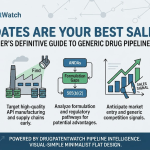
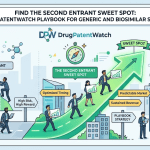
A systematic, intelligence-led playbook for commercial and market access vendors targeting pre-LOE mandates with health plans, PBMs, IDNs, and brand teams.
The Business Nobody Sees Coming
The commercial team at a mid-size specialty pharma brand typically knows its patent expiration date to the day. What it often does not have, two or three years out, is a vendor who walks in the door with a plan for that date. That gap is your business development opportunity.
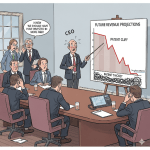
Every year, branded drugs generating tens of billions in U.S. revenue lose market exclusivity. Health plans, pharmacy benefit managers, and integrated delivery networks begin repositioning formularies, renegotiating rebates, and designing utilization management programs well before the generic or biosimilar hits the market. Brand manufacturers, meanwhile, face one of the most compressed commercial execution periods in their product’s lifecycle: maximize revenue while exclusivity lasts, retain patients where possible, and prepare authorized generic strategies that can blunt the revenue cliff.
Every single one of those activities requires outside expertise. Most of it gets purchased from vendors exactly like yours.
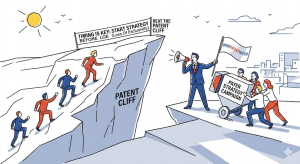
The problem is that most commercial and market access vendors operate reactively. They respond to RFPs already issued, attend conferences, and build relationships that generate sporadic inbound leads. The vendors who build durable revenue streams do something different: they mine patent expiration data systematically, identify drugs whose LOE creates the most commercial complexity, and launch outbound campaigns timed to hit both brand teams and payers in the 18-to-36-month pre-LOE window, when budgets are being set and mandates are being awarded.
This guide covers exactly how to do that: how to read patent expiration signals, segment and target the right buyers, and structure outreach campaigns that speak directly to what payers and brand teams need before exclusivity ends.
LOE Is the Most Reliable Revenue Signal in Pharma
Loss of exclusivity does not happen to one drug once. It happens to dozens of drugs every year on a predictable schedule, and the commercial disruption it causes is structurally similar each time. Brand teams need formulary defense strategies. Payers need transition protocols. PBMs need rebate modeling. Patient services vendors need retention and off-boarding support. HEOR firms need to prepare value dossiers that justify price even after generics arrive.
The scale of the opportunity is substantial. According to IQVIA’s annual medicine spending report, drugs losing exclusivity account for roughly $30-50 billion in U.S. brand revenue annually, with the precise figure varying based on which blockbusters cycle off in a given year [1]. The 2025-2027 window is particularly heavy, with major biologics in autoimmune, oncology, and metabolic disease facing biosimilar competition for the first time.
What makes LOE commercially distinct from other pharma business development triggers is its predictability. A product launch date can slip. An FDA approval can be delayed. A clinical trial readout can come back negative. Patent expiration is different: dates are filed publicly, contested through litigation whose timelines are also public, and monitored by dozens of market participants. This makes LOE a reliable, actionable, forward-looking trigger rather than a lagging indicator.
For vendors, predictability means you can plan a campaign cadence 24 to 36 months out and execute it with confidence. That is the starting premise of everything that follows.
Reading Patent Expiration Intelligence
Where the Data Lives
U.S. drug patents are listed in the FDA’s Orange Book (for small molecules) and Purple Book (for biologics). These are public databases, updated regularly, and they contain patent expiration dates, patent types (compound, formulation, method of use), and Paragraph IV certification filings that signal when a generic applicant believes a patent is invalid or non-infringed [4].
The practical problem with using the Orange Book raw is the same problem with most regulatory databases: it tells you when patents expire, but it does not tell you what the competitive landscape looks like, what litigation is pending, or how many generic or biosimilar applications are filed. That context determines how operationally urgent the LOE actually is.
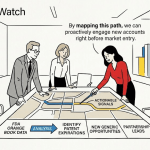
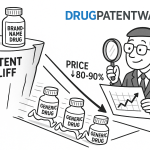
DrugPatentWatch aggregates FDA patent data, ANDA and 505(b)(2) applications, Paragraph IV filings, litigation histories, and market revenue estimates into a single searchable interface [5]. For business development teams, it functions as a prospecting database: you can screen for drugs above a revenue threshold, filter by LOE date range, and immediately see how many generic applicants are waiting. A drug with $1.2 billion in annual sales, a patent expiring in 18 months, and twelve ANDA filers is a very different commercial conversation than a drug with $200 million in sales and one generic applicant. DrugPatentWatch surfaces that distinction without requiring you to cross-reference four different federal databases manually.
The Signals That Actually Matter
Not all LOEs are equal. The commercial urgency, and therefore your prospecting priority, depends on four variables.
Revenue magnitude. A drug generating $800 million or more in annual U.S. revenue creates enough downstream disruption to justify multiple large vendor mandates. Payers want formulary transition support. Brand teams need patient retention and authorized generic strategy execution. PBMs model rebate replacements. The commercial activity compounds with revenue size.
Therapeutic complexity. Small-molecule LOEs with straightforward generic substitution create a different payer challenge than biologic LOEs, where biosimilar substitution policies, interchangeability designations, and physician education requirements generate far more vendor engagements. Oncology, immunology, and diabetes biologics approaching LOE consistently produce the highest density of commercial activity.
Litigation status. A drug in active Paragraph IV litigation may have an effective LOE earlier than its listed patent expiration date. If a court rules the patent invalid, the generic can launch immediately. Conversely, a settlement with a 180-day exclusivity period creates a defined window before multi-source competition drives prices down. Following patent litigation via DrugPatentWatch lets you estimate not just when LOE happens, but under what competitive conditions.
Number of generic or biosimilar applicants. Multi-source competition drives prices down faster and more severely than single-source generic entry. For payers, the formulary strategy for a drug facing twelve generic entrants differs from one where an authorized generic holds 70% of the market. For vendors, more applicants generally mean more payer activity and more brand-side urgency to retain formulary position.
The Pre-LOE Campaign Calendar
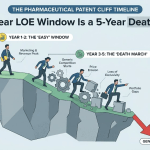
36 to 24 Months Before LOE: Intelligence and Positioning
Between three years and two years before LOE, most brand teams still operate in brand-protection mode. Marketing budgets are at or near peak. The question of what happens when the patent expires sits with legal, business development, and strategic planning, not commercial operations.
This is not yet the right time to sell a payer transition program. It is the right time to do two things.
Position your firm as an LOE subject matter expert by publishing content that brand teams and payers will encounter organically. Whitepapers on biosimilar market dynamics, case studies from prior LOE executions, and data on patient switching rates after generic entry establish credibility before you ever send an outreach email.
Build your watch list in DrugPatentWatch. Filter for drugs in the $500M-plus annual revenue range with LOE dates 24 to 36 months out, and begin monitoring them monthly. Litigation updates, new generic filer entries, and patent challenge outcomes can compress your timeline significantly.
24 to 12 Months Before LOE: The Mandate Window
This is the interval where commercial and market access vendor selection actually happens for most LOE-related engagements. Brand teams actively build LOE planning teams. Budget allocations for authorized generic programs, patient support transitions, and formulary defense get approved. Payer strategy teams at health plans and PBMs begin modeling what formulary changes will look like once multi-source alternatives are available.
Your outreach campaign should launch no later than 22 months before the target LOE date, segmented by buyer type (brand manufacturer, health plan, PBM, IDN) and tailored to the specific commercial challenge each faces.
For brand manufacturers, the pitch centers on revenue protection: how do you maximize the value of the remaining exclusivity window while executing a transition strategy that minimizes the cliff? Authorized generic launch timing, co-pay program wind-downs, formulary position defense, and patient retention all require vendors.
For payers, the pitch centers on formulary transition readiness: what is the payer’s substitution policy, how will it communicate changes to providers and patients, and what are the rebate and cost-savings projections associated with generic or biosimilar adoption? Payers who have been through large-molecule LOE before often underestimate the time needed to update formulary management systems, train pharmacy staff, and communicate policy changes to members.
12 Months to Launch: Execution Mode
Inside a year of LOE, execution becomes the dominant mode. Vendors not already engaged at this point compete for smaller, tactical mandates rather than the strategic work that carries higher fees and longer contract terms.
The exception is payer-side work, where formulary transition programs can be sold and executed entirely within the 12-month pre-LOE window. Health plans and PBMs that did not complete strategic planning earlier often look for rapid deployment of decision support tools, member communications frameworks, and utilization management protocol updates. If your firm specializes in fast-cycle payer engagements, this window remains viable.
Timeline
Vendor Focus Area
36-24 months out
Intelligence building, content positioning, watch list construction in DrugPatentWatch
24-18 months out
First outreach to brand teams and formulary planning staff at large payers
The brand team facing LOE is your most complex buyer. It has internal capability, existing agency relationships, and competing priorities. The LOE planning team is often assembled from people who already have day jobs, which creates structural demand for external vendors who can own discrete workstreams.
The highest-value LOE mandates for vendors cluster in four areas.
Authorized generic strategy and execution. The decision about whether to launch an authorized generic, at what price, and through which distribution partner is commercially and legally complex. Consultants and strategic advisory firms with prior AG experience command premium fees here.
Patient support program transition design. Co-pay assistance programs, patient adherence tools, and hub services all need to be modified or wound down as LOE approaches. Vendors who specialize in patient services have a narrow window to compete for this work before internal teams default to their existing partners.
Payer contracting strategy. Rebate structures, formulary tier guarantees, and step therapy protocols all need to be renegotiated in light of imminent generic competition. Managed markets consultants with payer relationships and modeling capabilities are in demand here.
Medical affairs and HEOR. For drugs where clinical differentiation can be maintained through outcomes data, or where the brand team is pursuing a patient segment strategy post-LOE, HEOR firms and medical affairs agencies are needed to develop and disseminate evidence.
Health Plans and PBMs
Payer-side buyers behave very differently from brand teams. Their planning horizons tie to formulary review cycles, which run on a calendar-year basis. Most health plans and PBMs lock formulary changes for the following year between August and October of the current year. This means a drug with a LOE date of mid-next-year will be actively discussed in payer formulary committees starting as many as 15 months before the LOE actually occurs.
For vendors targeting payers, the outreach trigger is the formulary review cycle, not the patent expiration date itself. If you know that Drug X loses exclusivity in Q2 of year N, you should be in front of the health plan’s pharmacy and therapeutics committee, and the consultants who support it, by Q3 of year N-1.
The services payers buy in the pre-LOE window include formulary transition analytics, step therapy and prior authorization redesign, member communication support, biosimilar interchangeability education for biologic LOEs, and utilization modeling.
Integrated Delivery Networks and Specialty Pharmacies
IDNs and large specialty pharmacy groups often have their own formulary structures and drug management protocols that operate independently of PBM contracts. For high-cost specialty drugs approaching LOE, IDNs may need to update infusion protocols, physician preference lists, and patient counseling materials. Specialty pharmacies need to prepare for new product relationships with generic or biosimilar manufacturers. Both segments are underpursued by most vendors who focus exclusively on brand teams and national payers.
What Payers Actually Need Before LOE
The payer pre-LOE challenge is a sequencing problem wrapped in an organizational politics problem.
The sequencing problem: payers want to adopt generics or biosimilars as soon as multi-source competition drives prices to a level that justifies formulary change. But they also need to communicate changes to members and providers far enough in advance to avoid plan disruption. Managing that sequence across tens of thousands of covered lives, multiple formulary tiers, and prior authorization workflows requires coordination that most payer teams cannot handle without structured support.
The organizational politics problem: the formulary committee, the contracting team, the medical policy team, and the pharmacy operations team at any large health plan may not have a unified view of how to handle a major LOE. The contracting team wants to delay commitments until they see generic pricing. The medical policy team wants to wait for FDA interchangeability designations before updating step therapy. The pharmacy operations team needs six months of lead time to update system configurations. Vendors who understand these internal dynamics can sell coordination and project management support almost as much as technical expertise.
Health plans that actively managed biosimilar transitions saw average per-member per-year savings 2.3 times higher than plans that defaulted to passive formulary adjustment.— AMCP Foundation, Biosimilar Adoption in U.S. Health Plans, 2023 [2]
That savings differential is your business case for every payer you target. A vendor who walks in with a structured transition framework, a timeline, and a reference case from a comparable LOE is offering something payers find operationally useful, not just intellectually interesting.
For biologics approaching LOE, the interchangeability question deserves detailed attention. The FDA’s interchangeability designation allows pharmacists to substitute a biosimilar without physician intervention, which materially accelerates generic uptake compared to non-interchangeable biosimilars. For payers, an interchangeable biosimilar dramatically simplifies formulary management. Knowing which biosimilars have or are pursuing interchangeability designation, information available in the Purple Book and tracked in DrugPatentWatch, lets you anticipate which LOEs will generate the fastest payer-side activity.
Structuring the Outreach Campaign
The Account-Based Approach
LOE-triggered business development works best when treated as an account-based program rather than a volume outreach effort. The universe of relevant accounts for any given LOE is finite: one to three manufacturers of the branded product, fifteen to thirty health plans with meaningful coverage of the drug, three to five major PBMs, and a small number of IDNs in high-prescribing geographies. You are not trying to reach everyone; you are trying to reach specific people at specific accounts at a specific time.
Build a target account list for each LOE you are prioritizing. For each account, identify the specific commercial challenge the account faces, the internal stakeholders who own that challenge by name and title, the timing of their decision-making cycle relative to the LOE date, and your existing relationship or entry point.
This account map, updated quarterly, is the operational core of your LOE business development program.
Message Architecture by Buyer Type
Your outreach message should not be ‘we do payer strategy.’ It should be: ‘We see that Drug X loses exclusivity in Q3 of next year, and we have executed formulary transition programs for three analogous LOEs in the past 18 months. Here is what those programs looked like and what they delivered.’
Specificity in message construction separates you from the other vendors sending generic capabilities decks. The LOE trigger date gives you a factual, time-bound anchor for every outreach you send. Using it demonstrates that you are paying attention, that you have done basic intelligence work before reaching out, and that you understand the buyer’s planning cycle well enough to show up at the right moment.
For brand-side buyers, lead with revenue protection. How much of the branded revenue run rate can realistically be defended, and what are the most effective mechanisms? Authorized generic timing, patient retention program design, and formulary tier guarantees each have measurable revenue impact.
For payer-side buyers, lead with savings and operational simplicity. Payers do not have loyalty to branded drugs; they have fiduciary obligations to manage drug spend and serve their members. A vendor who shows up with a structured transition framework, a timeline, and a reference case from a comparable LOE is offering something payers find genuinely useful.
Channel and Cadence
The campaign cadence for a 22-month pre-LOE outreach program runs across three channels.
Direct outreach, personalized by stakeholder type, launched 22 months before LOE and refreshed every 60 to 90 days with new intelligence updates. Each touchpoint should add something specific: a new Paragraph IV filing, an FDA designation update, a competitor biosimilar launch date, or a published study on formulary transition outcomes. Generic check-ins accomplish nothing.
Event-based engagement. Major payer and managed markets conferences including AMCP, AHIP, and eyeforpharma Market Access typically occur 12 to 18 months before any given LOE date. Attending and presenting with LOE-specific content generates both credibility and serendipitous account encounters.
Content marketing. Whitepapers, webinars, and data analyses tied to the therapeutic category or drug in question build organic inbound at lower cost than direct outreach. A 2,000-word analysis of the competitive biosimilar landscape for an autoimmune drug approaching LOE, published on your website and distributed through LinkedIn, will reach the exact audience you are targeting without requiring individual outreach for every potential buyer.
Pricing Your Engagement Around LOE Timeline Economics
The LOE timeline creates natural pricing leverage that most vendors underuse. Budget allocation for LOE-related activities is not drawn from standard marketing budgets; it comes from a specific loss-of-exclusivity provision within the brand P&L, from strategic planning reserves, or from payer operations budgets with a defined payback model. That budget exists independent of your general relationship with the client.
The implication is that your pricing should be anchored to the value of the problem you are solving, not to your hourly rate or a comparison with other agency fees. For a brand generating $900 million in annual revenue, a formulary defense strategy that extends preferred tier status by six months is worth tens of millions of dollars. A vendor who prices their contribution at $350,000 is leaving significant margin on the table.
For payer-side engagements, the ROI framework is even more tractable. If your biosimilar transition program delivers average savings of $X per member per year across Y covered lives, the payer can calculate a precise return on the vendor fee. Build that model and present it in your outreach. Payers who work with outcome-based pricing models respond well to vendors who can structure a fee against a measurable savings target.
Contract length is a function of the LOE timeline. Strategic planning mandates awarded 22 months before LOE typically run through launch plus 90 days, creating a 24-month engagement. Execution-phase mandates awarded 12 months before LOE run 12 to 15 months. The earlier you enter, the longer the contract and the higher the total engagement value.
Common Mistakes in Pre-LOE Business Development
Vendors who attempt LOE-triggered business development and fail to convert at scale make four predictable mistakes.
Starting too late. The 18-month pre-LOE window is widely recognized in the industry. If you enter at 18 months, you are competing with everyone else who reads the same conference presentations. The vendors who win mandates at this stage are usually the ones who started building relationships at 30 months and are simply closing deals they have already warmed.
Leading with capability instead of context. ‘We help biopharma companies manage loss of exclusivity’ is a capability statement. ‘Drug X has 14 ANDA filers and a Paragraph IV challenge whose trial date is in six months, which means the effective LOE could be 12 months earlier than the listed patent expiration, and your formulary committee review cycle in October puts you in exactly the right window to design a biosimilar transition program now’ is a contextual statement. One of these opens meetings. The other does not.
Misidentifying the budget holder. LOE planning draws from multiple budget lines across commercial, medical affairs, managed markets, and patient services. Vendors who pursue only the brand manager or only the managed markets director miss mandates owned elsewhere. Map the full stakeholder structure before you invest in account development.
Failing to prepare LOE-specific reference cases. General healthcare consulting capabilities are not what LOE buyers are purchasing. They are purchasing demonstrated experience with the specific commercial mechanics of patent expiration. If your firm has executed work that touched LOE dynamics, document it explicitly with outcomes data and make it the centerpiece of your outreach materials.
Using DrugPatentWatch as a Prospecting Engine
DrugPatentWatch was built primarily for generic manufacturers, legal teams, and investors who need granular patent status data. For commercial and market access vendors, it functions differently: as a forward-looking prospecting database organized around the events that generate demand for your services.
The most effective way to use it for business development is to build a structured query routine across three recurring tasks.
Monthly revenue-and-timeline screening. Run a filter for branded drugs with annual U.S. revenues above $500 million and patent expiration dates falling within the next 36 months. Export this list and compare it against your existing client base and active pipeline. The gap is your prospecting universe.
Competitive depth analysis. For each drug on that list, check the number of ANDA or BLA filers, any pending Paragraph IV litigation, and the FDA application status of key generic or biosimilar competitors. This tells you how competitive the LOE will be and therefore how urgent the payer-side planning is.
Change-event monitoring. Track changes month over month. A new Paragraph IV filing, a litigation settlement, or an FDA interchangeability designation for a biosimilar are all events that should trigger immediate outreach to relevant accounts, because they change the effective LOE timeline and can compress your selling window.
Integrate patent expiration dates into your CRM as a custom deal stage field. Every account in your pipeline associated with a drug approaching LOE should carry that date as an attribute, with automated reminders tied to your campaign cadence. This kind of systematic, data-driven prospecting transforms LOE business development from a reactive, conference-dependent activity into a predictable pipeline-building process.
Case Study: The Adalimumab LOE
The biosimilar entry pattern for adalimumab (Humira) illustrates both the scale of the pre-LOE commercial opportunity and the advantage of early intelligence.
By late 2021, the Purple Book and DrugPatentWatch showed more than twenty biosimilar applicants with FDA-approved or under-review applications [3]. Payers watching this data knew, with two years of lead time, that they would face an unusually crowded biosimilar market with multiple interchangeable and non-interchangeable options when U.S. exclusivity ended in January 2023.
The health plans and PBMs that began formulary planning in 2021 were able to negotiate rebate structures with both the brand manufacturer and biosimilar manufacturers before generic pricing stabilized, model their member populations for high-adalimumab users who would need transition support, update prior authorization criteria to reflect new biosimilar options, and design and execute provider education programs. Each of those activities created a distinct vendor engagement opportunity.
The vendors who won mandates in this process were not primarily the ones with the best RFP responses in late 2022. They were the ones already in conversations with formulary committee staff in 2021, presenting data from the Orange Book and DrugPatentWatch on the competitive landscape and positioning their biosimilar transition frameworks as proactive tools rather than reactive responses.
This pattern repeats across every major biologic LOE. The data, the timeline, and the buyer planning cycle are all knowable in advance. The only variable is whether your firm is in the conversation early enough to shape the mandate.
Building a Repeatable LOE Intelligence Program
The goal of this approach is not to win one mandate. It is to build a business development function that systematically identifies, tracks, and converts LOE-driven opportunities across the industry on a rolling basis. That requires four operational components.
A patent intelligence feed. Whether you use DrugPatentWatch, IQVIA LOE forecasting data, or a combination of sources, you need a structured, recurring data pull that keeps your pipeline current. This should run at least monthly and output a tiered list of priority prospects organized by LOE date, revenue magnitude, and competitive complexity.
A CRM discipline that maps accounts to drug assets. Your CRM should allow you to associate each manufacturer account with its key drug assets and their LOE dates. The same logic applies to payer accounts: which major drugs in their formulary are approaching LOE, what savings opportunity does that represent, and what is the timeline for their formulary review cycle?
A content library specific to LOE mechanics. Whitepapers, case studies, and data analyses that speak to the commercial dynamics of patent expiration, by therapeutic category, are your primary business development assets. They generate inbound leads, support direct outreach, and establish the credibility that allows you to command a premium fee structure.
A dedicated LOE business development responsibility. Opportunistic LOE business development yields opportunistic results. Firms that consistently win pre-LOE mandates have assigned someone the explicit job of tracking the patent landscape, building account maps, and managing the campaign cadence. This does not require a full-time FTE at most boutique vendors; it does require dedicated time protected from being consumed by client delivery work.
The Pre-LOE Business Development Checklist 1. Set up monthly DrugPatentWatch queries: drugs >$500M, LOE within 36 months 2. Tag accounts in CRM with drug asset names and LOE dates as custom fields 3. Build buyer maps for each priority LOE (brand + payer + IDN stakeholders by name) 4. Launch first outreach 22+ months before LOE with patent-specific context 5. Align outreach cadence to payer formulary review cycles (Aug-Oct decision window) 6. Publish therapeutic category LOE landscape analysis for organic content inbound 7. Refresh outreach at each patent litigation update or FDA designation event 8. Price against value created (revenue protected or savings delivered), not hours
Key Takeaways
Patent expiration dates are public, predictable, and computable years in advance. They are the most reliable business development trigger available to commercial and market access vendors because they are not dependent on FDA decisions, clinical outcomes, or internal client priorities shifting.
DrugPatentWatch is the fastest way to build a prospecting list organized by LOE date, revenue magnitude, and generic applicant count. Use it monthly, not quarterly, and integrate its output directly into your CRM.
The mandate window for strategic LOE engagements is 22 to 14 months before patent expiration. Entering after 14 months means competing for execution work rather than strategy work, which carries lower fees and shorter contract durations.
Payer buyers run on formulary review cycles, not patent calendars. For any drug with LOE in Q2-Q3 of a given year, payer committee engagement must start by Q3 of the prior year. Miss that window and you are waiting 12 months for the next opportunity with that account.
Message specificity converts. Context-based outreach anchored to a specific drug, its patent status, and the buyer’s planning cycle generates meetings that generic capability statements do not. Use the patent data to personalize every touchpoint.
LOE pricing should reflect the value of the problem solved, not the cost of hours delivered. For brand teams managing hundreds of millions in revenue, your contribution has a quantifiable financial impact. For payers, the ROI of a well-executed biosimilar transition is measurable in per-member per-year savings.
Repeat the program. LOE happens every year, at predictable intervals, to predictable drug classes. The vendors who build a permanent LOE intelligence and outreach function generate compounding pipeline value, while competitors who treat each LOE as a discrete project start from zero each time.
FAQ
Q1: How early should a commercial vendor realistically start outreach before a drug patent LOE?
The short answer is earlier than you think. The strategic mandate competition for most major LOEs closes 14 to 18 months before patent expiration. To be in that competition, you need established relationships and a demonstrated point of view well before the formal evaluation starts — which means initial outreach at 22 to 30 months is not premature; it is the minimum required to compete for the highest-value work. Vendors who enter at 12 months are typically competing for execution-phase mandates with smaller scopes and shorter contract terms.
Q2: What is the difference between targeting brand teams versus payers for pre-LOE business?
Brand teams are trying to protect revenue: they want to extend formulary access, maximize the remaining exclusivity period, manage the authorized generic decision, and transition patient support programs. Payers are trying to capture savings: they want biosimilar or generic adoption frameworks, formulary management support, utilization modeling, and member communication tools. The same LOE event creates opposite commercial pressures for these two buyer types, which means your value proposition, pricing model, and success metrics should be entirely different for each outreach campaign. Running a single generic LOE capabilities pitch to both buyer types is one of the more common vendor mistakes.
Q3: How useful is DrugPatentWatch for vendors who are not attorneys or patent experts?
Very useful, with the right framing. You do not need to understand patent law to extract business development value from DrugPatentWatch. The key data points for prospecting purposes are straightforward: the patent expiration date, the number of ANDA or BLA filers, any active Paragraph IV litigation, and the FDA application status of key competitors. These four variables let you quickly assess the commercial urgency of any LOE without a law degree. The tool is effectively a pre-filtered prospect list that someone has already organized by date and revenue magnitude.
Q4: How should vendors handle accounts where the brand team already has an existing LOE vendor?
Start earlier and enter through a different door. If the brand team already has an established relationship with a competitor vendor 18 months before LOE, competing directly on that mandate is difficult. Two alternative strategies work: first, identify workstreams the existing vendor is unlikely to own, such as payer contracting strategy or IDN education programs, and position for those. Second, initiate payer-side outreach for the same drug, which is entirely separate from the brand team budget and often involves different decision-makers. The payer relationship may open brand team introductions later, particularly if payer-side results generate credibility.
Q5: What content formats perform best for pre-LOE lead generation?
Therapeutic category-specific biosimilar or generic landscape analyses consistently outperform general capability content. A 10-page analysis titled ‘The Competitive Biosimilar Landscape for [Drug Class]: What Payers Need to Know Before 2026’ will generate more qualified inbound than a generic whitepaper on market access strategy. Formats that work well include PDF landscape analyses distributed via LinkedIn and email, live webinars featuring a payer or brand team practitioner who has navigated a prior LOE, and short data-driven posts tied to specific FDA filing events or litigation updates that you monitor through DrugPatentWatch. The specificity signals intelligence and relevance to exactly the audience you want to reach.
References
[1] IQVIA Institute for Human Data Science. (2024). The use of medicines in the U.S. 2024: Usage and spending trends and outlook to 2028. IQVIA Holdings. https://www.iqvia.com/insights/the-iqvia-institute/reports-and-publications/reports/the-use-of-medicines-in-the-us-2024
[2] Academy of Managed Care Pharmacy Foundation. (2023). Biosimilar adoption in U.S. health plans: Formulary strategies and outcomes. AMCP Foundation. https://www.amcp.org/research/amcp-foundation
[3] U.S. Food and Drug Administration. (2023). Purple Book database of licensed biological products. https://purplebooksearch.fda.gov/
[4] U.S. Food and Drug Administration. (2024). Orange Book: Approved drug products with therapeutic equivalence evaluations (44th ed.). https://www.accessdata.fda.gov/scripts/cder/ob/
[5] DrugPatentWatch. (2025). Patent expiration and ANDA filing data for U.S. branded pharmaceuticals. https://www.drugpatentwatch.com
[6] Association for Accessible Medicines. (2024). The U.S. generic and biosimilar medicines savings report. AAM. https://accessiblemeds.org/resources/reports/2024-savings-report