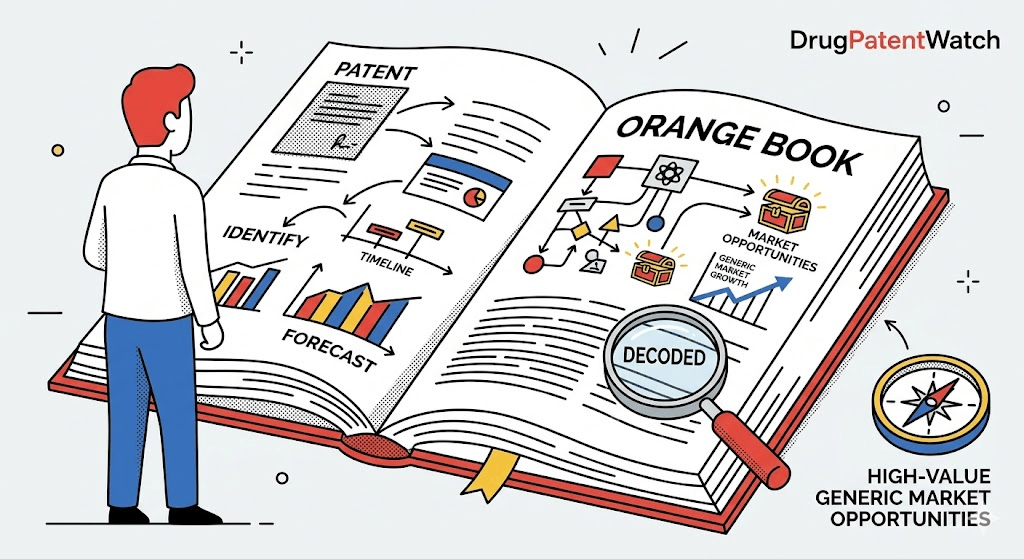
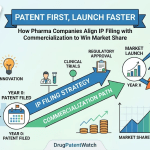
What this article covers: How to read the FDA Orange Book like a competitive intelligence tool, not a regulatory checkbox. It covers patent expiry forecasting, Paragraph IV litigation strategy, exclusivity stacking, loss-of-exclusivity (LOE) timing, generic first-filer advantages, and the commercial valuation of generic market entry opportunities. Real drugs, real companies, real timelines.
What the Orange Book Actually Is (and What Most People Miss)
The FDA’s Approved Drug Products with Therapeutic Equivalence Evaluations, universally called the Orange Book, is the federal registry of brand-name drug patents and exclusivities that generic manufacturers must navigate before entering the U.S. market. Published continuously since 1980, it determines when, how, and whether a generic can legally launch. Most people treat it as a compliance document. Experienced generic strategists treat it as a market map.
The Orange Book lists every patent a brand manufacturer has submitted for inclusion alongside an approved New Drug Application (NDA). It also records FDA-granted market exclusivities: orphan drug exclusivity, new chemical entity (NCE) exclusivity, pediatric exclusivity, and others. Any company filing an Abbreviated New Drug Application (ANDA) must certify against each listed patent, and that certification decision drives the entire competitive timeline for every generic drug in the U.S.
The commercial implication is direct. A drug with $3 billion in annual U.S. revenue, six Orange Book patents, and no first-filer generic on the horizon looks categorically different from a drug with $3 billion in revenue, one easily-challenged patent, and three ANDA filers already in litigation. The Orange Book tells you which situation you’re in, if you know how to read it.
The FDA updates the Orange Book monthly. Patent additions, deletions, exclusivity grants, and ANDA approval status all feed through this database. Tools like DrugPatentWatch aggregate and track these changes over time, building patent expiry timelines and litigation history into searchable commercial intelligence. Without that historical view, the static monthly snapshot gives you a position but not a trajectory.
The Four Certification Choices That Structure Every Generic Strategy
When an ANDA filer certifies against an Orange Book patent, it must choose one of four paths, called Paragraph certifications under 21 U.S.C. § 355(j)(2)(A)(vii):
Paragraph I: No patent information has been filed. Rare in practice for commercial products.
Paragraph II: The patent has expired. Generic can launch immediately on approval.
Paragraph III: The generic applicant agrees not to launch before the patent expires. Safe, slow, yields no exclusivity reward.
Paragraph IV: The patent is invalid, unenforceable, or will not be infringed. This triggers potential litigation and, if the filer is first, 180-day generic exclusivity.
Every one of these choices has a corresponding commercial profile. Paragraph II and III filings are lower-risk but lower-reward. The market tends to be crowded by approval time. Paragraph IV filings carry litigation risk and legal costs, but first-filer status yields a protected 180-day window that, for a blockbuster drug, can generate hundreds of millions of dollars for a single generic company before the rest of the market enters.
How Orange Book Patent Listings Differ from USPTO Records
A critical nuance that trips up analysts who approach pharma IP from a general patent background: the Orange Book does not list all patents owned by a brand drug manufacturer. It lists only those patents the NDA holder has submitted as covering the approved drug product or its approved method of use. Orange Book listing is a voluntary submission by the brand company, subject to FDA regulations at 21 C.F.R. § 314.53, and the selection of which patents to list is itself a strategic decision.
Brand manufacturers sometimes list patents aggressively, including patents of marginal strength, specifically to trigger the 30-month stay that follows a Paragraph IV filing. When a brand sues within 45 days of an ANDA filer’s Paragraph IV notice, FDA automatically delays generic approval for 30 months unless a court rules earlier. This stay has been weaponized systematically. The Medicare Prescription Drug, Improvement, and Modernization Act of 2003 tightened listing rules, but aggressive listing persists.
Conversely, some patents covering a drug’s core chemistry never appear in the Orange Book because the manufacturer chose not to list them, either because they expired before the NDA approval, or because listing them might invite challenges the company would prefer to avoid. USPTO databases and the brand company’s own patent portfolio disclosures, reviewed alongside the Orange Book, give the complete picture.
Reading Patent Expiry Dates: The Art Behind the Numbers
Why the Orange Book Expiry Date Is Rarely the Real Expiry Date
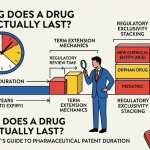
The expiry date shown in the Orange Book reflects the base statutory term of the patent (20 years from filing date), adjusted only for any Patent Term Extension (PTE) already granted. It does not automatically show pediatric exclusivity additions, patent term adjustments pending at the USPTO, or the effect of terminal disclaimers tying the patent to another patent’s expiry. Generic strategists must reconstruct the full expiry picture from multiple sources.
Patent Term Extension under the Hatch-Waxman Act (35 U.S.C. § 156) compensates brand manufacturers for time lost during FDA review. The extension can add up to five years to a patent’s life, subject to a cap that the remaining term plus extension cannot exceed 14 years from NDA approval. For a blockbuster drug with a long regulatory review period, this extension is the difference between a patent that expires in 2027 and one that expires in 2031.
Pediatric exclusivity adds six months to every listed Orange Book patent and to any other exclusivity, tacked on after the underlying IP protection expires. Congress created this incentive in 1997 to encourage manufacturers to study drugs in children. The commercial result is that a drug with an NCE exclusivity expiring December 2026 and pediatric exclusivity granted will have its effective market exclusivity extend to June 2027. Multiplied across a drug generating $4 billion annually, that six months is worth roughly $2 billion in protected sales.
Patent Term Adjustment vs. Patent Term Extension: What Generic Filers Must Track
Patent Term Adjustment (PTA) under 35 U.S.C. § 154(b) compensates for USPTO delays in prosecution. Unlike PTE, which is a Hatch-Waxman mechanism applied to one patent per drug, PTA can apply to every patent in the portfolio. A formulation patent filed in 2015 with three years of USPTO delay built in might carry a PTA of 800 days, shifting expiry from 2035 to 2037. This matters enormously for generic timing, and it requires checking the USPTO Patent Center record directly, not just the Orange Book listing.
The litigation over correct PTA calculation has been active. Novartis and other brand manufacturers have successfully argued for larger adjustments, while the USPTO has fought to cap them. Every disputed day adds to the effective exclusivity wall that generic filers must clear.
Terminal Disclaimers and Why They Sometimes Help Generic Filers
A terminal disclaimer is a statement by a patent holder that a later patent will expire no later than an earlier, related patent. Brand manufacturers sometimes file terminal disclaimers during prosecution to overcome obviousness-type double patenting rejections. The result is a later-expiring patent artificially tied to the expiry of an earlier one. For a generic filer, a terminal disclaimer in a formulation or metabolite patent can actually collapse the apparent patent wall, because once the anchor patent expires or falls in litigation, the disclaimed patent falls with it.
Identifying terminal disclaimers requires reading the actual prosecution history of each Orange Book patent, accessible through USPTO Patent Center. DrugPatentWatch cross-references these records and flags terminal disclaimer relationships, which is one reason experienced generic strategy teams use it alongside the raw Orange Book data rather than in place of it.
The 180-Day First-Filer Exclusivity: The Most Valuable Regulatory Asset in Generic Pharma
What Triggers First-Filer Status and How the Clock Starts
The 180-day generic exclusivity is awarded to the first ANDA applicant to file a substantially complete application containing a Paragraph IV certification against a listed patent. Multiple applicants filing on the same day share the exclusivity. The clock starts either on the date of first commercial marketing by any first-filer or on a court decision holding the challenged patent invalid or not infringed, whichever comes first.
The commercial math is straightforward. A drug with $2 billion in annual brand sales, at typical brand-to-generic price ratios, will generate roughly $1 billion in generic sales in its first year post-LOE. A first-filer with 180 days of protected market, no other generic competition, will capture the bulk of that volume. At typical generic margins for a large-molecule oral solid, this can represent $150 million to $400 million in gross profit for a single applicant over six months.
The MMA 2003 reform also introduced forfeiture provisions that can strip a first-filer of its exclusivity if it fails to market within a reasonable window after the forfeiture triggers. These triggers include: failure to obtain tentative approval within 30 months of filing, failure to market within 75 days of a final approval, a court decision that the challenged patent is valid and infringed, and others. Navigating these triggers without forfeiting is itself a strategic exercise in ANDA project management.
Shared Exclusivity: When Multiple Filers Get the Same Day-One Advantage
When multiple ANDA applicants file Paragraph IV applications on the same day for the same reference listed drug (RLD), all of them share the 180-day exclusivity equally. This is common for large branded drugs with well-known patent expiry timelines. The commercial result is that a theoretically exclusive period becomes a duopoly or triopoloy. Shared exclusivity among three filers is typically still highly profitable. Shared among eight filers, the economics deteriorate significantly.
Strategic filers watch the application date of their competitors through FDA’s ANDA filing date disclosure process, established after litigation forced FDA to reveal this information. Services like DrugPatentWatch track filed applications and tentative approval lists to let non-first-filers assess whether the exclusivity window is already locked up.
The Authorized Generic Threat to First-Filer Economics
Brand manufacturers learned quickly that an authorized generic, launched by or licensed from the NDA holder, does not count as ‘generic competition’ that triggers forfeiture of the first-filer’s 180-day exclusivity. But an authorized generic does compete directly with the first-filer during the exclusivity window, splitting market share without triggering exclusivity forfeiture. The practical effect is that a first-filer expecting a 50% market share in a protected period finds itself competing against the brand company’s own generic arm and often captures only 35-40% of the volume.
Brand companies systematically deploy authorized generics against first-filers. Pfizer, AstraZeneca, and AbbVie have all used this tactic. The FTC studied the practice in 2011 and found that authorized generic competition reduces first-filer revenues by 40-52% during the exclusivity period.[1] Some ANDA filers now explicitly model this scenario into their commercial forecasts when evaluating whether to pursue Paragraph IV challenges.
“First-filer applicants that faced authorized generic competition earned significantly lower profits during the 180-day exclusivity period, with average revenue reductions ranging from 40 to 52 percent compared to first-filers who did not face authorized generic competition.”Federal Trade Commission, ‘Authorized Generic Drugs: Short-Term Effects and Long-Term Impact,’ August 2011, p. iii
How to Identify High-Value Generic Market Opportunities in the Orange Book
The Five Commercial Filters Every Generic Strategy Team Should Apply
Not every patent cliff is worth pursuing. The resources required for ANDA preparation, bioequivalence studies, and potential Paragraph IV litigation are substantial. Before committing, experienced generic strategy teams run candidate drugs through a commercial filter. The five most useful screens:
U.S. brand revenue concentration: Annual U.S. revenue above $500 million is the practical floor for most Paragraph IV challenges at major generics companies. Below that, the litigation economics get uncomfortable unless the patent challenge is unusually straightforward.
Patent wall complexity: A drug protected by 15 Orange Book patents with staggered expiries from 2027 through 2038 presents a different opportunity than one with a single composition-of-matter patent expiring in 2028. Count the patents, map their types (composition of matter, formulation, method of use, metabolite), and assess which can be designed around or challenged.
Existing ANDA filer landscape: FDA publishes tentative approvals and, through periodic disclosure, first-filer dates. If 12 ANDAs are already filed and multiple first-filers are in litigation, the opportunity calculus changes. A late entrant faces both litigation risk and a crowded post-exclusivity market.
API complexity and sourcing: Drugs with difficult active pharmaceutical ingredients, those requiring controlled synthesis routes, specialized starting materials, or proprietary crystalline forms, present natural competitive moats that reduce the ANDA filer pool and preserve margins post-launch.
Regulatory pathway complexity: Some drugs require Risk Evaluation and Mitigation Strategy (REMS) programs, and REMS shared system requirements have historically been used by brand companies to delay generic access to RLD samples needed for bioequivalence testing. The 2022 FDA Safety Landfill Act provisions aimed to reduce this tactic, but litigation over REMS access continues.
How to Use DrugPatentWatch to Map Patent Cliffs Before They Become Obvious
The Orange Book’s raw format is a static government database. It tells you what patents are listed for what drugs, with their expiry dates and exclusivity codes. What it does not do is tell you what has happened to those patents over time, which ones have been challenged and invalidated in previous litigation on related drugs, which ones have terminal disclaimers, or which ones are currently being challenged by active ANDA filers.
DrugPatentWatch aggregates this longitudinal record. When evaluating a potential generic target, analysts use it to see the complete patent history, every ANDA filed, every lawsuit recorded under 21 U.S.C. § 355(j)(5)(B)(iii), every settlement filed with the FTC, and comparable patent challenge outcomes on structurally similar patents. A method-of-use patent that has been invalidated on claim construction grounds in three prior litigations involving different drugs is a much weaker obstacle than its face suggests. That context only emerges from historical patent challenge data, which the static Orange Book does not provide.
Composition of Matter vs. Formulation Patents: Which Challenges Are Worth Fighting
Not all Orange Book patents are equal in strength or in their susceptibility to challenge. Composition of matter patents, which claim the active molecule itself, are the hardest to invalidate and the most impossible to design around. When the composition-of-matter patent expires, generic entry becomes possible regardless of how many formulation patents remain, because a generic that uses the same molecule but a different formulation can certify Paragraph III against the formulation patents and still launch on the composition-of-matter expiry date.
Formulation patents, metabolite patents, and method-of-use patents are the secondary layer. These matter enormously when they cover a form of the drug (an extended-release formulation, a transdermal patch) that accounts for most of the branded product’s volume. AstraZeneca’s Prilosec (omeprazole) became famous for exactly this dynamic: the composition-of-matter patent expired in 2001, but AstraZeneca launched Nexium (esomeprazole, the active enantiomer) backed by its own patent wall, shifting prescribers before generics could fully commoditize the market. The tactic became so notorious that ‘Evergreening’ entered the pharmaceutical business lexicon permanently.
Evergreening Tactics: Identifying When Brand Strategies Delay Your Launch
Evergreening is the practice of extending effective market exclusivity beyond the original composition-of-matter patent through sequential filings of secondary patents. Common forms:
Polymorph patents: claiming a specific crystalline form of the molecule with allegedly superior stability or bioavailability
Enantiomer switches: reformulating a racemic drug as its active enantiomer (Nexium from Prilosec; Lexapro from Celexa)
Extended-release formulations: new patent coverage for a once-daily version of a twice-daily drug
Combination products: pairing the original drug with a companion agent under new IP (Vimovo: naproxen plus esomeprazole)
Metabolite patents: claiming the active metabolite formed in vivo from the original drug
Each of these can anchor additional Orange Book listings. A generic filer must evaluate each secondary patent separately. Polymorph patents in particular have had a mixed litigation record. U.S. courts have invalidated numerous polymorph patents on obviousness grounds (the Seroquel XR quetiapine extended-release litigation is instructive), while others have survived challenge when the polymorph demonstrated genuinely unexpected properties.
Paragraph IV Litigation Strategy: From Notice Letter to Court Decision
What Happens After the Paragraph IV Notice Letter Is Sent
Once an ANDA applicant sends a Paragraph IV notice letter to the NDA holder and relevant patent holders, the brand company has 45 days to file a patent infringement lawsuit in federal district court. Filing within that window triggers an automatic 30-month stay of FDA approval. The stay runs until the 30 months expire, the court enters final judgment, or FDA otherwise acts. Failure to sue within 45 days forfeits the stay but does not necessarily mean FDA approves the ANDA immediately — the underlying patent issue remains.
The 30-month stay is arguably the most powerful tool in the brand manufacturer’s defensive arsenal. It buys roughly 2.5 years of continued exclusivity regardless of patent merit, as long as the brand can file a lawsuit within the deadline. For drugs generating $1 billion or more annually, a 30-month stay is worth several billion dollars in protected revenue. Brand manufacturers almost always sue within the 45-day window, regardless of their genuine assessment of patent validity, because the cost of the litigation is trivial compared to the revenue protected.
From the generic filer’s perspective, the 30-month stay resets the commercial timeline. A company that files an ANDA and sends a Paragraph IV notice the moment it’s able to must plan for a 30-month litigation delay before any potential launch. If the underlying patent doesn’t expire until after the 30 months anyway, the stay may be commercially irrelevant. If it delays a launch by 30 months that could have come earlier, the present value of that delay can exceed $1 billion for large drugs.
Key Venues: Why Delaware and New Jersey Dominate Hatch-Waxman Litigation
The District of Delaware and the District of New Jersey handle the overwhelming majority of Hatch-Waxman patent litigation. Both districts have developed specialized expertise in pharmaceutical patent cases. Delaware in particular has become the dominant venue because many large pharmaceutical companies are Delaware-incorporated, providing a basis for personal jurisdiction, and because its courts have deep experience with claim construction, pharmaceutical formulation patents, and ANDA litigation procedure.
The Federal Circuit, which hears all patent appeals from these district courts, has its own substantial body of pharmaceutical-specific doctrine on obviousness, claim construction, and the Wands factors governing enablement of biotech claims. Generic strategy teams tracking active Paragraph IV litigations should monitor Federal Circuit precedent in real time, because a ruling in one case can flip the litigation calculus in several others involving structurally similar patents.
Invalidity Arguments That Win: Obviousness, Prior Art, and Written Description
Generic filers challenging Orange Book patents most commonly argue:
Obviousness under 35 U.S.C. § 103: The claimed compound, formulation, or method would have been obvious to a person of ordinary skill given the prior art. This is the most common invalidity argument and the one with the most nuanced case law. The KSR v. Teleflex (2007) Supreme Court decision expanded the scope of obvious combinations, helping generic challengers.
Anticipation under 35 U.S.C. § 102: The patent is invalid because it was already disclosed in prior art. This requires finding a single prior art reference that discloses every element of the claim — a higher bar than obviousness.
Written description and enablement failures under 35 U.S.C. § 112: The patent specification doesn’t adequately describe the claimed invention or enable a person skilled in the art to make and use it. Used frequently against genus claims covering entire chemical classes.
Non-infringement: Even if the patent is valid, the ANDA filer’s product doesn’t infringe it. This argument is central to formulation and method-of-use patent disputes where the generic uses a different form or is labeled for a different indication.
The inter partes review (IPR) process at the Patent Trial and Appeal Board (PTAB) has become an alternative route for patent challenges. Unlike Hatch-Waxman district court litigation, IPR can be filed by any party and proceeds relatively quickly (12-18 months to a final written decision). Coalition for Affordable Drugs, run by hedge fund manager Kyle Bass, used IPR aggressively beginning around 2015 to challenge high-profile pharmaceutical patents without holding an ANDA, purely as a financial short strategy. The tactic drew significant controversy and subsequent PTAB rule changes, but IPR remains a legitimate tool for generic challengers to use alongside or instead of Paragraph IV litigation.
Reverse Payment Settlements: The FTC’s Ongoing War with Pay-for-Delay
Reverse payment settlements, also called pay-for-delay agreements, occur when a brand manufacturer pays a generic challenger to drop its Paragraph IV challenge and agree not to enter the market until an agreed future date. The payment flows backward — from the patent holder to the accused infringer — which is the opposite of the normal litigation dynamic. From an antitrust perspective, this looks like the brand company buying off its competition with part of its monopoly profits.
The Supreme Court’s FTC v. Actavis (2013) decision held that such settlements can violate antitrust law and must be analyzed under a rule of reason standard. The FTC has pursued dozens of cases since. Notable enforcement actions include the Lipitor (atorvastatin) settlements involving Ranbaxy and Watson, and the AndroGel (testosterone gel) settlement involving AbbVie and Besins Healthcare, which resulted in a $160 million FTC settlement in 2021.[2]
For generic strategy teams, reverse payment settlements are worth tracking as competitive signals. When a brand company settles a Paragraph IV challenge with a generous payment to the generic challenger, it reveals the brand’s internal assessment that the patent is vulnerable. That information is useful to subsequent ANDA filers evaluating the same patent.
FDA Exclusivity Types: A Commercial Map of the Alphabet Soup
NCE Exclusivity, NME Exclusivity, and the Five-Year Clock
New chemical entity (NCE) exclusivity, now more precisely called new molecular entity (NME) exclusivity by FDA, gives a brand manufacturer five years of market exclusivity during which FDA will not accept an ANDA for a generic version of the drug. No amount of Orange Book patent analysis matters if NCE exclusivity hasn’t expired, because FDA won’t even receive the application.
There is a critical exception. An ANDA applicant can file a Paragraph IV challenge to an NCE-protected drug’s patents after four years of the five-year NCE period have elapsed. If the brand sues within 45 days, the 30-month stay begins from the four-year mark rather than the five-year mark. The practical result is that a well-timed ANDA filing in year four of NCE exclusivity, followed by an immediate Paragraph IV notice, can position the generic for a launch close to the NCE expiry date if the patent challenge succeeds. This is the strategy that makes early litigation on recently-approved drugs commercially viable.
3-Year Clinical Investigation Exclusivity: Why It Matters for Supplemental NDAs
Three-year clinical investigation exclusivity applies not to new chemical entities but to changes to an existing approved drug backed by new clinical investigations. This includes new indications, new routes of administration, new patient populations, and significant formulation changes. The exclusivity protects only the specific condition for which the new clinical studies were conducted, not the entire drug.
The strategic implication for generic filers: a brand company can layer multiple three-year exclusivities on top of each other by conducting sequential clinical studies. A drug with an expired NCE exclusivity and expired composition-of-matter patent can still be protected for specific indications under three-year exclusivities if the brand has continued generating clinical data. Generic applicants who certify Paragraph III against patents and wait for the exclusivity to expire often find themselves waiting for overlapping exclusivity periods they didn’t initially account for.
Orphan Drug Exclusivity: When Small Patient Populations Create Large Patent Cliffs
Orphan drug designation, granted to drugs treating diseases affecting fewer than 200,000 Americans, carries seven years of market exclusivity from the date of approval. Unlike patent protection, orphan drug exclusivity cannot be extended by pediatric studies. But it can completely block generic entry even after all Orange Book patents have expired.
Biogen’s Spinraza (nusinersen) for spinal muscular atrophy had orphan drug exclusivity that stretched well beyond any patent timeline analysis alone would suggest. Generic development for Spinraza is complicated further by its classification as a large molecule (an antisense oligonucleotide), meaning it doesn’t follow the ANDA pathway at all. But for small molecules, orphan drug exclusivity has blocked what appeared to be open generic windows for drugs like Lomitapide (Juxtapid, for homozygous familial hypercholesterolemia) and Eliglustat (Cerdelga, for Gaucher disease).
Pediatric Exclusivity as a Six-Month Extension on Every Listed Patent
When FDA grants pediatric exclusivity in response to a Written Request for pediatric studies, that six-month extension attaches to every Orange Book patent and every exclusivity for the drug. It runs after, not instead of, those protections. The brand company gets six months of additional protected sales for conducting and submitting pediatric study results, regardless of whether the studies showed the drug works in children.
The financial math explains why brand manufacturers almost always respond to Written Requests. For a drug with $2 billion in annual U.S. revenue, six months of additional exclusivity is worth approximately $1 billion in revenue. Pediatric study costs for a single drug, even complex studies requiring multiple age cohorts, rarely exceed $20-30 million. The return on investment is exceptional, and accepting the Written Request delays the generic competition clock at a trivial cost.
LOE Forecasting: How to Model Loss of Exclusivity Timelines
Building a Loss-of-Exclusivity Model: The Seven Variables That Matter
Loss of exclusivity is the date at which a brand drug loses effective market protection and generic competition can begin. In practice, LOE is not a single date but a range governed by seven variables:
Latest Orange Book patent expiry (including PTE and PTA)
FDA exclusivity end dates (NCE, orphan, clinical investigation)
Pediatric exclusivity addition
Status of active Paragraph IV challenges (are they settled, litigated, or pending?)
First-filer ANDA status and readiness to launch
Manufacturing authorization status (API supplier DMF, ANDA approval stage)
Authorized generic deployment by the brand company
Each variable shifts the effective LOE date. A model that only incorporates the latest patent expiry date without accounting for pending Paragraph IV challenges that could accelerate LOE by two years will produce forecasts that are commercially useless. This is why pharmaceutical market research firms, investment banks, and institutional investors maintain dedicated LOE forecasting models, often cross-referencing multiple data sources including DrugPatentWatch, FDA’s ANDA approval database, PACER for litigation status, and their own primary research.
Why Generic Entry Often Lags the Technical LOE Date by 6-18 Months
Even after the last patent expires and all FDA exclusivities end, generic entry is not instantaneous. API manufacturing and drug product manufacturing must be ready and inspected. The ANDA must receive final approval. Distribution relationships must be in place. For complex dosage forms, spray-dried dispersions, hot-melt extrusion formulations, or modified-release delivery systems, process development and scale-up can take 18-24 months after ANDA filing even when the patent situation is fully clear.
This lag is well documented in empirical studies of generic entry timing. A 2018 analysis in the Journal of Managed Care and Specialty Pharmacy found that for drugs with revenues over $250 million at LOE, median time from first patent expiry to first generic market entry was 11.3 months across a sample of 97 drugs.[3] For drugs with complex formulations or API manufacturing challenges, the lag was significantly longer.
This lag period is commercially important in two directions. For brand companies, it represents months of continued high-price sales after their patents expire, because no generic alternative is on pharmacy shelves. For insurance companies, PBMs, and government payers, it represents billions in excess drug spend relative to the post-generic equilibrium. For generic companies that are early to market, it means a brief period of limited competition even without a formal exclusivity grant.
Scenario Analysis: Accelerated LOE, Base Case, and Delayed LOE
Sophisticated LOE models run three scenarios for each target drug:
Accelerated LOE: A successful Paragraph IV challenge invalidates the key blocking patent 2-3 years before its expiry. The 30-month stay expires and FDA approves the ANDA. The first-filer launches, triggering the 180-day exclusivity clock. Brand market share collapses rapidly. This scenario typically requires modeling the probability of patent invalidation given the strength of the specific patents at issue.
Base Case LOE: Paragraph IV challenges are settled with negotiated entry dates, or all challenges fail and the last patent expires normally. Generic launch occurs near the statutory expiry date, adjusted for manufacturing readiness and FDA approval lag. Multiple ANDA approvals follow quickly and market share erosion is steep.
Delayed LOE: The brand company successfully defends all patents through litigation, layers additional secondary patents with later expiry dates, secures pediatric exclusivity, and deploys an authorized generic to contain first-filer economics. The generic price environment deteriorates slowly rather than sharply. Brand revenue erosion takes 36-48 months instead of 12-18.
Each scenario has different revenue implications for both the brand and the generic entrants. Investment analysts modeling portfolio companies with large LOE exposures typically probability-weight these three scenarios to generate expected revenue forecasts.
Case Studies: Orange Book Strategy in Action
Humira (Adalimumab): The Most Analyzed Patent Cliff in Pharmaceutical History
AbbVie’s Humira (adalimumab) for rheumatoid arthritis and other immune conditions is the most commercially significant LOE event in the modern pharmaceutical industry. At its peak, Humira generated roughly $21 billion globally per year, with U.S. sales exceeding $14 billion annually. AbbVie constructed a patent thicket around Humira that, as of 2022, comprised more than 250 U.S. patents covering manufacturing processes, formulations, drug concentrations, dosing regimens, and methods of treatment.[4]
The Humira biosimilar situation differs from a standard Hatch-Waxman ANDA scenario because Humira is a large biologic governed by the Biologics Price Competition and Innovation Act (BPCIA) rather than Hatch-Waxman. Biosimilar applications follow the 351(k) pathway, and their patent disputes follow the BPCIA ‘patent dance’ procedure. But the strategic dynamics are closely analogous to the Orange Book framework, and the Humira case illustrates the extreme end of secondary patent layering.
Amgen, Boehringer Ingelheim, Samsung Bioepis, Pfizer, and others all developed adalimumab biosimilars. All settled patent disputes with AbbVie under license agreements that allowed U.S. biosimilar launch in January 2023, nearly two years after European biosimilar entry. The settlements gave AbbVie substantial additional U.S. revenue protection, consistent with the reverse payment analysis applicable to Hatch-Waxman: the brand bought additional time in exchange for future market access.
Eliquis (Apixaban): BMS and Pfizer’s Successful Patent Defense
Apixaban (brand: Eliquis), an oral Factor Xa inhibitor jointly marketed by Bristol Myers Squibb and Pfizer, illustrates a successful patent defense against multiple Paragraph IV challengers. Eliquis U.S. revenues exceeded $12 billion in 2023. The composition-of-matter patent, U.S. Patent 6,967,208, was listed in the Orange Book with an expiry that after Patent Term Extension ran to approximately November 2026.
Multiple generic companies, including Mylan (now Viatris), filed ANDAs with Paragraph IV certifications challenging the key patents. Litigation in the District of Delaware proceeded through claim construction and summary judgment stages. BMS and Pfizer successfully defended the patents, and the court ruled in their favor. The result is that generic entry for apixaban was pushed to the natural patent expiry rather than an earlier court-ordered date.
The apixaban case is instructive because it shows what successful brand patent defense looks like commercially. With a composition-of-matter patent surviving challenge, the full patent term ran, and generic companies that spent years in ANDA preparation and litigation ultimately waited for the natural expiry date rather than gaining an early entry premium. The 180-day exclusivity that first-filers would have captured in a successful challenge scenario was replaced by a Paragraph III wait.
Celgene’s Revlimid (lenalidomide) for multiple myeloma is the paradigmatic case of negotiated generic entry through settlement in a complex patent environment. Celgene settled with multiple generic challengers, including Natco Pharma and others, granting them licensed entry beginning in January 2022 at volume-limited quantities, with full generic competition beginning in January 2026.
The structure of the Revlimid settlements was highly unusual. Rather than a simple date-of-entry license, the settlements included volume caps on generic lenalidomide during a transition period. Generics could enter but could only capture a percentage of the market — a structure designed to preserve Celgene (now BMS) revenue during the transition while providing some benefit to the generic challengers.
The FTC investigated these settlements but ultimately did not challenge them under antitrust law, though the agency expressed concerns about the volume-cap structure as a potential model for future pay-for-delay variants. The Revlimid case demonstrates that patent settlements are not binary (either full entry or no entry) but can involve structured market access arrangements that complicate both brand revenue forecasting and generic commercial planning.
Lipitor (Atorvastatin): The Template for First-Filer Exclusivity Monetization
Atorvastatin calcium (brand: Lipitor, Pfizer) was the best-selling drug in pharmaceutical history at the time of its LOE in 2011. U.S. sales in the year before LOE exceeded $7 billion. Ranbaxy Laboratories was the Paragraph IV first-filer, having filed its ANDA years earlier and entered the tortured Hatch-Waxman litigation that would eventually reveal Ranbaxy’s own manufacturing and data integrity problems.
The Lipitor LOE played out over a 180-day exclusivity window beginning in November 2011. Despite Ranbaxy’s deep corporate problems with FDA (which would eventually result in consent decrees and criminal convictions for manufacturing fraud), it held first-filer status. Pfizer deployed an authorized generic through Prasco immediately. The result was a first-filer (Ranbaxy) competing with the brand company’s authorized generic during the 180-day exclusivity window, with the full generic market entering after the exclusivity expired.
Atorvastatin’s LOE is now cited in virtually every generic commercial model as the reference case for rapid brand-to-generic substitution. Within 12 months of LOE, atorvastatin generic prescriptions constituted over 90% of total atorvastatin volume. Brand Lipitor retained only a tiny residual share among patients whose plans didn’t mandate generic substitution. The speed of the transition was faster than most analysts had forecast, setting a benchmark that subsequently influenced how financial analysts modeled LOE revenue erosion across the therapeutic class broadly.
Orange Book Changes, Delisting, and the Strategic Significance of Patent Removal
What Happens When a Brand Company Delists an Orange Book Patent
Patent delisting occurs when an NDA holder removes a patent from the Orange Book, either voluntarily or because FDA determines the patent was improperly listed. Delisting can dramatically affect the generic competitive landscape. An ANDA filer that filed a Paragraph IV certification against a now-delisted patent may lose its first-filer status if the certification no longer has a patent to certify against. Alternatively, the delisting may remove the basis for a 30-month stay in ongoing or future litigation.
Brand companies occasionally delist patents strategically. If a patent has been ruled invalid in litigation against one generic challenger, the brand may delist it to prevent its Orange Book listing from facilitating additional Paragraph IV challenges. A ruling of invalidity doesn’t automatically delist a patent, but the ruling can be used by subsequent ANDA filers arguing that the patent provides no exclusivity barrier.
The reverse delisting scenario is also commercially significant. If an NDA holder lists additional patents after ANDAs have already been filed, ANDA applicants must certify against the new patents or convert their certification to Paragraph III. This can restart 30-month stay litigation and delay an ANDA approval that was imminent. The MMA 2003 reforms limited the brand company’s ability to list new patents and trigger new stays late in the ANDA process, but the rules are complex and litigation over late-listed patents has continued.
Orange Book Reform: What the FDA’s 2023 and 2024 Patent Listing Rules Changed
The Drug Price Transparency in Combating Coronavirus Act and subsequent Biden Administration executive orders on pharmaceutical pricing led FDA to propose and finalize rules tightening Orange Book patent listing standards. The FDA’s October 2023 final rule clarified that device patents (auto-injectors, inhaler devices) are not properly listed in the Orange Book unless they specifically claim the drug product approved in the NDA.[5]
This rule directly addressed a systematic brand manufacturer practice: listing device patents for combination products like EpiPen (epinephrine auto-injector), Spiriva (tiotropium HandiHaler), and Symbicort (budesonide-formoterol inhaler) to trigger 30-month stays against ANDA filers even when those filers were using completely different delivery devices. The FTC submitted comments supporting the FDA’s stricter approach, calling out what it characterized as improper listings that imposed anticompetitive delays on generic entry.
The practical effect of the 2023 rule is visible in subsequent ANDA litigation filings. Brand companies defending device patent listings in the Orange Book for inhaler and injection products face both FDA administrative delisting proceedings and district court challenges to their ability to obtain 30-month stays based on those patents. The competitive map for complex drug-device combination generics shifted meaningfully.
Generic Entry Forecasting by Therapeutic Class
Oncology LOE Pipeline: The Next Wave of Generic Opportunities, 2025-2030
The oncology patent cliff over 2025-2030 is the most commercially significant LOE wave since atorvastatin in 2011. Key drugs approaching LOE in this window include:
Drug (Brand)
Active Ingredient
Indication
U.S. Revenue (approx.)
Estimated LOE
Revlimid
Lenalidomide
Multiple myeloma
$7B+ (at peak)
Full entry 2026
Imbruvica
Ibrutinib
CLL, MCL, others
$4B+ U.S.
2027-2029
Jakafi
Ruxolitinib
Myelofibrosis, PV
$2.5B+ U.S.
2027-2028
Pomalyst
Pomalidomide
Multiple myeloma
$2B+ U.S.
2027-2028
Xtandi
Enzalutamide
Prostate cancer
$2B+ U.S.
2027-2029
Ibrutinib (Imbruvica, AbbVie/J&J) is a particularly well-analyzed case. The drug’s composition-of-matter patents and secondary process and use patents created an initial patent wall. Multiple ANDA filers have filed applications. The complexity of ibrutinib’s synthesis, combined with its tablet formulation, makes ANDA development non-trivial, which naturally limits the number of credible early entrants even after the patent situation resolves.
Immunology and Autoimmune Drug LOE: GLP-1, JAK Inhibitors, and IL-Pathway Agents
The JAK inhibitor class, including tofacitinib (Xeljanz, Pfizer) and upadacitinib (Rinvoq, AbbVie), represents the next generation of immunology patents approaching the midpoint of their life cycle. Tofacitinib’s key composition-of-matter patent already expired (around 2025), but secondary patents and the complexity of the patient population have maintained some market stability. Multiple ANDA filers are positioned for entry as the patent landscape clears.
GLP-1 receptor agonists including semaglutide (Ozempic/Wegovy, Novo Nordisk) and tirzepatide (Mounjaro/Zepbound, Eli Lilly) are structurally large molecules governed by biosimilar pathways rather than ANDA, complicating the generic analysis. However, oral semaglutide (Rybelsus) follows an NDA pathway and will eventually face ANDA competition. The peptide synthesis complexity of oral semaglutide’s API creates manufacturing barriers that may concentrate the early generic market among a small number of capable manufacturers.
CNS Drug Patent Expiries: Schizophrenia, ADHD, and Antidepressant Generics
The central nervous system therapeutic class has historically been one of the most active areas for Paragraph IV litigation, given high-volume prescribing and the relatively manageable manufacturing complexity of most oral CNS drugs. Key LOE events in the near-term window:
Vraylar (cariprazine, AbbVie) has patents extending into the late 2020s. Lybalvi (olanzapine-samidorphan, Alkermes) is a combination product whose samidorphan component patent runs separately from the generic olanzapine already on market. The combination product’s Orange Book listings reflect this hybrid structure, and ANDA filers must certify against both sets of patents.
Extended-release formulations of established CNS drugs continue to generate litigation. Teva’s generic extended-release methylphenidate products, Mallinckrodt’s generic amphetamine products, and various generic quetiapine XR products all generated or are generating Paragraph IV litigation over formulation patents long after the original composition-of-matter patents expired. The extended-release patent battles in CNS have been notable for the frequency with which courts have ruled patents invalid on obviousness grounds.
Biosimilar vs. Generic: Different Pathways, Same Strategic Logic
BPCIA Patent Dance vs. Hatch-Waxman: Key Differences for Market Entry Planning
The Biologics Price Competition and Innovation Act, passed as part of the Affordable Care Act in 2010, created the 351(k) biosimilar pathway as the large-molecule analog of the Hatch-Waxman ANDA framework. But the two frameworks differ in commercially important ways.
BPCIA exclusivity for reference biological products is 12 years from the date of first licensure, compared to Hatch-Waxman’s 5-year NCE exclusivity. The patent dispute mechanism, called the ‘patent dance,’ is a sequential exchange of patent lists between the biosimilar applicant and the reference product sponsor that can continue for several years before litigation begins. No equivalent of the 30-month automatic stay applies to biosimilar applications after the 2021 Amgen v. Sandoz Supreme Court decision, though injunctions can still delay commercial launch.
Biosimilar market dynamics also differ from small-molecule generics in the degree of price competition achievable. A small-molecule ANDA generic can be substituted automatically at the pharmacy under state generic substitution laws when rated AB (therapeutically equivalent) by FDA. An interchangeable biosimilar can similarly be substituted at pharmacy. Non-interchangeable biosimilars require physician or prescriber action to switch, which slows market share capture. Building a biosimilar commercial strategy requires understanding which interchangeability designation the product will achieve and how that affects payer formulary decisions.
Interchangeability Designation: The Most Valuable Biosimilar Regulatory Status
FDA’s interchangeability designation for a biosimilar requires demonstrating that switching between the reference product and the biosimilar produces the same clinical result in any given patient, and that the risk of alternating between the two products is no greater than using the reference product continuously. This is a higher bar than biosimilarity alone. Boehringer Ingelheim’s Cyltezo (adalimumab-adbm) was the first biosimilar to receive interchangeable designation with a reference product (Humira) in the U.S., in 2021.[6]
For a biosimilar company, interchangeable status is worth pursuing because it enables pharmacy-level substitution in states that have enacted biosimilar substitution laws. Without it, market capture depends on prescriber education and payer formulary mandates, both slower mechanisms than automatic substitution. The investment in conducting switching studies required for interchangeable designation typically runs into the hundreds of millions of dollars for complex biologics, but the market capture differential over 3-5 years can easily justify the cost for large reference products.
What Generic Entry Means for Payers, PBMs, and Formulary Strategy
How PBMs Exploit the LOE Window to Generate Rebate Revenue
Pharmacy benefit managers occupy a unique structural position in the LOE event. In the 12-24 months before a major drug’s patent expiry, PBMs begin negotiating enhanced rebates from the brand manufacturer in exchange for continued formulary preference or preferred tier placement. Brand companies, aware that generic competition will soon erode their market share, sometimes pay higher rebates to preserve their unit volume through the transition. PBMs collect these rebates and may or may not fully pass them to plan sponsors, depending on their contract structure.
After LOE, PBMs typically mandate generic substitution through formulary design. A drug that was Tier 2 (preferred brand) during its exclusivity period moves to Tier 1 (generic preferred) or is removed from formulary entirely once the generic is available. The brand version, if retained on formulary at all, moves to Tier 3 or 4 with high cost sharing. This formulary management drives the rapid volume transfer from brand to generic that characterizes major LOE events.
Specialty Drug LOE: Why the Transition Is Slower for High-Cost Injectable and Biologic Products
The brand-to-generic transition speed observed for oral solid dosage forms (atorvastatin: 90% generic within 12 months) does not replicate for specialty drugs. Specialty biologics, oncology infusion products, and complex injectables transition more slowly for several reasons.
Physician familiarity and patient adherence patterns are stickier for specialty products. A rheumatologist who has successfully managed 200 patients on a branded biologic for five years is reluctant to switch stable patients to a biosimilar without compelling evidence or payer pressure. That physician inertia takes time to overcome. Additionally, specialty pharmacy distribution, specialty hub services, and patient assistance program infrastructure tied to the brand product are all factors that complicate the transition dynamics that are absent in the commodity oral solid world.
Empirical data on biologics LOE from IQVIA shows that reference products in immunology biosimilar markets typically retain 40-60% of market share 24 months after biosimilar launch, compared to less than 10% retention for large oral brand drugs in the same post-LOE window.[7] This difference has enormous implications for how quickly biosimilar developers can achieve commercial viability and how quickly their products generate returns on the enormous development investments involved.
Manufacturing and Supply Chain Considerations in Generic Market Timing
API Sourcing, DMF Filings, and Why Manufacturing Readiness Determines Real LOE
The Orange Book and patent analysis tell you when you legally can enter a market. Manufacturing readiness tells you when you actually will. These two dates can differ by 18-36 months for complex APIs or dosage forms.
Drug Master File (DMF) filings with FDA are required for API suppliers to an ANDA product. FDA must review and accept the DMF before the associated ANDA can be approved. For APIs manufactured through complex synthesis routes with multiple regulated intermediates, DMF preparation and FDA review can take 18-24 months. A generic company that begins API sourcing work only after winning patent litigation on an accelerated Paragraph IV timeline may find itself unable to supply product for another 18 months even after the legal barrier drops.
The most operationally capable generic companies (Teva, Mylan/Viatris, Sun Pharma, Dr. Reddy’s, Apotex) maintain API development programs that run 36-48 months ahead of expected LOE dates. They begin DMF preparation for key APIs well before the patent situation is clear, accepting some wasted investment if the patent challenge fails, because the alternative — being legally able to enter a market but not operationally ready — is commercially devastating, particularly for first-filer exclusivity windows where every week of delay costs real revenue.
ANDA Manufacturing Inspection Risk: When FDA Delays Become Competitive Weapons
FDA’s pre-approval inspection program for ANDA applicants (the same manufacturing inspection program applicable to all pharmaceutical manufacturing) can delay approval by 6-18 months if manufacturing deficiencies are found. In competitive ANDA scenarios, this FDA process becomes a de facto competitive disadvantage for the company that gets inspected and found deficient relative to a competitor that passes inspection cleanly.
The post-COVID FDA inspection backlog created systemic delays in ANDA approvals throughout 2021-2022, with some facilities in India and China not inspected for two or three years. FDA’s Mutual Recognition Agreements with European regulators provided some relief for facilities already inspected by EMA. But the backlog created uneven competitive timing among ANDA filers targeting the same LOE date: some filers received final approval quickly while others waited for inspection slots, regardless of their filing date or first-filer status.
Tracking ANDA approval status for competing filers is accordingly part of sophisticated generic market timing analysis. FDA’s ANDA approval database, updated regularly, shows tentative approvals (approval in principle, pending resolution of patent or exclusivity issues) and final approvals. A generic company monitoring its competitive field for a shared first-filer LOE event watches this database closely to see when competitors receive final approval, because that event starts the 180-day exclusivity clock if it constitutes the first commercial marketing trigger.
Financial Modeling: How Investors Value Generic LOE Opportunities
DCF Valuation of First-Filer Exclusivity: A Framework for Generic Pipeline Assets
Institutional investors and private equity firms that hold generic pharmaceutical assets model first-filer exclusivity positions as real options on future cash flows. The basic DCF structure for valuing a first-filer position in an ANDA:
The key inputs are: (1) probability-weighted LOE date across accelerated, base, and delayed scenarios; (2) expected market share during the 180-day exclusivity period, net of authorized generic competition; (3) expected price realization as a percentage of brand price during the exclusivity period; (4) manufacturing and COGS assumptions; (5) cost of the underlying Paragraph IV litigation and ANDA development; and (6) terminal value of the competitive generic market post-exclusivity, where margins compress sharply.
For a drug with $3 billion in annual U.S. revenues, a successful first-filer position with a 180-day exclusivity period and no authorized generic might be worth $400-600 million in NPV, depending on litigation cost and timing uncertainty. With authorized generic competition, that NPV drops by 40-50%. Discounted for litigation failure probability and applied against the full development cost including failed opportunities, the IRR on first-filer ANDA programs for large branded drugs can be exceptional, which is why it remains a core business model for leading generic companies despite the regulatory and litigation complexity.
The Declining IRR Problem in Generic Pharma and Why Orange Book Intelligence Matters More Than Ever
Generic pharmaceutical returns have compressed since 2015. The primary drivers: FDA approval backlogs reduced first-mover advantages as competitive products received approval simultaneously; pricing pressure from consolidated pharmacy chains and PBMs squeezed generic margins; and API supply chain concentration created shared cost exposure across generic companies competing for the same molecules.
In this environment, the competitive advantage shifts to companies with better upstream intelligence. A generic company that identifies a high-value Orange Book opportunity 24 months before its competitors, correctly assesses which patents are weak, begins API development early, and files its ANDA on the earliest possible date compresses that competitive window relative to less-informed rivals. The information advantage embedded in sophisticated Orange Book analysis translates directly into IRR differential.
This is why specialized databases and analytics platforms like DrugPatentWatch have become embedded in the standard workflow of generic strategy teams at major companies. The raw Orange Book data is free and public. The analytical layer — litigation history, patent strength assessment, first-filer tracking, exclusivity modeling — is where proprietary intelligence creates commercial value.
Wall Street’s LOE Models: What Analysts Get Wrong About Brand Revenue Erosion
Sell-side pharmaceutical analysts routinely underestimate the speed and depth of revenue erosion at LOE for large oral branded drugs. A consistent pattern documented across multiple LOE events: consensus forecasts assume 60-70% volume loss in year one post-LOE, while actual observed volume loss for large oral drugs frequently runs 80-90% in the same period. The difference reflects the aggressive formulary management by PBMs and state Medicaid programs, which mandate generic substitution more rapidly than consensus models assume.
Conversely, analysts often underestimate the resilience of branded revenue for specialty injectables and biologics post-LOE, for the reasons discussed above (physician stickiness, specialty pharmacy dynamics). The result is a systematic model error in opposite directions: analysts overestimate brand revenue persistence for oral drugs and underestimate it for specialty products.
Correcting for these biases requires drug-specific analysis of formulary management dynamics and physician prescribing patterns, not just the application of a generic erosion curve derived from historical averages. A drug with 80% of volume in Medicaid (which mandates generic) will erode differently from one with 80% of volume in commercial insurance under fee-for-service (which is slower to mandate substitution).
Regulatory Intelligence: Using Orange Book Data to Track FDA Approval Timelines
ANDA Tentative Approval: What It Means for Competitive Positioning
FDA issues a Tentative Approval letter to an ANDA applicant whose application satisfies all ANDA approval criteria except that final approval cannot be given due to unexpired patent or exclusivity protection for the reference listed drug. Tentative approval is commercially meaningful because it confirms that the manufacturing, bioequivalence, and labeling requirements have been met. The only barrier to final approval is legal, not scientific.
A tentative approval with a known patent expiry date or pending court decision gives the ANDA applicant a clear line of sight to final approval. It also signals to competitors that this applicant is ready to launch, which affects the competitive dynamics of the LOE event. A drug with three tentative approvals and a clear LOE date will see more aggressive generic price competition on day one than a drug where most ANDA filers are still working through bioequivalence failures or manufacturing issues.
Priority Review of ANDAs: Which Drugs Get Expedited Generic Approval and Why
FDA’s Complex Drug Substance, Complex Drug Product, and Drug Shortage designations can accelerate ANDA review timelines. In 2020, FDA established expedited procedures for ANDAs targeting drugs in shortage. Pharmaceutical companies that develop generics for shortage drugs can receive review priority, which reduces the standard 10-month ANDA review period.
For commercial generic strategy, the drug shortage database maintained by FDA identifies drugs where early generic entry could benefit from expedited review. A generic company targeting a shortage drug faces less competition (by definition, the market hasn’t attracted sufficient supply) and receives faster FDA review. The tradeoff is that shortage drugs are often in shortage because they’re low-margin, difficult to manufacture, or subject to pricing pressure that makes investment unattractive. The exceptions are shortage drugs that became scarce due to manufacturing disruptions at a dominant supplier, where the underlying demand and pricing economics remain attractive.
The Future of Orange Book Strategy: AI, Data Intelligence, and Competitive Monitoring
How Machine Learning Is Changing Patent Expiry Forecasting
The sheer volume of Orange Book data, combined with USPTO prosecution history, Federal Circuit case law, ANDA filing records, and settlement disclosures, creates an analytical problem that scales beyond what manual analysis can handle efficiently. Machine learning models trained on historical Paragraph IV litigation outcomes can assign probability scores to patent challenges based on patent type, claim breadth, prior art landscape, and court venue. These models, applied to current active ANDAs, generate probabilistic LOE forecasts more accurate than the manual approach for a large universe of drugs simultaneously.
Several data companies now offer AI-assisted patent expiry forecasting for pharmaceutical clients. The models are not yet reliable enough to replace expert analysis for individual high-stakes decisions, but they are increasingly useful as a screening tool for identifying which drugs in a large pipeline warrant deeper manual analysis. A generic company evaluating 200 potential ANDA targets can use machine learning screening to prioritize the 20 most commercially attractive targets for expert evaluation, compressing the human time required for comprehensive portfolio planning.
Real-Time Orange Book Monitoring: What Changes to Watch and When
Active Orange Book monitoring involves tracking monthly FDA updates for changes to five categories of information:
New patent listings by existing NDA holders (potential new exclusivity barriers)
Patent expirations and expiry date corrections
Exclusivity grant updates (new pediatric exclusivity awards, orphan drug grants)
ANDA approval status changes (new tentative or final approvals for competing filers)
Product discontinuations and RLD changes (which can affect the valid basis for a pending ANDA)
DrugPatentWatch provides automated alert systems for Orange Book changes tied to specific drugs or therapeutic classes, which generic strategy teams, payer analytics groups, and pharmaceutical investors use to maintain continuous situational awareness without manual database monitoring. Changes to Orange Book listings for a drug in a live Paragraph IV litigation can be immediately commercially significant — a new patent listing after ANDA filing, for instance, may trigger a new certification requirement and litigation, resetting the timeline.
Key Takeaways
The Orange Book is not a compliance document — it’s a competitive market map that determines the timing and economics of every generic entry in the U.S. pharmaceutical market.
Patent expiry dates in the Orange Book must be adjusted for Patent Term Extension, Patent Term Adjustment, and pediatric exclusivity before use in any commercial forecast.
First-filer 180-day exclusivity is the most valuable regulatory asset in generic pharma, but authorized generic competition from brand manufacturers reduces its value by 40-52%.
Composition-of-matter patents are far harder to challenge than formulation, metabolite, or method-of-use patents. Generic strategy teams must categorize each Orange Book patent before assessing challenge feasibility.
The 30-month automatic stay triggered by Paragraph IV litigation is commercially worth billions for brand manufacturers on large drugs, which is why brand companies almost always sue within the 45-day window regardless of their actual assessment of patent strength.
Accelerated LOE through successful Paragraph IV challenges typically requires 3-5 years from ANDA filing to court decision — not the 18-24 months that project timelines sometimes assume.
LOE models must incorporate manufacturing readiness, API DMF status, FDA inspection risk, and ANDA tentative approval status alongside the patent and exclusivity timeline to generate commercially actionable forecasts.
The biologics LOE transition is slower than oral drug LOE, with reference products typically retaining 40-60% market share 24 months post-biosimilar launch, compared to less than 10% for large oral branded drugs.
Orange Book reform, including the 2023 FDA final rule on device patent listings, has shifted the competitive landscape for complex drug-device combination products and is creating new generic entry opportunities.
Tools like DrugPatentWatch, used alongside FDA’s public Orange Book and USPTO prosecution histories, provide the analytical depth required to translate raw patent data into actionable commercial intelligence.
Frequently Asked Questions
1. What is the Orange Book in pharmaceutical terms, and who publishes it?
The Orange Book is the FDA publication ‘Approved Drug Products with Therapeutic Equivalence Evaluations.’ FDA publishes and continuously updates it. It lists brand-name drug products approved under New Drug Applications (NDAs), together with their Orange Book-listed patents and FDA-granted exclusivities. Generic manufacturers use it to identify which drugs they can target with an Abbreviated New Drug Application (ANDA) and under what conditions.
2. How do I find out when a drug’s Orange Book patents expire?
Start with FDA’s online Orange Book at accessdata.fda.gov/scripts/cder/ob/index.cfm, which shows patent expiry dates as listed by the NDA holder. Then cross-reference those dates with USPTO Patent Center records for each patent to check for Patent Term Adjustment. Apply any granted Patent Term Extension. Check for pediatric exclusivity grants that add six months after the base expiry. Finally, review active litigation records and ANDA filings to understand whether any Paragraph IV challenges may accelerate the effective LOE date.
3. What is a Paragraph IV certification and why does it matter commercially?
A Paragraph IV certification is a statement by an ANDA applicant that a listed Orange Book patent is invalid, unenforceable, or will not be infringed by the generic product. It’s the mechanism that triggers potential Hatch-Waxman litigation and, for the first ANDA filer to make this certification, qualifies that filer for 180 days of generic market exclusivity. This exclusivity period is the primary financial incentive that motivates generic companies to invest in costly patent challenges rather than simply waiting for patents to expire.
4. How does 180-day generic exclusivity work, and what can forfeit it?
The 180-day generic exclusivity begins running from the date of first commercial marketing by any first-filer, or from the date of a court decision holding the challenged patent invalid or not infringed, whichever comes first. It can be forfeited if the first-filer fails to obtain tentative approval within 30 months of filing, fails to market within 75 days of final approval eligibility, or if the challenged patent is found valid and infringed. All first-filers sharing the same filing date share the exclusivity window equally.
5. What is the difference between LOE and patent expiry for pharmaceutical market analysis?
Patent expiry is a legal date; LOE (loss of exclusivity) is a commercial event. A drug can have a composition-of-matter patent expiring in 2027 but also have pediatric exclusivity, a formulation patent expiring in 2029, and an outstanding Paragraph IV litigation that will determine whether the formulation patent survives. The commercial LOE, when generic competition actually begins at scale, depends on resolving all of these layers. Generic market entrants must model the latest of all effective exclusivity protections, not simply the composition-of-matter patent expiry.
6. Can a brand company add new patents to the Orange Book after generics have filed ANDAs?
Yes, but with restrictions. An NDA holder can submit newly-issued patents for Orange Book listing after ANDA applications have been filed. Existing ANDA applicants must then certify against those new patents. However, the MMA 2003 reforms limited the brand company’s ability to obtain additional 30-month stays from patents issued after the first ANDA was filed. The rules distinguishing between patents that can and cannot trigger additional stays are complex and have been heavily litigated.
7. What is the authorized generic, and how does it affect generic company revenue during the 180-day exclusivity period?
An authorized generic is a version of a brand drug marketed by the NDA holder itself (or a licensee) under the brand’s NDA without a separate ANDA approval. Because it’s marketed under the brand NDA, it doesn’t count as generic competition that triggers forfeiture of the first-filer’s 180-day exclusivity. But it does compete directly with the first-filer during the exclusivity window. FTC research shows authorized generics reduce first-filer revenues during exclusivity by 40-52%. Brand manufacturers deploy them routinely against large first-filer positions.
8. How are biosimilar LOE events different from small-molecule generic LOE events?
Biosimilars follow the 351(k) BPCIA pathway with 12-year reference product exclusivity, rather than the Hatch-Waxman ANDA pathway with 5-year NCE exclusivity. Patent disputes follow the BPCIA ‘patent dance’ rather than the Paragraph IV notification and 30-month stay structure. Commercially, biosimilar market share capture is substantially slower than small-molecule generic market share capture, because pharmacy-level automatic substitution requires interchangeable designation, and physician and patient stickiness is higher for complex biological therapies.
9. What did the FDA’s 2023 Orange Book device patent listing rule change?
FDA’s October 2023 final rule clarified that device patents for combination products (auto-injectors, inhalers, drug-device combinations) may only be listed in the Orange Book if those patents specifically claim the approved drug product. Patents that cover only the device component without claiming the drug product are not properly listed. This rule removed an avenue brand manufacturers used to trigger 30-month stays against ANDA filers developing alternative delivery device formulations for drugs like EpiPen and Spiriva. It reduced the patent listing barriers for complex generic inhalers and auto-injectors.
10. What is DrugPatentWatch and how do pharmaceutical companies use it?
DrugPatentWatch is a commercial pharmaceutical patent intelligence database that aggregates and cross-references FDA Orange Book data, USPTO patent records, Hatch-Waxman litigation history, ANDA filing data, and settlement filings. Generic companies use it to identify patent expiry timelines, track competitor ANDA filings, review litigation histories for specific patents, and monitor Orange Book changes for drugs in their commercial pipeline. Payers, PBMs, and pharmaceutical investors use it to forecast LOE dates and model generic entry timelines for portfolio drugs. It provides the longitudinal and cross-referenced view of patent data that the static monthly Orange Book snapshot does not.
References
Federal Trade Commission. (2011). Authorized Generic Drugs: Short-Term Effects and Long-Term Impact. Federal Trade Commission. https://www.ftc.gov/sites/default/files/documents/reports/authorized-generic-drugs-short-term-effects-and-long-term-impact-report-federal-trade-commission/p083105authgenericdrugsreport.pdf
Federal Trade Commission. (2021, July 20). FTC Obtains $160 Million Settlement in AbbVie Pay-for-Delay Case. Federal Trade Commission. https://www.ftc.gov/news-events/news/press-releases/2021/07/ftc-obtains-160-million-judgment-androgel-pay-delay-case
Grabowski, H., Guha, R., & Salgado, M. (2018). Regulatory and patent barriers to generic competition in the US. Journal of Managed Care and Specialty Pharmacy, 24(4), 349-356. https://www.jmcp.org/doi/10.18553/jmcp.2018.24.4.349
Feldman, R. (2018). May your drug price be evergreen. Journal of Law and the Biosciences, 5(3), 590-647. https://doi.org/10.1093/jlb/lsy022
U.S. Food and Drug Administration. (2023, October 6). Orange Book: Final Rule on Patent Listing Requirements for Drug Products. Federal Register, 88(193). https://www.federalregister.gov/documents/2023/10/06/2023-21557/listing-of-patent-information-in-the-orange-book
U.S. Food and Drug Administration. (2021, October 18). FDA Approves Cyltezo, the First Interchangeable Biosimilar to Humira. FDA. https://www.fda.gov/news-events/press-announcements/fda-approves-first-interchangeable-biosimilar-humira
IQVIA Institute for Human Data Science. (2023). The Use of Medicines in the United States 2023. IQVIA. https://www.iqvia.com/insights/the-iqvia-institute/reports-and-publications/reports/the-use-of-medicines-in-the-united-states-2023