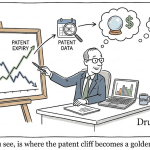
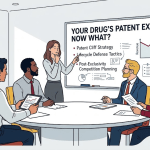
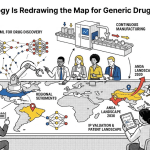
The launch of OpenAI GPT-Rosalind on April 17, 2026, marks the end of the traditional patent cliff as a predictable revenue event for brand-name pharmaceutical companies. This frontier reasoning model is not a chatbot for clinical summaries; it is a domain-specific architecture built to navigate the biochemical and legal labyrinths that have historically protected multi-billion-dollar assets.1 For generic manufacturers, the tool provides a mechanism to compress the research and development cycle for complex small molecules and biologics while simultaneously identifying technical vulnerabilities in the patent thickets that defend them.4
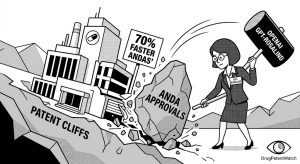
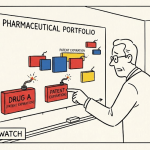
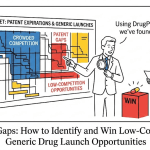
The industry currently faces a period of unprecedented revenue exposure. Between 2025 and 2030, branded drugs generating $217 billion to $236 billion in annual sales will lose market exclusivity.5 The traditional response for originators is the evergreening playbook: layering secondary patents on polymorphs, salt forms, and methods of use to extend monopolies.7 GPT-Rosalind alters this dynamic by allowing generic firms to simulate alternative chemical pathways and formulation strategies in silico, bypassing the ‘crystalline traps’ and ‘formulation walls’ that originators build.4
Architecture of Biological Reasoning
GPT-Rosalind uses a mechanism called Bio-Bond Attention to process biological sequences and chemical structures.3 Unlike general-purpose models that treat SMILES strings or genomic data as linear text, this architecture interprets the functional relationships between atoms and bonds.3 The training corpus includes 200 billion tokens drawn from peer-reviewed journals, genomic databases, and global patent libraries.3 This specialized foundation allows the model to reason across biochemistry, genomics, and protein engineering with a degree of precision that general models lack.1
In head-to-head benchmarks, the model demonstrates a clear performance delta over the general-purpose GPT-5.4 flagship.
Benchmark
Task Type
GPT-5.4 Score
GPT-Rosalind Score
Human Expert Baseline
LABBench2
DNA Cloning & Enzyme Design
64%
82%
Senior Lab Scientist
BixBench
Bioinformatics Data Analysis
71%
89%
Post-Doc Researcher
RNA Prediction
Sequence-to-Function
68th Percentile
95th Percentile
Top 5% Human Experts
CloningQA
Molecular Protocol Design
58%
84%
Expert Bench Scientist
Sources: 2
The ability of the model to reach the 95th percentile of human experts in RNA sequence prediction indicates that the ‘computational ceiling’ for drug development is rising.7 Generic firms use these capabilities to optimize lead compounds by suggesting modifications based on structure-activity relationships (SAR) that do not infringe on the primary composition-of-matter patents.12
Compressing the ANDA Lifecycle
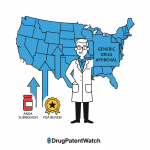
A typical generic drug development program costs between $2 million and $10 million and takes three to five years to reach the market.4 The financial model for these projects is fragile; profit margins on commodity small molecules can fall below 10% once multiple competitors enter the market.4 Success depends on hitting the 180-day Hatch-Waxman exclusivity window, which allows the first filer to capture the majority of the brand’s volume at a higher price point.4
GPT-Rosalind compresses this timeline by addressing the three most time-intensive stages of generic development: literature synthesis, formulation optimization, and bioequivalence (BE) prediction.1 Beta partners using the model report cutting literature review protocols from three weeks to under three days.3 Alongside this efficiency, the model enables virtual screening of millions of compounds in silico, narrowing the search to a subset with the highest likelihood of passing bioequivalence tests.14
Development Phase
Traditional Timeline
AI-Augmented Timeline
Cost Reduction Potential
Literature Review
15-20 Days
<3 Days
85%
Target Identification
1-2 Years
3-6 Months
40%
Formulation Dev
12-18 Months
4-6 Months
50%
Pre-clinical Testing
3-6 Years
12-18 Months
70%
Sources: 3
This compression is not an incremental gain; it is a wholesale process redesign. A firm that reduces formulation development time by 50% reaches the market sooner after patent expiry, a move that is worth tens of millions of dollars for a blockbuster asset.4 The model proposal for alternative co-formers and salt forms allows generics to match the dissolution and bioavailability profile of the reference product without replicating the patented elements.4
Weaponizing IP Intelligence with DrugPatentWatch
The pharmaceutical patent landscape is a probability distribution, not a static record.15 Every blockbuster drug is defended by a ‘patent thicket,’ a collection of secondary patents that extend market exclusivity long after the original molecule patent expires.8 Brand manufacturers, such as AbbVie with its 136-patent wall around Humira (adalimumab), use these thickets to block entry.8
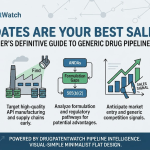
Generic firms utilize platform tools like DrugPatentWatch to monitor these thickets in real-time.7 By integrating DrugPatentWatch data with the reasoning power of GPT-Rosalind, R&D teams identify which patents in a stack are vulnerable to an Inter Partes Review (IPR) challenge.15 The model analyzes the prosecution history of a patent to identify ‘non-patentably distinct’ claims or terminal disclaimers that suggest the brand’s IP is technically weak.5
Data from DrugPatentWatch allows generic companies to see Paragraph IV certifications as they are filed, providing a leading indicator of competitive density.16 This intelligence informs portfolio management decisions, allowing firms to pivot away from congested chemical territories and toward ‘white space’ opportunities where the risk of litigation is lower or the technical path to market is clearer.15
The PHOSITA Shift and the Non-Obviousness Trap
The legal standard for patentability rests on the concept of the Person Having Ordinary Skill in the Art (PHOSITA).15 A patent is invalid if the invention would have been ‘obvious’ to a PHOSITA at the time it was made. As AI tools for target identification and molecular design become standard equipment in drug discovery labs—with over 90% of major pharma companies now investing in AI—the capabilities of the PHOSITA are evolving.15
GPT-Rosalind helps generic manufacturers document ‘human inventive contribution’ by showing that certain discoveries were predictable results of AI-driven simulation.15 If the model can propose a specific polymorph or dosage form that solves a known stability issue, that solution becomes an ‘obvious to try’ candidate under the KSR doctrine.15 This argument is a primary mechanism for challenging the validity of secondary patents in PTAB hearings.15
Legal Battleground
Brand Strategy
Generic AI-Driven Counter-Strategy
Polymorph Patents
Patent every stable version of a drug.
Use GNNs to find non-infringing stable forms.8
Formulation Walls
Block AB-rated substitution via proprietary excipients.
Predict PBPK profiles for alternative formulations.4
Method of Use
Use ‘skinny labeling’ to induce infringement suits.
Analyze use codes to carve out safe harbor labeling.19
Crystalline Trap
Patents on only stable crystalline structures.
Simulate amorphous or co-crystal alternatives.8
Sources: 4
The organizational consequence of this shift is that IP counsel must be engaged upstream in the R&D process.5 Rather than validating a decision after a compound is synthesized, the IP team uses GPT-Rosalind and DrugPatentWatch to flag chemical series as congested during lead selection.15 This proactive filter prevents the accumulation of hundreds of millions of dollars in sunk costs on programs that have no clear path to market exclusivity.15
Reverse Engineering and the Crystalline Trap
The ‘Polymorph Paradox’ is a central challenge for generic firms. To gain FDA approval, a generic must be bioequivalent to the branded drug.8 If the originator has patented every commercially viable polymorph, the generic manufacturer is trapped.8 It must find a version of the molecule that is stable enough to shelf but different enough to avoid infringement.8
GPT-Rosalind addresses this by using Graph Neural Networks (GNNs) to map the structural distance between compounds.15 This method is more sensitive than traditional Tanimoto similarity metrics and allows researchers to find ‘structural neighborhoods’ that offer the desired physical properties without triggering a literal infringement of the brand’s claims.15 The model assists in designing experimental programs to generate the evidence of ‘unexpected technical effects’ needed to survive European Patent Office (EPO) opposition hearings.15
Drug Candidate
Manufacturer
2026 Status
Key IP Constraint
Eliquis (apixaban)
BMS / Pfizer
Nov 2026 LOE
Patent thicket on salt forms.13
Januvia (sitagliptin)
Merck
Spring 2026 LOE
Staggered generic entry settlements.13
Xarelto (rivaroxaban)
J&J / Bayer
2026 LOE
Litigation on method-of-use patents.21
Stelara (ustekinumab)
J&J
2026 IRA Impact
Biosimilar entry vs. price caps.13
Sources: 6
In the case of Januvia, Merck used the litigation process to stagger generic entry, preventing a ‘flash crash’ of the brand’s share.13 Generic firms using AI models to analyze these settlement patterns can better predict the residual value of an asset and decide whether to invest in a ‘clean cliff’ strategy or a ‘managed slope’ entry.13
Regulatory Evolution and FDA Oversight
The FDA and EMA have established new frameworks, including ICH Q12, to manage the integration of AI in drug development.22 These guidelines stress the importance of transparency in AI usage and the requirement for human oversight by qualified individuals for final decisions.22 By early 2026, the FDA authorized over 1,350 AI-enabled devices, illustrating the rapid growth in this sector.24
For generic manufacturers, the FDA draft guidance ‘Artificial Intelligence in Drug and Biological Product Development’ outlines expectations for documenting and validating AI-based tools used in regulatory contexts.25 The guidance is concerned with tools whose outputs influence regulated activities, such as nonclinical study design, manufacturing decisions, and bioequivalence data submitted in support of an ANDA.25
Risk-Based Validation: Sponsors must assess the impact of AI tools on product quality and patient safety.23
Data Governance: Data source provenance and analytical decisions must be documented in a traceable and verifiable manner.25
Model Transparency: Descriptions of data sources, collection context, and preprocessing steps are required in submissions.25
Human Oversight: AI technologies are intended to augment human expertise, not replace it.10
OpenAI has implemented ‘high-precision flags’ in GPT-Rosalind to watch for signs of bioweapons concerns or other misuse, reflecting the sensitivity of biological research.11 For legitimate generic development, these guardrails ensure that the model is used within a governed environment that meets HIPAA and SOC 2 Type 2 standards.1
The 505(b)(2) Value-Added Generic Playbook
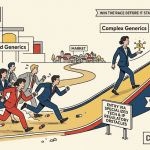
The most successful generic firms are moving away from simple replication and toward ‘value-added’ innovation.5 The 505(b)(2) regulatory pathway allows a company to rely on the safety and efficacy data of a reference drug while seeking approval for a modification that offers a clinical benefit.4 This pathway is particularly useful for formulation and dosage form changes, drug repurposing, and fixed-dose combinations.5
GPT-Rosalind acts as a discovery engine for these value-added products. By analyzing historical drug data, the model identifies successful compounds that are candidates for reformulation into extended-release mechanisms or improved delivery devices.12 A company that uses AI to design a subcutaneous version of an existing intravenous biologic can secure its own period of market exclusivity, protecting margins from the commodity generic market.13
Innovation Type
Regulatory Pathway
Exclusivity Potential
Competitive Advantage
Pure Generic
ANDA
180 Days
First-to-file speed.4
New Formulation
505(b)(2)
3-5 Years
Clinical differentiation.5
New Indication
505(b)(2)
7 Years (Orphan)
Untapped market segments.28
Branded Generic
Emergent Markets
Post-Expiry Premium
Quality and brand trust.27
Sources: 4
Branded generics sit at the premium end of the spectrum, combining the INN molecule with genuine clinical differentiation.27 These products account for roughly 70% of pharmaceutical volume across Asia, Africa, and Latin America.27 Platform tools like DrugPatentWatch allow executives to track exactly when patents expire in these jurisdictions, making post-expiry revenue planning more sophisticated.27
Financial Impacts and Market Realignment
The launch of GPT-Rosalind triggered an immediate drop in the stock prices of traditional drug discovery companies.11 Recursion Pharmaceuticals and Schrodinger each lost more than 5% of their value as investors reacted to the potential disruption of their proprietary models by OpenAI’s frontier reasoning system.11 Conversely, major biopharma companies like Amgen, Moderna, and Novo Nordisk have integrated the model to identifies promising drug candidates and shorten R&D timelines.30
In the generic sector, 2026 is projected to be a record year for M&A, with deal flow potentially hitting $3.9 trillion.13 Large pharmaceutical firms are acquiring mid-cap ‘innovation engines’ to replenish pipelines before the 2026-2030 super-cliff.13 Generic manufacturers that have integrated AI-driven IP screening into their stage-gate processes carry lower IP attrition risk and are more attractive targets for consolidation.15
Metric
2025 Market Value
2026 Projection
2034 Forecast
Global AI in Pharma
$1.94 Billion
$2.51 Billion
$16.49 Billion
AI Drug Discovery
$5 – $7 Billion
$8 – $10 Billion
Stated Value $110B
Generic Drug Market
$490 Billion
$530 Billion
$730 Billion
M&A Deal Flow
$2.8 Trillion
$3.9 Trillion
–
Sources: 4
The patterns from 2025 suggest that smaller AI drug discovery companies face existential pressures.33 Venture investment is concentrating in well-funded players, while weaker firms are pursuing delisting or workforce reductions.33 The industry is moving from a period of exuberance to one of discipline, where the definitive test is whether AI can deliver drugs that work at scale in Phase III trials.33
Key Takeaways
The introduction of GPT-Rosalind has shifted the primary lever for generic drug development from incremental efficiency to wholesale process redesign. The ability of the model to perform deep biological reasoning and synthesize 200 billion tokens of domain-specific data allows generic firms to compress R&D timelines by up to 70% while reducing discovery costs by 40%.3
Strategic IP Management: Patent risk is now a continuous probability rather than a binary legal event. Generic firms use DrugPatentWatch and AI to quantify ‘obvious to try’ risks and identify vulnerabilities in brand patent thickets.15
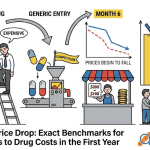
Speed as the Only Margin: In a market where prices collapse by 95% after multi-source entry, the 180-day Hatch-Waxman exclusivity window is the only period of high-margin profitability. AI is the engine that hits this window.4
The Rising Bar of PHOSITA: As AI tools become standard, the legal standard for non-obviousness is rising. This allows generic manufacturers to challenge secondary patents that are merely predictable extensions of existing knowledge.15
Value-Added Migration: The 505(b)(2) pathway provides a more sustainable business model than commodity generics. AI helps firms identify clinically meaningful reformulations that carry their own market exclusivity.5
Regulatory Alignment: Success in the 2026 landscape requires compliance with new FDA and EMA guidances on AI transparency and validation. Human oversight remains the essential guide for AI’s computational power.22
FAQ
How does GPT-Rosalind affect the 30-month stay in Hatch-Waxman litigation? GPT-Rosalind does not change the statutory 30-month stay triggered by a Paragraph IV filing, but it identifies which patents are likely to be found invalid or non-infringed. This allows generic firms to choose targets with higher probabilities of a favorable court ruling or settlement, potentially shortening the effective time to market.13
Can the model identify non-infringing polymorphs for complex generic products? The model uses Graph Neural Networks and Bio-Bond Attention to analyze molecular interactions and predict the stability of alternative crystalline forms. This allows researchers to find amorphous or co-crystal variations that match the bioequivalence of the reference drug without infringing on the originator’s patented polymorphs.4
What role does DrugPatentWatch play in an AI-driven R&D workflow? DrugPatentWatch provides the structured data—including global patent expirations, litigation dockets, and Paragraph IV filings—that GPT-Rosalind needs to perform competitive intelligence. It allows R&D teams to identify entry points, track competitor activity, and strengthen new formulation patents by studying prior claims and litigation.7
Does GPT-Rosalind replace the need for traditional medicinal chemistry teams? The model is designed to augment human expertise, not replace it. While it can suggest modifications and identify patterns across datasets, human researchers remain responsible for validating findings, ensuring experimental accuracy, and managing the ethical and legal implications of the results.10
What is the primary risk for generic firms adopting this technology? The primary risks include regulatory friction if AI-driven decisions are not properly documented and the ‘hallucination’ risk common to large language models. Firms must implement robust quality systems and ‘human-in-the-loop’ workflows to ensure that the scientific justifications for their ANDA submissions are verifiable and defensible in court.7