A single composition-of-matter patent can represent $40 billion in franchise value. At the Patent Trial and Appeal Board (PTAB), that patent can be challenged by any competitor in America, adjudicated by a panel of Ph.D.-credentialed judges using a lower evidentiary standard than any federal court, and invalidated in under 18 months. That is the operating reality every pharma IP team, portfolio manager, and R&D lead must internalize.
This guide dissects PTAB risk from first principles. It covers the procedural mechanics of inter partes review (IPR) and post-grant review (PGR), the statistical realities that separate Orange Book patents from biologic patents, the legal doctrines that decide cases at the margin, and the proactive portfolio architecture that shifts PTAB economics back in favor of the innovator. It is designed for the people who actually own the problem: in-house IP counsel, institutional investors modeling patent cliffs, biosimilar launch teams, and R&D heads who need to know which assets in their pipeline carry hidden PTAB exposure.
Part I: The Post-AIA Paradigm — How the Leahy-Smith America Invents Act Rewrote Patent Security
What the AIA Actually Changed
The Leahy-Smith America Invents Act (AIA), signed in September 2011 and fully effective by March 2013, is the most consequential overhaul of U.S. patent law since the Patent Act of 1952. Its headline change was the shift from a ‘first-to-invent’ priority system to ‘first-inventor-to-file,’ aligning the U.S. with virtually every other patent jurisdiction in the world. For pharmaceutical companies, this shift created an immediate operational consequence: file provisional applications earlier, often before clinical data is mature, to secure a priority date.
That earlier filing imperative created a structural tension that now defines biologic patent risk. Applications filed with immature data are more likely to contain thin disclosures — specifications that lack the working examples, sequence data, and representative coverage that satisfy the written description and enablement requirements of 35 U.S.C. § 112. The AIA thus incentivized filing practices that, combined with the Supreme Court’s 2023 ruling in Amgen Inc. v. Sanofi, left an entire generation of biologic patents exposed to § 112 attacks in a forum — the PTAB — specifically engineered to be fast and cheap for challengers.
The AIA also moved the U.S. to an ‘inter partes’ model for post-grant challenges, abolishing the old inter partes reexamination system and replacing it with a suite of new proceedings: IPR, PGR, and the transitional program for covered business method patents (CBM). Each was designed to let the USPTO correct mistakes it made at examination — a concession by Congress that the patent grant, long treated as near-final administrative action, was in fact provisional.
IP Valuation in the Post-AIA Landscape
Patent IP is no longer a binary asset — granted or not granted. Post-AIA, it exists on a risk-adjusted spectrum. A composition-of-matter patent on a blockbuster small molecule with no prior PTAB challenge history, a clean prosecution record, and robust secondary-consideration data trades at a very different risk premium than a broad functional antibody patent filed 18 months ago with two working examples.
Investors pricing a pharma acquisition or a royalty stream now need to model PTAB probability at the individual patent level, not just at the portfolio level. The relevant variables include: the patent’s technology category (small molecule vs. biologic vs. formulation), the density of the surrounding thicket, prior litigation history, prosecution history quality (amendment frequency, examiner arguments), and the identity of the likely petitioner class in a given therapeutic area. Each of these factors maps to a different risk-adjustment multiplier.
Key Takeaways — Part I
The AIA’s ‘first-to-file’ shift created pressure to file early with immature data, seeding § 112 vulnerability in a generation of biologic patents. The PTAB’s creation converted patents from near-final administrative acts into assets subject to ongoing re-examination by technically expert judges using a lower evidentiary burden than any federal court. Investors and IP teams that model patent security as binary — valid or invalid — are operating with broken assumptions. The correct frame is a dynamic, continuously updated risk score that integrates prosecution quality, technology category, thicket density, and challenger economics.
Investment Strategy — Part I
Institutional investors acquiring pharma assets or valuing royalty streams should build a PTAB risk haircut into DCF models at the individual patent level. A composition-of-matter patent on a best-in-class small molecule with a clean prosecution history and no prior PTAB challenge warrants a low risk-adjustment. A broad functional biologic patent with thin § 112 support, filed shortly after the AIA’s enactment, warrants a risk haircut of 30-50% on patent-protected revenue, given post-institution invalidation rates north of 70% for this asset class. The delta between these two scenarios is often larger than the market prices in, creating both upside (undervalued small molecule franchises with resilient IP) and downside (biologic premiums that assume patent security that does not exist).
Part II: The PTAB Gauntlet — IPR, PGR, and the Mechanics of a Challenge
Inter Partes Review: The Workhorse of the Patent Challenge System
IPR is the dominant PTAB vehicle, accounting for roughly 97% of all petitions filed in recent fiscal years. Any person other than the patent owner can file an IPR petition, beginning nine months after the patent’s grant date or after any pending PGR has concluded. One statutory clock matters above all others in pharmaceutical litigation: a defendant served with a patent infringement complaint has exactly one year from service to file an IPR petition, or they lose the right to do so. This deadline forces an accelerated strategic decision — often while Hatch-Waxman litigation has barely begun.
IPR’s scope is narrow by design. Challengers can only assert anticipation under 35 U.S.C. § 102 or obviousness under 35 U.S.C. § 103, and only on the basis of prior art consisting of patents and printed publications. Physical products, prior public uses, and on-sale activity are off the table. This limitation matters: it makes IPR a precision instrument for attacking the documented prior art landscape, not a kitchen-sink forum for every invalidity theory.
The proceeding itself runs on a tight statutory clock. After the petition is filed, the patent owner may file an optional Patent Owner’s Preliminary Response (POPR). Within six months of the petition filing date, a three-judge APJ panel issues an institution decision. If the PTAB institutes the trial, a full 12-month proceeding follows, culminating in a Final Written Decision (FWD). From petition to FWD: 18 months. From the perspective of a Hatch-Waxman defendant, this is 18 months to potentially invalidate the most commercially threatening patent before the parallel district court case has fully developed.
The cost differential between the two venues is operationally significant. A district court Hatch-Waxman case through trial typically costs $2 million to $8 million per side. An IPR through FWD costs $350,000 to $700,000. For a generic manufacturer whose prize is 180-day first-filer exclusivity worth hundreds of millions of dollars, the economics of filing one or multiple IPR petitions against a branded drug’s patent thicket are compelling to the point of being nearly mandatory.
The ‘Pincer Movement’: Why Dual-Track Pressure Is the Real Threat
The asymmetry between IPR and district court creates a tactical tool that sophisticated generic and biosimilar manufacturers use systematically. After filing an ANDA or biosimilar BLA triggering a Hatch-Waxman or BPCIA lawsuit, the challenger files one or more IPR petitions against the same patents. The innovator now has to manage two proceedings simultaneously: a slow, expensive district court battle and a fast, technically demanding PTAB trial where the standard of proof and the decision-maker both favor the challenger.
The threat value of the PTAB in this context is not purely about invalidation outcomes. It operates as a settlement accelerator. A weak IPR petition that gets denied institution still consumed months of the patent owner’s management attention and legal budget. A petition that gets instituted places enormous pressure on settlement negotiations: the patent owner knows that a Final Written Decision against them would effectively end the district court case too, and that the PTAB institution rate has been rising every fiscal year. Settling on terms the challenger would not have accepted pre-PTAB becomes the rational choice — and that is the intended strategic outcome.
Post-Grant Review: The Biologic Patent’s Specific Nemesis
PGR is available only during the first nine months after a patent’s grant date — a narrow window that makes it tactically distinct from IPR. Its scope, however, is dramatically broader. A PGR petition can challenge a patent on any ground of invalidity, including § 101 (subject matter eligibility), § 102 (anticipation), § 103 (obviousness), and — critically for biologics — § 112 (written description, enablement, and indefiniteness). Prior art in PGR also includes public use and on-sale activity, not just patents and publications.
The institution standard is slightly higher than IPR: the petitioner must demonstrate that it is ‘more likely than not’ (greater than 50% probability) that at least one challenged claim is unpatentable. In practice, this difference from IPR’s ‘reasonable likelihood’ standard has not meaningfully limited institution rates.
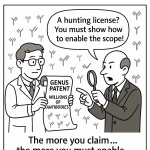
The PGR’s strategic importance has exploded following Amgen Inc. v. Sanofi (2023). In that case, a unanimous Supreme Court invalidated Amgen’s PCSK9 antibody patents under § 112’s enablement requirement. Amgen had claimed a genus of antibodies defined by their function — the ability to bind PCSK9 at specific residues and block its interaction with LDL receptors — rather than by their specific amino acid sequences. The Court held that a patent claiming a vast genus by functional description must enable a person of ordinary skill in the art to make and use the full scope of that genus without undue experimentation. Two working examples covering a handful of specific antibodies were insufficient to enable a claim covering potentially millions of structurally diverse antibodies.
The downstream consequences were immediate and systematic. Biopharma IP teams began auditing their functional antibody patent portfolios for enablement exposure. Biosimilar manufacturers and their counsel began mapping target biologic products to their newly granted functional claim patents, identifying those filed within the nine-month PGR window. The PGR became the administrative tool through which Amgen’s legal theory could be applied by a technically expert panel, using a preponderance-of-the-evidence standard, against patents that never faced this level of § 112 scrutiny at examination.
The Institution Decision: The Gateway That Predicts Everything
Both IPR and PGR turn on the institution decision. Once trial is instituted, the statistical odds shift sharply against the patent. Prevention of institution is therefore the patent owner’s highest-priority objective in any active PTAB proceeding.
Discretionary denials are one path to preventing institution without engaging on the merits. Under the framework established in Apple Inc. v. Fintiv (PTAB 2020), the Board can deny institution when a parallel district court proceeding involving the same patent is advanced enough that completing the PTAB trial would waste resources or create inconsistent results. The Fintiv analysis weighs six factors, including the proximity of the district court trial date, the overlap in claim terms and prior art, and whether the petitioner is also the defendant in the parallel suit.
The political instability of these discretionary doctrines is a real and underappreciated risk variable. The USPTO’s application of Fintiv has swung significantly with changes in agency leadership. The Biden-era USPTO was generally more willing to apply Fintiv denials and expanded their use through guidance in 2022. The Trump-era USPTO has signaled a preference for fewer discretionary denials, favoring merit-based institution decisions. A patent that benefited from a Fintiv denial under one administration may face a very different calculus under the next. Patent security, to the extent it rests on discretionary procedural shields rather than substantive claim strength, is not security at all — it is a policy loan that can be called.
Comparison: IPR vs. PGR
Attribute
IPR
PGR
Filing Window
9 months post-grant through expiry
First 9 months post-grant only
Grounds Available
§ 102, § 103 (patents/publications only)
Any ground: § 101, 102, 103, 112
Prior Art Scope
Patents and printed publications
All prior art including public use/on-sale
Institution Standard
Reasonable likelihood of prevailing on one claim
More likely than not one claim unpatentable
Primary Pharma Use Case
Attacking secondary patents in a thicket; obviousness challenges
Challenging newly issued biologic patents on § 112 grounds
Key Takeaways — Part II
IPR’s narrow scope (§ 102/103, documentary prior art only) makes it the primary tool for dismantling secondary patent thickets through documented obviousness arguments. PGR’s broader scope and § 112 availability make it the vehicle of choice for biologic patent challenges post-Amgen v. Sanofi. The dual-track pincer movement — simultaneous Hatch-Waxman litigation plus PTAB challenge — is the standard generic/biosimilar playbook, and its leverage derives not just from invalidation risk but from settlement pressure. Institution decisions are subject to discretionary denial doctrines whose application fluctuates with USPTO leadership, introducing policy risk that is independent of the patent’s underlying legal strength.
Investment Strategy — Part II
For biosimilar developers modeling launch timelines, the PGR window for a newly granted biologic patent is a strategic clock. A credible § 112 enablement challenge filed within nine months of grant, particularly against a functional antibody patent with limited working examples, carries a higher probability of institution than an IPR against a mature small molecule patent. Portfolio managers in biosimilar-focused funds should track grant dates on key biologic patents monthly and evaluate PGR candidacy as a standard part of competitive intelligence. Missing the nine-month window is an unrecoverable strategic error.
Part III: What the Data Actually Shows — PTAB Outcomes for Pharma and Biologic Patents
The PTAB has been operating for over a decade, long enough for clear empirical patterns to emerge. The overall picture is stark. According to USPTO trial statistics through August 2024, the institution rate on a per-petition basis rose from 56% in fiscal year 2020 to 68% in fiscal year 2024. The trend is directional: the PTAB is becoming more willing to institute trials, not less.
Post-institution outcomes have hardened in the same direction. The all-claims invalidation rate — the percentage of Final Written Decisions in which every challenged claim is found unpatentable — reached 70% in fiscal year 2024, up from 55% in 2019. On a per-claim basis, the invalidation rate in 2024 approached 80%. These numbers have earned the PTAB its widely cited description as a ‘patent death squad,’ a phrase reportedly attributed to a former Chief Judge of the Federal Circuit.
The counterintuitive aspect of this trend is that invalidation rates have increased as the PTAB has matured. One might expect the most obviously weak patents to be weeded out early, leaving a progressively more difficult residual population. The opposite is happening. Petitioner sophistication is increasing, prior art search capabilities (including AI-assisted prior art discovery) are improving, and the PTAB’s institutional norms and APJ panels have developed consistent frameworks for analyzing pharmaceutical claims. The lesson is operational: do not assume that a patent that has survived a decade without challenge is safe. The threat is not diminishing with age.
The Small Molecule / Biologic Divergence: Two Radically Different Risk Profiles
The most actionable statistical finding in the PTAB data is the divergence in outcomes between Orange Book-listed small molecule patents and biologic patents. These two categories require entirely different risk frameworks.
Orange Book patents — those covering small molecule drugs and listed in the FDA’s publication — have demonstrated surprising post-institution resilience. Their overall institution rate sits around 62%, consistent with the broad average. But once a trial is instituted, the outcome distribution is roughly even. Analyses of Final Written Decisions on Orange Book patents find that approximately 45-50% result in all challenged claims being found unpatentable, while 50-55% result in all claims being upheld or only a partial invalidation. One analysis found that only 23% of PTAB decisions on Orange Book patents invalidated all challenged claims, a rate comparable to district court outcomes. The number of IPR petitions filed against Orange Book patents has declined in recent years as this relative strength has become apparent to challengers.
Biologic patents tell a fundamentally different story. Their institution rate is similar to Orange Book patents at around 61%, but post-institution outcomes are heavily tilted against the patent. Multiple independent analyses confirm: approximately 70% of Final Written Decisions on biologic patents find all challenged claims unpatentable, against only 21% where all claims are upheld. When viewed at the petition level rather than the FWD level, the numbers are equally alarming: all-claims invalidation represents roughly 22% of all biologic petitions filed (meaning the challenge went all the way and the patent lost everything), while all-claims-confirmed outcomes represent only 6% of petitions. PTAB petition volume against biologic patents is rising and has now surpassed the volume directed at Orange Book patents.
This divergence has a mechanistic explanation. Small molecule composition-of-matter patents typically protect a specific, structurally defined chemical entity with a documented prior art landscape. The non-obviousness of that specific molecule, supported by clinical data showing unexpected results and commercial success, is often a strong defensive position. Biologic patents more frequently claim broad functional genera — classes of antibodies defined by what they do rather than what they are — with prosecution histories that rarely include the depth of structural data needed to survive a rigorous § 112 challenge. The Amgen v. Sanofi ruling operationalized this structural weakness.
PTAB Outcomes by Patent Category
Metric
Orange Book (Small Molecule)
Biologic
Annual Petition Volume Trend
Decreasing
Increasing
Institution Rate
~62%
~61%
FWD: All Claims Unpatentable
~45-50%
~70%
FWD: All Claims Confirmed
~50-55%
~21%
Primary Attack Vehicle
IPR (§ 103 obviousness)
IPR + PGR (§ 112 enablement/written description)
Settlement Patterns and the 180-Day First-Filer Incentive
Pharmaceutical PTAB proceedings settle at lower rates than technology sector disputes. This is not an accident. The Hatch-Waxman Act’s 180-day first-filer exclusivity provision creates a structural incentive against settlement for the generic challenger. The first generic to file a Paragraph IV certification against an Orange Book-listed patent and survive (either by winning in court, having the patent expire, or reaching a defined settlement trigger) earns a six-month exclusivity window against all other generic entrants.
For blockbuster drugs, that 180-day window can be worth $200 million to $500 million or more. No licensing deal or settlement payment easily matches that prize. So generic manufacturers fight. They do not settle PTAB proceedings the way a technology company might trade IPR outcomes for cross-licensing terms. Pharma PTAB battles tend to go all the way to a Final Written Decision because the downstream commercial stakes demand it. This ‘winner-take-all’ dynamic is a feature of the Hatch-Waxman architecture that PTAB proceedings have amplified rather than softened.
Key Takeaways — Part III
PTAB institution rates and invalidation rates are both rising, with 70% of all-claims FWDs now resulting in invalidity across all technology areas. Orange Book small molecule patents are meaningfully more resilient post-institution than the overall average, with outcomes approximating a coin flip. Biologic patents are fragile: 70% of instituted trials end in total invalidation. The 180-day first-filer exclusivity incentive structurally disincentivizes settlement, pushing pharma PTAB proceedings toward final decisions at higher rates than other technology sectors.
Investment Strategy — Part III
For buy-side analysts building patent cliff models, the biologic patent risk premium must be calibrated to post-institution invalidation rates, not just petition filing probabilities. A biologic patent that gets instituted is more than twice as likely to lose everything as to survive intact. Revenue modeling that treats a PTAB institution decision as a coin flip on a biologic patent is systematically overestimating protected revenue. Conversely, Orange Book small molecule patents with clean prosecution histories and documented secondary considerations are materially more durable than their biologic counterparts and may be undervalued on a risk-adjusted basis.
Part IV: The Legal Doctrines That Decide Cases — Claim Construction, Prosecution History Estoppel, and Secondary Considerations
Claim Construction: How the Words of a Patent Become a Battlefield
Before any argument about prior art can proceed, the PTAB panel must determine what the challenged claims actually mean. Claim construction is the legal interpretation of patent claim language, and it is often dispositive. A broad construction exposes a claim to more prior art; a narrow construction may save the claim from invalidity but potentially limit its commercial scope against infringers.
Since the Federal Circuit’s 2015 ruling in Cuozzo Speed Technologies v. Lee (which was superseded by rule change), the PTAB now applies the same Phillips standard used in district courts, interpreting claim terms according to their ‘ordinary and customary meaning’ as understood by a person of ordinary skill in the relevant technical field. The analysis is grounded in intrinsic evidence: the claim language itself, the specification, and the prosecution history.
The difference at the PTAB is who is doing the interpreting. APJs hold advanced technical degrees in biotechnology, chemistry, or pharmacology. Their readings of claim language are informed by genuine technical expertise, which can cut in unpredictable directions. An APJ who understands protein biochemistry may parse a claim term like ‘functionally equivalent’ very differently than a generalist district court judge relying on expert testimony. Recent Federal Circuit decisions illustrate the stakes.
In a case involving a method of treating prostate cancer, the Federal Circuit affirmed a PTAB construction of the term ‘treatment’ that included reduction of side effects — not just anti-tumor activity — which rendered the method claims obvious over prior art that independently taught each component. The construction turned on the specification’s own language, which the APJ panel read broadly and correctly. In AstraZeneca AB v. Mylan Pharmaceuticals, the court emphasized that a percentage term’s construction must ‘most naturally align’ with the specification’s description of the invention — a principle that has been used to both narrow and broaden claims depending on how carefully the patent was drafted. In a separate case involving an eye treatment patent, the Federal Circuit reversed the PTAB, finding that prosecution history arguments gave a claim phrase a more restrictive meaning than the Board had assigned.
The recurring lesson: every linguistic choice made during patent drafting — transitional phrases (‘comprising’ vs. ‘consisting essentially of’ vs. ‘consisting of’), percentage ranges, functional descriptors — is a potential claim construction dispute waiting to be activated in a future PTAB proceeding. The technically expert PTAB panel will find the inconsistency if it exists.
Prosecution History Estoppel: The Permanent Record That Can End a Case
Prosecution History Estoppel (PHE) is among the most consequential doctrines in patent law and among the least appreciated by non-lawyers who evaluate patent portfolios. The doctrine holds that amendments and arguments made to the USPTO examiner during the original prosecution process permanently limit the scope of the issued patent. Subject matter surrendered to get the patent allowed cannot be recaptured in litigation through the doctrine of equivalents.
PHE arises in two forms. Amendment-based estoppel applies when an applicant narrows a claim by adding a limitation — for example, changing a broad temperature range to a narrower one after the examiner cited prior art teaching temperatures within the original range. The applicant is thereafter estopped from asserting that a competitor’s product operating at the surrendered temperatures infringes under equivalents. Argument-based estoppel applies when an applicant makes a ‘clear and unmistakable’ distinction over prior art in prosecution arguments, even without formally amending the claim. If the applicant told the examiner that their claimed compound is ‘particular’ or ‘uniquely suited’ in ways that distinguish it from a prior art reference, they cannot later argue that a competitor’s compound with different properties achieves the same result and therefore infringes.
The Federal Circuit has applied PHE aggressively in pharmaceutical contexts. In a 2025 ruling, the court held that a patent owner’s prosecution arguments characterizing a claimed combination as ‘particular’ amounted to a surrender of other combinations, barring infringement claims against a competitor using a structurally similar but distinct combination. In another 2025 decision, the Federal Circuit ruled that cancellation of one independent claim during prosecution estopped the patent owner from asserting a broader scope for a separate, unamended independent claim in the same patent — a sweeping application of estoppel that went beyond the claim that was actually changed.
The strategic implication is direct: a patent prosecuted with numerous amendments and expansive examiner arguments to overcome rejections arrives at issuance as a diminished asset, not just because the claims are narrower, but because each amendment and argument is a future estoppel waiting to be weaponized. The highest-quality pharmaceutical patents are those prosecuted with discipline — claims allowed with minimal amendments, arguments that distinguish the invention without making unnecessary concessions, and a specification that supports a range of claim scopes as fallback positions.
Obviousness Under § 103: The Primary Battleground and the Nexus Problem
Obviousness under 35 U.S.C. § 103 is the most common ground on which pharmaceutical patents are invalidated at the PTAB. The legal framework comes from Graham v. John Deere Co. (1966), which established four factors for the analysis: the scope and content of the prior art, the differences between the prior art and the claimed invention, the level of ordinary skill in the relevant field, and objective indicia of non-obviousness (commonly called secondary considerations). For pharmaceutical patents, which frequently protect incremental but commercially critical improvements over known compounds or formulations, secondary considerations are often the only thing standing between the patent and invalidation.
The most commonly used secondary considerations in pharmaceutical PTAB proceedings include commercial success of a product embodying the invention, failure of others to solve the same problem, long-felt but unresolved need in the field, unexpected results produced by the claimed invention, industry praise from third parties not associated with the patent owner, and copying by competitors. The evidentiary weight of each depends on the patent owner’s ability to establish a ‘nexus’ between the secondary consideration evidence and the specifically claimed invention.
The nexus requirement is where most secondary considerations cases are won or lost. The patent owner must prove that commercial success, for example, flows from the novel and non-obvious aspects of the claimed invention — not from brand recognition, advertising spend, superior salesforce execution, or formulation features that are not actually covered by the claims under challenge. PTAB panels have consistently held that simply citing sales data and claim charts is insufficient. The patent owner must present a detailed, causally argued account of why the sales reflect the inventive contribution.
In Endo Pharmaceuticals v. Depomed, the Board rejected commercial success evidence because the patent owner failed to articulate how the drug’s market penetration was attributable to the specific claimed features rather than to the broader product offering. Contrast that with Innopharma Licensing v. Senju Pharmaceutical, where the Board found unexpected results persuasive because the patent owner demonstrated a specific 44% improvement in drug stability directly tied to a claimed excipient that prior art taught away from using at the claimed concentration. The difference is causation, specificity, and contemporaneous data — not the magnitude of commercial success.
Challengers counter by severing the nexus. Their standard argument is that the product’s success results from Hatch-Waxman market exclusivity itself, not from the inventive features of the patent, or that the successful product contains features (other patents, other unclaimed formulation elements) that independently drive preference. When this argument lands, it can neutralize even genuinely impressive commercial performance.
Key Takeaways — Part IV
Claim construction at the PTAB is performed by technically expert judges who read specifications and prosecution histories with more precision than generalist courts. Every ambiguous term, transitional phrase, or loosely defined percentage range is a potential construction dispute. PHE permanently limits the scope of issued claims based on prosecution-era amendments and arguments; patents prosecuted with numerous concessions to overcome rejections arrive pre-weakened. Secondary considerations — particularly commercial success and unexpected results — are viable non-obviousness defenses, but only when a tight nexus between the specific claimed invention and the evidence is established with specificity and contemporaneous data.
Part V: Building the Fortress — Proactive PTAB Resilience Architecture
PTAB-Aware Patent Prosecution: Building Durability from Day One
The single highest-leverage action any pharmaceutical patent team can take is to draft and prosecute patent applications with PTAB attack scenarios fully mapped in advance. This is not standard prosecutorial practice at most companies. It should be.
Prior art search for a pharmaceutical application should go beyond establishing novelty. It should anticipate the combinations of references that a competent IPR petitioner — with access to a global patent database, AI-assisted prior art discovery tools, and a team of Ph.D. scientists — would construct to argue obviousness. This means searching not just for references that directly teach the claimed compound or method, but for combinations that might be assembled from scientific journals, foreign patent applications, conference proceedings, and regulatory submissions filed in other jurisdictions.
Claim architecture should be built for defense in depth. A composition-of-matter patent with only two independent claims is a single-layer fortification. A properly constructed pharmaceutical patent includes a spectrum of claims: broad independent claims designed for maximum commercial coverage, multiple dependent claims that add increasingly specific limitations (specific salt forms, specific crystalline polymorphs, specific dosage ranges, specific patient populations), and method-of-use claims that capture clinical practice. Each layer of dependent claims is a fallback position. When the broadest claim falls, the narrower claims must be structured to retain meaningful commercial coverage.
The specification should be drafted as a pre-built secondary considerations dossier. The background section should document the prior art failures in specific, citable terms — establishing the ‘long-felt need’ on the record. The examples section should include comparative data showing the claimed invention’s superiority over the closest prior art alternatives, preferably expressed in objective, quantifiable terms. Unexpected results are most persuasive when they appear in the original application, authored before any litigation strategy was contemplated, rather than in expert declarations prepared years later for PTAB proceedings. The contemporaneous nature of the data matters as much as its scientific content.
For biologic patents post-Amgen v. Sanofi, § 112 support is the foundational issue. Functional antibody claims covering a broad genus require a specification that discloses a representative number of structurally diverse working examples, maps common structural features that correlate with function, and provides enough mechanistic understanding that a person of ordinary skill in the field can reliably identify other members of the claimed genus without undue experimentation. Filing a biologic patent with two or three working examples and a functional claim covering potentially millions of antibody variants is now a documented path to PGR invalidation.
The Patent Thicket as Economic Deterrent
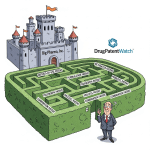
A patent thicket around a pharmaceutical product is not a legal strategy — it is an economic deterrent system. Its power lies not in the invincibility of any individual patent but in the aggregate cost and uncertainty it imposes on any challenger attempting to clear a path to generic or biosimilar entry.
A well-constructed pharmaceutical thicket begins with the composition-of-matter patent on the active pharmaceutical ingredient (API), which provides the most durable protection. It is reinforced by formulation patents covering specific delivery systems, extended-release mechanisms, coatings, or co-formulations that improve efficacy or tolerability. Method-of-use patents protect new indications developed during the product lifecycle, effectively resetting some of the market exclusivity clock for each new approved use. Process patents covering non-obvious manufacturing methods create both defensive value (hard for generics to navigate) and offensive value (potential infringement claims against biosimilar manufacturers using similar synthesis routes). Polymorph patents protect specific crystalline forms with improved stability or bioavailability. For injectable biologics and inhaled drugs, device patents covering the delivery system — auto-injectors, prefilled syringes, inhaler designs — add another layer that a biosimilar or generic must independently design around.
Real-world examples illustrate the economic logic. AbbVie’s patent estate around adalimumab (Humira) at its peak encompassed more than 130 patents covering the antibody sequence, formulation, manufacturing process, and device. Challengers seeking biosimilar entry faced not one PTAB proceeding but potentially dozens, each requiring independent analysis, petition drafting, and trial preparation. The result was a seven-year delay in U.S. biosimilar competition beyond the European biosimilar launch timeline, protecting approximately $150 billion in U.S. sales that the patent thicket’s economics made commercially irrational to challenge comprehensively.
Pfizer’s tofacitinib (Xeljanz) employed a different but instructive thicket construction. The base JAK inhibitor composition patent was reinforced by formulations patents for the extended-release version, method-of-use patents for additional indications beyond rheumatoid arthritis (including psoriatic arthritis and ulcerative colitis), and dose-titration method patents. When IPR challenges targeted the composition claims, the formulation and method-of-use portfolio provided fallback commercial positions.
The cost allocation this creates is the thicket’s real power. A generic or biosimilar challenger must evaluate every patent in the thicket, estimate PTAB petition costs and probabilities for each, model litigation costs in parallel district court proceedings, and decide whether the economics justify the investment. For any single patent, the math often works in the challenger’s favor. For 40 or 130 patents, the math typically does not.
Continuous Patent Intelligence as Operational Infrastructure
Static patent analysis — conducted once at the time of filing or at the outset of ANDA litigation — is insufficient in the PTAB era. The competitive IP landscape changes continuously. New patents issue. Prior PTAB decisions on closely related patents establish prior art frameworks that a future petitioner will reuse. A competitor’s patent challenge strategy against a different drug in the same therapeutic area can signal intent, reveal their prior art library, and preview the legal theories they will deploy against your portfolio.
Monitoring PTAB petition filings in real time is operationally necessary for any major pharmaceutical patent owner. When a petition is filed, the patent owner has a defined window to prepare a POPR and needs to begin that process immediately, not after weeks of internal deliberation. When a competitor’s petition against a third party is instituted on an obviousness theory using prior art references that could also be applied to your patents, that is an early warning signal — not a curiosity.
Platforms that aggregate Orange Book listing data, Paragraph IV certification history, PTAB petition and institution data, litigation dockets, and patent family coverage in a single interface provide the intelligence layer necessary for proactive strategy. Knowing that a generic manufacturer has filed IPR petitions against four formulation patents in your therapeutic area in the past 18 months, all using a similar prior art combination, tells you something about which of your patents are likely next and what arguments you will need to defend.
Key Takeaways — Part V
PTAB resilience begins in patent prosecution, not in PTAB proceedings. Drafting applications with anticipated attack scenarios mapped, building a spectrum of claims for defense in depth, embedding secondary considerations data contemporaneously in the specification, and providing robust § 112 support for biologic claims are the foundational interventions. The patent thicket is an economic deterrent whose value compounds with the number and diversity of its patents. Continuous patent intelligence — monitoring petition filings, prior art frameworks developed in related proceedings, and competitor challenge patterns — is the operational infrastructure that converts reactive defense into proactive strategy.
Part VI: Active Defense — Navigating a Live PTAB Challenge
The POPR: One Chance at Denial Before Trial
When a petition lands, the patent owner’s immediate strategic decision is how to respond — and whether to respond substantively at all — before the institution decision. The Patent Owner’s Preliminary Response is optional. Filing it on the merits is a calculated commitment.
A strong POPR that demonstrates a fatal flaw in the petition — a petitioner’s misconstruction of a key claim term that renders their obviousness argument inapplicable, a misreading of a prior art reference, a failure to address a dependent claim limitation that is commercially critical — can convince the APJ panel to deny institution outright. That is the ideal outcome: the challenge ends before trial, no estoppel runs, and the patent emerges unscathed.
The risk is transparency. A detailed POPR on the merits hands the petitioner a comprehensive preview of the patent owner’s defense strategy. If the Board institutes trial anyway — which happens at increasing rates — the petitioner knows exactly what they are responding to and can refine their reply brief to preemptively address every argument. This is not a theoretical risk; experienced PTAB petitioners read POPRs carefully and use them.
The decision framework for whether to file a substantive POPR depends on the petition’s objective quality, the composition of the specific APJ panel (some panels have demonstrated clear preferences in how they weigh claim construction arguments vs. prior art arguments), whether there are strong procedural grounds for discretionary denial (Fintiv factors, parallel litigation status), and the overall commercial importance of the challenged patent relative to the rest of the thicket. A patent that is one of 40 in a thicket may be worth letting go at the POPR stage rather than burning the defense strategy. The anchor composition patent is worth an aggressive POPR fight regardless of the disclosure risk.
The Merits Defense: Obviousness Rebuttal and Secondary Considerations
After institution, the patent owner must respond with a full Patent Owner’s Response (POR) that both dismantles the petitioner’s prima facie obviousness case and builds an affirmative case for non-obviousness using secondary considerations. These are not independent exercises — they must be integrated. A petitioner who establishes a prima facie case by combining two prior art references that each independently teach most of the claimed invention must be met with an argument that teaches away, coupled with unexpected results data that makes the combination counterintuitive in hindsight.
The expert declaration is the mechanism for both. A credible, technically respected declarant who can explain why a person of ordinary skill in the art would not have combined the petitioner’s references, and who can then walk through the experimental data demonstrating unexpected results with the meticulousness required to establish nexus, is worth more than any procedural argument. The credibility of the expert is often as important as the content of the testimony: PTAB panels have shown they will discount declarations from experts who appear to have minimal engagement with the technical details or whose opinions are internally inconsistent.
Deposition of the patent owner’s expert by petitioner’s counsel is the crucible. The structured questioning format of PTAB depositions is more constrained than civil discovery depositions but more consequential: admissions made under cross-examination about the state of the prior art, the level of ordinary skill, or the scope of the secondary consideration evidence can be case-dispositive. Expert preparation for PTAB depositions requires more technical depth than trial preparation for generalist courts.
Motions to Amend: The Last Resort
A Motion to Amend (MTA) allows a patent owner to propose substitute claims that are narrower than the challenged claims, designed to overcome the prior art asserted by the petitioner. In theory, this allows partial preservation of the patent’s coverage. In practice, MTAs have historically succeeded at low rates, though recent USPTO pilot programs — including the ‘MTA Pilot Program’ that provided preliminary guidance from the Board before final briefing — have improved procedural outcomes modestly.
Filing an MTA during an instituted proceeding signals strategic retreat. It tells the petitioner and the Board that the patent owner lacks confidence in the original claims and is seeking a narrower fallback. This can influence how the Board evaluates the patent owner’s credibility on the merits arguments for the original claims. MTAs are most appropriate when the challenged claims are clearly broader than necessary to protect the commercial product, and when a narrower substitute claim would still provide meaningful protection against the specific biosimilar or generic product at issue.
The estoppel consequences of an MTA are also significant. Claims presented in an MTA that the Board does not enter are treated as having been proposed and rejected, limiting the patent owner’s future prosecution options in continuation applications.
Key Takeaways — Part VI
The POPR decision is a strategic gamble between maximizing the chance of pre-institution denial and preserving defense strategy for trial. The merits defense rests on an integrated argument combining prior art teaching-away analysis with specific, nexus-established secondary consideration evidence. Expert credibility and deposition performance are as important as the underlying evidence. MTAs are last-resort instruments that signal weakness and carry estoppel consequences; they are appropriate only when original claims are clearly overbroad relative to the commercially protected product.
Part VII: Real-World Case Studies — PTAB Risk in Live Pharmaceutical IP Disputes
Humira: The Thicket That Won
AbbVie’s adalimumab (Humira) patent estate is the paradigm case for the patent thicket as competitive moat. The originator composition-of-matter patent expired in 2016. By that point, AbbVie had constructed a portfolio of more than 130 U.S. patents covering formulation, manufacturing process, dosage regimen, auto-injector device, and additional indications. Biosimilar applicants who completed the FDA approval process — Sandoz’s Hyrimoz, Boehringer Ingelheim’s Cyltezo, Amgen’s Amjevita, and others — found themselves facing not a patent landscape to clear but an economics calculation. Litigating or filing IPR petitions against 130+ patents was not commercially rational for most biosimilar entrants.
AbbVie eventually settled with nine biosimilar manufacturers, granting patent licenses with U.S. launch dates ranging from 2023 to 2023 — seven years after European biosimilar competition began. The settlements included royalty payments that were not publicly disclosed but that analysts have estimated at rates high enough to significantly dilute biosimilar manufacturers’ margins. The thicket did not need to be impenetrable; it needed to be expensive enough that a negotiated settlement was the rational alternative to comprehensive challenge.
From an IP valuation perspective, the Humira thicket extended the net present value of AbbVie’s U.S. adalimumab franchise by an estimated $50 billion to $100 billion beyond what a single composition patent would have provided. That figure represents the commercial output of a deliberate, decades-long patent prosecution and portfolio management strategy.
Amgen’s PCSK9 Patents: When the Thicket Had No Floor
Amgen’s evolocumab (Repatha) and related PCSK9 antibody patents represent the failure mode of biologic patent strategy in the post-Amgen v. Sanofi environment. Amgen’s original patents, particularly the claims covering broad functional genera of anti-PCSK9 antibodies defined by their binding epitopes and LDL-lowering function rather than specific sequences, were challenged by Sanofi (manufacturer of alirocumab, Praluent) in district court proceedings that ultimately reached the Supreme Court.
The Court’s 2023 decision found that Amgen’s enablement disclosure was insufficient for the breadth of the functional claims. The specification’s approximately 26 working examples, while demonstrating the existence of some antibodies meeting the functional criteria, did not enable a person of ordinary skill in the field to reliably produce the full genus of antibodies covered by the claims without undue experimentation. The ruling invalidated those broad claims, effectively leaving Amgen’s PCSK9 franchise exposed to biosimilar entry on the functional antibody patents.
The lesson is not that broad biologic patents are impossible to defend. It is that functional breadth must be anchored by proportionate disclosure. A patent claiming a genus of millions of possible antibodies needs more than a handful of working examples and a functional screening assay. It needs structural characterization of diverse representatives, mechanistic explanation of what structural features predict the functional outcome, and data enabling a skilled researcher to reliably expand from known examples to undisclosed members of the genus. That level of disclosure requires investment in characterization work before filing — investment that most development programs do not make because the urgency of clinical development crowds it out.
Vertex’s Ivacaftor Patents: Unexpected Results as the Defense
Vertex Pharmaceuticals’ patents on ivacaftor (Kalydeco) and the combination regimens that followed (lumacaftor/ivacaftor as Orkambi, tezacaftor/ivacaftor as Symdeko, elexacaftor/tezacaftor/ivacaftor as Trikafta) illustrate a different pattern. The CFTR modulator patent estate faced generic ANDA challenges and PTAB attention, but the secondary considerations defense was exceptionally strong.
Ivacaftor addressed a disease — cystic fibrosis — where decades of prior art failures to find effective modulators of mutant CFTR protein established long-felt unresolved need with unusual clarity. The efficacy data, particularly in patients with the G551D mutation, was clinically dramatic and objectively documented in published trial results before PTAB proceedings were filed. These factors, combined with the specificity of Vertex’s claimed compounds and the documented nexus between the specific molecular design choices and the unexpected potentiation of mutant CFTR function, created a secondary considerations record that was difficult to sever.
The broader lesson: in rare disease indications with well-documented failed prior art attempts and dramatic clinical outcomes, secondary considerations can be particularly potent defenses. The nexus between the claimed invention and the evidence is easier to establish when the disease’s prior treatment history is itself evidence of long-felt failure, and when clinical results are objectively measured and publicly validated.
Conclusion: Patent Security Is a Dynamic State, Not a Legal Certificate
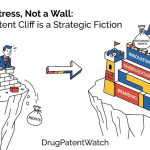
The question this guide started with — when is a drug patent truly secure — has a precise answer: a pharmaceutical patent is secure when invalidating it is economically irrational for a potential challenger, given the combined legal strength of its claims, the depth of its secondary considerations record, the breadth and density of the portfolio surrounding it, and the cost and uncertainty the thicket imposes on any comprehensive challenge strategy.
That condition is constructed, not granted. It requires PTAB-aware prosecution from the outset, a spectrum of claims designed for layered defense, a contemporaneous secondary considerations record embedded in the specification, continuous intelligence monitoring of the competitive landscape, and a disciplined response strategy when challenges arrive. No patent survives indefinitely on the strength of its initial grant alone.
The statistical realities of the PTAB — 68% institution rates, 70% all-claims invalidation rates in FWDs, biologic patents failing at three times the rate of Orange Book small molecule patents — are not arguments against seeking patents. They are arguments for seeking better ones, prosecuting them with more discipline, and protecting them within portfolios designed to make the economics of challenge work against the challenger.
In the Hatch-Waxman and BPCIA era, patent security is ultimately a business calculation, not a legal certificate. The goal is not to hold a patent that a court has declared valid — that is an outcome of defensive litigation. The goal is to hold a patent, inside a portfolio architecture, that no rational competitor would attempt to invalidate.
Key Takeaways: Full Summary
The AIA created the PTAB as a low-cost, fast, challenger-friendly forum for invalidating patents, using a lower evidentiary standard (preponderance of the evidence) and technically expert judges rather than lay juries. PTAB institution rates rose to 68% in FY2024; post-institution invalidation rates reached 70% for all challenged claims. Biologic patents are far more vulnerable than Orange Book small molecule patents: approximately 70% of instituted biologic proceedings end in total claim invalidity, compared to roughly 45-50% for small molecule patents. The dual-track pincer movement — simultaneous Hatch-Waxman/BPCIA district court litigation plus IPR/PGR petitions — is standard competitive strategy for generic and biosimilar manufacturers, with PTAB leverage operating primarily through settlement pressure rather than direct invalidation alone. Post-institution, secondary considerations (commercial success, long-felt need, unexpected results, failure of others) are the primary non-obviousness defense for pharmaceutical patents, but only when a specific, data-backed nexus to the claimed invention is established. Prosecution history estoppel is a permanent constraint: every claim amendment and every argument made to overcome an examiner rejection limits future patent scope. Patent thickets work as economic deterrents by making comprehensive challenge strategies irrational; their power derives from aggregate cost and uncertainty, not from individual patent invincibility. PGR is the operationalized form of the Amgen v. Sanofi ruling for newly issued biologic patents; any functional antibody patent granted within the past nine months should be assessed for PGR candidacy. Discretionary denial doctrines like Fintiv are policy instruments whose availability fluctuates with USPTO leadership; security that rests on discretionary procedural shields rather than substantive claim strength is provisional.
Frequently Asked Questions
A composition-of-matter patent on our lead compound is 12 years old and has never been challenged. How much protection does age alone provide?
Age is not protection. It may support a discretionary denial argument under settled-expectations doctrine if a PTAB petition is filed, but that doctrine’s application depends on current USPTO leadership policy and has been inconsistently applied. A 12-year-old patent with strong substantive claims, a clean prosecution history, and robust secondary considerations data is safe because of those attributes, not because of its age. A 12-year-old patent with thin specification support and a prosecution history full of claim-narrowing amendments is vulnerable regardless of its age.
After Amgen v. Sanofi, what does adequate § 112 support look like for a functional antibody patent filing today?
The minimum viable specification for a broad functional antibody claim needs to disclose a representative number of structurally diverse antibody examples that meet the functional criteria (the specific number will depend on the breadth of the claimed genus, but a handful is clearly insufficient for a genus of thousands or millions). It needs to characterize the structural features common to the claimed antibodies — specific CDR sequences, binding epitope structure, or other molecular attributes that correlate with the functional outcome. It needs to provide a mechanism of action explanation that allows a skilled researcher to predict whether a novel antibody will meet the functional claim without having to exhaustively screen every candidate. And it needs data demonstrating that the characterization is actually predictive — that given the disclosed structural framework, a person of ordinary skill can identify new genus members without undue trial and error. This requires substantial pre-filing lab work. Programs that file before this characterization is complete should consider whether filing narrower structural claims with strong enablement support, and pursuing functional claims only when the characterization data supports the breadth, is a more defensible strategy.
As a biosimilar developer, should we always file an IPR rather than rely solely on district court litigation?
Not automatically. IPR estoppel is binding and broad: if you petition on a patent and receive a Final Written Decision, you are estopped from asserting in any subsequent district court or ITC proceeding any invalidity ground that you raised or reasonably could have raised in the IPR. Losing at PTAB and then having your best district court invalidity arguments estopped is a serious risk. The IPR is the right vehicle when the prior art case is clear and documentary — specific published references that combine to make the claimed compound or method obvious. When the invalidity theory rests on enablement or written description arguments (better suited for PGR if in the nine-month window), on prior public use or on-sale activity, or on a complex expert-driven analysis of what the prior art actually teaches, district court or PGR may be better forums.
We have substantial commercial success data for our drug. How do we structure the nexus argument at the PTAB?
Nexus requires a specific causal link between the commercially successful product’s market performance and the novel, non-obvious features of the claimed invention — not the product generally. The argument needs to be built in four layers: first, document that the claimed invention’s features (as specifically construed) produce the therapeutic benefits that drive prescriber preference; second, obtain physician survey data or testimony documenting that those specific benefits drive prescribing decisions; third, present market data showing that sales growth correlates with the availability of the claimed product feature and not simply with launch timing, market exclusivity, or marketing spend; fourth, account for and rebut the challengers’ anticipated argument that Hatch-Waxman exclusivity, not the patent’s specific innovation, is what produced the commercial opportunity. An economic analysis that disaggregates marketing-driven and exclusivity-driven components of revenue from innovation-driven components is the most persuasive form this can take.
What is the most common structural mistake in IPR petitions against pharmaceutical secondary patents?
Failure to address every claim limitation with particularity. Petitioners targeting secondary formulation or method-of-use patents often identify the most commercially important limitation (the active ingredient concentration, the target patient population) and argue that prior art teaches it, while giving only cursory attention to seemingly minor limitations that the claim also contains. Patent owners locate these gaps and build their entire defense around them. A single unaddressed limitation is enough to defeat an obviousness challenge to a properly construed claim. An IPR petition that does not account for every element of every challenged claim, with specific prior art support for each, will not survive a focused Patent Owner’s Response.