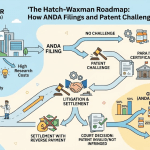
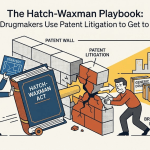
A Paragraph IV filing is not a legal emergency. It is a predictable business event built into the architecture of the Hatch-Waxman Act — and companies that treat it as one consistently destroy value that better-prepared competitors capture. This guide is written for IP teams, portfolio managers, R&D leads, and in-house counsel who need a complete, technically rigorous picture of every resolution pathway available when a generic challenger files an Abbreviated New Drug Application (ANDA) with a Paragraph IV certification. It covers the mechanics of litigation, the post-Actavis settlement minefield, the underused power of mediation and arbitration, and the competitive intelligence infrastructure that determines who negotiates from strength.
The Hatch-Waxman Architecture: Why Conflict Is the Feature, Not the Bug
The Legislative Bargain That Birthed Paragraph IV
The Drug Price Competition and Patent Term Restoration Act of 1984 — the Hatch-Waxman Act — created two markets simultaneously: one for brand innovation, one for generic competition. On the innovator side, the law granted patent term extensions of up to five years to compensate for time consumed by FDA review, plus data exclusivity periods (five years for new chemical entities, three years for new clinical studies). On the generic side, it created the ANDA pathway, allowing challengers to rely on the brand’s existing safety and efficacy data rather than repeating costly clinical trials.
The mechanism connecting these two markets is the patent certification system. When a generic files an ANDA, it must certify with respect to each patent the brand has listed in the FDA Orange Book. A Paragraph I certification states the patent has already expired. A Paragraph II certification acknowledges the patent but commits to not launching until expiration. A Paragraph III certification gives a specific patent expiration date and agrees to wait. Each of these is essentially a concession.
A Paragraph IV certification is different in kind. It asserts that the listed patent is either invalid, unenforceable, or will not be infringed by the proposed generic product. Under 35 U.S.C. Section 271(e)(2), the filing of an ANDA containing a Paragraph IV certification constitutes an artificial act of patent infringement. Congress deliberately engineered this legal fiction so patent disputes could be adjudicated before a generic product reaches pharmacy shelves, avoiding the catastrophic market disruption that would follow an improper commercial launch.
The 180-Day Exclusivity: A Bounty on Weak Patents
The Hatch-Waxman Act rewards the first ANDA filer to submit a Paragraph IV certification against a given patent with 180 days of market exclusivity. During this half-year window, the first-filer operates as a duopolist with the brand. No other generic may receive final approval from the FDA until the exclusivity period expires, regardless of how many other ANDAs are pending for the same drug.
The financial value of this exclusivity is not trivial. For a drug with $2 billion in annual U.S. sales, the market during the first 180 days post-generic entry is typically worth $800 million to $1.2 billion in aggregate revenue, with the generic capturing 60-80% of new prescriptions by day 90 while still pricing at a significant premium to where the market will ultimately settle once multiple generics compete. A first-filer generic on a blockbuster drug can recover its entire litigation investment within the first six weeks of commercial launch.
This structure creates a direct policy incentive: the law essentially places a bounty on questionable patents. If an innovator is sitting on a composition-of-matter patent that has obvious prior art problems, or a formulation patent that a competent medicinal chemist could design around, a sophisticated generic company has every rational and legal reason to challenge it. The 180-day exclusivity is the prize for doing the work.
The strategic implication for innovator IP teams is not comfortable: every patent in your Orange Book listing is a potential 180-day exclusivity target. The question is not whether someone will look at your portfolio. They already are.
IP Valuation in Hatch-Waxman: What the Patent Is Actually Worth
When a Paragraph IV challenge is filed, the legal question is patent validity and infringement. The business question is the economic value of the patent being challenged, which determines how aggressively both sides should fight.
For an innovator, the core IP asset under threat is typically a composition-of-matter patent covering the drug’s active ingredient. These are the highest-value patents in any pharmaceutical portfolio because they provide the broadest exclusionary scope. A composition-of-matter patent on a blockbuster drug like AbbVie’s adalimumab (Humira) or Pfizer’s apixaban (Eliquis) can represent tens of billions of dollars in net present value over its remaining term. Below that sit formulation patents (covering specific dosage forms, release profiles, excipient combinations), method-of-use patents (covering specific therapeutic indications or patient populations), process patents (covering manufacturing methods), and polymorph patents (covering specific crystalline forms of the active ingredient).
Each patent type has a different IP valuation profile. Composition-of-matter patents carry the highest value and are the hardest to invalidate because prior art searches must go back decades and often require expert testimony on complex chemistry. Formulation patents are easier to design around but often provide a second line of defense when the primary composition patent is expiring, which is why they are a cornerstone of lifecycle management strategies. Method-of-use patents are particularly interesting because a generic can carve out the patented indication from its label (a ‘skinny label’), though the FTC and plaintiff litigants have increasingly challenged the effectiveness of skinny labels in practice.
For a generic challenger, the IP valuation question runs the opposite direction: what is the business case for challenging this specific patent on this specific drug? The calculation involves the total U.S. market size (accessible from IMS Health/IQVIA data), the probability of success on the merits (requiring a frank assessment of the patent’s vulnerabilities), the expected litigation cost (typically $5-15 million per case through appeal), the time to market given the 30-month stay, the value of the 180-day exclusivity, and the probability that other generics will file their own ANDAs, potentially triggering forfeiture of the exclusivity. This is a sophisticated NPV calculation, and companies that run it rigorously — rather than filing Paragraph IV certifications reflexively against every drug over a certain revenue threshold — consistently allocate their legal and R&D resources more efficiently.
Key Takeaways: The Hatch-Waxman Architecture
The Hatch-Waxman Act structures conflict as a policy mechanism, not an accident. Paragraph IV certifications are artificial acts of infringement by statutory design, enabling pre-market patent adjudication. The 180-day first-filer exclusivity creates a rational economic incentive to challenge weak patents, which means innovator portfolios containing vulnerable IP will be challenged. IP valuation — the NPV of the patent’s remaining exclusionary scope — is the variable that determines how both sides should calibrate their litigation posture and settlement parameters. Every strategic decision downstream flows from that number.
The Default Path: Hatch-Waxman Litigation in Full Technical Detail
The 45-Day Clock and the 30-Month Stay
When the FDA sends an ANDA filing acknowledgment letter, the generic filer has 20 days to send its Paragraph IV notice letter to the patent holder and NDA holder. That notice letter is itself a legal document with specific content requirements under 21 C.F.R. Section 314.52: it must contain a detailed statement of the factual and legal basis for the generic’s contention that the patent is invalid, unenforceable, or not infringed. Courts have held that a notice letter lacking a good-faith factual basis can support an award of attorneys’ fees under 35 U.S.C. Section 285, so counsel on both sides scrutinize them carefully.
Upon receipt of the notice letter, the innovator has 45 days to file a patent infringement lawsuit in federal district court. Filing within this window is not optional if the innovator wants to trigger the 30-month stay of FDA approval provided under 21 U.S.C. Section 355(j)(5)(B)(iii). The stay automatically suspends final approval of the ANDA for 30 months from the date the notice letter was received — unless the court reaches a final decision on patent validity and infringement before that 30-month period expires, whichever comes first. If the innovator does not file within 45 days, the FDA may grant final ANDA approval immediately upon finding the application otherwise approvable, eliminating the single most valuable procedural tool available to the brand.
The 30-month stay is an economic weapon as much as a procedural one. For a drug generating $1.5 billion annually, 30 months of continued exclusivity represents $3.75 billion in protected revenue, against which the cost of litigation is nearly rounding error.
The Procedural Gauntlet: Claim Construction Through Appeal
District court litigation in a Paragraph IV case follows a predictable multi-year arc, though the specific timeline varies substantially by venue and case complexity.
Discovery is the most resource-intensive phase. In a typical Hatch-Waxman case involving a small-molecule drug, discovery covers the brand’s internal R&D documents (lab notebooks, internal emails, formulation development records, regulatory submissions to the FDA), the ANDA filer’s development files, and the prosecution history at the U.S. Patent and Trademark Office. E-discovery costs in complex cases can reach seven figures. Depositions of key scientists and inventors frequently involve multi-day sessions that require senior technical personnel to step away from active programs.
The Markman hearing is often the dispositive event. In this proceeding, the district court construes the meaning of disputed patent claim terms — a question of law, not fact, meaning the Federal Circuit reviews it de novo on appeal. A narrow claim construction can result in non-infringement even if the generic product is nearly identical to the brand’s formulation. A broad construction can create infringement where the generic’s design-around strategy appeared successful on paper. Companies invest heavily in Markman preparation because a favorable ruling can effectively end the case before trial.
Post-discovery, parties file motions for summary judgment on specific issues. District courts rarely grant full summary judgment in complex Paragraph IV cases, but partial grants on particular claims or defenses can significantly narrow what must be resolved at trial. Bench trial follows, typically lasting one to three weeks for a standard small-molecule case and considerably longer for complex biologics matters.
The Federal Circuit’s role cannot be understated. It hears all patent appeals and has developed a specialized body of Hatch-Waxman jurisprudence. Its rulings on obviousness (under 35 U.S.C. Section 103), written description, and enablement directly shape the validity landscape that both innovators and generics must navigate. The court’s 2007 decision in KSR International v. Teleflex, though not a pharmaceutical case, meaningfully lowered the bar for obviousness findings, benefiting generic challengers who argue that minor modifications to known chemical structures were predictable to a person of ordinary skill in the art.
Appeal from the district court to the Federal Circuit adds 12 to 24 months to the total timeline. A petition for certiorari to the Supreme Court is possible but rarely granted in patent cases absent a circuit split or question of exceptional constitutional importance. From notice letter to final Federal Circuit decision, the median Paragraph IV dispute runs 36 to 48 months.
Litigation Economics: The Full Cost Picture
Direct legal costs are the visible part. Top-tier patent litigation firms handling a Paragraph IV case through trial bill at rates that place total outside counsel fees between $5 million and $15 million for a standard small-molecule case. A biologics case with a larger patent portfolio, more complex science, and BPCIA (Biologics Price Competition and Innovation Act) overlay can run substantially higher. Expert witnesses — medicinal chemists, pharmacologists, formulation scientists, FDA regulatory experts, and economic damages experts — add several hundred thousand dollars to several million more.
The costs that do not appear on legal invoices are consistently larger. Senior scientists pulled into deposition preparation and trial cannot simultaneously advance Phase II or Phase III programs. IP counsel seconded to litigation management cannot focus on prosecution strategy, Orange Book listing decisions, or freedom-to-operate analyses for new programs. Every month a chief scientific officer spends preparing for a bench trial is a month of foregone scientific leadership.
For generic companies, the opportunity cost calculus is starker. Unlike the innovator, which at least receives continued monopoly revenue from the challenged drug during the 30-month stay, the generic filer burns cash throughout. No product revenue offsets the legal fees. The 180-day exclusivity is a future contingent asset, not a current cash flow. A generic company with thin margins on its existing portfolio and a large litigation portfolio is making a leveraged bet on patent outcomes that are, as the data shows, approximately 50/50 at trial.
The Statistical Reality of Hatch-Waxman Trial Outcomes
The litigation success rate figures cited in the pharmaceutical press require careful interpretation. Studies that define ‘generic success’ to include settlements — where the generic receives a defined entry date in exchange for dropping its challenge — report success rates for generic challengers in the range of 70-80%. This figure is meaningless for assessing litigation risk because the outcome being measured is not a litigation outcome.
When the analysis is restricted to cases resolved by a court decision on the merits, the picture is substantially different. Studies examining adjudicated outcomes consistently find that generics prevail in roughly 45-55% of cases at the district court level. The Federal Circuit reversal rate on patent validity issues is meaningful, and outcomes shift modestly toward innovators when the full appellate process is included. The takeaway is not that one side has a decisive advantage in court — it is that neither does, and a coin-flip outcome on billions of dollars in projected revenue is a risk profile that rational actors on both sides should seek to avoid.
Venue matters more than most executives appreciate. The District of Delaware handles the majority of Hatch-Waxman cases, given that most pharmaceutical companies are incorporated there. District of New Jersey is the second-largest venue. Both have judges with substantial experience in pharmaceutical patent matters, but the data consistently shows that generics win at trial in these preferred innovator venues at rates meaningfully below the national average. Generics challenging Delaware-filed cases win at trial approximately 36% of the time, compared to 48% nationally. This is not coincidental. Innovators file in these jurisdictions precisely because experienced judges who understand patent doctrine are more likely to sustain carefully crafted patent claims.
Investment Strategy Note: Litigation as a Valuation Signal
For portfolio managers and biotech analysts, the filing of a Paragraph IV challenge against a company’s flagship drug is a material event that warrants immediate IP portfolio diligence, not simply a reflexive negative. The relevant question is not whether a challenge was filed but what the strategic response looks like. An innovator that files within the 45-day window, demonstrates a multi-layered patent portfolio, and has a documented history of prevailing in Paragraph IV litigation presents a materially different risk profile than one sitting on a single expiring composition patent with no secondary IP protection and no authorized generic strategy. Companies that have built formulation patent estates, filed continuation applications, and secured regulatory exclusivity stacking (e.g., new clinical investigation exclusivity on a specific pediatric study) have structural defenses that are not visible in a simple Orange Book search.
Settlement Post-Actavis: Navigating the Regulatory Minefield
The Pre-Actavis Era: How ‘Pay-for-Delay’ Became Standard Practice
The economic logic of reverse payment settlements was direct. A brand company generating $2 billion annually on a protected drug faces a generic challenger who has spent $10 million preparing an ANDA with a Paragraph IV certification. The brand’s worst-case scenario is losing the patent case and suffering an 80-90% revenue decline within 12 months of generic entry. The generic’s worst-case scenario is losing the litigation and receiving nothing. The brand can rationally offer the generic an amount that is attractive to the generic — say $100 million — while still retaining the vast majority of its monopoly profits by securing a delayed generic entry date several years in the future.
Under the ‘scope of the patent’ test that prevailed in the Second, Eleventh, and Federal Circuits before 2013, this arrangement was presumptively lawful. Courts reasoned that a patent grant by definition excludes competition for its term, so a settlement that delayed generic entry until within the patent’s term merely exercised rights the patent already conferred. The FTC had been challenging these settlements for years under a different legal theory, arguing that paying a would-be competitor to stay out of the market is anticompetitive regardless of the patent backdrop. The agency spent most of the 2000s losing those arguments in court.
Between 2005 and 2012, the FTC’s annual reports on pharmaceutical patent settlement agreements documented a steady increase in reverse payment deals. In fiscal year 2012 alone, the FTC identified 40 settlements it categorized as potentially anticompetitive based on payment structure, the largest number recorded to that point. The economic value of those deals — measured by the sales of the drugs whose generic entry was delayed — represented tens of billions of dollars in consumer harm, according to the agency’s analysis.
FTC v. Actavis: The Decision That Changed Everything
The case arose from Solvay Pharmaceuticals’ settlement of Paragraph IV litigation over AndroGel, a testosterone replacement therapy that generated approximately $400 million in annual U.S. sales at the time. Solvay had listed U.S. Patent No. 6,503,894 in the Orange Book. Watson Pharmaceuticals (later Actavis), Paddock Laboratories, and Par Pharmaceutical each filed ANDAs with Paragraph IV certifications. Solvay sued all three within the 45-day window. During the litigation, Solvay settled with each defendant, agreeing to pay Watson between $19 million and $30 million annually for several years, and similar amounts to the other challengers, in exchange for agreements not to market generic AndroGel until 2015 — years before the ‘894 patent’s listed expiration date.
The FTC filed suit in 2009, alleging that the settlements were unlawful horizontal agreements to delay competition. The Eleventh Circuit dismissed the complaint, applying the scope-of-the-patent test. The Supreme Court granted certiorari.
In FTC v. Actavis, Inc., 570 U.S. 136 (2013), Justice Breyer writing for a five-justice majority held that reverse payment settlements are neither per se lawful nor per se unlawful, but must be evaluated under the antitrust ‘rule of reason.’ The majority identified several factors courts should consider: the size and unjustified nature of the reverse payment, the payment’s likelihood of causing anticompetitive harm, the payment’s potential justifications, and the extent to which it exceeds the value of services the generic provides to the brand.
The majority’s central inference was that a large unexplained reverse payment suggests the brand doubts its own patent. If the patent were strong, the brand would win in court and pay nothing. The willingness to pay a large sum to the challenger signals that the patent’s probability of invalidation is high enough to make the payment rational — which in turn means competition, absent the payment, would likely have arrived sooner. Chief Justice Roberts dissented, joined by Justices Thomas and Scalia, arguing that the majority’s approach was unworkable in practice. His observation that ‘Good luck to the district courts’ proved prescient.
A Decade of Post-Actavis Litigation: What the Courts Have Decided
The decade following Actavis produced a substantial body of lower court decisions attempting to operationalize the rule-of-reason framework. Several recurring issues have emerged as recurring battlegrounds.
The question of what constitutes a ‘large’ payment remains unsettled. Courts have generally used the FTC’s analytical framework, which treats any reverse payment exceeding saved litigation costs as presumptively suspect. The FTC has informally suggested approximately $7 million as a threshold below which it is unlikely to bring enforcement action for litigation cost reimbursement, though this figure has no statutory basis and is not a formal safe harbor. Any payment above that amount requires a substantive antitrust justification.
The Eleventh Circuit addressed the case on remand in FTC v. AbbVie Inc., 976 F.3d 327 (3d Cir. 2020), though that case actually involved AbbVie’s AndroGel settlements under similar facts. The Third Circuit in that decision clarified that the plaintiff bears the initial burden of showing that the payment is large and unjustified, after which the burden shifts to the defendant to demonstrate procompetitive justifications. The Fifth Circuit’s 2021 decision in Impax Laboratories, Inc. v. FTC affirmed an FTC finding against Impax’s settlement of Paragraph IV litigation over Zomig (zolmitriptan) extended-release tablets with AstraZeneca, validating the FTC’s approach of using the size of the payment as a surrogate for anticompetitive harm even without direct proof of market effects.
AbbVie’s settlement litigation is worth examining in detail because it illustrates the full range of IP valuation issues that arise post-Actavis. AbbVie’s patents on AndroGel 1.62% included U.S. Patent No. 8,580,802. The FTC alleged that AbbVie’s Paragraph IV suits against Perrigo and Teva were shams — filed not to protect legitimate patent rights but to trigger the 30-month stay and then settle on terms that delayed generic entry. The Third Circuit ultimately held that sham litigation findings require showing objective baselessness, a high bar that the FTC did not meet on the specific facts, but simultaneously affirmed that the reverse payments in the underlying settlements were actionable under Actavis. The case produced $448 million in disgorgement against AbbVie, a figure later vacated by the Supreme Court in Liu v. SEC on grounds that disgorgement is not an available remedy in FTC civil penalty actions — a procedural outcome that does not affect the underlying antitrust liability analysis.
The Shift to Non-Cash ‘Possible Compensation’
The FTC’s MMA (Medicare Modernization Act of 2003) reporting requirement gives the agency direct visibility into every brand-generic patent settlement. The MMA mandates that parties file their settlement agreements, along with any collateral agreements entered within 30 days of the primary settlement, with the FTC and DOJ within 10 days of execution. The 2018 amendments strengthened these requirements to prevent parties from disguising value transfers as independent business transactions.
The FTC’s analysis of MMA filings over the decade following Actavis documents a clear trend: explicit cash payments declined sharply, while ‘possible compensation’ arrangements increased. The agency currently categorizes the following as potential unlawful compensation:
No-AG commitments represent the most economically significant category. A no-authorized-generic commitment is a promise by the brand that it will not launch its own authorized generic during the first-filer’s 180-day exclusivity period. This is enormously valuable to the generic because an authorized generic competes directly during exclusivity, effectively converting the duopoly into a three-player market and cutting the generic’s revenue by 30-50% during the most profitable window it will ever have. The FTC has successfully argued in multiple proceedings that a no-AG commitment constitutes a transfer of economic value that must be justified under Actavis. The D.C. Circuit in In re Loestrin 24 Fe Antitrust Litigation and related cases has treated no-AG commitments as a core component of the reverse payment analysis.
Quantity restrictions are the FTC’s current enforcement focus. Between fiscal years 2018 and 2021, the FTC identified 23 settlement agreements containing quantity limitation provisions — clauses that cap the volume of generic product the first-filer may sell during a defined period. The FTC’s January 2025 blog post ‘Reverse Payments: From Cash to Quantity Restrictions and Other Possibilities’ explicitly named quantity caps as a category of unlawful market allocation. The agency’s theory is that a sufficiently restrictive quantity cap produces the same anticompetitive effect as a delayed entry date: it limits the competitive pressure the generic exerts on the brand’s price, allowing both parties to extract supra-competitive profits at consumer expense.
Side deals — agreements for services, licenses, or supply arrangements entered contemporaneously with a patent settlement — require rigorous fair-market-value analysis. If a brand pays a generic $50 million for co-promotion services in a co-promotion agreement signed the same day as a patent settlement that conveniently delays the generic’s entry, the FTC will examine whether $50 million reflects the market rate for those services or is simply a cash payment in commercial clothing. Companies entering these arrangements must have independent valuation support, ideally from a credible third-party economic consulting firm, before execution.
Other forms of possible compensation the FTC monitors include declining royalty structures in patent licenses (where royalty rates decrease if the brand launches an authorized generic, effectively penalizing the brand for competing), right-of-first-refusal provisions granting the generic preferred access to the brand’s AG, and above-market pricing in supply agreements between the parties.
Structuring a Defensible Post-Actavis Settlement
The practical challenge for settlement counsel is constructing an agreement that achieves the parties’ business objectives while surviving rule-of-reason scrutiny. Several structural features characterize defensible settlements in the current environment.
The entry date is the cleanest currency. An agreement that grants the generic a specific market entry date before patent expiration, with no side deals and no payment other than a documented reimbursement of attorneys’ fees at or below the FTC’s informal benchmark, carries the lowest antitrust risk. The brand gives up some period of exclusivity; the generic gets certainty; neither party gives the FTC anything to scrutinize.
When side deals are commercially necessary — for example, when the generic has been manufacturing the brand’s API for years and the commercial relationship predates the litigation — the parties should document the deal’s commercial justification through an independent arm’s-length process, retain economic experts to opine on fair market value, and ensure that the settlement agreement itself does not reference or condition the side deal.
Most-Favored Entry (MFE) clauses have drawn increasing FTC attention. An MFE clause in a brand-first-filer settlement provides that if the brand subsequently grants any other generic challenger an earlier entry date, the first-filer automatically receives the same date. The FTC views these clauses as potentially anticompetitive because they can lock in a collectively agreed entry date that prevents the brand from reaching earlier settlements with subsequent filers who may have stronger patent challenges.
Investment Strategy Note: Reading the Settlement Landscape
For analysts tracking a specific drug’s generic entry timeline, the MMA filings with the FTC are essential primary source material, though the agency often publishes its analysis with a significant lag. More timely signals include press releases by generic companies announcing ‘final resolution’ of Paragraph IV litigation (often the public disclosure of a settlement), which typically contain enough information to infer the agreed entry date even when settlement terms are confidential. An authorized generic launch by the brand concurrent with the generic’s entry date is a strong signal that the settlement did not contain a no-AG commitment, which suggests the brand felt it could absorb the competition — or that the generic negotiated from a position of strength on the patent merits.
Mediation in Paragraph IV Disputes: The Confidential Path to Creative Resolution
What Mediation Is and What It Is Not
Mediation is a voluntary, confidential process in which a neutral third party helps disputants negotiate their own agreement. The mediator has no authority to impose a decision. The process terminates whenever either party chooses to walk away. Nothing said in mediation is admissible in subsequent court or arbitration proceedings, a feature protected by the Federal Mediation Privilege under the Administrative Dispute Resolution Act of 1996 and state equivalents, as well as Rule 408 of the Federal Rules of Evidence.
This confidentiality protection is not incidental — it is the feature that makes mediation strategically distinct from direct settlement negotiations. In direct negotiations conducted by counsel, every written proposal, every email, and every counter-offer is potentially discoverable in subsequent litigation or FTC proceedings. In mediation, the parties can have substantive, candid conversations about the business realities of the dispute — including frank assessments of their own legal vulnerabilities — without creating a paper trail. A generic company’s counsel can tell a mediator ‘Our client’s Paragraph IV certification on the formulation patent is probably weak, but the composition patent has real obviousness problems’ without generating an admission that will be used against them in court.
The Mediator’s Role in Pharmaceutical Patent Disputes
A skilled mediator in a Paragraph IV case does several things that direct negotiation between adversarial counsel cannot replicate. First, they reality-test legal positions in private caucus. When a mediator meets separately with each party, they can probe the strengths and weaknesses of each side’s legal theory in ways that opposing counsel cannot in direct negotiation without appearing to concede ground. An experienced mediator who is a former Federal Circuit judge or a patent litigator who has tried 30 Hatch-Waxman cases can tell the brand’s IP team privately that their formulation patent’s prosecution history estoppel problem is more serious than outside counsel appears to have acknowledged in public filings. That conversation — which could never happen in direct negotiation — can move a brand from an unrealistic settlement demand to a realistic one in a single afternoon.
Second, a mediator can surface underlying business interests that the parties have not explicitly communicated to each other. A generic company may nominally be seeking an immediate entry date, but its actual business priority is manufacturing scale-up certainty: it needs 18 months of lead time before launch regardless of the legal outcome. If the mediator surfaces this through private caucus, the brand may be able to offer a structure — say, a license with an 18-month notice period before exercise — that satisfies the generic’s actual operational need while giving the brand more time than the generic’s public demand suggested was possible.
Third, a mediator can help parties structure complex deals around the post-Actavis antitrust constraints. The mediator can work with both parties to develop a settlement structure that achieves their business objectives without crossing regulatory red lines, helping them think through the antitrust risk of specific provisions before those provisions are committed to paper.
When to Propose Mediation: Strategic Timing
The timing of a mediation proposal is itself a strategic decision. Early mediation — before significant discovery has occurred — saves the most money and preserves the most relationship capital, but requires both parties to have formed realistic assessments of the case’s merits without the full evidentiary record. Post-Markman mediation is often the most productive moment: the claim construction ruling has resolved the central legal ambiguity of the case, giving both parties a clearer picture of who is likely to prevail at trial, while discovery costs have not yet reached their peak.
Post-summary judgment mediation is less common but can be valuable when a partial summary judgment has altered the balance of power. A brand that has survived a summary judgment motion on validity may be willing to negotiate from a stronger position; a generic that has successfully invalidated one claim on summary judgment may be willing to settle because the remaining claims are more defensible than originally assessed.
Companies should not wait for opposing counsel to propose mediation. A first-mover mediation proposal signals business maturity and confidence — it communicates that you are willing to have a candid conversation about the case because you know your own position well. A company that reflexively refuses mediation proposals from the other side risks appearing unable to engage substantively with the risks in its own case.
The American Arbitration Association, JAMS, and the WIPO Arbitration and Mediation Center all provide pharmaceutical mediation services with experienced neutrals. The WIPO Center has particular expertise in international pharmaceutical IP disputes and maintains a roster of former IP judges and senior patent practitioners from multiple jurisdictions.
Mediation as Antitrust Risk Management
Post-Actavis, mediation has acquired a function beyond dispute resolution: it is a tool for proactive antitrust risk management in settlement structuring. When parties negotiate a complex settlement directly, every draft and counter-draft creates a documentary record that can later be used by the FTC or private plaintiffs to reconstruct the negotiating history and argue that a particular side deal was merely a disguised reverse payment. The most damaging evidence in FTC enforcement actions is often internal email chains in which executives discuss the ‘net present value’ of delaying generic entry or describe a service agreement as being ‘worth it’ because of what the other side is giving up on the patent.
In a confidential mediation, those conversations happen in a protected setting. The parties can explore the antitrust implications of specific deal terms with the mediator, stress-test proposed provisions against the FTC’s enforcement framework, and build the business rationale for any side deal into the deal’s structure before it is ever reduced to writing. The final agreement that emerges from this process has been pre-hardened against regulatory attack in a way that a deal negotiated solely through direct correspondence rarely achieves.
Key Takeaways: Mediation
Mediation is not a soft option. It is a tactically sophisticated resolution pathway that provides confidentiality protections unavailable in direct negotiation or litigation, creates space for creative commercial solutions that courts cannot order, and enables proactive antitrust risk management in post-Actavis settlement structuring. Companies that wait for the other side to propose mediation consistently miss the optimal timing window. The best mediation proposals come from a position of strategic clarity about one’s own legal vulnerabilities and business objectives.
Arbitration: Private Adjudication With Pharmaceutical-Specific Expertise
The Structural Advantages of Arbitration Over Federal Court
Arbitration is a binding, private adjudication conducted before one or more neutral arbitrators pursuant to a written agreement between the parties. Unlike mediation, it produces a final decision. Unlike litigation, that decision is made by a decision-maker the parties selected for expertise, in a confidential proceeding, on a timeline the parties substantially control.
The ability to select the decision-maker is arbitration’s most operationally significant advantage in the pharmaceutical context. A district court judge assigned to a Hatch-Waxman case in the District of Delaware may be a skilled jurist with no prior exposure to pharmaceutical formulation science, ANDA regulatory procedure, or the specific complexities of obviousness analysis for structural analogs. The parties will spend significant time and money educating that judge on the science before any legal argument can be effectively made. In arbitration, the parties can select an arbitrator — or a three-member panel — with deep combined expertise in patent law, FDA regulatory practice, pharmaceutical chemistry, and Hatch-Waxman litigation. The arbitrator who has tried 40 Paragraph IV cases as a judge or litigator does not need the 101 lecture on 30-month stays or the difference between composition and formulation patents. That expertise translates directly into a more focused, technically accurate, and efficient proceeding.
Speed is the second structural advantage. The median time from filing to final award in commercial arbitration is approximately 12-18 months for complex cases, compared to 30-48 months for Paragraph IV cases through trial and Federal Circuit appeal. Compressed discovery (typically limited to document production and a defined number of depositions), streamlined motion practice, and flexible scheduling all contribute to this acceleration. For a generic company burning cash while waiting for a market entry date, every month saved in the dispute resolution process has direct economic value.
Confidentiality is absolute in arbitration in a way it never is in litigation. The parties’ pleadings, exhibits, witness testimony, and the final award can all be kept private by agreement. This matters enormously when the dispute turns on a non-infringement defense based on a proprietary manufacturing process or a novel crystal form that the generic developed at significant R&D cost. In federal court, a protective order limits but does not eliminate the risk of competitive information entering the public record. In arbitration, there is no public record at all.
The Enforceability Architecture: FAA and the New York Convention
Domestic pharmaceutical arbitration agreements are governed by the Federal Arbitration Act (FAA), 9 U.S.C. Section 1 et seq., which establishes a strong federal policy favoring arbitration and severely limits the grounds on which a court may vacate an award. Under 9 U.S.C. Section 10, a court may vacate an arbitration award only if it was procured by corruption, fraud, or undue means; if the arbitrator was evidently partial or engaged in misconduct; if the arbitrator exceeded their powers; or if the arbitrator refused to hear material evidence. A court cannot vacate an award because it disagrees with the arbitrator’s legal conclusions or factual findings. This finality is the defining structural feature of arbitration, and it cuts both ways.
For international pharmaceutical disputes — particularly those arising under licensing agreements between U.S. innovators and European or Asian generic manufacturers, or under collaboration agreements between multinational pharmaceutical companies — the New York Convention on the Recognition and Enforcement of Foreign Arbitral Awards (1958) provides a mechanism for enforcing arbitral awards in 170+ signatory countries. Enforcing a U.S. federal court judgment in Germany, Japan, or India typically requires re-litigating the merits in a local court that applies its own procedural law. Enforcing an arbitral award in those same countries requires only that the local court verify the award meets the New York Convention’s formal requirements. This enforceability advantage makes arbitration the near-universal standard for resolving pharmaceutical licensing disputes with international counterparties.
Arbitrating Paragraph IV-Adjacent Disputes: Where Arbitration Fits
A pure Paragraph IV infringement case — the statutory infringement action created by the ANDA filing — is brought in federal court by statute and cannot simply be redirected to arbitration unilaterally. Both parties must consent. In practice, the route to arbitration in the Paragraph IV context runs through pre-existing contractual relationships. Consider the following scenarios:
A brand company has a license agreement with a specialty generics company covering certain products. The agreement contains a broad arbitration clause covering ‘all disputes arising under or related to this agreement, including any dispute regarding the validity, infringement, or enforceability of any patent subject to this agreement.’ When the generic files an ANDA on a drug covered by the license, the brand’s Paragraph IV suit may be subject to a motion to compel arbitration based on the contractual clause.
A manufacturing and supply agreement between a brand and a generic company that has historically supplied the brand’s authorized generic contains an arbitration clause. When the commercial relationship sours and the generic files a Paragraph IV certification, both parties have an interest in resolving the patent dispute in the same confidential forum that would govern the supply agreement disputes — and can execute a post-dispute arbitration agreement to consolidate the proceedings.
International licensing agreements, where a U.S. innovator has licensed territory rights to a foreign generic company, almost universally contain arbitration clauses specifying WIPO or ICC arbitration. When those relationships break down and the foreign licensee files patent challenges in its home jurisdiction, arbitration provides a neutral, enforceable forum that neither party’s national courts can offer.
Drafting the Arbitration Clause: What Gets Negotiated At the Contract Stage
The arbitration clause is not a boilerplate provision. In a pharmaceutical licensing or supply agreement, it should specify the administering institution (AAA, JAMS, ICC, or WIPO), the rules to be applied (each institution publishes its own procedural rules, with varying approaches to discovery, emergency relief, and appellate review), the seat of arbitration (which determines the national law governing the arbitration’s procedure), the number of arbitrators (one for lower-stakes disputes, three for bet-the-company matters), the specific professional qualifications required of arbitrators (e.g., ‘at least one arbitrator with experience in pharmaceutical patent litigation in U.S. federal courts’), the language of proceedings, any carve-outs for emergency injunctive relief in national courts, and the governing substantive law for the underlying contract.
WIPO’s Arbitration and Mediation Center specifically offers a ‘Supplementary Rules for Hatch-Waxman Disputes’ option that incorporates the key features of ANDA litigation into the arbitration framework, including provisions for Orange Book-related patent disputes and biologics BPCIA proceedings. For pharmaceutical companies routinely entering into licensing arrangements that could implicate Hatch-Waxman disputes, WIPO’s specialized rules are worth examining as a drafting resource.
The Finality Risk: Selecting the Arbitrator as the Highest-Stakes Decision
The irreversibility of an arbitration award means that arbitrator selection is not a procedural step — it is the single most consequential strategic decision in the dispute. An arbitrator who misunderstands the claim construction standard for pharmaceutical process patents, or who applies an incorrect legal framework for assessing obviousness of enantiomers, has effectively decided the case incorrectly with no correctable appeal. Unlike the Federal Circuit, which reviews district court claim constructions de novo and has reversed multiple district courts on this basis in high-profile pharmaceutical cases, no court will review an arbitrator’s legal reasoning for correctness.
This reality demands genuine diligence in arbitrator vetting. Candidates should be evaluated not just for general credentials but for their specific record on relevant legal issues. Has this arbitrator addressed obviousness of pharmaceutical salts or polymorphs? What is their documented position on prosecution history estoppel in the pharmaceutical context? Have they previously served as an expert or advocate in Hatch-Waxman matters? These questions are answerable through careful review of published awards (where available), court decisions reviewing prior awards by the candidate, bar association publications, and direct inquiry with counsel who have appeared before the candidate.
For three-arbitrator panels, the selection process itself is often multi-step: each party selects one arbitrator (typically a partisan advocate for their general legal philosophy, though not a partisan decision-maker), and the two party-selected arbitrators select the chair. In that structure, the chair’s views on the central legal questions in the dispute are often decisive, making the chair selection negotiation as important as the case itself.
Key Takeaways: Arbitration
Arbitration offers pharmaceutical patent disputants expert decision-makers, reduced timelines, confidentiality, and — for international disputes — superior award enforceability. Its fundamental limitation is the near-total absence of substantive appellate review, which elevates arbitrator selection to a critical strategic decision that must be executed with the same rigor as case strategy itself. For disputes arising under pre-existing commercial relationships with arbitration clauses, the pathway is straightforward. For pure Paragraph IV suits, arbitration requires post-dispute consent from both parties — which is achievable but demands that both sides recognize the mutual advantages over federal court.
Competitive Intelligence as a Force Multiplier in Every Resolution Pathway
Pre-Dispute IP Vulnerability Assessment: Building the Litigation-Resilient Portfolio
The time to assess your Paragraph IV exposure is before the notice letter arrives. For innovator companies, this means conducting a frank internal vulnerability assessment of every patent listed in the Orange Book for each commercial product, using the same analytical lens a sophisticated generic challenger would apply.
Start with the composition-of-matter patents. For small molecules, assess the obviousness risk under KSR and the Federal Circuit’s pharmaceutical-specific obviousness doctrine, which requires that a claimed compound be non-obvious not just in structure but in properties. For biologics, the relevant framework is different: the BPCIA’s 12-year reference product exclusivity window and the complexity of demonstrating biosimilarity under 42 U.S.C. Section 262(k) create different vulnerability profiles than Hatch-Waxman, though the IP principles overlap. Identify any prior art not cited in the prosecution history. Commission a freedom-to-operate opinion from counsel who was not involved in prosecution of the patent. Check for double-patenting issues in the patent family.
For formulation and method-of-use patents, the analysis is more commercially nuanced. These patents are only as valuable as a generic’s inability or unwillingness to design around them. A formulation patent claiming a specific extended-release coating excipient combination may be strong on its face, but if a generic can achieve bioequivalent performance with a different excipient at comparable cost, the patent provides little actual barrier to entry. The vulnerability assessment should include not just legal analysis but a technical assessment from formulation scientists who understand what design-around options are available.
For polymorph and crystal form patents — a frequent target in secondary patent strategies — the assessment must grapple with the Federal Circuit’s consistently narrow view of polymorph patentability post-Pfizer, Inc. v. Apotex, Inc., 480 F.3d 1348 (Fed. Cir. 2007), in which the court found that the selection of a pharmaceutically acceptable salt form of amlodipine was obvious because there was strong motivation to select that form and a reasonable expectation of success. Polymorph patents on drugs where the crystalline form was selected primarily for manufacturing convenience, rather than for unexpected pharmacological properties, are particularly vulnerable.
From the generic side, the pre-dispute intelligence question is: which drug, on which patents, produces the best risk-adjusted return? The variables in this NPV calculation are well-defined but require real data to quantify accurately.
Market size and revenue trajectory determine the ceiling on the 180-day exclusivity value. A drug with $3 billion in current sales and a growing indication is worth challenging; one with $800 million in peak sales that has already been replaced by a next-generation product may not justify the litigation investment even if the patents are weak.
Patent portfolio depth determines the floor of complexity. A drug protected by a single composition-of-matter patent expiring in 18 months requires a different analysis than one with a composition patent plus a patent thicket of eight formulation, method-of-use, and polymorph patents of varying quality. The cost of a successful Para IV challenge scales roughly with the number of patents that must be addressed, though the strength of those patents determines whether the challenge is worth pursuing at all.
Existing ANDA filings in the FDA’s public records, cross-referenced with Orange Book listings and active litigation tracked in PACER (Public Access to Court Electronic Records), tell a generic company how many other challengers are already pursuing the same target. A target with five first-filer-eligible ANDA filers already in litigation is a crowded trade; a target with no pending ANDAs may represent an overlooked opportunity — or may indicate that smarter players have already assessed the patent as too strong to challenge efficiently.
Leverage in Negotiation: Patent and Litigation Data as Bargaining Currency
Once a dispute is underway, the party with superior information about patent strength, litigation history, and the opponent’s business pressures consistently negotiates from a stronger position.
Prosecution history analysis — reviewing the complete record of communications between the patent applicant and the USPTO examiner during prosecution — is the single most important source of intelligence on patent scope limitations. Arguments made by the applicant to distinguish prior art during prosecution can create prosecution history estoppel that limits the patent’s effective claim scope even when the claim language appears broad. A generic challenger who has identified a specific prosecution history estoppel argument that limits the composition-of-matter claim to exclude its proposed product has a powerful, concrete non-infringement argument that changes the settlement calculus materially.
Litigation history analysis goes beyond reading the prior case’s final opinion. In prior Paragraph IV cases involving the same innovator or the same patent family, the parties’ expert reports, Markman briefing, and trial exhibits are often available through PACER and can be obtained with modest effort. These documents reveal the technical arguments that have already been made, the expert witnesses each side has relied upon, and the specific claim construction arguments that have succeeded or failed in earlier rounds of litigation. A generic company entering a Paragraph IV dispute with a competitor it has litigated against before has an enormous informational advantage over one approaching the same opponent for the first time.
Business pressure intelligence is the most underused analytical layer. A brand company reporting deteriorating EBITDA on its flagship product, facing pricing pressure from PBM formulary changes, or managing a pipeline with no late-stage assets is not the same negotiating counterpart as one with robust earnings and three Phase III assets approaching readiness. An innovator in financial distress may be more willing to reach a structured settlement that provides royalty revenue from the generic, even at the cost of an earlier entry date, than one that can afford to litigate to the Federal Circuit. Quarterly earnings calls, 10-K and 10-Q filings, and analyst reports contain the signals that translate into negotiating leverage — if someone reads them.
Most major Paragraph IV disputes involve multiple ANDA filers pursuing the same drug. The first-filer dynamic creates a complex web of interlocking positions. The first-filer generic holds the 180-day exclusivity; subsequent filers hold no exclusivity but may be pursuing the same underlying patent challenge. If the first-filer settles, the subsequent filers’ exclusivity clock starts only if the first-filer’s 180 days expire or are forfeited, which creates specific conditions under 21 U.S.C. Section 355(j)(5)(D).
Real-time tracking of FDA Orange Book updates, new ANDA filings, active litigation dockets, and settlement announcements is essential for managing this complexity. A second-filer generic company monitoring the first-filer’s litigation should track every significant court event — Markman rulings, summary judgment decisions, trial dates — because any of these can signal an impending settlement, which changes the second-filer’s own leverage position dramatically. An innovator managing multiple simultaneous Paragraph IV suits should track the litigation posture of each generic separately, since a favorable settlement with the first-filer on an entry date years in the future is worth far less if subsequent filers are positioned to challenge the first-filer’s exclusivity and trigger their own market entry.
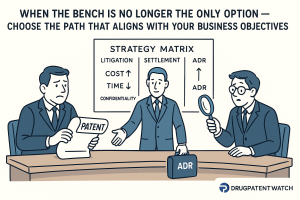
The Decision Framework: Selecting the Right Resolution Path
The Decision Matrix
No resolution pathway dominates every dimension. The right choice depends on a structured analysis of case-specific factors:
Patent strength is the foundational variable. A composition-of-matter patent with a clean prosecution history, strong secondary considerations of non-obviousness (commercial success, long-felt need, failure of others), and no identified prior art vulnerabilities supports an aggressive litigation posture. The same patent with a documented prosecution history that limits claim scope, a prior art reference the examiner did not cite, or a co-pending reexamination proceeding is a candidate for a structured settlement or ADR.
Revenue at risk determines the economic ceiling on acceptable resolution costs. For a drug generating $4 billion annually with 5 years of remaining patent life, the NPV of that exclusivity exceeds $15 billion at a modest discount rate. Legal fees of $15 million to protect that value are de minimis. For a drug generating $300 million annually with 18 months of remaining exclusivity, a trial strategy may not be economically rational even with a strong patent.
Core business objectives define what ‘success’ means. An innovator launching a next-generation formulation in 24 months may value any resolution pathway that keeps the market clear long enough to establish that product, even if it requires conceding the primary composition patent claim. A generic building a brand identity around rapid genericization of blockbusters may value a favorable trial precedent that establishes its litigation credibility with future opponents more than the economic terms of a specific settlement.
Confidentiality requirements weigh heavily when the non-infringement defense rests on trade-secret manufacturing or formulation information. Federal court litigation produces protective orders, not silence. Arbitration produces silence.
Risk tolerance is not just a psychological disposition — it has organizational and investor relations dimensions. A public company with institutional shareholders who model earnings on specific patent expiry dates cannot sustain multi-year binary litigation risk without significant valuation consequences. A private equity-backed generic with patient investors may be willing to absorb that uncertainty in pursuit of a decisive trial win.
The regulatory climate is a dynamic variable. During periods of aggressive FTC enforcement — which characterizes the current environment under the post-Actavis doctrine — any settlement involving side deals or quantity restrictions carries elevated risk of a secondary enforcement proceeding that can negate the value of the settlement entirely.
Comparative Analysis of Resolution Pathways
Factor
Litigation
Post-Actavis Settlement
Mediation
Arbitration
Total Cost
$10M-$50M+
Moderate + payment value
$50K-$500K
$1M-$5M
Timeline
36-60 months
Weeks to 18 months
Weeks to 6 months
12-18 months
Confidentiality
Low (public docket)
Low (FTC/DOJ filing)
High (protected process)
High (private proceedings)
Outcome Control
Low (judge decides)
High (party agreement)
High (party agreement)
Low (arbitrator decides)
Business Certainty
Low during pendency
High post-signing
Low until agreement
Very high post-award
Decision-Maker
Federal judge (random)
Parties
Parties (with facilitator)
Expert arbitrator(s)
Antitrust Exposure
None
High (FTC scrutiny)
Low (confidential structuring)
None
Key Advantage
Precedent, injunction
Commercial certainty
Creative deal structures
Speed, expertise, privacy
Key Risk
Catastrophic loss, cost
FTC challenge to deal
No resolution reached
Irreversible bad outcome
Best Suited For
Strong patent, clear infringement
Certain entry date needed
Complex business deal possible
Fast expert decision needed
Investment Strategy Note: Reading a Company’s Resolution Strategy
The resolution pathway a pharmaceutical company selects in a Paragraph IV dispute is itself a signal to analysts about management’s assessment of its own IP strength. A company that consistently settles Paragraph IV challenges early — providing licensed entry dates well before patent expiry — is effectively telling the market that its secondary patent portfolio is weak or that it doubts its composition patents in litigation. A company that litigates major challenges to final Federal Circuit decisions, wins most of them, and uses those wins to deter subsequent ANDA filings has demonstrated IP portfolio discipline that has a computable NPV premium over one that settles reflexively.
The choice to use mediation for a specific dispute, while maintaining a general posture of aggressive litigation, often signals that a specific patent in the portfolio is weaker than the rest — or that the business rationale for a creative commercial arrangement with the specific generic challenger outweighs the value of a trial win. Sophisticated analysts track these resolution patterns across a company’s complete Paragraph IV history and weight them in their IP valuation models accordingly.
Key Takeaways: The Complete Paragraph IV Dispute Resolution Playbook
The Hatch-Waxman Act was designed to channel conflict, not prevent it. Paragraph IV certifications are deliberate, legally sanctioned challenges to patents the challenger believes are weak, invalid, or non-infringed. Every Orange Book-listed patent is a target. Companies that treat this reality as a strategic planning variable, rather than a crisis to be managed, consistently outperform those that do not.
The 30-month stay is an economic weapon worth more than its face value. For drugs with high annual revenues, the automatic stay of FDA approval triggered by a timely filed Paragraph IV suit can protect billions in revenue at a fraction of the litigation cost. Missing the 45-day filing deadline is a governance failure with quantifiable billion-dollar consequences.
Trial outcomes in Paragraph IV cases are close to 50/50 for adjudicated decisions. The statistically higher ‘success rates’ reported for generics in aggregate studies include settlements in the numerator, which conflates business outcomes with litigation outcomes. Companies making litigation-versus-settlement decisions should use the adjudicated success rates by specific venue, not aggregate figures.
Post-Actavis settlement requires antitrust discipline. The era of straightforward cash payments to delay generic entry is over. No-AG commitments, quantity restrictions, and side deals all carry FTC enforcement risk and require rigorous fair-market-value justification. Every settlement term that transfers value beyond documented litigation cost reimbursement needs independent economic support.
Mediation provides confidentiality protections unavailable anywhere else in the dispute resolution landscape. The Federal Mediation Privilege and Rule 408 protection allow parties to have frank discussions about legal vulnerabilities and business interests without creating discoverable records. The post-Actavis antitrust environment makes this feature strategically more valuable, not less.
Arbitrator selection is the highest-stakes decision in an arbitration, given the near-total absence of substantive appellate review. The finality of an arbitral award on a patent with billions in NPV makes diligence in evaluating arbitrator candidates as important as case strategy itself.
Superior competitive intelligence — covering patent prosecution history, litigation track records, and the opponent’s business pressures — is a durable source of negotiating leverage across every resolution pathway. The party that understands why its opponent needs to resolve the dispute, not just what legal position they are asserting, consistently achieves better outcomes.
Frequently Asked Questions
After Actavis, can any reverse payment be legally defensible?
Yes, within narrow parameters. The Supreme Court acknowledged that some compensation is legitimate — specifically, payments that represent saved litigation costs avoided by the settlement. The FTC has informally referenced approximately $7 million as a threshold that draws less scrutiny, though no statutory safe harbor exists at that level. Any transfer of value above documented litigation cost reimbursement — whether in cash, no-AG commitments, quantity restrictions, or service agreements — requires a procompetitive justification supported by rigorous economic analysis demonstrating fair market value. The burden of producing that justification in any subsequent enforcement action sits with the settling parties.
What is the most common mistake companies make in mediation?
Selecting the wrong mediator. The effectiveness of mediation is almost entirely a function of the neutral’s specific expertise and temperament. A mediator who does not understand Hatch-Waxman procedure, Orange Book mechanics, or the antitrust constraints on pharmaceutical settlements cannot reality-test the parties’ positions effectively. A mediator who is technically expert but lacks the interpersonal skill to manage the high-stakes emotional dynamics between senior executives and their counsel cannot unlock the impasses that stall direct negotiations. The mediator selection decision deserves the same diligence as expert witness selection in litigation.
Why don’t more pure Paragraph IV disputes go to arbitration?
Several reasons. The statutory cause of action for Paragraph IV infringement is a federal court action by design — it cannot be diverted to arbitration absent both parties’ consent. Innovators with strong patents often prefer the public vindication of a Federal Circuit affirmance, which has precedential value in deterring future challenges to related patents. Generics with strong invalidity arguments often prefer the Federal Circuit’s de novo claim construction review, which provides a second bite at the Markman apple if the district court rules narrowly. The biggest structural barrier is finality aversion: when the outcome of a dispute can determine the entire commercial life of a multi-billion-dollar product, the absence of meaningful appeal makes arbitration a higher-stakes, lower-flexibility option than many legal teams and boards are willing to accept.
How should a smaller generic company compete analytically against a Big Pharma IP team?
Focus on concentration of analytical effort, not breadth. A large innovator’s IP team monitors its entire portfolio; a smaller generic can focus its full analytical capacity on a single target. The prosecution history of the relevant patent, the prior litigation involving that patent or related family members, the innovator’s Orange Book listing strategy, and the regulatory exclusivity landscape for the target drug are all publicly accessible from USPTO records, PACER, and FDA databases. The analytical advantage a well-resourced innovator has in breadth does not translate into a comparable advantage in depth for a specific target. A smaller generic that knows one patent’s prosecution history better than the innovator’s own outside counsel is, on that dispute, operating from a position of strength.
What is the FTC’s current enforcement priority regarding quantity restrictions in settlements?
The FTC has been explicit about this in recent public statements. The agency’s January 2025 analysis categorizes quantity restrictions alongside cash payments and no-AG commitments as potential unlawful reverse payments. The agency’s theory is that a restrictive quantity cap produces the same anticompetitive effect as a delayed entry date because it limits the competitive pressure the generic exerts on brand pricing. Companies considering quantity restriction clauses should be prepared to present a detailed economic justification demonstrating that the provision, on net, promotes rather than harms competition — a burden that is difficult to meet when the restriction is sufficiently severe to affect pricing dynamics in the relevant market. The safest course, absent a compelling procompetitive rationale, is to avoid quantity restrictions entirely and negotiate instead on entry date and AG terms.
This analysis reflects publicly available information and does not constitute legal advice. Patent, antitrust, and regulatory law in the pharmaceutical sector involves fact-specific analysis that requires qualified legal counsel.