The global biosimilar market is not a niche regulatory experiment. It is a multi-hundred-billion-dollar structural shift in how biologic drugs get priced and who gets access to them. IQVIA projects that biosimilar adoption will generate $234 billion in healthcare savings in the U.S. alone between 2021 and 2025. The market itself is forecast to exceed $110 billion globally by 2030, driven by patent expiries on drugs like Keytruda, Stelara, Prolia, and Enbrel.
The economic logic for biosimilar development is straightforward: reference biologics carry average list prices between $10,000 and $500,000 per patient per year. A successful biosimilar entry can trigger price reductions of 15% to 80% depending on competitive intensity. That spread is enormous for payers, modest for developers competing against patent thickets, and catastrophic for originators with single-product revenue dependencies.
What makes the biosimilar market structurally different from small-molecule generics is the cost of entry. Developing a Paragraph IV-style Hatch-Waxman challenge to a conventional drug costs $1-5 million. Developing a biosimilar to the point of regulatory submission costs $100-300 million, takes 6-9 years, and still does not guarantee freedom to operate against a patent estate that can contain dozens to hundreds of active patents. PTAB proceedings exist at the intersection of these two facts: they are the only mechanism that provides a faster, cheaper path to patent validity adjudication before the enormous sunk costs of biosimilar development are fully committed.
Key Takeaways: Section 1
Biosimilar market savings are measured in hundreds of billions of dollars, not margins.
Development costs of $100-300 million make patent risk quantification a pre-commitment necessity.
PTAB is the only venue where a biosimilar company can challenge patents affordably before committing full development capital.
2. The BPCIA Framework: Rules of Engagement
The Biologics Price Competition and Innovation Act, enacted March 23, 2010 as part of the Affordable Care Act, established the abbreviated Biologics License Application (aBLA) pathway under Section 351(k) of the Public Health Service Act. It is the legal architecture within which every biosimilar-biologic patent dispute in the U.S. plays out.
The BPCIA borrowed its structural logic from the Hatch-Waxman Act but layered in complexity commensurate with the scientific complexity of biologic products. The core regulatory exclusivity provisions: a biosimilar aBLA cannot be filed until four years after the reference product’s initial license date, and no approval can take effect until 12 years have elapsed from the reference product’s first licensure. These 4/12 year windows are separate from patent protection and cannot be waived or negotiated away by settlement agreements.
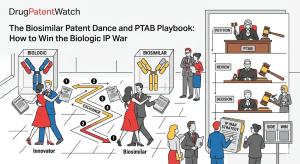
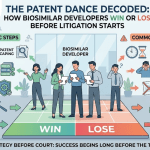
Beyond these fixed exclusivity periods, the BPCIA created the ‘patent dance,’ a structured pre-litigation exchange mechanism designed to identify which patents are actually in dispute before formal litigation begins. The dance is, by design, a mechanism of controlled information release. It forces both parties to declare their positions early and in detail, narrowing the eventual litigation battlefield.
The regulatory standard for biosimilar approval is ‘highly similar to the reference product notwithstanding minor differences in clinically inactive components,’ with ‘no clinically meaningful differences’ in safety, purity, and potency. For interchangeable biosimilar designation, the standard is higher: the product must demonstrate that switching between it and the reference product does not reduce efficacy or increase patient risk. As of 2025, FDA has granted interchangeable status to a growing list of biosimilars, including Cyltezo (adalimumab-adbm) and Hadlima (adalimumab-bwwd), and the regulatory bar for interchangeability has become a strategic consideration in its own right, since pharmacy-level substitution without physician intervention depends on it.
IP Valuation Context
The BPCIA’s 12-year data exclusivity period is a cash-flow guarantee that analysts must price separately from patent protection. A biologic can lose all its composition-of-matter patents and still enjoy regulatory exclusivity through the 12-year window. Conversely, a biologic with robust patents but a 12-year exclusivity that has already expired faces a materially different threat profile. When building a net present value (NPV) model for a reference biologic, both the patent estate and the regulatory exclusivity runway must be modeled independently and in combination.
Key Takeaways: Section 2
The 4-year filing bar and 12-year approval bar operate independently of patent protection.
Regulatory exclusivity is a separate asset from the patent thicket and must be valued as such.
The interchangeable biosimilar designation is a commercial asset; it enables automatic pharmacy substitution.
3. The Patent Dance, Step by Step
The BPCIA patent dance is a mandatory disclosure sequence with fixed statutory deadlines. Despite the Supreme Court’s confirmation in Sandoz v. Amgen (2017) that the dance is optional for biosimilar applicants, most participants still engage in some form of it, because the information gained is operationally valuable. Here is the complete choreography.
Day 0: FDA accepts the aBLA for review.
Day 1-20: The biosimilar applicant must provide the reference product sponsor (RPS) with a confidential copy of the complete aBLA and manufacturing process information. This disclosure is subject to strict access controls. Typically, only designated outside counsel and specific in-house attorneys who are walled off from related patent prosecution may review the information.
Day 20-80 (RPS window): Within 60 days of receiving the aBLA, the RPS must provide a list of unexpired patents for which it reasonably believes infringement could be asserted if the biosimilar were commercialized without a license. The RPS must also identify which patents on that list it would be willing to license. The penalty for omitting a patent here is significant: the RPS is generally barred from asserting any unlisted patent under 35 U.S.C. § 271(e) until the biosimilar product is actually on the market. This compels originators to maintain continuously updated, litigation-ready patent lists well before any aBLA filing becomes public.
Day 80-140 (Biosimilar applicant window): The biosimilar applicant has 60 days to respond. It may propose additional patents the RPS could reasonably assert. For each patent identified by either party, the biosimilar applicant must provide a claim-by-claim statement of the factual and legal bases for any assertions of invalidity, unenforceability, or non-infringement. If the RPS offered licenses, the applicant responds to those offers.
Day 140-200 (RPS response): Within 60 days of receiving the biosimilar applicant’s counter-arguments, the RPS provides its own claim-by-claim infringement contentions and responses to validity challenges.
Day 200-215 (Patent selection): The parties attempt to agree on a subset of patents for immediate (Phase I) litigation. If no agreement is reached within 15 days, the biosimilar applicant notifies the RPS of how many patents it will litigate, and both parties exchange their selected lists.
Phase I Litigation Trigger: The RPS must file suit within 30 days for each Phase I patent. The filing of the aBLA itself constitutes an artificial act of infringement, enabling pre-market litigation, an analog to Paragraph IV Hatch-Waxman filings but specific to the biologic regulatory pathway.
Phase II Trigger: When the biosimilar applicant provides 180 days’ notice of intended commercial marketing, the RPS may seek a preliminary injunction against any patent in the previously exchanged lists that was not litigated in Phase I.
The information asymmetry that the dance resolves is real and consequential. The RPS holds the patent rights but lacks detailed process and formulation knowledge. The biosimilar applicant has product knowledge but needs clarity on which patents the RPS will actually assert. Early, precise disclosure changes the settlement dynamics: parties who see the full scope of each other’s claims earlier tend to resolve disputes faster and at lower total litigation cost.
Key Takeaways: Section 3
Missing the 60-day patent list deadline is not a procedural technicality; it permanently bars assertion of the unlisted patent pre-commercialization.
Claim-by-claim invalidity contentions in the dance are the earliest form of the IPR petition arguments. Drafting them well sets the tone for PTAB filings.
The Phase II preliminary injunction mechanism, triggered by a 180-day notice, can be filed before FDA approval.
4. Sandoz v. Amgen: When Optionality Became a Weapon
The Supreme Court’s unanimous 2017 decision in Sandoz Inc. v. Amgen Inc. did two things that permanently altered biosimilar litigation strategy.
First, it held that a biosimilar applicant’s failure to provide its aBLA to the RPS does not give the RPS a right to an injunction compelling disclosure. The RPS’s remedy in that scenario is a patent infringement suit, nothing more. The dance is optional.
Second, the Court held that the 180-day notice of commercial marketing can be provided at any time, including before FDA approval of the biosimilar. This collapsed the long-assumed requirement that the clock on the 180-day period could only start running post-approval.
The practical effect: a biosimilar company can file an aBLA, immediately provide 180-day notice, and bypass the entire patent dance. Litigation begins at the RPS’s initiative, not on the dance’s structured timeline. This shifts the burden of suing to the RPS and potentially accelerates the path to a district court decision, though it also cedes the structured information-limiting benefits of the dance.
For biosimilar companies with high confidence in their freedom-to-operate analysis, this optionality is a market entry accelerant. For those with more complex patent exposure, skipping the dance trades timeline speed for loss of control over which patents get litigated first.
5. The PTAB Tribunal: Mechanics, Standards, and Asymmetric Advantage
The Patent Trial and Appeal Board is an administrative tribunal within the USPTO, established by the Leahy-Smith America Invents Act of 2011. It formally replaced the Board of Patent Appeals and Interferences in September 2012. Its adjudicators are Administrative Patent Judges (APJs), who are typically scientists and engineers with law degrees, a profile that makes PTAB proceedings technically rigorous in ways that generalist district court litigation often is not.
The two primary proceeding types relevant to biosimilar challengers are Inter Partes Review (IPR) and Post-Grant Review (PGR). Both operate under a ‘preponderance of the evidence’ standard for patent invalidity, compared to the ‘clear and convincing evidence’ standard in federal district courts. That gap in the burden of proof is the single most consequential design choice in the PTAB system. A prior art reference that fails to meet the higher district court standard can satisfy the PTAB’s preponderance threshold, and this asymmetry produces the high invalidation rates that make PTAB attractive to challengers.
The Board is statutorily required to issue a final written decision no later than one year after institution, with a six-month extension available for good cause. This timeline stands in stark contrast to federal patent litigation, where time from complaint to trial routinely exceeds three years and total litigation costs regularly reach $5-15 million per party. PTAB proceedings cost hundreds of thousands of dollars, not millions, and they conclude on a schedule that can be predicted and modeled.
Standing is not required at the PTAB. Any party other than the patent owner can petition for IPR or PGR. This means a biosimilar company that has not yet been sued, and has not even filed an aBLA, can challenge a blocking patent preemptively. That is not possible in federal court.
IP Valuation Context: The PTAB Discount Rate
When analysts value a biologic patent estate, the existence of a funded and technically capable biosimilar developer with PTAB access should apply a discount to expected cash flows from patents in the thicket. A patent covering a major biologic that is more than nine months post-grant faces credible IPR risk. A patent issued within the last nine months faces PGR risk on broader grounds. Depending on the technology category and claim breadth, analysts modeling originator revenue from 2025 forward should apply scenario-weighted probability of invalidation to individual patents, not simply assume all patents in a thicket will survive intact to their statutory expiry dates.
Key Takeaways: Section 5
Preponderance of the evidence vs. clear and convincing evidence is a structural advantage for PTAB challengers.
One-year to final written decision makes PTAB outcomes modelable in corporate timelines.
No standing requirement allows preemptive challenges before litigation is filed.
Analysts valuing biologic patent estates must apply PTAB invalidation probability as a haircut on expected patent revenue.
6. IPR vs. PGR: Choosing the Right Instrument
The choice between IPR and PGR is not stylistic. It is dictated by the patent’s age and the challengers’ available grounds, and picking the wrong instrument forecloses arguments the other would have preserved.
Inter Partes Review challenges patents on novelty (35 U.S.C. § 102) and obviousness (35 U.S.C. § 103) grounds only, and only based on prior art consisting of patents and printed publications. It can be filed at any time after the nine-month post-grant window closes (i.e., the PGR window) until the patent expires. The critical constraint is the one-year time bar: if the petitioner has been served with a district court complaint alleging infringement of the patent, it must file the IPR petition within one year of service. Miss that deadline and the IPR option is permanently foreclosed.
Post-Grant Review can challenge a patent on any ground of invalidity: novelty, obviousness, patentable subject matter (§ 101), written description (§ 112), enablement (§ 112), and double patenting. That ‘any ground’ scope is PGR’s primary advantage over IPR. For biologic patents, § 112 challenges are particularly powerful. Biologic patent specifications often contain broad claims supported by prophetic examples rather than actual experimental data. A written description or enablement challenge at the PTAB, arguing the specification does not adequately support the scope of the claims, can be devastatingly effective. That challenge is available in PGR. It is not available in IPR.
The tradeoff: PGR petitions must be filed within nine months of the patent’s grant date. Miss that window and PGR is unavailable for that patent, permanently.
For biosimilar companies developing market entry strategy, this creates a monitoring imperative. Every patent continuation, every newly issued patent in an originator’s portfolio, opens a nine-month PGR window. A patent intelligence system that flags new patent grants in real time, with immediate workflow for PGR petition assessment, is not optional for any biosimilar developer with market entry ambitions against a major originator.
An additional consideration for older biologics: AIA first-inventor-to-file patents, those with an effective filing date on or after March 16, 2013, are the only ones eligible for PGR. Patents filed before that date, including many core composition patents for biologics approved in the 2000s and early 2010s, can only be challenged via IPR. This matters enormously for targeting: AbbVie’s adalimumab (Humira) core patents were pre-AIA, which confined challengers to IPR and prior-art-only grounds. More recently filed continuation and secondary patents in the same portfolio are post-AIA and therefore PGR-eligible within their nine-month windows.
Key Takeaways: Section 6
PGR offers § 112 written description and enablement challenges; IPR does not. For biologic patents with prophetic claims, PGR is the more powerful weapon.
PGR window is exactly nine months post-grant. Late by one day means IPR only.
Pre-AIA patents (effective filing date before March 16, 2013) are IPR-only.
Continuous patent monitoring with PGR-trigger workflows is operationally necessary.
7. The 2025 PTAB Rupture: Institution Rates, Director Review, and the New Landscape
The PTAB that biosimilar companies are navigating in 2025 and 2026 is categorically different from the one described in most existing litigation playbooks.
In 2024, the overall PTAB institution rate was 68% by petition. In fiscal year 2025, under Director John Squires’ reforms, overall IPR institution rates collapsed. By the third quarter of 2025, institution rates for all technology categories had dropped to 15-34%, down from 65-82% in the first quarter of the same year. Procedural denials surged 630% to a record 607. IPR filings declined to 60.4% of total PTAB petitions, and ex parte reexamination filings surged 66.1% to 726, as practitioners migrated to the alternative.
But here is the critical asymmetry: bio/pharma patents are not subject to the same discretionary denial dynamics that are throttling software and mechanical patent challenges. As of early 2025, bio/pharma IPR institution rates remained near or at 100%, while the overall rate was below 45%. The Director’s bifurcated institution framework, which examines discretionary denial factors before reviewing petition merits, is applying differently across technology categories.
The reason for the asymmetry likely involves the public health dimension of pharmaceutical patent challenges, the Fintiv analysis factors (which look at parallel district court timelines and trial proximity), and the distinct nature of pharmaceutical patent disputes where PTAB resolution often avoids rather than duplicates district court proceedings. The 2025 procedural reforms also introduced ‘compelling economic, public health, or national security interests’ as factors that can drive discretionary institution even where standard procedural analysis might support denial. That factor creates a political dimension to PTAB institution decisions: an administration with a drug pricing mandate can cite public health interests to grant institution of pharmaceutical IPRs over procedural objection.
The March 2025 USPTO memorandum also rescinded the prior interim guidance on Sotera stipulations. A Sotera stipulation, by which the IPR petitioner agrees not to pursue in district court the same or reasonably similar invalidity grounds raised in the IPR, was previously a near-dispositive factor in avoiding Fintiv-based discretionary denial. That stipulation is now only one factor in a holistic Fintiv analysis and no longer reliably prevents denial. The implication: file earlier. File before a trial date is set. File before parallel district court litigation is well advanced.
For biosimilar companies specifically, the practical guidance from the 2025 landscape is:
File PGR petitions within the nine-month window without exception, as these remain the most comprehensive challenge tool and have seen increased filing relative to IPR. In 2025, PGR filings for biologic-related patents reached their closest parity with IPR filings since the AIA’s enactment. File IPR petitions as early as possible in any parallel litigation, well before the one-year service bar and certainly before a district court scheduling order sets a near-term trial date.
For secondary patent thickets where PGR windows have closed and IPR is the only option, monitor ex parte reexamination as a complementary tool. Ex parte reexam requests are granted at a 95% rate. Claim cancellation or modification occurs in approximately 62% of cases. Costs are substantially lower than IPR. The adversarial limitation (the requester does not participate after filing) is a disadvantage, but as a volume tool for attacking secondary patents, reexamination is underused.
Key Takeaways: Section 7
Overall PTAB institution rates dropped to 15-34% by Q3 2025; bio/pharma rates remain near 100%.
Sotera stipulations are no longer dispositive. File earlier, not later.
PGR filings for biologic patents are accelerating; 2025 is the first year they have approached parity with IPR filings.
Ex parte reexamination, granted 95% of the time, is a viable high-volume secondary patent attack tool.
8. Orchestrating PTAB Challenges for Market Entry
PTAB challenges do not exist in isolation. Their strategic value is almost entirely a function of how they are timed relative to aBLA filing, the patent dance, district court litigation, and anticipated FDA approval dates.
The optimal sequencing for a biosimilar company with a clearly identified target looks like this: conduct a freedom-to-operate analysis and patent thicket mapping before committing to full development. Identify which patents in the thicket are most likely to block market entry, which are most vulnerable to IPR or PGR challenge, and which nine-month PGR windows are still open on recently issued continuations. File PGR petitions on newly granted patents immediately, within weeks of grant, not months. File IPR petitions on older thicket patents with solid prior art before or concurrent with aBLA submission.
The goal of early filings is to obtain PTAB institution decisions and, ideally, final written decisions before district court litigation reaches trial. A PTAB institution decision finding at least one claim likely unpatentable raises a ‘substantial question of validity’ in the eyes of the district court. That finding directly undermines the originator’s ability to obtain a preliminary injunction under the standard that requires likelihood of success on the merits.
A final written decision finding claims unpatentable goes further: it can render moot an injunction application, trigger estoppel considerations for the patent owner who argued claim validity and lost, and radically shift settlement dynamics. The Stelara cases are the clearest recent illustration. Samsung Bioepis’ IPR challenge against Janssen’s U.S. Patent No. 10,961,307 settled before a final written decision, with Samsung securing a licensed entry date of February 22, 2025. Biocon filed a follow-on IPR against the same patent, settled separately, and secured the same entry date. The PTAB challenge did not need to reach a final decision to generate its primary strategic value: it generated settlement leverage that compressed the originator’s exclusivity window.
Key Takeaways: Section 8
The timing goal: PTAB final written decision before district court trial.
Institution decisions creating ‘substantial questions of validity’ are sufficient to block preliminary injunctions.
Settled IPRs, even without final written decisions, generate measurable settlement leverage.
PGR filings within weeks of patent grant are the most aggressive and comprehensive first move.
9. Patent Thickets: Anatomy, Valuation Impact, and Pruning Tactics
A patent thicket is not simply a large number of patents. It is a deliberately layered IP architecture designed to make any single successful challenge insufficient for freedom to operate.
The anatomical structure of a major biologic thicket typically contains several layers:
The innermost layer consists of composition-of-matter patents covering the biologic molecule itself, its sequence, or its structural form. These are the hardest to design around and typically the most robustly drafted. They are also the oldest in a reference product’s lifecycle, meaning they often expire earliest and are least amenable to PGR (being pre-AIA in many cases).
The second layer covers manufacturing processes: cell culture conditions, purification steps, quality control assays, and process analytical technologies. These process patents are often the most vulnerable to IPR challenge based on prior art publications from academic institutions and earlier process development work. They are also the layer most likely to contain prophetic claims that are PGR-vulnerable.
The third layer covers formulation: specific excipient combinations, pH ranges, osmolarity specifications, and stabilizer systems. Regeneron’s Eylea thicket is the clearest recent example of how a single, surviving formulation patent can block biosimilar entry even after all process and method patents have been invalidated or disclaimed.
The fourth layer covers dosing, administration, and methods of use: specific patient populations, treatment regimens, dose escalation protocols, and combination therapies. AbbVie’s Humira thicket contained over 100 active patents at its peak, with a significant portion covering methods of use in specific indications that were not covered by earlier biologics patents.
From an IP valuation standpoint, the thicket’s monetary value is not additive across patents. The value of each patent in the thicket depends on the vulnerability of every other patent. A highly robust innermost composition patent with decades of life creates a revenue-generating foundation. A dense layer of surrounding process and formulation patents extends the exclusivity window but each individually has less standalone value if the composition patent survives. Conversely, if the composition patent is weak or expired, the formulation and process patents may carry significant individual value as the last line of defense.
The Humira Thicket and Its Resolution
AbbVie’s adalimumab (Humira) thicket, with over 100 U.S. patents at its peak, is the most studied example of strategic patent layering. The core composition patents expired in 2016, but AbbVie built subsequent layers covering formulations, manufacturing processes, and methods of use that collectively held off U.S. biosimilar competition until 2023, years after European biosimilar entry in 2018. The pre-AIA filing dates of the core patents constrained challengers to IPR and prior-art-based grounds, limiting the scope of PTAB attack.
The commercial result: AbbVie collected an estimated $200 billion in Humira revenue over the exclusivity period. The IP valuation question for analysts is whether that revenue stream should have been modeled with heavier PTAB discounting. In retrospect, the answer is that the pre-AIA constraint on PGR grounds and the breadth of AbbVie’s licensing settlements (which secured entry dates for all major biosimilar developers) made the thicket more durable than many analysts predicted.
Key Takeaways: Section 9
Thicket layers have different vulnerability profiles: process patents are most IPR-vulnerable; formulation patents with narrow but well-supported claims are most resilient.
A single surviving patent is sufficient to block market entry (Eylea’s ‘865 formulation patent demonstrated this in 2024-2025).
IP valuation of a reference biologic requires layer-by-layer patent vulnerability analysis, not a simple count.
Analysts should model thicket durability scenarios: base case (full thicket holds), stress (30-50% of thicket invalidated), bear (core composition invalid, formulation patents only).
10. Synchronizing PTAB and District Court Timelines
The tactical challenge of running PTAB challenges and district court litigation simultaneously is a coordination problem that most IP teams underestimate. The two venues interact in multiple ways, and the actions taken in one consistently affect outcomes in the other.
The most direct interaction is through the Fintiv framework. When a PTAB petition is filed after a district court trial date has been set in a parallel proceeding, the PTAB applies a six-factor analysis to determine whether to institute the petition or exercise discretionary denial. The factors include: whether the court has granted a stay, proximity of the trial date, overlap between issues raised and litigated in district court, the parties’ relationship, whether the district court raised Fintiv concerns, and the merits of the petition. If the district court trial is six months away when the IPR petition arrives, the PTAB is highly likely to deny on Fintiv grounds, regardless of petition merit.
The solution is filing PTAB petitions early in the litigation, before scheduling orders and trial dates are established. A biosimilar company served with a complaint in January has until the following January under the one-year IPR bar. Filing in March rather than December provides dramatically better Fintiv positioning.
The second interaction is through stays. District courts have the discretion to stay parallel patent infringement proceedings pending PTAB institution or final decision. Stays in BPCIA litigation have historically been uncommon, but the landscape is shifting as PTAB proceedings become a more established part of biologic patent dispute resolution. A granted stay in district court can effectively pause injunction proceedings and extend the period during which the biosimilar company can prepare for commercial launch, assuming the PTAB proceeding moves toward institution.
The third interaction is through claim construction. PTAB and district court use different claim construction standards. PTAB uses the ‘plain and ordinary meaning’ standard applicable to unexpired patents (aligned with the Phillips standard since 2019, replacing the former broadest reasonable interpretation standard). District courts also apply Phillips. This alignment reduces cross-venue claim construction conflicts that were a source of strategic uncertainty in the early PTAB era.
11. Preliminary Injunctions: How PTAB Shifts the Balance
A preliminary injunction in BPCIA litigation is the originator’s most powerful short-term enforcement tool. If granted, it blocks biosimilar commercialization until the patent issues are resolved on the merits, which can take years. For a biosimilar developer that has spent $200 million and five years to reach approval, an injunction is an existential event.
The standard for a preliminary injunction requires the moving party to show: likelihood of success on the merits, likelihood of irreparable harm without the injunction, that the balance of equities favors the movant, and that the public interest favors granting the injunction. The ‘likelihood of success on the merits’ prong is where PTAB proceedings create their most direct impact.
A PTAB institution decision finding at least a reasonable likelihood that at least one claim is unpatentable introduces a ‘substantial question of validity’ that courts must weigh. The Federal Circuit’s precedent holds that a ‘substantial question of validity’ can defeat the likelihood-of-success prong. An originator that cannot show a strong likelihood its patent claims are valid cannot obtain a preliminary injunction.
The Alexion/Samsung Bioepis eculizumab (Soliris) litigation in 2024 demonstrated this dynamic precisely. In May 2024, a Delaware district court denied Alexion’s preliminary injunction motion. The court found that Samsung Bioepis’ invalidity theories raised a substantial question of validity as to Alexion’s ‘176 method patent, and the PTAB’s institution of Samsung Bioepis’ IPR against the ‘189 patent independently raised a substantial question of validity as to that patent. Both patents fell short of the preliminary injunction standard as a result.
Amgen’s Eylea biosimilar (Pavblu) received a different outcome in September 2024, when Chief District Judge Kleeh denied Regeneron’s preliminary injunction motion specifically because Amgen had successfully designed around the ‘865 formulation patent. By contrast, Samsung Bioepis and Formycon faced preliminary injunctions that the Federal Circuit upheld in January 2025, finding no substantial question of invalidity as to the ‘865 patent in their cases. The design-around success that protected Amgen’s Pavblu from injunction, confirmed by the Federal Circuit in March 2025, illustrates that manufacturing process differentiation is a legitimate alternative to patent challenge as an injunction-avoidance strategy.
The lesson: PTAB institution and design-around work in combination. A well-timed IPR filing against a critical patent, combined with manufacturing process differentiation sufficient to create a non-infringement argument, produces the most robust preliminary injunction defense posture.
Key Takeaways: Section 11
PTAB institution decisions raising ‘substantial questions of validity’ can defeat preliminary injunction motions.
The Alexion/Samsung Bioepis 2024 Delaware ruling is the clearest example of PTAB institution directly defeating injunction.
Design-around and PTAB challenge are complementary, not alternative, injunction defense strategies.
12. Estoppel: The Trap Inside the Tool
Estoppel is the mechanism that makes PTAB strategy irreversible. Under 35 U.S.C. § 315(e), once a final written decision has been issued, the petitioner is estopped from asserting in any U.S. district court or ITC proceeding any ground of invalidity that was raised, or that reasonably could have been raised, during the PTAB trial.
The phrase ‘reasonably could have been raised’ is the source of significant, ongoing litigation in the district courts. The circuit courts have not settled on a uniform interpretation. Some district courts apply a narrow reading, limiting estoppel to the specific prior art grounds actually raised. Others apply a broader reading, extending estoppel to any prior art that a ‘skilled searcher conducting a diligent search reasonably could have been expected to discover.’ Under the broader reading, a petitioner who conducts a thorough prior art search before filing an IPR, and includes ten references in the petition, may find itself estopped from relying on an eleventh reference in subsequent district court litigation if a judge determines a diligent search would have uncovered it.
Estoppel does not apply to: patent claims for which the IPR was not instituted (because the petition was denied or the ground was not included); grounds raised in a petition but denied institution on non-merits procedural grounds; and challenges in PGR based on § 101 or § 112 grounds not available in IPR.
The strategic implications are several. First, draft IPR petitions comprehensively. Include the best prior art available, and include enough of it that the ‘reasonably could have been raised’ threshold is more likely to be satisfied by the petition itself, not by art held in reserve. Second, consider whether preserving certain invalidity arguments for district court is worth the narrower petition. Third, understand that a failed IPR, one that is instituted but results in all claims found patentable, is the worst outcome: it leaves the patent valid, produces estoppel, and strengthens the originator’s position in all subsequent proceedings.
Investment Implication: Analysts tracking biosimilar companies should flag companies that have received final written decisions finding claims patentable as materially disadvantaged in ongoing district court litigation. Estoppel from a failed IPR is a patent estate strengthening event for the originator.
13. Ex Parte Reexamination: The Underutilized Alternative
The 2025 surge in ex parte reexamination filings (up 66.1% to 726) is a direct response to the PTAB’s changing institution dynamics. Ex parte reexam deserves more strategic attention than it currently receives.
The mechanism: any person, including the eventual requester who remains anonymous, can request reexamination of a patent by presenting a substantial new question of patentability based on patents or printed publications. The USPTO grants approximately 95% of reexamination requests. The proceeding is conducted between the patent owner and a USPTO examiner, with the requester having no further participation after filing.
The advantages: cost (substantially lower than IPR), speed (typically 18-24 months to conclusion), the ability to remain anonymous, the absence of estoppel consequences for the requester (since the requester does not participate in the adversarial phase), and the fact that there is no one-year time bar based on service of a complaint.
The disadvantages: lower claim cancellation rates (approximately 14% of claims are cancelled outright, versus 70-80% in IPR final written decisions), no right to participate after filing, and no estoppel on the patent owner who could have claimed scope.
For biosimilar companies with large patent thickets to address, ex parte reexamination is best used as a volume tool against secondary process and formulation patents, while IPR and PGR are reserved for the highest-priority blocking patents where adversarial participation and higher cancellation rates justify the cost and estoppel risk.
14. Originator Counter-Strategies: Evergreening, Continuations, and Next-Gen Conversion
Understanding originator IP defense tactics is as important for biosimilar strategy as understanding PTAB mechanics. The two interact: a biosimilar team that does not anticipate the originator’s next patent prosecution moves will be perpetually reactive.
Continuation Applications and Claim Refinement
Continuation applications allow an originator to maintain active patent prosecution around a biologic product essentially indefinitely, provided each continuation claims priority to an earlier application within the chain. The originator files the continuation, gets the patent, and opens a new nine-month PGR window. A well-resourced originator with an active continuation prosecution strategy, filing new claims as it learns about a biosimilar developer’s specific manufacturing process through the patent dance or commercial intelligence, can build a thicket that targets known biosimilar characteristics rather than the reference product generally.
For biosimilar developers, the counter to active continuation prosecution is continuous monitoring. Every new patent grant in the originator’s family should trigger immediate PGR assessment. A nine-month window is not long, and missing it is permanent.
Evergreening via Dosing and Method Patents
Evergreening in biologics typically takes the form of new method-of-use patents covering specific dosing regimens, patient populations, or combination therapies. These claims are easier to draft around FDA’s labeling regime if the biosimilar seeks a ‘skinny label’ excluding the patented indication, a strategy borrowed from Hatch-Waxman generic litigation. However, induced infringement risk (the argument that prescribers will use the biosimilar in the patented indication regardless of labeling) limits the skinny label strategy’s protection in practice.
Next-Generation Product Conversion
The most commercially sophisticated originator defense is not legal at all. It is launching a clinically differentiated next-generation product 1-3 years before loss of exclusivity on the original biologic, then aggressively converting patients and prescribers to the new product before biosimilar competition can establish market share.
Regeneron launched EYLEA HD (aflibercept 8 mg, versus the original 2 mg), which uses a higher-dose formulation enabling less frequent injections. Physicians and retina specialists respond to dosing convenience, and the higher-dose product secured significant prescriber adoption before biosimilar entry into the standard-dose market. AstraZeneca and Amgen followed a similar strategy with Repatha HD formulations.
The commercial effect: biosimilar developers who enter the 2 mg aflibercept market in 2025-2026 face a market where originator conversion efforts have already shifted a portion of the prescribing base to a product those biosimilars do not compete with. The total addressable market for aflibercept biosimilars is materially smaller than the peak Eylea 2 mg revenue would suggest.
Investment Strategy Note for Analysts
When valuing the revenue opportunity for a biosimilar entering a specific market, analysts should model the next-generation product conversion rate explicitly. A reference product with an active next-gen launch underway at the time of biosimilar entry has lower effectively addressable revenue than the reference product’s peak sales suggest. Discount biosimilar revenue opportunity by an estimated next-gen conversion rate, typically 15-40% within 18 months of next-gen launch in the relevant indication.
15. Eylea (Aflibercept): A Full IP Valuation Case Study
Eylea is the most instructive current-generation case study for biosimilar patent strategy because it contains almost every dimension of the thicket-challenge dynamic in one product.
The Reference Product’s IP Profile
Regeneron’s aflibercept (Eylea 2 mg) generated approximately $9.5 billion in global sales in 2024. In the U.S., it generates roughly $6 billion annually. Regeneron built a thicket that, at biosimilar aBLA filing time in 2022, encompassed 72 patents across composition, manufacturing, formulation, and method layers.
The PTAB Challenge Campaign
Multiple biosimilar companies (Samsung Bioepis, Formycon, Amgen, Mylan/Biocon, Celltrion, Fresenius Kabi) filed extensive PTAB challenges. By end-2025, eight Regeneron patents had been found unpatentable or statutorily disclaimed: six method-of-treatment patents, one composition patent, and one manufacturing patent.
The Surviving Patent and Its Injunction
U.S. Patent No. 11,084,865 (‘the ‘865 patent’), a formulation patent covering a specific stabilizer, buffer, and co-solvent system for the aflibercept formulation, survived all PTAB challenges. Regeneron secured preliminary and permanent injunctions based on this single patent against Samsung Bioepis, Formycon, Mylan, Celltrion, and Biocon. The Federal Circuit affirmed those preliminary injunctions in January 2025.
Amgen’s Pavblu (aflibercept-fbbm) used a self-buffering formulation approach that differentiated it from the ‘865 patent claims. A Delaware district court denied Regeneron’s preliminary injunction against Pavblu in September 2024, and the Federal Circuit affirmed that denial in March 2025.
The Settlement Resolution
Samsung Bioepis settled with Regeneron in February 2026, securing a licensed entry date for U.S. commercialization of OPUVIZ 2 mg. Sandoz settled separately in 2025, obtaining an entry date for its interchangeable Enzeevu biosimilar. The confidential settlement terms indicate negotiated entry dates, not invalidation victories, as the outcome for most Eylea biosimilar entrants.
IP Valuation Lesson
The Eylea thicket illustrates the ‘last patent standing’ dynamic. Biosimilar companies invalidated 8 of 72 patents but could not reach the one formulation patent that mattered. The correct valuation approach for an originator in this scenario: weight the revenue protection value of the patent portfolio not by patent count but by the expected durability of the most commercially critical individual patent. Regeneron’s ‘865 patent, a single formulation patent, protected approximately $6 billion in annual U.S. revenue for at least two additional years beyond when PTAB challenges cleared most of the thicket. The NPV of that protection, discounted at pharmaceutical industry rates, is measured in billions.
For biosimilar challengers, the lesson is complementary: PTAB campaigns against method and process patents do not guarantee market entry if a robust formulation patent survives. Freedom-to-operate analysis must map the minimal surviving patent scenario and assess whether a design-around of that scenario is feasible.
16. Stelara (Ustekinumab): IPR as Settlement Catalyst
Janssen’s ustekinumab (Stelara) entered biosimilar competition in early 2025, with both Samsung Bioepis (Pyzchiva) and Biocon (Yesintek) receiving licensed entry dates of February 22, 2025.
The key PTAB event: Samsung Bioepis filed an IPR in September 2023 challenging Janssen’s U.S. Patent No. 10,961,307, covering a method of treatment using ustekinumab. Within months, the parties settled and terminated the IPR. The settlement terms, which remain confidential, provided a licensed entry date. Biocon filed a follow-on IPR challenging the same patent in November 2023 before the PTAB’s institution decision. Janssen settled with Biocon separately, granting the same entry date.
The PTAB challenge did not reach a final written decision. It did not need to. The filing of a credible IPR petition, with strong prior art grounds, was sufficient to shift the settlement dynamics and compress Janssen’s exclusivity window. The settlement also attracted antitrust scrutiny, with regulators examining whether the license terms constituted a pay-for-delay analog applicable to biologics.
IP Valuation Context for Stelara
At peak, Stelara generated approximately $10 billion annually in global revenue. Janssen’s settlement strategy resolved litigation at a negotiated entry date rather than litigating to a final PTAB decision or district court judgment. From an originator’s valuation perspective, the settlement preserved some exclusivity runway while eliminating PTAB invalidity risk. From a biosimilar perspective, the IPR filing’s leverage produced entry 12-18 months earlier than a fully litigated outcome likely would have.
17. Adalimumab (Humira): The Thicket That Defined a Decade
AbbVie’s adalimumab (Humira) thicket is the canonical reference case for the strategic use of continuation-based patent layering in biologics. At its peak, the U.S. Humira thicket comprised over 100 active patents. The core composition-of-matter patents expired in 2016. U.S. biosimilar competition did not begin until January 2023, a seven-year gap generated entirely by secondary patent protection.
The pre-AIA filing dates of AbbVie’s core patents confined challengers to IPR with prior-art-only grounds. AbbVie’s secondary patents, covering formulations (e.g., the citrate-free formulation that enabled a less painful injection), manufacturing processes, and methods of use in specific indications including Crohn’s disease and rheumatoid arthritis, provided the exclusivity extension.
AbbVie resolved biosimilar competition through an extensive settlement and licensing program, granting eight biosimilar developers licensed entry dates of January 2023 in the U.S. and 2018 in Europe. These settlements, while commercially rational, drew regulatory attention and antitrust investigation regarding whether the licensing structure constituted a coordinated delay.
The commercial outcome: Humira’s U.S. revenues remained above $14 billion in 2022, with the cumulative 2016-2022 exclusivity extension generating an estimated additional $90 billion in U.S. sales beyond what would have been collected without the secondary thicket. That is the dollar value of a seven-year patent thicket extension for a single product, the most vivid IP valuation number in biopharmaceutical history.
The Keytruda PTAB story inverts the conventional framing. Here, it is the originator, Merck, that is the PTAB petitioner, challenging third-party patents that threaten its commercialization of Keytruda.
Johns Hopkins University holds a portfolio of patents covering methods of treating microsatellite instability-high (MSI-H) and mismatch repair-deficient (dMMR) tumors with pembrolizumab. These indications are among Keytruda’s most commercially significant, with Keytruda generating approximately $25 billion in global revenue in 2024, much of it in oncology indications that overlap with JHU’s claimed methods.
Merck filed nine IPRs in late 2023 and early 2024 challenging JHU’s method patents. The PTAB instituted all nine proceedings by September 2024. The district court in Maryland, where Merck had filed a declaratory judgment action, stayed the litigation pending PTAB resolution. Between June and November 2025, the PTAB issued final written decisions across all nine proceedings, finding all challenged claims unpatentable. JHU appealed all nine to the Federal Circuit, with consolidated briefing scheduled for May 2026.
Separately, Merck launched a PGR campaign against Halozyme’s patents related to the ENHANZE drug delivery technology used in Keytruda SC (subcutaneous formulation). In late 2024 and 2025, Merck filed 15 PGR petitions against 15 Halozyme patents covering the modified human hyaluronidase (MDASE) technology that enables subcutaneous administration. This is among the largest coordinated PGR filings against a single technology platform in PTAB history.
Investment Implication
The Keytruda PTAB campaign illustrates that PTAB is not a biosimilar-only tool. Any company facing a method-of-use or platform technology patent that threatens a commercial product can use PTAB offensively. For investors: the Halozyme ENHANZE technology, which generates royalty revenue from subcutaneous formulation deals with multiple major drug companies including Roche, J&J, and AstraZeneca, faces material royalty revenue risk if Merck’s PGR campaign succeeds and the MDASE patents are found unpatentable. That risk should be quantified as a downside scenario in any Halozyme valuation model.
19. The ‘Biosimilar Void’: 90% of Expiring Patents With No Challengers
An IQVIA Institute report identified what it termed the ‘biosimilar void’: of 118 biologics expected to lose patent protection in the U.S. between 2025 and 2034, approximately 90% have no publicly disclosed biosimilars in development.
This is not a market failure in the abstract sense. It is a rational response to a combination of entry barriers: development costs of $100-300 million per product, 6-9 years to regulatory submission, the cost and uncertainty of PTAB campaigns against dense thickets, the post-launch commercial challenges of payer rebate walls, formulary positioning, and prescriber inertia, and the risk that an originator’s next-generation product conversion reduces the addressable market before biosimilar entry.
The biosimilar void has direct implications for patent strategy. In markets where no biosimilar developer has committed, the originator’s thicket faces no PTAB challenge, no patent dance, and no competitive threat during the loss-of-exclusivity period. The thicket’s commercial value in that scenario is not discounted by PTAB risk; it is its full face value.
For analysts, the void means that the market of expiring biologic patents is not uniformly threatened by biosimilar competition. The conventional model, that a loss-of-exclusivity event triggers revenue erosion on a standard S-curve, does not apply to approximately 90% of the products in the 2025-2034 cohort. The revenue cliff model should be applied only to products with confirmed biosimilar development programs, regulatory submissions, or patent dance activity.
20. Predictive Analytics and Patent Intelligence Infrastructure
Modern biosimilar patent strategy is a data problem before it is a legal problem. The volume of relevant information, active patents, continuation applications, PTAB filings, district court docket entries, FDA aBLA acceptances, regulatory approval timelines, settlement terms, and competitive intelligence, exceeds what any IP team can monitor manually.
Patent intelligence platforms integrate these data streams and apply analytics layers to them. The most operationally useful capabilities include:
Real-time alerts on new patent grants in a competitor’s portfolio, triggering PGR window tracking. Litigation docket monitoring that flags new aBLA filings, complaint filings, and scheduling orders relevant to the Fintiv analysis. Settlement term analysis, including confidential royalty and entry date data from litigation databases. PTAB petition outcome tracking with claim-level granularity, enabling assessment of which prior art combinations have succeeded against which patent types in the biologics technology category.
Predictive models trained on historical PTAB outcomes, claim characteristics, prior art quality, and panel composition can generate probabilistic assessments of IPR institution and invalidity likelihood for specific patents. These models do not replace legal judgment, but they allow IP teams to triage large patent thickets: which patents merit full PTAB challenge, which are candidates for ex parte reexamination, which are best addressed through design-around.
The integration of clinical and regulatory timelines with patent data creates the most complete decision support: when does FDA approval of the biosimilar aBLA become probable, and does the PTAB timeline for any critical patent challenges align with that approval date? If the PTAB final written decision on a blocking formulation patent is expected six months after biosimilar approval, an at-risk launch decision requires quantifying that specific window of injunction exposure.
21. Investment Strategy for Analysts
For originator biologic companies:
Model each reference biologic’s IP estate as a layered structure with independent vulnerability profiles at each layer, not as a monolithic patent count. Assign PTAB invalidation probability to each patent class: composition-of-matter (low to moderate risk), manufacturing process (moderate to high, especially for PGR-eligible post-AIA patents), formulation (variable based on claim specificity and supporting data), method-of-use (moderate, and partially mitigable via skinny label risk to biosimilar).
Apply the next-generation conversion model as a standard revenue defense mechanism valuation. A next-gen product launching 2 years before LOE with a 25-35% prescriber conversion rate reduces the addressable market for biosimilars and extends effective exclusivity commercially even as legal exclusivity expires.
Price the bio/pharma PTAB institution rate asymmetry as a persistent risk. As of 2025, bio/pharma patents continue to face near-100% institution rates while overall PTAB rates have collapsed. This is an originator-unfavorable asymmetry that has not converged with broader PTAB trends.
For biosimilar developers:
The market opportunity is real, but entry cost and timeline require early-stage patent risk assessment, not post-commitment discovery. PTAB strategy should begin before development commitment, not at aBLA filing.
The highest-ROI sequence: (1) freedom-to-operate analysis before development commitment, (2) PGR filings within nine-month windows on all newly granted thicket patents, (3) IPR filings on older thicket patents at aBLA filing or concurrent with Phase I litigation, (4) synchronize filing timing to avoid Fintiv-based discretionary denial.
Model PTAB challenge outcomes probabilistically across patent layers. A 70% probability of invalidating process patents and a 40% probability of invalidating the most critical formulation patent, combined with a design-around scenario that avoids the formulation patent, produces a risk-weighted NPV calculation that identifies which biosimilar development programs have justified expected returns.
For investors in biosimilar developers:
PTAB campaign progress is a leading indicator of market entry probability. Track: institution rates on filed petitions, claim-level outcomes in final written decisions, preliminary injunction denials attributable to PTAB proceedings, and settlement term disclosures. Companies that secure IPR institutions against the most commercially critical thicket patents are closer to negotiated entry than companies with no PTAB activity, even at the same stage of FDA review.
22. Key Takeaways by Segment
For IP Teams
The patent dance is optional but information-rich. Engagement is often rational even post-Sandoz v. Amgen. Claim-by-claim dance contentions are the earliest iteration of PTAB petition arguments; draft them accordingly. PGR window monitoring on originator continuation grants should be a standing operational workflow, not a reactive one. Estoppel from failed IPRs is a material strategic risk; petition comprehensively or reserve arguments deliberately, never by accident.
For Portfolio Managers
Biologic patent estate valuation requires layer-by-layer PTAB vulnerability modeling. The 12-year regulatory exclusivity window is a separate asset from the patent thicket and must be modeled independently. Settlement terms (licensed entry dates) rather than litigation victories are the most likely biosimilar market entry mechanism; track settlement indicators as leading indicators of LOE timing. The biosimilar void means that most biologic LOE events will not trigger conventional revenue erosion patterns through 2034.
For R&D Leads
Manufacturing process differentiation is a legitimate and proven patent avoidance strategy. Amgen’s Pavblu design-around of the Eylea ‘865 formulation patent is the most recent proof. Design-around investment early in development reduces injunction risk later. Next-generation product development is the most commercially durable originator defense; R&D leads should model next-gen IP positioning as a component of base product lifecycle management from the beginning.
For Institutional Investors
The 2025 PTAB bifurcated institution framework creates political risk that previous models did not incorporate. A Director’s exercise of discretionary review can shift PTAB outcomes across pharmaceutical patent categories. This is a systemic risk to originator patent protection that should be incorporated in scenario modeling. The Merck Keytruda PGR campaign against Halozyme illustrates that platform technology royalty streams face PTAB attack risk, not just product-specific patents.
23. Frequently Asked Questions
What makes the BPCIA patent dance ‘optional’ after Sandoz v. Amgen, and when should a biosimilar company skip it?
The Supreme Court held in 2017 that failure to provide the aBLA to the RPS does not entitle the RPS to an injunction compelling disclosure. The RPS’s remedy is a patent infringement suit. Skipping the dance makes sense when the biosimilar company has a high-confidence freedom-to-operate position and wants to accelerate litigation and potential market entry. It makes less sense when the biosimilar faces a large, uncertain thicket where the structured information exchange would narrow the scope of patents actually in dispute.
What is the difference between IPR and PGR, and why does that matter for biologic patent challenges?
IPR challenges on novelty and obviousness grounds only, using prior art patents and publications, and can be filed at any time after a nine-month post-grant window. PGR challenges on any invalidity ground including written description and enablement, which are frequently applicable to biologic patents with broad, prophetically-supported claims. PGR must be filed within nine months of patent grant. For newly granted continuation patents in an originator’s thicket, PGR is the more powerful instrument and the filing window is strictly limited.
How does the 2025 PTAB bifurcated institution process affect biosimilar companies specifically?
While overall IPR institution rates collapsed to 15-34% by Q3 2025, bio/pharma patents continue to see institution rates near 100%. The bifurcated process that is throttling software and mechanical patent challenges has left the pharmaceutical channel essentially open. The practical guidance for biosimilar companies: file earlier in litigation to avoid Fintiv-based denial, prioritize PGR over IPR where windows are available, and consider ex parte reexamination as a volume tool for secondary patents.
What is estoppel, and how does it constrain PTAB challenge strategy?
After a final written decision, the petitioner is estopped from asserting in U.S. district court or the ITC any invalidity ground raised, or that reasonably could have been raised, in the PTAB proceeding. A failed IPR (all claims found patentable) produces the worst outcome: the patent is confirmed valid and the petitioner loses its best prior art arguments in district court. Draft petitions comprehensively, and never choose which arguments to include based on cost rather than strategic reasoning.
How should analysts model the commercial impact of a biosimilar company’s PTAB campaign on originator revenue?
At the patent layer level: assign scenario-weighted PTAB invalidation probabilities to each patent class in the thicket (composition, process, formulation, method). At the timeline level: map the expected PTAB final written decision dates against expected FDA approval dates to determine whether market entry is blocked by surviving patents during the approval window. At the market level: discount biosimilar revenue opportunity by originator next-gen conversion rate and payer formulary dynamics. PTAB petition institution is a leading indicator; model it as a probability-weighted reduction in expected originator revenue in the period after expected biosimilar entry.
What is the ‘biosimilar void’ and what does it mean for patent risk analysis?
IQVIA identified that approximately 90% of biologics expected to lose U.S. patent protection between 2025 and 2034 have no publicly disclosed biosimilar in development. For originators in that 90%, the thicket faces no PTAB challenge and the conventional LOE revenue cliff does not apply. For analysts, the LOE revenue erosion model should be applied only to products with confirmed biosimilar development programs. For the other 90%, patent expiration is a legal event with limited near-term commercial consequence.