For pharma IP teams, portfolio managers, R&D leads, and institutional investors navigating the post-IRA, outcomes-contingent revenue landscape.
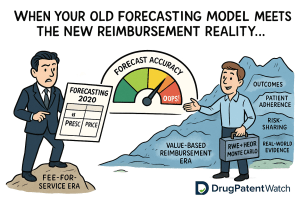
The numbers are damning. A comprehensive analysis of more than 1,700 forecasts covering 260 drugs found that actual peak sales diverged from predictions made one year before launch by an average of 71%, with many forecasts overstating projections by more than 160%. A parallel study of pharmaceutical reimbursement submissions in Austria found that manufacturers overestimated real-world sales by an average of 33%, with more than half of submissions materially inaccurate. These are not modeling errors. They are the predictable output of organizations still solving a value-based pricing problem with a volume-based toolkit.
The failure is structural. Most biopharma forecasting functions remain architecturally designed for a fee-for-service world: epidemiology-derived patient pools, prescriber-adoption S-curves, and a stable, product-level list price. None of those inputs survive first contact with an outcomes-based contract (OBC), a Paragraph IV-challenged formulary negotiation, or a Medicare price negotiation under the Inflation Reduction Act. The traditional forecast is not slightly wrong. It is asking the wrong question.
This pillar page is a comprehensive rebuild of the forecasting function for the value-based era. It covers the reimbursement models that have already displaced fee-for-service in large payer segments, the specific IP assets and contract mechanics that determine realized revenue, the advanced analytics required to model performance-contingent cash flows, and the organizational design required to make any of this work in practice. Every section is written for readers who already know what a Paragraph IV filing is.
Part I: Why Fee-for-Service Forecasting No Longer Works
The Architecture of the Old Model and Its Core Assumption
Traditional pharmaceutical forecasting rested on one foundational assumption: a stable, linear relationship between units prescribed and revenue received. Under fee-for-service reimbursement, that assumption held. Prescriptions generated revenue. More prescriptions generated more revenue. The forecaster’s job was to estimate the size of the prescribing population, the rate of market share capture, and the price per unit. Everything else was arithmetic.
The dominant methodologies that emerged from this environment were sensible given those inputs. Analog analysis benchmarked a new product’s expected trajectory against the historical launch curves of therapeutically similar predecessors. Bottom-up epidemiology models started with disease prevalence, filtered by diagnosis rates and treatment rates, then applied a market share assumption to arrive at a patient volume. Trend extrapolation used historical data on comparable products to project forward. Each method was coherent, teachable, and widely adopted across commercial planning organizations.
The problem is that fee-for-service no longer describes how a growing and strategically important segment of U.S. healthcare is paid for. The HHS framework for alternative payment models categorizes reimbursement arrangements across four tiers, from pure fee-for-service at Category 1 to full population-based capitation at Category 4. The U.S. government set a formal target of moving 50% of traditional Medicare payments into Category 3 or 4 arrangements by end of 2018 and largely met it. The commercial insurance market has followed. As a result, the healthcare systems buying pharmaceutical products are themselves compensated in ways that reward clinical outcomes, penalize readmissions, and demand cost-effectiveness. That changes what they will pay for a drug and how they will pay for it.
The Four Structural Forces Killing Volume-Based Revenue Models
Understanding why this shift is permanent requires understanding what is driving it. Four forces are operating simultaneously, and they reinforce each other.
Medical cost inflation has been running at structurally elevated rates for two decades. PwC projects a group market medical cost trend of 8.5% for 2026, a rate not seen since the early 2000s. Pharmacy spending is a material contributor, with per-capita drug spending expected to increase by $50 billion in 2024 alone. Payers at scale cannot absorb indefinite compound growth in drug costs without tying payment to demonstrated outcomes. The financial logic of OBCs is simply that if a therapy does not deliver its promised benefit in a real-world population, the payer is entitled to a price adjustment. That logic becomes more compelling, not less, as drug list prices rise.
Legislative intervention is the second force. The Inflation Reduction Act of 2022 granted Medicare direct price negotiation authority over selected high-spend drugs for the first time. The first ten drugs designated for negotiation in 2023 included Eliquis (apixaban), Jardiance (empagliflozin), Xarelto (rivaroxaban), Januvia (sitagliptin), Farxiga (dapagliflozin), Entresto (sacubitril/valsartan), Enbrel (etanercept), Imbruvica (ibrutinib), Stelara (ustekinumab), and Fiasp/NovoLog (insulin aspart). The negotiated prices effective January 1, 2026 range from a 38% reduction for Jardiance to a 79% reduction for Januvia versus list price. These are not marginal haircuts. They represent structural repricing of products that generated, collectively, tens of billions in annual revenue on volume-based models. Any 10-year forecast for a Medicare-eligible product that does not model IRA negotiation exposure is materially incomplete.
State-level PBM reform is the third force. Legislation in more than 30 states now targets spread pricing, patient steering, and in some cases the vertical integration between PBMs and pharmacies. These reforms reduce the ability of large PBM-integrated payers to cross-subsidize formulary exclusions and erode the leverage manufacturers historically used to secure preferred tier placement through rebate negotiations divorced from clinical value. As formulary design becomes more transparent and outcome-linked, revenue becomes more directly tied to demonstrated product performance.
The data infrastructure enabling real-world outcome measurement is the fourth force. Electronic health records now cover the majority of U.S. clinical encounters. Claims data from CMS and large commercial payers provides longitudinal patient histories at population scale. Wearables and remote monitoring are adding new data streams. For the first time, it is operationally feasible to write a contract that says ‘if your drug does not reduce hospitalization rates in our actual patient population, you owe us an incremental rebate,’ and then actually measure whether it does. The contractual possibility and the analytical infrastructure arrived at the same time. That combination is what makes OBCs durable rather than experimental.
Key Takeaways: Part I
The volume-to-value transition is not a trend. It is a structural repricing of pharmaceutical products by payers who are themselves being paid for outcomes. The IRA has put the most commercially significant products directly in the path of mandatory price negotiation. Fee-for-service forecasting produces materially inaccurate projections in this environment because it models the wrong revenue driver.
Investment Strategy Note: Part I
Portfolio managers holding positions in large-cap pharma should model IRA price negotiation risk as a probability-weighted reduction to the long-term revenue curve of each Medicare-eligible product with WAC above the small-molecule and biologic designation thresholds, not as a binary event. The negotiated price for Eliquis (BMS/Pfizer) of approximately $231 per 30-day supply versus a list price of roughly $590 provides a real data point for calibrating that reduction for anticoagulants. The Stelara (J&J) negotiated price of roughly $4,695 per course versus a list price of over $21,000 provides a comparable reference for high-cost biologics.
Part II: The Contract Mechanics Forecasters Must Model
Outcomes-Based Contracts: IP Value as a Negotiating Asset
An outcomes-based contract is a confidential agreement between a manufacturer and a payer that ties a drug’s effective price — through rebate adjustments — to whether it achieves specified clinical or economic endpoints in a real-world patient population. The concept is straightforward. The execution is not.
The canonical early-stage OBCs were structured around easily measurable claims-data endpoints. Novartis’s Entresto (sacubitril/valsartan, approved FDA 2015) was among the first high-profile examples in the U.S. market. Entresto’s OBCs with Aetna and Cigna tied rebate levels to its ability to reduce heart failure-related hospitalization rates in the payers’ covered populations, mirroring the primary endpoint from the PARADIGM-HF trial. The strategic logic from Novartis’s perspective was that the PARADIGM-HF data gave them confidence that real-world performance would hold, while the OBC structure gave payers the formulary access that would generate the utilization data to confirm it. Entresto’s commercial trajectory was slow initially, reaching roughly $3.5 billion in global sales by 2022, but its patent estate remains a core IP asset: the compound patent on sacubitril expires in 2026 in the U.S., with supplementary protection certificates extending coverage in key European markets to 2027-2028. A first Paragraph IV challenge was filed against the compound patent, with Novartis successfully defending in Novartis Pharmaceuticals Corp. v. HEC Pharm Co., Ltd. The litigation outcome added approximately 30 months of forecasting certainty to Novartis’s net sales model.
Amgen’s Repatha (evolocumab) contracts took the OBC structure further. The agreement with Harvard Pilgrim Health Care included a full refund provision for any plan member on Repatha who experienced a myocardial infarction or stroke, directly tying payment to the ultimate cardiovascular outcome rather than a surrogate endpoint. Repatha’s IP position at the time of contract execution was material to Amgen’s willingness to accept that risk: it held compound patent protection through 2026, method-of-use patents through 2030-2031, and had secured 12 years of reference product exclusivity (RPE) as a biologic. The IP runway gave Amgen a sufficient exclusivity window to accept short-term rebate risk in exchange for formulary inclusion while its biosimilar competitors were still in development. Repatha biosimilars (Pfizer’s Cimerli-adjacent products and others) began entering the PCSK9 market in 2023-2024, reshaping the competitive dynamic entirely. Amgen’s OBC strategy, calibrated against the IP lifecycle, was rational precisely because the patent estate provided the commercial horizon needed for the contracts to generate cumulative net positive value.
The Boehringer Ingelheim/Eli Lilly Jardiance (empagliflozin) contract with UPMC Health Plan represents a structural evolution. Rather than tying payment to a single product endpoint, the contract linked rebates to the total cost of care for UPMC’s full diabetic population. This is a different kind of bet. It commits the manufacturer to bearing risk for broader health system performance, not just drug-specific efficacy. It also requires substantially more sophisticated measurement infrastructure. Jardiance holds compound patent protection through 2025 in the U.S. (with pediatric exclusivity extensions applied in some indications), meaning Boehringer and Lilly executed these contracts in the middle of the product’s commercial peak, using the OBC framework not to secure initial access but to defend existing formulary position against the encroachment of competing SGLT-2 inhibitors including Farxiga (dapagliflozin, AstraZeneca) and Invokana (canagliflozin, J&J).
The structural lesson for forecasters is that OBC terms are not generic. They are calibrated against a product’s specific IP position, the payer’s measurement capabilities, the competitive landscape in the therapeutic area, and the evidentiary strength of the clinical package. A forecast that models a single ‘rebate percentage’ for OBC exposure is not modeling an OBC. It is making up a number.
IP Valuation as a Core OBC Variable
The ability to accept OBC risk — and to negotiate favorable contract terms — is directly proportional to the depth and duration of a product’s intellectual property estate. A company that holds a compound patent with seven years of remaining exclusivity, three formulation patents with independent expiry dates, a method-of-use patent covering the primary indication, and 12 years of biologic RPE has a fundamentally different risk profile in an OBC negotiation than a company whose sole protection is a single compound patent expiring in 18 months.
This IP depth-to-OBC-risk relationship is a specific type of IP valuation that most commercial planning functions have not internalized. The standard IP valuation approach in pharma models net present value of cash flows discounted to reflect probability of generic/biosimilar entry at LOE. The OBC-specific IP valuation model requires an additional dimension: for each year of the patent protection window, what is the cumulative value of rebate exposure versus formulary-access benefit, and how does that tradeoff evolve as the patent clock runs down?
For AbbVie’s Skyrizi (risankizumab), this analysis is currently material. Skyrizi’s IP position includes compound patents through at least 2031, a broad portfolio of formulation and manufacturing process patents, and biologic RPE through 2031-2032. With that exclusivity depth, AbbVie can enter OBCs for Skyrizi in psoriasis, Crohn’s disease, and ulcerative colitis with a long enough revenue window to absorb performance-linked rebate volatility. A competitor with a biosimilar to a product losing RPE in 24 months does not have that option.
Risk-Sharing Agreements: Financial vs. Performance-Linked Structures
Risk-sharing agreements (RSAs) cover a broader category than pure OBCs. The distinction that matters for forecasting is between financial-based RSAs, which manage budget impact without tying payment to clinical outcomes, and performance-linked RSAs, which do tie payment to outcomes.
Financial-based RSAs include price-volume agreements (PVAs), where a manufacturer offers escalating rebates if utilization exceeds a pre-agreed threshold, protecting the payer from budget overruns due to unexpectedly high uptake. PVAs are common in markets where the disease population size is uncertain at launch, particularly for rare disease products seeking broad label expansions. For a forecaster, a PVA introduces a nonlinear revenue function: revenue per unit is not constant but declines above the volume threshold, requiring a probability distribution of uptake scenarios rather than a single peak-share estimate.
Capitation agreements, where a manufacturer accepts a fixed per-member-per-month fee to cover all costs for a defined population, are the most extreme form of financial RSA. These are most common in hospital system negotiations for high-utilization therapeutic areas. Their effect on forecasting is to decouple revenue entirely from utilization within the capped population, requiring the forecaster to model the probability and scale of capitation contract coverage rather than prescription volume.
Coverage with Evidence Development (CED) agreements occupy a distinct position. Under CED, a payer grants conditional reimbursement while requiring the manufacturer to collect prospective real-world data to resolve residual uncertainty, typically about long-term effectiveness or cost-effectiveness in a subpopulation not fully represented in the pivotal trial. CED agreements are increasingly common for products approved via FDA accelerated approval, where confirmatory trial data may be 3-5 years away from the approval date. Forecasters modeling a CED-covered product must explicitly model the probability that the confirmatory evidence will be favorable enough to convert conditional coverage to full reimbursement, and the revenue consequence of coverage withdrawal if it is not.
Subscription Models and Annuity-Based Payment for Curative Therapies
Subscription models represent the most radical departure from volume-based revenue logic. The Louisiana Medicaid hepatitis C subscription agreement with Asegua Therapeutics, a subsidiary of Gilead Sciences, paid a fixed annual fee for unlimited access to generic sofosbuvir/veldecatasvir for the state’s Medicaid and incarcerated populations. Louisiana’s annual payment was approximately $48 million per year over five years, covering a treatment that previously cost roughly $24,000 per patient course at Gilead’s list price. The subscription effectively converted a volume-based revenue model into a lump-sum access payment.
The NHS England agreement with Vertex Pharmaceuticals for the cystic fibrosis modulator portfolio (Trikafta/Kaftrio, Orkambi, Symkevi, Kalydeco) negotiated in 2019 and expanded subsequently, covered not just existing products but future pipeline products in the CF modulator class for a defined budget commitment over multiple years. This is a portfolio subscription, where the payer is buying guaranteed access to a therapeutic franchise rather than individual products. From a forecasting standpoint, the ‘revenue’ for Vertex in this model is not a function of prescription volume or clinical endpoint performance. It is the probability-weighted present value of contract renewal at acceptable terms. The forecaster’s job becomes macroeconomic and diplomatic, not epidemiological.
Annuity-based payment for one-time cell and gene therapies is being actively designed for products like Sarepta Therapeutics’ Elevidys (delandistrogene moxeparvovec) for Duchenne muscular dystrophy (list price: $3.2 million for a one-time infusion) and Vertex/CRISPR Therapeutics’ Casgevy (exagamglogene autotemcel) for sickle cell disease (list price: $2.2 million). Annuity structures allow the cost to be spread across 5-10 years with outcome-linked milestones that reduce the annual payment if the gene therapy’s functional benefit declines or the patient discontinues. For Casgevy specifically, given its novelty and the absence of long-term durability data beyond four years of follow-up in the pivotal trial, the annuity structure is both a payer necessity and a manufacturer risk-sharing tool. Forecasting revenue for Casgevy requires modeling the probability distribution of durability outcomes over the annuity period, not just initial patient uptake.
Key Takeaways: Part II
OBC terms are inseparable from IP structure. The willingness to accept rebate risk in a performance contract is calibrated against remaining patent exclusivity and biologic RPE duration. Financial RSAs like PVAs introduce volume-threshold nonlinearities into the revenue function that deterministic models cannot capture. Subscription and annuity models require a completely different forecasting framework, closer to discounted contract valuation than traditional sales projection.
Investment Strategy Note: Part II
Analysts covering Vertex Pharmaceuticals should model the CF franchise subscription renewal risk as a distinct probability event, separate from patient population growth. The NHS contract structure means that Vertex’s U.K. CF revenue is a binary negotiation outcome at each renewal point, not a smooth function of incidence and treatment rates. Similarly, for gene therapy developers, the rate of annuity-model adoption by large commercial payers is the key variable determining whether $2M+ list prices translate to actual realized revenue or sit in theoretical whitespace.
Part III: Rebuilding the Forecasting Equation for Value-Based Contracts
The Six Input Variables That Replace the Traditional Model
The transition from fee-for-service to value-based forecasting requires replacing six core inputs with six new ones, each substantially more complex and less observable.
The traditional addressable patient population becomes a contract-eligible patient cohort. Payer-specific prior authorization criteria, step-therapy requirements, and the clinical inclusion criteria written into OBCs typically exclude 30-60% of patients who carry the relevant ICD-10 diagnosis from being eligible for the contracted product under the contracted terms. A forecast that starts with total disease prevalence without applying payer-specific filtering will systematically overestimate the accessible market.
Peak market share as a fixed percentage becomes a performance-adjusted uptake rate. Patient adherence directly drives outcomes achievement in most OBCs. A drug whose outcomes are measured at six months requires that patients be adherent for six months. If adherence rates in the real-world population are materially lower than in the clinical trial (they routinely are, often by 20-40 percentage points), the outcomes achievement rate falls, rebate exposure increases, and net realized price drops. The forecast must model these dynamics simultaneously, not sequentially.
The gross list price or WAC becomes a net-net realized price. The cascade from WAC to net-net price in a value-based world includes: mandatory Medicaid best price discounts, standard commercial rebates negotiated at formulary placement, IRA negotiated price reductions where applicable, Part D redesign-driven manufacturer liability in the catastrophic coverage phase, and then performance-linked rebates triggered by outcome non-achievement. Each layer is a separate contractual obligation with distinct probability and magnitude. Modeling them as a single ‘average net price’ conceals the variance that drives scenario planning.
The outcome achievement rate is the single most consequential new variable. It is the probability that a given patient, in a given payer population, under real-world prescribing and adherence conditions, achieves the clinical or economic endpoint specified in the OBC. This number is fundamentally uncertain at the point of contract design, requires prospective RWE to estimate with confidence, and is almost always lower than the corresponding rate in the pivotal trial. Building an accurate outcome achievement rate estimate requires HEOR team involvement from Phase II, not after launch.
Revenue recognition timing in milestone-gated models replaces the standard S-curve adoption timeline. Under CED agreements, full coverage — and therefore full revenue realization — is contingent on delivering confirmatory evidence that may be 36-60 months away. Under annuity models, revenue is distributed over a payment schedule that may span 10 years. Under subscription models, revenue is recognized at contract execution rather than at prescription. None of these fit a standard new product forecasting template.
Real-world competitor performance replaces simple market share erosion. In an OBC environment, a competitor’s demonstrated real-world outcomes affect the benchmark against which your product’s outcomes are measured. If a payer has enrolled a competing product in an OBC that shows a 25% hospitalization reduction, and your product achieves only 18% in their population, you face both contractual rebate liability and formulary position risk. The forecaster must model competitor OBC terms — often not public — and their probable real-world performance trajectories.
The Outcome Achievement Rate: How to Model an Unknown
The outcome achievement rate sits at the center of every OBC-based revenue forecast and is unknowable with precision at launch. The practical approach requires a probability distribution rather than a point estimate, derived from three data sources that must be integrated by the HEOR team.
The first source is the pivotal clinical trial data, which provides an upper-bound estimate of outcomes achievement. Pivotal trial populations are selected for adherence, clinical stability, and protocol compliance. They systematically overrepresent the outcomes that can be achieved in real clinical practice.
The second source is external RWE from analogous products in the same therapeutic area. If three prior OBCs in heart failure showed an average 15-percentage-point reduction in outcomes achievement rates versus the pivotal trial, that historical gap can be used to adjust downward from the trial-based estimate for a new product entering the same space.
The third source is prospective RWE from early access programs, compassionate use, or the first months of commercial launch before the OBC measurement period begins. This data, if the measurement design has been pre-specified by the HEOR team, can provide a calibration signal before the rebate calculation period.
The Austrian reimbursement accuracy study provides an important reference point. Across the drug submissions analyzed, actual sales were on average 33% below forecast, with the error heavily skewed toward overestimation. For complex biologics in competitive therapeutic areas, the overestimation rate was substantially higher. This data point should be applied as a prior distribution adjustment to any outcomes-based revenue forecast that relies primarily on pivotal trial data for its inputs.
HEOR and RWE: From Post-Marketing Function to Core Forecasting Input
Health Economics and Outcomes Research was historically a post-approval function, generating cost-effectiveness models and outcomes data to support formulary negotiations after a product was already on the market. In the value-based era, HEOR is a pre-launch forecasting input, and its integration with commercial planning must begin in Phase II.
The specific HEOR outputs that matter for forecasting are distinct from those required for HTA submissions. The HTA submission needs a cost-per-QALY analysis. The forecasting model needs a probabilistic estimate of real-world outcome achievement rates stratified by payer population characteristics, a baseline cost-of-care model for the untreated or currently-treated population (because OBC benchmarks are set against current standard of care), and an estimate of the total cost of care differential that the new therapy generates across the disease episode. Each of these requires access to RWD that is not available from the pivotal trial.
The FDA’s framework for real-world evidence, published in 2018 and updated subsequently, defines RWD as data collected from sources outside of conventional clinical trials, including EHRs, claims databases, disease registries, patient-generated data from digital health tools, and data from other observational sources. RWE is the clinical evidence derived from analysis of that data. The FDA has approved labeling updates and supplemental indications based on RWE in multiple cases, and CMS has begun accepting RWE in certain coverage determinations. These regulatory uses of RWE establish its credibility as an inputs source for forecasting models, not just as a post-hoc validation tool.
Patient-reported outcomes (PROs) are a specific and increasingly contractually important subset of RWE. As OBCs expand from claims-measurable endpoints (hospitalizations, lab values) to broader health status measures, PRO data captured via validated instruments becomes a measurement requirement for contract compliance. The NIH PROMIS initiative has standardized PRO measurement tools across more than 70 health domains. Payers using PROMIS-based PRO endpoints in OBCs need manufacturers who have pre-specified PRO collection in their real-world data capture protocols. Forecasters modeling OBC contracts that will use PRO endpoints must therefore also model the operational feasibility and cost of collecting that data, since failure to collect it creates contractual measurement risk.
Specialty Drugs, Orphan Products, and Curative Therapies: Where Forecast Error Is Most Expensive
Forecast error is not uniformly distributed across the product landscape. It concentrates in the three categories where the value-based reimbursement shift has been most aggressive and where the gap between clinical trial evidence and real-world evidence is widest.
Specialty drugs, defined broadly as products requiring special handling, administration, or monitoring, account for 43% of global pharmaceutical spending by 2028 projections and over 55% in U.S.-equivalent developed market estimates. The forecasting challenges in specialty are structural: high unit costs make payers willing to invest in OBC administration; complex administration pathways introduce site-of-care variables that affect both cost and adherence; and the competitive density in specialty oncology, where over 100 new treatments are expected to launch over a five-year horizon, makes peer-comparison OBC benchmarking an active payer tactic. A biosimilar entering a specialty market does not just erode market share; it can disqualify the reference biologic from its OBC terms if the biosimilar demonstrates comparable outcomes at lower cost.
Orphan drugs present the opposite challenge. Traditional cost-effectiveness analysis, the standard HTA framework, breaks down for products treating populations of fewer than 10,000 patients in the U.S. The absence of large trial populations creates evidence uncertainty that neither the manufacturer nor the payer can fully resolve at launch. European HTA bodies have responded by adopting Multi-Criteria Decision Analysis (MCDA), which scores products across a vector of criteria including unmet medical need, disease severity, quality of the evidence base, and societal value, in addition to cost and efficacy. The FDA’s Rare Pediatric Disease Priority Review Voucher program and the EMA’s orphan designation status add regulatory IP value overlays that must be incorporated into the IP valuation model before any revenue forecast is credible. A priority review voucher sold in the secondary market has generated prices ranging from $67.5 million (2013) to $350 million (2019), and the voucher’s existence extends the effective commercial lifecycle of an orphan product beyond what the patent estate alone provides. Forecasters covering rare disease pipelines who do not model voucher value are leaving a material asset unquantified.
Cell and gene therapy forecasting is a category unto itself. Products like Casgevy (exagamglogene autotemcel, Vertex/CRISPR Therapeutics) for sickle cell disease and beta-thalassemia, Elevidys (delandistrogene moxeparvovec, Sarepta) for Duchenne, and Lyfgenia (lovotibeglogene autotemcel, bluebird bio) for sickle cell have list prices between $2.2 million and $3.5 million for a one-time administration. The forecasting challenge is not primarily epidemiological; the total global treatable populations are small. It is structural: what payment model will be adopted, by how many payers, on what timeline, and with what outcome-contingency terms? A scenario where the U.S. commercial insurance market broadly adopts annuity-based payment within three years produces a materially different near-term revenue profile than a scenario where the Centers for Medicare and Medicaid Services adopts gene therapy coverage with 10-year annuity payment as a standard policy. Neither scenario can be derived from a traditional epidemiology-and-share model.
Key Takeaways: Part III
The six input variables of value-based forecasting are more interdependent and less observable than their fee-for-service equivalents. The outcome achievement rate is the dominant uncertainty variable and requires integration of pivotal trial data, external RWE analogues, and prospective real-world data collection from launch. HEOR must be embedded in forecasting from Phase II. Orphan and gene therapy products require specialized IP and regulatory exclusivity valuation methodologies that have no equivalent in standard sales forecasting.
Investment Strategy Note: Part III
For gene therapy positions specifically, the key modeling question is not ‘how many patients will be treated’ but ‘what fraction of payers will execute annuity contracts within the forecast window, and at what implicit effective price?’ The gap between a scenario where 40% of commercial payers adopt annuity payment at an effective net price of $1.8M and a scenario where payer adoption is 15% at $1.2M effective price is not a sensitivity — it is a fundamental difference in the product’s commercial viability. That gap needs to be quantified, not footnoted.
Part IV: Advanced Analytics for Performance-Contingent Revenue
Monte Carlo Simulation: Replacing Point Estimates with Probability Distributions
A single-point forecast for an OBC-based product is not a forecast. It is a guess presented with false precision. The net realized revenue from an outcomes-based contract is the product of multiple uncertain variables — outcome achievement rate, payer-specific uptake, competitor performance trajectory, and contract term evolution — each of which has a probability distribution rather than a single correct value. Point estimates for multi-variable uncertain systems are reliably wrong. The only question is in which direction.
Monte Carlo simulation addresses this by replacing each input variable with a defined probability distribution and running thousands of iterations through the revenue model, each time sampling from those distributions, to produce a full probability distribution of potential revenue outcomes. A well-specified Monte Carlo model for a product with three active OBCs might show that there is a 90% probability of achieving net revenue above $X, a 50% probability of exceeding $Y, and a 10% probability of reaching $Z. That output is actionable. A single-point estimate is not.
The critical design decisions in a pharma Monte Carlo model are the choice of distribution shape for each variable and the correlation structure between variables. The outcome achievement rate in a given payer population is probably best modeled with a beta distribution bounded between 0 and 1. The timing of a competitor launch is probably best modeled with a lognormal distribution reflecting the right-tail risk of delay. The correlation between adherence rates and outcomes achievement rates is high and positive; failing to specify that correlation in the model will underestimate the tail risk from a simultaneous adherence and outcomes shortfall.
A specific application of Monte Carlo in the OBC context is modeling the sensitivity of net realized price to outcome achievement rate across different contract structures. For a contract that provides a 15% rebate on all units if the outcomes rate falls below 60%, the expected rebate exposure at a mean outcomes rate of 65% with a standard deviation of 10% is substantially different from a contract that provides a 30% rebate only on the units attributable to patients who failed to achieve outcomes. Running Monte Carlo iterations across both contract designs produces a direct comparison of the expected value and variance of net revenue, which is the right input to a contract negotiation, not a single assumed rebate percentage.
Machine Learning Applications: Adaptive Forecasting for Dynamic Markets
Artificial intelligence and machine learning provide two distinct types of value in value-based forecasting: improved input estimation, and adaptive model updating.
On input estimation, ML models trained on EHR and claims data can generate patient-level predictions of adherence probability, likelihood of outcome achievement, and risk of early discontinuation, each of which is a key input variable in an OBC-based revenue model. A gradient boosting model trained on 500,000 historical patient records in a specific therapeutic area can identify predictors of adherence failure — polypharmacy burden, co-morbidity complexity, prior treatment history, socioeconomic proxies from claims — that a human analyst cannot synthesize at scale. Those patient-level predictions, aggregated across the payer’s enrolled population, produce a more accurate estimate of the mean and variance of the outcome achievement rate than extrapolation from the clinical trial.
On adaptive updating, reinforcement learning architectures allow a forecasting model to update its parameters in response to incoming real-world performance data, without manual recalibration. The multi-task learning combined with reinforcement learning framework published in the pharmaceutical forecasting literature demonstrates that models designed to learn simultaneously across multiple products and markets, and to receive feedback signals from observed versus predicted sales, outperform static models in dynamic competitive environments. For a product with active OBCs in multiple payer segments, an RL-based forecasting engine can update the outcome achievement rate distribution for each payer in near-real-time as rebate adjustment invoices are processed, producing a progressively more accurate estimate of full-year rebate liability. That capability is operationally valuable for CFO-level quarterly guidance, not just for long-range strategic planning.
The practical constraint on ML in pharmaceutical forecasting is data. Training a reliable adherence prediction model requires patient-level data access through a commercial claims or EHR data partnership. That data must be clean, longitudinal, and disease-specific. Most mid-size biopharma companies do not have this infrastructure in-house. The realistic path for those companies is a data partnership with IQVIA, Symphony Health, or a specialty claims aggregator, combined with an ML capability accessed through a consulting firm or vendor rather than built internally.
Patent Intelligence as a Forecasting Input: Loss of Exclusivity and Evergreening
Long-range biopharma revenue forecasting is meaningless without an accurate model of intellectual property lifecycle. The year in which a product faces first generic or biosimilar competition is the most impactful single variable in a 10-year revenue projection, and for many products, that date is uncertain, contested, or subject to change through litigation.
The patent protection landscape for a biologic product is typically multi-layered. A reference biologic like Humira (adalimumab, AbbVie) at the time of its first biosimilar challenge in the U.S. held a compound patent on adalimumab, process patents on manufacturing, formulation patents on the citrate-free high-concentration formulation, device patents on the pre-filled syringe, and method-of-use patents covering specific dosing regimens in specific indications. AbbVie’s ‘patent thicket’ strategy involved accumulating approximately 132 U.S. patents on Humira, creating a defensive portfolio that delayed biosimilar entry until 2023 despite the core compound patent expiring in 2016. The economic consequence of that delay was roughly $20 billion in additional U.S. net sales between 2016 and 2023 that would not have existed in a simple LOE model.
The flip side of this analysis is that forecasters working with a naive LOE date — the core compound patent expiry — systematically underestimate the duration of brand exclusivity for large biologics with active evergreening programs. The correct LOE date for forecasting purposes is the date of first commercially available biosimilar interchangeability, not the compound patent expiry. Those two dates can differ by 5-8 years for products with well-constructed IP estates.
Patent intelligence platforms that track the Orange Book, the Purple Book, active Paragraph IV certifications, PTAB inter partes review proceedings, and biosimilar development pipeline status provide the raw data needed to construct a defensible LOE date estimate. For a product like Keytruda (pembrolizumab, Merck), which has patent protection on the antibody itself extending to approximately 2028, formulation patents to 2031-2032, and method-of-use patents in specific oncology indications potentially extending to the mid-2030s, a simple 2028 LOE assumption would systematically overestimate biosimilar revenue impact in indication-specific models.
Paragraph IV certification litigation is a specific forecasting input that requires legal intelligence, not just patent data. When a generic manufacturer files an ANDA with a Paragraph IV certification asserting that the reference drug’s listed patents are invalid or will not be infringed, the brand manufacturer has 45 days to file suit, triggering an automatic 30-month stay on ANDA approval. The outcome of that litigation is a binary event that shifts the LOE date by as much as 5 years. A Monte Carlo model for a product facing active Paragraph IV challenges should include litigation outcome probability as an explicit variable, with the two branches of the distribution (brand wins, generic wins) propagating to separate revenue trajectories. The probability inputs for that variable can be estimated from the historical win-rate data in ANDA paragraph IV litigation, which has historically been approximately 50% in favor of brand manufacturers, though this varies substantially by patent type and therapeutic area.
Key Takeaways: Part IV
Monte Carlo simulation is the analytically correct framework for OBC-based revenue modeling; point estimates produce false precision in a performance-contingent revenue environment. ML-based adherence and outcome prediction models provide better distribution inputs than trial-based extrapolation but require claims or EHR data partnerships. Patent intelligence must be integrated into long-range forecasts as an LOE date probability distribution, not a point estimate; Paragraph IV litigation outcomes and evergreening program success are material variables that need explicit modeling.
Investment Strategy Note: Part IV
For portfolio managers running discounted cash flow models on large-cap pharma, the LOE date is typically treated as a single point in the model. The realistic range of LOE dates for a product with active patent litigation and an evergreening strategy can span 3-8 years. At a 10% discount rate, the NPV difference between a 2028 LOE and a 2033 LOE for a product generating $6 billion annually is approximately $10-15 billion. That variance belongs in the model as a probability-weighted range, not a point estimate footnoted as ‘subject to patent outcome.’
Part V: Organizational Architecture for Value-Based Forecasting
The Cross-Functional Forecasting Mandate: Why Silos Produce Bad Forecasts
Value-based forecasting cannot be produced by a single function. A commercial team working in isolation will estimate market share without access to the payer’s OBC measurement framework. A market access team working in isolation will know the contract terms but not the product’s IP duration or clinical evidence uncertainties. A HEOR team working in isolation will model outcomes achievement rates without understanding the prescriber behavior and adherence patterns that determine whether those rates are achievable in practice. The only way to produce a complete forecast is to integrate these perspectives into a shared model.
Research on sales team performance consistently identifies poor cross-functional collaboration as a primary driver of commercial underperformance. In the value-based forecasting context, the specific collaboration failure that produces inaccurate forecasts is the disconnection between the assumptions embedded in the commercial forecast (which typically assume high adherence, full formulary coverage, and stable contract terms) and the assumptions embedded in the market access and HEOR plans (which typically reflect the complexity, uncertainty, and performance risk that the commercial plan ignores).
The functions that must be structurally integrated into the forecasting process are Market Access, which owns payer intelligence, contract terms, and formulary positioning; HEOR, which owns the evidence generation strategy and outcomes modeling; Medical Affairs, which owns clinical evidence interpretation and KOL engagement; R&D and Regulatory, which own the pipeline evidence timeline and label expansion possibilities; Commercial, which owns prescriber behavior modeling and promotional response functions; and Finance, which owns capital allocation and must translate forecast distributions into capital commitment decisions.
This integration must begin no later than the Phase II readout, not at launch planning. The reason is structural: the clinical trial design itself must be ‘payer-rationalized’ to generate the evidence that OBCs will require. If a Phase III trial does not pre-specify collection of the outcomes endpoints that payers will contractually require, the manufacturer will face an OBC negotiation with evidence gaps that cannot be retrospectively filled. A product that reaches launch without a prospective plan for generating payer-required outcomes evidence will negotiate from weakness, accepting worse contract terms and lower net realized prices as a consequence.
HEOR and Market Access Organizational Structure: The Reporting Line Question
The organizational placement of HEOR — whether it reports to Medical Affairs or to the commercial Market Access and Pricing function — has direct consequences for forecasting quality.
When HEOR reports to Medical Affairs, it gains scientific independence and alignment with the clinical development strategy. The risk is commercial disconnection: HEOR studies get designed for scientific elegance rather than for the specific endpoints that payers will measure in OBCs. Cost-effectiveness models get built for HTA submissions rather than for internal forecasting inputs. The function becomes an evidence generator rather than a strategic revenue forecasting partner.
When HEOR reports to the commercial pillar alongside Pricing and Market Access, it gains commercial focus and direct accountability for access outcomes. Studies get designed around payer requirements. Evidence gaps get identified against the contract landscape, not just the academic literature. The risk is scientific compromise: commercial pressure can distort study design or push for the use of evidence that is favorable but not robust, which creates downstream risk when payers’ own data analysis contradicts the manufacturer’s claims.
The organizational solution adopted by best-in-class companies is a matrix structure with formal governance protocols. HEOR has functional reporting to Medical Affairs for scientific integrity, but joint accountability — defined in advance, in writing — for specific commercial outcomes including formulary placement, contract terms, and OBC performance thresholds. The joint accountability is operationalized through a cross-functional brand team that has budget authority over both the evidence generation program and the market access execution plan.
Senior-level representation for Market Access and HEOR is not optional in a value-based world. Companies that have elevated P&MA to EVP-level reporting directly to the CEO — rather than embedding it two or three levels below the Chief Commercial Officer — have fundamentally different access to strategic decision-making than companies where market access is a regional sales support function. The decision to accept OBC risk for a new product, at the terms under negotiation, is a strategic and financial commitment that needs C-suite visibility. If the Market Access lead does not have direct access to the CEO and CFO, that decision will be made by someone who does not have full context on the contract’s financial implications.
Change Management: Incentive Realignment as the Enabling Condition
The most sophisticated forecasting model and the most capable HEOR team will produce no commercial improvement if the sales force is still compensated on prescription volume. This is the core change management challenge for biopharma organizations in transition to a value-based operating model.
The incentive misalignment is structural and predictable. A sales representative whose compensation is tied to scripts written has no financial incentive to invest time in patient adherence programs, therapy management support, or any other activity that contributes to outcomes achievement rather than to new prescription generation. If the OBC forecast model assumes that patient adherence will be 70%, and the commercial execution plan does not include active adherence support programs funded and resourced at the required level, the forecast assumption is wrong by design.
Correcting this misalignment requires connecting commercial incentive structures to the value metrics embedded in OBCs, not just to volume metrics. This might mean including patient persistency rates as a component of sales force performance metrics, or tying regional commercial leadership bonuses in part to OBC rebate performance in their territory. Neither approach is standard. Both require finance, HR, and legal to redesign compensation structures that have been stable for decades.
John Kotter’s eight-step change model provides a useful framework for sequencing the change management program. The urgency case is quantitative: IRA-mandated price reductions, active OBC rebate exposure, and the Austrian forecasting study’s 33% average overestimation error all provide concrete financial evidence that the current model is producing costly errors. The guiding coalition must include the CFO, because incentive realignment requires financial commitment. The short-term wins that build momentum should be concrete: one product where the HEOR and Market Access teams were integrated from Phase II, where the OBC terms were designed with IP lifecycle awareness, and where the Monte Carlo model produced a tighter forecast range than the legacy deterministic model.
The change management literature consistently identifies incentive misalignment as the most common reason large-scale organizational change fails. In the biopharma value-based transition, the incentive structures that need to change are not peripheral. They are the compensation systems for the largest and most expensive commercial infrastructure the company operates. Changing them requires senior leadership commitment that goes beyond endorsing a new forecasting framework. It requires restructuring how commercial success is defined and measured across the entire commercial organization.
Key Takeaways: Part V
Cross-functional integration between Market Access, HEOR, R&D, and Commercial must be institutionalized from Phase II, not assembled at launch. Organizational structure for HEOR requires a formal matrix that preserves scientific integrity while ensuring commercial accountability. EVP-level Market Access representation is necessary to embed access and value considerations in strategic capital allocation decisions. Incentive realignment, specifically connecting sales force compensation to outcomes metrics rather than prescription volume, is the enabling condition without which value-based forecasting strategy cannot translate into commercial execution.
Investment Strategy Note: Part V
Companies that have publicly disclosed EVP-level Market Access and HEOR leadership, and that have demonstrated Phase II HEOR integration through published health economic analyses ahead of Phase III data readouts, are operationally more prepared for the value-based commercial environment than those where these functions are junior commercial support roles. This organizational signal is observable in SEC proxy filings (executive compensation disclosures reveal functional importance), in published conference presentations (Phase II HEOR abstracts at ISPOR and AMCP), and in the structure of market access teams disclosed in analyst day presentations.
Conclusion: The Forecast as a Strategic Asset
The argument of this pillar page is simple, even if its supporting detail is not. Biopharma sales forecasting is currently miscalibrated for the environment in which it operates. The evidence is the 71% average divergence between predictions and outcomes, the 33% systematic overestimation in reimbursement submissions, and the mounting list of high-profile launch disappointments where formulary access complexity and OBC rebate exposure were not adequately modeled.
The corrective is not a new software tool. It is a different forecasting logic, built around the actual revenue-determining variables of the value-based world: IP estate depth and LOE probability distributions, outcome achievement rate modeling derived from prospective RWE, performance-contingent net-net price calculations, and contract structure scenarios modeled with Monte Carlo distributions rather than single-point assumptions. That logic requires different data, different organizational integration, and different incentive structures to operate correctly.
Companies that build this capability are building a durable competitive advantage. The ability to design an OBC from a position of analytical confidence — knowing the distribution of expected rebate exposure, knowing the IP runway over which the contract will operate, and knowing the adherence and outcomes infrastructure required to make the contract terms favorable — is not a marginal operational improvement. It is a strategic capability that determines formulary position, realized net price, and ultimately the commercial success of the most important launches in the pipeline.
Final Key Takeaways
Traditional sales forecasting produces a 71% average prediction error for peak sales and a 33% systematic overestimation in reimbursement submissions. These errors are structural, not random, and they trace to using volume-based model logic in a performance-contingent revenue environment. The IRA’s negotiated prices — ranging from 38% to 79% reductions against list for the first ten designated drugs — have provided the first concrete data points for calibrating long-term Medicare revenue sensitivity in DCF models. OBC design is inseparable from IP valuation: the willingness and ability to accept rebate risk requires quantifying the exclusivity window over which that risk can generate net positive cumulative value. The outcome achievement rate is the single most consequential new variable in value-based forecasting and requires prospective RWE collection designed from Phase II. Monte Carlo simulation is the correct analytical framework for performance-contingent revenue; point estimates produce systematically misleading guidance to capital allocation decisions. Patent intelligence, including active Paragraph IV litigation tracking and evergreening program monitoring, must be integrated into long-range forecasts as a probability distribution of LOE dates, not a point estimate. Organizational change, including incentive realignment connecting commercial compensation to outcomes metrics, is the enabling condition for any value-based forecasting strategy to translate into accurate projections and successful commercial execution.
Data points on IRA negotiated prices sourced from CMS Maximum Fair Price announcements (2024). Humira patent portfolio data sourced from public Orange Book and PTAB records. Sales figures for Entresto, Repatha, and Casgevy sourced from respective company earnings disclosures and FDA approval documentation.