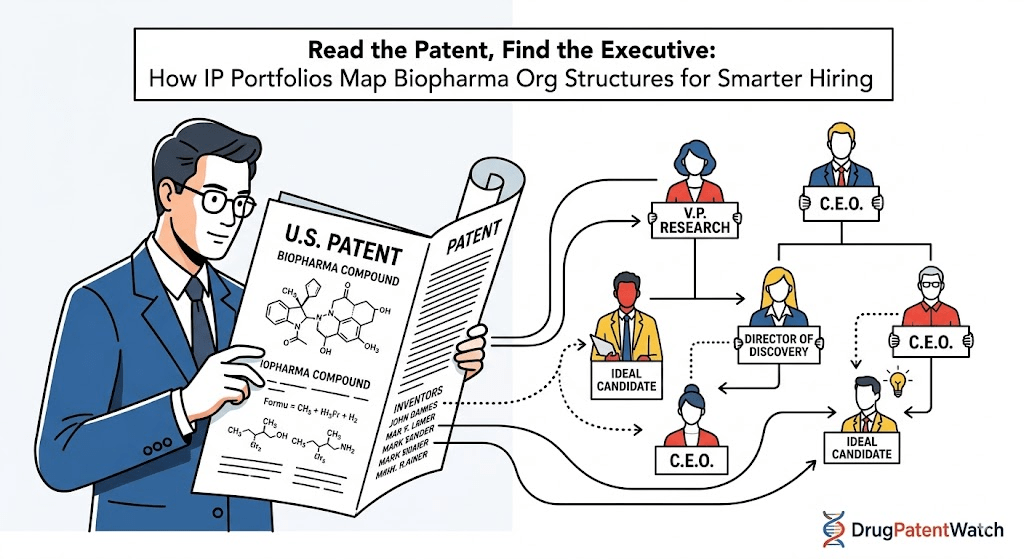
Every biopharma patent filing is a confession. It tells you what a company believes is worth protecting, who did the science, how the organization is structured around that science, and, if you know how to read the silences, where the leadership gaps are. Most executive search professionals never read past the assignee field. That’s a missed opportunity worth mapping.
The premise here is simple: a pharmaceutical company’s intellectual property portfolio is a real-time organizational chart. Not the org chart on the website—that one is sanitized for LinkedIn and press releases. The IP portfolio is the one that reflects actual resource allocation, genuine scientific priorities, and the human networks that produce innovation. When Pfizer reorganized its entire R&D leadership structure around the $43 billion Seagen acquisition in 2023 and 2024, you could read the pressure coming months before Chris Boshoff’s CSO appointment was announced [1]. The patent filing patterns told you where the ADC expertise sat, who was doing the hands-on chemistry, and which organizational seams needed executive attention.
This article is for executive search professionals, talent strategists, venture capital investors, and business development teams who need a sharper tool for mapping biopharma organizational reality. It explains how to extract org-structure intelligence from patent data, how to identify leadership vacuums before they become press releases, and how tools like DrugPatentWatch make that analysis systematic rather than artisanal.
Why Standard Org-Chart Research Fails in Biopharma
Ask a recruiter how they map a biopharma target company before a search, and you’ll get a familiar answer: LinkedIn scraping, conference speaker lists, a few SEC filings, maybe a call to a former employee. It works tolerably well for commercial roles. It fails almost completely for R&D and scientific leadership, and here is why.
Biopharma R&D organizations are structured around therapeutic platforms and compound families, not the functional hierarchy that LinkedIn reflects. A company might list a ‘Head of Oncology Research’ but that title tells you nothing about whether oncology is a legacy franchise in managed decline or an expanding platform with five active IND filings. The patent record tells you which one it is. Filing volume, inventor concentration, continuation strategy, and the presence or absence of method-of-treatment claims all describe organizational investment with a precision that no job title can match.
The problem compounds at the senior level. CSO searches, CMO transitions, and VP-level R&D appointments are driven by strategic inflection points that don’t appear on public org charts until months after the decision was made. The patent record, however, often shows those inflection points in real time. A sudden drop in inventor diversity within a particular therapeutic area frequently signals internal reorganization or key talent departure. A burst of continuation filings in a platform the company had not previously patented signals an acquisition or licensing deal that broadened the portfolio before the press release was written.
For context: biotech companies collectively face a $300 billion growth gap through 2028 as key biologics lose patent protection. That pressure doesn’t stay in the finance department. It restructures R&D organizations, eliminates leadership layers, and creates new executive roles specifically designed to manage the transition. The patent cliff is the most honest signal in the industry. It’s also public, structured, and machine-readable.
The Patent as Org Chart: What the Data Actually Contains
Assignee Fields and Corporate Architecture
The assignee field on a pharmaceutical patent tells you the legal owner of the invention. In a large pharma company, that’s usually the parent entity. But in practice, assignee diversity within a portfolio reveals a great deal about how the organization thinks about its own boundaries.
When Bristol-Myers Squibb acquired Celgene in 2019 for $74 billion, the resulting patent portfolio carried Celgene assignee designations on key immunology and oncology compounds for years afterward. A recruiter examining BMS’s portfolio in 2021 and 2022 who failed to account for Celgene legacy filings would have fundamentally misread the size and depth of the immunology franchise and, consequently, would have miscalibrated what kind of head of immunology BMS actually needed. Understanding assignee normalization—the process of mapping legacy corporate identities to current owners—is not a technical footnote. It is central to reading the org structure correctly.
The same logic applies to subsidiaries. AstraZeneca patents in rare disease often appear under Alexion Pharmaceuticals Inc. designations, reflecting the 2021 acquisition. When you see a company whose patent portfolio fragments into multiple legal assignees across a single therapeutic area, you’re looking at an organization that has grown through acquisition and has not yet completed the cultural and structural integration of those businesses. That’s an executive hiring signal: integration leadership roles are typically unfilled or underqualified at exactly that moment.
Inventor Lists as Shadow Org Charts
This is where patent analysis becomes genuinely powerful for talent and leadership mapping. Under U.S. patent law, only natural persons can be named as inventors [2]. That means every patent is a direct record of who did the science. Across a portfolio of dozens or hundreds of patents, the inventor network becomes a shadow org chart with a resolution that LinkedIn cannot match.
For competitive intelligence on a competitor’s R&D direction, tracking a star inventor’s filings is often more revealing than tracking the corporate assignee, because inventor activity follows the actual science. That’s true as far as it goes, but the more sophisticated application for executive search is tracking inventor network topology rather than individual inventors.
Here’s what the topology tells you:
A tightly clustered inventor network—where 80% of filings in a given therapeutic area come from the same 4-6 individuals—indicates an organization that has concentrated scientific leadership in a small team. That structure is efficient but brittle. If one or two of those inventors depart, the organization loses not just headcount but a disproportionate share of its IP-generating capacity. From an executive search perspective, this is an early warning sign: the company will need a VP-level hire to rebuild scientific depth before the next product cycle begins.
A distributed inventor network—where the same therapeutic area generates patents from 20-30 different inventors across multiple sites—indicates an organization that has invested in building broad scientific capability. That structure generates lower per-inventor output but creates organizational resilience. The executive hire profile here is different: you’re looking for someone who can coordinate distributed teams, not someone who can anchor a concentrated scientific operation.
A declining inventor network—where the same therapeutic area shows fewer unique inventors per patent family over a three-year window—is one of the clearest signals available that an organization is losing scientific momentum in that area. Leadership departure, budget cuts, and strategic deprioritization all produce this pattern. The company often doesn’t announce the change. The patents do.
Filing Cadence and Strategic Inflection Points
Patent filing cadence is organizational behavior made visible. A company that increases filing velocity in a therapeutic area is committing capital and headcount to it. A company that stops filing new matter and begins heavy continuation activity is managing an existing portfolio rather than building a new one—a posture that typically accompanies either a strategic pivot or a funding constraint.
Platforms like DrugPatentWatch allow analysts to track filing cadence by assignee and therapeutic category across time, connecting those trends to specific Orange Book listings, Paragraph IV filing histories, and exclusivity expiry dates. That integrated view lets you answer questions that LinkedIn search cannot: is this company’s oncology team in expansion mode or harvest mode? Is the immunology franchise getting new investment or living off the hump of a 2018 filing burst?
Those questions have direct consequences for executive search. A company in expansion mode needs a leader who can recruit and build. A company in harvest mode needs a leader who can manage portfolio wind-down, handle Paragraph IV litigation exposure, and execute lifecycle management. The skill sets overlap but they don’t align. Hiring the wrong profile because you didn’t read the patent cadence correctly is an expensive mistake.
Case Study: Pfizer-Seagen and the ADC Leadership Architecture
The Pfizer acquisition of Seagen is one of the most instructive case studies available for IP-driven org-structure analysis, precisely because the entire leadership restructuring was telegraphed by the patent record before the org chart changed.
Seagen had built one of the world’s most concentrated ADC (antibody-drug conjugate) patent portfolios. The company’s IP covered linker chemistry, payload selection, antibody engineering, and manufacturing process—a vertically integrated position that represented years of specialized scientific labor. When Pfizer announced the $43 billion acquisition in 2023, any analyst reading the Seagen patent inventor networks could see that the company’s scientific value was not evenly distributed. It was concentrated in specific inventor clusters corresponding to specific compound families: vedotin payloads, PADCEV chemistry, TIVDAK linker architecture.
That concentration created a predictable organizational problem. Five of the nine leaders in Boshoff’s unit joined from Seagen. The patent record would have shown why: the ADC expertise Pfizer was buying lived in the Seagen organization, not in Pfizer’s pre-existing oncology team. A recruiter mapping this situation would have known, before any press release, that Pfizer’s post-acquisition org structure would need to elevate Seagen scientific talent into leadership positions—and that the interim period between close and full integration would create a specific kind of leadership vacuum at the VP and SVP level, where Pfizer’s legacy oncology executives and Seagen’s incoming team would need coordination governance that didn’t yet exist.
Boshoff will be in charge of integrating medicines from Seagen in his new role. The merger will bring in an antibody-drug conjugate oncology platform, which has plenty of competition from the likes of AstraZeneca and Daiichi Sankyo. The competitive context that sentence acknowledges is itself patent-visible: AstraZeneca-Daiichi Sankyo’s Enhertu ADC program had built an IP position in HER2-targeting that directly competed with Seagen’s approach. Reading both portfolios together let analysts predict the leadership battle lines before either company’s press release confirmed them.
The subsequent reorganization confirmed what the patents predicted. Boshoff will assume his new post on Jan. 1, succeeding Mikael Dolsten, who oversaw research at Pfizer for 15 years. That succession wasn’t a routine transition. It was the organizational expression of a strategic pivot—from a generalist R&D leadership model under Dolsten to an oncology-specialized model under Boshoff, driven entirely by the IP reality that ADC technology now represented the core of Pfizer’s growth thesis.
An executive search firm that had been tracking Pfizer’s patent portfolio continuously from 2022 onward would have had an 18-month head start on that hiring cycle. They would have known Boshoff’s profile was rising, known Dolsten’s tenure was organizationally misaligned with the post-Seagen strategy, and been able to position alternative candidates before Pfizer publicly launched the search.
Reading the Patent Cliff as a Leadership Calendar
The patent cliff is the most systematically underexploited organizational intelligence source in biopharma executive search. The reason is simple: most recruiters think of patent expiries as a commercial problem, not an organizational one. They’re wrong. Patent cliffs restructure biopharma organizations predictably and on a timeline that is completely visible years in advance.
‘Companies that use patent data for trend forecasting are 2.3 times more likely to be market leaders in their respective fields.’ — McKinsey & Company [3]
Here’s the organizational pattern that plays out around a major patent expiry:
Roughly 24-36 months before loss of exclusivity on a major asset, the company begins pipeline prioritization work to identify replacement revenue. That work requires scientific leadership with a specific profile: deep familiarity with the therapeutic area, relationships with academic centers where next-generation compounds are being developed, and the operational experience to manage a compressed development timeline. Companies often discover they don’t have that profile internally. The patent record tells you which companies are in that position right now.
Roughly 12-18 months before loss of exclusivity, the company either launches a lifecycle management strategy (continuation filings, new formulation patents, pediatric exclusivity applications) or begins active M&A positioning to acquire replacement assets. Both moves require new leadership. Lifecycle management requires a VP-level IP strategist who can navigate Orange Book listing strategy and Paragraph IV litigation. Acquisition-driven replacement requires a business development leader with dealmaking experience in the specific therapeutic class. Neither role typically exists at the required seniority level in companies that have been operating a blockbuster franchise on autopilot.
The $236 billion patent cliff exposure between 2025 and 2030—affecting nearly 70 blockbuster products—means that this organizational cycle is playing out simultaneously across dozens of major companies right now [4]. Merck faces the Keytruda expiry in 2028 with a franchise that accounted for more than half of Merck’s pharmaceutical sales by 2025. Bristol-Myers Squibb faces Eliquis in 2026 and Opdivo in 2028. AstraZeneca faces Farxiga in 2026 [5]. Each of these events has a predictable organizational consequence that shows up in the patent record before it shows up in an org announcement.
BMS: When Cost-Cutting Signals a Leadership Profile Shift
Bristol-Myers Squibb’s response to its patent cliff exposure illustrates how financial pressure translates into specific leadership requirement changes that patent data can help you see in advance.
In April 2024, the pharma kicked off a sweeping realignment program—which includes around 2,200 layoffs—with an eye toward saving up to $1.5 billion through 2025. In its full-year 2024 business report, the company tacked another $2 billion to the cost-cutting goal, which it hopes to realize through 2027. That financial posture, combined with BMS’s patent cliff timeline, tells you exactly what kind of executive the company needs and what kind it doesn’t.
A company in structured cost reduction ahead of a loss-of-exclusivity event needs operational leaders who can manage complexity with fewer resources—people who have managed franchise wind-downs, who understand the manufacturing cost dynamics of products losing pricing power, and who can maintain commercial momentum while the pipeline replenishment work happens elsewhere in the organization. It does not need visionary build-from-scratch executives. The patent record confirms this: BMS’s recent filing activity in cardiovascular shows heavy continuation work on existing compounds, not new matter. That’s a harvest posture, and it requires a harvest-mode leadership profile.
Merck’s decision to separate its oncology business into a standalone unit offers a current example of how patent strategy drives organizational design in real time. Merck did not create a standalone oncology unit simply because oncology expanded. It did so because oncology redefined the company’s value architecture, risk exposure, and strategic future. When a franchise becomes large enough, structure becomes strategy.
An analyst tracking Merck’s Keytruda patent portfolio over the past five years would have seen the structural pressure building. Keytruda’s IP position—the combination of the core pembrolizumab composition patents, the method-of-treatment patents covering dozens of indications, and the combination therapy patents with partner molecules—created an IP architecture so large and complex that it effectively required its own organizational home. The patent record showed a franchise that had outgrown its governance structure before Merck’s org chart reflected that reality.
The leadership appointments confirm the thesis. Jannie Oosthuizen, a Merck veteran with deep commercial leadership experience, was named to lead the standalone oncology business. His appointment signals continuity, franchise knowledge, and strategic alignment with Merck’s oncology heritage. Leading the newly formed diversified portfolio unit is Brian Foard, an external hire from Sanofi.
Read that through the patent lens: the oncology unit, which needs to manage a mature but extraordinarily complex IP portfolio through its peak commercial years and into the 2028 expiry period, gets an internal continuity hire. The diversified portfolio unit, which needs to build new IP in areas where Merck has historically underinvested, gets an external build-mode hire. Those two appointment profiles exactly match what the patent record predicts.
Geographic Filing Patterns and International Org Structure
Pharmaceutical companies file patents in multiple jurisdictions, and the geographic pattern of their filings tells you something important about where organizational investment is flowing globally.
A company that files aggressively with the European Patent Office in a specific therapeutic area but maintains thin USPTO coverage in the same area is signaling a Europe-first commercial strategy for that compound. From an organizational perspective, that means the executive team required to support that franchise needs European market access experience, EU regulatory relationships, and comfort with the EMA process—a different skill set than a U.S.-focused launch team would require.
The reverse pattern—heavy USPTO filing with minimal EPO or WIPO PCT coverage—is becoming less common in biopharma but still appears in companies with thin international commercial infrastructure. It signals an organization that either can’t afford global patent prosecution or has made a deliberate choice to focus on U.S. exclusivity. Either way, the head of commercial or head of regulatory they need looks different than a company pursuing a synchronized global launch.
Chinese patent filings have become a particularly interesting signal since roughly 2020. Boshoff noted at the 2024 J.P. Morgan Healthcare Conference that Pfizer was ‘looking at opportunities from companies in the Far East now, and certainly also companies in China, which is important in this whole area, especially ADC development.’ That China orientation was visible in filing patterns before the executive comment confirmed it. Companies that begin registering IP with the China National Intellectual Property Administration in a specific therapeutic class are typically beginning business development conversations with Chinese biotech partners at the same time. Those conversations require a different kind of business development executive—one comfortable with the specific deal structures, regulatory pathways, and relationship norms of the Chinese biopharma market.
PCT Filing Strategy as a Proxy for Pipeline Confidence
The Patent Cooperation Treaty (PCT) system lets applicants delay national-phase entry into individual countries for up to 30 months from the priority date. Companies that file PCT applications and then enter only a small number of national phases are telling you something important: they believe the compound is worth protecting in some markets but not others. That’s a resource allocation decision, and it reflects leadership’s genuine assessment of the asset’s commercial potential more honestly than any investor presentation will.
A portfolio where a company consistently skips certain major markets in national phase—particularly markets like Japan, South Korea, or Brazil—tells an executive recruiter that the company doesn’t have the organizational infrastructure to commercialize in those markets and isn’t planning to build it. That’s a direct constraint on the kind of head of international markets the company should be searching for. A candidate who built their career on Asia-Pacific expansion would be poorly suited to a company whose patent geography shows no interest in protecting its assets in APAC.
Continuation Architecture and the R&D Pipeline Map
Understanding a company’s continuation filing strategy—how it uses continuation applications, divisionals, and continuation-in-part filings to extend and broaden its IP coverage—provides a detailed map of how the R&D organization is investing in the future of its existing franchises.
A robust continuation architecture around a lead compound typically signals that the organization has a functioning medicinal chemistry team actively exploring analogs, formulations, and new therapeutic applications. That’s a specific organizational asset: a team with the expertise and organizational mandate to do that work. If that team is intact and productive, the executive recruiter looking to understand Pfizer’s or Novartis’s capabilities in a specific class doesn’t need to ask—the continuation filings tell you the team is there and working.
A sparse continuation architecture—where the original composition patent has no follow-on filings despite the compound being in Phase 2 or Phase 3—is either a sign of organizational constraint (the IP team is understaffed, the patent prosecution budget has been cut) or a sign of diminished internal confidence in the compound’s commercial future. Both possibilities have implications for the leadership search. In the first case, the company needs a Head of IP who can build prosecution capacity rapidly. In the second, the executive search for commercial leadership should be recalibrated to reflect a narrower peak sales opportunity than the clinical pipeline summary suggests.
Orange Book Listings and Commercial Readiness
The FDA’s Orange Book—the official list of approved drug products with their associated patent and exclusivity information—is the conversion point between R&D patent strategy and commercial reality. A patent that appears in the Orange Book has survived the FDA review process and now carries legal weight in Hatch-Waxman Paragraph IV challenges. DrugPatentWatch aggregates patent data, Orange Book listings, Paragraph IV filing histories, exclusivity expiry dates, and ANDA filing activity into a unified interface designed for pharmaceutical IP and business development teams.
The gap between a company’s active patent portfolio and its Orange Book listings tells you something specific about organizational execution capability. A company that consistently fails to list patents in the Orange Book in a timely way—or that lists patents that are subsequently delisted after FDA challenge—has an IP governance problem. That problem typically reflects organizational structure: either the R&D-to-regulatory handoff is broken, or the legal and IP functions are not communicating effectively with commercial. Both are leadership problems that require specific executive hires to address.
Conversely, a company that maintains comprehensive, well-coordinated Orange Book listings, pursues pediatric exclusivity applications aggressively, and files timely Hatch-Waxman responses when generic challengers appear is demonstrating organizational maturity in IP commercialization. That maturity reflects good leadership in IP strategy. An executive recruiter should be noting which leaders oversaw the development of that capability—because those people are the most valuable candidates for companies that need to build it.
Using DrugPatentWatch for Systematic IP Intelligence
Most of the analysis described in this article can be done manually for a single company if you have a few weeks and access to the USPTO, EPO Espacenet, and FDA databases. For systematic tracking across multiple companies and therapeutic areas—which is what serious executive search intelligence requires—you need a platform that normalizes, aggregates, and layers the data.
DrugPatentWatch is built specifically for this purpose in the pharmaceutical context. It connects patent families to specific approved drugs and their ANDA competition histories, normalizes inventor and assignee data across filings, and provides an interface designed for IP and business development teams rather than pure patent attorneys. For executive search professionals, the relevant capabilities are:
First, assignee normalization. Patent owner names were classified into categories: ‘Organisation,’ ‘Acquired,’ and ‘Individuals.’ Organisations include patent owners that were part of companies and universities, while Acquired owners are those that were within legacy entities which have been acquired or merged into larger organisations. That normalization work is essential for reading portfolio breadth correctly across acquired subsidiaries—exactly the BMS-Celgene and AstraZeneca-Alexion situations discussed earlier.
Second, Orange Book to patent family mapping. Knowing which patents cover which approved drugs, and when each patent expires, lets you build a precise leadership calendar for a company: when will the IP team be under Paragraph IV challenge pressure, when will commercial leadership need to manage generic entry, when will business development need to source replacement assets. Each of those calendar points is a potential executive hire.
Third, ANDA filing tracking. When a generic manufacturer files an Abbreviated New Drug Application with a Paragraph IV certification—asserting that the branded drug’s patents are invalid or not infringed—it typically triggers litigation. That litigation requires specific legal and regulatory leadership with Hatch-Waxman expertise. Companies facing multiple simultaneous Paragraph IV challenges often need to hire or strengthen their VP-level IP litigation function on short notice. Tracking ANDA activity across a target company’s portfolio gives you 45 days’ advance notice of that need—because that’s the statutory period between the generic filing and the company’s litigation decision.
Inventor Departure as a Leading Indicator of Leadership Gaps
One of the most sensitive and actionable signals in patent intelligence for executive search is the inventor departure event—the moment when a key inventor stops appearing on new filings for a company they previously filed with consistently.
This happens for several reasons. Inventors retire. They move to competitors. They leave for startups. They are laid off in restructurings. They shift internal function from research to management and stop contributing directly to patent-generating work. Each scenario has different implications for the company’s organizational health and its executive hiring needs.
A senior inventor who moves from a large pharma to a startup is often a signal that the large pharma’s research culture has become inhospitable to the kind of exploratory science that generates new compound families. That’s an organizational problem at the VP or SVP level—it means the head of research is not creating the environment that retains scientific talent. The patent record shows you the departure; the inference about its cause requires judgment, but it’s a hypothesis that can be tested through interviews and reference networks.
A cluster departure—where multiple inventors from the same therapeutic area stop appearing on new filings within a 6-12 month window—is rarely a coincidence. It typically reflects a team dissolution event: a restructuring, a budget cut, or the aftermath of a failed Phase 3 study that deprioritized the program. In each case, the organizational consequence is a hole in the company’s scientific capability that a single executive hire cannot fill. What it requires is a leader who can rebuild a team from scratch—a specific and relatively rare skill set that a recruiter who hadn’t read the patent record wouldn’t know to specify.
The Spin-Out Signal
A specific variant of the inventor departure pattern deserves its own analysis: the academic spin-out signal. Many biopharma programs begin in academic labs, and the patents that underlie them are initially assigned to universities. When a university-assigned patent begins appearing in continuation filings under a corporate assignee—or when a corporate inventor list contains names that match faculty members at a major research university—you’re watching a licensing deal or spin-out event in progress.
That event has organizational implications. The company acquiring or licensing the technology needs to integrate an externally originated compound into its development infrastructure. That integration work is leadership-intensive: it requires someone who can bridge academic and industrial cultures, manage the technology transfer process, and establish development timelines for a compound that was not internally generated. Companies that do this repeatedly—and many do, particularly in rare disease and gene therapy where academic science generates the foundational IP—need a specific kind of VP of Translational Research or VP of Early Development whose resume includes successful academic-to-industrial technology transfer.
The patent record will show you which companies have this pattern of academic-origin licensing. LinkedIn will not.
Mapping Platform Technologies vs. Product Companies
One of the most practically useful distinctions in biopharma executive search is between platform technology companies and product-focused companies. The leadership profiles required for each are fundamentally different, and the patent portfolio is the most reliable way to establish which kind of company you’re actually dealing with—as opposed to which kind of company the CEO claims to be running.
A platform technology company’s patent portfolio clusters around enabling technologies: platform processes, screening methods, manufacturing approaches, formulation technologies. The composition-of-matter claims on specific drug candidates may be relatively thin or delegated to partners. The company’s value is in the platform, not the product. Leadership for this company needs to understand licensing, partnership management, and the long-term protection of enabling IP. The CMO or Head of Development is less important than the Chief Platform Officer or VP of Strategic Alliances.
A product company’s portfolio clusters around specific drug candidates: composition-of-matter claims on lead compounds, method-of-treatment claims for specific indications, formulation patents for approved dosage forms. The value is in the drug, not the technology. Leadership for this company needs clinical development depth in the specific indication, regulatory experience with the relevant therapeutic class, and commercial capability for launch and market defense.
The blurring of these categories—which happens routinely as platform companies advance compounds into clinical development—creates a specific organizational challenge: the leadership team that was right for a platform-stage company is often wrong for a product-stage company. Patent analysis lets you see when this transition is happening, often before the company’s public narrative acknowledges it. That’s an executive search opportunity: the company is about to need different leadership than it has, and it probably already knows it even if it hasn’t said so.
mRNA and Gene Therapy: The Platform Patent as Organizational Indicator
The rise of mRNA and gene therapy platforms over the past decade created a new category of IP that serves as an organizational indicator. Moderna’s foundational mRNA delivery patents, BioNTech’s lipid nanoparticle formulation portfolio, and the various AAV capsid patents held by gene therapy companies like Sarepta and Spark Therapeutics all represent platform technologies that require specific organizational structures to exploit.
A company with a strong mRNA platform patent position but thin clinical development infrastructure needs a different kind of Chief Medical Officer than a company with an established CNS franchise. The mRNA-platform CMO needs to understand the specific regulatory pathway for mRNA therapies, the manufacturing challenges of lipid nanoparticle scale-up, and the clinical endpoint design considerations for novel modalities. That profile is a specialty within clinical medicine that was essentially nonexistent before 2015. Companies that built mRNA portfolios early and now need clinical leadership often discover that the available talent pool for this specific intersection of skills is genuinely small, and that the patent portfolio told you the hiring challenge was coming long before the clinical program needed a CMO.
Reading Absence: What Companies Don’t Patent
The absence of patent activity in a therapeutic area a company claims to be pursuing is one of the most reliable signals of strategic misalignment between what leadership says and what the organization is actually doing.
Every pharma company of any size has a pipeline slide. The pipeline slide shows compounds in various stages of development across multiple therapeutic areas. When an investor, acquirer, or executive recruiter reads that slide, they’re getting the official narrative. When they read the patent record for the same company, they often find that the narrative doesn’t match the IP activity. Compounds listed as ‘preclinical’ in a therapeutic area where the company has filed zero new composition patents in three years are probably not getting serious organizational investment. The head of research who owns that program is managing a strategic fiction.
Patent intelligence can no longer be treated as a siloed, back-office legal function. That observation applies with particular force to executive search. The search professional who reads only the pipeline slide is operating on the official story. The one who reads the patent record is operating on the organizational reality. Those two things are often different.
The practical application: when a company tells you they’re building a cardiovascular franchise and want to hire a VP of Cardiovascular Development, check the patent record first. If the cardiovascular filing activity is thin or absent, and the inventor network shows no scientists with cardiovascular backgrounds, the ‘franchise building’ may be a market signal designed for investors rather than an operational reality. You’ll either recruit someone into a role with inadequate organizational support, or you’ll find that the hire fails within 18 months because the resources aren’t there. The patent record would have told you that in advance.
Paragraph IV Litigation as Leadership Intelligence
Hatch-Waxman Paragraph IV litigation—the process by which generic manufacturers challenge branded drug patents—is the most adversarial expression of pharmaceutical IP strategy, and it’s a rich source of leadership intelligence for executive search professionals.
Companies that face Paragraph IV challenges on their major assets are engaged in a legal and strategic contest that requires specific executive capabilities. The VP of IP Litigation needs Hatch-Waxman expertise and relationships with specialized patent litigation counsel. The Head of Regulatory Affairs needs to understand FDA’s role in the 30-month stay mechanism and the implications of consent judgments for Orange Book listings. The Head of Commercial needs to manage investor expectations and sales force motivation through a period of legal uncertainty. Each of these roles requires specific experience that not all executives in those titles actually have.
Looking at historical Paragraph IV challenge records for a target company tells you whether that company has built these capabilities. A company that has successfully defended multiple Paragraph IV challenges—particularly complex ones involving mechanism-of-action patents or polymorph patents—has developed genuine organizational depth in IP defense. That’s a talent asset the company may not advertise. A company that has settled multiple Paragraph IV cases rapidly and on terms that accelerated generic entry has either been poorly advised or lacked the organizational will to defend its assets. That’s a leadership weakness the patent record reveals clearly.
The reverse perspective matters too. For companies trying to recruit from branded pharma into generic or biosimilar development, the Paragraph IV history tells you which executives have actually managed the litigation process from the branded side—and therefore have the institutional knowledge that makes them valuable to a challenger entering the same therapeutic area.
Building the IP-Informed Executive Search Framework
The analysis described so far translates into a practical framework for IP-informed executive search. The framework has four stages, and each stage uses patent data differently.
Stage 1: Organizational Topology Mapping
Before the search brief is written, map the company’s patent portfolio by therapeutic area, inventor network, filing cadence, and geographic coverage. This gives you a ground-truth organizational picture that you’ll use to test and refine the client’s own description of what they need.
Specifically, look for: inventor network concentration versus diffusion in the target therapeutic area; filing cadence trend over the past 36 months; continuation architecture depth; Orange Book listing completeness; and geographic coverage alignment with the company’s stated commercial strategy. Each of these tells you something about organizational structure that the client’s own job description may not reflect.
Stage 2: Gap Analysis
Compare the organizational picture from Stage 1 against the client’s stated strategic priorities. The gaps between the IP reality and the strategic narrative are where the most urgent executive needs typically lie. A company that says it’s building a rare disease franchise but has filed no orphan drug designation applications and has thin rare disease inventor activity needs a different kind of senior hire than a company with an established rare disease platform—and probably needs that hire more urgently than it realizes.
The gap analysis also includes temporal mapping. Use patent expiry timelines from tools like DrugPatentWatch to project when specific organizational pressures will peak. The company facing a major loss-of-exclusivity event in 2027 needs certain executive capabilities in place by mid-2025 at the latest. If they’re only beginning to search now, they’re already behind the organizational timeline that the patent record defines.
Stage 3: Candidate Signal Tracking
Track inventor activity for candidate executives across their career history. A candidate for a Head of Oncology role who lists 45 patents in their name across four companies has demonstrated scientific productivity that a pure clinical profile won’t show you. Conversely, a candidate who was listed as inventor on 20 patents at one company and zero at the next may have made the transition from hands-on science to management—which is fine, but it’s a career inflection point you should understand.
Cross-reference candidate names against patent litigation records. A VP of IP who has been named in testimony or deposition in Paragraph IV litigation has real experience. One who has only managed the legal budget has a different profile. The public patent litigation record will tell you which is which.
Stage 4: Competitive Context and Counteroffer Intelligence
The final stage is using competitor patent activity to assess the candidate’s current value to their existing employer. A star inventor who is currently filing at a high rate for a competitor is a candidate whose departure would genuinely damage that competitor’s IP-generating capacity. That company will fight hard to retain them. That’s a counteroffer risk, and it’s predictable from the patent record before you make the approach.
Conversely, a candidate whose patent filing activity has declined substantially at their current employer—the inventor who was filing 8 patents a year and is now filing zero—is likely disengaged from the core scientific work. The organizational pull toward their current employer is weaker, and the approach can be made with less counteroffer risk. The patent record told you that before the first phone call.
GLP-1s, Obesity, and the Novo-Lilly Patent Race as Hiring Map
The GLP-1 obesity and diabetes market provides a current, real-time example of IP-driven organizational transformation that has direct consequences for biopharma executive hiring across the industry.
Novo Nordisk’s semaglutide IP position—covering the core peptide composition, the formulation patents for both Ozempic and Wegovy, and the manufacturing process patents that underpin their production advantage—created an organizational mandate that drove one of the most dramatic workforce expansions in industry history. Novo Nordisk’s full-time employee count surged 43.9% to nearly 68,800 in 2025, while Lilly’s head count jumped 42.9% to about 50,000. Lilly is only one of three pharma companies—alongside AstraZeneca and Amgen—to have consistently increased its total employee numbers every year since 2021.
That workforce expansion was organizationally predictable from the patent record. When Novo’s semaglutide patent estate reached a level of coverage that suggested sustained exclusivity well into the 2030s—particularly the formulation and delivery device patents—and when the Phase 3 data for Wegovy in obesity confirmed a market opportunity beyond diabetes, the organizational expansion was inevitable. Executive search firms tracking Novo’s patent portfolio from 2019 onward would have known to position themselves for years of continuous senior hiring across manufacturing, commercial, regulatory, and clinical functions.
The flip side is equally patent-visible. Novo Nordisk shifted from an industry-leading 20.4% team expansion in 2024 to a 9.8% head count reduction in 2025, the deepest cut by percentage rate among the companies we evaluated. The organizational contraction followed GLP-1 sales disappointments and rising competition. Those competitive pressures were visible in the patent record: Eli Lilly’s tirzepatide IP position, covering both GIP and GLP-1 receptor agonism with a differentiated chemical structure, signaled from early filings that a genuine competitor was coming. Companies building executive search practices for obesity-focused organizations would have been tracking both portfolios simultaneously.
Biosimilar Entry and the Organizational Wind-Down Map
The biosimilar market creates a specific organizational challenge that patent intelligence helps you anticipate: the management of franchise wind-down when a blockbuster biologic faces biosimilar competition.
AbbVie’s experience with Humira is the most studied case in the industry. The Humira patent estate—which at various points covered more than 130 patents across composition, formulation, dosing, and manufacturing process—created a fortress IP position that delayed biosimilar entry in the U.S. until 2023, a full decade after European biosimilar entry. The organizational consequence was that AbbVie had years to build replacement revenue through Skyrizi and Rinvoq while the Humira franchise remained intact.
Not every company manages this transition well. For biologics with less robust patent estates—or for companies that failed to file timely follow-on patents protecting new indications and formulations—biosimilar entry arrives faster and with more organizational disruption. The patent record tells you, with considerable precision, how much lead time a company actually has. That lead time translates directly into an organizational calendar: how long does the current commercial leadership team have before they need to execute a franchise handoff, and does the current team have the experience to manage that transition?
Companies that built their commercial leadership during the blockbuster years of a biologic franchise often lack the skills needed for biosimilar-era franchise management. The metrics change, the pricing dynamics change, and the field force model changes. Recognizing when a company’s biologic IP timeline requires leadership renewal—not because of failure, but because the competitive context has fundamentally shifted—is one of the most sophisticated applications of IP-informed executive search.
The AI Drug Discovery Layer: New IP Patterns, New Org Structures
The integration of AI into pharmaceutical drug discovery is generating a new category of IP that requires its own interpretive framework for organizational analysis. The critical interpretive challenge is that AI-generated compound filings often look like traditional small-molecule composition patents but represent a fundamentally different organizational process—and therefore a different leadership profile.
A company that generates lead compounds through AI-driven structure-activity relationship analysis does not need the same Head of Medicinal Chemistry as a company that generates them through traditional synthetic chemistry programs. The AI-oriented organization needs someone who understands how to validate AI outputs experimentally, how to manage the human-AI collaboration process in a lab setting, and how to document inventorship in a way that satisfies USPTO requirements given the current legal position that only natural persons can be named as inventors [6].
Patent filing patterns from AI-focused drug discovery companies—including Insilico Medicine, Recursion Pharmaceuticals, and Exscientia—show specific characteristics: compressed timelines between program initiation and first patent filing, unusually broad Markush structures reflecting the AI’s exploration of chemical space, and inventor lists that are often smaller than traditional medicinal chemistry programs despite the breadth of the IP claimed. Each of those characteristics has organizational implications.
The compressed timeline signals that the company’s VP of IP needs a prosecution strategy adapted to early-stage, fast-moving programs—not the methodical 18-month provisional-to-PCT cycle of traditional drug discovery. The broad Markush structures create specific patentability challenges that require IP counsel experienced with AI-generated claims. The small inventor lists reflect the AI-augmented team structure and signal an organization that does not need a large traditional chemistry department.
For executive search, the practical implication is this: when a company’s patent record shows the AI drug discovery fingerprint—short cycles, broad claims, small inventor networks—the leadership profile required for chemistry and medicinal science functions is different from what the job title ‘VP of Chemistry’ would historically have implied. The recruiter who doesn’t recognize that will shortlist the wrong candidates.
Competitive Mapping: Using Rival Patents to Define the Ideal Hire
A sophisticated extension of IP-driven organizational analysis uses competitor patents to define the capability requirements of the executive hire. The logic is straightforward: the executive you’re hiring will spend a significant portion of their tenure competing directly with specific rivals. The competitor’s IP position defines what that competition will look like. The ideal candidate is someone who has operated successfully against exactly that IP environment.
Take the ADC space as a concrete example. A company building an ADC oncology franchise in 2025 is operating against IP positions held by Pfizer-Seagen, AstraZeneca-Daiichi Sankyo (Enhertu), Roche, and a growing number of Chinese companies with increasingly competitive linker and payload patents. The Head of ADC Development they need is not simply someone with general oncology development experience. They need someone who has navigated specifically against the vedotin and TOPO1 payload patent landscapes, who understands the freedom-to-operate implications of the existing ADC linker chemistry IP, and who has managed the regulatory filing strategy for ADCs in the context of the specific safety and efficacy data packages those mechanisms generate.
Reading the competitor patent portfolios in detail—using tools like DrugPatentWatch to map the exact scope of the Seagen vedotin estate and the Daiichi Sankyo TOPO1 inhibitor IP—gives you a specification for the ideal candidate’s background that a generic job description cannot capture. You’re not just hiring a CMO. You’re hiring a CMO who has specifically navigated around these claims, in this competitive context, on this timeline.
The Patent Assignee Shift: Reading Restructuring Before the Announcement
One of the most valuable and least widely discussed signals in pharmaceutical IP monitoring for organizational intelligence is the patent assignment record—the record of patent ownership transfers between entities.
When a company assigns patents from one subsidiary to another, or reassigns patents from an acquired company to the acquiring parent, those assignments are recorded in USPTO and EPO databases with timestamps. The pattern of those assignments tells you how an organization is consolidating or reorganizing its IP assets—typically in advance of a public announcement about the corresponding organizational change.
Companies preparing for spin-offs, divestitures, or joint ventures routinely reorganize their patent assignments in the months before the transaction closes. A systematic tracker of assignment records—which DrugPatentWatch maintains as part of its aggregated patent database—will show a burst of assignment activity in a specific therapeutic area followed, weeks or months later, by a business development announcement involving exactly those assets. For executive search professionals, that’s a hiring signal: the transaction that creates the assignment burst will also create new leadership needs in the carved-out entity.
Novartis’s Sandoz separation is a relevant example. The process of separating Sandoz’s generics and biosimilars business from Novartis’s branded pharmaceutical operations required extensive patent reassignment—moving IP that supported both businesses from centralized ownership into the appropriate entity. That reassignment activity preceded the spin-out announcement and was visible in public assignment records. The organizational consequence—a new leadership team needed for the independent Sandoz, with different IP strategy priorities than a captive generics division inside Novartis—was predictable from the patent record before the formal leadership search was launched.
Practical Tools and Data Sources
Translating this analytical framework into practice requires access to the right data sources. The landscape of pharmaceutical patent intelligence tools has matured significantly over the past decade, but it remains fragmented enough that a practical toolkit requires combining several sources.
The USPTO’s Patent Full-Text and Image Database provides raw patent text and metadata, including inventor names, assignees, filing dates, and claim text. It’s comprehensive but requires significant parsing and normalization work to use for organizational analysis. The same is true of the EPO’s Espacenet and WIPO’s PATENTSCOPE.
For pharmaceutical-specific intelligence—particularly the connection between patent families and specific approved drugs, Orange Book listings, and ANDA filing history—specialized platforms provide substantially more analytical value. DrugPatentWatch’s capabilities include automated chemical structure recognition, multilingual patent support covering English, Chinese, and Japanese filings, and mapping tools that connect patent families to specific approved drugs and their ANDA competition histories.
LexisNexis PatentSight provides inventor collaboration network analysis that directly supports the organizational mapping work described earlier. A new analytical dimension introduces inventor collaboration network analysis, revealing how innovation is structured within organizations. That capability—mapping how scientific collaboration flows within and across organizations—is exactly the tool that supports the inventor network analysis described in this article.
For competitive intelligence on who is filing what, and how quickly companies are building IP positions in emerging areas, the Clarivate Derwent World Patents Index normalizes inventor and assignee data across 59 patent authorities worldwide, providing a cleaned dataset that makes cross-portfolio comparison tractable [7].
The practical workflow for IP-informed executive search combines these sources: DrugPatentWatch for drug-specific intelligence and ANDA tracking, PatentSight for inventor network analysis, and either Espacenet or USPTO for raw filing data when you need to read the actual claim language of specific patents. None of these tools is designed specifically for executive search. The analytical framework described here is what converts them into organizational intelligence tools.
Limitations and Calibration
IP-driven organizational analysis is powerful but it has specific limitations that any practitioner needs to understand.
First, patent filing is a lagging indicator for some types of organizational information. The patent application is filed months after the scientific work is done, and the application is not published until 18 months after its earliest priority date. For fast-moving organizational developments—a sudden CEO departure, a program cancellation that hasn’t yet affected the IP record—the patent record won’t give you real-time intelligence. It gives you structural intelligence with a 12-18 month lag. That’s valuable for understanding organizational shape and trajectory, not for tracking individual events.
Second, not all pharmaceutical innovation is patented. Trade secrets protect manufacturing processes that companies prefer not to disclose, formulation know-how that would require detailed disclosure in a patent application, and analytical methods whose protection is more valuable as a trade secret than as a disclosed patent. An organization with strong trade secret culture—which is common in small-molecule formulation and manufacturing—will appear to have a thinner patent portfolio than its actual IP asset base would suggest. Read that limitation carefully: it doesn’t mean the company’s IP is weaker, it means the patent record is an incomplete picture of the IP.
Third, large pharmaceutical companies file many patents on compounds that will never be developed commercially. The patent record is a map of what the organization has worked on; it is not a complete map of what the organization intends to commercialize. Distinguishing between defensive filings, freedom-to-operate filings, and genuine program-supporting IP requires judgment and domain knowledge that no automated tool can fully supply. The best use of IP analysis for executive search is as one layer of evidence to be combined with pipeline information, leadership interviews, and market intelligence—not as a standalone oracle.
The Future of IP-Driven Talent Intelligence
The convergence of AI-enabled patent analysis and executive talent intelligence is creating capabilities that were not available five years ago. Large language model-based patent analysis can now extract inventor collaboration networks, map claim scope, and identify filing pattern anomalies at a scale that would have required months of manual work. For executive search professionals, that means the analytical framework described in this article is becoming more accessible—which also means it is becoming more necessary as a competitive differentiation tool.
As the ability to find information becomes commoditized by AI, the durable competitive advantage will shift to the ability to ask the right questions of the AI and to synthesize its outputs with other forms of business intelligence into a coherent and compelling corporate strategy. The future belongs not to the machine, but to the human expert who knows how to wield it most effectively.
That observation applies directly to IP-driven executive search. The data—inventor networks, filing cadence, assignee geography, continuation architecture—will increasingly be available to anyone with a subscription to the right tools. The advantage will belong to the practitioner who knows how to read organizational meaning into that data, how to combine it with other intelligence sources, and how to convert it into a search strategy that finds the right executive before the company has announced they’re looking for one.
The pharmaceutical patent system is a public record system designed for legal purposes. Its value for organizational intelligence is entirely secondary to its legal function—but it is substantial, systematic, and largely untapped by the executive search profession. The companies that figure this out first will have a structural advantage in biopharma talent strategy that compounds over time, just like the IP portfolios they’re learning to read.
Key Takeaways
Patent portfolios are organizational documents as much as legal ones. Inventor networks, filing cadence, assignee geography, and continuation architecture all describe the internal structure of a biopharma R&D organization with a precision that no public org chart can match.
The patent cliff is a leadership calendar. Loss-of-exclusivity events on major assets—$236 billion at risk between 2025 and 2030—drive predictable organizational restructuring. The IP record tells you which companies are entering that pressure cycle and what executive capabilities they’ll need before the restructuring begins.
Inventor departure is a leading indicator of leadership gaps. When key inventors stop appearing on new filings in a therapeutic area, the organization is losing scientific momentum in that area. That typically happens before any public announcement, and it signals a specific kind of executive hire.
Assignee normalization matters for M&A-heavy portfolios. Reading AstraZeneca’s rare disease IP without accounting for Alexion legacy filings, or reading BMS without accounting for Celgene, produces a fundamentally distorted picture of the organization’s scientific capability and the leadership required to manage it.
Tools like DrugPatentWatch convert raw patent data into pharmaceutical-specific intelligence. The connection between patent families, Orange Book listings, Paragraph IV challenge history, and ANDA filing activity creates an integrated view that is essential for translating patent analysis into practical executive search intelligence.
What companies don’t patent is as informative as what they do. Thin IP activity in a therapeutic area a company claims to be building often signals strategic fiction rather than operational reality—a critical calibration for executive recruiters who would otherwise take pipeline slides at face value.
The AI drug discovery layer creates new interpretive requirements. Patents from AI-enabled drug discovery programs show specific characteristics—compressed timelines, broad Markush structures, small inventor networks—that signal a different organizational model requiring different executive leadership profiles.
Frequently Asked Questions
Q1: How do I start using patent data for executive search if I have no legal background?
You don’t need a legal background to extract organizational intelligence from patents. The three elements you need to track—inventor names, assignee entities, and filing dates by therapeutic area—are all metadata fields that appear on every patent without requiring you to read the claims. Start with a platform like DrugPatentWatch, which normalizes assignee data, maps patent families to specific drugs, and provides a structured view of a company’s portfolio across time. Your first analysis should be simple: for a given company and therapeutic area, how many unique inventors appear on filings in the past three years, and is that number rising or falling? That single metric tells you whether the company is building or contracting its scientific capacity in that area. From that baseline, you can add layers of complexity as your familiarity with the data grows.
Q2: How reliable is patent-derived organizational intelligence compared to direct sourcing?
They address different questions. Direct sourcing—reference networks, informational interviews, former employee conversations—gives you real-time cultural intelligence: what’s the actual leadership dynamic on the team, who’s unhappy, what’s the real reason the last executive left. Patent data gives you structural intelligence: what the organization has been working on, how resource allocation has shifted, what the competitive IP context requires. The most powerful approach combines both. Use patent data to build a structural hypothesis about what the organization needs, then use direct sourcing to test and refine that hypothesis. Patent data is particularly reliable for questions about strategic priorities and scientific capability, where the public record reflects real organizational behavior rather than curated narrative.
Q3: Can you really predict executive departures from patent filing patterns?
You can predict organizational conditions that make departures likely, not specific departures. When a senior inventor’s patent activity drops sharply over 12-18 months at a given company—particularly when the broader team’s activity remains stable—it often reflects one of several conditions: the inventor has moved into management and stopped hands-on research, the inventor’s program has been deprioritized or cancelled, or the inventor is disengaged and planning to leave. None of those is definitively departure, but all three create organizational conditions where a skilled recruiter’s approach is more likely to find receptivity. Combining that patent signal with industry network intelligence—conference appearances, publication activity, LinkedIn pattern changes—gives you a higher-confidence hypothesis before you make any approach.
Q4: How do you use IP analysis for companies that haven’t yet built large patent portfolios, like early-stage biotechs?
For early-stage companies, the patent record is thinner but often more revealing precisely because of its thinness. A Series B biotech that claims to be pursuing a broad oncology platform but has filed patents for only a single compound family is either not as broad as it claims or has not yet invested in IP protection for its broader research—both of which have implications for the head of research or head of IP they need. The geographic filing strategy for provisional applications is also a useful signal in early-stage companies: a company that files only U.S. provisionals and consistently declines to enter PCT national phase outside the U.S. is either resource-constrained or has a U.S.-only commercial strategy. That constrains the commercial leadership profile considerably. Finally, the academic assignment history of early-stage companies’ foundational patents—which university filed what, which professor was named inventor, what the license terms required—often defines the organizational culture and IP governance structure that a new executive will inherit.
Q5: How does Paragraph IV litigation history inform executive search strategy beyond the obvious IP roles?
Paragraph IV litigation history is most commonly used to inform IP and regulatory leadership searches, but its implications extend to commercial leadership as well. A company that has been a Paragraph IV defendant multiple times on its major assets has built organizational muscle around a specific kind of commercial risk management: the ability to maintain market confidence, manage payer relationships, and defend pricing while litigation is unresolved. That’s a specific commercial competency. Executives who built their commercial careers at companies with strong Paragraph IV defense track records have been tested in ways that executives from less challenged franchise environments have not. For a company facing its first major generic challenge, that experience premium is real—and it’s visible in the legal record before you ask the candidate about it in an interview. Cross-referencing a candidate’s employment history against public Paragraph IV litigation records in the same therapeutic area is a quick, practical screen for this experience.
Sources
Fierce Biotech. (2025, February 6). Pfizer builds out oncology team with appointment of Novartis vet Jeff Legos. https://www.fiercebiotech.com/biotech/pfizer-taps-ex-novartis-leader-helm-cancer-rd-work
Thaler v. Vidal, 43 F.4th 1207 (Fed. Cir. 2022). AI systems cannot be listed as patent inventors under current U.S. law. Retrieved via DrugPatentWatch Drug Patent Strategy Guide: https://www.drugpatentwatch.com/blog/optimizing-your-drug-patent-strategy-a-comprehensive-guide-for-pharmaceutical-companies/
DrugPatentWatch. (2026, March 30). How to Track Competitor R&D Pipelines Through Drug Patent Filings. https://www.drugpatentwatch.com/blog/how-to-track-competitor-rd-pipelines-through-drug-patent-filings/ (citing McKinsey & Company)
DrugPatentWatch. (2025, December 9). A Framework for Multi-Year Pharmaceutical Patent Cliff Impact Modeling and Strategic Response. https://www.drugpatentwatch.com/blog/a-framework-for-multi-year-pharmaceutical-patent-cliff-impact-modeling-and-strategic-response/
DelveInsight. (2025, September 26). The End of Exclusivity: Opportunity or Crisis for Big Players? https://www.delveinsight.com/blog/navigating-the-loss-of-exclusivity
DrugPatentWatch. (2026, March 22). Drug Patent Strategy: The Definitive Guide for Pharmaceutical IP Teams, R&D Leads, and Institutional Investors. https://www.drugpatentwatch.com/blog/optimizing-your-drug-patent-strategy-a-comprehensive-guide-for-pharmaceutical-companies/
Clarivate. (2024). Derwent World Patents Index [Database]. https://clarivate.com/products/ip-intelligence/patent-intelligence-and-research/derwent-world-patents-index/
Fierce Pharma. (2024, January 11). JPM24: Even after Seagen buyout, Pfizer oncology chief still eyes ADC deals. https://www.fiercepharma.com/pharma/jpm24-pfizer-oncology-chief-still-eyes-adc-deals-post-seagen-org-built-speed-and-efficiency
Fierce Biotech. (2023, July 27). Pfizer shuffles R&D leadership to prepare for Seagen merger. https://www.fiercebiotech.com/biotech/pfizer-shuffles-rd-leadership-prepare-seagen-merger
BioPharma Dive. (2024, November 20). Pfizer, under pressure to change, names oncology head as new R&D chief. https://www.biopharmadive.com/news/pfizer-chris-boshoff-cso-research-development-dolsten-successor/733433/
BioSpace. (2025, February 19). 5 Pharma Powerhouses Facing Massive Patent Cliffs—And What They’re Doing About It. https://www.biospace.com/business/5-pharma-powerhouses-facing-massive-patent-cliffs-and-what-theyre-doing-about-it
Fierce Pharma. (2026, March 25). Large pharma companies reduced headcounts by more than 22K in 2025 as $300B patent cliff looms. https://www.fiercepharma.com/pharma/large-pharma-companies-reduced-headcount-over-22000-2025-300b-patent-cliff-looms
DrugPatentWatch. (2026, March 29). Pharma Patent Filing Strategies That Maximize Exclusivity: The Complete IP Playbook. https://www.drugpatentwatch.com/blog/filing-strategies-for-maximizing-pharma-patents/
DrugPatentWatch. (2025, October 14). The Innovator’s Compass: Navigating the Patent Landscape to Drive Pharmaceutical R&D and Secure Market Leadership. https://www.drugpatentwatch.com/blog/the-innovators-compass-navigating-the-patent-landscape-to-drive-pharmaceutical-rd-and-secure-market-leadership/
Compass Executive Group. (2025, February 18). The True Impact of Leadership Gaps in BioPharma and Asset Development. https://www.compasscgroup.com/2025/02/18/the-true-impact-of-leadership-gaps-in-biopharma-and-asset-development/
DrugPatentWatch. (2025, March 3). Google Patents for Drug Patent Research: The Definitive Analyst’s Playbook. https://www.drugpatentwatch.com/blog/using-google-patents-for-drug-patent-research-a-comprehensive-guide/
Dey, S., et al. (2023). Pharmaceutical patent landscaping: A novel approach to understand patents from the drug discovery perspective. bioRxiv. https://www.biorxiv.org/content/10.1101/2023.02.10.527980.full.pdf
Deloitte. (2025, July 10). Trends Shaping Biopharma in 2025. https://www.deloitte.com/us/en/Industries/life-sciences-health-care/blogs/health-care/trends-shaping-biopharma.html