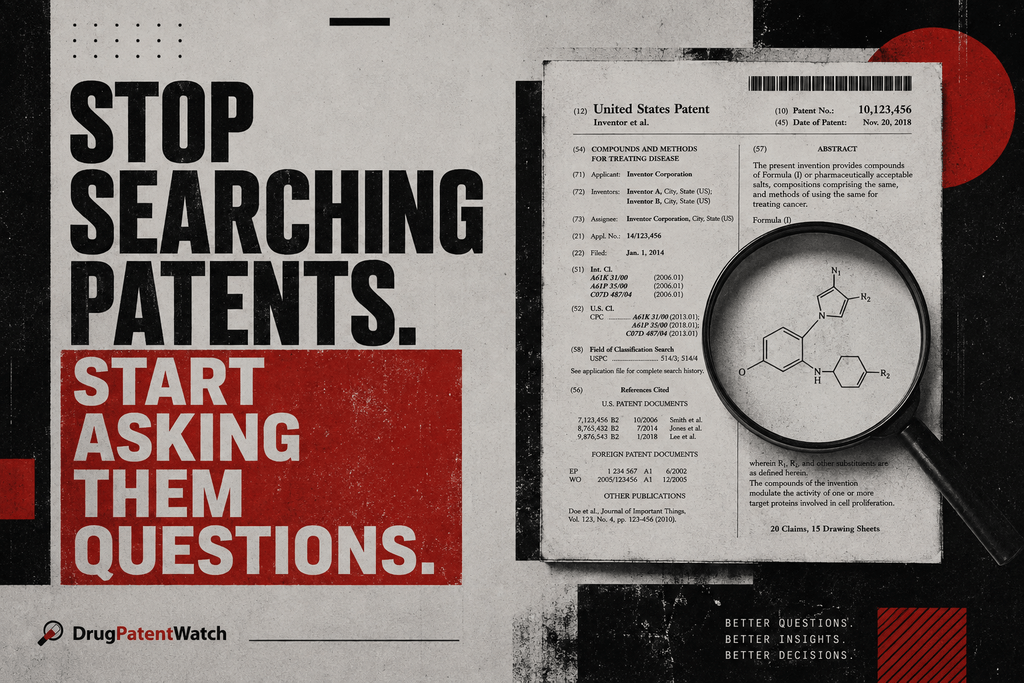
On October 8, 2025, the U.S. Patent and Trademark Office quietly admitted something the patent search industry had been saying for a decade: keyword search misses things. That day, the USPTO published a Federal Register notice launching the Artificial Intelligence Search Automated Pilot Program, or ASAP!, an internal AI tool that reads an application’s specification, claims, and abstract as a whole and returns a ranked list of the ten most relevant prior art documents — before a single Boolean string gets typed [1]. Director John A. Squires has called it the first of many AI pilots the agency plans to deploy in examination [2].
That is the government’s patent office — the institution that trained the modern definition of “prior art search” — conceding that asking a database a real question works better than interrogating it with AND, OR, and NOT.
This matters far beyond patent prosecution. Pharmaceutical IP teams, generic challengers, and licensing groups have spent decades running prior art, freedom-to-operate, and invalidity searches through the same keyword logic examiners use. DrugPatentWatch exists partly because that logic has limits: a compound described one way in a 2004 NDA can be described five different ways across a Phase II trial registry, a 2006 journal article, and a competitor’s patent family, and a keyword string built around any single vocabulary will miss the others. This piece looks at what actually changes — technically, legally, and financially — when a patent question can be asked in plain language instead of translated into search syntax first.
The Short Answer
Keyword and Boolean search return documents that contain your exact words. Natural-language and semantic search return documents that describe your concept, even in different words. The gap between those two results is where invalidating prior art hides, where freedom-to-operate risk goes undetected, and where patent examiners themselves run out of the 19 hours, on average, they are given to review an entire application — reading it, searching it, and writing a rejection or allowance [3]. The USPTO’s own 2024 examiner-activity study found that prior art search alone consumes 46.3% of an examiner’s working time, more than any other task [4]. When the search step is that constrained, what gets asked of the database determines what gets found — and for two decades, what got asked was a string of keywords joined by Boolean operators, a format built in the 1970s for retrieving exact text matches, not concepts [1].
The Findings That Matter
Finding 1: The average USPTO examiner has about 19 hours to review an entire patent application, including the prior art search, per a 2017 comment letter to the USPTO from law professors Michael Frakes and Melissa Wasserman [3].
Finding 2: Prior art search and office-action drafting together account for 86.2% of examiner working hours; search alone is 46.3%, based on an analysis of 560,603 USPTO examiner search records from 2010 [4].
Finding 3: The USPTO’s ASAP! pilot, launched October 8, 2025, had received 169 petitions and granted 76 as of April 16, 2026 — six months into a program the agency had to make fee-free and double the intake target for, in order to drive participation [5][6].
Finding 4: As of early 2026, an industry survey found 68% of patent practitioners had adopted AI-assisted search tools, up from 31% in 2022 — more than doubling adoption in three years [7].
Finding 5: In Salix Pharmaceuticals v. Norwich Pharmaceuticals, the prior art that invalidated three IBS-D patents on Xifaxan was not a patent at all: it was a 2005 ClinicalTrials.gov protocol combined with a 2006 journal article, two documents that used different dosing terminology and had to be conceptually combined rather than keyword-matched [8].
Finding 6: In Millennium Pharmaceuticals v. Sandoz, fourteen-plus generic-drug defendants searched for prior art to invalidate the patent covering Velcade’s active ingredient formulation — and the Federal Circuit found none of them identified a reference that actually taught or suggested the claimed compound [9].
Finding 7: A freedom-to-operate analysis for a single pharmaceutical asset typically costs between $50,000 and $500,000, against a median U.S. pharmaceutical patent damages award of $8.7 million in 2023 — a ratio that explains why search quality, not just search cost, is the real variable being priced [10].
What a Keyword Patent Search Actually Does (and Doesn’t Do)
Before assessing what changes, it helps to be precise about what a keyword search is actually doing under the hood, because the mechanics explain the failure mode.
Boolean Logic Hasn’t Changed Since the 1970s
Patent Public Search, the USPTO’s own free search platform, is built on the same foundation examiners have used for decades: Boolean operators (AND, OR, NOT, XOR), proximity operators (ADJ, NEAR), wildcards, and truncation symbols [11]. It replaced the legacy PatFT/PubEAST/PubWEST systems in 2022, but it runs on the same underlying logic those systems used, and it is the same tool examiners use internally through the Patents End-to-End platform [12][1].
The Default Operator Problem
Patent Public Search’s default Boolean operator is OR. Type two words with just a space between them — “generate produce” — and the system silently treats it as “generate OR produce,” not as a phrase [13]. Get the default operator wrong and a search intended to narrow results instead balloons them, or vice versa. This is not a hypothetical edge case; it is the system’s default behavior, and IP attorneys write entire guidance memos about how to override it [13].
Stopwords: Where Queries Silently Fail
Patent Public Search does not index common words — “stopwords” — inside the body text of a patent at all. Search for a stopword in a title, abstract, or claim and the system returns zero results unless you wrap the term in quotation marks and use a special mixed-case index label [14]. A researcher who does not know this convention exists will simply get an empty result set and conclude, incorrectly, that no relevant art exists.
What This Looks Like With a Real Drug
Consider the vocabulary problem in Salix v. Norwich. Salix’s IBS-D patents claimed administering rifaximin at 550 mg three times daily (1,650 mg/day) for 14 days [8]. The prior art that ultimately invalidated those claims was a Phase II clinical trial protocol describing twice-daily dosing at 550 mg or 1,100 mg, and a 2006 journal article describing 400 mg three times daily (1,200 mg/day) for a different diagnosis code [8]. None of those documents contains the claimed dosing regimen in its own text. A keyword search for “rifaximin AND 1650 mg AND TID AND IBS-D” would not retrieve either reference — because neither reference uses those terms. The Federal Circuit found the combination obvious anyway, reasoning that a skilled person would have been motivated to combine the two documents and would have expected success [8]. That is a conceptual bridge across two documents with non-overlapping vocabulary and non-overlapping numbers — precisely the kind of connection literal text matching is not built to find.
Why Examiners Themselves Don’t Have Time to Ask Better Questions
The 19-Hour Application
The examiner production system — commonly called the “count system” — assigns a fixed number of hours to each application based on its technology area and the examiner’s seniority [15]. Frakes and Wasserman, in formal comments submitted to the USPTO’s own examination time study, put the average at 19 hours per application, covering everything: reading the specification, searching prior art, comparing it to the claims, drafting a rejection, and responding to the applicant’s arguments [3]. For context, an outside attorney defending a client in litigation might spend dozens or even hundreds of hours on prior art search alone for a single patent [3].
Prior Art Search Is Nearly Half the Job
A 2024 study that reconstructed examiner activity from 560,603 OCR-digitized USPTO search records found prior art search alone consumes 46.3% of examiner working time, and that search plus office-action drafting together account for 86.2% [4]. That leaves a thin margin for everything else — interviews, administrative work, consultation with colleagues — inside a schedule the agency has not fundamentally restructured in over three decades [16].
The Classification-and-Keyword Bottleneck
Examiners search within technology classifications first, then apply keyword logic within that classification [17]. That two-step funnel is efficient for narrowing scope, but it structurally excludes prior art sitting in an adjacent classification — the exact pattern that shows up in cross-disciplinary or cross-indication pharmaceutical prior art, where a compound tested for one condition surfaces as invalidating art for a patent claiming a different one, as it did in Salix v. Norwich [8].
Dimension
Keyword/Boolean Search
Semantic/Natural-Language Search
What it matches
Exact text strings and their declared variants
Conceptual similarity regardless of exact wording
Handles synonyms
Only if the searcher lists them (OR chains)
Native — different terms for the same concept cluster together
Cross-language art
Requires translation before searching
Machine-translated corpora searched natively [18]
Query format
Structured syntax (AND/OR/NOT/ADJ/NEAR)
Plain-language question or invention description
Failure mode
Silent — zero results looks identical to “no art exists”
Over-inclusion; requires human review to rank true relevance
Underlying method
Inverted-index text matching (BM25-style ranking)
Vector embeddings, knowledge graphs, or LLM-based retrieval
What “Asking a Real Question” Means, Technically
From Term-Matching to Meaning-Matching
The technical shift underlying every AI patent search platform is the move from representing a document as a bag of words to representing it as a vector — a point in mathematical space where documents about similar concepts sit near each other, regardless of the specific words used [19]. Researchers Julian Risch and Ralf Krestel published foundational work in 2019 training word embeddings specifically on patent-domain text, rather than general-purpose corpora like Wikipedia, because patent vocabulary behaves differently from ordinary language [20]. That domain-specific approach now underlies much of the commercial semantic patent search market.
Graph-Based Search: An Invention as a Network
A second technical approach represents an invention as a graph of technical features and their relationships, rather than as text at all. IPRally, a platform built specifically around this method, lets a researcher type a description in plain language and returns patents that share technical structure even when the vocabulary is completely different, while showing the reasoning behind each match for auditability [21]. PatSnap, Patlytics, and Solve Intelligence take a related but distinct path, layering large language models on top of semantic retrieval to let a user ask a direct question — “has anyone patented a subcutaneous delivery mechanism for a PD-1 inhibitor using this specific excipient class” — and receive a structured, source-cited answer rather than a ranked list of documents to read one by one [22][23].
What the Peer-Reviewed Evidence Shows
This is not purely a vendor claim. A 2019 study published in PLOS One built a full-text similarity search system specifically to address the problem that keyword queries are error-prone because the same technical concept gets described with different vocabulary across disciplines [24]. Separately, a labeled dataset called PatentMatch — built from patent claims paired with prior art passages, with every match verified by technically skilled European Patent Office examiners — exists specifically to train and benchmark machine-learning systems on the task of recognizing semantic correspondence that keyword matching cannot capture [25].
The underlying principle is not new to patents specifically. In one of the earliest rigorous comparisons of the two approaches, a Westlaw researcher evaluated Boolean versus natural-language query performance across two legal-document collections of 12,000 and 410,000 records and found natural-language queries outperformed Boolean search on recall and precision combined [26]. That finding predates the current generation of AI tools by decades — it is a property of how professionals actually search, not a marketing claim about any specific product.
“According to Clarivate’s 2025 State of Innovation Report, the Derwent database indexes 95% of global pharmaceutical patent publications within 48 hours of publication” [27] — a freshness standard that keyword search cannot improve on, because the bottleneck it solves is speed of indexing, not quality of retrieval.
The Patent Office Stopped Waiting and Built Its Own Tool
ASAP!: A Timeline
The USPTO’s Artificial Intelligence Search Automated Pilot Program did not emerge from nowhere. It followed years of infrastructure work: the Patents End-to-End search platform, rolled out to examiners starting around 2020, already gave examiners access to tens of millions more foreign-language documents than the legacy EAST/WEST systems and was explicitly built to integrate with an AI search layer [12]. ASAP! is that layer becoming applicant-facing.
Date
Event
Oct. 8, 2025
Federal Register notice announces ASAP! [1]
Oct. 20, 2025
Petitions open for original, noncontinuing utility applications [1]
Oct. 31, 2025
Director Squires addresses AIPLA on the agency’s AI direction [28]
Nov. 28, 2025
USPTO issues revised AI-inventorship guidance, restoring the presumption of human inventorship [29]
Mar. 25, 2026
Squires testifies before House Judiciary Subcommittee on the tool’s design [2]
Apr. 16, 2026
USPTO extends ASAP! to June 1, 2026, waives the petition fee, doubles intake target to 3,200 applications [5]
What the Automated Search Results Notice Actually Contains
ASAP! works by feeding an application’s Cooperative Patent Classification code, specification, claims, and abstract into an internal AI tool, which searches U.S. patents, pre-grant publications, and foreign patent text for similar disclosures and returns up to ten ranked documents in an Automated Search Results Notice, delivered before a human examiner is even assigned [1][6]. The notice is not a formal Section 132 office action and applicants are not required to respond to it — but once granted, examiners treat the cited documents as standard prior art, and the notice becomes a permanent part of the public file wrapper [6][30].
Six Months In: The Adoption Numbers
Here is where the story gets more honest than the press releases suggest. As of April 16, 2026 — six months after launch — only 169 petitions had been filed across every technology center at the USPTO, and only 76 had been granted [5]. That is a strikingly low number relative to the roughly 600,000 utility applications the agency processes annually, and it is precisely why the USPTO waived the petition fee and doubled its intake target rather than declaring victory [5]. Even a government agency actively promoting its own AI tool is finding that adoption takes real incentive, not just capability.
DesignVision and the Image-Search Parallel
The USPTO paired ASAP! with a second AI initiative: an image-based prior art search tool for design patents, which began examiner training in 2025 and is tied to the Federal Circuit’s LKQ v. GM decision expanding the scope of prior art examiners must consider [31]. The pattern is consistent across both programs — the agency is betting that AI-assisted retrieval, whether over text or images, finds art that classification-plus-keyword search structurally cannot.
The Version 2 Problem
One detail undercuts the current rollout’s completeness: the ASAP! tool in its initial version searches based on the application’s specification alone, not the claims — even though claims define the legal scope of protection [32]. Director Squires has reportedly announced a version 2 that will search the claims directly, but as of this writing that improvement has not shipped [32]. It is a useful reminder that “AI-powered” does not mean “complete,” and that the current generation of even the patent office’s own tool has a known, acknowledged gap.
Where Keyword Search Fails in Pharma Litigation: Two Cases
Case One: Salix v. Norwich — The Combination Nobody Typed Into a Search Box
Rifaximin, the active ingredient in Salix’s Xifaxan, was first synthesized in Italy in the early 1980s and approved there as an antibiotic in 1985 [33]. The FDA approved Xifaxan in 2004 for travelers’ diarrhea, then 550 mg tablets in 2010 for hepatic encephalopathy and in 2015 for IBS-D [33]. When Norwich Pharmaceuticals filed an ANDA in 2019 for a generic 550 mg version, Salix sued under the Hatch-Waxman framework, asserting dozens of Orange Book-listed patents across three groups: hepatic encephalopathy methods, IBS-D methods, and a crystalline polymorph [34]. At trial, the district court held the polymorph and IBS-D claims invalid as obvious, while upholding the HE claims [34]. The Federal Circuit affirmed on April 11, 2024, in a precedential decision [8].
What actually invalidated the IBS-D claims — U.S. Patent Nos. 8,309,569 and 10,765,667 — was not a competitor’s patent search turning up a smoking-gun reference. It was a combination of a 2005 clinical trial protocol on ClinicalTrials.gov and a 2006 gastroenterology journal article, neither of which disclosed the claimed 1,650 mg/day, three-times-daily regimen on its own [8]. The court found a skilled person would have been motivated to combine them with a reasonable expectation of success [8]. Separately, the polymorph patent fell because a 1985 prior art patent (the “Cannata” reference, U.S. 4,557,866) disclosed preparation protocols that a skilled artisan would have characterized using routine techniques, revealing the same crystalline form [35][8].
Case Two: Millennium v. Sandoz — When Fourteen Companies Searched and Still Lost
Velcade’s active ingredient, bortezomib, was itself prior art — disclosed and claimed in an earlier Millennium patent, U.S. 5,780,454 (the “Adams” patent), along with its anticancer activity [36]. But bortezomib alone was too unstable and insoluble to formulate into a viable injectable product. Millennium’s researchers discovered that lyophilizing (freeze-drying) bortezomib in the presence of the bulking agent mannitol produced an entirely new chemical compound — the D-mannitol ester of bortezomib — with dramatically improved stability and solubility, patented as U.S. 6,713,446 [37].
At least fourteen generic-drug companies, including Sandoz, Accord Healthcare, Actavis, Mylan, Agila, two Dr. Reddy’s entities, two Sun Pharma entities, two Apotex entities, Teva, three Glenmark entities, Hospira, and two Wockhardt entities, filed ANDAs and challenged the ‘446 patent’s validity as obvious [38]. The district court initially agreed, ruling the claimed compound was simply the inherent, obvious result of a known process — lyophilizing a known compound with a known bulking agent [38]. The Federal Circuit reversed in 2017, holding that the Adams patent listed ten candidate alcohols for making bortezomib esters but never specifically disclosed, prepared, or tested the mannitol ester, and that no generic defendant identified any reference that actually taught or suggested making that specific compound [9][39]. Despite years of collective litigation resources across more than a dozen sophisticated generic manufacturers, none surfaced prior art connecting the dots the way Salix’s challengers eventually did with rifaximin.
Non-patent literature (ClinicalTrials.gov, journal)
Patent literature only (Adams patent)
Outcome
IBS-D and polymorph claims invalidated; HE claims survive
All challenged claims upheld as non-obvious
Search lesson
Conceptual combination across mismatched vocabulary succeeded
Literal disclosure existed but the specific combination was never found or accepted
What This Means for Freedom-to-Operate and Landscaping Budgets
The Traditional Cost of Asking the Wrong Question
A pharmaceutical freedom-to-operate analysis typically costs between $50,000 and $500,000 per asset, scaled against a drug development program that averages $2.6 billion and ten to fifteen years, per the widely cited Tufts Center for the Study of Drug Development figures [10]. Measured against a median 2023 U.S. pharmaceutical patent damages award of $8.7 million — with top awards exceeding $2 billion — that FTO spending represents roughly 0.002% to 0.02% of the R&D investment it protects [10]. The expense is not the search itself; it is the fully-loaded attorney and analyst time required to construct, run, and manually review keyword queries across multiple jurisdictions and multiple vocabularies for the same underlying chemistry.
An Original Illustrative Calculation
Patent landscaping tasks that required four to six weeks of associate time under a fully manual, keyword-driven search-and-review process can now produce a first-pass structured output — claim charts, prosecution history summaries, preliminary non-obviousness analysis — in hours using LLM-native workflows layered on semantic retrieval, according to reporting on pharma patent landscaping practice [40]. The following is a labeled, illustrative calculation, not a reported industry average. If a mid-level IP associate bills at $350–$400 per hour and a manual landscaping project consumes 160–240 hours (four to six 40-hour weeks), the fully loaded cost of that first-pass search runs roughly $56,000–$96,000 in associate time alone, before partner review. Compressing the first-pass output to a matter of hours does not eliminate the need for expert review and validation — it does not replace the associate — but it shifts where that professional time gets spent: away from the mechanical work of constructing and re-running keyword permutations across jurisdictions, and toward evaluating and stress-testing the results an AI system already surfaced.
A Taxonomy of Search Failure
Reviewing the mechanics above and the two case studies together, four distinct failure modes recur across pharmaceutical prior art and freedom-to-operate work. This is an original classification, not an established industry taxonomy.
Type 1: Terminology Mismatch
The same compound, mechanism, or dosing regimen is described with different vocabulary across documents — a trial protocol’s dosing schedule versus a patent claim’s dosing schedule, as in Salix v. Norwich [8]. Keyword search requires the searcher to anticipate every variant in advance.
Type 2: Non-Patent Literature Blind Spot
Invalidating prior art frequently lives outside the patent corpus entirely — in clinical trial registries, conference abstracts, or journal articles — sources that traditional patent-database search tools do not index by default and that require a separate, differently structured search [8][41].
Type 3: Combination-Finding Failure
Obviousness turns on whether a skilled person would combine two or more references, not whether any single reference discloses the claim outright. Keyword search retrieves individual documents; it does not surface the conceptual bridge between them. That bridge is exactly what defeated the Salix polymorph and IBS-D claims and exactly what fourteen-plus challengers failed to construct in Millennium v. Sandoz [8][9].
Type 4: Time-Budget Recall Ceiling
Even a technically sound search strategy is bounded by how much time a human searcher has to run it. At 46.3% of a roughly 19-hour examination budget, an examiner has a few hours, at most, to search [3][4]. Outside counsel has more time but a hard dollar ceiling tied to the FTO or landscaping budget [10]. Recall — the share of all relevant prior art actually found — degrades as available search time shrinks, regardless of how good the search strategy is.
What Changes for Generic Challengers, Brand Teams, and Investors
For ANDA Filers Running Invalidity Searches
Semantic and graph-based tools that surface conceptually similar prior art regardless of exact wording directly target Type 1 and Type 3 failures — the terminology-mismatch and combination-finding problems that determined the outcome in Salix v. Norwich [8][21][22]. For a generic manufacturer evaluating whether a branded drug’s secondary patents are vulnerable, the practical question shifts from “what keywords describe this claim” to “what does this claim actually cover, described any way at all.”
For Brand Teams Building Patent Portfolios
The same tools cut both ways. If an AI system can find the combination of a trial protocol and a journal article that a Boolean search missed, brand-side counsel drafting new claims can run the same search before filing — identifying and designing around vulnerabilities before a challenger does. The USPTO’s own ASAP! tool exists explicitly to give applicants that early warning before formal examination even begins [1][6].
For Investors and Licensing Teams
For institutional investors and licensing groups conducting diligence, the absence of a documented, stage-appropriate FTO opinion is treated as comparable in severity to missing clinical data [10]. As search tools that can answer plain-language questions across fragmented patent and non-patent literature become standard, the bar for what counts as a “reasonably thorough” search rises accordingly — a diligence team relying solely on legacy keyword search may increasingly be judged against a higher available standard, whether or not it used one.
Where Structured Pharma Data Fits Into This Shift
The same principle applies below the patent-search layer, to the regulatory and litigation data that determines whether a patent is even worth searching around. DrugPatentWatch aggregates Orange Book listings, ANDA filing history, PTAB proceedings, and district court litigation into a single structured platform specifically so that a “what does the data show” question can be answered directly, rather than requiring separate manual queries across the FDA, USPTO, and PACER systems [42]. Its Deep Research Engine is built to return a direct, cited answer to a plain-language pharmaceutical patent question, pulling from disparate underlying sources rather than requiring the user to know in advance which government database, court docket, or filing type contains the answer [43].
The Limits: What AI Search Still Can’t Do
Explainability and the Black-Box Problem
Not every AI search architecture shows its work. Vendors differ meaningfully on this point: graph-based tools like IPRally are built specifically to expose why a given result was matched, in contrast to embedding-based systems where the relevance score is harder to interrogate [21][44]. For litigation-grade work, where a search result may need to hold up as evidence, that transparency gap is not a minor UX detail.
Hallucination Risk in LLM-Native Tools
Large language models generating claim charts, novelty summaries, or comparison memos on top of a retrieval layer introduce a new failure mode entirely absent from keyword search: confident, well-formatted output that misstates what a cited reference actually says. A keyword search that returns nothing tells the searcher, correctly, that it found nothing. An LLM-generated summary that misreads a reference does not announce its own error.
“A Supplementary Data Point, Not a Substitute”
Even attorneys evaluating the USPTO’s own tool have been explicit about its ceiling. Patent counsel reviewing ASAP! specifically for biotechnology applicants concluded the automated notice is useful as one additional input, but is not a substitute for expert human judgment and analysis, particularly given that complex biological databases are not yet well integrated into the search [45]. That caveat generalizes: every tool discussed in this article accelerates and widens the first pass of a search. None of them replaces the legal judgment required to decide whether what was found actually invalidates a claim, discloses an element, or creates freedom-to-operate risk.
What Happens Next
Version 2 and Beyond at the USPTO
Squires has indicated the next iteration of the agency’s internal search tool will search claim language directly rather than the specification alone — closing a gap that currently means the most legally significant part of an application, its claims, is not what the AI tool is actually reading [32]. The agency has also signaled ASAP! is the first in a planned series of AI pilots, not a one-off experiment [2].
What to Watch
Three signals will indicate whether this shift is durable rather than a pilot-program press cycle: whether ASAP! participation grows meaningfully once the fee waiver and expanded intake take effect through June 2026; whether the agency publishes data on how often ASRN-cited art actually gets used in office actions; and whether biotech- and pharma-specific databases get integrated into the search corpus, addressing the exact gap patent counsel has already flagged [5][45].
Key Takeaways
Boolean keyword search, still the default at the USPTO and in most commercial patent databases, matches exact text strings and structurally misses prior art described in different vocabulary [11][13][14].
Examiners have roughly 19 hours to review an entire application, with prior art search alone consuming 46.3% of that time — a hard constraint on how thorough any keyword search can be [3][4].
The USPTO’s own ASAP! pilot, launched October 2025, is an institutional admission that AI-assisted, context-aware search finds art that classification-plus-keyword search does not reliably surface [1].
Six months into ASAP!, adoption remained low (169 petitions, 76 granted) until the agency waived the fee and doubled its intake target — a reminder that better tools do not automatically translate into changed behavior [5].
In Salix v. Norwich, invalidating prior art came from combining a clinical trial registry entry and a journal article across mismatched dosing terminology — a Type 1/Type 3 failure mode that natural-language and semantic search are specifically designed to catch [8].
In Millennium v. Sandoz, more than a dozen generic challengers searched and still failed to find or construct a combination that invalidated the patent — evidence that thorough keyword search, even at scale, has a recall ceiling [9].
AI-assisted search tools accelerate the first pass of prior art and freedom-to-operate work but do not replace the legal judgment required to evaluate what they find, and current tools vary widely in explainability and coverage of specialized databases [21][45].
FAQ
Does natural-language patent search actually find more prior art than keyword search?
Peer-reviewed evidence supports this for both patents specifically and legal text retrieval generally. A 2019 PLOS One study built a full-text similarity system to address exactly this gap, and a classic legal-research comparison found natural-language queries outperformed Boolean search on combined recall and precision [24][26]. The advantage is not universal or unlimited, but it is documented, not just a vendor claim.
Is the USPTO’s ASAP! tool available to everyone filing a patent application?
ASAP! is limited to original, noncontinuing, nonprovisional utility applications filed electronically through Patent Center, and requires a petition on the filing date; it accepted petitions through June 1, 2026 as of this writing, with the petition fee waived starting March 23, 2026 [1][5].
Does the USPTO’s AI search tool replace examiner review?
No. The Automated Search Results Notice is not a formal office action, and examiners remain the decision-makers; the tool surfaces candidate references earlier in the process rather than substituting for examination [1][6].
Why didn’t fourteen generic drug companies find prior art to invalidate the Velcade patent?
The Federal Circuit found that while the closest prior art patent disclosed bortezomib and listed candidate alcohols for making esters of it, no reference specifically disclosed, prepared, or tested the mannitol ester that Millennium’s inventors discovered, and no defendant identified a reference providing a reason to make that specific compound [9]. Extensive, well-resourced search does not guarantee that a valid combination exists to find.
What kinds of prior art does keyword search tend to miss in pharmaceutical patent disputes?
Non-patent literature is a recurring blind spot — clinical trial registry protocols, conference abstracts, and journal articles that use different dosing or formulation vocabulary than the patent claims they end up invalidating, as in Salix v. Norwich [8].
How much does a pharmaceutical freedom-to-operate analysis typically cost?
Published ranges run from roughly $50,000 to $500,000 per asset depending on scope and jurisdictional coverage, a small fraction of the $2.6 billion average cost of bringing a drug to market but still a meaningful line item, which is why search efficiency matters as much as search cost [10].
What’s the difference between semantic search and graph-based patent search?
Semantic search represents documents as vectors in a mathematical space where conceptually similar text clusters together, regardless of exact wording [19][20]. Graph-based search instead represents an invention as a network of technical features and their relationships, which some vendors argue makes the reasoning behind each match more transparent and auditable [21].
Can AI patent search tools hallucinate or misread references?
Tools that use large language models to generate claim charts or novelty summaries on top of retrieval can produce confidently formatted output that misstates what an underlying reference actually discloses — a failure mode that does not exist in plain keyword search, where a null result at least signals its own emptiness.
Is AI-assisted prior art search widely adopted yet among patent professionals?
Adoption has grown quickly but from a low base: one industry survey found 68% of patent practitioners had adopted AI-assisted search tools as of early 2026, up from 31% in 2022, while the USPTO’s own flagship pilot program had only 169 petitions filed six months after launch [7][5].
Should a pharma company rely entirely on AI-assisted search for freedom-to-operate work?
Patent counsel reviewing the USPTO’s own AI search tool for biotechnology applications concluded it functions as a useful supplementary data point rather than a substitute for expert human judgment, a caveat that applies broadly to the current generation of AI-assisted search tools across the industry [45].
References
Federal Register. (2025, October 8). Automated Search Pilot Program. U.S. Patent and Trademark Office. https://www.federalregister.gov/documents/2025/10/08/2025-19493/automated-search-pilot-program
Nixon Peabody LLP. (2026, April 22). USPTO extends AI-driven prior art search pilot and waives petition fee. https://www.nixonpeabody.com/insights/alerts/2026/04/22/uspto-extends-ai-driven-prior-art-search-pilot-and-waives-petition-fee
Frakes, M. D., & Wasserman, M. F. (2017, January 30). Comments Re: Examination Time Goals [Letter to USPTO External Examination Time Study]. U.S. Patent and Trademark Office. https://www.uspto.gov/sites/default/files/documents/etacomment_f_frakes-wasserman_30jan2017.pdf
ScienceDirect. (2024). Procrastination or incomplete data? An analysis of USPTO examiner search activity. Research Policy. https://www.sciencedirect.com/science/article/abs/pii/S0048733324000829
Nixon Peabody LLP. (2026, April 22). USPTO extends AI-driven prior art search pilot and waives petition fee [adoption figures]. https://www.nixonpeabody.com/insights/alerts/2026/04/22/uspto-extends-ai-driven-prior-art-search-pilot-and-waives-petition-fee
U.S. Patent and Trademark Office. (2025). Artificial Intelligence Search Automated Pilot Program. https://www.uspto.gov/patents/initiatives/automated-search-pilot-program
PatSnap. (2026, March 4). 7 Best Integrated IP Research Platforms in 2026. https://www.patsnap.com/resources/blog/articles/7-best-integrated-ip-research-platforms-in-2026/
Millennium Pharmaceuticals, Inc. v. Sandoz Inc., No. 15-2066 (Fed. Cir. July 17, 2017). https://www.govinfo.gov/content/pkg/USCOURTS-ca13-16-01010/pdf/USCOURTS-ca13-16-01010-0.pdf
DrugPatentWatch. (2026, March 20). The Definitive Biopharmaceutical Freedom-to-Operate Playbook. https://www.drugpatentwatch.com/blog/conducting-a-biopharmaceutical-freedom-to-operate-fto-analysis-strategies-for-efficient-and-robust-results/
U.S. Patent and Trademark Office. Search overview QRG – Patent Public Search. https://www.uspto.gov/sites/default/files/documents/Patent-Public-Search-Search-overview-QRG.pdf
U.S. Patent and Trademark Office. (2020). USPTO year in review: New search tool, shorter examination times, and unexpected higher filing volume. https://www.uspto.gov/about-us/news-updates/uspto-year-review-new-search-tool-shorter-examination-times-and-unexpected
Mintz. (2024, February 12). Need Prior Art? Here’s How to Search the PTO Database of Patents Like a Patent Examiner. https://www.mintz.com/insights-center/viewpoints/2231/2024-02-12-need-prior-art-heres-how-search-pto-database-patents
U.S. Patent and Trademark Office. Search overview QRG – Patent Public Search [stopwords]. https://www.uspto.gov/sites/default/files/documents/Patent-Public-Search-Search-overview-QRG.pdf
Harrity & Harrity, LLP. (2024, March 28). Unveiling the USPTO’s Examiner Production System. https://harrityllp.com/unveiling-the-usptos-examiner-production-system-strategic-insights-for-patent-prosecutors/
U.S. Patent and Trademark Office. Patent Examiner Count System. https://www.uspto.gov/patents/initiatives/patent-examiner-count-system
Patent Trademark Blog. (2023, August 10). What a USPTO patent examiner really thinks. https://www.patenttrademarkblog.com/uspto-patent-examiner/
projectpq.ai. (2026, June 21). Top 10 AI Patent Search Tools For Novelty and Prior Art Search. https://projectpq.ai/top-ai-patent-search-tools-2026/
XLSCOUT. (2024, October 29). The Most Popular Patent Database Search Techniques. https://xlscout.ai/popular-patent-database-search-techniques/
Risch, J., & Krestel, R. (2019). Domain-specific word embeddings for patent classification. Data Technologies and Applications, 53(1), 108–122.
IPRally. AI Patent Search, Review & Classification. https://www.iprally.com/
Solve Intelligence. (2026, January 14). Prior Art Search: 7 AI Tools Ranked for Patent Professionals. https://www.solveintelligence.com/blog/post/prior-art-search-ai-tools
PatSnap Eureka. (2025, November 13). Top 7 Prior Art Search Tools for Patent Attorneys in 2025. https://eureka.patsnap.com/blog/ip/prior-art-search-tools-lawyers-2025/
Helmstetter, C., & Sohn, D. (2019). Automating the search for a patent’s prior art with a full text similarity search. PLOS ONE. https://journals.plos.org/plosone/article?id=10.1371%2Fjournal.pone.0212103
Risch, J., Alder, N., Hewel, C., & Krestel, R. (2020). PatentMatch: A Dataset for Matching Patent Claims & Prior Art. CEUR Workshop Proceedings. https://ceur-ws.org/Vol-2909/paper5.pdf
Turtle, H. (as cited in) Case law retrieval: problems, methods, challenges and evaluations in the last 20 years. (2022). arXiv. https://arxiv.org/pdf/2202.07209
PatSnap. (2026, March 4). 7 Best Integrated IP Research Platforms in 2026 [Clarivate Derwent statistic]. https://www.patsnap.com/resources/blog/articles/7-best-integrated-ip-research-platforms-in-2026/
Knobbe Martens. (2025, October 31). The USPTO’s Evolving Approach to Patent Eligibility: Insights from Director Squires’ AIPLA Address. https://www.jdsupra.com/topics/patent-applications/uspto-pilot-program
IPWatchdog. (2026, May 21). The USPTO’s AI Agenda: Examining the Office’s AI Tools and Guidance for Practitioners. https://ipwatchdog.com/2026/05/21/uspto-ai-agenda-examining-the-offices-ai-tools-and-guidance-for-practitioners/
Volpe Koenig. USPTO’s ASAP! Pilot Program: An Early, AI-Assisted Prior Art “Heads Up” for New Patent Filings. https://www.jdsupra.com/legalnews/uspto-s-asap-pilot-program-an-early-ai-2571317/
National Law Review. (2025, July 21). USPTO Announces Upcoming Launch of AI Prior Art Search Tool. https://natlawreview.com/article/uspto-launch-ai-powered-image-based-search-tool-design-patents-amidst-new-legal
Patent Docs. (2026, April 19). USPTO Extends Artificial Intelligence Search Automated Pilot Program (ASAP!). https://patentdocs.org/2026/04/19/uspto-extends-artificial-intelligence-search-automated-pilot-program-asap/
Robins Kaplan LLP. Salix Pharms., Ltd. v. Norwich Pharms. Inc. https://www.robinskaplan.com/newsroom/insights/resources-legal-updates-generically-speaking-hatch-waxman-bulletin-2024-generically-speaking-q2-salix-pharms-v-norwich-pharms2
Lexology / Mintz. (2024, April 25). Federal Circuit Affirms Obviousness of Rifaximin Polymorph Patents. https://www.mintz.com/insights-center/viewpoints/2231/2024-04-25-federal-circuit-affirms-obviousness-rifaximin-polymorph
Salix Pharmaceuticals, Ltd. v. Norwich Pharmaceuticals Inc. [Appendix, Cannata reference]. Supreme Court docket filing. https://www.supremecourt.gov/DocketPDF/24/24-292/325676/20240911133504696_Salix%20-%20Appendix.pdf
McDermott Will & Emery. Obviousness Reversed for Clear Error in Factual Findings on Combination of References. https://www.jdsupra.com/legalnews/obviousness-reversed-for-clear-error-in-72260
Mintz. (2017, July 26). Federal Circuit Thoroughly Reverses District Court Findings of Velcade® Patent Obviousness. https://www.mintz.com/insights-center/viewpoints/2231/2017-07-26-federal-circuit-thoroughly-reverses-district-court
FindLaw. Millennium Pharmaceuticals Inc. v. Sandoz Inc. et al. (2017). https://caselaw.findlaw.com/court/us-federal-circuit/1868072.html
Procopio. (2022, May 9). Millennium Case May Strengthen IP Portfolios of Pharma Companies. https://www.procopio.com/millennium-case-may-strengthen-ip-portfolios-of-pharma-companies/
DrugPatentWatch. (2026, April 13). Patent Landscaping in Pharma: The Human-Supervised AI Playbook That Actually Works. https://www.drugpatentwatch.com/blog/revolutionizing-patent-landscaping-a-human-supervised-ai-approach-to-identify-tech-clusters/
PatSnap. (2026, April 30). Prior art search automation landscape 2026. https://www.patsnap.com/resources/blog/articles/prior-art-search-automation-landscape-2026/
DrugPatentWatch. (2026, April 7). Generic Drug Patent Law: The Complete Playbook. https://www.drugpatentwatch.com/blog/generic-pharmaceutical-patent-and-fda-law/
DrugPatentWatch. Predict Generic Entry, Patent Risk, and Revenue Shifts. https://www.drugpatentwatch.com/