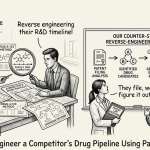
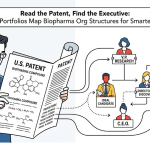
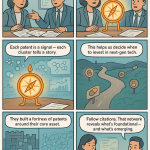
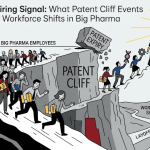
How life sciences talent teams can map influence networks, identify hidden innovators, and outmaneuver competitors using publicly available IP data — before the next $173 billion patent cliff reshapes every R&D team in the industry.
The Intelligence Gap That’s Costing You Candidates
Every year, pharmaceutical companies pour billions into competitive intelligence about molecules. They track Paragraph IV filings, monitor Orange Book listings, and dissect the citation structures of competitor patent portfolios looking for white space. The patent record is the most detailed, continuous, publicly available account of organized scientific work in the world — and most life sciences recruiters treat it as raw material for legal teams.
That is a serious mistake.
The same data that tells a business development team which compounds AstraZeneca is quietly advancing also tells a sophisticated recruiter precisely who is doing the advancing, who taught them, who they work alongside, and which external academic labs feed into their pipeline. The inventor lists embedded in patent filings are not a formality. They are, in aggregate, a map of human scientific capability — organized by topic, dated by priority filing, and cross-referenced through citation networks that reveal intellectual influence as clearly as any organizational chart.
The pharmaceutical industry is entering the most consequential talent cycle in at least two decades. Between 2025 and 2030, nearly 70 high-revenue products will face patent expiration, putting a colossal $236 billion in annual revenue at risk. Companies facing that revenue erosion are not going to fix it with cost-cutting. They need new science — fast. That demand for innovation is creating an acute and immediate war for the scientists capable of generating it. Four out of five pharmaceutical manufacturing facilities are struggling with skills mismatches, and half of all executives say that recruiting experienced staff is challenging.
The recruiters who win that war will not be the ones with the longest LinkedIn contact lists. They will be the ones who learned to read the patent record the way a fixed-income analyst reads a credit filing — not for what it says on the surface, but for what the structure underneath reveals.
This article explains exactly how to do that.
Why Patent Records Are a Talent Intelligence Asset
What a Patent Filing Actually Tells You
A pharmaceutical patent is a legal document, but it is also a data artifact. Every granted patent or published application contains a set of fields that, taken together, produce a remarkably detailed profile of the human beings involved in a piece of research.
The inventor list is the obvious starting point. Every patent names the individuals who made a ‘significant contribution to conception’ of the invention — a legal standard that, in practice, identifies the scientists who did the core intellectual work. This is not the same as an authorship list on a peer-reviewed paper, which often reflects lab hierarchy, grant funding relationships, and departmental politics. Patent inventorship is more carefully policed because getting it wrong creates legal exposure; incorrectly omitting or including an inventor can, in extreme cases, render a patent unenforceable.
Courts have found inequitable conduct — an unforgivable sin in patent law that renders a patent permanently unenforceable — where inventors were deliberately omitted or misrepresented. The incentive to list inventors accurately is therefore high, which makes the inventor field more reliable as a proxy for genuine scientific contribution than publication authorship often is.
Beyond the inventor list, a pharmaceutical patent also tells you the assignee (the company or institution that owns the intellectual property), the filing and priority dates (which reveal the timeline of research activity), the Cooperative Patent Classification (CPC) codes (which precisely categorize the technology), and — most importantly for talent intelligence — the citation network that connects the patent to prior art and to subsequent work.
The forward and backward citations are where the real intelligence lives.
Forward and Backward Citations: Two Different Intelligence Questions
Patent citation analysis involves two directions of inquiry. Backward citation search means analyzing the references cited by a patent. This allows you to explore the foundational prior art upon which the invention was built. Forward citation search means identifying all newer patents that have cited the patent you are analyzing. This is a valuable technique for understanding how a technology has evolved, who the key players are in its development, and what improvements have been made over time.
For talent intelligence purposes, these two citation directions answer fundamentally different questions.
Backward citations answer the question: where did these scientists learn? When a research team at Moderna files a patent citing three papers from a Scripps Research Institute laboratory, they are giving you a map of their intellectual lineage. The scientists whose work is cited are either direct influences on the inventors or — more interestingly — potential sources of the inventors themselves. Academic labs that are consistently cited in cutting-edge patent filings are producing the talent that industry is hiring and developing.
Forward citations answer the question: who considers this work foundational? When a patent filed by a Pfizer team in 2019 is cited by eight subsequent patents filed by five different companies, those five companies have effectively declared that the original Pfizer team’s work matters to their programs. This is a talent intelligence signal of a different kind. The original inventors are demonstrably influential — not just within their own organization, but across the competitive landscape. That influence is precisely the quality that makes a scientist worth recruiting.
For a pharmaceutical company, analyzing the backward citations of a competitor’s new drug patent can uncover the key academic studies, foundational compounds, or platform technologies that informed their discovery process. A sparse list of backward citations can also be a powerful signal, suggesting that a technology is so new that it has few predecessors — a potential indicator of a truly novel and unexplored field ripe for innovation.
The Inventor as a Node in a Network
The leap from patent analysis to talent intelligence requires a conceptual shift. You are not looking at patents; you are looking at people who happen to be represented in patent records. Each inventor is a node. Each co-inventorship relationship is an edge. The resulting co-inventor network is a representation of how scientific collaboration is actually structured inside and between organizations — not how the org chart says it should be structured, but how it genuinely functions.
Inventor networks are denser and more clustered than organization networks — consistent with the presence of small recurrent teams embedded into broader institutional hierarchies. This finding, drawn from analysis of biotechnology patent data, has a direct practical implication for recruiters: the scientists who matter most to a research program are often not the ones with the highest titles. They are the ones who appear repeatedly in the same patent filings, who attract co-inventors from across the organization, and whose work is consistently cited by subsequent efforts. Organizational hierarchy is a poor guide to actual scientific influence. Patent networks are a much better one.
Research shows a statistically significant difference in the time lag until first citation is linked to whether or not that citation comes from a patent whose listed inventors share membership in the same communities as the inventors of the cited patent. This work can quantify the expected acceleration of knowledge flow within inventor communities, establishing the utility of network-analysis tools for studying innovation dynamics.
Translated into talent terms: scientists who are embedded in dense co-inventor communities are not just productive individually — they accelerate the productivity of everyone around them. Recruiting a node with high centrality in an inventor network does not just add one head count; it potentially restructures the knowledge flows within your own R&D organization.
The Patent Cliff Is Forcing a Talent Reckoning
Why the Next Five Years Are Different
The competitive pressure driving this talent intelligence imperative is unusually acute right now. The biopharma sector is unique in that companies face a loss of patent for lead assets every decade or so. That lifecycle of assets requires companies to constantly come up with new innovations — or buy those who do. What makes 2026 through 2030 different is the concentration and size of the losses coming due simultaneously.
Bristol Myers Squibb’s Eliquis, a leading anticoagulant co-marketed with Pfizer, generated over $13 billion for BMS in 2024, with key patents expiring between 2026 and 2028. Johnson & Johnson’s Darzalex, the cornerstone of a $12 billion multiple myeloma franchise, faces patent expiration by 2029. Novartis’s Entresto, a heart failure blockbuster with $7.8 billion in sales, faces generic competition as early as mid-2025.
Perhaps the most watched patent cliff belongs to Merck’s blockbuster cancer therapy Keytruda, one of the industry’s highest-earning assets with more than $29 billion in sales. Keytruda faces a key patent expiry in 2028.
Companies with that exposure are not standing still. Pharma has about $300 billion in revenue nearing loss of exclusivity and about $500 billion in balance sheet capacity. Some of that capital will go toward acquisitions. But acquisitions only work if you have the scientific talent to evaluate, integrate, and advance the assets you are buying. The demand for R&D capability — specifically for the scientists who generate, validate, and iterate on novel drug candidates — is going to intensify sharply through the decade.
Life sciences occupations are among those with the lowest levels of unemployment, with a rate of less than 2%. This scarcity of available talent makes the competition for qualified workers exceptionally tight and hiring timelines longer.
Talent teams that approach this environment with traditional sourcing methods — scanning LinkedIn profiles, trawling conference attendee lists, working alumni networks — will find themselves in a reactive position, bidding against multiple competitors for the same visible candidates. Patent citation analysis offers a way to work proactively, identifying influential scientists before they become active candidates, understanding what motivates their research interests, and building relationships based on genuine knowledge of their work.
The Signal in the Noise: Why Patent Data Beats LinkedIn for Scientific Talent
LinkedIn is an opt-in system. Scientists who are not looking to move, who are heads-down in a research program, who prefer not to maintain a public digital presence — they are systematically underrepresented in the candidate pools that recruiting firms build from social network data. The most productive, most deeply embedded researchers are often the least visible on professional networking platforms.
Patent data has the opposite bias. It is an opt-out system in the sense that filing a patent is a business requirement, not a choice by the individual scientist. A researcher who has never updated their LinkedIn profile in three years will appear in the patent record every time their work produces a patentable invention. The patent record captures scientists at their most productive — when they are generating intellectual property for their organization — precisely the moment that makes them most relevant to a competitor or recruiter.
Natural language processing and machine learning technologies are changing how organizations assess candidate qualifications. These tools parse scientific literature, patent filings, and research citations to better understand a candidate’s domain impact and potential trajectory. This signals a shift: recruitment in pharma is becoming increasingly data-informed and technically augmented.
The practical implication is that a recruiter who builds sourcing capability around patent data is not competing in the same pool as everyone else working from LinkedIn and conference rosters. They are accessing a different, more complete, and more accurately calibrated signal of scientific productivity.
How to Build a Patent Citation Map: A Practical Framework
Step One — Define Your Target Technology Space with Precision
The first step is not to open a database. It is to understand, with precision, what scientific capability you are trying to identify. Broad category descriptions — ‘oncology expertise,’ ‘RNA therapeutics background,’ ‘bispecific antibody experience’ — are not sufficient. You need to translate the scientific requirement into the language of the patent system.
That language is the Cooperative Patent Classification (CPC) system. The CPC is a hierarchical taxonomy of technology that the U.S. Patent and Trademark Office and the European Patent Office jointly maintain. It organizes every patent into categories that go from broad (A61 — Medical or Veterinary Science) through progressively specific subcategories down to extremely precise designations like A61K31/4745 (Pharmaceutical preparations containing piperazine compounds with a nitrogen atom having two or more substituents). A sudden increase in filings by a competitor under A61K47/69 (pharmaceutical nanoparticles) combined with A61P35/00 (antineoplastic agents) and cross-referenced to a specific target gene designation signals a new oncology nanoformulation program years before it appears in a clinical trial registry.
For talent intelligence purposes, identifying the two or three CPC codes that most precisely describe the scientific capability you need allows you to pull a tightly scoped set of patents and the inventor population associated with them. This is far more precise than keyword searching, which produces noise because the same words mean different things across patents filed by different organizations.
Once you have your CPC codes, you can use free tools — USPTO Patent Public Search, Google Patents Advanced Search, the European Patent Office’s Espacenet — to pull all patents in that classification space within your target time window. Google Patents aggregates patent data from the USPTO, EPO, WIPO and more into one streamlined interface. It allows users to filter by date, assignee, inventor, patent office, language, filing status, citing patent, and CPC class.
For pharmaceutical-specific intelligence, DrugPatentWatch extends this foundation with curated data specifically built for the biopharma ecosystem. DrugPatentWatch is a valuable resource offering insights into global drug patents, patent expiration, exclusivity status, and competitive landscapes for pharmaceuticals. It provides data on drug patents, litigation histories, and detailed patent and generic drug manufacturer information. For talent teams operating in drug development contexts, the ability to cross-reference patent data with FDA Orange Book listings and clinical trial registries accelerates the process of identifying which research programs are most active and therefore most likely to be driving current hiring needs.
Step Two — Build Your Seed Inventor Set
With your target patent set defined, extract every unique inventor name associated with those patents over your chosen time window — typically three to five years, though longer windows are useful for identifying scientists who have maintained sustained focus in a particular area.
This raw inventor list is your seed set. For any meaningful technology area at a major pharmaceutical company, this set will contain dozens to hundreds of names. The challenge is ranking them by likely impact and relevance — and this is where the citation network analysis begins to add value that simple name extraction cannot provide.
At the most basic level, frequency is informative. An inventor who appears on twelve patents in a three-year period within a specific CPC classification has a demonstrated commitment to that technology area. But frequency alone conflates prolific filers (who may be managers or coordinators of research programs) with deep contributors (who are doing the actual scientific work). Co-inventor patterns help resolve this ambiguity. A scientist who appears on many patents with a consistent small group of co-inventors is likely operating as a hands-on contributor to a coherent research program. A scientist who appears on many patents with constantly rotating co-inventor lists is more likely operating in an integrating or managing role.
Both profiles are valuable for different recruiting purposes. The hands-on contributor is the candidate you approach when you need to add scientific depth. The integrating figure is the candidate you approach when you need someone who can coordinate across research streams or lead a program.
Step Three — Apply Network Centrality Metrics
Once you have your seed inventor set and the co-inventor connections between them, the analysis moves to the network level. This requires applying metrics from social network analysis (SNA) to the co-invention graph. Three metrics are particularly useful for talent intelligence.
Degree centrality is the simplest: the number of unique co-inventors a given scientist has worked with. High degree centrality indicates a scientist who is collaborative and well-connected within the research community. These individuals tend to have broad networks that extend across organizational boundaries.
Betweenness centrality identifies scientists who sit at the junctions between different research communities. A scientist with high betweenness centrality is a bridge — someone whose removal from the network would disconnect clusters that currently exchange knowledge. Betweenness centrality allows for the identification of more junior researchers that have not yet accumulated sufficient papers to be favoured by more classic metrics such as the h-index. This approach prioritizes strengthening and building a resilient, highly connected research network rather than focusing exclusively on highly productive individuals. For recruiting purposes, these bridging figures are often the most difficult to replace and the most transformative to hire — they carry relational capital as well as scientific knowledge.
Inventors who serve as interfaces or links between different inventor groups apply for technologically broader patents, hence benefiting from their access to different knowledge through their position. This structural position translates directly into commercial value: scientists who bridge communities are more likely to generate cross-domain innovations, the kind that produce genuinely novel mechanisms of action rather than incremental improvements on existing chemistry.
PageRank centrality (or its time-normalized variant, rescaled PageRank) goes further by weighting a scientist’s influence not just by how many connections they have, but by how influential those connections are. A scientist who co-invents with ten highly cited, well-connected colleagues ranks higher than a scientist who co-invents with ten relatively peripheral colleagues. An age-normalized measure of patent centrality, called rescaled PageRank, allows for the identification of significant patents earlier than raw citation count and PageRank score. The patents’ citation dynamics is significantly slower than that of papers, which makes early identification of significant patents more challenging than that of significant papers.
The parallel for talent intelligence is that PageRank-style weighting lets you identify the scientists who are most influential within the most influential clusters — the figures who shape the direction of an entire research community, not just their immediate team.
Step Four — Trace the Citation Trail for Influence Mapping
With your centrality rankings in hand, the next step is to trace the citation trails of your highest-priority inventors. For each scientist in your top tier, pull:
The backward citation network of their patents. Which academic papers, which prior-art patents, and which researchers’ prior work did they build upon? This tells you where they trained intellectually and who their scientific mentors and influences are.
The forward citation network of their patents. Which subsequent patent filings cite their work? The companies and inventors who cite them have effectively cast a vote for the relevance of their contributions. If a scientist at a small biotech finds their 2021 patent cited by five subsequent filings from Eli Lilly, Bristol-Myers Squibb, and Regeneron, they have achieved a level of cross-industry influence that their title and employer may not reflect.
Patent documents support knowledge transfer from academia to industry. Analysis of patent-to-paper citations illuminates the impact of research beyond academia, highlighting its contributions to industry, product development, and technological innovation. Patent to paper citations show how knowledge from academia transfers to industry and adds more value.
The citation trail also tells you something about intellectual trajectory. A scientist whose early patents cite exclusively academic literature, whose mid-career patents cite a mix of academic and industry sources, and whose recent patents cite primarily competitor company work is showing you a professional arc from basic research to applied development. That arc has implications for where they will fit best in a new organization — and what kind of role, culture, and research freedom they are likely to need.
Step Five — Identify the Academic Feeder Institutions
One of the most underutilized insights from patent citation analysis is the identification of academic laboratory feeder networks — the university research groups that consistently generate the scientists who end up in high-impact industrial positions.
When you trace the backward citations of a cluster of patents filed by, say, the mRNA delivery team at a major pharmaceutical company, you will find that those citations concentrate around a small number of academic groups. The labs of specific professors at MIT, the University of Pennsylvania, or the ETH Zurich appear repeatedly because those groups have been producing the foundational work — and, implicitly, the graduate students and postdoctoral researchers — that industrial teams are building on.
Growing evidence shows that scientific collaboration plays a crucial role in transformative innovation in the life sciences. Contemporary drug discovery and development reflects the work of teams of individuals from academic centers, the pharmaceutical industry, the regulatory science community, health care providers, and patients. Public understanding of how collaborations between academia and industry catalyze novel target identification and first-in-class drug discovery is limited.
For talent teams, identifying these academic feeder institutions allows for a fundamentally different sourcing strategy. Rather than waiting for graduates of key labs to appear on LinkedIn or at conferences, a recruiter with this intelligence can build relationships with the lab PIs themselves, understand the graduation timelines and placement preferences of current students, and position their organization as a preferred destination before competitors even know these candidates exist.
This is the patent citation equivalent of building a university recruiting program — except it is targeted at exactly the scientific capabilities your organization needs, rather than at the institutions that your HR department has a historical relationship with.
Reading the Signals: What Different Citation Patterns Mean
The Dense Cluster: A Tightly Integrated Team
When you find a group of inventors who appear together repeatedly across multiple patents in a short time window, you are looking at a high-functioning research team. The density of co-inventor connections within the cluster tells you something about how integrated and interdependent the team is. A very dense cluster — every member has co-invented with every other member — suggests a small, close-knit group that works in tight collaboration. A looser cluster with a few highly connected central nodes surrounded by more peripheral contributors suggests a hub-and-spoke structure with identifiable scientific leaders at the center.
For recruiting purposes, this distinction matters enormously. Recruiting a central node from a dense cluster is high-value but high-risk: they may not function as effectively when separated from their immediate collaborators, and their departure may disrupt the productivity of the team they leave behind in ways that create a legal or ethical issue depending on their contractual obligations. Recruiting a peripheral contributor from a dense cluster is lower risk but also lower expected impact.
The more actionable approach in many cases is to identify which members of a dense cluster are likely to become available due to organizational changes — a merger, a restructuring, a program cancellation — and to build relationships before those events make the candidates visible and therefore contested.
The Bridge Figure: Cross-Domain Innovators
Scientists with high betweenness centrality in a co-inventor network — those who connect otherwise disconnected clusters — have a specific scientific profile that is worth recognizing. They tend to be technically fluent across multiple sub-disciplines. They often have non-linear career histories that have exposed them to different research communities. They are more likely than highly specialized colleagues to generate cross-domain innovations — for example, a chemist with a background in materials science who applies nanoformulation principles to drug delivery in a way that their purely pharmaceutical colleagues would not have considered.
Tracking the publication record and patent portfolio of key scientists at competitor organizations — or at the CROs and academic institutions they partner with — can reveal the technical direction of a program from the intellectual fingerprints of the people executing it. When a company with no prior history in RNA therapeutics begins filing patents with inventors from a leading RNA delivery laboratory, the strategic intent is legible.
For life sciences recruiters, the citation network of a bridge figure is particularly informative. Their backward citations will span multiple fields, reflecting their cross-domain training. Their forward citations will come from researchers in multiple disciplines, reflecting the broad applicability of their contributions. This pattern of broad influence, combined with high betweenness centrality, identifies the scientists who are genuinely capable of catalyzing new research directions — not just executing within established ones.
The Sparse Filer: Early-Career Scientists to Watch
Not every important inventor has a long patent trail. Scientists who have been working in industry for two to four years may have only one or two patents to their names — not because they are unproductive, but because it takes time for research programs to mature to the point of patentable invention and for patent applications to clear the examination process.
The citation network offers a way to identify high-potential early-career scientists who would be invisible to traditional seniority-based filtering. A researcher who filed their first patent in 2023 and already has three forward citations from patents filed by top-tier competitors has demonstrated impact that exceeds what their seniority suggests. Their backward citations — especially if they include their own graduate school publications or the work of a prominent academic advisor — reveal intellectual lineage that predicts future contribution.
Rescaled PageRank allows for the identification of significant patents earlier than citation count and PageRank score. As patents in emerging technological domains tend to quickly attract many citations, age-rescaled metrics can be used as powerful tools to early identify growing technological domains.
The parallel insight for talent intelligence: just as age-normalized centrality metrics identify the most important patents early, applying similar normalization to inventor-level analysis identifies the most important scientists early — before they become senior, before they become visible, and before every recruiter in the industry is calling them.
The Departure Signal: When Citation Activity Stalls
Patent filing data also contains signals about organizational change that talent teams rarely know to look for. When a scientist who has been consistently filing patents — one or two per year over a five-year period — suddenly stops appearing in new filings, that gap is informative. It may indicate a role transition into management or business development. It may reflect a shift to a research area that generates less patentable output. It may also indicate that they have left the organization and their non-compete is preventing them from filing in the same area at a new employer.
For DrugPatentWatch users tracking competitor organizations, this kind of filing-pattern disruption can be an early indicator of organizational change — a research program being wound down, a team being restructured, or a key figure becoming available. The talent intelligence application is to monitor the filing activity of priority scientists on an ongoing basis, treating a sudden gap as a signal worth investigating through other channels.
Real-World Applications: How This Works in Practice
Case Study: Mapping the mRNA Delivery Research Community
The development of lipid nanoparticle (LNP) delivery systems for mRNA therapeutics is one of the most consequential areas of pharmaceutical research of the past decade. The foundational work that enabled the COVID-19 vaccines developed by Pfizer/BioNTech and Moderna emerged from a network of academic and industrial researchers whose connections are legible in the patent record going back to the early 2000s.
A recruiter trying to build an LNP delivery team in 2024 or 2025 could have approached this challenge by searching for candidates with ‘mRNA delivery’ or ‘lipid nanoparticle’ in their LinkedIn profiles. This would have produced a list of candidates skewed toward those who were actively seeking new positions and had recently updated their profiles — almost certainly not the most productive, most deeply embedded scientists in the field.
Alternatively, that recruiter could have pulled all patents filed under CPC code A61K9/51 (nanocapsules) and A61K31/7105 (oligonucleotides and polynucleotides) over the period 2015 to 2024, extracted the complete inventor list, and mapped the co-inventor network. That analysis would have surfaced the small number of scientists who appear repeatedly across filings from multiple organizations — researchers who had clearly moved from academic programs into Moderna, Alnylam, Acuitas Therapeutics, or similar companies, and whose work was being cited by subsequent filings from competitors.
The backward citation trail of those highly central inventors would have pointed back to specific academic laboratories: the Cullis lab at the University of British Columbia (which did foundational LNP work), the Langer lab at MIT (whose contributions to controlled drug delivery appear throughout the prior art), and the Weissman and Karikó labs at the University of Pennsylvania (whose work on nucleoside modification is foundational to mRNA stability). Understanding which of those labs were producing graduates who were entering industry careers would have given a talent team a multi-year view of incoming scientific talent in the field.
This is not hypothetical. The patent record contained this information before it was commonly known that mRNA delivery was going to be among the most commercially valuable pharmaceutical technologies of the decade. Recruiters who had built this analytical capability would have had a meaningful head start in building relationships with the scientists who ultimately became central to the COVID-19 vaccine programs and the broader mRNA therapeutic pipeline.
Case Study: Tracking a Competitor’s Research Team Through Patent Reassignment
Mergers and acquisitions are a routine feature of pharmaceutical industry dynamics, and they create specific talent intelligence challenges. When a large pharmaceutical company acquires a smaller biotech, the scientific staff of the acquired company often face significant organizational uncertainty: their programs may be absorbed, restructured, or discontinued; their reporting relationships change; their cultural environment shifts entirely.
For a competitor or a recruiter, this is a window. But identifying which scientists from an acquired company are likely to be dislocated — or which are most worth recruiting — requires knowing who they are and what they do. Patent data provides exactly this information.
An M&A team can scan the patent landscape for smaller companies that own a handful of highly-cited, highly-central patents in a therapeutic area of strategic interest. These ‘niche innovators,’ identifiable by their potent but compact patent network footprint, can represent highly valuable acquisition opportunities. Performing due diligence through network analysis becomes a crucial component of this process.
For talent teams, the same analysis applies in reverse. When a large company like AstraZeneca or Pfizer acquires a smaller biotech, pulling the acquired company’s complete patent portfolio and mapping its inventor network tells you who the scientific contributors are, what they have been working on, and how central each person is to the program that was acquired. The scientists with the highest centrality in that network — the ones whose removal would most disrupt the knowledge structure of the acquired program — are both the most valuable to the acquirer and, frequently, the most uncertain about their future within a large corporate environment.
Those individuals are worth contacting. Not in a predatory way — and not in the first weeks after an acquisition closes, when emotions are raw and non-solicitation periods may apply — but as a medium-term relationship-building exercise. A recruiter who understands a scientist’s work, can speak intelligently about their research contributions, and can articulate why their specific expertise fits a compelling opportunity at a different organization has a meaningful advantage over a recruiter who is cold-calling from a list of acquired-company employee names.
Case Study: Identifying Hidden Talent in CRO and Academic Partnership Filings
Large pharmaceutical companies routinely collaborate with contract research organizations (CROs) and academic institutions, and those collaborations sometimes result in jointly filed patents. The inventor lists on collaborative patents contain a category of scientific talent that is genuinely difficult to identify through any other sourcing method: researchers who are doing sophisticated pharmaceutical work in a CRO or academic context, who may not self-identify as pharmaceutical industry candidates, but whose technical capabilities match exactly what drug developers need.
Citation network analysis provides a way to track the publication record and patent portfolio of key scientists at competitor organizations — or at the CROs and academic institutions they partner with — and reveal the technical direction of a program from the intellectual fingerprints of the people executing it.
For talent purposes, joint patent filings between a pharmaceutical company and an academic lab are particularly interesting because they represent a moment of particularly close collaboration — close enough that the academic scientists involved are listed as co-inventors on a commercial patent. That is a much stronger signal of industry-relevant expertise than a publication alone. The academic researchers appearing on those joint filings are scientists who have already demonstrated they can work productively within the applied research context of pharmaceutical development. They are ideal candidates for industry transitions.
Tools and Data Sources for Patent Citation Talent Analysis
Free Public Resources
The foundational resources for patent citation analysis are free and publicly accessible.
The USPTO Patent Public Search system provides full-text search of all U.S. patents and published applications, including inventor-field search that retrieves all patents associated with a specific inventor name. The interface allows filtering by date, assignee, CPC classification, and citation relationships. For basic inventor profiling and small-scale co-inventor mapping, the USPTO system is sufficient and reliable. The system distinguishes between the inventor name field — which identifies the human beings who contributed to conception — and the assignee field, which identifies the legal owner of the patent. For talent intelligence, the inventor field is the one that matters. An invention may be assigned to a company the day it is filed, but the inventors listed are the individuals whose scientific contributions made the application possible.
Patent Public Search supports Boolean query construction. A query like IN/’Smith John’ AND AN/’Pfizer’ retrieves all patents where a person named John Smith is listed as inventor on a Pfizer-assigned application. More practically, you can pull all patents assigned to a specific organization within a specific CPC classification and export the complete inventor list — a process that takes minutes in the basic interface and produces a raw dataset that can be sorted and deduplicated in a spreadsheet. The resulting table, showing inventor names, co-inventor relationships, and filing dates across a defined technology space, is the starting material for a co-inventor network map.
Google Patents extends this with cross-jurisdiction coverage, including EPO, WIPO, and patent offices from more than 100 countries. Google Patents allows users to view full PDFs, check citations (prior art and newer patents citing each result), use ‘Similar patents’ for related ideas, and analyze trends with visual maps. The forward citation feature — which shows all patents that cite a given patent — is directly usable for talent intelligence without any additional analytical tools. A recruiter who identifies a candidate from a competitor’s inventor list can pull that candidate’s most significant patent, click through to its forward citations, and within ten minutes understand which organizations have found their work relevant enough to cite in subsequent filings.
Google Patents also supports inventor-name search across all jurisdictions simultaneously, which matters for pharmaceutical recruiting because significant scientific work is international. A British chemist who spent five years at a German biotech before joining a U.S.-based pharmaceutical company will have patents filed in EPO, DPMA, and USPTO, all potentially under slightly different name spellings. Google’s cross-jurisdiction aggregation surfaces all of these together in a way that the USPTO’s database alone does not.
The Lens (lens.org) offers a particularly powerful free resource for academic-to-patent citation tracing. It allows users to identify which scientific papers are cited by which patents, enabling the backward tracing from patent to academic work to specific laboratory that is central to identifying academic feeder institutions. The Lens’s Scholar search covers over 200 million academic works and its Patent search covers global filings, and the system explicitly maps the connections between these two bodies of literature. A talent analyst who wants to know which academic papers are cited most frequently within the LNP delivery patent corpus — and therefore which academic labs are most influential in the field — can extract that information from the Lens in ways that require significant technical work to replicate in other databases.
Espacenet, maintained by the European Patent Office, provides access to over 140 million patent documents and supports sophisticated search filtering, including inventor-based retrieval across the global patent corpus. Espacenet’s INPADOC family grouping function is particularly useful for identifying when a single invention has been filed in multiple jurisdictions, which avoids the risk of double-counting inventors who appear in both the U.S. and European filings of the same underlying patent application.
WIPO’s PatentScope covers PCT applications — international patent applications that can eventually become national patents in over 150 countries. Many pharmaceutical companies use PCT applications as their first filing for global drug development programs precisely because a single PCT application preserves the option to pursue patent protection in multiple markets simultaneously. The inventor lists on PCT applications therefore reflect the team composition at the very beginning of a global drug development program — often a more complete and accurate picture of the core research team than is available from any subsequent national-phase filing.
Commercial Platforms for Scaled Analysis
Free tools are adequate for targeted, manual analysis of specific inventors or small patent sets. Scaled analysis — tracking citation patterns across thousands of patents to build comprehensive inventor network maps — requires commercial platforms.
DrugPatentWatch stands out for its laser focus on biopharmaceutical business intelligence. It is designed not just for patent attorneys but for business development, portfolio management, and competitive intelligence professionals. For talent teams working within pharmaceutical companies, the ability to access DrugPatentWatch’s curated patent data alongside FDA Orange Book listings, litigation history, and exclusivity status means that inventor-level analysis can be contextualized within the commercial significance of the research programs those inventors are working on. Knowing that an inventor is central to a program protecting a drug with $2 billion in annual revenue is a different starting point for a talent conversation than knowing they are working on a program that has not yet reached clinical trials.
Platforms such as DrugPatentWatch are designed specifically for the pharmaceutical industry and provide a powerful suite of features for competitive intelligence. They connect patent information directly to FDA regulatory data, including Orange Book listings, exclusivities, and tentative approvals. For life sciences recruiters, this integration is valuable because it allows you to answer a question that pure patent analysis cannot: is this inventor working on something that is commercially significant today, or are they working on something that may be commercially significant in seven years? The answer affects how urgently you need to build a relationship and how competitive the talent market for that scientist is likely to be.
DrugPatentWatch’s litigation tracking capability adds another dimension. A patent that has been challenged through a Paragraph IV filing, that is the subject of inter partes review, or that has been the focus of district court litigation has drawn attention from the industry in a way that has real implications for the team that developed it. Litigation creates organizational stress. Scientists whose work is under legal challenge may be more available for conversations about new opportunities than their LinkedIn profiles suggest. Competitive intelligence platforms that track this complex data, such as DrugPatentWatch, are indispensable tools for portfolio management and for identifying the earliest possible market entry opportunities — and, by extension, for identifying when the inventors associated with a contested patent may be entering a period of professional uncertainty.
Clarivate’s Derwent Innovation and Orbit Intelligence are enterprise patent analytics platforms that provide inventor-level analysis, citation network mapping, and patent landscape visualization at scale. Both include normalized inventor name disambiguation — which solves the practical problem of common names appearing in patent filings from multiple inventors — and organization-level analytics that allow comparison of inventor productivity across companies. Derwent World Patents Index captures patent publications from 59 authorities worldwide, translating them into English, correcting errors, normalizing inventor and assignee data, and indexing records using 322 technology classes. For a pharmaceutical talent team trying to track inventor activity across Pfizer, Novartis, AstraZeneca, and a dozen smaller biotechs simultaneously, the normalization and indexing that Derwent provides is what makes the analysis manageable.
Clarivate’s PatSnap or Amplified Sciences’ Innography provide co-inventor network visualization that makes the relational structure of research teams visually interpretable without requiring any programming knowledge. The ability to see a co-inventor network as a visual graph — with nodes sized by patent count, edges weighted by co-invention frequency, and node color indicating employer organization — compresses hours of analytical work into an instantly scannable representation. A talent director reviewing such a map can identify the densely connected central nodes (the scientists doing the most integrated work), the bridge figures (those connecting otherwise separate clusters), and the peripheral contributors (those with a few patents in the area but not deeply embedded in the community) in a single visual inspection.
For talent teams with the budget for enterprise tools, the return on that investment is primarily in analyst time. A task that takes two days of manual work using free databases — building a co-inventor network map for a specific CPC classification and computing basic centrality metrics — can be completed in two hours with a commercial platform’s built-in visualization and analytics. At the scale of an ongoing talent intelligence program tracking dozens of priority inventors across multiple technology areas, that efficiency difference is substantial.
Building Analytical Workflows for Ongoing Intelligence
The most sophisticated talent intelligence programs treat patent citation analysis not as a one-time research exercise but as an ongoing monitoring capability. Tools like DrugPatentWatch can be leveraged to set up automated alerts to be notified whenever a key competitor files a new patent application in a specific therapeutic area or for a particular class of compounds, allowing for real-time tracking of R&D activities.
For talent teams, the equivalent capability is setting up inventor-level alerts. When a scientist you have identified as high-priority files a new patent, that event is informative in several ways: it confirms their continued active involvement in research, it updates your understanding of their technical focus, and the new patent’s co-inventor list may reveal new relationships — potentially new colleagues who are themselves worth adding to your candidate pipeline.
This kind of ongoing monitoring requires some organizational infrastructure: a system for tracking your priority inventor list, a workflow for reviewing new patent alerts, and a method for updating your network maps as new data comes in. The effort is not trivial, but the competitive advantage it produces — a continuously updated map of the most influential scientists in your target technology areas, with visibility into their career trajectories, research directions, and professional networks — is not replicable through traditional recruiting methods.
The Legal and Ethical Framework
What Is and Is Not Permissible
Patent data is public. The inventor names, assignee organizations, filing dates, and citation networks within the patent record are all publicly available by design — the disclosure of information in exchange for the grant of exclusive rights is the foundational bargain of the patent system. There is nothing legally or ethically problematic about using this publicly available information for talent intelligence purposes.
Where legal and ethical constraints do apply is in the manner of outreach to candidates identified through patent analysis. Non-solicitation agreements, which typically prohibit one company from recruiting employees from another for a defined period, remain enforceable regardless of how you identified the candidate. The fact that you identified a scientist through patent analysis rather than through a personal referral does not affect the applicability of any contractual restrictions on recruiting them.
Similarly, the intelligence that patent analysis provides about a competitor’s research programs — which specific drugs are in development, which technical approaches are being pursued, which teams are working on which problems — is legitimately gathered intelligence, but the way it is used matters. Recruiting a scientist specifically to access confidential information about a competitor’s program (as distinct from recruiting them for their general scientific expertise) is a different matter and can raise trade secret concerns even when the patent record was the initial sourcing tool.
The practical guidance is to use patent citation analysis for sourcing and for building a genuine understanding of a candidate’s scientific work, but to conduct recruiting conversations in the same manner you would with any other candidate — focused on what the candidate wants to do next and what your organization offers, not on extracting intelligence about their current employer’s confidential programs.
Inventor Name Disambiguation: A Real Problem
One practical limitation of patent citation analysis for talent intelligence is that inventor names in patent filings are not uniquely identified. A search for ‘J. Wang’ in the USPTO database returns contributions from hundreds of different individuals. The same individual may appear as ‘J. Wang,’ ‘Jian Wang,’ ‘Wang, J.,’ and ‘Jian H. Wang’ across different filings depending on how the application was prepared.
Commercial patent databases address this through inventor disambiguation algorithms that assign unique identifiers to individual inventors based on combinations of name, assignee organization, co-inventor networks, and CPC classifications. These systems are imperfect but significantly better than raw name matching. For manual analysis of specific high-priority individuals, cross-referencing patent inventorship against scientific publication records — using PubMed, Google Scholar, or ORCID — provides a reliable disambiguation method. Most productive pharmaceutical researchers have both patent and publication records, and the two can be triangulated to confirm identity.
ORCID (Open Researcher and Contributor ID) is particularly useful for linking patent records to scientific publication records because many researchers now voluntarily include their ORCID identifiers in both, creating an explicit linkage between their academic and industrial intellectual contributions.
Integrating Patent Intelligence Into Recruiting Workflows
Building the Talent Intelligence Function
Most life sciences recruiting organizations are not currently structured to perform patent citation analysis. The skill set required — familiarity with patent databases, basic network analysis concepts, and the ability to read and interpret patent claims in a relevant technology area — is not standard in talent acquisition functions. Building this capability requires either developing it internally or partnering with it externally.
The internal development path typically involves identifying one or two individuals within the talent acquisition team who have scientific backgrounds and an interest in developing patent intelligence skills. A PhD-level scientist who has transitioned into recruiting (a not-uncommon career path in life sciences) has the scientific literacy to read patents meaningfully. Adding training in patent database navigation and basic network analysis tools to that foundation is achievable in weeks.
The external partnership path involves engaging with competitive intelligence firms or patent analytics specialists who already have these capabilities and can perform targeted analysis on request. This approach works well for episodic needs — a specific search for the top RNA delivery scientists in the U.S. market, or a mapping of the co-inventor networks behind a particular competitor’s oncology program — but does not easily scale to ongoing monitoring.
The most effective model combines both: an internal resource with basic patent intelligence capability for ongoing monitoring and alert management, supported by external specialists for deep-dive analysis when a specific strategic need arises.
Structuring the Outreach: How to Approach Scientists Identified Through Patent Analysis
The practical challenge of turning patent-based intelligence into successful recruiting conversations is significant. A scientist who has never heard of you or your organization receives a message demonstrating detailed knowledge of their specific patents — including the precise technical areas of their work, the academic foundations of their research, and the forward citation network that demonstrates the influence of their contributions. That outreach can either be compelling or unsettling, depending entirely on how it is framed.
The framing that works is one of genuine intellectual engagement rather than surveillance. A message that says, ‘I read your 2022 patent on lipid nanoparticle formulations and noticed that your work on PEGylation optimization was cited in three recent Moderna filings — I wanted to discuss how your approach might apply to the delivery challenges we are working on’ is a conversation opener that respects the scientist’s intellectual work. A message that says ‘I see from your patent filings that you have been working on LNP delivery — we have an opening that might interest you’ is functionally indistinguishable from any other cold recruiting message and loses the intelligence advantage entirely.
Advanced tools enable precision hiring by analyzing patents, publications, and technical records to identify professionals proficient in CRISPR, FDA compliance, or mRNA technologies. Roche reduced its hiring cycle by 30% by integrating natural language processing into its talent search processes, improving diversity and alignment with technical needs.
The depth of knowledge that patent citation analysis enables is a conversation asset — but only if it is deployed as genuine scientific engagement. Recruiters using this approach need either the scientific literacy to engage at that level themselves, or a clear workflow that connects the intelligence output of the analysis to a scientific hiring manager who can conduct the initial technical conversation.
Building Long-Term Relationships with the Academic Feeder Network
One of the highest-return applications of patent citation analysis for talent teams is the systematic identification and relationship-building with the academic research groups that consistently produce pharmaceutical scientists. This is a longer-term strategy than direct candidate outreach, but it has compounding returns.
When you identify, through backward citation analysis, that a specific academic laboratory at Johns Hopkins or UCSF is consistently cited in the foundational patents of your target technology area, that information should flow to a relationship-building program with that lab. This means engaging with the PI at relevant scientific conferences, establishing a visiting scientist or collaborative research program if your organization’s resources support it, and developing a pipeline of awareness about the lab’s current students and postdoctoral researchers and their research timelines.
The competitive advantage of this approach is timing. By the time a graduating PhD student or postdoctoral researcher from a high-impact lab is actively interviewing for industry positions, they are typically talking to multiple companies simultaneously. The organization that has already built a relationship with that lab — that the PI knows by name and recommends to their students — has a meaningful first-mover advantage over the organization cold-calling the same candidate three months before their graduation.
Advanced Techniques: Reading the White Space
What Is Not Being Filed: Technology Gaps as Talent Signals
Patent citation analysis is not only a tool for finding candidates. It is also a tool for understanding the shape of scientific opportunity — and the shape of scientific opportunity determines what kind of talent is most strategic to recruit.
When a systematic analysis of the patent landscape in a given technology area reveals that a significant scientific question is not being addressed — that despite a large body of filings on protein degradation, for example, there are relatively few filings on the delivery mechanisms needed to get degraders into intracellular compartments — that white space is both an innovation opportunity and a talent signal. The scientists who are working on that gap, whether in academia or at smaller biotechs, are working on a problem whose solution will be highly valuable.
Strategically, backward citation analysis can reveal gaps in the prior art that may represent opportunities for innovation. If an area of technology shows few backward citations, it might indicate that the field is relatively unexplored and ripe for new inventions. This insight allows businesses to direct their R&D efforts towards under-researched areas, potentially leading to breakthrough innovations and first-to-market advantages.
For talent strategy, this means that the scientists whose current work sits in the white spaces — whose research is not yet being heavily cited because it is genuinely novel — are worth identifying and cultivating before the competitive significance of their work becomes obvious. By the time a white space fills with filings from multiple major pharmaceutical companies, the most capable scientists in that area are known to many recruiters. The time to build relationships with them is before that happens.
Tracking Technology Migrations: Scientists Who Cross Domain Boundaries
Some of the most commercially valuable scientific innovations in pharmaceutical history have come from domain migration — the application of methods or concepts from one field to problems in another. CRISPR’s application to gene therapy emerged from a mechanism originally identified in bacterial immune systems. GLP-1 receptor agonists as obesity treatments emerged from diabetes research. Antibody-drug conjugates brought oncology and immunology together in ways that required scientific fluency in both.
Patent citation analysis can identify scientists who are executing this kind of domain migration in real time. A researcher whose early patents cite primarily materials science literature and whose more recent patents cite primarily pharmaceutical delivery literature is crossing a domain boundary. If their recent pharmaceutical patents are already attracting forward citations from established drug developers, the migration has been successful — they have brought genuine cross-domain insight into a pharmaceutical application and the field is recognizing it.
These domain-migrating scientists are systematically undervalued by traditional recruiting approaches that filter candidates based on narrow keyword matches to job description requirements. They rarely have the precise domain-specific vocabulary that a keyword-filtered LinkedIn search retrieves. But in patent citation networks, their cross-domain influence is measurable — and that influence predicts their capacity to generate the kind of unexpected innovation that pharmaceutical organizations most need as the easy incremental advances in established drug classes become harder to find.
Monitoring Inventor Activity Near Patent Expiration
Platforms like DrugPatentWatch that track patent expiration timelines provide a specific talent intelligence signal that is worth combining with inventor-level analysis. When a major pharmaceutical company’s blockbuster product is approaching patent expiration, the research team that developed and extended that product faces an organizational pressure: they are no longer working on a growth asset. Their work may shift to defending the franchise through lifecycle management patents, or the program may be wound down as attention shifts to new pipeline assets.
Scientists in that situation are often more open to conversations about new opportunities than they would be at the peak of a program. They know the commercial dynamics of their situation. They understand that the resources devoted to their program are likely to decline. And they may have a strong interest in finding a new context where they can work on something genuinely early-stage again.
DrugPatentWatch tracks pharmaceutical patent portfolios across thousands of compounds, allowing companies to monitor competitor filings, identify gaps in coverage, and anticipate generic or biosimilar entry timelines. A talent team that uses this data to identify the research teams associated with products approaching patent expiration — and builds relationships with the scientists on those teams two to three years before the cliff arrives — is operating with foresight that purely reactive recruiting never achieves.
Building the Business Case: What This Intelligence Is Worth
The Cost of Getting It Wrong
In pharmaceutical research and development, the cost of talent misjudgment is unusually high. The total cost of bringing a new molecular entity to market is estimated by most analyses to exceed $2 billion, and a significant portion of that cost is the time and resources spent on programs that fail. Program failure rates in pharmaceutical R&D remain stubbornly high — roughly 90% of drug candidates that enter Phase I clinical trials do not reach approval. The scientific leadership of a research program has a measurable effect on those success rates.
Recruiting a scientist who lacks genuine expertise in the relevant domain — who presents well in an interview but whose actual contribution to the field, as measured by patent and publication impact, is peripheral — is costly in ways that extend well beyond the direct cost of a failed hire. Failed or suboptimal senior scientific hires can misdirect programs, delay timelines, and deplete the organizational capital needed for the next attempt.
Patent citation analysis does not eliminate this risk. But it provides a pre-interview signal about a candidate’s actual scientific contribution that is more reliable than a CV, more objective than a reference check, and more domain-specific than a general intelligence assessment. A scientist with high centrality in the citation network of their field has demonstrated, through the cumulative judgment of other scientists citing their work, that they are making meaningful contributions. That signal is worth incorporating into hiring decisions.
Consider a concrete scenario. A pharmaceutical company needs to hire a Head of RNA Delivery for a new mRNA therapeutic program. Two finalists emerge from a conventional search: Candidate A has a strong CV, publications in good journals, and impressive interview performance. Candidate B has a less polished CV presentation but a patent portfolio in the target technology area with four highly cited patents cited by eight subsequent filings from Moderna, Alnylam, and Arctus Biotherapeutics. Candidate A’s publications are primarily descriptive; their research has not generated significant forward citation activity. Candidate B appears on the co-inventor network as a bridge figure — someone who connects the basic academic LNP research community to the applied pharmaceutical delivery community.
Conventional recruiting processes often favor Candidate A: better CV presentation, smoother interview, and a title history that linearly maps to the open role. Patent citation analysis systematically surfaces Candidate B: lower personal visibility, but demonstrably higher impact within the community that matters most for the program. The difference in hiring outcome between organizations that can make this distinction and those that cannot, compounded across dozens of senior scientific hires over a multi-year period, is significant.
The Quantifiable Advantage
‘69% of life sciences and healthcare employers report difficulty sourcing skilled talent’ — ManpowerGroup U.S. Talent Shortage Survey [1]
In that environment, the advantage of accessing a candidate pool that competitors do not see is not just theoretical. A talent team that identifies a high-impact scientist before they become an active candidate — that builds a relationship over 12 to 24 months before a formal search begins — has, in effect, removed that scientist from the competitive market. When a role opens, the relationship already exists. The time-to-hire compresses. The offer acceptance rate improves. The total cost of the search declines.
A Deloitte report indicates a 25% increase in hiring expenses since 2020 in biotech, exacerbated by supply-chain disruptions and increased R&D demands. Pfizer leverages machine learning to forecast staffing needs, cutting time-to-hire by 15% and avoiding costly R&D delays. Amgen’s collaboration with staffing agencies lowered costs by 30% while ensuring high-quality candidates through pre-vetted talent pools.
The financial case for investing in patent-based talent intelligence capability is straightforward: if it reduces the average time-to-fill for senior scientific roles by 20% and increases the proportion of hires who demonstrate measurable scientific impact, the return on the investment in analytical tools and capability development is large relative to the cost of that investment.
Quantifying that return requires making assumptions about hire quality and program impact that are inherently uncertain. But the indirect evidence is strong. Pharmaceutical companies whose R&D programs have historically produced more first-in-class innovations share a common characteristic: they are better than their peers at identifying and recruiting scientists who are working at the productive frontier of their fields, not just scientists with relevant credentials. Patent citation analysis is not the only way to achieve that, but it is the most systematic, scalable, and evidence-based approach currently available.
Measuring the Program: What Good Looks Like
A patent-based talent intelligence program should be measured against concrete recruiting outcomes, not just analytical outputs. The metrics that matter are the proportion of hires sourced through patent intelligence channels, the forward citation activity of those hires in the three years following their joining (a proxy for their scientific productivity and impact), the time-to-fill for senior scientific roles compared to roles filled through conventional sourcing, and the retention rates of scientists identified and hired through this program versus conventionally sourced hires.
The citation impact metric deserves particular attention. A scientist who joins your organization and immediately begins generating patents that attract forward citations from industry peers is doing exactly what patent citation analysis predicts they will do — contributing meaningfully to the advancement of the field from their new position. Tracking this metric provides a validation loop for the talent intelligence program: if the scientists identified through patent citation analysis and successfully hired are, in fact, more impactful than the scientists hired through conventional sourcing, the methodology is working. If not, the analytical approach needs refinement.
Program metrics should be reviewed annually at minimum, and the analytical methodology should evolve as the organization’s understanding of which citation signals best predict scientific productivity improves. The best talent intelligence programs are, in this sense, self-improving: each hiring cycle generates new data about which analytical indicators were most predictive, and that data is used to sharpen the next cycle’s prioritization.
Implementation Roadmap: From Zero to Patent Intelligence Capability
Phase One: Baseline Mapping (Weeks 1 to 6)
Start with your three most pressing hiring needs, not with an attempt to map every relevant technology area simultaneously. For each need, define the target CPC classification codes (use the CPC browser at the USPTO website), pull all patents in that classification from the past five years at your priority competitor organizations, and extract the complete inventor lists with filing frequencies.
Do not attempt to build the full network analysis in this phase. The goal is a ranked list of inventors at competitor organizations, organized by patent frequency, with each inventor’s complete patent list attached. This takes one to two days of analytical work per technology area using free tools, and it produces immediate value — you will almost certainly discover names that are not visible in any existing candidate pipeline.
Phase Two: Citation Network Analysis (Weeks 7 to 16)
For the top fifteen to twenty inventors from your Phase One analysis, build the citation maps. For each priority inventor:
Pull their top five most-cited patents (by forward citation count). Identify the three to five organizations most frequently citing their work. Trace their two to three most significant backward citations to identify their academic training and intellectual influences. Identify all academic labs that appear in the backward citations of the priority inventor group collectively — these are your feeder institution targets.
In this phase, the co-inventor mapping becomes critical. For each priority inventor, pull the complete list of co-inventors on all their patents in the analysis window. Build a matrix that shows which priority inventors have co-invented with each other directly, which have shared co-inventors without directly co-inventing, and which are essentially unconnected within the patent record. This matrix is the foundation of your network graph.
Tools like Gephi (free, open-source network visualization software) or even Excel’s Power Query can render this matrix as a visual network graph without requiring specialized patent analytics software. Nodes are inventors; edges connect co-inventors; edge weight reflects the number of patents co-invented. Applying a basic force-directed layout algorithm will visually separate dense clusters from bridge figures and peripheral nodes, making the network’s structure immediately readable.
At this stage, you also want to pull the non-patent literature cited in each priority inventor’s patents. The Lens and Google Scholar both support this. The cited papers’ author lists identify the academic scientists whose work is foundational to the industrial research — these are the people whose labs you want to be building relationships with. Cross-reference those academic authors against recent graduation records and postdoctoral appointment announcements in the field; the students and postdocs of the most-cited academic authors are your next generation of high-potential candidates.
This analysis produces two outputs: a prioritized list of candidate targets (the priority inventors themselves, ranked by citation centrality) and a list of academic relationships worth developing (the feeder labs identified through backward citation tracing).
Phase Three: Engagement Strategy Development (Weeks 13 to 20)
Before any outreach happens, the talent team needs to develop engagement strategies calibrated to the specific profile of each priority inventor. Read the patents — not just the abstract and claims, but the detailed description and the background section. The background section of a pharmaceutical patent is often the clearest prose articulation of the scientific problem the inventors were trying to solve. Reading it tells you what challenge motivated the work, what existing approaches were inadequate, and what the inventors understood about the state of the field when they started.
Check the corresponding publications. Most pharmaceutical patent filings are accompanied by related scientific publications in peer-reviewed journals, typically filed before or shortly after the patent application to avoid prior art issues. PubMed and Google Scholar searches for the inventor’s name will surface these. Reading the publication alongside the patent gives you the scientific rationale in the academic voice — which is often more detailed and more revealing about the scientist’s intellectual framework than the patent’s legal prose.
Review conference participation history. Most pharmaceutical scientists present their work at relevant therapeutic conferences — AACR for oncology, AHA for cardiovascular, EASD for diabetes, AAPS for drug delivery — and those presentations are often the most candid articulations of a research program’s current direction. Conference presentations cited in a scientist’s publication record provide a window into how they think about their work and what they consider the most significant open questions in their field.
With this preparation, the engagement strategy for each priority inventor can be tailored. A scientist who has spent the past three years working on a single, well-defined problem needs to hear about how your organization’s research program addresses that same problem in a complementary way. A scientist whose work spans multiple technology areas needs to understand how your organization creates space for cross-domain thinking. A scientist who has recently co-invented with a set of junior researchers needs to be approached as a potential team leader — someone whose ability to build and mentor a research group is part of what you are recruiting.
Phase Four: Ongoing Monitoring and Relationship Building (Ongoing)
Set up patent alerts through Google Patents or a commercial platform for all priority inventors. Assign relationship development to specific members of the talent team, with a goal of one meaningful touchpoint per quarter for each priority target — not necessarily a recruiting conversation, but engagement at relevant conferences, sharing of relevant scientific publications, or participation in scientific communities where those researchers are active.
The touchpoints that work best are those that demonstrate genuine awareness of the scientist’s current work. A note that says ‘I read your recent paper on PROTAC degrader selectivity and thought you might be interested in this preprint from our research group on the same mechanism’ is a qualitatively different communication from a standard recruiting email. It shows that the recruiter or hiring manager is tracking the scientist’s work on an ongoing basis — which is exactly what a patent alert system makes possible.
For academic feeder institution targets, the engagement cadence is different. PIs of key labs appreciate being kept informed about career opportunities for their students, about the state of the field from an industry perspective, and about potential collaborative research arrangements. An annual conversation — at a conference, during a lab visit, or over a video call — is sufficient to maintain the relationship. The goal is not to recruit the PI but to ensure that when their students and postdocs are considering industry careers, your organization is on their shortlist.
Review the priority inventor list quarterly. New filings will bring new names to attention. Gaps in filing activity may indicate organizational change. New co-inventor relationships may reveal team restructuring or new collaborative partnerships worth understanding. The goal is a living document — not a static list compiled once and consulted occasionally, but a continuously updated map of the most influential scientists in your target technology areas.
The Intersection of AI Drug Discovery and Patent Talent Intelligence
How AI-Assisted Inventions Are Changing the Inventor Landscape
The rapid integration of artificial intelligence into pharmaceutical drug discovery is creating a new category of patent filing — the AI-assisted invention — that has specific implications for talent intelligence analysis. The USPTO’s 2024 guidance on AI-assisted inventions establishes a ‘significant contribution to conception’ standard that requires pharmaceutical companies to document not just what their AI models produced, but what their human scientists decided and why. That documentation is the foundation of any patentable AI-assisted invention.
What this means for talent intelligence is that the inventor lists on AI-assisted pharmaceutical patents are, if anything, more reliable as signals of genuine human scientific contribution than inventor lists on conventionally discovered patents. Because the legal standard explicitly focuses on which human beings made the meaningful conceptual decisions — as distinct from which AI models generated candidate structures or predictions — the scientists listed as inventors on these patents are the ones who shaped the research direction, interpreted the AI output, and made the scientific judgments that determined what got synthesized, tested, and developed.
The implication for co-inventor network analysis is that AI-assisted patents may produce denser, more cross-functional co-inventor networks than conventional discovery patents. A patent covering an AI-discovered compound requires inventors who understand the biology of the target, the chemistry of the compound class, the computational methods used to generate and prioritize candidates, and the experimental validation methods that confirmed activity. That breadth means the co-inventor list on an AI-assisted patent may function as a window into the full interdisciplinary composition of an organization’s AI drug discovery team in ways that a conventional medicinal chemistry patent — where the inventor list is often just the chemists — does not.
For talent teams, this means that AI drug discovery patents are worth examining not just for the specific inventors listed, but for what those inventor lists reveal about how organizations are structuring their AI research programs. A company whose AI-assisted patents consistently list three computational chemists alongside two biologists and an ADME specialist has a different organizational model than a company whose AI-assisted patents list only computational scientists — reflecting a more integrated, cross-functional team structure. Understanding those structural differences tells you what kind of talent each organization needs most and what kind of collaboration environment prospective candidates would be entering.
Patent Quality as a Recruiting Signal
Not all patents are created equal as talent intelligence signals. An AI-driven discovery program that files many quickly-drafted patents with thin inventorship documentation is building a portfolio that competitors can challenge. An AI-driven program that files fewer patents with thorough documentation and carefully crafted claims is building a durable competitive moat. The distinction between a patent portfolio built for quantity and one built for quality is readable in the patent record — and it reflects something real about the research culture of the organization that produced it.
For talent intelligence, a scientist whose patents are consistently granted with strong independent claims, whose work survives examination with minimal claim narrowing, and whose portfolio includes patents that have withstood inter partes review challenges is demonstrating both technical capability and IP strategy sophistication. These scientists are the ones who understand how to translate genuine innovation into durable intellectual property — a combination of skills that is genuinely rare and genuinely valuable.
Conversely, a high-volume filer whose patents consistently receive heavily narrowed claims during examination, or whose filings frequently cite their own prior work as the most relevant prior art rather than advancing into new territory, may be a productive scientist in a narrow sense but is not necessarily the transformative innovator that their publication or patent count might suggest. The quality signal in patent citation networks — where high-quality patents attract forward citations from a wide range of subsequent filers, while low-quality patents receive few or no forward citations — is exactly this discrimination. Raw count favors prolific filers; citation quality favors impactful contributors.
Competitive Dynamics: How Rival Companies Use This Intelligence Against You
Your Patent Portfolio Is a Talent Recruitment Map for Competitors
The analysis described in this article works in both directions. The same methodology that allows your talent team to identify key scientists at competitor organizations allows competitor talent teams to identify the key scientists in your organization. Every patent your company files is a public disclosure of who is doing your most important scientific work. The inventor lists, the co-inventor networks, and the citation footprint of your portfolio are all visible to anyone with the analytical sophistication to read them.
This has practical implications for talent retention strategy. Scientists with high betweenness centrality in your co-inventor network — those who bridge otherwise separate research communities within your organization — are the most likely to be identified as high-priority targets by competitor recruiters using the methods described here. They are also, as noted earlier, the scientists whose departure would most disrupt the knowledge flows that your research programs depend on.
Understanding which of your own scientists are most exposed to this kind of targeted recruiting is itself a talent intelligence application of the methodology. Running the centrality analysis on your own patent portfolio, rather than a competitor’s, produces a ranked list of your most scientifically influential and therefore most recruitable employees. Those individuals warrant specific attention in your retention planning — not just competitive compensation, but genuine recognition of their scientific contributions, research freedom, resources commensurate with their influence, and a sense of participation in strategic decisions about the research programs they are central to.
Scientists with high network centrality typically did not achieve that centrality by accident. They are intellectually engaged, highly collaborative, and motivated by the quality of the work they are doing. Retention strategies that focus purely on financial compensation without addressing research quality, organizational culture, and scientific autonomy will fail with these individuals even when the compensation is generous.
The Arms Race Dimension: When Everyone Is Using This
As patent-based talent intelligence becomes more widely understood, the question is what happens when most sophisticated pharmaceutical talent teams are using the same methodology. Does the advantage disappear when it is no longer unique?
The answer is probably not, for two reasons. The first is that the methodology requires genuine scientific literacy to execute well. Reading a pharmaceutical patent and extracting meaningful intelligence about the scientist who filed it requires understanding the science. A talent analyst who cannot distinguish between a broad composition-of-matter claim and a narrow method-of-use claim, who cannot interpret CPC codes in the context of the relevant therapeutic area, and who cannot assess the significance of a specific backward citation is not extracting the same intelligence that a scientifically literate analyst extracts from the same document. The floor for doing this analysis competently is high enough that significant execution variation will persist even as awareness of the methodology grows.
The second reason is that the analysis is only one part of the talent acquisition process. The intelligence is the sourcing advantage — it tells you who to approach. The relationship-building, the candidate experience, the research environment, and the quality of the science being done are what determine whether an approached scientist actually joins your organization. Organizations with genuinely compelling research programs, strong scientific cultures, and authentic commitment to the scientific development of their employees will convert the leads that patent intelligence provides at higher rates than organizations that have merely done better sourcing.
Patent citation analysis is a front-end advantage. It does not substitute for the organizational qualities that make a pharmaceutical company worth joining.
Special Applications: Using Patent Intelligence for Due Diligence and Integration Planning
M&A Scientific Due Diligence Through Inventor Network Analysis
Pharmaceutical M&A has accelerated sharply in the current patent cliff environment. With $36 billion in late-2025 M&A and analysts projecting even greater deal volume through 2026 and 2027, the pace of acquisition is creating a specific talent intelligence challenge: companies need to quickly understand the scientific capabilities they are acquiring, determine which scientists are most central to the value of the acquired asset, and develop retention strategies for those individuals before the deal closes.
Patent citation network analysis is directly applicable to this due diligence challenge. For a target company with a five-year patent history, a co-inventor network analysis can be completed in days — producing a clear picture of who the key scientific contributors are, how the research team is structured, which external collaborators are critical to the program, and which individuals are most central to the knowledge network that the acquirer is trying to buy.
Network analysis is a powerful screening tool for identifying potential acquisition targets that may be flying under the radar of traditional financial analysis. An M&A team can scan the patent landscape for smaller companies that own a handful of highly-cited, highly-central patents in a therapeutic area of strategic interest. These ‘niche innovators,’ identifiable by their potent but compact patent network footprint, can represent highly valuable acquisition opportunities. The portfolio strength assessment moves beyond a simple inventory: by mapping the target’s portfolio, the acquirer can ask critical strategic questions about whether the portfolio is a dense, defensible patent thicket, or a sparse collection of easily circumvented patents.
For talent-focused due diligence, the network analysis also reveals risk factors. A target company whose entire program depends on one or two central inventors — whose departure would leave a sparse, disconnected patent portfolio — is an acquisition with substantial key-person risk. A company with a more distributed co-inventor network, where knowledge is spread across multiple individuals and teams, is a more resilient asset. This assessment can directly inform the retention packages structured for closing: the scientists with the highest betweenness centrality in the target’s co-inventor network are precisely the individuals whose retention should be negotiated as part of the deal terms.
Post-Merger Integration: Using Patent Data to Merge Research Teams
After an acquisition closes, the challenge of integrating scientific teams — determining which programs to advance, which to discontinue, and how to organize the combined research workforce — is among the most consequential decisions an acquirer makes. Talent retention during integration is notoriously difficult; studies of pharmaceutical M&A consistently find that key scientists depart in the first twelve to eighteen months after a deal closes, often taking institutional knowledge and program momentum with them.
Patent network analysis provides a structured tool for integration planning. By building a combined co-inventor network that includes both the acquirer’s and the target’s patent records — and mapping the connections, if any, between the two inventor communities — the integration team can identify which scientists from each organization are most likely to collaborate productively, which research streams have complementary knowledge bases, and which areas of overlap represent either consolidation opportunities or duplication.
The analysis also identifies the scientists who are most likely to be integration-resistant — those who are deeply embedded in the target company’s co-inventor network but have few or no connections to the acquirer’s network. These individuals are the highest flight risk during integration: they have the strongest attachment to the team and culture they are leaving and the weakest initial connection to the organization they are joining. Identifying them through network analysis before integration planning begins allows the acquirer to develop specific retention and engagement strategies rather than discovering their disengagement after they have already departed.
Key Takeaways
Patent filings are the most comprehensive, most reliably accurate, and most systematically underutilized source of talent intelligence in life sciences recruiting. Inventor lists capture scientists at their most productive, in a format that is publicly available, free to access, and not yet widely used for talent identification.
Forward and backward citation networks answer two distinct talent intelligence questions. Forward citations identify scientists whose work the competitive community considers foundational — a signal of cross-industry influence that no LinkedIn profile reliably provides. Backward citations map intellectual lineage, revealing academic feeder institutions and the training histories that shape scientific capabilities.
Network centrality metrics — degree centrality, betweenness centrality, and PageRank — translate co-inventor relationship data into ranked assessments of scientific influence. Bridge figures with high betweenness centrality are systematically undervalued by seniority-based filtering and represent some of the highest-impact recruiting targets available.
The $173 billion to $236 billion patent cliff of 2026 to 2030 is creating a talent demand that traditional sourcing methods are not equipped to satisfy. Scientists who can generate the next generation of pharmaceutical innovation are already embedded in research programs, invisible to LinkedIn-based sourcing, and accessible primarily through the patent record.
DrugPatentWatch and similar pharmaceutical intelligence platforms extend basic patent analysis by connecting inventor data to the commercial significance of the programs being developed — allowing talent teams to prioritize candidates based not just on scientific influence but on the strategic importance of the work they are doing.
Academic feeder institution identification, through backward citation tracing, enables a proactive recruiting relationship strategy that creates first-mover advantage over competitors who wait for candidates to become active in the job market.
The legal and ethical framework for this approach is straightforward: patent data is public, using it for talent intelligence is entirely permissible, and the constraints that apply to outreach (non-solicitation agreements, trade secret protections) are the same constraints that apply to any recruiting activity.
Frequently Asked Questions
Q1: How do you handle inventor name disambiguation when building co-inventor networks from patent data?
This is the single most significant practical challenge in patent-based talent analysis, and the approach depends on the scale of the analysis. For targeted manual analysis of specific inventors you have already identified through other means, cross-referencing patent inventorship against scientific publications using PubMed and Google Scholar is reliable and reasonably quick. Most pharmaceutical scientists with meaningful patent portfolios also have publication records, and the combination of name, employer organization, and scientific topic area usually produces unambiguous identification. ORCID identifiers, where available, provide a direct link between patent and publication records that eliminates ambiguity entirely.
For large-scale analysis involving hundreds of inventors, manual disambiguation is impractical. Commercial platforms including Clarivate’s Derwent Innovation and PatSnap apply algorithmic disambiguation that assigns persistent identifiers to inventors based on name patterns, assignee organization, CPC classification, and co-inventor network position. These algorithms are estimated to achieve disambiguation accuracy in the range of 90 to 95% for common scenarios, though accuracy declines for inventors with very common names or frequent employer changes. For talent intelligence purposes, this level of accuracy is adequate — the goal is to identify strong candidates for further investigation, not to produce an exhaustively accurate academic dataset.
Q2: What is the difference between using patent data for competitive intelligence versus using it for talent intelligence, and do the same tools work for both?
The analytical methods overlap significantly, but the questions being asked are different. Competitive intelligence from patent data focuses on what is being invented and by which organization — the goal is to understand the strategic direction of a competitor’s R&D program. Talent intelligence focuses on who is doing the inventing and how influential that individual is within their scientific community — the goal is to identify and rank potential candidates.
The same databases and citation analysis techniques support both purposes, but the output is different. A competitive intelligence analysis typically produces a technology landscape map showing which organizations are active in which CPC classifications, the trend lines of filing activity over time, and the white spaces where significant prior art is absent. A talent intelligence analysis produces inventor network maps, centrality rankings, and academic feeder institution profiles.
In practice, these analyses are most valuable when run together. Understanding the strategic direction of a competitor’s patent activity tells you which capabilities are most in demand; understanding who is driving that activity tells you which scientists are most worth recruiting. Platforms like DrugPatentWatch support both analyses within a pharmaceutical-specific data environment that connects patent data to clinical trial registries, Orange Book exclusivity data, and litigation history — making both the competitive and talent dimensions of the analysis richer.
Q3: Can small biotechs or academic spinouts meaningfully use this approach, or is it only practical for large pharmaceutical companies with substantial talent acquisition resources?
The approach is accessible at any scale, because the underlying data is free. A talent team at a Series B biotech can pull inventor lists from Google Patents, trace citation networks manually for a focused set of target scientists, and identify academic feeder labs through backward citation analysis without any commercial tool investment. The free tier of analysis is genuinely useful for targeted, episodic sourcing needs.
What scales poorly at the free tier is ongoing monitoring and large-scale network analysis. A company that needs to track dozens of priority inventors continuously, or that wants to map the complete co-inventor network of a large technology area, will need either commercial tools or significant staff time dedicated to the analysis.
For small organizations, the highest-ROI application is probably academic feeder institution identification. A Series B biotech competing against Big Pharma for PhD graduates from top programs will lose on compensation and brand recognition if it competes in the standard recruiting market. But if it has built genuine relationships with two or three academic labs whose work aligns precisely with its research program — relationships built through scientific engagement rather than transactional recruiting — it can access candidate pipelines before those candidates enter the competitive market. The cost of that relationship-building program is low; the returns, measured in access to scientific talent that competitors do not see, can be significant.
Q4: How far back should a patent citation analysis go to produce useful talent intelligence, and how do you handle scientists who have moved between organizations?
The time window depends on the technology area and the question being asked. For rapidly evolving fields like mRNA therapeutics, RNA interference, or AI-driven drug discovery, a three-year window captures the most commercially relevant current activity and the inventors most likely to be actively working at the frontier. Extending to seven or ten years adds historical context about which scientists have sustained focus in an area versus those who have moved on to different work.
For scientists who have moved between organizations, the patent record is actually a useful tracking tool precisely because it captures career transitions in ways that a LinkedIn profile may not. An inventor who appears on patents assigned to Company A through 2021 and patents assigned to Company B from 2022 onward has changed employers, and the patent record makes this transition visible even if they have not updated their professional profile. The transition itself is intelligence: understanding why a scientist moved, what they are working on at their new organization, and whether their research direction has changed are all informed by the patent filings before and after the transition.
For talent purposes, a scientist who has recently changed employers and whose current filing activity suggests they are in a new and still-forming research program may be a candidate worth approaching earlier than a scientist who is deeply embedded in a mature, well-resourced program at their current organization.
Q5: Are there pharmaceutical sub-sectors where patent citation analysis is more or less useful for talent intelligence, and why?
Patent citation analysis is most powerful in areas where patent filing is the primary mechanism of IP protection and where the relationship between patentable invention and commercial product development is direct. This makes it particularly effective in small molecule drug discovery, formulation science, antibody engineering, gene therapy, RNA therapeutics, and platform technology development across all therapeutic areas.
It is less effective in areas where IP protection relies primarily on trade secrets, regulatory data exclusivity, or manufacturing know-how rather than patents — historically, aspects of biologic manufacturing process development fell into this category, where companies often chose to protect manufacturing methods as trade secrets rather than disclose them through patent filings. In those areas, the patent record captures less of the relevant scientific activity, and the inventor networks built from it are correspondingly less complete.
It is also less effective for identifying talent in regulatory affairs, clinical development, and commercial functions, where the work does not typically produce patentable inventions. For those roles, publication analysis, conference participation data, and professional network mapping remain more relevant sourcing tools. Patent citation analysis is optimally deployed for the scientific and technical roles in drug discovery, platform development, formulation, and process development — precisely the roles where pharmaceutical companies competing through the patent cliff most urgently need new talent.
References
ManpowerGroup. (2024). U.S. Talent Shortage Survey: Life Sciences and Healthcare Sector. ManpowerGroup/Experis. https://www.experis.com/en/insights/articles/life-sciences-recruitment-trends
AMS. (2025, May 15). Why pharma and life sciences need to rethink talent attraction. Alexander Mann Solutions. https://www.weareams.com/stories/why-pharma-and-life-sciences-need-to-rethink-talent-attraction/
GQR. (2025, January 8). Navigating talent acquisition in 2025: Biotech and pharma in focus. GQR Global Markets. https://www.gqr.com/blog/2025/01/navigating-talent-acquisition-in-2025-biotech-and-pharma-in-focus
Lau, A. K. W. (2025). Patent research in academic literature: Landscape and trends with a focus on patent analytics. Frontiers in Research Metrics and Analytics, 9. https://doi.org/10.3389/frma.2024.1484685
Hegedűs, M., Dadkhah, M., & Dávid, L. D. (2025). The impact beyond academia: Patent citations of the Advanced Pharmaceutical Bulletin. Advanced Pharmaceutical Bulletin. https://doi.org/10.34172/apb.025.45761
DrugPatentWatch. (2025, October 19). The innovation compass: Using drug patent citation network analysis to chart the future of pharmaceutical research. https://www.drugpatentwatch.com/blog/the-innovation-compass-using-drug-patent-citation-network-analysis-to-chart-the-future-of-pharmaceutical-research/
DrugPatentWatch. (2025, October 14). The innovator’s compass: Navigating the patent landscape to drive pharmaceutical R&D and secure market leadership. https://www.drugpatentwatch.com/blog/the-innovators-compass-navigating-the-patent-landscape-to-drive-pharmaceutical-rd-and-secure-market-leadership/
DrugPatentWatch. (2026). Why patent data is the key to unlocking AI-powered drug discovery. https://www.drugpatentwatch.com/blog/the-missing-ingredient-why-patent-data-is-the-key-to-unlocking-ai-powered-drug-discovery/
PLOS ONE. (2020). Patent citation network analysis: A perspective from descriptive statistics and ERGMs. PLOS ONE, 15(12), e0241797. https://doi.org/10.1371/journal.pone.0241797
arXiv. (2019). Community structure in co-inventor networks affects time to first citation for patents. arXiv:1902.09679. https://arxiv.org/pdf/1902.09679
PatentPC. (2025). How to use citation analysis in patent searches. https://patentpc.com/blog/how-to-use-citation-analysis-in-patent-searches
Mariani, M. S., Medo, M., & Zhang, Y. C. (2019). Early identification of important patents: Design and validation of citation network metrics. Technological Forecasting and Social Change, 146, 644–654. https://www.sciencedirect.com/science/article/abs/pii/S0040162517314312
arXiv. (2018). Early identification of important patents through network centrality. arXiv:1710.09182. https://arxiv.org/pdf/1710.09182
Du, Y. P., et al. (2015). Using heterogeneous patent network features to rank and discover influential inventors. Frontiers of Information Technology and Electronic Engineering, 16(7). https://link.springer.com/article/10.1631/FITEE.1400394
Velden, T., et al. (2007). Visualizing patent statistics by means of social network analysis tools. World Patent Information, 29(4). https://www.sciencedirect.com/science/article/abs/pii/S0172219007001366
PMC. (2020). Importance of scientific collaboration in contemporary drug discovery and development: A detailed network analysis. BMC Medicine. https://www.ncbi.nlm.nih.gov/pmc/articles/PMC7556984/
arXiv. (2025). The hidden structure of innovation networks. arXiv:2601.10224. https://arxiv.org/pdf/2601.10224
PMC. (2021). Exploring the topology and dynamic growth properties of co-invention networks and technology fields. https://www.ncbi.nlm.nih.gov/pmc/articles/PMC8412278/
PMC. (2016). Social network analysis as a tool for research policy. PLOS NTDs. https://www.ncbi.nlm.nih.gov/pmc/articles/PMC4697811/
DrugPatentWatch. (2024). About DrugPatentWatch. https://www.drugpatentwatch.com/about.php
DrugPatentWatch. (2026, February 2). The data-driven guide to winning the 2026 patent cliff. https://www.drugpatentwatch.com/blog/the-data-driven-guide-to-winning-the-2026-patent-cliff/
DrugPatentWatch. (2025, November). Forging strategic partnerships to conquer the $400 billion patent cliff. https://www.drugpatentwatch.com/blog/forging-strategic-partnerships-to-conquer-the-400-billion-patent-cliff/
CNBC. (2026, January 7). Big pharma race to snap up biotech assets as $170 billion patent cliff looms. https://www.cnbc.com/2026/01/07/big-pharma-race-to-snap-up-biotech-assets-as-170-billion-patent-cliff-looms.html
BioSpace. (2025, December 17). Pharmas write big M&A checks again as patent urgency seizes C-suites. https://www.biospace.com/business/pharmas-write-big-m-a-checks-again-as-patent-urgency-seizes-c-suites
BioSpace. (2025). 5 pharma powerhouses facing massive patent cliffs — and what they’re doing about it. https://www.biospace.com/business/5-pharma-powerhouses-facing-massive-patent-cliffs-and-what-theyre-doing-about-it
DrugPatentWatch. (2026). Algorithms don’t own patents: How to win the AI drug race. https://www.drugpatentwatch.com/blog/algorithms-dont-own-patents-how-to-win-the-ai-drug-race/
Emanus. (2025). Google Patent search vs. USPTO: Which one should you use? https://emanus.com/google-patent-search-vs-uspto-guide/
DrugPatentWatch. (2025). The basics of drug patent searching: Unlocking competitive advantage in the pharmaceutical landscape. https://www.drugpatentwatch.com/blog/the-basics-of-patent-searching/
DrugPatentWatch. (2026). The pharmaceutical patent playbook: Forging competitive dominance from discovery to market and beyond. https://www.drugpatentwatch.com/blog/developing-a-comprehensive-drug-patent-strategy/
Foley & Lardner. (2025, September). Will the next patent cliff further spur M&A activity? https://www.foley.com/insights/publications/2025/09/patent-cliff-ma-activity-for-companies-right-now/