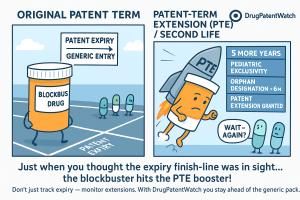
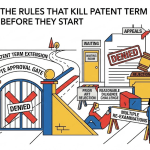
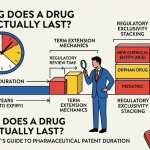
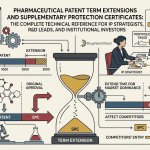
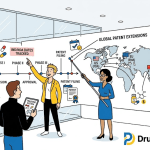
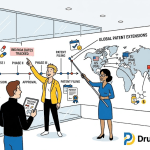
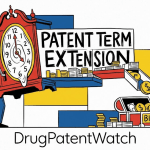
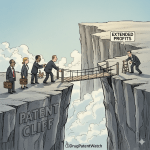
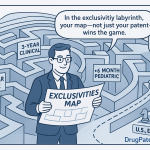
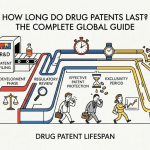
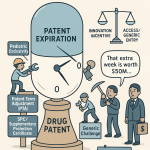
Every blockbuster drug has two commercial lives. The first runs from approval to the loss of its composition-of-matter patent. The second, often more lucrative, is carved out by a single legal mechanism: the patent term extension (PTE) in the United States, or its European counterpart, the Supplementary Protection Certificate (SPC). Get the extension right and you can add five years, sometimes more, to a franchise generating $10 billion annually. Miss a 60-day filing window, overlook a terminal disclaimer, or miscalculate the regulatory review period, and that asset evaporates.
This guide is written for pharma IP teams, portfolio managers, R&D leads, and institutional investors who need granular, technically dense coverage of how PTEs and SPCs work, what they are worth, how they are challenged, and how to build a monitoring infrastructure that turns exclusivity data into competitive advantage. Every drug, company, and legal case cited here is real.
Part I: The Economic Architecture of Pharmaceutical Exclusivity
Why Standard Patent Law Fails Pharmaceutical Innovators
A utility patent runs 20 years from the earliest effective filing date. In most industries, that is more than enough time to commercialize an invention and earn a return. Pharmaceuticals are the exception. The journey from a novel chemical entity (NCE) or biologic to an approved prescription product routinely consumes 10 to 14 years, the majority of which occurs while the patent clock is already running.
Consider a standard timeline. A composition-of-matter patent for a new small-molecule kinase inhibitor is typically filed during lead optimization or early IND-enabling studies, perhaps in year two or three of a drug discovery program. Preclinical toxicology, Phase I dose escalation, Phase II proof-of-concept, and a pivotal Phase III trial consume another eight to ten years. An NDA submission follows, and the FDA’s standard review period is ten to twelve months, with priority review reducing that to six months. The drug reaches pharmacy shelves with, on average, eight to twelve years of patent life remaining.
The R&D cost to get there is, per the most cited peer-reviewed estimate, $2.6 billion per approved new molecular entity in capitalized costs, accounting for the cost of failures (Wouters et al., JAMA, 2020). Without a mechanism to recover some of the patent term consumed during regulatory review, the economics of first-in-class drug development collapse. The incentive structure tilts entirely toward follow-on compounds, biosimilars, and low-risk reformulations of established molecules.
PTEs and SPCs were created specifically to correct this structural distortion.
The IP Valuation Framework: What a Single Year of Exclusivity Is Worth
Before examining the legal mechanics, establish the financial stakes. Patent term extension value is calculable, and every IP team and investment desk should run this math explicitly.
The formula is simple: annual net revenue multiplied by the net profit margin, multiplied by the number of extension years, discounted to present value. For a drug generating $8 billion per year in global revenues at a 35% operating margin, one year of exclusivity is worth roughly $2.8 billion in operating profit before discounting. A full five-year PTE on that asset is a $14 billion NPV event, though discounting at a 10% WACC over the extension period compresses that to approximately $10-11 billion in present-value terms. A six-month paediatric extension adds another $1.4 billion.
This is why AbbVie’s Humira (adalimumab) patent portfolio, which delayed biosimilar entry in the United States by nearly seven years past the primary compound patent expiry, is widely cited as the most successful IP lifecycle management campaign in pharmaceutical history. It is also why Gilead’s sofosbuvir patent estate, Pfizer’s tofacitinib (Xeljanz) formulation strategy, and Novo Nordisk’s semaglutide compound patents are each managed as multi-billion-dollar financial assets, not merely legal instruments.
For investors and M&A teams, the PTE/SPC date is the single most material variable in any DCF model for a single-product pharma company. Misestimate it by 18 months and you have mispriced the equity by billions.
Part II: United States Patent Term Extension Under Hatch-Waxman
The Statutory Foundation: 35 U.S.C. § 156 and the Drug Price Competition and Patent Term Restoration Act of 1984
The Hatch-Waxman Act is the controlling legislation for pharmaceutical patent extensions in the United States. Title II of the Act added section 156 to Title 35 of the U.S. Code, creating the Patent Term Extension mechanism. Title I created the Abbreviated New Drug Application (ANDA) pathway and the Paragraph IV certification process. The two titles are inseparable in practice: the ANDA-Paragraph IV mechanism generates the generic challenges that make the PTE so commercially valuable to defend.
The legislative intent was explicit. Congress recognized that the regulatory review period for pharmaceuticals was effectively a tax on patent life, paid in lost exclusivity time. Section 156 was designed to restore up to five years of that lost time for one patent per approved product.
The implementing regulations are found in 37 C.F.R. Part 1, Subpart F. The USPTO and FDA jointly administer the process, with the FDA responsible for calculating the “regulatory review period” and the USPTO responsible for determining the final extended term. This joint administration creates complexity and multiple intervention points for competitors.
Eligibility: The Five-Prong Test
A PTE application must satisfy all of the following conditions under 35 U.S.C. § 156(a):
The patent must not have expired. The application must be filed by the patent owner or its representative. The application must be filed within 60 days of receiving marketing approval from the FDA. This is a hard statutory deadline with no waiver provision. The product, as approved, must fall within the scope of at least one claim of the patent. The approval must represent the first permitted commercial marketing of the product under the Federal Food, Drug, and Cosmetic Act or the Public Health Service Act.
The fifth condition is the most legally consequential. “First permitted commercial marketing” means a PTE is available only for a product’s first FDA approval based on the active moiety. If the same active moiety was previously approved in any formulation, route, or dose, no PTE is available for subsequent approvals. This rule has generated substantial litigation, particularly around prodrugs, esters, salts, and metabolites that may or may not constitute the “same active moiety.”
The definition of “active moiety” is governed by 21 C.F.R. § 314.108(a), which defines it as the molecule responsible for the physiological or pharmacological action of a drug substance, excluding appended portions (e.g., ester or salt forms). Esomeprazole (Nexium) illustrated this precisely: AstraZeneca argued it was a distinct active moiety from omeprazole (Prilosec) because it is the S-enantiomer, not the racemate. The FDA and courts ultimately treated them as different moieties for purposes of 5-year New Chemical Entity (NCE) exclusivity, though the PTE eligibility analysis parallels this framework.
The Regulatory Review Period: What the FDA Calculates and Why Competitors Scrutinize Every Day
The core of any PTE is the “regulatory review period” (RRP), calculated by the FDA under 35 U.S.C. § 156(g). The RRP has two components:
The “testing phase” runs from the date the IND became effective to the date the NDA (or BLA) was submitted. This period reflects time spent in clinical development. The “approval phase” runs from the date of NDA submission to the date of FDA approval. This reflects time spent in regulatory review.
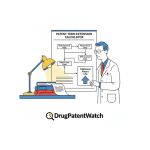
The PTE term is calculated as one-half of the testing phase plus the full approval phase. From this sum, the statute deducts any period during which the applicant failed to act with “due diligence.” The FDA defines due diligence as acting as quickly as possible given the applicant’s resources and the existing state of the science.
A worked example using real-world analogous timelines:
Assume an NDA for a novel PCSK9 inhibitor where the IND went effective on March 1, 2016; the NDA was submitted on September 1, 2023 (2,741 days later); and the FDA granted approval on July 1, 2024 (304 days after submission).
Testing phase credit: 2,741 / 2 = 1,370.5 days Approval phase credit: 304 days Gross PTE: 1,674.5 days, or approximately 4 years and 7 months.
Assume no due diligence deduction. The cap analysis then applies.
The Dual Cap Structure: 5-Year Maximum and the 14-Year Rule
The calculated PTE is subject to two statutory caps, and the shorter of the two resulting periods controls.
Cap 1: The extension cannot exceed five years (1,825 days). In our example, the calculated 4 years and 7 months falls below this cap, so it is not limiting.
Cap 2: The total remaining patent term after extension cannot exceed 14 years from the FDA approval date. This cap is designed to prevent companies with very short development timelines from compounding a modest regulatory delay into an outsized market exclusivity period. In practice, the 14-year cap rarely binds because most drugs have consumed enough development time that the 5-year cap controls.
Where the 14-year cap bites: Consider a drug where the composition-of-matter patent was filed late in development (say, four years before approval) and the development timeline was compressed. The patent would expire four years after approval. Add a 5-year PTE and you get expiry nine years post-approval, well under the 14-year threshold. The cap is not limiting. Now consider a drug approved only two years after its patent filed: the patent expires in 18 years’ time. A 5-year PTE would create a 23-year post-filing term, or 21 years post-approval. The 14-year cap would reduce the extension to protect the competitive market.
Both caps must be calculated for every PTE application. Competitors perform the same calculation independently.
Due Diligence Challenges: An Underused Offensive Tool for Generic Manufacturers
The due diligence provision is one of the most overlooked tools in the generic manufacturer’s arsenal. Under 35 U.S.C. § 156(c)(1), the FDA can reduce the RRP by any period during which the applicant failed to act with due diligence in seeking FDA approval.
A competitor may petition the FDA to investigate due diligence within 180 days of the publication of the PTE application in the Official Gazette. The petition must provide specific evidence of delay attributable to the applicant’s own conduct, such as slow enrollment, failure to respond promptly to FDA Complete Response Letters, or unnecessary holds on clinical trials.
Successful due diligence challenges are rare but consequential. The FDA standard requires showing that the applicant could have acted more quickly with reasonable effort. Cases where enrollment was demonstrably slow relative to industry benchmarks, or where FDA correspondence went unanswered for extended periods, are the strongest candidates. For a drug with $5 billion in annual revenues, a 180-day reduction in the RRP is worth $2.5 billion in generic revenue acceleration. The economics justify the legal and investigative effort.
The 60-Day Filing Deadline: The Most Dangerous Date in Pharma IP
Missing the PTE filing deadline is an irreversible error. Unlike many patent office deadlines, 35 U.S.C. § 156(d)(1) imposes a 60-day window from the date of FDA approval with no statutory mechanism for revival. The USPTO has repeatedly held that it lacks authority to accept late applications regardless of the circumstances.
The 60-day clock runs from the date of the approval letter, not the date the company receives it. For drugs approved late on a Friday afternoon, particularly if the approval letter arrives by mail rather than electronic notification, the countdown can begin before the IP team is even aware of the approval. Companies should have a pre-built PTE application template completed before the FDA PDUFA date, with the only remaining variable being the insertion of the actual approval date and any last-minute regulatory review period data from the FDA. The application must be filed within 60 days. Nothing else matters more in pharmaceutical IP management in the days following an FDA approval.
One Patent, One Extension: Strategic Patent Selection for PTE
Only one patent per product may receive a PTE. This means the innovator must select, strategically, which patent in its portfolio it wishes to extend. The implications are significant and often counterintuitive.
The instinct is to extend the composition-of-matter (CoM) patent, which covers the active ingredient. But the CoM patent is also typically the earliest-filed and the broadest, which means it often has the shortest remaining term at the time of approval. A method-of-use patent filed five years later might have more remaining term, and a five-year PTE on that patent could provide exclusivity protection later into the future.
The trade-off: the CoM patent is broader and harder to design around. A method-of-use patent, even extended, can be designed around by a generic seeking a “skinny label” that avoids the patented use. Section 8 carve-outs under the ANDA pathway specifically permit a generic manufacturer to omit protected uses from its labeling, though inducement-of-infringement and carve-out jurisprudence under GSK v. Teva (Fed. Cir. 2021) complicates this calculus.
Novartis made this decision explicitly with imatinib (Gleevec/Glivec). The selection of the specific patent for PTE filing required weighing claim scope, remaining term, and litigation vulnerability across multiple patents covering the compound, its specific salt form (imatinib mesylate), and methods of treating CML.
Key Takeaways, Part II
The PTE calculation is a four-variable problem: testing phase, approval phase, due diligence deductions, and the dual cap. Every variable is independently verifiable and challengeable. The 60-day filing window is the hardest deadline in pharmaceutical IP and requires pre-built infrastructure to meet reliably. Patent selection for PTE is a strategic decision with 10-year revenue consequences. Generic manufacturers can petition the FDA to challenge the regulatory review period on due diligence grounds within 180 days of the Official Gazette publication.
Investment Strategy Note
For analysts modeling a pharma asset, calculate the PTE independently using public regulatory data. FDA approval dates are public; IND effective dates can often be estimated from clinical trial registries. Cross-check your calculation against the company’s stated exclusivity guidance. A discrepancy of six months or more warrants direct IR inquiry. Terminal disclaimer status (see Part IV) is the most common source of an unexpected extension reduction and should be checked in the USPTO file history before modeling any PTE.
Part III: European Supplementary Protection Certificates
The Legal Foundation: Regulation (EC) No 469/2009 and Its Interpretive History
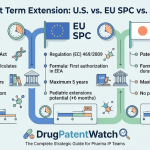
The European SPC system is governed by Regulation (EC) No 469/2009 (the consolidated codification of the original 1992 Regulation 1768/92). Unlike the U.S. PTE, an SPC is not an extension of a patent at all. It is a sui generis intellectual property right, distinct in nature from the underlying patent, that provides patent-like protection for an approved medicinal product after the basic patent expires.
This distinction has practical consequences. An SPC provides narrower protection than the basic patent: it covers only the specific product for which Marketing Authorisation (MA) was granted, for the approved uses. The basic patent may cover a broad genus of compounds; the SPC covers only the specific species that became the approved drug.
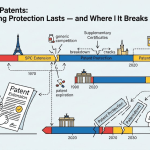
The SPC takes effect the day after the basic patent expires and runs for a period equal to the interval between the patent filing date and the first MA date in the European Economic Area, minus five years. The maximum duration is five years. Combined with the basic patent, the total protection from filing date to SPC expiry cannot exceed 15 years from the first EEA MA.
Critically, SPCs are national rights. An innovator must apply separately in each EU member state where they have both a valid basic patent and a valid MA. Germany, France, Italy, Spain, and the UK (for drugs approved before Brexit) are the commercially critical jurisdictions. The European Patent Office does not grant SPCs. Each national patent office examines and grants its own certificate, and national courts adjudicate disputes under national procedural rules, though substantive SPC law is interpreted by the Court of Justice of the European Union (CJEU).
Article 3: The Four Conditions and Their Litigation History
Article 3 of Regulation 469/2009 sets out four conditions, all of which must be met:
The product must be protected by a basic patent in force at the time of the SPC application. A valid MA for the product as a medicinal product must have been granted, either nationally or via the EMA’s centralized procedure. The product must not have previously been the subject of a certificate. The MA must be the first authorization to place the product on the market as a medicinal product.
Conditions (a) and (d) have generated more CJEU referrals than any other area of SPC law.
On condition (a), “protected by a basic patent,” the CJEU has evolved its position through a sequence of landmark cases. The Medeva case (C-322/10, 2011) held that the patent claims must “relate to” the product. The Teva case (C-121/17, 2018) introduced the current two-limb test: the product must either be expressly mentioned in the claims, or be identifiable to a skilled person reading the claims in light of the description, where the specific embodiment is the necessary technical contribution of the invention. Post-Teva national courts, particularly in Germany and the UK (pre-Brexit), have wrestled with how strictly to apply the second limb. The Royalty Pharma case (C-650/17, 2020) further refined this, holding that the active ingredient must be specifically identifiable as the core inventive concept of the basic patent.
On condition (d), “first authorisation,” the key issue arises with combination products. If ingredient A has already been approved as a monotherapy, can an innovator obtain an SPC for the combination of A plus B? The Neurim case (C-130/11, 2012) introduced an exception for new therapeutic uses. The subsequent Abraxis case (C-443/17, 2019) limited that exception, holding that nab-paclitaxel (Abraxane) was not eligible for its own SPC because it was a new formulation of an already-approved active ingredient (paclitaxel), not a new active ingredient.
The Abraxis ruling has direct IP valuation consequences. Any company planning SPC protection for a novel formulation, a prodrug, or a combination product must assess whether the CJEU’s current jurisprudence supports eligibility. An SPC application filed on a shaky Article 3(d) basis can be denied or later invalidated, removing what appeared to be a $3-4 billion asset from the balance sheet.
SPC Duration Calculation: A Worked Example
Take the basic patent for pembrolizumab (Keytruda, Merck/MSD), which covers the specific antibody sequence. Assume the patent was filed on February 7, 2011. The European Commission granted a centralized MA on July 17, 2015.
SPC duration = MA date minus patent filing date, minus 5 years: = (July 17, 2015 – February 7, 2011) – 5 years = 4 years, 5 months, and 10 days – 5 years = Negative result; SPC duration would be zero.
In practice, Keytruda received its initial EU MA after a development timeline of about four years from the basic patent filing. The interval is less than five years, meaning no SPC is available. This is a real scenario that often surprises IP teams: drugs developed quickly have compressed intervals and may receive no SPC benefit at all.
Contrast this with a drug filed in 2005 and approved in 2016. The interval is 11 years. Minus 5 years equals a 6-year potential SPC. Capped at 5 years, the SPC runs for 5 years post-patent expiry. Add the 6-month paediatric extension and the effective term is 5.5 years. For a drug generating $2 billion per year in Europe, that half-year pediatric extension alone is worth approximately $1 billion across the EU market.
The SPC Manufacturing Waiver: Operational Mechanics and Monitoring Implications
Regulation (EU) 2019/933, which entered into force on July 1, 2019, introduced what is colloquially called the SPC Manufacturing Waiver. It creates a structured exception to SPC rights for EU-based manufacturers.
Under the waiver, an EU-based generic or biosimilar manufacturer may produce a product protected by an SPC during the SPC term, subject to conditions. The manufacturer must notify the national patent office and the SPC holder at least three months before manufacture begins. The notification must specify the nature of the intended activity: export to markets outside the EU/EEA where the product is not protected or where protection has expired, or stockpiling for Day 1 entry into the EU market in the final six months of the SPC term.
The waiver creates a window starting six months before SPC expiry during which a generic or biosimilar company can legally manufacture product within the EU for domestic launch preparation. For biosimilars, where batch lead times can be 9-12 months, the six-month stockpiling window may be insufficient without prior export manufacturing. An EU-based biosimilar manufacturer will typically begin export production well before the six-month window, then transition to EU-destined stockpiling when that window opens.
For innovator monitoring teams, the notification mechanism is both an early warning system and a potential source of legal action. If a manufacturer’s notification is deficient (wrong dates, failure to specify the purpose, manufacturing beyond the permitted scope), it constitutes SPC infringement. Companies have established dedicated monitoring processes for waiver notifications filed in each national patent office.
Unitary Patent and Unified Patent Court: The Structural Shift Underway
The Unified Patent Court (UPC) opened on June 1, 2023. The Unitary Patent, which provides a single patent right across all UPC participating states (currently 17 EU members), is now available. For SPCs, the UPC can hear infringement and validity actions that affect all participating states simultaneously, eliminating the need for parallel national litigation.
The first UPC SPC decisions are emerging in 2024 and 2025. Their impact on the fragmentation of European SPC enforcement is expected to be substantial. A single UPC ruling on SPC validity now resolves the issue across all participating states, rather than requiring 17 separate national proceedings. For generic manufacturers, this is a double-edged shift: one successful invalidity action wipes out SPC protection across participating states simultaneously, but so does one successful infringement finding.
Key Takeaways, Part III
SPC eligibility under Article 3(a) requires the product to be specifically identifiable as the core inventive concept of the basic patent claims, per the Teva/Royalty Pharma tests. The Abraxis decision forecloses SPC protection for novel formulations of previously approved active ingredients. Duration is zero when the patent-to-MA interval is less than five years. The manufacturing waiver creates a six-month pre-expiry window for domestic stockpiling, with mandatory notification to the national patent office and the SPC holder. The UPC centralizes SPC litigation for participating states.
Part IV: Advanced IP Mechanics That Alter Extension Value
Terminal Disclaimers: The Hidden Landmine in U.S. PTE Calculations
A terminal disclaimer is a commitment filed with the USPTO to overcome an obviousness-type double patenting rejection. When Patent B claims an invention that is patentably indistinct from Patent A (already owned by the same entity), the examiner rejects Patent B under the doctrine of double patenting. To overcome this, the applicant files a terminal disclaimer agreeing that Patent B will expire no later than Patent A.
The consequence for PTE is severe and frequently underappreciated. 35 U.S.C. § 156(b)(2) specifies that a PTE cannot extend the term of a patent beyond the expiration date of any patent from which the extension patent has been disclaimed. A five-year PTE calculation means nothing if the terminally disclaimed “parent” patent expires before the extended term would run.
A concrete scenario: Patent A covers a broad genus of compounds and expires in 2026. Patent B covers the specific compound that became an approved drug, but it was terminally disclaimed over Patent A and also expires in 2026 (despite being filed three years later). The FDA approves the drug in 2022. The PTE calculation generates a four-year extension, suggesting expiry in 2030. But the terminal disclaimer caps the extension at 2026. The net PTE term is effectively zero.
For generic manufacturers, checking for terminal disclaimers is the first task after identifying a target PTE patent. It is a five-minute search in USPTO’s Patent Center. For innovators, the presence of a terminal disclaimer over a patent expiring before the extended term should trigger an immediate strategy review: can the terminal disclaimer be rescinded? (Generally not, once the underlying rejection is overcome and the patent issues.) Can a different patent, one without a terminal disclaimer, be selected for the PTE? This analysis should happen during patent prosecution, not post-approval.
Investment strategy implication: Before accepting a company’s stated PTE expiry, search the file history of the relevant patent for terminal disclaimers. This is public information and takes minutes. A missed terminal disclaimer in a sell-side equity model is an analytical error with material valuation consequences.
Interim Extensions: What They Signal and Why Competitors Should Watch Them
An interim extension under 37 C.F.R. § 1.790 is a temporary one-year extension of patent term granted to prevent a patent from expiring while a PTE application is under active review at the USPTO. Interim extensions can be renewed annually.
When a generic company sees an interim extension on a target patent, it signals that the patent is approaching or has passed its original expiry, that a final PTE determination has not yet been reached, and that the innovator believes the PTE will ultimately be granted (otherwise they would not incur the procedural cost). Interim extensions are a strong signal that the market entry date is still legally contested and that the final PTE term will be dispositive.
The USPTO’s publicly searchable Patent Center shows all pending PTE applications and any interim extensions. Competitors should set automated monitoring for interim extension grants on all target patents.
Biologics and BPCIA: Parallel Exclusivity Architecture
Biologics are governed by the Biologics Price Competition and Innovation Act (BPCIA, 2010), not Hatch-Waxman. The exclusivity framework is structurally different but equally susceptible to PTE optimization.
Under BPCIA, a reference biological product receives 12 years of data exclusivity from the date of first licensure under 42 U.S.C. § 262(k)(7). No biosimilar may be approved until this period expires. This 12-year exclusivity runs independently of patent protection. A biosimilar applicant may file an aBLA application after four years of the reference product’s approval, but FDA cannot act on it until the 12-year period lapses.
Layered on top of this statutory exclusivity, the innovator can obtain PTEs on patents covering the biologic. For a monoclonal antibody, the relevant patents typically include the composition-of-matter patent for the antibody (covering the CDR sequences), formulation patents, and method-of-use patents for specific indications. A PTE on a composition-of-matter patent for a biologic approved in 2012 with 15 years of patent life remaining could extend protection to 2032, well past the 12-year BPCIA exclusivity that expires in 2024.
The “patent dance” under BPCIA, codified at 42 U.S.C. § 262(l), requires the biosimilar applicant and reference product sponsor to exchange patent lists and engage in a structured negotiation over which patents will be litigated before launch. Understanding the PTE status of each listed patent is central to the dance’s litigation strategy. A patent with a weak PTE (due to a terminal disclaimer or a short regulatory review period) may not be worth asserting, while a patent with a robust five-year extension and a clean file history becomes the anchor of the litigation strategy.
AbbVie/Humira as the architectural case study: Adalimumab’s original composition-of-matter patent, US 6,090,382, expired in December 2016. AbbVie built a portfolio of over 130 patents covering the molecule’s formulations, manufacturing processes, dosing regimens, and specific disease indications. It then entered into settlement agreements with Amgen, Samsung Bioepis, Mylan (now Viatris), Sandoz, and others that permitted U.S. biosimilar entry no earlier than July 2023, nearly seven years after the primary patent expired. The total NPV of exclusivity retained through this strategy, at Humira’s U.S. peak of approximately $15 billion annually, represents roughly $70-100 billion in cumulative revenue protection across the delayed period. No single PTE was responsible; the strategy was architectural.
Paragraph IV Certifications and the 30-Month Stay: The Litigation Overlay
When a generic manufacturer files an ANDA with a Paragraph IV certification against a patent listed in the FDA’s Orange Book, alleging that the patent is invalid or will not be infringed by the generic product, the innovator has 45 days to file a patent infringement suit. If it does, an automatic 30-month stay on FDA final approval is triggered under 21 U.S.C. § 355(j)(5)(B)(iii). This stay runs from the date the innovator received notice of the Paragraph IV certification.
The 30-month stay interacts directly with the PTE status of listed patents. Three scenarios:
First: the 30-month stay expires before the PTE does. FDA can grant final approval, and the generic can launch at risk while patent litigation continues. This is the “at-risk launch” scenario.
Second: the PTE expires before the 30-month stay does. The stay becomes irrelevant because the patent is no longer in force. The generic can launch without risk.
Third: the 30-month stay expires simultaneously with, or after, the PTE. The FDA grants final approval the day after patent expiry, and the generic launches on Day 1.
Mapping these three scenarios for each target patent requires knowing both the 30-month stay end date (calculable from the ANDA filing date) and the precise PTE expiry. For a generic company, being off by one month on the PTE expiry date can mean launching into active patent litigation (at-risk) versus launching on a legally clear Day 1. The financial exposure in the at-risk scenario can be hundreds of millions of dollars.
Evergreening: The Lifecycle Management Playbook
Evergreening is the practice of obtaining secondary patents on modifications, formulations, or new uses of an existing drug to extend market exclusivity beyond the expiry of the primary compound patent. While the term is often used pejoratively in policy discussions, the practice is entirely legal and reflects ordinary IP strategy.
Common evergreening strategies include:
Polymorphic form patents, which cover specific crystalline structures of an active ingredient that may have superior stability or processability. These are notoriously difficult to obtain in Europe, where the EPO requires non-obvious advantage over the known amorphous form, but have been granted more readily in some jurisdictions.
Salt or ester patents, covering specific salt forms (e.g., the besylate salt of amlodipine in Pfizer’s Norvasc) with particular pharmaceutical properties. The pediatric patent for amlodipine besylate’s salt form was the subject of Pfizer v. Apotex (Fed. Cir. 2007), in which the court invalidated the salt patent for obviousness, accelerating generic entry.
Extended-release or modified-release formulation patents, which cover delivery technologies providing once-daily dosing or improved tolerability. Bupropion (Wellbutrin XL), oxycodone CR (OxyContin), and methylphenidate OROS (Concerta) are examples where formulation patents extended market protection for years after the compound patent expired.
New indication patents, covering methods of treating diseases not covered by the original label. These must be asserted carefully because the Paragraph IV/skinny label regime allows a generic to carve out patented indications. But if the carved-out indication is the primary commercial use of the drug, the carve-out may be insufficient to avoid liability for induced infringement.
Pediatric exclusivity, which operates as an exclusivity overlay rather than a patent right. A company that completes FDA-requested pediatric studies under PREA receives six months of exclusivity attached to all existing patent and regulatory exclusivities. This is the most efficient evergreening mechanism available: one pediatric study, covering perhaps $20-50 million in clinical costs, can protect a $10 billion franchise for an additional six months, worth $5 billion in revenue.
Key Takeaways, Part IV
Terminal disclaimers cap PTE terms and must be checked in the USPTO file history before any extension analysis. Interim extensions signal active PTE proceedings and contested market entry dates. BPCIA creates a 12-year exclusivity runway for biologics, on top of which PTE applies. Paragraph IV litigation and 30-month stays interact with PTE expiry dates in three analytically distinct ways. Evergreening through secondary patents, formulation patents, and pediatric exclusivity is the standard lifecycle management toolkit; the aggregate value can exceed the original compound patent by several-fold.
Part V: Global Patent Term Extension Systems
Japan: The Encho System and Its Lifecycle Management Flexibility
Japan’s patent term extension system, governed by Article 67(2) of the Japanese Patent Act, is among the most mature outside the United States and EU. The extension compensates for the time required to obtain approval from the Pharmaceuticals and Medical Devices Agency (PMDA), up to a maximum of five years.
Japan’s system has a meaningful strategic advantage over the U.S. system: extensions are available for new indications and new dosage regimens of previously approved active ingredients, not just for the first approval of an active moiety. An innovator that receives PMDA approval for a new oncology indication for a drug originally approved in a cardiovascular indication can, in principle, obtain a Japanese extension on a patent covering that new indication, effectively resetting portions of the exclusivity runway.
The application must be filed within three months of PMDA approval. The J-PlatPat database, maintained by the Japan Patent Office, provides public access to extension application records. Key inputs include the basic patent number, the approval date, and the product registration number from the PMDA approval.
Australia: Extension of Term and the 15-Year Effective Life Cap
Australia’s Extension of Term (EOT) system, under Part 3 of Chapter 6 of the Patents Act 1990, provides up to five years of additional term for patents covering pharmaceutical substances. The effective protection from the date of the first Australian Register of Therapeutic Goods (ARTG) inclusion is capped at 15 years, directly mirroring the European SPC architecture.
The calculation uses the interval between the patent’s standard expiry date and the first ARTG inclusion. If that interval is less than five years, the extension term is the actual shortfall. If the interval is greater than five years, the extension is the full five years, subject to the 15-year effective life cap.
The application must be filed within six months of the later of the ARTG first inclusion or the grant of the patent. The Australian IP Office (IP Australia) maintains the AusPat database with full EOT records. Australia is an increasingly important monitoring jurisdiction given the growing size of its pharmaceutical market and its active Paragraph IV equivalent litigation under the Patents Act.
Canada: Certificates of Supplementary Protection
Canada’s CSP system, introduced under amendments to the Patent Act that came into force on September 21, 2017 as part of CETA implementation, provides a maximum of two years of additional exclusivity. This is notably shorter than the five-year maximum available in the EU, U.S., Japan, and Australia.
The two-year maximum reflects a deliberate Canadian policy choice: Canada sought to comply with CETA’s intellectual property provisions while minimizing the impact on domestic drug prices and public health expenditure. The CSP duration formula is identical in structure to the EU SPC: the interval between patent filing and first Canadian Notice of Compliance (NOC) from Health Canada, minus five years.
The application window is 120 days from the NOC grant, a tighter deadline than most comparable jurisdictions. Applications are filed with the Canadian Intellectual Property Office (CIPO). Eligibility requires the patent to claim the approved drug product or its use, and the NOC to be the first Canadian authorization for the active ingredient.
For innovators, the CSP adds at most two years of Canadian exclusivity, worth considerably less than a full U.S. PTE or EU SPC in absolute revenue terms but still material for major products. Canada’s generic sector is highly competitive, and Day 1 generic entry following CSP expiry has historically been aggressive.
China: Patent Term Compensation Under the 2021 Patent Law Amendments
China’s patent term compensation for pharmaceutical regulatory delays was formalized in the fourth amendment to the Patent Law, effective June 1, 2021. The framework introduces two compensation mechanisms: one for delays at the China National Intellectual Property Administration (CNIPA, compensating for patent examination delays beyond a threshold) and one specifically for pharmaceutical regulatory delays.
For drugs approved by the National Medical Products Administration (NMPA), a patent term compensation of up to five years is available, with the total effective patent term from approval date not exceeding 14 years. This 14-year effective life cap directly mirrors the Hatch-Waxman structure.
The implementing regulations and examination guidelines are still developing, and CNIPA issued detailed guidance in January 2024 on the procedural requirements. The system requires the applicant to file for compensation within three months of NMPA approval. Early applications have been accepted, but the first major extensions under the new system are only now entering litigation. Given China’s status as the world’s second-largest pharmaceutical market, this new exclusivity regime changes the competitive calculus for global drug launches and M&A valuations of China-facing assets.
Brazil and Emerging Market Dynamics
Brazil represents the opposite trajectory. In 2021, the Supreme Federal Court (STF) issued a ruling striking down Article 40 of Brazil’s Industrial Property Law, which had automatically extended patent terms by 10 years from grant (to compensate for delays at the Brazilian patent office INPI). This ruling, effective prospectively, eliminated a major source of extended pharmaceutical exclusivity in Brazil and was a significant victory for generic manufacturers and the Brazilian Ministry of Health.
Brazil does not currently have a formal PMDA-style regulatory delay compensation mechanism. Legislative proposals for a PTE system are periodically introduced but have not advanced, partly due to political opposition from health advocacy groups and public health ministries concerned about drug pricing. Brazil remains a high-volume generic market with no meaningful patent extension protection for regulatory delays, meaning exclusivity in Brazil is effectively limited to the standard 20-year patent term from filing.
Key Takeaways, Part V
Japan uniquely permits PTE for new indications of existing drugs, enabling lifecycle management unavailable in the U.S. or EU. Canada’s two-year CSP maximum reflects deliberate policy restraint. China’s new PTE system (2021) is structurally similar to Hatch-Waxman and will reshape IP valuation of China-focused assets as the first major cases mature. Brazil eliminated automatic patent term adjustments in 2021 and currently lacks a regulatory delay compensation mechanism.
Investment Strategy Note
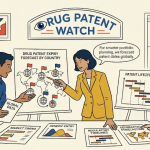
For global drug assets, build a country-by-country exclusivity matrix covering all major markets. Total global exclusivity value is the sum of jurisdiction-specific exclusivity periods weighted by that market’s revenue contribution. An asset with a 5-year U.S. PTE, a 5-year EU SPC, a 5-year Japanese extension, and a 2-year Canadian CSP has a significantly different global NPV profile than one with only U.S. protection. M&A models that use a single “patent expiry” date without jurisdiction-specific analysis are systematically mispriced.
Part VI: Monitoring Infrastructure and Competitive Intelligence Operations
The Monitoring Workflow: From IND to Day 1 Generic Entry
Patent term extension monitoring is not a static database query. It is a time-sequenced intelligence operation with multiple decision gates, each corresponding to a regulatory or legal event that changes the exclusivity calculus.
The workflow begins at IND. When a new drug program enters clinical development, IP teams should record the IND effective date and the filing dates of all relevant patents. At this stage, the PTE calculation is prospective and model-dependent, but even rough estimates are useful for long-range financial planning. For a drug in Phase I with ten years of patent life remaining and a projected 10-year development timeline, the PTE will likely approach the five-year cap, pushing effective exclusivity to potentially fifteen or more years from market entry.
The workflow becomes more precise at NDA submission. Once the NDA or BLA is submitted to FDA, the approval phase component is no longer a projection; it begins accumulating in real time. The testing phase is now fixed. The PTE term can be estimated to within a few months. Competitors should recalculate their estimates at this stage.
At FDA approval, the 60-day PTE filing clock starts. Competitors should publish their own independent PTE calculations internally and begin preparing the due diligence investigation to determine whether any challenges to the regulatory review period are warranted.
At Official Gazette publication of the PTE application, the 180-day window for due diligence petitions opens. Generic manufacturers should review the FDA’s preliminary regulatory review period determination at this stage.
At PTE grant, the final expiry date is established. This date goes into the Orange Book and becomes the legal anchor for all ANDA-related activity.
In Europe, the equivalent sequence runs from EMA MAA submission through centralized MA grant (typically 12 to 18 months later), triggering the six-month SPC application window in each national jurisdiction. Companies monitoring European exclusivity must track MA grants at the EMA and national level simultaneously.
Critical Public Databases
The USPTO’s Patent Center (formerly Public PAIR) provides complete file history for all U.S. patents, including PTE applications, interim extensions, and correspondence with the FDA. Any pending PTE application is visible here. Patent Center replaced Public PAIR in 2022 and provides bulk data download capabilities that support automated monitoring workflows.
The FDA Orange Book, available at fda.gov and updated monthly, lists all approved drugs with their associated patents and regulatory exclusivities, including PTE expiry dates once granted. The Orange Book is the authoritative U.S. source for post-grant exclusivity status.
The FDA Patent and Exclusivity Search tool at Drugs@FDA provides the same information in a more drug-centric interface, allowing users to search by active ingredient, NDA number, or applicant. For tracking paediatric exclusivity determinations specifically, the FDA’s Pediatric Labeling Database is the primary source.
In Europe, the EMA’s EPAR (European Public Assessment Report) database provides MA details for centrally authorized products. National patent office registers, including Germany’s DPMA, France’s INPI, Italy’s UIBM, Spain’s OEPM, and the UKIPO, each provide their own SPC application and grant databases. The European Patent Register at the EPO shows basic patent status across member states but does not directly show SPC data.
The Japan Patent Office’s J-PlatPat database provides extension records for Japanese patents. IP Australia’s AusPat database covers Australian EOT applications. Health Canada’s Drug Product Database and CIPO’s patent database support Canadian CSP monitoring.
Commercial Intelligence Platforms: What They Add and When They Are Necessary
Manual monitoring across the databases listed above is operationally feasible for small patent portfolios but does not scale. A pharmaceutical company with 20 pipeline drugs in multiple global markets faces thousands of monitoring tasks annually. Missed deadlines and delayed intelligence are the operational risks.
Commercial platforms aggregate data from multiple databases into unified interfaces with alerting capabilities. They provide calculated exclusivity dates (including PTE and SPC estimates before formal grant), portfolio-level dashboards showing the aggregate exclusivity runway across product lines, and Orange Book monitoring with automated alerts for new patent listings, paragraph IV certifications, and exclusivity grant events.
For competitive intelligence operations, these platforms also enable analysis of competitor portfolios. A generic manufacturer can use a commercial platform to screen the Orange Book for drugs with PTEs expiring within a two-to-five-year window, run the dual-cap analysis to validate the stated extension term, check the underlying patent for terminal disclaimers, and identify due diligence challenge opportunities, all in a structured workflow. The same analysis done manually against the USPTO and FDA databases would take significantly longer and has higher error rates.
The cost of a comprehensive commercial platform subscription is measured in tens of thousands to low hundreds of thousands of dollars annually. For IP teams managing portfolios with NPV in the billions, this cost is not a significant consideration. The relevant question is the cost of operating without one.
Building Internal IP Intelligence Capability
Commercial platforms provide data. Humans provide judgment. The two are not substitutes. An effective internal IP intelligence function requires four distinct competencies working in coordination.
Patent attorneys and agents with deep knowledge of 35 U.S.C. § 156, CJEU SPC jurisprudence, and BPCIA patent dance mechanics provide the legal interpretation layer. They assess not just whether an extension was filed, but whether it is vulnerable to challenge, and what the litigation dynamics suggest about its durability.
Regulatory affairs specialists who understand FDA review timelines, the IND-to-NDA pathway, and EMA centralized procedure timing provide the regulatory input layer. They can assess whether a “due diligence” challenge to a competitor’s regulatory review period has factual support.
Scientists, particularly medicinal chemists and pharmacologists, provide the technical assessment layer. They can evaluate whether a competitor’s formulation or method-of-use patent is genuinely non-obvious or whether it is a thin evergreening patent vulnerable to invalidity challenge.
Business intelligence and financial analysts provide the so-what layer. They translate legal and technical assessments into revenue projections, competitive entry timelines, and investment recommendations. They own the DCF models and the strategic planning outputs.
Organizations that structurally separate these four functions, with the business intelligence layer making final recommendations, consistently outperform those where patent attorneys present legal conclusions directly to senior leadership without financial translation.
Part VII: Case Studies in PTE/SPC Strategy and Failure
Humira (Adalimumab): The Patent Thicket at Scale
AbbVie’s Humira reached peak U.S. sales of approximately $15 billion in 2022. The composition-of-matter patent, US 6,090,382, expired December 31, 2016. U.S. biosimilar entry occurred in July 2023, 6.5 years later. The intervening period was managed through a combination of patent thicket strategy and settlement agreements.
AbbVie built a portfolio of over 130 U.S. patents covering different aspects of adalimumab. These included patents on the citrate-free formulation introduced in 2016 (a lower-pain injection version, marketed as Humira Citrate-Free), which required biosimilar manufacturers seeking substitutability to match the new formulation exactly. They included patents on specific dosing regimens for Crohn’s disease, psoriasis, and ankylosing spondylitis. They included manufacturing process patents and antibody sequence variant patents.
Each biosimilar entrant (Amgen’s Amjevita, Samsung Bioepis’s Hadlima, Coherus’s Yusimry, and others) entered into confidential settlement agreements with AbbVie that specified U.S. launch dates, royalty structures, and licensing terms. The confidential settlements effectively replaced a chaotic, multifronted patent war with a structured, staggered market entry schedule.
The IP valuation of the Humira patent portfolio in 2016, as it existed in AbbVie’s hands at the composition-of-matter expiry, was roughly $70-80 billion in NPV terms (at a 10% discount rate, assuming $15 billion in annual U.S. revenue declining on a schedule after generic entry). The portfolio’s actual commercial performance closely tracked this estimate.
Monitoring lessons from Humira: First, a single PTE on the composition-of-matter patent would have run only from December 2016 to approximately December 2018, adding at most two years (the short development timeline constrained the PTE calculation). The real exclusivity extension came from secondary patents and settlement agreements. Second, biosimilar monitoring for a product like Humira requires tracking not just patents but the litigation and settlement landscape, which is partially public (BPCIA filings) and partially confidential (settlement terms). Third, the citrate-free formulation introduction in 2016 was itself a monitoring event that should have alerted competitors: it signaled the specific formulation patents that would require biosimilar interchangeability matching and drove the multi-year negotiation timeline.
Sovaldi (Sofosbuvir): PTE Under Regulatory and Political Pressure
Gilead’s sofosbuvir (Sovaldi, approved December 2013; combined with ledipasvir as Harvoni, approved October 2014) is the largest commercial success in the history of antiviral therapy. U.S. sales in 2014 alone reached $10.3 billion.
The core sofosbuvir patent, US 7,964,580, covers the nucleotide prodrug structure. Gilead’s PTE on this patent was filed and granted in the standard course, adding approximately five years to the composition-of-matter expiry.
The challenge to Sovaldi’s patent estate came from multiple directions simultaneously. Merck filed an Inter Partes Review (IPR) against several key sofosbuvir patents, arguing that the key chemistry was developed at a company (Pharmasset) that Merck had previously worked with and that Merck’s scientists had contributed to the invention. The district court litigation resulted in a $2.5 billion damage award against Merck in 2016 for breach of a confidentiality agreement, not patent invalidity, which left Gilead’s patent estate largely intact.
Separately, public interest groups challenged sofosbuvir’s patents in India and other developing countries, arguing lack of inventive step over known nucleotide chemistry. India granted compulsory licenses in several circumstances, and Brazil explicitly considered doing so. These jurisdictions do not participate in the Hatch-Waxman or SPC frameworks, meaning PTEs are irrelevant there; the relevant mechanism is the validity of the underlying compound patent.
Monitoring lessons from Sovaldi: The durability of a PTE depends entirely on the health of the underlying patent. IPR proceedings at the USPTO and post-grant opposition proceedings at the EPO can invalidate a patent retroactively, rendering the extension worthless. A comprehensive monitoring operation must track IPR filings, EPO oppositions, and district court validity challenges in parallel with the PTE/SPC administrative process.
Gleevec (Imatinib Mesylate): SPC Complexity and the Article 3(d) Problem
Novartis’s imatinib mesylate (Gleevec in the U.S., Glivec in Europe) was approved in the EU in November 2001. The drug is covered by two relevant patents: EP 0564409 (the Zimmermann patent), filed in January 1992, covering a broad genus of phenylaminopyrimidine compounds, and EP 0998473, covering imatinib mesylate specifically.
Novartis’s SPC strategy centered on EP 0998473 as the basic patent, because the specific salt form was explicitly claimed there. The SPC duration calculation for this patent in Germany, the most commercially important European jurisdiction: EP 0998473 was filed in October 1997; the first EU MA was November 2001. Duration = (November 2001 – October 1997) – 5 years = approximately 4 years, 1 month – 5 years. The result is negative. No SPC.
For the earlier Zimmermann patent (EP 0564409), filed January 1992: Duration = (November 2001 – January 1992) – 5 years = 9 years, 10 months – 5 years = 4 years, 10 months. This would support an SPC of approximately 4 years and 10 months. But does imatinib fall within the Zimmermann patent under the Article 3(a) test? The patent claims a genus; imatinib is a species. Post-Medeva and Teva, this is precisely the legal question that generates CJEU referrals.
Monitoring lessons from Gleevec: In Europe, patent selection for SPC is frequently not the most specific patent (which may have too short an interval with the MA) but an earlier genus patent (which has a longer interval but raises Article 3(a) eligibility risk). The legal risk is compounded when the basic patent will also face EPO opposition proceedings. Monitoring for European SPCs requires simultaneous tracking of the SPC application status at national patent offices and the opposition/appeal status of the basic patent at the EPO.
Eliquis (Apixaban): Clean PTE Execution and Paediatric Extension Value
Bristol-Myers Squibb and Pfizer’s apixaban (Eliquis) demonstrates clean PTE execution. The composition-of-matter patent, US 6,967,208, was filed in September 2000 and covered pyrazolo[1,5-a]pyrimidine compounds as anticoagulants. FDA approved Eliquis in December 2012 for stroke prevention in non-valvular atrial fibrillation.
BMS/Pfizer filed for a PTE on US 6,967,208 within the 60-day window. The PTE was granted, extending the patent’s U.S. expiry from approximately November 2020 to approximately November 2026. The IND for apixaban became effective in the early 2000s, and the long clinical development program (Phase III ARISTOTLE trial completed 2011) generated a substantial testing-phase component.
Generic challengers filed Paragraph IV ANDAs against Eliquis beginning around 2015. BMS/Pfizer filed suit, triggering the 30-month stay. The litigation ultimately resulted in settlements that allowed generic entry only after the PTE expiry in November 2026, subject to ongoing appeal proceedings.
The paediatric exclusivity component: No FDA written request for pediatric studies has been issued for apixaban as of this writing, so the six-month paediatric extension has not been sought for the Eliquis franchise. This represents a potential missed opportunity if apixaban had uses in pediatric populations that could support a written request, though the anticoagulation indication has limited pediatric applicability.
The commercial scale: Eliquis reached $12 billion in U.S. revenues in 2023. The six-year exclusivity window from 2020 to 2026 (estimated from PTE) represents approximately $60-70 billion in cumulative U.S. revenue protected against generic entry. Clean PTE execution, combined with the successful 30-month stay litigation strategy, was worth roughly a decade of patent protection beyond the original composition-of-matter expiry.
Part VIII: The Future of Patent Term Extensions
U.S. Legislative Threats and the IRA’s Shadow
The Inflation Reduction Act (IRA) of 2022 introduced Medicare drug price negotiation for a select group of drugs without generic competition. While the IRA did not modify PTE law directly, it introduced an indirect pressure on extension value: for drugs subject to negotiation, the government sets a maximum fair price, reducing the revenue per unit during the extension period and thus the NPV of the extension itself.
The IRA identifies “small molecule drugs” as eligible for negotiation after nine years post-approval and “biologics” after thirteen years. For a drug with a five-year PTE, the negotiation eligibility date may arrive before the extension expires, meaning some of the extension period will be subject to below-market prices. Financial models for drugs expected to be IRA-eligible must now discount PTE-period revenues at the negotiated price rather than the market price.
Further legislative proposals, including those aimed at restricting “patent thicket” strategies (e.g., the PATAS Act, which would require patent applicants to certify that PTE applications cover patents not subject to terminal disclaimers) and those addressing PTE abuse through secondary patents, continue to circulate in Congress. The probability of major PTE structural reform passing in the next legislative cycle is uncertain, but the directional pressure is toward restriction.
CJEU SPC Jurisprudence: A Living Standard
European SPC law is judge-made at the CJEU level, with national courts providing referrals and the CJEU providing binding interpretations. The pipeline of pending CJEU SPC referrals is always nonzero. Post-Teva and post-Royalty Pharma, the Article 3(a) test remains fact-intensive and case-specific. Each new CJEU ruling on “protected by a basic patent” refines the test with implications for hundreds of pending SPC applications and granted SPCs across the EU.
The Unitary Patent system’s interaction with SPCs is also evolving. The EU Commission published a legislative proposal in April 2023 for a Unitary SPC, which would provide a single certificate covering all UPC participating states rather than requiring separate national applications. If enacted, this would dramatically simplify application and enforcement but would also mean that a single invalidity finding wipes out SPC protection across all participating states simultaneously. The proposal remained under discussion in the EU legislative process as of early 2025.
AI-Assisted Patent Intelligence
Machine learning tools are now available that automate large portions of the patent landscape analysis, SPC eligibility assessment, and PTE calculation workflow. NLP models trained on patent claim language can assess Article 3(a) eligibility risk for proposed SPC applications by comparing claim structure to the Teva/Royalty Pharma test without manual attorney review at the initial screening stage. Time-to-market prediction models trained on historical FDA review data can generate PTE estimates with confidence intervals based on drug class, application type, and historical review performance.
None of these tools eliminate the need for experienced patent counsel making final determinations. But they substantially reduce the time and cost of initial screening and portfolio-level analysis, allowing IP intelligence teams to cover more drugs and markets with the same headcount.
Key Takeaways: The Complete Picture
The 60-day U.S. PTE filing deadline and the six-month EU SPC filing window are the hardest deadlines in pharmaceutical IP. Both require pre-built filing infrastructure, not reactive assembly after approval.
Terminal disclaimers can entirely negate a PTE and must be checked in the USPTO file history as the first step in any PTE analysis. This is public, fast, and routinely overlooked by sell-side analysts.
The Hatch-Waxman dual-cap structure (five years maximum; 14 years from approval) requires independent calculation by both innovators and competitors. The two caps produce different results in different scenarios.
European SPC eligibility under Article 3(a) is a fact-specific legal question governed by a sequence of CJEU rulings (Medeva, Teva, Royalty Pharma). Products based on novel formulations of previously approved actives face significant Article 3(d) risk post-Abraxis.
The SPC manufacturing waiver (Regulation 2019/933) creates a six-month pre-expiry stockpiling window in Europe that changes Day 1 generic entry logistics. Innovators must monitor waiver notifications. Generics must build manufacturing timelines around it.
Japan permits PTE for new indications of existing drugs, enabling lifecycle extension strategies unavailable in the U.S. or EU. China’s 2021 PTE system is structurally analogous to Hatch-Waxman and will reshape IP valuation of China-facing assets as the first major cases mature. Brazil has no regulatory delay compensation mechanism.
BPCIA’s 12-year biologic exclusivity runs concurrently with, not instead of, PTE. Both must be tracked. The “patent dance” makes PTE status of listed patents central to the litigation strategy.
Patent validity is the foundation under every extension. IPR proceedings, EPO oppositions, and district court invalidity challenges can render a granted PTE worthless. Extension monitoring must include patent health monitoring.
For every $1 billion in annual drug revenues, one year of PTE is worth approximately $350 million in after-tax NPV at standard discount rates. Five years plus a six-month paediatric extension on a $10 billion drug is roughly a $17 billion NPV event. These are the stakes that justify professional IP intelligence infrastructure.
Frequently Asked Questions
Can a formulation patent receive a PTE in the U.S.?
Yes, a formulation patent can receive a PTE if the approved product falls within the patent’s claims and the approval represents the first permitted commercial marketing of the active moiety. The more common limitation is the “first approval” requirement: if the same active moiety was previously approved in any formulation, the formulation patent covering a new delivery form is generally not eligible for PTE.
What happens if an SPC’s basic patent is partially revoked in EPO opposition?
If the basic patent’s claims are narrowed in opposition and the product no longer meets the Article 3(a) “protected by” test under the amended claims, national patent offices can reject pending SPC applications, and national courts can invalidate granted SPCs. This outcome requires case-by-case assessment in each jurisdiction where an SPC is pending or granted, as national courts apply the CJEU test to the specific amended claims.
Can two different companies each hold an SPC on the same product in the same EU member state?
No. Article 3(c) prohibits granting more than one SPC per product per member state. If the innovator holds an SPC, no other party may receive one for the same product in that jurisdiction.
How does a due diligence petition against a U.S. PTE actually work?
Any person may petition the FDA to investigate whether the applicant failed to act with due diligence during the regulatory review period. The petition must be filed within 180 days of the Official Gazette publication of the PTE application. The FDA reviews the petition, investigates the applicant’s conduct during the IND-to-NDA period, and issues a determination. If due diligence failure is found, the FDA reduces the regulatory review period by the period of failure, which reduces the calculated PTE term.
What is the effect of a Paragraph IV “first filer” on PTE strategy?
The first generic company to file an ANDA with a Paragraph IV certification against a listed patent may be entitled to 180 days of exclusivity against subsequent generic filers under 21 U.S.C. § 355(j)(5)(B)(iv). This 180-day generic exclusivity period runs from the first commercial marketing of the Paragraph IV filer. The PTE determines when this exclusivity period can begin, because the first filer cannot launch until patent expiry (absent an at-risk launch decision). The 180-day exclusivity and the PTE expiry date are two of the three most important dates in any ANDA strategy (the third is the 30-month stay expiry).
References and Sources
Wouters, O. J., McKee, M., & Luyten, J. (2020). Estimated Research and Development Investment Needed to Bring a New Medicine to Market, 2009-2018. JAMA, 323(9), 844-853.
35 U.S.C. § 156. Extension of patent term. U.S. Code.
21 U.S.C. § 355(j)(5)(B)(iii). Abbreviated new drug applications. U.S. Code.
37 C.F.R. Part 1, Subpart F. USPTO Regulations on Patent Term Extension.
Regulation (EC) No 469/2009 of the European Parliament and of the Council of 6 May 2009 concerning the supplementary protection certificate for medicinal products.
Regulation (EU) 2019/933 of the European Parliament and of the Council of 20 May 2019 amending Regulation (EC) No 469/2009.
Regulation (EC) No 1901/2006 of the European Parliament and of the Council of 12 December 2006 on medicinal products for paediatric use.
CJEU, Case C-322/10, Medeva BV v Comptroller-General of Patents, [2011] ECR I-12051.
CJEU, Case C-121/17, Teva UK Ltd and Others v Gilead Sciences Inc, ECLI:EU:C:2018:585.
CJEU, Case C-650/17, Royalty Pharma Collection Trust v Deutsches Patent- und Markenamt, ECLI:EU:C:2020:327.
CJEU, Case C-443/17, Abraxis Bioscience LLC v Comptroller General of Patents, ECLI:EU:C:2019:238.
42 U.S.C. § 262(k)(7). Biologics Price Competition and Innovation Act. U.S. Code.
GSK LLC v. Teva Pharmaceuticals USA, Inc., 7 F.4th 1320 (Fed. Cir. 2021).
Pfizer Inc. v. Apotex Inc., 480 F.3d 1348 (Fed. Cir. 2007).
AbbVie Inc. Annual Reports on Form 10-K, 2016-2023. U.S. Securities and Exchange Commission.
National People’s Congress of the People’s Republic of China (2020). Decision on Amending the Patent Law of the People’s Republic of China. Effective June 1, 2021.
Government of Canada (2017). Certificate of Supplementary Protection Regulations, SOR/2017-165.
Japanese Patent Office (2023). Examination Guidelines for Patent and Utility Model, Part IX.
European Commission (2023). Proposal for a Regulation on Supplementary Protection Certificates for Medicinal Products. COM(2023) 222 final.