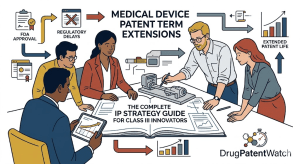
Patent Term Extension (PTE) under 35 U.S.C. § 156 is one of the most financially consequential and systematically neglected tools in the medical device IP toolkit. Between 1984 and 2024, only 178 medical device PTE submissions were recorded, against a backdrop where roughly 80% of all U.S. PTE requests come from the pharmaceutical sector and devices account for approximately 10%. That gap is not simply a knowledge problem — it is partly structural, partly strategic, and increasingly correctable.
The core issue: PTE eligibility for medical devices is confined to products approved under Section 515 of the Federal Food, Drug, and Cosmetic Act (FFDCA), which maps exclusively to Class III Premarket Approval (PMA). Devices cleared through 510(k) or De Novo pathways are categorically ineligible. For a sector where most devices qualify for 510(k) clearance, that structural limitation removes the majority of the market from consideration before a single strategy discussion takes place.
For the Class III device companies that do qualify, the financial stakes are substantial. Successful medical device PTE applications have restored an average of 987 days of patent term. In cardiovascular device markets where reimbursement rates run high and competitive device design-arounds can take three to five years to execute, 987 days of exclusive pricing authority translates directly to hundreds of millions in preserved revenue.
This guide covers the statutory framework, calculation methodology, IP valuation mechanics, case law, combination product risks, global SPC coordination, and the operational playbook for PTE execution. It is written for IP teams, portfolio managers, R&D leads, and institutional investors who need technical precision, not a regulatory overview.
Part 1: The Legal Architecture of 35 U.S.C. § 156
1.1 The Hatch-Waxman Act — What It Actually Did
The Drug Price Competition and Patent Term Restoration Act of 1984 created a legislative bargain. Generic manufacturers gained an accelerated approval pathway (abbreviated NDAs, now extended in principle to biosimilars via the BPCIA). Innovators received a partial restoration mechanism for patent time consumed by mandatory FDA review. Section 156 of Title 35 is that restoration mechanism.
The statute covers human drugs, food and color additives, animal drugs, veterinary biological products, and medical devices. The inclusion of medical devices was not a secondary afterthought — it reflected Congress’s recognition that Class III devices face regulatory burdens comparable in duration and cost to pharmaceutical NCEs. That recognition has been poorly operationalized in practice.
The USPTO holds administrative authority over PTE grants. For medical devices specifically, the FDA calculates and certifies the regulatory review period, which the USPTO then uses to determine the final extension length. This inter-agency coordination creates documentation dependencies that companies must manage proactively, not reactively.
1.2 The Statutory Requirements — Checklist and Failure Points
Under 35 U.S.C. § 156(a), five conditions must all be satisfied simultaneously:
The patent must be unexpired when the application is submitted. The patent term must never have been extended under Section 156 previously. The application must come from the owner of record or an authorized agent. The product must have undergone a regulatory review period before first-permitted commercial marketing. The patent must claim the approved product, a method of using it, or a method of manufacturing it.
That fifth condition — claim coverage — is where most unexpected denials originate. It is not enough for a patent to exist in the portfolio of the PMA applicant. The patent must claim the specific approved product, or a method directly tied to its use or manufacture, with language that maps onto the FDA’s regulatory approval designation. The ZILVER PTX denial, discussed in Part 6, demonstrates precisely how a seemingly covered combination product can fail this test on claim language alone.
1.3 The ‘One Patent, One Product, One Extension’ Rule
A single product’s regulatory review period can support only one PTE. When multiple patents cover a PMA-approved device, the owner must elect one patent for extension. That election is not merely procedural — it is a portfolio optimization decision with a decade-long commercial horizon.
The USPTO typically provides a one-month election window. Companies that treat this window as an administrative formality, rather than a strategic deliberation period, frequently elect the patent with the longest remaining nominal term rather than the patent that offers the broadest and most litigation-resistant protection during the extended period. Those are rarely the same patent.
Conversely, a single patent can only receive one extension regardless of how many approved products it covers. If a core platform patent covers two separately approved Class III devices, the company must choose which product’s regulatory review period to apply.
1.4 The 60-Day Filing Deadline — No Exceptions
The PTE application must be submitted within 60 days of the FDA’s grant of permission for first commercial marketing. This deadline has no statutory exception and no cure mechanism. Companies that miss it forfeit PTE permanently for that product’s regulatory review period, regardless of how long the PMA process took or how meritorious the underlying innovation.
Interim extensions of up to one year are available to prevent a patent from expiring while a PTE application is under review, but a full application must already be on file within the 60-day window for the interim extension to apply. The 60-day clock starts on the PMA approval date, not on the commercial launch date, and those dates can differ when companies stage market entry.
Key Takeaways — Part 1
The Hatch-Waxman Act’s PTE provision applies to Class III medical devices, but the eligibility framework is narrower in practice than the statute suggests because it requires PMA, not just any FDA review. Claim language precision at prosecution determines PTE eligibility years before approval. The 60-day filing deadline is absolute. The patent election decision should be treated as a portfolio optimization exercise, not a formality.
Part 2: FDA Pathways and PTE Eligibility — The Fork in the Road
2.1 Premarket Approval (PMA) — The Only PTE-Eligible Route
PMA under Section 515 of the FFDCA is mandatory for Class III medical devices — those presenting unreasonable risk of illness or injury absent general and special controls. The category includes implantable cardiac pacemakers, transcatheter heart valves, left ventricular assist devices, cochlear implants, deep brain stimulators, and total artificial hearts.
PMA requires a comprehensive technical file: device design and engineering specifications, a manufacturing quality system compliant with 21 CFR Part 820, pre-clinical testing results, and clinical trial data from IDE-authorized human investigations sufficient to demonstrate reasonable assurance of safety and effectiveness. The FDA conducts a substantive scientific review, often including an advisory panel meeting, and frequently issues a major deficiency letter requiring additional data before approval. Pre-approval inspections of manufacturing facilities are standard. The total elapsed time from PMA submission to approval runs 180 days at minimum and frequently extends to 18-36 months for first-in-class devices.
This extended timeline is the direct source of PTE value. Every day from IDE authorization through PMA approval is patent time consumed without commercial revenue.
2.2 510(k) Clearance — Fast to Market, Ineligible for PTE
510(k) clearance requires a showing of substantial equivalence to a legally marketed predicate device. The submission requires performance data — bench testing, biocompatibility data, software documentation for software-dependent devices — but clinical trials are not routinely required. The FDA’s target review time is 90 days, and actual median clearance times for standard 510(k) submissions run between 90 and 180 days.
Devices cleared via 510(k) are not eligible for PTE under any circumstances. The statute is explicit: the triggering approval must be under Section 515, not Section 510(k) of the FFDCA. This structural exclusion affects the large majority of medical devices, including Class II orthopedic implants, diagnostic imaging equipment, infusion pumps, and software as a medical device (SaMD) cleared as Class II.
For companies developing novel devices that might qualify for either pathway, the 510(k) route offers faster market entry and lower clinical development cost. The trade-off is permanent ineligibility for PTE. That trade-off requires a full net present value analysis before the regulatory strategy is finalized, not after the IDE application is filed.
2.3 De Novo Classification — The Fastest-Growing Pathway and a PTE Dead End
De Novo provides a route to market for novel, low-to-moderate risk devices without a predicate. The device initially receives automatic Class III designation due to the absence of a predicate, then the FDA evaluates whether Class I or II classification with appropriate controls is sufficient. Successful De Novo grants create a new device type that can serve as a predicate for future 510(k) submissions.
De Novo use has grown sharply since 2015 as the FDA has worked to reduce the automatic Class III burden on genuinely novel moderate-risk devices. Approval timelines run 150 to 270 days, and approximately 80% of De Novo submissions require clinical data to support the classification request.
Despite involving clinical data and a meaningful regulatory review period, De Novo-approved devices are not eligible for PTE. The statute requires Section 515 PMA, and De Novo does not produce a Section 515 approval. Companies with novel devices that could plausibly qualify for De Novo face a direct conflict between the cost and speed advantages of De Novo and the market exclusivity advantages of PMA-based PTE.
2.4 The Pathway Decision Framework
The choice between PMA and De Novo (where clinically and regulatorily defensible) is one of the highest-stakes IP decisions a Class III device company makes. The relevant inputs include projected PMA review duration, estimated IDE trial duration and cost, the likely competitive design-around timeline for the specific device technology, projected market size and reimbursement rates, the patent portfolio’s remaining term, and the device’s commercial lifecycle relative to the 14-year effective term cap discussed in Part 3.
No formula resolves these inputs automatically. The decision requires a cross-functional team with IP counsel, regulatory affairs, health economics, and business development working from a shared financial model, not from separate departmental analyses.
Key Takeaways — Part 2
PTE eligibility is hard-wired to PMA. 510(k) and De Novo devices are categorically ineligible, regardless of how long their regulatory review took. The pathway decision for novel Class III devices is simultaneously a regulatory strategy and an IP strategy decision. Companies that separate these decisions create foreseeable financial risk.
Part 3: Calculating the Extension — Where Deals Are Won and Lost
3.1 The Statutory Calculation Formula
The PTE calculation for medical devices follows a specific formula under 35 U.S.C. § 156(g)(3)(B) and 37 CFR § 1.777. The extension length equals the testing period plus the approval period, reduced by three deductions and capped at statutory maximums.
The testing period runs from the earlier of the date the IDE became effective or the date a clinical investigation on humans began, through the date the PMA application was initially submitted. This period captures the pre-submission clinical development phase entirely.
The approval period runs from the date the PMA application was initially submitted to the date of PMA approval. This captures the FDA’s review timeline from submission through final approval.
3.2 The Three Mandatory Deductions
Three reductions apply to the raw testing-plus-approval period:
Days that occurred before the patent issued are subtracted in full. This deduction is particularly impactful for foundational platform patents filed early in development — often before the device design is finalized. If the patent issued after the IDE was authorized, that entire pre-issuance period disappears from the PTE calculation regardless of how long it ran.
Half of the testing period after patent issuance is subtracted. The legislative rationale is that the testing period, while consuming patent time, also generates the clinical evidence that makes the product commercially valuable. The 50% deduction reflects a legislative compromise between full compensation and none. In practice, a testing period of three years post-patent issuance contributes only 1.5 years to the PTE calculation.
Days during which the applicant did not act with ‘due diligence’ are subtracted. This provision requires active demonstration that every phase of the regulatory review process moved at the maximum practicable pace. Any period of inaction attributable to the applicant — not to FDA processing delays or reasonable clinical investigation requirements — can be deducted. The FDA makes this determination at the request of any interested party, which means a competitor can trigger a due diligence investigation at any time within the application review period.
3.3 The Two Statutory Caps
The PTE cannot exceed five years, regardless of how long the combined testing and approval period was. This cap is absolute and applies to every product regardless of clinical complexity or FDA review backlog.
The total effective patent term, meaning original remaining term plus extension, cannot exceed 14 years from the PMA approval date. This is the more commercially limiting cap for products with long development timelines. If a device’s core patent was filed 12 years before PMA approval, and the patent issues 18 months after filing, the remaining term at approval might be only eight to nine years. Even a full five-year PTE cannot push the effective term beyond 14 years from approval. Companies with deep-in-development product cycles need to model this constraint against their patent issue dates to avoid projecting exclusivity that the statute cannot deliver.
3.4 Worked Example: Mapping the Calculation to a Hypothetical Transcatheter Device
Consider a hypothetical transcatheter mitral valve replacement system. The core engineering patent issues in January 2016. The IDE for the pivotal U.S. trial becomes effective March 2017. The PMA is submitted November 2020. FDA issues major deficiency letter April 2021, company responds July 2021, PMA approval granted February 2023.
Testing period: March 2017 through November 2020 = approximately 44 months (1,340 days). Approval period: November 2020 through February 2023 = approximately 27 months (820 days). Combined raw period: 2,160 days.
Pre-patent-issuance deduction: zero, because patent issued January 2016, before IDE effectiveness. Half-testing-period deduction: 670 days (half of 1,340). Net raw calculation before due diligence review: 2,160 minus 670 = 1,490 days.
This falls below the 5-year (1,825-day) cap. The company must then survive a due diligence review. If no days are deducted for lack of diligence, the PTE is 1,490 days — approximately four years and one month. The patent issued January 2016 with a nominal 20-year term expiring January 2036. At PMA approval (February 2023), approximately 13 years of term remain. Adding 1,490 days (roughly 4.1 years) would push nominal expiry to approximately April 2040, which is 17.1 years from FDA approval. The 14-year effective term cap applies here: the maximum allowed expiry is 14 years from February 2023, which is February 2037. The actual extension granted would therefore be capped at approximately 14 months rather than the full calculated 1,490 days.
This is not a rare edge case. It is the standard situation for Class III devices with platform patents filed early in development. Companies that model PTE value based only on the raw testing-plus-approval calculation without accounting for the 14-year cap systematically overestimate their IP protection runway.
3.5 Due Diligence Defense — Operational Requirements
Defending the due diligence standard requires contemporaneous documentation, not reconstructed timelines. Every significant decision in the regulatory process must be recorded with dates, rationale, and responsible parties at the time the decision is made.
The FDA evaluates due diligence based on whether the applicant pursued approval with the level of diligence that a reasonably diligent applicant would exercise. The standard is objective, not based on the applicant’s actual resource constraints. If a trial enrollment delay was caused by underinvestment in clinical sites, that is not an FDA-side delay. Any period of inactivity attributable to applicant choices is vulnerable to deduction upon third-party challenge.
Companies should maintain an indexed regulatory diary with timestamped entries for IDE protocol submissions, FDA correspondence, protocol amendments, interim analysis decisions, database lock dates, PMA module submissions, and responses to FDA information requests. This diary should be maintained in a form accessible to legal counsel and prepared for production in the event of a due diligence challenge.
Key Takeaways — Part 3
The 14-year effective term cap, not the 5-year extension cap, is the binding constraint for most Class III devices with early-filed platform patents. Due diligence documentation is a legal defense asset that must be built in real time, not retrospectively. The half-testing-period deduction substantially reduces the contribution of long pivotal trials to the final PTE length. Companies should run the full calculation including both caps before assuming a PTE provides a specific number of years of extended exclusivity.
Part 4: IP Valuation — What a PTE Is Actually Worth
4.1 The Core Valuation Framework
A medical device PTE is most accurately valued as an option on a revenue stream: the right to maintain exclusivity pricing during a defined period that would otherwise have been competitive. The gross value equals the revenue differential between the exclusivity price and the post-exclusivity equilibrium price, multiplied by the market volume during the extension period, discounted to present value at the company’s cost of capital and probability-weighted for PTE grant risk.
The output of this calculation is not the same as the total revenue generated during the extension period. It is specifically the revenue that would be lost if exclusivity ended at patent expiration without PTE. For medical devices, that differential depends heavily on the competitive dynamics of the specific device category.
4.2 Pricing Power Retention During the PTE Window
In pharmaceutical markets, loss of exclusivity (LOE) typically triggers rapid price erosion as generics enter and compete on price. Medical device markets behave differently. The competitive alternative is not a chemically identical copy but a functionally equivalent competing device. The time required for a competitor to design around an issued patent, complete preclinical validation, enroll and complete a clinical trial (if required), and obtain PMA or 510(k) clearance for a Class III device can range from three to seven years in complex anatomical areas.
This means the effective pricing power differential during a medical device PTE window may be smaller than the full post-LOE drug pricing collapse, but it persists over a longer competitive window. The device market is not winner-take-all on patent expiration. It is a market where the incumbent retains significant pricing leverage until the first credible competitive device achieves clinical equivalency in the same indication.
For transcatheter heart valve systems — the category with the highest concentration of medical device PTE activity — average selling prices run $30,000 to $40,000 per implant. A three-year PTE covering an implant used in 80,000 annual procedures at a $5,000 price premium over the competitive equilibrium price represents $1.2 billion in preserved gross margin before discounting. That figure is the analytical anchor for patent election decisions, combination product claim drafting decisions, and regulatory pathway trade-off analyses.
4.3 Edwards Lifesciences SAPIEN 3 — IP Asset Valuation in Context
U.S. Patent No. 7,780,723, covering the SAPIEN 3 ULTRA TRANSCATHETER HEART VALVE SYSTEM, received a PTE following the product’s PMA approval. Edwards filed for regulatory review period determination, which the FDA published in the Federal Register in March 2024.
The SAPIEN 3 product line generated revenues of approximately $2.3 billion in 2023 according to Edwards’ annual filings. Even a modest price premium maintenance attributable to the patent extension — call it five percent over two years of exclusivity — implies more than $230 million in preserved revenue on that product alone. That is the value of getting the PTE application right: filing on time, with the correct patent elected, with claims that explicitly cover the approved device, and with a due diligence record that survives challenge.
The Edwards SAPIEN 3 PTE also demonstrates the compounding IP benefit of the SAPIEN platform. Edwards has pursued PTE for multiple valve system iterations — the original SAPIEN, SAPIEN XT, SAPIEN 3, and SAPIEN 3 ULTRA — each through separate PMA approvals. This is the legitimate version of lifecycle IP management for medical devices: iterative hardware improvements that require genuine Class III PMA review, generating separate PTE eligibility windows for each generation.
4.4 The $1 Billion Evalve-Edwards Settlement — A PTE Patent in Action
The litigation between Evalve (Abbott) and Edwards Lifesciences over transcatheter mitral valve repair IP resulted in Edwards agreeing to pay more than $1 billion to settle claims involving an Edwards patent that had been extended under PTE. The settlement amount makes the financial leverage of a contested PTE-extended patent concrete. This is not an edge case or an extraordinary outcome — it is what happens when a foundational Class III device patent with an active PTE covers a multi-billion dollar market and a competitor’s product potentially infringes it.
For IP teams, this settlement establishes the benchmark for PTE claim scope analysis. A patent worth litigating over for more than $1 billion in settlement value did not achieve that leverage by accident. It achieved it through claim scope that covered the competitor’s design, through prosecution choices that resisted narrowing, and through PTE filing that extended the enforcement window into the period when the competitive market was most contested.
4.5 Valuation Inputs for Investment Analysis
For institutional investors, medical device PTE status affects two variables in a DCF model: the duration of above-market pricing power and the probability of sustained market share. Both variables shift materially when PTE is granted versus absent.
The risk-adjusted way to model PTE value for a Class III device pre-approval is to probability-weight three scenarios: full PTE granted at maximum allowed length, PTE granted with partial due diligence deductions reducing the extension by one to two years, and PTE denied or not filed. Assign probabilities based on the pipeline product’s regulatory pathway, the patent claim drafting quality as assessed by specialized IP counsel, and the company’s historical track record of regulatory documentation practices.
Key Takeaways — Part 4
PTE value for Class III medical devices is concentrated in markets with high per-procedure ASPs and slow competitive device development cycles. The SAPIEN platform and the Evalve-Edwards settlement define the upper bound of what PTE leverage looks like in the cardiovascular device category. Institutional investors should model PTE as a duration extension on above-market pricing power, probability-weighted by grant risk, not as a binary on/off assumption.
Part 5: The Cardiovascular Device PTE Concentration
The 2024 Taylor & Francis study covering 1984-2024 found that nearly half of all medical device PTE applications were associated with cardiovascular devices. This concentration reflects three converging factors: structural eligibility, commercial scale, and competitive intensity.
Structurally, the cardiovascular device category has the highest proportion of Class III PMA-required products of any device specialty. Transcatheter heart valves, ventricular assist devices, implantable defibrillators (original PMA generation), cardiac resynchronization therapy devices, and structural heart repair systems all require PMA. This creates a larger pool of PTE-eligible products than in orthopedics, neurology, or ophthalmology, where 510(k) clearance is more common.
Commercially, cardiovascular devices carry the highest per-procedure ASPs in the device market. A transcatheter aortic valve replacement (TAVR) system runs $30,000-$40,000. A left ventricular assist device (LVAD) costs $80,000-$120,000. Mechanical cardiac valves approved decades ago still generate meaningful revenues. The financial leverage from two additional years of exclusive pricing in these markets is measured in hundreds of millions.
Competitively, the structural heart market is among the most active for device patent litigation. Edwards Lifesciences, Medtronic, Abbott, and Boston Scientific have each spent nine figures on IP litigation in this space over the past decade. PTE extends the enforcement window into the most commercially valuable phase of the product lifecycle, which is why filings are concentrated here.
5.2 Emerging PTE Activity in Neurology and Oncology Devices
The cardiovascular concentration is shifting. Deep brain stimulation systems, vagus nerve stimulators, and spinal cord stimulators for chronic pain have historically been Class III PMA products with meaningful clinical development timelines. As procedure volumes for neuromodulation devices grow and competitive design-around attempts increase, PTE activity in this segment is increasing.
In oncology, ablation systems and intravascular drug delivery platforms that require PMA due to drug-device combination classification are generating increased PTE interest. The combination product classification issue discussed in Part 8 is particularly acute in this segment.
5.3 The 987-Day Average and Its Distribution
The average PTE restoration of 987 days across successful medical device applications masks a wide distribution. Devices with very long IDE trials can hit the 5-year cap. Devices with short pivotal trials and fast PMA reviews may restore fewer than 500 days. The distribution depends heavily on the device category’s clinical evidence requirements and the FDA’s review workload during the application period.
For portfolio planning, the 987-day average is less useful than the category-specific historical data. Cardiovascular Class III devices with pivotal IDE trials in the U.S. typically show PTE restorations in the 800-1,400 day range before applying the 14-year cap. Companies should request category-specific PTE length data from patent intelligence platforms rather than applying the aggregate average to their projections.
Key Takeaways — Part 5
The cardiovascular concentration in medical device PTE is structural, driven by the high proportion of Class III PMA requirements in that category. Emerging PTE activity in neuromodulation and oncology devices follows the same pattern: Class III PMA products in high-ASP markets with active competitive dynamics. The 987-day average restoration figure requires category-specific calibration for financial modeling.
Part 6: Case Studies — Wins, Losses, and a $1 Billion Settlement
6.1 Edwards Lifesciences SAPIEN Platform — The Iterative PTE Model
The SAPIEN transcatheter heart valve platform is the most instructive example of deliberate, multi-generation PTE strategy in the medical device sector. Each hardware iteration, from the original SAPIEN through SAPIEN XT, SAPIEN 3, and SAPIEN 3 ULTRA, underwent a separate PMA process. Each PMA generated a separate PTE opportunity tied to the platform’s iteratively improving valve design and delivery system.
The SAPIEN 3 ULTRA PTE application for U.S. Patent No. 7,780,723 was published in the Federal Register in March 2024. The Edwards SAPIEN 3 Transcatheter Pulmonary Valve PTE regulatory review period determination was published in June 2025, covering a different anatomical application of the same core platform technology. This sequential PTE capture across indications and hardware generations reflects a disciplined cross-functional process in which IP planning, regulatory affairs, and business development operate from a shared patent lifecycle map updated at each design iteration.
6.2 The Evalve-Edwards Settlement — PTE as Litigation Leverage
The litigation between Evalve (an Abbott subsidiary acquired in 2006) and Edwards Lifesciences over transcatheter mitral valve repair IP illustrates how PTE-extended patents function as litigation assets. The settlement, reported to exceed $1 billion, involved claims over Edwards patent rights that had been extended under PTE.
The key mechanism: without PTE, the patent in question might have expired before the market for transcatheter mitral valve repair scaled to the point where infringement exposure became material. PTE extended the enforcement window precisely into the growth phase of the market. This is the strategic leverage point that portfolio managers should model: PTE is most valuable when the commercial market for a Class III device is in its fastest growth phase after initial FDA approval, which is typically years two through six post-approval.
6.3 ZILVER PTX — The Combination Product PTE Trap
The ZILVER PTX Drug Eluting Peripheral Stent case is the medical device sector’s most analyzed PTE denial, and it remains the primary teaching case for combination product IP teams.
Angiotech, acting on behalf of the patent owner, sought a five-year PTE for U.S. Patent No. 5,811,447 following the ZILVER PTX’s PMA approval. The FDA had designated the product’s primary mode of action as medical device, routing the application to CDRH and requiring PMA — the prerequisites for PTE eligibility appeared met.
The denial turned on claim language. The patent’s central claim described a ‘method for biologically stenting a mammalian blood vessel.’ The USPTO and subsequently the courts held that this claim describes a biological method, not a method of using a medical device within the meaning of 35 U.S.C. § 156. The fact that executing the method requires a physical stent, and that the stent had received PMA approval, was not sufficient. The claim itself had to explicitly describe a method of using a medical device, and it did not.
The downstream consequence: a full five-year PTE on a drug-eluting stent in the peripheral arterial disease market, with procedure volumes in the hundreds of thousands annually, was forfeit on a claim drafting issue that predated the IDE application by years. The product’s IP protection window ended materially earlier than it would have with properly drafted claims.
The practical lesson for prosecution strategy: for any device with combination product characteristics, the patent claims must be drafted at prosecution to explicitly describe the device as a medical device and the method of use as a method of using that medical device. ‘Method of treating a disease by administering a device that does X’ is not equivalent to ‘method of using a medical device comprising X to treat disease Y.’ The difference is legally dispositive.
6.4 Medtronic CoreValve — Parallel PTE and Design-Around Dynamics
Medtronic’s CoreValve system, the principal competitive product to Edwards SAPIEN in the TAVR market, navigated its own PMA process and PTE filing timeline. The competitive dynamics between CoreValve and SAPIEN illustrate how PTE-extended patents interact with parallel competitive development programs.
When TAVR patents from both companies were active and extended, neither competitor could freely copy the other’s design. Both pursued independent patent portfolios protecting their distinct delivery mechanisms, valve frames, and sealing technologies. The result was a duopoly market with limited price erosion despite the size of the opportunity — precisely the commercial outcome that PTE is designed to protect.
Key Takeaways — Part 6
The SAPIEN platform demonstrates that iterative PTE capture across device generations is achievable with disciplined IP-regulatory coordination. The Evalve settlement quantifies PTE leverage in litigation: over $1 billion in a single dispute. The ZILVER PTX denial demonstrates that combination product claim language is the single highest-risk element of medical device PTE eligibility, requiring explicit claim-level precision that cannot be retrofitted after prosecution.
Part 7: PTE vs. Evergreening — Structural Differences and Strategic Overlap
7.1 The Definitional Boundary
PTE and evergreening are distinct legal mechanisms that produce overlapping commercial outcomes: extended market exclusivity beyond the original patent term. Their legal bases differ in ways that matter for policy analysis and for IP strategy.
PTE is a statutory compensation mechanism under 35 U.S.C. § 156. It restores lost patent time caused by mandatory regulatory review for the first approved commercial marketing of a product. Its eligibility criteria are statutory, its duration is calculated by formula, and its maximum is capped by law. It does not create new patent rights — it extends existing rights for a period tied to regulatory delay.
Evergreening describes a strategy of securing new patents on incremental modifications, alternative formulations, delivery system improvements, or new indications for an existing product, with the objective of extending the commercial exclusivity period beyond the original patent’s expiration. The new patents are not extensions of the original patent — they are independent IP rights on genuinely distinct, if incremental, innovations.
7.2 The EpiPen as a Medicine-Device Combination Evergreening Model
The EpiPen case is the clearest published example of delivery device evergreening applied to a medicine-device combination product. The original epinephrine auto-injector received FDA approval in 1987. Mylan, which acquired the product in 2007, introduced an updated device in 2011 protected by patents covering specific mechanical features of the injector, including locking assemblies and actuation mechanisms. Those patents were set to expire in 2025, providing approximately 38 years of total commercial protection for a product whose active pharmaceutical ingredient has been off-patent for decades.
A 2022 study published in JAMA Internal Medicine identified 14 other FDA-approved medicine-device combination products with patent protection solely for the delivery device, with a median exclusivity extension of 9.0 years. The clinical and financial implication is that the delivery device patent portfolio, not the drug patent, is the terminal source of exclusivity in a significant portion of the combination product market.
7.3 Legitimate Iterative Innovation vs. Strategic Patent Layering
The regulatory and policy debate over evergreening conflates two distinct scenarios that require separate analysis. The first is genuine iterative innovation: a company develops a materially improved drug delivery system that provides clinical benefits (improved dosing accuracy, reduced adverse events, expanded patient eligibility) and patents those improvements. The second is strategic patent layering: a company patents trivial mechanical modifications to prevent generic manufacturers from copying the delivery device even after the drug patent expires, without providing clinically meaningful benefits.
The legal system does not distinguish between these scenarios at the patent grant stage. Both types of patents receive examination under the same novelty, non-obviousness, and enablement standards. The distinction matters primarily for policy analysis and for antitrust exposure — if delivery device patents are used to restrain generic entry in ways that courts find anticompetitive, patent misuse or antitrust liability can follow.
For medical device IP teams, the relevant question is whether proposed improvements to Class III device designs are clinically substantive enough to support a new PMA (and thus new PTE eligibility) or whether they qualify only for a PMA supplement or a 510(k) for modification of an existing PMA device. Only the former generates a new PTE opportunity.
Key Takeaways — Part 7
PTE and evergreening are legally distinct but commercially overlapping strategies. PTE extends an existing patent’s term to compensate for regulatory delay. Evergreening secures new patents on incremental innovations to maintain exclusivity after the original patent expires. For Class III device companies, iterative hardware improvements that require new PMA processes generate new PTE opportunities — this is the legitimate device analogue of pharmaceutical evergreening, and it is the model Edwards has executed most consistently in structural heart.
Part 8: Drug-Device Combination Products — A Separate Risk Category
8.1 Primary Mode of Action and Regulatory Pathway Assignment
Combination products — products that combine a drug and a device in a single entity — require the FDA to determine which component constitutes the primary mode of action (PMOA) before assigning the product to a lead review center. Products whose PMOA is a drug go to CDER. Products whose PMOA is a device go to CDRH.
PMOA determination follows the framework in 21 CFR § 3.7: the primary mode of action is the single mode that provides the most important therapeutic action of the combination product. For drug-eluting stents, the determination turns on whether the primary therapeutic effect is physical (maintaining vessel patency through structural support) or pharmacological (preventing restenosis through drug elution). The FDA has generally held that the structural function of the stent provides the most important therapeutic action, routing these products through CDRH as medical devices requiring PMA.
8.2 The ZILVER PTX Rule for Combination Product Claim Drafting
The ZILVER PTX denial established a clear drafting rule that applies to every combination product with a CDRH-PMOA designation: patent claims must explicitly identify the medical device as a medical device and describe the method of use as a method of using a medical device. This cannot be retrofitted into existing claims through reissue or post-grant proceedings if the claims were not originally drafted to satisfy this standard.
The operational implication: combination product patent portfolios require a PTE eligibility audit before the IDE application is filed, and certainly before the PMA is submitted. That audit should identify every patent in the portfolio covering the combination product and assess whether each patent’s claims satisfy 35 U.S.C. § 156’s claim coverage requirement for medical device PTEs. Patents with borderline claims should be supplemented with continuation applications that include claims explicitly satisfying the statutory language before the PTE election window closes.
8.3 Drug-Eluting Orthopedic Implants and Antibiotic-Coated Devices
Beyond cardiovascular stents, the drug-device combination question arises in antibiotic-coated orthopedic implants, drug-eluting spinal fusion cages, and sustained-release ocular implants. Each product category has a distinct PMOA analysis and a distinct IP claim drafting challenge.
For antibiotic-coated orthopedic implants, if the PMOA is infection prevention through antibiotic elution, the FDA may route the product through CDER rather than CDRH, potentially changing the regulatory approval mechanism from PMA to NDA or BLA. That change affects PTE eligibility calculation: the testing period and approval period definitions differ between device and drug pathways under 35 U.S.C. § 156(g).
Companies developing combination products should obtain a formal FDA Request for Designation (RFD) early in development to establish the regulatory pathway before IP strategy is set. The PMOA determination in the RFD directly controls which PTE calculation methodology applies and which claim types must be included in the patent portfolio.
Key Takeaways — Part 8
Combination product PTE eligibility depends on PMOA designation, which must be sought through a formal FDA RFD process early in development. The ZILVER PTX claim drafting rule applies universally to CDRH-designated combination products: claims must explicitly describe a method of using a medical device. Portfolios covering combination products require a PTE eligibility audit before the PMA filing deadline locks in the election window.
Part 9: Global PTE Equivalents — SPCs and International Filing Coordination
9.1 European Supplementary Protection Certificates
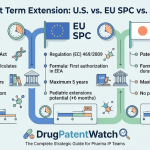
The European analogue to U.S. PTE is the Supplementary Protection Certificate (SPC), governed by Regulation (EC) No. 469/2009 for medicinal products and Regulation (EC) No. 1610/96 for plant protection products. There is no SPC equivalent for medical devices in Europe, which creates a significant asymmetry between U.S. and EU IP protection strategies for Class III device companies.
European medical devices are regulated under the EU Medical Device Regulation (EU MDR 2017/745), with CE marking as the market access mechanism rather than FDA PMA. CE marking does not generate SPC eligibility because CE marking is not a marketing authorization in the sense required by the SPC regulations — it is a conformity assessment, not a product-specific regulatory approval of safety and efficacy.
This means European medical device companies cannot replicate the U.S. PTE strategy in their home market. The only analogous protection available in Europe for device IP is through national patent term restoration mechanisms in countries that have implemented them, which remains limited and inconsistent.
9.2 Japan’s Patent Term Extension for Medical Devices
Japan’s patent term extension system under the Patent Act allows for extension of up to five years for products that receive approval under the Pharmaceutical and Medical Device Act (PMDA). The Japanese system covers medical devices that require regulatory approval before commercial marketing, analogous to the U.S. PTE framework.
For multinational Class III device companies, coordinating U.S. PTE applications with Japanese patent term extension applications requires attention to the distinct calculation methodologies and filing deadlines in each jurisdiction. Japan’s extension period calculation uses different reference dates and different definitions of the regulatory review period than the U.S. system.
9.3 Coordination Strategy for Global IP Lifecycle Management
Companies with Class III devices in multiple major markets should map PTE or PTE-equivalent opportunities in each jurisdiction against their global patent portfolio at the time of first market approval. U.S. PTE, Japanese extension, and whatever national mechanisms exist in other target markets should be filed on coordinated timelines to prevent inadvertent forfeiture of any jurisdiction’s extension due to missed local deadlines.
The U.S. 60-day deadline is among the strictest globally. Other jurisdictions allow longer filing windows after approval, but companies that establish a 60-day filing discipline for the U.S. application should calibrate each country’s deadline into the same internal monitoring calendar.
Key Takeaways — Part 9
No EU SPC equivalent exists for medical devices. U.S. PTE remains the primary statutory protection extension mechanism for Class III devices globally. Japan provides an analogous patent term extension system under PMDA approval. Multinational companies should coordinate global IP lifecycle management against the most restrictive filing deadline in their portfolio, which is typically the U.S. 60-day window.
Part 10: Best Practices — The Operational Playbook
10.1 Integrate IP Planning with Regulatory Strategy at the IDE Stage
The optimal time to align patent strategy with PTE eligibility is before the IDE is filed, not after PMA approval. At the IDE stage, the company knows the device design well enough to draft claims that explicitly cover the approved product and its method of use. Patent prosecution initiated at this stage with PTE eligibility in mind produces claims that satisfy 35 U.S.C. § 156’s coverage requirement and resist narrowing during prosecution.
Claims should explicitly use the phrase ‘medical device’ in method-of-use claims covering combination products. Apparatus claims should describe the device in terms that map directly to the PMA-approved design. System claims should cover the deployment system or delivery catheter as a unitary medical device where that framing is clinically accurate.
10.2 Build the Due Diligence Calendar at IDE Authorization
From the day the IDE is authorized, the company’s regulatory diary should be initialized and maintained by a designated responsible party. Every protocol submission, FDA meeting request, meeting summary, protocol amendment, interim analysis trigger, database lock date, PMA module submission, and FDA information request response should be recorded with date, author, and content summary.
This diary has two uses: it documents due diligence for PTE purposes, and it provides the evidentiary basis for defending against third-party due diligence challenges. The investment to maintain it is minimal. The cost of not maintaining it, if a competitor petitions for a due diligence determination and finds documented gaps, is measured in months of PTE extension.
10.3 Set a 60-Day Filing Alert at PMA Submission
The 60-day PTE filing window begins at PMA approval, not at commercial launch. Companies that track the clock from launch rather than approval create a foreseeable risk of missing the deadline. The PMA approval date is definitively established by the FDA’s approval letter. That date should trigger an automatic alert to the responsible IP counsel and regulatory affairs lead on the day the letter is received.
The PTE application itself requires specific information: patent identity and claims, product identity and the relevant FFDCA section, a brief description of significant regulatory activities and dates, and the applicant’s calculation of the extension period. Assembly of this application should not begin when the 60-day clock starts. It should be substantially prepared before PMA approval, updated with the confirmed approval date and final regulatory period dates, and filed within the first two weeks of the window.
10.4 Conduct the Patent Election Analysis Before the PMA Is Filed
By the time a PMA is submitted, the company should have completed a formal patent election analysis that ranks every potentially eligible patent in the portfolio and documents the rationale for the preferred election choice. This analysis should evaluate claim scope relative to the approved product, remaining patent term, prosecution history estoppel and its effect on claim coverage, validity exposure based on known prior art, and the difficulty a competitor would face in designing around the patent during the extended period.
The analysis should be conducted by patent counsel with both prosecution experience and litigation perspective, because the value of a PTE-extended patent depends partly on its enforceability against the specific design-arounds a competitor is likely to attempt.
10.5 Maintain a Multi-Layer Portfolio for Lifecycle Protection
PTE extends a single patent. The commercial lifecycle of a Class III device extends beyond any single patent. A multi-layer portfolio strategy ensures that when the PTE-extended patent ultimately expires, additional patents covering manufacturing improvements, accessory components, delivery system refinements, or subsequent hardware generations remain in force.
For cardiac valve platforms, this means maintaining patents on the valve frame geometry, the sealing skirt design, the delivery catheter mechanism, the deployment actuation system, and the crimping specifications. Each element represents a distinct innovation that a competitor must address independently, and each can be the subject of separate patent protection even if not eligible for PTE.
Key Takeaways — Part 10
PTE execution is an operational discipline, not a one-time filing event. The foundations are set at the IDE stage through claim drafting, due diligence documentation, and portfolio layering decisions. The 60-day window requires preparation before PMA approval, not after. Patent election analysis should be completed before PMA submission, not during the election window.
Part 11: Investment Strategy for Portfolio Managers
11.1 How PTE Status Affects Valuation Models
For institutional investors in medical device companies, PTE status materially affects the duration and defensibility of projected revenue streams in DCF models. A patent with an active PTE that extends the exclusivity window by three to four years, applied to a Class III device with $500M-$2B in annual revenue, changes the terminal value calculation significantly.
The key inputs to model are the PTE grant probability, the expected PTE length given the product’s regulatory history and the 14-year cap analysis, the ASP maintenance rate during the extension period relative to the competitive equilibrium price, and the competitive device entry timeline.
For pre-approval pipeline assets in companies pursuing PMA for novel Class III devices, the PTE option value should be included in the risk-adjusted NPV model as a probability-weighted duration extension on the projected exclusivity pricing period. Companies that have documented IDE authorization, established a due diligence recording process, and commissioned a preliminary patent election analysis have reduced the execution risk component of that probability weight.
11.2 PTE as a Due Diligence Screen in M&A
In medical device M&A transactions, the acquiring company’s IP due diligence should include a PTE audit for every Class III device in the target’s portfolio. The audit should answer: which devices are PTE-eligible, which have filed applications, which have received grants, what is the calculated extension length for each, are there open due diligence challenges or third-party petitions, and were the 60-day filing deadlines met for products approved before the transaction.
A missed PTE filing on a recently approved Class III device is an immediate acquisition value impairment. A successfully filed and granted PTE for a high-ASP device in a competitive market is a positive value driver that may not be fully captured in revenue projections that use unadjusted patent expiry dates.
11.3 Monitoring PTE Activity as a Competitive Intelligence Signal
Medical device PTE applications are publicly documented through Federal Register notices of regulatory review period determination. These notices identify the product, the patent, and the applicant, and they appear within the first year post-approval for devices where PTE applications have been filed.
Investors and competitive intelligence teams tracking Class III device approvals should monitor Federal Register PTE notices as a systematic signal of which approved devices the manufacturer considers most IP-defensible. A company that files for PTE on a newly approved Class III device is signaling that the product has a patent portfolio strong enough to merit extension, that the regulatory development timeline supports a meaningful extension calculation, and that the commercial market justifies the application investment.
A company that does not file PTE on an eligible Class III device is signaling one of several things: awareness gap, patent portfolio weakness relative to the approved product, expectation of rapid product obsolescence, or a commercial lifecycle too short to justify the extension.
11.4 The PTE-LOE Transition as a Shorting Signal
For devices where PTE is approaching expiration with no successor generation in sight and no remaining portfolio patents of comparable scope, the transition from PTE protection to open competition represents a material revenue risk. In pharmaceutical markets, this is the LOE cliff. In medical device markets, the cliff is less vertical but still significant — price compression of 15-25% over two to three years as competitive devices gain clinical adoption.
Tracking PTE expiration dates for Class III devices in high-ASP categories, mapped against the competitive pipeline of alternative devices, provides a forward-looking risk timeline for existing device revenue models.
Key Takeaways — Part 11
PTE status is a material input to Class III device revenue duration models. M&A IP due diligence should include a systematic PTE audit covering all PMA-approved products in the target’s portfolio. Federal Register PTE notices are a public competitive intelligence signal about which Class III device approvals a manufacturer considers most IP-defensible. PTE expiration without successor generation patents is an LOE signal that warrants updated revenue projections.
Part 12: Policy Reform Considerations
12.1 The De Novo Gap
The current PTE framework creates an anomaly for De Novo-approved devices. A truly novel Class III device reclassified to Class II through De Novo may require extensive clinical data — the CDRH reports that approximately 80% of De Novo submissions require clinical evidence — and a regulatory review period of up to 270 days. That review period consumes patent time in exactly the same way as PMA review, but it generates no PTE eligibility.
The legislative distinction between PMA and De Novo as PTE triggers was not irrational at the time of the Hatch-Waxman Act’s passage, when De Novo did not exist as a pathway and the Act’s drafters designed around the regulatory structure of 1984. The De Novo pathway was created by the FDA Modernization Act of 1997. Congress has not revisited the PTE framework to address this structural gap.
Arguments for extending PTE eligibility to De Novo approvals are straightforward: De Novo devices face genuine regulatory review periods, require clinical evidence, and consume patent time before first commercial marketing. The legislative purpose of compensating for mandatory regulatory delay applies equally to these products. Arguments against expansion center on concerns about extending exclusivity for moderate-risk devices that have already benefited from a less burdensome approval pathway compared to PMA.
12.2 The Short Device Lifecycle Problem
Even for PMA-eligible Class III devices, the competitive device design-around cycle can be short relative to the potential PTE window. A competitor can design around a stent frame patent and complete a 510(k) or PMA Supplement review in two to three years in some cases. If the PTE extends exclusivity for three to four years, but a design-around competitor enters the market 18 months post-approval, the practical exclusivity window is shorter than the statutory window.
This dynamic varies dramatically by device category. Transcatheter valve systems require years of clinical validation before a competitor can claim equivalency. Drug-eluting stents have an established competitive market where design-around iterations move faster. The PTE framework applies a uniform calculation methodology to both, which means its commercial value varies by category in ways that the statutory formula does not capture.
12.3 Legislative and Administrative Options
Three approaches exist for addressing the De Novo gap and the structural underutilization of the PTE framework for medical devices. Congressional action could amend 35 U.S.C. § 156 to include De Novo approvals as triggering regulatory review periods. The FDA and USPTO could develop a joint administrative guidance clarifying PTE eligibility criteria for combination products and De Novo-adjacent PMA products. Industry advocacy through AdvaMed or similar organizations could prioritize PTE framework modernization as a legislative agenda item.
The practical timeline for any of these approaches is measured in years to a decade. Companies operating in the current framework should optimize within the existing rules while tracking legislative developments that may expand the eligible product universe.
Key Takeaways — Part 12
The De Novo gap is a structural policy anomaly, not a regulatory error, and correcting it requires Congressional action. Companies developing novel Class III devices should model both PMA and De Novo pathways with PTE value included in the PMA scenario and excluded from De Novo scenarios. Legislative advocacy for expanded PTE eligibility to De Novo products is a legitimate industry position with a coherent statutory rationale.
Appendix A: Reference Tables
Table 1: PTE Eligibility by FDA Approval Pathway
Pathway
Device Risk Class
Regulatory Statute
PTE Eligible
Typical Review Time
Premarket Approval (PMA)
Class III
FFDCA § 515
Yes
180 days – 36+ months
510(k) Premarket Notification
Class I/II
FFDCA § 510(k)
No
90-180 days
De Novo Classification
Class I/II (reclassified)
FFDCA § 513(f)(2)
No
150-270 days
PMA Supplement (major)
Class III
FFDCA § 515
Potentially, for new product claim
Varies
Table 2: PTE Calculation Components for Medical Devices (35 U.S.C. § 156(g)(3)(B) / 37 CFR § 1.777)
Component
Definition
Direction
Testing Period
IDE effective date (or first human investigation) through initial PMA submission
Add
Approval Period
Initial PMA submission through PMA approval
Add
Pre-Patent Issuance Deduction
Days of regulatory review period before patent issued
Subtract
Half-Testing-Period Deduction
50% of testing period days after patent issued
Subtract
Due Diligence Deduction
Days where applicant did not act with due diligence
Subtract
Maximum Extension Cap
5 years absolute maximum
Cap
Effective Term Cap
Original remaining term + extension cannot exceed 14 years from PMA approval
Cap
Table 3: Key Statutory References
Provision
Subject Matter
35 U.S.C. § 156(a)
PTE eligibility requirements
35 U.S.C. § 156(c)
Caps and deductions
35 U.S.C. § 156(d)(1)
Application requirements and 60-day deadline
35 U.S.C. § 156(f)(1)(B)
Medical device product definition
35 U.S.C. § 156(g)(3)(B)
Regulatory review period calculation for devices
37 CFR § 1.730-.785
USPTO procedural regulations for PTE
21 CFR § 3.7
FDA combination product PMOA determination
FFDCA § 515
PMA authorization for Class III devices
Appendix B: Due Diligence Documentation Checklist
The following events should be recorded contemporaneously with date, responsible party, and a brief content summary:
IDE protocol submission and FDA receipt confirmation. IDE authorization letter receipt. Initial Investigational Review Board (IRB) approvals at principal study sites. First patient enrolled (first-in-human date). Each protocol amendment filing and FDA acceptance. Each interim analysis trigger and Data Safety Monitoring Board (DSMB) decision. Any clinical hold issuance and response. Last patient last visit date. Database lock date. PMA module submissions (complete list of all modules in a modular PMA, with submission dates). FDA Acceptance Review completion and notification. Major Deficiency letter receipt and response filing date. Advisory Panel scheduling, meeting date, and recommendation. Pre-approval inspection scheduling, completion, and outcome. PMA approval letter receipt date.
Every item on this list should be in the regulatory diary. Every gap in the diary is a potential due diligence deduction if challenged.
This article is intended for informational and strategic planning purposes. Nothing in this guide constitutes legal advice. Companies should retain qualified patent counsel with medical device PTE experience before making patent election decisions or filing PTE applications.
Copyright considerations: Primary source data drawn from 35 U.S.C. § 156, 37 CFR §§ 1.730-1.785, Taylor & Francis study (Tandfonline, 2024), Federal Register PTE determination notices for Edwards Lifesciences SAPIEN 3 products, USPTO MPEP §§ 2750-2759, and published case law including Angiotech Pharmaceuticals v. Lee (Fed. Cir. 2016).