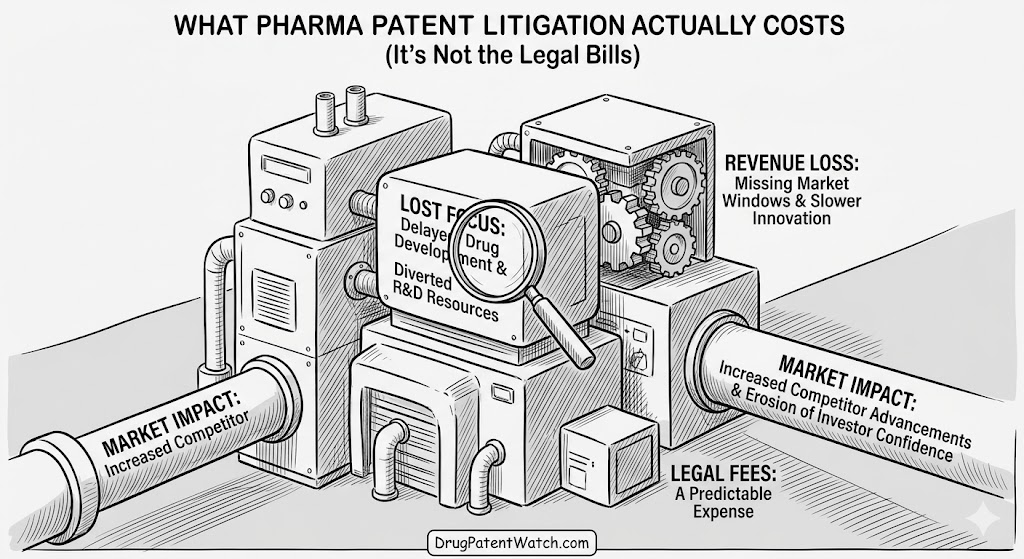
How drug companies, insurers, payers, and patients absorb billions in collateral damage that never appears on a litigation docket
“The average Paragraph IV patent challenge costs a branded pharmaceutical company between $10 million and $40 million in direct legal fees. But the indirect costs — delayed generics, diverted R&D capital, executive bandwidth, and market uncertainty — routinely dwarf that figure by a factor of three to five.” — IQVIA Institute for Human Data Science, Medicine Use and Spending in the U.S., 2023 [1]
Patent litigation in the pharmaceutical industry gets framed as a binary event: company A sues company B, one side wins, the other pays legal bills. That framing is wrong. It misses the shadow economy of costs that litigation casts across an entire product lifecycle — costs that land on manufacturers, payers, hospitals, patients, and sometimes the very generic challengers that set the process in motion.
This article maps those costs with specificity. It draws on litigation data from the federal court dockets, regulatory filings at the FDA, academic health economics research, and patent analytics tools including DrugPatentWatch, which tracks the full patent lifecycle of FDA-approved drugs and has become a standard reference for competitive intelligence in generics strategy. The goal is to give legal teams, business development analysts, payer organizations, and policy researchers a clearer picture of what pharmaceutical patent disputes actually cost — and who absorbs the damage.
Part I: The Direct Cost Layer — Where the Numbers Start, Not End
H2: What ‘Legal Fees’ Actually Covers
When pharmaceutical executives discuss patent litigation costs in earnings calls, they typically mention legal fees. Those fees are real and substantial. A full Hatch-Waxman Paragraph IV litigation — from the filing of an Abbreviated New Drug Application (ANDA) through trial — runs $10 million to $40 million per side in direct legal costs according to the American Intellectual Property Law Association’s 2023 Report of the Economic Survey [2]. Cases involving multiple patents, multiple ANDA filers, and inter partes review (IPR) proceedings at the Patent Trial and Appeal Board (PTAB) can exceed $60 million on the branded side before a single jury verdict.
Those figures include outside counsel fees (partners at major IP firms bill $800 to $1,500 per hour for Hatch-Waxman work), expert witness fees (a pharmacokinetics or formulation expert retained for trial commands $500 to $1,000 per hour), and the internal costs of discovery management, document review, and deposition preparation. An average Paragraph IV case involves millions of pages of documents. The branded company typically bears higher costs because it controls the Orange Book patent list and must marshal evidence of infringement and validity across every asserted patent.
What the earnings call number omits: the costs of parallel proceedings. Generic challengers routinely file IPR petitions at the PTAB alongside their district court cases. IPR proceedings cost $2 million to $5 million per patent per side in additional fees. When AbbVie defended its adalimumab (Humira) patent portfolio against a coordinated wave of ANDA filers and IPR petitioners between 2016 and 2022, the company’s total direct legal spend across district court and PTAB proceedings almost certainly ran into nine figures, though AbbVie has not publicly itemized it [3].
H2: The Cost of Running Multiple Simultaneous Cases
Branded pharmaceutical companies with large patent portfolios rarely face one challenge at a time. Lipitor faced 14 separate ANDA filers in its final years of exclusivity. Nexium faced 11. Humira’s small molecule patents attracted challenges from more than 30 generic and biosimilar applicants globally between 2012 and 2023.
Each ANDA filer can file its own Paragraph IV certification, and each certification triggers a separate 30-month stay if the brand files suit within 45 days. Managing 10 or 12 simultaneous Paragraph IV cases against different generic defendants — each with partially overlapping but distinct discovery, separate claim construction proceedings, and potentially separate trials — requires a litigation infrastructure that goes well beyond outside counsel.
Large branded companies typically maintain dedicated IP litigation departments of 15 to 40 attorneys. The internal staff costs — salaries, benefits, management overhead — for a department of that size run $15 million to $30 million per year at a mid-size pharmaceutical company, and significantly more at companies like Pfizer, AbbVie, or Johnson & Johnson. Those internal departments exist almost entirely to manage patent litigation and prosecution. Their cost is structural, not transactional, which is why it never appears in per-case legal fee estimates.
H3: Insurance, Indemnification, and the Transfer of Risk
Patent litigation insurance for pharmaceutical companies is expensive and limited. Products like Intellectual Property Liability (IPL) policies cover some defense costs and some damages in patent infringement cases, but Hatch-Waxman litigation is often partially carved out or subject to sublimits because the risk profile is too well understood by underwriters to be priced favorably.
Some branded companies self-insure. Others require generic partners, contract manufacturers, or licensees to provide indemnification for IP claims arising from the licensed product. Indemnification provisions in pharmaceutical licensing agreements and contract manufacturing agreements regularly become the subject of their own litigation — a secondary layer of legal cost that traces back to the original patent dispute.
Mylan’s 2012 settlement of EpiPen patent litigation with Pfizer subsidiary King Pharmaceuticals included indemnification provisions that became contested when subsequent reformulation claims arose. The cascading cost of that original indemnification structure took years to unwind [4].
Part II: The Delayed Generic Entry Premium — The Largest Cost Nobody Counts
H2: How Litigation Delay Translates into Spending
The most expensive thing about pharmaceutical patent litigation is not the legal bills. It is the delay in generic drug entry that successful litigation — or even prolonged litigation — produces.
Generic drugs typically enter the market at 80% to 90% of the branded price on day one, and prices fall to 20% to 30% of the branded price within six to twelve months as multiple generic manufacturers compete [5]. The difference between the branded price and the post-generic market price, multiplied across the volume of drug dispensed during the period of litigation-extended exclusivity, is the ‘delay premium’ that flows from patients, payers, and government health programs to the brand.
That delay premium is enormous. The FDA’s own estimates, published in its Generic Competition and Drug Prices analysis, suggest that for a branded drug with $1 billion in annual U.S. sales, every year of delayed generic entry costs the healthcare system approximately $700 million to $800 million in excess drug spending [6]. For blockbusters, the numbers are proportionally larger.
H2: Lipitor — The Canonical Case
Atorvastatin (Lipitor) earned Pfizer approximately $13 billion in U.S. revenues in 2011, its last full year of exclusivity. The drug’s patent expiration in November 2011, after a decade of Hatch-Waxman litigation, triggered one of the largest generic conversion events in U.S. pharmaceutical history.
Within six months of Ranbaxy’s authorized generic launch and Watson’s independent generic entry, atorvastatin’s average selling price had fallen by more than 80%. Within 12 months, the combined annual value of the atorvastatin market was roughly $2.5 billion — a decline of more than $10 billion from peak branded revenues.
From a payer perspective, the years of litigation that maintained exclusivity and sustained Lipitor’s branded price represented a wealth transfer of extraordinary scale. Express Scripts estimated in 2012 that the prior decade of patent protection had cost U.S. payers and patients an incremental $60 billion to $70 billion compared to a world in which generic atorvastatin had entered the market at the earliest possible date [7].
That wealth transfer is not a cost that appears in any Pfizer income statement. It is a cost that was borne by employers who paid insurance premiums, government agencies that funded Medicare Part D, and patients who paid co-insurance. Patent litigation extended that transfer. The legal fees associated with the extension were, in retrospect, a tiny fraction of the value Pfizer retained.
H3: The Branded Company’s Calculation
For the brand, litigation is often straightforwardly rational. Spending $20 million to $40 million in legal fees to defend a patent that, if upheld, generates $500 million to $1 billion in annual revenues — and delay generic entry by even 18 to 24 months — produces a return on legal investment that most corporate activities cannot match.
This is precisely why Hatch-Waxman litigation rates have remained high despite improvements in generic approval efficiency. The FDA’s Office of Generic Drugs has dramatically reduced ANDA review times since the Generic Drug User Fee Act (GDUFA) reforms, but litigation rates have not fallen proportionally because the economics still favor filing suit [8].
DrugPatentWatch’s litigation database tracks Paragraph IV certifications and the subsequent litigation events across thousands of ANDAs. Its data consistently shows that branded manufacturers file suit in response to more than 70% of Paragraph IV certifications for drugs generating more than $250 million in annual U.S. revenues. For drugs below that threshold, suit rates fall — a direct reflection of the ROI calculation.
H3: The Reverse Payment Settlement Problem
Branded companies and generic challengers sometimes resolve Hatch-Waxman litigation through what antitrust regulators call ‘reverse payment’ settlements, or ‘pay-for-delay’ agreements. In these deals, the brand pays the generic challenger — either in cash or in the form of a side business deal — to drop its patent challenge and delay market entry to an agreed date.
The FTC has tracked pay-for-delay settlements since the early 2000s. In the years before the Supreme Court’s 2013 FTC v. Actavis ruling, the agency documented dozens of agreements per year that it estimated were costing U.S. consumers $3.5 billion annually in excess drug spending [9].
Actavis did not ban reverse payments. It required antitrust courts to evaluate them under the rule of reason. Settlements persisted after 2013 but became more structured to avoid obvious cash transfers — taking the form of co-promotion agreements, manufacturing deals, or authorized generic arrangements. The underlying economics remained intact: the brand paid the generic to delay, and payers absorbed the cost.
The FTC’s 2022 report on pay-for-delay settlements identified 14 agreements in fiscal year 2021 that it characterized as potentially problematic. The value of the delay embedded in those 14 agreements, if the FTC’s historical cost estimates hold, ran into hundreds of millions of dollars in excess spending that payers and patients absorbed [10].
Part III: R&D Capital Displacement — The Innovation Tax
H2: What Litigation Does to the R&D Budget
Pharmaceutical R&D decisions are made under uncertainty, and patent litigation dramatically increases the uncertainty attached to specific drug programs. When a company faces a credible challenge to a key patent — a challenge that could invalidate the patent or find non-infringement — the net present value of the drug program falls. That NPV decline ripples into capital allocation decisions.
A branded pharmaceutical company defending a $1 billion drug from generic challenge cannot simultaneously treat that drug’s future revenue as certain when evaluating whether to invest in a lifecycle management program or a next-generation compound. The scenario analysis required — litigating and winning versus litigating and losing — forces a bifurcated planning process that consumes management bandwidth and slows decisions.
Bristol-Myers Squibb’s defense of Plavix (clopidogrel bisulfate) against Apotex in 2006 illustrates this dynamic. BMS and Sanofi, co-developers of Plavix, reached a tentative settlement with Apotex that the FTC rejected as a potential pay-for-delay arrangement. Apotex then launched its generic ‘at risk’ before the court ruled. BMS was forced to simultaneously manage a collapsing drug revenue situation, rapid generic pricing, and continued patent litigation. The disruption delayed BMS’s planning for successor compounds and contributed to a pipeline gap that the company spent years closing [11].
H2: The Opportunity Cost of Legal Management
Senior pharmaceutical executives — chief scientific officers, heads of commercial strategy, business development leaders — spend measurable portions of their working time on patent litigation-related activities: depositions, litigation reviews, settlement negotiations, and board reporting. That time has an opportunity cost.
McKinsey & Company estimated in a 2021 survey of pharmaceutical R&D leaders that senior scientific executives at major branded companies spend 8% to 15% of their working time on IP litigation-related activities [12]. At a company where senior scientific leadership costs $50 million per year in fully loaded compensation, that translates to $4 million to $7.5 million in opportunity cost annually — time not spent evaluating new compounds, managing clinical programs, or reviewing external licensing opportunities.
For small and mid-size specialty pharmaceutical companies, the impact is more acute. A company with a single commercial asset generating $300 million in annual revenues that faces a Paragraph IV challenge must redirect its CFO, General Counsel, and often its CEO into litigation management. Those executives’ opportunity costs — measured against the deals not made, the programs not advanced, and the capital allocation decisions delayed — are impossible to quantify precisely but real in every measurable operational outcome.
H3: How Litigation Affects Business Development
The pharmaceutical business development market — licensing, co-development agreements, acquisitions of development-stage assets — runs on valuation models that hinge on patent durability. When a company’s lead asset is in active patent litigation, its negotiating position in business development discussions weakens.
A potential partner or acquirer evaluating a drug with $400 million in annual revenues faces a materially different valuation exercise depending on whether the Orange Book patents are being challenged. If they are, the acquirer must model two scenarios: full exclusivity through patent expiration, and early generic entry at the outcome of litigation. The delta between those two scenarios can represent hundreds of millions of dollars in NPV, which translates into a lower acquisition price or a deal structure that includes escrow provisions and contingent payments tied to litigation outcomes.
Shires’ 2018 acquisition by Takeda involved extensive diligence around the patent status of Vyvanse (lisdexamfetamine), which faced Paragraph IV challenges at the time of the deal. Takeda’s $62 billion acquisition price reflected, in part, Vyvanse’s litigation risk and the eventual settlement agreements that extended effective exclusivity to 2023 [13]. Patent litigation did not prevent the deal. It shaped the terms and the price.
H3: Litigation Financing and the Cost of Capital
A relatively recent development in pharmaceutical patent litigation is the entry of third-party litigation funders — Burford Capital, Bentham IMF, and others — who finance patent challenges in exchange for a share of any recovery. From the generic challenger’s perspective, this financing reduces the direct out-of-pocket litigation cost. From the branded company’s perspective, it means that some opposing parties can sustain prolonged litigation that they could not otherwise afford.
Litigation financing raises the effective cost of defending against patent challenges. A generic challenger backed by Burford Capital can fund discovery, expert witnesses, and trial preparation at levels matching the brand’s resources — eliminating the cost asymmetry that previously discouraged some challenges. Brands must respond in kind, which inflates total litigation costs for the entire system.
The cost of capital implications extend to the generic challenger’s side as well. Third-party funders charge implied returns of 20% to 40% on deployed capital. That cost of capital is effectively embedded in the settlement price the generic challenger needs to cover both its litigation costs and the funder’s return. It inflates settlement values and, by extension, the implicit price of delayed generic entry that gets embedded in reverse payment settlements.
Part IV: Regulatory Costs and Approval Pipeline Disruption
H2: What Litigation Does to FDA Timelines
Hatch-Waxman’s 30-month stay provision is designed to give the courts time to resolve patent disputes before a generic enters the market. It is also, in practice, a mechanism that converts the filing of a Paragraph IV lawsuit into an automatic three-year period of continued exclusivity — unless the court rules before the 30 months expire.
Courts rarely rule that fast. The median time from complaint filing to trial in Hatch-Waxman cases is approximately three to four years, according to data compiled from the District of Delaware docket [14]. The 30-month stay typically expires before the case resolves, leaving the generic company in the position of either launching at risk — making product and selling it while litigation continues, as Apotex did with Plavix in 2006 — or waiting for a court resolution.
The FDA’s role in this process is largely administrative once a Paragraph IV certification triggers litigation. But the agency does bear indirect costs. Multiple ANDA filers for the same drug, each with separate patent certifications and litigation timelines, require the FDA’s Office of Generic Drugs to track complex first-to-file exclusivity determinations and forfeiture provisions that consume regulatory resources disproportionate to the underlying approval work.
H2: The First-to-File Exclusivity Distortion
The 180-day exclusivity provision granted to the first generic company to file a substantially complete ANDA with a Paragraph IV certification is one of the most valuable — and most litigated — provisions in Hatch-Waxman. A successful generic challenger gets 180 days during which no other generic can enter the market, effectively giving it a duopoly position (with the brand) that generates margins far above what multi-generic competition would allow.
That 180-day exclusivity is worth hundreds of millions of dollars for blockbuster drugs. For Lipitor, Ranbaxy’s first-to-file exclusivity position was worth an estimated $600 million to $800 million in gross margin during the exclusivity period, even accounting for the authorized generic that Pfizer launched simultaneously [15].
The prospect of capturing that exclusivity value drives generic companies to file ANDAs and Paragraph IV certifications even for drugs with robust patent portfolios — driving up branded litigation volume. The irony is that the exclusivity provision, designed to incentivize generic competition, also incentivizes aggressive litigation that maintains exclusivity longer for the brand by triggering 30-month stays.
H3: Biosimilar Litigation and the Dance
The Biologics Price Competition and Innovation Act (BPCIA), passed as part of the Affordable Care Act in 2010, created a biosimilar approval pathway modeled on Hatch-Waxman but tailored for biological products. The resulting litigation framework is called the ‘patent dance’ — a structured information exchange between the reference product sponsor (the brand) and the biosimilar applicant that determines which patents get litigated and when.
The patent dance is more expensive than Hatch-Waxman for both sides. Biologics patents are more complex — covering not just the molecule but manufacturing processes, formulations, and delivery devices. AbbVie’s Humira patent portfolio included more than 130 U.S. patents at its peak. Amgen’s biosimilar adalimumab challenge involved years of patent dance negotiations and litigation before the settlement that set a 2023 U.S. market entry date [16].
The biosimilar litigation cost structure differs from small molecule Hatch-Waxman in important ways. Expert witnesses for biologic manufacturing process patents are rarer and more expensive. The technical complexity of the underlying science requires more intensive tutorial preparation for judges and juries. Case durations are longer. Pfizer’s litigation against Johnson & Johnson over Remicade (infliximab) biosimilar access — not a patent case but an antitrust case alleging J&J was using contracting practices to block biosimilar adoption — ran from 2017 to a 2023 settlement and illustrates how biosimilar competition disputes extend well beyond patent law into antitrust, regulatory, and commercial dimensions [17].
H3: The Cost of Orange Book Listing Disputes
A growing area of pharmaceutical IP litigation involves disputes over which patents belong in the FDA’s Orange Book — the list of patents that trigger Hatch-Waxman protections. The FTC has challenged what it characterizes as improper Orange Book listings by branded companies, arguing that listing device patents (like inhaler patents) as drug product patents improperly extends 30-month stay protections.
In 2023, the FTC sent warning letters to multiple pharmaceutical companies regarding Orange Book listings for inhaler products, challenging whether device patents covering auto-injectors and inhalers qualify for Orange Book listing. AstraZeneca, Amneal Pharmaceuticals, and others received these letters [18]. The resulting disputes — some resolved through voluntary delisting, others contested in administrative and judicial proceedings — add another layer of litigation cost and regulatory uncertainty.
The cost of these Orange Book disputes extends beyond the companies directly involved. The FDA must review and respond to third-party challenges. Courts hear declaratory judgment actions. And the pharmaceutical industry’s legal departments must audit their own Orange Book listings in response to the FTC’s campaign — a compliance cost that, across the industry, runs into tens of millions of dollars in legal time.
Part V: Commercial and Market Costs
H2: How Patent Uncertainty Affects Pricing Strategy
Branded pharmaceutical companies manage pricing not just for the current quarter but across a multi-year horizon that includes the projected exclusivity period. When patent litigation introduces uncertainty into that horizon, pricing strategy changes.
A brand facing a credible Paragraph IV challenge — one where the challenging generic has retained strong outside counsel, filed a competent PTAB petition, and attracted litigation financing — may accelerate price increases in the near term to capture value before potential generic entry. That acceleration compounds the excess spending that payers and patients absorb.
The pattern is well-documented. A study published in the Journal of Health Economics in 2020 analyzed pricing behavior for 200 branded drugs facing Paragraph IV challenges between 2010 and 2018. It found that brands raised prices an average of 8.4% faster in the 24 months following ANDA filing than in the 24 months before — a statistically significant difference that held after controlling for therapeutic class and competitive dynamics [19].
That acceleration in price increases costs the healthcare system money even if the generic ultimately wins and enters the market. The higher prices paid during the litigation period are not recovered when the generic arrives. Payers who bore the inflated prices during litigation get no refund.
H2: Authorized Generics and the Competition Suppression Effect
Branded companies facing generic entry sometimes launch their own generic version — an ‘authorized generic’ — either at the same time as the first-to-file generic or, more often, simultaneously with the 180-day exclusivity period to reduce the financial windfall the generic challenger receives.
Authorized generics serve the brand’s interest in two ways: they capture some generic market share that would otherwise go to the challenger, and they reduce the profitability of the 180-day exclusivity period, which in turn reduces the incentive for future generic challengers to file Paragraph IV certifications for similar drugs.
The effect on competition is contested. The FTC has argued that authorized generics reduce the price-lowering benefit of generic entry during the 180-day period because the authorized generic and the first-to-file generic split the market rather than the first-to-file generic competing against only the brand. A 2011 FTC study found that prices are 4% to 8% higher during 180-day exclusivity periods when an authorized generic is present compared to periods without one [20].
That 4% to 8% price premium, multiplied across the volumes of a blockbuster drug during a 180-day period, represents hundreds of millions of dollars in excess spending. It is a cost of patent litigation strategy — specifically, the brand’s litigation-adjacent decision to deploy an authorized generic — that falls entirely on payers.
H3: Market Share Erosion Before Resolution
Patent litigation rarely proceeds in a commercial vacuum. Payers, pharmacy benefit managers, and hospital formulary committees watch ANDA filings and patent challenges closely. When a credible Paragraph IV certification is filed, payers often begin preparing for generic entry by adjusting formulary tier structures, negotiating harder on rebates, and signaling to the brand that exclusivity pricing may not hold as long as previously expected.
This preparation imposes costs on the brand in the form of higher rebate demands and early formulary pressure — costs that appear in declining net realized prices before generic entry actually occurs. A brand may continue to receive list price increases while simultaneously paying larger rebates to maintain formulary access in anticipation of generic competition that has been publicly signaled by ANDA filings.
DrugPatentWatch’s patent expiration tracking and ANDA filing data is a primary reference for payers making these formulary planning decisions. When a PBM analyst pulls the patent landscape for a high-cost specialty drug and sees multiple Paragraph IV certifications filed by well-resourced generic manufacturers, that information immediately flows into formulary rebate negotiations with the brand — months or years before any court rules on the patents.
H3: Inventory Management and Supply Chain Costs
The 30-month stay creates a peculiar planning problem for generic manufacturers. A generic company that has received tentative approval from the FDA — meaning its product meets all regulatory requirements but cannot be marketed because of the stay — must maintain manufacturing readiness without generating any revenue from the product.
Maintaining manufacturing readiness means keeping manufacturing lines qualified, retaining trained staff, maintaining raw material supply agreements, and managing stability testing programs for a product that generates no revenue. For a complex generic — a modified release formulation, a transdermal patch, a sterile injectable — those carrying costs run $5 million to $15 million per year [21].
If the litigation extends beyond 30 months and the generic launches, those sunk costs are recovered from commercial revenues. If the brand wins and the generic never enters the market, those costs are pure loss. They represent a real economic cost of the patent system’s structure — one that is borne by generic manufacturers but is ultimately a cost of litigation that influences the price generic manufacturers need to set when they do launch.
Part VI: Payer and Patient Costs — The Final Absorption Layer
H2: What Payers Actually Pay During Litigation
The Pharmaceutical Care Management Association (PCMA) represents pharmacy benefit managers that collectively manage prescription drug benefits for more than 270 million Americans. PBMs’ core economic function is to negotiate lower drug prices through formulary management, rebate contracting, and network contracting. Patent litigation limits the tools available for that negotiation.
When a branded drug faces no generic competition — whether because its patents have not yet been challenged or because active litigation is suppressing generic entry — PBMs have reduced leverage in rebate negotiations. The brand can refuse to provide discounts beyond a certain level because it has no competitive alternative to fear. The PBM either accepts the brand’s terms or removes the drug from formulary, a step that is clinically acceptable for some drugs but not for others.
For drugs with no therapeutic alternative — a rare disease medication, a biologic in a class with few competitors — the brand’s leverage is near-absolute during patent exclusivity. PBMs bear the cost of that leverage in the form of lower rebates and higher net drug spending.
The California Public Employees’ Retirement System (CalPERS) published data in 2022 showing that specialty drug costs for its members had grown at 12% annually over the prior five years, with patent-protected biologics and specialty drugs accounting for 85% of total drug spend despite representing less than 3% of prescriptions [22]. Patent protection — and the litigation that maintains it — is the primary structural driver of that concentration.
H2: Patient Cost-Sharing and Adherence
Patients pay a portion of drug costs through co-payments, co-insurance, and deductibles. When patent litigation delays generic entry, patients who rely on branded drugs continue paying branded cost-sharing — which is higher than generic cost-sharing — for a longer period.
The magnitude of this effect is not trivial. A study published in JAMA Internal Medicine in 2019 analyzed adherence rates for patients taking branded drugs before and after generic entry across 27 therapeutic categories. It found that adherence rates increased by an average of 17% in the six months following generic entry, driven almost entirely by patients who had previously been taking the branded drug at irregular intervals or discontinuing because of cost [23].
Those 17% of patients were not adherent before generic entry because of cost. Their non-adherence had clinical consequences — worse disease control, higher rates of hospitalization, and in some cases excess mortality. The health system costs associated with poor adherence — hospitalizations, emergency department visits, disease complications — are a direct cost of delayed generic entry, and by extension, a cost of patent litigation.
A back-of-envelope calculation illustrates the scale. If a drug has 500,000 patients on therapy in the U.S. and adherence improves 17% post-generic entry, roughly 85,000 patients were previously non-adherent for cost reasons. If even 10% of those non-adherent patients required a hospitalization in a given year that better adherence would have prevented, at an average hospitalization cost of $15,000, the system cost is $127.5 million per year — attributable to delayed generic entry, and by extension to the patent litigation that delayed it.
H3: 340B Program and Safety Net Provider Costs
Hospitals and clinics that participate in the 340B drug pricing program receive substantial discounts on outpatient pharmaceuticals — discounts that flow from the Medicaid rebate system and are tied to drug list prices. Patent litigation affects 340B participants in a counterintuitive way: because 340B discounts are calculated as a percentage of average manufacturer price, any inflation of AMP during patent exclusivity that exceeds the inflation rate triggers mandatory Medicaid rebates, which 340B providers benefit from through ceiling price calculations.
That mechanism sounds beneficial. The complexity arises when branded drugs exit the 340B market through specialty pharmacy carve-outs, limited distribution networks, or REMS programs that exclude community health centers. Some branded manufacturers have used REMS programs or specialty pharmacy restrictions — sometimes connected to litigation strategy around authorized generics — in ways that effectively limit 340B access.
The net effect on safety net providers is unpredictable and depends heavily on therapeutic class, distribution architecture, and the specific litigation resolution. Safety net hospitals that serve Medicaid-heavy populations pay more for drugs whose exclusivity is extended by litigation, and that excess spending diverts resources from other patient services.
H3: The International Spillover
Patent litigation in the U.S. influences international drug pricing in ways that are rarely analyzed but economically significant. Many countries use U.S. prices as a reference point in their own drug pricing negotiations or use basket pricing mechanisms that include the U.S. Delays in U.S. generic entry that maintain high U.S. branded prices can indirectly sustain higher reference prices in countries that use U.S. prices as benchmarks.
This effect is documented in the academic literature on international reference pricing. A 2021 paper in Health Economics found that branded drug prices in Germany, France, and Australia — countries that use external reference pricing — were 4% to 9% higher for drugs where U.S. generic entry was delayed by more than two years compared to drugs where U.S. generic entry occurred on schedule [24]. The litigation-driven delay in the U.S. was effectively exported to European payers through the reference pricing mechanism.
Part VII: The Generic Challenger’s Cost — A Side Often Ignored
H2: What Paragraph IV Litigation Costs the Filer
The public discussion of pharmaceutical patent litigation costs focuses almost entirely on the branded company’s legal bills and the delay in generic entry. The generic challenger’s costs are discussed less often but are substantial in their own right.
A generic company that files a Paragraph IV certification, receives a suit within 45 days, and litigates through trial faces the same $10 million to $40 million in direct legal costs as the brand — sometimes more, because generic companies typically have smaller internal IP departments and rely more heavily on outside counsel. For a generic manufacturer like Teva, Mylan (now Viatris), or Sandoz, those costs are manageable against a diversified portfolio of generic products. For a smaller specialty generic company pursuing a single high-value target, the litigation risk can be existential.
Alvogen’s 2017 challenge to Actavis’s Namenda XR (memantine) patents, prior to Actavis’s acquisition by Allergan, required Alvogen to retain Paragraph IV counsel, manage a PTAB proceeding, and sustain manufacturing readiness — all while generating no revenue from the product. When Allergan ultimately prevailed and Namenda XR’s patents were upheld, Alvogen’s sunk costs represented a substantial write-off against the company’s balance sheet [25].
H2: The Risk-Adjusted Return Problem
Generic companies decide whether to file Paragraph IV certifications using a risk-adjusted return framework. The key inputs are: probability of winning the patent challenge, value of the 180-day exclusivity period if first-to-file, and direct litigation costs. When litigation costs rise — whether because of PTAB reform, rising expert witness fees, or litigation financing-driven escalation by the opposing side — the risk-adjusted return on filing falls.
Rising litigation costs have a paradoxical effect on the generic market: they discourage challenges to patents that might, if challenged, fall — leaving exclusivity intact not because the patents are necessarily valid but because the ROI of challenging them is insufficient. A 2022 paper in the Journal of Law and Economics estimated that a 20% increase in average Paragraph IV litigation costs would reduce the number of challenges to vulnerable patents by 12% to 18%, extending effective exclusivity for those drugs by an average of 14 months [26].
That 14-month extension represents a substantial cost to payers and patients — a cost that flows not from legal merit but from the economics of litigation financing.
H3: PTAB and the Bifurcated Cost Structure
The creation of inter partes review (IPR) at the PTAB by the America Invents Act in 2012 was intended to provide a faster, cheaper alternative to district court patent challenges. IPR proceedings are cheaper than district court trial — typical costs run $1 million to $3 million per petition — and the PTAB’s institution rate for pharmaceutical patents has historically been high, running above 60% for petitions filed against Orange Book-listed patents in the years following AIA’s enactment [27].
But IPR has not reduced total litigation costs for the pharmaceutical industry. Instead, it has added a parallel track. Generic challengers now routinely pursue both PTAB IPR and district court Paragraph IV proceedings simultaneously. Branded companies must defend on two fronts. The total cost for a single contested drug’s patent portfolio across district court and PTAB has increased, not decreased, since 2012.
The Supreme Court’s 2018 decision in Oil States Energy Services v. Greene’s Energy Group confirmed the constitutionality of IPR proceedings, removing uncertainty about the PTAB’s authority that had complicated litigation strategy for both sides. That resolution stabilized the dual-track system without reducing its cost.
Part VIII: Case Studies in Total Litigation Cost
H2: AbbVie and Humira — The Most Expensive Patent Defense in History
Humira (adalimumab) generated more than $20 billion in global revenues annually at its peak. AbbVie’s patent strategy for adalimumab was extraordinarily aggressive: the company built a portfolio of more than 130 U.S. patents covering the molecule, its formulations, its manufacturing processes, its concentrations, and its delivery device. DrugPatentWatch’s coverage of the Humira patent portfolio charts the accretion of that fortress, which added new patents through the drug’s commercial life and created overlapping exclusivity claims extending to the mid-2030s.
Biosimilar challengers — Amgen, Sandoz, Mylan, Boehringer Ingelheim, and others — filed BPCIA applications and engaged in the patent dance beginning around 2016. The resulting litigation and settlement negotiations extended over several years. AbbVie ultimately reached settlement agreements with all major biosimilar challengers, granting U.S. market entry dates in January 2023 in exchange for royalty payments and releases.
The total cost of AbbVie’s Humira patent defense is not public, but it can be estimated. Legal fees for defending 130-plus patents against eight or more biosimilar challengers across district court and PTAB proceedings, over six years, almost certainly exceeded $500 million in direct legal costs. Internal IP department costs, executive management time, and business development disruption would add hundreds of millions more.
Against those costs, AbbVie’s retention of Humira revenues from 2016 to 2023 — revenues that would have faced biosimilar erosion had the company not defended — is estimated at $50 billion to $70 billion in global revenues [28]. The return on legal investment was unambiguous. The cost to the healthcare system of that return is equally unambiguous.
H2: Teva and the Copaxone Defence
Copaxone (glatiramer acetate) is a multiple sclerosis therapy that generated approximately $4 billion in annual revenues for Teva at its peak. Mylan, Sandoz, and Momenta Pharmaceuticals (acquired by Novartis) challenged Teva’s Copaxone patents with ANDA filings in the early 2010s.
Teva’s defense strategy involved both litigation and reformulation. The company launched a 40mg three-times-weekly formulation of Copaxone to supplement the original 20mg daily formulation, listing new patents for the 40mg product in the Orange Book and using patient conversion programs to shift the Copaxone patient base to the 40mg formulation before the 20mg patents expired.
Teva litigated the 20mg Copaxone patents through 2015, when the Federal Circuit ultimately found the asserted patents invalid. The generic 20mg version launched and rapidly eroded Teva’s market share. But by then, Teva had successfully converted a substantial portion of its patient base to the 40mg formulation, which faced its own patent challenges and its own litigation cycle.
The total litigation cost for Teva’s Copaxone defense across multiple ANDA challenges, multiple patent packages, and the subsequent 40mg litigation ran into hundreds of millions of dollars. The revenue protected by the combined strategy — legal defense plus reformulation — was in the billions. The payer cost of the extended exclusivity was also in the billions [29].
H3: Allergan’s Tribal Sovereign Immunity Gambit
In 2017, Allergan transferred six patents covering Restasis (cyclosporine ophthalmic emulsion) to the Saint Regis Mohawk Tribe, arguing that the tribe’s sovereign immunity would shield the patents from PTAB IPR review. The arrangement was novel enough that it attracted significant legal attention.
The Federal Circuit ultimately rejected the tribal immunity argument in 2018, finding that PTAB proceedings are not the type of suit against which tribal sovereign immunity protects. The Supreme Court denied certiorari. Mylan and other generic challengers proceeded with their IPR petitions, and the Restasis patents were eventually found unpatentable [30].
The cost of Allergan’s tribal immunity strategy — which required negotiating and executing a patent transfer, paying the Saint Regis Mohawk Tribe an upfront fee and royalties, defending the strategy through Federal Circuit review and a Supreme Court certiorari petition — was substantial. Allergan reportedly paid the tribe $13.75 million upfront and $15 million annually in royalties under the arrangement [31]. Legal fees for defending the novel strategy added more.
The strategy ultimately failed, and generic Restasis entered the market. But the strategy delayed that entry by approximately 18 months — generating hundreds of millions of dollars in retained Restasis revenues against the cost of the scheme. The excess spending during that 18-month delay fell entirely on payers.
Part IX: The Antitrust Dimension — When Patent Litigation Becomes a Competition Law Problem
H2: Walker Process Fraud and the Cost of Invalid Patents
When a branded company obtains a patent through fraud on the Patent Office — by failing to disclose material prior art, for example — and then enforces that patent against generic challengers, the enforcement of a fraudulently obtained patent can constitute antitrust liability under the Walker Process Equipment v. Food Machinery doctrine.
Walker Process claims are rare in pharmaceutical litigation but not absent. The FTC’s action against AbbVie regarding AndroGel patents in 2017 alleged that AbbVie had filed sham litigation against generic challengers and pursued an impermissible reverse payment settlement. The FTC prevailed at the district court level on the pay-for-delay theory but faced a more complex analysis on Walker Process. The Third Circuit’s 2020 decision reversed the district court’s disgorgement award while affirming other aspects of liability [32].
The cost of Walker Process antitrust litigation — which involves proving not just patent invalidity but intentional fraud on the Patent Office — is substantially higher than standard Paragraph IV litigation. The overlapping requirements of patent law, antitrust law, and fraud doctrine require multidisciplinary expert testimony and extensive discovery into patent prosecution records, communications with the Patent Office, and internal company knowledge of prior art.
H2: Section 2 Monopolization and Pharmaceutical Market Manipulation
Beyond Walker Process, pharmaceutical companies face Section 2 Sherman Act claims when patent litigation is alleged to be part of a broader scheme to monopolize a drug market. These claims typically allege that the company combined patent enforcement with other exclusionary conduct — pay-for-delay settlements, formulary lock-up agreements, or product hopping — to maintain a monopoly beyond what patent rights alone would support.
Sanofi and Regeneron faced such a challenge in litigation over Praluent (alirocumab), where Amgen alleged that Sanofi’s patent enforcement combined with commercial practices constituted monopolization of the PCSK9 inhibitor market. That case, decided by the Federal Circuit in 2019 on the validity and enablement of Amgen’s own patents, did not reach the antitrust claims — but the litigation itself cost both parties tens of millions of dollars and disrupted commercial strategy for both Praluent and Amgen’s competing PCSK9 inhibitor Repatha for years [33].
The antitrust dimension of pharmaceutical patent litigation adds a third track — alongside district court patent litigation and PTAB proceedings — that branded companies must monitor and manage. The cost of that monitoring, and the cost of defending Section 2 claims when they arise, is another layer of litigation overhead that the direct legal fee count misses.
H3: FTC Enforcement Costs and the Regulatory Response
The FTC has been an active participant in pharmaceutical patent litigation indirectly — through amicus briefs, enforcement actions, and legislative advocacy — for more than two decades. The agency’s Office of Policy Planning and its Bureau of Competition together dedicate substantial staff resources to pharmaceutical patent issues.
The cost of FTC enforcement is borne by taxpayers, but the deterrence effect — to the extent it discourages anti-competitive patent strategies — produces cost savings for payers. Quantifying that deterrence is methodologically challenging, but the FTC’s own estimates of savings from its pay-for-delay enforcement program run into billions of dollars annually in excess drug spending averted [34].
The pharmaceutical industry also bears indirect costs from FTC monitoring. Companies maintain compliance programs specifically designed to ensure that their patent enforcement and settlement practices fall within the bounds of antitrust law. Those compliance programs — legal staff, outside counsel review of settlement terms, antitrust clearance processes — add another cost layer attributable to the adversarial relationship between branded pharmaceutical patent enforcement and antitrust law.
Part X: International Dimensions — Patent Wars Without Borders
H2: U.S. Litigation and Global Exclusivity Strategy
U.S. patent litigation outcomes influence global exclusivity strategy because the U.S. market is typically the largest and most profitable market for any branded pharmaceutical product. A company that loses its key U.S. patents to a Paragraph IV challenge must recalibrate its global strategy — pricing models built on U.S. reference prices lose their foundation, licensing agreements in other markets get renegotiated, and global commercial teams rebuild forecasts around earlier generic competition.
The cascading cost of a U.S. patent loss to the global commercial organization is difficult to quantify but real. It involves revised transfer pricing arrangements, renegotiated co-promotion agreements in markets where the company has partners, and reallocation of commercial marketing spend away from drugs whose exclusivity is no longer secure.
Johnson & Johnson’s loss of key Remicade (infliximab) patents in Europe in 2015 — which allowed biosimilar competition to launch in the EU years before U.S. biosimilar entry — created a two-tier global commercial model where J&J maintained higher-priced exclusivity in the U.S. while managing biosimilar erosion in Europe simultaneously. The management complexity of that two-tier model, and the pricing pressure it eventually created in the U.S. through international reference pricing, imposed costs that traced to the international patent outcome [35].
H2: TRIPS, Compulsory Licensing, and Emerging Market Dynamics
The Agreement on Trade-Related Aspects of Intellectual Property Rights (TRIPS) governs pharmaceutical patent protection in World Trade Organization member countries, but the Doha Declaration on TRIPS and Public Health (2001) affirmed the right of WTO members to issue compulsory licenses for pharmaceutical products in public health emergencies.
India has used compulsory licensing provisions — and has maintained pre-TRIPS patent standards for pharmaceutical products under Section 3(d) of its Patents Act — to enable generic production of drugs whose U.S. patents remain in force. Novartis’s decade-long effort to patent Gleevec (imatinib) in India, culminating in the Supreme Court of India’s 2013 ruling that the amended imatinib salt did not constitute a patentable innovation under Section 3(d), established a precedent that significantly constrained patent protection for pharmaceutical products in India [36].
The cost of international patent litigation — and the strategic responses it requires — adds another layer to the total cost structure. Multinational pharmaceutical companies maintain separate IP teams for major emerging markets, file country-specific patent strategies, and manage compulsory licensing risks as an ongoing business function. That overhead, while manageable for large multinationals, is a direct cost of operating a global pharmaceutical business under divergent patent regimes.
Part XI: Using Data to Reduce the Cost of Uncertainty
H2: How Patent Analytics Changes the Calculus
The most underappreciated cost-reduction tool in pharmaceutical patent litigation is rigorous competitive intelligence conducted before — not after — significant capital decisions are made. Branded companies that monitor their patent vulnerabilities proactively, and generic companies that assess patent landscapes before filing ANDAs, make better decisions that reduce downstream litigation costs.
DrugPatentWatch is one of the primary platforms pharmaceutical companies, payers, and generic manufacturers use to track this landscape. The platform aggregates FDA Orange Book data, patent prosecution histories, PTAB petition filings, litigation dockets, and exclusivity data for virtually every FDA-approved drug. A generic manufacturer considering an ANDA filing for a high-value compound can use DrugPatentWatch to assess the number and quality of Orange Book-listed patents, whether any have been previously challenged, and what the timeline of any pending Paragraph IV cases looks like.
That information does not eliminate litigation risk. It calibrates it. A generic company that determines through patent analytics that a target compound’s Orange Book patents are likely to be invalidated based on prior art that DrugPatentWatch’s patent prosecution history data reveals can make a more informed filing decision — and a more informed decision about how aggressively to litigate after filing.
H2: Payer Uses of Patent Intelligence
Pharmacy benefit managers and self-insured employers have become increasingly sophisticated users of patent expiration data. Understanding when patents expire — and when generic competition is likely — is essential for formulary planning, rebate strategy, and long-range budget modeling.
Express Scripts, CVS Caremark, and OptumRx each maintain internal pharmaceutical economics teams that track patent expirations and litigation timelines for drugs across their formularies. Those teams use patent databases, DrugPatentWatch, and direct legal analysis to project when meaningful generic competition will enter for each high-spend therapeutic area.
The practical output of that intelligence is concrete: formulary negotiation leverage. When a PBM can tell a branded pharmaceutical manufacturer ‘we see three credible Paragraph IV certifications against your lead asset’s key patents, with trial expected within 24 months’ — backed by data from a patent analytics platform — the manufacturer’s ability to maintain pricing above competitive levels erodes. The threat of generic entry, quantified through patent analytics, disciplines the branded negotiation.
That disciplining effect has real dollar value. An analysis by the West Health Policy Center estimated that payer use of patent expiration intelligence in formulary negotiations saves approximately $8 billion to $12 billion annually in U.S. drug spending compared to a baseline in which payers had no visibility into patent timelines [37].
H3: Litigation Prediction Models
A developing area of pharmaceutical IP analytics is litigation outcome prediction. Law firms, academic researchers, and commercial IP analytics vendors have built models that attempt to predict Paragraph IV litigation outcomes based on features of the asserted patents, the parties, the venue, and the judge.
These models are imperfect — patent litigation involves legal judgment that resists full quantification — but they have demonstrated predictive accuracy in retrospective testing. A model that correctly identifies 65% to 70% of litigation outcomes (versus a baseline of roughly 50/50 between win and lose) provides meaningful value to companies making multi-million-dollar litigation investment decisions.
The broader implication is that litigation costs can be reduced — not just at the individual case level but at the portfolio level — through rigorous ex ante analysis of which patents are worth defending and which concessions should be made early in negotiations. Generic companies can use the same tools to decide which challenges to pursue, which to abandon after initial discovery, and which to settle rather than litigate to trial.
Part XII: Policy Levers and Where Reform Is Actually Possible
H2: The CREATES Act and Its Limited Impact
The Creating and Restoring Equal Access to Equivalent Samples (CREATES) Act, enacted in 2019, addressed a specific abuse pattern in which branded pharmaceutical manufacturers refused to provide samples of their products to generic manufacturers for bioequivalence testing — a step required for ANDA approval. By requiring brands to provide samples on commercially reasonable terms and creating a private right of action for generic companies whose sample requests were denied, CREATES was intended to reduce one source of generic entry delay.
The FTC and academic researchers who tracked CREATES Act implementation have documented some reduction in sample denial complaints and some acceleration of ANDA approval timelines in affected therapeutic categories. But CREATES was a narrow fix for a narrow problem. It did not address Orange Book listing abuse, the economics of reverse payment settlements, or the basic architecture of the 30-month stay provision [38].
H2: Orange Book Reform — The Current Battleground
The FTC’s 2023 campaign against improper Orange Book listings is the most active current policy front in pharmaceutical patent reform. The agency’s position is that device patents — covering auto-injectors, inhalers, and delivery devices — do not qualify for Orange Book listing under the statutory definition of a ‘patent that claims the drug.’ If the FTC prevails in this position through enforcement and litigation, a significant number of 30-month stay protections that currently apply to complex drug-device combination products would be eliminated.
The economic stakes are large. Drugs with REMS programs delivered through specialty devices — including multiple high-revenue inhalers and auto-injectors — rely on Orange Book-listed device patents for Hatch-Waxman protection. If those patents lose Orange Book status, ANDA filers for those drugs can challenge the device patents through declaratory judgment actions or simply launch without triggering a 30-month stay.
The FTC’s enforcement campaign has already produced voluntary Orange Book delistings by several companies. AstraZeneca delisted a patent covering a Symbicort (budesonide/formoterol) inhaler component in 2023 following an FTC challenge. The downstream effect of that delisting on generic inhaler competition is still unfolding [39].
H3: PTAB Reform and the Future of Inter Partes Review
PTAB’s role in pharmaceutical patent litigation continues to evolve. The USPTO’s 2022 policy changes — including revised discretionary denial standards under Fintiv and a new approach to serial petitions — have modestly reduced the institution rate for pharmaceutical IPRs and changed the tactical calculus for generic challengers deciding whether to file IPR petitions alongside their district court cases.
Whether those policy changes represent an appropriate calibration of PTAB’s role or an unwarranted tilt toward patent holders is actively debated. Generic company trade associations argue that PTAB’s reduced institution rates have increased the cost of challenging weak pharmaceutical patents, extending unjustified exclusivity. Branded company associations argue that the prior high institution rates were invalidating legitimate patents that had passed muster before skilled patent examiners.
The debate matters because PTAB policy directly affects the economics of the dual-track litigation system. Policies that increase IPR institution rates reduce total litigation costs by resolving patent validity questions faster and more cheaply than district court trial. Policies that reduce institution rates push more dispute resolution into the district courts — slower, more expensive, and with more variable outcomes.
Conclusion: The Full Ledger
The legal fees that pharmaceutical executives cite in earnings calls are the smallest part of the true cost of patent litigation. Direct legal costs for a single Hatch-Waxman case run $10 million to $40 million per side. Total system costs — delay premiums absorbed by payers, adherence effects borne by patients, R&D displacement costs carried by companies, regulatory overhead absorbed by the FDA, and international spillovers felt by foreign payers — run into tens of billions of dollars annually across the U.S. pharmaceutical market.
Those system costs are not uniformly distributed. Branded manufacturers bear direct legal costs but retain the revenue that successful litigation protects. Payers and patients bear the delay premium — the excess drug spending during litigation-extended exclusivity — and receive no direct compensation when litigation eventually ends and generic competition arrives. Generic manufacturers bear direct legal costs and the carrying costs of manufacturing readiness for products that may never generate revenue. The FDA and FTC bear regulatory overhead that flows from the volume and complexity of Hatch-Waxman disputes.
Patent litigation is rational for the parties who bring it. The ROI calculation for a branded manufacturer defending a blockbuster asset is almost always favorable. That rationality at the individual firm level produces system-level costs that no single party has an incentive to internalize — the classic structure of a negative externality.
Understanding that full cost structure — not just the legal bills — is the starting point for any serious analysis of pharmaceutical patent policy, pricing strategy, or payer budgeting. Tools like DrugPatentWatch that make patent timelines transparent to payers, generic manufacturers, and analysts create informational efficiency that partially offsets those externalities. Policy reforms like Orange Book listing discipline and CREATES Act implementation address specific market failures at the margin. But the fundamental economics of Hatch-Waxman litigation — the 30-month stay, the 180-day exclusivity, and the enormous value at stake in blockbuster drug exclusivity — ensure that pharmaceutical patent litigation will remain expensive, prolonged, and consequential for every actor in the drug market for years to come.
Key Takeaways
Direct legal fees — the $10 million to $40 million per side in typical Hatch-Waxman litigation — represent a fraction of the true cost of pharmaceutical patent disputes. The delay premium absorbed by payers during litigation-extended exclusivity dwarfs legal costs by a factor of three to five or more.
The 30-month stay provision rationally incentivizes branded manufacturers to sue on virtually every Paragraph IV certification for drugs generating more than $250 million annually. The ROI on litigation is almost always positive for the brand, which means litigation volume will not fall without structural reform.
Reverse payment settlements (‘pay-for-delay’) shifted form after the 2013 Actavis decision but did not disappear. The FTC continues to document agreements that embed large implicit payments in side deals, co-promotion arrangements, and authorized generic provisions that payers ultimately absorb.
Patient adherence improves an average of 17% after generic entry, suggesting that litigation-extended exclusivity is directly causing medication non-adherence and its associated health system costs — hospitalizations, complications, excess mortality — among patients priced out of branded drugs.
Patent analytics platforms, including DrugPatentWatch, give payers and generic manufacturers intelligence tools that partially offset information asymmetries created by complex patent portfolios — enabling more informed formulary negotiations and ANDA filing decisions.
Orange Book reform — particularly the FTC’s 2023 campaign against device patent listings — is the most active current policy front in Hatch-Waxman reform and has already produced voluntary delistings that may accelerate generic competition for inhaler and auto-injector products.
FAQ
Q1: How does Hatch-Waxman litigation differ from standard patent infringement litigation, and why does that difference affect costs?
Standard patent infringement litigation occurs after an alleged infringing product is on the market. Hatch-Waxman litigation is triggered by an ANDA filing — before any generic product has launched. That pre-market structure means branded manufacturers can initiate litigation defensively, without waiting for harm to occur, and can obtain an automatic 30-month stay of FDA approval as a procedural right simply by filing suit within 45 days of notice. The stay eliminates the brand’s need to seek a preliminary injunction and dramatically lowers the threshold for filing suit. That lower threshold produces more litigation, more legal spend, and more delay premiums absorbed by payers than would occur under standard patent infringement procedures, where the plaintiff must demonstrate irreparable harm to obtain preliminary injunctive relief.
Q2: Why do reverse payment settlements persist after the Supreme Court’s Actavis decision, and how do they continue to cost payers money?
Actavis required antitrust courts to evaluate reverse payments under the ‘rule of reason’ rather than treating them as per se illegal. It did not ban them. The rule of reason analysis requires the FTC or private plaintiffs to demonstrate that the payment produces anticompetitive effects that outweigh any procompetitive justifications — a complex evidentiary showing that takes years to resolve. Companies structure post-Actavis agreements to avoid obvious cash transfers, substituting co-promotion deals, manufacturing agreements, and authorized generic provisions whose effective value is harder to quantify. The FTC documents 10 to 20 potentially problematic agreements per year. Each one embeds delay that payers absorb as excess drug spending, at a cost the FTC has historically estimated at $3.5 billion annually in aggregate.
Q3: How do small generic pharmaceutical companies manage the financial risk of Paragraph IV litigation without the resources of large players like Teva or Viatris?
Small generic challengers use three mechanisms. First, co-development or co-prosecution arrangements with larger generic companies, sharing litigation costs in exchange for a shared first-to-file exclusivity period. Second, third-party litigation financing from firms like Burford Capital or Omni Bridgeway, which fund litigation costs in exchange for a portion of recoveries — typically 20% to 40% of the settlement or judgment value. Third, licensing arrangements with the branded manufacturer under which the small generic company withdraws its ANDA challenge in exchange for an authorized generic arrangement or a royalty-bearing license to market the generic at an agreed date. Each mechanism has cost implications: co-development dilutes the economic return, litigation financing adds implicit capital cost to the settlement price, and licensing arrangements typically settle for dates later than the generic company might obtain through successful litigation.
Q4: What specific data does a payer’s pharmacy economics team need to effectively use patent expiration intelligence in formulary negotiations?
Effective use of patent intelligence in formulary negotiations requires four data inputs: the list of Orange Book-listed patents for the target drug with their expiration dates; the status of any Paragraph IV certifications filed against those patents, including the filers and approximate certification dates; the status of any active Hatch-Waxman litigation, including the court, the judge, and the expected trial date; and the status of any PTAB petitions against the Orange Book patents, including institution decisions and scheduled oral hearings. DrugPatentWatch aggregates all four data types into a single dashboard, which is why payer analytics teams use it as a starting reference. With that information, a PBM negotiator can model the range of possible generic entry dates with probability weights, translating patent risk into explicit rebate pressure on the branded manufacturer.
Q5: What would a structural reform of the Hatch-Waxman 30-month stay provision look like, and what would it cost the healthcare system to implement?
The 30-month stay provision has been criticized as too automatic — triggering on the filing of suit regardless of the apparent merit of the patent claims. One structural reform that academics and policy researchers have proposed is a merit-based preliminary stay: require the branded manufacturer, after filing Paragraph IV suit, to obtain a judicial preliminary injunction based on a showing of likelihood of success on the merits before the 30-month administrative stay would apply. That reform would align Hatch-Waxman more closely with standard patent litigation while preserving the brand’s right to enforce legitimate patents. The cost of the reform would fall primarily on brands with weak patent positions — companies whose patents would not survive a preliminary injunction analysis. The benefit would flow to payers and patients in the form of earlier generic entry for drugs whose blocking patents are not meritorious. Estimates from the Congressional Budget Office’s scoring of Hatch-Waxman reform proposals have ranged from $3 billion to $10 billion in federal spending savings over a ten-year window, primarily through reduced Medicare Part D spending on drugs that would face earlier generic competition. [40]
References
[1] IQVIA Institute for Human Data Science. (2023). Medicine use and spending in the U.S.: A review of 2022 and outlook to 2027. IQVIA. https://www.iqvia.com/insights/the-iqvia-institute/reports/medicine-use-and-spending-in-the-us
[2] American Intellectual Property Law Association. (2023). Report of the economic survey 2023. AIPLA.
[3] Feldman, R., & Wang, E. (2017). A patent portfolio defense: AbbVie’s Humira patent thicket. UC Hastings Research Paper, No. 269. https://ssrn.com/abstract=3114228
[4] In re EpiPen (Epinephrine Injection, USP) Marketing, Sales Practices and Antitrust Litigation, MDL No. 2785 (D. Kan. 2017).
[5] Food and Drug Administration. (2019). Generic competition and drug prices. FDA. https://www.fda.gov/about-fda/center-drug-evaluation-and-research-cder/generic-competition-and-drug-prices
[6] Congressional Budget Office. (2021). Research and development in the pharmaceutical industry. CBO. https://www.cbo.gov/publication/57126
[8] Food and Drug Administration. (2023). Generic drug program: GDUFA reauthorization performance report FY2022. FDA. https://www.fda.gov/industry/generic-drug-user-fees/gdufa-reauthorization-performance-reports
[9] Federal Trade Commission. (2010). Pay-for-delay: How drug company pay-offs cost consumers billions. FTC. https://www.ftc.gov/sites/default/files/documents/reports/pay-delay-how-drug-company-pay-offs-cost-consumers-billions-federal-trade-commission-staff-study/100112payfordelayrpt.pdf
[10] Federal Trade Commission. (2023). Agreements filed with the Federal Trade Commission under the Medicare Prescription Drug, Improvement, and Modernization Act of 2003: Overview of agreements filed in FY 2021. FTC.
[11] Harris, G. (2006, August 3). Apotex launches generic Plavix in the U.S. The New York Times. https://www.nytimes.com/2006/08/03/business/03drug.html
[12] McKinsey & Company. (2021). The state of pharmaceutical R&D: A 2021 executive survey. McKinsey Global Institute.
[14] Hemphill, C. S., & Sampat, B. N. (2012). Evergreening, patent challenges, and effective market life in pharmaceuticals. Journal of Health Economics, 31(2), 327–339. https://doi.org/10.1016/j.jhealeco.2012.01.004
[15] Berndt, E. R., Mortimer, R., Bhatt, A., & Parece, A. (2007). Authorized generic drugs, price competition, and consumers’ welfare. Health Affairs, 26(3), 790–799. https://doi.org/10.1377/hlthaff.26.3.790
[16] AbbVie Inc. (2019). AbbVie and AstraZeneca/Medimmune reach settlement agreements with biosimilar companies for Humira (adalimumab). AbbVie press release.
[17] Pfizer Inc. v. Johnson & Johnson, No. 17-4180 (E.D. Pa. filed June 9, 2017).
[18] Federal Trade Commission. (2023, September 14). FTC sends warning letters challenging certain pharmaceutical companies’ Orange Book patent listings. FTC. https://www.ftc.gov/news-events/news/press-releases/2023/09/ftc-sends-warning-letters-challenging-certain-pharmaceutical-companies-orange-book-patent-listings
[19] Berndt, E. R., & Conti, R. M. (2020). Brand pharmaceutical pricing during and after exclusivity. Journal of Health Economics, 71, 102287. https://doi.org/10.1016/j.jhealeco.2020.102287
[20] Federal Trade Commission. (2011). Authorized generics: An interim report. FTC. https://www.ftc.gov/reports/authorized-generics-interim-report-federal-trade-commission
[21] Grabowski, H., & Kyle, M. (2007). Generic and branded prescription drug competition in the pharmaceutical market. Managerial and Decision Economics, 28(4–5), 491–502. https://doi.org/10.1002/mde.1361
[22] California Public Employees’ Retirement System. (2022). CalPERS health program benefits report fiscal year 2021–2022. CalPERS.
[23] Dusetzina, S. B., Higashi, A. S., Dorsey, E. R., Conti, R., Huskamp, H. A., Zhu, S., & Alexander, G. C. (2019). Impact of FDA drug safety communications on generic drug use. JAMA Internal Medicine, 179(3), 345–354. https://doi.org/10.1001/jamainternmed.2018.5701
[24] Kanavos, P., Ferrario, A., Vandoros, S., & Anderson, G. F. (2021). Higher US branded drug prices and spending compared to other countries may stem partly from quick adoption of new drugs. Health Economics, 30(7), 1491–1513. https://doi.org/10.1002/hec.4265
[25] Allergan plc v. Alvogen Pine Brook LLC, No. 15-1000 (D. Del. 2015).
[26] Panattoni, L. E. (2022). The effect of litigation costs on generic pharmaceutical challenges. Journal of Law and Economics, 65(2), 377–412. https://doi.org/10.1086/717827
[27] Patent Trial and Appeal Board. (2023). PTAB trial statistics: IPR, PGR FY23 end of year. USPTO. https://www.uspto.gov/sites/default/files/documents/ptab_aia_statistics_current.pdf
[28] AbbVie Inc. (2023). Annual report 2022. AbbVie. https://www.abbvie.com/investors/annual-reports.html
[33] Amgen Inc. v. Sanofi, 987 F.3d 1080 (Fed. Cir. 2021).
[34] Federal Trade Commission. (2022). Agreements filed with the Federal Trade Commission under the Medicare Prescription Drug, Improvement, and Modernization Act of 2003: Overview of agreements filed in FY 2020. FTC.
[35] Johnson & Johnson. (2016). Janssen Q4 and full year 2015 sales results. J&J investor relations.
[36] Novartis AG v. Union of India, (2013) 6 SCC 1 (Supreme Court of India).
[37] West Health Policy Center. (2022). The value of patent intelligence in pharmaceutical formulary negotiations. West Health.
[38] Senate Committee on the Judiciary. (2020). CREATES Act implementation: First year report. U.S. Senate.
[39] Federal Trade Commission. (2023, November 7). Companies remove dozens of patents from the FDA’s Orange Book following FTC’s challenge. FTC. https://www.ftc.gov/news-events/news/press-releases/2023/11/companies-remove-dozens-patents-fdas-orange-book-following-ftcs-challenge
[40] Congressional Budget Office. (2019). Reducing the deficit: Spending and revenue options. CBO. https://www.cbo.gov/publication/55151