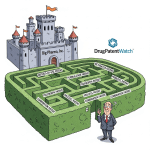
On April 30, 2024, the Federal Trade Commission sent warning letters to ten pharmaceutical companies disputing more than 300 patent listings across 20 brand-name products in the FDA’s Orange Book, including Novo Nordisk’s Ozempic, Saxenda, and Victoza [1]. Novo Nordisk has since delisted the FTC-challenged device patents covering all three products [2]. And in December 2025, the Federal Circuit put a court decision behind the theory the FTC was arguing: in Teva Branded Pharmaceutical Products R&D, Inc. v. Amneal Pharmaceuticals, LLC, the court affirmed a district court order delisting device patents that claimed only inhaler components rather than a specific active ingredient [3].
That sequence — regulatory warning, voluntary delisting, appellate confirmation — is the concrete outcome behind what pharmaceutical business development teams have been calling the GLP-1 “patent fortress.” For a 505(b)(2) sponsor evaluating whether to build a differentiated product around semaglutide or tirzepatide, the practical question is no longer abstract: courts are now willing to strip device patents that don’t name an active ingredient, and at least one originator has already pulled its own listings rather than litigate the point.
Quick Answer: Can You Legally Design Around a GLP-1 Patent?
Yes, through the FDA’s 505(b)(2) New Drug Application pathway, which lets a sponsor rely in part on the FDA’s prior safety and efficacy findings for an already-approved reference drug while developing a formulation, delivery method, or indication that falls outside the originator’s patent claims. The pathway does not avoid patent litigation risk entirely — a 505(b)(2) filing containing a Paragraph IV certification can still trigger a 30-month stay if the reference product sponsor sues — but it is materially faster and cheaper than developing a new molecular entity, and it does not require a generic manufacturer’s razor-thin margins.
The Regulatory Record: FTC Challenges and What Happened Next
Round One and Round Two of FTC Orange Book Challenges
The FTC’s campaign against what it calls “junk” Orange Book listings began with a first wave in November 2023 targeting more than 100 patents held by nine drugmakers [4]. The agency followed with a second, larger wave on April 30, 2024, disputing more than 300 patent listings across 20 products from ten companies, explicitly naming Novo Nordisk’s Ozempic, Saxenda, and Victoza alongside AstraZeneca’s Bydureon and several inhaler products from GSK, Boehringer Ingelheim, and Novartis [1][5]. Then-FTC Chair Lina Khan framed the action around the 30-month automatic stay mechanism: improperly listed patents let companies “block generic competition” by forcing a 30-month delay any time a generic filer is sued over a listed patent, regardless of whether that patent actually covers the drug product [6].
What Novo Nordisk Actually Did
Following the FTC challenge, Novo Nordisk delisted the disputed device patents covering the injector pens for Ozempic, Saxenda, and Victoza [2]. This did not strip the products of patent protection entirely — compound and formulation patents on the underlying semaglutide and liraglutide molecules remain listed — but it removed the specific device-mechanism claims the FTC had flagged as improper. Other companies named in the same round, including Mylan Specialty, GSK, AstraZeneca, AbbVie, Covis Pharmaceuticals, Novartis, and Amphastar, had not delisted their challenged patents as of the same reporting [7].
The Federal Circuit Puts a Legal Standard Behind the FTC’s Theory
The FTC’s letters were a regulatory position, not a binding legal ruling. That changed in December 2025. In Teva Branded Pharmaceutical Products R&D, Inc. v. Amneal Pharmaceuticals, LLC, Amneal counterclaimed for an order delisting certain device patents from the Orange Book; the district court granted it, and the Federal Circuit affirmed, holding that the device patents were not properly listable because they claimed only components of a delivery device and did not recite a specific active ingredient [3]. That holding, decided outside the GLP-1 class but directly on the delisting standard the FTC has been applying to GLP-1 pens, is the primary legal authority a 505(b)(2) sponsor’s patent counsel will cite when evaluating whether a specific device claim on a competitor’s product is durable or vulnerable to a delisting counterclaim.
Event
Date
What happened
Source
FTC first-wave warning letters
November 2023
100+ patents challenged across 9 companies
[4]
FTC second-wave warning letters
April 30, 2024
300+ patents challenged across 10 companies, 20 products, including Ozempic, Saxenda, Victoza, Bydureon
[1][5]
Novo Nordisk delisting
2024–2025
Delisted FTC-challenged device patents on Ozempic, Saxenda, Victoza
[2]
Teva v. Amneal Federal Circuit decision
December 2025
Affirmed delisting of device patents that claim only device components, not an active ingredient
[3]
The Tirzepatide Compounding Shutdown: A Precise Timeline
The source material for this analysis characterizes the end of tirzepatide compounding loosely as “late 2024.” The actual timeline is more specific and has its own legal history. The FDA first announced tirzepatide’s removal from the drug shortage list on October 2, 2024, based on data supplied by Eli Lilly showing supply meeting or exceeding demand [8]. The Outsourcing Facilities Association sued to block the decision, and the FDA agreed to reevaluate, keeping tirzepatide off the shortage list during the reevaluation while declining to pursue enforcement in the interim [9]. On December 19, 2024, the FDA issued a 12-page Declaratory Order reconfirming the October decision [10]. Enforcement against state-licensed 503A pharmacies began after February 18, 2025; enforcement against 503B outsourcing facilities began after March 19, 2025 [11].
“FDA will not take action against compounders for violations of the FD&C Act related to tirzepatide’s inclusion on the drug shortage list” during the specified transition windows. [10]
For a 505(b)(2) sponsor, this closure is the commercial event, not the regulatory footnote: it converted a multi-billion-dollar compounded-tirzepatide market into a vacuum that only FDA-approved products — branded, generic, or 505(b)(2) — can legally fill, and it did so on a fixed, published timeline that any competitive launch plan can be built against.
Sometimes, if claims extend beyond the listed drug product
Method-of-use
Specific indication, titration schedule, dosing regimen
Medium — new indications or dosing regimens can carve out around method claims
No, but subject to Section viii carve-out statements
Device
Injector pen mechanics, needle shields, cartridge systems
Low-to-medium — alternative delivery hardware is buildable
Yes — per Teva v. Amneal, if the claims don’t recite an active ingredient
Compound Patent Expiration: The Clock That Still Matters Most
Whatever happens to device and formulation listings, the compound patent is the layer a design-around strategy cannot shortcut, because it protects the active ingredient itself rather than a particular way of delivering or dosing it. For semaglutide, the primary compound patent is understood to run into the early 2030s, which is why current 505(b)(2) and business-development activity in the class is concentrated on formulation, device, and indication-based differentiation rather than waiting out compound protection. Liraglutide, approved well before semaglutide and tirzepatide, has already begun losing its primary patent protection, which is why it is frequently cited as the more accessible starting molecule for 505(b)(2) “super-generic” or fixed-dose-combination development in the near term.
Method-of-Use Carve-Outs: Section VIII in Practice
A 505(b)(2) applicant facing an Orange Book-listed method-of-use patent has an option beyond direct patent challenge: filing a Section viii statement certifying that the applicant is not seeking approval for the patented use. This is most workable when the reference product has multiple approved indications and the applicant is pursuing only the unprotected one — for example, pursuing an indication where the originator’s method patents were written narrowly around obesity or type 2 diabetes dosing, while the applicant targets a distinct, separately studied indication such as obstructive sleep apnea or MASH. A Section viii carve-out does not eliminate patent risk on its own; it removes the specific listed method claim as a barrier to approval, and the sponsor still needs independent clinical data supporting the carved-out indication.
Definitions
505(b)(2) NDA: A New Drug Application pathway under the FD&C Act that permits the FDA to rely in part on safety or efficacy data it did not require the applicant to generate — typically data for an already-approved reference drug — while still requiring the applicant to demonstrate its modified product is safe and effective for its intended use.
Orange Book: The FDA’s public listing of approved drug products together with the patents and regulatory exclusivities the sponsor has certified as covering them; a Paragraph IV certification against a listed patent can trigger a 30-month stay on generic or follow-on approval if the patent holder sues within 45 days.
Section viii statement: A certification that an applicant is not seeking approval for a patented method of use, used to design around a method-of-use patent without directly challenging its validity.
30-month stay: The automatic delay on FDA approval that follows a timely infringement suit against a Paragraph IV filer, intended to give courts time to resolve the patent dispute before a competing product reaches the market.
FAQ
Did the Novo Nordisk device patent delisting actually happen, or is it just an FTC proposal? It happened. Novo Nordisk voluntarily delisted the FTC-challenged device patents covering the injector pens for Ozempic, Saxenda, and Victoza following the agency’s April 2024 warning letters [2]. Compound and formulation patents on the underlying molecules were not affected.
Is there a court ruling that supports delisting GLP-1 device patents, or only regulatory pressure? The Federal Circuit’s December 2025 decision in Teva Branded Pharmaceutical Products R&D, Inc. v. Amneal Pharmaceuticals, LLC affirmed delisting of device patents that claim only device components without reciting an active ingredient — a standard directly applicable to the same category of GLP-1 pen-mechanism patents the FTC challenged [3].
Exactly when did compounded tirzepatide become illegal to distribute? State-licensed 503A pharmacies faced enforcement after February 18, 2025; 503B outsourcing facilities faced enforcement after March 19, 2025, following the FDA’s December 19, 2024 Declaratory Order reconfirming that the tirzepatide shortage had ended [10][11].
Does a 505(b)(2) filing avoid the 30-month stay entirely? Not automatically. If the 505(b)(2) application contains a Paragraph IV certification against a listed patent and the patent holder sues within the statutory window, the 30-month stay applies the same as it would to an ANDA. Using Section viii statements to carve out patented methods of use, rather than certifying against them, is the mechanism that avoids triggering the stay on that particular patent.
How many companies has the FTC challenged over Orange Book listings, and what happened to their patents? Across its November 2023 and April 2024 rounds, the FTC challenged more than 400 patents across roughly 19 companies and 20-plus products [1][4]. Outcomes have varied by company: Novo Nordisk and Boehringer Ingelheim delisted challenged patents, while others, including Mylan Specialty, GSK, AstraZeneca, AbbVie, Covis, Novartis, and Amphastar, had not done so as of the most recent public reporting [7].
What is the legal test the Federal Circuit applied in Teva v. Amneal? The court held that a device patent is not properly listable in the Orange Book if its claims are directed only to components of the delivery device and do not recite a specific active ingredient covered by the approved drug product [3].
Why is liraglutide a more accessible target for 505(b)(2) development than semaglutide or tirzepatide? Liraglutide was approved earlier, and its primary compound patent protection has already begun expiring, while semaglutide’s primary compound patent runs into the early 2030s — giving liraglutide a meaningfully shorter runway to design-around-free development.
Does delisting a device patent eliminate all patent risk for that product? No. Delisting removes that specific patent’s Orange Book status and its ability to trigger a 30-month stay through the listing mechanism, but the patent holder may still assert the patent in ordinary infringement litigation outside the Hatch-Waxman framework, and compound and formulation patents on the same product typically remain listed and enforceable.
Key Takeaways
The FTC’s April 30, 2024 warning letters challenged more than 300 Orange Book patent listings across 20 products and 10 companies, specifically naming Ozempic, Saxenda, and Victoza [1].
Novo Nordisk has already delisted the FTC-challenged device patents on those three products; other named companies had not, as of the most recent public reporting [2][7].
The Federal Circuit’s December 2025 decision in Teva v. Amneal supplies binding legal authority for delisting device patents that don’t recite an active ingredient — the same theory underlying the FTC’s GLP-1 challenges [3].
Tirzepatide’s compounding shutdown followed a specific, litigated timeline: shortage-list removal on October 2, 2024, a Declaratory Order reconfirming that decision on December 19, 2024, and enforcement beginning February 18, 2025 (503A) and March 19, 2025 (503B) [8][10][11].
Compound patents remain the hardest layer to design around and the one a 505(b)(2) strategy cannot shortcut; device and method-of-use layers carry materially lower design-around difficulty and, for devices, active delisting exposure.
Section viii statements, not Paragraph IV certifications, are the mechanism for avoiding the 30-month stay when the design-around target is a method-of-use patent rather than the underlying compound.
Sources
[1] Sperbeck, A. E. (2024). Weight-Loss Wonder Drug Faces Legal Disputes. Landslide, American Bar Association. https://www.americanbar.org/groups/intellectual_property_law/publications/landslide/2024-25/september-october/weight-loss-wonder-drug-faces-legal-disputes-ozempic/
[2] The Capitol Forum. Teva inhaler patents Orange Book / Novo Nordisk device patent delisting. https://thecapitolforum.com/teva-inhaler-patents-orange-book/
[3] Teva Branded Pharmaceutical Products R&D, Inc. v. Amneal Pharmaceuticals, LLC, Fed. Cir. (Dec. 2025), as discussed in: GLP-1 Receptor Agonists: Drug Litigation Overview and Trends, Foley & Lardner LLP / Mondaq. https://www.mondaq.com/unitedstates/life-sciences-biotechnology-nanotechnology/1607234/glp-1-receptor-agonists-drug-litigation-overview-and-trends
[4] Pharmaphorum. FTC steps up campaign on junk patents with warning letters. https://pharmaphorum.com/news/ftc-steps-campaign-junk-patents-warning-letters
[5] Pink Sheet / Citeline. Weight Loss, Diabetes Treatments Focus Of FTC’s Second Round Of Patent Listing Challenges. https://pink.citeline.com/PS154691/Weight-Loss-Diabetes-Treatments-Focus-Of-FTCs-Second-Round-Of-Patent-Listing-Challenges
[6] Fierce Pharma. FTC targets Novo’s Ozempic, others in crackdown on 300-plus ‘junk’ patent listings in FDA database. https://www.fiercepharma.com/pharma/ftc-targets-novos-ozempic-others-crackdown-300-plus-junk-patent-listings-fda-database
[7] The Capitol Forum. Ibid. (list of companies that had not delisted as of reporting date).
[8] Buchanan Ingersoll & Rooney. FDA Removed Tirzepatide from the Drug Shortage List. https://www.bipc.com/fda-removed-tirzepatide-from-the-drug-shortage-list
[10] Foley & Lardner LLP. GLP-1 Drugs: FDA “Re-Confirms” Decision Removing Tirzepatide from the Drug Shortage List. https://www.foley.com/insights/publications/2024/12/glp-1-drugs-fda-removing-tirzepatide-drug-shortage-list/
[11] Healio. FDA confirms end of tirzepatide shortage. https://www.healio.com/news/endocrinology/20241220/fda-confirms-end-of-tirzepatide-shortage