On September 12, 2025, a Delaware jury awarded Mallinckrodt Pharmaceuticals roughly $9.5 million against Airgas Healthcare for infringing patents covering INOmax, its inhaled nitric oxide treatment.[1] The number itself is unremarkable by pharmaceutical patent standards. What matters is the methodology underneath it. The court calculated that royalty using a reasonable-royalty framework whose modern template was set a decade earlier, in a Federal Circuit ruling about a heartburn drug that had already lost patent protection once before most current pharmaceutical brand managers started their careers.[2] Between that 2015 ruling and the 2025 verdict, the market it was built to price has been rebuilt twice over: pharmacy benefit manager rebates now separate list price from net price by 40 to 50 points on many biologics, Medicare negotiates prices directly on a growing list of blockbusters, and biosimilars launch at risk into litigation that runs on a different statute entirely. The damages model has not caught up. This article maps where it hasn’t, using the cases that show the gap.
The Short Answer
At-risk launch damages in Hatch-Waxman and BPCIA litigation are still calculated almost exclusively through two doctrines that predate most of the market structure they now have to price: lost profits, which requires proof the patentee would have made the infringer’s sales, and reasonable royalty, the fallback default built on the 1970 Georgia-Pacific factors and refined in a 2015 case about omeprazole.[2] Courts have made real, recent updates to the mechanics — when the hypothetical negotiation is deemed to occur, what evidence a damages expert may rely on — but the underlying framework has no standard method for apportioning damages across multiple same-day generic filers, no settled treatment of net price after PBM rebates, no resolved approach to a branded drug’s exposure to Medicare price negotiation, and almost no case law at all for biosimilar at-risk launches, which rarely reach a damages verdict in the first place.[21]
How an ANDA Filing Becomes a Damages Case
The Artificial Infringement Trigger Under 35 U.S.C. § 271(e)(2)
Hatch-Waxman litigation exists because Congress needed a way to resolve patent disputes before a generic drug ever reaches a pharmacy shelf. Filing an Abbreviated New Drug Application with a Paragraph IV certification — asserting that a listed Orange Book patent is invalid or won’t be infringed — is deemed an act of patent infringement under 35 U.S.C. § 271(e)(2), even though no tablet has been manufactured for sale and no patent has been infringed in the ordinary sense.[3] That legal fiction is what gives the brand company standing to sue the moment it receives notice, rather than waiting for a commercial launch that might never happen. It also means that, in the ordinary Hatch-Waxman case, damages are not on the table at all — the litigation produces only a declaratory judgment and, if the brand wins, continued FDA non-approval of the ANDA until the patent expires.
The 30-Month Stay and Why At-Risk Launches Happen After It Expires
A timely infringement suit triggers an automatic 30-month stay of FDA approval.[4] If litigation runs past that window — which happens often enough to be a routine planning scenario rather than an edge case — the FDA can approve the ANDA regardless of whether the underlying patent dispute has been resolved. At that point, the generic manufacturer faces a genuine decision: wait for a final judgment, or launch immediately and accept the risk of a damages judgment if the brand ultimately prevails. That decision is what “at-risk launch” means, and it is the only scenario in ordinary Hatch-Waxman litigation where post-launch damages — as opposed to injunctive relief — become available, and where the case can be tried before a jury rather than a judge.[4]
Why Most Paragraph IV Litigation Never Reaches a Damages Verdict
Most Paragraph IV suits never get anywhere near a damages calculation because they settle. An academic dataset covering 274 first-filer ANDAs from 1985 through 2010 found that the fraction of filed lawsuits reaching an actual court decision, while higher than typical civil litigation, still left a majority of cases resolved short of a ruling on the merits in many years of the sample.[5] The FTC’s own review of ANDA settlement agreements filed in fiscal year 2014 found that 81 to 87 percent contained no cash compensation from the brand to the generic and no restriction on the generic’s ability to enter — the terms regulators associate with legitimate settlement rather than reverse-payment delay.[6] The practical result is that the body of case law building out at-risk launch damages methodology is thin relative to the volume of Hatch-Waxman litigation as a whole, and every new ruling — AstraZeneca in 2015, Mallinckrodt in 2025 — carries outsized weight precisely because so few cases produce one.
The Two Damages Theories Available After an At-Risk Launch
Lost Profits: Rare, Powerful, Hard to Prove
Under 35 U.S.C. § 284, a patentee is entitled to damages “adequate to compensate for the infringement,” and courts have long read that to authorize lost profits where the patentee can show it would have made the sales the infringer actually made.[7] Lost profits are the more valuable remedy because they capture the patentee’s actual margin rather than a negotiated fraction of it, but proving them requires a detailed reconstruction of the “but-for world” — what the patentee’s sales, pricing, and market share would have looked like absent the infringement — and that reconstruction becomes materially harder the more market participants and pricing mechanisms stand between list price and realized revenue.
The But-For World Reconstruction, in Practice
Building that reconstruction typically means modeling demand elasticity, the patentee’s manufacturing capacity, and whether the infringer’s customers would have bought from the patentee, from a different lawful generic, or not at all. Every added layer of market complexity — a second brand-owned product family, a rebate-driven payer channel, a government price-negotiation program — adds another assumption to that model, which is part of why lost profits claims remain rare in at-risk launch litigation even though they are, in theory, the more valuable remedy.
Reasonable Royalty: The Default Fallback
Where lost profits cannot be proven, Section 284 guarantees the patentee “in no event less than a reasonable royalty for the use made of the invention by the infringer.”[7] Courts calculate that royalty through a hypothetical negotiation construct: what a willing licensor and willing licensee would have agreed to at the date infringement began, typically analyzed through the fifteen-factor framework from Georgia-Pacific Corp. v. U.S. Plywood Corp., a 1970 case that predates Hatch-Waxman itself by fourteen years.[8] In at-risk launch cases, the parties frequently stipulate to reasonable royalty as the governing theory before trial even begins, as they did in AstraZeneca v. Apotex, because a clean lost-profits case is difficult to build once a generic is already on shelves.[2]
The Georgia-Pacific Factors Most Contested in At-Risk Cases
Of the fifteen Georgia-Pacific factors, three do most of the work in at-risk launch disputes: the royalties the patentee has already received for licensing the patent, the rates paid by licensees for comparable patents, and the profitability of the patented product and its commercial success.[8] All three depend on evidence — prior settlement licenses, sales data, margin data — that the 2025 EcoFactor ruling and the shift toward net-of-rebate pricing have each made harder to marshal in a clean, court-ready form.
The Hybrid Split Between Lost Sales and Licensed Sales
Where some of the infringer’s sales displaced sales the patentee would otherwise have made and others did not — because, for instance, the patentee was capacity-constrained or some purchasers would have bought from a different source regardless — courts can split the award, applying lost profits to the diverted sales and a reasonable royalty to the remainder.[8] This hybrid approach is the theoretically correct tool for multi-filer generic markets, where a brand rarely loses one hundred percent of volume to a single at-risk entrant, but building the underlying demand model is expensive and rarely attempted in practice.
Price Erosion as a Third Category of Harm
Separate from lost unit sales, a patentee can recover for price erosion — the profit lost on units it did sell, at a lower price than it would have charged absent the infringing competition. The doctrine is old: the Supreme Court recognized it in 1886, holding that a price reduction “enforced by infringing competition” is a proper basis for damages.[9] The Federal Circuit’s 2001 decision in Crystal Semiconductor Corp. v. TriTech Microelectronics International tightened the evidentiary bar, requiring the patentee’s price-erosion theory to account for the structure of the relevant market and the comparability of any benchmark market used to isolate the effect of the infringement.[10] That evidentiary burden is exactly where the modern pricing environment creates the most friction, because “price” in a rebate-driven market is no longer a single number.
The Findings That Matter
Finding One — AstraZeneca’s 50-Percent Benchmark Still Sets the Modern Template
In AstraZeneca AB v. Apotex Corp., the Federal Circuit affirmed a district court award of $76,021,994.50 plus prejudgment interest, calculated as 50 percent of Apotex’s gross margin on its at-risk omeprazole sales between November 2003 and 2007.[11][12] A decade later, that 50-percent-of-margin structure remains the reference point damages experts cite first in at-risk launch cases, including in the Mallinckrodt v. Airgas litigation decided in 2025.
Finding Two — At-Risk Damages Awards Span Three Orders of Magnitude
The reported outcomes range from Apotex’s roughly $444 million final payment to Sanofi and Bristol-Myers Squibb over a three-week Plavix launch in 2006, to AstraZeneca’s $76 million award over a four-year omeprazole exposure period, to Mallinckrodt’s $9.5 million verdict over a roughly two-year INOmax exposure window.[13][14][11][1] The variance tracks market size far more than it tracks exposure duration, which is itself a data point about how thinly the case law covers mid-sized and specialty products relative to blockbusters.
Finding Three — Courts Have Started Rejecting the ANDA-Filing Date as the Negotiation Date
In August 2025, the District of Delaware rejected Mallinckrodt’s argument that the hypothetical negotiation date should be pegged to November 2022, when Airgas amended its ANDA to add Paragraph IV certifications. Judge Richard Andrews held instead that the appropriate date was November 2023 — when Airgas actually launched its Ulspira product — reasoning that an ANDA holder needs no license simply to file an application, but does need one to launch.[15][16] That distinction between the moment of “artificial” statutory infringement and the moment of commercial risk-taking is a genuine methodological refinement, and it changes which market conditions — and which comparable licenses — are relevant to the damages calculation.
Finding Four — EcoFactor Puts Every Settlement-License Comparable at Risk
On May 21, 2025, the en banc Federal Circuit ruled in EcoFactor, Inc. v. Google LLC that lump-sum settlement or license agreements cannot support expert testimony assigning a per-unit reasonable-royalty rate unless the agreement unambiguously reflects that both parties understood the payment that way.[17][18] The ruling did not arise from a pharmaceutical case, but its target — damages experts relying on prior settlement licenses as Georgia-Pacific comparables — is precisely the evidentiary backbone of ANDA damages practice, where the most relevant “comparable” licenses are almost always confidential Hatch-Waxman settlement agreements between brands and other generic filers.
Finding Five — No Reported Decision Has Yet Priced an At-Risk Launch Against an IRA-Negotiated Baseline
Legal analysis published in 2023 flagged that the Inflation Reduction Act’s Medicare Drug Price Negotiation Program complicates the lost-profits “but-for world” inquiry: an infringer can argue that, absent the at-risk launch, the branded product would eventually have been selected for negotiation and sold at a lower Maximum Fair Price regardless, reducing the profits the patentee could credibly claim to have lost.[19] As of this writing, no reported court decision has resolved how to net an IRA-negotiated price against a historical lost-profits claim, even though multiple drugs eligible for negotiation — including some with pending or recently resolved Paragraph IV litigation — sit squarely at that intersection.
“For products with a single generic producer, the generic AMP is 39% lower than the brand drug price before generic competition… With six or more competitors, generic prices using both AMP and invoice-based drug prices show price reductions of more than 95% compared to brand prices before generic entry.” — U.S. Food and Drug Administration, Generic Competition and Drug Prices[20]
Patent Damages Timeline: From Yale Lock to Mallinckrodt v. Airgas
1886–2001: Price Erosion Becomes a Recognized, Then a Rigorously Policed, Harm
Year
Case / Event
Significance
1886
Yale Lock Mfg. Co. v. Sargent, 117 U.S. 536
Supreme Court first recognizes price erosion caused by infringing competition as a compensable harm.[9]
1970
Georgia-Pacific Corp. v. U.S. Plywood Corp., 318 F. Supp. 1116
Establishes the fifteen-factor hypothetical-negotiation framework still used to calculate reasonable royalties today.[8]
1984
Drug Price Competition and Patent Term Restoration Act (Hatch-Waxman Act)
Creates the ANDA pathway and the artificial-infringement trigger under 35 U.S.C. § 271(e)(2).[3]
2001
Crystal Semiconductor Corp. v. TriTech Microelectronics Int’l, 246 F.3d 1336
Federal Circuit tightens the evidentiary showing required to support a price-erosion damages theory.[10]
2006–2015: The At-Risk Generic Launch Becomes a Named, Litigated Category
Year
Case / Event
Significance
2006
Apotex launches generic Plavix at risk
Roughly $900 million in net sales over a three-week window before a preliminary injunction; damages later capped by settlement contract at 50% of net sales.[13][14]
2010
Biologics Price Competition and Innovation Act implementation begins
Creates the BPCIA pathway for biosimilars, structurally different from Hatch-Waxman in ways damages doctrine has yet to fully reconcile.[21]
2013
District court awards AstraZeneca $76,021,994.50 against Apotex
Reasonable royalty set at 50% of gross margin using Georgia-Pacific factors.[12]
2015
Federal Circuit affirms in AstraZeneca AB v. Apotex Corp., 782 F.3d 1324
Becomes the modern reference case for reasonable-royalty methodology in at-risk launch disputes.[2]
2024–2026: The Model Gets Tested Against New Evidence Rules and New Market Structures
Year
Case / Event
Significance
2024
Amgen launches Pavblu at risk against Regeneron’s Eylea
Live test of at-risk damages exposure under BPCIA, with new patents issuing mid-launch.[22][23]
2025
EcoFactor, Inc. v. Google LLC (Fed. Cir., en banc)
Restricts expert reliance on lump-sum settlement licenses as royalty-rate comparables.[17]
2025
Mallinckrodt v. Airgas hypothetical negotiation date ruling and $9.5M jury verdict
Fixes negotiation date at actual launch, not ANDA amendment date; produces the first post-EcoFactor at-risk launch damages verdict.[15][1]
Two more biosimilar at-risk disputes resolve without a damages verdict, leaving the doctrine thin.[24][25]
Case Study: AstraZeneca v. Apotex and the 50-Percent-of-Gross-Margin Benchmark
How the Court Built the Hypothetical Negotiation
AstraZeneca’s Prilosec (omeprazole) litigation in the Southern District of New York involved eight ANDA filers sued in two staggered waves; Apotex was not the first, second, or third generic to face this patent dispute — it was the fourth.[25] The district court, applying the Georgia-Pacific framework, found that AstraZeneca had every reason to expect a fourth generic entrant, particularly one operating without a license, would accelerate the collapse of omeprazole pricing and threaten the broader franchise.[25] That fact pattern — sequential rather than simultaneous entrants — let the court build a relatively clean single-defendant royalty calculation. It would not have worked the same way had four generics launched on the same day.
Why Entry Order Changed the Analysis
Because Apotex was the fourth entrant rather than the first, the court could isolate the incremental price and market-share effect attributable specifically to Apotex’s conduct, distinguishing it from price movement already caused by the first three generics.[25] That isolation exercise is precisely what breaks down once several ANDA holders share a first-filer date and enter on the same day, since there is no “first three” baseline left to subtract.
The Cross-Product Problem the Court Did Solve: Nexium Cannibalization
One genuinely sophisticated piece of the AstraZeneca analysis addressed a cross-product effect: after Apotex’s November 2003 entry, AstraZeneca had to increase Nexium rebates to third-party payers to offset pricing pressure flowing over from generic omeprazole, since patients moving off branded Prilosec were natural candidates to switch to Nexium instead.[26] The court’s willingness to trace that franchise-level effect into the damages calculation is one of the more forward-looking pieces of the opinion, and it is a template other courts have not had many opportunities to reuse, since few at-risk launches involve a patentee with a closely related successor product already on the market.
What the Court Never Had to Model: Net Price After Rebates
What the AstraZeneca court did not have to build was a net-price model layered under PBM formulary rebates, because the 2003–2007 exposure period predates the scale of vertically integrated PBM rebate contracting that now defines list-to-net spreads on many branded drugs. The court’s 50-percent-of-gross-margin structure operated on Apotex’s own sales data, a comparatively clean number for a small-molecule generic sold largely through traditional wholesale channels. That same structure, applied unmodified to a modern biologic or specialty small molecule with a 40-to-50-point gap between list price and realized net price, produces a royalty base that may bear little relationship to either party’s actual economics — and no reported decision has yet built a standard method for reconciling the two.
Case Study: Sanofi and BMS v. Apotex and the Cost of a Three-Week Window
The Contractual Damages Cap That Replaced a Jury Trial
Apotex launched generic Plavix (clopidogrel bisulfate) at risk on August 8, 2006, roughly three weeks before Sanofi and Bristol-Myers Squibb obtained a preliminary injunction.[13] Rather than litigate damages to a jury verdict, the parties had already negotiated a settlement agreement earlier that year capping Sanofi’s recovery: 50 percent of Apotex’s net sales up to the date of any injunction, with Sanofi waiving its statutory right to seek treble damages for willful infringement.[14] During that three-week window, Apotex generated close to $900 million in net sales of its generic product.[14] The dispute that followed — resolved through multiple rounds of Federal Circuit appeal — was not about whether Apotex infringed, but about how to apply the contractual formula: whether Sanofi was owed prejudgment interest on top of the 50-percent figure, and whether Sanofi’s decision to cut Plavix’s own branded price during the dispute counted as launching an “authorized generic” under the settlement’s alternative 40-percent formula. The court held it did not.[14]
Why $900 Million in Sales Produced Roughly Half in Damages
The trial court initially awarded approximately $442 million plus $108 million in prejudgment interest; the Federal Circuit’s later ruling removed the interest component because of how the settlement agreement was drafted, and Apotex ultimately paid Sanofi and BMS $444 million in 2012 to close out litigation that had run for roughly a decade.[27][28] The case is the cleanest illustration in the case law of how quickly at-risk exposure compounds for a true blockbuster: a three-week window on one product produced a nine-figure judgment, an order of magnitude larger than AstraZeneca’s four-year omeprazole exposure and nearly fifty times Mallinckrodt’s two-year INOmax verdict. That gap is a function of underlying market size, not of legal doctrine, and it is a useful corrective against treating any single case’s damages multiple as a portable benchmark.
Case Study: Mallinckrodt v. Airgas and the 2025 Reset on Timing
The Hypothetical Negotiation Date Ruling
Mallinckrodt sued Airgas in December 2022 over five patents covering INOmax and its DSIR Plus delivery system, alleging Airgas’s ANDA for a generic inhaled nitric oxide product — later branded Ulspira — would infringe.[29] After the district court denied Mallinckrodt’s motion for a preliminary injunction in February 2025, finding insufficient evidence on the induced-infringement theory tied to Airgas’s product labeling, Airgas proceeded to launch Ulspira.[30] On summary judgment in August 2025, Judge Andrews rejected Mallinckrodt’s argument that the hypothetical negotiation date should track November 2022, the date Airgas amended its ANDA to add Paragraph IV certifications, holding instead that the operative date was November 2023 — when Airgas actually began commercial sales.[15][16] The distinction matters because Georgia-Pacific factors like the parties’ relative bargaining positions and available non-infringing alternatives are assessed as of the negotiation date; pegging that date to a regulatory filing rather than a commercial launch would import a full year of market conditions that never actually informed either side’s real decision-making.
What a Single-Digit-Million Verdict Signals About Market Size
The jury’s September 2025 award of roughly $9.5 million reflects a reasonable-royalty theory applied to a hospital-administered gas therapy — a far smaller, more concentrated market than a retail blockbuster like Plavix or Prilosec.[1] The case is nonetheless significant as the first fully litigated at-risk launch damages verdict decided after the EcoFactor ruling reshaped what evidence a damages expert may rely on, making it an early data point for how courts are applying the tightened standard in the pharmaceutical context specifically.
Five Market Realities the Reasonable Royalty Model Was Never Built to Price
List Price vs. Net Price After PBM Rebates
A reference biologic with a high list price can pay pharmacy benefit managers rebates in the range of 40 to 50 percent, producing a realized net price well below the number that appears on an invoice.[31] None of the major at-risk launch damages decisions to date has had to build a standard methodology for whether a reasonable royalty or a price-erosion claim should be calculated against list price, net price, or some blended figure — largely because the cases decided so far involve either small-molecule generics sold through more conventional wholesale channels or exposure periods that predate the current scale of rebate contracting.
Why Rebate Data Rarely Surfaces in a Damages Record
Rebate agreements between manufacturers and PBMs are themselves confidential and separately negotiated from any patent settlement, which means a damages expert seeking to model net price has to obtain and reconcile a second category of confidential contract on top of whatever comparable patent licenses Georgia-Pacific factors one and two already require. That two-layer confidentiality problem is one reason net-of-rebate modeling has not yet become standard practice in reported at-risk launch decisions.
Multiple Simultaneous First-Day Filers and Cliff Pricing
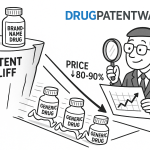
FDA’s own analysis of generic entry between 2015 and 2017 shows the steepness of the problem: a single generic competitor produces roughly a 39 percent average manufacturer price reduction versus the pre-entry brand price, two competitors produce roughly 54 percent, four competitors roughly 79 percent, and six or more competitors produce reductions exceeding 95 percent.[20] AstraZeneca v. Apotex was able to build a clean single-defendant royalty because Apotex entered fourth in a sequence; when multiple ANDA filers share a first-filer date and launch simultaneously — an increasingly common outcome given how 180-day exclusivity sharing rules operate — no reported decision has established a standard method for apportioning a reasonable-royalty award among several defendants whose collective, near-simultaneous entry is what actually produced the price collapse each one benefited from.
The 180-Day Exclusivity Sharing Mechanism
Simultaneous first-day filing is not an edge case; it is a structural feature of the 180-day first-filer exclusivity rules, which allow multiple ANDA holders who submitted their Paragraph IV certifications on the same calendar date to share first-filer status and, with it, a shared launch date once exclusivity is triggered. A damages framework built around a single defendant’s individual hypothetical negotiation sits awkwardly on top of a regulatory structure that was specifically designed to let several defendants enter together.
Authorized Generics as a Damages Wildcard
The Sanofi-Apotex litigation shows how much weight a single contractual definition can carry: the parties’ settlement agreement set damages at 50 percent of Apotex’s net sales, or 40 percent if Sanofi launched its own authorized generic, and the parties fought over whether Sanofi’s decision to cut Plavix’s branded price counted as launching one.[14] The court held it did not, but the dispute illustrates a broader gap — reasonable-royalty and lost-profits models generally assume the patentee’s own pricing response to an at-risk launch is background noise rather than a variable that itself needs to be modeled, even though an authorized generic (or a branded price cut functioning like one) directly changes both parties’ realized economics during the damages period.
The IRA’s Maximum Fair Price and the “But-For World” Problem
Future lost profits have always required proof “beyond speculation,” per the Federal Circuit’s 1996 decision in Oiness v. Walgreen Co.[19] The Inflation Reduction Act adds a new speculative variable to that inquiry for any branded drug that is, or may become, eligible for Medicare Drug Price Negotiation: an infringer can argue that the patentee’s own but-for-world profits would have been depressed anyway by a Maximum Fair Price the government would eventually have negotiated, independent of the infringement.[19] That argument cuts against the patentee for both past and future lost-profits claims, and 2023 legal analysis flagged the issue years before any court would need to resolve it in a live at-risk launch dispute — the gap between when the problem was identified and when case law will actually address it is itself a marker of how far behind the doctrine runs.
Patents That Keep Issuing After the At-Risk Launch Has Already Started
The hypothetical-negotiation construct assumes a single date on which the parties would have struck a license. That assumption breaks down when new patents covering the same product issue after a generic or biosimilar is already selling at risk.
The Eylea/Pavblu Sequence as a Live Example
Amgen’s Pavblu, a biosimilar of Regeneron’s Eylea (aflibercept), launched at risk in late October 2024 after the Federal Circuit declined to reinstate a preliminary injunction pending appeal.[22][23] Litigation continued through 2025 and into 2026: the PTAB upheld one Regeneron patent’s claims in amended form in October 2025 while invalidating a different asserted patent the following April, and Regeneron filed an entirely new lawsuit against Amgen in June 2025 over U.S. Patent No. 12,331,099 — a patent that had not yet issued when Amgen began selling Pavblu.[32] Amgen’s answer raised antitrust counterclaims alleging the patents were fraudulently obtained.[32] A single hypothetical-negotiation date cannot cleanly price a royalty for infringement of a patent that did not exist on the date the parties would supposedly have negotiated a license, and no reported at-risk launch damages decision has yet had to resolve that sequencing problem on the merits.
How EcoFactor v. Google Reaches Back Into Pending ANDA Cases
What Rule 702 Now Requires of a Royalty Expert
The en banc Federal Circuit’s May 2025 ruling in EcoFactor held that a damages expert cannot rely on lump-sum license or settlement agreements to support a per-unit royalty rate unless the agreement itself unambiguously reflects that both parties understood the payment as reflecting that rate.[17] The court framed this as a straightforward application of the district court’s Rule 702 gatekeeping duty under Daubert, but the practical effect is a materially higher bar for the kind of comparable-license testimony that has anchored reasonable-royalty analysis across patent law for decades.[18]
Why ANDA Damages Experts Depend on Confidential Settlement Licenses
Georgia-Pacific factors one and two ask what royalties the patentee has already received for licensing the patent, and what rates the licensee has paid for comparable patents.[8] In pharmaceutical patent litigation, the most obviously “comparable” transactions are almost always confidential Hatch-Waxman or BPCIA settlement agreements between the same brand and other generic or biosimilar challengers — exactly the kind of lump-sum, confidentially negotiated agreement EcoFactor now treats with heightened skepticism. Every pending ANDA damages case that expected to lean on a prior settlement license as its primary comparable now has to build a more explicit evidentiary record showing the parties to that earlier settlement understood it in per-unit terms — a showing many settlement agreements were never drafted to make, because the parties negotiating them were trying to end litigation, not build a damages exhibit for a future case.
The Apportionment Problem Rex Medical Just Reinforced
Five months after EcoFactor, the Federal Circuit reduced a $10 million jury verdict to $1 in nominal damages in Rex Medical, L.P. v. Intuitive Surgical, Inc., a medical-device rather than pharmaceutical case, because the patentee’s damages expert relied on a comparable license without adequately apportioning the value of the asserted patent from the other rights the license covered.[33][34] The Federal Circuit made clear that Section 284’s “in no event less than a reasonable royalty” floor does not rescue a damages case built on insufficient evidence.[34] Read together with EcoFactor, the two 2025 rulings put pharmaceutical damages experts on notice that the comparable-license shortcuts long used in ANDA litigation now require considerably more foundational work before they reach a jury.
Biosimilars Run a Different Damages Playbook Entirely
No Automatic Stay Means No Default Waiting Period
The BPCIA departs from Hatch-Waxman in a structural way that directly shapes at-risk launch dynamics: there is no automatic stay of FDA approval equivalent to the Hatch-Waxman 30-month stay.[35] A biosimilar applicant can receive FDA approval and face an immediate decision about launching at risk without the built-in litigation runway small-molecule generics get by default, which is part of why biosimilar developers have shown a documented willingness to launch at risk earlier and more frequently, relative to the size of the litigation record, than small-molecule ANDA filers.
Interchangeability Adds Another Variable
An interchangeable biosimilar designation, such as the one Amgen’s Wezlana received for Stelara, allows pharmacy-level substitution without prescriber sign-off in states that permit it, which can accelerate volume shift far faster than a standard biosimilar launch would.[36] A damages model built for small-molecule generic substitution, where pharmacist-level substitution has long been routine, has to be adapted rather than simply reused once an interchangeability designation is added to the fact pattern.
Why Biosimilar At-Risk Launches Rarely Reach a Damages Verdict
A 2023 review of BPCIA litigation found that, while a number of biosimilar at-risk launches have occurred, the disputes have overwhelmingly resolved through settlement rather than through a fully litigated damages verdict, and the one reported BPCIA damages award on record involved pre-launch manufacturing batches outside the Section 271(e) safe harbor rather than an at-risk commercial launch into the U.S. market.[21] That leaves the reasonable-royalty and lost-profits doctrine built up for small-molecule at-risk launches since Plavix and Prilosec largely untested against the biologics market it would actually need to price.
Denosumab MDL: Settlement Instead of a Damages Trial
Amgen’s litigation against Hikma and Gedeon Richter over proposed denosumab biosimilars (competing with Amgen’s own Prolia and Xgeva) became part of a multidistrict litigation in June 2025; rather than proceeding to a damages trial, the parties settled, and the District of New Jersey entered a consent judgment in November 2025 enjoining the Hikma biosimilar from the U.S. market until January 1, 2026.[24] The dispute resolved through an injunction and a negotiated market-entry date, not through a damages verdict — the outcome pattern that dominates biosimilar litigation generally.
What Happens When the Injunction Comes Down After the Launch
The Eylea litigation shows the alternative pattern: rather than settling before launch, Regeneron obtained preliminary injunctions against several would-be Eylea biosimilar entrants — Celltrion, Formycon, and (until a February 2026 settlement vacated it) Samsung Bioepis — while Amgen’s Pavblu launched at risk after successfully defeating Regeneron’s injunction request.[32][36] That divergence, within a single reference product’s litigation, between defendants who launched at risk and faced ongoing damages exposure and defendants who were enjoined before ever selling a unit, illustrates why biosimilar at-risk damages case law develops unevenly — each defendant’s outcome turns heavily on interlocutory injunction rulings that resolve before any damages theory is ever tested.
Lost Profits vs. Reasonable Royalty vs. Price Erosion
Damages Theory
Legal Basis
What the Patentee Must Prove
Modern Complication
Lost Profits
35 U.S.C. § 284; common-law “but-for” causation
It would have made the infringer’s sales absent infringement
PBM rebates and multi-filer entry make the but-for sales and price path far harder to isolate[7][20]
What a hypothetical negotiation would have produced at the negotiation date
EcoFactor restricts reliance on lump-sum settlement licenses as comparables; negotiation-date timing now contested[17][15]
Price Erosion
Yale Lock (1886); Crystal Semiconductor (2001) evidentiary standard
Infringing competition caused it to charge lower prices than it otherwise would have
Net price after rebates, not list price, is the economically relevant figure but rarely the one modeled[9][10]
Scenario Analysis: Pricing an At-Risk Launch Today
Scenario One — Single Filer, Clean Patent, No IRA Exposure
A single generic launches at risk against a mid-sized branded product with no PBM rebate complexity and no Medicare Drug Price Negotiation eligibility. This is the closest modern fact pattern to AstraZeneca v. Apotex or Mallinckrodt v. Airgas, and the existing reasonable-royalty framework, refined by the 2025 negotiation-date and evidentiary rulings, applies with relatively few structural gaps.
Scenario Two — Multiple Simultaneous First-Day Filers
Several ANDA holders share a first-filer date and launch on the same day, producing the kind of cliff-pricing collapse FDA’s own data documents once four or more competitors are active.[20] No reported decision offers a standard method for apportioning a reasonable-royalty award among defendants whose simultaneous entry, not any one filer’s individual conduct, drove the bulk of the price decline — leaving damages experts to construct bespoke allocation theories with limited precedent to anchor them.
Scenario Three — IRA-Eligible Brand Mid-Negotiation
A brand facing at-risk generic or biosimilar competition is simultaneously listed, or reasonably likely to be listed, for Medicare Drug Price Negotiation. Under the reasoning flagged in 2023 legal commentary, the infringer has a colorable argument that the patentee’s but-for-world profits were always going to be constrained by an eventual Maximum Fair Price, complicating both historical and future lost-profits claims in a way current case law has not yet resolved.[19]
What This Means for Brand Manufacturers
The AstraZeneca and Sanofi cases remain useful anchors for single-defendant, sequential-entry fact patterns, but brand litigators facing simultaneous multi-filer entry, PBM-rebated products, or IRA-eligible drugs are increasingly litigating damages theory in territory the reported cases have not mapped. The EcoFactor ruling in particular means that a damages strategy built primarily around prior confidential settlement licenses as Georgia-Pacific comparables needs a considerably more explicit foundational record than it did before May 2025.
What This Means for Generic and Biosimilar Challengers
The Mallinckrodt negotiation-date ruling is a genuine, favorable data point for at-risk launchers: tying the hypothetical negotiation to the actual commercial launch date, rather than an earlier ANDA amendment date, keeps the relevant market conditions closer to the ones that actually informed the decision to launch.[15] For biosimilar developers, the practical reality remains that most at-risk launch disputes resolve through preliminary injunction litigation or settlement well before any damages theory is tested on the merits, which means the interlocutory injunction fight — not the eventual damages number — is still where most of the real exposure gets decided.
A Practical Checklist Before Launching at Risk
Based on the case patterns above, a generic or biosimilar developer weighing an at-risk launch is evaluating at least four variables courts have already shown they will scrutinize: the number of other filers likely to enter around the same date, whether any settlement licenses it or its competitors have signed could later be read as per-unit royalty evidence under EcoFactor, whether the reference product is listed or plausibly eligible for Medicare price negotiation, and whether the reference-product owner has additional patents still working through prosecution that could issue mid-launch.
Methodology
This analysis is based on primary sources including Federal Circuit and district court opinions, SEC filings, FDA regulatory analyses, and contemporaneous legal-industry reporting on each case discussed, all cited inline and listed in the references below. Dollar figures for damages awards and settlements are drawn from court filings, Federal Circuit opinions, and company disclosures as reported by the cited sources; figures described as “roughly” or “approximately” reflect rounding in the underlying source material. The timeline tables group cases by decade-scale era for readability; case dates within each table are cited individually. Where a legal question (such as the IRA/lost-profits interaction or multi-filer damages apportionment) is described as unresolved, that reflects the absence of a reported court decision found in the sources reviewed as of this article’s publication and should not be read as a comprehensive survey of every unreported or sealed ruling.
Key Takeaways
The reasonable-royalty methodology governing most at-risk launch damages cases still traces its modern structure to AstraZeneca AB v. Apotex Corp. (Fed. Cir. 2015), a case built on a sequential single-defendant fact pattern from 2003–2007.[2]
Reported at-risk launch damages outcomes range from roughly $9.5 million (Mallinckrodt v. Airgas, 2025) to $76 million (AstraZeneca v. Apotex) to $444 million (Sanofi/BMS v. Apotex), tracking market size rather than any consistent doctrinal multiple.[1][11][13]
The August 2025 Mallinckrodt ruling fixed the hypothetical negotiation date at the generic’s actual launch date rather than an earlier ANDA-amendment date.[15]
The May 2025 en banc EcoFactor v. Google decision restricts expert reliance on lump-sum settlement licenses as royalty comparables, directly affecting the confidential settlement agreements ANDA damages experts have long used as Georgia-Pacific comparables.[17]
FDA data shows generic prices fall roughly 39 percent with one competitor, 54 percent with two, 79 percent with four, and more than 95 percent with six or more — yet no reported decision offers a standard method for apportioning reasonable-royalty damages among multiple simultaneous first-day filers.[20]
2023 legal analysis identified an unresolved conflict between IRA Medicare price negotiation eligibility and lost-profits “but-for world” damages claims; no reported decision has yet addressed it on the merits.[19]
Amgen’s Pavblu at-risk launch against Regeneron’s Eylea involves a patent (U.S. 12,331,099) that issued after the at-risk launch had already begun, a sequencing problem the single-date hypothetical negotiation framework was not built to handle.[32]
Biosimilar at-risk launch disputes — including the denosumab MDL and the Eylea/Samsung Bioepis litigation — continue to resolve overwhelmingly through preliminary injunctions and settlements rather than litigated damages verdicts, leaving BPCIA damages doctrine comparatively undeveloped.[24][36]
FAQ
What counts as an “at-risk” generic drug launch?
An at-risk launch occurs when a generic or biosimilar manufacturer begins commercial sales after receiving FDA approval but before the underlying patent infringement litigation has been finally resolved, accepting the risk of a damages judgment — and potentially a permanent injunction — if the patent holder ultimately prevails.[4]
Why don’t most Hatch-Waxman cases involve damages at all?
Because filing an ANDA with a Paragraph IV certification is only “artificial” infringement under 35 U.S.C. § 271(e)(2) — no product has actually been sold. Damages become available only if the generic launches commercially, typically after the 30-month stay expires without a final resolution.[3][4]
What is the difference between lost profits and a reasonable royalty?
Lost profits compensate the patentee for the sales, and the associated profit margin, it can prove it would have made absent the infringement. A reasonable royalty is a statutory floor under 35 U.S.C. § 284, calculated as what a hypothetical license negotiation would have produced, and is typically used when lost profits cannot be cleanly proven.[7]
How was the AstraZeneca v. Apotex damages award calculated?
The court applied the Georgia-Pacific factors to a hypothetical negotiation dated November 2003 and awarded AstraZeneca 50 percent of Apotex’s gross margin on its at-risk omeprazole sales through 2007, totaling $76,021,994.50 plus prejudgment interest.[11][12]
Did Apotex actually pay $444 million for the Plavix at-risk launch?
Yes. After a trial court award and a Federal Circuit appeal that removed a separate prejudgment interest component, Apotex paid Sanofi and Bristol-Myers Squibb $444 million in 2012 under a contractual formula capping damages at 50 percent of Apotex’s net sales during its three-week 2006 at-risk launch.[27][28]
How does the EcoFactor v. Google ruling affect pharmaceutical patent cases even though it isn’t a pharma case?
EcoFactor restricts when a damages expert may rely on a lump-sum license agreement to support a per-unit royalty rate. Because ANDA damages experts routinely rely on confidential Hatch-Waxman settlement agreements as Georgia-Pacific comparables, the ruling raises the evidentiary bar for a methodology used across pharmaceutical patent litigation generally, not just in the case that produced it.[17]
Why did the Mallinckrodt v. Airgas court reject the ANDA-amendment date as the hypothetical negotiation date?
The court reasoned that filing or amending an ANDA is only a statutory act of infringement and does not itself require a license, whereas actually launching a commercial product does — so the hypothetical negotiation date was set at the November 2023 commercial launch date rather than the November 2022 ANDA amendment date.[15][16]
Does the Inflation Reduction Act’s Medicare price negotiation program actually reduce patent damages awards?
No reported court decision has yet ruled on this. Legal commentary published in 2023 identified the theoretical argument — that an infringer could claim the patentee’s but-for-world profits would have been constrained by a future negotiated Maximum Fair Price regardless of the infringement — but the issue remains unresolved in reported case law.[19]
Why do biosimilar at-risk launches rarely produce a damages verdict?
Most BPCIA disputes resolve through preliminary injunction rulings or settlement before a damages theory is ever tested at trial. A 2023 review found the sole reported BPCIA damages award involved pre-launch manufacturing activity rather than an at-risk commercial launch, and more recent disputes — including the denosumab MDL and parts of the Eylea litigation — have followed the same settlement-before-verdict pattern.[21][24]
What happens when a new patent issues after a biosimilar has already launched at risk?
There is no settled doctrine. In the Eylea litigation, Regeneron filed a new infringement suit against Amgen in June 2025 over a patent that issued after Amgen’s Pavblu biosimilar had already been selling at risk since late 2024, a sequencing scenario the standard single-date hypothetical negotiation framework was not designed to address.[32]
References
Lidgett, A. (2025, September 12). Jury Awards Mallinckrodt $9.5M In Nitric Oxide Patent Suit. Law360. https://www.law360.com/articles/2387676/jury-awards-mallinckrodt-9-5m-in-nitric-oxide-patent-suit
AstraZeneca AB v. Apotex Corp., 782 F.3d 1324 (Fed. Cir. 2015). Justia. https://law.justia.com/cases/federal/appellate-courts/cafc/14-1221/14-1221-2015-04-07.html
WIPO. An International Guide to Patent Case Management for Judges — United States. https://www.wipo.int/patent-judicial-guide/en/full-guide/united-states/10.13.2
Federal Trade Commission. Antitrust Issues in the Settlement of Pharmaceutical Patent Disputes, Part II. https://www.ftc.gov/news-events/news/speeches/antitrust-issues-settlement-pharmaceutical-patent-disputes-part-ii
Various authors. Evidence from Paragraph IV Patent-Litigation Decisions. Journal of Law and Economics working paper. https://jonwms.web.unc.edu/wp-content/uploads/sites/10989/2021/06/ParIVSettlements_JLE.pdf
Noonan, K. E. (2016). FTC Issues Report on ANDA Settlement Agreements. Patent Docs. https://patentdocs.org/2016/02/29/ftc-issues-report-on-anda-settlement-agreements/
Congressional Research Service. The Role of Patents and Regulatory Exclusivities in Drug Pricing (Report R46679). Congress.gov. https://www.congress.gov/crs-product/R46679
Cotter, T. F. Four Principles for Calculating Reasonable Royalties. Stanford Law School. https://law.stanford.edu/index.php?webauth-document=event%2F265103%2Fmedia%2Fslspublic%2FThomas+F.+Cotter+-+Four+Principle+for+Calculating+Reasonable+Royalties.pdf
Yale Lock Mfg. Co. v. Sargent, 117 U.S. 536 (1886), as discussed in Forms of Lost Profit. Patent Damages Book. https://www.patentdamagesbook.com/lost-profit/forms.html
vLex. AstraZeneca AB v. Apotex Corp., 782 F.3d 1324. https://case-law.vlex.com/vid/astrazeneca-ab-v-apotex-892316781
Bloomberg Law. (2013, December 6). Apotex to Pay AstraZeneca $76 Million In Damages After ‘At Risk’ Prilosec Launch. https://news.bloomberglaw.com/pharma-and-life-sciences/apotex-to-pay-astrazeneca-76-million-in-damages-after-at-risk-prilosec-launch
Sanofi-Synthelabo v. Apotex Inc. CourtListener. https://www.courtlistener.com/opinion/2421560/sanofi-synthelabo-v-apotex-inc/
Sanofi-Aventis v. Apotex Inc. CourtListener. https://www.courtlistener.com/opinion/2473720/sanofi-aventis-v-apotex-inc/
Mattes, C., & LoCastro, N. (2025). Federal Judge Rules on Patent Damages Issue in Mallinckrodt v. Airgas Case. Quinn Emanuel. https://quinnsights.quinnemanuel.com/post/102l0qs/federal-judge-rules-on-patent-damages-issue-in-mallinckrodt-v-airgas-case
Winston & Strawn. (2025). The En Banc Federal Circuit Clarifies What Evidence May Be Relied on for Proving Reasonable Royalty Damages. https://www.winston.com/en/insights-news/the-en-banc-federal-circuit-clarifies-what-evidence-may-be-relied-on-for-proving-reasonable-royalty-damages
White & Case LLP. (2025). Federal Circuit Tightens Standard for Patent Damages Experts. https://www.whitecase.com/insight-alert/federal-circuit-tightens-standard-patent-damages-experts
Finnegan. (2023). Potential Implications of Inflation Reduction Act on Pharmaceutical Patent Litigation. https://www.finnegan.com/en/insights/articles/potential-implications-of-inflation-reduction-act-on-pharmaceutical-patent-litigation.html
U.S. Food and Drug Administration. Generic Competition and Drug Prices. https://www.fda.gov/media/133509/download
Lexology. (2023). Biosimilars and biologics litigation in the United States. https://www.lexology.com/library/detail.aspx?g=e85c6ac3-355c-4394-89ce-50d2506a95dc
Wu, G., Fidler, B., Pagliarulo, N., & Himmel, J. (2026). Amgen plans launch of Eylea biosimilar after court ruling. BioPharma Dive. https://www.biopharmadive.com/news/amgen-eylea-biosimilar-at-risk-launch-regeneron-appeals-court/730682/
pharmaphorum. Legal win leads Amgen to at-risk launch of Eylea biosimilar. https://pharmaphorum.com/news/legal-win-leads-amgen-risk-launch-eylea-biosimilar
Amgen Inc. (2026). Form 10-K for Fiscal Year 2025. U.S. Securities and Exchange Commission. https://www.sec.gov/Archives/edgar/data/318154/000031815426000010/amgn-20251231.htm
Sullivan, R. Patent Damages in “At-Risk” Generic Drug Launches: Lessons from the Federal Circuit in AstraZeneca v. Apotex. Secretariat. https://secretariat-intl.com/insights/patent-damages-in-at-risk-generic-drug-launches-lessons-from-the-federal-circuit-in-astrazeneca-v-apotex/
United States Court of Appeals for the Federal Circuit. AstraZeneca AB v. Apotex Corp., opinion text. Justia. https://cases.justia.com/federal/appellate-courts/cafc/14-1221/14-1221-2015-04-07.pdf
Fierce Pharma. (2011, October 19). Court upholds $442M Plavix judgment against Apotex. https://www.fiercepharma.com/sales-and-marketing/court-upholds-442m-plavix-judgment-against-apotex
Fierce Pharma. (2012, March 25). Sanofi, BMS collect their $444M in Plavix damages. https://www.fiercepharma.com/sales-and-marketing/sanofi-bms-collect-their-444m-plavix-damages
Mallinckrodt Pharmaceuticals Ireland Limited v. Airgas Therapeutics LLC. CourtListener. https://www.courtlistener.com/opinion/10657702/mallinckrodt-pharmaceuticals-ireland-limited-v-airgas-therapeutics-llc/
Law360 Healthcare Authority. (2025, February 13). Mallinckrodt Fails To Halt Airgas’ Generic Nitric Oxide Drug. https://www.law360.com/healthcare-authority/articles/2297368/mallinckrodt-fails-to-halt-airgas-generic-nitric-oxide-drug
DrugPatentWatch. (2026). Drug Patent Expiration: The Complete Strategic Guide to Loss of Exclusivity, Lifecycle Management, and the $400 Billion Cliff. https://www.drugpatentwatch.com/blog/the-impact-of-drug-patent-expiration-financial-implications-lifecycle-strategies-and-market-transformations/
Regeneron Pharmaceuticals, Inc. (2026). Form 10-Q for the quarter ended June 30, 2026. U.S. Securities and Exchange Commission. https://www.sec.gov/Archives/edgar/data/0000872589/000087258926000025/regn-20260630.htm
Patently-O. (2025). Proven Infringement, Zero Recovery: Federal Circuit Once Again Cancels a Jury Verdict for the Patentee (discussing Rex Medical, L.P. v. Intuitive Surgical, Inc.). https://patentlyo.com/patent/2025/10/infringement-recovery-patentee.html
White & Case LLP. (2025). Federal Circuit Says Where Expert Evidence Is Insufficient, Patent Damages Can Be Nominal. https://www.whitecase.com/insight-alert/federal-circuit-says-where-expert-evidence-insufficient-patent-damages-can-be-nominal
Loeb & Loeb LLP. (2025). The Landscape of Regeneron’s Eylea Litigation After the Federal Circuit Affirmed Two Preliminary Injunction Orders Blocking Biosimilar Market Entry. https://www.loeb.com/en/insights/passle/2025/02/the-landscape-of-regenerons-eylea-litigation-after-the-federal-circuit-affirmed-two-preliminary-inju
Venable LLP, BiologicsHQ. (2026). Regeneron and Samsung Bioepis Settle EYLEA BPCIA Litigations Related to Opuviz. https://biologicshq.com/regeneron-and-samsung-bioepis-settle-eylea-bpcia-litigations-related-to-opuviz/