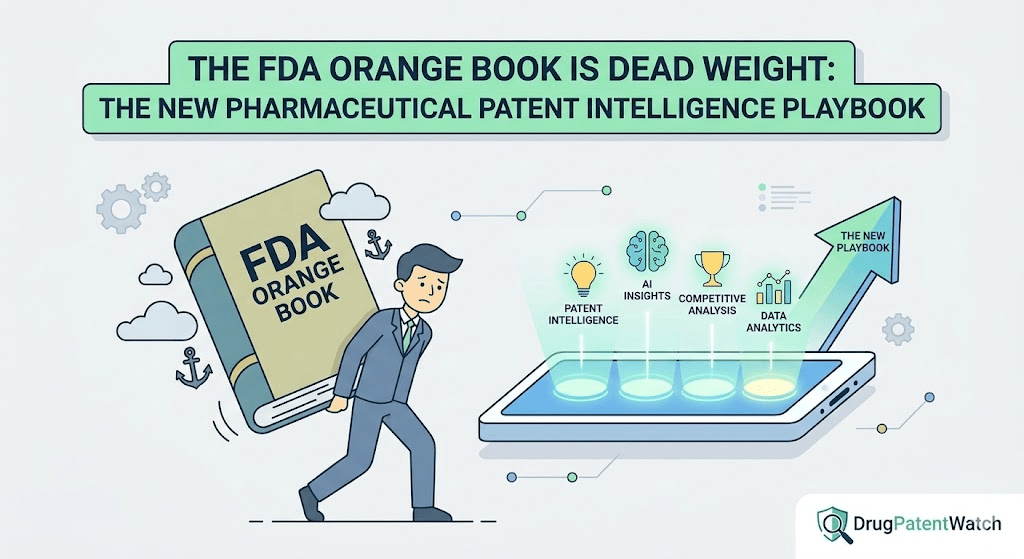
The FDA Orange Book publishes patent expiry dates. Analysts read them, model them into revenue forecasts, and brief executives on their conclusions. The problem is that none of that tells you when competition actually arrives.
Generic manufacturers file ANDAs months before the expiry date that the Orange Book shows. They challenge patents that are not listed at all. They use PTAB proceedings to knock out secondary claims before any ANDA is even filed. They watch for FTC delisting campaigns that can strip a brand of its 30-month stay protection overnight. Meanwhile, the brand company’s real defense perimeter extends far beyond whatever the Orange Book currently displays: continuation applications still in prosecution at the USPTO, unmarked foreign patents with potential domestic relevance, pediatric exclusivity extensions triggered by FDA Written Requests that the database never captures, and price-negotiation timelines under the Inflation Reduction Act that change the calculus on whether defending a patent at all is commercially rational.
Every one of those dimensions is invisible to an analyst whose entire workflow runs through a single Orange Book lookup. That analyst is making decisions about a $2 billion revenue stream with a fraction of the relevant data.
This article maps the complete intelligence landscape that pharmaceutical IP professionals, portfolio managers, generic manufacturers, biosimilar developers, and commercial forecasters need to operate in the current environment. The Orange Book is where you start. It is nowhere near where you should finish.
What the FDA Orange Book Actually Covers (and What It Has Never Covered)
The Orange Book, officially titled Approved Drug Products with Therapeutic Equivalence Evaluations, was established through federal rulemaking in 1980 and became structurally critical after the Drug Price Competition and Patent Term Restoration Act of 1984, universally called the Hatch-Waxman Act. [1] It has three core functions: it lists FDA-approved drug products, it records patent information for those products as submitted by brand manufacturers, and it documents regulatory exclusivity periods awarded by FDA as a matter of statute.
Understanding what belongs in the Orange Book requires reading the statute. Only drug substance, drug product, and method-of-use patents are eligible for listing. Manufacturing process patents are excluded. The Orange Book records only patents that the brand manufacturer has submitted. FDA exercises no independent review of those submissions for accuracy or completeness. The agency is not a patent examiner, and it does not verify that a submitted patent actually covers the listed drug product. Brand manufacturers certify compliance themselves.
What the Orange Book Does Not Include: A Definitive List
Before you can fix a broken intelligence process, you need a precise inventory of the gaps. The Orange Book does not contain:
Manufacturing process patents, even when those patents represent a meaningful barrier to generic manufacturing
Patents held by third parties that are not assigned to the NDA holder, such as platform delivery technology patents held by a contract manufacturer
Any patent related to the active pharmaceutical ingredient that was not submitted by the brand for listing
International patents that may inform domestic prosecution and claim construction arguments
Continuation and divisional applications still in prosecution at the USPTO, which can issue as new listed patents at any point
Unpublished patent applications within the 18-month publication window
ANDA filing history, including whether any generic has filed against a listed product, who filed first, and what type of certification accompanied the filing
Paragraph IV notification letters or litigation case numbers
Settlement agreement terms or agreed-upon entry dates
Post-approval supplemental NDA activity that has not yet been translated into a new Orange Book patent listing
Biologics. All biologic drugs regulated under the Public Health Service Act are tracked in the separate FDA Purple Book, which has its own, substantially less complete patent information infrastructure
Databases like DrugPatentWatch aggregate Orange Book patent listings, FDA exclusivity records, ANDA filing activity, and litigation outcomes into a unified view that shows not just when patents expire on paper, but when meaningful generic competition can realistically begin. That synthesis is qualitatively different from a static Orange Book lookup because it answers the operational question: not when can a generic file, but when will a generic actually be on pharmacy shelves.
How the Orange Book Is Structured: Therapeutic Equivalence Codes and What They Signal
The Orange Book assigns every listed drug product a therapeutic equivalence (TE) code. The ‘A’ designation means FDA has determined the generic is therapeutically equivalent to the reference listed drug (RLD) and can be substituted without physician intervention. The ‘B’ designation means FDA has not made that determination, typically because of documented or potential bioequivalence problems. For a formulary manager at a pharmacy benefit manager, the TE code governs automatic substitution at the pharmacy counter. For a generic manufacturer, the ‘A’ code is the commercial objective.
TE codes are not static. A product initially assigned a ‘B’ code can be upgraded after the manufacturer provides additional data. A product with a ‘BX’ code — meaning FDA lacks data to determine equivalence — can remain commercially stranded until the issue is resolved. These code changes do not generate regulatory filings that appear in standard patent alert systems. Tracking them requires dedicated monitoring of FDA’s periodic Orange Book updates, which are published electronically but not systematically indexed for competitive intelligence purposes.
Orange Book vs. Purple Book: Two Systems with Incompatible Patent Coverage
The Purple Book lists all FDA-approved biological products and biosimilar designations, but it does not replicate the Orange Book’s patent listing system. Brand biologic manufacturers are not required to submit patents for Purple Book listing, and most do not. The result is a structural information asymmetry that makes biosimilar competitive intelligence categorically harder than small-molecule generic intelligence.
Only approximately 2% of the brand biologic listings in the Purple Book contain patent information. In comparison, the percentage of small-molecule drugs disclosing patent information in the Orange Book is 21 times greater. Given that the Purple Book lists so little patent information about brand biologic drugs, a prospective biosimilar maker cannot readily assess its risk of patent infringement litigation, and so must make investment and manufacturing decisions blindly.
This is not a minor administrative inconvenience. The informational deficit in the Purple Book contributes to the high price of biologic drugs by discouraging biosimilar entry and hampering competition. Based on the most recent data available, biologics accounted for 37% of all drug spending in the United States while accounting for only 2% of all US prescriptions.
The legal architecture governing biologic patent disputes, the Biologics Price Competition and Innovation Act’s “patent dance,” is an entirely separate process from Hatch-Waxman Paragraph IV mechanics. Understanding it requires a different analytical toolkit entirely. We cover it in detail later in this article.
Why Orange Book Patent Listings Are Not What They Used to Be: The FTC Delisting Campaign
The most consequential change to Orange Book practice in the past three years did not come from FDA. It came from the Federal Trade Commission.
Starting in September 2023, the FTC began systematically challenging Orange Book patent listings it considered improper under the Hatch-Waxman statute. The core allegation: brand manufacturers had been listing patents on drug-device components, REMS systems, and other product elements that do not claim the drug substance, drug product, or method of use as the statute requires. By listing these patents, brands could trigger automatic 30-month stays against ANDA filers, delaying generic entry on drugs that were technically no longer patent-protected in the conventional sense.
The FTC Warning Letter Campaign: Scope and Targets
Sept 2023
FTC issues policy statement warning that improper Orange Book listings may constitute antitrust violations. First round of warning letters sent to brand manufacturers.
Apr 2024
FTC challenged an additional 300 Orange Book patents as improperly listed, sending warning letters concerning 20 different brand-name drugs. Challenges included patents relating to asthma and COPD inhalers and patents on devices to deliver injectable weight-loss and diabetes treatments.
Dec 2024
Federal Circuit rules in Teva Branded Pharmaceutical Products R&D v. Amneal Pharmaceuticals of New York that to be listable in the Orange Book, a patent’s claims must recite the active pharmaceutical ingredient of the approved drug. Teva ordered to delist five inhaler patents.
May 2025
FTC challenged an additional 200 Orange Book patents relating to 17 different drug products. The FTC issued its third round of warning letters — its first under the Trump administration — explicitly stating its prerogative is to seek ‘transparent, competitive, and fair healthcare markets.’
Several hundred patents have been removed from the Orange Book following FTC’s actions. For any pharmaceutical IP team that has been relying on device patents to maintain 30-month stay protection against generic challengers of inhaler or auto-injector products, the landscape changed materially between 2023 and 2025.
Teva v. Amneal: What the Federal Circuit’s API Rule Means for Combination Products
The Teva decision is the most operationally significant court ruling in Orange Book practice in a decade. In Teva Branded Pharmaceutical Products R&D, Inc. v. Amneal Pharmaceuticals of New York, LLC, the Federal Circuit held that to be listable in the Orange Book, the claims of the patent must recite the active pharmaceutical ingredient (API) of the corresponding FDA approved drug. The Federal Circuit affirmed the district court’s order delisting Teva’s patents from the Orange Book, since those patents claimed inhalers and components of inhalers, but did not recite the API, albuterol sulfate.
The Federal Circuit subsequently denied Teva’s request for an en banc rehearing in March 2025. Notwithstanding Teva’s petition seeking Supreme Court review, Teva must now delist the five patents.
For brand manufacturers of combination drug-device products — inhalers, auto-injectors, prefilled syringes — the ruling eliminates the ability to use device-component patents as 30-month stay triggers. Patents on the albuterol sulfate molecule itself, or on a formulation containing it, remain listable. Patents on the inhaler cap, dose counter, or actuator mechanism do not. The practical consequence is that branded inhalers and auto-injectors now face shorter effective stay protection than they did before December 2024.
Jazz Pharmaceuticals v. Avadel and the REMS Patent Question
The Federal Circuit’s ruling in Jazz Pharmaceuticals v. Avadel CNS Pharmaceuticals addressed a different category of improper Orange Book listings: the court held that a patent on a computerized risk evaluation and mitigation strategy (REMS) system for a drug should not have been listed in the Orange Book. REMS systems are FDA-mandated safety management programs, not drug products or methods of treatment, and patents covering their electronic infrastructure have no legitimate basis for Orange Book listing regardless of how the brand frames them.
The Lantus case added a third category. The U.S. Court of Appeals for the First Circuit held in In re Lantus Direct Purchaser Antitrust Litigation that a patent on a device for injecting a drug should not have been listed in the Orange Book.
Three separate courts, three separate drug categories, three consistent conclusions: the Orange Book listing criteria are narrower than brand manufacturers have been treating them. Any IP strategy that assumes device and REMS patents can safely anchor the 30-month stay structure now carries regulatory delisting risk that needs to be built into scenario planning.
What This Means for Generic Entry Timelines on Drug-Device Combinations
The practical timeline acceleration created by the FTC delisting campaign is significant. A branded inhaler product that previously triggered a 30-month stay by listing inhaler-component patents now faces ANDA competition without that automatic protection on those claims. Generic challengers can receive tentative or final ANDA approval and launch at risk without waiting for the stay period to expire, provided they are willing to accept preliminary injunction risk.
For drugs in this category, IP teams need to map their remaining defensive position against composition-of-matter and formulation patents alone. If those are strong, the delisting of device patents matters relatively little to actual competitive timing. If the composition-of-matter patent has expired or is close to expiry and only device patents were providing real-world protection, the FTC campaign represents a direct and material acceleration of loss of exclusivity.
The Patent Thicket Problem: Why Orange Book Listings Are Just the Public Face of Brand Strategy
A pharmaceutical patent thicket is not something the Orange Book displays. It is something the Orange Book partially describes, while the rest of it lives at the USPTO, in continuation application files, in foreign patent registers, and in licensing agreements that never get filed publicly.
AbbVie filed an astonishing 247 patent applications related to Humira in the United States. The most telling statistic: a full 89% of these were filed after the drug was already approved and on the market, with nearly half filed more than a decade after its launch. These were not patents on the core invention; they were secondary patents covering everything from manufacturing processes and formulations to specific methods of use for various autoimmune conditions.
The Orange Book lists the subset of those 247 applications that AbbVie chose to list under the Hatch-Waxman criteria. Manufacturing process patents, which cannot be listed, are invisible to ANDA analysis. Continuation applications still in prosecution are invisible. Foreign patents that might support domestic claim construction arguments are invisible.
Evergreening Architecture: How Brand Companies Build Patent Cliffs Into Slopes
Evergreening describes the practice of layering new patents onto an approved drug to extend effective market exclusivity beyond the original composition-of-matter patent expiry. A company that lists only a composition-of-matter patent in the Orange Book signals limited lifecycle management investment. A company that lists twelve patents spanning formulation, dosage form, and method of use signals an aggressive evergreening strategy. The reading is that direct.
The standard evergreening toolkit, in order of legal durability, works as follows. Polymorph patents cover crystalline forms of the API that may offer stability or processing advantages over the original form. They are scientifically plausible and patentable but inherently vulnerable to challenge because generic manufacturers can often use an alternative polymorph. Formulation patents cover specific delivery mechanisms, extended-release matrices, or co-crystal forms. Purdue Pharma’s suite of OxyContin formulation patents is the canonical case. After the original oxycodone composition-of-matter patent expired, Purdue listed formulation patents covering the abuse-deterrent matrix, extending Orange Book protection and creating a new barrier to generic entry requiring bioequivalence to the reformulated product, not the original. Method-of-use patents cover specific approved indications. Brand manufacturers can file supplemental NDAs to add new approved indications, then list the associated method-of-use patents, which can run years beyond compound patent expiration.
For a generic manufacturer, the strategic implication is stark: the expiration of the 30-month stay should not be viewed as a green light to launch. The presence of unlisted secondary patents, continuation applications in prosecution, or method-of-use patents covering your target indication may still create infringement exposure even after all Orange Book-listed patents have been addressed.
How to Read an Orange Book Entry as a Competitive Intelligence Signal
The timing, clustering, and category distribution of Orange Book patent listings contain signals about the brand’s evergreening intentions that go beyond the face value of any individual patent. When a brand manufacturer adds a new patent to the Orange Book for a drug whose original compound patent has already been filed and listed, that addition reveals that the manufacturer believes it has secured legally-sufficient coverage worth asserting. The date of the listing relative to the drug’s approval date, the patent’s expiration date, and the patent category (compound vs. formulation vs. method of use) collectively define the shape of the evergreening architecture.
Analysts should monitor Orange Book additions continuously rather than conducting point-in-time lookups. A new patent listing that appears six months before you planned to file your ANDA can trigger a 30-month stay that you had not modeled. Late listings are legal. If listed before an ANDA is submitted, they create stay exposure even if the patent issued long after the drug’s original approval.
The Litigation Cost Barrier: Why Generic Companies Settle Rather Than Fight Every Patent
Challenging a single secondary patent typically costs $5 to $15 million in legal fees. A dense patent thicket like Humira’s 130-plus patents would require resources exceeding what the prospective generic revenues could justify. Generic companies are rational commercial actors: if the combined litigation cost of challenging all listed patents exceeds the expected value of earlier market entry, settlement on a licensed entry date is the better outcome.
This asymmetry is why pay-for-delay settlements exist. The brand offers the generic a licensed entry date that is earlier than all patents would otherwise expire, in exchange for the generic dropping its challenge. Both parties benefit relative to litigating to exhaustion. The social cost is that consumers pay brand prices for longer than they would in a fully competitive market. The FTC’s challenge under the Actavis framework, which subjects these settlements to antitrust scrutiny under a rule of reason standard, has constrained but not eliminated the practice.
The Complete Patent Portfolio Map: What You Need Beyond the Orange Book
USPTO Prosecution History: The Data Source Analysts Skip
Every listed Orange Book patent has a prosecution history at the USPTO. That file contains the original claims as filed, every office action the examiner issued, and every response the applicant submitted. For a generic challenger evaluating whether a listed patent is vulnerable to invalidity arguments, the prosecution history is primary data. Claim amendments made during prosecution define the scope of the claims through prosecution history estoppel, and those amendments are not visible in the patent itself or in the Orange Book.
Patent term adjustments are also calculated from the prosecution history. A patent whose term was extended by USPTO delays in prosecution may expire significantly later than the 20-years-from-filing baseline. Orange Book listings typically reflect the adjusted expiry date, but tracking the source of that adjustment, and whether it might be challenged, requires going to the prosecution file.
Continuation Applications and the Pipeline Patent Problem
A brand manufacturer that files a continuation application from an original patent filing can get a new patent with new claims issued years after the original, while maintaining priority to the original filing date. If the continuation claims cover the approved drug product or method of use, the brand can list it in the Orange Book when it issues, regardless of how long the original application family has been in prosecution. There is no statutory prohibition on this practice, and it is a standard lifecycle management tool.
For generic manufacturers, continuation application monitoring is a mandatory element of competitive intelligence on any major product. The USPTO publishes continuation application data, but correlating pending applications with specific Orange Book products requires matching assignee names, family relationships, and claim descriptions against the listed drug product. This is labor-intensive manual work without a purpose-built analytical platform. The first step in any patent expiry forecast is mapping the complete patent portfolio for the drug in question. This means going beyond the Orange Book.
Patent Term Extensions: How Regulatory Review Time Lengthens Listed Expiries
The Hatch-Waxman Act created patent term restoration, which allows brand manufacturers to apply to the USPTO for an extension of up to five years to compensate for time lost during FDA review. The mechanism recognizes that a drug patent starts running from filing date, often years before the drug reaches the market. Without restoration, the effective commercial exclusivity period would be far shorter than 20 years.
The restoration calculation uses FDA approval dates, IND filing dates, and prosecution timelines. It is not simple arithmetic, and the restored term is capped at 14 years of effective exclusivity from FDA approval. Understanding the patent term restoration calculation for a specific product tells you whether the Orange Book expiry date reflects the maximum legally available protection or whether there was a deliberate decision not to seek full restoration, which itself may signal something about the brand’s confidence in its patent position.
Pediatric Exclusivity: The Six-Month Extension That Rarely Gets Modeled Correctly
When FDA issues a Written Request for pediatric studies under section 505A of the FD&C Act and a manufacturer completes those studies, the reward is six months of additional exclusivity that attaches to each of the brand’s Orange Book-listed patents and to any Orange Book-listed exclusivity period. The six months applies to every patent simultaneously, not just the one with the latest expiry date. For a drug with several listed patents expiring in sequence, pediatric exclusivity effectively adds six months to each of them in turn.
The intelligence requirement is monitoring FDA Written Requests under section 505A, which are published on the FDA website and represent advance notice that pediatric exclusivity is being sought for a specific drug. When a Written Request appears for a drug you are planning to target, the six-month extension becomes a planning assumption in your entry timeline modeling. Failing to account for pediatric exclusivity in ANDA timing strategy is one of the most common and costly planning errors in generic entry analysis.
Orphan Drug Exclusivity: Seven Years of Protection That Sits Outside the Patent System Entirely
Orphan drug exclusivity, granted for drugs approved to treat rare diseases affecting fewer than 200,000 patients in the U.S., provides seven years of marketing exclusivity that runs independently of any patent. An ANDA filer cannot receive final approval for a product covered by orphan drug exclusivity during that seven-year period, regardless of whether any patent is listed or challenged. The Orange Book displays orphan drug exclusivity periods, but they are exclusivity records, not patent records, and their interaction with patent challenges creates analytical complexity that simple expiry-date tracking misses.
Paragraph IV Mechanics: What Happens After an ANDA Is Filed
When a generic manufacturer files an ANDA and certifies under Paragraph IV that a listed Orange Book patent is invalid or will not be infringed, it must notify the brand manufacturer and patent holder. The brand then has 45 days to file a patent infringement suit. If it does, the FDA cannot grant final ANDA approval for 30 months from the date of the Paragraph IV notice, unless the patent expires or is adjudicated invalid before that time. That automatic 30-month stay is the core mechanism through which Orange Book patent listings translate into commercial protection.
What Is the 30-Month Stay and When Does It Not Apply?
The 30-month stay automatically prevents FDA from granting final ANDA approval for up to 30 months after the brand receives a Paragraph IV notice and files suit within the 45-day window. It applies to patents listed in the Orange Book before the ANDA was filed. Patents listed after the ANDA filing do not trigger a new stay, though they still must be addressed through a Paragraph IV certification.
The stay expires at 30 months, when the patent expires, or when a court renders a decision that the patent is invalid or not infringed — whichever comes first. Research shows that while stays generally expire before generic launch, they remain a primary tool for lifecycle management, allowing brand companies to maximize revenue from mature products.
The delisting developments described earlier are directly relevant here. A patent that gets delisted from the Orange Book cannot trigger a 30-month stay. For drug-device combination products where the FTC has forced delistings, the brand’s ability to use Paragraph IV litigation as an automatic delay mechanism has been materially reduced.
How Paragraph IV Challenge Success Rates Are Misread
The widely cited figure that generic companies win 76 percent of Paragraph IV challenges requires careful interpretation. One comprehensive study found that the overall ‘success rate’ for generics in Paragraph IV challenges was a remarkable 76%. However, this number comes with a critical caveat: the study defined ‘success’ to include not only court victories but also settlements and cases that were dropped by the brand. When looking only at cases that were fully litigated to a trial decision, the generic win rate plummeted to just 48%. More recent data from 2024 suggests an even starker trend, with innovator companies prevailing in court decisions 20% of the time, compared to just 2% for generic companies.
These numbers reflect both selection effects and strategic dynamics. Brand companies drop weak cases before trial because they would rather settle on favorable entry date terms than let a court establish invalidity on the record, which would affect not just the litigating generic but every subsequent challenger. Fully litigated cases therefore skew toward stronger brand patents, which inflates the brand’s win rate at trial.
The 180-Day Generic Exclusivity Incentive: First-Filer Economics
The first ANDA applicant to file a substantially complete Paragraph IV challenge against a given Orange Book patent earns 180 days of generic exclusivity. During that period, FDA cannot grant final approval to any other ANDA applicant for the same product. The first filer and the brand are the only commercial participants. This window is often the most profitable period in a generic’s lifecycle, often capturing 60% to 80% of the product’s total lifetime value.
For a drug generating $1 billion annually, 180-day exclusivity with pricing at 20 to 30 percent below brand generates well over $100 million in revenue for a single filer. The value of first-filer status creates intense competitive pressure to identify filing opportunities early and file as quickly as possible once a patent becomes challengeable. That competitive pressure is why generic companies run sophisticated patent monitoring programs that go well beyond reading the Orange Book. They watch continuation applications at the USPTO. They track FDA Written Requests for pediatric studies. They monitor IRA negotiation lists to assess whether defending a 180-day exclusivity prize is worth it on a drug whose post-LOE pricing power may already be constrained.
Forfeiture Events: When the 180-Day Prize Disappears
The 180-day exclusivity period is not guaranteed to the first filer. Congress created forfeiture provisions in the Medicare Prescription Drug, Improvement, and Modernization Act of 2003 to prevent first filers from indefinitely parking their exclusivity and blocking all other generics from entering. A first filer forfeits exclusivity if it fails to market within a specified period after receiving final ANDA approval, withdraws its application, or fails to obtain tentative approval within 30 months. Missing the 30-month tentative approval window is the most common path to forfeiture.
Pay-for-Delay Settlements After FTC v. Actavis: What Changed and What Did Not
The Supreme Court’s 2013 ruling in FTC v. Actavis held that reverse payment settlements in Hatch-Waxman litigation are not immune from antitrust scrutiny and must be evaluated under a rule of reason standard. The ruling was intended to deter settlements in which a brand company pays a generic to delay market entry beyond what any patent’s strength could justify. The practical consequence has been a reduction in cash payments and an increase in non-monetary consideration, including agreements not to launch an authorized generic (no-AG provisions), co-promotion arrangements, and supply agreements.
A federal court in New Jersey handling the Revlimid purchaser antitrust litigation in 2024 addressed whether a de facto no-AG provision in the settlement arrangements rendered the settlements anticompetitive. No-AG provisions remain an active area of antitrust enforcement scrutiny. For IP teams evaluating settlement terms, the presence of any non-monetary benefit to the generic, including volume restrictions on authorized generic supply, creates antitrust exposure that needs to be documented and analyzed under the Actavis framework.
PTAB, IPR, and the Patent Validity Challenge That Bypasses the Courts
The America Invents Act of 2011 created the Patent Trial and Appeal Board and with it two new post-grant challenge mechanisms: Inter Partes Review (IPR) and Post-Grant Review (PGR). Both allow third parties to challenge the validity of issued patents before an administrative tribunal on a fraction of the timeline and cost of district court litigation. For the pharmaceutical industry, PTAB introduced a new front in the patent battle that operates entirely outside the Orange Book and Hatch-Waxman frameworks.
IPR vs. District Court Litigation: Strategic Differences for Generic and Biosimilar Challengers
Dimension
District Court (ANDA Litigation)
Inter Partes Review (PTAB)
Standard of proof
Clear and convincing evidence of invalidity
Preponderance of the evidence
Claim construction
Phillips standard (ordinary meaning)
Also Phillips since 2019 rule change
Cost to challenger
$5–$20M+ for complex litigation
$300K–$1M+ per petition
Timeline to resolution
Median ~28.7 months; appeals add years
12 months to final written decision after institution
Grounds available
Full invalidity including written description, enablement, 101
Anticipation and obviousness only (§§ 102, 103)
Impact on 30-month stay
Direct; favorable ruling ends stay
Indirect; estoppel may affect follow-on district court litigation
Estoppel effect
None on PTAB proceedings
Estops challenger from raising grounds that were raised or reasonably could have been raised
How Orange Book Patent IPR Filings Have Trended Since 2015
The peak years for IPR petitions against Orange Book-listed patents were 2015 and 2016, when generics used the new PTAB process aggressively against secondary pharmaceutical patents. Orange Book patents accounted for 7.5% of all PTAB petitions in 2016, but only about 1% in 2023 and into FY2024. Since FY2020, the number of Orange Book patent petitions has ranged from 6 to 20 petitions annually, far down from peaks of well over 100 petitions in FY2015 and FY2016. Nearly all of the proceedings, 96%, were IPRs.
The decline reflects a combination of Hatch-Waxman estoppel concerns, changes in PTAB institution rates, and the simple reality that the most vulnerable secondary pharmaceutical patents have already been cleared. The remaining Orange Book patent portfolio contains more formulation, extended-release, and bioavailability patents that are scientifically harder to challenge on prior art grounds alone.
Biologic Patent IPRs: A Trend Moving in the Opposite Direction
Biologic patent petitions dipped after 2017 but have recently climbed back, for example reaching 38 petitions in FY2023. In short, generic (small-molecule) IPRs are off the boil, while biosimilar IPRs are heating up.
The pattern reflects where the patent action is. With small-molecule secondary patents either exhausted through prior IPR campaigns or defended through stronger claim drafting, the growth market for patent validity challenges is in biologics, where patent thickets are large, recently filed, and largely untested by court challenge. Biosimilar developers with a $100 to $250 million development investment need confidence that their product can reach the market. IPR petitions against key biologic patents are increasingly part of the pre-launch planning process for biosimilar developers, not an afterthought.
The 2025 PTAB Reforms: What the USPTO Rule Changes Mean for Pharmaceutical Patent Challengers
The USPTO proposed modifications to the rules of practice for inter partes review that would focus proceedings on patent claims that have not previously been challenged in litigation or where prior litigation was resolved at an early stage. The practical effect is to restrict serial IPR petitions against patents that have already survived a challenge or that are actively in parallel district court litigation.
Filings for ex parte reexaminations surged 66.1% to 726 in 2025, likely driven by the IPR institution declines. Ex parte reexaminations, conducted between the patent owner and an examiner without adversarial proceedings, have a 95% request grant rate but lower claim cancellation rates. For challengers who face IPR institution uncertainty, the reexamination route provides an alternative pathway to affecting claim scope, even if it does not deliver the clean invalidity finding that a favorable final written decision provides.
“A composition-of-matter patent on a $5 billion drug that survives until its 2029 expiry date represents a very different NPV than the same patent invalidated at the PTAB in 2026. The delta between those two scenarios can exceed $10 billion in revenue for the patent holder.”— DrugPatentWatch, The Patent Trial and Appeal Board: The Definitive Analyst’s Guide (2026)
The Purple Book Gap: Biosimilar Competitive Intelligence Under the BPCIA Patent Dance
The Biologics Price Competition and Innovation Act of 2010 created the biosimilar approval pathway and a patent dispute resolution mechanism called the patent dance. It is not the Orange Book. It is not the Paragraph IV system. It operates on fundamentally different mechanics and produces public information in fundamentally different ways.
How the BPCIA Patent Dance Works: A Step-by-Step Breakdown
After the FDA accepts a biosimilar application, the biosimilar applicant must provide the reference product sponsor (the brand biologic manufacturer) with a copy of the application and all manufacturing information within 20 days of FDA acceptance. The brand then has 60 days to provide a patent list. The biosimilar applicant has 60 days to respond with its own patent list and claim charts explaining why each patent is invalid, unenforceable, or not infringed. The parties then negotiate which patents to litigate first in an action for patent infringement. The brand files suit on the agreed-upon patents, and the remaining patents from the brand’s list are held for a second wave of litigation if the biosimilar enters the market.
None of this produces an automatically accessible public record. The patent lists exchanged in the dance are confidential between the parties. The patents the brand lists are not added to the Purple Book. The claim charts detailing the biosimilar applicant’s invalidity positions are not filed with FDA. Unless and until litigation is filed, the patent dispute is invisible to outside observers.
Why the Purple Book Cannot Substitute for a BPCIA Intelligence Program
As of 2023, a new provision, the Biological Product Patent Transparency (BPPT) provision, requires biosimilar originators to publish patent lists. This new requirement may eventually feed into Purple Book entries. But “eventually” is doing heavy lifting in that sentence. As of 2025, the structural gap between Orange Book patent transparency and Purple Book patent transparency remains one of the most significant information asymmetries in pharmaceutical competitive intelligence.
The gap explains every strategic divergence that follows, from Paragraph IV filings to AbbVie’s Humira settlement strategy to FDA’s June 2024 reversal on interchangeability switching studies. Biosimilar developers who want to understand the patent landscape they are navigating must use sources beyond the Purple Book: litigation dockets when suits have been filed, BPPT disclosures when available, USPTO family analysis, and industry intelligence from platforms that aggregate biologic patent data across multiple primary sources.
Humira Biosimilar Settlements: What 130-Plus Patents Actually Look Like in Practice
AbbVie’s Humira (adalimumab) patent protection strategy is the most documented example of large-scale biologic patent thicket construction. AbbVie obtained over 130 patents on Humira, with approximately 80% found to be ‘non-patentably distinct’ or duplicative. These patents were linked together by ‘terminal disclaimers,’ a procedural mechanism where the innovator agrees to let a newer patent expire at the same time as an older one. While this does not prolong the overall duration of protection, it creates a formidable litigation landscape where a biosimilar challenger must navigate dozens of proceedings.
The settlement outcome for Humira biosimilars in the U.S. was a series of individually negotiated licensed entry dates, the earliest of which allowed biosimilar launches in January 2023. The deal structure gave AbbVie several years of protected U.S. revenue well beyond what the core adalimumab composition patent justified while giving biosimilar applicants certainty of entry rather than years of additional litigation cost. Multiple biosimilars launched in 2025 following settlement agreements that established royalty-bearing access. J&J reported Stelara revenue declining sharply through 2024-2025 as biosimilar competition materialized. Humira itself followed a similar arc.
Before 2024, achieving interchangeable biosimilar status required dedicated switching studies demonstrating that patients could safely alternate between the biosimilar and the reference product multiple times. That requirement created a two-tier competitive structure: biosimilars without interchangeability relied on physician prescribing decisions, while interchangeables could benefit from pharmacy-level substitution.
The FDA’s June 2024 reversal on interchangeability switching studies removed the additional switching study requirement for most biological products. Biosimilars can now pursue interchangeability status on the basis of their core biosimilarity data package rather than conducting separate switching trials. The practical consequence is that the economic model for biosimilar development changed materially: the cost premium of pursuing interchangeability dropped, and the competitive advantage it confers became more widely achievable.
For high-volume self-injectable products like insulin analogs and adalimumab, interchangeability is the difference between 10% and 40% market share within 24 months of launch. Biosimilar developers track Purple Book exclusivity expiration windows years before filing their abbreviated Biologics License Applications (aBLAs). With the switching study barrier removed, more biosimilar developers will pursue interchangeability as standard rather than optional, which intensifies price competition in the post-LOE biologic market.
Loss of Exclusivity Forecasting: Building a Complete LOE Model That Doesn’t Rely on One Database
What a Complete LOE Analysis Requires
A robust loss of exclusivity forecast integrates data from at least eight distinct sources, only one of which is the Orange Book.
Orange Book patent listings and exclusivity records (starting point, not endpoint)
USPTO patent prosecution database for continuation applications, patent term adjustments, and terminal disclaimers
FDA Written Request publications for pediatric exclusivity signals
ANDA filing history, including Paragraph IV certification dates and first-filer identity
Federal district court dockets for active Paragraph IV litigation, 30-month stay status, and preliminary ruling signals
PTAB docket for active IPR petitions against listed patents
IRA negotiation selection lists, which create revenue risk on drugs that survive to their LOE date with Medicare-heavy patient populations
International patent registers for key markets, particularly Europe, Japan, and Canada, where competitive entry timelines can signal domestic strategy
Beyond patents, calculate all applicable FDA exclusivity windows. The five-year new chemical entity (NCE) exclusivity begins on the date of first FDA approval and prohibits generic ANDA filers from even submitting an application during the first four years. The three-year clinical exclusivity applies to new conditions of use, new formulations, or new dosage forms supported by new clinical investigations. Each of these exclusivities operates independently of patents and can protect a drug from competition after all Orange Book patents have expired.
How ANDA Filing Count Predicts Competitive Intensity After LOE
ANDA filing counts and filer identities tell you how many generic manufacturers are queuing up for a given product. A product with 12 ANDA filers faces a more aggressive competitive entry than one with two. Post-LOE pricing dynamics are directly correlated with the number of approved ANDA holders in the market. A product with two generics retains brand pricing power loss of 40 to 60 percent. A product with twelve approved generics can see 80 to 90 percent pricing erosion within 18 months of multi-source entry.
A payer modeling their formulary options for a drug currently under LOE review needs this data. A generic manufacturer deciding whether to invest in another ANDA for an already crowded product needs this data. The Orange Book does not show it. ANDA filing counts require tracking FDA’s Paragraph IV certification publication list, which is released periodically and requires systematic monitoring to use as a planning tool.
The Average Effective Exclusivity Gap: Why 20-Year Patents Generate 11-Year Commercial Exclusivity
Effective market exclusivity for a small-molecule drug averages 11 to 12 years post-approval, not 20 years. PTR, NCE exclusivity, and pediatric extensions each add distinct, independently trackable time windows. NCE exclusivity blocks ANDA filing for five years; Paragraph IV certification triggers a 30-month litigation stay, extending practical protection further.
The gap between a patent’s filing date and the drug’s NDA approval typically runs seven to 12 years for complex drugs. That gap consumes a substantial portion of the 20-year patent term before the drug generates any revenue. Patent term restoration compensates for some of that loss but is capped at five years and cannot push the restored term beyond 14 years of post-approval exclusivity. The arithmetic explains why the industry works so intensively on lifecycle management: the actual commercial window is substantially shorter than a headline patent expiry date suggests.
Loss of Exclusivity Timeline: A Representative Drug Case Study
Consider a hypothetical branded drug approved in 2010 with a composition-of-matter patent filed in 2000, expiring in 2020. The effective patent life looks like this:
Event
Year
Protection Layer
NDA approval
2010
5-year NCE exclusivity begins
Earliest ANDA submission possible
2014
NCE exclusivity (year 4 allows filing, not approval)
NCE exclusivity expires
2015
Final ANDA approval now possible absent stay
Composition patent expires (with PTR)
2022
Restored patent term adds 2 years
Formulation patent expires
2024
Listed post-approval; method of use patent follows
Method-of-use patent (last indication) expires
2026
Final Orange Book protection lapses
Pediatric exclusivity addition
2026 + 6 months
Extends all remaining windows by 6 months
This is a compressed illustration, but it captures the structure. The headline composition patent expiry in 2022 does not mark actual LOE. Formulation and method-of-use patents extend effective protection to 2026, and pediatric exclusivity pushes the real generic entry date into the second half of that year. An analyst who modeled LOE based on the 2022 composition patent expiry was off by four years.
The Inflation Reduction Act Changes the Patent Strategy Calculus
The Inflation Reduction Act of 2022 introduced Medicare drug price negotiation as a permanent feature of the U.S. pharmaceutical market. Its implications for patent strategy are less discussed than its pricing implications, but they may ultimately be more consequential for how brand companies manage their patent portfolios.
How IRA Negotiation Selection Affects Patent Litigation Decisions
A brand manufacturer could prefer in some cases to allow biosimilar competition to avoid being subject to price negotiation. While brand-name manufacturers generally seek to prevent competition, immunity from price negotiation may influence the cost-benefit analysis when a manufacturer decides whether to file a patent lawsuit seeking to prevent the entry of a generic or biosimilar competitor.
The IRA exempts drugs from negotiation selection if they face generic or biosimilar competition. A branded drug that would otherwise be selected for Medicare price negotiation, where negotiated prices can be 50 to 65 percent below the current level, may generate better commercial outcomes by allowing a licensed generic to enter. The brand can negotiate settlement terms that include royalties, retains a smaller share of a nominally competitive market, and escapes the full force of government price negotiation. The pure patent-maximization strategy that drove pharmaceutical IP management for the previous two decades is no longer automatically optimal in an IRA environment.
Small Molecule vs. Biologic Differential Treatment Under the IRA
To qualify for selection by the Medicare price negotiation program, a small-molecule drug must have had FDA approval for at least 7 years, and a biological product must have been FDA-licensed for at least 11 years. The four-year differential creates a structural advantage for biologics in the IRA environment, and it has material implications for where pharmaceutical R&D capital flows.
The IRA’s incentive structure pushes brand companies toward biologic development and away from small-molecule development, other things being equal. For small-molecule drugs approaching the seven-year threshold, the IRA creates a planning horizon that did not previously exist: within seven years of approval, FDA could nominate the drug for price negotiation if Medicare spending is high enough and the drug lacks generic competition. Patent strategy for small-molecule drugs approved after 2022 now needs to account for this timeline as an explicit scenario in revenue modeling.
IRA Inflation Rebates and the Death of Annual Price Increases
For any drug with annual price increases above CPI-U, the rebate obligation reduces effective revenue by the excess price increase times total Medicare units sold. A drug growing 8 percent annually in price versus 3 percent CPI-U generates a 5 percent rebate obligation on all Medicare sales, a meaningful drag on revenue for large-volume products.
According to IQVIA analysis, the rate of drug price increases above CPI-U fell sharply in 2023 compared to the 2017-2022 average, with many manufacturers holding price increases at or below inflation for the first time in decades. For products whose primary patent is approaching expiry, this changes the revenue profile during the exclusivity rundown period. The inflation rebate provision eliminates the pricing escalation that previously generated peak-year revenue bumps for products near LOE. The practical effect is to reduce the financial value of the final years of exclusivity for Medicare-heavy products.
Most Favored Nation Pricing: The 2025 Executive Order’s Patent Strategy Implications
On May 12, 2025, the White House issued an Executive Order directing the Secretary of HHS to pursue most-favored-nation prescription drug pricing. The MFN framework, which ties U.S. drug prices to the lowest price paid in comparable developed countries, would fundamentally alter the commercial case for patent protection by compressing the peak price achievable during the exclusivity period. Brand companies have historically relied on U.S. market revenues to generate returns that justify global R&D investment, with European and other markets serving as secondary revenue streams at substantially lower price points. MFN pricing, if implemented with legal force, collapses that differential.
The patent strategy implications are straightforward: if the U.S. price of a drug during exclusivity converges toward international reference prices, the revenue value of each year of patent protection declines proportionally. The litigation economics of defending every listed patent against every Paragraph IV challenger shift. Some secondary patents that are worth litigating in a $15 billion/year U.S. market may not be worth litigating in a $6 billion/year U.S. market after MFN adjustment.
How Brand Companies Actually Build Market Exclusivity Beyond the Orange Book
Product Hopping: Authorized Reformulation as Competitive Defense
Product hopping is the practice of introducing a new formulation, dosage form, or delivery method shortly before the original product’s patents expire, then marketing the new version to shift prescription volume away from the about-to-go-generic original. If the reformulation has meaningful clinical advantages, FDA approves it on the basis of those advantages. If it does not, the reformulation still qualifies for three years of new clinical investigation exclusivity based on the new studies conducted to support the supplemental NDA.
The strategy works commercially because physicians and patients migrate to the new formulation, and the generic company that had prepared an ANDA for the original product must now certify against the new formulation’s patents and conduct its own bioequivalence studies. The original formulation may be quietly withdrawn from the market, which can extinguish the generic’s reference listed drug and complicate its ANDA approval pathway. The FTC has signaled a zero-tolerance policy for product hopping as presumptive anticompetitive conduct under the current administration, and proposed legislation would grant the FTC express authority to prosecute product hopping.
Authorized Generics as a Revenue Management Tool
An authorized generic is a copy of a brand drug marketed under the brand’s NDA rather than an ANDA. Because it is not an ANDA product, it does not trigger a 30-month stay and does not compete for first-filer exclusivity. A brand company can launch an authorized generic the day after a generic’s first-filer exclusivity begins, immediately competing with the generic on price and volume.
The no-AG provision, sometimes included in Paragraph IV settlements as non-monetary compensation to the generic, is a brand commitment not to launch an authorized generic during the first filer’s 180-day exclusivity window. From the generic’s perspective, no-AG provisions are worth significant commercial value: 180-day exclusivity with no authorized generic competition allows pricing 10 to 20 percent above what the generic could sustain against an authorized competitor. From an antitrust perspective, the value transfer created by a no-AG commitment is consideration that must be analyzed under Actavis.
Supply Chain Exclusivity: API Sourcing Control as a Non-Patent Barrier
A dimension of pharmaceutical market exclusivity that receives almost no attention in patent intelligence analysis is API sourcing control. Brand manufacturers can enter into exclusive supply agreements with the API manufacturer, file DMF amendments that lock in specifications, or acquire the API manufacturing capacity itself. A generic company that has successfully navigated every Orange Book patent, completed bioequivalence studies, and received ANDA approval can still face a launch delay of 12 to 24 months if it cannot source API at commercial scale.
FDA’s Drug Shortages database and DMF filing history at the agency provide partial visibility into this dimension, but it requires supply chain intelligence work that is separate from patent analysis. For competitive intelligence teams evaluating when a competitor’s product will face meaningful generic entry, API sourcing capacity is a variable that can shift the timeline by years relative to what the Orange Book expiry date would suggest.
Where DrugPatentWatch Fits in the Modern Patent Intelligence Stack
The analytical gap between what the Orange Book provides and what IP teams, generic manufacturers, biosimilar developers, and institutional investors actually need is not a minor inconvenience. It is the reason purpose-built pharmaceutical patent intelligence platforms exist.
DrugPatentWatch pulls directly from primary sources — the USPTO, FDA Orange Book, ANDA filings, litigation records, and patent registers across 134 countries. Every source an analyst would use, updated daily. The value is not access to any single source but the synthesis: cross-referencing Orange Book listings against ANDA filing history, litigation status, and first-filer identification in a single query workflow eliminates the manual aggregation work that consumes hundreds of analyst hours annually in pharmaceutical IP departments.
The Orange Book does not tell you whether any ANDA has been filed against a listed patent, who filed it, when, or what type of Paragraph IV certification accompanied it. Generic competition timelines depend critically on this filing activity, which is reported separately by FDA through periodic publication and can be systematically tracked through platforms like DrugPatentWatch. The Orange Book contains no litigation data. You cannot determine from it whether a brand manufacturer has sued a Paragraph IV filer, whether a 30-month stay has been triggered, whether the litigation has produced any preliminary rulings.
The platform’s patent expiry calendar is one of its most used features. It allows users to view upcoming expirations by therapeutic category, drug product, company, or time period, giving generic manufacturers and investors an advance view of the competitive opportunity pipeline. For a generic manufacturer planning capital allocation across multiple ANDA projects, a reliable expiry calendar is essential.
Beyond simple expiry tracking, DrugPatentWatch’s data includes abandonment records, terminal disclaimer identifications, and patent term extension records, allowing a more nuanced view of effective market exclusivity than a simple composition patent expiry date provides. The core analytical capability of these platforms is the ability to synthesize disparate data streams into a coherent view of a drug’s competitive timeline. A strategist querying a single product can obtain the full Orange Book patent and exclusivity listing, a count of existing ANDA filers with their Paragraph IV certification dates, the status of any associated litigation, the identity of the current first-filer for 180-day exclusivity purposes, international patent expiration dates across major markets, and the names of qualified API manufacturers.
How Institutional Investors Use Pharmaceutical Patent Intelligence
Portfolio managers at institutional investors use the same platforms to track the pipeline of generic competition facing their branded pharmaceutical holdings. A holding in a company with one or more major brands approaching expiration requires regular monitoring of ANDA filing activity, first-filer identification, and litigation progress to refine revenue forecasts and adjust position sizing.
The competitive intelligence advantage in pharmaceutical equity analysis is disproportionately derived from reading patent signals earlier than consensus. An analyst who identifies that a Paragraph IV challenge has been filed against a blockbuster drug’s primary composition patent, before that litigation produces any court filings that receive press coverage, has potentially months of lead time in refining a revenue model. ANDA filing publications, DrugPatentWatch alerts, and PTAB petition monitoring are the instruments that create that lead time.
The district court in which Paragraph IV litigation is filed has a material effect on how long the brand’s 30-month stay protection functions as a practical barrier. Cases filed in the District of New Jersey, where many pharmaceutical companies are headquartered and where the court has extensive experience with Hatch-Waxman matters, have historically moved faster than cases in districts with less pharmaceutical patent volume. Cases filed in the District of Delaware, the preferred venue for many brand companies, have seen longer pendency times as Delaware’s patent docket has become extremely congested.
Brands whose drugs are challenged with Paragraph IV certifications in slow-moving districts face a higher probability that the 30-month stay expires before final judgment, converting the litigation posture from automatic stay-protected to preliminary injunction-dependent. Preliminary injunctions in ANDA cases require the brand to show likelihood of success on the merits, irreparable harm, balance of hardships, and public interest considerations. Courts do not automatically grant preliminary injunctions in ANDA cases, and a denial allows the generic to launch at commercial risk.
For brand companies evaluating where to file their Paragraph IV infringement suits, venue strategy is an explicit variable in the litigation plan. For generic manufacturers, the venue in which they expect to be sued affects their launch risk modeling: a slow-moving district with a backlogged patent docket may allow the 30-month stay to expire before the case is decided, creating an opportunity for an at-risk launch.
At-Risk Launch Mechanics: When Generics Enter Before Final Court Rulings
An at-risk launch occurs when a generic manufacturer commercially launches its product after the 30-month stay has expired but before a final court ruling on the brand’s patent infringement claims. The generic assumes the risk that if the brand subsequently wins on the merits, it will owe substantial damages for the revenue generated during the at-risk period. Those damages can in theory represent the full harm caused by the generic’s market entry, calculated based on the brand’s lost revenue at pre-generic prices.
The economics of at-risk launch depend on three variables: the size of the market, the probability that the generic ultimately wins the litigation, and the brand’s realistic damages calculation. For products with multiple generic filers, at-risk launch by the first filer may be quickly followed by launches from the second and subsequent filers, which distributes both the litigation risk and the revenue opportunity. Generic companies evaluate at-risk launch decisions with explicit expected value models that combine market size, litigation probability estimates, and expected damages calculations.
International Patent Intelligence and Its Domestic Relevance
Why European Patent Prosecution Signals Domestic Claim Strength
European Patent Office examination standards differ from USPTO standards in several ways that matter for domestic claim analysis. The EPO applies a rigorous problem-solution approach to obviousness that requires a demonstrated technical effect over the closest prior art. Claims that pass USPTO examination may face narrowing amendments during EPO prosecution, and those amendments can inform domestic claim construction arguments in U.S. litigation.
When a brand company’s EPO counsel narrows a formulation claim to overcome a prior art objection, that narrowing is on the public record in the European prosecution file. A U.S. generic challenger who finds the narrowed EPO claim is not infringed by their proposed product has evidence that the brand itself acknowledged the claim’s limitations, an argument that can influence claim construction even in U.S. proceedings where the EPO prosecution is not formally binding.
Patent Expiry Comparisons Across Markets: What Early Generic Entry in Europe Signals for U.S. Strategy
European patent protection operates through national validation of European patents and through supplementary protection certificates (SPCs), which extend patent protection for up to five years to compensate for regulatory review time. SPC expiry dates and the presence of European generic competition can signal information about U.S. competitive entry timing in several ways.
First, European generic entry by a competent manufacturer demonstrates that the product can be manufactured at commercial scale outside the original brand’s API supply chain, which reduces API sourcing risk for U.S. ANDA applicants. Second, European clinical data packages assembled for marketing authorization applications in Europe can support U.S. bioequivalence claims. Third, patent invalidity arguments successfully advanced in European national proceedings are admissible as persuasive authority in some U.S. district courts, particularly for chemical obviousness arguments built on shared international prior art.
What Winning Actually Looks Like: Case Studies in Full-Spectrum Patent Intelligence
Case Study: Teva’s Revlimid Settlement Strategy and the Volume Restriction Model
Lenalidomide (Revlimid, Bristol Myers Squibb) generated over $10 billion in annual global revenue at its peak. The product’s settlement architecture with generic challengers, which included volume-capped licensed entry dates, attracted significant antitrust scrutiny. A federal court in New Jersey handling the Revlimid purchaser antitrust litigation in 2024 addressed whether a de facto no-AG provision in the settlement arrangements rendered the settlements anticompetitive.
The Revlimid case illustrates the limitation of analyzing only what the Orange Book shows. The commercial barrier that extended BMS’s effective exclusivity was not principally a listed patent; it was a settlement structure that capped generic volume and delayed meaningful price competition even after licensed entry. Generic manufacturers who monitored only Orange Book expiry dates had no visibility into those terms until litigation made them public.
Case Study: GLP-1 Patent Strategy for Ozempic and Wegovy
Semaglutide (Ozempic, Wegovy), manufactured by Novo Nordisk, and tirzepatide (Mounjaro, Zepbound), from Eli Lilly, are the two dominant GLP-1 and GLP-1/GIP receptor agonists driving the obesity and diabetes treatment market. Both products are biologics regulated under the BPCIA, which means their patent protection does not appear in the Orange Book at all.
The semaglutide composition patent was filed in 2003 and expires in the early 2030s in the U.S., with various formulation and method-of-use patents extending beyond that. Compounding pharmacies have already entered the market in periods when FDA has declared official shortages of the products, a separate regulatory issue that does not require ANDA filing or patent challenge. The competitive intelligence challenge for any prospective biosimilar developer is that the relevant patent landscape requires entirely non-Orange Book intelligence: Purple Book exclusivity records, BPPT disclosures if available, USPTO family analysis, and litigation monitoring for any patent dance proceedings that may have been initiated by existing BPCIA challengers.
Case Study: Regeneron’s Eylea Lifecycle Management Strategy
Regeneron launched a higher-dose formulation (Eylea HD, 8mg) before biosimilar entry into the original 2mg market, a lifecycle management strategy designed to shift prescribing to a formulation not covered by biosimilar approvals referencing the original 2mg product. This is product hopping applied to a biologic: the reformulation was scientifically defensible in that the higher dose offers clinical convenience, but its commercial timing was designed to reduce the commercial significance of biosimilar entry into the original market.
An analyst who tracked only the Eylea 2mg product’s 12-year biologic exclusivity would have correctly identified the statutory LOE date. But modeling actual commercial LOE required understanding Regeneron’s reformulation strategy and the prescribing shift it was designed to create, none of which appeared in the Purple Book or any regulatory filing in advance.
Building the Modern Pharmaceutical Patent Intelligence Function
What a Minimum Viable Patent Intelligence Program Looks Like for a Generic Manufacturer
A generic manufacturer operating without a structured patent intelligence program is navigating with a blindfold. The minimum viable program requires four components:
Daily monitoring of Orange Book additions and changes for target product classes, using automated alerts from a platform like DrugPatentWatch rather than periodic manual lookups
USPTO continuation application tracking for any product actively in the ANDA development pipeline, with quarterly reviews of relevant patent families
FDA Written Request monitoring for pediatric exclusivity signals on pipeline targets
PTAB petition docket review for active IPR proceedings against patents the manufacturer is planning to certify against, since a successful IPR petition by another filer can eliminate the patent before the ANDA is even filed
What Brand Company IP Teams Miss When They Treat the Orange Book as a Defense Tool Rather Than a Signal
Brand companies use the Orange Book to implement evergreening, where they extend market protection by filing follow-on patents on minor modifications. Instead of a sudden loss of revenue at patent expiration, this creates a patent slope, gradually transitioning the market while protecting high margins. But the Orange Book as a defensive tool has real limitations that brand IP teams can lose sight of.
Listing more patents in the Orange Book does not automatically mean longer effective protection. The FTC’s delisting campaign demonstrated that improperly listed patents create litigation exposure and reputational risk, not just defensive value. A secondary patent listed in the Orange Book that is obviously invalid under PTAB standards invites a cheap IPR petition and does nothing to delay a sophisticated generic challenger who models the claim landscape before filing. The signal value of Orange Book listings runs in both directions: a poorly constructed patent thicket signals desperation and invites challenge, just as a well-constructed one signals durability and may deter it.
The Intelligence Stack: Tools, Data Sources, and Team Structure
Intelligence Layer
Primary Source
Platform/Tool
Update Frequency
Listed patents and expiries
FDA Orange Book
DrugPatentWatch, Orange Book Plus
Daily
ANDA filing history and first-filer status
FDA ANDA filings list
DrugPatentWatch
Weekly
Patent prosecution status
USPTO Patent Center
DrugPatentWatch, Derwent
Weekly
PTAB proceedings
USPTO PTAB portal
Docket Navigator, PTAB Analytics
Daily
District court litigation
PACER
Docket Navigator, Law360
Daily
Biologic patent landscape
Purple Book, BPPT disclosures, USPTO
DrugPatentWatch, Cortellis
Weekly
IRA negotiation selection
CMS Medicare Drug Price Negotiation
CMS website, law firm alerts
Annual selection cycles
International patents
EPO, JPO, CIPO national registers
Derwent Innovation, DrugPatentWatch
Monthly
What Happens at Loss of Exclusivity: Commercial Dynamics That Patent Analysis Misses
How Quickly Brand Revenue Falls After Generic Entry
The speed of post-LOE revenue decline depends on therapeutic class, number of ANDA approvals, and whether the brand has launched an authorized generic. In primary care products with multiple generic approvals on day one, brand volume can fall 80 to 90 percent within 12 months. In specialty products where prescribing is physician-directed and brand market support is strong, the decline is slower: 40 to 60 percent volume decline in the first 12 months, with further erosion as payers shift formulary tiers.
Oncology, specialty neurology, and certain rare disease products have historically demonstrated slower generic substitution curves because formulary management is less aggressive and patient-physician relationships resist switching. These dynamics cannot be read from the Orange Book. They require therapeutic class analysis, payer formulary research, and physician prescribing pattern data.
Pricing Dynamics After the First-Filer Exclusivity Window Closes
When the 180-day exclusivity window ends and multiple generic approvals become active simultaneously, the pricing collapse accelerates sharply. First generics typically price 20 to 30 percent below brand and capture 40 to 60 percent market share in the exclusivity window. After the window closes and the second, third, and subsequent ANDA holders enter, prices drop to 80 to 90 percent below brand within 24 months as manufacturers compete on price for pharmacy and PBM contracts.
For brand companies trying to model their financial performance through the LOE transition, the number of ANDA approvals at multi-source entry, the presence or absence of an authorized generic, and the payer formulary management timeline are all more predictive of actual revenue performance than the patent expiry date itself.
The Regulatory Exclusivity System: What Runs Independently of Patents
New Chemical Entity Exclusivity: Five Years of FDA Protection That Has Nothing to Do with Patents
NCE exclusivity prevents ANDA submissions for four years from FDA approval and prevents final ANDA approval for five years. It applies only to truly new chemical entities that have never been approved in any form. NCE exclusivity is separate from any patent; it can protect a drug after all its patents have expired, or it can coexist with a robust patent portfolio. For a new drug with no listed Orange Book patents (an unusual situation for commercial products, but possible for early licensing or niche products), NCE exclusivity is the only barrier to generic ANDA submission for the first four years.
Three-Year Clinical Exclusivity: The Formulation Defense Tool
Three-year clinical exclusivity applies to supplemental NDA approvals that rely on new clinical investigations conducted by or for the applicant. It runs from the supplemental approval date and prevents ANDA approval for any product that relies on the same clinical investigation. Unlike NCE exclusivity, it does not block ANDA submission, only final approval. The practical consequence is that a brand manufacturer who introduces a new dosage form, new formulation, or new indication supported by new clinical data receives three years of market exclusivity in that formulation or indication, independent of any patent.
Orphan Drug, Pediatric, and Antibiotic Designations: The Specialty Exclusivity Stack
Orphan drug exclusivity provides seven years of marketing exclusivity from FDA approval for drugs treating diseases affecting fewer than 200,000 U.S. patients. Pediatric exclusivity adds six months to any exclusivity period or patent listed in the Orange Book when the manufacturer completes FDA-requested pediatric studies. The GAIN Act provides five years of additional exclusivity for qualified infectious disease products (QIDPs). Each of these programs creates exclusivity periods that are legally separate from the patent system and operate according to their own rules, timelines, and eligibility criteria. A complete LOE analysis must model all applicable exclusivity layers, not just patents.
The Future of Pharmaceutical Patent Intelligence: Where the Data Is Going
AI-Assisted Patent Landscape Analysis: Promise and Current Limitations
Machine learning tools applied to patent landscape analysis can now process entire patent families at throughput levels no attorney team can match, identifying claim overlaps, prior art candidates, and invalidity theories across thousands of documents. For a generic company evaluating the defensibility of a large secondary patent portfolio around a target drug, AI-assisted claim analysis reduces the time to produce a defensibility assessment from weeks to days.
The current limitation is precision: AI tools that work well on standard formulation or composition claims struggle with complex biotechnology claims, biologic sequence claims, and method-of-use claims that require understanding both the therapeutic mechanism and the legal claim construction framework. For biosimilar developers, where the patent landscape involves molecular biology patents that require specialized scientific expertise, human expert judgment remains essential at the analytical level even as AI tools accelerate document processing.
Proposed Orange Book Reform Legislation: What It Would Change
Versions of the proposed Patent Eligibility Preservation Act (S. 150, S. 1041) have been introduced in the 118th and 119th Congresses. The legislation aims to specifically target patent thickets and product hopping. It proposes limiting the number of patents a biologic sponsor can assert in the patent dance to 20, with a cap of 10 patents issued post-approval. It would also grant the FTC express authority to prosecute product hopping as presumptive anticompetitive conduct.
If passed, such legislation would fundamentally alter the biologic lifecycle management toolkit. The patent dance with a 20-patent cap is structurally different from the Humira 130-patent thicket architecture. Brand companies would need to select their most defensible 20 patents rather than forcing biosimilar challengers to navigate hundreds. The selection process itself would reveal which patents the brand believes are strongest, creating a more transparent and contestable competitive landscape.
BPPT Patent Transparency Requirements: When Will Biologics Have Orange Book-Level Visibility?
The Biological Product Patent Transparency provision requiring originators to publish patent lists represents a meaningful step toward closing the Orange Book-Purple Book information gap. But the provision does not require the level of detail that Hatch-Waxman patent listings provide: specific patent numbers tied to specific approved products, with expiry dates and use code classifications. Until biologic patent transparency reaches that level, biosimilar competitive intelligence will remain harder, slower, and more expensive than small-molecule generic intelligence.
The regulatory and legislative trajectory points toward more transparency, not less. FTC enforcement actions, judicial rulings limiting listable patent categories, proposed patent thicket legislation, and BPPT disclosure requirements are all moving in the same direction: a pharmaceutical patent system where listings more closely reflect what actually covers the approved drug product, where challenges are cheaper and more accessible, and where market entry timelines are more predictable. The Orange Book as it exists today is a transitional artifact of a system still working out what drug patent transparency should mean.
Key Takeaways
The Orange Book records only patents the brand manufacturer has submitted under Hatch-Waxman listing criteria. Manufacturing process patents, unlisted secondary patents, continuation applications in prosecution, and all biologic patents are invisible to it.
Federal Circuit rulings in 2024 and FTC enforcement actions in 2023 through 2025 have eliminated device-component and REMS patents from Orange Book listing eligibility, stripping 30-month stay protection from hundreds of combination drug-device products.
A complete LOE forecast requires at minimum eight data sources: Orange Book, USPTO prosecution history, FDA ANDA filings, FDA Written Requests, district court dockets, PTAB dockets, IRA negotiation selection lists, and international patent registers.
PTAB IPR petitions against Orange Book patents have declined sharply since 2015-2016 peaks, but biologic patent IPR filings are increasing as biosimilar pipelines mature. Ex parte reexamination filings surged 66 percent in 2025 as IPR institution rates fell.
The Purple Book lists patent information for only approximately 2 percent of brand biologic products, compared to a 21-times-higher rate for small molecules in the Orange Book. Biosimilar competitive intelligence requires entirely non-Purple-Book data sources.
The Inflation Reduction Act changes the patent litigation calculus for Medicare-heavy products. For some drugs, allowing licensed generic entry to escape price negotiation selection may produce better commercial outcomes than defending every listed patent.
Evergreening extends effective market exclusivity well beyond composition-of-matter patent expiry through formulation patents, method-of-use patents, pediatric exclusivity, and three-year clinical exclusivity. Modeling only the composition patent expiry typically misses the actual LOE date by multiple years.
The number of ANDA approvals active at multi-source entry, not the patent expiry date, is the primary determinant of post-LOE pricing dynamics. A product facing 12 concurrent generics will see 80 to 90 percent price erosion; one facing two will see 40 to 60 percent.
Platforms like DrugPatentWatch that aggregate Orange Book listings, ANDA filing history, litigation status, and exclusivity records into a single interface provide the synthesis layer that turns raw regulatory data into operational competitive intelligence.
Treating the Orange Book as a defense tool rather than a competitive signal is a strategic error for both brand and generic companies. The timing, category, and clustering of Orange Book listings reveal lifecycle management intentions that sophisticated competitors read in real time.
Frequently Asked Questions
What is the difference between the FDA Orange Book and Purple Book?
The Orange Book lists approved small-molecule drug products and records the patents brand manufacturers have submitted for listing under Hatch-Waxman, along with regulatory exclusivities. The Purple Book lists approved biological products and biosimilar designations but does not require or typically include patent listings. Only approximately 2 percent of brand biologic listings in the Purple Book contain patent information, versus a rate 21 times higher for Orange Book small-molecule listings. The practical consequence is that biosimilar developers cannot assess their patent infringement risk from the Purple Book alone and must conduct independent patent landscape analysis.
Can the FTC force a brand company to remove a patent from the Orange Book?
The FTC cannot unilaterally order a delisting, but it can send warning letters identifying patents it considers improperly listed, pursue antitrust actions against companies that refuse to delist, and litigate in support of generic challengers seeking delisting orders. Courts can also order delistings, as occurred when the Federal Circuit affirmed the order to delist Teva’s inhaler-component patents in December 2024. In practice, FTC warning letter campaigns have resulted in hundreds of voluntary delistings, because the cost of defending an improper listing against both FTC scrutiny and private antitrust claims exceeds the commercial benefit for most secondary device and REMS patents.
How long does the 30-month stay last in Paragraph IV litigation?
The 30-month stay runs from the date the brand manufacturer receives the Paragraph IV notice. It expires at 30 months, when the challenged patent expires or is adjudicated invalid or not infringed, or when a court orders otherwise. The stay applies only to patents listed in the Orange Book before the ANDA was filed. Late-listed patents, filed after the ANDA submission, do not trigger a new stay. A brand that wins Paragraph IV litigation before the stay expires maintains exclusivity until the full patent term. A brand that loses has its patent adjudicated invalid or not infringed, clearing the path for immediate generic approval.
What patents are not eligible for Orange Book listing?
Manufacturing process patents cannot be listed regardless of how central the manufacturing process is to the drug’s commercial position. Patents on drug delivery devices that do not recite the active pharmaceutical ingredient cannot be listed, per the Federal Circuit’s Teva v. Amneal ruling. REMS system patents cannot be listed, per the Federal Circuit’s Jazz v. Avadel ruling. Patents on device components for combination drug-device products that claim the device but not the drug substance are also ineligible. Only patents that claim the drug substance, drug product (including formulations), or approved methods of use qualify for listing.
How does the Inflation Reduction Act affect pharmaceutical patent strategy?
The IRA creates Medicare price negotiation authority for drugs approved at least seven years (small molecules) or 11 years (biologics) without generic or biosimilar competition. This means that successfully defending patents to extend exclusivity, while commercially rational in isolation, can trigger government price negotiation that reduces prices by up to 65 percent on negotiated drugs. For some products, allowing a licensed generic to enter may be preferable to price negotiation selection. The IRA also imposes inflation rebate obligations that reduce effective revenue from annual price increases, compressing the financial value of the later years of exclusivity for Medicare-heavy products.
What is the BPCIA patent dance and how does it differ from Paragraph IV?
The BPCIA patent dance is a structured information exchange between a biosimilar applicant and the reference product sponsor that is meant to identify patent disputes before litigation begins. After FDA accepts the biosimilar application, the applicant shares manufacturing information with the brand, which provides a patent list; the parties exchange claim charts and positions and negotiate which patents to litigate first. Unlike Paragraph IV, there is no automatic 30-month stay in the BPCIA system. The information exchanged in the dance is confidential between the parties and does not appear in the Purple Book or any other public database, creating a structural information gap for outside observers.
What is first-filer exclusivity and how long does it last?
The first ANDA applicant to file a substantially complete application with a Paragraph IV certification against a specific Orange Book patent earns 180 days of generic exclusivity. During that period, FDA cannot grant final ANDA approval to any other applicant for the same product. The 180-day window typically begins when the first filer commercially launches, or at an FDA-triggered date if forfeiture provisions are met. It can be forfeited by missing the 30-month tentative approval window, withdrawing the ANDA, or failing to market within specified post-approval periods. The 180-day exclusivity period is typically the single most commercially valuable period in a generic drug’s lifecycle.
What is product hopping and why is it an antitrust issue?
Product hopping occurs when a brand manufacturer introduces a reformulated version of a drug shortly before the original formulation’s patent expires, then markets the new version aggressively to shift prescription volume. The original formulation may be withdrawn from the market, complicating or eliminating the ANDA approval pathway for generics that had been preparing to challenge the original. The FTC views product hopping as potentially anticompetitive when the reformulation offers no meaningful clinical benefit and its sole purpose is to undermine a generic entry that consumers and payers would benefit from. The 2025 FTC guidance signaled a zero-tolerance posture, and proposed legislation would make product hopping presumptively anticompetitive.
Why do generic companies sometimes settle Paragraph IV cases instead of litigating to judgment?
Challenging a single secondary patent through full district court litigation typically costs $5 to $15 million in legal fees, and appeals can take an additional two to four years. A brand with a dense patent thicket can force a generic challenger to litigate multiple patents simultaneously, making exhaustion litigation cost more than the expected value of early market entry. Settlement with a licensed entry date ahead of full patent expiry gives the generic commercial certainty, avoids the risk of losing and being excluded from the market, and avoids the ongoing legal cost. Under the FTC v. Actavis framework, settlements that include reverse payments or non-monetary concessions must be evaluated under antitrust rule of reason scrutiny, constraining but not eliminating the practice.
What does effective market exclusivity actually mean for a typical small-molecule drug?
Effective market exclusivity averages 11 to 12 years from FDA approval for small-molecule drugs, not 20 years from patent filing. The gap reflects the years consumed during drug development before approval, which exhaust a substantial portion of the 20-year patent term. Patent term restoration can recapture up to five years of that lost time, but is capped at 14 years of post-approval exclusivity. NCE exclusivity, three-year clinical exclusivity, and pediatric extensions add separate protection layers that can operate after all patents have expired. The practical commercial life of an exclusivity-period drug is shaped by the combination of these overlapping, independently running legal periods, not by any single expiry date.
References
Congressional Research Service. (2026, January 21). Patent Listing in FDA’s Orange Book (IF12644). Library of Congress. https://www.congress.gov/crs-product/IF12644
UpCounsel. (2025, October 15). Orange Book listed patents: FDA Orange Book patents and generic drug approvals. https://www.upcounsel.com/orange-book-listed-patents
Federal Trade Commission. (2025, May 21). Warning letter to Covis Pharma regarding improper Orange Book patent listings for Tudorza Pressair and Duaklir Pressair. https://www.ftc.gov/system/files/ftc_gov/pdf/covis-wl.pdf
Eckert Seamans. (2025, March 5). To be listable in the FDA’s ‘Orange Book,’ patents must recite the API in claims. https://www.eckertseamans.com/legal-updates/to-be-listable-in-the-fdas-orange-book-patents-must-recite-the-api-in-claims
McDermott Will & Emery. (2025, June 4). FTC revives Orange Book listing challenges. https://www.mwe.com/insights/ftc-revives-orange-book-listing-challenges/
RxDataLab. (2024, August 10). FDA Orange Book. https://rxdatalab.com/blog/fda-orange-book/
Sinha, R., & Tahir, D. (2024, April 25). Paucity of intellectual property rights information in the US biologics system a decade after passage of the Biosimilars Act. PLOS Medicine. https://journals.plos.org/plosmedicine/article?id=10.1371/journal.pmed.1004381
DrugPatentWatch. (2025, November). Two pathways, two playbooks: A comparative analysis of biosimilar and generic drug development and the divergent roles of the Purple and Orange Books. https://www.drugpatentwatch.com/blog/two-pathways-two-playbooks-a-comparative-analysis-of-biosimilar-and-generic-drug-development-and-the-divergent-roles-of-the-purple-and-orange-books/
DrugPatentWatch. (2025, July). Insights into shifting dynamics: Orange Book and biologic PTAB trends. https://www.drugpatentwatch.com/blog/insights-into-shifting-dynamics-orange-book-and-biologic-ptab-trends/
Finnegan, Henderson, Farabow, Garrett & Dunner. (2024). Trends in PTAB trials involving drug and biologic patents. https://www.finnegan.com/en/insights/blogs/at-the-ptab-blog/trends-in-ptab-trials-involving-drug-and-biologic-patents.html
USPTO. (2025, October). PTAB trial statistics FY25 end of year outcome roundup. https://www.uspto.gov/patents/ptab/statistics
Biosimilars IP Bulletin. (2026, January 27). PTAB reforms shift the battleground: Why ex parte reexaminations are gaining ground as IPRs fade. https://www.biosimilarsip.com/2026/01/27/ptab-reforms-shift-the-battleground-why-ex-parte-reexaminations-are-gaining-ground-as-iprs-fade/
DrugPatentWatch. (2026, February). Orange Book vs. Purple Book: Strategic differences for small molecule vs. biologics competition. https://www.drugpatentwatch.com/blog/orange-book-vs-purple-book-strategic-differences-for-small-molecule-vs-biologics-competition/
DrugPatentWatch. (2026, March). The complete expert guide to FDA Orange Book and Purple Book patent research: IP strategy, exclusivity mechanics, and market entry intelligence. https://www.drugpatentwatch.com/blog/drug-patent-research-expert-tips-for-using-the-fda-orange-and-purple-books/
DrugPatentWatch. (2026, March). Beat the brand: Using patent intelligence to anticipate and defeat drug patent evergreening. https://www.drugpatentwatch.com/blog/beat-the-brand-using-patent-intelligence-to-anticipate-and-defeat-drug-patent-evergreening/
DrugPatentWatch. (2026, March). The evergreening playbook: How pharma extends drug exclusivity and what it actually costs. https://www.drugpatentwatch.com/blog/the-evergreening-playbook-how-pharma-extends-drug-exclusivity-and-what-it-actually-costs/
DrugPatentWatch. (2026, January). Evergreening by lawsuit: Strategic patent actions and generic entry stagnation. https://www.drugpatentwatch.com/blog/evergreening-by-lawsuit-strategic-patent-actions-and-generic-entry-stagnation/
DrugPatentWatch. (2026, February). Top Paragraph IV litigation trends and what they mean for pharma. https://www.drugpatentwatch.com/blog/top-paragraph-iv-litigation-trends-and-what-they-mean-for-pharma/
DrugPatentWatch. (2026, March). Know before the cliff: How to forecast drug patent expiry. https://www.drugpatentwatch.com/blog/know-before-the-cliff-how-to-forecast-drug-patent-expiry/
DrugPatentWatch. (2026, March). Read the Orange Book, then ignore it: How smart supply chains use patent intelligence. https://www.drugpatentwatch.com/blog/read-the-orange-book-then-ignore-it-how-smart-supply-chains-use-patent-intelligence/
DrugPatentWatch. (2026, March). The patent cliff playbook: Pharmaceutical IP valuation, generic entry timing, and biosimilar strategy. https://www.drugpatentwatch.com/blog/patent-expirations-seizing-opportunities-in-the-generic-drug-market/
DrugPatentWatch. (2026, March). Expired and abandoned drug patents: The hidden goldmine everyone ignores. https://www.drugpatentwatch.com/blog/expired-and-abandoned-drug-patents-the-hidden-goldmine-everyone-ignores/
DrugPatentWatch. (2026, February). The paragraph IV playbook: Turning patent challenges into market dominance. https://www.drugpatentwatch.com/blog/the-paragraph-iv-playbook-turning-patent-challenges-into-market-dominance/
DrugPatentWatch. (2026, March). ANDA litigation: The complete playbook for pharmaceutical patent litigators, IP teams, and institutional investors. https://www.drugpatentwatch.com/blog/anda-litigation-strategies-and-tactics-for-pharmaceutical-patent-litigators/
DrugPatentWatch. (2026, March). The IRA price reset: What it actually does to pharma pricing and what comes next. https://www.drugpatentwatch.com/blog/the-ira-price-reset-what-it-actually-does-to-pharma-pricing-and-what-comes-next/
Congressional Research Service. (2025). Medicare drug price negotiation under the Inflation Reduction Act: Industry responses and potential effects (R47872). https://www.congress.gov/crs-product/R47872
Centers for Medicare & Medicaid Services. (2025, November 28). Medicare program; Inflation Reduction Act (IRA) Medicare Drug Price Negotiation Program final guidance. Federal Register. https://www.federalregister.gov/documents/2025/11/28/2025-21501/
ITIF. (2025, February 25). The Inflation Reduction Act is negotiating the United States out of drug innovation. https://itif.org/publications/2025/02/25/the-inflation-reduction-act-is-negotiating-the-united-states-out-of-drug-innovation/
Helland, E., & Seabury, S. (2023). Settled: Patent characteristics and litigation outcomes in the pharmaceutical industry. Research Policy. https://www.sciencedirect.com/science/article/abs/pii/S0144818823000479
USPTO. (2025, October 17). Revision to rules of practice before the Patent Trial and Appeal Board. Federal Register. https://www.federalregister.gov/documents/2025/10/17/2025-19580/revision-to-rules-of-practice-before-the-patent-trial-and-appeal-board