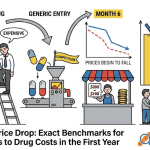
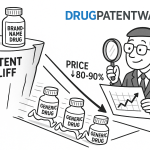
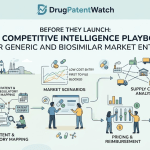
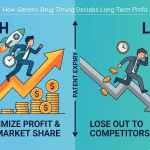
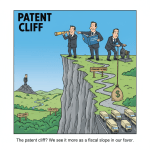
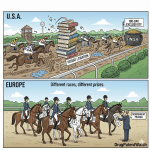
Ranbaxy launched generic Lipitor on November 30, 2011. Pfizer’s exclusivity ended that day. If a payer or brand team modeled that as “the” generic entry date, they modeled the wrong drug economics. Six months later, in late May 2012, seven more manufacturers reached the market, and the price of atorvastatin collapsed a second time.Pfizer expected up to eight generics to compete for market share once Ranbaxy’s 180-day exclusivity period expired in late May 2012. One date, two separate economic events. This pattern repeats across most blockbuster small molecules and nearly every biosimilar, and it is why a single “generic entry date” in a forecast model is usually a modeling error, not a simplification.
The Short Answer
Generic and biosimilar competition does not arrive as a single event. It arrives in statutory waves (a first filer’s 180-day exclusivity), litigated waves (at-risk launches and injunctions), negotiated waves (settlement-capped volumes), and biologic waves (staggered biosimilar and interchangeability launches). Each wave changes price and volume differently, and the gap between the first wave and full multi-source competition has run from six months (Lipitor) to more than nine years (Copaxone) in the cases documented below.
The Five Findings That Matter
The FDA’s own price-ratio data show a generic priced with a single competitor sells at roughly 61% of the pre-generic brand price, while six or more competitors push that ratio below 5%Products with a single generic producer see a 39% reduction in average manufacturer prices compared with a reduction of more than 95% for products with 6 or more competitors — meaning the first wave and the fourth wave are different products economically, not different degrees of the same one.
Revlimid’s generic entry began in March 2022, but the license was capped at a mid-single-digit share of volume, rising gradually to one-third by March 2025 before uncapped competition starts January 31, 2026 — a single “entry date” spanning nearly four years of deliberately staged waves.The license includes a volume limitation on the first generic that rises gradually from a mid-single digit percentage in the first year to a maximum of one-third of total U.S. sales in the final year before unrestricted launch.
Copaxone took nine years and five months to go from its first generic (April 2015) to a fourth manufacturer’s approval (September 2024), spanning three different companies and two dose strengths.Generic glatiramer acetate has been available in the United States since 2015, with Sandoz’s Glatopa approved in April 2015, Mylan approved for both strengths in October 2017, and Synthon Pharmaceuticals approved in September 2024.
Nine Humira biosimilars entered within seven months of each other in 2023, but that wave took nearly two decades of patent life to arrive and needed a specific regulatory trigger — interchangeability status — before payers moved volume.CYLTEZO became the first HUMIRA biosimilar with interchangeable status to be commercially available in the United States on July 1, 2023.
Eliquis received its first FDA-approved generic applications in December 2019, but litigation has pushed the earliest confirmed market entry to April 1, 2028 at minimumA federal appeals court ruling set Bristol Myers Squibb and Pfizer up to retain U.S. exclusivity for Eliquis until April 1, 2028 — an eight-year gap between “FDA-approved generic exists” and “generic is legally sellable” that a naive Orange Book read would miss entirely.
What “Generic Entry” Actually Means: One Date vs. Multiple Waves
Most patent-cliff forecasts use a single loss-of-exclusivity (LOE) date pulled from the Orange Book or a company’s 10-K. That date marks when a listed patent or exclusivity period ends. It does not mark when competitive pricing exists, when volume actually shifts, or when the market becomes fully multi-source. Three separate mechanisms typically operate in sequence, and DrugPatentWatch’s own patent and exclusivity tracking exists specifically because these dates diverge across FDA approval, patent expiration, and actual commercial launch.
Wave Zero: The Authorized Generic, If the Brand Chooses to Compete With Itself
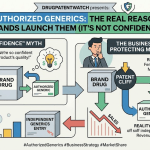
An authorized generic is the branded product sold without the brand name, usually by the same manufacturer or a licensed partner, and it is not subject to the 180-day exclusivity rule because it was never filed as an ANDA.An authorized generic is a branded drug marketed without its brand name, using the same active ingredient, formulation, dosage form, strength, route of administration, and manufacturing process. Brands frequently launch an authorized generic on the same day the first ANDA filer launches, which changes the economics of that first wave substantially. The FTC’s 2011 study found authorized generic competition cuts the first filer’s revenue by 40% to 52% during the exclusivity period and by 53% to 62% during the following 30 months.Revenues of a first-filer generic firm drop between 40 and 52 percent during the 180-day exclusivity period and between 53 and 62 percent during the 30 months after the exclusivity period ends when an authorized generic is present.
Wave One: The First-to-File Generic and Its 180 Days
Hatch-Waxman gives the first ANDA filer to submit a Paragraph IV certification against a listed patent 180 days of exclusivity against other ANDA filers.The 180-day exclusivity period blocks the approval of subsequent ANDAs that also contain a paragraph IV certification, but not those having paragraph III certifications. That exclusivity typically starts on the earlier of first commercial marketing or a court decision on the challenged patent.The statute provides that the first applicant to file a substantially complete ANDA containing a paragraph IV certification is eligible for a 180-day period of exclusivity beginning either from the date it begins commercial marketing, or from a court decision finding the patent invalid or not infringed. If multiple companies file on the exact same first day, FDA’s multiple-first-applicant policy splits that exclusivity among all of them rather than awarding it to one.A multiple first applicant approach limits the number of ANDAs approved during the exclusivity period to the number of first applicants, giving each first applicant part of the benefit of exclusivity.
Wave Two and Beyond: Full Multi-Source Entry
Once the 180-day clock runs out, FDA can approve every other pending ANDA that has cleared review, and the market usually goes from one or two sellers to six, eight, or more within weeks. This is the wave that actually produces the price collapse the FDA’s competition data describes below — not the first-filer launch.
Why the Orange Book Date Isn’t the Launch Date
A drug can have FDA-approved generic applications on file for years before any of them can legally be sold. Litigation and negotiated settlements routinely separate “approved” from “marketed,” and that gap is where most patent-cliff models go wrong.
Paragraph IV Certification and the 30-Month Stay
When an ANDA filer certifies that a listed patent is invalid or not infringed, the brand has 45 days to sue. Filing suit within that window triggers an automatic stay of FDA approval lasting up to 30 months or until a court rules, whichever comes first.If the NDA sponsor or patent owner files a patent infringement suit within 45 days of receipt of notice, FDA may not give final approval to the ANDA for at least 30 months from the date of the notice, unless a court reaches a decision earlier.
At-Risk Launch
Some generic makers launch before litigation resolves, accepting the risk of damages if they lose. Apotex did this with clopidogrel (Plavix) on August 8, 2006, roughly seven months after FDA approval, and was enjoined 23 days later.On August 8, 2006, Apotex announced it had launched a generic version of clopidogrel bisulfate tablets in competition with Plavix in the United States; on August 31, 2006, the district court granted a preliminary injunction ordering Apotex to halt sales. Apotex ultimately paid $442 million in damages.Sanofi and BMS announced on February 8, 2012, that Apotex had paid $442 million in damages in the Plavix patent infringement case, following an October 2011 Federal Circuit decision upholding the award.
Negotiated Entry Date
Patent settlements can grant a generic maker a license to enter on a specific future date, sometimes years before the actual patent expires and sometimes with volume restrictions attached. Novartis used this structure repeatedly to manage Gilenya’s generic entry, settling with several ANDA filers for an agreed date ahead of the patent’s December 2027 expiration while continuing to litigate the remaining challenger.Novartis entered into settlement agreements with a number of manufacturers, allowing those ANDA filers to launch a generic version of Gilenya on an agreed-upon date prior to the expiration of the dosage regimen patent.
Approved but Enjoined
FDA approval of an ANDA is a regulatory finding of bioequivalence. It says nothing about whether a court will allow the product to ship. FDA approved three generic fingolimod (Gilenya) applications in December 2019,The FDA approved the first three generic applications for fingolimod capsules in December 2019, granting approvals to HEC Pharm, Biocon, and Sun Pharmaceutical Industries. yet a permanent injunction kept every one of them off the market for years while the underlying patent’s validity bounced between the district court, a Federal Circuit panel, and a Federal Circuit rehearing.A U.S. District Court decision in August 2020 resulted in a permanent injunction against HEC Pharma until the patent’s December 2027 expiration, and HEC was the only remaining ANDA filer still challenging that patent.
Five Real Entry Curves
The mechanisms above are abstractions until you attach real dates to them. The five cases below span 2006 to the still-unresolved present and cover small-molecule ANDAs, a negotiated volume-capped settlement, and a biosimilar wave.
Lipitor (Atorvastatin): The Textbook Two-Wave Entry
Pfizer’s patent on Lipitor expired November 30, 2011.Pfizer lost exclusivity for Lipitor in the U.S. on November 30, 2011, under a 2008 licensing agreement that let Ranbaxy sell generic Lipitor and Caduet in the U.S. effective that date. Two things happened simultaneously that day: Ranbaxy launched the first ANDA generic under its 180-day exclusivity,Ranbaxy received FDA approval for generic Lipitor covering 10 mg, 20 mg, 40 mg, and 80 mg strengths and launched the product, with a portion of profits during the exclusivity period paid to its partner Teva. and Pfizer’s own licensee, Watson Pharmaceuticals, launched an authorized generic under a five-year exclusive supply deal.Pfizer also granted Watson Pharmaceuticals the exclusive right to sell the authorized generic version of Lipitor in the U.S. for five years, commencing November 30, 2011, with Pfizer manufacturing the tablets as Watson’s exclusive supplier. That two-seller market held prices artificially high relative to what was coming: Pfizer itself told investors it expected up to eight generic competitors once Ranbaxy’s exclusivity lapsed at the end of May 2012.Pfizer expected up to eight generics to compete for market share after the 180-day exclusivity period expired. Pfizer also ran co-pay card and pharmacy-incentive programs through the exclusivity window specifically to blunt the wave-one transition, a strategy pharmacists publicly objected to.Pfizer urged pharmacists to hold off dispensing generic Lipitor in exchange for discounts on the brand product, with that arrangement remaining in effect until Ranbaxy’s exclusivity was expected to end in late May 2012. Calculated span, wave one to wave two: six months, matching the statutory exclusivity period exactly.
Plavix (Clopidogrel): When Wave One Arrives At-Risk
FDA approved Apotex’s ANDA for clopidogrel bisulfate in January 2006.FDA approved Apotex’s ANDA #76-274 on January 20, 2006. Apotex launched at risk on August 8, 2006, without a final resolution of the underlying patent litigation, immediately cutting into a franchise that had generated roughly $3.2 billion in 2005 U.S. sales.PLAVIX had U.S. sales of approximately $3.2 billion for the year ended December 31, 2005, and the drug was the subject of ongoing patent litigation with Apotex when Apotex launched its generic on August 8, 2006. The resulting hit to Sanofi and Bristol-Myers Squibb was immediate and large: BMS estimated the at-risk launch cost it $525 million to $600 million in third-quarter 2006 net sales alone and $1.2 billion to $1.4 billion for the full year.The at-risk launch of generic clopidogrel bisulfate had a significant adverse effect on net sales of PLAVIX in 2006, estimated at $1.2 billion to $1.4 billion for the year, including $525 million to $600 million in the third quarter. A district court enjoined further Apotex sales on August 31, 2006, 23 days after launch, though it did not order a recall of product already in the channel.On August 31, 2006, the district court granted a preliminary injunction halting Apotex’s sales of generic clopidogrel bisulfate, but did not order a recall of products already shipped or enjoin resales. Litigation ran for years afterward; the Federal Circuit upheld a damages award in October 2011, and Apotex paid $442 million in February 2012.The US$442 million payment followed the October 2011 Federal Circuit decision upholding the damages award, closing out litigation that began March 21, 2002. The underlying patent did not expire until May 17, 2012 — nearly six years after the at-risk launchPlavix’s US patent was set to expire on May 17, 2012. — meaning the “first generic event” (2006) and lawful full multi-source entry (2012) were separated by the better part of a decade, with a $442 million damages payment sitting between them.
Copaxone (Glatiramer Acetate): A Nine-Year, Four-Wave Entry
Copaxone is a non-biologic complex drug — a synthetic peptide mixture rather than a small molecule — and its generic pathway unfolded over the better part of a decade rather than months.Glatiramer acetate is a chemically synthesized, nonbiologic mixture of peptides, and its generic approval occurred without new clinical trials, based instead on extensive structural and functional characterization demonstrating equivalence to the innovator drug. Sandoz’s Glatopa, developed with Momenta Pharmaceuticals, became the first generic version of the 20 mg daily dose in April 2015.Sandoz announced US approval of Glatopa, the first generic version of Teva’s Copaxone 20 mg/ml once-daily multiple sclerosis therapy, on April 16, 2015. More than two years passed before a second manufacturer, Mylan, entered — and Mylan’s October 2017 approval covered both the 20 mg daily and 40 mg three-times-weekly strengths simultaneously.FDA approved Mylan’s ANDAs for Glatiramer Acetate Injection 40 mg/mL for three-times-a-week use and 20 mg/mL for once-daily use as AP-rated substitutable generics for Copaxone, with Mylan noting it may be eligible for 180-day exclusivity as one of the first applicants for the 40 mg/mL strength. Sandoz then extended its own portfolio to the 40 mg strength in February 2018, and a fourth manufacturer, Synthon Pharmaceuticals, was not approved for either strength until September 2024.Glatopa 40 mg/mL from Sandoz was approved on February 12, 2018, and Synthon Pharmaceuticals was approved for both strengths on September 25, 2024. Calculated span, first generic to fourth manufacturer: nine years and five months — a timeline driven by the analytical complexity of proving equivalence for a non-biologic complex peptide mixture, not by a single patent cliff date.
Revlimid (Lenalidomide): Negotiated Waves With Volume Caps
Revlimid shows what a wave looks like when the brand and generic negotiate the ramp instead of litigating it to a single cutoff. Celgene’s 2015 settlement with Natco Pharma set a volume-limited license beginning March 2022, with the cap starting at a mid-single-digit percentage of total U.S. lenalidomide volume and rising roughly annually to a maximum of one-third of the market by March 2025, ahead of unrestricted entry on January 31, 2026 — all well before the last Orange Book-listed patent’s April 2027 expiration.Celgene’s license included a volume limitation on Natco’s generic rising gradually from a mid-single digit percentage in the first year to a maximum of one-third of total U.S. lenalidomide sales in the final year before unrestricted launch on January 31, 2026; the last Orange Book-listed patent covering Revlimid expires in April 2027. Bristol Myers Squibb, which acquired Celgene, later struck near-identical volume-and-timeline deals with Dr. Reddy’s, Sun Pharma, and Alvogen, all keyed to the same post-March-2022, pre-2026 window.Bristol Myers reached a settlement with Dr. Reddy’s Laboratories for a volume-limited launch during the same post-March-2022 timeframe as Sun Pharma’s deal, with both companies able to sell without restriction beginning in early 2026, following near-identical earlier pacts with Natco Pharma and Alvogen. The effect on price was muted relative to a normal wave-one launch: the first generic entered at 86.4% of the branded price, a discount of only 13.6%, far short of the roughly 40% discount the FDA typically observes with even a single generic competitor in an uncapped market.When the first generic version of Revlimid entered the US market in March 2022, it launched at 86.4% of the branded price, a discount of just 13.6% for a drug generating billions in annual revenue. Litigation over the arrangement continues: purchasers have argued the volume caps amount to a form of delayed competition that has also contributed to reported generic lenalidomide shortages.In 2024, the American Society of Health-System Pharmacists reported a shortage of generic lenalidomide, with volume restrictions embedded in the settlement agreements cited as a contributing factor.
Humira (Adalimumab): Nine Biosimilars in Two Waves
Humira’s patent estate held off biosimilar competition in the U.S. for roughly two decades after its 2002 approval, despite biosimilars reaching European markets in 2018.Humira brought in more than $20 billion in 2021 for AbbVie; although biosimilars like Amgen’s Amjevita had been marketed in Europe since 2018, patents and exclusivity laws prevented U.S. competition until 2023. When the dam broke, it broke in two distinct waves rather than one. Amgen’s Amjevita launched alone in January 2023 under a negotiated entry date, giving it nearly six months of uncontested biosimilar market share.Amjevita launched in January 2023, and for nearly six months it was the only adalimumab biosimilar available on the US market before the July 2023 wave. The second wave arrived July 1, 2023, when seven more biosimilars launched within the same week: Cyltezo, Hyrimoz, Hadlima, Yusimry, Yuflyma, Idacio, and Hulio.Seven adalimumab biosimilars referencing HUMIRA entered the U.S. market within the same week: Boehringer Ingelheim’s Cyltezo, Sandoz’s Hyrimoz, Organon and Samsung Bioepis’s Hadlima, Coherus Biosciences’s Yusimry, Celltrion’s Yuflyma, Fresenius Kabi’s Idacio, and Biocon’s Hulio. Cyltezo carried a regulatory distinction the others lacked at launch: FDA’s interchangeable designation, which let pharmacies substitute it for Humira without a new prescription and prompted PBM Optum Rx to place it on formulary at parity with the brand.Beginning July 1, 2023, CYLTEZO became the first HUMIRA biosimilar with interchangeable status to be commercially available in the United States, and pharmacy-benefit manager Optum Rx, covering more than 66 million patients, placed it as a preferred brand on its commercial formulary. By 2026, the market had grown to ten approved biosimilars, eight of them carrying interchangeable status, with CVS Caremark reporting $1.5 billion in gross savings and 95% adoption of preferred low-cost biosimilars.As of May 2026, ten biosimilars referencing Humira have been approved by the FDA, eight of which carry the interchangeable designation, and CVS Caremark reported $1.5 billion in gross savings with 95% adoption of low-cost preferred biosimilars. Calculated span, first biosimilar to ten-product market: roughly three years and four months.
What the Data Shows: Price Erosion Tracks Competitor Count, Not the Calendar
FDA’s recurring “Generic Competition and Drug Prices” analysis is the primary-source backbone for why waves matter more than dates. Its central finding: price falls in the number of active manufacturers, not in time elapsed since patent expiration.
FDA’s competition analysis found generic drugs with a single manufacturer priced at roughly 61% of the pre-generic brand price on average, while markets with six or more manufacturers saw average manufacturer prices fall by more than 95% relative to the brand.Products with a single generic producer see a 39% reduction in average manufacturer prices compared with the brand, versus a reduction of more than 95% for products with 6 or more competitors.
Price Erosion by Number of Competitors
Number of generic manufacturers
Median generic-to-brand price ratio (AMP)
Approximate reduction from brand price
1
~61%
~39%
2
~46%
~54%
4
~21%
~79%
6 or more
<5%
>95%
Source: FDA, Generic Competition and Drug Prices, average manufacturer price (AMP) analysis.Generic prices were 54% lower than pre-generic brand prices with 2 competitors, and 79% lower with 4 competitors, using average manufacturer price data. A related study using Medicare Part D claims found prices decline about 20% with roughly three competitors and continue falling to a 70–80% total reduction as the market reaches ten or more competitors, confirming the same competitor-count relationship using an independent dataset.Prices decline by 20% in markets with about three competitors, and continue declining by 80% relative to the pre-generic entry price in markets of ten or more competitors, based on Medicare Part D drug event data from 2007 to 2018.
The mechanism generalizes to physician-administered and biologic products, though more slowly. A 2021 JAMA Network Open study of 50 brand drugs and 28 biologic-biosimilar pairs found roughly a 53% price decrease materializes only after three generic or biosimilar competitors have reached the market.In a cohort study of 50 brand-name drugs and generic versions, as well as 28 biologics and biosimilars, generic competition was associated with reduced prices, achieving a nearly 53% price decrease after three generic competitors were approved. That threshold, three competitors, is functionally a definition of “wave two” for most drug classes, not the first-filer launch.
Original Analysis: The Gap Between First Entry and Full Competition
Pulling the dates documented above into a single table makes the wave pattern explicit. These spans are calculated directly from the primary-source dates cited in each case study; they are not independently reported figures and should be read as derived intervals, not as officially designated milestones.
Time From First Entry to Broad Multi-Source Competition
Drug (active ingredient)
First entry event
Broad multi-source event
Calculated span
Entry mechanism
Lipitor (atorvastatin)
Nov 30, 2011 — Ranbaxy + authorized generic
~May 30, 2012 — 180-day exclusivity ends
~6 months
Statutory (180-day)
Plavix (clopidogrel)
Aug 8, 2006 — Apotex at-risk launch
May 17, 2012 — patent expiration
~5 years, 9 months
Litigated / at-risk
Copaxone (glatiramer acetate)
Apr 16, 2015 — Glatopa 20 mg
Sep 25, 2024 — Synthon, both strengths
~9 years, 5 months
Sequential ANDA approvals
Revlimid (lenalidomide)
Mar 2022 — Natco, volume-capped
Jan 31, 2026 — uncapped entry
~3 years, 10 months
Negotiated / volume-capped
Humira (adalimumab)
Jan 2023 — Amjevita
May 2026 — 10 biosimilars on market
~3 years, 4 months
Biologic / interchangeability-staggered
Eliquis (apixaban)
Dec 2019 — first ANDAs approved
Apr 1, 2028 — earliest confirmed lawful entry
~8 years, 4 months
Litigated, still unresolved
The range across six real drugs runs from roughly six months to more than nine years. No single “months after patent expiry” heuristic captures that spread, and a forecast model that assumes one behaves the same way it assumes the other five will be wrong about revenue, price, and volume in ways that compound over multiple planning cycles.
A Taxonomy of Multi-Source Entry Patterns
Not every wave is caused by the same mechanism. Separating them clarifies what a forecast actually needs to model.
Statutory Wave
Driven by the 180-day exclusivity clock. Highly predictable once the first filer launches: exclusivity almost always resolves in exactly six months absent forfeiture. Lipitor is the clean example.
Litigated Wave
Driven by patent infringement litigation outcomes, injunctions, and appeals. Highly unpredictable in timing; can compress (at-risk launch) or extend by years (Gilenya, Eliquis) depending on how appellate courts rule.
Negotiated Wave
Driven by settlement terms that grant a specific entry date, sometimes with volume caps attached. Predictable once the settlement is public, but the ramp to full competition is deliberately slow. Revlimid is the clearest example, and Gilenya used the same negotiated-date structure for some filers while litigating others.
Biologic / Interchangeability Wave
Driven by BPCIA exclusivity, patent settlements common across an entire reference product’s litigation portfolio, and the separate regulatory threshold of interchangeability, which affects pharmacy-level substitution and payer formulary decisions independently of biosimilar approval itself. Humira is the clearest example; a first biosimilar can be approved and marketed for months before the “real” wave of formulary-driven substitution begins.
What Happens Next: Eliquis and the 2026–2031 Window
Eliquis (apixaban) is a live illustration of why “generic exists” and “generic is sellable” are different facts. FDA approved the first generic apixaban applications, to Micro Labs and Mylan, in December 2019.The U.S. Food and Drug Administration approved the first generics for Eliquis in December 2019, granting approval of generic apixaban applications to Micro Labs Limited and Mylan Pharmaceuticals Inc. Both companies settled patent disputes with BMS and Pfizer and agreed not to enter before at least 2026.Micro Labs and Mylan reached settlement agreements over patent disputes with BMS and Pfizer that prevent those companies from entering the market until at least 2026. Other challengers took a different path: Sigmapharm, Sunshine Lake Pharma, HEC Pharm, and Unichem litigated the composition-of-matter and formulation patents instead of settling, lost at the district court in August 2020, and lost again on appeal, which set the earliest confirmed exclusivity date at April 1, 2028.The U.S. Court of Appeals for the Federal Circuit upheld a prior win for BMS and Pfizer covering the composition of matter and formulation patents, setting the companies up to retain U.S. exclusivity until April 1, 2028; previously, generic entry had been expected to occur between 2026 and 2031. As of this year, the picture is still shifting: BMS disclosed in its mid-2026 SEC filings that a new challenger, Azurity Pharmaceuticals, filed a Paragraph IV certification in November 2025 against a formulation patent, and BMS and Pfizer have already sued.In November 2025, BMS received a Notice Letter from Azurity Pharmaceuticals notifying BMS that Azurity had filed a paragraph IV certification seeking approval to market apixaban products in the U.S. and challenging a formulation patent listed in the Orange Book for Eliquis, prompting BMS and Pfizer to initiate a patent infringement action in the U.S. District Court for the District of Delaware. Generics have also already entered at least one European market — Poland — while European litigation continues in more than twenty other jurisdictions.BMS is involved in litigation throughout Europe against companies seeking to launch generic apixaban prior to expiration of the composition-of-matter patent and its associated SPCs, and one or more generics have entered the market in Poland while proceedings are pending in numerous other countries. Eliquis alone represents roughly $9 billion a year in combined revenue for BMS and Pfizer, and analysts have flagged it, together with Opdivo, as the largest single growth gap facing any large-cap pharmaceutical company heading into the 2026–2028 patent cliff.Eliquis, together with the company’s immuno-oncology flagship drug Opdivo, accounts for roughly half of BMS’s total earnings, and as both approach the end of their exclusivity the company faces the largest growth gap among its large-cap peers, estimated at approximately $38 billion in future at-risk revenue.
What This Means for Brand Manufacturers
Waves are a lever, not just a threat. An authorized generic deployed at wave one captures generic-level volume without ceding it entirely to a competitor, and the FTC’s data shows it also compresses the first filer’s economics by 40–52%, which changes how aggressively that filer prices.An authorized generic reduces the first-filer generic’s revenue by 40 to 52 percent during the 180-day exclusivity period. Negotiated, volume-capped settlements — the Revlimid model — convert a hard patent cliff into a multi-year ramp, at the cost of ongoing antitrust scrutiny under the FTC v. Actavis framework for reverse-payment settlements.Authorized generic threats are frequently the negotiating lever in Hatch-Waxman patent settlements, and the FTC scrutinizes “no-AG” commitments as a form of reverse payment under antitrust standards established in FTC v. Actavis. The broader 2026–2032 patent cliff makes this more than an academic exercise: estimates of total annual U.S. and global revenue at risk range from roughly $230 billion through 2030 to as much as $500 billion through 2032, depending on the analyst and the drugs included, spanning roughly 200 products.The US market alone is projected to lose more than $230 billion in revenue between 2025 and 2030.An estimated $500 billion in branded innovator drugs face generics/biosimilar exposure between 2026 and 2032, according to industry analysis.
What This Means for Payers, PBMs, and Health Systems
A formulary strategy timed to a single LOE date will systematically overpay during wave one and may miss the real savings inflection at wave two or three. The FDA’s competitor-count data implies that meaningful savings, in the 50%-plus range, typically require three or more manufacturers on the market, not one.A nearly 53% price decrease materializes after three generic competitors have been approved. For biosimilars, interchangeability status is a separate trigger from approval itself and is often the actual event that moves formulary placement, as Optum Rx’s Cyltezo decision demonstrated.Optum Rx placed CYLTEZO as a preferred brand on its formulary specifically because of its interchangeable status. Volume-capped settlements like Revlimid’s also carry a supply-side risk beyond pricing: the American Society of Health-System Pharmacists linked capped generic volume to a reported 2024 lenalidomide shortage, meaning the wave structure itself can constrain access even after “generic entry” has technically occurred.Constrained supply, combined with limited competitive pressure, meant that patients seeking the lower-cost generic option faced access barriers, with volume restrictions embedded in settlement agreements cited as a contributing factor to a reported 2024 shortage.
What This Means for Generic and Biosimilar Challengers
Being first to file is valuable specifically because it is temporary and exclusive; the same FTC data shows that value evaporates by roughly half the moment a brand launches a competing authorized generic.When an authorized generic is available, revenues of the generic firm drop between 40 and 52 percent during the 180-day exclusivity period. For complex, non-biologic drugs like Copaxone, the multi-year gap between the first approved generic and the second is largely a function of analytical and characterization burden, not patent law, and later entrants should expect years, not months, of runway before a third competitor arrives. For biosimilars, interchangeability is worth pursuing even after basic biosimilar approval, since it is the designation that actually converts regulatory approval into pharmacy-level substitution and PBM preferred status.
Methodology
The case studies and the calculated-span table above draw exclusively on primary and near-primary sources: FDA guidance and press releases, SEC filings (10-K and 10-Q disclosures from Pfizer, Bristol-Myers Squibb, and Celgene), Federal Trade Commission reports, court decisions as reported by legal trade press, and company press releases announcing FDA approvals and product launches. Dates were taken as stated in the cited source, using the earliest documented date for each event (FDA approval date, court decision date, or commercial launch date, as applicable and as distinguished in the text). Calculated spans in the “Time From First Entry to Broad Multi-Source Competition” table were computed by the author from the two boundary dates cited for each drug; they are original calculations, not figures reported by any single source, and are labeled as such. The FDA price-ratio table reproduces published FDA average-manufacturer-price analysis as summarized in FDA’s public reporting; it is not an independent re-derivation. Case selection prioritized drugs with well-documented, verifiable multi-source entry timelines spanning different entry mechanisms (statutory, litigated, negotiated, and biologic); it is illustrative, not a systematic or exhaustive sample of all drugs that lost exclusivity in the period covered. Limitation: settlement terms in several cases (exact volume-cap percentages in the Revlimid deals, exact negotiated entry dates in the Gilenya settlements) are confidential and were not independently verifiable beyond what settling parties or litigants disclosed publicly.
Definitions
180-day exclusivity: A period during which FDA may not approve a subsequent ANDA containing a Paragraph IV certification against the same patent, granted to the first ANDA filer(s) to challenge that patent.The 180-day exclusivity provision blocks the approval of subsequent ANDAs containing a Paragraph IV certification referencing the same patent.
Authorized generic: A brand manufacturer’s own product sold under a generic label, typically by the manufacturer itself or a licensed distributor, not subject to 180-day exclusivity because it is not filed as an ANDA.An authorized generic is a branded drug marketed without its brand name, with the same active ingredient, dosage form, strength, and manufacturing process as the branded product.
At-risk launch: Commercial launch of a generic product before patent litigation concludes, exposing the launching company to damages if it ultimately loses.
Interchangeable biosimilar: A biosimilar that has met an additional FDA standard allowing pharmacy-level substitution for the reference biologic without a new prescription, distinct from ordinary biosimilar approval.
Paragraph IV certification: An ANDA applicant’s certification that a patent listed for the reference drug is invalid, unenforceable, or will not be infringed by the generic product.
30-month stay: An automatic stay of ANDA approval, up to 30 months, triggered when a patent holder sues an ANDA filer within 45 days of receiving a Paragraph IV notice.Filing suit within 45 days of receipt of notice triggers a stay of ANDA approval for at least 30 months from the date of notice, unless a court rules earlier.
Frequently Asked Questions
Why do multiple generics sometimes launch on the exact same day?
Either FDA’s multiple-first-applicant policy split 180-day exclusivity among several companies that filed on the same first day,A multiple first applicant approach applies only when multiple ANDA applicants submit paragraph IV certifications challenging the same listed patent on the same first day. or the exclusivity period held by a single first filer has simply expired, unblocking every other approved ANDA at once, as happened with Gilenya’s three simultaneous December 2019 approvals.The FDA approved the first three generic versions of Gilenya simultaneously in December 2019, with applications filed by Sun Pharmaceutical, Biocon, and HEC Pharm.
Does an authorized generic count toward the “number of competitors” that drives price down?
Yes, and it typically arrives earlier than independent competitors, which is why FTC data shows retail generic prices average 4% to 8% lower and wholesale prices 7% to 14% lower when an authorized generic competes during the 180-day window than when it does not.Empirical evidence from the FTC’s Authorized Generic Study shows that competition from an authorized generic drug during the first-filer’s 180-day exclusivity period results, on average, in retail generic prices 4 to 8 percent lower and wholesale generic prices 7 to 14 percent lower than prices without authorized generic competition.
Why did Revlimid’s first generic launch at only a 13.6% discount to the brand?
Because the settlement capped Natco’s sellable volume at a mid-single-digit percentage of the market in year one, removing the competitive pressure that normally forces price down even with just one competitor.The first generic version of Revlimid launched at 86.4% of the branded price, a discount of just 13.6%, reflecting the near-total absence of competitive pressure under the volume-capped settlement.
What is the difference between a generic being “approved” and being “on the market”?
Approval is an FDA finding that the product is bioequivalent and manufactured to standard. Marketing requires that no injunction, stay, or settlement term currently blocks the sale. Gilenya’s three December 2019 approvals remained unsellable for years afterward due to a standing injunction against the sole remaining litigant and confidential negotiated dates for the settling parties.The permanent injunction against HEC Pharma remained in place after the FDA-approved generics existed, continuing to bar marketing and sale of the generic until the patent litigation was resolved.
How much does an interchangeable designation matter for a biosimilar’s commercial success?
It can determine formulary placement independent of price. Optum Rx named Cyltezo a preferred, formulary-parity product specifically because of its interchangeable status, ahead of seven other biosimilars launching the same week.Optum Rx, covering more than 66 million patients, placed CYLTEZO as a preferred brand on its commercial formulary specifically because of the product’s commercial launch as the first interchangeable HUMIRA biosimilar.
Can a brand manufacturer legally pay a generic company to delay launch?
Reverse-payment settlements are legal but subject to antitrust review under the Supreme Court’s FTC v. Actavis framework, and commitments not to launch a competing authorized generic are treated by the FTC as a form of compensation that can itself constitute an anticompetitive reverse payment.The FTC’s position is that “no-AG” commitments are a form of reverse payment, valuable consideration flowing from brand to generic in exchange for delayed competition, and scrutinizes them under antitrust standards established in FTC v. Actavis (2013).
How large is the 2026–2030 patent cliff compared to prior cliffs?
Estimates vary by source and time horizon, but multiple analysts place US revenue at risk between 2025 and 2030 above $230 billion,The US market alone is projected to lose more than $230 billion in revenue between 2025 and 2030. with broader global exposure through 2032 estimated as high as $500 billion across roughly 200 products.More than $500 billion in sales are potentially at risk from generics and biosimilar competition between 2026 and 2032, according to industry analysis. One widely cited comparison puts the prior 2016 cliff at roughly $100 billion in eroded brand-name sales, making the current cliff several times larger.The previous patent cliff, in 2016, eroded about $100 billion in brand-name sales; the current one is roughly three times that size.
Why is Eliquis still not generic if the first ANDAs were approved in 2019?
Two of the three Orange Book-listed patents were not set to expire until 2026 and 2031 at the time of an early court ruling, and a federal appeals court later upheld the composition-of-matter and formulation patents, pushing the earliest confirmed date for litigating challengers to April 1, 2028.Two other patents for Eliquis, first approved in 2013, were not set to expire until 2026 and 2031.The appeals court win set the companies up to retain U.S. exclusivity until April 1, 2028.
Does DrugPatentWatch track the difference between approval, patent expiration, and actual launch dates?
Distinguishing FDA approval dates, Orange Book patent expiration dates, exclusivity end dates, and confirmed or estimated commercial launch dates is the specific analytical problem this kind of patent-and-exclusivity tracking exists to solve, precisely because the cases above show those dates routinely diverge by months or years.
What is a “wave” in practical forecasting terms?
A wave is any discrete change in the number of legally sellable competitors for a molecule, whether triggered by exclusivity expiration, a court ruling, a settlement date, or an interchangeability designation. A forecast that models revenue against calendar time since patent expiration, rather than against the actual competitor count at each date, will misstate both the timing and the magnitude of price erosion, as the gap between Lipitor’s six-month wave spacing and Copaxone’s nine-year wave spacing demonstrates.
Key Takeaways
Loss-of-exclusivity dates mark when a patent or statutory exclusivity ends, not when full competitive pricing begins; the gap between the two ranged from six months to more than nine years across the six drugs examined here.
FDA’s own price data shows the real price collapse requires three or more competitors, not one, with average manufacturer prices falling from roughly 61% of brand with one competitor to under 5% with six or more.Products with a single generic producer see a 39% reduction in average manufacturer prices, versus a reduction of more than 95% for products with 6 or more competitors.
Authorized generics, at-risk launches, negotiated volume caps, and biosimilar interchangeability designations each create a distinct, separately timed wave with its own price and access effects.
Negotiated, volume-capped entry (Revlimid) can produce a technically “generic” market with almost no price discount, and has been linked to a documented 2024 drug shortage.The first generic version of Revlimid launched at a discount of just 13.6%, and volume restrictions embedded in the settlement agreements were cited as a contributing factor to a reported 2024 shortage.
Eliquis, currently the subject of active 2025–2026 litigation over new Paragraph IV challenges, illustrates that even an eight-year-old FDA generic approval can remain commercially meaningless until the underlying patent litigation resolves.
References
U.S. Food and Drug Administration. (2023, October 26). Small Business Assistance: 180-Day Generic Drug Exclusivity. https://www.fda.gov/drugs/cder-small-business-industry-assistance-sbia/small-business-assistance-180-day-generic-drug-exclusivity
U.S. Food and Drug Administration. Guidance for Industry: 180-Day Exclusivity When Multiple ANDAs Are Submitted on the Same Day. https://www.fda.gov/files/drugs/published/180-Day-Exclusivity-When-Multiple-ANDAs-Are-Submitted-on-the-Same-Day.pdf
Federal Trade Commission. (2009, June). FTC Issues Interim Report on “Authorized Generic” Drugs. https://www.ftc.gov/news-events/news/press-releases/2009/06/ftc-issues-interim-report-authorized-generic-drugs
Jones Day. (2011, September). Antitrust Alert: FTC Releases Report on Authorized Generic Drugs. https://www.jonesday.com/en/insights/2011/09/antitrust-alert–ftc-releases-report-on-authorized-generic-drugs
Health Affairs. Authorized Generics In The US: Prevalence, Characteristics, And Timing, 2010–19. https://www.healthaffairs.org/doi/10.1377/hlthaff.2022.01677
Pfizer Inc. (2012). Form 10-K for fiscal year 2011. U.S. Securities and Exchange Commission, EDGAR. https://www.sec.gov/Archives/edgar/data/0000078003/000119312512085703/d278590d10k.htm
GaBI Online. Pfizer continues to fight for Lipitor. https://www.gabionline.net/generics/news/Pfizer-continues-to-fight-for-Lipitor
GaBI Online. Ranbaxy to launch generic atorvastatin on time. https://gabionline.net/generics/news/Ranbaxy-to-launch-generic-atorvastatin-on-time
GenEngNews. Ranbaxy Launches Generic Lipitor in the U.S. https://www.genengnews.com/topics/drug-discovery/ranbaxy-launches-generic-lipitor-in-the-u-s/
Bristol-Myers Squibb Co. (2007). Form 10-K for fiscal year 2006. U.S. Securities and Exchange Commission, EDGAR. https://www.sec.gov/Archives/edgar/data/0000014272/000119312507039915/d10k.htm
Drug Topics. Apotex markets generic Plavix. https://www.drugtopics.com/view/apotex-markets-generic-plavix
Novartis. (2015, April 16). Sandoz receives FDA approval for Glatopa as the first generic competitor to MS therapy Copaxone 20mg. https://www.novartis.com/news/media-releases/sandoz-receives-fda-approval-glatopatm-first-generic-competitor-ms-therapy-copaxone-20mg
Mylan N.V. (2017). Mylan Announces U.S. FDA Approval of First Generic for Copaxone 40 mg/mL 3-Times-a-Week. https://investor.mylan.com/news-releases/news-release-details/mylan-announces-us-fda-approval-first-generic-copaxoner-40-mgml
QuickRx. Is There a Generic for Copaxone? Glatiramer Acetate Availability & Copay Assistance. https://quickrxspecialty.pharmacy/generic-copaxone-glatiramer-acetate-availability-copay-assistance/
Celgene Corporation. (2015). Celgene Settles REVLIMID Patent Litigation [SEC exhibit]. U.S. Securities and Exchange Commission, EDGAR. https://www.sec.gov/Archives/edgar/data/816284/000157104915010171/t1503008_ex99-1.htm
Fierce Pharma. Bristol Myers inks another Revlimid patent settlement—this time with Sun Pharma—as copycats near. https://www.fiercepharma.com/manufacturing/bristol-myers-settles-sun-pharma-for-limited-revlimid-generic-launch-2022
Goodwin. (2023, June). CYLTEZO to Launch on July 1 as the First Interchangeable HUMIRA Biosimilar. https://www.goodwinlaw.com/en/insights/blogs/2023/06/cyltezo-to-launch-on-july-1-as-the-first-interchangeable-humira-biosimilar
Big Molecule Watch. (2023, July 6). HUMIRA (adalimumab) Biosimilar Launches. https://www.bigmoleculewatch.com/2023/07/06/humira-adalimumab-biosimilar-launches/
GoodRx. 10 Humira Biosimilars Approved in the U.S. https://www.goodrx.com/humira/biosimilars
AJMC. The Wait Is Over: 8 Adalimumab Biosimilars Launching in the US in July. https://www.ajmc.com/view/the-wait-is-over-8-adalimumab-biosimilars-launching-in-the-us-in-july
PharmTech. (2019, December 6). FDA Approves First Generics of Novartis’ Blockbuster MS Drug. https://www.pharmtech.com/view/fda-approves-first-generics-novartis-blockbuster-ms-drug
Novartis. (2022, January 4). Novartis Announces U.S. Court of Appeals for the Federal Circuit (CAFC) Upholds Validity of Gilenya (Fingolimod) Dosage Regimen Patent. https://prod1.novartis.com/news/media-releases/novartis-announces-us-court-appeals-federal-circuit-cafc-upholds-validity-gilenya-fingolimod-dosage-regimen-patent
Novartis. (2022, September 21). Novartis plans to petition the U.S. Supreme Court to uphold validity of the Gilenya dosing regimen patent. https://prod1.novartis.com/node/180311/printable/print
Fierce Pharma. Bristol Myers, Pfizer score another win in their Eliquis patent defense, protecting the blockbuster until 2028. https://www.fiercepharma.com/pharma/bristol-myers-pfizer-score-another-win-their-eliquis-defense-protecting-blockbuster
Bristol-Myers Squibb Co. (2026). Form 10-Q [Eliquis intellectual property disclosure]. U.S. Securities and Exchange Commission, EDGAR. https://www.sec.gov/Archives/edgar/data/0000014272/000001427226000010/bmy-20260331.htm
U.S. Food and Drug Administration. Generic Competition and Drug Prices. https://www.fda.gov/about-fda/center-drug-evaluation-and-research-cder/generic-competition-and-drug-prices
Pharmacy Times. Competition Lowers Drug Prices, FDA Says. https://www.pharmacytimes.com/view/competition-lowers-drug-prices-fda-says
U.S. Department of Health and Human Services, Office of the Assistant Secretary for Planning and Evaluation. Drug Competition Series: Analysis of New Generic Drug Entrants. https://aspe.hhs.gov/sites/default/files/documents/510e964dc7b7f00763a7f8a1dbc5ae7b/aspe-ib-generic-drugs-competition.pdf
Dickson, S. R., & Kent, T. (2021). Association of generic competition with price decreases in physician-administered drugs and estimated price decreases for biosimilar competition. JAMA Network Open. https://www.ncbi.nlm.nih.gov/pmc/articles/PMC8593762/
DrugPatentWatch. The 180-Day Gold Rush: Why First Generic Launches Win Billions and Later Entrants Fight Over Scraps. https://www.drugpatentwatch.com/blog/first-generic-launch-has-significant-first-mover-advantage-over-later-generic-drug-entrants/
Drug Discovery News. (2026, February 24). Blockbuster drugs face a massive patent cliff in 2026. https://www.drugdiscoverynews.com/blockbuster-drugs-face-a-massive-patent-cliff-in-2026-17019
GEN. Top 20 Drugs Heading for the Patent Cliff, 2026-2029. https://www.genengnews.com/topics/drug-discovery/top-20-drugs-heading-for-the-patent-cliff-2026-2029/