In February, March, and April 2017, twenty-five generic drug companies sent Bristol-Myers Squibb and Pfizer formal notice that they had filed abbreviated new drug applications (ANDAs) with Paragraph IV certifications against Eliquis, the apixaban blood thinner. Not one company. Not three. Twenty-five, inside a ninety-day window, all challenging the same two Orange Book patents [1][2]. BMS and Pfizer sued all twenty-five at once, in federal courts in Delaware and West Virginia [1].
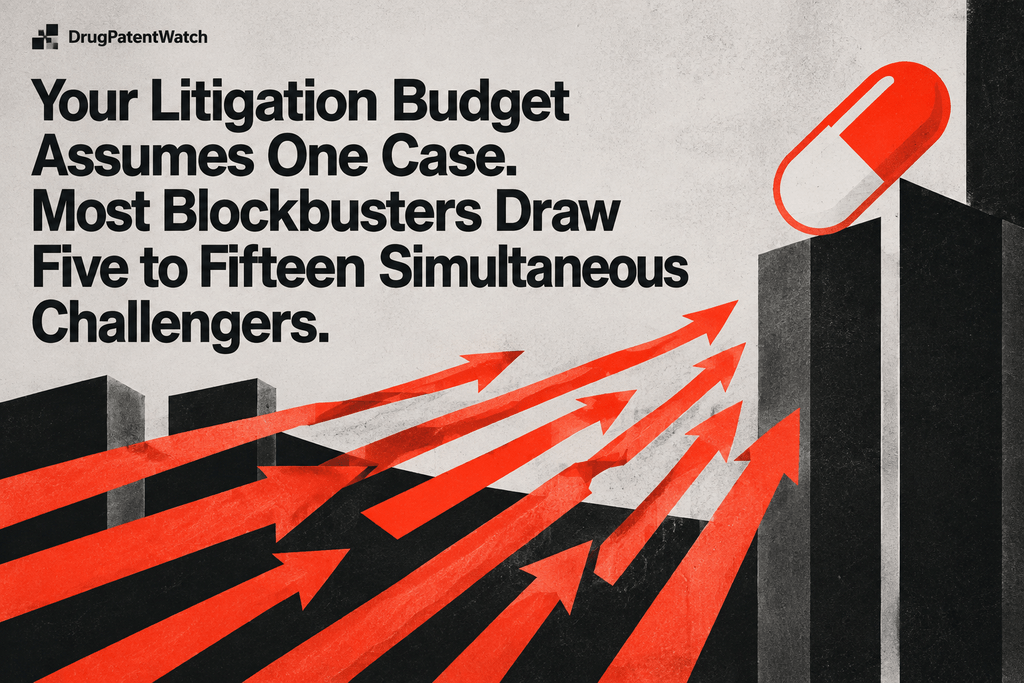
That is not an outlier. It is closer to the median outcome for a drug that clears a billion dollars in annual sales. A brand company that sizes its Paragraph IV litigation reserve around the cost of defending one patent against one generic filer is budgeting for a scenario that blockbusters rarely produce.
The Short Answer
Blockbuster drugs routinely draw somewhere between five and twenty-five simultaneous ANDA or biosimilar challengers, not one. Eliquis drew 25 ANDA filers in a single quarter [1]. Suboxone Film drew 7 [3]. Humira drew 8 biosimilar developers [8][9][10]. Revlimid drew at least 10 generic manufacturers named in litigation and settlement records [15]. Stelara drew 7 FDA-approved biosimilars that launched within a five-month window in 2025 [16][17][18]. Standard litigation-cost benchmarks published by the American Intellectual Property Law Association (AIPLA) are built around a single-defendant case, and multiplying that benchmark by the actual defendant count on any of these five drugs produces a discovery-phase cost exposure many times larger than a single-case budget line [20][21].
What a “One Case” Litigation Budget Actually Assumes
A Hatch-Waxman Paragraph IV certification is a generic manufacturer’s statement, filed as part of an ANDA, that a patent listed in the FDA’s Orange Book for a reference drug is invalid, unenforceable, or not infringed by the generic product. Once the brand receives notice of that certification, it has 45 days to sue. If it sues in time, FDA approval of that ANDA is automatically stayed for up to 30 months or until the litigation resolves, whichever comes first [23].
Legal and finance teams that plan around this mechanic tend to build a reserve for one lawsuit: one plaintiff, one defendant, one patent family, one trial track. That is the shape of most patent litigation outside pharma. It is not the shape of Hatch-Waxman litigation against a drug with real commercial stakes.
How Brand Legal Departments Size a Paragraph IV Reserve
Litigation reserves for pharmaceutical patent disputes are typically built from a per-case cost estimate, a probability of suit, and a time horizon tied to loss-of-exclusivity planning. The per-case cost estimate is where the single-defendant assumption enters, because the most widely cited cost benchmark in the industry, the AIPLA Report of the Economic Survey, reports cost as a function of damages at risk in a single infringement action, not as a function of how many infringers are named [20].
The AIPLA Cost Curve Everyone Cites, Built Around a Single Defendant
The AIPLA’s 2023 survey breaks patent litigation cost into two stages, cost through the end of discovery and claim construction, and cost through trial and appeal, and reports both per patent, per side [20][21]. The bands below are the numbers most frequently cited in brand-side and generic-side legal budgeting memos.
Under $1 Million at Risk: $300,000 Then $600,000 Per Patent
For the lowest damages band, the median cost per patent is $300,000 through discovery and claim construction, and another $600,000 to carry the same patent through trial and appeal [21].
$1 Million to $10 Million at Risk: $600,000 Then $1 Million Per Patent
Move into the mid-tier band, the one that fits most single-source ANDA disputes on a drug with real revenue, and those figures double to roughly $600,000 through discovery and claim construction and $1 million through trial and appeal, per patent [21].
$10 Million to $25 Million at Risk: $1.5 Million Then $3 Million Per Patent
At the high-stakes band, the numbers rise again, to roughly $1.5 million through discovery and claim construction and $3 million through trial and appeal, per patent [21].
Every one of these figures describes one patent litigated against one infringing party. None of them describes what happens when a brand’s Orange Book listing draws a dozen infringing parties inside the same quarter.
How Often Do Multiple Challengers Actually Show Up?
The FDA maintains a public Paragraph IV Certification List that tracks every drug and patent combination that has received a first Paragraph IV filing. As of the January 2026 update, that list contained 1,588 entries spanning 880 unique drugs, according to an industry analysis of the FDA data [22]. Not every one of those 880 drugs draws a crowd. But the drugs that generate real commercial stakes, the ones with billion-dollar-plus annual sales, disproportionately do.
The FDA Paragraph IV Certification List, By the Numbers
The FDA list itself does not disclose how many applicants filed on a given date, only that a first filing occurred [24]. That design choice matters. It means a brand company frequently cannot tell from the public record alone whether it is facing one challenger or fifteen until litigation begins and defendants start appearing on the docket.
Same-Day Filing: Why Challengers Arrive in Clusters, Not One at a Time
A meaningful share of first-filer determinations involve more than one applicant submitting a substantially complete ANDA with a Paragraph IV certification on the identical date [23][24]. For a drug protected by a five-year New Chemical Entity (NCE) exclusivity period, the earliest a generic company can file a Paragraph IV certification against a listed patent is one year before that exclusivity expires, a date known in the industry as NCE-1. Every generic company chasing 180-day exclusivity knows that date, and every one of them has an incentive to file on it rather than a day later, because filing after the first mover forfeits any shot at exclusivity [24]. The result is a structural magnet that pulls independent, uncoordinated companies toward the same filing date, which is exactly the mechanic that produced Eliquis’s 25 filers inside a single quarter [1].
Five Case Studies in Counting the Actual Defendant Roster
Cost benchmarks and filing statistics describe the shape of the problem in the abstract. The five matters below describe what it looked like in practice, drawn from SEC filings, court opinions, and contemporaneous trade press.
Eliquis: Twenty-Five ANDA Filers in a Ninety-Day Window
Bristol-Myers Squibb and Pfizer’s own SEC filings put the number precisely. Between February and April 2017, 25 generic companies sent Paragraph IV certification letters challenging two Orange Book patents on Eliquis: U.S. Patent No. 6,967,208, the composition-of-matter patent covering apixaban itself, and U.S. Patent No. 9,126,945, a formulation patent [1][29]. A third patent listed at the time was also challenged before later expiring [1].
The Consolidation Order in Delaware and West Virginia
BMS and Pfizer sued all 25 filers in April 2017, splitting the docket between the District of Delaware and the Northern District of West Virginia depending on where each generic company was organized or did business [1][29]. Individual defendants, including Amneal Pharmaceuticals, moved to consolidate the related cases, and the court granted consolidation in November 2017, setting a single case schedule with trial set for October 2019 [27].
What Happened After Consolidation
In August 2017, the U.S. Patent and Trademark Office granted patent term extension on the composition-of-matter patent, pushing its expiration from February 2023 to November 2026 [28]. By the end of 2018, BMS reported it had settled with a number of the 25 ANDA filers, staggering their entry dates without disturbing the company’s projected loss-of-exclusivity date [28]. Consolidation did not eliminate the cost of facing 25 parties, but it did let BMS and Pfizer litigate common claim-construction and validity issues once rather than 25 separate times, which is the single largest cost lever available in a multi-defendant Hatch-Waxman case.
Suboxone Film: Seven Challengers, Five Different Legal Outcomes
Indivior’s buprenorphine and naloxone sublingual film drew ANDA filings from seven separate corporate groups: Watson Laboratories (later Actavis), Par Pharmaceutical, Alvogen Pine Brook, Teva Pharmaceutical, Dr. Reddy’s Laboratories, Sandoz, and Mylan Technologies [3]. Indivior sued all seven under the Hatch-Waxman Act beginning in 2015 [3]. Unlike Eliquis, the Suboxone Film cases were not consolidated into a single track, and the seven companies ended up on five different legal paths.
Actavis and Par: Infringement Found, Barred Until 2024
A court found that Actavis and Par infringed Indivior’s core ‘514 patent, barring both companies from launching a generic Suboxone Film product until April 2024, even though Actavis had already received tentative FDA approval in October 2017 [4].
Teva and Dr. Reddy’s: Non-Infringement, At-Risk Launch
A separate ruling found that Teva and Dr. Reddy’s products did not infringe the same ‘514 patent, a decision Indivior appealed [4]. Sandoz abandoned its generic version entirely, and Mylan, after filing an inter partes review petition against two of the asserted patents, ultimately settled [4]. Alvogen’s product was found not to infringe the three originally asserted patents in a March 2018 ruling, but Indivior went on to assert newly issued patents against Alvogen and Dr. Reddy’s and obtained a temporary restraining order against Alvogen in January 2019 [3][6]. The Federal Circuit vacated a related injunction against Dr. Reddy’s in November 2018, the Supreme Court declined to stay that mandate in February 2019, and Dr. Reddy’s and then Mylan launched their generics that same month [5]. Alvogen launched at risk in 2019 and did not finally resolve its dispute with Indivior until October 2023, when the two companies settled for $15 million, eight years after the first suit was filed [6].
Revlimid: Ten Generic Makers, One Staggered Settlement Waterfall
A 2022 antitrust complaint against Bristol Myers Squibb, Celgene, and their generic counterparties named at least 10 companies that had submitted ANDAs for generic lenalidomide, Revlimid’s active ingredient: Natco Pharma, Mylan, Teva, Dr. Reddy’s, Lotus Pharmaceutical, Alvogen, Cipla, Apotex, Zydus, and Cadila [15]. Rather than litigating all 10 to a verdict, Celgene settled with each in turn, building a volume-limited entry schedule. Natco could begin selling a small single-digit percentage of Revlimid’s volume starting in March 2022, ramping toward roughly one-third of total volume over time [13]. Alvogen received a nearly identical structure the same month, both companies gaining unrestricted entry on January 31, 2026 [14]. Dr. Reddy’s and Sun Pharma settled on comparable terms in subsequent years [13]. None of the 10 companies litigated Revlimid’s core patents to a jury verdict; every one of them entered through a negotiated, date-certain settlement.
Humira: Eight Biosimilar Makers, One Settlement Cadence
AbbVie built a Humira patent estate that eventually exceeded 100 patents, of which the company identified 74 as infringed by Boehringer Ingelheim’s biosimilar candidate alone [11]. Eight biosimilar developers ultimately entered into settlement agreements with AbbVie that delayed U.S. launch until 2023 while permitting earlier entry in Europe: Amgen, Samsung Bioepis, Mylan, Sandoz, Fresenius Kabi, Pfizer, Momenta, and Boehringer Ingelheim [8][9][10]. Only two of those disputes reached the point of a defined patent count in litigation. AbbVie v. Amgen proceeded on 10 of the 61 patents AbbVie and Amgen had identified during the BPCIA’s mandatory patent-disclosure process, before the companies settled in September 2017 [11]. AbbVie v. Boehringer Ingelheim proceeded on 8 patents, after AbbVie proposed litigating 5 and Boehringer agreed to 5, with 2 overlapping between the two lists [12]. The remaining six biosimilar disputes settled without ever reaching a court-defined patent count, which is itself a data point: the deepest patent thickets do not need every challenger to litigate to conclusion, they only need enough litigation risk to make settlement the rational choice for all sides.
Stelara: Seven Biosimilars, a Two-Year Delay Compressed Into One Quarter
Seven ustekinumab biosimilars won FDA approval for Stelara’s indications, and patent litigation between Janssen and each biosimilar developer pushed what the industry had originally expected as 2023 launches into a five-month window in 2025 [16]. Amgen’s Wezlana launched first, on January 1, 2025 [16]. Alvotech and Teva’s Selarsdi followed on February 21, then Samsung Bioepis and Sandoz’s Pyzchiva and Biocon’s Yesintek on February 24, Fresenius Kabi and Formycon’s Otulfi on March 3, Celltrion’s Steqeyma on March 13, and Accord and Intas’s Imuldosa in May [17][18]. Seven companies that had been independently delayed by separate litigation and licensing negotiations with Janssen ended up launching within roughly 19 weeks of each other, discounting Stelara’s list price by 80 to 90 percent [17][19].
Original Analysis: What the AIPLA Cost Curve Predicts When You Multiply by Actual Defendant Counts
The AIPLA’s per-patent, per-side cost figures were never designed to be multiplied by a defendant roster. But a brand company setting a litigation reserve has no better public benchmark to start from, and the multiplication exercise makes the budgeting error visible in dollar terms rather than in the abstract.
Methodology for the Multiplier Model
The table below applies the AIPLA’s median cost through discovery and claim construction for the $1 million to $10 million at-risk band, $600,000 per patent, per side, against the documented number of simultaneous filers and the documented number of patents-in-suit for each case study above [20][21]. This band was selected because it is the tier most Hatch-Waxman and BPCIA counsel treat as the realistic floor for a drug generating meaningful annual revenue. The result is not a claim about what any of these companies actually spent, since none of the five discloses litigation spend at this level of granularity. It is a floor estimate of discovery-phase exposure, using only patent counts that are independently documented in court filings, SEC disclosures, or trade press.
What Counts as a Simultaneous Challenger in This Analysis
A simultaneous challenger is a distinct corporate entity, or family of affiliated entities operating as one applicant, that submitted an ANDA or biosimilar application against the same reference product within roughly the same litigation window, regardless of whether that company ultimately settled, litigated to judgment, or abandoned its application.
Limitations of an AIPLA-Based Estimate
Four limitations apply to every figure in the table. First, the AIPLA survey reports medians across all patent technology areas, not pharmaceutical patents specifically, so the true cost of a chemistry or biologics patent case may run higher or lower. Second, consolidation, as in Eliquis’s Delaware and West Virginia dockets, creates real efficiencies that a linear multiplication does not capture. Third, most defendants in every case study below settled before reaching the trial-and-appeal cost band, so the discovery-phase figure is the more realistic exposure number, not the full through-trial figure. Fourth, none of the five companies discloses actual litigation spend publicly, so every number below is a calculated estimate, not a reported cost.
Table: Estimated Discovery-Phase Exposure by Case and Defendant Count
Drug
Documented simultaneous filers
Documented patents-in-suit
Illustrative discovery-phase exposure*
Source
Eliquis
25
2
$30.0 million
[1][2][29]
Suboxone Film
7
3 (initial patents)
$12.6 million
[3]
Humira, AbbVie v. Amgen matter
1 of 8 total makers
10 (pre-settlement)
$6.0 million
[11]
Humira, AbbVie v. Boehringer Ingelheim matter
1 of 8 total makers
8
$4.8 million
[12]
Revlimid
10
At least 1 disclosed per company
$6.0 million floor
[15]
*Calculated as filers times patents-in-suit times $600,000, the AIPLA 2023 median cost through discovery and claim construction, per patent, per side, for cases with $1 million to $10 million at risk [20][21]. Figures are illustrative floor estimates, not reported litigation spend.
Summed across just these five matters, using only documented, defensible patent counts, the discovery-phase exposure floor exceeds $59 million, before a single dollar of trial-and-appeal cost and before any settlement payment. A brand legal team that reserved for one $600,000-per-patent case, rather than the actual roster, would have underestimated its exposure on Eliquis alone by a factor of 25.
Why Challengers Cluster: The Mechanics Behind the Five-to-Fifteen Range
The five case studies above reflect three distinct clustering mechanisms. Distinguishing them matters because each one calls for a different budgeting response, and none of them is an established industry taxonomy; this is an original framework built from the pattern across the five matters.
The NCE-1 Filing Date and the One-Year Anniversary Effect
The first clustering type is same-day statutory clustering. It is driven by the NCE-1 filing date, the earliest day a generic company can submit a Paragraph IV certification against a small-molecule drug’s core patents. Every generic company racing for 180-day exclusivity has the same incentive to file on that date rather than after it, which pulls independent companies toward a single filing window without any coordination between them [24]. Eliquis’s 25 filers inside a 90-day span is the clearest documented example of this mechanic [1].
180-Day Exclusivity Is a Race, Not a Filter
Because 180-day exclusivity goes to the first filer, or to every filer that submits on the same day if there is a tie, the statute rewards speed over caution [23]. A generic company has little reason to wait and see whether competitors will also file, since waiting only risks losing exclusivity to a faster rival. The design of the exclusivity rule therefore amplifies, rather than dampens, same-day clustering.
Patent Thickets Multiply the Number of Entry Points
The second clustering type is thicket-driven sequential settlement. A biologic protected by more than 100 patents, as Humira was, creates enough distinct legal entry points that many independent companies can each find a different path to a non-infringement or invalidity argument, yet the brand ends up negotiating a broadly similar settlement template with each one [7][11][12]. Revlimid’s 10-company settlement waterfall follows the same pattern on the small-molecule side [13][14][15]. The third type is regulatory-queue compression clustering, where several already-approved products are held back by parallel litigation and licensing negotiations and then released within a single compressed window once the underlying disputes resolve, which is what happened to Stelara’s seven biosimilars in the first months of 2025 [16][17][18].
What Breaks First When Five Defendants Show Up Instead of One
A litigation budget built for one case does not just run short on dollars. It runs short on the specific line items that scale with defendant count rather than with case complexity.
Discovery and Deposition Multiplication Across Parallel Dockets
Each additional defendant brings its own document production, its own expert witnesses, and its own deposition schedule, even when the underlying patents and infringement theories are identical across defendants. Consolidation, as BMS and Pfizer achieved on Eliquis, mitigates this cost but does not eliminate it [27].
Divergent Claim Construction Rulings on the Same Patent
When cases are not consolidated, as on Suboxone Film, different courts can reach different conclusions on the same patent against different defendants, producing the exact split outcome Indivior faced: infringement findings against Actavis and Par, non-infringement findings for Teva and Dr. Reddy’s, all interpreting overlapping claims of the same ‘514 patent [4]. A litigation budget that assumes one outcome cannot plan for a docket that produces two.
Settlement Sequencing Risk and the Most-Favored-Nations Problem
Settling with an early filer on favorable terms can constrain the terms available for every later filer, particularly when a settlement includes a most-favored-nations clause tying later deals to the first one’s economics. A brand negotiating with 10 counterparties, as Celgene did on Revlimid, effectively negotiates one master template and then applies it repeatedly, which is efficient once the template is set but expensive to get wrong on the first deal [13][14][15].
Why the Filer Count Changes the Commercial Timeline, Not Just the Legal Bill
The number of simultaneous challengers does not only affect what a brand spends on outside counsel. It affects how fast the brand’s revenue erodes once generic or biosimilar competition arrives, because price erosion accelerates with the number of competitors on the market, not with the number of competitors that once existed on paper.
FDA’s Own Price-Erosion Curve by Number of Competitors
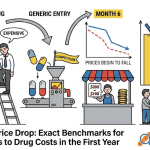
A single generic competitor cuts a drug’s average manufacturer price by roughly 39 percent. Six or more competitors cut it by more than 95 percent [25][26].
FDA’s own analysis of average manufacturer price data found that a product with one generic competitor saw a 39 percent price reduction compared to the pre-competition brand price, rising to 54 percent with two competitors, 79 percent with four competitors, and more than 95 percent with six or more competitors [25][26]. A brand that settles with its first filer while ten more wait in the wings has not bought itself much price protection, since the price curve does not flatten until the field of competitors is genuinely large.
Translating Filer Count Into a Revenue-at-Risk Date
Because 180-day exclusivity limits the market to the brand and one generic (or a same-day-filer group) for a fixed window, a large filer roster does not accelerate the date at which some form of generic competition begins. It does, however, compress the period between the first generic launch and the arrival of the fourth, fifth, and sixth competitor, since the remaining filers are already in the litigation queue and can often clear FDA approval quickly once the first settlement establishes a template. Stelara’s compressed five-month launch window for seven biosimilars is the clearest recent illustration of that compression effect [16][17][18].
What This Means for Brand Manufacturers
A brand company with a drug generating meaningful revenue should treat the FDA’s Paragraph IV Certification List and any BPCIA patent-dance correspondence as an early warning system rather than a formality, and should build litigation reserves around a distribution of possible filer counts rather than a single expected case [22][23]. Consolidation, where the venue rules allow it, converts a linear cost problem into something closer to a fixed cost with marginal increments per additional defendant, which is the lesson of Eliquis’s Delaware and West Virginia consolidation compared to Suboxone Film’s fragmented docket [1][27][3][4].
What This Means for Generic and Biosimilar Challengers
A generic or biosimilar company evaluating whether to file should weigh not only the strength of its own invalidity or non-infringement position, but the likely size of the filer field it will be litigating alongside, since a crowded field changes settlement dynamics, changes the value of first-filer 180-day exclusivity, and changes how much litigation risk the brand is willing to absorb before offering a template settlement. Revlimid’s staggered volume-limited entry schedule shows that even a company that settles late can still secure a workable, date-certain outcome, provided it understands where it sits in the brand’s settlement sequence [13][14][15].
A Litigation-Budget Checklist for Multi-Defendant Exposure
Four questions separate a budget built for one case from a budget built for the roster a blockbuster actually draws.
Four Questions to Ask Before Filing the First Motion
First, how many patents does the Orange Book or Purple Book listing actually cover, and how many of those are strong enough to assert against every filer, not just the first one. Second, does the venue and timing allow for consolidation, and if not, what is the realistic cost of running parallel, potentially divergent, dockets. Third, what does the AIPLA cost curve predict at the realistic patent count and realistic filer count, not the single-case default. Fourth, what settlement template will the brand offer the first filer, and how will that template constrain the economics of every filer that follows.
Setting a Contingency Multiplier Instead of a Single-Case Number
Rather than reserving for a single AIPLA-benchmarked case, a brand can reserve for a range built from its own drug’s revenue tier, cross-checked against the documented filer counts on comparable blockbusters: 7 to 10 for a mid-tier small-molecule blockbuster with a modest patent estate, 8 to 10 for a biologic with a defensible but not extreme patent thicket, and 15 to 25 for a top-selling small-molecule drug near the top of its therapeutic class. Platforms that track Paragraph IV and BPCIA filing activity across the full Orange Book and Purple Book, including DrugPatentWatch, exist precisely because the public FDA list alone does not disclose filer counts, and a reserve built on an undercount is a reserve built on the wrong number.
Methodology
The filer counts and patent counts in this article are drawn from primary sources wherever available: SEC filings from Bristol-Myers Squibb, Pfizer, Celgene, and Indivior; a federal district court opinion in Indivior’s Suboxone Film litigation; and FDA guidance on 180-day exclusivity mechanics [1][2][3][6][14][23][28][29]. Where primary court or regulatory documents were not directly accessible, the article relies on contemporaneous trade press with named sourcing, including BioPharma Dive, Fierce Pharma, Patent Docs, Big Molecule Watch, and the Petrie-Flom Center at Harvard Law School [4][5][7][8][9][10][11][12][13][15][16][17][18][19]. The cost-multiplier table applies a single published AIPLA benchmark uniformly across all five case studies rather than case-specific cost data, since none of the five companies discloses litigation spend at the per-matter level; the table’s limitations section above sets out what that choice does and does not support.
Key Takeaways
Eliquis drew 25 simultaneous ANDA Paragraph IV filers in a single 90-day window in 2017, documented in Bristol-Myers Squibb’s own SEC filings [1][2].
Suboxone Film’s 7 ANDA filers produced 5 different legal outcomes, from a 2024 launch bar to non-infringement findings to a $15 million settlement reached eight years after the first suit [3][4][6].
Humira settled with 8 biosimilar developers, but only 2 of those disputes ever reached a court-defined patent count: 10 patents in AbbVie v. Amgen and 8 in AbbVie v. Boehringer Ingelheim, out of a portfolio that exceeded 100 patents [11][12].
Revlimid’s 10 documented generic filers entered through a staggered, volume-limited settlement waterfall rather than trial verdicts [13][14][15].
Stelara’s 7 FDA-approved biosimilars, delayed by litigation from an expected 2023 launch, all reached the market within roughly 19 weeks of each other in 2025 [16][17][18].
Applying the AIPLA’s 2023 median discovery-phase litigation cost of $600,000 per patent, per side, to the documented filer and patent counts across these five matters produces a floor exposure estimate exceeding $59 million, before trial costs or settlement payments [20][21].
FDA’s own price-erosion data shows a single generic competitor cuts average manufacturer price by about 39 percent, while six or more competitors cut it by more than 95 percent, meaning a large filer roster left unsettled carries real, quantifiable revenue risk [25][26].
FAQ
What is a Paragraph IV certification?
A Paragraph IV certification is a statement filed inside an ANDA declaring that a patent listed in the FDA’s Orange Book for the reference drug is invalid, unenforceable, or not infringed by the proposed generic product, which triggers the brand’s 45-day window to sue and, if it sues, a 30-month stay on FDA approval [23].
How many companies typically challenge a blockbuster drug’s patents?
Among the five blockbusters examined here, the documented filer counts ranged from 7 (Suboxone Film) to 25 (Eliquis), with Humira, Revlimid, and Stelara each drawing between 7 and 10 [1][3][8][15][16].
Does 180-day generic exclusivity always go to a single company?
No. FDA guidance confirms that when multiple ANDA applicants submit substantially complete Paragraph IV applications on the same day, all of them can share first-filer status and the resulting 180-day exclusivity period [23].
Can several biosimilars really launch on the same day, or close to it?
Yes. Seven Stelara biosimilars, each independently delayed by separate litigation and licensing negotiations with Janssen, ended up launching within a five-month window in the first half of 2025 [16][17][18].
Why do multiple generic companies file ANDAs on the same date?
For drugs with New Chemical Entity exclusivity, the earliest a Paragraph IV certification can be filed is one year before that exclusivity expires. Every generic company chasing 180-day exclusivity has an incentive to file on that date rather than later, which pulls independent companies toward the same filing window without coordination between them [24].
How much does ANDA or BPCIA patent litigation cost per case?
The AIPLA’s 2023 survey reports a median of $600,000 per patent, per side, through discovery and claim construction, and roughly $1 million per patent through trial and appeal, for cases with $1 million to $10 million at risk [20][21].
Do brand companies usually take every ANDA filer to trial?
No. Across the five matters examined here, only Suboxone Film produced a subset of defendants that litigated to a final infringement ruling. Revlimid’s 10 filers, Humira’s 8 biosimilar makers, and most of Stelara’s 7 biosimilar developers all resolved through settlement rather than verdict [4][11][12][13][14][15][16][17].
Do generic companies coordinate their simultaneous filings?
There is no evidence of coordination in the matters examined here. The clustering results from each company independently racing to file on the earliest legally available date, since the FDA’s public Paragraph IV list discloses filing dates but not applicant counts, leaving each filer to guess how many competitors share the same date [22][24].
What happens to a brand’s litigation budget when more filers show up than expected?
Using the AIPLA’s per-patent cost benchmark, an unconsolidated docket with 25 filers and 2 patents in suit produces a discovery-phase exposure floor of roughly $30 million, compared to $1.2 million for a single-defendant case at the same patent count, a 25-fold gap that a single-case reserve does not cover [1][20][21].
Where can a company track how many Paragraph IV filers exist against a specific drug?
The FDA’s Paragraph IV Certification List is the primary public source, though it discloses filing dates rather than applicant identities or counts [22][24]. Patent intelligence platforms such as DrugPatentWatch aggregate Orange Book, Purple Book, and litigation docket data to help IP and business development teams estimate filer counts before they are fully visible in court records.
References
Bristol-Myers Squibb Co. (2017). Form 10-Q for the quarter ended June 30, 2017. U.S. Securities and Exchange Commission. https://www.sec.gov/Archives/edgar/data/0000014272/000001427217000165/bmy-20170630x10q.htm
Bristol-Myers Squibb Co. (2020). Form 10-Q, quarter ended September 2020, referencing 2017 Eliquis Paragraph IV notices. U.S. Securities and Exchange Commission. https://www.sec.gov/Archives/edgar/data/78003/000007800320000070/Financial_Report.xlsx
Indivior Inc. v. Dr. Reddy’s Laboratories S.A. et al. (2017). Opinion. U.S. District Court for the District of New Jersey. http://business.cch.com/ipld/IndiviorDrReddys20170713.pdf
BioPharma Dive. (2018, March 23). Indivior loses patent battle for Suboxone Film. https://www.biopharmadive.com/news/indivior-loses-patent-battle-for-suboxone-film/519868/
BioPharma Dive. (2019, February 22). Dr. Reddy’s relaunches Suboxone generic after court victories. https://www.biopharmadive.com/news/dr-reddys-relaunches-suboxone-generic-after-court-victories/548907/
Indivior PLC. (2023). Form 6-K, Q3 2023 press release. U.S. Securities and Exchange Commission. https://www.sec.gov/Archives/edgar/data/1625297/000162529723000012/exhibit991q32023pressrelea.htm
Petrie-Flom Center, Harvard Law School. (2021, January 6). AbbVie Wins First Round in Humira Antitrust Lawsuit. https://petrieflom.law.harvard.edu/2021/01/06/abbvie-humira-antitrust-patent-thicket/
STAT News. (2019, March 20). AbbVie is sued for using Humira patent deals to block competition in the U.S. https://www.statnews.com/pharmalot/2019/03/20/abbvie-humira-patents-antitrust/
Pharmacy Times. Class Action Lawsuit Filed Against AbbVie, Biosimilar Manufacturers. https://www.pharmacytimes.com/view/class-action-lawsuit-filed-against-abbvie-biosimilar-manufacturers
Keeley DeAngelo LLP. Six Lawsuits Filed Against Humira Maker. https://keeleydeangelo.com/six-lawsuits-filed-against-humira-maker/
Patent Docs. (2017, September 28). HUMIRA Biosimilar Update: Settlement in AbbVie v. Amgen Case Announced and AbbVie v. Boehringer Ingelheim Litigation Begins. https://patentdocs.org/2017/09/28/humira-biosimilar-update-settlement-in-abbvie-v-amgen-case-announced-and-abbvie-v-boehringer-ingelhe/
Big Molecule Watch. (2017, August 2). New BPCIA Litigation: AbbVie Sues Boehringer Ingelheim Regarding Proposed Biosimilar to Humira (adalimumab). https://www.bigmoleculewatch.com/2017/08/02/new-bpcia-litigaton-abbvie-sues-boehringer-ingelheim-regarding-proposed-biosimilar-humira-adalimumab/
Fierce Pharma. Bristol Myers inks another Revlimid patent settlement, this time with Sun Pharma, as copycats near. https://www.fiercepharma.com/manufacturing/bristol-myers-settles-sun-pharma-for-limited-revlimid-generic-launch-2022
Celgene Corp. (2019, March 29). Form 8-K, Exhibit 99.1: Celgene Settles U.S. Revlimid Patent Litigation With Alvogen. U.S. Securities and Exchange Commission. https://www.sec.gov/Archives/edgar/data/816284/000114420419016894/tv517471_ex99-1.htm
Fierce Pharma. BMS, generics companies face new suit over Revlimid ‘monopoly’. https://www.fiercepharma.com/pharma/new-antitrust-lawsuit-says-monoploy-allowed-bristol-myers-and-generics-makers-steal-30b
Center for Biosimilars. (2025, February 27). 3 Ustekinumab Biosimilars Launch on US Market. https://www.centerforbiosimilars.com/view/3-ustekinumab-biosimilars-launch-on-us-market
Venable BiologicsHQ. (2025, April 2). March Stelara Biosimilar Launches: Fresenius Kabi’s Otulfi and Celltrion’s Steqeyma. https://biologicshq.com/march-stelara-biosimilar-launches-fresenius-kabis-otulfi-and-celltrions-steqeyma/
MMIT. Apples to Apples: Stelara Biosimilars and the Fight for Market Share. https://www.mmitnetwork.com/thought-leadership/stelara-biosimilars-fight-market-share/
American Intellectual Property Law Association. (2023). 2023 Report of the Economic Survey. https://www.aipla.org/detail/journal-issue/2023-report-of-the-economic-survey
Ramey LLP. The Hidden Price of Patent Wars: How Legal Costs Are Killing Innovation, citing AIPLA Report of the Economic Survey 2023 at 61. https://www.rameyfirm.com/the-hidden-price-of-patent-wars-how-legal-costs-are-killing-innovation
Solidus Bio. (2026, February 16). The ANDA Threat Landscape in 2026: What Brand Pharma Needs to Know. https://solidus.bio/blog/anda-threat-landscape-2026
U.S. Food and Drug Administration. Guidance for Industry: 180-Day Exclusivity When Multiple ANDAs Are Submitted on the Same Day. https://www.fda.gov/files/drugs/published/180-Day-Exclusivity-When-Multiple-ANDAs-Are-Submitted-on-the-Same-Day.pdf
Lachman Consultants. (2020, March 4). 4 New Paragraph IV Certifications Listed by FDA. https://www.lachmanconsultants.com/2018/03/4-new-paragraph-iv-certifications-listed-by-fda/
Pharmacy Times. Competition Lowers Drug Prices, FDA Says. https://www.pharmacytimes.com/view/competition-lowers-drug-prices-fda-says
U.S. Food and Drug Administration, Center for Drug Evaluation and Research. Generic Competition and Drug Prices. https://www.fda.gov/about-fda/center-drug-evaluation-and-research-cder/generic-competition-and-drug-prices
Amneal Pharmaceuticals, Inc. (2018). Form S-1. U.S. Securities and Exchange Commission. https://www.sec.gov/Archives/edgar/data/0001723128/000119312518153798/d414240ds1.htm
Bristol-Myers Squibb Co. (2019). Form 10-K for fiscal year 2018. U.S. Securities and Exchange Commission. https://www.sec.gov/Archives/edgar/data/14272/000001427219000047/bmy-20181231x10xk.htm
U.S. District Court for the District of Delaware. Bristol-Myers Squibb Co. v. Mylan Pharmaceuticals Inc. (Eliquis/apixaban patent infringement opinion, identifying U.S. Patent Nos. 6,967,208 and 9,126,945). https://www.ded.uscourts.gov/sites/ded/files/opinions/17-379.pdf