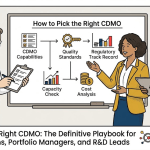
A comprehensive framework covering due diligence, KPI architecture, IP asset valuation, technology roadmaps, and strategic governance across the full drug development lifecycle.
1. Why CDMO Evaluation Has Become a Board-Level Risk Function {#section-1}
A generation ago, pharmaceutical manufacturing outsourcing was primarily a procurement decision. You found a contract manufacturer who could press your tablet or fill your vial at a reasonable cost, you audited the facility once, and you moved on. That model is gone.
The CDMO sector has undergone a structural transformation that mirrors — and in many ways drives — the broader shift in how drugs are discovered, developed, and delivered. Virtual biotechs with no manufacturing footprint routinely advance molecules to late-stage clinical trials. Large-cap pharma companies have deliberately shed internal manufacturing assets to redeploy capital toward R&D and business development. Complex modalities — monoclonal antibodies, bispecifics, Antibody-Drug Conjugates (ADCs), cell therapies, gene therapies — require specialized process knowledge and capital equipment that most sponsors cannot justify owning at scale.
The result is a pharmaceutical industry where the supply chain is not a support function. It is the product. A CDMO that manufactures your biologic is not executing a peripheral task; it is producing the molecule that will generate your revenue, protect your IP, and determine whether patients receive the therapy they need. A single failed batch of a gene therapy at a commercially critical moment does not just cost the price of goods. It costs months of delay, consumes the regulatory patience of agencies already scrutinizing your file, and hands a competitive window to your nearest rival.
What changed the evaluation calculus most sharply was the COVID-19 pandemic. Supply chain fragility became impossible to ignore when critical raw materials — single-use bioreactor bags, chromatography resins, proprietary lipid nanoparticle (LNP) components — disappeared from global supply. CDMOs that had built redundant supply networks and had deep supplier relationships delivered. Those that had optimized purely for unit cost did not. The sponsor companies that had invested in rigorous CDMO governance — frequent site visits, shared data platforms, contractual access to production schedules — had early warning and could act. Those that treated their CDMO as a black box had no visibility into the unraveling until it was too late.
The regulatory environment also shifted. The FDA’s 2021 CGMP initiative, increased scrutiny of foreign manufacturing sites — particularly in India and China following a series of high-profile inspection failures — and the Agency’s accelerating use of remote regulatory assessments have all raised the stakes for sponsors who lack robust oversight mechanisms for their external manufacturers.
None of this means outsourcing is the wrong strategy. For most biotechs and for a growing number of large pharma programs, it remains the correct one. But it does mean that the tools, frameworks, and governance structures used to evaluate and manage CDMO performance must operate at a fundamentally different level of rigor than a standard vendor scorecard.
Key Takeaways: Section 1
The decision to outsource manufacturing is no longer separable from a company’s IP strategy, regulatory risk profile, or supply chain resilience planning. CDMO performance evaluation is a cross-functional discipline requiring input from Quality, Regulatory Affairs, Legal, Technical Operations, and Finance. Companies that treat it as a procurement task routinely learn that lesson at the worst possible time — during a commercial launch or an FDA inspection.
2. The CDMO Market Landscape: Capacity, Consolidation, and IP Power {#section-2}
Understanding how to evaluate a CDMO requires understanding the market structure in which CDMOs operate, because that structure shapes the leverage, incentives, and long-term viability of every potential partner.
Market Size, Growth Drivers, and Competitive Dynamics
The global CDMO market was valued at approximately $180 billion in 2024 and is projected to reach $300 billion by 2030, driven primarily by the continued growth in biologics and cell and gene therapy pipelines. Those headline figures, however, mask enormous heterogeneity. The market consists of hundreds of organizations ranging from single-site specialists with fewer than 200 employees to fully integrated networks spanning 40 or more sites across multiple continents.
The consolidation trend that defined the sector between 2015 and 2022 has modestly slowed, partly because the largest acquirers — Lonza, Thermo Fisher (Patheon), Catalent (now largely integrated into Novo Holdings following a $16.5 billion acquisition in 2024), Samsung Biologics, and WuXi Biologics — have already absorbed most of the obvious bolt-on targets. What has accelerated instead is capital investment in capacity expansion, particularly for biologics. Samsung Biologics added its fifth plant (S5) at its Incheon campus in 2023, bringing total capacity to over 780,000 liters, making it the single largest biomanufacturing site in the world. Lonza broke ground on a dedicated ADC manufacturing hub in Visp, Switzerland, responding to a pipeline surge that now counts over 100 ADCs in clinical development globally.
The IP Architecture of Major CDMOs: What Sponsors Often Miss
Most sponsor companies evaluate CDMOs on their stated capabilities, regulatory track record, and price. They spend considerably less time analyzing the IP position of a potential partner — a gap that can create serious problems.
Lonza Group: Platform IP as Competitive Moat
Lonza’s most strategically valuable intellectual property is not its physical bioreactor capacity. It is the CHOBRI expression system and the related upstream process development know-how that underlies a significant portion of its mammalian cell culture work. Lonza holds a portfolio of patents around fed-batch and perfusion process intensification that, in practical terms, gives it an advantage in achieving high titers for difficult-to-express proteins. When you engage Lonza for a biologic, you are implicitly licensing access to that process knowledge for the duration of the relationship.
The critical IP question for any sponsor entering a Lonza relationship is: what happens to process improvements developed during your program? Lonza’s standard contractual framework, like that of most major CDMOs, includes background IP and foreground IP provisions. Background IP — know-how Lonza brought into the relationship — remains Lonza’s. Foreground IP — innovations developed specifically for your product — is typically assigned to the sponsor. But the line between general process improvement (background) and product-specific optimization (foreground) is legally contested territory. Sponsors should negotiate explicit definitions, particularly for novel expression vector modifications or purification protocols developed during tech transfer.
Lonza’s 2024 revenue was approximately CHF 6.1 billion, with biologics and small molecules drug substance representing the majority of that figure. Its capital expenditure run rate of roughly CHF 1 billion per year supports a credible capacity expansion trajectory, but also signals that a significant portion of new capacity is committed to existing client programs under long-term take-or-pay contracts — which means “available capacity” may be more constrained than headline site tour figures suggest.
Samsung Biologics: Scale Economics and the Data Exclusivity Question
Samsung Biologics went public on the Korea Stock Exchange in 2016 and now carries a market capitalization that routinely exceeds $40 billion. Its financial profile is unusual for a CDMO: capital-intensive, heavily leveraged during expansion phases, but with long-term contracts providing predictable cash flow. The S5 facility, which targets both clinical and commercial biomanufacturing, was designed with single-use technology and continuous processing capability integrated from the outset, reflecting the industry’s direction of travel.
From an IP standpoint, Samsung Biologics’ strategic positioning changed meaningfully when it established Samsung Bioepis as a separate biosimilar development entity. This creates a potential — if carefully managed — conflict of interest for sponsors of branded biologics who use Samsung Biologics as their CDMO. The concern is not industrial espionage; Samsung’s compliance infrastructure is robust. The concern is structural. Samsung Bioepis develops biosimilars for products whose innovator versions are manufactured by Samsung Biologics’ sister division. Sponsors should understand this structure explicitly, negotiate firewall provisions into their Quality Agreement, and consider whether any CQA data shared with the CDMO during tech transfer could, even inadvertently, inform a future biosimilar development program targeting their product.
For institutional investors, Samsung Biologics’ valuation implies an expectation of continued volume growth from its existing multinational client base — AstraZeneca, Bristol-Myers Squibb, and Roche are reported clients. Any sustained volume decline from these anchor relationships, or any major regulatory failure at the Incheon campus, would compress multiples significantly given the fixed-cost-heavy nature of large-scale biomanufacturing.
Catalent / Novo Holdings: Post-Acquisition Integration Risk
The 2024 acquisition of Catalent by Novo Holdings — the investment arm of the Novo Nordisk Foundation — represents the most significant change-of-control event in the CDMO sector in at least a decade. Catalent had built itself into a genuinely diversified platform, with drug product manufacturing, biologics drug substance, and softgel capabilities across more than 50 sites globally.
The strategic rationale for Novo Holdings was transparent: its Ozempic and Wegovy supply crisis created enormous reputational damage, and acquiring Catalent’s fill-finish and biologics capacity gave Novo Nordisk priority access to manufacturing volume it could not build fast enough on its own. Certain Catalent sites were carved out to Novo Nordisk directly post-close.
For sponsors who had existing manufacturing relationships with Catalent, this acquisition created immediate and legitimate concerns. Novo Nordisk is both a direct competitor to many biotech and pharma companies AND now, through Novo Holdings, a controlling owner of their CDMO. The firewall provisions in newly negotiated contracts need to be substantially more robust than they were pre-acquisition. Sponsors should conduct a fresh IP audit of all data shared with Catalent sites that now fall under Novo Holdings’ operational influence, and Legal should evaluate whether existing agreements contain adequate change-of-control protections.
For evaluators and investors: Catalent’s integration presents execution risk that may disrupt service quality at non-Novo-prioritized sites. Watch for personnel attrition among Catalent’s senior technical leadership, which has historically been a leading indicator of service degradation post-acquisition across the CDMO sector.
WuXi Biologics: Geopolitical Risk as IP Risk
WuXi Biologics operates one of the largest biologics manufacturing networks in the world, with facilities in China, Ireland, Germany, and the United States. Its cost structure — particularly for Chinese operations — is materially lower than Western peers, and its technical capabilities in mammalian cell culture and downstream processing are genuinely world-class.
The geopolitical dimension is now impossible to separate from the IP risk analysis. The BIOSECURE Act, proposed in the U.S. Congress and partially advancing through 2024, would restrict U.S. federal contracts and potentially affect FDA approval pathways for drugs manufactured by certain Chinese-linked CDMOs. WuXi Biologics is explicitly named in draft legislation. Regardless of the final legislative outcome, the regulatory and reputational uncertainty itself constitutes a material risk for any U.S. or European sponsor.
The IP concern is specific: any proprietary process know-how, cell line data, formulation details, or analytical methods shared with WuXi Biologics and stored on servers with Chinese operational exposure is potentially subject to Chinese data security laws that differ materially from U.S. or EU privacy and IP protection frameworks. Sponsors with products in competitive therapeutic areas — oncology biologics, neurology, rare disease — should conduct a formal IP risk assessment before engaging WuXi Biologics for any program where the process know-how constitutes a significant portion of the product’s commercial value.
Investment Strategy Note: Reading CDMO Valuations
For institutional investors evaluating CDMO sector exposure, the key financial metrics are revenue concentration (what percentage comes from top 3-5 clients), contract length and take-or-pay structure (which determines downside protection), CapEx cycle position (companies mid-expansion carry more near-term risk), and regulatory inspection track record (a Warning Letter or consent decree can immediately impair revenue from affected sites).
EV/EBITDA multiples for publicly traded CDMOs have compressed from peak 2021 levels (25-35x) to a more rational 12-18x range as of early 2026, partly driven by the normalization of COVID-related demand and partly by rising interest rates. The most durable premium belongs to CDMOs with defensible technological differentiation — proprietary expression systems, specialized ADC conjugation capability, or first-mover scale in cell and gene therapy — rather than pure capacity volume.
Key Takeaways: Section 2
The CDMO market is stratified by modality specialization, not just scale. Evaluating a potential partner requires understanding its IP architecture (what it owns, what it licenses to you, and what rights it retains), its financial structure (leverage, CapEx commitments, client concentration), and its geopolitical exposure. Post-acquisition integration risk is real and measurable; companies should monitor personnel attrition and governance changes at CDMO partners that have recently changed ownership.
3. Building the Evaluation Foundation: Due Diligence That Actually Works {#section-3}
The most common error in CDMO selection is compressing the due diligence timeline. Sponsors under pressure to start manufacturing — and virtually every sponsor feels that pressure — treat due diligence as a procedural hurdle rather than a genuine risk-reduction exercise. The result is relationships that work fine during straightforward operations and collapse under the pressure of a clinical setback, a supply crunch, or an FDA inspection.
Effective due diligence runs in three distinct phases, each with different objectives and different information sources.
Phase 1: Internal Alignment and the ‘Ideal Partner’ Profile
Before sending a single RFP or scheduling a single site visit, the sponsor organization needs to reach genuine cross-functional consensus on what it actually needs. This sounds obvious. It is routinely skipped or executed so superficially that it adds no value.
Technical Operations typically thinks in terms of equipment specifications: what bioreactor size, what fill-finish format, what analytical infrastructure. Quality thinks in terms of compliance posture: inspection history, CAPA rates, data integrity culture. Regulatory Affairs thinks in terms of site licensing and prior approval supplement (PAS) risk. Finance thinks in terms of unit economics and payment terms. Supply Chain thinks in terms of lead times and geographic risk. Without an explicit process to reconcile these perspectives — which will often conflict — the RFP will be incoherent and the eventual selection will reflect whoever had the most organizational authority at the decision meeting, not the best fit for the product.
The ‘ideal partner’ profile should address, at minimum: the specific modality and scale required at each development phase (not just current needs but the Phase III and commercial program anticipated 3-5 years out), the geographic requirements driven by regulatory strategy and supply chain risk tolerance, the minimum acceptable compliance posture (which should be operationally defined, not stated as ‘excellent quality’), the technology roadmap requirements (does the product need continuous manufacturing capability, will it require PAT integration, are there cold-chain logistics complexities), and the IP sensitivity of the program (which dictates the firewall and confidentiality provisions that must be non-negotiable in the agreement).
Phase 2: The RFP as a Diagnostic Instrument
The Request for Proposal is where most sponsors make their second critical error: they use the RFP to collect claims rather than to collect evidence.
A CDMO’s marketing department can answer any capabilities question with ‘yes.’ The RFP should be designed to make answers to capabilities questions falsifiable. Instead of ‘Do you have experience manufacturing monoclonal antibodies at commercial scale?’ ask: ‘List all monoclonal antibody products currently in commercial manufacture at this site. For each, provide the current annual batch volume, the bioreactor size used, and the date of first commercial batch.’ The difference in information quality is enormous.
Specific RFP elements that consistently separate capable from incapable CDMOs:
Provide the KPI dashboard from your last three Quality Management Reviews. Request the raw data, not a narrative summary. The actual numbers — RFT rates, deviation frequencies by classification, CAPA closure times, OOS investigation rates — tell you far more than prose.
Request the complete regulatory inspection history for the past seven years for the specific manufacturing site. Ask for every Form 483, the agency’s classification of the inspection outcome, and a copy of the establishment inspection report (EIR) if available. Do not accept a summary. Read the actual observations. An observation about inadequate process validation has different implications than one about HVAC records.
Ask for staff turnover data by department for Quality, Technical Operations, and Analytical Development over the past two years. Turnover rates above 20% in any of these functions should prompt detailed follow-up questions about compensation, management quality, and site culture.
Request project management methodology documentation. Ask for a redacted example of a risk register from an active project and a redacted example of a tech transfer project plan for a biologic of similar complexity to yours. Evaluate the sophistication of the plan — is it a real, resource-loaded schedule with critical path analysis, or is it a list of milestones in a spreadsheet?
Phase 3: The Site Audit as Immersive Diagnostic
The site audit is not an inspection. An inspection seeks to identify non-conformances. An audit seeks to understand the quality culture that will either generate or prevent non-conformances in the future. The distinction matters because it shapes how you approach the visit and what you look for.
Walking the manufacturing floor at the start of a shift is more informative than a formal conference room presentation. Watch how operators interact with batch records. Are they checking off boxes after the fact, or recording data in real time? When an instrument reads unexpectedly, what happens? Does the operator stop and flag it, or does the line keep running while they investigate quietly? These behaviors reflect deeply embedded training and management culture that no documentation can reveal.
The quality unit deserves particular attention. A high-functioning pharmaceutical quality organization has what experienced auditors call ‘productive tension’ with manufacturing — it is neither so aggressive that operations becomes adversarial nor so deferential that it becomes a rubber stamp. You can assess this in a single meeting. Ask the Quality Director to describe the last significant disagreement they had with the Operations team and how it was resolved. The answer tells you about decision-making authority, escalation culture, and whether quality is genuinely independent.
Data integrity is a specific audit focus that has become increasingly important following a series of high-profile FDA Warning Letters. Examine whether analytical data from HPLC runs, stability chambers, and environmental monitoring is collected in a validated LIMS with audit trail functionality. Ask to see a recent audit trail review. A site that cannot demonstrate routine audit trail review of electronic data is a compliance liability regardless of its other strengths.
The ‘Live Fire’ Evaluation: Engineering Runs Before Commitment
For high-value, technically complex programs — late-stage biologics, novel ADCs, gene therapies — the most powerful diligence tool is a paid engineering run. Commission the potential CDMO to perform a non-GMP (or at least non-commercial GMP) trial run of the most technically challenging step in your process.
The purpose is not to get a perfect result. A perfect first run tells you very little. What you want to observe is how the team responds when something does not go as expected, because something will always not go exactly as expected. Do they communicate immediately and clearly? Do they have a structured approach to real-time deviation management? Does the team leader make decisions, or do problems escalate to committee while the run waits? Do they document contemporaneously, or reconstruct after the fact?
A CDMO that performs well under this kind of observable operational pressure has almost always earned that performance through sustained investment in training, procedure quality, and management discipline. It is not accidental.
Key Takeaways: Section 3
Effective due diligence requires internal alignment before external engagement, an RFP designed to collect evidence rather than claims, and a site audit focused on quality culture rather than compliance documentation. For programs where manufacturing risk is material to clinical or commercial outcomes, commissioning a paid engineering run before contract execution is a legitimate and cost-effective risk mitigation tool. The upfront investment in thorough diligence is invariably smaller than the cost of selecting the wrong partner.
4. The Four-Pillar KPI Framework: A Complete Scorecard Architecture {#section-4}
Once a partner is selected and the relationship moves to active manufacturing, the evaluation challenge shifts from selection to ongoing performance management. The tool that governs this process is the KPI scorecard, and the quality of the scorecard determines the quality of the oversight.
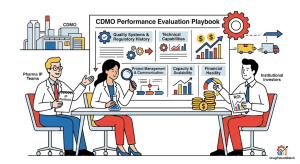
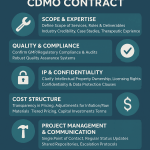
Most pharmaceutical companies use scorecards that are too simple, too static, or too focused on lagging indicators. The framework described here is organized around four distinct performance pillars, each addressing a different dimension of the partnership. The four pillars are Quality and Compliance, Operational Excellence and Supply Chain, Financial Health and IP Valuation, and Governance and Communication. Together, they provide a 360-degree view of partner performance that can detect emerging problems before they become acute failures.
The scorecard should be built and reviewed jointly by the sponsor and the CDMO, not handed down as a report card. A unilaterally imposed scorecard measures compliance. A jointly developed scorecard drives improvement. The practical difference is that the CDMO’s own quality and operations leadership will surface context and root cause information proactively when they co-own the metrics.
Customizing KPIs Across the Development Lifecycle
The metrics that matter most change as a product moves through development. A single static scorecard applied from Phase I to post-commercialization will always be measuring the wrong things at some stage.
During pre-clinical and Phase I activities, the priority is scientific problem-solving speed, flexibility in process development, and effective knowledge transfer. The key questions are: how quickly can the CDMO iterate on process parameters, how clearly are development decisions documented for future regulatory submission, and how effectively does the CDMO communicate technical uncertainty rather than projecting false confidence?
At Phase II and III, process robustness becomes the dominant concern. The process design space needs to be understood and characterized well enough for a regulatory filing. The CDMO must demonstrate that its process is capable, reproducible, and controlled within defined specifications. Regulatory compliance becomes mission-critical — every deviation, every change control, and every out-of-specification investigation is potential regulatory filing material.
At commercial scale, the focus shifts to supply reliability, cost of goods optimization, and continuous improvement. The CDMO is no longer primarily a development partner; it is a supply chain node that must perform predictably, month after month, with minimal management overhead from the sponsor.
The Trap of the 15-Metric Dashboard
More metrics is not better. A scorecard with 40 KPIs is operationally unmanageable and creates noise that obscures signal. The goal is the minimum set of metrics that collectively predict whether the partnership will achieve its strategic objectives. For a commercial biologic, that set is rarely more than 10-12 primary metrics. Every metric that cannot be directly connected to a strategic risk or objective should be eliminated or relegated to a secondary operational dashboard.
Ask of each proposed KPI: ‘If this number moves by 10% in the wrong direction over three months, what specific action would we take?’ If the answer is ‘nothing’ or ‘we’d discuss it at the next QBR,’ the metric belongs in a supplementary report, not the primary scorecard.
5. Deep Dive: Quality and Compliance Metrics {#section-5}
Quality is the non-negotiable foundation of pharmaceutical manufacturing. A CDMO can be operationally efficient, financially stable, and pleasant to work with, but if it cannot consistently produce a product that meets specifications and survives regulatory scrutiny, none of the rest matters.
Right-First-Time (RFT) Rate: The Master Metric
RFT measures the percentage of batches manufactured and released without unplanned deviations, rework, or non-conformances. It is calculated as:
RFT (%) = (Number of Batches Released Without Deviation / Total Batches Started) x 100
For a mature commercial small molecule process, RFT should exceed 98%. For a complex biologic at commercial scale, 95-97% is a realistic high-performing benchmark. For novel ADCs or early-phase gene therapy manufacturing, benchmarks are less established, and the relevant comparison is the CDMO’s own improving trajectory rather than an industry standard.
The definitional question that must be resolved before tracking RFT is what counts as a deviation. Minor documentation corrections should be excluded from RFT calculation, while any event that triggers a formal deviation report must be included. This definition must be written explicitly into the Quality Agreement. Without it, two organizations can calculate dramatically different RFT rates from identical manufacturing data.
Track RFT by product, by manufacturing train, and by production team where possible. Aggregate facility-level RFT can mask problems concentrated in specific equipment, shifts, or operators. A site with 96% aggregate RFT but 85% RFT on the manufacturing train assigned to your product is not a 96% quality partner for your program.
Deviation Rate and Root Cause Analysis: Moving Below the Surface
Deviation data is the granular intelligence that drives root cause analysis and continuous improvement. The aggregate deviation count is a starting point; the classification and root cause distribution are what matter for management purposes.
Classify deviations by severity (minor, major, critical) and by root cause category. The ICH framework identifies human error, equipment failure, procedural inadequacy, material defect, and environmental factors as the primary root cause categories. A CDMO where more than 60% of deviations are attributed to human error has almost certainly not done adequate root cause analysis. Human error is almost always a symptom — of inadequate training, poorly written procedures, excessive workload, or production pressure from management. A CDMO that accepts ‘human error’ as a terminal root cause is a CDMO that will keep generating the same deviations.
Track the rate of Out-of-Specification (OOS) and Out-of-Trend (OOT) results from the QC laboratory separately from manufacturing deviations. A high OOS rate that triggers repeated Phase I investigations (per 21 CFR 211.192 requirements) signals underlying analytical method robustness issues or laboratory practices problems. Either is a regulatory risk.
The deviation recurrence rate — the percentage of deviations that occur within 12 months of a CAPA closure for the same or substantially similar root cause — is one of the most powerful single-metrics for assessing a CDMO’s true corrective action capability. A recurrence rate below 5% indicates that root causes are genuinely identified and addressed. A rate above 15% indicates that CAPAs are being closed administratively rather than operationally.
Regulatory Inspection Performance: The Third-Party Validation
FDA, EMA, and other regulatory agency inspections are the most rigorous third-party assessments of a CDMO’s compliance posture available. They are also public record in the United States through the FDA’s Warning Letter database, the establishment inspection report (EIR) system, and the FOIA process.
Form 483 observations require careful analysis beyond the raw count. Evaluate the nature of each observation against the FDA’s quality systems framework: production, laboratory controls, packaging and labeling, materials, facilities and equipment, and quality. Observations in laboratory controls and quality systems are generally more serious than those in facilities and equipment, because they suggest systemic rather than infrastructure problems.
The CDMO’s response to a 483 is as informative as the observations themselves. A thorough, evidence-based response that demonstrates genuine corrective action — rather than promising future implementation — signals organizational maturity. Ask to see the full response package, not just the cover letter. A response that commits to 30-day completion of a complex validation activity is almost certainly not credible.
Warning Letters represent a material compliance failure and trigger enhanced FDA scrutiny for subsequent inspections. Any product manufactured at a site under a Warning Letter faces increased regulatory risk, including the possibility that applications referencing that site will receive additional questions or a complete response letter from the Agency. The financial exposure from a Warning Letter at a commercial CDMO site can be substantial: manufacturing delays, site remediation costs, potential consent decree implications, and lost client revenue.
CAPA System Effectiveness: Process Control for Process Control
The CAPA (Corrective and Preventive Action) system is the mechanism by which a quality organization learns from failures and prevents recurrence. Its effectiveness is measurable.
Track: average time from deviation identification to root cause investigation completion (should be within 30-45 days for major deviations), average time from root cause determination to CAPA implementation (highly variable by complexity, but should have a defined SLA), CAPA closure rate within the committed timeline (a consistently low closure rate indicates either over-commitment or resource constraints), and the recurrence metric described above.
Change control management is the preventive counterpart to CAPA’s corrective function. Track both the cycle time of change control reviews (a median above 45 days for standard technical changes suggests process bottlenecks or insufficient quality resources) and the rate of post-implementation problems attributed to changes that cleared the change control system. The latter metric is a quality assessment of the risk assessment process embedded in change control.
Key Takeaways: Section 5
Quality metrics must be definitionally precise, mutually agreed upon, and tracked at the program level, not just the facility aggregate. RFT is the master indicator; deviation root cause analysis and CAPA effectiveness are the diagnostic tools. Regulatory inspection history, properly analyzed, is the best available third-party validation of compliance culture. A CDMO with a consistently improving quality trajectory — even from a mediocre starting point — is often more valuable than one with an impressive but static profile.
6. Deep Dive: Operational Excellence and Supply Chain Resilience {#section-6}
Quality tells you whether the product is right. Operational metrics tell you whether it will be available when and where it is needed. For a commercial product, supply reliability is often the more immediately visible dimension of CDMO performance.
On-Time In-Full (OTIF): The Supply Chain Summary Statistic
OTIF measures whether the correct quantity of product was delivered to the correct location on the agreed date. The calculation is:
OTIF (%) = (Orders Delivered On-Time AND In-Full / Total Orders) x 100
The critical structural question is how ‘on time’ is defined. If the contract defines delivery as ex-works (EXW) — meaning the CDMO’s obligation ends when the product leaves their loading dock — then the sponsor assumes all logistics risk. If it is defined as arrival at the sponsor’s warehouse or distribution center, the CDMO is responsible for shipping performance. For temperature-controlled biologics, this distinction can be significant.
Separate the OTIF metric into its two components for diagnostic purposes. Consistent ‘on time but not in full’ delivery suggests a yield problem in the manufacturing process or a raw material supply issue. Consistent ‘in full but late’ delivery suggests a scheduling or capacity management problem. The root cause analysis for each is entirely different.
For clinical supply specifically, OTIF should be supplemented by a ‘Site Ready Date’ metric that measures the CDMO’s ability to have product available for clinical site distribution by a defined date relative to protocol milestones. A late delivery of clinical supply at a site initiation visit can delay patient enrollment and extend the trial timeline — a cost that can dwarf the manufacturing expense many times over.
Production Cycle Time and Its Implications for Working Capital
Cycle time is the elapsed time from raw material staging to QC-approved final product. For a biologic drug substance, this can range from 30-45 days for a high-performing fed-batch process to 90-120 days for a longer perfusion run or a product requiring extended final formulation and fill-finish steps.
Reducing cycle time directly improves working capital efficiency: shorter cycles mean lower inventory requirements for safety stock and less capital tied up in in-process materials. For a product with a high cost of goods — a gene therapy or a complex biologic — this can translate to tens of millions of dollars in cash flow improvement at commercial scale.
Track cycle time by campaign and by manufacturing step. A CDMO that commits to Lean manufacturing methodology should be able to provide a current-state value stream map that identifies both the value-added manufacturing time and the non-value-added waiting time embedded in the process. The ratio of value-added to total cycle time is a direct measure of operational efficiency. At many pharmaceutical manufacturing sites, the ratio is surprisingly low — sometimes less than 20% — because of queue time, batch record review delays, and QC testing turnaround.
Cycle time that drifts upward over successive campaigns — even while staying within specification limits — is an early warning indicator of process drift, equipment degradation, or staffing problems. Trending this metric rigorously catches problems that do not yet manifest in quality failures.
Capacity Utilization, OEE, and the ‘Available Capacity’ Problem
CDMOs routinely state capacity figures that do not reflect what is actually available for new clients. The distinction between theoretical capacity (what the equipment could produce at 100% utilization), practical capacity (what the equipment reliably produces accounting for planned maintenance and changeover), and committed capacity (what is already contracted to existing clients) is rarely made explicit in initial discussions.
The most useful operational metric for understanding true availability is Overall Equipment Effectiveness (OEE), which combines availability (what percentage of scheduled time is the equipment actually available), performance (what percentage of available time is the equipment running at target rate), and quality (what percentage of production output meets first-pass quality specifications). OEE = Availability x Performance x Quality Rate. World-class manufacturing operations achieve OEE around 85%. Pharmaceutical manufacturing, given its inherent batch-process constraints and regulatory requirements, typically achieves 55-70%. A CDMO running at 75% or above leaves limited flexibility for upside demand scenarios or batch failure recovery.
Scenario planning discussions should be part of every Quarterly Business Review. Present specific, quantified scenarios: ‘If our demand increases by 25% in the next quarter, what would be the plan, timeline, and capacity constraint? If we have a failed batch requiring re-manufacture, what is the fastest realistic turnaround given current scheduling commitments?’ A CDMO that cannot engage credibly with these questions has not been thinking about your supply chain risk.
Raw Material Supply Chain Security: The Hidden Vulnerability
The CDMO’s own supply chain is your supply chain. This is one of the least-evaluated dimensions of CDMO performance despite being a primary driver of manufacturing delays.
For biologics, critical raw materials include cell culture media components (amino acids, vitamins, trace elements), bioreactor consumables (impeller assemblies, spargers, gaskets), single-use bags and tubing sets, and downstream processing materials including chromatography resins and ultrafiltration membranes. Certain of these have single-source or dual-source supply with long manufacturing lead times. A bioreactor bag from a specific supplier that goes on allocation can halt manufacturing weeks before any visibility appears in conventional supply chain metrics.
Evaluate the CDMO’s supplier qualification program. It should include initial qualification audits, regular re-qualification at defined intervals, and criteria for approved vendor list (AVL) management. Critically, it should include second-source qualification for every material classified as critical. A CDMO that cannot demonstrate approved second sources for its top 10 raw materials by volume has a supply chain that is structurally fragile in predictable ways.
Geographic diversification of raw material sourcing has become a compliance expectation as well as a business resilience measure. The FDA’s drug shortage regulation (21 CFR 314.81(b)(2)(i)) requires certain sponsors to notify the Agency of interruptions that could result in shortages. But for the sponsor company, the practical risk management goal is preventing the shortage in the first place, which requires visibility into the CDMO’s supply chain two and three tiers deep.
Key Takeaways: Section 6
Operational metrics require definitional precision in contracts, particularly the OTIF delivery trigger and the cycle time measurement endpoints. OEE is the most honest single indicator of true manufacturing capacity; theoretical capacity figures are marketing numbers. Supply chain fragility at the raw material level is a primary driver of manufacturing delays and should be evaluated explicitly during due diligence and reviewed at every QBR. Upside demand scenarios should be stress-tested in advance, not at the moment they become urgent.
7. Deep Dive: Financial Health, IP Valuation, and Commercial Viability {#section-7}
Financial evaluation of a CDMO is frequently reduced to price negotiation and payment terms. This reflects a misunderstanding of the true financial relationship between a sponsor and its external manufacturing partner.
Total Cost of Ownership: The Only Financially Honest Comparison
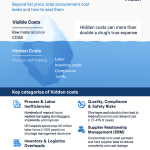
The invoice price for a batch of clinical drug substance is one data point in a much larger financial equation. Total Cost of Ownership (TCO) captures the full economic cost of the manufacturing relationship:
Direct manufacturing costs include the batch price, raw material pass-throughs, analytical testing fees, stability storage, and shipping. These are typically 50-65% of TCO.
Sponsor oversight costs — the internal FTE hours from Technical Operations, Quality, Regulatory Affairs, and Supply Chain staff dedicated to managing the CDMO relationship — are frequently not calculated at all. At a fully-loaded internal cost of $150,000-$250,000 per FTE per year, a manufacturing relationship that requires two to three dedicated internal staff members adds $300,000-$750,000 to the annual cost before a single batch is manufactured.
Cost of Poor Quality (CoPQ) is the most variable and most frequently underestimated TCO component. Failed batches destroy not just the cost of goods but the entire upstream investment in raw materials, analytical testing, and manufacturing labor. For a complex biologic drug substance with a cost of goods of $500,000-$2,000,000 per batch, a failure rate differential of 3-5% between two potential CDMOs translates to millions of dollars annually at commercial scale.
Tech transfer, validation, and process change costs are one-time and lifecycle expenditures that belong in any honest TCO comparison. A CDMO that charges lower batch prices but requires extensive and expensive tech transfer support, or that requires a supplemental application filing for every process improvement, can be more expensive over the product lifecycle than a premium-priced partner with an efficient tech transfer methodology and a sound change management strategy.
The IP Valuation Lens: What CDMOs Actually Own
Manufacturing IP is a less-discussed but increasingly valuable category of pharmaceutical intellectual property. When a CDMO develops a specialized process for your product — a novel chromatography gradient, a specific cell culture media formulation, a conjugation protocol for an ADC — the resulting know-how may have standalone commercial value that goes beyond your specific product.
The key IP question in any CDMO agreement is the ownership and licensing of foreground IP: inventions and know-how developed specifically in the course of the manufacturing program. The default in most CDMO agreements — that foreground IP is assigned to the sponsor — sounds protective but can be challenging to enforce when the ‘invention’ is an incremental process optimization that builds on the CDMO’s proprietary background methodology.
Practically, the most important provision is not IP ownership but IP freedom-to-operate. Even if a CDMO retains ownership of a process improvement, the sponsor needs a royalty-free, worldwide, sublicensable license to use that improvement in connection with the specific product. This license must survive the term of the manufacturing agreement, must extend to other CDMOs if the sponsor transfers manufacturing, and must not require ongoing royalty payments that would disadvantage the sponsor relative to competitors whose CDMOs do not impose similar restrictions.
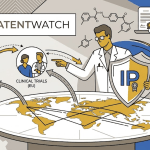
The secondary IP question is CDMO patent activity around your product’s manufacturing process. A CDMO that files a patent on a process modification developed for your product — even if your Quality Agreement prohibits it from applying that process to a competing product — creates a theoretical encumbrance that could complicate a future manufacturing transfer or technology license. Audit your CDMO partner’s patent filing activity at regular intervals. DrugPatentWatch’s patent landscape tools can systematically flag new filings by a CDMO assignee that could be related to your process technology.
CDMO Financial Stability: Reading the Signals
A CDMO that fails financially during the commercial lifecycle of your product creates a category-one supply chain emergency. Qualifying an alternative manufacturer for a commercial biologic takes 18-24 months minimum. A CDMO insolvency without warning is an existential supply risk.
For publicly traded CDMOs — Lonza, Samsung Biologics, Siegfried — standard financial analysis applies. Revenue concentration, EBITDA margins (healthy pharmaceutical CDMOs typically operate at 20-30% EBITDA margins at scale), debt/EBITDA ratios (above 4x is concerning for a capital-intensive business), and free cash flow generation relative to stated CapEx commitments are the primary indicators.
For privately held CDMOs — which represent the majority of smaller and mid-tier operators — financial visibility is more limited. Credit ratings from Dun & Bradstreet or Moody’s Analytics can provide some signal. More practically, the structural markers of financial stress tend to appear operationally before they appear financially: deferred maintenance on critical equipment, reductions in training program investment, staff turnover spikes in technical departments, or delays in delivering capital improvements that were committed during contract negotiation. Monitor these operational signals actively.
Private equity ownership introduces a specific risk profile. PE-owned CDMOs typically operate under leverage ratios that prioritize returns within a 5-7 year exit horizon. Capital allocation decisions in a PE-controlled CDMO are made through the lens of EBITDA margin optimization, which can create pressure to defer maintenance spending, reduce headcount, and extract cash rather than reinvest. This is not universally true — some PE sponsors in the pharma services sector take a long-term, value-building approach — but sponsors should understand the financial incentive structure of their CDMO’s ownership and assess whether it aligns with the investment horizon of their manufacturing program.
Pricing Models and Incentive Structure
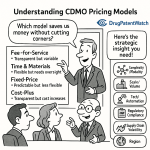
The pricing model in a manufacturing services agreement shapes behavior as powerfully as any quality system requirement. A fee-for-service model with no performance provisions pays the CDMO the same amount for an efficient batch and an inefficient one. This is structurally misaligned.
More sophisticated agreements incorporate gain-sharing provisions: if the CDMO improves the production yield beyond an agreed baseline, the resulting cost savings are shared between the sponsor and the CDMO at a defined ratio. This gives the CDMO a financial incentive to invest in process optimization, which also reduces the sponsor’s cost of goods over time. Similarly, modest penalty provisions for controllable major deviations or significant delivery failures — written carefully to avoid disincentivizing transparency — ensure that quality failures carry financial consequences for both parties rather than just the sponsor.
For development programs with high technical uncertainty, FTE-based models (where the sponsor pays for a defined number of CDMO staff rather than specific outputs) are often more appropriate than fixed-price deliverable models. The latter incentivizes the CDMO to minimize scope and resist additional work required to solve unexpected technical problems. An FTE model better accommodates the inherent uncertainty of early-phase development.
Investment Strategy Note: Valuing a Drug Program’s Manufacturing IP
For investors conducting due diligence on biotech companies approaching clinical milestones, the manufacturing IP embedded in a CDMO relationship is a material component of program valuation that is routinely overlooked. A biologic program that has completed commercial process validation at a high-performing, FDA-approved CDMO has lower technical risk and higher value than an identically profiled program still in process development. The manufacturing readiness of a program should be explicitly included in risk-adjusted NPV models, with a discrete credit for validated commercial-scale process capability.
In licensing and acquisition due diligence, the quality of the CDMO relationship — its governance structure, its regulatory history, the IP ownership provisions in the manufacturing agreement — is a legitimate diligence item. Acquirers of late-stage biotech programs regularly inherit CDMO relationships that were negotiated under time pressure with suboptimal IP provisions, creating post-close remediation work and sometimes re-negotiation leverage for the CDMO.
Key Takeaways: Section 7
TCO is the only financially coherent basis for CDMO comparison. IP ownership and freedom-to-operate provisions in manufacturing agreements require explicit legal attention, not boilerplate. CDMO financial health is measurable through operational signals as well as financial statements. PE ownership introduces an incentive structure that may not align with the sponsor’s long-term manufacturing program interests. Manufacturing IP is a legitimate and often significant component of drug program valuation.
8. Deep Dive: Governance, Communication, and Cultural Alignment {#section-8}
The most technically capable CDMO with the most rigorous quality systems will underperform in a relationship characterized by poor governance and inadequate communication. Conversely, a CDMO with average technical capabilities but exceptional partnership discipline can deliver outcomes that exceed what the technical profile would predict.
Governance Architecture: The Operating System of the Partnership
A functioning governance structure is not a meeting schedule. It is a decision-making architecture that defines who has authority over what, how information flows, and how disputes are resolved. Without it, every significant decision becomes an improvised negotiation.
The governance framework should operate at three levels. The strategic level — a Joint Steering Committee (JSC) with executive representation from both organizations — should meet quarterly or semi-annually to review overall partnership health, discuss strategic changes (new programs, capacity requirements, regulatory strategy), and make decisions that are beyond the operational authority of the project team. The operational level — a Manufacturing and Quality Operations meeting — should occur monthly, reviewing KPI performance, CAPA status, change control progress, and supply chain status against the production schedule. The project level — a cross-functional project team meeting including Technical, Quality, Regulatory, and Supply Chain representatives — should meet weekly to manage day-to-day execution.
The escalation pathway between levels must be formally defined and documented. When a quality event cannot be resolved at the project team level — because it requires significant resource commitment, regulatory notification, or a decision that affects contractual terms — there must be a named individual at the CDMO and the sponsor who has the authority to resolve it. An escalation that reaches a CDMO site director who then discovers they need to escalate to their corporate VP of Quality, who needs legal review, who needs finance sign-off, has failed its purpose. Define the decision rights clearly in advance.
Joint Risk Register reviews should be incorporated into the monthly operational meeting. The risk register should capture technical, regulatory, supply chain, and operational risks for each active program, with likelihood, impact, mitigation status, and ownership assigned to each risk item. This transforms risk management from a reactive exercise into an active management tool.
Communication Quality: Measuring What Is Usually Unmeasured
Transparent, timely communication in a CDMO relationship is a genuine competitive differentiator for sponsors that cultivate it. The question is how to measure something that is usually treated as a cultural attribute.
Formalize the cadence: weekly project team meetings should have documented agendas and action items distributed within 24 hours. Monthly operational reviews should include a KPI dashboard reviewed before the meeting, not presented during it, so the meeting time is spent on analysis and decisions rather than data presentation. Quarterly business reviews should include a written performance summary prepared by both parties, not just the CDMO.
The ‘bad news test’ is a real diagnostic tool, not a cliche. Ask the project team: ‘When was the last significant problem at the CDMO that you did not hear about through your CDMO’s Quality contact first?’ If the honest answer is that you found out from your person-in-plant, from a delayed deviation report, or by noticing a shipment was late, then the communication culture has a problem. The standard should be that the CDMO’s quality or operations contact calls before the sponsor’s team realizes there is an issue.
Quarterly communication surveys within your own organization — asking project team members to rate the CDMO on proactivity, responsiveness, transparency, and follow-through on commitments — convert a subjective impression into a trendable data point. A score that declines over four consecutive quarters is an early warning worth addressing explicitly at the JSC level.
Project Management Discipline and Tech Transfer Rigor
Tech transfer is the highest-risk phase of the CDMO relationship. It is the period during which proprietary process knowledge moves from the sponsor’s organization — or from a clinical-stage CDMO — into the commercial-stage CDMO’s hands. The failure points are numerous and well-documented.
A strong tech transfer program begins with a comprehensive Technology Transfer Plan (TTP) that covers analytical method transfer, raw material specifications and vendor qualifications, manufacturing process step-by-step procedure documentation, equipment comparability assessment between sending and receiving sites, and a validation strategy for the receiving site’s regulatory filing. The TTP should be a living document with version control, not a one-time deliverable.
Assign a dedicated Project Manager from each organization to own the tech transfer. The CDMO PM should hold a relevant credential (PMP or equivalent) and should have prior successful tech transfer experience for a biologic of comparable complexity. Verify this with reference checks — specifically contact prior sponsors who worked with this individual on a tech transfer.
Track tech transfer milestones against the critical path, not just the overall timeline. A four-week delay in analytical method transfer may have no impact on the overall schedule if it is not on the critical path. A two-week delay in cell bank qualification may delay the entire program. Understanding which activities drive the critical path — and having contingency plans for the most probable delays on that path — is the difference between a tech transfer that stays on schedule and one that slips by months.
Cultural Fit: Diagnosing the Unmeasurable
Cultural alignment between a sponsor and a CDMO organization is real, measurable through behavior, and highly predictive of long-term relationship performance. It is not, as commonly suggested, simply a matter of whether the teams get along.
The cultural dimensions that matter most operationally are: accountability culture (do individuals own problems and commitments, or do problems diffuse into collective ambiguity), problem-solving orientation (does the organization default to technical analysis and solution generation, or to blame assignment and documentation of why something wasn’t their fault), communication directness (is bad news delivered clearly and early, or managed, softened, and delayed), and quality mindset (is compliance understood as the minimum, with continuous improvement as the goal, or is the FDA the ceiling that defines acceptable performance).
Assess these during the site visit through scenario questions and behavioral observation. When you present a hypothetical deviation scenario — ‘At 3 PM on a Friday, your team discovers the dissolved oxygen in the bioreactor has been 10% below target for the last 8 hours. Walk me through exactly what happens next’ — the answer should be specific, confident, and reflect a rehearsed organizational response. Hesitation or vague reference to ‘the standard process’ suggests the scenario is not one they have thought through carefully.
Key Takeaways: Section 8
Governance architecture must define decision rights, escalation pathways, and meeting cadence explicitly. Communication quality is measurable through formal cadence tracking and periodic internal surveys. Tech transfer is the highest-risk phase and requires a detailed Technology Transfer Plan with critical path management. Cultural fit is assessed through behavioral observation and scenario responses, not self-reported questionnaires.
9. Technology Roadmaps: Biologics, ADCs, and Cell and Gene Therapy Manufacturing {#section-9}
The modality of the drug product is the single most important determinant of which manufacturing capabilities actually matter in a CDMO evaluation. A framework designed for monoclonal antibody evaluation will miss critical risk factors for an AAV-based gene therapy. This section maps the specific technology considerations for the three modalities with the most complex and rapidly evolving CDMO landscape.
Biologics: The Bioreactor-to-BLA Capability Roadmap
For monoclonal antibodies and related biologics (bispecifics, Fc-fusion proteins, nanobodies), the CDMO capability evaluation should map across five distinct manufacturing technology domains:
Upstream process capability covers cell line development, media optimization, bioreactor design, and process intensification. The key technology questions are whether the CDMO can support the sponsor’s preferred expression system (CHO, HEK293, NS0), what upstream process intensification approaches it has validated (fed-batch vs. intensified fed-batch vs. perfusion), and what titers it consistently achieves for proteins of comparable molecular complexity. Titers matter because they determine the capital cost of goods: a process that achieves 8 g/L from a 2,000L bioreactor requires less manufacturing volume — and thus less schedule — than a 3 g/L process for the same annual production target.
Downstream purification capability covers protein A capture chromatography (the workhorse step for most mAbs), polishing steps (ion exchange, hydrophobic interaction chromatography, mixed mode), and viral clearance validation. The regulatory requirements for viral clearance — demonstrating at least 12 logs of reduction across the overall purification process, with at least two orthogonal steps contributing — are demanding and require specific experience. A CDMO that has successfully filed multiple BLAs with the same downstream purification platform for structurally similar molecules offers a risk reduction that a first-time sponsor may not appreciate until they are in front of the FDA’s division of Manufacturing and Product Quality.
Analytical characterization capability, often assessed superficially, is commercially critical. The sponsor’s own analytical development team may have developed highly specific methods for measuring critical quality attributes (CQAs) like glycosylation profile, aggregation, and charge variants. These methods must be transferred to the CDMO and validated at the CDMO’s analytical facility with the CDMO’s instruments and analysts. Analytical method transfer failures are a primary contributor to tech transfer delays. Evaluate the CDMO’s HPLC and mass spectrometry infrastructure, its LIMS integration, and the experience level of its analytical scientists with the specific CQAs relevant to your molecule.
Formulation and fill-finish capability matters particularly for biologics with complex formulation requirements (high-concentration, subcutaneous formulations face viscosity challenges that require specific device development expertise), cold chain requirements (ultra-low temperature storage for some mRNA products, for example), or specialized container-closure systems (autoinjectors, prefilled syringes).
Continuous manufacturing integration is the forward-looking technology question. The FDA’s emerging framework for continuous manufacturing — the 2019 guidance document and subsequent real-world approvals — has created a regulatory pathway that rewards sponsors willing to invest in process intensification. CDMOs with validated continuous manufacturing capability for biologics (including integrated continuous capture and continuous polishing steps) offer potential for significant reductions in facility footprint, cycle time, and cost of goods. At present, fewer than a dozen CDMOs globally can credibly claim commercially validated continuous biomanufacturing capability. This is a differentiating capability worth investigating specifically.
ADC Manufacturing: The Conjugation Competency Map
Antibody-Drug Conjugates represent one of the most technically demanding CDMO manufacturing challenges. The ADC is a composite molecule — an antibody, a linker, and a cytotoxic payload — each of which requires separate manufacturing, and the conjugation process that joins them must achieve a precise drug-to-antibody ratio (DAR) while maintaining antibody integrity and payload stability.
The CDMO evaluation for ADC manufacturing must cover four separate capability domains: antibody manufacturing (assessed as above), payload synthesis (a specialized small molecule chemistry capability), conjugation (the technically novel step), and ADC fill-finish (which requires containment for cytotoxic materials).
Payload synthesis requires pharmaceutical-grade chemistry capabilities for highly potent active pharmaceutical ingredients (HPAPIs). Most leading ADC payloads — MMAE, DM1, DM4, SN-38 derivatives — are classified as Occupational Exposure Limit (OEL) Category 4 or 5, requiring contained synthesis suites with engineering controls, specialized PPE programs, and validated wipe test and air monitoring procedures. A CDMO that synthesizes ADC payloads without a formally documented HPAPI containment strategy is an immediate regulatory and liability risk.
Conjugation is where process chemistry directly determines product quality. Stochastic conjugation via lysine or cysteine residues produces a heterogeneous DAR distribution; site-specific conjugation using engineered cysteines, non-natural amino acids, or enzymatic approaches produces a more homogeneous product with typically better therapeutic index. The regulatory implications of the conjugation chemistry choice are significant: a site-specific conjugation approach requires extensive analytical characterization of site occupancy and may require a novel characterization method that has not yet been reviewed by the FDA’s biologics division.
Evaluate the CDMO’s reference standards capability for ADC characterization. The potency assay for an ADC must measure both the antibody’s target-binding activity and the payload’s cytotoxic activity, typically in a cell-based assay. Developing and validating this assay requires expertise that is not universally available. A CDMO that cannot demonstrate an experienced bioassay development team for ADC potency measurement is not positioned to support your regulatory filing.
Cell and Gene Therapy: The Manufacturing Complexity Frontier
Cell and gene therapies represent the highest-complexity manufacturing challenge in the contemporary pharmaceutical industry. The biological material — whether it is a patient’s own T cells that will be modified and reinfused (autologous) or allogeneic cells from a donor bank, or a viral vector like AAV or lentivirus carrying a therapeutic gene — cannot be characterized to the same degree of precision as a small molecule or even a conventional biologic. The process is, to a greater extent than any other modality, the product.
Autologous CAR-T cell therapy manufacturing is governed by the critical constraint that the starting material is a specific patient’s collected T cells. The manufacturing process — activation, transduction with a viral vector, expansion, formulation, and cryopreservation — must be executed for each individual patient’s batch, typically within a defined release window that corresponds to the patient’s clinical treatment schedule. A manufacturing failure for an autologous therapy does not mean a failed batch; it means a specific patient does not receive their treatment.
This creates CDMO evaluation criteria that are unique to autologous manufacturing: vein-to-vein turnaround time (the interval from patient leukapheresis to return of finished product to the clinical site), chain of identity controls (the systems ensuring patient material is never mixed or mislabeled through the manufacturing process), batch failure recovery protocols (what happens when a specific patient’s batch fails release testing), and global clinical supply logistics (including cryogenic shipping and clinical site coordination capacity).
AAV vector manufacturing for in vivo gene therapy programs requires evaluation of the CDMO’s capability across the upstream production system (baculovirus/Sf9, triple-transfection HEK293, producer cell lines), purification strategy (ultracentrifugation vs. chromatography-based approaches, with the latter generally preferred for commercial-scale regulatory submissions), and analytical characterization of the vector, particularly full:empty capsid ratio (a CQA with direct efficacy implications that requires specialized analytical methods including AUC-sedimentation velocity or CryoEM).
The AAV sector in particular has a specific CDMO IP consideration. Regenxbio, Spark Therapeutics (Roche), and several academic institutions hold patents on specific AAV serotype capsids, production systems, and purification processes. A CDMO that uses a production technology covered by one of these patent holders without an appropriate license creates patent infringement exposure that passes upstream to the sponsor. IP freedom-to-operate analysis of the CDMO’s manufacturing technology is not optional for gene therapy programs.
Key Takeaways: Section 9
Modality-specific technology evaluation requires modality-specific expertise on the sponsor’s assessment team. Biologics evaluation maps across five distinct capability domains. ADC manufacturing requires assessment of four separate manufacturing steps, with HPAPI containment as a non-negotiable prerequisite. Cell and gene therapy CDMO selection requires evaluation of metrics that do not exist for any other modality — vein-to-vein time, chain of identity, full:empty capsid ratio characterization — and requires explicit IP freedom-to-operate analysis of the CDMO’s production technology.
10. Continuous Manufacturing: The Regulatory and Competitive Case {#section-10}
Continuous manufacturing (CM) has moved from a theoretical FDA aspiration to a commercially validated regulatory reality. Vertex Pharmaceuticals’ ivacaftor (Kalydeco) was the first drug approved by the FDA using continuous manufacturing in 2015. Janssen’s darunavir solid oral dosage form conversion followed. The FDA’s 2019 guidance, ‘Quality Considerations for Continuous Manufacturing,’ provided the regulatory framework for both new applications and post-approval supplements.
For CDMO evaluation, the continuous manufacturing question is now practically relevant for small molecule oral solid dosage forms and is increasingly relevant for biologics. The investment required to implement CM at a CDMO site — in both equipment and process development expertise — is substantial enough that the number of CDMOs with genuinely validated CM capability remains limited. This creates a differentiation opportunity for sponsors willing to ask about it specifically.
The Technology Roadmap for Continuous Biomanufacturing
A fully integrated continuous biomanufacturing process connects upstream continuous cell culture (typically perfusion mode, achieving steady-state productivity) with downstream continuous capture (periodic counter-current chromatography, or PCC) and continuous polishing. The regulatory advantage of this integrated approach is that the process generates a continuous stream of consistent product rather than discrete batches with inter-batch variability.
The implementation roadmap for a sponsor considering continuous biomanufacturing at a CDMO has four stages. At the process development stage, the sponsor and CDMO must jointly establish the design space for the continuous process, including control strategies for steady-state operation, criteria for process state transitions, and the sampling strategy that will demonstrate process consistency for regulatory purposes. At the engineering run stage, continuous operation over multiple operating intervals must demonstrate that the process achieves and maintains steady-state, that product quality attributes are consistent across intervals, and that the downstream processing train can handle the continuous feed from the upstream bioreactor without accumulation or quality drift. At the GMP validation stage, the key regulatory question is whether the continuous process produces ‘batches’ for regulatory purposes and, if so, how they are defined. The FDA’s guidance allows sponsors flexibility in batch definition; the chosen definition must be internally consistent and scientifically justified. At the commercial operation stage, the real-time release testing (RTRT) framework enabled by Process Analytical Technology (PAT) integration offers the most meaningful commercial advantage of continuous manufacturing: QC release can occur on a near-continuous basis rather than on the traditional batch-release schedule.
Evergreening Implications of Manufacturing Technology Changes
The relationship between manufacturing technology and IP lifecycle management is underappreciated by R&D and manufacturing organizations that operate in separate silos. A manufacturing technology change — such as transitioning from batch to continuous processing or from a first-generation to a second-generation expression system — can have patent implications that affect the product’s commercial IP landscape.
If a manufacturing improvement results in a changed product profile — a different impurity profile, a modified glycoform distribution, or improved stability characteristics — it may be patentable as a new product formulation or composition of matter. This is a form of manufacturing-driven evergreening that is legally distinct from but mechanistically similar to classical pharmaceutical evergreening strategies (new formulations, new salt forms, pediatric exclusivity). The IP team should review any significant manufacturing process improvement with the question: does this change create a patentable product distinction that extends the commercial protection window?
Paragraph IV certification dynamics are also relevant for manufacturing changes. Generic filers targeting a branded biologic or small molecule product for Paragraph IV ANDA filing assess the listed patents in the Orange Book. Manufacturing process patents are generally not listed in the Orange Book — they cover the process, not the product — but they can support injunctive relief in a Hatch-Waxman litigation context if the generic product is made by a process that infringes those patents. For CDMOs that develop proprietary manufacturing processes for sponsor products, the question of whether those process patents are owned by the sponsor and whether they are enforced against competing manufacturers is a legitimate IP strategy question, not just an academic one.
Key Takeaways: Section 10
Continuous manufacturing capability is now commercially validated and regulatory-framework-supported. It offers advantages in product consistency, cycle time, and — when integrated with PAT and RTRT — cost of goods. The number of CDMOs with genuine validated CM capability is still small; identifying one with CM experience in your modality provides real competitive differentiation. Manufacturing technology improvements can generate patentable product distinctions that extend commercial IP protection, creating a legitimate convergence between Technical Operations and IP strategy.
11. Competitive Intelligence: Using Patent Data to Evaluate CDMOs {#section-11}
Patent data is one of the most information-dense and least-utilized resources in pharmaceutical competitive intelligence. For CDMO evaluation specifically, it provides concrete evidence of technical capability, process innovation trajectory, and manufacturing relationships that no marketing document can replicate.
Analyzing CDMO Patent Portfolios for Genuine Capability Signals
A CDMO’s patent filing activity reveals its actual R&D investment priorities with a specificity that stated capabilities cannot match. A company that claims world-class ADC conjugation expertise but whose patent portfolio shows no filings related to conjugation chemistry, linker design, or DAR control methodology is a company whose claims should be tested more rigorously.
Search CDMO patent portfolios systematically across three dimensions. Technology innovation filings show where the CDMO is investing in proprietary process development — expression system improvements, novel purification approaches, analytical method innovations. The recency and volume of filings in a specific technology area provides a quantitative proxy for investment intensity. Regulatory strategy filings, including divisional applications and continuation filings around specific manufacturing processes, show which technologies the CDMO considers most commercially valuable and is investing in IP protection for. Licensing patterns, visible through assignee changes and licensing agreement references in patent documents, can reveal whether the CDMO is building its own technology base or is primarily a licensee of third-party manufacturing technologies.
DrugPatentWatch’s patent landscape tools can systematically track CDMO patent activity by assignee, technology classification, and filing date, providing a structured view of innovation trajectory that would take weeks to assemble manually from raw patent databases. The platform’s cross-referencing of patent data with drug pipeline information and regulatory filings can also surface probable CDMO-client relationships that are not publicly disclosed.
Mapping CDMO-Client Relationships Through Patent and Regulatory Data
Direct sponsor-CDMO contracts are confidential. But the regulatory and patent ecosystem surrounding those relationships creates an information trail that experienced analysts can partially reconstruct.
FDA drug master files (DMFs) are submitted by manufacturers to support drug applications without publicly disclosing the proprietary information contained in the DMF. When a new drug application (NDA) or biologics license application (BLA) references a DMF, the sponsor’s product and the DMF holder’s manufacturing site are connected in regulatory records. Cross-referencing DMF holder data with known CDMO facility databases can identify probable manufacturing relationships.
Application-specific publications — Chemistry, Manufacturing, and Controls (CMC) summaries in FDA approval packages, European Public Assessment Reports (EPARs), or Health Canada approval documents — sometimes contain facility identifiers that allow inference of the manufacturing site for a specific product. This data, combined with CDMO facility capabilities, can help sponsors benchmark their own CDMO against the partners chosen by competitors for comparable products.
Patent citations in new drug applications — where the sponsor cites process patents as part of the regulatory submission — can directly identify which manufacturing technology patents are embedded in a specific approved product’s supply chain. If a competitor’s approved product cites patents assigned to a specific CDMO as the manufacturing process foundation, that CDMO has demonstrated regulatory-track-record capability for that technology.
Technology Benchmarking: Which CDMOs Are Ahead of the Curve
Using patent landscape data to assess technology leadership across the CDMO sector requires tracking several leading indicators simultaneously. The number of active patent families in a specific technology area (e.g., perfusion bioreactor optimization, single-use bioreactor design, continuous chromatography, viral vector purification) indicates current capability investment. The citation frequency of a CDMO’s patents by other organizations — including academic institutions, equipment manufacturers, and other CDMOs — indicates whether the CDMO’s innovations are considered foundational enough to be built upon. The number of international patent applications (PCT filings) indicates whether the CDMO is protecting its innovations globally, which correlates with a higher level of commercial confidence in those innovations.
This analysis can be integrated with the site visit and RFP data collected during due diligence to produce a triangulated view of a CDMO’s genuine versus claimed technical capability.
Key Takeaways: Section 11
Patent data provides technology capability evidence that no marketing materials can replicate. CDMO-client relationships, while formally confidential, leave a partial information trail through DMF references, EPAR disclosures, and patent citations that systematic analysis can partially reconstruct. Monitoring a current CDMO partner’s patent filing activity at regular intervals detects IP encroachment risks before they become contractual disputes. Technology benchmarking using patent landscape data can identify which CDMOs are investing most aggressively in the specific manufacturing capabilities relevant to your programs.
12. Digital Infrastructure: PAT, MES, and AI-Driven Process Oversight {#section-12}
The shift from retrospective quality control to real-time process monitoring is the most consequential operational technology change in pharmaceutical manufacturing in the past two decades. CDMOs that have made this transition provide sponsors with a qualitatively different level of oversight capability.
Process Analytical Technology: From Theory to Operational Reality
PAT, as defined by the FDA’s 2004 guidance document, involves the use of a system for designing, analyzing, and controlling manufacturing through timely measurements of critical quality and performance attributes of raw and in-process materials and processes with the goal of ensuring final product quality.
In biologic manufacturing, the most practically significant PAT implementations involve in-line bioreactor monitoring. Rather than relying on discrete off-line samples taken every 12-24 hours, in-line probes measure pH, dissolved oxygen, dissolved CO2, cell density (via capacitance or Raman spectroscopy), nutrient levels, and product titer on a near-continuous basis. This produces a rich, time-dense data stream that reveals process dynamics invisible to traditional monitoring.
The regulatory value of PAT data is that it strengthens the scientific foundation of the control strategy submitted in a BLA or NDA. A control strategy built on PAT-generated understanding of the relationship between process parameters and product quality attributes is more defensible in regulatory review than one built on off-line testing at defined intervals. FDA reviewers from the Office of Pharmaceutical Quality (OPQ) and the Center for Biologics Evaluation and Research (CBER) have consistently rewarded sponsors who demonstrate genuine process understanding through PAT data in CMC submissions.
For sponsor oversight, PAT integration into a shared data portal means that process performance can be monitored remotely and in near-real-time. A sponsor Technical Operations team in Boston can watch a CHO cell culture in a Lonza facility in Portsmouth, New Hampshire, with the same analytical visibility as someone standing next to the bioreactor. This changes the oversight model from periodic batch record review to active, continuous monitoring.
Evaluate a CDMO’s PAT program by asking for specific examples of how PAT data has been used to prevent a batch failure or improve a process. A CDMO that can describe a specific incident where an in-line Raman signal for product titer detected a media preparation issue 18 hours before it would have been visible in an off-line sample, allowing intervention before the batch was lost, has demonstrated genuine operational integration of the technology. A CDMO that describes PAT as a feature on their site tour but cannot provide specific examples of operational impact is one where the investment in sensors has not translated to operational culture change.
Manufacturing Execution Systems and the ‘Single Source of Truth’
A Manufacturing Execution System (MES) is the software layer that bridges the physical manufacturing process and the quality documentation system. It captures electronic batch records in real time, integrates data from PAT sensors and laboratory instruments, enforces sequence steps to prevent operator error, and creates an audit-controlled record of every action taken during a manufacturing run.
For sponsor oversight, the critical capability is whether the CDMO’s MES is integrated with a client portal that allows sponsor quality and technical staff to access batch execution data without the delay of paper batch record review. The paper batch record — submitted as a PDF days or weeks after a manufacturing run — is a compressed, retrospective summary of a process that generated thousands of data points in real time. The MES audit trail is the actual record.
Assess MES maturity during the site audit by asking to review the electronic batch record structure for a current product. Is it a true electronic batch record with sequence enforcement and real-time data capture, or is it an electronic form that replicates the structure of a paper batch record without the process integration? The distinction is practically significant: the former prevents deviations through sequence enforcement, the latter only records them after they occur.
Predictive Analytics and the Emerging AI Layer
Artificial intelligence applications in pharmaceutical manufacturing are past the proof-of-concept stage at a small number of CDMOs and are approaching validated operational deployment. The most practically advanced applications are in equipment predictive maintenance and multivariate process monitoring.
Predictive maintenance models trained on historical sensor data from manufacturing equipment (pumps, agitators, chromatography columns, filtration systems) can identify failure signatures weeks before an equipment failure that would shut down a manufacturing campaign. A bioreactor agitator failure during a 14-day perfusion run can potentially destroy a batch worth millions of dollars in materials, labor, and lost time. A predictive maintenance system that flags the bearing degradation signature three weeks in advance — allowing scheduled replacement during a planned downtime window — eliminates that risk.
Multivariate statistical process control (MSPC) models, now increasingly enhanced with machine learning, can simultaneously track dozens of process parameters and detect subtle multi-dimensional deviations that fall outside the process norm even when every individual parameter remains within its univariate specification limit. This is analytically important because process upsets in complex biological systems often manifest as correlated changes across multiple parameters simultaneously — a signature invisible to conventional univariate control charts.
When evaluating a CDMO’s AI analytics capability, apply the same evidentiary standard as for PAT: ask for specific validated case studies, not general descriptions. What specific model was built? What data was it trained on? What is its false positive rate (important — excessive false alarms create alert fatigue that defeats the purpose)? Has it been validated in a regulatory context or is it purely an operational tool? The answers distinguish genuine operational AI from marketing narrative.
Key Takeaways: Section 12
PAT integration provides both regulatory value (strengthening process understanding in CMC submissions) and operational value (real-time deviation detection). MES sophistication determines the quality and immediacy of sponsor oversight. AI applications in predictive maintenance and multivariate process monitoring are operational at leading CDMOs and provide material risk reduction for high-value manufacturing programs. Evaluate all three technology domains with a specific evidence standard: ask for validated operational case studies, not capability claims.
13. Case Studies: Turnarounds, Launches, and Costly Mistakes {#section-13}
Case Study A: The Late-Phase Biologic Turnaround
A mid-sized U.S. biotech — call it PrecisionBio — had a monoclonal antibody in Phase III for a moderate-to-severe inflammatory condition. Manufacturing was outsourced to a European biologic CDMO with a strong regulatory track record. Eighteen months before the planned BLA submission, the Right-First-Time rate for the downstream purification process had declined from 92% to 76% over eight consecutive campaigns. The cause was not immediately clear. CAPA investigations had identified ‘operator variability’ as the root cause in four of the five formal deviations — a classic signal that root cause analysis had not gone deep enough.
PrecisionBio’s new VP of Technical Operations took an unconventional step: she suspended the weekly teleconference format for three months and embedded two of her own senior process engineers at the CDMO site full-time. The embedded team participated in manufacturing runs, attended the CDMO’s internal deviation investigations, and co-led root cause sessions using structured fishbone analysis.
What emerged was a multi-factor root cause that the CDMO’s investigation team had not connected. A buffer preparation procedure had been revised eight months earlier to accommodate a new vessel configuration after a capital improvement. The revision was technically correct but was written at a level of abstraction that required the operator to make a judgment call about mixing time based on visual observation — a judgment that was proving inconsistent across the three operators who performed that step. Simultaneously, a new chromatography resin lot from the primary supplier had a slightly different back-pressure profile that was within specification but was interacting with the undercharacterized buffer preparation variability.
The fix required a procedure rewrite that replaced the visual observation criterion with a time-and-impeller-speed specification based on validated mixing studies, combined with a lot-qualification protocol for the chromatography resin that included a functional performance acceptance criterion beyond the vendor’s certificate of analysis. These were not simple fixes — they required a change control process, an update to the regulatory filing strategy, and a validation campaign for the revised procedure.
Within four campaigns after implementation, RFT returned to 94%. The BLA was filed on the revised schedule. First-cycle approval followed. The total cost of the turnaround — embedded personnel, additional validation batches, regulatory strategy revision — was approximately $4 million. The cost of the alternative, qualifying a new CDMO 18 months before BLA submission, was estimated at $25-35 million and two years of delay.
The lesson is not that every troubled CDMO relationship is salvageable. Some are not, and continuing to invest in a fundamentally misaligned or incapable partner is a sunk cost fallacy with real clinical and financial consequences. The lesson is that the resolution of a ‘performance problem’ often requires embedding diagnostic capability at the site level, not managing from a distance through deviation reports.
Case Study B: The Gene Therapy Launch That Worked
GeneVector Therapeutics had a one-time treatment for a rare pediatric neuromuscular disease. The regulatory pathway was accelerated — a Breakthrough Therapy Designation and an anticipated rolling review — and the patient population was small, perhaps 200-300 eligible patients annually in the United States. A manufacturing failure at commercial launch would not just be a financial event; it could deny a life-altering treatment to children who had no other options.
GeneVector chose its CDMO — a mid-sized cell and gene therapy specialist — after a six-month due diligence process that included audits of three finalists, direct reference checks with two prior sponsors, and a paid engineering run of the AAV purification process using GeneVector’s specific serotype. The engineering run was not perfect: the downstream process experienced an unexpected column fouling event that required a process modification. The CDMO team’s response to this event — immediate notification, rapid generation of three hypotheses with associated experimental designs, resolution within 72 hours and full documentation within five days — was more valuable than a perfect run would have been. It demonstrated exactly the operational culture that GeneVector needed to trust for commercial manufacturing.
The manufacturing services agreement included a governance architecture with real teeth. A Joint Operations Committee met every two weeks during the tech transfer phase and monthly thereafter. The CDMO’s Head of Manufacturing and Head of Quality were contractually required to attend quarterly JSC meetings in person. The agreement included an explicit ‘vein-to-vein’ turnaround time commitment with graduated financial consequences for delays beyond defined thresholds, with exceptions for events outside the CDMO’s operational control.
The commercial launch manufacturing campaign achieved a 100% batch success rate across the first 12 campaign runs. Critically, two potentially serious process deviations — one in the upstream bioreactor (a nutrient pump calibration drift) and one in the fill-finish step (a vial stopper seating anomaly in the first 50 units of a lot) — were both detected by in-process PAT monitoring before they could result in a product quality failure. Both were communicated to GeneVector’s QA team within the two-hour notification window specified in the Quality Agreement.
Case Study C: The Acquisition That Disrupted a Commercial Supply Chain
A large European pharmaceutical company’s best-selling biologic — a second-generation anti-TNF antibody with annual revenues exceeding $2 billion — was manufactured exclusively at a single U.S. CDMO site. The relationship was 11 years old. The process was validated, well-understood, and had an enviable regulatory inspection track record.
When a U.S. private equity firm acquired the CDMO as part of a larger specialty pharmaceutical services roll-up, the European pharma company’s management team treated it as a routine change-of-control administrative event. The contract had a change-of-control notification clause. The new owners notified them. Acknowledgment was sent. Business continued.
Within 18 months, the following had occurred: the site’s Head of Manufacturing, Head of Quality, and three of the five senior process scientists who had direct hands-on familiarity with the antibody program had all left the company — two to a competitor CDMO, one to the sponsor itself, and two to early retirement. The new PE-controlled management had implemented a 15% headcount reduction site-wide and had restructured the compensation program in a way that accelerated departures among the most mobile (and most experienced) technical staff. Capital maintenance expenditures had been reduced by 40% as the firm optimized for EBITDA ahead of an anticipated secondary sale.
The first operational signal appeared 14 months post-acquisition: a 4% decline in the antibody program’s RFT rate that coincided with a change in batch record review procedures (an efficiency initiative that reduced review time but introduced new transcription error risks). The signal was present in the data but was not connected to the acquisition until a retrospective analysis was performed following a more serious deviation nine months later.
Total remediation cost — including emergency requalification efforts, a parallel qualification campaign at a backup site that was accelerated under crisis conditions, and the regulatory implications of process changes made during the disruption period — exceeded $60 million over a three-year period.
The structural failure was the initial response to the change-of-control. A defensible response would have included an immediate supplemental site audit focused on personnel retention and capital investment plans, a formal re-evaluation of the program’s supply risk under the new ownership structure, and acceleration of the secondary site qualification program that had been planned but deprioritized.
Key Takeaways: Section 13
Troubled manufacturing relationships often require embedded, site-level diagnostic capability rather than remote governance escalation. Success in novel modality commercial launch depends on selecting a partner whose response to process adversity, not absence of adversity, meets the required standard. Private equity acquisitions of CDMO partners are a specific supply chain risk event that requires a formal supplemental due diligence response, not a routine administrative acknowledgment.
14. Investment Strategy: How Analysts Should Read the CDMO Sector {#section-14}
Sector-Level Valuation Dynamics
The global CDMO sector trades at a structural premium to the broader industrial services sector, justified by the regulatory barriers to entry, the long-term contractual revenue visibility, and the secular growth tailwind from pharmaceutical outsourcing. The premium has compressed from its 2020-2021 peak as post-COVID normalization removed the exceptional demand created by vaccine manufacturing capacity buildout.
For investors constructing CDMO sector exposure, the relevant segmentation is by modality: conventional small molecule CDMOs trade at lower multiples with more competitive pricing pressure; biologics CDMOs command premium multiples supported by higher technical barriers and longer contract terms; cell and gene therapy CDMOs carry the highest multiples with the most execution risk, given the relative immaturity of the manufacturing platforms and the limited commercial volume available to absorb high fixed-cost infrastructure.
Key Metrics for CDMO Investment Analysis
Revenue quality is the primary financial metric that differentiates durable from fragile CDMO business models. Track the percentage of revenue under multi-year take-or-pay contracts (higher is better for revenue predictability), client concentration (the HHI index for the top 5 clients), and the clinical-to-commercial revenue mix (commercial revenue is more predictable but clinical revenue predicts future commercial volume growth).
CapEx discipline is the most commonly misread financial signal in CDMO sector analysis. A CDMO that is aggressively expanding capacity is consuming cash and increasing leverage, which reads negatively on near-term EPS models but should read positively if the expansion is supported by contracted volume commitments rather than speculative capacity addition. Distinguish between demand-pull expansion (capacity being added to support contracted programs, with take-or-pay protection) and supply-push expansion (capacity being added in anticipation of market growth without contracted backing). The former deserves a valuation premium; the latter carries demand risk.
Regulatory inspection track record, as discussed at length in the quality section of this document, is a material investment risk factor that is insufficiently incorporated into most CDMO sell-side models. A Warning Letter at a major manufacturing site is not a one-quarter event; it creates a multi-year remediation burden, a revenue impairment from clients who pause or transfer programs, and a reputational discount in new business development. The financial impact of a Warning Letter at a CDMO with 30-40% of revenue concentrated in a single affected site has historically ranged from 15-25% revenue impairment in the affected periods.
Drug Lifecycle and Patent Expiry as CDMO Demand Drivers
The relationship between drug patent expiry and CDMO demand is structurally positive for the contract manufacturing sector in a way that is counterintuitive to many analysts.
As branded biologics approach loss of exclusivity (LOE) — the period when biosimilar interchangeability certification enables meaningful market share erosion — the innovator company faces a manufacturing cost imperative. The branded product must defend its price premium through either clinical differentiation or cost reduction. CDMOs that offer validated, lower-cost-of-goods manufacturing for established biologic processes (through process intensification, continuous manufacturing, or operational efficiency) become strategically valuable to innovator companies facing biosimilar competition.
For biosimilar developers, CDMO selection is a core competitive strategy. The ability to launch rapidly after a reference product’s LOE event — and to scale volume quickly in response to market uptake — depends entirely on manufacturing readiness. A biosimilar sponsor that has completed commercial process validation and has a qualified, scaled manufacturing facility ready for the day of regulatory approval can capture disproportionate market share in the critical first 6-12 months of a biosimilar launch window. CDMOs that specialize in biosimilar manufacturing and have a track record of successfully supporting biosimilar submissions (including successful analytical similarity package reviews, a known FDA regulatory focus area) are positioned to benefit from the accelerating biosimilar wave in the late 2020s.
DrugPatentWatch’s LOE forecasting data provides a systematic view of which reference biologics are approaching their primary patent expiry and secondary method-of-use or formulation patent expirations — the latter being particularly important since evergreening strategies can extend effective market exclusivity well beyond the primary patent cliff. Integrating LOE forecasting with CDMO capacity data allows analysts to map potential demand growth for biosimilar manufacturing services by modality and timeline.
M&A Strategy: What Makes a CDMO an Acquisition Target
The characteristics that make a CDMO attractive to acquirers — whether strategic buyers like Thermo Fisher or Lonza, or financial sponsors — are largely the same characteristics that make it a high-quality manufacturing partner: defensible technology differentiation, long-term contracted revenue, diversified client base, and a strong regulatory track record.
The acquisition premium signals most commonly seen in CDMO M&A are: sole-source technology position (the CDMO has the only commercially validated platform for a specific novel modality), capacity scarcity (the CDMO has the only available commercial-scale capacity in a high-growth segment), regulatory achievement (the CDMO has first-ever regulatory approvals associated with a novel manufacturing approach), and geographic positioning (for sponsors with specific regional supply requirements driven by regulatory localization strategies).
For investors in small and mid-cap CDMOs, the M&A optionality embedded in these characteristics can represent significant upside relative to the standalone DCF valuation. Track which CDMOs are receiving investor inquiries or have disclosed ‘strategic alternatives’ review processes, and assess whether the M&A premium implied by comparable transactions is reflected in the current market valuation.
Key Takeaways: Section 14
CDMO sector investment analysis requires segmentation by modality, revenue quality assessment beyond simple top-line growth, and explicit incorporation of regulatory inspection risk into financial models. CapEx investment should be evaluated in the context of contracted demand pull vs. speculative capacity addition. Drug patent expiry and the accelerating biosimilar pipeline are structural demand drivers for specialized CDMO capacity that will be increasingly visible in the latter half of the 2020s. M&A optionality for CDMOs with defensible technology differentiation and regulatory achievement may not be fully reflected in standalone DCF models.
Frequently Asked Questions {#faq}
Q: Our biotech has one full-time person managing a CDMO relationship. How do we implement this framework without hiring a team?
Prioritize ruthlessly based on development stage. For pre-IND or Phase I programs, focus on three metrics: tech transfer effectiveness, deviation communication speed, and project timeline adherence. Expand the scorecard as the program advances. For clinical-to-commercial transition, invest in quality audit support from a specialist consultant rather than adding headcount. The cost of one experienced external manufacturing quality consultant for three days of site audit activity is substantially less than the cost of a manufacturing quality event at a late-stage CDMO.
Require transparency as a contract term, not as a relationship request. Mandate that the CDMO provide access to their deviation management and change control database for your programs. Many CDMO quality management systems have client portal functionality that provides this access at no additional cost. This single capability provides visibility that would otherwise require a person-in-plant.
Q: How do we structure the Quality Agreement to protect our IP without souring the relationship?
The Quality Agreement and the IP provisions of the manufacturing services agreement should be negotiated in parallel, not sequentially. The IP provisions govern ownership and licensing; the Quality Agreement governs the operational protocols that protect the confidentiality and integrity of proprietary information in the manufacturing environment.
Specific Quality Agreement provisions with IP implications include: who has access to your manufacturing documentation (restrict to named individuals with role justification), how your process data is stored and for how long (ensure data is segregated from other clients’ data in both physical and electronic systems), and what happens to process knowledge at contract termination (including the return or certified destruction of all process documentation and the restriction on using your process know-how in comparable programs for a defined post-termination period).
Q: Our CDMO was just acquired by a competitor. What immediate steps should we take?
First, within 30 days, conduct a formal supplemental due diligence review focused on four specific questions: which key personnel from your program team are staying with the organization (and get written commitment if possible), what is the new owner’s stated capital investment plan for the site over the next three years, whether the new owner’s broader business has any competitive products in your therapeutic area, and whether your manufacturing agreement’s change-of-control protections have been triggered and what remedies they provide.
Second, accelerate the qualification of an alternative manufacturing site if one is not already in place. The optimal time to qualify an alternative is before you need it; the worst time is after your primary partner’s capability has deteriorated.
Third, request a meeting with the new ownership’s leadership — not just the site management team — to understand their strategic intent for the site. A PE firm that intends to exit within three years has different incentives than a strategic acquirer building a long-term platform.
Q: How should we think about CDMOs with significant China-based manufacturing given the current regulatory and legislative environment?
The geopolitical risk associated with China-based pharmaceutical manufacturing has evolved from a theoretical concern to an active regulatory and legislative risk in the United States and, to a lesser degree, in the European Union. The BIOSECURE Act’s progress through Congress and the FDA’s enhanced scrutiny of foreign manufacturing sites following a series of data integrity and quality system failures at Chinese facilities have created a risk environment that requires explicit assessment rather than assumption of stability.
For programs with significant U.S. commercial exposure, a China-only manufacturing strategy carries supply chain risk that is now difficult to justify based on cost savings alone. A dual-sourcing strategy that includes at least one U.S. or European manufacturing site for the U.S. commercial supply chain is increasingly a regulatory and commercial risk management requirement rather than a preference.
For programs in early clinical development with limited immediate U.S. commercial relevance, China-based CDMO use remains defensible if the IP risk assessment is favorable and the regulatory track record of the specific site is strong. The risk calculus should be revisited explicitly at each development stage gate.
Q: What is the most common negotiating mistake sponsors make in CDMO contracts?
Accepting the CDMO’s standard template as a starting point without recognizing that standard templates are written to protect the CDMO’s interests, not the sponsor’s. The most consequential provisions that sponsors frequently under-negotiate are: IP ownership of foreground inventions (often drafted to create ambiguity that favors the CDMO), the definition of force majeure (often drafted broadly enough to excuse supply failures that the CDMO had operational control over), the remedy structure for late delivery or batch failure (often limited to refund of the batch price, which grossly underestimates the sponsor’s actual loss from a commercial supply failure), and the audit rights clause (often limited to one audit per year with extended advance notice, which is insufficient for a high-risk manufacturing relationship).
Engage pharmaceutical manufacturing legal counsel, not general commercial counsel, for CDMO contract negotiation. The technical specificity of pharmaceutical manufacturing agreements — their Quality Agreement annexes, batch release procedures, and IP schedules — requires domain expertise that general commercial lawyers typically do not have.
References and Data Sources
FDA, ‘Quality Considerations for Continuous Manufacturing,’ Guidance for Industry, February 2019.
FDA, ‘PAT — A Framework for Innovative Pharmaceutical Development, Manufacturing, and Quality Assurance,’ Guidance for Industry, September 2004.
ICH Q10, ‘Pharmaceutical Quality System,’ International Conference on Harmonisation, June 2008.
ICH Q12, ‘Technical and Regulatory Considerations for Pharmaceutical Product Lifecycle Management,’ November 2019.
ISPE, ‘Good Practice Guide: Technology Transfer,’ 3rd Edition, 2021.
FDA, Drug Master File (DMF) Database, publicly searchable at accessdata.fda.gov.
FDA Warning Letter Database, publicly searchable at fda.gov/inspections-compliance-enforcement.
DrugPatentWatch, pharmaceutical patent landscape and drug pipeline intelligence services, drugpatentwatch.com.
Samsung Biologics Annual Report, 2023.
Lonza Group Annual Report, 2024.
Novo Holdings press release on Catalent acquisition close, December 2024.
IQVIA Institute for Human Data Science, ‘Global Trends in R&D 2024.’
GlobalData Pharma Intelligence, ‘CDMO Market Outlook 2025-2030.’
Dun & Bradstreet, ‘Global Business Risk Report 2024.’
Copyright notice: This document is intended for informational purposes for pharmaceutical industry professionals and institutional investors. Specific legal, regulatory, and investment decisions should be made with qualified professional advice.