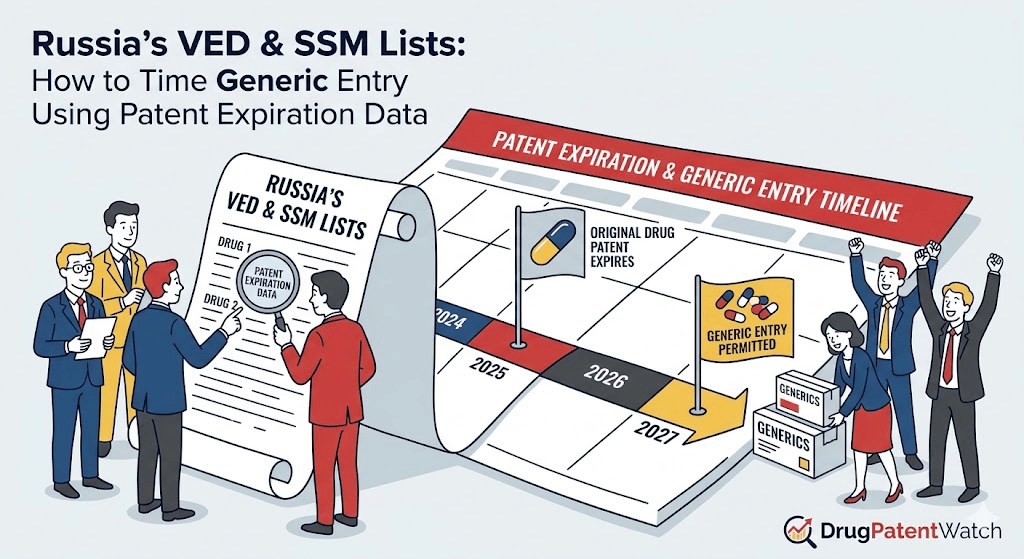
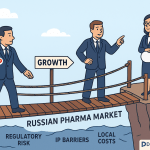
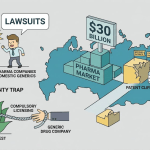
Russia’s pharmaceutical market generated 2.85 trillion roubles in 2024, roughly $30.9 billion at prevailing exchange rates. [1] That headline figure gets quoted in boardroom decks and investor presentations. What it obscures is the story underneath: two parallel reimbursement universes, each governed by its own legal architecture, each demanding a distinct competitive strategy, and each offering a fundamentally different risk-reward profile for generic and biosimilar manufacturers.
The List of Vital and Essential Drugs, known in Russian as Zhiznenno Neobkhodimye i Vazhneyshiye Lekarstvennye Preparaty (VED or GNVLP), and the List of Strategically Significant Medicines (SSM, Strategicheski Znachimye Lekarstvennye Preparaty) are not interchangeable categories. They have different legal origins, different procurement rules, and increasingly different consequences for patent holders and generic challengers. Getting the two confused costs companies time, money, and in the worst cases, a procurable market position that a faster competitor will simply take.
This article works through both lists at the mechanism level. It explains what ‘Second Extra’ actually means for a generic tender bid, how compulsory licensing under Article 1360 of the Civil Code has become a policy instrument rather than an emergency measure, and why patent expiration dates on VED-listed molecules require a three-layer analytical framework to interpret correctly. The goal is practical: giving commercial teams, business development officers, and IP counsel the context they need to sequence a generic entry strategy in Russia between now and 2030.
Two Lists, Two Logics
The VED List: Price Control with Procurement Teeth
The VED list traces its statutory authority to Federal Law No. 61-FZ of April 12, 2010, the Law on Circulation of Medicines, and is operationally governed through annual Government Resolutions. [2] As of February 24, 2026, the current iteration includes 828 International Nonproprietary Names (INNs), issued under Government Resolution No. 3867-r of December 18, 2025. [3] That is up from 758 INNs noted in earlier years, reflecting a steady expansion policy driven by both epidemiological need and import substitution ideology.
The list’s primary purpose is price regulation. Any drug on the VED list must have its maximum selling price registered with the Federal Antimonopoly Service (FAS). Manufacturers submit a registration dossier with a price, FAS reviews it against reference countries and cost-of-production data, and the registered price becomes a ceiling for public procurement. In a high-inflation environment, that ceiling compresses margins mechanically: the VED segment’s prices grew only 2.6% in 2025, compared to 8.7% for non-VED drugs. [4]
For generic manufacturers, the VED list does something else entirely. It is the gateway to the government procurement segment, which in 2025 reached 1.03 trillion roubles, up from 819 billion roubles in 2024. [4] That 25.5% growth rate makes the state segment the fastest-growing channel in the Russian pharmaceutical market. The commercial segment, where price regulation does not apply, expanded at 13%. A generic manufacturer who gets a molecule on the VED list and qualifies for full-cycle domestic production status is essentially positioned to win state tender volumes that a foreign originator cannot match under current procurement rules.
The SSM List: National Security as Commercial Policy
The SSM list is smaller and legally distinct. Created in 2010, it covers 215 drug substances whose domestic production is linked explicitly to Russia’s national security framework. [5] The SSM concept has always carried a harder ideological edge than the VED list: the government’s position is that supply disruption for these drugs constitutes a national security risk, not merely a public health problem.
That framing matters for patent strategy. When the state characterizes a drug’s supply gap as a national security issue, Article 1360 of the Civil Code becomes an available legal tool. Article 1360 allows the government to authorize use of a patented invention without the patent holder’s consent in circumstances of ‘extreme necessity’ or national security needs. [6] The semaglutide episode, discussed in detail later, is the clearest example of how the SSM/VED classification interacts with that provision.
The practical difference between the two lists for a generic company comes down to one question: does your target molecule appear on both lists, or just one? A VED-only molecule faces price controls and procurement preferences, but the legal environment for generic entry follows something closer to a conventional patent cliff model. An SSM-listed molecule that is also on the VED list faces a regulatory environment where the government has demonstrated willingness to issue compulsory licenses when supply is disrupted, irrespective of the patent expiry date. That is a categorically different competitive dynamic, and patent data tools need to be applied differently in each case.
The Procurement Architecture: What ‘Second Extra’ Actually Does
The Legal Evolution from ‘Third Wheel’ to Resolution No. 1875
Russia’s procurement preference system for pharmaceuticals has gone through several iterations since the Pharma 2020 strategy launched import substitution as state policy. The most familiar formulation to international observers was the ‘Third Wheel’ rule (‘Tretiy Lishny’), which excluded foreign bids from public tenders when two or more domestic or EAEU-origin alternatives were present. That mechanism was phased out in its original form by January 1, 2025. [7]
Government Resolution No. 1875, published December 25, 2024, and effective January 1, 2025, replaced the Third Wheel with a more nuanced but arguably more restrictive architecture. [7] For VED-listed drugs specifically, the Resolution introduces a hierarchy based on production cycle completeness. Drugs for which all production stages, including active pharmaceutical ingredient (API) synthesis, are carried out within Russia or EAEU member states receive the highest preference tier. Drugs produced in Russia but relying on imported API occupy a secondary tier. Foreign drugs without any domestic production trail sit at the bottom.
The ‘Second Extra’ (‘Vtoroy Lishniy’) mechanism is the operative clause for the VED segment. When at least one full-cycle domestic or EAEU bid is present in a public tender, all other bids are automatically excluded. [8] This is not a price disadvantage mechanism or a scoring penalty. It is categorical rejection. A foreign originator brand or a generic manufactured outside the EAEU simply does not compete if a domestic full-cycle product submits a bid. The Resolution also prohibits mixing VED-listed and non-VED drugs in the same procurement lot, which eliminates a previous workaround where purchasers bundled essential and non-essential drugs to avoid the preference rules. [7]
What This Means for Entry Timing
The practical implication for a generic manufacturer is that registration timing and procurement strategy must be synchronized differently than in Western markets. In a US or EU generic entry scenario, the key milestone sequence runs roughly as follows: patent expiry confirmed, ANDA or MA filed, regulatory clearance obtained, launch executed. The primary variable is the patent litigation timeline.
In Russia’s VED market, a fourth variable carries equal weight: production cycle status. A generic manufacturer who registers a VED-listed molecule using imported API from India or China can participate in procurement but will lose automatically to any competitor who qualifies for full-cycle EAEU production status. That creates a two-stage entry problem. The first stage is patent clearance. The second stage is API localization. Companies that solve both problems before patent expiry are positioned to capture state tender volumes from day one. Companies that get regulatory registration without solving API localization will face the Second Extra rule as a systematic exclusion mechanism.
By August 2024, the Ministry of Industry and Trade reported that the VED list contained 819 items, of which 95% had at least some production stages in Russia. Of those, 58.4% qualified for full-cycle domestic production status, and 19.2% had production beginning from the finished dosage form stage. [9] Those figures tell you that for roughly 40% of VED molecules, a competitor who could achieve full-cycle status does not yet exist. That gap represents the commercially relevant opportunity window.
SSM List Extension: The January 2026 Delay and Its Consequences
The SSM list was supposed to come under the Second Extra mechanism on September 1, 2025. The Ministry of Industry and Trade pushed that deadline back four months to January 1, 2026, citing the need to allow manufacturers sufficient time to localize full-cycle production within the EAEU. [5] The delay itself was informative. It acknowledged that the production capacity simply was not there to implement categorical domestic preference across all 215 SSM molecules on the original schedule.
For strategic planning purposes, that delay created a short window during which SSM-listed drugs were effectively still accessible to non-EAEU manufacturers on more competitive terms. Companies who used that window to file registration applications, negotiate localization partnerships, or build out API synthesis capacity positioned themselves ahead of the January 2026 inflection point. The companies who did not have effectively conceded those state tender volumes.
Patent Expiration Data: The Three-Layer Framework
Patent data is the starting point, not the endpoint, of generic entry analysis in Russia. The country has its own national patent register, operates under the EAEU harmonization framework introduced via the Agreement on Unified Principles and Rules for the Circulation of Medicines, and maintains a data exclusivity regime that was substantially revised by Article 13 of the amended Law on Circulation of Medicines, effective September 1, 2024. [10] Each of these layers intersects differently with the VED and SSM lists.
Layer One: Russian National Patents and EAEU Harmonization
Russia’s patent system grants 20-year terms from the filing date, with Patent Term Extensions (PTEs) available for medicines that undergo delayed regulatory approval. A PTE can extend protection by up to five years. For generic entry planning, this means that a molecule whose primary patent was filed in, say, 2005, and approved in Russia in 2010, might carry an effective exclusivity period extending to 2030 under a PTE scenario. Miscalculating this is expensive.
DrugPatentWatch tracks estimated patent expiration dates for Russian Federation patents on a broad portfolio of drugs, providing generic manufacturers with a critical analytical base. For example, CREON (pancrelipase), manufactured by Abbott’s European entity, carried a DrugPatentWatch-estimated Russian patent expiration date of August 15, 2025, controlled by Russian Federation Patent 2,408,364 and Patent 2,440,101. [11] Crizotinib (Xalkori, marketed by Pfizer’s PF Prism CV entity) carried an estimated expiration of December 5, 2025, under Russian Federation Patent 2,387,650. [11] These are concrete entry opportunities, dateable and plannable, provided the secondary patent landscape and data exclusivity status are also mapped.
The EAEU harmonization layer complicates matters. Since March 2024, unified rules for drug circulation apply across the five EAEU member states (Russia, Belarus, Kazakhstan, Armenia, Kyrgyzstan). A patent registered under EAEU supranational procedures has different geographic reach than a purely national Russian patent. For a generic company, this distinction affects both freedom-to-operate analysis and the geographic scope of a first-mover advantage. A drug localized in Kazakhstan for EAEU-level production may qualify for Russia’s Second Extra preferences in ways that a drug produced in India cannot.
Layer Two: Data Exclusivity Under the Revised Article 13
Data exclusivity is separate from patent protection, and the two do not necessarily expire at the same time. Russia’s data exclusivity regime was governed by Article 18 of the Law on Circulation of Medicines until September 1, 2024, when the revised Article 13 took effect. [10] The new article aligns the regime with EAEU rules, applying both to national registrations and to registrations conducted under the EAEU unified procedure.
Data exclusivity blocks a generic manufacturer from relying on the reference drug’s preclinical and clinical data for a set period after the originator’s registration. In Russia, that period is typically six years for small molecules (with an additional two-year market exclusivity in some cases) and ten years for biologics. A molecule whose primary patent expires in 2026 but whose reference drug was registered in Russia in 2022 may still carry data exclusivity protection through 2028 or later. A generic company that launches on patent expiry alone, without confirming data exclusivity status, may find itself fighting a registration battle it cannot yet legally win.
Layer Three: Secondary Patents and the Freedom-to-Operate Wall
Originators in Russia, as in other major markets, use secondary patent filings to extend effective protection beyond the primary compound patent. These cover formulations, polymorphs, methods of treatment, delivery systems, and manufacturing processes. Olaparib (Lynparza, AstraZeneca) illustrates the point: DrugPatentWatch records twelve patents protecting the drug, with an estimated Russian patent expiration of October 17, 2026, under Patent 2,465,270. [11] But those twelve patents include secondary filings that a generic manufacturer must map individually. The October 2026 date represents the earliest expiry in that family, not the last line of patent defense.
The Federal Antimonopoly Service (FAS) in Russia demonstrated in 2024 that early generic launches are not consequence-free. FAS ruled that premature market launches of generics for several innovator molecules constituted unfair competition, issuing fines that collectively exceeded 1 billion roubles ($10.9 million) across indicted companies. [12] That enforcement action shows that even in a market with strong political incentives toward domestic generics, launching before secondary patent clearance carries regulatory and legal exposure.
‘In 2024, Russian pharmacies had 134 fewer essential drugs than the year before. Of these, about 15% treat cancer.’Russia Post / Ksenia Buksha, citing pharmacy association data, 2024 [13]
That supply gap is the commercial pressure that generic companies can address, but only if they do so legally. The balance the Russian government is trying to strike is patent-compliant, but rapidly exploitable, generic entry. FAS enforcement on premature launches and Supreme Court validation of compulsory licensing on VED-critical drugs sit at opposite ends of that balance.
The Compulsory License Weapon: When Patents Become Negotiating Chips
Article 1360 Before and After Semaglutide
Article 1360 of the Civil Code of the Russian Federation has existed since the 2006 codification of intellectual property law. It authorizes the government to use a patented invention without the patent holder’s consent when national security or emergency conditions require it. Before 2022, the provision was rarely invoked for pharmaceuticals. The geopolitical rupture that followed Russia’s invasion of Ukraine in February 2022 turned it into active policy.
The mechanism’s logic, as it has been applied, works in stages. A foreign company withdraws its drug from the Russian market, either due to sanctions compliance pressure or reputational calculation. That withdrawal creates a supply gap on a VED or SSM-listed molecule. The government, or a domestic manufacturer seeking legal cover, invokes Article 1360 on national security grounds. A compulsory license is issued to one or more Russian companies. The license typically includes a compensation payment to the patent holder, calibrated as a percentage of the licensee’s revenue from the compulsorily licensed product.
Semaglutide is the case study that defined what this mechanism can actually do. Novo Nordisk informed Russian authorities in the fall of 2022 that it would stop supplying Ozempic to Russia, with supply ending by early 2024. [14] Semaglutide was included on the VED list. Geropharm first attempted to negotiate a voluntary license with Novo Nordisk and received no response. It then petitioned the Russian government. In December 2023, the government issued compulsory licenses to both Geropharm and Promomed, authorizing production of semaglutide without Novo Nordisk’s consent. [15]
Novo Nordisk challenged the licenses in court. The Supreme Court of Russia, in its August 2025 Appeals Board ruling, upheld the government’s authority, finding that cessation of Ozempic supplies constituted a direct threat to the health of Russian citizens and satisfied the ‘extreme necessity’ clause. [16] The licenses were extended through December 31, 2026. Novo Nordisk’s valid semaglutide patent runs until 2035. [14]
Market Consequences of Compulsory Licensing: The Semaglutide Data
The speed with which the Russian semaglutide market restructured after the compulsory license issuance is instructive. By 2024, Russian pharmaceutical companies held nearly 100% of domestic semaglutide market volume. Sales of semaglutide-based medicines in 2024 reached 9.9 billion roubles in retail, a 5.3-fold increase over 2023. Government procurement purchases of semaglutide analogues grew 28% to 2.3 billion roubles in 2024. [17]
The market split across four producers by 2025: Geropharm (Semavik), commanding a 50-63% share; Promomed (Quincenta, Velgia, and the November 2025-registered Semaltara, the first Russian semaglutide in tablet form), holding 30-35%; PSK Pharma (Insudive); and Pharmasyntez-Nord. [18] Geropharm exported its product to Kazakhstan, Azerbaijan, and Paraguay, with the first shipment of 10,000 packs reaching Paraguay in October 2025. The compulsory license created not just domestic market capture but an export revenue stream.
The compensation terms under the Geropharm/Promomed licenses were set at 0.5% of actual revenue from the compulsorily licensed product, paid to Novo Nordisk. [19] At reported sales volumes, this amounts to a commercially immaterial payment relative to the revenue being generated. Novo Nordisk has effectively been expropriated from its own market at a 0.5% royalty rate, with no avenue for recovery until 2026 when license renewals come up for negotiation, or until 2035 when the primary patent expires.
Which Molecules Are Next?
The question every generic company asking about Russia’s market should be posing is: what VED or SSM-listed drugs with valid patents have supply disruptions that could trigger Article 1360? The preconditions the Russian government has consistently required are supply withdrawal by the originator, VED or SSM list inclusion, and a domestic manufacturer ready to absorb production. Companies that position themselves in advance, with a registered product and production capacity, are the ones who receive compulsory licenses rather than compete for them after the fact.
The oncology segment merits particular attention. American pharmaceutical company Abbott’s decision to discontinue supply of hepatitis C drug Zepatier (elbasvir/grazoprevir) to Russia was reported in 2024. Several antiviral and oncology drugs from companies headquartered in ‘unfriendly countries’ have either been withdrawn or are at supply risk. [20] Given that antiviral sales grew 21% in monetary terms in the first quarter of 2025, [1] the demand-supply gap in this category is measurable and growing.
Orphan disease drugs represent a distinct sub-market with its own dynamics. Of 99 INNs and 115 trade names of orphan medicines registered in Russia, 59 are on the VED list. In 2025, 91.2% of total orphan drug spending went to imported products, with 80% sourced from ‘unfriendly countries.’ [5] That import dependency is precisely the kind of structural vulnerability that Article 1360 is designed to address. Domestic manufacturers who develop orphan drug production capabilities are positioning for a procurement category where foreign competition is systematically at risk.
Reading the Patent Expiration Pipeline: 2025-2027
Key Molecules with Near-Term Russian Patent Expirations
DrugPatentWatch’s analysis of Russian Federation patent expirations for 2025-2027 identifies a pipeline of near-term generic entry opportunities. [11] The following molecules represent a cross-section of that pipeline, selected for their therapeutic importance, VED/SSM list status, and commercial scale:
Drug (INN)
Brand
Originator
Estimated RU Expiry
Controlling Patent
Pancrelipase
Creon
Abbott (Mylan)
August 15, 2025
RU 2,408,364 / 2,440,101
Crizotinib
Xalkori
Pfizer
December 5, 2025
RU 2,387,650
Lubiprostone
Amitiza
Sucampo / Mallinckrodt
January 24, 2026
RU 2,420,291
Morphine sulfate/naltrexone HCl
Embeda
Alpharma Pharms
June 19, 2026
RU 2,445,077
Menthol/methyl salicylate
Salonpas
Hisamitsu
August 4, 2026
RU 2,441,649
Olaparib
Lynparza
AstraZeneca
October 17, 2026
RU 2,465,270
Betrixaban
Bevyxxa
Portola Pharmaceuticals
December 8, 2026
RU 2,452,484
These dates are DrugPatentWatch estimates based on registered Russian Federation patent terms. They do not account for PTEs, secondary patent filings, or data exclusivity periods that may extend effective market exclusivity beyond the primary patent expiry. Each molecule requires the full three-layer analysis before any launch decision.
Crizotinib (Xalkori): The Oncology Case Study
Crizotinib deserves extended attention because it sits at the convergence of several trends. Pfizer’s Xalkori is an ALK/ROS1/MET inhibitor used in non-small cell lung cancer. It is listed on the VED list given its oncology indication and Russia’s explicit prioritization of cancer treatment as a national health objective. [1] The December 2025 expiry of Patent 2,387,650 means that the patent cliff has already been reached as of this writing.
Pfizer has maintained a localization strategy in Russia through licensing partnerships, which complicates a straightforward generic challenge. However, if the originator supply chain for crizotinib is disrupted in the same pattern as Ozempic, the combination of VED list inclusion, oncology disease burden, and a now-expired primary patent makes this molecule a high-probability candidate for domestic generic entry. BIOCAD and R-Pharm, both of which have established oncology pipelines, are the domestic manufacturers most likely to move on this opportunity. [1]
Olaparib (Lynparza): PARP Inhibitors and the Oncology Pipeline
AstraZeneca’s olaparib presents a more complex picture. The October 2026 expiry of Patent 2,465,270 is the earliest date in a twelve-patent family covering the drug. [11] Secondary patents covering specific formulations or treatment methods could push effective exclusivity well beyond that date. AstraZeneca has historically pursued an aggressive secondary patent strategy across its oncology portfolio globally.
Russia’s oncology spending is a major national priority, with cancer treatment funded through the ‘Health System’ national project. The ‘Circle of Kindness’ foundation, which procures drugs for rare pediatric diseases, saw its drug purchasing budget grow 79% in 2024. [1] That spending expansion means that oncology molecules appearing on procurement programs carry proportionally larger revenue consequences at generic entry. For PARP inhibitors, the VED list inclusion status needs to be confirmed INN by INN, as the list covers INNs rather than brand names, and multiple PARP inhibitor INNs may be listed independently.
The 2026-2027 Pipeline Beyond These Names
DrugPatentWatch’s database of Russian Federation patent expirations for 2026-2027 runs to at least 21 molecules facing generic entry opportunities in that window. [11] The broader pipeline includes drugs across diabetes, cardiovascular, neurology, and infectious disease categories. For a generic manufacturer building a Russia pipeline, the correct methodology is to screen that expiry list against the current VED list (828 INNs as of February 2026) and the SSM list (215 drugs), then run the three-layer patent analysis on each overlap.
The overlap between ‘near-term patent expiry’ and ‘VED/SSM listed’ is the commercial priority matrix. Molecules with both characteristics and no current domestic full-cycle production are the highest-value opportunities. Molecules on neither list may offer commercial pharmacy revenue but will not capture state procurement volumes.
Pharmstandard, R-Pharm, BIOCAD: How Domestic Champions Are Playing It
Pharmstandard: Volume Through Vertical Integration
Pharmstandard is Russia’s largest pharmaceutical company by domestic market revenue and has anchored its strategy around the full-cycle domestic production status that the Second Extra mechanism rewards. Its approach is horizontal: cover as many VED-listed INNs as possible with domestic API production, accept the price ceiling, and win state tender volumes through preferential exclusion of competitors. The company’s breadth across cardiovascular, neurological, and anti-infective categories maps closely to the disease burden driving VED list composition.
For foreign generic companies considering Russia, Pharmstandard represents both a potential partner and a dominant competitor. A licensing or co-production arrangement with Pharmstandard can provide the full-cycle production status needed to qualify for Second Extra preferences, while the foreign partner contributes formulation technology or bioequivalence data. The risk is dependence on a domestic partner whose regulatory relationships and political access may be irreplaceable, but whose terms will reflect that leverage.
R-Pharm: Localization Partnerships as Business Model
R-Pharm has built a strategy explicitly around serving as the localization partner for international companies who want to maintain a presence in Russia’s government procurement market but cannot independently achieve EAEU full-cycle production status. This model accelerated significantly after 2022, as Western companies faced reputational and sanctions compliance pressure but were reluctant to exit a market generating meaningful revenues.
The company has active toll-manufacturing and technology transfer agreements with multiple international originators and generics companies. For a foreign generic manufacturer entering a VED-listed INN, an R-Pharm partnership provides Russian manufacturing credentials, regulatory expertise, and access to tender networks. The trade-off is that R-Pharm’s own interests in the procurement market may not always align with a foreign partner’s.
BIOCAD: Biosimilars and Original Drug Development
BIOCAD is Russia’s most globally-oriented pharmaceutical company and its most scientifically credentialed. It has developed biosimilars for trastuzumab, rituximab, and bevacizumab, several of which it has registered in international markets. Its strategic significance for the VED/SSM timing question lies in its behavior as a first-mover on biologic molecules where patent cliffs are approaching.
Biologics introduce an additional complexity not present in small-molecule analysis. A biosimilar to a VED-listed biologic is not simply a ‘generic.’ It requires comparability studies, different regulatory data packages, and typically a longer development timeline. But biologics on the VED list carry higher per-unit prices than small molecules, which means the revenue consequence of winning a biosimilar tender position is proportionally larger. BIOCAD’s oncology biosimilar pipeline is effectively a forward map of the VED molecules it expects to challenge in the 2025-2030 window.
Geropharm and Promomed: The Opportunistic Tier
Geropharm and Promomed represent a different strategic type: companies that move fast on supply gaps rather than building diversified generics pipelines. The semaglutide case defines both companies’ identities. Geropharm’s pivot from insulin specialist to compulsory-license semaglutide manufacturer happened in under twelve months. Promomed, which gained prominence during the COVID-19 response period, used its government relationships to secure co-licensing alongside Geropharm and then extended into oral semaglutide formulation with Semaltara. [18]
For international companies watching the Russian market, Geropharm and Promomed represent the institutional memory of the compulsory license mechanism. They have demonstrated the capability to move from government petition to commercial product in the time frame that Article 1360 requires. Any VED-listed molecule whose originator supply is at risk is a molecule where Geropharm or Promomed is a plausible compulsory licensee. Factor that into competitive analysis accordingly.
Registration Strategy: The Clock Before the Clock
How Long Does Russian Drug Registration Take?
Russia’s drug registration timeline has been a chronic pain point for generic manufacturers. Under national procedures, the standard timeline for a new drug registration runs to 160 working days for small molecules, though the 2024 amendments to the Law on Circulation of Medicines reduced the veterinary registration timeline to 120 working days as a template for further streamlining. [10] In practice, the effective clock from dossier submission to market authorization is often longer, particularly when the regulator requests additional data or when the applicant is navigating the EAEU harmonization layer simultaneously.
The EAEU registration route, available to manufacturers in all five member states, theoretically enables a single registration decision with market access across the bloc. For a generic targeting Russia’s VED procurement market, an EAEU registration can establish the ‘country of origin’ credentials needed for Second Extra qualification while simultaneously opening Kazakhstan and Belarus as secondary markets. The practical difficulty is that EAEU registration procedures are still being operationally harmonized, and experienced regulatory affairs teams familiar with both national and EAEU tracks are a scarce resource.
The 2024 amendments also transferred most registration processes to electronic form through FGIS Gosuslugi and EGISZ platforms. [10] That digitization reduces physical submission friction but requires updated IT systems and Russian-language regulatory affairs capabilities. Non-Russian companies using domestic regulatory affairs consultants need to assess whether those consultants have fully adapted to the post-2024 electronic submission environment.
The Pre-Patent Expiry Filing Window
Russia does not have a formal Paragraph IV equivalent that triggers automatic patent litigation when a generic manufacturer files a registration application relying on a reference drug’s data before patent expiry. Generic manufacturers can file registration dossiers using the reference drug’s data during the data exclusivity period, but they cannot obtain market authorization until data exclusivity expires. Patent expiry and data exclusivity expiry are independent events that both need to occur before lawful market launch.
The strategic implication is that smart generic manufacturers file their dossiers early, often 18-24 months before the anticipated data exclusivity and patent expiry dates, to ensure that registration review is complete by the time both protection periods expire. A company that waits until data exclusivity expiry to begin registration will be 18-24 months behind a competitor who filed early. In a market where the Second Extra rule creates winner-take-all procurement outcomes in state tenders, an 18-month delay at market entry means forfeiting years of state procurement revenue to the first mover.
The GRLS Register: Practical Intelligence Tool
Russia’s State Register of Medicines (GRLS, Gosudarstvenny Reestr Lekarstvennykh Sredstv) is a publicly accessible database that contains all registration approvals, including the dates of original drug registration (which starts the data exclusivity clock), INN information, and marketing authorization holder details. Cross-referencing the GRLS with DrugPatentWatch’s Russian Federation patent expiration data is the basic analytical methodology for VED/SSM generic entry timing.
The GRLS also reveals which generic registrations have already been obtained for a given INN. If five generic manufacturers have already registered for a VED-listed molecule but none has full-cycle domestic production, a sixth entrant with full-cycle EAEU production status could sweep the state tender market without facing the registered generics as effective competitors under the Second Extra rule. The registration count alone does not determine the competitive landscape; the production cycle status of each registered product is what matters under the current procurement rules.
The Russia-2030 Localization Mandate: Recalibrating the Long-Range Strategy
What the Healthcare Development Strategy Actually Requires
Vladimir Putin signed the Healthcare Development Strategy by presidential decree in December 2025. The strategy sets a target of 90% domestic production (by full cycle) for all drugs required by the healthcare system by 2030. The VED list share of domestically produced drugs is targeted to reach 90% by the same date. [5] The share of domestic technologies in medicine is set at 80% by 2030.
These are not aspirational statements. They are policy targets backed by procurement mechanisms (Second Extra), localization requirements (API synthesis in EAEU), and compulsory licensing authority (Article 1360). The direction of Russian pharmaceutical policy from 2025 to 2030 is unambiguous: systematic displacement of imported drugs from state procurement, regardless of patent status, for every molecule where domestic production can be established.
For international pharmaceutical companies maintaining a presence in Russia, the 2030 targets define the outer boundary of their procurement market position under current conditions. Any VED or SSM-listed drug whose originator is not producing with full-cycle EAEU credentials by 2027-2028 risks being effectively excluded from state tenders in the final years of the decade, as domestic competitors complete localization under the government’s production support programs.
The Production Target Gap: Where Opportunities Remain
The Ministry of Economic Development projected that medicines production would grow 33.1% by 2027 compared to the 2024 baseline. Growth of 9.9% is projected in 2025 and 4.8% annually in 2026-2027. [20] These growth rates reflect a production base that, despite significant expansion since Pharma 2020 launched in 2010, is still insufficient to achieve the 2030 targets across the full breadth of VED molecules.
API synthesis is the constraint. Finished dosage form production in Russia has advanced significantly; 19.2% of VED molecules are produced from finished dosage form stage domestically. But full-cycle API synthesis within the EAEU remains the minority case at 58.4% of VED coverage. [9] Russia and the EAEU still depend on China and India for many advanced chemical precursors. That dependency is precisely what the ‘full-cycle EAEU’ preference in the Second Extra mechanism is designed to address over the medium term, but it creates a production bottleneck in the near term that generic manufacturers with existing API capabilities can exploit.
Companies with EAEU-compliant API manufacturing, whether through Russian synthesis capacity or through partners in Kazakhstan or Belarus, hold a structural advantage in this environment. The Kazakhstani pharmaceutical industry has received Russian government interest as a partial solution to the EAEU API gap, given that Kazakhstan maintains better supply chain relationships with China than Russia does under current sanctions conditions.
The Commercial Market: Different Rules, Different Opportunities
Not every pharmaceutical business in Russia runs through state procurement. The commercial (pharmacy) segment reached 1.85 trillion roubles in 2025, up 13% from 1.63 trillion roubles in 2024. [4] In the commercial segment, price controls apply only to VED-listed drugs, and the Second Extra procurement preference does not apply. A foreign brand or generic registered in Russia can compete in the commercial segment on price and physician prescription patterns without facing categorical exclusion.
This bifurcation creates a viable ‘commercial-only’ strategy for international companies that cannot achieve or do not wish to achieve full-cycle EAEU production status. By focusing on physician education, pharmacist training, and commercial channel distribution for VED-listed molecules in the private pharmacy market, a company can maintain revenue from Russia’s 64,000-plus pharmacy points without competing in state tenders. The risk is that commercial market prices for VED molecules are capped by the FAS-registered ceiling, limiting margin expansion even in the private channel.
For non-VED molecules, the commercial market is genuinely unrestricted in pricing. The top-selling commercial drugs in 2024 included Bayer’s Xarelto (rivaroxaban) at 18.08 billion roubles and Pfizer’s Elikvis (apixaban) at 18.02 billion roubles, both cardiovascular therapies. [1] These are precisely the molecules that the government’s import substitution ‘hit list’ targets for localization pressure. A domestic or EAEU-origin generic for rivaroxaban or apixaban, once the patent landscape clears, would face both commercial and state procurement demand.
Price Registration Strategy for VED Generics
The FAS Registration Mechanism
A generic manufacturer targeting a VED-listed molecule must register its maximum selling price with the FAS before marketing in any government procurement tender. The registration process requires submission of a price justification dossier that includes production cost data, foreign reference prices (Russia compares to a basket of reference countries), and the applicant’s proposed margin. FAS reviews the submission and registers a ceiling price, which then applies to all public sales of that drug by that manufacturer.
The practical implication is that price competition in VED procurement is not free-form. Once prices are registered, a manufacturer cannot spontaneously offer a lower price to win a tender unless it re-registers a new ceiling. This creates a coordination dynamic where the first generic entrant’s registered price effectively anchors the market. Subsequent entrants who register lower prices to undercut the first mover trigger a downward price spiral that reduces the total revenue pool for all generic participants.
The semaglutide compulsory license case set the pricing precedent clearly. Geropharm’s registered price for Semavik (4,279.5 roubles per pack, excluding VAT) was set at 26% below Ozempic’s approved originator price. [21] That discount was negotiated between Geropharm, the Ministry of Health, and FAS in a process that included political considerations about drug affordability. Generic manufacturers entering VED markets through normal patent expiry rather than compulsory licensing will face a similar three-party negotiation, but without the political urgency that accelerated the semaglutide process.
Inflation and the Price Registration Trap
Russia’s general inflation rate has remained elevated since 2022. Pharmaceutical market inflation ran at 6.7% in 2025, but VED segment price growth was only 2.6%, held down by the FAS registration ceiling structure. [4] That divergence means the real purchasing power of VED-registered prices erodes year over year. Manufacturers who registered VED prices in 2020 or 2021 are now selling at a material real discount to their original registered value.
Price re-registration (upward revision) is possible but requires FAS approval and is subject to a defined annual process. The incentive to underinvest in VED markets or to allow quality degradation over time as real margins shrink is a documented phenomenon in regulated markets globally. For Russia’s VED market, this dynamic creates a long-term risk that some domestic producers will exit or reduce supply of the lowest-margin molecules, creating fresh supply gaps that either trigger Article 1360 or attract new generic entrants willing to operate at lower margins in exchange for procurement volume.
Geopolitical Variables No Patent Model Can Price
The ‘Unfriendly Country’ Classification
Russia’s Ministry of Finance maintains a list of ‘unfriendly countries and territories’ that includes the United States, all EU member states, the United Kingdom, Japan, Australia, Canada, and others. Pharmaceutical companies headquartered in these jurisdictions face specific procurement restrictions, currency repatriation constraints, and informal pressure to localize production or exit the market.
For patent strategy, the unfriendly country classification creates a secondary risk layer. A patent held by a company headquartered in an unfriendly country may be more vulnerable to compulsory licensing pressure than one held by a company in a neutral country, because the political cost to the Russian government of overriding the patent is lower. Put differently: the threshold for invoking Article 1360 against a Danish company (Novo Nordisk) or an American company is effectively lower than it would be for a Chinese or Indian patent holder. This asymmetry should factor into generic entry risk analysis for molecules where the patent holder is based in an unfriendly country.
Sanctions Compliance and Repatriation Risk
Western pharmaceutical companies operating in Russia face a dual compliance burden. They must satisfy Russian regulatory requirements for continued market presence while navigating export control regimes, payment restrictions, and internal corporate governance policies that may restrict Russia revenue recognition or repatriation. SWIFT exclusion of major Russian banks limits the payment channels available for royalty flows, license fees, and trade payments.
Those operational frictions have led some Western companies to effectively suspend Russia operations without formally withdrawing their product registrations. The GRLS does not automatically cancel a registration for a drug that has not been sold in Russia for an extended period, though a rule that would have canceled registrations for drugs absent from civil circulation for three or more years was specifically exempted for pharmaceutical products effective January 1, 2026. [10] That exemption preserves the registration portfolio of companies who have suspended but not exited, maintaining the option to re-engage if the political environment changes.
Parallel Imports: The Mechanism of Last Resort
Russia legalized parallel imports for a broad range of goods categories in 2022 as a sanctions countermeasure. For pharmaceuticals, the Ministry of Health restricts parallel imports more tightly than for consumer goods, citing cold chain integrity and authenticity verification concerns. [16] The mechanism is available for medicines, but in practice the state prefers compulsory licensing of domestic production over unregulated grey-market imports for prescription drugs on the VED list.
The grey market for pharmaceuticals in Russia is real but legally precarious. By 2024, Russians were purchasing more than 1,200 types of drugs through informal reseller channels, primarily via Telegram chats, at prices reflecting the premium of accessing products unavailable in pharmacies. [13] Dedicated Telegram channels for drug reselling saw monthly offering volumes increase 150% in 2024 versus 2023. [13] That informal market reflects a genuine supply gap, but it does not represent a stable commercial channel for a licensed generic manufacturer. It is, however, a demand signal: where grey market volumes are large for a VED-listed molecule, the unmet legitimate demand is real and quantifiable.
Using DrugPatentWatch for Russia Strategy: A Practical Guide
Building the Russian Patent Cliff Database
The starting point for any Russia generic entry project is a systematic mapping of Russian Federation patent expirations for the target therapeutic area. DrugPatentWatch provides this data at the individual drug and patent level, including the controlling patent number, the estimated expiry date, and cross-referencing to the patent family’s global footprint. [11] A drug with 254 patent family members across 52 countries, like olaparib, requires different secondary patent analysis than a drug with limited international filing activity.
The workflow for VED/SSM-targeted research using DrugPatentWatch has four steps. First, pull all Russian Federation patent expiry estimates for the target therapeutic area. Second, cross-reference against the current VED list (828 INNs) and SSM list (215 drugs). Third, for each overlap, check GRLS for existing generic registrations and their marketing authorization holder identities. Fourth, layer in the data exclusivity calendar using the September 1, 2024 Article 13 revised regime as the governing framework.
DrugPatentWatch’s estimated expiry dates for Russian Federation patents, as illustrated by CREON’s August 2025 date and Xalkori’s December 2025 date, provide the time axis around which the rest of the analysis organizes. Without reliable patent expiry data calibrated to the Russian national patent register, the entire timing model collapses into guesswork. The platform’s ability to track patent term extensions is particularly critical given that PTEs can shift the effective expiry date by up to five years from the basic patent term.
Freedom-to-Operate Analysis in the Russian Context
Freedom-to-operate (FTO) analysis for Russia must account for the country’s specific patent prosecution history and Rospatent’s examination standards, which may differ from USPTO or EPO practice. Russian patent applications go through Rospatent, the Federal Service for Intellectual Property. A claim scope that would be invalidated by prior art in US or European proceedings may have survived Rospatent examination due to different examination protocols or claim language.
For molecules with established international patent litigation histories, the Russian patent family members may have different claims scope than the US or EU patents. A PARP inhibitor secondary patent that was invalidated in US proceedings may remain valid in Russia. Conversely, a Russian patent that was never challenged may be vulnerable to invalidity arguments if challenged before Rospatent or in Russian courts. The FAS demonstrated in 2024 that it will enforce against premature generic launches, but the underlying patent validity is a separate question that the courts have authority to address.
Monitoring Compulsory License Risk for Innovator Companies
For innovator companies and patent holders, the same data environment works in reverse. DrugPatentWatch’s Russian Federation coverage allows patent holders to map their exposure: which of their Russian patents cover VED or SSM-listed drugs, which of those drugs are currently under supply pressure, and which domestic Russian companies have registered generic versions that would be positioned to receive a compulsory license if supply disruption triggers Article 1360.
The Novo Nordisk case establishes that a patent valid until 2035 provides zero commercial protection if the government issues a compulsory license and courts uphold it. The only effective risk mitigation for a patent holder in this environment is continued supply. If a company decides to exit the Russian market for compliance or reputational reasons, the patent portfolio does not protect the market position. The Russian Supreme Court’s 2025 ruling makes this explicit: cessation of supply satisfies ‘extreme necessity’ for Article 1360 purposes. [16]
Case Study: Rivaroxaban (Xarelto) and the Cardiovascular VED Opportunity
The Molecule and Its Russian Market Position
Rivaroxaban, sold by Bayer as Xarelto, was Russia’s single best-selling pharmaceutical product in 2024 by value, generating 18.08 billion roubles in sales. [1] It is listed on the VED list as an anticoagulant with cardiovascular disease indications that match Russia’s primary disease burden: cardiovascular diseases are the leading cause of mortality in Russia, and anticoagulation therapy demand is correspondingly large.
Bayer has maintained a Russian market presence through a localization partnership, which includes some Russian production activity. The precise cycle completeness, whether Bayer’s Russian production qualifies as full-cycle EAEU under the Second Extra definition or falls in a lower tier, determines whether the company can defend its state procurement position against a domestic full-cycle generic manufacturer who files to register for rivaroxaban when the patent clock runs out.
The Patent Landscape
Xarelto’s primary compound patent has expired in the United States (the US compound patent expired in 2024), but the Russian national patent situation requires independent analysis. Bayer’s Russian patent portfolio for rivaroxaban may include compound patents, formulation patents covering the specific tablet architecture used in Xarelto (the drug’s bioavailability depends heavily on its formulation), and method-of-treatment patents for specific cardiovascular indications. A generic manufacturer targeting rivaroxaban in Russia needs to confirm the expiry of each patent in the Russian portfolio, not just the compound patent.
If the Russian compound patent has expired or is close to expiry, the relevant question is whether Russian generic companies are already in registration for rivaroxaban. Given the molecule’s prominence as Russia’s top-selling drug, it is almost certain that domestic manufacturers have been in preparation for generic entry. The competitive question is which company achieves full-cycle EAEU production status first, because that company will sweep the state tender market under the Second Extra mechanism.
The VED Price Registration Constraint on a Blockbuster
Rivaroxaban’s commercial channel revenue of 18.08 billion roubles includes both pharmacy sales at registered VED prices and state procurement revenues. The FAS-registered ceiling price for rivaroxaban constrains what any generic manufacturer can charge in state procurement. Given Russia’s high-inflation environment, if the ceiling price was registered several years ago, the real margin for a new generic entrant may be lower than the nominal price suggests.
A domestic generic manufacturer entering at the VED ceiling price would undercut Bayer’s branded product on price in state tenders, potentially winning volume at acceptable margins if production costs are sufficiently below the ceiling. The First Extra/Second Extra hierarchy means the generic manufacturer with full-cycle EAEU production wins the tender automatically if one domestic bid is present. For a 18-billion-rouble drug, even a partial state tender share represents hundreds of millions of roubles in annual revenue at a first-mover price point.
Apixaban (Elikvis): A Parallel Opportunity
Pfizer’s apixaban (Elikvis, the Russian brand name for Eliquis) generated 18.02 billion roubles in 2024, making it the second best-selling drug in Russia. [1] Like rivaroxaban, it is a direct oral anticoagulant on the VED list. The US compound patent for apixaban expired in November 2022 (Bristol-Myers Squibb and Pfizer co-developed the drug). The Russian national patent situation requires the same independent analysis as rivaroxaban, but the US expiry provides a useful baseline for estimating the Russian compound patent timeline.
Bristol-Myers Squibb has largely exited direct Russia operations since 2022. Pfizer has maintained a more visible localization discussion in Russia. The patent holder dynamic for apixaban in Russia involves two Western companies with different Russia exposure, which complicates any voluntary license negotiation but may accelerate the conditions for compulsory licensing if supply gaps emerge. A domestic generic manufacturer who has registered apixaban and built EAEU full-cycle production capacity is positioned for a rapid procurement takeover if originator supply is disrupted.
The Bioequivalence Question: Regulatory Shortcuts and Their Limits
Russian bioequivalence requirements for generic registration align with EAEU standards set out in the unified pharmacopoeia and clinical trial rules. A generic manufacturer must demonstrate bioequivalence to the reference drug using Russian-approved methodology, which requires conducting clinical pharmacokinetic studies in Russian clinical sites (or EAEU-recognized sites). Using foreign bioequivalence data (from EU or US studies) is not directly transferable without Russian or EAEU regulatory review.
This requirement adds 12-18 months and material cost to any generic entry timeline compared to a market where bioequivalence data can be imported directly. For a manufacturer already registered in a major EU market with established bioequivalence data, the incremental cost of a Russia-specific bioequivalence study is manageable but not trivial. For a manufacturer building a Russia-first strategy, the bioequivalence study must be factored into the pre-patent expiry preparation timeline.
Companies targeting the VED list through the EAEU route can in some cases use bioequivalence data generated at sites in other EAEU member states, particularly Kazakhstan or Belarus, which have established clinical research infrastructure. This route is faster than starting from scratch for a manufacturer entering the EAEU market for the first time, and it builds the EAEU production credentials that the Second Extra mechanism requires simultaneously.
What the Market Looks Like in 2030
Projecting Russia’s pharmaceutical market out to 2030, as the Healthcare Development Strategy mandates, requires accepting the government’s stated intent at face value: 90% domestic production of VED-listed drugs, full-cycle API synthesis as the preferred production model, and systematic displacement of unfriendly-country imports from state procurement. The Ministry of Economic Development’s forecast of market volume reaching 3.7 trillion roubles by 2030 [20] is consistent with continued high-single-digit rouble-denominated growth driven by inflation, increased state spending, and the expansion of coverage programs.
The practical consequence for generic manufacturers is a narrowing window of opportunity in the VED/SSM state procurement market. Companies that establish full-cycle EAEU production credentials in 2025-2027 will be positioned to hold state tender positions through the decade. Companies that delay localization will find that the pool of VED molecules accessible to non-full-cycle producers shrinks each year as domestic capacity expands.
The commercial market, by contrast, may expand its relative importance as the state segment becomes more fully domesticated. Patients willing to pay out of pocket for imported or specialty drugs that are unavailable through state programs represent a commercial channel that the Second Extra mechanism does not directly reach. Online pharmacy sales, which reached 283 billion roubles in 2024 at 14% of the total pharmacy market, [1] are a growing channel for commercially oriented pharmaceutical sales that operate outside the state procurement preference framework.
For the foreign generic manufacturer, the honest assessment is that Russia’s state procurement market is becoming structurally inaccessible without EAEU localization. The commercial channel remains accessible but is price-constrained for VED molecules and will be increasingly competitive as domestic producers seek commercial revenue to supplement margins compressed by VED price ceilings. The narrow path to sustainable Russia revenue runs through patent-timed entry, EAEU full-cycle production establishment, VED list registration, and first-mover state tender capture before competitors complete the same localization journey.
Key Takeaways
Russia’s VED list (828 INNs) and SSM list (215 drugs) operate under different procurement rules. The Second Extra mechanism, codified in Resolution No. 1875 effective January 2025, automatically excludes non-full-cycle EAEU producers from VED state tenders when one qualifying domestic bid is present.
Patent expiration dates for Russian Federation patents are the starting clock but not the only clock. Data exclusivity under the revised Article 13 (effective September 2024) and secondary patent families must be mapped independently before any launch decision.
Compulsory licensing under Article 1360 of the Civil Code operates independently of patent expiry. The semaglutide case established that supply withdrawal by an originator headquartered in an ‘unfriendly country’ satisfies ‘extreme necessity.’ Any VED-listed molecule at supply risk from a departing Western company is a compulsory licensing candidate.
DrugPatentWatch’s Russian Federation patent expiration estimates provide the time axis for generic entry planning. Cross-referencing these estimates against the VED and SSM lists identifies the priority molecule shortlist where near-term patent cliffs meet maximum procurement market leverage.
The 2030 Healthcare Development Strategy mandates 90% domestic VED production. Companies that do not achieve EAEU full-cycle production status by 2027-2028 will face systematic exclusion from state tenders in the final years of the decade regardless of their registration status.
Russia’s commercial pharmacy market (1.85 trillion roubles in 2025) operates under different rules than state procurement. VED price ceilings apply, but the Second Extra categorical exclusion does not. A commercial-channel strategy is viable for companies unable or unwilling to achieve EAEU production credentials.
Pre-patent expiry registration filing, typically 18-24 months before the anticipated expiry date, is essential for capturing day-one procurement opportunities. The GRLS database and DrugPatentWatch Russian patent data together provide the analytical inputs needed to time this filing window.
FAQ
Q1: Can a company registered in an EAEU country but not Russia benefit from the Second Extra preference in Russian VED tenders?
Yes, with important caveats. The Second Extra preference extends to drugs produced in Russia or EAEU member states (Belarus, Kazakhstan, Armenia, Kyrgyzstan) in a full production cycle. A Kazakhstani manufacturer producing a VED-listed drug with EAEU-origin API synthesis qualifies for the preference tier. However, the country-of-origin determination follows the EAEU Agreement on Rules for Determining Country of Origin, which requires substantial transformation of the product in the claiming country. Simply packaging an imported API in an EAEU facility does not establish EAEU origin under the full-cycle production definition. A Kazakhstani company must demonstrate API synthesis within EAEU territory to claim the top-tier preference. The Registration Certificate in Russia or EAEU registration is also required to submit a tender bid; EAEU-origin production credentials without Russian market authorization do not provide procurement access.
Q2: How does Russia’s data exclusivity regime under Article 13 interact with the VED list for biosimilar entry?
Data exclusivity for biologics in Russia runs for ten years from the date of the reference biological’s state registration, extended from the six-year period that applies to small molecules. For a biosimilar targeting a VED-listed biologic, this means the entry window depends on both the biologic’s Russian registration date and the patent expiry date, whichever is later. A biologic registered in Russia in 2016 carries data exclusivity through 2026. A patent on the same molecule expiring in 2024 does not open the market for biosimilar registration before 2026, because data exclusivity is still running. BIOCAD’s biosimilar pipeline implicitly reflects this calendar: its development timelines are calibrated to the data exclusivity windows on the reference biologics it is targeting, not solely to patent cliffs. The Article 13 revision in September 2024 harmonized Russia’s data exclusivity framework with EAEU rules, which means that companies relying on EAEU registration routes for biologics face the same ten-year exclusivity period calculated from the EAEU registration date, which may differ from the Russian national registration date.
Q3: If a Western company exits Russia, does its Russian patent remain enforceable, and can it block a generic launch?
A Russian patent remains technically valid and enforceable in Russian courts regardless of whether the patent holder actively supplies the market. The FAS’s 2024 ruling against premature generic launches confirmed that the Russian legal system does not treat originator market exit as a de facto invalidation of the patent. However, the semaglutide case shows that a valid patent does not prevent compulsory licensing when supply withdrawal triggers Article 1360 conditions. The practical outcome is a two-tier situation: a generic manufacturer who launches without waiting for patent expiry or a compulsory license faces FAS enforcement and patent infringement claims. A generic manufacturer who receives a compulsory license from the government can launch legally, paying the nominal compensation rate, despite a valid patent. The patent remains on the register; the compulsory license overrides it. An originator company that has exited Russia cannot effectively enforce a patent against a compulsory licensee without simultaneously arguing in Russian courts that the government’s emergency measure was unlawful, which the Supreme Court has now held it is not.
Q4: How does the MDLP (track-and-trace) data system work as a competitive intelligence tool for Russian pharma?
The MDLP (Drug Labeling and Traceability System, or Monitoring Dvizheniya Lekarstvennykh Preparatov) is Russia’s mandatory serialization and track-and-trace infrastructure. Every drug package sold in Russia carries a Data Matrix code that is registered in the MDLP system, recording its movement from manufacturer or importer through distributor to pharmacy or hospital. The MDLP data is not publicly accessible at the individual transaction level but is aggregated and commercially distributed by analytics providers such as DSM Group and RNC Pharma. These aggregated data sets provide granular regional and channel-level sales data that is more accurate than standard IMS or IQVIA methodologies because it is based on actual serialized package flows rather than survey estimates. For a generic company doing market sizing for a VED-listed molecule, MDLP-derived sales data from DSM Group provides the closest available proxy for actual consumption volumes in state versus commercial channels, by region, and by molecule. This level of precision is important for accurately projecting the revenue consequence of winning or losing a state tender under the Second Extra mechanism.
Q5: What is the realistic timeline from patent expiry identification to first state tender revenue for a VED-listed generic in Russia?
Working backward from state tender participation, the realistic minimum timeline from initiating a Russia generic entry project to first state tender revenue is 36-48 months, and often longer. The components are: API sourcing and EAEU-origin qualification assessment (6-12 months); bioequivalence study design, conduct, and data analysis in Russia or an EAEU-recognized site (12-18 months); registration dossier preparation and GRLS submission (3-6 months); Rospatent or EAEU review and registration approval (up to 160 working days, or roughly 8-9 calendar months in practice); FAS price registration (2-3 months); and tender participation in the next procurement cycle after registration (variable, but state tenders typically run annual or semi-annual procurement cycles). A company that starts this process 30 months before estimated patent expiry may achieve first tender participation at or near the expiry date. A company that starts the process at patent expiry is 36-48 months behind the first mover. Given the winner-take-all dynamics of the Second Extra mechanism in state procurement, that lag is commercially disqualifying for the state tender channel.
References
DrugPatentWatch. (2025, November 15). Breaking into the Russian pharmaceutical market: Opportunities and challenges. DrugPatentWatch Blog. https://www.drugpatentwatch.com/blog/breaking-into-the-russian-pharmaceutical-market-opportunities-and-challenges/
Federal Law No. 61-FZ of April 12, 2010. On Circulation of Medicines (Russia). Russian Federation.
Government of the Russian Federation. (2025, December 18). Resolution No. 3867-r: Approval of the List of Vital and Essential Drugs. Government Resolution, effective February 24, 2026. Russian Federation.
TAdviser. (2026, April). Pharmaceutical market of Russia. TAdviser Analytics. https://tadviser.com/index.php/Article:Pharmaceutical_market_of_Russia
The Insider. (2025, December 15). Russians set to lose access to imported medicines by 2030 as the country pivots to a new national healthcare development strategy. The Insider. https://theins.press/en/news/287778
Civil Code of the Russian Federation, Part IV, Article 1360. (2006). Use of an invention, utility model, or industrial design in the interests of national security. Russian Federation.
Brace Legal Firm. (2025, January). Public procurement of foreign goods in Russia: New national regime rules. Brace LF Analytics. https://brace-lf.com/en/analytics/contract-law/public-procurement-of-foreign-goods-in-russia-new-national-regime-rules/
The Pharmaletter. (2024, October 1). Russia finalizes rules for granting preference to domestic drugs in public procurements. The Pharmaletter. https://www.thepharmaletter.com/russia-finalizes-rules-for-granting-preference-to-domestic-drugs-in-public-procurements
Ministry of Industry and Trade of the Russian Federation. (2024, August). VED list production statistics. Cited in TAdviser, Pharmaceutical market of Russia. https://tadviser.com/index.php/Article:Pharmaceutical_market_of_Russia
Lidings Law Firm. (2024, February). Key changes to the Law on Circulation of Medicines. Lidings Legal Update. https://www.lidings.com/media/legalupdates/medicines_law/
Law.asia. (2025, August 27). Life sciences sector in Russia: Regulatory landscape for 2025. Law.asia. https://law.asia/life-sciences-regulatory-landscape-russia/
Russia Post / Buksha, K. (2024). Medications in Russia are in short supply and getting more expensive. Russia Post (republished from Republic). https://russiapost.info/economy/medications
The Pharmaletter. (2024, June). Geropharm registers generic of Novo Nordisk’s Ozempic in Russia. The Pharmaletter. https://www.thepharmaletter.com/generics/geropharm-registers-generic-of-novo-nordisk-s-ozempic-in-russia
BRICS Competition. (2023, December 29). Russia issued a compulsory license to produce analogues of Ozempic. BRICS Competition Blog. https://www.bricscompetition.org/news/russia-issued-a-compulsory-license-to-produce-analogues-of-ozempic
GxP News. (2025, August 15). The Supreme Court of Russia allowed the production of Ozempic versions without the consent of the patent owner. GxP News. https://gxpnews.net/en/2025/08/the-supreme-court-of-russia-allowed-the-production-of-ozempic-versions-without-the-consent-of-the-patent-owner/
Taitra / Vedomosti. (2025, April 25). Russia: Government purchases of Ozempic analogues increased by 28% over the year to 2.3 billion roubles. Taitra News Service. https://www.taitra.org.tw/en/News_Content.aspx?n=215&s=112676
Pharmprom.net. (2026, January 27). Patent cliff and compulsory licensing to transform the semaglutide market. Pharmprom.net. https://pharmprom.net/patent-cliff-and-compulsory-licensing-to-transform-the-semaglutide-market/
Realnoe Vremya. (2024, February 6). Diabetics will have to fork out: Analogue of Danish Ozempic appears in Tatarstan. Realnoe Vremya. https://realnoevremya.com/articles/7723-analogue-of-danish-ozempic-appears-in-tatarstan
MARUS / Ministry of Economic Development of the Russian Federation. (2024). Import substitution in the medical industry: How Russia creates its own innovative drugs. MARUS. https://marus.care/articles/import-substitution-in-the-medical-industry-how-russia-creates-its-own-innovative-drugs
DrugPatentWatch. (2026, January 20). The Russian pharmaceutical industry: A definitive guide to strategic evolution, geopolitical realities, and market sovereignty. DrugPatentWatch Blog. https://www.drugpatentwatch.com/blog/the-russian-pharmaceutical-industry-strategic-evolution-key-players-and-technological-innovation/
Pharmcompass. (2026). Federal drug lists: EDL. Pharmcompass. https://pharmcompass.com/en/articles/federal-drug-lists
DrugPatentWatch. (2026, February 23). Inside the Russian pharma industry: Key players and innovations. DrugPatentWatch Blog. https://www.drugpatentwatch.com/blog/inside-the-russian-pharma-industry-key-players-and-innovations/