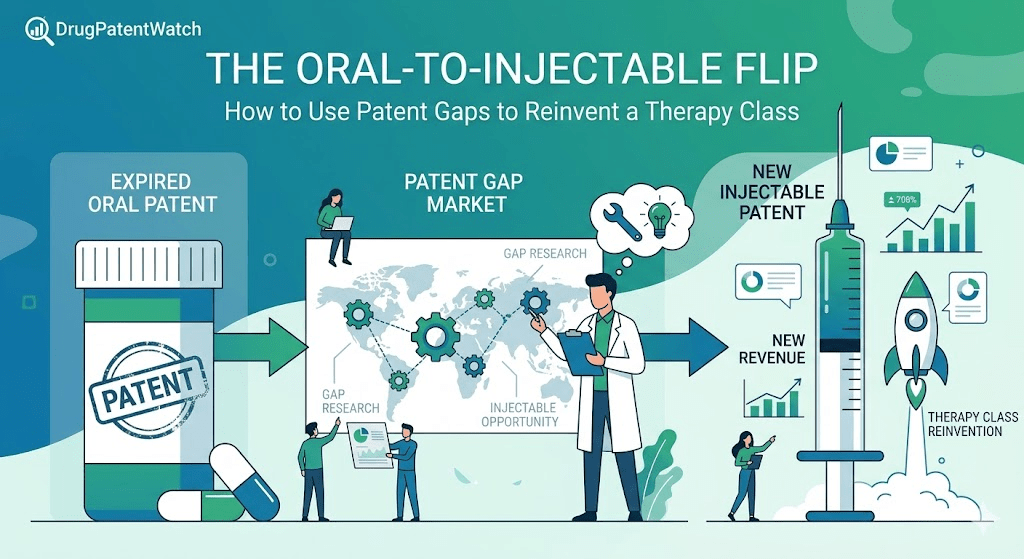
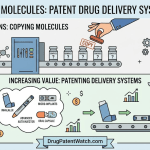
The compound is twenty years old. The molecule patent expires in eighteen months. Forty ANDA filers are lined up. The brand faces an 80% revenue drop within a year of first generic entry. That is the standard script.
What breaks the script is a route-of-administration switch. An oral drug, reformulated as a long-acting injectable (LAI) or subcutaneous depot, arrives at the FDA under a 505(b)(2) New Drug Application (NDA). It gets three to seven years of fresh regulatory exclusivity. It gets new Orange Book patents on formulation, device, and dosing regimen. And it clinically differentiates on the dimension that payers and health systems actually track: adherence.
This article maps the full strategy, from the patent gap identification stage through 505(b)(2) filing mechanics, Orange Book listing tactics, ANDA litigation playbooks, manufacturing exclusivity barriers, and loss-of-exclusivity (LOE) timelines, with case studies from antipsychotics, addiction medicine, oncology, rheumatology, and the GLP-1 class. It uses real patent numbers, real court cases, and real launch dates. The goal is a working framework for business development, IP counsel, and competitive intelligence teams who need to move faster than the generic filers watching the same calendar.
What Is the Oral-to-Injectable Strategy? A Working Definition
Short answer: The oral-to-injectable (O2I) strategy takes a known active pharmaceutical ingredient (API) whose compound patent has expired or is expiring, reformulates it into an injectable dosage form with meaningful clinical differentiation, and files a 505(b)(2) NDA that relies on existing safety and efficacy data for the reference listed drug (RLD). The resulting product gains new Orange Book patents and FDA regulatory exclusivity independent of the original compound protection.
The strategy is not evergreening in its crude form. Crude evergreening adds a polymer coating and claims a new dissolution profile. The O2I flip changes something structural about how the drug interacts with the patient and the healthcare system. A once-daily oral pill becomes a once-monthly injection given in a clinic. The clinical, payer, and operational differences are real, which is why the strategy survives regulatory scrutiny and, more importantly, physician adoption.
The underlying logic is straightforward: when a drug is taken orally, bioavailability varies, compliance is voluntary, and generic substitution at the pharmacy is automatic once the patent expires. When the same API is formulated into a PLGA microsphere or a palmitate prodrug designed for slow enzymatic release, the pharmacokinetics change, the clinical setting changes, and the manufacturing requirements change. None of those differences appear in a generic ANDA. A generic filer cannot simply point to oral bioequivalence data and claim substitutability.
The economic math is compelling. DrugPatentWatch estimates that a 505(b)(2) reformulation program costs between $8 million and $20 million to develop, while delivering three to seven years of new market exclusivity on a drug that may carry $500 million to $2 billion in annual revenue.[1] Revenue for a branded oral drug typically drops 80% to 90% within 12 months of first generic entry.[2] An injectable reformulation with a viable IP position extends the protected revenue curve by years.
How an Oral Drug Becomes an Injectable: The Chemistry of the Flip
The O2I flip takes several distinct technical forms, each with different patent implications:
Prodrug modification. The API is chemically modified into an inactive prodrug that is slowly converted back to the active form after injection. Janssen’s conversion of oral paliperidone (Invega) to paliperidone palmitate (Invega Sustenna) used exactly this mechanism. The palmitate ester is highly lipophilic, allowing slow dissolution from the intramuscular injection site, followed by enzymatic hydrolysis to free paliperidone. The prodrug itself is patentable as a new chemical entity under certain circumstances, or patentable at minimum as a novel composition of matter and formulation.
PLGA microsphere encapsulation. The API is encapsulated in biodegradable poly(lactide-co-glycolide) microspheres that release drug over weeks to months as the polymer degrades. Vivitrol (naltrexone) and Risperdal Consta (risperidone) use this platform. The microsphere particle size distribution, PLGA composition, and drug loading ratio are all independently patentable technical parameters. A generic developer cannot simply purchase naltrexone powder and PLGA and reproduce the release kinetics without extensive empirical optimization. As one published reverse-engineering study of Vivitrol noted, the microspheres incorporate naltrexone into a 75:25 polylactide-co-glycolide matrix at a concentration of 337 mg per gram of microspheres, a specification that took years and substantial capital to develop.[3]
Nanoparticle or nanosuspension formulations. The API is milled to nanoparticle size and formulated as a stable suspension. Invega Hafyera (paliperidone palmitate 1,092 mg/3.5 mL), approved in 2021 for once-every-six-months dosing, uses a nanosuspension of paliperidone palmitate crystals. Each step toward less frequent dosing generates new clinical data, new dosing regimen patents, and new competitive differentiation.
Subcutaneous autoinjector devices. The drug is formulated for subcutaneous self-injection using a proprietary autoinjector. Otrexup (methotrexate) replaced the oral tablet in rheumatoid arthritis patients who could not tolerate oral GI side effects, using the Vibex autoinjector. Patents on the device itself supplement formulation patents.
Why Patent Gaps Make the Timing Possible
The strategy only works when you read the patent gap correctly. The compound patent on most oral small molecules expires roughly 20 years after filing, typically 12 to 14 years after launch given typical drug development timelines. At expiration, the API becomes free for all. But the gap between compound patent expiration and the end of commercially viable brand revenues is not zero. It takes time for generics to gain formulary access. It takes time for physicians to switch long-tenured patients. During that gap, a company that has already filed a 505(b)(2) NDA for the injectable reformulation can receive FDA approval and Orange Book listing.
The timing target is the four-year pre-LOE window. A 505(b)(2) program initiated four years before anticipated LOE can produce an approved injectable product with its own exclusivity that is already generating revenue when the oral brand collapses. Rather than a cliff, the originator experiences a slope: oral revenues decline but injectable revenues grow, serving the same patient population with a genuinely differentiated product.
Patent surveillance tools like DrugPatentWatch allow IP teams to map the precise expiration dates of every Orange Book-listed patent on the oral RLD, track which Paragraph IV certifications have been filed, and model the likely timing of first generic entry. That timeline is the primary input for the O2I development decision.[4]
The 505(b)(2) Pathway: How Injectable Reformulations Get New Regulatory Exclusivity
Short answer: A 505(b)(2) NDA permits the applicant to rely on published safety and efficacy data for the reference listed drug rather than conducting full de novo clinical trials. For an oral-to-injectable switch, the applicant bridges from the existing safety database using pharmacokinetic bridging studies and targeted clinical studies demonstrating the new formulation’s performance. The FDA grants three years of New Clinical Investigation (NCI) exclusivity where new clinical investigations are essential to the approval, or five years of New Chemical Entity (NCE) exclusivity if the injection involves a new chemical entity such as a novel prodrug.
The 505(b)(2) pathway was created by the Hatch-Waxman Amendments of 1984 and codified at 21 U.S.C. § 355(b)(2). It occupies the space between a full NDA under 505(b)(1), which requires all safety and efficacy data to be generated by the applicant, and an ANDA under 505(j), which requires only bioequivalence data. By 2024, approximately 60% of all NDA approvals routed through 505(b)(2), with long-acting injectables representing one of the two remaining defensible niches after the simpler reformulations were competed away.[5]
Three-Year NCI Exclusivity vs. Five-Year NCE Exclusivity: What’s the Difference for Injectable Products?
Three-year NCI exclusivity applies when at least one new clinical investigation was essential to approval. For an oral-to-injectable switch, the pivotal pharmacokinetic study demonstrating that the injectable achieves therapeutically relevant plasma concentrations qualifies. For a paliperidone palmitate product, three-year exclusivity begins on the approval date and prohibits FDA from approving a duplicate ANDA for that period. Critically, Paragraph IV ANDA filers can still submit applications during the exclusivity period, they simply cannot receive final approval.
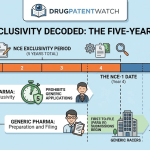
Five-year NCE exclusivity applies when the NDA contains an active moiety that has never been previously approved. Prodrug O2I switches can qualify. Aripiprazole lauroxil, the prodrug of aripiprazole that became Aristada, was treated as a new chemical entity for exclusivity purposes. Alkermes received NCE exclusivity with the 2015 approval, meaning generic filers could not even submit an ANDA until four years after approval, and could not receive approval until five years had elapsed. That five-year bar is far more valuable commercially than three-year NCI exclusivity and is the primary reason prodrug-based O2I switches carry premium valuations in business development transactions.
What Happens When Both a Compound Patent and NCE Exclusivity Exist on an Injectable?
For prodrug injectables, the NCE exclusivity on the new chemical entity (the prodrug itself) runs independently of any Orange Book patent. If the injectable prodrug was patented separately from the parent compound, the patent and exclusivity timelines are additive rather than overlapping. A company can hold NCE exclusivity expiring in year five, formulation patents expiring in year twelve, and dosing regimen patents expiring in year fifteen, each layer requiring a separate legal challenge for a generic to reach the market.
Orange Book Listing Strategy for Injectable Reformulations
Listing a patent in the Orange Book for an injectable NDA requires the patent to claim the drug product or a method of using the drug product. The listing triggers the 30-month automatic stay against ANDA approval when a generic filer submits a Paragraph IV certification. For injectable products, the following patent types are Orange Book eligible and tactically important:
Composition-of-matter patents on the prodrug or novel salt form
Formulation patents covering the microsphere composition, nanoparticle size range, PLGA ratio, or suspension vehicle
Device patents claiming the specific autoinjector or reconstitution kit when the device is integral to the approved drug product
Dosing regimen patents claiming the specific loading-dose and maintenance-dose schedule
Each separately listed patent generates a separate 30-month stay period upon a Paragraph IV challenge, and a generic filer must challenge all of them simultaneously or sequentially. A well-structured Orange Book listing for a complex injectable can require a generic challenger to litigate four to six independent patents across a multi-year period, a process that often resolves through settlement rather than trial.
The Dosing Regimen Patent: Invega Sustenna’s Last Line of Defense
U.S. Patent No. 9,439,906, titled ‘Dosing Regimen Associated with Long Acting Injectable Paliperidone Esters,’ illustrates how a dosing regimen patent can outlast all other IP protection on an injectable product. When Teva filed an ANDA for a generic version of Invega Sustenna, Janssen sued under this patent as the final remaining Orange Book-listed patent. The case was litigated in the United States District Court for the District of Delaware. The ‘906 patent claims the specific loading dose and maintenance dose schedule for paliperidone palmitate, not the molecule, not the microsphere, not the vehicle: just the regimen.[6] This is the pharmaceutical IP equivalent of patenting the instruction manual.
When Tolmar submitted ANDA No. 211995 seeking approval to market generic paliperidone palmitate injectable suspension and filed a Paragraph IV certification on the ‘906 patent, Janssen initiated patent infringement proceedings under 35 U.S.C. § 271(e)(2)(A), triggering the 30-month stay.[7] As of data available through DrugPatentWatch, the earliest estimated generic entry date for Invega Sustenna is January 26, 2031, reflecting the litigation-extended exclusivity runway.[8]
Case Study: Risperdal to Risperdal Consta: The Microsphere Blueprint
The Risperdal to Risperdal Consta transition is the foundational case study for the O2I strategy. Janssen, then a subsidiary of Johnson & Johnson, launched oral risperidone (Risperdal) in the United States in 1994. The molecule patent on risperidone, U.S. Patent No. 4,804,663, expired in December 2003, after which Janssen’s exclusive marketing rights for the oral formulation terminated the following June.[9] The generic entry into oral risperidone was complete and irreversible.
What Janssen had done years earlier, however, was develop Risperdal Consta, a biweekly intramuscular injection of risperidone formulated in PLGA microspheres. The active ingredient was the same. The clinical proposition was fundamentally different: a schizophrenia patient who takes an oral risperidone pill every day at home has a measured adherence rate well below what clinical trials achieve in controlled settings. A patient who receives a biweekly injection in a clinical setting is adherent by definition for the two-week duration.
Risperdal Consta received FDA approval in 2003. The PLGA microsphere formulation technology carried its own distinct patent coverage through Alkermes, which developed the Medisorb microsphere manufacturing technology. Alkermes licensed the technology to Janssen, collecting royalties while Janssen commercialized the product. This licensing structure meant that patents covering the microsphere process and composition were held by a separate entity from the NDA holder, complicating ANDA challenges that needed to address both Janssen’s Orange Book patents and potentially Alkermes’s manufacturing patents.
Why PLGA Microspheres Create Manufacturing Exclusivity Beyond the Patent
The PLGA microsphere barrier is not purely legal. Any generic developer seeking to reproduce Risperdal Consta or Vivitrol faces what FDA guidance documents describe as a ‘complex drug product’ challenge. The challenge is empirical: the relationship between PLGA molecular weight distribution, lactide-to-glycolide ratio, microsphere particle size distribution, drug loading ratio, and in vivo drug release kinetics cannot be derived from the label or from the patents. It requires extensive formulation development, in vitro dissolution testing, and ultimately pharmacokinetic studies in humans to demonstrate bioequivalence.[10]
FDA’s 2019 draft guidance for complex injectables under 505(j) requires generic developers to conduct comparative pharmacokinetic studies rather than relying on simple in vitro bioequivalence. This shifts the ANDA pathway for complex injectables much closer to an abbreviated NDA, with corresponding cost and timeline increases. The practical effect is that fewer generic developers attempt to enter the complex injectable space at all, and those that do require five to eight years from initiation to approval. By that time, the original product may have migrated its patient base to a next-generation formulation.
Oral Risperidone Patent Expiry Timeline vs. Risperdal Consta Exclusivity: A Case Comparison
1988 Risperidone compound patent (U.S. 4,804,663) filed by Janssen
1994 Oral Risperdal approved by FDA; commercial launch
2003 (September) FDA approves Risperdal Consta; Medisorb PLGA microsphere formulation patents in force
2003-2012 Risperdal Consta generates protected branded revenues during oral generic erosion period, demonstrating the financial logic of the O2I flip
The Risperdal Consta story had one significant commercial limitation that later O2I strategies corrected: the biweekly intramuscular injection required clinic administration and was described by patients and physicians as more painful than the gluteal injections that followed. Janssen acknowledged this in subsequent product design, which is why every later-generation antipsychotic injectable moved to monthly or longer dosing intervals and, where possible, to subcutaneous routes.
Case Study: Paliperidone (Invega) to Invega Sustenna to Invega Trinza to Invega Hafyera: Stacking Exclusivity by Extending Duration
The Invega franchise is the most sophisticated executed example of sequential O2I IP stacking in pharmaceutical history. Janssen took a single active metabolite, paliperidone, and built a decade-long protected revenue machine by extending the dosing interval at each generation.
Oral Invega (paliperidone) was approved in 2006 as an extended-release tablet using the OROS osmotic delivery system. The OROS technology itself carried independent formulation patents. When the compound and formulation patents on oral paliperidone faced expiration, Janssen had already received FDA approval for Invega Sustenna (paliperidone palmitate 1-monthly injectable) in 2009, based on a 505(b)(2) NDA that relied on the oral Invega safety database.
Invega Sustenna’s commercial peak revenues approached $2.2 billion annually within Janssen’s neuroscience division by 2022.[11] The product held four U.S. patents in the Orange Book, with twelve patent litigation cases filed by generic challengers and an estimated earliest generic entry date of January 26, 2031.[12] Of those twelve cases, Janssen prevailed in several, and the remaining were resolved through settlements granting delayed generic entry. The litigation was worth fighting: each year of delayed generic entry on a $2 billion product represents $2 billion in incremental brand revenue.
Invega Trinza and Invega Hafyera: How Duration Extension Generates New IP
Invega Trinza (paliperidone palmitate 3-monthly injectable) received FDA approval in 2015. Invega Hafyera (paliperidone palmitate 6-monthly injectable) received FDA approval in 2021. Each product required new clinical studies demonstrating adequate plasma concentration maintenance over the extended interval, which qualified each product for three-year NCI exclusivity. Each product received new Orange Book patents covering the formulation at the specific dosing interval and the loading dose requirements for patients transitioning from shorter-interval products.
The key insight is that the clinical differentiation at each step was real, not manufactured. Psychiatrists treating schizophrenia know that any reduction in injection frequency reduces the probability that patients miss an administration. A patient stabilized on once-monthly Invega Sustenna who transitions to once-every-three-months Invega Trinza has four fewer clinic visits per year. That matters to patients, caregivers, and health systems. The IP stacking and the clinical value creation are genuinely aligned.
What the Invega Franchise Teaches About Sequential NDA Filing Strategy
The Invega franchise demonstrates a principle that DrugPatentWatch’s patent landscape analyses consistently identify in the most commercially durable O2I programs: file the next-generation NDA before the current product’s exclusivity expires. Invega Trinza’s FDA approval in 2015 occurred while Invega Sustenna was still building revenue and before its first Paragraph IV challenge had resolved. Invega Hafyera was in clinical development while Invega Trinza was growing. At each step, there was a next-generation product in the regulatory pipeline that raised the bar for generic entry and maintained patient migration away from expiring formulations.
Case Study: Oral Naltrexone (ReVia) to Vivitrol: Addiction Medicine’s PLGA Transformation
Oral naltrexone for alcohol and opioid dependence has been available as a generic since the mid-1990s. Adherence to daily oral naltrexone in real-world addiction treatment settings is poor, with multiple studies documenting discontinuation rates exceeding 50% within the first month of treatment. The clinical rationale for a monthly injectable version was therefore not incremental: it was structural. A patient who cannot be trusted to take a daily pill can receive a once-monthly injection, and adherence is no longer a variable.
Alkermes developed Vivitrol using its proprietary Medisorb PLGA microsphere technology, the same platform it had licensed to Janssen for Risperdal Consta. Vivitrol (naltrexone for extended-release injectable suspension) was approved by FDA for alcohol dependence in April 2006, and the indication was expanded to include opioid dependence prevention in October 2010. The product uses a 75:25 PLGA polymer matrix encapsulating 380 mg of naltrexone per vial.[13]
Vivitrol Patent Strategy: U.S. Patent No. 7,919,499 and the 2023 Teva Settlement
The primary Orange Book-listed patent for Vivitrol was U.S. Patent No. 7,919,499, which expires in 2029. When Teva submitted ANDA No. 213195 seeking approval to market a generic version of Vivitrol and filed a Paragraph IV certification against the ‘499 patent, Alkermes initiated patent infringement litigation in the U.S. District Court for the District of New Jersey in September 2020.[14]
The parties completed a trial in March 2023. Before a decision was rendered, Alkermes and Teva entered a settlement agreement announced August 30, 2023. Under the settlement, Alkermes granted Teva a license under the ‘499 patent to market a generic version of Vivitrol beginning January 15, 2027, or earlier under certain specified circumstances.[15] The settlement was submitted for review to the Federal Trade Commission and the Department of Justice per standard Hatch-Waxman settlement procedures.
The commercial arithmetic is instructive. Vivitrol generated approximately $523 million in manufacturing and royalty revenue for Alkermes in fiscal 2023.[16] A generic entry in January 2027 represents roughly four years of continued protected revenue after the trial concluded without a judgment, bought through settlement rather than litigation risk.
Why Compounding and Manufacturing Complexity Sustains Vivitrol Pricing
Even after the ‘499 patent expires and Teva’s licensed generic enters the market in 2027, Vivitrol will face a more limited competitive erosion than a typical small-molecule oral generic entry. PLGA microsphere manufacturing requires specialized equipment, validated spray-drying or solvent-extraction processes, and stringent particle size control. Only a small number of contract development and manufacturing organizations globally have the capability to produce PLGA microspheres at commercial scale for injectable use.
‘FDA proposed the Drug Competition Action Plan in June 2017 specifically acknowledging that complex injectables present an extraordinary barrier to generic entry: of more than 30 years of clinical use of PLGA-based microspheres, only 12 PLGA-based microsphere formulations have been approved by the FDA as of 2021, which signals the difficulty in developing such a product.’ [3]Molecules, 2021, reviewing Vivitrol reverse-engineering challenges
Teva’s licensed generic will require its own manufacturing validation and pharmacokinetic studies. The market entry will be real, but the price discount and speed of brand erosion will be slower than for a simple oral tablet, because the delivery system complexity does not disappear upon patent expiration.
Case Study: Oral Aripiprazole (Abilify) to Aristada: The Prodrug Approach to NCE Exclusivity
Aripiprazole (Abilify), developed by Otsuka and commercialized in the United States in partnership with Bristol-Myers Squibb, was one of the top-grossing drugs in pharmaceutical history before oral generics entered the market in 2015. The compound was well-characterized, widely used for schizophrenia and bipolar disorder, and faced certain generic erosion.
Alkermes developed aripiprazole lauroxil, a chemical modification of aripiprazole wherein a lauroyl ester is attached to the free hydroxyl group of aripiprazole. Lauroxil is a prodrug: after intramuscular injection, it undergoes enzymatic hydrolysis at the injection site and in systemic circulation to release free aripiprazole over an extended period. Because aripiprazole lauroxil had never been previously approved, it qualified as a new chemical entity for FDA exclusivity purposes.
Aristada’s 505(b)(2) Filing: How NCE Status Changed the IP Timeline
Alkermes filed a 505(b)(2) NDA for Aristada, relying on FDA’s extensive safety and effectiveness findings for oral Abilify as the reference listed drug. This reliance significantly reduced the clinical development burden: Alkermes did not need to re-establish the antipsychotic efficacy of aripiprazole; it needed to demonstrate that the lauroxil prodrug achieved therapeutically relevant aripiprazole plasma concentrations over the intended dosing interval.[17]
FDA approved Aristada in October 2015. Because aripiprazole lauroxil was a new chemical entity, the five-year NCE exclusivity applied. ANDA filers could not submit applications until October 2019 (NCE-1), and could not receive approval until October 2020. Compound this with the formulation patents on the nanocrystalline aripiprazole lauroxil suspension, and the effective exclusivity runway extended well beyond the five-year minimum.
Alkermes subsequently developed Aristada Initio, a separate injectable formulation containing aripiprazole lauroxil in a concentrated form for rapid initiation of therapy, designed to achieve therapeutic levels on day one and permit the regular Aristada injection on day one rather than requiring an oral aripiprazole bridge. Aristada Initio received FDA approval in 2018, generating a new round of NCI exclusivity and additional Orange Book listings. Total Aristada franchise revenues for Alkermes reached approximately $919 million in fiscal 2023 and grew to over $1.15 billion in fiscal 2024.[18]
Abilify Maintena vs. Aristada: Competing O2I Strategies on the Same Molecule
The Abilify situation produced a particularly unusual competitive dynamic: two separate companies executed O2I strategies on the same active moiety using different chemical approaches.
Otsuka, the original developer of aripiprazole, developed Abilify Maintena, an extended-release injectable suspension of aripiprazole monohydrate administered monthly. It received FDA approval in February 2013, preceding the oral generic entry and establishing a protected injectable revenue stream for the originator. Abilify Maintena uses a nanocrystalline aripiprazole suspension rather than a prodrug, meaning it did not qualify for NCE exclusivity, but it received NCI exclusivity and Orange Book patents on the formulation and manufacturing process.
Alkermes developed Aristada using the prodrug approach, which produced a distinct chemical entity with NCE protection. The result was two branded LAI aripiprazole products competing with each other rather than with oral generics, while oral aripiprazole had already become a commodity.
Feature
Abilify Maintena (Otsuka)
Aristada (Alkermes)
Active ingredient
Aripiprazole monohydrate
Aripiprazole lauroxil (prodrug)
FDA approval
February 2013
October 2015
Exclusivity type
NCI (3-year)
NCE (5-year)
Dosing interval
Monthly
Monthly, 6-weekly, or 8-weekly
505(b)(2) RLD
Oral Abilify (aripiprazole)
Oral Abilify (aripiprazole)
Patent coverage
Formulation, manufacturing process
Prodrug composition, formulation, dosing
2023 ANDA status
Multiple Paragraph IV challenges filed
ANDA submissions post-NCE-1
In April 2023, FDA also approved Abilify Asimtufii, a once-every-two-months LAI aripiprazole product developed by Otsuka and Lundbeck, making it the first 2-month LAI indicated for both schizophrenia and maintenance treatment of bipolar I disorder.[19] Each new dosing interval generates new clinical data, new dosing regimen patents, and new regulatory exclusivity, demonstrating that the O2I stacking logic on a single molecule can continue for over a decade.
Case Study: Oral Methotrexate to Otrexup and Rasuvo: Subcutaneous Autoinjectors in Rheumatology
Oral methotrexate for rheumatoid arthritis and psoriasis has been generic for decades. Absolute bioavailability of oral methotrexate is variable and decreases at higher doses due to saturable gastrointestinal absorption, which limits the dose many patients can effectively receive. Subcutaneous methotrexate consistently achieves higher plasma exposures at equivalent doses, which translates to better clinical outcomes in patients who fail to respond to oral therapy.
Two companies saw the O2I opportunity in methotrexate and pursued it through competing 505(b)(2) NDAs.
Antares Pharma (now Halozyme) developed Otrexup, a prefilled autoinjector delivering subcutaneous methotrexate. The Vibex autoinjector platform provided the device patents independent of the drug formulation. Otrexup received FDA approval on October 14, 2013. Because the subcutaneous methotrexate formulation qualified as a novel dosage form, Antares received three years of NCI exclusivity.[20] Additional patents on the Vibex autoinjector provided supplementary IP coverage extending beyond the NCI period.
Medac GmbH, a German specialty pharma company, developed Rasuvo, a single-dose prefilled injector with the broadest dosing range of any subcutaneous methotrexate product: 7.5 mg through 30 mg in 2.5 mg increments. Rasuvo filed a competing 505(b)(2) NDA using a different autoinjector platform (Becton-Dickinson), specifically designed to avoid Antares’s Vibex device patents. FDA approved Rasuvo in July 2014. Medexus subsequently acquired Rasuvo, which carries patent protection with an estimated earliest generic entry of June 1, 2029.[21]
What the Methotrexate O2I Cases Teach About Device Patent Independence
The Otrexup-Rasuvo competition illustrates a critical structural feature of O2I strategies involving autoinjectors: the device patent is independent of the drug formulation patent. A generic developer who designs around the Vibex autoinjector is not blocked by Antares’s device patents, but must develop and validate an entirely separate delivery mechanism. This raises the development cost and timeline for generic entry without requiring the brand holder to prove infringement of a drug composition patent.
Subcutaneous drug formulations with proprietary delivery devices therefore generate two separate IP barriers: a 30-month stay from Orange Book-listed drug patents, and a separate potential infringement claim under non-Orange-Book device patents that can be asserted in district court under 35 U.S.C. § 271(a) outside the Hatch-Waxman framework.
Oral Methotrexate vs. Injectable: What the Clinical Data Shows and Why It Matters for Payer Coverage
The bioavailability advantage of subcutaneous over oral methotrexate is documented in peer-reviewed comparative studies. Subcutaneous methotrexate shows superior or equivalent outcomes in rheumatoid arthritis patients who have failed to achieve adequate response on oral therapy. This creates a payer-recognized clinical differentiation that justifies prior authorization requirements for the subcutaneous form in patients who have documented oral tolerance issues.
The commercial implication is real: subcutaneous methotrexate products do not compete with oral generic methotrexate on price. They compete on clinical positioning as a step before biologic therapy. At the step-therapy position just before very expensive biologics, payers are willing to pay premium pricing for subcutaneous methotrexate if it keeps patients off biologics for additional months or years. This commercial dynamic is entirely a product of the O2I route change, not of any chemical innovation in the molecule itself.
Semaglutide: When the Injectable Precedes the Oral, and the Patent Strategy Runs in Reverse
The GLP-1 receptor agonist class presents the most commercially significant inversion of the standard O2I pattern. Novo Nordisk developed semaglutide as an injectable first: Ozempic (semaglutide 0.5 mg, 1 mg, and 2 mg weekly subcutaneous injection) was approved for type 2 diabetes in December 2017, and Wegovy (semaglutide 2.4 mg weekly subcutaneous injection) was approved for obesity in June 2021.
Novo Nordisk subsequently developed oral semaglutide using its SNAC (sodium N-[8-(2-hydroxybenzoyl) amino] caprylate) absorption enhancer technology. Rybelsus (oral semaglutide 3 mg, 7 mg, 14 mg) was approved in September 2019 for type 2 diabetes, making it the first oral GLP-1 receptor agonist approved by FDA.
In December 2025, FDA approved Wegovy pill (oral semaglutide 25 mg) for weight management, extending the Wegovy brand from the injectable to the oral formulation.[22] This reversal of the O2I direction, what might be called an injectable-to-oral (I2O) migration for the obesity indication, reflects a different kind of IP and commercial logic. The oral formulation was developed after the injectable had achieved multi-billion-dollar revenues. The oral product extends the franchise to patients who cannot or will not self-inject, broadens the addressable market, and generates new IP through the SNAC oral absorption technology.
Semaglutide Patent Architecture: How Novo Nordisk Separated the Molecule from the Delivery System
Novo Nordisk’s semaglutide patent strategy is layered precisely to insulate each formulation from the others’ expiry. The semaglutide peptide sequence carries compound patents separate from the Ozempic pen device patents, separate from the SNAC oral absorption technology patents for Rybelsus, and separate from the Wegovy 2.4 mg dosing and obesity indication patents. Each formulation and indication can theoretically reach loss of exclusivity at a different time.
The practical consequence for generic and biosimilar developers is that semaglutide cannot be attacked as a single patent portfolio. An ANDA for a generic oral semaglutide tablet must address the SNAC formulation patents and any NCI exclusivity from the SOUL cardiovascular outcomes trial data that Novo Nordisk has been pursuing as a label expansion for Rybelsus.[23] A biosimilar for injectable semaglutide must address biological product exclusivity under the Biologics Price Competition and Innovation Act (BPCIA) as well as the device patents on the delivery pen.
Compounded Semaglutide: The Unauthorized O2I That Disrupted Novo Nordisk’s Revenue Model
The most unusual competitive dynamic in the semaglutide franchise is not from a licensed generic or authorized biosimilar, but from compounding pharmacies. During a period when FDA listed injectable semaglutide on its drug shortage list, compounding pharmacies were legally permitted to compound semaglutide without Novo Nordisk’s authorization. Novo Nordisk’s own market research, cited in its Q2 2025 investor communications, described ‘unsafe and unlawful mass compounding’ of semaglutide continuing even after FDA removed injectable semaglutide from the shortage list in February 2025.[24]
The commercial impact was measurable: compounded GLP-1 volumes depressed the uptake of branded Wegovy prescriptions in the cash channel. Novo Nordisk responded with litigation against multiple entities marketing compounded semaglutide and with the launch of NovoCare Pharmacy, a direct-to-patient channel designed to compete with telehealth companies dispensing compounded alternatives. The episode demonstrates that the O2I strategy’s IP protection is only as durable as regulatory enforcement of the restrictions on unauthorized copying.
How to Identify Oral-to-Injectable Opportunities: A Patent Gap Analysis Framework
Finding the right O2I candidate requires a structured process. The following framework combines patent data, clinical evidence, and commercial modeling.
The O2I strategy is most defensible where oral adherence failure is independently documented as a clinical problem. Therapeutic areas with strong adherence failure data include:
Schizophrenia and bipolar disorder (oral antipsychotic discontinuation rates exceed 70% in naturalistic studies within 18 months)
Opioid and alcohol use disorder (oral naltrexone adherence below 50% within one month in addiction treatment settings)
HIV treatment (documented viral load rebound from missed doses)
Rheumatoid arthritis (oral methotrexate GI intolerance rates of 15-30% leading to dose reduction or discontinuation)
Type 2 diabetes and obesity (oral GLP-1 receptor agonists require specific administration conditions that reduce real-world effectiveness vs. injectable equivalents)
Where payers have already quantified the cost of non-adherence in a therapeutic area, they are more likely to cover the injectable reformulation at premium pricing. This is not speculative: Medicaid and commercial payer data on schizophrenia relapse hospitalization costs have been used directly in Invega Sustenna and Aristada health economics models that justified formulary positioning.
Step 2: Map the Orange Book Patent Landscape Using DrugPatentWatch
A complete O2I candidate assessment requires mapping all Orange Book-listed patents on the oral RLD, identifying which patents face active Paragraph IV challenges, which have already been adjudicated or settled, and when each expires. DrugPatentWatch provides this data in structured form for all FDA-approved oral drugs, including patent expiry dates, ANDA filing histories, and litigation case summaries.[4]
The target LOE date for the oral RLD is the input to the O2I development timeline. Working backward from estimated oral LOE, the program initiation date for a 505(b)(2) injectable NDA should be four to five years prior to projected generic entry. This provides sufficient time for formulation development, manufacturing scale-up, PK bridging studies, FDA review, and commercial launch preparation before the oral revenue begins to erode.
Step 3: Assess Whether a New Chemical Entity or Novel Formulation Approach Is Available
The binary decision between a prodrug approach (targeting NCE exclusivity) and a formulation approach (targeting NCI exclusivity) is the most commercially significant technical choice in O2I program design. NCE exclusivity provides five years versus three years, and the NCE-1 filing restriction means generic challengers cannot submit ANDAs for four years from approval. For a drug with $500 million in annual injectable revenues, the difference between three-year and five-year exclusivity is roughly $1 billion in protected revenues at risk.
Not all APIs are amenable to prodrug modification. The parent API must have an accessible functional group (typically a hydroxyl, amine, or carboxyl) for prodrug esterification, and the resulting prodrug must be clinically active through reliable in vivo hydrolysis. Paliperidone palmitate and aripiprazole lauroxil both work because the parent drugs carry accessible hydroxyl groups that form stable, slowly-hydrolyzed esters at the injection site.
Step 4: Evaluate the CMC Barrier and Manufacturing Exclusivity
The manufacturing complexity of the injectable formulation is a second-order IP asset. A generic developer who successfully invalidates all Orange Book patents can still face a five-to-eight-year manufacturing development timeline for complex injectables. This ‘practical exclusivity’ from CMC complexity adds commercially significant protection beyond legal exclusivity periods.
PLGA microsphere products, nanocrystalline suspensions, and implantable depot systems all carry high CMC barriers. Simple aqueous suspensions for subcutaneous injection, like many early insulin analogs, have low CMC barriers and face faster generic development. The higher the CMC barrier, the more defensible the injectable franchise against non-prodrug O2I challengers.
CMC Complexity Rating by Injectable Platform Type
Platform
CMC Barrier
Generic Development Timeline (Est.)
Example Products
PLGA microspheres
Very High
5-8 years
Vivitrol, Risperdal Consta
Prodrug nanocrystalline suspension
High
4-6 years
Invega Sustenna, Aristada
Lipid-based nanoparticle
High
4-7 years
Emerging LAI platforms
Implantable rod/pellet
High
5-8 years
Sublocade (buprenorphine)
Autoinjector prefilled syringe (simple solution)
Moderate
3-4 years
Otrexup, Rasuvo
Standard intramuscular suspension
Low-Moderate
2-4 years
Basic depot antipsychotics
Paragraph IV Litigation Playbooks for Injectable Reformulations
When a generic developer files a Paragraph IV certification against an O2I injectable product, the litigation that follows differs from oral drug patent disputes in several technically important respects.
How Paragraph IV Certifications Work Against Injectable Orange Book Patents
A Paragraph IV certification is a formal statement, filed as part of an ANDA under 21 U.S.C. § 355(j)(2)(A)(vii)(IV), asserting that a listed patent is invalid, unenforceable, or will not be infringed by the proposed generic product. Filing a Paragraph IV certification on an Orange Book patent triggers a patent infringement action under 35 U.S.C. § 271(e)(2), which in turn triggers a 30-month automatic stay preventing FDA from approving the ANDA while the parties litigate.
For injectable products with multiple Orange Book patents, a generic filer must certify against every listed patent. Each patent certification triggers a separate cause of action in the NDA holder’s infringement complaint. The district court must adjudicate each asserted patent on its merits. In a complex injectable case with four Orange Book patents covering composition, formulation, device, and dosing regimen, the litigation becomes effectively four separate patent trials, often handled simultaneously but with distinct fact patterns for each patent.
Invalidity Challenges Against Formulation and Dosing Regimen Patents
Generic challengers targeting injectable O2I products have developed specific invalidity theories for each patent type:
Against formulation patents, the primary challenge is obviousness under 35 U.S.C. § 103. The generic challenger argues that a person of ordinary skill in the art (POSITA) would have been motivated to combine known polymer chemistry with the known API using standard microsphere or nanoparticle preparation techniques, with a reasonable expectation of success. The strength of this argument depends on what prior art existed at the time of the formulation patent’s priority date and whether the clinical performance of the injectable (extended half-life, therapeutic plasma concentrations) was predictable from that prior art.
Against dosing regimen patents, the standard challenge argues that the regimen itself is a method of medical treatment that involves physician judgment, and that such a method is not patent-eligible under 35 U.S.C. § 101 under the Mayo/Alice framework as a natural relationship or abstract idea. The Invega Sustenna dosing regimen patent litigation was closely watched because the ‘906 patent claims a specific loading-dose-and-maintenance-dose schedule, a type of claim that several courts have found patent-eligible as a new and specific application of an otherwise known principle.
Settlement Economics in Injectable Patent Disputes
Most O2I injectable patent litigation resolves through settlement before or shortly after trial. The economics favor settlement for both parties when the injector holds a strong Orange Book position: a favorable settlement grants the generic a fixed future entry date, eliminating litigation risk. For the brand, a settlement that delays generic entry by three to five years, relative to what litigation risk suggests might happen at trial, justifies the settlement premium.
The FTC reviews all Hatch-Waxman settlements under the Actavis framework established by the Supreme Court in 2013. A ‘reverse payment’ settlement in which the brand pays the generic to delay entry is presumptively anticompetitive and subject to rule-of-reason analysis. Settlements that simply grant a future license date without payment are generally permissible. Most injectable product settlements fall into the licensed-entry-date category, as the Alkermes-Teva Vivitrol settlement illustrated: a January 2027 license date granted without disclosed payment consideration.[15]
The First-Filer Advantage: 180-Day Exclusivity for Generic Complex Injectables
Under Hatch-Waxman, the first ANDA filer to submit a Paragraph IV certification on a given patent is entitled to 180 days of generic marketing exclusivity before any subsequent filer can launch. For oral small molecules, this exclusivity is intensely competed for. For complex injectables, the first-filer exclusivity is both valuable and problematic: the 180-day period begins to run from the first commercial marketing of the generic, but the manufacturing complexity of PLGA or nanocrystalline injectable products means the first-filer often takes years longer than anticipated to actually launch, potentially forfeiting the exclusivity period or triggering failure-to-market forfeiture provisions under 21 U.S.C. § 355(j)(5)(D).
Manufacturing and Supply Chain Exclusivity: The Non-Patent Barrier
The most underappreciated competitive moat in the O2I strategy is manufacturing exclusivity. This is not a legal concept. It is a practical barrier arising from the specialized equipment, validated processes, and experienced workforce required to produce complex injectable formulations at commercial scale.
Why Generic PLGA Injectable Manufacturers Face a Decade of Development Time
A generic developer seeking to reproduce a PLGA microsphere injectable faces sequential development challenges, each of which is independently time-consuming:
First, the PLGA polymer specifications. PLGA is not a single compound; it is a family of co-polymers with a range of lactide:glycolide ratios, molecular weight distributions, and end-group chemistries. The specific PLGA grade that produces the correct release kinetics for a given drug loading is determined empirically. The developer cannot start with the brand product label, which says ’75:25 polylactide-co-glycolide’ and simply purchase that grade; the polymer must be characterized and the release kinetics validated against the reference product.
Second, the manufacturing process. PLGA microspheres are produced by solvent evaporation, spray drying, or similar process technologies. Each process has dozens of critical process parameters (CPPs) that affect particle size distribution, drug loading uniformity, and release rate. A change in any CPP requires re-validation of the in vitro release profile and potentially in vivo bioequivalence studies in humans.
Third, the analytical methods. Measuring in vitro drug release from microspheres requires specialized dissolution apparatus and methods. FDA guidance requires generic PLGA products to demonstrate adequate in vitro-in vivo correlation before in vivo bioequivalence studies can be conducted. Developing validated analytical methods for PLGA release testing alone can take one to two years.
Supply Chain Concentration Risk in LAI Antipsychotics: What Happens When One Manufacturer Stumbles
The manufacturing complexity of injectable O2I products creates supply concentration risk that regulators and payers have increasingly monitored. Risperdal Consta and Vivitrol both depend on Alkermes’s PLGA microsphere manufacturing facilities. A manufacturing shutdown at those facilities would have no immediate generic substitute available, because the regulatory barriers to generic approval and the manufacturing barriers to production are both unresolved for most PLGA drugs.
This supply concentration dynamic has caused FDA to expedite review of some complex injectable generic applications to increase supply security for critical-use medications. For schizophrenia LAIs, the FDA Complex Drug Substances program has published specific product development guidance to lower the technical barrier to generic development, representing a regulatory acknowledgment that the manufacturing exclusivity problem, while commercially beneficial to brand holders, creates public health risks when supply is threatened.
What This Means for Branded Oral Drug Companies Facing LOE in 2025-2030
Pharmaceutical manufacturers face a revenue contraction of 62% from their top-selling assets by 2030, with blockbuster drugs representing $236 billion in annual global revenue approaching patent expiration.[1] The O2I strategy is one of three defensible lifecycle management approaches for companies facing this cliff; the others are indication expansion and fixed-dose combination development.
The Four-Year Pre-LOE Window: When to Start the O2I Program
Standard project timelines for a 505(b)(2) injectable NDA from program initiation to approval run four to six years for a moderately complex formulation. That means for a drug with projected oral LOE in 2028, the injectable O2I program must have commenced formulation work no later than 2023 or 2024. Companies that identify the opportunity after the LOE date is already within two to three years face a timing problem: the injectable product will launch after the oral brand has already experienced generic entry, limiting the patient migration opportunity.
The optimal scenario is the one Janssen executed with paliperidone: the injectable reformulation is approved and commercially launched before the oral brand reaches LOE, allowing the commercial team to migrate patients proactively rather than reactively. The Invega Sustenna approval in 2009, three years before significant oral paliperidone LOE pressure materialized, gave Janssen’s field force time to establish prescribing habits for the injectable formulation that persisted through the oral LOE transition.
What the IRA Interaction Means for Injectable LOE Strategy Post-2026
The Inflation Reduction Act (IRA) Medicare price negotiation provisions, which took effect in 2026, create a new variable in O2I strategy modeling. Under the IRA, small-molecule drugs become eligible for Medicare price negotiation nine years after initial approval, and biologics become eligible thirteen years after initial approval. This creates an incentive for companies to develop biologic or large-molecule injectable alternatives to oral small molecules: the eleven-year negotiation exclusivity window for small-molecule injectables (injectable small molecules are still small molecules for IRA purposes) is shorter than the thirteen-year window for biologics.
For companies considering O2I programs using PLGA microsphere small molecules, the IRA timeline means the injectable franchise may face mandatory price negotiation at a date that compresses the commercial return. Strategic advisors at several major pharmaceutical companies have noted that the IRA price negotiation eligibility date must now be included as a variable in the net present value models for injectable 505(b)(2) programs, not as a minor adjustment but as a primary commercial risk factor.
Forecast: Which Therapy Classes Are Next for O2I Disruption?
Based on the combination of patent gap analysis, documented adherence failure data, and existing formulation technology, several therapy classes are active areas for O2I program development through 2030:
HIV treatment. Long-acting injectables for HIV preexposure prophylaxis (PrEP) and antiretroviral therapy (ART) are already in development. Cabenuva (cabotegravir plus rilpivirine injectable) received FDA approval in January 2021 as the first complete long-acting injectable HIV treatment regimen. As oral ART generic landscapes evolve, O2I programs for integrase inhibitors and other oral HIV drugs are commercially attractive candidates.
Multiple sclerosis. Oral disease-modifying therapies for multiple sclerosis face patent expirations across several agents. Subcutaneous or intramuscular depot formulations of oral MS drugs, if they could demonstrate the adherence advantage documented in psychiatry, would find receptive payer environments. The technology challenge is formulating large, complex oral MS molecules like siponimod or ozanimod for injectable delivery.
CGRP antagonists for migraine. Oral CGRP antagonists (gepants) approved for acute and preventive migraine treatment represent a near-term O2I opportunity as those compound patents approach expiration. Injectable CGRP monoclonal antibodies (erenumab, fremanezumab, galcanezumab) already demonstrated the value of injectables in migraine prophylaxis; the same adherence rationale applies to small-molecule oral gepants if reformulated as depot injectables.
GLP-1 receptor agonists beyond semaglutide. As the GLP-1 class matures and individual compound patents expire, O2I strategies converting oral GLP-1 agonists to long-acting injectables, or vice versa as Novo Nordisk demonstrated, will intensify. The SNAC oral absorption technology patents themselves are potential O2I barriers for competitors seeking to develop oral formulations of injectable GLP-1 APIs.
Evergreening vs. Genuine Innovation: The Regulatory and Commercial Distinction
The O2I strategy sits in contested legal and commercial territory. Critics, including FTC economists and academic pharmacoeconomists, characterize injectable reformulations of expired oral drugs as a form of evergreening: IP manipulation that extends brand revenues without proportionate patient benefit. The pharmaceutical industry’s counter-argument is that the clinical benefit of improved adherence is real, measurable, and often substantial.
FDA’s Current Position on Route-of-Administration Switches as Clinical Innovation
FDA has consistently treated route-of-administration switches as potentially clinically meaningful innovations that warrant 505(b)(2) review and are eligible for the full range of regulatory exclusivities. The agency’s position is grounded in the observation that bioavailability, pharmacokinetics, and safety profiles can differ substantially between oral and injectable formulations of the same API, requiring independent evaluation of the injectable product rather than simple reliance on the oral database.
FDA’s 2020 guidance on 505(b)(2) NDAs for complex injectables requires applicants to demonstrate that the injectable formulation achieves and maintains therapeutically relevant plasma concentrations, tolerability at the injection site, and appropriate bridging from the oral safety database. This is a meaningful regulatory standard that distinguishes genuine route-of-administration reformulations from minimal-change label updates designed solely to extend exclusivity.
The Payer Perspective: When Injectable Reformulations Justify Premium Pricing
Commercial and government payers apply two tests to injectable reformulation coverage decisions: first, does the injectable demonstrate clinically superior outcomes in the target population compared to the oral formulation? Second, does the clinical superiority justify the price differential?
For LAI antipsychotics, the answer to the first question is well-supported: multiple randomized controlled trials and observational studies document lower relapse rates and hospitalization rates in patients treated with LAI versus oral antipsychotics, particularly in patients with documented adherence challenges. Health technology assessment bodies in Europe and the United States have formally recognized this clinical advantage in coverage decisions and treatment guidelines.
For subcutaneous autoinjector formulations of generic oral drugs, the answer is more nuanced. Otrexup and Rasuvo justify premium pricing primarily in patients who have failed or cannot tolerate oral methotrexate due to gastrointestinal side effects. In patients who can tolerate oral methotrexate, payers typically require step therapy through oral formulations before approving subcutaneous versions. This step-therapy requirement limits the addressable market but does not eliminate it.
Sublocade and Long-Acting Buprenorphine: The Next O2I Frontier in Opioid Use Disorder
Buprenorphine has been available as a sublingual tablet (Subutex) and sublingual/buccal film (Suboxone, with naloxone) since the mid-2000s. Both products are now widely available as generics. The adherence problem with oral buprenorphine is structurally different from antipsychotics: the drug must be administered daily or multiple times daily, the film must dissolve under the tongue for adequate absorption, and patients in active opioid use disorder often have chaotic medication-taking patterns. These characteristics make buprenorphine a strong O2I candidate.
Indivior developed Sublocade (buprenorphine extended-release injection), a subcutaneous depot product approved by FDA in November 2017. Sublocade uses the ATRIGEL delivery system, a proprietary biodegradable PLGA polymer solution that is liquid at room temperature and solidifies upon subcutaneous injection, releasing buprenorphine over approximately one month. The ATRIGEL technology is licensed from Tolmar and carries independent manufacturing and formulation patents separate from Indivior’s NDA-specific IP.
Braeburn Pharmaceuticals developed Brixelle (buprenorphine implant), a subdermal rod implant approved in May 2016 providing continuous buprenorphine delivery for six months. Brixelle represents the most extreme O2I conversion in addiction medicine: from a daily sublingual film to a six-month implant, eliminating patient medication adherence as a variable for the implant duration. The physical implantation procedure, performed under local anesthesia in a clinical setting, restricts the prescriber base to trained providers, which is itself a commercial and regulatory gatekeeping mechanism for generic substitution.
Why Addiction Medicine Is the Most Defensible O2I Therapeutic Area
Generic challengers for addiction medicine O2I products face higher hurdles than in psychiatry or rheumatology. FDA’s 2020 product-specific guidance for buprenorphine extended-release injectable products requires in vivo pharmacokinetic bioequivalence studies rather than in vitro dissolution testing alone, reflecting the complex release kinetics of ATRIGEL and similar depot systems. Clinical trials for bioequivalence in opioid use disorder populations add years and millions to the generic development timeline beyond the manufacturing challenge.
Prescriber infrastructure compounds this. Sublocade and Brixelle both require certified prescribers and specific Risk Evaluation and Mitigation Strategy (REMS) programs. A generic buprenorphine extended-release injection cannot be dispensed through standard retail pharmacy channels. Medicaid and commercial payers reimburse LAI buprenorphine through medical benefit codes rather than pharmacy benefits in many states, removing the drug from standard formulary substitution mechanics. These system-level barriers sustain injectable buprenorphine pricing power for years beyond patent expiration.
HIV Long-Acting Injectables: Cabenuva, Lenacapavir, and the Emerging O2I Wave
ViiV Healthcare and Janssen jointly developed Cabenuva (cabotegravir 600 mg plus rilpivirine 900 mg), a two-drug, two-injection HIV treatment regimen administered once monthly or once every two months. FDA approved Cabenuva in January 2021 as the first complete long-acting injectable HIV treatment regimen.
The O2I commercial logic for HIV differs from psychiatry or addiction medicine. HIV patients on effective oral antiretroviral therapy typically maintain viral suppression and do not exhibit the same acute adherence failure rates as schizophrenia or addiction patients. The value proposition for Cabenuva is lifestyle-based: eliminating daily pill-taking for a condition that carries stigma, particularly among younger patients or those in relationships where HIV status is not disclosed. This lifestyle adherence rationale translates differently in payer coverage decisions than clinical adherence improvement data, requiring more extensive health economics modeling to justify coverage.
The patent architecture for Cabenuva involves two separate NDA holders’ patent portfolios, ViiV for cabotegravir and Janssen for rilpivirine, each with Orange Book listings for their respective injectable formulations and dosing regimens. Generic challengers must simultaneously address two independent portfolios from two separate companies. No precedent directly governs this multi-party Orange Book scenario, and the litigation dynamics, if Paragraph IV certifications are eventually filed, will require courts to address coordination between two separate infringement actions against the same ANDA applicant.
Lenacapavir: When Injectable-First Development Applies the Same IP Logic
Gilead Sciences developed lenacapavir (Sunlenca), a capsid inhibitor administered as a twice-yearly subcutaneous injection, approved by FDA in December 2022 for heavily treatment-experienced HIV patients. Lenacapavir was designed as an injectable from initial development rather than as a lifecycle management retrofit. But the IP principles are identical to the O2I framework: formulation patents on the specific crystal form for subcutaneous depot use, dosing regimen patents on the twice-yearly schedule, and manufacturing complexity of the subcutaneous suspension provide the same three-layer IP defense. The strategic distinction is that Gilead built the IP stack as primary innovation rather than as a secondary reformulation, which typically produces a stronger patent estate with fewer obviousness vulnerabilities.
How to Model the LOE Financial Impact of an O2I Program
The investment case for an O2I program is a revenue bridge analysis. The model compares two scenarios: an undefended LOE, where oral revenues collapse 80-90% within 12 months of first generic entry, versus a defended LOE with an O2I injectable, where oral revenues collapse on the same schedule but injectable revenues ramp to capture a fraction of the patient base before, during, and after oral LOE.
Key Variables in the Revenue Bridge Model
Four primary variables drive the model. First, the oral LOE date and revenue trajectory, sourced from Orange Book patent analysis and adjusted for settlement probability distributions from Paragraph IV litigation history in the therapeutic class. DrugPatentWatch provides structured patent expiration and litigation data for this input.[4]
Second, the injectable program approval date, modeled as a probability distribution over FDA review timelines. For LAI antipsychotics, FDA’s historical review times for 505(b)(2) NDAs provide solid base-rate data. Standard review takes approximately 10 months from NDA submission; priority review takes 6 months.
Third, the injectable LOE date. For a three-year NCI exclusivity product, competitive pressure begins three years post-approval. For a five-year NCE product, all downstream events shift by two years. Manufacturing complexity adds practical exclusivity beyond legal exclusivity: a complex PLGA injectable may have two to four years of practical exclusivity after legal LOE before a generic manufacturer completes development, validation, and launch.
Fourth, patient migration rate from oral to injectable, which carries the highest commercial uncertainty. In antipsychotics, market penetration for LAIs has taken five to ten years even with clinical guideline support. In rheumatology, subcutaneous methotrexate has captured a minority of the total methotrexate-treated RA population despite bioavailability advantages. Patient migration is a function of prescriber education investment, formulary access, and clinical differentiation strength.
Risk-Adjusted NPV: How O2I Programs Rank Against Competing Business Development Opportunities
Compared to the 86-90% attrition rate in new chemical entity development, the risk profile for an O2I program using an established polymer platform and well-characterized API is materially more favorable. Primary development risks include formulation failure (inability to achieve target release kinetics), PK bridging failure (injectable does not achieve therapeutic plasma concentrations), FDA CMC deficiencies, and patent invalidation in Paragraph IV or IPR proceedings. Each of these risks is lower probability and lower cost to mitigate than the equivalent risks in NCE development.
Development costs of $8-150 million versus $1-2.6 billion for an NCE, combined with the reduced attrition risk, drive the risk-adjusted NPV of O2I programs above that of most early-stage NCE programs at equivalent commercial revenue projections. This is why business development teams at specialty pharmaceutical companies consistently prioritize O2I pipeline candidates in their capital allocation decisions, particularly for therapeutic areas with documented adherence failure data that supports payer coverage of the injectable premium.
The Global Patent Landscape for O2I Injectables: Non-U.S. LOE Timing Divergence
U.S. patent analysis drives most O2I strategy discussions, but the LOE timing in non-U.S. markets often diverges from the U.S. timeline in commercially important ways.
Supplementary Protection Certificates in the EU: Extending Injectable Exclusivity Beyond Patent Term
In the European Union, Supplementary Protection Certificates (SPCs) extend the effective patent term for pharmaceutical products that received marketing authorization after regulatory review. SPCs can extend exclusivity by up to five years beyond standard patent expiration, with a maximum total exclusivity period of 15 years from first EU marketing authorization. For injectable reformulations that received EU marketing authorization years after the original patent filing, SPCs push the effective EU LOE date several years beyond the U.S. LOE date.
Invega Sustenna held SPC protection in multiple EU member states with expiration dates varying by country, creating a fragmented LOE landscape that complicates generic launch planning across the EU. A generic developer who successfully challenges U.S. Orange Book patents may be blocked from the EU market under SPC protection for years after U.S. generic launch, even if the underlying formulation patents have expired in both jurisdictions.
Japan’s Re-Examination Period and Emerging Market Dynamics
Japan’s Pharmaceuticals and Medical Devices Agency (PMDA) grants a re-examination period of six years for new formulations of existing approved drugs, during which generic applications cannot be approved. For injectable reformulations of drugs already approved in oral form in Japan, the six-year re-examination period runs from the Japanese approval date for the injectable, independent of compound patent status. An O2I injectable approved in Japan in 2023 has protected Japanese revenues through at least 2029.
In emerging markets including Brazil, India, China, and Southeast Asia, compound patent landscapes for older APIs are simpler. Patents that were not filed or were not awarded in those jurisdictions before the WTO TRIPS Agreement leave APIs completely unpatented. In those markets, O2I injectable programs compete not against expiring oral patents but against already-generic oral APIs. The commercial logic shifts from IP-based pricing to health system adoption: monthly injectable antipsychotics in emerging market government health programs compete against very inexpensive oral generics primarily on adherence outcomes per health system cost, not on brand exclusivity.
Orange Book Reform and the Delisting of Device Patents: A Regulatory Risk for O2I IP Stacks
The Orange Book Transparency Act of 2020 and subsequent FDA guidance have increased scrutiny of device patents listed in the Orange Book for combination drug-device products. Courts have interpreted the scope of Orange Book-listable device patents narrowly, holding that patents on autoinjector devices that are not claimed as part of the approved drug product composition are not properly listed in the Orange Book and therefore cannot trigger the 30-month stay against generic ANDA approval.
This Orange Book reform risk is real for O2I programs that rely heavily on device patents for IP protection. If a device patent is delisted from the Orange Book following a successful delisting petition by a generic challenger, the brand loses the 30-month stay benefit on that patent. The patent itself remains valid and potentially infringed, but the generic can obtain FDA approval and launch commercially while patent litigation continues in district court without the automatic stay protection.
Practical IP Strategy Checklist for O2I Program Design
For IP counsel and business development teams structuring a 505(b)(2) injectable NDA program, the following checklist addresses the decisions with the highest commercial impact.
Patent Filing Strategy: What to Claim and When
File the composition-of-matter patent on the injectable formulation as early as possible in development, ideally on the day the first successful in vitro formulation is characterized. This establishes the earliest possible priority date and maximizes the remaining patent term at FDA approval. Do not wait for clinical data before filing the formulation patent.
File method-of-treatment patents on the dosing regimen after clinical data establishes the specific loading and maintenance doses. Dosing regimen patents, as the Invega Sustenna ‘906 patent demonstrated, can outlast formulation patents and represent the final Orange Book-listed barrier to generic entry.
File device patents if the delivery device is novel. Determine early whether device patents qualify for Orange Book listing based on the integral-to-the-drug-product standard, and list those that qualify to maximize the 30-month stay benefit.
Timeline Coordination: NDA Filing, Orange Book Listing, and ANDA Watch
Once the injectable NDA is approved and patents are listed in the Orange Book, begin monitoring for Paragraph IV certifications immediately. Hatch-Waxman requires the generic applicant to notify the NDA holder within 20 days of ANDA submission. The NDA holder then has 45 days to initiate patent infringement litigation to trigger the 30-month stay. Missing this 45-day window forfeits the stay.
Use DrugPatentWatch and FDA’s Orange Book database to track competing ANDA filers across all competing injectable products in the therapeutic class.[4] A first filer for a competing injectable product’s generics may have strategic implications for your own product’s generic competitive landscape.
Managing the Risk of Inter Partes Review (IPR) Against Injectable Patents
The America Invents Act created the Inter Partes Review (IPR) process at the Patent Trial and Appeal Board (PTAB), which allows generic challengers to petition for review of patent validity in an administrative proceeding before a panel of technically trained administrative patent judges. IPR has a higher invalidity rate than district court litigation for many patent types, and generic developers routinely file IPR petitions as a parallel or alternative strategy to ANDA Paragraph IV litigation.
Formulation patents for injectable O2I products are particularly vulnerable to IPR on obviousness grounds, because the prior art in polymer science, parenteral drug delivery, and depot formulation technology is extensive and well-documented in the academic literature. Companies should conduct freedom-to-operate and validity analyses of their injectable formulation patents specifically through the lens of PTAB obviousness doctrine before relying on those patents as primary IP protection in a commercial launch plan.
Loss of Exclusivity Timelines: Where the Biggest Injectable Products Stand Today
Invega Sustenna: Estimated Generic Entry January 2031
Invega Sustenna holds four Orange Book-listed U.S. patents. The earliest estimated generic entry date, based on patent expiration analysis and outstanding litigation, is January 26, 2031. Twelve patent litigation cases have been filed, with five tentative generic approvals indicating commercial interest from multiple manufacturers. The franchise has already transitioned patients toward Invega Trinza and Invega Hafyera, which carry their own independent exclusivity periods extending beyond Sustenna’s LOE date.[12]
Aristada: Post-NCE Exclusivity Paragraph IV Challenges Active
Aristada’s NCE exclusivity expired in October 2020, at which point ANDA filers could begin submitting applications. Multiple Paragraph IV certifications against Aristada’s formulation and process patents were filed after the NCE-1 date. The litigation landscape remains active. Alkermes has not disclosed the status of all pending Aristada challenges, but the commercial ramp for Aristada and Aristada Initio through 2024 ($919 million in fiscal 2023, $1.15 billion in fiscal 2024) suggests no generic entry has occurred through the end of that period.[18]
Vivitrol: Generic Entry Licensed for January 2027
Alkermes and Teva’s settlement grants a generic naltrexone extended-release injectable launch in January 2027. Vivitrol revenues were approximately $523 million in manufacturing and royalty terms in fiscal 2023. Post-2027, Alkermes faces pricing pressure from Teva’s generic but retains manufacturing advantages from its established PLGA process and supply chain relationships. No other generic filer has received approved or tentative ANDA status for Vivitrol through publicly available data as of mid-2026.
Rasuvo (Methotrexate Autoinjector): Estimated Generic Entry June 2029
Rasuvo holds one Orange Book-listed patent, with an estimated earliest generic entry date of June 1, 2029. No active Paragraph IV challenges have been publicly disclosed for Rasuvo as of the latest available data. The subcutaneous methotrexate market remains a specialty niche, with the primary revenue risk being physician and payer substitution of one branded autoinjector for another rather than oral generic methotrexate substitution.[21]
Five O2I Mistakes That Cost Companies Their Injectable Exclusivity
The O2I playbook produces value when executed with precision and destroys value when executed carelessly. These are the five failures that most commonly convert a promising injectable lifecycle management program into a costly litigation loss or commercial disappointment.
Mistake 1: Listing Device Patents in the Orange Book That Courts Will Delist
The most litigated O2I IP failure of the past decade is improper Orange Book device patent listing. Driven by the commercial logic that more Orange Book patents equal more 30-month stays, some NDA holders listed device patents covering only the mechanical operation of the autoinjector independent of the drug product formulation. When generic challengers filed successful Orange Book delisting petitions, courts ordered the patents removed. The brand lost the 30-month stay benefit and, in several cases, faced rapid FDA approval of the generic with no automatic litigation protection.
The corrective standard: only list device patents in the Orange Book if the patent expressly claims the drug product with the device as an integral component, not merely the device’s mechanical function independently. Before listing any device patent, IP counsel should prepare a written analysis documenting how each claim reads on the approved drug product specifically.
Mistake 2: Filing the Injectable NDA Too Late to Capture the Pre-LOE Patient Base
Companies that initiate O2I programs when oral LOE is already imminent face a structural commercial problem. A physician who has been prescribing the oral generic for two years is not a natural transition candidate for a new injectable at premium price. The window for prescriber education and patient migration is three to five years before oral LOE, not after it. Injectable programs approved post-oral-LOE must compete against entrenched oral generic prescribing patterns, which requires a new-product launch approach rather than a lifecycle extension approach.
Aristada demonstrates both sides of this principle. Alkermes received FDA approval in October 2015, the same year oral aripiprazole generic entry occurred. Simultaneous timing meant launching a premium injectable in a class where the oral drug had just become a commodity. Commercial traction built slowly and accelerated as LAI aripiprazole prescribing experience grew. A two-year earlier approval would have established Aristada in broader use before the oral LOE disrupted prescribing patterns.
Mistake 3: Under-Investing in Formulation Patent Claim Depth
Injectable formulation patents claiming only broad composition parameters without dependent claims specifying critical technical details are vulnerable to both invalidity challenges and design-arounds. A generic developer who produces a microsphere at a drug loading outside the claimed range, using a slightly different PLGA grade, avoids infringement while achieving comparable bioequivalence.
The claim architecture for injectable formulation patents should cascade from broad genus claims through narrower dependent claims precisely defining the commercially critical embodiment. This protects against design-around attempts while maintaining the broad coverage needed to deter generic entry. The cost of filing dependent claims at prosecution is trivial compared to the commercial cost of a successful generic design-around four years post-launch.
Mistake 4: Treating Manufacturing Exclusivity as a Substitute for Legal Exclusivity
Developers who rely primarily on manufacturing complexity with inadequate investment in the Orange Book patent estate face accelerated generic timelines when FDA issues specific bioequivalence guidance targeting their product class. FDA’s Drug Competition Action Plan explicitly targeted PLGA microsphere generics; once FDA guidance clarifies the development pathway, the manufacturing exclusivity period compresses for all products in that category simultaneously.
Manufacturing exclusivity and legal exclusivity are complementary, not substitutable. The optimal O2I program has strong patents triggering multiple 30-month stays when challenged, plus manufacturing complexity extending practical exclusivity beyond legal LOE. Reducing investment in either dimension increases commercial risk.
Mistake 5: Under-Investing in Health Economics Evidence for Payer Access
A clinically superior injectable that lacks payer coverage generates zero commercial revenue. O2I programs that invest heavily in FDA approval and IP protection but underinvest in health economics and outcomes research enter the market without the payer coverage tier that justifies premium pricing.
Vivitrol’s commercial trajectory illustrates the solution. In the early years post-approval, Vivitrol faced restrictive Medicaid formulary positioning in several states. Alkermes invested in outcomes research publications, direct-to-payer presentations, and advocacy with state Medicaid programs documenting hospitalization cost reduction from LAI versus oral naltrexone. By the late 2010s, Vivitrol had broad Medicaid coverage in most states and revenues accelerated accordingly. The health economics work took years but was essential to the commercial model.
What This Means for Generic Developers: Competing Against O2I IP Stacks
The O2I strategy analysis is not exclusively useful for brand developers. Generic and specialty generic companies targeting complex injectable products need to understand the same IP landscape to time their development programs correctly, prioritize litigation strategies, and identify design-around opportunities.
Generic Developer Strategy: Sequencing Paragraph IV Certifications for Maximum Impact
A generic developer planning an ANDA for a complex injectable O2I product must file Paragraph IV certifications against every Orange Book-listed patent. The litigation investment priority is: formulation patents first (they define the composition you must reproduce), then dosing regimen patents (vulnerable to 35 U.S.C. § 101 eligibility challenges under Mayo/Alice), and device patents last (Orange Book delisting petitions may eliminate them without requiring infringement litigation).
If the formulation patent cannot be designed around, options are: invalidity litigation at PTAB via IPR or district court, negotiating a settlement for a future license date, or developing a formulation that achieves bioequivalence without infringing specific composition claims. The third option is technically demanding for PLGA products but has been achieved using different polymer grades and processes that produce statistically equivalent release profiles from distinct manufacturing starting points.
IPR Petitions Against Injectable Formulation Patents: Success Rates and Timing
Institution rates for IPR petitions on pharmaceutical formulation patents have historically run 60-70%, and petitioners who achieve institution have better-than-even odds of a final written decision finding at least one claim unpatentable. The strategic timing question is whether to file IPR before or after submitting the Paragraph IV ANDA. Filing IPR first allows testing validity arguments at PTAB before committing to the Paragraph IV litigation path. Filing the ANDA first secures the 180-day first-filer exclusivity benefit if the Paragraph IV challenge succeeds. Companies must model both paths against the specific patent claims and competitive landscape.
Design-Around Strategies for Complex Injectables: What Is Technically Feasible
For PLGA microsphere products, plausible design-around strategies include using a different PLGA polymer grade (different lactide:glycolide ratio or molecular weight distribution) to avoid specific polymer composition claims, using a different manufacturing process to avoid process claims, or using a particle size distribution that achieves equivalent in vivo release from a different in vitro profile.
For prodrug-based injectables like paliperidone palmitate, design-around at the molecular level is more constrained. A different paliperidone ester requires independent clinical development demonstrating equivalent in vivo performance, essentially a new 505(b)(2) program rather than an ANDA. This is why prodrug O2I switches command premium IP valuations in business development: they close the standard ANDA design-around route that is available for standard microsphere formulations.
Key Takeaways
The oral-to-injectable strategy converts a mature compound’s expiring IP into a new IP stack through route-of-administration innovation, 505(b)(2) regulatory filings, and layered Orange Book patents.
Prodrug approaches (aripiprazole lauroxil, paliperidone palmitate) can qualify for five-year NCE exclusivity rather than three-year NCI exclusivity, representing roughly $1 billion to $2 billion in additional protected revenues on a blockbuster injectable product.
PLGA microsphere and nanocrystalline injectable platforms generate manufacturing exclusivity that persists beyond patent expiration, because generic development timelines for complex injectables are five to eight years even after legal barriers are resolved.
Dosing regimen patents are increasingly the last line of Orange Book defense for injectable products whose formulation patents have been challenged or invalidated. The Invega Sustenna ‘906 patent case is the template.
The four-year pre-LOE window is the optimal timing for O2I program initiation. Programs started after oral LOE is within two years face a launch timing problem that limits patient migration opportunities.
Novo Nordisk’s semaglutide franchise demonstrates that the O2I logic can run in reverse: an injectable-to-oral switch, using novel oral absorption technology, can extend franchise revenues and IP protection independently of the original injectable product.
The IRA Medicare price negotiation provisions, effective from 2026, must be modeled as a primary commercial risk factor in injectable 505(b)(2) NPV calculations, particularly for small-molecule injectables eligible for negotiation nine years post-approval.
Orange Book reform and PTAB IPR petitions represent the two primary regulatory and legal threats to O2I IP positions. Device patent delistings and PTAB obviousness findings are the vulnerability points most likely to compress the injectable exclusivity runway.
DrugPatentWatch provides the patent expiration, ANDA filing, and litigation data necessary to model oral LOE timelines and identify O2I program timing windows across all approved drug categories.
Therapeutic areas with the strongest O2I pipeline through 2030 include HIV long-acting antiretrovirals, CGRP antagonists for migraine, and GLP-1 receptor agonists in diabetes and obesity.
Frequently Asked Questions
Q1: Can a company file a 505(b)(2) NDA for an injectable version of a drug that has already gone generic in oral form?
Yes. The 505(b)(2) pathway is available as long as the injectable formulation is not an exact duplicate of an already-approved injectable product and makes a meaningful change to the drug product (such as a new dosage form, route of administration, or formulation). The expiration of oral compound patents does not prevent 505(b)(2) filing for an injectable reformulation, and new Orange Book patents for the injectable formulation generate independent exclusivity. The oral generic landscape is irrelevant to the injectable’s IP position.
Q2: What is the difference between a Paragraph III and Paragraph IV certification for injectable ANDAs?
A Paragraph III certification states that the applicant will not seek approval before the relevant patent expires. A Paragraph IV certification asserts the patent is invalid, unenforceable, or not infringed. Only Paragraph IV certifications trigger the 30-month stay and patent infringement litigation. Many ANDA filers for complex injectables submit Paragraph IV certifications on method-of-use patents while filing Paragraph III certifications on formulation patents they cannot design around, effectively conceding one layer of protection while challenging another.
Q3: How does a first generic filer’s 180-day exclusivity work for injectable products with complex manufacturing?
The 180-day first-filer exclusivity begins when the first qualified ANDA filer commences commercial marketing. For complex injectables, there is often a gap of years between ANDA approval (or tentative approval) and actual commercial launch, because the manufacturer needs time to scale up PLGA or nanocrystalline manufacturing to commercial scale. If the first-filer fails to launch within a specified time after triggering events, forfeiture provisions under 21 U.S.C. § 355(j)(5)(D)(i)(I) can strip the exclusivity and allow subsequent filers to launch simultaneously.
Q4: Do device patents on autoinjectors qualify for Orange Book listing?
Only if the device patent claims the drug product itself or a method of using the drug product as defined in the NDA. Recent court decisions, including the Becton Dickinson insulin pen cases and subsequent FTC Orange Book reform guidance, have narrowed the scope of listable device patents. Patents claiming only the mechanical operation of a delivery device, independent of the drug product formulation, are not properly Orange Book-listed and are subject to delisting petitions. Companies should conduct careful Orange Book listing reviews of all proposed device patents before listing.
Q5: How does the IRA price negotiation affect injectable 505(b)(2) products approved after 2022?
Small-molecule drugs, including injectable small-molecule reformulations approved under 505(b)(2), become eligible for Medicare price negotiation nine years after initial approval. A 505(b)(2) injectable approved in 2024 becomes negotiation-eligible in 2033. Negotiated prices apply to Medicare Part D and potentially Part B if the injectable is administered in an outpatient setting. Net present value models for injectable programs must discount projected revenue streams to account for negotiated price reductions in the post-negotiation period, which are estimated in the 25-65% range based on initial negotiation outcomes.
Q6: What is the typical cost to develop a 505(b)(2) injectable NDA compared to a full NDA for a new chemical entity?
A 505(b)(2) injectable NDA development program typically costs $8 million to $20 million for relatively straightforward subcutaneous formulations, rising to $50 million to $150 million for complex PLGA microsphere or nanocrystalline suspension products requiring substantial bioequivalence studies. A full NDA for a new chemical entity typically costs $1 billion to $2.6 billion. The 505(b)(2) cost advantage is large, but complex injectable 505(b)(2) programs should not be underestimated relative to the simpler oral reformulation programs in the $8-20 million range.
Q7: Can a generic developer file an ANDA for an injectable version of an oral drug that is still under NCE exclusivity?
No. NCE exclusivity on the reference listed drug prohibits ANDA submissions for any drug that relies on the same active moiety for four years from the date of NDA approval, and prohibits approval for five years. A 505(b)(2) application referencing a drug under NCE exclusivity must wait for the NCE-1 filing date and cannot receive approval until the full five years have elapsed. This is why NCE exclusivity on the oral RLD is protective for the O2I injectable program: the brand holder can develop the injectable program during the exclusivity window without competitive 505(b)(2) filings from third parties.
Q8: How do payers distinguish between O2I injectable products for formulary placement versus the oral generics they replace?
Payers typically place injectable reformulations of genericized oral drugs on a specialty tier with prior authorization requirements, at significantly higher cost sharing than the oral generic. Formulary access depends on whether the payer recognizes a clinical superiority claim: where clinical guidelines and health economics data support the injectable for adherence-challenged patient subgroups, prior authorization criteria are written to approve the injectable for those patients while defaulting stable patients to oral generics. The quality of the real-world evidence base for adherence improvement is therefore a commercial, not just scientific, priority for O2I programs.
Q9: What role does DrugPatentWatch play in O2I competitive intelligence?
DrugPatentWatch provides structured patent expiration data, ANDA filing histories, Paragraph IV certification tracking, litigation case summaries, and exclusivity expiration dates for all FDA-approved drug products. For O2I program evaluation, the platform allows teams to identify the precise LOE date for the oral RLD, assess whether competitor 505(b)(2) injectable programs have already been filed or approved, track Paragraph IV challenges against a launched injectable product in real time, and model generic entry probability based on historical challenge success rates. It is the primary data source for the patent gap analysis at the foundation of any O2I investment thesis.
Q10: Is there a meaningful difference between the O2I strategy for psychiatric drugs and for metabolic or autoimmune drugs?
Yes, in commercially important ways. For psychiatric drugs, the adherence rationale is so well-documented and the cost of non-adherence (psychiatric relapse, hospitalization) so quantified that payers have established benefit carve-outs specifically supporting LAI use in documented non-adherent patients. This creates a pre-structured reimbursement pathway that O2I psychiatric programs can access through prior authorization criteria. For metabolic and autoimmune drugs, the adherence story is less institutionalized. Subcutaneous methotrexate or injectable GLP-1 agonists require more individualized payer contracting to establish access pathways, which increases commercial launch complexity relative to psychiatric LAIs.
References
DrugPatentWatch. (2026, March 8). Drug reformulation strategy: Buy seven years of exclusivity for $20 million. DrugPatentWatch Blog. https://www.drugpatentwatch.com/blog/drug-reformulation-strategy-buy-seven-years-of-exclusivity-for-20-million/
DrugPatentWatch. (2023). Drug revenue decline after generic entry: Industry benchmarks. DrugPatentWatch Research.
Zheng, Y., et al. (2021). Key factor study for generic long-acting PLGA microspheres based on a reverse engineering of Vivitrol. Molecules, 26(5), 1247. https://www.mdpi.com/1420-3049/26/5/1247
DrugPatentWatch. (2026). Patent expiry, ANDA, and litigation data for FDA-approved drugs. https://www.drugpatentwatch.com
DrugPatentWatch. (2026). 505(b)(2) NDAs: The complete IP, litigation, and commercial strategy guide for 2025. DrugPatentWatch Blog. https://www.drugpatentwatch.com/blog/review-of-drugs-approved-via-the-505b2-pathway-uncovering-drug-development-trends-and-regulatory-requirements/
Robins Kaplan LLP. (2024). Janssen Pharms., Inc. v. Teva Pharms. USA, Inc.: Case summary. https://www.robinskaplan.com/newsroom/insights/janssen-pharms-v-teva-pharms
United States District Court for the District of Delaware. (2024, February 26). Janssen Pharmaceuticals, Inc. v. Tolmar, Inc., Case 1:21-cv-01784-WCB-SRF. Findings of Fact and Conclusions of Law.
DrugPatentWatch. (2026). Invega Sustenna patent and LOE data. https://www.drugpatentwatch.com/p/tradename/INVEGA+SUSTENNA
Arnold & Itkin LLP. (n.d.). Risperdal attorneys: Patent history. https://www.arnolditkin.com/medical-pharmaceutical-injury/risperdal/
U.S. Food and Drug Administration. (2019). Draft guidance for industry: Long-acting injectable microsphere drug products. FDA CDER.
DrugPatentWatch. (2025). Invega Sustenna market analysis and revenue data. https://www.drugpatentwatch.com/p/alphasignals/tradename/INVEGA+SUSTENNA
DrugPatentWatch. (2026). Invega Sustenna loss of exclusivity analysis. https://www.drugpatentwatch.com/p/tradename/INVEGA+SUSTENNA
Alkermes plc. (2010). Vivitrol prescribing information. U.S. Food and Drug Administration. https://www.accessdata.fda.gov/drugsatfda_docs/label/2010/021897s005s010lbl.pdf
Alkermes plc. (2023, August 30). Alkermes announces settlement with Teva related to Vivitrol patent litigation [Form 8-K]. U.S. Securities and Exchange Commission. https://www.sec.gov/Archives/edgar/data/0001520262/000095017023045176/alks-ex99_1.htm
Alkermes plc. (2023, August 29). Settlement agreement with Teva Pharmaceuticals: VIVITROL ANDA No. 213195 [Form 8-K Exhibit]. U.S. Securities and Exchange Commission.
Alkermes plc. (2024). Annual Report and fiscal 2023 revenue data [Form 8-K]. U.S. Securities and Exchange Commission. https://www.sec.gov/Archives/edgar/data/0001520262/000095017024015597/alks-ex99_1.htm
DrugPatentWatch. (2026). The art of the pivot: Mastering 505(b)(2) hybrid patent strategies. https://www.drugpatentwatch.com/blog/the-art-of-the-pivot-mastering-505b2-hybrid-patent-strategies-for-market-dominance/
Alkermes plc. (2024). Full year 2024 financial results [Form 8-K]. U.S. Securities and Exchange Commission. https://www.sec.gov/Archives/edgar/data/0001520262/000095017024132303/alks-ex99_1.htm
Kuntz, L. (2023, April 28). NDA approved for long-acting injectable for schizophrenia and bipolar I. Psychiatric Times. https://www.psychiatrictimes.com/view/nda-approved-for-long-acting-injectable-for-schizophrenia-and-bipolar-i
Smith on Stocks. (2014, July 12). Antares: My view of how Otrexup and Medac’s new product Rasuvo may compete. https://smithonstocks.com/antares-my-view-of-how-otrexup-and-medacs-new-product-rasuvo-may-compete-atrs-buy-2-54/
DrugPatentWatch. (2026). Rasuvo patent and LOE data. https://www.drugpatentwatch.com/p/tradename/RASUVO
Novo Nordisk A/S. (2025, December 22). FDA approves Wegovy pill (oral semaglutide 25 mg) [Form 6-K]. U.S. Securities and Exchange Commission. https://www.sec.gov/Archives/edgar/data/0000353278/000117184325008080/f6k_122225.htm
Novo Nordisk A/S. (2024, October 21). Rybelsus SOUL trial cardiovascular outcomes [Form 6-K]. U.S. Securities and Exchange Commission. https://www.sec.gov/Archives/edgar/data/0000353278/000117184324005708/f6k_102124.htm
Novo Nordisk A/S. (2025, July 29). Q2 2025 financial results: Compounded semaglutide market impact [Form 6-K]. U.S. Securities and Exchange Commission. https://www.sec.gov/Archives/edgar/data/0000353278/000117184325004760/f6k_072925.htm