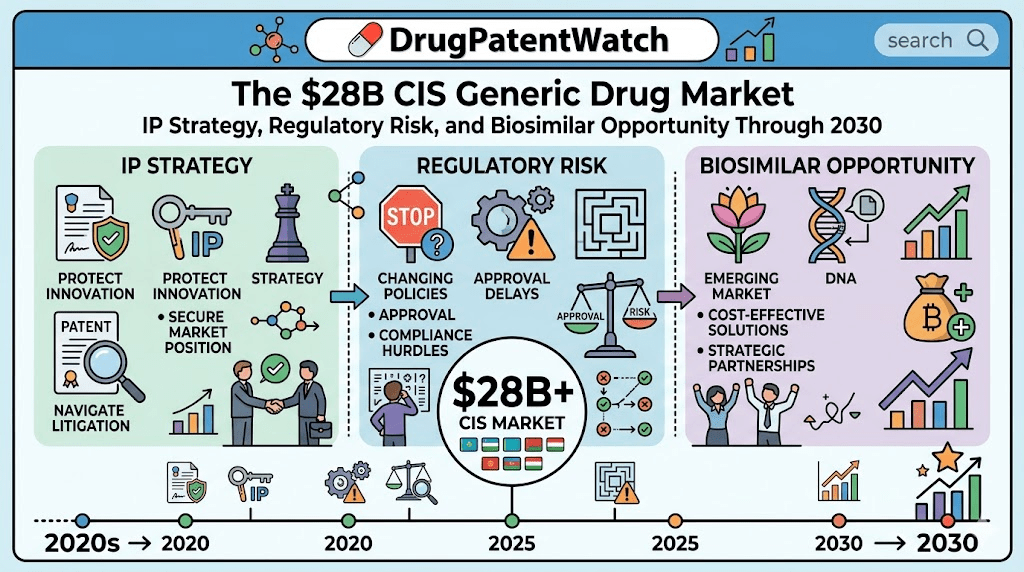
The Commonwealth of Independent States pharmaceutical market is one of the last large generic drug markets where the rules are still being written. Patent linkage is largely absent. Data exclusivity regimes are inconsistent. A single government procurement rule in Moscow can lock out foreign manufacturers from 39% of the Russian market overnight. And a regulatory harmonization deadline at the end of 2025 is forcing every market participant to rebuild their dossier architecture from scratch.
This is not a market for passive importers. It rewards companies that understand IP strategy as an offensive weapon, treat localization as a commercial prerequisite, and anticipate regulatory shifts before they become crises. What follows is a comprehensive analysis of the CIS generic drug market, written for pharma IP teams, portfolio managers, commercial forecasting units, and institutional investors tracking emerging-market pharmaceutical exposure.
How Big Is the CIS Generic Drug Market, and Who Controls It
The CIS pharmaceutical market was valued at approximately $28.8 billion in 2019-2020, with forecasts projecting 12-14% expansion by 2025. That growth rate consistently outpaces Western Europe and the US, where markets are saturated and pricing pressure is structurally embedded. Generics already account for 68.4% of all Russian prescription drug sales by value and 83.2% by volume. In Kazakhstan, generics hold 42% of market value; in Ukraine, 43.5%. The region-wide reliance on off-patent medicines is not a cultural artifact; it is the direct product of state procurement policy and falling real incomes in key markets.
Russia is the dominant actor. It accounts for approximately 69% of the total CIS pharmaceutical market and 75% of the region’s generics market. In 2024, the Russian pharmaceutical market reached 2.85 trillion roubles, a 10% increase in local currency terms. Measured in euros, the market contracted slightly to €28.4 billion, a divergence explained almost entirely by rouble devaluation rather than declining demand. Drug price inflation ran at 7.8% in 2024, which means much of the apparent local-currency growth is accounting rather than organic volume expansion. Foreign companies repatriating earnings face a fundamentally different picture from what ruble-denominated revenue figures suggest.
Kazakhstan is the clear second market and the most commercially organized pharmaceutical hub in Central Asia. It was valued at $2.1 billion with a projected CAGR of 12.3% through 2024. Sales in the first ten months of 2024 reached 1,152.6 billion tenge. Belarus, while smaller, grew output to nearly 2.5 billion Belarusian rubles in 2024, a more than 20% increase in actual prices year-over-year.
The Russian generics segment alone is projected to grow at a 9.1% CAGR from 2021 to 2028, reaching $14.3 billion. This figure is structurally reliable because the demand driver is state procurement policy, not consumer discretion.
What Russia’s ‘Pharma 2030’ Strategy Means for Generic Drug Market Access
Every commercial strategy for the CIS generic drug market must begin with a clear-eyed assessment of state industrial policy. In Russia, Belarus, and Kazakhstan, national governments are not passive regulators. They are architects of the competitive landscape.
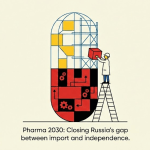
Russia’s Pharma 2030 strategy, the successor to Pharma 2020, is built on one core political premise: dependence on imported medicines is a national security vulnerability. The stated goals are to raise domestic production to 75% of market value and to localize active pharmaceutical ingredient (API) manufacturing within Russia’s borders. Russia currently imports approximately 95% of its APIs, primarily from India and China. Reducing that dependency is an explicit objective of the program, and it shapes procurement rules, subsidy allocation, and the regulatory treatment of foreign applicants.
How Russia’s ‘Third Wheel’ Rule Blocks Foreign Manufacturers from State Tenders
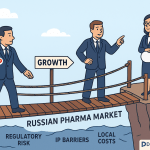
The most consequential implementation of Pharma 2030 is the “Third Wheel” procurement rule (sometimes called the “two’s a crowd” rule). Under this regulation, foreign-manufactured drugs are excluded from state tenders if at least two bids from manufacturers within the Eurasian Economic Union are submitted. The state-funded segment accounts for roughly 39% of the total Russian pharmaceutical market. That means a single procurement rule effectively bars foreign importers from nearly half the market’s most stable, predictable revenue. Localization is not a commercial enhancement; it is the price of admission.
Belarus has pushed even further, targeting domestic production at 50% of market value. That target has been exceeded: locally produced drugs now account for approximately 65% of the market measured by standard packages. State procurement in Belarus is explicitly structured to favor local manufacturers, creating a protected market that imports cannot penetrate through price competition alone.
Kazakhstan’s localization target is 50% of the national market by 2025. The government is deploying fast-track registration pathways for localized products, preferential investment terms, and long-term supply contracts with 34 domestic manufacturers. It has also signed technology transfer agreements with Pfizer, AstraZeneca, and Roche, a dual strategy of nurturing local champions while importing foreign manufacturing know-how.
What Happens to Foreign Generic Companies That Ignore Localization Policy
A business model based on finished-goods importation is viable only in the retail pharmacy segment, where it faces intense price competition and is fully exposed to currency devaluation risk. The state-funded segment, which provides the most reliable cash flow and the largest volume contracts, is structurally inaccessible without a credible localization footprint. Companies that have not addressed this by building or partnering for local manufacturing will find themselves competing in a shrinking addressable market.
How the EAEU Pharmaceutical Harmonization Creates Risk and Opportunity Simultaneously
The Eurasian Economic Union, comprising Russia, Kazakhstan, Belarus, Armenia, and Kyrgyzstan, is progressively building a common pharmaceutical market. The harmonized framework introduces a centralized registration procedure under which a company can designate one member state as a reference country, obtain approval, and have that authorization mutually recognized across the bloc. The theoretical outcome is one registration certificate for a market of nearly 185 million people.
The practical outcome is more complicated.
Why the January 2026 EAEU Registration Deadline Matters for Every Market Participant
All medicines previously registered under national law must achieve full compliance with EAEU requirements by the end of 2025. After January 1, 2026, legacy national registration certificates become invalid. For companies with large legacy portfolios, this is a regulatory cliff edge. Products that miss the transition deadline cannot be legally sold in EAEU member states until new registrations are issued. Given that the EAEU dossier requirements are materially more stringent than the national standards they replace, often approaching FDA or EMA rigor, the cost and timeline for converting legacy registrations is substantial.
Companies that complete this transition with high-quality, EAEU-compliant dossiers will benefit from a consolidation dynamic. Competitors unable to meet the new documentation, GMP, and clinical standards will exit specific product categories. The cost of entry into the CIS is rising, but for well-prepared players, the prize is unfettered access to an integrated market growing at twice the rate of Western Europe.
Operational Friction: Why the EAEU Digital Framework Isn’t Fully Digital Yet
Despite the move toward a unified electronic submission system, many regulatory authorities in the region continue to require physical submission of multiple document copies. Russian language capability is a practical prerequisite, not a preference, for effective regulatory engagement. These operational frictions add 6-12 months to timelines that the formal procedural rules suggest should be shorter. Any commercial forecast that uses official registration timelines rather than practical ones will materially overstate launch speed.
Generic Drug Registration in Russia: What the 12-18 Month Timeline Actually Covers
The official Russian registration timeline for a generic drug is 80 business days, administered by the Ministry of Healthcare (Minzdrav) with expert evaluation conducted by FGU (Scientific Centre for Expert Evaluation of Medicinal Products). That figure excludes all time required to respond to expert queries, submit and analyze physical samples, and resolve any deficiency letters. The realistic timeline from dossier submission to approval is 12 to 18 months.
The Common Technical Document format is required. All documents must be professionally translated into Russian. Bioequivalence studies must demonstrate comparability to the reference product, but they do not need to be conducted in Russia; data from studies performed in other jurisdictions is acceptable. A valid GMP certificate for the manufacturing site, issued following a Russian authority inspection, is a mandatory prerequisite for any foreign manufacturer. The inspection process itself adds variable lead time that is rarely factored into launch planning.
Generic Drug Registration in Kazakhstan: The EAEU Transition and the 30% Pricing Rule
Kazakhstan’s regulatory system is in active transition from national procedures to the EAEU harmonized framework. The expert body is the National Center for Expertise of Medicines and Medical Devices. Under EAEU rules, the standard timeline is 140 working days, with practical timelines extending to 12-18 months. A fast-track national pathway targeting 100 working days exists for specific product categories, created as part of the government’s effort to attract manufacturing investment.
The most significant recent policy change for generic manufacturers is a July 2025 regulation mandating that generic medicines be priced at least 30% below the originator product, with biosimilars required to be priced at least 10% below the reference biologic. This locks in a structural price discount for generics across the entire Kazakh market, not just the public procurement channel. Combined with the government’s existing ceiling prices for both wholesale and retail sales of all medicines, Kazakhstan’s pricing regime is among the most restrictive in the region.
Kazakhstan is also implementing mandatory serialization and track-and-trace for all medicines, with full implementation for prescription and OTC products scheduled by July 1, 2025. Manufacturers without compliant packaging and supply chain IT systems will face distribution interruptions regardless of registration status.
Generic Drug Registration in Belarus: The Data Exclusivity Gap That Closes Under EAEU Rules
Belarus registration is managed by the Ministry of Health, with technical evaluation performed by the Center for Expert Evaluation and Testing in Health Care. The official timeline is 210 days, with the evaluation phase alone taking up to six months. Dossiers must be submitted in paper form, translated into Russian or Belarusian. Appointing a local authorized representative is a legal requirement for foreign applicants.
Belarus has a distinctive IP feature that creates a time-limited strategic advantage: as a non-WTO member, it has not implemented data exclusivity provisions under its national legislation. Generic companies can submit registration dossiers referencing originator clinical data immediately, without waiting for any exclusivity period to expire. This makes Belarus a potentially fast-entry market for products still under data exclusivity elsewhere.
That advantage disappears when EAEU harmonization is complete. The EAEU framework establishes a standard 5-year data exclusivity period followed by 1 year of market exclusivity across all member states. Generic firms that have built CIS launch sequencing around an early Belarus entry need to revise their commercial models accordingly.
The Intellectual Property Battleground: How Patent Enforcement Works Without Patent Linkage
The absence of a formal patent linkage system across most of the CIS is the single most consequential structural feature of the region’s IP landscape for generic manufacturers.
In the US, the Hatch-Waxman framework links drug registration to patent status through the Orange Book. A generic ANDA triggers automatic stay mechanisms that prevent approval until patent disputes are resolved. In the CIS, no equivalent mechanism exists. Regulatory authorities in Russia, Kazakhstan, Belarus, and most other member states are not legally obligated to block a generic’s marketing authorization because the originator holds a valid patent. Registration and patent status are legally decoupled.
What Patent Linkage Absence Means for At-Risk Generic Launches in Russia
For generic manufacturers, the absence of patent linkage creates a high-risk, high-reward environment. A company can secure full marketing authorization for a product while the originator’s patent is still in force. The originator’s only recourse is post-authorization infringement litigation. This dynamic fuels a race to market. The first generic entrant that successfully registers and launches at risk can capture significant market share before a court-ordered injunction halts distribution.
Russia has taken incremental steps toward transparency. The Eurasian Patent Office launched a Pharmaceutical Register cataloging patents related to active pharmaceutical substances. This register is not formally connected to Minzdrav’s approval process; it is an informational tool, not a linkage mechanism. Russian courts are beginning to treat generic registration itself as a “threat of infringement” in some decisions, but this remains unsettled law. Legal risk at launch is not fully quantifiable through standard FTO analysis; it requires an assessment of the likelihood of judicial injunctive relief, which varies by court, judge, and originator legal resources.
AstraZeneca vs. Axelpharm: How Russia’s FAS Became a Patent Battlefield
The ongoing dispute between AstraZeneca and Axelpharm over osimertinib illustrates how the CIS patent environment works in practice. Axelpharm obtained Russian marketing authorization for a generic of AstraZeneca’s cancer drug despite AstraZeneca holding a valid patent covering the compound. AstraZeneca responded with parallel patent infringement litigation and a petition to Russia’s Federal Antimonopoly Service alleging unfair competition.
The FAS has emerged as an unpredictable but powerful actor in pharmaceutical patent disputes. It can investigate and sanction companies for abuse of IP rights, a mechanism that cuts in multiple directions: it can be used by originators against generic entrants, but it has also been deployed against originators accused of using patents anticompetitively. The osimertinib case has produced rulings and reversals at multiple judicial levels, illustrating both the persistence required to defend patents in this jurisdiction and the legal costs generic challengers must budget for.
How Russia’s Patent Term Extension Reforms Changed Generic Challenger Economics
In Russia, a Patent Term Extension can add up to five additional years of market exclusivity to a pharmaceutical patent. Failing to identify and account for an active PTE in an FTO analysis can produce a market entry that triggers willful infringement damages. The Intellectual Property Court has recently reformed the PTE challenge procedure in ways that materially favor generic challengers. The burden of proof for maintaining a PTE has shifted from the generic challenger to the patent holder. The restrictive three-month deadline for filing a PTE invalidity lawsuit has been removed. These changes make patent term extension challenges a more viable and cost-effective component of generic market entry strategy in Russia.
Data Exclusivity by Country: The Strategic Implications
Market
Data Exclusivity Period
Patent Linkage
Notes
Russia
6 years (preclinical data)
None (informational register only)
PTE available; IPC has reformed challenge procedure
Kazakhstan
6 years (from first domestic MA)
None
Formal linkage discussed but not implemented
Belarus
None (non-WTO)
None
Advantage closes under EAEU harmonization
EAEU (Harmonized)
5 years + 1 year market exclusivity
Not specified
Full implementation pending
Why Freedom-to-Operate Analysis Works Differently in the CIS Than in the US or EU
A Freedom-to-Operate analysis in a jurisdiction with patent linkage is primarily a go/no-go assessment. In the CIS, the same analysis serves a different purpose. Because marketing authorization will be granted regardless of patent status, an FTO’s most important output is a risk-adjusted litigation probability assessment: given the patents covering this molecule, what is the probability of a successful injunction, what is the expected litigation cost, and what is the expected timeline to judicial resolution?
A comprehensive FTO analysis for a complex drug candidate ranges from $50,000 to over $500,000 depending on the breadth of the patent landscape, the number of jurisdictions covered, and the depth of claim-by-claim analysis required. That is a material but necessary cost for any company considering an at-risk launch in Russia or Kazakhstan, where originator companies are increasingly willing to litigate aggressively.
Patent landscaping, the broader exercise of mapping all IP in a therapeutic area, can identify white spaces where patent density is low. These spaces represent the lowest-risk launch opportunities. For portfolio planning purposes, a company that systematically identifies therapeutic areas with weak or expiring IP protection in the CIS can build a launch pipeline that minimizes litigation exposure while maximizing market timing advantage.
How BIOCAD Became Russia’s Most Valuable Domestic Pharmaceutical Company
BIOCAD is the clearest example of a domestic pharmaceutical company that has converted state industrial policy alignment into commercial dominance. The company has focused on the most technically demanding and high-margin segment of the Russian generics market: biosimilars for oncology and autoimmune indications.
Its portfolio includes biosimilar rituximab (Acellbia), biosimilar trastuzumab (Herclon), and biosimilar bevacizumab (Avegra), all developed and manufactured in Russia through a full-cycle R&D and production process. This end-to-end domestic capability is what allows BIOCAD’s products to qualify as genuinely “local” under Pharma 2030 procurement standards, not just locally packaged or labeled. That distinction matters enormously in state tender competitions where originator biologics are not eligible and imported biosimilars face the Third Wheel rule.
BIOCAD’s strategy cannot be replicated through a distribution partnership or toll manufacturing arrangement. Its competitive position depends on genuine technical capability in mammalian cell culture manufacturing, analytical characterization of complex biologics, and clinical development to meet EAEU similarity requirements. For foreign biosimilar developers assessing the Russian market, BIOCAD is both a competitive benchmark and a potential partnership target.
Geropharm’s Vertical Integration Play in the Russian Insulin Market
Geropharm’s strategy for the insulin market illustrates how vertical integration from API to finished dosage form creates a defensible competitive position that pure commercial strategies cannot replicate. Russia imports approximately 95% of its APIs, a dependency the Pharma 2030 program is explicitly designed to reduce. Geropharm is building the capability to produce recombinant insulin API domestically, which eliminates the input cost exposure that imported-API competitors face and positions the company as a Pharma 2030 execution partner rather than a foreign-import substitute.
The insulin market in the CIS is projected to grow, with the biosimilar insulin sub-segment expected to show the highest CAGR of any insulin category. Geropharm’s vertical integration means that as second-generation insulin biosimilars displace first-generation human insulin products, it is positioned to compete on both cost structure and procurement eligibility.
What Pharmstandard’s Role as MNC Manufacturing Partner Reveals About Market Access Economics
Pharmstandard is Russia’s largest domestic pharmaceutical manufacturer and a critical infrastructure player for multinational companies pursuing the Partner localization model. Pfizer and Sanofi have both used Pharmstandard contract manufacturing arrangements to give their products “local” status for tender purposes. For an MNC that wants access to Russia’s state procurement market without committing to greenfield plant construction, Pharmstandard is the most established gateway.
The commercial trade-off is a margin share with the local partner and exposure to quality control risks during technology transfer. But for most generic products, the margin dilution from a toll manufacturing arrangement is smaller than the revenue opportunity cost of being excluded from 39% of the market.
How Teva’s $500M FCPA Settlement Exposed the Compliance Architecture Failure in CIS Market Entry
In 2016, Teva Pharmaceutical Industries paid over $500 million to US authorities to resolve Foreign Corrupt Practices Act charges. A core element of the case involved Russia, where Teva paid bribes to a high-ranking government official to influence state tender outcomes and boost Copaxone sales. The mechanism was a local distribution company secretly owned by the official, which received above-market profit margins as a conduit for corrupt payments.
The Teva case exposed a failure at multiple levels: inadequate due diligence on distribution partners, insufficient monitoring of commercial arrangements, and a sales incentive structure that rewarded results without scrutinizing methods. Russia’s state procurement environment, where personal relationships between commercial teams and procurement officials create high-friction, high-opacity interactions, is an FCPA risk environment. Any company that does not operate its CIS business under an independently audited compliance framework is taking on legal and reputational exposure that can dwarf the commercial upside of market access.
The settlement also had a commercial consequence: Teva’s ability to compete in the Russian state tender market was materially disrupted, precisely at the moment when the market was consolidating around domestic manufacturers.
The Counterfeit Drug Problem in Russia: Why Supply Chain Integrity Is a Commercial Issue, Not Just a Safety Issue
Counterfeit pharmaceuticals account for an estimated 3.6% of all drugs sold in Russia. Up to 80% of those counterfeits are believed to be produced domestically, sometimes within licensed facilities operating illicit parallel production. Law enforcement fines are too low to deter sophisticated counterfeit operations, and corruption within enforcement agencies has historically limited prosecution effectiveness.
For a legitimate generic manufacturer, counterfeits are not just a patient safety problem. They are direct revenue theft. Products that look identical to yours at the pharmacy counter are sold at prices that undercut your pricing model, eroding both volume and brand perception. The response is active supply chain security: rigorous distributor audits, EPCIS-based track-and-trace implementation to create a verifiable digital record from manufacturing to dispensing, and secure packaging technology. Kazakhstan’s mandatory serialization requirement, fully phased in by July 2025, is the most explicit government acknowledgment in the region that authentication infrastructure is now a market entry requirement.
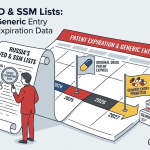
Key Patent Expiry Dates and Biosimilar Entry Windows for CIS Markets
The biosimilar market in Russia is projected to reach $356.8 million by 2027 at a 13.6% CAGR. The CIS insulin biosimilar sub-segment is expected to grow at a 15.3% CAGR. The global biosimilar market CAGR through 2030 is approximately 15.9%. These growth rates reflect two converging forces: patent expiries on major biologics that opened competitive windows, and government purchasing policies that actively favor biosimilar adoption to reduce healthcare spending on high-cost originators.
The following biologics have expired or are approaching loss of exclusivity in the EAEU:
Biologic (Trade Name)
Originator
EAEU Patent Status
Key CIS Biosimilar Entrants
Rituximab (MabThera)
Roche
Expired
BIOCAD (Acellbia), Celltrion, Pfizer/Hospira
Trastuzumab (Herceptin)
Roche/Genentech
Expired
BIOCAD (Herclon), Samsung Bioepis, Amgen
Bevacizumab (Avastin)
Roche/Genentech
Expired
BIOCAD (Avegra), Pfizer, Amgen
Infliximab (Remicade)
J&J/MSD
Expired
BIOCAD, Celltrion (Remsima), Pfizer
Adalimumab (Humira)
AbbVie
Expired
BIOCAD (in pipeline), Sandoz, Amgen, Samsung Bioepis
Insulin Glargine (Lantus)
Sanofi
Expired
Geropharm, Biocon/Viatris, Eli Lilly
Insulin Aspart (NovoRapid)
Novo Nordisk
Expired
Geropharm, Biocon/Viatris
Filgrastim (Neupogen)
Amgen
Expired
Pharmstandard, Sandoz (Zarxio)
Pegfilgrastim (Neulasta)
Amgen
Active/expiring
Multiple international players
Etanercept (Enbrel)
Pfizer/Amgen
Active
Under development
Why Biosimilar Manufacturing Complexity Is a Structural Barrier to Generic Entrants
The barrier to biosimilar entry is categorically different from small-molecule generic entry. A small-molecule generic requires bioequivalence data and a chemistry, manufacturing, and controls package demonstrating pharmaceutical equivalence to the reference product. A biosimilar requires comparability studies across structural, functional, pharmacokinetic, and clinical dimensions. Analytical characterization of a monoclonal antibody involves mass spectrometry, glycan mapping, peptide mapping, and cell-based potency assays that require specialized laboratory infrastructure. Manufacturing requires upstream cell culture development, purification process design, and aseptic fill-finish capability in cleanroom environments compliant with EU GMP or equivalent standards.
The capital cost to build a biologics manufacturing facility capable of producing a commercial-scale biosimilar is typically $200 million to $500 million or more. This is why the CIS biosimilar market is dominated by a small number of well-capitalized domestic champions like BIOCAD and vertically integrated multinationals. Companies that have built their competitive model around low-cost small-molecule generics cannot simply pivot to biosimilars. The technical barrier is real, and it will define the competitive structure of the CIS pharmaceutical market through the 2030s.
How the MNC Localization Choice Between Build and Partner Determines Long-Term Market Share
For multinational pharmaceutical companies, the single most consequential strategic decision in the CIS is the localization model. Two primary approaches exist, each with distinct risk profiles.
The Build Model: AstraZeneca’s Kaluga Investment and What It Costs to Own Local Manufacturing
AstraZeneca’s plant in the Kaluga region and Novartis’s manufacturing investment in St. Petersburg represent the maximum-commitment version of localization. The company owns the facility, controls quality, manages the production schedule, and retains full IP control over the manufacturing process. The government relations benefit is significant: a multihundred-million-dollar fixed investment in Russian manufacturing infrastructure is a credible signal of long-term market commitment that can open doors in policy discussions.
The liability is symmetrical. Fixed assets in Russia cannot be easily relocated in response to geopolitical deterioration, sanction regimes, or regulatory hostility. The post-2022 geopolitical environment has made this risk highly visible. Companies that built under the assumption of stable EU-Russia relations now own manufacturing infrastructure in a jurisdiction with restricted capital flows and significant operational constraints. For new entrants evaluating the Build model today, the geopolitical risk premium must be explicitly priced into the investment case.
The Partner Model: Why Pfizer and Sanofi Chose Contracts Over Capital
Pfizer’s contract manufacturing arrangement with Pharmstandard and Sanofi’s partnership with Nanolek for specific products represent a lower-capital, more flexible approach. The product acquires “local” status for tender purposes through the manufacturing relationship, but the MNC avoids the irreversible capital commitment of building its own plant. Sanofi has also operated its own insulin facility in Russia while using a partner for vaccine manufacturing, a hybrid that reflects portfolio-specific optimization rather than a single localization philosophy.
The partner model’s risks are different in kind from the build model. Technology transfer creates IP exposure if the local partner uses transferred know-how to develop competing products or shares it with state-owned enterprises. Quality control during toll manufacturing requires rigorous oversight to prevent product quality divergence. And commercial terms must be renegotiated as market conditions change, creating periodic strategic uncertainty.
For generic companies, the partner model is almost always the logical choice. Generic product margins rarely justify greenfield manufacturing investments in a foreign jurisdiction. Accessing the state tender market through a contract manufacturing arrangement with an established local player provides the necessary procurement qualification without the capital risk.
How Kazakhstan’s E-Health Strategy Changes Pharmaceutical Commercial Models
Kazakhstan is pursuing a national digital health transformation that will materially alter how pharmaceutical companies engage with the market. The government is building a national Electronic Health Record platform, expanding telemedicine networks for rural populations, and promoting mobile health applications for patient self-management.
The commercial implications are specific. National EHR deployment will generate real-world data on prescribing patterns, treatment switching behavior, and outcomes across the entire Kazakh patient population. This data can support health economics analyses, outcomes-based contracting discussions with the Ministry of Health, and market sizing models for new product launches. Companies that position themselves as partners in the digital health infrastructure, rather than passive product suppliers, will have earlier access to this data and greater influence over how it informs formulary decisions.
Kazakhstan has already signed digital health partnership agreements with international technology companies, and the pharmaceutical-technology interface is expanding. Generic companies that invest in digital patient support programs, electronic adherence monitoring, and telemedicine-compatible prescription services will differentiate themselves in a market where most competitors are competing purely on price.
Russia’s E-Pharmacy Segment and the Apteka.ru Channel Shift
Russia’s e-pharmacy segment has grown to 283 billion roubles, representing 14% of the total pharmacy retail market. Apteka.ru commands a 32% share of online pharmaceutical sales, creating a centralized digital channel that reaches patients directly without the intermediation of traditional brick-and-mortar pharmacy chains. The historical dominance of three national distributors, Protek, Pulse, and Katren, over physical pharmacy access has been a structural constraint on foreign generic manufacturers’ ability to negotiate competitive commercial terms. E-pharmacy creates a parallel channel where manufacturers can engage more directly, gather first-party data on purchasing patterns, and reduce distribution margin leakage.
A functional Russian retail strategy in 2025 requires both a relationship with the traditional distributor network and an e-commerce channel strategy. Companies that treat e-pharmacy as a secondary channel are ceding ground in the fastest-growing segment of the Russian pharmaceutical retail market.
Revenue at Risk: How to Quantify the CIS Exposure for Originator Drug Portfolios
For multinational companies with branded products currently selling in Russia, Kazakhstan, or Belarus, the EAEU’s evolving biosimilar and generic framework creates quantifiable revenue risk. The key inputs to that assessment are:
First, the patent expiry timeline for each product in each EAEU jurisdiction, including any active PTEs that extend protection beyond the primary patent term. Second, the data exclusivity status under EAEU harmonized rules, which determines when a generic or biosimilar applicant can reference clinical data. Third, the number and capability of potential generic or biosimilar challengers currently active in the relevant therapeutic area in the EAEU. Fourth, the pricing dynamics after loss of exclusivity, where Kazakhstan’s new 30% mandatory discount rule is the most explicit market-shaping factor.
The originator revenue erosion timeline after loss of exclusivity in Russia follows a faster curve than in Western markets, partly because of the Third Wheel rule’s effect in the state segment. Once two EAEU-local manufacturers have submitted bids for the same tender, the originator product is excluded from competing regardless of clinical superiority. Branded drugs that cannot meet EAEU localization criteria face a binary revenue transition in the state segment: full market share before loss of exclusivity, near-zero access after it.
Most Important Ongoing CIS Pharmaceutical Litigation to Watch
The AstraZeneca-Axelpharm osimertinib dispute over Russia’s first-in-class EGFR inhibitor patent remains the most closely watched patent enforcement case in the region. The FAS involvement gives this case implications beyond patent law; it is testing the outer limits of what Russia’s competition authority considers appropriate enforcement of pharmaceutical IP. The outcome will influence how aggressively other originator companies pursue parallel FAS strategies alongside court-based patent litigation.
Beyond osimertinib, the pattern of Paragraph IV-equivalent filings in the CIS is expanding. Companies like Axelpharm, Canonpharma, and several Central Asian generic manufacturers are systematically identifying products where at-risk registration is viable and originator litigation capacity is limited. Monitoring these filings in real time, through services that track EAEU registration databases and Russian IP court dockets, is a prerequisite for any originator company seeking to defend revenue in the region.
What Investors Are Watching in CIS Pharma Exposure
Institutional investors with exposure to companies that derive significant revenue from CIS pharmaceutical markets are focused on several specific risk factors that standard sell-side analysis tends to underweight.
The January 2026 EAEU registration transition deadline is a near-term binary event. Companies with large legacy portfolios in Russia, Belarus, or Kazakhstan that have not disclosed their EAEU conversion status or budgeted for the compliance costs face revenue disruption risk if products are pulled from market pending new registrations.
The ruble devaluation risk is persistent. A company reporting strong double-digit revenue growth in Russia in local currency terms may be experiencing flat or negative growth in reported currency. Investors should distinguish between volume growth, price inflation-driven growth, and currency translation effects when evaluating CIS performance metrics.
The Third Wheel rule’s impact on originator products entering their loss-of-exclusivity window is increasingly quantifiable. As BIOCAD, Geropharm, and Pharmstandard expand their biosimilar pipelines, the number of products for which two EAEU-local bids can be assembled is growing. Originator companies that have not localized manufacturing face an accelerating exclusion from the state segment of their own therapeutic areas.
FCPA and anti-bribery compliance exposure is material and under-discussed. The CIS procurement environment, particularly Russia and some Central Asian markets, carries elevated corruption risk relative to OECD benchmarks. Companies that have not invested in independent compliance auditing of their CIS distribution and government affairs functions carry regulatory tail risk that is difficult to price.
Common Investor Questions About CIS Pharmaceutical Market Exposure
Does Russian pharmaceutical market growth translate to profit for foreign companies? Not automatically. Local-currency revenue growth driven by drug price inflation does not produce equivalent profit growth when earnings are repatriated. Currency translation, Third Wheel exclusion from state tenders, and localization investment costs all compress the actual financial return from reported revenue growth.
How should the EAEU harmonization deadline affect valuation of companies with CIS generic portfolios? Companies that have completed EAEU dossier conversions for their core products ahead of the January 2026 deadline are operationally better positioned than competitors still mid-conversion. The transition cost is a one-time regulatory investment; the benefit is continued market access across five countries. Portfolio managers should ask directly whether companies have disclosed conversion completion status.
Is Russia’s biosimilar market accessible to non-Russian manufacturers? Yes, but competitively only for companies with EAEU-compliant manufacturing, either through owned facilities or credible toll manufacturing partners. Sandoz, Celltrion, and Pfizer are active in the Russian biosimilar market. The competitive barrier is not regulatory access; it is the procurement disadvantage created by the Third Wheel rule when BIOCAD or another domestic player submits a qualifying bid.
What is the data exclusivity risk for products launching in Belarus? Currently minimal under national law, as Belarus has no data exclusivity provisions. Under EAEU harmonization, that changes to 5 years plus 1 year of market exclusivity. Companies currently using Belarus as an early-entry market for products under exclusivity elsewhere have a limited window before that strategy becomes unavailable.
Investment Strategy: How to Allocate Across the CIS Pharmaceutical Opportunity
The CIS pharmaceutical market rewards specific types of capital allocation and penalizes others.
Capital directed at API localization in Russia has the highest alignment with state policy objectives and the strongest procurement access implications. Geropharm’s insulin API integration is the proof-of-concept. A foreign company willing to co-invest in Russian API capacity for a high-volume therapeutic area could access preferential tender treatment, long-term government supply contracts, and partnership opportunities with domestic manufacturers seeking to upgrade their technical capabilities.
Capital directed at EAEU-compliant biosimilar development for oncology and autoimmune indications addresses the largest unmet market need. The Russian biosimilar market will reach $356.8 million by 2027. Products targeting adalimumab, etanercept, and the next generation of checkpoint inhibitors (as those patents approach expiry) represent the highest-value opportunities in the region’s pharmaceutical IP landscape.
Capital directed at e-pharmacy partnerships in Russia addresses the fastest-growing commercial channel without requiring manufacturing localization. This is the lowest-cost way to expand CIS retail market presence for a company that has already secured registration for its products.
Capital directed at building original manufacturing infrastructure in Russia carries the highest geopolitical risk premium. The analysis must account explicitly for the possibility of further sanctions escalation, asset nationalization risk, and the limitations on profit repatriation under current capital control regimes.
Key Takeaways
The CIS generic drug market offers genuine growth for companies that operate with commercial and legal precision. The $28.8 billion market, growing at 12-14% annually, has structural demand drivers in government procurement and falling real incomes that will sustain generic dominance for the foreseeable future.
State industrial policy is the dominant commercial force. The Third Wheel rule, Pharma 2030, and Kazakhstan’s 30% pricing mandate are not peripheral regulatory features. They are the operating conditions that define who can access the most valuable market segments.
Intellectual property strategy in the CIS requires a different analytical framework than in the US or EU. Patent linkage is absent. At-risk launches are common. FTO analyses must assess litigation probability rather than just freedom to operate. The recent Russian PTE challenge reforms have improved generic challengers’ legal position but also increased originator litigation intensity.
The January 2026 EAEU transition deadline is a near-term operational event with revenue consequences. Companies that miss it lose market access for affected products until new registrations are issued.
The biosimilar opportunity is real, large, and technically demanding. Leadership in the CIS biosimilar market belongs to companies with full-cycle biologics manufacturing capability and state procurement alignment. BIOCAD is the domestic model. Foreign entrants need either owned manufacturing or credible local partnerships to compete in this segment.
The compliance risk in this market is underpriced. Teva paid $500 million to learn what inadequate internal controls cost in the CIS procurement environment. Any company entering or expanding in this region without a robust, independently audited compliance program is carrying tail risk that belongs on the balance sheet.
Patent expiry dates and regulatory timelines subject to jurisdiction-specific PTE grants, EAEU harmonization decisions, and litigation outcomes. This analysis is for informational purposes and does not constitute legal, regulatory, or investment advice.