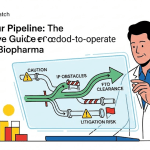
How the smartest pharmaceutical IP teams build exclusivity that outlasts the molecule by a decade — and what happens when courts decide the strategy went too far
The Central Argument: Delivery Is the Drug
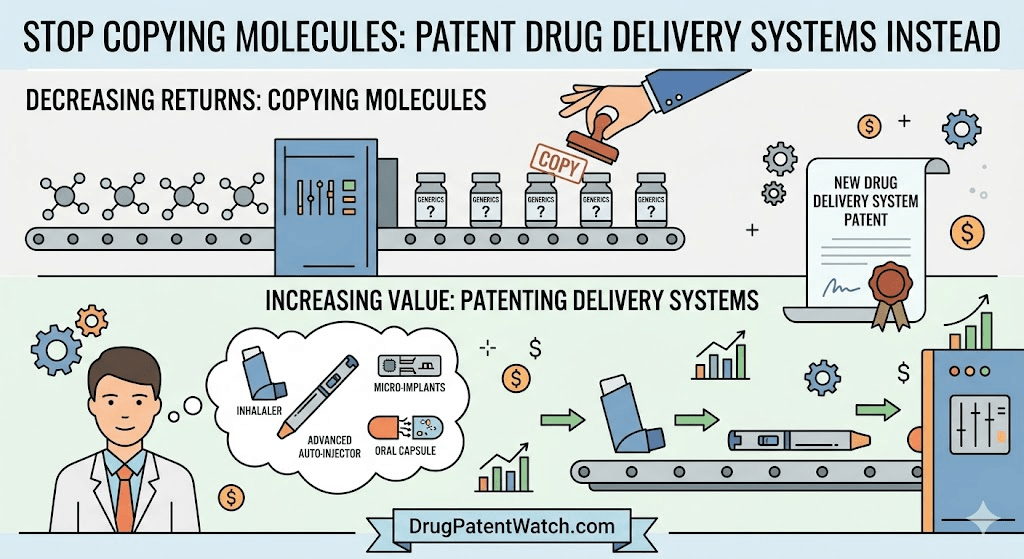
Ask any first-year pharmacology student what a drug is, and they will say it is the active pharmaceutical ingredient — the molecule that binds a receptor, inhibits an enzyme, or modulates a pathway. Ask the same question of a seasoned pharmaceutical IP attorney, and you will get a more interesting answer. The drug, commercially and legally, is the product that reaches the patient. That product is almost always a delivery system wrapped around a molecule, and in many cases the delivery system is where the real value — and the real IP — lives.
This distinction is not semantic. It is financial. An API patent expires. A sophisticated delivery platform can generate a family of patents whose combined effect pushes effective market exclusivity well past the primary molecule’s expiration. Done correctly, delivery-system IP is defensible, clinically meaningful, and capable of generating revenue that dwarfs the molecule’s final years under protection. Done incorrectly — as Teva Pharmaceuticals discovered with its ProAir HFA inhaler — it invites court-ordered delisting, Federal Trade Commission enforcement, and antitrust counterclaims.
The 2024-2025 period produced the clearest test yet of where that line sits. The Federal Circuit’s December 20, 2024 ruling in Teva Branded Pharmaceutical Products R&D, Inc. v. Amneal Pharmaceuticals of New York, LLC (Fed. Cir. Case 2024-1936) established that a device patent must recite the active pharmaceutical ingredient to qualify for Orange Book listing — and the 30-month stay that listing triggers. That ruling, combined with an FTC campaign that had challenged more than 600 Orange Book patents by May 2025, means the rules for delivery-system patents changed. They did not disappear.
Understanding the distinction between enforceable delivery IP and improperly listed device patents is now the most commercially consequential skill in pharmaceutical portfolio management. This article explains exactly where that line falls, how the most successful companies build delivery-system exclusivity that survives litigation, and what the post-Teva v. Amneal landscape means for branded pharmaceutical strategy through 2035.
What Is a Drug Delivery System Patent and Why Does It Survive Longer?
A drug delivery system patent protects the mechanism, formulation, or device used to get an active pharmaceutical ingredient to its target site in the body — as distinct from a patent on the molecule itself. Because delivery technologies are independent innovations often developed after the primary compound patent, they typically have later filing dates and correspondingly later expiration dates. They also protect a different set of claims, meaning a generic manufacturer that synthesizes the identical molecule cannot automatically use the branded delivery system without potential infringement.
The pharmaceutical patent lifecycle typically includes three broad layers. Primary patents cover the novel molecule — its structure, synthesis routes, and core pharmacological activity. Secondary patents cover formulations, combinations, and dosing regimens. Tertiary patents — the category increasingly scrutinized by the FTC and courts — cover the devices and delivery mechanisms used to administer a product.
A 2025 retrospective cohort study published in JAMA Health Forum analyzed 331 drug-device combination products approved by the FDA between 1986 and 2023 and found that 1,751 of 3,241 individual patent listings in the Orange Book were on the delivery devices of those products — more than half the total patent listings across drug-device combinations. That statistic alone explains why the FTC has made device patent listings a priority enforcement area and why courts have been willing to draw bright lines on what qualifies.
Primary, Secondary, and Tertiary Patents: A Working Taxonomy
The industry uses three informal tiers to categorize pharmaceutical patents. Primary patents claim the novel API itself — its chemical structure, its enantiomers, key metabolites, and the core synthetic pathway. These generally expire 20 years from filing, which for most drugs means approximately 10-13 years of post-approval exclusivity after the NDA review clock runs. For small molecules, once primary patent protection ends, generic manufacturers can synthesize the identical active ingredient under 35 U.S.C. § 271(e)(1) without liability.
Secondary patents claim a specific formulation, a crystalline polymorph, a prodrug, a fixed-dose combination, or a dosing regimen. These can have filing dates years after the primary patent and can survive the primary expiration by several years if they capture genuine innovation in how the drug is prepared or administered.
Tertiary patents — the device and delivery-mechanism layer — protect the physical apparatus used for administration: the inhaler, the autoinjector, the transdermal patch adhesive matrix, the prefilled syringe system, the dose counter, the microparticle encapsulant. These are often filed during clinical development or at launch, meaning they carry expiration dates in the mid-2030s even for drugs approved in the 2000s.
The ADDS Framework: When the Delivery System Creates the Product
Some drugs do not merely use a delivery system. They require one to exist as viable commercial products. DrugPatentWatch has described this class as Advanced Drug Delivery Systems (ADDS), where a highly potent cytotoxic compound with poor aqueous solubility may be physically impossible to administer safely without nanoparticle encapsulation, and a peptide drug with a 20-minute half-life is clinically useless without a depot formulation that extends activity to weeks. In both cases, the delivery system does not improve the drug — it creates it as a commercial product.
This category includes paclitaxel without albumin-bound nanoparticle technology (Abraxane/nab-paclitaxel), siRNA without lipid nanoparticle delivery, and GLP-1 agonists without the formulation engineering that enables oral absorption or subcutaneous depot release. These are not conveniences added after the fact. They are the technical achievement that enables clinical use. Their patents carry proportionate weight.
How Delivery System Patents Generate Independent Commercial Value
The commercial logic is straightforward. A generic manufacturer that synthesizes the identical API cannot necessarily copy the branded delivery system. If a polymer depot formulation, a specialized lipid nanoparticle, or a device with specific dose-metering properties requires its own manufacturing process, the generic faces a parallel development burden. That burden translates into time, capital expenditure, and clinical validation — all of which delay market entry independent of any patent litigation.
For the innovator, delivery-system IP generates value in at least two ways. It supports direct patent enforcement through the Hatch-Waxman framework when the patents are properly listed in the Orange Book. It also creates a manufacturing and formulation barrier that discourages generic investment even absent formal litigation. The combination — legal barrier plus technical barrier — is what IP strategists call the exclusivity moat.
The Orange Book Listing Question: What Can Actually Be Listed?
The FDA Orange Book lists only three categories of patents for NDA-approved drug products: drug substance patents (covering the API), drug product patents (covering the finished formulation), and method-of-use patents (covering an approved indication). Manufacturing process patents are explicitly excluded. After Teva v. Amneal (Fed. Cir. 2024), device patents must also recite the API to qualify as drug product patents eligible for listing.
The FDA’s Orange Book — formally titled Approved Drug Products with Therapeutic Equivalence Evaluations — sits at the center of pharmaceutical IP strategy because it determines which patents can trigger the Hatch-Waxman automatic 30-month stay of generic approval. Only drug substance, drug product, and method-of-use patents are eligible for listing; manufacturing process patents are excluded.
The 30-month stay is valuable because it allows brand manufacturers to litigate patent disputes before a generic reaches the market — and to do so without exposing themselves to traditional patent infringement damages during that period. The brand sues because the automatic 30-month stay is worth more than the litigation costs. This economic calculation has driven a predictable behavior: manufacturers list as many patents as possible against each NDA to maximize the potential for multiple, stacked 30-month stays.
The Teva v. Amneal Ruling: A Bright-Line Test for Device Patents
Before December 20, 2024, branded drug manufacturers could argue that device patents covering components of a drug-device combination product qualified as drug product patents and thus belonged in the Orange Book. That argument sustained a significant secondary-exclusivity strategy across the respiratory, injectable, and transdermal categories. Teva’s ProAir HFA case put the argument to a final test.
Teva had listed nine patents in the Orange Book for ProAir HFA. Five of those patents were central to the case and generally focused on the device components of the inhaler — such as the dose counter — and addressed various problems related to dose counting. None of the patents explicitly claimed the active ingredient albuterol sulfate. Amneal Pharmaceuticals, seeking to launch a generic version, filed an ANDA with a Paragraph IV certification and counterclaimed that the device patents were improperly listed.
The District of New Jersey agreed. On appeal, the Federal Circuit affirmed, holding that ‘patents claiming just the device components of the product approved in an NDA do not meet the listing requirement of claiming the drug for which the applicant submitted the application.’ The ruling established a bright-line rule: an Orange Book-listed patent must recite the active pharmaceutical ingredient of the approved drug. Claims that cover only the delivery mechanism, with no reference to the API, do not qualify.
The FTC responded within hours. Hannah Garden-Monheit, Director of the FTC’s Office of Policy Planning, stated: ‘This decision is important not only for lowering asthma inhaler costs, it also sets the stage for removal of junk listings on a range of other critical medications where junk device listings impede competition.’
What the Ruling Actually Prohibits vs. What It Permits
The ruling’s consequences are narrower than early commentary suggested. It prohibits listing a patent whose claims cover only the device, with no recitation of the API. It does not prohibit patents that claim a drug-device combination where the claims genuinely cover both the formulation and the device as an integrated system. The distinction matters significantly for next-generation products like autoinjector-prefilled syringe combinations for biologics, metered-dose inhalers where the propellant system is integral to drug delivery, and transdermal patches where the adhesive matrix controls release kinetics.
Patents on these systems can still qualify for Orange Book listing if the claims are drafted to include the API. The correct response to Teva v. Amneal is not to abandon device-integrated patent strategies. It is to draft claims that specifically recite the active ingredient as part of the claimed combination, and to structure formulation claims so that the delivery mechanism and the drug substance appear together in the independent claims.
The FTC Crackdown Timeline: 2023-2025
November 2023:FTC challenges more than 100 Orange Book patent listings across 10 companies, including 37 Teva patents on respiratory delivery devices.
March 2024:FTC files amicus brief in Teva v. Amneal at the District of New Jersey, urging delisting of ProAir inhaler patents.
April 2024:FTC challenges an additional 300 Orange Book patents and sends new warning letters concerning 20 brand-name drugs, including patents relating to asthma and COPD inhalers and patents on devices to deliver injectable weight-loss and diabetes treatments.
June 10, 2024:District Court for the District of New Jersey denies Teva’s motion to dismiss, grants Amneal’s motion for judgment.
December 20, 2024:Federal Circuit affirms, orders Teva to delist five ProAir HFA inhaler patents.
May 2025:FTC challenges an additional 200 Orange Book patents relating to 17 different drug products.
The cumulative effect: the FTC’s actions have led to the delisting of patents across 22 different brand-name products. Several hundred additional patents remain under challenge as of mid-2025.
How Legitimate Delivery System Patents Work: The IP Architecture
Courts and the FTC are not opposing delivery-system patents as a category. They are opposing the specific practice of listing device-only patents in the Orange Book to trigger automatic approval delays. Patents on drug delivery systems remain enforceable through ordinary infringement litigation when they are properly drafted and listed. The legal framework for building a legitimate delivery-system IP portfolio is well-established — and it is worth examining in detail, because it determines what survives the current regulatory environment.
Formulation Patents: Protecting the Drug Product Layer
Formulation patents claim specific physical and chemical characteristics of the finished drug product: excipient composition, particle size distribution, pH range, solubility parameters, release profile specifications, and stabilizing agents. These are drug product patents under 21 C.F.R. § 314.53(b) and are properly listable in the Orange Book. They also represent genuine innovation, because the formulation determines bioavailability, tolerability, stability, and manufacturability.
A well-drafted formulation patent will specify the API by name in the independent claims, include the excipient ratios and particle specifications that achieve a particular release profile, and tie those claims to clinically meaningful outcomes — bioequivalence parameters, dissolution curves, or pharmacokinetic parameters measured in vivo. This claim structure survives Teva v. Amneal because the API is present in the claims, and it survives obviousness challenges because the specific combination of excipient ratios and physical parameters is not disclosed in prior art.
Extended-Release Architecture: How Controlled Release Patents Extend Exclusivity Timelines
Extended-release (ER) formulations are the most litigated subcategory of delivery-system patents in the Hatch-Waxman system. The commercial logic is compelling: an ER version of a drug that was previously dosed three times daily, now dosed once daily, can command a premium price, drive market-share migration from the immediate-release form, and carry a new patent portfolio with a filing date years after the primary compound patent.
The FDA considers ER formulations as distinct drug products from their immediate-release counterparts. A manufacturer seeking to launch a generic ER must file a separate ANDA against the ER NDA and certify against the ER patent portfolio. This means the primary compound patent expiration — often published prominently in analyst patent-cliff forecasts — does not signal the end of the brand’s exclusivity in the ER market.
The ER strategy produces measurable commercial results. Branded manufacturers routinely launch authorized generic ER versions shortly before competitors can enter, retaining revenue through the exclusivity transition. Meanwhile, generic manufacturers face the full Hatch-Waxman litigation clock against an ER patent portfolio that can include polymer selection patents, tablet core architecture patents, coating composition patents, and in vitro dissolution specification patents — each of which requires its own Paragraph IV certification and potentially its own 30-month stay.
Among the most defensible delivery-system patents in the industry are those covering poly(lactic-co-glycolic acid) (PLGA) microsphere depot formulations. PLGA microsphere technology controls drug release over weeks or months by encapsulating an API in a biodegradable polymer matrix that degrades at a rate determined by the polymer’s molecular weight, its lactide-to-glycolide ratio, and its end-cap chemistry.
These parameters — molecular weight, polydispersity index (PDI), lactide:glycolide ratio, and end-cap chemistry — are what DrugPatentWatch has described as Critical Quality Attributes (CQAs) that are the primary determinants of release kinetics and are extremely difficult to replicate without the innovator’s proprietary manufacturing process.
The patent strategy for PLGA microsphere products therefore operates on multiple levels simultaneously. Drug substance patents on the API itself. Formulation patents on the polymer composition and API loading ratio. Manufacturing process patents on the microsphere fabrication conditions (solvent system, emulsification parameters, drying protocol). Method-of-use patents on the treatment regimen using the specific depot formulation. Separately, trade-secret protection on the specific manufacturing process parameters that are not disclosed in the patents.
None of the manufacturing process patents are listable in the Orange Book under 21 C.F.R. § 314.53(b). But that is not their purpose. They serve as an additional layer of litigation risk for generic manufacturers, and they protect the manufacturing know-how even after the Orange Book-listed patents expire.
Lipid Nanoparticle Platforms: The Most Contested Delivery IP Space of the 2020s
Lipid nanoparticles (LNPs) emerged as the central delivery-system IP battleground after 2020, driven by the use of LNP technology in Moderna’s Spikevax and Pfizer-BioNTech’s Comirnaty COVID-19 vaccines. The LNP delivers nucleic acids — mRNA, siRNA, or pDNA — that cannot cross cell membranes unaided. Without the LNP, those therapeutic payloads are clinically useless. The delivery system is, in the ADDS sense, the product.
The litigation that followed the COVID-19 vaccine launches confirmed that LNP delivery IP has standalone commercial value measured in billions. In March 2026, Genevant Sciences (a subsidiary of Roivant) and Arbutus Biopharma announced a $2.25 billion global settlement with Moderna to resolve all U.S. and international enforcement actions involving Moderna’s unauthorized use of their LNP delivery technology in Spikevax, with $950 million due upfront and $1.3 billion contingent upon an appellate ruling.
The LNP patent landscape involves at least four distinct claim categories: the ionizable lipid composition (which enables pH-dependent endosomal escape); the lipid molar ratios in the four-component particle (ionizable lipid, phospholipid, cholesterol, and PEG-lipid); the particle size and polydispersity specifications; and the manufacturing process for achieving controlled encapsulation efficiency. Arbutus holds many patents relating to LNP-nucleic acid formulations generally, with the LNPs defined by ratios of the lipids in the particles, and has asserted these against Moderna and Pfizer-BioNTech.
Alnylam Pharmaceuticals, whose siRNA therapeutics (Onpattro, Givlaari, Oxlumo, Leqvio) all depend on LNP delivery, has built a separate LNP portfolio around ionizable lipids with biodegradable groups — a structural variation that affects the toxicity and clearance profile of the particle rather than just its encapsulation efficiency. These biodegradable lipid patents represent a distinct IP layer on top of the platform patents held by Arbutus and Genevant.
PEGylation Patents: Steric Stabilization as a Property-of-Matter Claim
PEGylation — the attachment of polyethylene glycol chains to a therapeutic molecule or nanoparticle surface — extends the circulating half-life of biologics and nanoparticulate systems by creating a steric barrier that reduces protein adsorption and immune clearance. It is one of the oldest delivery-enhancement strategies in the industry, and its early patents have long expired. The current patent landscape, however, contains numerous variations on PEG density, chain length, attachment chemistry, and branching architecture that carry later expiration dates.
As DrugPatentWatch has noted, PEGylated liposomes achieve extended circulation through steric stabilization, and the PEG density and chain length are themselves patentable. This is the claim structure that generic liposomal drug developers must navigate. A generic targeting Doxil (pegylated liposomal doxorubicin) must not only synthesize doxorubicin but also replicate a PEGylated liposome formulation that either does not infringe Sequus/Johnson & Johnson’s PEGylation composition claims or navigates around them with a demonstrably different PEG architecture.
The Hatch-Waxman Framework and Delivery System IP: How 30-Month Stays Are Triggered and Stacked
The Hatch-Waxman Act of 1984 (the Drug Price Competition and Patent Term Restoration Act) created the legal infrastructure that makes Orange Book patent listings commercially decisive. An Abbreviated New Drug Application (ANDA) filer must certify against each Orange Book-listed patent. A Paragraph IV certification — the assertion that a listed patent is invalid or will not be infringed — is an artificial act of infringement that allows patent litigation to begin before the generic ever reaches market.
The core mechanism: if the NDA or patent holder timely files suit within 45 days of receiving the Paragraph IV notice letter, FDA cannot approve the ANDA for 30 months while the parties litigate their patent dispute. That 30-month clock begins on the filing date of the Paragraph IV certification, not on the trial date — meaning the stay often expires before the case reaches a final verdict, unless the court issues an injunction.
How Multiple Delivery System Patents Stack 30-Month Stays
Innovator companies that want to extend the effective exclusivity period beyond a soon-to-expire primary patent can, by listing additional secondary patents in the Orange Book, stack additional 30-month stays on top of each other as each successive Paragraph IV certification triggers a new lawsuit and a new stay. Critics, including the FTC, have characterized this as a mechanism for extracting exclusivity through litigation procedure rather than patent merit.
The mathematics of stacking are worth illustrating. A brand NDA lists: (1) the compound patent, expiring 2026; (2) a formulation patent, expiring 2029; (3) a device-integrated delivery patent, expiring 2031 (if properly drafted to include the API); and (4) a method-of-use patent covering a new indication, expiring 2033. A generic manufacturer that files a Paragraph IV ANDA in 2025 against all four patents receives four notice letters, four 45-day windows, four potential lawsuits, and potentially four overlapping or sequential 30-month stays. The cumulative effect can push the generic’s effective approval date to 2028 or later — two years past the primary compound patent — even if the company ultimately prevails on all four patent challenges.
This delay is not costless for the brand. Each lawsuit requires litigation resources, and a loss on any patent provides the first Paragraph IV filer with the 180-day exclusivity reward. But the delay gives the brand time to migrate the market to a next-generation formulation — the new ER version, the reformulated injectable, the improved delivery device — before generic entry in the base product begins.
The First Paragraph IV Filer Advantage and Delivery System Patent Strategy
The 180-day exclusivity period available to the first Paragraph IV filer creates its own strategic interactions with delivery-system patents. The generic files the certification because the potential 180-day exclusivity prize is worth many multiples of the litigation cost. For major-revenue products, that 180-day period can represent hundreds of millions of dollars in revenue with no competing generic — justifying patent challenge litigation as an investment.
A brand that holds a dense delivery-system patent portfolio can influence the timing of first filers. If the delivery patents are strong and numerous, the first filer’s 180-day window will not begin until all patents have been adjudicated or expired. This delays the generic market structure from a competitive equilibrium to a temporary duopoly — still better for the brand than the rapid price erosion that comes with multiple generic entries simultaneously.
DrugPatentWatch maintains a real-time database of ANDA filings, Paragraph IV certifications, and 30-month stay expirations that allows brand companies and generics alike to track the patent certification landscape for any approved drug product. This is particularly useful for identifying patent clustering — products with unusually dense Orange Book listings that signal either a robust IP strategy or a potential FTC enforcement target, depending on how the claims are drafted.
PTAB Inter Partes Review as a Parallel Delivery Patent Challenge
Hatch-Waxman district court litigation is not the only forum for challenging delivery-system patents. The Patent Trial and Appeal Board (PTAB) offers inter partes review (IPR) as an alternative that operates under a lower burden of proof — preponderance of the evidence versus clear and convincing evidence in district court — and without the presumption of validity that district courts apply to issued patents. In fiscal year 2024, the institution rate for bio/pharma IPR petitions was approximately 73%, and of those instituted, a substantial fraction resulted in cancellation of at least some challenged claims.
Generic manufacturers increasingly use IPR as a first-move option against delivery-system patents, particularly formulation patents on extended-release products where the prior art landscape includes academic publications on polymer matrix technology that may anticipate or render obvious the challenged claims. A successful IPR cancellation removes the patent from the Orange Book automatically, eliminating the 30-month stay threat without requiring district court litigation.
The combined strategy — Paragraph IV certification in district court for infringement disputes, IPR at PTAB for validity challenges — allows generic companies to attack delivery-system patents on two fronts simultaneously, with each forum exerting settlement pressure on the brand.
Case Study: Respiratory Inhalers — The Delivery System Patent Battleground
No therapeutic class illustrates the delivery-system patent dynamic more clearly than inhaled respiratory drugs. The metered-dose inhaler (MDI), the dry-powder inhaler (DPI), and the soft mist inhaler each require a formulation-device integration that is itself patentable, carries clinical performance requirements, and creates technical barriers for generic manufacturers far beyond synthesizing the API.
AstraZeneca’s Symbicort Turbuhaler: Formulation, Device, and Indication Stacking
AstraZeneca’s Symbicort (budesonide/formoterol) offers one of the most studied examples of multi-layer delivery IP working as designed. Symbicort was launched in 2000 and is approved in approximately 120 countries, available either as the Symbicort Turbuhaler dry-powder inhaler or as a pressurised metered-dose inhaler (pMDI). In the U.S. market, only the pMDI form is approved.
The primary patents on budesonide expired in 2009. The primary patents on formoterol expired earlier. Yet AstraZeneca maintained Symbicort exclusivity in the U.S. market for years after those expirations through a portfolio that included formulation patents on the specific budesonide-formoterol combination ratio, device patents on the pMDI canister and actuator design, and method-of-use patents on specific dosing regimens.
Viatris (formerly Mylan) and its drug delivery device partner Kindeva Drug Delivery LP pursued Symbicort generics through ANDA filings with Paragraph IV certifications. On March 2, 2026, the U.S. District Court for the Northern District of West Virginia ruled in favor of AstraZeneca, finding that Viatris and Kindeva’s challenges to some Symbicort patents ‘are not invalid for obviousness,’ with the FDA having given tentative approval to the product amid the ongoing patent dispute.
The Symbicort case illustrates the standard modern outcome: generic entry eventually occurs, but years after the primary API patents expire, and the brand uses that window to transition the market toward the next iteration — in this case, toward Breztri Aerosphere (budesonide/glycopyrrolate/formoterol), the triple-combination pMDI that carries its own, later-expiring patent portfolio.
How ProAir HFA Crossed the Line: The Anatomy of Improper Device Listing
Teva’s ProAir HFA case is now the reference point for what an improper device patent listing looks like. The albuterol sulfate molecule itself went off-patent in 1989. Teva (and other manufacturers) maintained exclusivity through the shift from chlorofluorocarbon (CFC) propellants to hydrofluoroalkane (HFA) propellants — a formulation change mandated by the Montreal Protocol that required new NDAs and created new patent opportunities for the HFA formulation.
While the primary patents on the albuterol molecule expired decades ago (in 1989), Teva maintained exclusivity through a fortress of secondary patents covering the hydrofluoroalkane (HFA) propellant formulation and the intricate mechanics of the inhaler device itself. The formulation patents — which covered the albuterol-HFA combination and its stability parameters — were properly listed in the Orange Book because they recited albuterol sulfate in their claims. The device patents — which covered the dose counter mechanism and canister retention features — did not recite albuterol sulfate anywhere in their claims.
That omission was the fatal flaw. The dose counter was a useful mechanical innovation that reduced the risk of patients using an empty inhaler. But it was a device improvement, not a drug improvement, and its patents were written as such. The claims described dose counter mechanisms, anti-reverse rotation actuators, and assembly methods — with no reference to the drug being delivered. Under the statutory text of 21 U.S.C. § 355(b)(1), only patents that claim the drug or a method of using the drug qualify for Orange Book listing. The Federal Circuit held that Teva’s device patents did not meet that test.
What Generic Symbicort and ProAir HFA Generic Entry Means for the Asthma Market
The downstream commercial consequence of respiratory delivery-device patent disputes is measured in patients and prices. The FTC’s amicus brief in Teva v. Amneal specifically noted that absent Teva’s improper Orange Book listings, FDA could have approved Amneal’s competing product as early as April 2024 — meaning the delisting, once achieved, potentially brought a generic albuterol MDI to market two years ahead of schedule.
For patients with asthma who pay out of pocket for ProAir HFA refills, this is not an abstract legal outcome. It is the difference between a $50 copay and a $15 generic. The FTC’s enforcement posture has consistently connected the patent listing policy to drug pricing, making it politically durable across administrations.
GLP-1 Receptor Agonists: Injectable Delivery IP as Competitive Moat
The GLP-1 agonist class — dominated by Novo Nordisk’s semaglutide franchise (Ozempic, Wegovy, Rybelsus) and Eli Lilly’s tirzepatide franchise (Mounjaro, Zepbound) — is the fastest-growing pharmaceutical category in history by revenue. It is also the most active current arena for delivery-system IP competition, because the transition from injectable to oral formulations, and from standard autoinjectors to connected devices, creates parallel IP opportunities that will define market structure through the 2030s.
Semaglutide’s Delivery Platform: From FlexTouch to the Wegovy Pill
Novo Nordisk’s semaglutide franchise illustrates how a single molecule can generate multiple overlapping IP positions across delivery modalities. Injectable semaglutide (Ozempic 0.25 mg to 1.0 mg per week; Wegovy 2.4 mg per week) uses a FlexTouch autoinjector pen that Novo Nordisk has patented separately from the semaglutide molecule itself. The Rybelsus oral formulation uses a SNAC (sodium N-(8-[2-hydroxybenzoyl] amino) caprylate) absorption enhancer technology licensed from Emisphere Technologies — a delivery IP asset that Novo Nordisk acquired through a strategic deal and that enables the absorption of the large semaglutide peptide across the gastric mucosa.
In December 2025, the FDA approved the Wegovy pill (once-daily oral semaglutide 25 mg) as the first oral GLP-1 receptor agonist therapy approved for weight management, with Novo Nordisk announcing launch in early January 2026. The oral dosage form requires a fundamentally different delivery system than the injectable — specifically, the SNAC technology that enhances gastric absorption and the tablet formulation that protects semaglutide from acid degradation. Both are subject to independent IP protection with expiration dates that will outlast the core semaglutide molecule patents.
The commercial implication: when semaglutide’s primary compound patents expire, Novo Nordisk’s competitors will be able to synthesize semaglutide. They will not be able to use the SNAC oral delivery platform without a license or without developing their own alternative. The oral delivery route — now confirmed as clinically equivalent in weight loss to the injectable form — represents a separate market segment with its own IP fortress.
Compounding Threats and the Delivery System Defense
Novo Nordisk’s immediate commercial challenge as of 2025 is not generic entry under Hatch-Waxman — semaglutide’s primary compound patents have not yet expired — but compounded semaglutide produced by 503B outsourcing facilities operating under FDA shortage exemptions. Novo Nordisk’s market research shows that unsafe and unlawful mass compounding has continued after the FDA grace period for mass compounding expired on May 22, 2025, with multiple entities continuing to market compounded GLP-1s under the false guise of ‘personalization.’
Compounded semaglutide cannot use Novo Nordisk’s patented FlexTouch autoinjector, its SNAC oral delivery system, or its proprietary injectable formulation excipients. Compounders typically produce a solution formulation using semaglutide API, often sourced from third-party API manufacturers, without the formulation engineering that determines the drug’s pharmacokinetics, stability, and tolerability profile. This is not equivalent delivery — it is a different drug product, and Novo Nordisk has pursued litigation and regulatory petitions on that basis.
The delivery system’s legal status here is defensive: the patent on the FlexTouch autoinjector is not the primary shield (since compounders are not claiming to use it), but the formulation patents on the injectable solution composition are relevant to whether the compounded product infringes the approved product’s IP. More practically, the complexity of Novo Nordisk’s delivery engineering is part of the quality and safety argument that distinguishes branded from compounded semaglutide.
Tirzepatide Delivery: Eli Lilly’s Autoinjector Architecture
Eli Lilly’s tirzepatide (Mounjaro for diabetes, Zepbound for obesity) uses a KwikPen autoinjector system that Lilly has separately protected. Like semaglutide, tirzepatide is a large peptide that requires subcutaneous injection, and the autoinjector — which determines dose accuracy, injection depth, needle gauge, and dose delivery confirmation — is subject to device patents independent of the tirzepatide molecule.
The competitive dynamic for the GLP-1/GIP dual agonist class is still in the brand-versus-brand phase. Both Novo Nordisk and Lilly are investing in next-generation delivery systems — longer-acting depot formulations, implantable delivery, and oral formulations — that will carry new patent portfolios filed in 2023-2025, meaning their exclusivity runs to the mid-2040s regardless of when the primary peptide patents expire. This is delivery-system IP strategy working exactly as intended: the innovator uses the primary patent exclusivity window to develop and patent a better delivery system, so when generics enter the base product, the market has migrated to the next platform.
Biosimilars and Complex Drug-Device Combinations: The BPCIA Parallel
Biologics follow a different regulatory pathway than small molecules — the Biologics Price Competition and Innovation Act (BPCIA) rather than Hatch-Waxman — but the delivery-system IP dynamics are structurally similar, with some important differences. Biosimilar developers must demonstrate analytical and clinical similarity to the reference product, and many reference biologics are drug-device combinations whose device component cannot be biosimilar-substituted without separate approval.
Lantus SoloStar: When Insulin Pen Patents Were Challenged
The Lantus (insulin glargine) SoloStar pen case predates the current FTC enforcement wave but addresses the same underlying question. The U.S. Court of Appeals for the First Circuit held in In re Lantus Direct Purchaser Antitrust Litigation that a patent on a device for injecting a drug should not have been listed in the Orange Book. Like Teva v. Amneal, the First Circuit drew a distinction between the drug itself and the device used to administer it — a distinction that courts had been reluctant to enforce consistently for decades before the current litigation wave.
Sanofi’s insulin glargine franchise saw significant revenue erosion after Mylan and Biocon’s Semglee (insulin glargine-yfgn) received interchangeable biosimilar designation in July 2021 — the first interchangeable biosimilar designation in FDA history. The SoloStar pen became a competitive tool: Sanofi emphasized the pen’s ease of use and training resources, positioning device familiarity as a reason for patients and prescribers to stay on the branded product even as biosimilar insulins entered at substantially lower price points.
Why Biosimilar Launch Timelines Are Still Affected by Delivery IP
Even where Orange Book-style listing is not available for biologic device patents, delivery-system IP affects biosimilar competition through a different mechanism. A biosimilar applicant that wants to demonstrate interchangeability — the higher regulatory standard that allows pharmacist substitution without prescriber authorization — must demonstrate the same clinical performance as the reference product, including performance with the same delivery device or a demonstrably equivalent one.
If the reference product uses a patented autoinjector, the biosimilar developer faces a choice: design around the device patent and seek separate device approval as part of the biosimilar submission, or secure a license. Neither path is free or fast. The result is that device patents on biologic delivery systems extend the practical market exclusivity of brand biologics even when the biologic molecule itself has exhausted its BPCIA 12-year reference product exclusivity.
The LNP Patent War: Moderna, Arbutus, Alnylam, and the $2.25 Billion Settlement
The lipid nanoparticle litigation between Arbutus Biopharma/Genevant Sciences and Moderna is the defining delivery-system IP dispute of the 2020s. It established that delivery platform patents carry standalone commercial value of a scale previously associated only with blockbuster API patents, and it produced what is likely the largest settlement in pharmaceutical delivery-system IP history.
The LNP IP Landscape: Who Owns What
LNP technology for nucleic acid delivery evolved from cationic liposome research at the University of British Columbia and later at Inex Pharmaceuticals (which became Arbutus through a series of mergers and acquisitions). The foundational patents cover cationic and ionizable lipid formulations, lipid ratios, and methods for encapsulating nucleic acids. These were originally developed for antisense oligonucleotide delivery before the mRNA opportunity became commercially relevant.
Arbutus holds many patents relating to LNP-nucleic acid formulations generally, with the LNPs defined by ratios of the lipids in the particles. These patents have been asserted against Moderna and Pfizer/BioNTech. Moderna has attempted to challenge several of the Arbutus-owned patents with varying levels of success. Genevant Sciences, created to hold and license Arbutus’s LNP delivery IP, pursued Moderna after Spikevax generated over $17 billion in revenue in 2021-2022 using LNP technology Genevant asserted Moderna had not licensed.
The March 2026 settlement resolved the dispute with a total payout of $2.25 billion. The scale of the settlement reflects not only the lost licensing revenue on Spikevax but the precedent for future mRNA therapies. Every mRNA therapeutic in development — for cancer, for rare genetic diseases, for infectious diseases — will use some form of LNP delivery. The entity that holds the foundational LNP patents holds a toll position on the entire mRNA therapeutic class.
Alnylam’s Delivery IP Strategy: Ionizable Lipids as Proprietary Assets
Alnylam Pharmaceuticals has built the most sophisticated siRNA delivery IP portfolio in the industry. Its approved products — Onpattro (patisiran) for hATTR amyloidosis, Givlaari (givosiran) for acute hepatic porphyria, Oxlumo (lumasiran) for primary hyperoxaluria type 1, and Leqvio (inclisiran) for hypercholesterolemia — each use LNP or conjugate delivery systems that are independently patented.
Alnylam developed several ionizable lipids in-house and holds patents to LNPs comprising such lipids with biodegradable groups. Biodegradable ionizable lipids — in which the lipid’s hydrophobic tail contains an ester linkage that hydrolyzes after endosomal release — represent a genuine advance over first-generation cationic lipids in terms of tolerability and clearance kinetics. Alnylam’s patents on these specific lipid structures, combined with the specific lipid ratios and particle size specifications, constitute a delivery IP moat that is technically meaningful and legally defensible — exactly the category that survives the post-Teva v. Amneal scrutiny.
‘Between 2025 and 2030, an estimated $236 billion in global pharmaceutical revenue is at risk due to patent expirations. That figure includes both small-molecule drugs subject to Hatch-Waxman and biologics subject to the BPCIA — and for products with delivery system patents extending past the primary molecule, the effective exclusivity extends substantially beyond the published cliff date.’— DrugPatentWatch analysis, Hatch-Waxman Playbook, 2025
Building a Defensible Delivery-System Patent Portfolio: A Practitioner’s Framework
The FTC enforcement wave and the Teva v. Amneal ruling changed the cost-benefit analysis for device-only Orange Book listings. They did not change the fundamental value of delivery-system IP. The difference between the two positions lies almost entirely in patent drafting, claim structure, and listing strategy. What follows is a practitioner-oriented framework for building delivery-system IP that survives current regulatory and judicial scrutiny.
Drafting Claims to Recite the API: The Post-Teva Requirement
Any patent intended for Orange Book listing that covers a drug-device combination must now include the API in its independent claims. This is not a technical requirement that limits the scope of protection — a patent that claims ‘a pharmaceutical composition comprising [API] in a [delivery mechanism]’ still protects the delivery mechanism, as a practical matter, because any infringer using the delivery mechanism with the same API will infringe the claim. The claim scope is determined by the API recitation, not limited by it.
The correct drafting approach:
Independent Claim 1 should recite the API by chemical name or structural formula, combined with the specific delivery system parameters that constitute the innovation (particle size range, polymer composition, lipid ratio, device mechanism).
Dependent claims can then add device-specific limitations without the API, expanding the claim network to cover the device in a broader context — but these dependent claims should not be listed in the Orange Book independently.
A separate continuation application with device-only claims provides standalone protection for the mechanical innovation that can be enforced in ordinary infringement proceedings, without relying on Hatch-Waxman automatic stays.
When to List vs. When Not to List: Reconsidering the Orange Book Strategy
The default assumption in pharmaceutical IP departments has historically been that every eligible patent should be listed in the Orange Book. The logic: more listings generate more potential 30-month stays, and more 30-month stays extend exclusivity. Post-Teva v. Amneal, that logic requires a compliance filter. Every candidate for Orange Book listing must be assessed against the Federal Circuit’s API recitation requirement. A patent that fails that test should not be listed, both because it will not survive a delisting challenge and because improper listing now invites FTC enforcement and antitrust counterclaims.
The strategic consequence is a cleaner, smaller Orange Book portfolio — but one that is more defensible. A brand with four properly listed delivery-system patents is better positioned than a brand with nine listings that will be challenged and potentially produce antitrust exposure.
The Formulation-Manufacturing Process Combination: Layering Unlistable but Valuable IP
Manufacturing process patents — excluded from Orange Book listing under the statute — still provide competitive protection through multiple channels. They protect the manufacturing know-how from competitors who attempt to reverse-engineer the process. They provide a basis for trade-secret claims if confidential process parameters are misappropriated. They create a potential infringement basis if a generic manufacturer uses a process that falls within the patent claims during manufacturing, even if the final product does not infringe any formulation patent.
This layered approach — Orange Book-listable formulation patents combined with non-listed manufacturing process patents and trade-secret protection — is how the most sophisticated pharmaceutical IP portfolios are structured. DrugPatentWatch’s patent database allows analysts to map all patent filings associated with a given NDA, including process patents that are not in the Orange Book, giving a more complete picture of the total IP barrier than the Orange Book alone provides.
Lifecycle Management: When to Transition Markets Ahead of Generic Entry
The most successful pharmaceutical lifecycle management strategies use delivery-system IP not just to delay generic entry in the base product but to drive market migration to a new formulation before generics arrive. This requires timing: the new formulation must reach patients at scale before generic entry in the base product erodes the price umbrella that makes the migration commercially viable.
The transition requires:
Filing delivery-system patents on the new formulation early enough in development to secure expiration dates at least 12 years past the anticipated NDA approval date.
Conducting clinical trials that demonstrate the clinical advantage of the new delivery system — reduced dosing frequency, improved tolerability, better patient adherence — sufficient to support physician and payer acceptance of the price premium.
Launching the new formulation at least 18-24 months before the expected generic entry date in the base product to allow sufficient time for market-share migration.
Entering an authorized generic agreement for the base product to capture revenue during the generic transition period, while the company’s commercial focus shifts to the new formulation.
Comparison Table: Delivery System Patent Types and Their Orange Book Eligibility Post-Teva
Patent Type
Example Claims
Orange Book Eligible?
Triggers 30-Month Stay?
Enforcement Route if Not Listed
Formulation (API + excipients)
‘A composition comprising [API] and polymer X in a ratio of 1:5-1:10’
Yes — recites API
Yes
N/A
Drug-device combination (API + device)
‘An inhaler comprising [API] in HFA propellant and a dose counter of the specified type’
Yes — if API recited in independent claim
Yes
N/A
Device-only
‘A dose counter for a metered-dose inhaler comprising…’ (no API recited)
No — post-Teva v. Amneal
No
Standard 35 U.S.C. § 271 infringement
Manufacturing process
‘A method of producing [particle type] comprising the steps of…’
No — excluded by statute
No
Standard 35 U.S.C. § 271(g) process patent
Method of use
‘A method of treating [indication] comprising administering [API] via [delivery system]’
Yes — for approved indications only
Yes
N/A
LNP platform (API + lipid ratios)
‘A pharmaceutical composition comprising [nucleic acid] and LNP with ionizable lipid at 40-60 mol%’
Yes — recites API (nucleic acid)
Yes
N/A
Evergreening: When Delivery IP Is Legitimate Innovation vs. Anti-Competitive Strategy
The term ‘evergreening’ carries a negative connotation in pharmaceutical policy discussions, but it conflates two distinct practices that deserve separate evaluation. One is genuine clinical innovation delivered through a new formulation or delivery system — a practice that benefits patients and appropriately earns new IP protection. The other is the filing of patents on trivial modifications, with Orange Book listing designed to trigger automatic approval delays regardless of the patents’ merit. Courts and the FTC are increasingly willing to penalize the second practice while leaving the first alone.
Genuine Innovation Through Delivery: What It Looks Like and Why It Earns Protection
Abraxane (nab-paclitaxel, Celgene/Bristol-Myers Squibb) is the reference case for delivery-system innovation that created genuine clinical value. Paclitaxel is an effective cytotoxic with the problem of very poor aqueous solubility: the original Taxol formulation required Cremophor EL as a solubilizing agent, which itself caused serious hypersensitivity reactions requiring premedication with corticosteroids and antihistamines. The albumin-bound nanoparticle technology in Abraxane eliminated Cremophor from the formulation, allowed higher doses, and demonstrated improved efficacy in metastatic breast cancer compared to solvent-based paclitaxel.
This is delivery innovation that created a measurable clinical improvement — not just a different route of administration or a longer dosing interval, but a demonstrably safer and more effective product. The nab-technology patents held by Abraxis BioScience (later Celgene) earned protection proportionate to that achievement. When they began expiring, generic nab-paclitaxel entered from multiple manufacturers including Mylan and Fresenius Kabi.
A 2018 study published in the Journal of Law and the Biosciences found that 78% of drugs associated with new patents between 2005 and 2015 were existing medications rather than novel treatments. The category ‘existing medications’ includes both cases of genuine delivery innovation and cases of marginal modification. The policy challenge is distinguishing between them — which is why the FTC’s enforcement has focused on structural markers (device-only patents without API recitation) rather than requiring case-by-case clinical merit assessments.
When Delivery IP Becomes Anti-Competitive: The FTC’s Standard
The FTC’s test for improper Orange Book listing is statutory, not clinical: does the patent meet the listing requirements under 21 U.S.C. § 355(b)(1)? A patent that fails the statutory test is improper regardless of whether the device innovation it covers is clinically meaningful. The FTC is not empowered to evaluate whether a dose counter is good medicine; it is empowered to enforce the listing statute and challenge patents that use procedural mechanisms — automatic 30-month stays — to delay competition by means the statute does not authorize.
This means a pharmaceutical company can hold valid, valuable device patents and still face FTC enforcement action if those patents are listed in the Orange Book in violation of the API recitation requirement. The remedy — delisting, not patent invalidation — is surgical: it removes the automatic stay mechanism while leaving the underlying patent enforceable in regular litigation. Companies that have listed device patents in the Orange Book should conduct immediate portfolio reviews against the Teva v. Amneal standard, particularly for drug-device combination products where some claims cover the device without reciting the API.
Regulatory Pathways That Interact With Delivery System IP
Several FDA regulatory designations and exclusivity mechanisms interact with delivery-system patents in ways that can extend, compress, or complicate the effective exclusivity timeline. IP teams that track only Orange Book patent listings miss the full picture of how exclusivity is built.
New Chemical Entity Exclusivity and Its Interaction With Delivery IP
FDA grants five years of non-patent New Chemical Entity (NCE) exclusivity to the first NDA for a molecule that has never been previously approved. During the first four years of NCE exclusivity, no ANDA can even be filed. During the fifth year, ANDAs can be filed but with a Paragraph IV certification, the 30-month stay begins running from the NDA’s fifth anniversary rather than from the Paragraph IV filing date.
NCE exclusivity and delivery-system patents interact most directly in the development of combination products. If an approved drug is reformulated with a new delivery system and filed under a new NDA with a new (NCE) molecule (the case for some drug-device combinations or prodrugs), the new NDA may receive its own five-year NCE exclusivity — potentially resetting the exclusivity clock even for a product based on a known pharmacological mechanism.
505(b)(2) NDA Pathway and Delivery System Reformulation
The 505(b)(2) NDA pathway allows sponsors to rely partially on published literature or FDA’s prior findings of safety and effectiveness for a listed drug, while submitting their own clinical data for the specific product being approved. This pathway is the standard regulatory mechanism for new formulations, new delivery systems, and new routes of administration of existing molecules.
A 505(b)(2) filer that develops a genuinely improved delivery system — demonstrating bioequivalence or clinical superiority to the listed drug — can receive three years of market exclusivity for the clinical investigations essential to approval. This three-year period prevents another manufacturer from relying on the same clinical data to win approval of an identical or very similar product, giving the innovator a head start in the new formulation market even if the molecule itself has no remaining IP protection.
The 505(b)(2) pathway combined with a robust delivery-system patent portfolio is one of the most commercially productive combinations in pharmaceutical lifecycle management. The three-year exclusivity protects the early market, while the Orange Book-listed formulation and method-of-use patents provide a longer legal barrier period against ANDA filers who seek to copy the product after the initial exclusivity expires.
Pediatric Exclusivity as a Six-Month Extension on All Listed Patents
FDA grants six months of pediatric exclusivity to NDA holders who complete pediatric studies under a Written Request or Pediatric Research Equity Act requirement. This exclusivity attaches to all Orange Book-listed patents and adds six months to each patent’s effective exclusivity period. For a product with ten Orange Book-listed patents and patent expirations spread over a decade, pediatric exclusivity extends every single one of those expirations by six months.
For a high-revenue product, six months of additional exclusivity can represent hundreds of millions of dollars. Pediatric exclusivity is therefore not just a pediatrics initiative — it is a lifecycle management tool that brands should evaluate proactively for any product with substantial adult revenues, particularly when pediatric studies are scientifically feasible and commercially motivated.
Patent Term Extension and Patent Term Adjustment: Recovering Lost Time
Both the USPTO Patent Term Extension (PTE) program under 35 U.S.C. § 156 and Patent Term Adjustment (PTA) under 35 U.S.C. § 154(b) allow pharmaceutical patent holders to recover time lost during regulatory review or USPTO examination delays. These mechanisms are particularly important for delivery-system patents because they often cover complex technologies with lengthy prosecution histories.
How Patent Term Extension Works for Drug-Device Products
PTE can add up to five years to a qualifying patent’s term, limited so that the total post-approval exclusivity period does not exceed 14 years. Only one patent per product can receive PTE, and the patent must claim the active ingredient, the formulation, or the device used for administration — language that now must be read in light of Teva v. Amneal. A delivery-system patent that does not recite the API cannot receive PTE as a ‘drug product’ patent even if it is a legitimate technical innovation.
IP teams should identify the single patent most likely to benefit from PTE early in the NDA review process. The optimal candidate is typically the formulation or delivery-system patent with the latest natural expiration date and the longest potential PTE (determined by the regulatory review period minus half the clinical development period). For complex drug-device combinations with 30-month stay portfolios, the PTE election can add years of exclusivity beyond what the Orange Book listing alone provides.
What Happens After LOE: Market Dynamics When Delivery Patent Exclusivity Expires
Loss of exclusivity (LOE) for a drug with delivery-system IP takes a different commercial form than standard small-molecule generic entry. A generic manufacturer that has cleared all the delivery-system patent barriers still faces technical challenges in replicating a complex formulation. For certain delivery platforms — PLGA microsphere depots, PEGylated liposomes, nanoparticle albumin-bound formulations — replication is technically demanding enough that generic entry may be limited to one or two manufacturers at most, rather than the eight or ten that typically enter small-molecule markets within a few years of LOE.
Complex Product Generic Entry: Why Price Erosion Is Slower
Standard small-molecule LOE produces rapid and steep price erosion: within 12-18 months of the first generic entry, brand-equivalent prices typically fall 80-90% on a per-unit basis as multiple generics compete for market share. Complex formulation products behave differently. The manufacturing investment required to produce a PLGA microsphere depot, a liposomal formulation, or a nanoparticle product limits the number of viable generic entrants. Fewer entrants means slower price erosion and a longer period of competitive pricing rather than commodity pricing.
Doxil (pegylated liposomal doxorubicin) lost exclusivity in 2013 when Sun Pharmaceutical won the first generic approval. The generic market for liposomal doxorubicin has remained concentrated, with price erosion measured in years rather than months — a direct consequence of the technical difficulty of replicating the PEGylated liposome formulation to bioequivalence standards. Brand manufacturers designing delivery system strategies should model not just the timing of generic entry but the likely number and technical capability of generic entrants, since fewer entrants means a more favorable post-LOE pricing environment.
The ANDA to Complex Product Standard: FDA’s Approach to Generic Delivery Systems
FDA has published product-specific guidances for complex generics that specify the bioequivalence standards applicable to each delivery system type. For PLGA microsphere depots, bioequivalence requires both pharmacokinetic similarity and in vitro release profile matching — which effectively requires the generic to replicate the polymer architecture as well as the drug release rate. For metered-dose inhalers, bioequivalence requires particle size distribution, drug deposition, and bronchoprovocation studies.
These FDA bioequivalence requirements are not patent matters, but they interact with patent strategy in important ways. A brand can conduct studies that define its product’s in vitro and in vivo performance specifications, file those specifications as part of the NDA, and then patent those specifications as defining characteristics of the drug product — creating a circular relationship between the regulatory standard and the patent claims that makes generic compliance difficult without potential infringement.
The Supply Chain Dimension: Manufacturing Patents and Trade Secrets in Delivery Systems
Delivery-system IP is not limited to the patent portfolio. For complex formulations, manufacturing know-how functions as a parallel competitive barrier that in some cases outlasts the patents themselves. Trade-secret protection on specific process parameters — solvent selection, emulsification conditions, drying protocols, sterilization methods — requires no expiration date. If a competitor cannot learn the process from the patents (because the process details are maintained as trade secrets rather than disclosed) and cannot reverse-engineer the product (because the final product’s physical characteristics do not uniquely reveal the manufacturing process), the trade-secret layer provides indefinite protection.
This approach requires careful coordination between patent counsel and business decision-makers at the time of filing. The standard patent disclosure incentive — full disclosure of the invention in exchange for the patent monopoly — conflicts directly with trade-secret maintenance. Pharmaceutical companies must decide, for each process innovation, whether to protect it through a manufacturing process patent (which discloses the process and prevents competitors from using it for 20 years) or as a trade secret (which does not disclose the process but provides indefinite protection, at the risk that a competitor independently develops the same process and legitimately uses it).
For most delivery system manufacturing processes, the correct answer is a combination: patent the aspects of the process that are independently important and that would be independently discovered by sophisticated competitors in any event, while maintaining as trade secrets the specific process conditions that are most commercially sensitive and least likely to be independently derived.
Financial Impact Analysis: Quantifying the Value of Delivery System IP
The financial value of delivery-system IP is measurable in at least three ways: the revenue protected during the extended exclusivity period relative to the date the primary API patent expires; the settlement value in delivery-system patent litigation (as illustrated by the Genevant/Arbutus-Moderna $2.25 billion settlement); and the enterprise value premium of companies with defensible delivery-system platforms versus pure-play API companies.
Revenue at Risk: The $236 Billion Patent Cliff and Delivery IP’s Role
Between 2025 and 2030, an estimated $236 billion in global pharmaceutical revenue is at risk due to patent expirations. That figure is calculated from primary API patent expirations — the dates published most prominently in analyst reports and investor presentations. For products with delivery-system patent portfolios extending past the primary API expiration, the actual LOE date is later than the primary patent cliff date suggests. Investors and analysts who use primary patent cliff dates as LOE proxies systematically underestimate the residual exclusivity value of complex-formulation products.
DrugPatentWatch’s patent expiration tracking allows granular analysis of all Orange Book-listed patents for a given product, providing the true multi-patent cliff date rather than the single-molecule proxy. For major-revenue products with dense delivery-system portfolios, the gap between the primary API expiration and the final delivery-system patent expiration can represent 5-10 years of additional exclusivity — and billions of dollars in revenue that is not captured in standard patent-cliff models.
Delivery Platform Licensing: Building Revenue Streams Beyond the Product
Companies with proprietary delivery platforms — Alnylam’s GalNAc conjugate technology, Arbutus/Genevant’s LNP platform, Ashland’s Benecel hydroxypropyl methylcellulose polymer systems for ER tablets — can generate licensing revenue from their delivery IP independent of any specific drug product. A delivery platform that enables a class of therapeutic payloads can be licensed to multiple pharmaceutical partners, each using the platform for a different API, with royalties flowing to the platform owner for the life of the relevant patents.
This licensing model converts delivery-system IP from a defensive asset (protecting a specific product from competition) into an offensive revenue stream (capturing value from every drug that uses the platform). Alnylam’s GalNAc conjugate platform, which enables liver-targeted siRNA delivery without the LNP carrier, generates sublicensing revenue from partners including Novartis (zilebesiran, RNA interference therapy for hypertension). The platform royalties represent a recurring revenue stream that is less correlated with any individual product’s clinical success than milestone and royalty payments from a traditional out-licensing deal.
IP Valuation for Delivery Systems: Methods and Market Precedents
Valuing delivery-system IP requires a combination of the income approach (discounted future royalty streams from the patent portfolio), the market approach (comparable licensing transactions and litigation settlements), and the relief-from-royalty approach (the hypothetical royalty a licensee would pay for access to the platform versus the cost of developing an alternative).
The Genevant-Moderna settlement provides a concrete market data point: $2.25 billion for LNP delivery patents covering a single vaccine product generating approximately $17 billion in global revenue over its first two years. That suggests LNP delivery licensing rates in the range of 10-15% of net sales for foundational platform patents — a royalty rate comparable to blockbuster small-molecule patents in their most productive years, applied to a delivery technology rather than a novel API.
Scenario Analysis: Post-2025 Delivery System IP Strategy Under the New Rules
The regulatory and legal environment for pharmaceutical delivery-system IP has changed materially since 2023. What follows is a scenario analysis for companies in four situations common across the industry.
Scenario A: Brand Company With Existing Device-Only Orange Book Listings
If your company has Orange Book-listed patents that claim delivery devices without reciting the API in the independent claims, the Teva v. Amneal ruling creates an immediate delisting risk. Any ANDA applicant with a Paragraph IV certification against those patents now has a strong precedent for a delisting counterclaim. The FTC has stated publicly that it will continue pursuing improper listings.
The appropriate response: conduct an immediate audit of all Orange Book patent listings against the Federal Circuit’s bright-line test. For each device patent, determine whether any independent claim recites the API. If not, assess whether delisting is preferable to waiting for an adversarial challenge. Voluntary delisting avoids antitrust counterclaim exposure and demonstrates good faith. Simultaneously, file continuation applications with claims restructured to include the API and the device limitation in the same independent claim, eligible for listing upon issuance.
Scenario B: Generic Company Evaluating Delivery-System Patent Portfolio Before Filing ANDA
Generic manufacturers now have a cleaner framework for evaluating whether listed device patents are vulnerable to delisting challenges. A device patent without API recitation in its independent claims is challengeable under Teva v. Amneal. Including a delisting counterclaim in the ANDA complaint is now a standard practice that can remove a 30-month stay that would otherwise delay approval.
For complex formulation products with PLGA microsphere, LNP, or nanoparticle delivery systems, the technical challenge remains substantial regardless of the legal framework. The Paragraph IV certification and litigation provide the legal path; the bioequivalence demonstration and manufacturing capability provide the technical path. Both are necessary for market entry.
Scenario C: Biotech With Novel Delivery Platform Seeking to Maximize IP Protection
A company developing a new delivery platform — an LNP variant with improved endosomal escape efficiency, a new oral peptide absorption enhancer, a responsive polymer for targeted release — should structure its patent portfolio with both Orange Book listing and non-listed layers. The Orange Book-eligible layer requires API recitation in the independent claims. File these patents early, with specific API examples in the claims that correspond to the lead clinical candidates. The non-listed layer of manufacturing process patents and device-only claims provides additional protection without the API recitation requirement.
Seek platform licensing agreements before patent issuance if possible — the Genevant-Moderna settlement demonstrated that delivery platform IP has commercial value measured in the revenue of the products using it, not just in licensing fees. Early licensing agreements can also establish the royalty rate as a market precedent that benefits subsequent negotiations.
Scenario D: Investor Assessing Pharmaceutical IP Portfolio Value Post-Cliff
Standard patent cliff models underestimate post-primary-patent exclusivity for complex-formulation products. If a company’s LOE date is based on the primary API patent expiration but the product has delivery-system patents extending 5-10 years past that date, the revenue forecast is systematically pessimistic. Use DrugPatentWatch’s full Orange Book patent inventory — including all listed patents and their expiration dates — to build a complete multi-patent exclusivity timeline. Then layer in the technical barriers to generic entry (bioequivalence complexity, limited generic manufacturer capability, FDA product-specific guidance requirements) to assess the probability and magnitude of price erosion for each year of the patent window.
The Oral Peptide Delivery Race: GLP-1, PTH, and the Next Generation of Delivery Patents
The Wegovy pill approval in December 2025 confirmed that oral delivery of GLP-1 peptides is commercially viable and clinically competitive with injectable dosing. This will drive a wave of oral peptide delivery patent filings across multiple therapeutic classes. The enabling technologies — absorption enhancers like SNAC, protease inhibitors, tight junction modulators, and nanoparticulate carriers for gastrointestinal absorption — are the next major delivery-system IP battleground.
The SNAC Technology: Novo Nordisk’s Oral Semaglutide Delivery Moat
Novo Nordisk’s Rybelsus and Wegovy pill use SNAC (sodium N-(8-[2-hydroxybenzoyl]amino)caprylate), a medium-chain fatty acid derivative that enhances the absorption of semaglutide across the gastric epithelium. SNAC reduces the local pH in the stomach, inhibits local enzymatic degradation of the peptide, and transiently increases membrane permeability in the immediate vicinity of the tablet. The cumulative effect: approximately 1% of the administered dose reaches systemic circulation — negligible by standard pharmacokinetic standards, but sufficient for the GLP-1 receptor agonism needed for glycemic control and weight loss given the high potency of semaglutide.
The SNAC technology is protected by patents with expiration dates extending into the 2030s. Competitor companies seeking to develop oral GLP-1 agonists face a choice: license SNAC from Novo Nordisk, develop an alternative absorption enhancer system, or target a different GLP-1 molecule that may have different absorption characteristics. Each path involves delivery-system IP considerations that are at least as challenging as the peptide chemistry itself.
Oral Absorption Enhancement Patent Landscape: Competitors and Alternatives
Pfizer’s danuglipron, a small-molecule GLP-1 receptor agonist (not a peptide), sidesteps the oral peptide delivery problem by using a molecule small enough to absorb conventionally. Oramed Pharmaceuticals and others have oral insulin delivery platforms using enteric coatings and protease inhibitors. Structure Therapeutics’ GLP-1 agonist program targets oral delivery through a distinct small-molecule mechanism.
Each approach carries different IP implications. Small-molecule GLP-1 agonists use standard tablet formulation technology with conventional drug product patents. Oral peptide approaches require SNAC-equivalent delivery innovation, each of which will generate a new cluster of delivery-system patents. The race to patent alternative oral peptide delivery systems is already generating filings at a pace that will make this category one of the most competitive IP spaces in pharmaceutical innovation through 2030.
International Delivery System Patent Strategy: USPTO, EPO, and China
Pharmaceutical IP strategy is inherently global, and delivery-system patent protection must cover the major markets: the United States, European Union, Japan, China, and increasingly India and Brazil. The standards for what delivery-system claims are patentable vary across jurisdictions in ways that affect both the scope of protection achievable and the relative enforceability of the portfolio.
EPO Standards for Formulation Patent Novelty and Inventive Step
The European Patent Office applies the ‘inventive step’ standard (roughly equivalent to the U.S. non-obviousness standard) with a ‘problem-solution approach’ that requires identifying the objective technical problem solved by the claimed formulation over the closest prior art. For delivery-system patents, this means the examiner will identify the closest prior art formulation and ask whether the claimed modifications (particle size, excipient ratios, polymer composition) represent an obvious solution to a known problem or a non-obvious technical achievement.
Extended-release formulation patents tend to face significant inventive step challenges at the EPO, because the prior art literature on controlled-release polymer technology is extensive and examiners are familiar with it. Delivery patents on genuinely novel mechanisms — LNP variants, novel absorption enhancers, new targeting ligands — tend to fare better because the prior art landscape is thinner and the technical achievement is more clearly identifiable.
China’s Pharmaceutical Patent System and Delivery IP Protection
China amended its patent linkage system under the 2021 revisions to the Drug Administration Law, creating an Orange Book-equivalent (the ‘patent resolution procedure’) and a mechanism for generic manufacturers to challenge listed patents before launching a generic. The system is modeled on Hatch-Waxman but with some structural differences: challenges go through the National Medical Products Administration (NMPA) rather than directly to patent litigation, and the 9-month resolution period is shorter than the 30-month stay.
Delivery-system patent protection in China is evolving rapidly. The NMPA patent resolution database is newer than the U.S. Orange Book and currently holds fewer listed patents per product. As China’s branded pharmaceutical market matures, delivery-system patent listing practices in China will likely converge toward U.S. and European patterns — and the question of which device patents can be properly listed will eventually receive Chinese judicial attention analogous to the Teva v. Amneal ruling.
What This Means for Generic Manufacturers: Strategic Response to Dense Delivery Portfolios
Generic pharmaceutical companies have three principal strategies when facing a dense delivery-system patent portfolio: wait for expiration, challenge through Paragraph IV and IPR, or design around the delivery system.
Waiting for expiration is economically unattractive for high-revenue products because the first filer advantage in the 180-day exclusivity period rewards early movers. Generic companies that wait for natural expiration receive no 180-day exclusivity and face immediate competition from other generics that also waited.
Patent challenges through Paragraph IV and IPR are the standard first-mover strategy. A successful challenge invalidates the patent, which benefits all subsequent generic filers — but only the first filer earns the 180-day exclusivity prize. The challenge requires assessing the technical strength of each delivery-system patent and selecting which to challenge, which to design around, and which to accept as a block on the specific formulation (while potentially developing an alternative formulation that does not infringe).
Design-around is the least-discussed but often most durable strategy. A generic formulation that achieves the same clinical performance as the branded product through a different polymer matrix, a different excipient system, or a different device mechanism does not infringe the branded delivery patents. It requires investment in formulation development equivalent to the branded product’s original development — but it produces a generic that is fully independent of the branded IP and can be launched at any time without 30-month stay exposure. For products with robust clinical data requirements (inhaled corticosteroids, complex injectables), the development investment can be substantial, which limits design-around to well-capitalized generic manufacturers.
Key Takeaways
Delivery-system patents — formulations, polymer depots, LNP compositions, device-integrated drug products — are the primary mechanism for extending pharmaceutical market exclusivity past primary API patent expiration. Done correctly, they push effective exclusivity 5-15 years past the molecule patent cliff.
The Federal Circuit’s December 2024 ruling in Teva v. Amneal established that Orange Book-listed patents must recite the active pharmaceutical ingredient in their independent claims. Device-only patents that do not meet this standard are subject to delisting challenges and FTC enforcement action.
The FTC challenged more than 600 Orange Book patents between November 2023 and May 2025. Companies with device-only patent listings should conduct immediate portfolio audits and file continuations with reformulated claims that include the API.
The Genevant/Arbutus-Moderna $2.25 billion LNP patent settlement confirms that delivery platform IP has standalone commercial value measured in billions when the platform is foundational to a blockbuster therapeutic class.
Legitimate delivery-system patents — those covering formulations that recite the API, manufacturing compositions tied to clinical performance, and drug-device combinations with API recitation — remain fully enforceable and continue to represent the most defensible category of secondary pharmaceutical IP.
Between 2025 and 2030, $236 billion in pharmaceutical revenue is at risk from patent expirations. Products with delivery-system patent portfolios extending past primary API expiration dates are systematically undervalued by standard patent cliff models.
Oral peptide delivery systems, particularly SNAC-type absorption enhancers for GLP-1 agonists, represent the next major delivery-system IP battleground as the Wegovy pill’s commercial success attracts competitive investment.
Generic manufacturers now have a clearer legal framework for delisting challenges against device-only Orange Book patents, making the risk-benefit calculation for delivery-system patent listing strategies more important than ever for brand pharmaceutical IP teams.
FAQ: Pharmaceutical Delivery System Patents — 10 High-Value Questions
1. Can a pharmaceutical manufacturer still list device patents in the Orange Book after the Teva v. Amneal ruling?
Yes, but only if the patent’s independent claims recite the active pharmaceutical ingredient of the approved drug. A patent that claims only the device component — a dose counter, a canister, an actuator — without any reference to the API is not eligible for Orange Book listing after the Federal Circuit’s December 2024 ruling. Companies should audit their current listings against this standard immediately.
2. What is the difference between a drug product patent and a device patent for Orange Book purposes?
A drug product patent covers the drug in its final dosage form — which can include the delivery vehicle (an LNP, a PLGA microsphere, a liposome) but must recite the API. A device patent covers a physical mechanism (an inhaler, a pen injector) used to administer the drug. Post-Teva v. Amneal, a patent that claims a device without reciting the API is treated as a device patent for Orange Book purposes and is not eligible for listing, regardless of how the brand characterizes it.
3. How do PLGA microsphere patents differ from standard small-molecule formulation patents in terms of generic challenge difficulty?
PLGA microsphere patents are significantly harder to challenge and circumvent than standard tablet formulation patents. The polymer’s critical quality attributes — molecular weight, PDI, lactide:glycolide ratio, end-cap chemistry — must all be replicated to achieve the same drug release profile. Because these parameters are often maintained as manufacturing trade secrets alongside the patents, generic manufacturers face both a legal and a technical barrier. Standard tablet formulation patents typically protect excipient ratios that are more readily identified and replicated.
4. Can the FTC force delisting of Orange Book patents without going to court?
The FTC uses FDA’s administrative delisting process to challenge improperly listed patents. Under 21 C.F.R. § 314.53(f)(1), FDA can notify a patent owner that a patent may be improperly listed and request correction or deletion. The FTC has used this process to initiate challenges, which the brand can contest. If the challenge proceeds and the brand refuses to delist, the FTC can bring an enforcement action under Section 5 of the FTC Act, asserting that the improper listing constitutes an unfair method of competition.
5. What is the commercial value of the 180-day generic exclusivity in a delivery-system patent challenge?
The 180-day exclusivity is the economic prize for the first Paragraph IV ANDA filer who successfully challenges an Orange Book-listed patent. During the 180 days, no other generic can enter the market — creating a temporary duopoly between the brand and the first generic at a price above the fully competitive generic equilibrium. For a drug with $2 billion in annual U.S. sales, the 180-day window can be worth $200-400 million in revenue to the first generic filer — a return that easily justifies the cost of patent litigation against even a strong delivery-system portfolio.
6. How does the BPCIA ‘patent dance’ differ from Hatch-Waxman litigation for biosimilars with device components?
The BPCIA patent dance involves exchange of manufacturing and patent information between the reference product sponsor and the biosimilar applicant, with litigation following specific statutory timelines. Device patents on biologic delivery systems (autoinjectors, pen devices) can be asserted in BPCIA litigation if they are included in the reference product sponsor’s list of relevant patents. Unlike Hatch-Waxman, there is no automatic 30-month stay in BPCIA proceedings — the brand must seek a preliminary injunction if it wants to prevent biosimilar launch pending litigation resolution.
7. What is the patent term for a lipid nanoparticle delivery patent filed today, and how does patent term extension affect it?
A patent filed today has a nominal 20-year term from its earliest effective U.S. filing date, plus any Patent Term Adjustment granted for USPTO examination delays. For a patent filed in 2025, the nominal expiration would be 2045. If the patent covers the drug product (reciting the API and the LNP composition), and the product receives FDA approval, Patent Term Extension under 35 U.S.C. § 156 can add up to five additional years, subject to the 14-year post-approval cap. A 2025 filing for a product approved in 2030 could extend to 2044-2050 with PTE and PTA combined.
8. Why do delivery system patents on inhalers face more FTC scrutiny than those on injectable depots?
The FTC’s initial Orange Book challenges focused heavily on inhalers because the asthma and COPD inhaler market has large patient populations with significant out-of-pocket costs, and the pattern of listing device patents without API recitation was particularly prevalent in the respiratory drug category. Injectable depot products like PLGA microsphere formulations have typically listed formulation patents (which recite the API) rather than device patents — because the ‘device’ component of an injectable depot is often the polymer matrix rather than the administration apparatus. Inhaler manufacturers, by contrast, had historically listed device patents covering the inhaler hardware separately from the formulation patents covering the drug-propellant system.
9. What does DrugPatentWatch track that FDA’s Orange Book does not?
DrugPatentWatch tracks the full patent portfolio associated with an NDA, including manufacturing process patents, pending patent applications, and continuation filings that have not yet issued — none of which appear in the Orange Book. It also provides expiration date calendars across all listed patents, Paragraph IV certification history, litigation status, settlement agreements, and licensing events. For products where the competitive landscape depends on both listed and unlisted patents, DrugPatentWatch’s database provides a more complete picture of the actual IP barrier to generic entry than the Orange Book alone.
10. How does the oral Wegovy pill approval in December 2025 affect the GLP-1 patent landscape?
The oral Wegovy pill approval creates a new IP layer on top of the existing semaglutide franchise. The SNAC absorption enhancer patents, the tablet formulation patents specific to the 25 mg oral dose, and the method-of-use patents on the oral administration regimen for weight management all have later filing dates and later expirations than the core semaglutide molecule patents. Competitors who synthesize semaglutide after the molecule’s primary patents expire will not be able to use the SNAC oral delivery platform without either licensing from Novo Nordisk or developing a distinct oral absorption system. This is precisely how delivery system IP extends commercially meaningful exclusivity past the API patent cliff.
References
Congressional Research Service. (2026, January 21). Patent Listing in FDA’s Orange Book (IF12644). Congress.gov. https://www.congress.gov/crs-product/IF12644
Polsinelli LLP. (2025, January 23). Court Ruling Alters the Calculus for Orange Book Patent Listings. Life Science Leader. https://www.lifescienceleader.com/doc/court-ruling-alters-the-calculus-for-orange-book-patent-listings-0001
Teng, T.W. et al. (2026). Tertiary Patents on Drugs Approved by the FDA. JAMA Health Forum. PMC12761334. https://pmc.ncbi.nlm.nih.gov/articles/PMC12761334/
Federal Trade Commission. (2024, December 20). FTC Statement on Appellate Court Decision Ordering Delisting of Teva Inhaler Patents. https://www.ftc.gov/news-events/news/press-releases/2024/12/ftc-statement-appellate-court-decision-ordering-delisting-teva-inhaler-patents
Cooley LLP. (2025, January 2). Teva v. Amneal Ruling Interprets Orange Book Listing Statute, Affirms Delisting of Device Patents. https://www.cooley.com/news/insight/2025/2025-01-02-teva-v-amneal-ruling-interprets-orange-book-listing-statute-affirms-delisting-of-device-patents
Teva Branded Pharmaceutical Products R&D, Inc. v. Amneal Pharmaceuticals of New York, LLC, No. 24-1936 (Fed. Cir. Dec. 20, 2024). https://law.justia.com/cases/federal/appellate-courts/cafc/24-1936/24-1936-2024-12-20.html
DrugPatentWatch. (2025). The Hatch-Waxman Playbook: How Generic Drugmakers Use Patent Litigation to Get to Market Early. https://www.drugpatentwatch.com/blog/the-hatch-waxman-playbook-how-generic-drugmakers-use-patent-litigation-to-get-to-market-early/
DrugPatentWatch. (2025). Drug Patent Challenges: The Complete Strategic Playbook for IP Teams and Portfolio Managers. https://www.drugpatentwatch.com/blog/when-science-meets-law-the-art-and-strategy-of-challenging-drug-patents/
DrugPatentWatch. (2025). The Uncoupling of Device and Drug: A Strategic Post-Mortem of Teva v. Amneal and the New Era of Orange Book Rigor. https://www.drugpatentwatch.com/blog/the-uncoupling-of-device-and-drug-a-strategic-post-mortem-of-teva-v-amneal-and-the-new-era-of-orange-book-rigor/
DrugPatentWatch. (2025). Decoding the Billion-Dollar Blueprint: The 7 Factors That Define a Drug Patent’s Value. https://www.drugpatentwatch.com/blog/decoding-the-billion-dollar-blueprint-the-7-factors-that-define-a-drug-patents-value/
O’Neill Institute, Georgetown University Law. (2025, November 6). Recent Developments in Orange Book Litigation: How Patent Disputes Shape Prescription Drug Affordability. https://oneill.law.georgetown.edu/recent-developments-in-orange-book-litigation-how-patent-disputes-shape-prescription-drug-affordability/
FB Rice Patent & Trade Mark Attorneys. (2023, August 24). Lipid Nanoparticles for RNA vaccines — Even More Layers of Patents. https://www.fbrice.com.au/ip-news-insights/beyond-the-surface-delving-into-even-more-patent-layers-for-rna-vaccine-lipid-nanoparticles/
Roivant Sciences Ltd. (2026, March 3). Form 8-K: Genevant/Arbutus-Moderna $2.25 Billion LNP Settlement. SEC EDGAR. https://www.sec.gov/Archives/edgar/data/0001635088/000114036126007548/ef20067067_ex99-1.htm
Novo Nordisk A/S. (2025, December 22). Form 6-K: FDA Approves Wegovy Pill. SEC EDGAR. https://www.sec.gov/Archives/edgar/data/0000353278/000117184325008080/f6k_122225.htm
Novo Nordisk A/S. (2025, July 29). Form 6-K: 2025 Business Update Including Compounding Discussion. SEC EDGAR. https://www.sec.gov/Archives/edgar/data/0000353278/000117184325004760/f6k_072925.htm
AJMC. (2026, March 24). FDA Approves Generic Symbicort for Asthma, COPD. https://www.ajmc.com/view/fda-approves-generic-symbicort
AstraZeneca. (2021, March 3). US Court Decision Favours Symbicort in Patent Litigation. https://www.astrazeneca.com/media-centre/press-releases/2021/us-court-decision-favours-symbicort-patents.html
Pharmaceutical Technology / GlobalData. (2024, September 24). Jazz Pharmaceuticals Gets Grant for Liposome Compositions for Sparingly Soluble Drug Delivery. https://www.pharmaceutical-technology.com/data-insights/jazz-pharmaceuticals-gets-grant-for-liposome-compositions-for-sparingly-soluble-drug-delivery/
Eckert Seamans. (2025, March 5). To Be Listable in the FDA’s ‘Orange Book,’ Patents Must Recite the API in Claims. https://www.eckertseamans.com/legal-updates/to-be-listable-in-the-fdas-orange-book-patents-must-recite-the-api-in-claims
DLA Piper. (2024, October 17). Teva Ordered to Delist Inhaler Patents from FDA Orange Book. https://www.dlapiper.com/en-us/insights/publications/synthesis/2024/teva-ordered-to-delist-inhaler-patents-from-fda-orange-book
Fish & Richardson. (2024). Hatch-Waxman 101. https://www.fr.com/insights/thought-leadership/blogs/hatch-waxman-101-3/
Congressional Research Service. (2024). The Role of Patents and Regulatory Exclusivities in Drug Pricing (R46679). Congress.gov. https://www.congress.gov/crs-product/R46679
Brattle Group. (2025, May). Federal Circuit Affirms Device Patent Delisting in Teva v. Amneal. https://www.brattle.com/wp-content/uploads/2025/05/Federal-Circuit-Affirms-Device-Patent-Delisting-in-Teva-v.-Amneal.pdf
Mainardes, R.M., et al. (2024). Innovative and Patented Liposome-Based Drug Carriers. Processes, 12(9), 1970. https://www.mdpi.com/2227-9717/12/9/1970