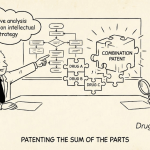
Somewhere in a brand-name drug company’s lifecycle management plan, there is usually a line item that reads something like: ‘Evaluate FDC opportunity with [Component A] + [Component B] — target filing Q3.’ What follows from that single line can amount to a decade of additional market exclusivity, billions in protected revenue, and a litigation campaign that ties up four generic manufacturers simultaneously. This is the fixed-dose combination (FDC) strategy, and it is one of the most commercially consequential tools in pharmaceutical IP.
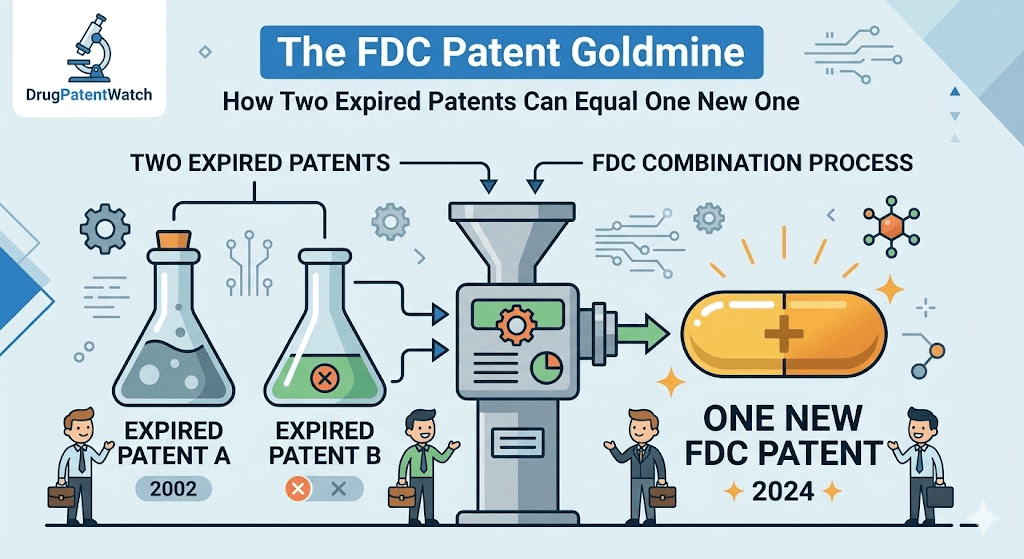
The central mechanism is simple enough that it sounds almost too convenient to be legal: take two drugs whose individual composition-of-matter patents have expired or will shortly expire, combine them into a single dosage form, and file for a new patent on that combination. If the combination is novel and non-obvious, the U.S. Patent and Trademark Office will grant a fresh 20-year patent term, entirely independent of the protections that covered the individual components. Loss of exclusivity (LOE) for Drug A and Drug B does not trigger LOE for the AB combination.
This is not a loophole. It is patent law operating as designed, and the courts have upheld it repeatedly. But it is also a strategy that generates enormous controversy, significant litigation, and occasionally, FTC scrutiny. Understanding exactly how it works — where the IP is defensible, where it is vulnerable, and what the commercial implications are for everyone from brand manufacturers to generic challengers to payers — is what this article is about.
What Is a Fixed-Dose Combination Drug, and Why Does It Matter for Patent Strategy?
A fixed-dose combination (FDC) is a pharmaceutical product containing two or more active pharmaceutical ingredients (APIs) in a single dosage unit at a predetermined ratio. Under the Hatch-Waxman Act framework, an FDC can receive its own patent protection independent of any patents covering its individual components, meaning patent expiry for individual drugs does not automatically trigger patent expiry for their combination product.
The FDA defines an FDC as a formulation where ‘two or more drugs may be combined in a single dose when each component makes a contribution to the claimed effects, and the dosage of each component is such that the combination is safe and effective for a significant patient population requiring such concurrent therapy.’[1] This definition comes from 21 CFR 300.50, and it sets the regulatory threshold for approval. The patent threshold is separate: the combination must be novel and non-obvious under 35 U.S.C. §§ 102 and 103.
Those two thresholds — regulatory and patent — function independently. A combination that meets the FDA’s clinical contribution requirement can still fail the USPTO’s non-obviousness test. Conversely, a combination that clears patent prosecution can still face obviousness challenges in Paragraph IV litigation years later. The brands that succeed with FDC patent strategy are those that treat regulatory and patent development as a single integrated program, not two sequential steps.
How Is an FDC Different from a Co-Packaged Drug Product?
An FDC puts both APIs in the same physical dosage unit — one tablet, one capsule, one inhaler. A co-packaged product puts separate dosage forms of each drug in the same box. The distinction matters for both patent strategy and generic substitution. A generic manufacturer can achieve AB-rated substitution for a co-packaged product by simply packaging approved generics of each component together. For a true FDC, the generic must make an integrated product — same formulation, same dosage form — and file a full ANDA or 505(b)(2) application covering the combination.
This distinction is why brand companies invest in FDCs rather than co-packaging. The IP protection is firmer, the substitution pathway for generics is more expensive and slower, and the opportunity to build a new patent estate around the integrated product is genuine.
The Three Types of IP That Protect an FDC
When a company launches an FDC, it typically pursues three overlapping categories of patent protection. First, composition-of-matter claims covering the specific combination at specific ratios — the core patent that defines what the product is. Second, formulation claims covering the physical or chemical structure that makes the combination work as a single dosage unit (immediate-release layering, pH-dependent release zones, specific excipients that prevent API interaction). Third, method-of-use claims covering the therapeutic indication for which the combination is approved, particularly if the combination produces a clinical effect that neither component achieves alone at the same dose.
A fourth category — method-of-manufacture claims — is less commercially significant for Orange Book listing purposes but can be important in IPR proceedings and cross-licensing disputes. DrugPatentWatch, which tracks patent listings and litigation across all Orange Book-listed products, shows that commercially successful FDCs routinely carry six to fifteen Orange Book-listed patents, each representing a different vector of protection against generic entry.[2]
The LOE Math: How FDC Strategy Extends Exclusivity in Practice
The numbers behind FDC patent extension are not theoretical. A 2015 study published in PLOS ONE analyzed FDA-approved FDCs from 1980 to 2012 and quantified the exclusivity extension effect directly. The authors found that non-NME FDCs (combinations of already-marketed drugs) entered the market at a median of 5.43 years after first FDA approval of the individual components. More importantly, these FDCs reached the market a median of 2.33 years before generic versions of the individual components became available.
‘Non-NME FDC added a median of 9.70 years (interquartile range 2.75, 16.24) to the patent and exclusivity life of the single active ingredients in the combination.’Hao J, Rodriguez-Monguio R, Seoane-Vazquez E, PLOS ONE, October 2015 [3]
Nearly a decade of additional exclusivity, achieved by recombining drugs that were already approved. The FDC approvals themselves increased from 12 in the 1980s to 59 in the 2000s, a trend that has continued accelerating since.[3]
When Does the Brand Launch the FDC Relative to Component LOE?
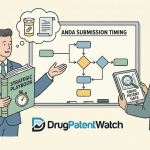
Timing is the strategic variable that separates effective FDC lifecycle management from a last-ditch revenue defense. The most commercially successful FDC launches occur two to four years before the LOE date of the primary component. This window allows the brand to shift patient volume to the combination product before generic erosion begins on the monotherapy. By the time generics enter the monotherapy market, a substantial portion of the prescribing base has migrated to the FDC, which remains under patent protection.
Gilead executed this playbook with precision across its HIV franchise. The company launched Atripla (efavirenz/emtricitabine/tenofovir disoproxil fumarate) in 2006 as the first single-tablet HIV regimen, well before the individual components reached LOE. It then launched Complera (emtricitabine/rilpivirine/TDF) in August 2011 and Stribild (elvitegravir/cobicistat/TDF/emtricitabine) in August 2012, each time migrating the patient base before the prior product’s patents expired.[4] The Biktarvy (bictegravir/emtricitabine/tenofovir alafenamide) cycle, approved in 2018, is now doing the same for Genvoya patients.
The Revenue Cliff Without FDC Strategy: A Comparison Table
Scenario
Year 0 Revenue
Year 3 (Post-LOE) Revenue
Revenue Retention
Monotherapy only, no FDC
$2.0B
$300–400M (generics at 85–90% share)
15–20%
FDC launched 2 years pre-LOE
$2.0B (split across mono + FDC)
$1.2–1.5B (FDC still protected)
60–75%
FDC with successful Paragraph IV defense
$2.0B (split)
$1.6–1.8B (extended FDC exclusivity)
80–90%
These figures are illustrative based on typical generic price erosion curves. In therapeutic areas with high brand loyalty — HIV, opioid use disorder, diabetes — actual post-LOE retention for a well-positioned FDC can be higher still.
The Legal Basis: Why Expired Component Patents Don’t Kill the FDC Patent
35 U.S.C. § 102 and § 103: Novelty and Non-Obviousness Applied to Combinations
Two questions govern whether an FDC claim will survive examination and litigation. The first is novelty under § 102: has this exact combination, at this ratio, in this dosage form, been disclosed anywhere in prior art? The second is non-obviousness under § 103: even if the combination has never appeared in prior art, would a person having ordinary skill in the art (POSITA) have found it obvious to make this specific combination?
The novelty bar is usually clearable for new combinations. The non-obviousness bar is where FDC patents live or die. When both component APIs are disclosed in prior art — which they necessarily are, since they are already approved drugs — the combination faces a strong presumption of obviousness. The USPTO examiner and any future Paragraph IV challenger will ask: why wouldn’t a skilled formulator simply combine two known drugs that are prescribed together?
The Supreme Court’s 2007 ruling in KSR International Co. v. Teleflex Inc., 550 U.S. 398, made this presumption harder to overcome. Before KSR, patent challengers had to satisfy the rigid Teaching-Suggestion-Motivation (TSM) test: they needed to point to a specific prior art reference that explicitly suggested combining the two elements. KSR replaced that rigid test with a flexible, common-sense inquiry. After KSR, a POSITA is ‘a person of ordinary creativity, not an automaton.’ If it is common knowledge in a field that two drugs are frequently prescribed together, the combination of those drugs into a single product may be obvious to try — and ‘obvious to try’ is now much more likely to constitute legal obviousness.[5]
How Pharmaceutical Companies Rebut Obviousness for FDC Patents
Rebutting the post-KSR obviousness presumption requires experimental data, not narrative. There are four reliable evidence paths. First, synergy: showing that the combination produces a pharmacological effect greater than the sum of its parts, one that a POSITA would not have predicted from the individual drug profiles. Second, unexpected results: demonstrating that the combination achieves a clinically meaningful outcome — lower adverse event rates, superior efficacy at lower doses, a new mechanism of action — that would not have been anticipated. Third, long-felt need: establishing that the field recognized a problem that the combination solves, and that despite the motivation to solve it, no one succeeded for years before this combination. Fourth, commercial success: showing that the combination achieved market success that can be attributed to its technical merits rather than to marketing or distribution advantages.
The strongest FDC patents use multiple lines of evidence simultaneously. A naked composition claim — ‘A pharmaceutical composition comprising Drug A and Drug B’ — will almost certainly fail if both components and their combined use have appeared in prior art.[6] The IP value is in the specifics: the ratio, the formulation structure, the documented clinical differentiators.
Prosecution History Estoppel and Its Effect on Future Litigation
Every argument made during patent prosecution, every claim amendment, and every concession to an examiner’s rejection becomes part of the prosecution history. Under the doctrine of prosecution history estoppel, a patentee who narrowed a claim to overcome an obviousness rejection cannot later argue in infringement litigation that the claim covers the scope that was surrendered.[6]
This creates a difficult tradeoff for FDC patent applicants. Narrowing claims during prosecution to overcome a rejection preserves the patent — but at the cost of claim scope. The preferred approach, where possible, is to overcome rejections by argument and evidence (a declaration from an expert, a declaration from a named inventor with experimental data) rather than by claim amendment. An argument-based response preserves broader claim scope and avoids creating estoppel that a future Paragraph IV challenger can exploit.
The FDA Pathway: How FDCs Get Approved and What Exclusivities They Earn
505(b)(1) vs. 505(b)(2): Which Pathway for a New FDC?
A brand company developing an FDC from two already-approved drugs has a choice of regulatory pathways. A traditional 505(b)(1) NDA requires the sponsor to conduct and own all safety and efficacy studies. A 505(b)(2) application lets the sponsor rely, in part, on the FDA’s prior finding of safety and effectiveness for the individual components — the Reference Listed Drugs (RLDs) — and generate new data only to cover the specific differences: pharmacokinetics of the combination, drug-drug interaction characterization, combination-specific safety signals, and bioequivalence between the proposed FDC and co-administered individual components.[7]
The 505(b)(2) pathway is faster and cheaper, which is why it is the dominant route for combination products comprising two existing APIs. A typical FDC program via 505(b)(2) requires a bridging PK study, a drug-drug interaction study if there are metabolic pathway overlaps, and combination-specific safety data if the components share toxicity mechanisms. The full Phase III trial program conducted for each individual drug does not need to be repeated.
What Exclusivities Does an FDC Earn?
An FDC product approved via 505(b)(2) earns three-year new clinical investigation exclusivity (3-year NCI) if new clinical studies were essential to approval. It can earn five-year new chemical entity (NCE) exclusivity if any component of the combination has never been previously approved as a drug — a narrower scenario, but commercially significant when one component is a new pharmacological booster or novel metabolite. Pediatric exclusivity (six months added to existing patents and exclusivities) is available if the sponsor conducts qualifying pediatric studies. These exclusivities layer on top of any Orange Book-listed patents.
Three-year NCI exclusivity is the most common exclusivity award for non-NME FDCs. It blocks submission of an ANDA or 505(b)(2) that relies on the same clinical studies for three years from the date of approval. Critically, this three-year clock runs concurrently with existing patent terms — it is not additive to the strongest patent. But for products where no strong composition-of-matter patent exists, it provides a floor of market protection during the most commercially critical launch period.
The NCE-1 Date and Its Significance for Generic Timing
Under Hatch-Waxman, a generic manufacturer generally cannot submit an ANDA or 505(b)(2) relying on an RLD’s NCE exclusivity until the NCE-1 date — four years after the RLD’s approval — and cannot obtain approval until the five-year NCE exclusivity expires. For an FDC where one component holds active NCE exclusivity, the earliest ANDA submission date is the NCE-1 date of that component. This timing feature means that strategic sequencing — launching an FDC before the primary component’s NCE exclusivity expires — creates a period during which no ANDA can even be filed against the FDC, let alone litigated.[8]
Orange Book Listing Strategy for FDC Patents
A patent is eligible for Orange Book listing if it claims the drug product itself (composition), the drug substance (active ingredient), or a method of using the drug for an approved indication. For FDCs, this means a combination-specific composition patent, formulation patents covering the integrated dosage form, and method-of-use patents tied to the specific combination indication all qualify for listing.
Method-of-use patents that cover only one component’s mechanism — not the combination’s specific indication — are generally not eligible for listing in the FDC’s Orange Book entry. This distinction matters because it determines which patents trigger the 30-month stay in Paragraph IV litigation. Only listed patents trigger the automatic stay. Unlisted patents must be asserted separately in district court without the benefit of automatic FDA approval delay.
Case Study: Treximet (Sumatriptan/Naproxen Sodium) and the Combination Patent That Survived Multiple Generic Challenges
The Components: Two Generic Drugs, One Defendable Patent
By the time Pozen Inc. filed for Treximet’s patents, sumatriptan had been approved for migraine since the early 1990s and naproxen had been generic for decades. No one owned the composition of either molecule. Individually, neither drug was patentable. The combination was the entire IP thesis.
Pozen’s patents — U.S. Patent Nos. 6,060,499 and 6,586,458 — claimed methods and compositions for treating migraine using a combination of a 5-HT receptor agonist (sumatriptan) and a long-acting NSAID (naproxen). The key clinical claim was that the specific combination produced sustained pain relief that neither component achieved alone at the doses used: sumatriptan addresses the acute migraine attack, while naproxen suppresses the prostaglandin-mediated inflammatory cascade that contributes to migraine recurrence within 24 hours.
The Paragraph IV Challenge and Litigation Outcome
Generic manufacturers including Par Pharmaceutical, Alphapharm, Dr. Reddy’s Laboratories, and Teva filed ANDAs with Paragraph IV certifications against Treximet. Pozen sued for infringement in the Eastern District of Texas. The generic challengers argued that the combination was obvious: both drugs were known to treat migraine, both were known to be safe, and their co-administration was documented in prior art.
The Eastern District of Texas ruled in Pozen’s favor in August 2011, finding the patents valid and infringed.[9] The Federal Circuit affirmed in September 2012, upholding the district court’s non-obviousness analysis. The court’s reasoning turned on several points. Prior art references that disclosed co-administration of sumatriptan and NSAIDs did not document simultaneous administration for the purpose of reducing migraine recurrence. One clinician’s records showed he had prescribed both drugs to the same patients but testified he did not recall ever prescribing them simultaneously. Pozen’s patents claimed not just the combination but the specific clinical rationale — simultaneous administration to achieve sustained relief — and the prior art did not clearly teach that result.[10]
The Federal Circuit upheld three separate patents, affirming each through different non-obviousness analyses. For IP counsel working on combination drug patents, the Treximet outcome is a template: specificity of mechanism, specificity of dosing protocol, and clinical data demonstrating the specific result the combination achieves beyond each component alone.
What the Treximet LOE Timeline Looks Like Today
According to data from DrugPatentWatch, Treximet’s final patent expiry is estimated at April 2026, with three companies having already received ANDA approvals for the generic combination — Aurobindo Pharma among them.[11] The patent run from the 2008 approval date to 2026 represents approximately 18 years of effective FDC exclusivity on a product combining two APIs whose individual patent estates had long since expired. For a combination migraine product generating roughly $15 million in annual royalties to Pozen as of 2010, the patent defense was commercially rational even at the cost of multi-front ANDA litigation.
Case Study: Biktarvy and the Gilead HIV FDC Ladder
How Gilead Built a $13.4 Billion Annual Revenue Product from Combination IP
Biktarvy (bictegravir 50mg/emtricitabine 200mg/tenofovir alafenamide 25mg) is the most commercially successful FDC in pharmaceutical history by annual revenue. Gilead reported Biktarvy sales of $13.42 billion for full-year 2024, a 13% increase year-over-year, representing 47% of the company’s total product revenue.[12] Every one of those dollars flows from a combination patent strategy that stretches back two decades.
Bictegravir (BIC) is a novel integrase strand transfer inhibitor that Gilead developed specifically for the Biktarvy formulation. Emtricitabine (FTC) is the component Gilead has included in every iteration of its HIV combination franchise since Truvada. Tenofovir alafenamide (TAF) is the safer successor to tenofovir disoproxil fumarate (TDF) that Gilead developed — and patented — specifically to anchor its next-generation HIV portfolio. The three-component combination achieves high viral suppression rates with a renal and bone safety profile superior to earlier TDF-based combinations, which supported both clinical adoption and non-obviousness arguments.
The Biktarvy Patent Landscape: What Generic Entry Actually Looks Like
Biktarvy is protected by 15 U.S. drug patents, 10 of which are currently active. Gilead settled Paragraph IV patent challenges from Lupin, Cipla, and Laurus Labs in late 2025, extending effective U.S. market exclusivity to April 1, 2036 — three years beyond the previously estimated December 2033 expiry.[13] At 2024 revenue rates, that three-year extension represents approximately $40 billion in additional protected U.S. revenue.
The settlement structure is a standard authorized-generic-free consent judgment with an agreed entry date. No authorized generic provision was disclosed, meaning Lupin, Cipla, and Laurus cannot launch in the U.S. before April 2036. The settlement payment structure — which reportedly included a $1.25 billion payment to ViiV Healthcare related to overlapping IP — reflects the complexity of a three-component product where patent estates from multiple companies intersect.[13]
The Gilead Upgrade Cycle: How FDC Sequencing Protects the Franchise
Gilead’s HIV strategy over two decades demonstrates a specific FDC sequencing pattern. Each new combination product incorporates a new proprietary component (cobicistat in Stribild, TAF in Genvoya, bictegravir in Biktarvy) that anchors a fresh patent estate, while retaining FTC as the backbone NRTI to provide continuity and cross-label familiarity.
2006 — Atripla launched (efavirenz/FTC/TDF), first HIV single-tablet regimen, Gilead/BMS collaboration
2025 — Biktarvy generic entry delayed to 2036 via patent settlements with Lupin, Cipla, Laurus Labs
At each transition point, Gilead used a new proprietary component to anchor a new patent estate while the previous generation’s patents approached expiry. When Genvoya launched in 2015, 78% of initial prescriptions came from switches off Stribild — Gilead migrating its own patients to a more-protected product before Stribild reached LOE.[14] The FDC upgrade cycle is both a clinical improvement program and an IP defense mechanism.
Case Study: Synjardy (Empagliflozin/Metformin) and the Diabetes FDC Market
How Boehringer Ingelheim and Eli Lilly Extended the Empagliflozin Franchise
Metformin has been generic since the early 2000s. Its primary composition patents expired decades ago. It remains one of the world’s most commonly prescribed type 2 diabetes medications. Empagliflozin (Jardiance), by contrast, is a patented SGLT2 inhibitor developed by Boehringer Ingelheim and Eli Lilly, with composition-of-matter patents expiring in the 2026-2027 range in major markets.[15]
Synjardy, the empagliflozin/metformin FDC approved in August 2015, is protected by 16 U.S. patents and carries 38 patent litigation cases — a figure that reflects the product’s commercial significance and the generic industry’s corresponding motivation to challenge it. DrugPatentWatch data shows 38 patent litigation cases involving Synjardy’s patent portfolio.[16] The combination patent estate extends effective exclusivity to approximately 2034, compared with the 2026-2027 empagliflozin monotherapy LOE.
The commercial logic is straightforward: empagliflozin’s EMPA-REG OUTCOME data, published in 2015, demonstrated significant cardiovascular mortality reduction in patients with established cardiovascular disease. That outcome data anchored not just the Jardiance label expansion but also the clinical rationale for the Synjardy combination — the cardiovascular benefit of empagliflozin combined with the foundational glucose control of metformin in a once-daily FDC positioned to capture the enormous type 2 diabetes polypharmacy market.
Synjardy vs. Jardiance: Why the Combination Patent Lasts Longer than the Monotherapy
Product
Active Ingredients
Approval Date
Estimated LOE
Patents Listed (US)
Jardiance (monotherapy)
Empagliflozin
August 2014
December 2034 (latest)
15
Synjardy
Empagliflozin + Metformin HCl
August 2015
November 2034 (latest)
16
Synjardy XR
Empagliflozin + Metformin HCl ER
December 2015
December 2034 (latest)
14
The composition-of-matter empagliflozin patents expire in 2026-2027. The FDC patent portfolios extend to 2034 via combination-specific formulation and method-of-use patents. That eight-year differential — achieved by combining a patented SGLT2 inhibitor with an off-patent metformin — is the FDC patent goldmine in precise quantitative form.
The Suboxone Playbook: FDC as Abuse Deterrence and Exclusivity Anchor
Buprenorphine + Naloxone: Why the Combination Exists and How It Generated IP Value
Suboxone’s buprenorphine/naloxone combination has a legitimate clinical rationale that precedes any lifecycle management consideration. Naloxone is added at a 4:1 ratio specifically to deter intravenous diversion: when the sublingual film is used as intended, naloxone has negligible bioavailability and does not interfere with buprenorphine’s therapeutic effect. When the film is dissolved and injected, the naloxone precipitates opioid withdrawal in a dependent user, making the product aversive to misuse. That pharmacological design — not just the combination of two components, but the specific mechanism the combination exploits — is the IP foundation.
Indivior obtained FDA approval for Suboxone Tablets in 2002. The FDA designated Suboxone Tablets as an orphan drug because it was the first buprenorphine-based product approved for opioid addiction treatment, and the FDA believed Indivior would not recover development costs. That orphan designation conferred seven years of market exclusivity.[17] The product proved more successful than the FDA anticipated, generating hundreds of millions in annual revenue by the late 2000s.
The Film Switch: How a Formulation Change Extended FDC Exclusivity
In December 2006, Reckitt Benckiser Healthcare (now Indivior) and MonoSol signed a development agreement for a sublingual film formulation of Suboxone specifically to create a new dosage form before tablet LOE. The film offered faster dissolution, reduced risk of accidental pediatric ingestion through unit-dose packaging, and a different abuse resistance profile. MonoSol applied for a formulation patent (issued as U.S. Patent No. 8,017,150) covering polyethylene oxide-based sublingual film technology.[17]
The film earned its own new clinical investigation exclusivity. By March 2013, less than two weeks after generic tablets entered the market, Indivior withdrew the tablets from commerce — completing what antitrust regulators would later characterize as a ‘hard switch’ designed to strand the generic tablet entrants without a therapeutically equivalent branded reference product on the market.
Indivior’s strategy generated a patient preference result of approximately 80% for the film format and extended effective market protection for the buprenorphine/naloxone franchise. It also triggered an FTC antitrust enforcement action against Reckitt Benckiser for filing citizen petitions characterized as sham filings designed to delay generic tablet approval, a settlement that illustrates the compliance boundary between legitimate safety advocacy and anticompetitive delay.
Suboxone film currently carries three U.S. patents with an estimated latest LOE of March 2030, with 16 companies having filed ANDAs and approved generics already on the market.[18]
The Seven-Patent Picket Fence: How to Build a Defensible FDC Patent Estate
Why One Combination Patent Is Never Enough
A single composition-of-matter patent on an FDC is necessary but not sufficient for effective commercial protection. Generic manufacturers can design around a narrow composition claim by adjusting the ratio, the excipients, the particle size, or the release mechanism. A defensible FDC patent estate builds layered protection across at least seven distinct patent categories, each blocking a different vector of generic entry.[6]
The seven categories are: composition-of-matter claims at the specific ratio (blocking identical products), composition claims covering a range of ratios (blocking near-identical products), formulation claims covering the specific dosage form architecture (blocking same-ratio reformulations), method-of-use claims tied to the specific indication (blocking products relying on the same clinical effect), crystalline form or polymorph claims if applicable (blocking different solid-state manifestations), manufacturing process claims (blocking certain production methods even when the product itself might be non-infringing), and combination-specific PK claims (covering bioavailability, Tmax, or Cmax relationships documented in clinical studies that define the combination’s performance).
System Claims for Drug-Device FDC Combinations
For FDCs delivered through a device component — an inhaler, an autoinjector, a transdermal patch — system claims offer a structural advantage over composition claims alone. A system claim covers the integrated product: the device, the drug combination, and their operational relationship. The company that manufactures and sells the integrated device-FDC is the single party performing all claim elements, avoiding the divided infringement problem that can arise when composition and device are made by different parties. As GLP-1 agonist combination products with proprietary autoinjector platforms proliferate, system claim drafting is increasingly critical for protecting the full commercial product rather than just its pharmacological components.[6]
What Makes a Ratio Claim Defensible Post-KSR?
A ratio claim is defensible when the specific ratio is the invention — when clinical or experimental data demonstrate that this ratio, and not a range of ratios, achieves the clinical effect that makes the combination non-obvious. A claim covering ‘between 1:1 and 10:1’ of Drug A to Drug B is likely to fall on obviousness grounds if the prior art suggests combining the two drugs at any ratio. A claim covering specifically a 4:1 ratio with pharmacokinetic data demonstrating that this ratio achieves simultaneous peak plasma concentrations of both components — producing a synergistic effect demonstrably absent at a 3:1 or 5:1 ratio — is a fundamentally different legal claim supported by quantitative evidence that a POSITA would not have predicted.
Paragraph IV Litigation Against FDC Patents: The Generic Challenger’s Playbook
How Generics Approach Obviousness Arguments Against Combination Patents
The obviousness argument against a combination drug patent generally follows one of three structures. The first is ‘motivation to combine’: arguing that physicians already routinely co-prescribed the two components for the same indication, establishing that a POSITA had clear motivation to combine them. This argument is most powerful when clinical practice guidelines explicitly recommended combination therapy before the FDC patent was filed.
The second structure is ‘predictable results’: arguing that combining two drugs with known, complementary mechanisms of action produces exactly the pharmacological result a skilled formulator would have expected, with no surprise outcome. Post-KSR, this argument has real force: if both drugs act on the same disease pathway through different molecular targets, combining them is the textbook therapeutic rationale for polypharmacy, and arguing that the combination was non-obvious requires genuine data showing something unexpected.
The third structure is ‘obvious to try’: arguing that the combination was one of a finite, identifiable set of combinations a skilled researcher would have investigated. This argument is strongest when prior art identifies both components as the most clinically relevant options in their respective drug classes and when no meaningful technical obstacle existed to making the combination.
Secondary Considerations That Brand Companies Use to Rebut Invalidity
Brand companies defend combination patents through secondary considerations (also called objective indicia of non-obviousness). Commercial success is the most commonly invoked: high market adoption, prescriber preference data, payer formulary placements. Long-felt but unsolved need is often available in therapeutic areas where multimorbidity is high and pill burden has been a documented barrier to adherence. Failure of others — evidence that competitors tried to develop a similar combination and abandoned it before succeeding — is the most powerful secondary consideration but also the most difficult to establish from public evidence alone.
For FDC patents specifically, the adherence benefit can support commercial success and long-felt need simultaneously. If controlled studies demonstrate that patients on the FDC achieve measurably better adherence and clinical outcomes than patients on identical regimens of separately administered components, that clinical differentiation supports non-obviousness even when the pharmacological mechanism of each component is individually well understood.
The 30-Month Stay and Its Strategic Value for FDC Brands
When a brand manufacturer sues a Paragraph IV ANDA filer within 45 days of receiving the notice letter, the FDA is automatically barred from approving the generic’s ANDA for up to 30 months, or until the court resolves the infringement question, whichever comes first.[8] For an FDC with six Orange Book-listed patents, a brand company that files six separate Paragraph IV suits may be able to stack 30-month stays across different patent expiry dates, though courts have been increasingly skeptical of late-filed patents added to the Orange Book specifically to trigger additional stays.
The 30-month stay provides the brand with a critical operational window: 30 months of continued exclusive sales while the litigation proceeds. For a combination product generating $1 billion annually, each 30-month stay is worth $2.5 billion in protected revenue while the legal dispute plays out. This commercial calculus is why brand companies file suit within the 45-day window almost without exception when a Paragraph IV notice covers a commercially significant FDC.
Inter Partes Review at the PTAB: The Generic’s Alternative Forum
Since the America Invents Act of 2011, generic manufacturers have had access to Inter Partes Review (IPR) at the Patent Trial and Appeal Board (PTAB) as a parallel validity challenge forum. IPR proceedings offer a lower burden of proof for invalidity (preponderance of the evidence versus the clear and convincing standard in district court), shorter timelines (typically 12 months from institution to final written decision), and a more technically specialized panel of administrative patent judges who are themselves patent attorneys with scientific backgrounds.
For combination drug patents, the IPR forum is particularly attractive to challengers because the obvious-to-combine argument that is difficult to establish in district court — where secondary considerations carry significant weight — can be developed more rigorously in PTAB’s fact-based, claim-by-claim analysis. A successful IPR that invalidates even one FDC patent claim can shift leverage dramatically in parallel district court litigation, often producing settlement offers from brand companies that would not otherwise be available.[11]
Why Payers and PBMs Are the Hidden Variable in FDC Commercial Success
When Clinical Logic Meets Formulary Denial: The Yosprala Problem
Not every FDC survives market contact. Yosprala (aspirin/omeprazole), developed by Aralez Pharmaceuticals, is the canonical example of a clinically coherent combination that payers refused to cover at a meaningful premium. The clinical rationale is defensible: patients who require daily aspirin for cardiovascular risk reduction often need a proton pump inhibitor to protect against aspirin-induced gastrointestinal bleeding. A single FDC pill simplifies adherence to both drugs simultaneously.
Payers rejected the premium pricing argument because generic aspirin and generic omeprazole are separately available at trivial cost. A patient could purchase the therapeutic equivalent of Yosprala in separate pills for a few dollars per month. The patent protection on the combination was not the problem; the inability to demonstrate clinical differentiation sufficient to justify formulary placement above the generic co-administration alternative was.[9]
This is the commercial constraint that narrows the FDC strategy: patent protection creates the legal right to charge a premium, but it does not guarantee payers will pay one. The FDC patent goldmine produces revenue only when the combination achieves formulary placement, step-edit coverage, or utilization management provisions that create prescribing friction around the generic alternative.
Formulary Positioning Strategy for FDCs with Generic Component Alternatives
Brand manufacturers generally pursue one of two formulary strategies for FDCs facing generic component competition. The first is clinical differentiation: producing health economic data demonstrating that improved adherence with the FDC reduces downstream hospitalization, emergency care, or disease progression costs enough to justify the premium over separate generics. This approach has worked in HIV (where single-tablet regimens are the standard of care and multi-pill regimens are associated with measurably worse adherence outcomes) and in type 2 diabetes (where cardiovascular outcomes data for certain SGLT2 inhibitor combinations supports medical society guidelines).
The second strategy is access and affordability programs: co-pay assistance cards that eliminate out-of-pocket costs for commercially insured patients, often combined with patient support programs that create brand loyalty before patent expiry. This approach maintains volume while the litigation runs and before payers have built formulary restrictions around the generic component alternatives.
What Happens to FDC Pricing When Component Generics Enter?
The pricing trajectory for a branded FDC after component generic entry follows a predictable pattern. In Year 1 post-component-LOE, the FDC retains most of its list price as prescribers continue using established prescribing habits and patients resist formulary switches. In Years 2 and 3, payer step-edit requirements and prior authorization barriers begin to divert new patients to generic co-administration, while switching existing stable patients requires a step-edit failure or physician override. Volume declines at 10-15% annually. By Year 5, the FDC market splits between insured patients on FDC (protected by co-pay assistance) and uninsured or government-program patients on generic components.
For Medicare Part D patients, the calculus is different: the Inflation Reduction Act’s drug pricing negotiation provisions, implemented from 2026, affect single-source brand drugs in high-expenditure therapeutic categories. FDCs are not immune to negotiation if both components are already available generically and the combination’s incremental clinical benefit cannot be demonstrated in outcomes data.
The Regulatory Scrutiny Problem: When FDC Strategy Attracts Antitrust Attention
Product Hopping and the Line Between Lifecycle Management and Anticompetitive Conduct
The Suboxone antitrust case established a doctrinal line that every brand company considering an FDC hard switch must internalize. When a brand company introduces a new formulation and then withdraws the old formulation from commerce before generic entry, the conduct may constitute anticompetitive product hopping if the withdrawal’s primary effect is to prevent generic substitution rather than to provide genuine clinical benefit.
The legal test is not whether the new formulation is better — it generally is, by some measure. The test is whether the withdrawal of the old product, combined with the new product’s patent protection, creates a market foreclosure effect that no legitimate competition from generic equivalents can overcome. Indivior’s withdrawal of Suboxone tablets immediately after generic tablet entry, combined with pre-withdrawal efforts to shift the prescribing base to the film, met the legal threshold for antitrust liability in several state attorney general actions.[17]
The doctrinal implication for FDC strategy is that product transitions should occur through market competition — physicians choosing the FDC over the monotherapy based on clinical merit — rather than through elimination of the branded reference product on which generic substitution depends. Maintaining the monotherapy on the market, even at reduced promotional priority, is the low-risk approach.
FTC Review of Hatch-Waxman Settlements Involving FDC Products
Reverse payment settlements — where a brand pays a generic challenger to delay market entry — receive mandatory FTC review in the U.S. under the FTC Improvement Act. For settlements involving FDC products, the FTC looks specifically at whether the settlement includes provisions that delay entry of both generic FDC versions and generic components simultaneously, creating a broader exclusivity scope than either patent alone would confer. A settlement that delays a generic component’s market entry in exchange for the generic dropping an FDC Paragraph IV challenge extends the brand’s competitive advantage beyond what its FDC patent justifies and may constitute an antitrust violation under FTC v. Actavis, 570 U.S. 136 (2013).
FDC Strategy in Emerging Therapeutic Areas: What’s Being Built Now
GLP-1 and SGLT2 Combinations: The Next Wave of FDC IP
The diabetes-obesity-cardiovascular therapeutic space is generating the next generation of commercially significant FDC patent filings. Semaglutide (Ozempic/Wegovy) and empagliflozin operate through complementary mechanisms — GLP-1 receptor agonism and SGLT2 inhibition — with non-overlapping adverse event profiles and additive or synergistic effects on weight, glycemic control, and cardiovascular outcomes. Fixed-dose combination tablets or injectables combining these classes are in development at multiple companies.
The patent challenge for these combinations is different from the Treximet or Synjardy situations because neither component is yet generic. The FDC patent must demonstrate non-obviousness not relative to two expired APIs but relative to two patented, commercially successful drugs whose combination has obvious clinical logic. The non-obviousness argument will likely turn on specific ratio optimization data and on novel delivery systems that achieve stable co-formulation of a peptide (semaglutide) and a small molecule (empagliflozin) in a single dosage form — a genuine technical challenge that could support a defensible patent position.
Cardiovascular FDC Combinations: ARBs, ACE Inhibitors, and Polypill Strategy
The cardiovascular polypill concept — a single pill combining a statin, an antihypertensive, and low-dose aspirin for cardiovascular risk reduction in low-to-middle income countries — has been in development for decades. In higher-income markets, fixed-dose combinations of angiotensin receptor blockers (ARBs) with thiazide diuretics, and ACE inhibitors with calcium channel blockers, have established commercial footprints. Entresto (sacubitril/valsartan), Novartis’s heart failure combination, demonstrates what a well-differentiated two-drug FDC can generate: the combination produced a survival benefit in the PARADIGM-HF trial that neither component achieved independently, anchoring both a defensible patent position and a premium pricing case to payers.
Oncology Combinations: Small Molecule FDCs and the Approval Pathway
Fixed-dose combinations in oncology face a different clinical evidence burden. The FDA requires that each component of an oncology FDC make a contribution to the claimed effect that is independently demonstrable. For combination chemotherapy regimens — two cytotoxics at fixed ratios, or a targeted therapy combined with a pharmacokinetic booster — the contribution requirement may demand separate dose-finding studies demonstrating that the ratio reflects individually active doses rather than arbitrary convenience.
The patent opportunity in oncology FDCs is substantial because synergistic cytotoxic combinations — where the combination produces tumor cell kill significantly exceeding the additive effect of both agents — generate strong non-obviousness arguments. U.S. Patent No. 6,906,040, which claimed a combination of doxorubicin with a specific co-agent and demonstrated that the combination did not produce the cardiotoxic metabolites that doxorubicin generates with taxanes, is the model: toxicity data as the centerpiece of the non-obviousness case, not an afterthought.[6]
Detecting FDC Lifecycle Management Moves Before They Happen: A Competitive Intelligence Framework
The Four Pre-Launch Signals That Indicate an FDC Is Coming
An FDC launch rarely comes without advance warning for analysts who know where to look. The signals appear at least 24 to 36 months before the combination product reaches the market, often earlier. Recognizing them early allows generic manufacturers to begin formulation development, allows investors to update revenue models, and allows payers to prepare formulary strategy before the brand controls the prescribing narrative.
The first signal is a new patent filing with combination-specific claims in the USPTO. The USPTO’s Patent Full Text Database publishes patent applications 18 months after filing. A newly published application from a brand manufacturer claiming a composition comprising Drug A and Drug B, with clinical data as supporting evidence, is the earliest public indication that an FDC program has reached patent prosecution stage. Linking USPTO publication dates to Orange Book product codes — a function that DrugPatentWatch’s alert system provides for subscribers — allows competitive intelligence teams to catch these filings when they publish rather than when they result in Orange Book listings months or years later.
The second signal is a new IND (Investigational New Drug) application for a combination study. The FDA discloses the existence of IND submissions for combination products in its clinical holds database and in ClinicalTrials.gov registrations. A Phase II study registered on ClinicalTrials.gov comparing a combination of Drug A and Drug B to each component individually in a head-to-head design is an explicit public disclosure of the combination program and provides information about the target indication, the ratio being studied, and the clinical endpoint the brand intends to use as its non-obviousness foundation.
The third signal is a new NDA filing. The FDA’s drug approval action letters database and the Drugs@FDA system update when NDAs are filed, reviewed, and approved. A new 505(b)(2) NDA submission for a two-component combination product, logged by FDA approximately 60 days after receipt, appears in the public record before approval and gives generic manufacturers 12 to 18 months of additional notice before the product reaches the market.
The fourth signal — the earliest and most actionable — is a patent assignment record. When a brand company acquires rights to a formulation technology from a specialty drug delivery company (as Indivior did with MonoSol’s film technology for Suboxone), the assignment is recorded at the USPTO and creates a public footprint connecting the delivery technology to the brand manufacturer. Monitoring patent assignments for pharmaceutical companies in the two to three years before anticipated LOE dates of major products is a systematic early-warning practice for competitive intelligence teams.
Using Orange Book Changes to Track Brand Lifecycle Transitions
The FDA’s Orange Book is updated monthly with new patent listings, patent delistings, and exclusivity changes. Systematic monitoring of Orange Book updates — specifically tracking when brand companies add new patents to existing NDA products or list patents for new NDAs using familiar active ingredient combinations — provides a near-real-time view of brands’ lifecycle management activities.
A brand adding a new formulation patent to an existing NDA entry, six months before that NDA’s primary composition patent is scheduled to expire, is a textbook lifecycle management signal. A brand filing a new NDA for a combination of an existing proprietary component with an off-patent partner drug, listing three or more new combination patents simultaneously, is an FDC strategy in motion. Neither of these events requires regulatory disclosure beyond the Orange Book listing itself — which is why the Orange Book is the single most information-dense public document in pharmaceutical competitive intelligence.
DrugPatentWatch automates this monitoring across all FDA-approved products, flagging new patent listings within 48 hours of Orange Book publication and providing context on how each new listing affects the generic entry timeline for all pending ANDAs against that NDA.[2] Manual monitoring of the monthly Orange Book PDF, by contrast, requires extracting and differencing structured data across thousands of product entries — a task that is technically possible but practically infeasible at the speed that competitive intelligence requires.
Conference Presentations and Their Effect on Prior Art Timing
An oral presentation or poster at a scientific conference that describes the clinical data supporting an FDC’s non-obviousness position creates a public disclosure. In the U.S. post-AIA system, that disclosure starts a one-year grace period for the inventor to file a patent application. Outside the U.S., most jurisdictions treat the conference presentation as absolute prior art that defeats novelty for any patent filed after the disclosure date.
For brand companies, this means that coordinating clinical data presentations with patent filing dates is not optional — it is legally required for maintaining non-U.S. patent rights. A Phase II efficacy result presented at ADA (American Diabetes Association) in June without a corresponding international patent application filed before that date forfeits European, Japanese, and most other foreign FDC patent rights. The one-year U.S. grace period is a trap for unsophisticated patent counsel: it preserves U.S. rights while quietly forfeiting the international portfolio that may be commercially equally significant.
For generic manufacturers, conference presentations by brand scientists are a productive source of prior art for use in both ANDA Paragraph IV certifications and IPR petitions. A presentation from 2014 describing the clinical rationale for a combination product, made before the combination patent was filed, could constitute prior art that establishes the prior disclosure of the combination and its clinical use — potentially supporting an invalidity argument if the patent application was filed more than 12 months after the presentation date.
FDC Strategy in Infectious Disease: HIV, Hepatitis C, and Antifungals
Why Infectious Disease Created the Modern FDC Patent Template
HIV therapy gave the pharmaceutical industry the clearest evidence that FDC patents work commercially and clinically. The transformation from multi-drug cocktails — patients managing three, four, or five separate medications on complex timing schedules — to single-tablet once-daily regimens was driven partly by clinical need and partly by the patent economics of combination therapy. Atripla’s 2006 approval as the first single-tablet HIV regimen, a collaboration between Bristol-Myers Squibb and Gilead Sciences, demonstrated that the combination of components from different companies, each with their own separate IP, could create a new combined IP position defensible at the FDA and at the patent office simultaneously.[4]
The HIV FDC model worked for several specific reasons that have informed FDC strategy across other therapeutic areas. First, clinical guidelines were explicit that combination therapy was required — the motivation to combine was not merely theoretical but encoded in the standard of care. Second, adherence outcomes for single-tablet versus multi-tablet regimens were measurable in real-world data, providing direct commercial justification for the combination. Third, each generation of HIV therapy combined components from at least one drug class that was genuinely novel, anchoring a fresh IP position with each product cycle. Fourth, the patient population is relatively stable and clinically sophisticated, meaning prescribing inertia is lower and physician receptivity to new combination products is higher than in less intensively managed therapeutic areas.
Hepatitis C and the FDC Expansion: Sofosbuvir-Based Combinations
Gilead’s hepatitis C franchise extended the HIV FDC template to a second therapeutic area. Harvoni (ledipasvir/sofosbuvir), approved in October 2014, combined a newly developed NS5A inhibitor (ledipasvir) with sofosbuvir, which had been approved as Sovaldi just 11 months earlier. Epclusa (sofosbuvir/velpatasvir), approved in June 2016, added a pan-genotypic NS5A inhibitor to sofosbuvir to create the first single-tablet regimen effective across all major HCV genotypes.
The commercial and IP logic was identical to the HIV model: each new combination incorporated a novel proprietary component that anchored a new patent estate while retaining sofosbuvir as the backbone. By the time Harvoni faced generic competition, most commercially relevant patients had been shifted to Epclusa or Vosevi (sofosbuvir/velpatasvir/voxilaprevir). The HCV FDC franchise generated peak annual revenues exceeding $19 billion (2015) before declining as cure rates effectively reduced the patient population — a pattern that would not have been commercially possible without the IP scaffolding of the combination patent strategy.
Antifungal combination therapy presents a different non-obviousness challenge than HIV or diabetes combinations. Most antifungal drugs operate through a small number of cellular mechanisms — cell wall synthesis inhibition (echinocandins), ergosterol depletion (azoles), and DNA synthesis inhibition (flucytosine) — and the potential for pharmacodynamic interaction between agents in these classes is well understood in the literature. A combination of an echinocandin and an azole, for example, is scientifically straightforward: the two drugs affect different steps in ergosterol biosynthesis and cell wall assembly, and their clinical co-administration is already documented in treatment guidelines for severe invasive fungal infections.
Patenting such a combination requires demonstrating either a specific, quantitatively documented synergistic effect — in vitro kill curves, in vivo animal models, or clinical comparative data — or a formulation innovation that makes the combination clinically practical in a way that separate administration is not. An FDC of two antifungal agents in an IV infusion bag, designed to allow single-bag administration in an ICU setting, might be patentable on the basis of the formulation engineering required to maintain both agents’ stability and bioavailability during storage and infusion — even if the pharmacological rationale for the combination is obvious.
FDC Strategy in Respiratory Disease: Inhalers, Device Patents, and Symbicort’s Model
Why Inhalation FDCs Are the Most Defensible Category
Fixed-dose combination inhalers are among the most IP-defensible FDC products because the device component creates an additional, non-pharmacological layer of patent protection. Symbicort (budesonide/formoterol), AstraZeneca’s combination inhaler for asthma and COPD, combines an inhaled corticosteroid (ICS) with a long-acting beta-2 agonist (LABA) — two drug classes whose combination benefit has been recognized in respiratory medicine for decades. The pharmacological rationale for ICS/LABA combination is about as obvious as it gets: ICS reduces airway inflammation; LABA produces bronchodilation; both mechanisms are necessary for optimal asthma control.
Despite the obvious pharmacological rationale, Symbicort built a durable IP position through the device platform (the Turbuhaler and later the Breezehaler), device-specific formulation patents covering the physical properties of the drug-excipient blend required for consistent metered-dose delivery, and method-of-use patents covering specific patient populations and dosing regimens. The device patents are not Orange Book-listable — the Orange Book covers drug products, not delivery devices — but they can be asserted in separate district court litigation against generic inhaler manufacturers who use a device that infringes the device patent claims.
Advair Diskus (fluticasone propionate/salmeterol), GSK’s competing ICS/LABA combination, followed a similar pattern. Both products generated hundreds of millions in annual revenues for years after the individual API patents expired, protected by device platform patents and the high technical bar for demonstrating bioequivalence for combination inhaler products — where clinical endpoint bioequivalence studies, in addition to pharmacokinetic studies, may be required by FDA for generic approval.
The Bioequivalence Barrier for Generic Combination Inhalers
The FDA’s bioequivalence requirements for orally inhaled and nasal drug products (OINDPs) are substantially more demanding than for oral solid dosage forms. A generic combination inhaler must demonstrate not just PK equivalence for each API but device equivalence — that the device delivers the drug to the same region of the lung at the same dose, with the same particle size distribution, as the reference listed drug. These requirements involve in vitro cascade impaction studies, human PK studies, and potentially comparative clinical endpoint studies if the PK/PD relationship is not sufficiently characterized.
The practical consequence is that generic combination inhalers face a three- to five-year development timeline from ANDA submission to approval, versus one to two years for generic oral tablets. This extended timeline compresses the generic market entry window even after patents expire, giving the brand additional commercial runway beyond what the patent expiry dates alone would suggest. For FDC inhaler products, the total effective exclusivity period — patents plus bioequivalence development delays — can extend 15 to 20 years from original approval.
What Generic Manufacturers, Brand IP Teams, and Investors Should Do Now
For Brand IP Teams: The Pre-LOE FDC Filing Checklist
Brand IP and regulatory teams managing products approaching LOE in the next five years should work through a systematic FDC opportunity assessment. The starting point is identifying which component drugs the primary asset is most commonly co-prescribed with in real-world prescribing data. Co-prescribing patterns that appear in 30% or more of patients on a given drug indicate a clinical rationale that prescribers have already validated — a strong commercial signal and a starting point for combination patent development.
The next step is freedom-to-operate analysis for the partner compound. If the potential partner drug is itself still under active patent protection, the FDC strategy requires a licensing arrangement with the partner drug’s owner, as Gilead negotiated with BMS for Atripla and with ViiV Healthcare for Biktarvy-adjacent IP. If the partner drug is generic, the FDC strategy is simpler from a licensing standpoint but requires stronger non-obviousness evidence, because the motivation-to-combine argument for generic combination partners is more difficult to rebut.
The clinical development plan should generate non-obviousness evidence in parallel with NDA-required efficacy and safety data. This means designing early-phase studies to measure outcomes that demonstrate specific combination effects — not just additive efficacy but synergy, unexpected safety improvements, or adherence benefit quantified against individually administered components. Studies that produce only ‘the combination is safe and effective’ data are insufficient for patent prosecution; studies that produce ‘the combination is better than component A alone or B alone in ways a POSITA would not have predicted’ provide the IP foundation the prosecution and future litigation will require.
For Generic Manufacturers: Prioritizing FDC Targets
Generic manufacturers should prioritize FDC Paragraph IV challenges using a commercial-legal composite score. The commercial dimension weights annual brand revenue, competitive ANDA density (fewer existing ANDAs means more 180-day exclusivity value), and payer cost-containment pressure (products with multiple payer-imposed barriers are more attractive targets because market conversion will be faster post-patent expiry). The legal dimension weights patent vulnerability: combinations of two generics where the combination is widely co-prescribed, where early-phase combination studies were published before the patent filing date, or where the brand’s prosecution history includes significant claim narrowing to overcome obviousness rejections.
Products where only one Paragraph IV certification has been filed are particularly attractive: the first-filer dynamic means the existing challenger has first-mover advantage on 180-day exclusivity, but if that filer settles for a distant entry date, subsequent challengers can reopen the litigation with fresh prior art and potentially accelerate generic entry beyond what the first settlement contemplated. A settlement between a brand and the first ANDA filer does not bind subsequent filers.
For Institutional Investors: Building FDC Expiry Into LOE Models
Institutional investors building pharmaceutical revenue models should treat FDC patent expiry as a separate analytical event from monotherapy component expiry for every product with a commercially significant combination franchise. The analytical steps are: identify what percentage of current revenue flows through the FDC versus the monotherapy; identify the FDC’s latest Orange Book patent expiry date and any pending Paragraph IV certifications that could accelerate generic entry; model the FDC LOE scenario separately from the monotherapy LOE scenario; and stress-test the model against a scenario where the FDC’s primary combination patent is invalidated at the PTAB within 24 months.
For Boehringer Ingelheim and Eli Lilly’s diabetes franchise, failing to separate Jardiance (empagliflozin) LOE from Synjardy LOE in a revenue model produces a materially incorrect cash flow forecast. The empagliflozin composition-of-matter patents expire in 2026-2027; the Synjardy combination patent estate extends to approximately 2034. A model that treats 2026-2027 as the empagliflozin franchise cliff is wrong by eight years for the combination segment — a $2-3 billion annual revenue error at current run rates, compounding over the intervening period.
The same analytical discipline applies to Gilead’s HIV franchise, to any SGLT2 inhibitor combination in type 2 diabetes, to any ICS/LABA inhaler combination in respiratory medicine, and to any other therapeutic area where the branded FDC commands a price premium and patent protection that extends materially beyond the components’ individual LOE dates.
How to Identify FDC Products Worth Challenging
Not every FDC patent is worth challenging. The strategic analysis starts with commercial significance: products generating more than $500 million annually in U.S. sales are worth the litigation cost. Within that universe, the analysis focuses on patent vulnerability: combination patents filed close to component LOE dates are more likely to face obvious-to-combine rejections, because the closer in time the FDC filing is to the monotherapy’s expiry, the stronger the inference that the motivation was commercial rather than scientific.
DrugPatentWatch’s Paragraph IV database allows generic manufacturers to identify FDC products where no Paragraph IV certification has yet been filed, indicating either that the patent estate is widely regarded as strong or that the commercial opportunity has not attracted a challenger. Either inference is analytically useful: the former suggests caution and thorough prior art review; the latter suggests a potential first-mover opportunity with 180-day exclusivity for the first filer.[2]
Design-Around Strategies for Generic FDC Development
When an FDC composition-of-matter patent is strong, generic manufacturers have three design-around options. First, formulation differentiation: developing the generic FDC at the same API ratio but through a manufacturing process or excipient system that does not infringe the brand’s formulation patents. This requires demonstrating bioequivalence to the reference listed drug despite the formulation differences — technically demanding but possible. Second, ratio adjustment: developing the generic at a non-infringing ratio, provided the adjusted ratio achieves bioequivalence with the brand and the ratio claim does not cover a range that encompasses the generic’s formulation. Third, ANDA petitioned pathway: in limited circumstances, filing an ANDA suitability petition under 21 CFR 314.93 to request approval for a modified FDC (different strength or ratio) that does not require a full 505(b)(2) clinical program.
The 180-Day Generic Exclusivity Prize in FDC Paragraph IV Cases
The first filer in a Paragraph IV challenge against an FDC with no existing ANDA challenges earns 180-day generic exclusivity from first commercial marketing. For a combination product in a large therapeutic category, this 180-day window represents a uniquely profitable period: the first-filing generic effectively receives a temporary duopoly with the brand. Data from DrugPatentWatch indicates that 54% of successful patent challengers promptly launch generic drugs after winning their Paragraph IV cases, capturing the 180-day exclusivity and then sharing the market with subsequent generic entrants.[2]
The 180-day prize creates a distinct competitive dynamic around FDC patent challenges. The first filer has strong incentive to litigate aggressively rather than settle without an early entry date, because settlement without a near-term entry date forfeits the exclusivity period. Subsequent filers — who cannot benefit from 180-day exclusivity unless the first filer forfeits — have more incentive to settle at a later entry date. This asymmetry shapes the litigation strategy for everyone involved.
What This Means for Investors: How to Read FDC Patent Timelines
Patent Cliff Modeling for Products With Layered FDC Protection
Modeling the revenue impact of patent expiry for a product with both monotherapy and FDC components requires separating two distinct LOE events. The monotherapy LOE triggers generic erosion in the monotherapy market segment. The FDC LOE — which may be years later — triggers generic erosion in the combination segment. If the brand company has been actively switching patients from the monotherapy to the FDC in the pre-LOE period, the monotherapy segment may be commercially small by the time it goes generic, with most revenue already concentrated in the protected FDC.
The investor analysis question is: what percentage of the product’s revenue is in the protected FDC segment versus the unprotected monotherapy segment? For Jardiance/Synjardy, the monotherapy empagliflozin composition patents expire in 2026-2027, but the FDC combination patents extend to 2034. Any revenue model that treats the 2026-2027 date as the Boehringer Ingelheim empagliflozin revenue cliff is analytically wrong — it ignores the FDC patent estate that continues protecting the bulk of the franchise’s revenues.
Settlement Signals: What Biktarvy Taught Wall Street About Authorized Generic Risk
Gilead’s October 2025 settlement with Lupin, Cipla, and Laurus Labs, extending Biktarvy’s U.S. generic entry date to April 2036, prompted Leerink Partners to describe the outcome as a ‘significant positive’ and Wells Fargo to raise its Gilead price target.[13] The settlement’s significance was not just the three-year extension — it was the removal of uncertainty. Prior to settlement, investors had to model a probability distribution over possible litigation outcomes, including a scenario where all Biktarvy FDC patents were invalidated and generic entry occurred in 2030 or earlier.
For pharmaceutical investors, FDC patent settlements with authorized-generic-free entry dates are among the most analytically tractable IP events: they convert an uncertain probability distribution into a deterministic cash flow schedule. A settlement in which the brand company pays nothing and grants no early entry creates the maximum extension of certainty and generally triggers upward price moves proportional to the net present value of the extended exclusivity period.
When FDC Patent Listings Signal Lifecycle Management Intent
A brand company that begins listing FDC-specific patents in the Orange Book two to four years before monotherapy component LOE is signaling a commercial transition strategy. Portfolio analysts who monitor Orange Book listings systematically — as DrugPatentWatch does across all NDA-covered products — can identify these signals early. A new Orange Book patent listing on an FDC, appearing 36 months before the primary component’s LOE date, is a concrete indicator that the company is building patent protection around its next commercial phase and intends to migrate the prescribing base.
The reverse signal is also informative: a brand company that is not filing FDC applications in advance of component LOE either lacks a clinically defensible combination rationale, has decided to compete primarily on price with authorized generics, or is actively out-licensing the molecule. Each inference has different implications for the product’s revenue trajectory post-LOE.
Manufacturing and Supply Chain Considerations for FDC Generic Entry
Why Generic FDC Manufacturing Is More Complex Than Generic Monotherapy
A generic manufacturer targeting an FDC must solve a formulation problem that the original brand company spent years optimizing. Getting two APIs into a single stable dosage form — particularly when they have different physicochemical properties, incompatible pH requirements, or divergent solubility profiles — requires formulation development work that cannot be shortcut. The ANDA must demonstrate bioequivalence to the reference listed drug for both components simultaneously, across multiple PK metrics, in human bioequivalence studies.
For FDCs with complex drug-delivery architectures — bilayer tablets, osmotic pumps, modified-release coating systems that deliver one component immediately and the other at a delayed rate — the generic must replicate the release profile of the brand without infringing the brand’s formulation patents. This formulation reverse-engineering challenge is precisely why brand companies invest in complex dosage form patents for FDCs: not because the drug interaction is patentable, but because the physical structure that makes the combination work as a single tablet is genuinely inventive and difficult to design around.
Drug Master Files and API Supply for FDC Generic Manufacturers
An ANDA for a generic FDC requires drug master files (DMFs) from suppliers for each API in the combination. If one component has limited API supplier availability — as is sometimes the case for patented or highly specialized active ingredients — the generic manufacturer must either secure a supply agreement with an existing DMF holder or develop its own API synthesis and file a Type II DMF. This supply chain constraint can delay ANDA submission by 12 to 24 months beyond what the patent and regulatory timelines alone would suggest.
DrugPatentWatch’s DMF tracking data allows ANDA filers and their investors to assess supplier readiness before a patent challenge campaign begins. A combination product where one component has only one DMF holder, and that DMF holder is an affiliate of the brand company, presents a supply chain barrier that may be as commercially significant as the patent barrier itself.
FDC Patent Prosecution Strategy: From Initial Filing to Orange Book Listing
When to File the FDC Patent Application Relative to NDA Submission
Patent prosecution strategy and regulatory strategy must run in parallel, not in sequence. The critical rule is that a patent application should be filed before any public disclosure of the combination — including any clinical trial registration, conference presentation, or published protocol that describes the specific combination, ratio, and clinical rationale. A public disclosure more than 12 months before the U.S. patent filing date creates prior art that can be used against the patent claim in the U.S., and in most foreign jurisdictions, any public disclosure before filing creates absolute prior art.
The optimal filing timeline for an FDC patent application is before Phase II clinical results are published. Phase II studies typically provide the first head-to-head comparison data between the combination and the individual components — precisely the data that defines both the clinical value of the combination and the non-obviousness argument. Filing before publication preserves the ability to use that data as inventor-generated evidence supporting the patent claim, rather than having it treated as prior art that a challenger can use against the patent.
After filing, patent counsel must monitor prosecution for the NCE-1 timing interaction. If the FDC includes an NME component still under NCE exclusivity, the earliest ANDA submission date against the FDC is the NCE-1 date of that component. An FDC patent that issues early — before the NDA has even been approved — needs an Orange Book listing strategy that accounts for the fact that challenges cannot begin until the NCE-1 date, giving the brand a de facto additional protection period beyond the patent’s own expiry calculation.
Claim Architecture: What Goes in Independent Claims vs. Dependent Claims
For an FDC application, the independent composition claim should be drafted as broadly as the non-obviousness evidence supports — typically covering the combination at a range of ratios that the experimental data demonstrates to be active and effective, not just the single ratio used in the NDA formulation. Narrower dependent claims then specify the exact NDA ratio, the exact excipient system, and the exact dosage form — providing fallback positions that remain valid even if the broader independent claim is narrowed or invalidated.
Method-of-use independent claims should be drafted to cover the specific clinical outcome the combination achieves beyond each component alone. If the combination reduces migraine recurrence, the independent claim should specify that mechanism: administering a 5-HT agonist and a long-acting NSAID simultaneously to achieve sustained pain relief with reduced recurrence. Dependent claims narrow to the specific agents, the specific doses, and the specific patient population. This layered architecture ensures that invalidation of one claim level does not remove all protection — a critical consideration given that Paragraph IV litigation typically attacks multiple claims simultaneously.
Continuation Practice for FDC Patent Portfolios
A single patent application for an FDC is rarely sufficient. Best practice is to file a series of continuation and continuation-in-part applications as the clinical program generates new data. A continuation application shares the priority date of the parent application but pursues different claim scope — perhaps claiming the manufacturing process discovered during scale-up, or the polymorphic form identified during formulation optimization, or a new indication discovered in a Phase IIIb study. Continuation-in-part applications incorporate new experimental data (such as a synergy study completed after the initial filing) and pursue claims supported by that new data, with a later priority date for those new claims.
The result is a patent family with multiple members at staggered priority dates and expiry dates. Generic challengers who invalidate the earliest-priority composition claim may find that later continuation patents covering the specific formulation or specific manufacturing process remain valid — because their priority dates postdate the prior art that defeated the composition claim, and because the clinical data that supports them was generated after the initial filing.
DrugPatentWatch’s patent family tracking capability allows both brand and generic teams to map the full continuation family for an FDC product, identifying which claims are earliest-priority (most vulnerable to prior art dating to early development), which are middle-priority (dependent on data generated during clinical development), and which are latest-priority (potentially incorporating post-marketing evidence of commercial success or clinical superiority).[2]
Synergy Data: The Gold Standard for Non-Obviousness in Combination Patents
Synergy is the non-obviousness argument that is hardest to challenge. When a combination of Drug A and Drug B produces an effect greater than the additive effect of A and B independently — at the same doses — a POSITA would not have predicted that result from the individual drug profiles. The combination produces something genuinely new, and the patent claims that new thing.
Establishing synergy requires a specific experimental design. In vitro or in vivo studies must measure the effect of Drug A alone at several doses, Drug B alone at several doses, and the combination at several dose ratios. The data must demonstrate, using the appropriate statistical analysis (Bliss independence, Loewe additivity, or isobolographic analysis), that the combination achieves significantly greater effect than the additive model predicts. The analysis must be reproducible across multiple experimental replications, and the endpoints must be clinically relevant — not a proxy measure that a POSITA could dismiss as technically observable but therapeutically meaningless.
The strongest synergy cases use multiple complementary endpoints. Efficacy synergy (enhanced therapeutic effect) combined with safety synergy (reduced adverse effects at combination doses compared to higher doses of either component alone) creates an IP position that is extremely difficult to challenge on obviousness grounds. A combination that produces superior efficacy and lower toxicity simultaneously is precisely the kind of unexpected, clinically valuable result that patent law rewards.
FDC Pricing Power: How Patent Protection Translates to Formulary Leverage
The Price Premium Over Generic Co-Administration: How Large Is Too Large?
The branded FDC price premium over generic co-administration is the central commercial tension in the FDC business model. A premium too small fails to justify the development investment and litigation costs. A premium too large invites formulary exclusion, step-edit restrictions, and prior authorization walls that effectively block the product from reaching insured patients.
The market evidence suggests a sustainable premium range of roughly 2x to 6x the cost of generic component co-administration, provided the FDC offers genuine adherence benefits, single copay economics for patients, and a formulary placement argument grounded in clinical outcome data or real-world evidence. Yosprala, the aspirin/omeprazole combination that failed commercially, was priced far above the cost of generic aspirin plus generic omeprazole without a clinical differentiation argument that payers accepted as sufficient.[9] In contrast, Biktarvy’s pricing — approximately $3,800 per month in U.S. list price — reflects a market context where HIV treatment guidelines universally recommend single-tablet regimens, payer alternatives are limited to other patented combinations rather than cheap generics, and the clinical consequences of adherence failure are severe.
Government Programs and Rebate Negotiations for FDC Products
For Medicaid and Medicare Part D formulary placement, the rebate negotiation for an FDC differs from that for a novel NME. The statutory minimum rebate for brand drugs under Medicaid is 23.1% of Average Manufacturer Price (AMP) plus an inflation penalty if the drug’s price grows faster than CPI-U. For FDCs where both components are separately available as generics, the Medicaid rebate calculation applies to the FDC’s AMP as a whole — the brand does not receive credit for the generic-level cost of the individual components. This can result in substantial required rebates that erode net realized price even when list price remains high.
Under the Inflation Reduction Act’s drug price negotiation program, Medicare can negotiate directly with manufacturers for certain high-expenditure single-source drugs. FDCs are not inherently protected from IRA negotiation. A combination product generating substantial Medicare Part D spending, with both components available generically, presents a political and commercial profile that could make it a future negotiation target even while its FDC patents remain formally valid.
Copay Assistance Programs and Their Effect on Generic Conversion
Brand manufacturers routinely deploy copay assistance cards that reduce or eliminate out-of-pocket costs for commercially insured patients on branded FDCs. The economics are straightforward: if a patient’s insurer applies a $500 monthly copay for the branded FDC but the brand’s copay card reduces that to $10, the patient has no financial reason to request a switch to generic co-administration. The brand absorbs the full copay assistance cost but maintains the prescription and the corresponding net revenue after insurer rebates.
PBMs and insurers have responded with ‘copay accumulator’ and ‘copay maximizer’ programs that prevent copay assistance from counting toward a patient’s deductible or out-of-pocket maximum. These programs effectively nullify the patient-retention function of copay assistance in certain plan designs. For brand manufacturers defending FDC exclusivity, the growing penetration of accumulator programs is a meaningful commercial risk that reduces the effectiveness of one of their primary retention tools before generic entry.
Scenario Analysis: What Happens If an FDC Patent Is Invalidated?
Scenario 1: Obviousness Ruling Against the Combination Patent
If a district court finds an FDC’s primary combination patent obvious, and the Federal Circuit affirms, the ANDA receives FDA approval and the generic manufacturer can launch immediately, subject only to any remaining non-obvious patents in the Orange Book. In practice, an obviousness ruling against the composition claim often triggers rapid settlement of parallel Paragraph IV cases involving related patents, because the litigation leverage for the brand has evaporated.
The commercial impact follows a standard generic erosion curve: in the first six months, the first-filer generic captures the 180-day exclusivity period and typically prices at 20-40% below brand list price, taking 40-60% unit market share while maintaining relatively high prices. After the 180-day period expires, additional generics enter at further discounted prices, and unit market share erosion accelerates to 80-90% within 12-18 months. The brand retains a small but stable volume segment: Medicare FFS patients, loyal prescribers, patients on copay assistance, and markets where the brand has pharmacy distribution advantages.
This scenario is commercially interesting because it creates a two-tier generic landscape. Generics who can design around the surviving formulation patent by developing an alternative formulation — bioequivalent to the brand but using a different physical structure — can launch free of infringement risk. Generics who cannot design around the formulation patent must either continue litigating the remaining patent, seek a settlement, or wait for the formulation patent to expire.
For the brand, this scenario represents a partial win: the composition patent’s invalidation removes some 30-month stay protection and triggers generic entry for design-around generics, but the surviving formulation patent continues to block AB-rated substitution for those generics that cannot achieve bioequivalence through an alternative formulation. The brand retains pricing power in states with narrow formulary substitution laws that require the pharmacist to dispense the specific product prescribed, rather than any AB-rated generic.
Scenario 3: All FDC Patents Survive Paragraph IV Challenge
When all Orange Book-listed patents survive the Paragraph IV challenge — as happened with Treximet in 2011 and 2012 — the ANDA applicants must either wait for all patents to expire, settle for a later entry date, or mount an IPR challenge at the PTAB. A district court win for the brand is not necessarily permanent: the Federal Circuit reversed district court patent validity decisions in approximately 30% of pharmaceutical patent appeals in the period following KSR. A final, non-appealed Federal Circuit affirmance provides the strongest certainty of continued exclusivity but does not preclude a new ANDA filer from bringing a fresh validity challenge on different prior art grounds.
Post-trial, brand companies typically accelerate any pending FDC upgrade programs — introducing reformulated or combination-extended products while the winning patents still have years remaining, to establish the next-generation protected product before the current one’s exclusivity ends.
The International Dimension: FDC Patents Outside the United States
How TRIPS, EPC, and National Patent Laws Treat FDC Claims Differently
The FDC patent strategy available in the U.S. faces significant doctrinal resistance in certain major markets. India’s Section 3(d) of the Patents Act 1970 bars patents on combinations of known substances unless the combination demonstrates enhanced efficacy compared to those substances individually — a higher threshold than U.S. § 103. This provision was specifically designed to prevent combination-based evergreening by Western pharmaceutical companies seeking Indian market protection for FDCs based on off-patent components.
European Patent Convention jurisprudence on selection inventions and combination claims has historically been more receptive to FDC patents than India’s Section 3(d) framework, but the European Patent Office’s Problem-Solution Approach to obviousness can be particularly demanding for combinations where the problem being solved (pill burden, adherence) is a known, stated objective in prior art. A combination patent that solves a problem the field had explicitly identified as important must demonstrate that its specific solution was not obvious — a difficult showing when the two components were the most clinically relevant candidates in their respective drug classes.
FDC Patent Strategy in the Developing World: Compulsory Licensing Risk
HIV single-tablet regimens are the most commercially sensitive FDC category in access-to-medicines policy. Countries including Thailand, Brazil, and several sub-Saharan African nations have issued or threatened to issue compulsory licenses for HIV combination products, arguing that the FDC patent on a two- or three-component regimen that includes already-affordable generic components effectively extends monopoly pricing over the entire regimen beyond what was warranted. Gilead has managed this tension through tiered pricing agreements with the Medicines Patent Pool, granting voluntary licenses for generic production of key HIV FDC components in lower-income country markets while maintaining patent protection in high-income markets.
Key Takeaways
For pharmaceutical IP teams, generic manufacturers, payers, and investors, the FDC patent strategy produces eight operationally relevant conclusions:
An FDC’s patent estate is legally independent of its components’ expired patents. Component LOE does not equal FDC LOE, and the gap between the two is where most of the commercial value sits.
The PLOS ONE analysis of FDA-approved FDCs found a median 9.70-year extension in effective patent and exclusivity life for combination products compared to their individual components — not months, years.
Non-obviousness, not novelty, is the battleground for FDC patents. After KSR (2007), the standard is a flexible common-sense inquiry. Data, not narrative, is the only currency that survives litigation.
The 505(b)(2) pathway is the standard route for FDC approval from existing APIs. It allows reliance on the FDA’s prior findings for each component while generating new data only for the combination-specific differences.
Treximet’s Federal Circuit win in 2012 established that specificity of mechanism, dosing protocol, and clinical data demonstrating the combination’s effect beyond each component alone can sustain an FDC patent even when both components are long-generic.
Biktarvy’s $13.4 billion in 2024 sales, with generic entry delayed to 2036, shows what FDC patent strategy produces at commercial scale when the combination includes a genuinely novel proprietary component.
Payer acceptance is not automatic. Yosprala failed commercially because payers would not pay a premium for a combination where the generic co-administration alternative cost nothing. Clinical differentiation is a prerequisite for commercial return on FDC patent investment.
Tools like DrugPatentWatch allow both brand manufacturers and generic challengers to track FDC patent filings, Orange Book listings, Paragraph IV certifications, litigation status, and LOE estimates in real time — making patent strategy an intelligence function, not just a legal one.
FAQ: Fixed-Dose Combination Patents and Market Exclusivity
Q1: Can a pharmaceutical company patent a combination of two drugs whose individual patents have already expired?
Yes. U.S. patent law allows a patent on a combination of known substances if the combination is novel and non-obvious. The expiry of patents on the individual components does not prevent a new patent on their combination, provided the specific combination, ratio, or formulation achieves a result that a person skilled in the art would not have predicted from the individual drugs alone.
Q2: How long does an FDC patent last relative to the component drug patents?
An FDC patent has its own 20-year term from the filing date, entirely independent of any component patents. Published research across FDA-approved FDCs from 1980-2012 found that combination products added a median of 9.70 years to effective exclusivity life compared to their individual components. In individual cases like empagliflozin/metformin (Synjardy), the combination patent estate extends approximately eight years beyond the monotherapy composition-of-matter patents.
Q3: What is the FDA regulatory pathway for approving an FDC made of two already-approved drugs?
Most such FDCs use the 505(b)(2) NDA pathway, which allows the sponsor to rely on the FDA’s prior findings of safety and effectiveness for each component. The sponsor generates new data covering only the combination-specific elements: pharmacokinetics, drug-drug interactions, and combination-specific safety signals. A full Phase III efficacy trial is generally not required when both components are already approved for the target indication.
Q4: How does the 2007 KSR Supreme Court ruling affect the patentability of FDCs?
KSR replaced the rigid Teaching-Suggestion-Motivation test with a flexible obviousness inquiry. After KSR, combining two drugs that are widely co-prescribed for the same condition is more likely to be considered obvious, because a POSITA is now presumed to have ordinary creativity. FDC applicants must counter this with quantitative experimental evidence — synergy data, unexpected safety profiles, documented clinical effects absent from either component alone — rather than relying on the absence of an explicit prior art suggestion to combine.
Q5: What exclusivities does the FDA grant to an FDC product upon approval?
An FDC approved on the basis of new clinical investigations receives three-year new clinical investigation (NCI) exclusivity. If a component is a new chemical entity never previously approved, five-year NCE exclusivity applies. Pediatric exclusivity adds six months to existing patents and exclusivities if qualifying studies are conducted. These FDA exclusivities are separate from and cumulative with any Orange Book-listed patents.
Q6: What is a Paragraph IV certification, and how does it apply to FDC products?
A Paragraph IV certification is a statement by an ANDA filer that a listed patent is invalid, unenforceable, or will not be infringed by the generic product. For an FDC, the generic filer certifies against each Orange Book-listed patent covering the combination. If the brand files suit within 45 days, an automatic 30-month stay bars FDA approval of the ANDA. The first filer to successfully challenge all listed patents earns 180 days of generic marketing exclusivity before other generics can enter.
Q7: How should investors model the revenue impact of FDC patent expiry separately from monotherapy LOE?
Revenue modeling must distinguish the monotherapy segment from the FDC segment. Monotherapy LOE triggers generic erosion only in the monotherapy market. If the brand has been actively switching patients to the FDC before monotherapy LOE, the monotherapy revenue base may be small and declining by the time generics enter it. The FDC segment, still under patent protection, may represent 70-90% of total franchise revenue by the monotherapy LOE date. Models that apply monotherapy LOE dynamics to total franchise revenue overstate the near-term revenue risk.
Q8: Why did Indivior face antitrust liability for its Suboxone strategy despite holding valid FDC patents?
Indivior’s liability arose from the conduct surrounding the FDC product introduction — specifically the withdrawal of the tablet from the market immediately after generic tablet entry — not from the validity of the film patents themselves. The FTC and state attorneys general characterized the withdrawal as a ‘hard switch’ designed to prevent generic substitution rather than to provide genuine clinical benefit. Valid FDC patents protect against patent infringement claims; they do not immunize the patent holder from antitrust liability for market-foreclosing conduct.
Q9: What makes an FDC formulation patent stronger than the underlying composition-of-matter combination claim?
A composition-of-matter claim can be designed around by a generic manufacturer who changes the ratio or excipients while maintaining the same APIs. A formulation patent covering the specific physical structure of the dosage form — a bilayer tablet architecture, a modified-release coating system, a drug-polymer matrix that prevents API interaction — is more difficult to design around because the generic must achieve bioequivalence while using a different formulation, which may require extensive development work and cannot guarantee success without clinical testing. Formulation patents also tend to be filed closer to the product launch date, meaning they expire later than early composition claims.
Q10: How do companies like Gilead use sequential FDC launches to maintain revenue after each combination’s LOE?
Gilead’s HIV franchise demonstrates the approach. Each new combination incorporates one novel proprietary component — cobicistat, TAF, bictegravir — that anchors a new patent estate while retaining proven components for continuity. New FDC launches are timed to begin capturing patient switches two to four years before the prior product’s LOE. By the time the older combination loses exclusivity, most commercial patients have already transitioned to the newer, more-protected combination. The strategy requires continuous investment in genuinely novel components: relaunching an FDC with the same APIs at a different ratio, without new clinical differentiation, will not survive post-KSR patent prosecution or litigation.
References
U.S. Food and Drug Administration. (2021). Guidance for Industry: Fixed Dose Combinations, Co-Packaged Drug Products, and Single-Entity Versions of Previously Approved Antiretrovirals. FDA. https://www.fda.gov/drugs/guidance-compliance-regulatory-information
Hao, J., Rodriguez-Monguio, R., & Seoane-Vazquez, E. (2015). Fixed-dose combination drug approvals, patents and market exclusivities compared to single active ingredient pharmaceuticals. PLOS ONE, 10(10), e0140708. https://doi.org/10.1371/journal.pone.0140708
Choudhary, M. C., & Mellors, J. W. (2022). The transformation of HIV therapy: One pill once a day. Antiviral Therapy, 27(1). https://doi.org/10.1177/13596535211062396
KSR International Co. v. Teleflex Inc., 550 U.S. 398 (2007). Supreme Court of the United States.
DrugPatentWatch. (2026, March 23). A strategic guide to patenting drug combinations. thinkBiotech LLC. https://www.drugpatentwatch.com/blog/successfully-patenting-drug-combinations-strategies-and-challenges/
Freije, I., Lamouche, S., & Tanguay, M. (2019). Review of drugs approved via the 505(b)(2) pathway: Uncovering drug development trends and regulatory requirements. Therapeutic Innovation & Regulatory Science, 53(2). https://doi.org/10.1177/2168479018811889
DrugPatentWatch. (2026, August 25). File smarter, launch first: The 505(b)(2) patent timing playbook. thinkBiotech LLC. https://www.drugpatentwatch.com/blog/the-art-of-the-nudge-timing-your-505b2-nda-with-precision-using-drug-patent-data/
DrugPatentWatch. (2026, March 30). 505(b)(2) strategy: The complete playbook for portfolio management, IP defense, and generic launch. thinkBiotech LLC. https://www.drugpatentwatch.com/blog/integrating-clinical-trials-and-505b2-pathway-into-pharmaceutical-portfolio-management-and-generic-launch-strategy/
Pozen, Inc. v. Par Pharmaceutical, Inc., No. 11-1584 (Fed. Cir. 2012). United States Court of Appeals for the Federal Circuit.
DrugPatentWatch. (2026). TREXIMET patent and exclusivity profile. thinkBiotech LLC. https://www.drugpatentwatch.com/p/tradename/TREXIMET
Gilead Sciences, Inc. (2025). Fourth Quarter and Full Year 2024 Financial Results [Form 8-K]. U.S. Securities and Exchange Commission. https://www.sec.gov/cgi-bin/browse-edgar?action=getcompany&CIK=0000882095
Fierce Pharma. (2025, October 7). Gilead inks trio of Biktarvy patent settlements, waylaying US copycats until 2036. Questex. https://www.fiercepharma.com/pharma/gilead-notches-settlements-three-generic-drugmakers-waylaying-us-biktarvy-copycats-until
Fierce Pharma. (2016, July 26). Gilead’s new launch Genvoya racks up big script growth in fastest HIV rollout since Atripla. Questex. https://www.fiercepharma.com/marketing/gilead-s-new-launch-genvoya-racks-up-big-script-growth-fastest-hiv-rollout-since-atripla
DrugPatentWatch. (2026). JARDIANCE patent and exclusivity profile. thinkBiotech LLC. https://www.drugpatentwatch.com/p/tradename/JARDIANCE
DrugPatentWatch. (2026). SYNJARDY patent and exclusivity profile. thinkBiotech LLC. https://www.drugpatentwatch.com/p/tradename/SYNJARDY
United States District Court for the Eastern District of Pennsylvania. (2017). State of Wisconsin v. Indivior Inc., denial of motion to dismiss. National Association of Attorneys General. https://www.naag.org/wp-content/uploads/2020/10/705.civil_.WI-v.-Indivior-suboxone-denial-of-mtd-3.pdf
DrugPatentWatch. (2026). SUBOXONE patent and exclusivity profile. thinkBiotech LLC. https://www.drugpatentwatch.com/p/tradename/SUBOXONE