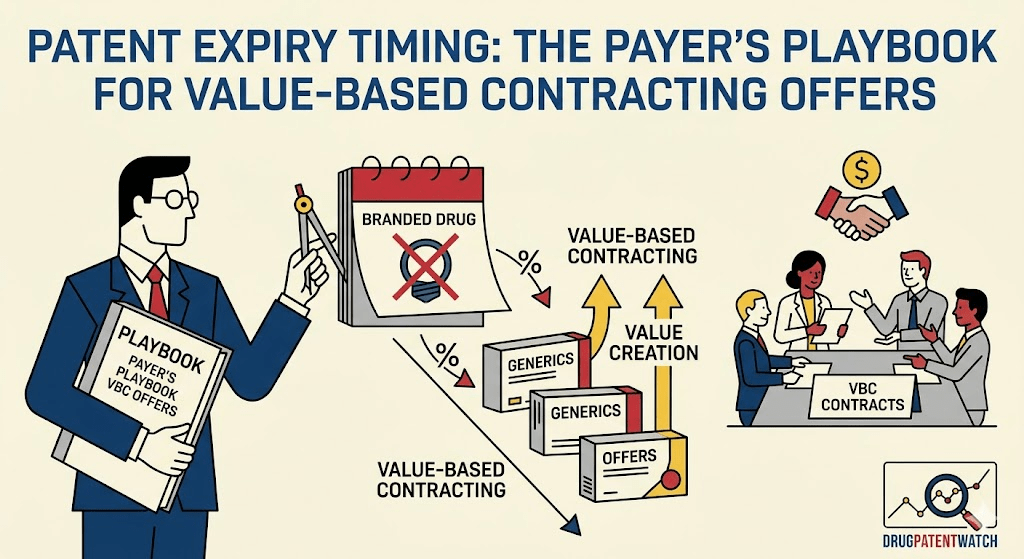
Every commercial contract negotiation in pharmaceuticals has a clock running in the background. That clock is the patent expiry date, and most payers treat it as a vague afterthought rather than the negotiating weapon it actually is.
Value-based contracting (VBC) in pharma means different things depending on who you ask. For manufacturers, it means protecting revenue with outcomes-linked rebate structures that justify premium pricing. For payers, health systems, and pharmacy benefit managers (PBMs), it means locking in cost certainty while preserving the leverage that comes from knowing exactly when a brand-name drug loses its exclusivity protections.
The problem is that most VBC negotiations happen without a systematic framework for connecting patent data to contract timing. A payer’s pharmacy director might know, loosely, that a major blockbuster goes off patent ‘in a few years,’ but they lack the patent-level granularity to know whether that means 18 months or 54 months, whether pediatric exclusivity extends the date, whether there are multiple formulation patents staggered across years, or whether a Paragraph IV challenge is already working its way through the Eastern District of Texas. Without that granularity, they leave money on the table.
This guide is for the professionals who negotiate formulary contracts, design VBC structures, or advise on pharmaceutical market access strategy. It treats patent expiry data not as academic background but as a commercial intelligence input that should directly shape the offer you make, the duration you accept, and the clauses you write into outcomes-linked agreements.
What Value-Based Contracting Actually Means in the Patent Context
Before getting into patent mechanics, it helps to be precise about what ‘value-based contracting’ covers in this discussion.
The term spans a wide range of agreement structures: outcomes-based contracts (OBCs) where rebates adjust based on clinical performance metrics, indication-specific pricing, adherence-linked rebate tiers, warranty arrangements, and population-level risk-sharing agreements. What they share is a departure from the flat-rebate model that has dominated US pharmaceutical contracting since the 1990s.
The flat-rebate model is, structurally, a patent-agnostic arrangement. A manufacturer offers a percentage rebate in exchange for formulary position, and that rebate tends to reflect the drug’s competitive pressure at the time of negotiation rather than any forward-looking assessment of exclusivity risk. This works tolerably when drugs have long patent lives and no credible generic threats. It falls apart when a drug is 18 months from loss of exclusivity (LOE) and the manufacturer is still asking for multi-year contract commitments.
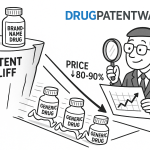
Value-based contracts complicate this because they are inherently multi-year instruments. Outcomes data takes time to accumulate. Real-world evidence protocols run for 12 to 36 months. If you sign a three-year VBC for a drug that loses its last meaningful patent in 22 months, you have either left rebate dollars uncaptured during the exclusivity window, or you have locked yourself into a brand relationship that becomes commercially irrelevant when generics enter at 80% to 90% discounts.
The thesis of this article is direct: patent expiry data should be the first input in any VBC design process, not a footnote. The contract structure, duration, rebate architecture, and exit provisions all flow from where a drug sits in its patent lifecycle.
How Pharmaceutical Patent Protection Works: The Layers Payers Must Understand
US pharmaceutical patent protection is not a single expiry date. It is a stack of overlapping protections, each expiring at a different time, each creating a different type of market exclusivity. Payers who treat it as a single date misread their negotiating position.
Composition-of-Matter Patents vs. Formulation Patents: Why the Difference Matters for Contracting
A composition-of-matter patent covers the active chemical or biological entity itself. It is the foundational patent, the hardest to design around, and typically the one that defines the ‘primary’ expiry date cited in analyst reports. When a composition-of-matter patent expires, the basic molecule or biologic is available for generic or biosimilar development.
Formulation patents cover specific delivery systems, salt forms, crystal structures, or dosage innovations. Method-of-use patents cover specific therapeutic indications or treatment protocols. These secondary patents may expire years after the composition-of-matter patent but can still delay generic entry if they are listed in the FDA’s Orange Book and successfully defended in Paragraph IV litigation.
For VBC timing, what matters is not the theoretical last patent expiry but the date on which the first generic or biosimilar can realistically enter the market. That date is a function of which patents are listed in the Orange Book, which have already been challenged, and what the litigation landscape looks like.
AstraZeneca’s esomeprazole (Nexium) is the textbook case. The composition-of-matter patents expired well before the drug’s market exclusivity effectively ended because formulation patents and the mechanics of Paragraph IV litigation extended brand protection. Conversely, Pfizer’s atorvastatin (Lipitor) faced an earlier-than-expected generic entry after Ranbaxy secured a Paragraph IV settlement that brought generics to market before some secondary patents expired.
What Is FDA Regulatory Exclusivity and How Does It Layer Over Patent Protection?
Patent protection and FDA regulatory exclusivity are legally separate, though they often overlap in ways that confuse the analysis.
New Chemical Entity (NCE) exclusivity blocks the FDA from accepting Abbreviated New Drug Applications (ANDAs) for five years from initial approval. Orphan Drug exclusivity blocks approval of a competitor for the same rare disease indication for seven years. Pediatric exclusivity adds six months to existing patent and exclusivity protections when a manufacturer completes FDA-requested pediatric studies. New Formulation exclusivity provides three years of protection for drugs with new clinical investigations supporting label changes.
The practical result is that a drug’s effective market exclusivity date may be later than its patent expiry date. Pediatric exclusivity, specifically, catches payers off guard. It attaches to patent expiry automatically when awarded, meaning a drug you modeled as losing exclusivity in Q3 of one year may actually maintain protection until Q1 of the following year. Six months sounds minor; in pharmaceutical contracting, it represents a full annual contract cycle.
The Orange Book: How Payers Should Read It for Contract Intelligence
The FDA’s Orange Book (Approved Drug Products with Therapeutic Equivalence Evaluations) lists all patents and exclusivities for approved small-molecule drugs. For a payer building a VBC strategy, the Orange Book is the starting point for understanding what legal barriers a generic manufacturer must clear before entering the market.
Each Orange Book patent listing includes a patent number, an expiry date, and a code indicating whether the patent covers the drug substance, drug product, or a method of use. When a generic manufacturer files a Paragraph IV certification challenging an Orange Book-listed patent as invalid or non-infringed, it triggers a 30-month stay of FDA approval during which the manufacturer can litigate.
Reading Orange Book listings strategically requires understanding that manufacturers have incentives to list as many patents as possible, that some listed patents are weak and likely to fall in litigation, and that method-of-use patents are often narrower in scope than they appear. Tools like DrugPatentWatch aggregate this data and layer on litigation history, Paragraph IV filing status, and settlement information, making it practical to build patent expiry maps without pulling each Orange Book entry manually.
Biologics and the Purple Book: BPCIA Patent Dance Explained for Payers
For biologics, the equivalent of the Orange Book is the Purple Book, and the patent framework is the Biologics Price Competition and Innovation Act (BPCIA), not the Hatch-Waxman Act that governs small molecules. The BPCIA created a structured patent information exchange process known informally as the ‘patent dance,’ which governs how reference product sponsors and biosimilar applicants identify and litigate relevant patents.
Biologics receive 12 years of reference product exclusivity from approval, during which the FDA cannot approve a biosimilar, regardless of patent status. Four years of data exclusivity prevents biosimilar applications from even being submitted. This exclusivity timeline is longer and more predictable than small-molecule exclusivity, but the complexity of the patent landscape around biologics is considerably greater. AbbVie’s adalimumab (Humira) patent estate included more than 130 patents by some counts, creating a thicket that delayed US biosimilar entry despite the reference product exclusivity expiring.
For payers designing value-based contracts for biologics, the 12-year exclusivity clock is a floor, not a ceiling. The realistic biosimilar entry date requires assessing both the exclusivity status and the litigation posture of the patent estate.
Building a Patent Expiry Map for Your Formulary: Step-by-Step Process
A patent expiry map is a formulary-specific intelligence document that plots each branded drug across its patent and exclusivity timeline, identifies the realistic date of first generic or biosimilar competition, and flags the leverage windows where VBC negotiations become favorable to payers.
Step 1: Identify High-Spend Brands Approaching LOE in Your Book of Business
Start with spend data. Pull your top 25 to 50 brand-name drugs by total gross spend, net spend, or member spend per unit, depending on your analytical preference. Cross-reference against patent expiry data. The priority targets for VBC redesign are drugs where gross spend is high, net rebates are meaningful, and patent expiry is within a two-to-five-year window.
Drugs outside that window are either too far from LOE for patent-timing arguments to carry weight in negotiations (manufacturers won’t feel urgency) or too close to LOE for multi-year VBC structures to make sense. Two to five years is the actionable zone.
Step 2: Pull Orange Book and Litigation Data for Each Target Drug
For each target drug, pull the full Orange Book patent listing and identify: the composition-of-matter patent expiry, the latest-expiring formulation or method-of-use patent, any active pediatric exclusivity, and any Paragraph IV certifications already filed.
DrugPatentWatch provides consolidated patent, exclusivity, and litigation data for FDA-approved drugs, which streamlines this process significantly compared to manual Orange Book research. The platform tracks Paragraph IV filings, first-filer status (which determines 180-day generic exclusivity eligibility), and settlement history, all of which affect the realistic generic entry timeline.
Document two dates for each drug: the ‘last patent expiry’ date (the theoretical maximum exclusivity period) and the ‘earliest realistic generic entry’ date based on litigation status, first-filer exclusivity, and manufacturing readiness. The gap between these two dates is often where payer leverage is underestimated.
Step 3: Map the Competitive Landscape for Each Drug Class
Patent expiry doesn’t happen in isolation. A drug approaching LOE in a class with two other branded competitors still on patent has different commercial dynamics than a drug approaching LOE as the sole agent in its class. Map the competitive landscape: which other agents in the class retain exclusivity, which are also approaching LOE, and which face biosimilar or generic competition already.
A manufacturer whose drug faces LOE with no remaining in-class brand competition has less ability to resist payer pressure. Conversely, a manufacturer whose branded drug will survive as the last remaining exclusive agent in its class after competitors go generic has considerable leverage to maintain formulary position. Both scenarios produce different VBC contract structures.
Step 4: Segment Drugs by Contract Action Type
Once you have patent expiry maps and competitive landscape data, segment target drugs into four action types:
Short-term VBC capture: Drugs with 12 to 24 months of remaining exclusivity where the priority is maximizing near-term rebates before LOE, not designing complex outcomes structures.
Full VBC design: Drugs with 24 to 48 months of remaining exclusivity where multi-year outcomes-linked contracts can generate both financial and clinical value before generics enter.
Transition planning: Drugs with 48 to 72 months of remaining exclusivity where the payer begins pre-competitive engagement with generic and biosimilar developers to position for a managed transition.
Monitor: Drugs beyond 72 months from LOE where patent landscape monitoring and litigation tracking are the primary tasks.
The Negotiating Leverage Window: When Patent Expiry Creates Payer Power
Patent expiry creates asymmetric leverage. Manufacturers know their revenue cliffs. Payers who also know the manufacturer’s revenue cliff, in detail, are fundamentally better positioned in contract negotiations than those who negotiate based on current market conditions alone.
Why Manufacturers Become More Flexible 18 to 36 Months Before LOE
A brand pharmaceutical manufacturer operating a drug with three years of remaining exclusivity faces a specific set of commercial pressures. The sales force is still deploying against prescribers. The managed care team is maintaining formulary position. But internally, the revenue model already shows the cliff: a 75% to 90% volume loss over 12 to 24 months after generic entry is standard for most small-molecule drugs. For biologics, biosimilar-driven erosion is slower but still material.
In this window, manufacturers prioritize three things: maximizing revenue per unit sold before LOE, protecting market share against in-class competitors who may outlast them on patent, and, in some cases, building payer relationships that serve their pipeline drugs. All three of these priorities create leverage for payers who can offer credible value in return: formulary access, covered lives volume, or real-world data partnerships.
The 18-to-36-month pre-LOE window is typically when manufacturers are most willing to accept outcomes-based structures because the clinical risk, if the drug performs well, is limited. A drug with six years of patent life remaining has no incentive to accept a structure where poor outcomes mean rebate clawbacks. A drug with 24 months of remaining exclusivity is more willing to demonstrate efficacy in exchange for premium formulary placement during its remaining brand life.
The Leverage Reversal: What Happens When Payers Wait Too Long
Waiting too long to negotiate removes most of the payer’s leverage. Once a drug is within 12 months of expected generic entry, manufacturers stop prioritizing managed care deals. The commercial team is focused on extracting existing formulary value, not building new contractual relationships. Generic manufacturers are finalizing launch plans. The payer who hasn’t renegotiated at this point will likely face a formulary decision that amounts to ‘stay on the brand at current terms or switch to generic when available.’
That switch-to-generic option is valuable, but it’s different from a value-based contract. Step therapy, formulary tiering changes, and prior authorization adjustments are blunt instruments compared to the outcomes-linked structures that a payer could have negotiated during the 18-to-36-month window.
How Paragraph IV Litigation Changes the Leverage Calculation
When a generic manufacturer files a Paragraph IV certification, it is publicly challenging one or more Orange Book patents as invalid or not infringed. If the brand manufacturer files an infringement suit within 45 days, the FDA approval of the generic is automatically stayed for 30 months. This 30-month stay is a standard feature of Hatch-Waxman litigation and has significant implications for VBC timing.
From a payer perspective, a drug with an active Paragraph IV suit has a known potential generic entry date that may be sooner than the listed patent expiry. If the generic manufacturer wins the case, or if a settlement is reached, generic entry can occur well before the last patent expires. If the brand manufacturer wins, the stay extends. The litigation outcome directly shifts the patent expiry map.
Tracking Paragraph IV filings in real time is practically necessary for payers managing large formularies. A drug that was modeled as a 2027 LOE candidate may become a 2025 candidate after a Paragraph IV settlement. The VBC you designed for a 36-month window suddenly has 18 months left. Contracts need provisions that address what happens to outcomes-linked structures when generic entry occurs before the contract term ends.
Case Study: How AbbVie’s Humira Biosimilar Negotiations Played Out for US Payers
Humira (adalimumab) reached US biosimilar competition in January 2023, when AbbVie’s settlements with biosimilar manufacturers allowed entry after years of delayed access. European markets had biosimilar competition years earlier because AbbVie’s patent estate was less extensive outside the US.
US payers who negotiated VBC structures with AbbVie in 2020 and 2021, with awareness of the January 2023 biosimilar entry date baked into the contract design, were able to structure agreements that included provisions for formulary transition to biosimilars at launch, real-world evidence requirements for continued preferred brand placement, and rebate cliffs that accelerated in the final pre-biosimilar year.
Payers who did not build the biosimilar entry date into their contract structures found themselves holding standard rebate agreements that offered no mechanism for managing the formulary transition. Some faced manufacturer pressure to maintain brand preference even after multiple interchangeable biosimilars were available.
‘The average branded drug that loses exclusivity sees volume erosion of approximately 80% within 24 months of first generic entry, with the steepest decline occurring in the first 12 months. For biologics facing biosimilar competition, the erosion rate is slower, averaging 30% to 40% volume loss in the first two years, but accelerating as interchangeability designations accumulate.’ — IQVIA Institute for Human Data Science, Medicine Use and Spending in the U.S.: A Review of 2022 and Outlook to 2027
Designing Value-Based Contracts Around Patent Lifecycle Stages
Not all VBC structures are appropriate for all points in a drug’s patent lifecycle. The right contract architecture depends on where the drug is in its exclusivity trajectory, what clinical data is available, and what the realistic competitive scenario looks like.
Early-Lifecycle VBC: When Outcomes Uncertainty Is High and Patents Are Long
Drugs in early exclusivity (more than five years from LOE) have extensive clinical data gaps and often a nascent real-world evidence base. Outcomes-based VBC for these drugs is commercially possible but carries high uncertainty for payers.
Manufacturers of early-lifecycle drugs tend to have more leverage. They hold long exclusivity windows, face limited generic competition risk, and don’t need to offer substantial financial accommodations to maintain formulary access. VBC structures for early-lifecycle drugs tend to skew toward manufacturer-friendly designs: outcomes metrics that the drug is likely to meet based on existing trial data, rebate adjustments capped at levels that protect net revenue, and multi-year terms that lock in formulary position.
The payer’s primary objective in early-lifecycle VBC is not to extract maximum near-term rebates but to establish the contractual infrastructure, data-sharing agreements, real-world evidence protocols, and performance metric definitions, that will give the payer leverage as LOE approaches. A payer that has three years of real-world outcomes data on a drug, showing it performs modestly below trial expectations in their specific population, has a powerful argument for aggressive rebate increases in the 24-to-36-month pre-LOE negotiation window.
Mid-Lifecycle VBC: The Optimal Window for Outcomes-Linked Structures
Drugs with two to five years of remaining exclusivity sit in the optimal window for full VBC design. Enough real-world evidence exists to set credible outcomes metrics. The manufacturer faces meaningful LOE pressure but retains sufficient exclusivity to make a multi-year agreement commercially attractive. The payer has genuine formulary alternatives (either in-class competitors or near-launch generics) that provide competitive leverage.
Mid-lifecycle VBC design typically centers on four structural elements:
Rebate schedules that step up as performance thresholds are met or missed
Contract durations aligned to, but not exceeding, the expected LOE date
Generic/biosimilar entry provisions that specify how the contract terminates or modifies when the first AB-rated generic or interchangeable biosimilar receives FDA approval
The contract duration point is worth emphasis. A three-year VBC signed 30 months before expected LOE has a problem: the contract outlasts the drug’s exclusivity. If it does not include an LOE exit provision, the payer may be contractually obligated to maintain brand preference for a drug competing against generics at 20% of brand price. This is not a theoretical concern; it has happened in practice.
What Should a VBC LOE Exit Clause Actually Say?
An LOE exit clause in a VBC should accomplish two things: define the trigger event (typically first FDA approval of an AB-rated generic or interchangeable biosimilar, or first commercial generic launch) and specify what happens to the contract’s financial and clinical obligations when the trigger fires.
The simplest version terminates the VBC on generic entry and converts to a short-term transition agreement. A more sophisticated version provides a formulary preference tier for the brand in exchange for a price match or near-parity discount relative to the lowest available generic WAC, for a defined transition period of three to six months.
A third structure, increasingly used for biologics, preserves the brand on formulary at preferred tier alongside biosimilars for 12 months post-biosimilar launch, with a rebate true-up that adjusts based on the brand’s market share performance during the transition. This structure compensates the manufacturer for agreeing to biosimilar formulary access in exchange for time-limited preferred positioning.
Late-Lifecycle VBC: What to Do in the 12 Months Before Generic Entry
Once a drug is within 12 months of expected generic entry, full VBC design is typically not practical. The time horizon is too short to generate meaningful outcomes data, and manufacturers are not incentivized to offer the commercial accommodations that make VBC structures valuable.
The practical focus for late-lifecycle drugs is transition management rather than VBC design. The payer should be finalizing generic formulary positioning, communicating step therapy or PA changes to prescribers, evaluating interchangeability status for biologics, and negotiating launch pricing with generic manufacturers who are competing for preferred formulary placement in the 180-day exclusivity window.
That said, even late-lifecycle drugs can benefit from patent timing intelligence. A payer who knows that an expected Q2 generic launch is at risk of delay, because the brand manufacturer just filed an infringement suit triggering a 30-month stay, should delay formulary changes and consider reopening brand contract negotiations rather than allowing the current agreement to lapse without replacement.
How to Use Paragraph IV Filings as a Forward-Looking Contracting Signal
Most payers monitor patent expiry dates. Fewer systematically monitor Paragraph IV filings. This gap is significant because Paragraph IV filings are forward-looking signals that indicate when generic manufacturers believe they can successfully challenge a patent, which directly predicts when generic competition will arrive.
What a Paragraph IV Filing Tells You That Patent Expiry Doesn’t
A Paragraph IV ANDA (Abbreviated New Drug Application) certification is a statement by a generic manufacturer that at least one of the Orange Book-listed patents for a branded drug is either invalid, unenforceable, or will not be infringed by the generic product. Filing a Paragraph IV is not a trivial act: it invites litigation, requires investment in patent counsel, and accepts a 30-month approval delay risk. Generic manufacturers file Paragraph IV certifications when they believe the patent can be defeated or when a settlement is likely.
When multiple generic manufacturers file Paragraph IV certifications against the same drug, it signals a market consensus that the patent estate is vulnerable. When the first filer settles with the brand manufacturer under terms that allow generic entry before patent expiry (an ‘authorized generic’ or early entry settlement), it typically triggers a cascade of generic approvals and market entry by subsequent filers.
For payers, a drug that has just received its first Paragraph IV filing should be immediately re-evaluated for LOE timing. The filed date is often 12 to 36 months before litigation resolves. If the generic manufacturer wins or settles favorably, generic entry can occur well before listed patent expiry. A drug the payer modeled as a 2028 LOE may become a 2026 candidate.
First-Filer 180-Day Exclusivity: How It Affects Generic Launch Timing and Payer Strategy
The first ANDA applicant to file a Paragraph IV certification is eligible for 180 days of generic market exclusivity, during which no other generic manufacturer can receive final FDA approval. This 180-day period is commercially important: the first-filer generic can price aggressively to capture market share while other generics are held off the market, but prices are typically still significantly below brand WAC.
From a payer perspective, the 180-day exclusivity period creates a specific commercial window. During this period, the payer can negotiate aggressively with the first-filer generic for preferred formulary position, knowing the first-filer needs payer access to maximize volume before the 180-day clock expires and competitors enter. After 180 days, generic competition intensifies, prices fall further, and the negotiating leverage dynamic shifts.
The worst payer outcome is failing to have a generic preferred-tier contract ready when the 180-day exclusivity window opens. The first-filer generic without a preferred-tier agreement will not receive the formulary placement that drives volume, the 180-day window closes, and multiple generics flood the market. The payer ends up managing formulary transition reactively rather than capturing the 180-day exclusivity period as a contracting opportunity.
Monitoring Tools: How DrugPatentWatch and Orange Book Tracker Support Real-Time Patent Intelligence
Manual monitoring of Orange Book listings and Paragraph IV filings across a full formulary is not feasible for most managed care organizations. Purpose-built patent intelligence platforms fill this gap.
DrugPatentWatch tracks patent expiry dates, Orange Book listings, exclusivity status, Paragraph IV filings, first-filer information, litigation outcomes, and settlement details across FDA-approved drugs. The platform provides both drug-level detail and portfolio-level views, making it practical to build and maintain patent expiry maps for formulary management. For health systems and payers managing high-cost specialty drugs, the litigation monitoring feature is particularly valuable: real-time Paragraph IV filing alerts can trigger immediate contract renegotiation workflows.
The FDA’s own Orange Book is publicly available but requires significant manual effort to track across a large formulary. The FDA also publishes Paragraph IV certification notices in the Federal Register, though the delay between filing and publication makes real-time tracking impractical without a purpose-built monitoring system.
VBC Contract Duration: How to Set Terms That Align with Patent Expiry
Contract duration is the single most patent-sensitive variable in VBC design. A contract that extends past LOE without protective provisions is worse than no VBC at all; it creates contractual obligations that benefit the manufacturer after their competitive advantages have expired.
The Case Against Multi-Year VBC Contracts Without Patent-Aligned Expiry Provisions
A three-year VBC contract signed today without patent-aligned provisions assumes the competitive landscape will remain stable for three years. For drugs approaching LOE, that assumption fails. The manufacturer who agreed to outcomes-linked rebates when facing 36 months of exclusivity has no incentive to honor the spirit of the VBC once generics are available. They will argue that the contract requires formulary preference regardless of the competitive landscape, and they may be right depending on how the contract is written.
Patent-aligned expiry provisions avoid this problem. They define the contract’s natural endpoint as the earlier of the stated term or the date of first generic or biosimilar market entry. They specify that outcomes measurement periods cannot extend past LOE unless the payer affirmatively elects continuation at modified terms. They include notice provisions that require the manufacturer to disclose Paragraph IV filings and settlement negotiations within 30 days of occurrence.
How to Structure Contract Duration Based on LOE Probability Scenarios
Rather than setting a single contract duration based on a best-estimate LOE date, sophisticated payers build duration structures around LOE probability scenarios.
A drug with a listed patent expiry of 2028 but two active Paragraph IV suits, one from a first-filer that settled with an entry date of early 2026 and one from a subsequent filer awaiting FDA approval, presents a probability distribution for generic entry that is skewed toward 2026, not 2028. A contract designed around the 2028 date is misaligned with commercial reality.
Scenario-based duration design sets a base contract term (e.g., 24 months) with extension options that apply only if specific patent litigation outcomes occur. If the Paragraph IV suit settles for early entry, the contract terminates. If the brand wins the litigation and the 30-month stay runs its full course, the extension option activates and the contract extends to cover the additional exclusivity period.
How Do Pediatric Exclusivity Extensions Affect VBC Duration Planning?
Pediatric exclusivity adds six months to existing patent protections when granted. If you are designing a VBC with a contract end date tied to a specific patent expiry, and that patent receives pediatric exclusivity after the contract is signed, the contract’s commercial logic changes. The brand retains exclusivity for an additional six months, which may benefit or harm the payer depending on whether the contract’s rebate structure is favorable or unfavorable.
The practical fix is to define contract termination relative to generic market entry, not patent expiry. Generic entry cannot occur during a pediatric exclusivity period, so tying the contract’s LOE provision to first generic approval or launch rather than a specific patent date automatically accommodates pediatric exclusivity extensions.
Biosimilar Contracting: How the BPCIA Timeline Changes the VBC Design Framework
Biosimilar contracting operates on a different logic than small-molecule generic contracting. The patent protections are more numerous, the exclusivity periods are longer, the interchangeability designation matters for formulary management, and the price erosion after biosimilar entry is slower.
Reference Product Exclusivity vs. Patent Expiry: What Controls Biosimilar Entry?
For biologics, the FDA cannot approve a biosimilar until the reference product’s 12-year exclusivity period expires. This is a statutory exclusivity, not a patent, so it cannot be challenged through the Paragraph IV equivalent (the ‘351(l) patent dance’). The 12-year clock is fixed from the reference product’s approval date.
However, manufacturers can file for biosimilar approval four years after the reference product’s approval (after the data exclusivity period), and patent litigation can proceed during the exclusivity period. This means biosimilar manufacturers are often ready to launch, with FDA approval secured, but waiting for the exclusivity clock to expire.
For payers, the biosimilar entry date for drugs still within their 12-year exclusivity period is predictable: it cannot be before the 12-year anniversary of approval. For biologics past the 12-year window, the biosimilar entry date depends on patent litigation outcomes and the progress of biosimilar development programs.
Interchangeability Designation: Why It Matters for VBC Formulary Management
The FDA’s interchangeability designation for biosimilars allows pharmacists in most states to substitute the biosimilar for the reference biologic without physician intervention. For payers, interchangeability designation is the trigger event for aggressive formulary management: once an interchangeable biosimilar exists, the payer can implement non-medical switching programs, update formulary tiers, and negotiate biosimilar-preferred contracts without patient access concerns.
VBC contracts for biologics should specify whether and how interchangeability designation affects the contract terms. A contract that was signed when no interchangeable biosimilar existed has a different risk profile than the same contract after an interchangeable biosimilar receives FDA designation. LOE provisions for biologics should reference interchangeability designation as a trigger for contract renegotiation, not just the existence of a biosimilar.
Humira Biosimilar Market: A Live Case Study in Patent-Timed VBC Strategy
The US adalimumab market after January 2023 biosimilar entry provides the most current case study in biologic patent timing and VBC strategy.
AbbVie secured settlements with all major biosimilar manufacturers that allowed US market entry no earlier than January 2023. This date was publicly known from the settlement announcements, giving US payers a specific, credible entry date for planning. Payers who used this date to build formulary transition plans negotiated biosimilar-preferred contracts before launch, set biosimilar market share targets, and designed step-edit protocols that activated on or shortly after January 1, 2023.
The early commercial data showed that US payers who proactively built biosimilar formulary access achieved higher biosimilar penetration than those who waited for spontaneous substitution. By mid-2023, health plans with biosimilar-preferred formularies reported adalimumab biosimilar market shares of 20% to 40%, while plans without proactive formulary management saw single-digit biosimilar uptake despite significant price differentials.
AbbVie, recognizing the biosimilar pressure, offered rebate programs (‘Humira Protect’) that effectively matched or approached biosimilar net prices for payers willing to maintain brand preference. This created a split market: payers who prioritized net cost and formulary management went biosimilar-first, while some payers accepted AbbVie’s net price matches and maintained brand preference. Both approaches were rational given the specific circumstances of each payer’s formulary and covered population.
How to Value-Based Contract a Biologic With Biosimilars Already on Market
Once biosimilars are available, VBC for the reference biologic changes character. The manufacturer’s negotiating position is weakened by the existence of lower-cost alternatives. The payer’s leverage is highest at launch, when biosimilar manufacturers are competing for preferred formulary placement and the reference biologic manufacturer is simultaneously trying to retain market share.
VBC structures in this environment can include: biosimilar transition bonuses (rebates contingent on achieving a specified biosimilar market share within the class), reference biologic guaranteed-minimum-rebate agreements that floor brand rebates at levels competitive with biosimilar net cost, and outcomes warranties for biosimilars from developers who want to differentiate on clinical performance rather than price alone.
Outcomes Metrics Design: How to Choose Measures That Hold Up Near LOE
The outcomes metrics in a VBC contract are the clinical core of the agreement. Poorly designed metrics create adverse incentive effects, administrative burden without analytical value, or financial outcomes unrelated to therapeutic performance.
What Clinical Outcomes Metrics Work in Short-Window VBC Contracts Near LOE?
Short-window VBC contracts (12 to 24 months) near LOE should use outcomes metrics that are measurable within the contract period. Surrogate endpoints that accumulate data quickly (HbA1c, LDL-C, blood pressure, viral load) are more practical than long-latency outcomes (cardiovascular events, hospitalizations, mortality) that require years of follow-up to generate statistically reliable signals.
The practical test for an outcomes metric in a near-LOE VBC is: can we measure this accurately, attribute it to the drug rather than confounders, and produce a rebate true-up within six months of contract term end? If the answer is no, the metric will create contract disputes rather than value.
For drugs in therapeutic classes where surrogate endpoints are well-validated (diabetes, lipid management, HIV, hepatitis C), short-window outcomes VBC is technically straightforward. For drugs in classes with less well-validated surrogates (oncology, immunology, rare disease), outcomes measurement requires more careful design and often produces results that are administratively intensive to adjudicate.
Adherence-Linked Rebates vs. Clinical Outcome Rebates: Which Works Better Near LOE?
Adherence-linked rebates adjust financial terms based on measured medication adherence in the covered population. Clinical outcome rebates adjust based on measured clinical endpoints. Near LOE, adherence-linked structures are often more practical because adherence data is available through pharmacy claims without requiring clinical data exchange agreements.
The limitation of adherence-linked structures is that they measure process, not outcome. A drug with 90% adherence that produces mediocre clinical results still triggers the maximum rebate in an adherence-linked contract. For payers whose primary concern is demonstrating clinical value for premium-priced drugs, adherence measurement alone does not satisfy the outcomes accountability argument.
A pragmatic approach for near-LOE VBCs combines adherence as the primary measurable metric, with a clinical outcome audit right at the two-year mark that informs the contract’s renewal decision or final rebate settlement. This approach captures the administrative tractability of adherence measurement while retaining clinical accountability at the contract’s end.
Specific Drug Classes Where Patent Timing Drives VBC Strategy Today
Several therapeutic classes face patent cliff dynamics in the 2024 to 2028 window that directly affect current VBC contract decisions. Each class has different patent characteristics, competitive dynamics, and VBC design implications.
GLP-1 Receptor Agonists: Semaglutide Patent Expiry Timeline and VBC Implications
Novo Nordisk’s semaglutide (Ozempic, Wegovy, Rybelsus) carries composition-of-matter patents that, based on Orange Book listings, extend into the early 2030s for the primary semaglutide molecule. Eli Lilly’s tirzepatide (Mounjaro, Zepbound) similarly has composition-of-matter protection well into the 2030s.
For the GLP-1 class, patent expiry is not the near-term issue. The current VBC pressure in this class comes from competition within the class and the extraordinary budget impact of widespread use. Payers designing VBC structures for GLP-1 agents are not primarily managing LOE risk; they are managing utilization, managing indication creep (cardiovascular outcomes, MASH, sleep apnea, CKD), and managing the clinical evidence base for different patient populations.
The VBC design implication for GLP-1 agents is to build contracts around indication-specific outcomes metrics and utilization management provisions rather than patent expiry timing. Rebates tied to cardiovascular event rates, weight loss outcomes, or diabetes control metrics in defined patient populations are more relevant than LOE-timing provisions for drugs with seven to ten years of remaining exclusivity.
BTK Inhibitors: Ibrutinib Generic Entry and What It Means for Payer Contracts
AstraZeneca and Johnson & Johnson’s ibrutinib (Imbruvica) has faced generic challenges, and the patent landscape for the BTK inhibitor class is evolving. Generic ibrutinib entry began in 2022 after settlement agreements with Paragraph IV filers, creating a class where second-generation BTK inhibitors (acalabrutinib, zanubrutinib) compete against both branded ibrutinib and its generics.
For payers managing the BTK inhibitor class, the VBC opportunity is not in contracting for ibrutinib itself, given generic availability, but in using ibrutinib’s generic status as leverage in contracting for acalabrutinib (AstraZeneca’s Calquence) and zanubrutinib (BeiGene’s Brukinsa). Both drugs retain significant exclusivity periods, and the availability of generic ibrutinib as a therapeutic alternative gives payers genuine formulary leverage to demand outcomes-linked rebates or deep discount programs from the branded second-generation agents.
PCSK9 Inhibitors: Evolocumab and Alirocumab Patent Status and Biosimilar Entry Forecast
Amgen’s evolocumab (Repatha) and Regeneron/Sanofi’s alirocumab (Praluent) are both monoclonal antibodies in the PCSK9 inhibitor class. Biosimilar applications for these agents have been progressing through the BPCIA patent dance, and biosimilar entry is anticipated in the mid-2020s depending on litigation outcomes.
For payers, PCSK9 inhibitors represent an extreme version of the VBC design challenge. These are high-cost agents ($5,000 to $7,000 per year at net after rebates) used in a relatively small but high-risk cardiovascular population. The clinical evidence for cardiovascular outcomes is robust (FOURIER and ODYSSEY OUTCOMES trials), but the real-world utilization in clinical practice involves patient populations with different baseline characteristics than trial participants.
VBC structures for PCSK9 inhibitors should account for near-term biosimilar entry (likely within two to three years for evolocumab) in the contract design. The most defensible structures tie brand preference to cardiovascular outcomes performance in the payer’s specific population, with explicit biosimilar entry provisions that convert the contract to a class-level outcomes agreement when biosimilars become available.
Multiple Sclerosis Drugs: The Fingolimod LOE Case and What Comes Next
Novartis’s fingolimod (Gilenya) entered generic competition in 2022 after Paragraph IV settlements with generic manufacturers. This followed years of premium pricing and moderate VBC adoption in the MS drug class. Payers who had LOE provisions in their Gilenya agreements were positioned to transition quickly to generic fingolimod; those without provisions faced formulary management gaps.
Looking forward, the MS class faces additional LOE events: natalizumab (Tysabri), dimethyl fumarate (Tecfidera, which already has generic competition), and siponimod (Mayzent) each have patent timelines that payers should be monitoring. The competitive dynamics of the MS drug class, where efficacy, safety, and administration differences create genuine clinical differentiation, mean that VBC structures need to account for outcomes differences, not just price.
Oncology Biosimilars: Trastuzumab, Bevacizumab, and Rituximab Market Share Patterns
The oncology biosimilar market in the US has developed differently from anticipated. Trastuzumab (Herceptin) biosimilars received FDA approval beginning in 2019, but uptake in the first two to three years was modest by historical standards, partly because hospital systems and oncology practices had established relationships with Genentech and partly because pharmacy and medical benefit splits created administrative friction for biosimilar adoption.
By 2022 and 2023, trastuzumab biosimilar market penetration had improved significantly, driven by payer formulary management and hospital group purchasing organization (GPO) contracting. Bevacizumab (Avastin) and rituximab (Rituxan) biosimilar markets showed similar trajectories.
The practical lesson for VBC design in oncology biosimilars is that formulary management tools (step edit requirements, prior authorization, tier differentials) produce biosimilar uptake, but only when combined with aligned prescriber contracts and GPO alignment at the hospital level. Medical benefit biosimilar management requires buy-in from oncology practices that may be margin-dependent on buy-and-bill revenues from reference biologics.
How Manufacturers Use VBC to Defend Exclusivity: Recognizing and Countering the Tactic
VBC is not a neutral tool. Manufacturers use it strategically to defend market share against both generic/biosimilar entry and in-class competition. Understanding how manufacturers deploy VBC defensively helps payers recognize when a proposed VBC structure serves the manufacturer’s interests more than the payer’s.
Long-Term VBC as a Formulary Lock-In Strategy: What to Watch For
A manufacturer proposing a five-year VBC with an attractive first-year rebate for a drug with four years of remaining exclusivity is offering a contract that extends 12 months past LOE. If the contract does not include a robust LOE exit provision, the payer is being asked to maintain brand preference for a year after generics enter, in exchange for current-year financial benefit.
Variations on this pattern include: graduated rebate structures where the largest rebates are back-loaded into years three through five, clinical outcome designs where the measurement period extends past LOE making contract termination administratively complex, and exclusivity bonus provisions that offer large one-time payments contingent on maintaining preferred formulary status for a full term that extends past generic entry.
None of these structures are inherently impermissible, but each should trigger scrutiny. The payer’s internal review of any proposed VBC should include a ‘what happens if generics enter in year two’ scenario analysis. If the financial model shows the payer significantly worse off under that scenario than under the current flat-rebate arrangement, the LOE provisions need strengthening before the contract is signed.
How Manufacturers Use Real-World Evidence Requirements as VBC Delay Tactics
A manufacturer who proposes a VBC contingent on the payer establishing extensive real-world evidence infrastructure (claims data feeds, EHR integration, clinical registry participation) is potentially using administrative complexity to delay the VBC and preserve existing flat-rebate arrangements during periods of increasing competitive pressure.
Real-world evidence requirements in VBC are legitimate and valuable when the evidence informs genuine outcomes measurement. They become delay tactics when the data requirements are disproportionate to the outcomes being measured, when the payer is expected to bear the full administrative cost, or when the manufacturer uses implementation delays to extend the current contract on current terms.
Payers should set a maximum implementation timeline for VBC infrastructure (six months is reasonable for most data exchange requirements) and include provisions that default to aggressive rebate escalators if the VBC is not implemented within that timeline due to manufacturer actions.
What Is a ‘Me-Too’ VBC and Why Should Payers Be Skeptical of Them?
A ‘me-too’ VBC is a contract structure that replicates the language of outcomes-based contracting without creating genuine financial risk for the manufacturer. Typical features include: outcome metrics that the drug is near-certain to meet based on existing clinical data, rebate penalties for underperformance that are immaterial relative to the drug’s net revenue, and measurement populations that exclude the highest-risk patients most likely to show poor outcomes.
The result is a contract that the manufacturer promotes as ‘value-based’ (generating positive press coverage and payer relationship credit) while creating no meaningful financial accountability for poor performance.
Payers can identify me-too VBCs by stress-testing the outcomes metrics: if the drug would need to substantially underperform its Phase III trial results to trigger a rebate penalty, and the penalty is less than 10% of the current net price, the contract is not genuinely outcomes-linked. A well-designed outcomes metric should have a real probability of triggering across a meaningful portion of the covered population.
Negotiation Tactics: How to Use Patent Expiry Data at the Bargaining Table
Knowing the patent expiry landscape is only valuable if you can use it effectively in negotiations. The following section covers how to translate patent intelligence into bargaining positions.
How to Present Patent Expiry Data to the Manufacturer’s Managed Care Team
Manufacturer managed care account executives are often aware of their drug’s patent status but accustomed to dealing with payers who haven’t done the detailed work. Walking into a negotiation with a precise patent expiry map, Paragraph IV filing history, 30-month stay status, and competitive generic entry timeline sends a clear signal: this payer has done their homework, and the standard one-size-fits-all rebate pitch is not going to work.
The goal is not to threaten generic switching in a way that sounds performative. Most manufacturers know generic switching is coming after LOE. The goal is to establish that the payer knows exactly how much time remains on the brand’s exclusivity clock and intends to negotiate contracts that reflect that reality, not a rosier version that serves the manufacturer’s revenue model.
A specific, effective opening position: ‘Our analysis shows your drug has 27 months of effective market exclusivity remaining, accounting for the current Paragraph IV litigation and the 30-month stay timeline. We’re offering a 36-month VBC with an LOE exit provision that triggers at first generic approval. We’d like to discuss rebate terms that reflect the drug’s exclusivity position rather than its listed patent expiry.’
Using Parallel Paragraph IV Filings to Create Urgency in Negotiations
When multiple generic manufacturers have filed Paragraph IV certifications against a drug, the probability of at least one achieving a favorable outcome rises. Multiple filers also mean multiple potential settlement counterparties, increasing the likelihood that the brand manufacturer will settle with at least one filer to obtain some control over the entry timeline.
In negotiations, multiple Paragraph IV filings are a concrete signal of generic entry risk that is difficult for manufacturers to dismiss. A manufacturer arguing for a five-year VBC on the basis of a 2030 patent expiry date has a weaker case when three generic manufacturers have already filed Paragraph IV certifications that could result in 2026 entry.
How to Negotiate LOE Exit Provisions: Specific Language Recommendations
LOE exit provisions should be drafted precisely. Vague language (‘the parties agree to renegotiate in the event of generic entry’) creates disputes. Specific language creates certainty.
Recommended LOE exit provision elements:
Trigger definition: ‘the date on which the FDA grants final ANDA approval to any manufacturer for an AB-rated generic version of [Drug Name], or the date on which the first commercial sale of such a generic product occurs, whichever is earlier’
Notice requirement: ‘Manufacturer shall notify Payer within 15 calendar days of any Paragraph IV ANDA filing against [Drug Name] patents listed in the FDA Orange Book’
Contract modification mechanism: ‘Within 30 days of the LOE trigger date, either party may elect to terminate the Agreement or to renegotiate terms. In the absence of renegotiation, the Agreement terminates automatically 90 days after the LOE trigger date’
Financial settlement provision: ‘Outcomes measurement periods that include the LOE trigger date shall be prorated to the trigger date for purposes of rebate calculation’
Real-World Evidence Infrastructure for Patent-Timed VBC: What You Actually Need
Value-based contracts require data. The data infrastructure needed for a short-window VBC near LOE is different from what is needed for a long-term early-lifecycle agreement. Matching data investment to contract scope prevents over-building infrastructure that won’t generate ROI before the contract ends.
Minimum Viable Data Infrastructure for Near-LOE Outcomes Measurement
For a VBC with 18 to 24 months of measurement before expected LOE, the minimum viable data infrastructure is: pharmacy claims for adherence measurement, medical claims for hospitalizations and related utilization, and a defined attribution method for linking drug use to outcomes events. Most large payers and PBMs have this infrastructure in place already.
The additional investment for near-LOE VBC is primarily analytical: defining the patient cohort, establishing the baseline comparator (historical performance or in-class comparator), and building the rebate true-up calculation methodology. This work requires an actuarial or outcomes analysis team and takes approximately three to six months to establish, which sets a practical floor on how quickly a near-LOE VBC can be operationalized.
When EHR Integration Is Worth the Investment for VBC Outcomes Measurement
EHR integration is the highest-cost, highest-complexity data element in VBC infrastructure. It is justified when: the outcome metric requires clinical data not captured in claims (laboratory values, physician-documented clinical status), the contract term is long enough to generate returns on the integration investment, and the drug’s therapeutic class has well-validated clinical endpoints that EHR data can reliably capture.
For a 24-month VBC on a drug 18 months from LOE, EHR integration is almost never justified. The timeline is too short and the LOE exit will terminate the measurement period before the data investment generates value. For a five-year VBC on a biologic with seven years of remaining exclusivity, EHR integration may be the only way to access the clinical outcomes data needed for meaningful accountability.
HIPAA, Data Sharing, and the Legal Framework for VBC Data Exchange
Data sharing between payers and manufacturers in VBC arrangements raises HIPAA privacy considerations. Manufacturers generally cannot receive individually identifiable health information about patients taking their drug without patient authorization. VBC data exchange therefore relies on aggregated or de-identified data, which limits the granularity of outcomes analysis.
Business Associate Agreements (BAAs) and data sharing agreements should specify exactly what data elements will be exchanged, in what format, under what security controls, and for what analytical purposes. Contracts that require data sharing without specifying the privacy and security framework create legal risk that can delay or terminate VBC implementation.
State Formulary Laws, PBM Transparency Requirements, and How They Affect VBC Execution
Federal and state regulatory requirements for PBM transparency, formulary design, and rebate disclosure affect how VBC contracts can be structured and administered. The regulatory landscape has shifted significantly since 2018, and contracts that were legally clean under prior regulatory frameworks may require modification under current rules.
The FTC PBM Report and Its Implications for VBC Contract Disclosure
The Federal Trade Commission’s 2022 study of PBM practices and subsequent actions examined whether large PBMs’ rebate negotiation practices serve payer and patient interests. The study’s findings on rebate retention, formulary design incentives, and spread pricing are relevant context for payers designing VBC structures that pass rebates through to health plans and ultimately to patients.
VBC contracts that include rebate-retention provisions favorable to PBMs but opaque to plan sponsors may face regulatory scrutiny under evolving transparency requirements. Health plans should ensure that VBC financial terms, including outcomes-linked rebate schedules, are fully visible in plan-level reporting.
CMS Formulary Requirements and How They Constrain VBC for Medicare Part D Plans
Medicare Part D plans operate under specific CMS formulary requirements that constrain VBC design in ways that do not apply to commercial plans. Part D plans must cover drugs in all six protected classes (including immunosuppressants, antidepressants, antipsychotics, anticonvulsants, antiretrovirals, and antineoplastics) without prior authorization or step therapy requirements that would restrict access.
For drugs in protected classes, outcomes-based VBC structures that include utilization management components (prior authorization, step therapy, quantity limits) are constrained by CMS rules. Purely financial VBC structures (outcomes-linked rebates without access restrictions) remain permissible but must be disclosed as non-standard rebate arrangements in bid submissions.
Scenario planning for LOE timing is a fundamental input to VBC financial modeling. The net present value of a VBC contract differs substantially depending on whether generic entry occurs in year two or year four of a five-year agreement.
How to Model VBC Net Value Under Early, Base, and Late Generic Entry Scenarios
A practical LOE scenario model for VBC evaluation should include three cases: early generic entry (Paragraph IV success or settlement at the earliest plausible date), base case (generic entry at the most probable date based on current litigation status), and late case (brand wins all litigation and last patent holds).
For each scenario, model: total brand spend during the contract period at negotiated net price, total brand spend under alternative formulary arrangements (flat rebate or tiered formulary), generic spend during and after the LOE window, and outcomes-linked rebate settlements under optimistic, neutral, and pessimistic clinical performance assumptions.
The contract structure that generates the best risk-adjusted net value across scenarios is the preferred design. In most cases, a shorter-term VBC with robust LOE provisions and moderate outcome rebates outperforms a longer-term VBC with attractive headline rebates but no LOE protection, under early and base generic entry scenarios.
What Is the Financial Impact of Waiting for Generic Entry vs. Executing a Near-LOE VBC?
Payers sometimes ask whether they should skip VBC entirely for drugs near LOE and simply wait for generic entry. The financial answer depends on: how long the effective wait is (10 months vs. 30 months of continued brand spend), the magnitude of rebates available in a near-LOE VBC vs. current flat rebates, and the administrative cost of implementing a VBC on a short timeline.
For drugs within 12 months of expected generic entry, skipping VBC is usually correct. For drugs with 12 to 24 months of effective exclusivity remaining, the rebate capture from even a modest near-LOE VBC typically exceeds the administrative cost. For drugs with 24 to 36 months remaining, full VBC design is financially justified in most cases.
Patient Access Considerations in Patent-Timed VBC
Value-based contracting that uses patent expiry timing as a commercial lever must also account for patient access. The formulary management tools available to payers near LOE, step therapy, prior authorization, non-medical switching, carry patient access implications that must be balanced against financial objectives.
When Non-Medical Switching to Biosimilars Is Clinically Appropriate and When It Is Not
Non-medical switching refers to changing a stable patient’s therapy from a reference biologic to a biosimilar for non-clinical reasons, typically cost. Several rheumatology, gastroenterology, and oncology medical societies have issued position statements on non-medical switching, arguing that stable patients on effective therapy should not be switched without clinical reason.
Payers must weigh these clinical arguments against the financial case for biosimilar utilization. FDA-designated interchangeable biosimilars have met a higher regulatory standard specifically to enable pharmacist-level substitution, and growing real-world evidence supports the safety of non-medical switching for most patients in most classes. However, patient populations with specific immunogenicity risks or who have failed prior biologic therapy may warrant individualized assessment before switching.
VBC structures that include biosimilar market share targets should include patient exemption criteria that allow prescribers to document clinical reasons for maintaining reference biologic therapy without triggering formulary penalty.
Key Takeaways
Patent expiry data is a contracting input, not background context. The date generic or biosimilar competition can realistically enter should be the first variable in any VBC design process.
Effective exclusivity is not the same as listed patent expiry. Pediatric exclusivity, regulatory exclusivity, formulation patent stacking, and Orange Book litigation all affect the realistic date of first competitive entry.
The 18-to-36-month pre-LOE window is the optimal time for full VBC design. Manufacturers face enough exclusivity pressure to offer meaningful terms, and enough time remains to generate outcomes data.
Paragraph IV filings are real-time signals of generic entry risk. Monitoring systems that track Paragraph IV activity (DrugPatentWatch being one practical tool) allow payers to renegotiate contracts before modeled LOE dates become obsolete.
Every multi-year VBC for a drug approaching LOE needs a patent-aligned exit provision. Vague renegotiation language creates disputes; specific trigger definitions create certainty.
Biosimilar contracting for biologics operates on a different timeline, dominated by 12-year reference product exclusivity rather than patent expiry. Interchangeability designation is the key trigger for aggressive formulary management.
Manufacturers use VBC tactically to defend exclusivity. Long-term agreements with back-loaded rebates, me-too outcome metrics, and LOE extension provisions require scrutiny before signing.
Data infrastructure investment should match contract scope. Near-LOE VBCs need claims data and analytical capacity, not EHR integration. Long-term VBCs on early-lifecycle biologics may justify more extensive data investment.
LOE scenario planning across early, base, and late generic entry cases produces better VBC financial decisions than single-point modeling.
Patient access considerations, particularly non-medical switching policies and biosimilar interchangeability, must be addressed within VBC formulary management designs near LOE.
Frequently Asked Questions
1. How do I find out when a specific drug’s patent expires?
Start with the FDA’s Orange Book, which lists all patents and exclusivities for approved small-molecule drugs. For biologics, check the Purple Book for exclusivity dates and the FDA’s biosimilar product information for patent dance disclosures. Commercial tools like DrugPatentWatch consolidate this data and add litigation tracking, which the FDA’s own databases do not provide in a searchable format. Always distinguish between the last listed patent expiry and the realistic first generic entry date, which may be earlier due to Paragraph IV settlements or later due to pediatric exclusivity.
2. What is a Paragraph IV certification and why does it matter for payer contracting?
A Paragraph IV certification is a generic manufacturer’s legal assertion that an Orange Book-listed patent for a branded drug is invalid, unenforceable, or will not be infringed by the generic product. It is filed as part of an ANDA submission. From a payer perspective, Paragraph IV filings are signals that one or more generic manufacturers believe they can achieve market entry before listed patent expiry. Multiple Paragraph IV filings against the same drug increase the probability of early generic entry and should trigger a review of any VBC contract covering that drug.
3. What happens to a value-based contract when the drug loses exclusivity mid-term?
Without an explicit LOE exit provision, the contract continues under its original terms until expiry. This can mean the payer is contractually obligated to maintain brand preference or pay financial penalties for formulary changes even after generics enter at a fraction of brand net price. Contracts should include provisions specifying that LOE is a defined trigger event allowing contract termination or renegotiation within a specified notice period (30 to 90 days is standard).
4. How does 180-day generic exclusivity affect a payer’s formulary transition strategy?
The 180-day generic exclusivity period gives the first Paragraph IV ANDA filer a window where no other generic can receive final FDA approval. During this period, payers who have negotiated preferred formulary contracts with the first-filer generic can capture significant savings while generic prices are still moderately high relative to post-180-day multi-source generic pricing. Failing to have a first-filer contract in place at launch means missing the 180-day window and waiting for multi-source generic competition to drive prices to commodity levels.
5. Are biosimilar VBC contracts structured differently than small-molecule VBC contracts?
Yes. Biosimilar contracting for reference biologics must account for the 12-year reference product exclusivity timeline, the interchangeability designation as a trigger for formulary management, and the slower price erosion dynamics of the biosimilar market versus the small-molecule generic market. Biosimilar VBC contracts for the reference biologic near the 12-year exclusivity expiry should include interchangeability-triggered exit provisions, biosimilar market share performance metrics, and provisions addressing non-medical switching policies.
6. How do I know if a manufacturer’s proposed VBC is genuinely outcomes-linked or just a marketing reframe of a standard rebate agreement?
Stress-test the outcomes metrics. A genuine outcomes-linked contract should include metrics that have a meaningful probability (at least 20% to 30%) of triggering rebate penalties based on the drug’s real-world performance expectations in your specific covered population. The rebate penalty for underperformance should be material (at least 10% to 20% of current net price). If the drug would need to catastrophically underperform its Phase III results to trigger any penalty, the ‘outcomes’ structure is cosmetic.
7. What is the difference between patent expiry and loss of exclusivity (LOE)?
Patent expiry refers to the date when a specific patent’s legal term ends. Loss of exclusivity refers to the date when the first generic or biosimilar can realistically enter the market. These are different. A drug may have its composition-of-matter patent expire in 2026 but retain market exclusivity through formulation patents until 2028. Conversely, a drug may have a listed patent expiry in 2028 but experience LOE in 2025 after a successful Paragraph IV challenge. Payers should model LOE rather than patent expiry as the relevant commercial event.
8. How should managed care organizations incorporate Humira biosimilar market dynamics into future biologic VBC templates?
The Humira/adalimumab biosimilar transition in the US provides four practical lessons for future biologic VBC design: biosimilar entry dates that are publicly known from settlement agreements should be used as definitive contract endpoints; rebate offers that match biosimilar net cost (‘Humira Protect’-style) require careful evaluation of long-term cost trajectories; payers who took proactive formulary management steps achieved materially higher biosimilar penetration than passive payers; and contract provisions should specify what happens to formulary tier when interchangeability designation is granted post-contract signing.
9. What role does DrugPatentWatch play in a payer’s patent intelligence program?
DrugPatentWatch aggregates patent expiry data, Orange Book listings, exclusivity status, Paragraph IV filing histories, first-filer information, litigation outcomes, and settlement details across FDA-approved drugs. For payers, its primary value is enabling real-time monitoring of patent challenges across a formulary without manual Orange Book research. The platform allows payers to identify Paragraph IV filings as they occur (rather than waiting for Federal Register publication), track litigation outcomes that affect LOE forecasts, and maintain updated patent expiry maps that reflect the current litigation landscape rather than static patent expiry dates.
10. What is the right contract duration for a value-based contract on a drug with 30 months of remaining effective exclusivity?
A 24-month contract with a 6-month LOE-exit option is typically the most defensible structure for a drug with 30 months of effective exclusivity. A 24-month term provides enough time to generate meaningful outcomes data while keeping the contract within the exclusivity window. The 6-month extension option can be exercised if litigation extends the exclusivity period (e.g., the brand wins a Paragraph IV suit and the 30-month stay extends). The contract should include explicit LOE exit provisions triggered by first generic approval or first commercial launch, whichever is earlier.
References
IQVIA Institute for Human Data Science. (2023). Medicine use and spending in the U.S.: A review of 2022 and outlook to 2027. IQVIA Institute. https://www.iqvia.com/insights/the-iqvia-institute/reports/medicine-use-and-spending-in-the-us
U.S. Food and Drug Administration. (2024). Orange Book: Approved drug products with therapeutic equivalence evaluations. FDA. https://www.accessdata.fda.gov/scripts/cder/ob/
U.S. Food and Drug Administration. (2024). Purple Book: Database of licensed biological products. FDA. https://purplebooksearch.fda.gov/
Biologics Price Competition and Innovation Act of 2009, Pub. L. No. 111-148, §7001–7003, 124 Stat. 119 (2010).
Drug Price Competition and Patent Term Restoration Act of 1984 (Hatch-Waxman Act), Pub. L. No. 98-417, 98 Stat. 1585 (1984).
Federal Trade Commission. (2022). Pharmacy benefit managers: The powerful middlemen inflating drug costs and squeezing main street pharmacies. FTC. https://www.ftc.gov/reports/pharmacy-benefit-managers-report
Centers for Medicare & Medicaid Services. (2023). Medicare prescription drug benefit manual: Chapter 6 – Part D drugs and formulary requirements. CMS. https://www.cms.gov/Medicare/Prescription-Drug-Coverage/PrescriptionDrugCovContra/Downloads/Part-D-Benefits-Manual-Chapter-6.pdf
Grabowski, H. G., Long, G., Mortimer, R., & Boyo, A. (2014). Updated trends in US brand-name and generic drug competition. Journal of Medical Economics, 17(1), 13–19. https://doi.org/10.3111/13696998.2013.838812
Sarpatwari, A., Avorn, J., & Kesselheim, A. S. (2015). Using a drug’s ‘authorized generic’ to delay competition from independent generics. JAMA Internal Medicine, 175(8), 1401–1402. https://doi.org/10.1001/jamainternmed.2015.2152
Westrich, K. (2018). Nature and prevalence of outcomes-based pharmaceutical contracts. National Pharmaceutical Council. https://www.npcnow.org/resources/nature-and-prevalence-outcomes-based-pharmaceutical-contracts
Dafny, L., Ody, C., & Schmitt, M. (2017). When discounts raise costs: The effect of copay coupons on generic utilization. American Economic Journal: Economic Policy, 9(2), 91–123. https://doi.org/10.1257/pol.20150588
Cohen, J. P., Carswell, C., Awashi, A., & Faden, L. (2020). Characteristics and outcomes of value-based pharmaceutical agreements. Health Affairs, 39(7), 1191–1198. https://doi.org/10.1377/hlthaff.2020.00027
Pan, H., & Webster, J. (2022). Biosimilar uptake in the United States: The role of formulary management. Journal of Managed Care & Specialty Pharmacy, 28(10), 1091–1097. https://doi.org/10.18553/jmcp.2022.28.10.1091