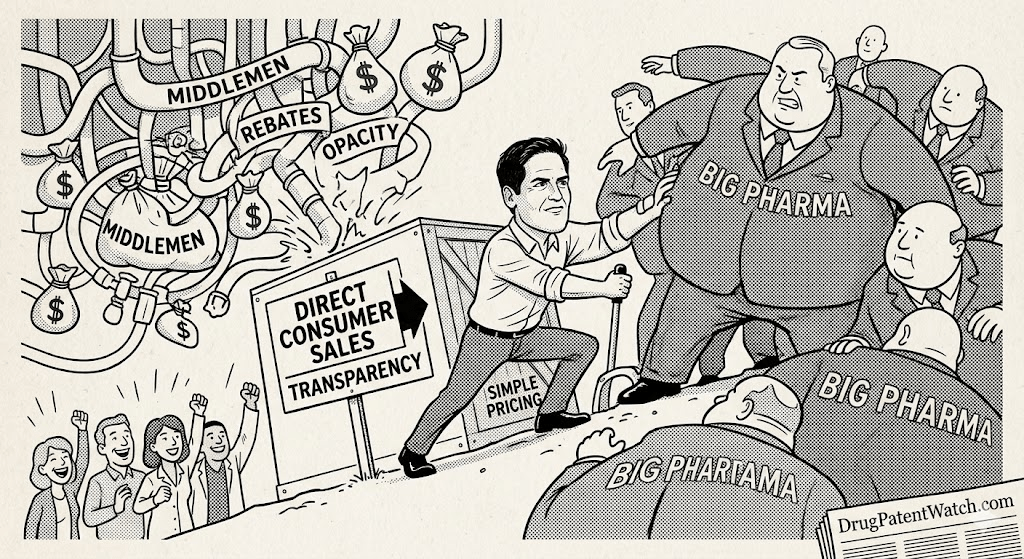
On Sunday, October 19, 2025, Mark Cuban told an HLTH audience in Las Vegas that Cost Plus Drugs would give TrumpRx access to its price data through an application programming interface [1]. Seven months later, a White House announcement added about 600 generic drugs to TrumpRx. The Washington Post reported that 559 of them come from Cost Plus [12]. A company founded in 2022 [1] now supplies most of the generic catalog of a federal price-comparison site.
That fact raises a question that pharmaceutical IP, pricing, and market-access teams need to answer: does Cost Plus Drugs compete with Big Pharma, or does it compete with someone else? This article answers it with published studies, company releases, government fact sheets, and calculations from those sources. It also shows where patents and FDA exclusivity set the limit on what a cost-plus pharmacy can do.
The Short Answer: Cost Plus Drugs Mostly Competes With Generic Pricing, Not With Brand Patents
Cost Plus Drugs sells mostly off-patent generics. Two physician-authors wrote in STAT that the company “mainly sells off-patent generics, which are already cheap” and that the affordability problem sits mainly with brand-name drugs [6]. That is the core limit of the model.
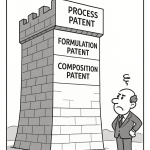
The company does not hold a patent wall in front of any brand drug. It cannot sell a generic version of a drug until generic entry is legal and an approved generic exists. Patents and FDA exclusivity decide when that happens. The brand owner controls that date through litigation, settlement, and portfolio strategy.
Big Pharma still feels pressure from Cost Plus Drugs. The pressure comes through three side channels: a public price benchmark for drugs after loss of exclusivity (LOE), the supply of generics to TrumpRx [12], and a push toward transparent pharmacy benefit manager (PBM) contracts [16]. Brand makers have also started to sell directly to patients at lower cash prices. Bristol Myers Squibb and Pfizer did this for Eliquis in 2025 [19].
The Eight Findings That Matter
Each finding below can stand alone. Figures marked “calculated” are our analysis of published numbers. They are not reported statistics.
Cost Plus Drugs prices each product at its acquisition cost plus 15%, plus a pharmacy fee if one applies [2]. On an imatinib 400 mg fill priced at $39.75, the 15% markup is $3.85. That is 9.7% of the final price (calculated from the NerdWallet example reported in [2]).
In a JAMA Health Forum analysis of more than 843 million fills for 124 generics, Cost Plus would have cost less on 11.8% of insured fills. The average estimated saving was $4.96 per prescription [3].
In an Annals of Internal Medicine brief report on more than 62 million 2024 commercial claims, Cost Plus offered savings on 15% of prescriptions. The median saving was $6 [4].
For prescriptions with a copay above $100, the median out-of-pocket cost was $140 through insurance and $25 through Cost Plus [4].
TrumpRx launched on February 5, 2026 with 40 branded medicines from 5 manufacturers [11]. Cash-price cuts on the nine products priced in our table range from 66.0% (Ozempic, average price) to 92.9% (Cetrotide) (calculated from [11]).
The FDA found that generic prices fall 39% below the brand price with one generic competitor and over 95% with six or more [14]. Cost Plus is a retail outlet for products that reach that second stage. It does not create the competition.
Cost Plus supplies 559 of about 600 generics added to TrumpRx in May 2026. That is 93.2% of the batch (calculated from [12]).
Eliquis (apixaban) has a stated earliest US generic launch date of April 1, 2028, subject to further appeals and challenges [24]. As of October 19, 2026, that date is about 17 months away (calculated).
Methodology: What We Analyzed and What We Did Not
What data does this article use?
We used public documents published between 2015 and October 2026. The set includes peer-reviewed study summaries, FDA analysis, White House fact sheets, company press releases, trade-press reports, and DrugPatentWatch analysis of PBM data. We did not have access to Cost Plus Drugs financial statements. The company is private.
How were figures calculated?
We calculated percentage changes as (list price minus new price) divided by list price. We used the average prices in the White House fact sheet where it gives an average. We calculated shares of totals from the figures each source gives. We did not adjust for inflation or for differences in data years. Calculated figures are labeled “calculated” in the text.
What are the limits of this analysis?
Four limits apply. First, some sources are summaries of studies we could not read in full. We name the summary source each time. Second, Cost Plus Drugs changes its catalog and its fees, so older price comparisons may not match today’s prices. Third, we did not query the live Cost Plus catalog. Fourth, several sources report different fee amounts for the same period, and we show those differences in a table instead of choosing one.
Definitions: Terms Used in This Article
What is cost-plus pricing in pharmacy?
Cost-plus pricing sets the patient price at the pharmacy’s acquisition cost for a drug, plus a stated markup and fees. Cost Plus Drugs states its formula as “our cost plus 15%, plus the pharmacy fee, if any” [2].
What is spread pricing?
Spread pricing is the gap between what a PBM bills a health plan and what it pays the pharmacy for the same claim [2]. A plan sponsor often sees only the billed amount.
What is most-favored-nation (MFN) pricing?
In this context, MFN pricing means a US price that matches the lowest price paid in other wealthy countries. The White House fact sheet on TrumpRx uses the phrase “in line with the lowest paid by other developed nations” [11].
What is loss of exclusivity (LOE)?
LOE is the point where a brand drug faces generic or biosimilar competition. Patent expiry, patent litigation outcomes, settlements, and FDA exclusivity periods all affect the date.
How Does Cost Plus Drugs Price a Prescription?
Cost Plus Drugs charges its acquisition cost, a 15% markup, and a pharmacy fee where one applies. Shipping is a separate charge [2]. The company does not accept health insurance [22].
What is the Cost Plus Drugs formula, and which fee amounts do sources report?
Sources disagree on fixed fees. The table shows what each source reports. We did not find a single dated fee schedule in the sources we read.
Source
Date
Markup
Fixed fees reported
BioSpace [22]
June 21, 2022
15%
$5 shipping (user account in a Business Insider test)
STAT, Emanuel and Connolly [6]
July 29, 2024
15%
$3 pharmacy service fee
Annals brief report, as reported by AJMC [4]
May 25, 2026
Not stated in the summary
$5.25 shipping, applied per drug in the analysis
NerdWallet example, as reported by DrugPatentWatch [2]
2026
15%
$5.00 pharmacy fee and $5.25 shipping
Fierce Healthcare [7]
April 27, 2026
15%
Not stated
DrugPatentWatch notes that its own coverage cites both $3 and $5 pharmacy fees [2]. Anyone who quotes a Cost Plus total price should check the company site on the date of use.
Worked example: what does an imatinib 400 mg fill cost?
NerdWallet’s example, as reported by DrugPatentWatch, shows the parts of one fill [2]. The percentage column is our calculation.
Component
Amount
Share of $39.75 (calculated)
Manufacturing (acquisition) cost
$25.65
64.5%
15% markup
$3.85
9.7%
Pharmacy fee
$5.00
12.6%
Shipping
$5.25
13.2%
Total, 30 tablets
$39.75
100%
Fixed fees (pharmacy fee plus shipping) are $10.25, or 25.8% of the total. The percentage markup is smaller than the fixed fees. This is an analytical point, and it affects how the model scales. A cheap drug pays a high share of its price in fixed fees. An expensive generic pays a low share.
Why does the fixed-fee share matter for low-cost drugs?
Cuban said, in the context of generics manufacturing, “There’s no reason for us to manufacture a $4 drug that you get at Walmart” [9]. The fixed fees point the same way. If a drug sells for $4 at a retailer, the $10.25 in fees in the example above would exceed that whole price.
Does Cost Plus Drugs count toward Medicare or deductibles?
No, according to the sources. Cost Plus does not bill Medicare, and purchases do not count toward the Part D deductible [2]. The Annals authors list the same issue for commercial plans: direct-to-consumer purchases do not count toward a deductible or out-of-pocket maximum [4].
Cost Plus Drugs by the Numbers: Scale and Catalog
Cuban founded the company in 2022 [1]. DrugPatentWatch reports a January 2022 launch with 111 generics [23]. Fierce Healthcare reported in April 2026 that the company carries about 2,300 medications, mostly generics [7]. DrugPatentWatch reports more than 2,500 medications and more than 2 million members, and states that neither count is audited [2].
These counts differ by source and date. We treat 2,300 (Fierce, April 2026 [7]) as the more conservative figure.
The company says it negotiates prices through private label agreements with third-party suppliers [22]. It states a mission that “everyone should have safe, affordable medicines with transparent prices” [22].
Who Does Cost Plus Compete With? A Four-Channel Taxonomy of Drug Price Pressure
This section is an original framework. It is not an established industry classification. It sorts the forces that push US drug prices down into four channels. Cost Plus Drugs sits in only one of them.
Channel 1: Cash-price generics (Cost Plus Drugs, GoodRx pharmacies, Costco)
This channel sells approved generics at a posted cash price. Cost Plus is the best-known example. It is not the only one. Emanuel and Connolly cite a 2023 analysis in which at least 141 of 211 Cost Plus generics beginning with “A” (67%) cost more than at one or more GoodRx pharmacies [6].
What does the GoodRx comparison say about the “lowest price” claim?
Cuban has claimed “the lowest prices on meds anywhere,” according to STAT [6]. The 2023 analysis cited by STAT does not support that claim for every drug. It does not follow that Cost Plus is expensive. It follows that on some drugs a competitor price is lower.
This channel is Big Pharma’s own cash-price offer. On July 17, 2025, Bristol Myers Squibb and Pfizer announced a direct-to-patient Eliquis option at “more than 40% less than the current list price” [19]. Eligible patients could buy from September 8, 2025. The program targets uninsured, underinsured, and self-pay patients and ships to all 50 states and Puerto Rico [19].
Channel 3: Government MFN deals and TrumpRx
On September 30, 2025, the administration announced its first agreement with a major drug maker, Pfizer. The agreement aligned US prices with the lowest prices in wealthy countries and gave every state Medicaid program access to MFN prices on Pfizer products [13]. The White House fact sheet says 16 deals had been announced with major manufacturers by February 2026 [11].
Channel 4: PBM redesign
This channel changes how large PBMs pay for drugs. Evernorth announced a rebate-free model on October 27, 2025 [17]. Navitus added Costco cost-plus pricing for its clients starting January 1, 2026 [18]. Cost Plus did not create these changes. DrugPatentWatch’s own review found no source that measures a causal effect of Cost Plus on PBM contract terms [2].
Which channel matters most for a brand drug before LOE?
Channels 2 and 3 matter most. Cost Plus does not sell a brand drug under patent at a discount, so Channel 1 does not touch that drug until generics arrive.
Which channel matters most for a drug after LOE?
Channels 1 and 4 matter most. Generic competition sets the acquisition cost. Cost Plus and PBM contract rules set how much of that cost reaches the patient.
Does Cost Plus Drugs Beat Insurance? What the Studies Show
Cost Plus beats insurance for a minority of fills and for most high-copay fills. Two studies, five years apart in data, give those results.
What did the 2024 JAMA Health Forum study find?
The study analyzed more than 843 million prescription fills for 124 generics in 2019. It matched Cost Plus prices from March 2023 to those fills. It adjusted out-of-pocket costs to 2023 using CMS National Average Drug Acquisition Cost data [3].
Insured patients could have spent less through Cost Plus on 11.8% of fills. The estimated average saving was $4.96 per prescription, including shipping [3].
Coverage type
Share of fills cheaper at Cost Plus
Median estimated saving per prescription
Uninsured
28.9%
$6.08
Military
9.9%
$5.05
Commercial
7.1%
$3.69
Medicare
5.5%
$4.64
Medicaid
No savings observed
Not applicable
Source for all rows: [3]. Among fills that saved money, 50.3% saved less than $5 and 28.4% saved more than $10 [3]. The authors note two limits: Cost Plus changes its drug selection and prices often, and in May 2023 the company sold only 26% of available expensive generics [3].
What did the 2026 Annals of Internal Medicine report find?
J.K. Lin, J.J. Xiang, X. Lei, and colleagues analyzed Merative MarketScan commercial claims for January to December 2024. The sample was more than 62 million generic prescription claims. They compared those claims with 2025 cash prices at Cost Plus [4]. About 97% of drug-form-strength combinations in the dataset were available at Cost Plus [4].
Cost Plus offered savings on 15% of prescriptions, with a median saving of $6 [4]. For copays above $15, Cost Plus was cheaper nearly 80% of the time, according to AJMC. AJMC’s key-takeaways box says about 82%, so the page contradicts itself [4]. JR Report states “at least 77%” [5].
How large are the savings when the copay is high?
For prescriptions with a copay above $100, the median out-of-pocket cost was $140 through insurance and $25 through Cost Plus. That is a relative saving of 85% and an absolute saving of $119 per prescription [4].
JR Report gives the average saving by copay band when Cost Plus was cheaper: about $6 for $15 to $24, $15 for $25 to $49, $45 for $50 to $99, and $115 for $100 and above [5]. It also reports that about 14% of commercial claims for drugs Cost Plus sells had cost sharing above $15 [5].
Which therapy areas show the largest savings?
The median saving was largest in oncology ($468), then urology ($139), psychiatry ($136), neurology ($133), and cardiology ($110) [4]. These areas hold generics with high copays. Imatinib is an oncology generic, and it fits this pattern.
How do the two studies compare?
The comparison below is our analysis. The studies use different data years, different claim sources, and different price dates, so the results are not a trend.
Item
JAMA Health Forum 2024 [3]
Annals 2026 [4]
Fill or claim data year
2019
2024
Cost Plus price date
March 2023
2025
Sample size
More than 843 million fills, 124 generics
More than 62 million claims
Payer scope
All coverage types
Commercial only
Share of fills with savings
11.8% (7.1% commercial)
15%
Typical saving
$4.96 average; $3.69 commercial median
$6 median
The commercial-only figures are the closest match: 7.1% in the first study and 15% in the second. We cannot say whether the gap comes from Cost Plus pricing, from changes in copay design, or from the different drug sets. The Annals authors suggest that patients check direct-to-consumer pharmacies “whenever their generic prescription’s co-payment or coinsurance exceeds $15” [4].
What does the STAT critique add?
Emanuel and Connolly wrote: “Though Cuban is well-intentioned, his current approach will fail to significantly dent prices” [6]. Their reasoning is that US generic prices are already low. They cite RAND data that US generics cost about 15% less than in other OECD countries [6]. They also argue that low generic prices discourage US manufacturers from investing in capacity, which feeds shortages [6].
How much could Medicare have saved at Cost Plus prices?
A study led by Brigham and Women’s Hospital and Harvard Medical School researchers compared Part D plan payments in 2020 with Cost Plus prices in 2022 for 89 generics. Medicare paid more for 77 of the 89 drugs. The total was $8.1 billion against $4.5 billion at Cost Plus prices, a difference of up to $3.6 billion [15].
From those figures we calculate that Medicare would have paid 44.4% less in total, and that Cost Plus was cheaper for 86.5% of the drugs. This is a model. It is not observed saving. The paper compares price data from two different years for one direct-to-consumer pharmacy [15].
Cost Plus Drugs vs. Big Pharma Brands: Why the Patent Line Matters
A patent or an exclusivity period can block a generic, and so it can block a cost-plus price on that drug. The sections below use two drugs to show the mechanics: imatinib (Gleevec) and apixaban (Eliquis).
Case study: How Gleevec became a $39.75 monthly fill
Sun Pharma announced on December 4, 2015 that a subsidiary had received final FDA approval for generic Gleevec (imatinib mesylate) and was eligible for 180 days of marketing exclusivity as a first-to-file Paragraph IV filer [20]. The settlement with Novartis set a launch date of February 1, 2016 [20]. GaBI reports that the settlement of patent litigation came in May 2014 [21].
The Sun Pharma release cites annual US sales of about $2.5 billion for the imatinib tablets, based on IMS data for August 2015 [20].
Timeline for Gleevec generic entry
May 2014: Sun Pharma and Novartis settle patent litigation [21].
December 4, 2015: Sun Pharma announces final FDA approval and 180-day exclusivity eligibility [20].
February 1, 2016: first generic launch [20][21].
About July 30, 2016: end of the 180 days if the period ran in full from launch (calculated).
The time from settlement to launch was 20 months (calculated from May 2014 to February 2016). The launch date came from a negotiated settlement, not from a court ruling in the sources we read.
What does the Gleevec case teach about Cost Plus?
Cost Plus could price imatinib only after generic makers had a legal path to market and a supply chain existed. Sun Pharma’s launch, and the generic competition after it, came first. The 15% markup sits on top of a price that competition has already lowered. The NerdWallet example puts acquisition cost at $25.65 for 30 tablets [2]. We do not have a source for the Gleevec price before 2016, so we do not calculate the cost reduction.
Case study: What happens to Eliquis on April 1, 2028?
On September 3, 2021, Bristol Myers Squibb and Pfizer announced that the Federal Circuit affirmed that two Eliquis patents were valid and infringed: the composition of matter patent US 6,967,208 and the formulation patent US 9,326,945 [24]. The release states that the earliest date generic apixaban can launch is April 1, 2028, “subject to additional appeals and challenges” [24].
That date is 6 years and 7 months after the ruling (calculated). It is about 17 months after today’s date, October 19, 2026 (calculated).
What is happening to Eliquis before generic entry?
The brand owners are using the channel Cost Plus helped to normalize. Bristol Myers Squibb and Pfizer launched a direct-to-patient Eliquis option on September 8, 2025, at a price “more than 40% less than the current list price” [19]. The release does not state a dollar list price [19]. BMS also said, in its own words, that Eliquis is “the nation’s number one prescribed oral anticoagulant” [19].
Why would apixaban matter for TrumpRx and Cost Plus?
Drug Topics reports that GSK, Bristol Myers Squibb, and Merck would donate active ingredients such as albuterol and apixaban to the Strategic Active Pharmaceutical Ingredients Reserve [12]. That is a supply measure. It does not set a price. Still, apixaban shows up in three places in these sources: a patent ruling, a direct-to-patient program, and a federal supply reserve.
What Happens When a Brand Drug Goes Generic? FDA Price Erosion by Competitor Count
The FDA studied products with initial generic entry from January 2015 through December 2017. The final sample was 181 unique products and 3,688 product-months. The FDA compared generic prices with the brand’s average price in the three months before generic entry [14].
FDA analysis of generic entry from 2015 to 2017: generic prices fell 39% below the brand price with one competitor, 54% with two, 79% with four, and over 95% with six or more, measured using average manufacturer price (AMP) [14].
Generic competitors
AMP-based reduction
Invoice-based reduction
1
39%
31%
2
54%
44%
4
79%
73%
6 or more
Over 95%
Over 95%
Source for all rows: [14]. The report counts authorized generics as competitors. It covers retail pharmacy sales only. AMP excludes wholesaler markups, and neither measure captures PBM rebates or patient prices [14]. The report’s appendix lists median six-competitor ratios that equal reductions of about 94% (AMP) and 90% (invoice), which is below the “over 95%” in the text [14].
How does this table connect to Cost Plus?
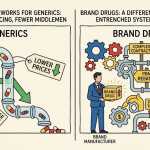
The table shows that the large price drop comes from competition among generic makers. A cost-plus pharmacy captures it for the patient. This is our interpretation. It explains why Cost Plus works best on drugs with several generic suppliers, and why the model has less effect where a drug has one supplier.
How Big Pharma Responds: Direct-to-Patient Pricing and TrumpRx
Brand makers answered the same cash-price logic with their own cash prices. The cuts below are for cash-paying patients, not for insured patients and not for list price in the market.
What did the TrumpRx launch list at which prices?
The White House fact sheet of February 5, 2026 lists 40 branded medicines from AstraZeneca, Eli Lilly, EMD Serono, Novo Nordisk, and Pfizer. It says additional drugs from other manufacturers with MFN deals will follow [11]. The table below uses its prices. The percentage column is our calculation.
Drug
Prior price (monthly unless noted)
TrumpRx price
Reduction (calculated)
Ozempic
$1,028
Average $350 (as low as $199)
66.0%
Wegovy injection
$1,349
Average $350 (as low as $199)
74.1%
Zepbound
$1,088
Average $346 (as low as $299)
68.2%
Cetrotide
$316
$22.50
92.9%
Ovidrel
$251
$84
66.5%
Bevespi Aerosphere
$458
$51
88.9%
Airsupra
$504
$201
60.1%
Eucrisa
$792
$158
80.1%
Duavee
$202
$30
85.1%
Source for prices: [11]. The fact sheet also lists insulin lispro as low as $25 and Gonal-F as low as $168 per pen without a prior price [11].
Which brand deals came with the May 2026 expansion?
Drug Topics reports that nine more brand manufacturers signed price agreements: Amgen, Bristol Myers Squibb, Boehringer Ingelheim, Genentech, Gilead Sciences, GSK, Merck, Novartis, and Sanofi [12]. It lists these price changes: Repatha from $573 to $239, Plavix from $756 to $16, and Epclusa from nearly $25,000 to $2,425 [12]. We calculate reductions of 58.3% for Repatha and 97.9% for Plavix. The Epclusa reduction is about 90.3% if the old price was exactly $25,000, and slightly lower if it was below that figure.
Why is the Plavix price cut different from the others?
Plavix is a drug with generic competition. A cut from $756 to $16 is a drop of 97.9%. That is near the over-95% FDA figure for six or more generic competitors [14]. We do not know how the $16 price is built, and the source does not say. This is an observation about scale, not a claim about cause.
What is the role of Cost Plus on TrumpRx?
Cuban said at HLTH that TrumpRx would not sell or distribute drugs. It would act as a search engine that sends users to direct-to-consumer sites, and Cost Plus would share its API [1]. In May 2026, the Washington Post reported that 559 of the roughly 600 added generics come from Cost Plus, with Amazon Pharmacy and GoodRx named as other pathways [12]. The 559 figure equals 93.2% of the batch (calculated).
Cuban explained the volume logic: “Because as our volumes go up, our costs go down. And when our costs go down, the price for patients go down” [1]. Model N’s Jesse Mendelsohn described the arrangement as “just another venue or route for patients to get therapy as opposed to a sea-change,” as quoted by DrugPatentWatch [2].
PBMs, Spread Pricing, and the Rebate-Free Shift
Cuban has named PBMs as a cause of high US drug prices. At HLTH he said wholesalers and PBMs cost “everybody hundreds of billions of dollars” [1]. The documented facts about PBM concentration come from the FTC.
How concentrated is the PBM market?
The FTC reported on July 9, 2024 that the top three PBMs processed nearly 80% of about 6.6 billion prescriptions dispensed in 2023 [2]. DrugPatentWatch summarizes FTC data showing that the three largest PBMs held 52% in 2004, and that their affiliated pharmacies took 68% of specialty dispensing revenue in 2023, up from 54% in 2016 [23]. The FTC’s second interim report of January 14, 2025 found that those PBMs’ affiliated pharmacies earned over $7.3 billion above estimated acquisition cost on 51 specialty generics from 2017 to 2022 [2].
DrugPatentWatch says the $7.3 billion figure is a related measure and is not spread pricing in the narrow sense [2]. We agree with that reading.
What did state audits find about spread pricing in generics?
The Ohio Auditor of State reported a spread of $224.8 million on $2.5265 billion paid by Medicaid managed care plans for April 2017 to March 2018, as summarized by DrugPatentWatch. That is about 8.9% (calculated). The average spread was $5.71 per prescription across about 39.38 million prescriptions [2].
Category
Spread
Paid by plans
Spread as share of category payments
Generics
$208.4 million
$662.7 million
31.4%
Brand-name
$9.8 million
About $1.25 billion
0.8%
Specialty
$6.6 million
$617.6 million
1.1%
Source for all rows: [2], summarizing the Ohio audit. We recalculated that generics were 92.7% of the total spread and 26.2% of spending. DrugPatentWatch reports the same figures [2]. The average generic spread was $6.14 per prescription [2].
This is the link to Cost Plus. Spread in the Ohio data sat almost entirely in generics. Generics are what Cost Plus sells. The Ohio Department of Medicaid announced it was abandoning spread pricing the day before the audit’s release [2]. We did not find a source that proves Cost Plus caused that change. Cost Plus did not exist during the audit period: the audit covered 2017 to 2018, and Cost Plus launched in 2022 [23].
What did Evernorth announce on October 27, 2025?
Evernorth, the health services division of The Cigna Group, announced a rebate-free model. Negotiated discounts apply at the point of sale. Pharmacies are paid their drug cost, a dispensing fee, and added payments for clinical services [17]. Technology selects the lowest price among the negotiated price, the copay, a cash discount, and the manufacturer’s direct-to-consumer price [17].
Evernorth gave an example: a $22 negotiated price, a $20 cash price, a $50 direct-to-consumer price, and a $25 copay. The customer pays $20 [17]. It expects brand-name prescriptions to cost an average of 30% less per month for people who pay full cost [17]. Cigna plans to move its own fully insured members, about 2 million people, to the model in 2027. It becomes the default for Evernorth clients in 2028 [16].
An Evernorth spokesperson said: “We remain confident in the long-term durability of our margin profile” [16]. TD Cowen’s Charles Rhyee estimated that retained rebates are under 10% of Evernorth’s adjusted pre-tax earnings [16].
What did Navitus add with Costco?
Navitus, a pass-through PBM, said on August 5, 2025 that it was adding Costco Pharmacy cost-plus pricing for its clients in all lines of business starting January 1, 2026. Members within an hour of a Costco Pharmacy can get no-cost same-day delivery through Instacart [18]. The release does not state the markup or fee amounts [18]. Costco is not Cost Plus Drugs. The arrangement shows that cost-plus pricing now appears inside traditional PBM networks.
What did Congress and the FTC change in 2026?
DrugPatentWatch summarizes the Consolidated Appropriations Act, 2026, signed February 3, 2026. It says Part D PBM compensation can no longer tie to drug prices or rebates, effective January 1, 2028. It says larger employer plans must receive pass-through reporting, with effect about 30 months after enactment [2]. DrugPatentWatch states that these effective dates come from secondary summaries, not from the statute text [2]. It also reports an FTC proposed consent order with Express Scripts dated February 4, 2026, and notes that it found no final order [2].
The Employer and Health-System Channel: Humana, CenterWell, and Epic
What did Humana and Cost Plus announce on April 27, 2026?
CenterWell Pharmacy, part of Humana, became a pharmacy partner of Cost Plus Drugs. CenterWell will use the Cost Plus software platform SwiftyRx for medication order intake. The companies plan an employer program that combines SwiftyRx, Cost Plus pricing, and CenterWell’s distribution capacity [8]. Humana Associate Benefit Plan employees will get home delivery through SwiftyRx [8].
Fierce Healthcare reports that CenterWell Pharmacy recorded nearly $13 billion in 2025 revenue, up from $11.6 billion in 2024. CenterWell overall brought in $22.5 billion [7]. From those figures we calculate that CenterWell Pharmacy’s revenue grew by about 12% (using “nearly $13 billion” as $13.0 billion). The release gives no financial terms for the partnership [7].
Cuban said: “We’re working with CenterWell Pharmacy because we trust the team” [8]. Bethanie Stein, president of pharmacy at Humana, said: “CenterWell’s value as a distribution partner lies in our capacity, infrastructure, and proven quality measures” [8].
How does the employer model work?
Fierce reports that a payer can work with an existing PBM for network access or offer a standalone “bolt-on” pharmacy benefit [7]. Fierce also reports that Cuban and Humana CEO Jim Rechtin first discussed a partnership in December 2025 [7].
What did Epic announce on October 15, 2026?
Epic announced a Prescription Marketplace planned for summer 2027. It will show pharmacy cash prices next to insured costs before a prescription is sent [10]. Cost Plus Drugs and Amazon Pharmacy helped shape the feature. Costco and Eli Lilly’s LillyDirect executives voiced support [10]. Epic says its existing Real-Time Prescription Benefit tool helped patients save over $250 million in 2025 [10].
Cuban said: “This will give patients transparency,” and “they should know that before they leave the doctor’s office” [10]. The Annals authors cited earlier research that real-time benefit tools identified savings on 11% of prescriptions with $50 to $100 cost sharing and on 39% above $100. Those rates are well below Cost Plus’s savings rates in the same copay tiers [4]. A price tool that shows cash prices addresses that gap.
Manufacturing: The Dallas Plant and the FDA Fee Question
What does the Dallas plant make?
Cost Plus operates a 22,000 square-foot fill-finish plant in Dallas that makes sterile injectables to address shortages [9]. The initial products were epinephrine and norepinephrine [6]. STAT quotes CEO Alex Oshmyansky saying the facility was “designed to end drug shortages” [6]. DrugPatentWatch reports the plant cost about $11 million [23].
What is Cuban asking the FDA to do?
Pharmaceutical Commerce reported on December 5, 2025 that Cuban was urging the Trump administration to waive hundreds of thousands of dollars in FDA fees on generic drug approvals. The article gives the fee for a generic approval application as nearly $360,000 [9]. A waiver would help Cost Plus enter generics manufacturing, with a focus on high-cost and shortage drugs, including rare disease drugs [9]. Cuban said the plant could expand within the year to make generics if the fees are waived [9].
Why is manufacturing a different fight from retail?
A retail cost-plus model needs only suppliers. A manufacturer must file an abbreviated new drug application (ANDA) and face patent challenges where they exist. The Gleevec case shows what that path involved for Sun Pharma: an approval, a Paragraph IV filing, a settlement, and a 180-day exclusivity period [20]. The Dallas plant has so far made products that Pharmaceutical Commerce and STAT describe as shortage drugs [6][9].
Scenario Analysis: What Could Happen Through 2028
These scenarios are our analysis. They use stated assumptions and do not predict events. Dates come from the sources cited.
Scenario A: The employer channel grows, and Cost Plus becomes a pharmacy network option
Assumption: more employers follow the Humana model [8], and PBMs like Evernorth keep their stated timeline of 2027 for Cigna fully insured members and 2028 as the default [16].
Result: Cost Plus pricing becomes one of several cost-plus options inside plan design. The Navitus-Costco program shows that cost-plus pricing no longer belongs to one company [18]. Cost Plus keeps a role through SwiftyRx and its price transparency, but it does not hold a unique price model.
Assumption: MFN deals and direct-to-patient programs continue to expand [11][12][19].
Result: Brand cash prices for some drugs move closer to the cash price of generics. The Plavix example already reaches a 97.9% reduction [12]. In this scenario, the cash-price gap between a brand under patent and a Cost Plus generic narrows in some categories. It does not close for drugs with no generic competitor, because generic competition is what sets Cost Plus’s acquisition cost [14].
Scenario C: Patent events reset the catalog
Assumption: Eliquis generic entry occurs on April 1, 2028, with no further appeal change [24].
Result: Apixaban could enter the generic cash-price channel about 17 months after October 19, 2026 (calculated). The FDA data suggest that price effects depend on how many generic competitors launch [14]. We cannot forecast the number of apixaban generics from the sources we used.
Illustrative patient arithmetic
Assume a patient pays a $50 copay for one monthly generic. Assume Cost Plus charges $20 for the drug plus $5.25 shipping, so $25.25. The annual difference is $297 (calculated: ($50 minus $25.25) times 12). The Annals report shows an average saving of $45 in the $50 to $99 copay band [5], which gives $540 per year per drug (calculated: $45 times 12). The assumptions here are ours. The patient must also weigh the deductible: direct purchases do not count toward it [4].
What This Means for Different Stakeholders
What this means for brand manufacturers
Brand makers face a benchmark that grows each year. Cost Plus, TrumpRx, and Epic’s planned marketplace make cash prices visible [10][11]. For drugs near LOE, a patent calendar and a direct-to-patient price plan belong in the same document. The Eliquis direct-to-patient program began about 31 months before the stated earliest generic date (calculated from September 8, 2025 to April 1, 2028).
What this means for generic manufacturers
Generic makers gain a transparent retail outlet and face a price benchmark. Cost Plus also announced manufacturing plans, though so far its plant produces sterile injectables [6][9]. A generic maker with a single-source product should check how its price compares with the cost-plus price for the same drug.
What this means for employers and plan sponsors
The Annals data suggest a simple test: check cash prices for generics with copays above $15 [4]. The deductible issue and the plan’s design change the result. Employers that use a PBM should read the pass-through and reporting terms that take effect under the 2026 law, as DrugPatentWatch summarizes them [2].
What this means for PBMs
Large PBMs have started to move to cost-plus pharmacy payment and rebate-free models [16][17]. Analysts compared Evernorth’s move with similar steps by CVS (TrueCost and CostVantage) and Optum Rx [16]. The evidence on margin is mixed. Evernorth says it is confident in the durability of its margin [16].
Timeline: Cost Plus Drugs and Big Pharma, 2014 to 2026
Date
Event
Source
May 2014
Sun Pharma and Novartis settle Gleevec patent litigation
[21]
Feb. 1, 2016
First US generic Gleevec launches
[20][21]
Sept. 3, 2021
Federal Circuit ruling on Eliquis patents; April 1, 2028 earliest generic date
[24]
Jan. 2022
Cost Plus Drugs launches with 111 generics (DrugPatentWatch)
[23]
Jun. 14, 2024
JAMA Health Forum study published
[3]
Jul. 29, 2024
STAT critique by Emanuel and Connolly
[6]
Jul. 17, 2025
BMS and Pfizer announce direct-to-patient Eliquis
[19]
Sept. 30, 2025
Pfizer announces first MFN agreement
[13]
Oct. 19, 2025
Cuban announces TrumpRx partnership at HLTH
[1]
Oct. 27, 2025
Evernorth announces rebate-free model
[17]
Feb. 5, 2026
TrumpRx launches with 40 branded medicines
[11]
Apr. 27, 2026
Humana CenterWell and Cost Plus announce employer partnership
[8]
May 18, 2026
About 600 generics added to TrumpRx
[12]
May 25, 2026
Annals report on commercial copays reported by AJMC
[4]
Oct. 15, 2026
Epic announces Prescription Marketplace
[10]
Where DrugPatentWatch Fits in This Analysis
DrugPatentWatch tracks patents, exclusivity, litigation, and generic entry for pharmaceutical products. It has published its own coverage of Cost Plus, including a May 28, 2026 piece on spread pricing and an April 28, 2026 piece on the strategic contest with Big Pharma [2][23]. We used those pieces to locate primary sources and PBM data. We did not treat them as substitutes for the FDA, the FTC, or court records.
A team that tracks brand products near LOE can use DrugPatentWatch to build the patent and exclusivity calendar. It can then pair each date with cash-price data from sources such as the ones above. The US FDA Orange Book and court dockets remain the primary evidence for any date used in a decision.
Key Takeaways
Cost Plus Drugs prices at acquisition cost plus 15%, plus fees, and does not accept insurance [2][22].
On a $39.75 imatinib fill, the 15% markup is 9.7% of the price, and fixed fees are 25.8% (calculated from [2]).
Cost Plus would have been cheaper on 11.8% of insured fills in a 2019 data set [3] and on 15% of commercial prescriptions in a 2024 data set [4].
For copays above $100, the median was $140 through insurance and $25 through Cost Plus [4].
The FDA found generic prices fall over 95% below brand price with six or more competitors [14].
Cost Plus supplies 559 of about 600 generics added to TrumpRx in May 2026 [12].
Brand makers now sell direct at lower cash prices, as in Eliquis at more than 40% below list [19].
Eliquis has a stated earliest generic date of April 1, 2028, subject to further appeals [24].
FAQ
Is Mark Cuban’s Cost Plus Drugs cheaper than insurance?
Sometimes. In a 2019 fill data set, it was cheaper on 11.8% of insured fills [3]. In a 2024 commercial claims set, it was cheaper on 15% of prescriptions, and for copays above $15 it was cheaper nearly 80% of the time [4].
How does Cost Plus Drugs make money?
The company states a formula of acquisition cost plus 15%, plus a pharmacy fee where one applies, with shipping charged separately [2]. It is private, and the sources we read do not give revenue or profit figures.
Does Cost Plus Drugs sell brand-name drugs?
The sources we read describe Cost Plus mostly as a generics seller [6][7]. Brand price cuts on TrumpRx come from manufacturer deals, not from Cost Plus [11][12].
Does Cost Plus Drugs work with Medicare?
No, according to the sources. It does not bill Medicare, and purchases do not count toward the Part D deductible [2].
What is the Cost Plus Drugs and TrumpRx partnership?
Cost Plus shares its API so TrumpRx can pull price data [1]. In May 2026, 559 of about 600 generics added to TrumpRx came from Cost Plus, according to the Washington Post as reported by Drug Topics [12].
Could Cost Plus Drugs lower brand-name drug prices?
Not directly. Emanuel and Connolly argue that lowering brand prices requires government action on patents or exclusivity [6]. Brand price cuts so far come from MFN deals and direct-to-patient programs [11][19].
What did Humana and Cost Plus announce?
On April 27, 2026, CenterWell Pharmacy became a Cost Plus pharmacy partner and will use the SwiftyRx platform for order intake. The companies plan employer prescription programs [8]. Financial terms were not disclosed [7].
How long did the generic Gleevec settlement take to turn into a launch?
Sun Pharma’s settlement with Novartis came in May 2014 and set a launch of February 1, 2016, 20 months later (calculated) [20][21].
When can generic Eliquis launch in the United States?
The earliest stated date is April 1, 2028, subject to additional appeals and challenges [24].
Does Cost Plus Drugs make its own drugs?
It operates a 22,000 square-foot Dallas plant that makes sterile injectables such as epinephrine and norepinephrine [6][9]. Cuban has asked the administration to waive FDA generic application fees, which Pharmaceutical Commerce puts at nearly $360,000 per application, so the plant can expand into generics [9].
References
Healthcare Dive. (2025, October 20). Mark Cuban says Cost Plus Drugs will partner with TrumpRx. https://www.healthcaredive.com/news/mark-cuban-cost-plus-drugs-partner-trumprx/803180/
DrugPatentWatch. (2026, May 28). Is Mark Cuban’s Cost Plus Drugs killing spread pricing? What the data says. https://www.drugpatentwatch.com/blog/mark-cubans-cost-plus-drugs-is-killing-spread-pricing-heres-what-that-actually-means/
Becker’s Hospital Review. (2024, June). Insured patients often save less with Mark Cuban’s drug company: Study (reporting JAMA Health Forum, June 14, 2024). https://www.beckershospitalreview.com/pharmacy/insured-patients-often-save-less-with-mark-cubans-drug-company-study.html
American Journal of Managed Care. (2026, May 25). Cost Plus Drugs beats commercial insurance co-pays 80% of the time (reporting Lin, J. K., Xiang, J. J., Lei, X., et al., Annals of Internal Medicine, doi:10.7326/ANNALS-25-05049). https://www.ajmc.com/view/cost-plus-drugs-beats-commercial-insurance-co-pays-80-of-the-time
JR Report. (2026, May 28). Mark Cuban’s Cost Plus Drugs often beats employer plan cost-sharing amounts. https://jrreport.wordandbrown.com/2026/05/28/mark-cubans-cost-plus-drugs-often-beats-employer-plan-cost-sharing-amounts/
Emanuel, E. J., & Connolly, J. (2024, July 29). Mark Cuban’s company won’t fix drug costs, but it can still help rectify America’s drug shortages. STAT. https://www.statnews.com/2024/07/29/mark-cuban-cost-plus-drug-company-bigger-impact-drug-shortages-not-drug-costs/
Fierce Healthcare. (2026, April 27). Humana’s CenterWell, Mark Cuban’s Cost Plus Drugs partner to tackle employers’ drug costs. https://www.fiercehealthcare.com/payers/humanas-centerwell-mark-cubans-cost-plus-drugs-handle-employers-prescriptions
Humana. (2026, April 27). CenterWell Pharmacy and Mark Cuban Cost Plus Drug Company teaming up to develop disruptive medication model. https://policy.humana.com/news-and-resources/news-press/2026/centerwell-pharmacy–and-mark-cuban-cost-plus-drug-company
Pharmaceutical Commerce. (2025, December 5). Mark Cuban pushes for generic drug fee waivers, as Cost Plus Drugs eyes US manufacturing expansion. https://www.pharmaceuticalcommerce.com/view/mark-cuban-pushes-for-generic-drug-fee-waivers
Pharmaceutical Commerce. (2026, October 16). Epic, Amazon, Cost Plus announce point-of-care cash price tool. https://www.pharmaceuticalcommerce.com/view/epic-amazon-cost-plus-build-point-of-care-cash-price-tool
The White House. (2026, February 5). Fact sheet: President Donald J. Trump launches TrumpRx.gov to bring lower drug prices to American patients. https://www.whitehouse.gov/fact-sheets/2026/02/fact-sheet-president-donald-j-trump-launches-trumprx-gov-to-bring-lower-drug-prices-to-american-patients/
Drug Topics. (2026, May 19). TrumpRx adds nearly 600 generic drugs to website. https://www.drugtopics.com/view/trumprx-adds-nearly-600-generic-drugs-to-website
American Hospital Association. (2025, September 30). Administration announces agreement with Pfizer to lower drug costs. https://www.aha.org/news/headline/2025-09-30-administration-announces-agreement-pfizer-lower-drug-costs
U.S. Food and Drug Administration. (2019). Generic competition and drug prices: New evidence linking greater generic competition and lower generic drug prices. https://fda.gov/media/133509/download
American Journal of Managed Care. (2022). Generic drug savings possibilities: $3.6 billion to Medicare using direct-to-consumer pricing (reporting Lalani, H. S., et al., Annals of Internal Medicine). https://www.ajmc.com/view/generic-drug-savings-possibilities-3-6-billion-to-medicare-using-dtc-pricing
Healthcare Dive. (2025, October 27). Evernorth, Express Scripts new PBM model and Cost Plus. https://www.healthcaredive.com/news/evernorth-express-scripts-new-pbm-model-cost-plus/803864/
Evernorth. (2025, October 27). Evernorth announces new pharmacy benefit services to lower Americans’ medication costs. https://www.evernorth.com/article/evernorth-announces-new-era-of-pharmacy-benefit-services-to-lower-americans-medication-costs
Navitus Health Solutions. (2025, August 5). Navitus partners with Costco Pharmacy to advance drug price transparency. https://navitus.com/press-release/navitus-partners-with-costco-pharmacy-to-advance-drug-price-transparency/
Bristol Myers Squibb. (2025, July 17). Bristol Myers Squibb and Pfizer announce direct-to-patient Eliquis (apixaban) option. Business Wire. https://www.businesswire.com/news/home/20250717718933/en/Bristol-Myers-Squibb-and-Pfizer-Announce-Direct-to-Patient-Eliquis-apixaban-Option
Sun Pharmaceutical Industries. (2015, December 4). Sun Pharma announces US FDA approval for generic Gleevec. Fierce Pharma. https://www.fiercepharma.com/pharma/sun-pharma-announces-us-fda-approval-for-generic-gleevec%C2%AE
GaBI Online. (2016, February 26). Sun Pharma launches imatinib mesylate in the US. https://gabionline.net/layout/set/print/generics/news/Sun-Pharma-launches-imatinib-mesylate-in-the-US
BioSpace. (2022, June 21). Mark Cuban’s pharmacy touts safe, affordable medicines with over 700 generic drugs. https://www.biospace.com/article/mark-cuban-s-pharmacy-touts-safe-affordable-medicines-with-over-700-generic-drugs/
DrugPatentWatch. (2026, April 28). Mark Cuban’s Cost Plus Drugs vs. Big Pharma: The strategic war you need to be modeling right now. https://www.drugpatentwatch.com/blog/mark-cubans-cost-plus-drugs-vs-big-pharma-the-strategic-war-you-need-to-be-modeling-right-now/
Bristol Myers Squibb & Pfizer. (2021, September 3). Bristol Myers Squibb-Pfizer Alliance pleased with decision of U.S. Court of Appeals for the Federal Circuit. https://www.pfizer.com/news/announcements/bristol-myers-squibb-pfizer-alliance-pleased-decision-us-court-appeals-federal